website watertownhistory.org
ebook History of Watertown, Wisconsin
St. Mary’s
Hospital
Founded and Opened in 1906
Missionary Sisters, Servants
of the Holy Ghost
Watertown Memorial Hospital
Watertown Regional Medical Center
ST. MARY’S
TIMELINE
1906: The First Hospital – the Schiffler Residence
1914:
Sisters took over hospital
1918:
First wing built
1937:
Second wing added, Schiffler home removed
1890
05 14 EMERGENCY HOSPITAL
PROPOSED AT OLD ENGINE HOUSE
The proposal of the health officer to
occupy the old engine house on First Street as an emergency hospital, provided
the privilege is granted by the council, meets with some opposition, especially
from those living and doing business in the vicinity.
If it should be the intention, as is
supposed, to care for patients with infectious diseases, the central location
of the building would make jeopardizing, no doubt, to the general health of the
city. On the other hand, cases here of
persons away from their homes needing urgent and immediate medical attention,
or particularly from accidents, which are the cases the health officer wishes
to provide for, are not numerous enough to make it worthwhile to go to the outlay
and troubles suggested. We believe not
more than three or four such cases have occurred in the city for the past six
or seven years, and in case of great emergency the marshal’s office would, we
think, meet all the requirements wanted.
WR
1901
02 06 NEED FOR HOSPITAL DISCUSSED
The physicians of Watertown held
a meeting Friday evening in the office of Dr. J. M. Sleicher
for the purpose of discussing the project of establishing a hospital here. There were present Drs. Spalding, Eter,
Whyte, Moulding, Feld, Werner . . . . After the
matter had been talked over at length, it was resolved that it would be
inexpedient at the present time for the city to purchase the Faith home building, for the reason
that the same could not be properly maintained as a hospital. However, the impression seemed to prevail
that there ought to be a hospital of some sort in the city . . . .
11 15 BENEFIT FOR AN EMERGENCY HOSPITAL
The Watertown Dramatics Club will
present “Mr. Bob,” a two-act farce, at Turner Opera House this evening, and the
Amateur Musical Club of 15 pieces will assist at the performance, which will be
followed by a dance, for which the full orchestra will furnish the music. The entertainment is for the benefit of
fitting up the emergency hospital with medical and surgical appliances, and the
citizens should give it a generous patronage.
Admission to lower hall 50 cents; gallery 25 cents. WG
11 22 BENEFIT FOR AN EMERGENCY HOSPITAL, more on
Friday night of last week an
association was formed here, the purpose of which is the maintaining of a
public emergency hospital. The officers
elected are: President, J. M. Sleicher; secretary, Dr. Thos. F. Shinnick; treasurer, Dr.
F. C. Moulding.
The object of the association is a most worthy one, and all our people
should do what they can to encourage its people. At the entertainment given last week for that
purpose about $135 were realized, and for this a number of necessary articles
will be purchased with which to equip the hospital. WG
1903
THE BEGINNING
There was a time not so many
years ago when Watertown did not have an emergency hospital and the paper
created such a sentiment for an emergency hospital that the city council by
ordinance April 14, 1903,
established a hospital in the building now used as a garage in (116 S) First
Street, and also had a morgue built into the basement of the old 1885 City Hall
building on North First St.
Previous to that time the editor had
witnessed scenes which caused him to advocate these measures. An injured man, were he a stranger, was taken
to the lockup and his injuries treated by a local physician. If he survived he was sent to the county poor
farm and if he died, to the potter’s field.
Laid out on the floor of the old engine house, a man picked up dead was
left to the rats and mice which ate the toes and ears, while well housed men
and women were enjoying the comforts of a cozy home.
The Emergency Hospital
Such was the condition when the
agitation for an emergency hospital was started, and thanks to good men then in
the council a better condition prevailed.
This hospital housed many an unfortunate and proved of great benefit as
a place at least where strangers and those without adequate means or in
emergency cases were treated and put on the road to recovery. At one time the writer knows that three
injury cases, involving the loss of limbs, eyesight and the like were treated
in the improvised hospital within one week.
It was the best the city would
then afford and was actually established under protest. But what was the result. In a few years the demand for a larger and
more up to date hospital was apparent.
01 03 KEEP IT
BEFORE THE PUBLIC
That Watertown Sanitarium, while
not yet fully equipped in all respects, is open for treatment of a limited
number of cases of acute or chronic disease.
Neat steam heated rooms, electric
light and the best of table board, with good nurses, German and English, can be
had at from $7.00 to $14.00 a week.
Cases of Cancer, Lupus,
Tuberculosis, and Scrofula are cured by our methods of treatment.
Special treatment for Rheumatism,
acute or chronic Neurasthenia or Nervous exhaustion in all degrees given speedy
relief.
Club feet and other deformities
of children treated by latest and most successful methods.
Most satisfactory treatment for
Piles, Fistula, and all Genito-urinary troubles. Cases of stricture cured without pain, and
often without detention from business.
Ladies desiring a quiet home
during confinement will receive special care; and all diseases of women,
treated by most approved and satisfactory means.
Patients who so desire can have
rooms and care and be attended by their own physician.
Cross reference note: The city council by ordinance April 14, 1903,
established a hospital in a building at 116 S. First Street, the precursor to
St. Mary’s on East Main.
1906
02 14 FIX UP THE HOSPITAL
Isn’t it
time that our dinky emergency hospital was put in shape and kept in condition
for sick or injured patients who are strangers in the city or have no home to
which they can be taken. The building
should be remodeled by the removal of the large double doors in front, which
was necessary when the building was used for fire
engine house (*) and the lower floor divided into rooms, so that there
might be a reception room, a kitchen and closet, and the second story, which
should be reached by an elevator, divided into two or more wards, and provided
with a water closet and lavatory. The
building, at present, is not an inviting place into which to take the sick or
injured and the public sentiment of the city would endorse the action of the
council in appropriating a few hundred dollars for making the needful changes.
And it might
not be amiss to call attention to the fact, that there is neither a private or public
hospital in the city and the necessity for early action in the direction
indicated. WR
(*) Cross reference note: In 1866, a “commodious Engine House” was erected
at 116 South First Street for the accommodation of the Pioneer Engine
Company. It was of brick, 28x32 feet in
size. The city council by an ordinance
of April 14, 1903 established a hospital in the building now used as a garage
in (116 S.) First Street
04 19 EMERGENCY HOSPITAL TO
BE ESTABLISHED
The Common Council of
the city of Watertown, do ordain as follows:
Section 1. That the city of Watertown establish and
maintain an Emergency Hospital, and for that purpose make use of the second
story of the brick building, on First Street, which is owned by said city, and
located on a part of lot number two (2), in block number twelve (12), in the
First ward of Watertown, Wisconsin according to Cole Bailey & Co s plat of
the village of Watertown, now City of Watertown, Jefferson County, Wisconsin. Said building being also known as old No. 1 Engine House.
Section 3. That the equipment and care of said hospital
become the duty of the Commissioner of Public Health of said city, who shall be
responsible to the city for the care of said hospital and shall take charge of all
surgical instruments, appliances, medicines and supplies, and attend to the
proper cleaning of said hospital, fixtures, surgical instruments and
appliances, as often as required, in order to keep the same in good sanitary
condition and cause the hospital rooms to be properly heated, whenever
necessary. WDT, 04 19 1903
1906
THE FIRST HOSPITAL - SCHIFFLER RESIDENCE
In 1906 an attempt was made by
the Rev. Phillip Schweitzer of St. Henry’s parish to interest all the
physicians of this city in a movement which had for its purpose the
establishment of a hospital in the city of Watertown. Previous to this time the importance and
necessity of such an institution where the sick and injured could be properly
cared for had been frequently discussed by the physicians, but at this meeting
the location, cost of construction, method of raising money, were considered
and various plans proposed and discussed.
To provide for the enterprise the
following courses were open: To build a
hospital by raising money from the individual donations of physicians and
others interested and then to turn the building or money over to some
charitable organization or society – to form a stock company, the stock to be
taken by all of the physicians. Both of
these plans failed because no charitable organization could be found to take up
the work and only a small minority of physicians present were willing to invest
money in such a project, because the history of all hospitals has been that
they are not profitable investments.
Subsequent to this, the great necessity of a suitable place for the care
of injured persons was frequently shown.
An emergency hospital provided for that purpose by the city proved
entirely inadequate. It was finally
taken up by several of the local physicians and a suitable place secured.
The building
purchased was a modern eight room house located at 1301 Main Street [Schiffler
home]. With the conversion of one of the
largest rooms on the second floor into a modern operating room, and with a few
other minor changes the hospital was ready to enter on its first year’s service. At the end of the first year the
building was found to be too small and was then remodeled and enlarged and St.
Mary’s hospital began its existence.
09 27 Preparations
are still going on for the opening in Watertown on the first of November of the
general hospital, the enterprise promoted by Drs. C. J. Habhegger and T. F. Shinnick of this
city, and Dr. F. Eichelberg of Reeseville.
The Schiffler residence which was recently purchased for this purpose,
will be vacated the first of next week and then the remodeling will take place
preparatory to the opening of the new hospital a month later. The improvements will include sanitary
plumbing and the laying of tiling in the operating room.
The names of the nurses have been
announced. They are four well known
ladies of the city, experienced in their chosen profession. They are Miss Lydia
K. Lehmann, matron, Misses Clara Lehmann (1), Emma Kroeplin and Martha Eichmann
1906
09 14 Eagles donation for a room;
Brandenburg sanitary furnishings; will open Oct. 1.
10 01 St. Mary’s opens
12 04 Every
evidence since the opening of the new St. Mary's Hospital has been to show its
great popularity in the city and surrounding country, which will increase daily
and the Leader makes the prediction that inside of a year the present building
will be found so inadequate to meet the demand that an addition doubling its
capacity will be found necessary. Even now, less than a month from the opening
(on Nov. 12th) there is agitation among the promoters of the advisability of
building an addition in the spring.
The fact of the popularity of the
new hospital is best evidenced in the fact that it was filled to its capacity
the second day after the opening and since that time a number have been turned
away simply because of the lack of room . . .
the hospital is located in the building formerly known as the Schiffler
residence on Main Street . . . The
downstairs is devoted to a pretty lobby and reception room, nurses' rooms, a
three-bed ward and the kitchen.
Upstairs there are two wards with
two beds and one with a single bed making twelve beds in all . . . On the
second floor is also the operating rooms with tile flooring and enamel walls
and ceiling and in the glare of the many electric lights is almost as light as
day . . . The operating table, is the
newest design. The cost of equipping this room was over $700.00 . . . At
present there are four nurses, a nurse girl and a cook employed.
1907
04 03 Bids
for the construction of the new addition to St. Mary's will be closed on April
15th, 1907. The doctors in charge are
desirous that all contractors and builders be notified as an impartial bid is
desired.
04 09 St.
Mary’s hospital will close on Monday, April 15th, owing to building operations
which will be in progress, the management having found it necessary to erect an
eight room addition. No new cases will
be received from this time on..
1907
First Officers
The hospital was instituted by
Drs. C. J. Habhegger, T. F. Shinnick, Watertown, and F. E. Eichelberg,
Reeseville, who composed the board of directors, and May Smith R. N., was the
first superintendent.
The staff was composed of the
following: Consulting physicians and surgeons
– D. D. Lewis, M. D. Chicago; Charles Rowan, M. D. Chicago; Harry Sifton, M. D.
Milwaukee; W. H. Washburn, M. D., Milwaukee; Henry V. Ogden, M. D. Milwaukee;
W. F. Whyte, M. D. Watertown, president state board of health.
Attending physicians and surgeons
– F. E. Eichelberg, T. F. Shinnick, J. S. Kings, Joseph O’Connell, Louis H. Nowack, C. R. Feld.
Attending surgeons – C. J.
Habhegger, E. H. Cook, eye, ear, nose and throat.
Visiting staff – F. C. Werner, F.
C. Moulding.
1907
07 17 The
city council at its regular meeting last evening adopted a resolution
authorizing the payment of $200 out of the general fund for the endowing of a
bed in St. Mary's hospital, the same being in the nature of an encouragement by
the general public and city. According
to the provisions . . . the owners of the hospital manifest a willingness to
provide the city with a bed in the ward room of the institution together with
the right to transfer its emergency hospital equipment from it presents location
to said institutions for a period of one year from the first day of October,
1907, and to take care of all such cases which are charges upon the city, to be
determined by the mayor, health commissioner and the committee on hospital and
health, upon the understanding that no one patient shall remain in said
institution for a longer period than six weeks and upon the further
understanding that said care to be furnished is to include the services of a
nurse and all hospital conveniences . . .
1907
11 06 Proposed
city building for storage of city property; second story would be devoted
to emergency hospital, janitor’s room, and
hay and feed storage.
1908
04 01 Skin graft operation performed by
Dr. Habhegger
08 07 Seven
pieces of birch furniture
donated
12 11 X-Ray machine installed WG
-- -- U.S. CAVALRY ENCAMPMENT ON GROUNDS OF NORTHWESTERN COLLEGE
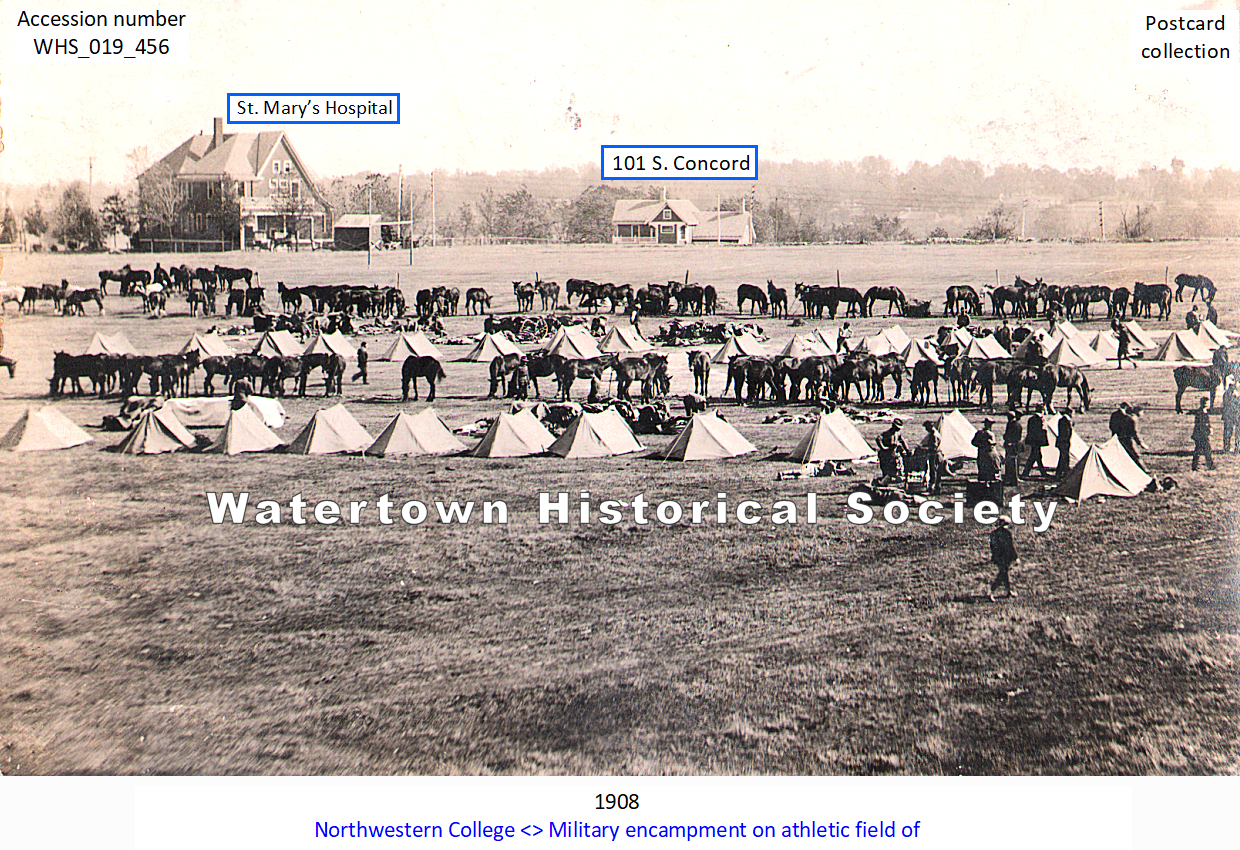 1908
1908
1909
01 08 Copeland-Roach Motor Co
purchased former fire engine house/emergency hospital WG
1910
06 24 Lorenz operation;
local physicians performed WG
1911
08 05 Nurses ride in Homecoming
parade
1912
07 11 FREE NURSES
The Metropolitan Life Insurance
Company will furnish nurses from St. Mary's Hospital to all sick members
holding policies in the Metropolitan Company.
Watertown is the only town of its size where the insurance company
furnishes free nurses and it was only through the efforts of the local agent,
C. F. Crueger, that this was brought about. WG
11 14 DONATION DAY AT ST. MARY'S
Wednesday, December 4, has been decided upon as donation day
for St. Mary's Hospital. St. Henry's
hall has been kindly offered for this purpose and this place will be opened
from 10 a.m. to 8 p.m. Someone will be
in attendance to receive any donation that may be brought there, or those who
prefer to do so, may bring their gift directly to the hospital. The superintendent wishes to say that
anything will be acceptable, especially in the line of fruits, provisions,
linens such as towels, tray cloths, table linen, stand covers, bedding,
etc. Old linen for bandages, etc., will
be very welcome. Watertown has reason to
be proud of such an institution, and the many patients who have been cared for
there will bear testimony to the fact that excellent work is being done. Ward patients are being cared for at a dollar
per day, which is far from covering the expenses of their care and food, etc.,
and although excellent results have already been obtained, yet the
superintendent, Miss May H. Smith, is sure that, with the cooperation of the
good people of Watertown, much better work can yet be done. WG
1913
01 23 NO DISCRIMINATION AT ST. MARY'S
To the Editor of The
Gazette: In justice to St. Mary's
Hospital and myself, I feel in duty bound to correct a rumor which is abroad,
namely, that the hospital is discriminating against certain doctors, and
refusing admission to their patients.
I can safely and truthfully say
that during my administration every physician, whether interested in the
hospital or not, who has brought patients there for treatment, has been shown
exactly the same courtesy and consideration.
In order to successfully conduct
a training school for nurses, it is absolutely necessary to have rules, and
these rules must be enforced. No patient
was ever refused admittance, nor will be, but we do ask the doctors and the
people to conform to the rules of the institution. In the early history of the hospital,
leniency was apparent in the enforcement of its rules – we have learned by this
experience that such was a detriment to the good and welfare or the
hospital. It is our desire to bring the
hospital up to its highest standard; our aim is to care for the sick in the
best possible manner.
It ought to, and I believe it
does, mean a good deal to the people of Watertown, to have in their city such
an institution – a place thoroughly equipped and up-to-date, maintained day and
night at a nominal expense to the city – where the sick and wounded can be
properly cared for — a place which is always in readiness to handle any
emergency case which may present itself.
I wish to say right here that positively nothing is allowed to stand in
the way of our giving the best attention the hospital affords to these cases,
whenever the occasion demands.
The good will of the people,
which has been manifested in numerous ways by so large a majority during the
past year, is very gratifying, and we feel assured that the very few who may
occasionally throw stones, do so because of some petty jealously or personal
feeling on their part, and of course, should be ignored.
Signed: May H. Smith, Superintendent. WG
12 12 HOSPITAL'S FIRST ANNUAL DONATION DAY
Citizens Help Hospital
The management of St. Mary's
Hospital and Training School for Nurses take this means of expressing their
heartfelt appreciation and gratitude to the good people of Watertown whose
generosity went to make the hospital's first annual donation day a success.
The interpretation of our
citizens' attitude on this occasion can only incite the superintendent and
management to emphasize their willingness to even better care for the poor and
afflicted ones who come under their care during the year. The committee who assisted by giving their
time and efforts to this work can rest assured that their unsolicited services
will be rewarded by the personal satisfaction they must know could only be
consummated by this self sacrifice on their
part. The hospital authorities feel
specially indebted to the press for their persistency in bringing this matter
before the public.
Following is a list of the
donors: Schempf Bros. Co., sheets; W. F.
Brandt & Sons Co., $25 worth of merchandise; Eugene Meyer, 2 barrels of
apples; Schempf Drug Co., syphon, ice cream; Brennecke Drug Co., stomach pump;
Carl Nowack, table, easel, porch chair; L. C. Brendel, box of oranges; Hertel
& Hoffmann, 2 bath robes; A Friend, groceries and a barrel of apples; Fred
Kusel, barrel of apples; Fred Bittner, groceries; John Habhegger Co., case of
eggs; Miss L. Grossmann, chair, bread box, bed spread; Mrs. M. F. Blumenfeld,
blankets; Mrs. E. Lehmann, two brass trays; Miss Ella Messer, two trays; Mrs.
F. A. Solliday, feather pillows; Paul Volkmann, potatoes; Miss L. Marquardt,
chickens, eggs and groceries; Mrs. E. J. Mathews, eggs and chickens; Mrs.
Charles Schiebel, clock.
FRUIT AND CANNED GOODS. Mrs. J H. Ott, Mrs. F. C. Hartwig, Miss L.
Marquardt, Mr. and Mrs. J. F. Prentiss, Mrs. Theo. Prentiss, Mrs. G. W. Norton,
Mrs. A. Frattinger, Mrs. Frank Exner, Mrs. T. F.
Shinnick, Mrs. D. Schwieger, Mrs. G. Buchheit, Mrs. E. Schempf, Mrs. O. E.
Meyer, Mrs. E, Shakshesky, Mrs. N. C. Daniell, Miss
Mary Shinnick, Mrs. A. Goeldner, Mrs. I. L. Henry, Mrs. Louis Schmidt, Mrs.
Emil Tanck, Mrs. John Thauer, Mrs. C. J. Salick, Mrs. O. C. Hahn, Mrs. F. A.
Solliday, Mrs. F. J. Sabin, Mrs. Ferd Schmutzler, Mrs. O. L. Forkenbridge, Mrs. C. E. Frey, Mrs. Edwin J. Schoolcraft,
Mrs. L. Schempf, Mrs. H. J. Donner, Mrs. W. S. Williams, Mrs. A. B. Liebermann,
Mrs. G. W. Henry.
TOWELS AND LINENS. Mrs. Max Kusel, Mrs. M. F. Blumenfeld, Mrs.
F. E. Woodard, Mrs. J. Throne, Mrs. C. A. Skinner, Mrs. N. C. Daniell, Mrs.
Frank Exner, Mrs. J. H. Otto. Mrs. A. A. Frattinger,
Mrs. W. Woodard. Mrs. Max Rohr, Mrs. John Schempf, Mrs. W. A. Beurhaus, Miss L. Grossmann, Mrs. Charles Miller, Miss M. Maldaner, Mrs. E. Geise, Mrs. H. Griffin, Mrs. I. L. Henry,
Mrs. F. C. Hartwig, Miss Ella Wilder, Mrs. F. J. Sabin, Miss Ella Winkenwerder,
Miss Nellie Needham, Miss. J. Needham, Mrs. H. Melzer, Mrs. L. Schempf, Mrs. L.
Parks, Mrs. A. B. Liebermann, Mrs. G. W. Norton.
CASH DONATIONS. Mrs. H. Mulberger, Mrs.
W. C. Stone, Mrs. John Throne, Mrs. M. Mulberger,
Miss E. Mulberger, Mrs. A. W. Meyers, Davis Film
Exchange, Mrs. Needham.
1914
01 05 THE NEW HOSPITAL - ST. MARY’S
On January 5, 1914, the present
sisterhood took over the hospital which had previously been conducted by the
physicians, and plans were soon made for its enlargement. This necessitated a new building and it was
finally decided to erect it adjacent to the old hospital, to which it is
connected by a structure which is used as a sun parlor and which proves to be
one of the most pleasant rooms in the structure. To the west it is connected with a recently
purchased residence property which has been converted into a chapel, and the
second floor of which is used as a dormitory for the nurses. When it was decided to build a new hospital
the sisterhood in charge invoked the aid of the citizens of this section to
help in securing a portion of the funds necessary to construct the necessary
building, which it was estimated would cost complete in the neighborhood of
$100,000. Several committees of men and
women took charge of this work and made a canvass of the city and adjoining
towns. A considerable sum was raised in
this manner, but of course the bulk of the amount required was of necessity
financed by the sisters. Our entry into
the war, which necessitated the raising of large sums of money put a stop to
the local solicitations for hospital work and reduced the total which might
have been raised under normal conditions.
Its
Equipment The equipment at St. Mary’s is
said to be the best that money can purchase.
In the institution are appliances of the most improved type for the
treatment of diseases. The X-Ray room is
fully equipped with the most modern articles that can be secured, second to
none in the country. It is known that
the X-ray is being wonderfully developed until now it has reached such
efficiency that with its aid the interior organs of the body can be seen in
action. In locating fractures of the
bone, dislocations and the like, its value cannot be measured in dollars and
cents.
There has also been installed a
complete electro-therapeutic and physical equipment and it will no longer be
necessary for those suffering from acute and chronic diseases to leave home for
complete relief and cure: for the
equipment is equal to that found in any sanitarium in the world, and the
sisters are to be commended for their progressive foresight and excellent
judgment in providing the hospital with this most modern and up to date means
of curing suffering humanity. But that
is not the end. Its bath facilities are
of the best and most modern. To its
shower, needle electric and other forms of bath, has been added an electric
light cabinet such as was used by the late King Edward of England, thus
acquiring the name of the “Bath of Kings”.
Fireproof
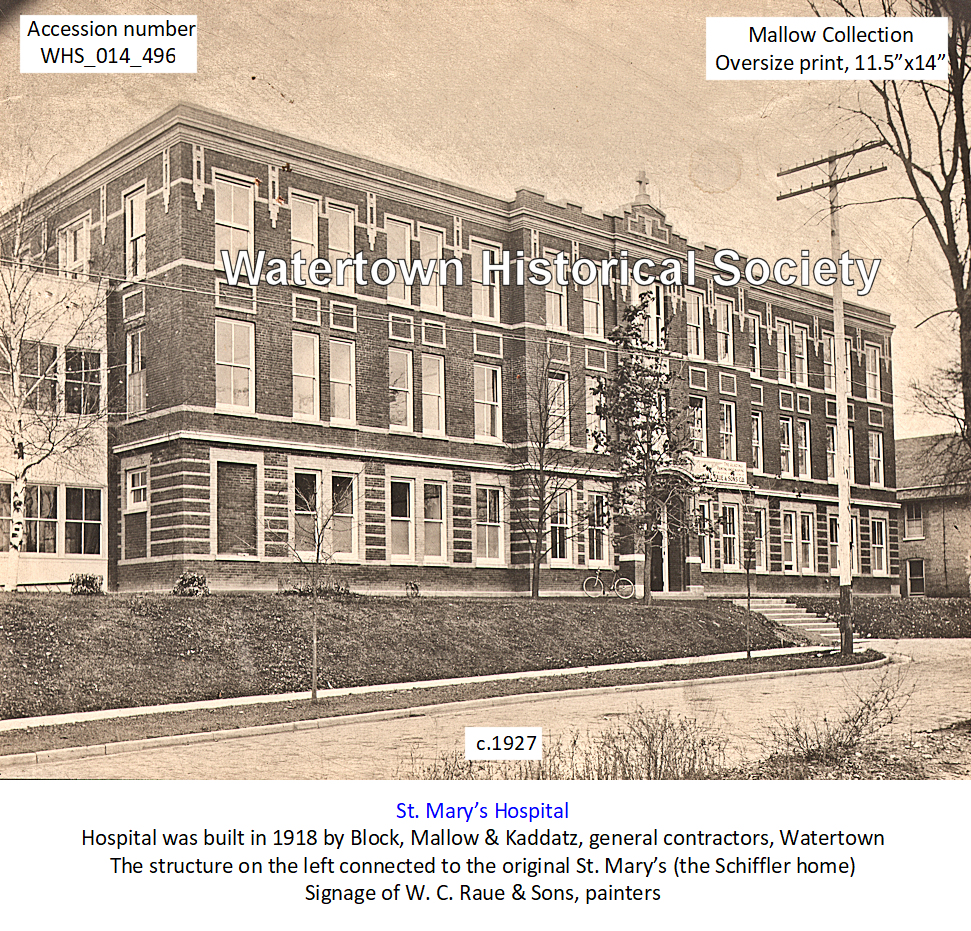
Construction The new St. Mary’s hospital is of
fireproof construction throughout. The
furnishings of the various rooms are in native white oak, but this is used only
sparingly. The corridors, hallways,
stairways, operating rooms, bath rooms and the like are of strictly fireproof
material. The building proper is 42x118
feet, three stories in height, and steam heated throughout. The foundation walls are of concrete and the
building is of red pressed brick with reinforced concrete floors finished in
granite Mosaic style. The stairways are
of iron supports with the same style of construction used in the floors. The corridors and hallways are constructed of
like material.
The general contract for the
construction of the hospital was let to Block Mallow & Kaddatz, local
contractors, who completed the building in a manner satisfactory to the
architect, Herman J. Gaul of Chicago, who spent considerable time in Watertown overlooking
its construction. The plumbing was
installed under contract by the Otto Biefeld
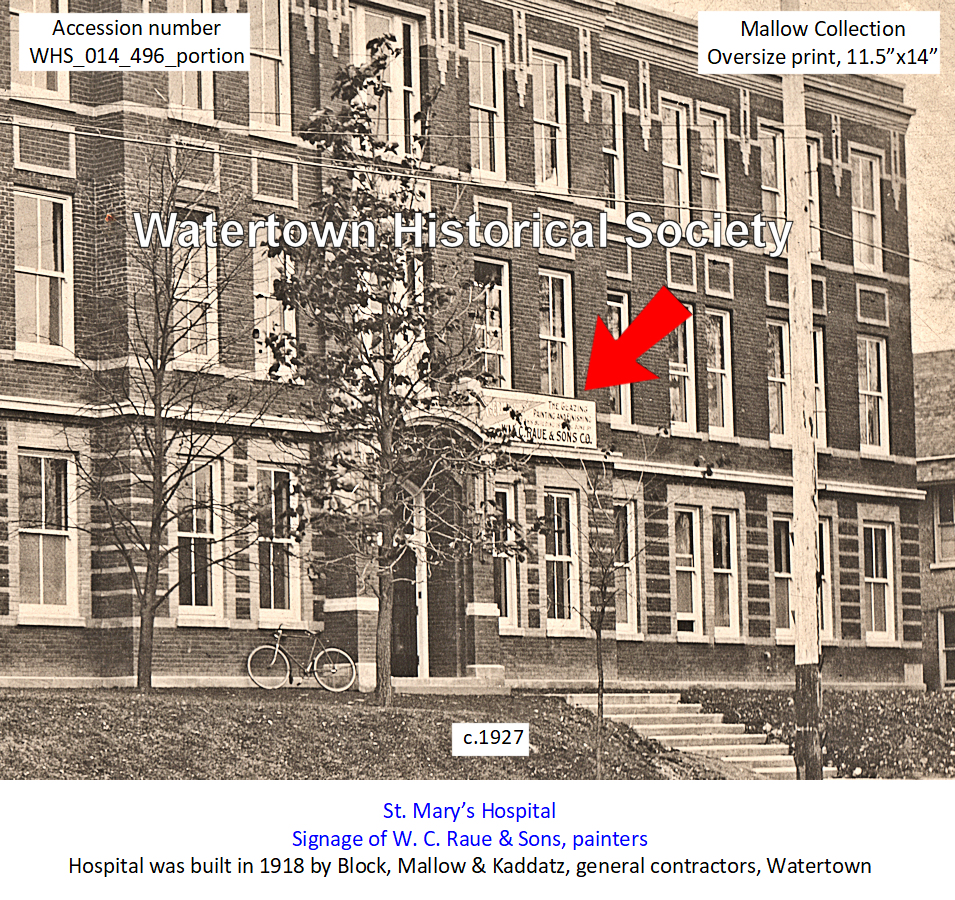
Company, and the painting contract included in the general contract was
done by W. C. Raue & Sons Co. The heating was put in by Chicago contractors
as was also the electric wiring and marble and Toronto floors.
The Sun
Parlor One of the coziest corners in the
institution is the sun parlor, which admits the sunlight from the south and
allows a fine view of the sweep of Rock River to the north. It is comfortably furnished and is in constant
use by those patients who are not confined to their rooms and wish to spend an
hour or two and imbibe the healthful influence which nature has provided, a
stimulating influence in the case of all sufferers where the genial warmth of
the sun’s rays exert a beneficial condition.
Here convalescents may lounge at leisure and occupy their time with
books, needlework or like light occupations.
On the same floor is also
situated the diet kitchen where the meals are assembled after being prepared in
the kitchen on the ground floor. As one
enters the hospital from Main Street, the vestibule opens into the waiting
parlor on the right and the general office on the left. A main corridor traverses the whole length of
the building on this floor and leads to the maternity hospital on the east and
the chapel on the west.
The two floors above are devoted
to the care of the sick, the rooms opening onto wide corridors excellently
lighted as are also all the rooms occupied by the patients with window
exposures.
On the first floor are also
arranged the baths, electric treatment room and rest room, emergency operating
room, X-Ray room and lecture room, all needed and necessary in an institution
of this character and all amply provided with the necessary equipment. The general operating room is located on the
third floor, furnished in white enamel, and the pink of cleanliness. Adjacent to this operating room are smaller
rooms devoted to the care of surgical instruments, dressings and other
appliances necessary in a well ordered hospital.
The
Sisters Such in brief is the history of
St. Mary’s hospital, but it would be incomplete were mention not made of the
glorious and self-sacrificing work of the noble women who have brought it to a
success and made the name of St. Mary’s revered not only among our own people
of Watertown, but in many outlying hamlets and villages, in the homes of the
farmer, artisan, professional man, and indeed to those in all walks of
life. The Sister Superior who controls
and directs the work of the institution is a woman with great executive
ability, and with a quiet, unassuming personage. To her must be given great credit for the
high plane on which the hospital rests.
No better testimonial could be given than that expressed by the head of
a big Chicago hospital, who was called here during the prevalence of the
Spanish influenza when his son-in-law was being cared for. He said: “Watertown should be proud of this splendid
institution and should be proud of the great and noble work being done by the
sisterhood. It is as complete in every
detail as one could wish for”.
Such unstinted praise coming from
a man who had the chance to observe, goes to show the magnificent work which
has been accomplished in Watertown. And
a visit to this place will repay anyone.
Homelike surroundings greet you on every hand. The dread of the ordeal is dissipated by the
knowledge that you will receive the care and nursing which in many cases cannot
be given you at home.
Citizens
Furnish Rooms But although the exigencies of
the war discouraged the solicitation of funds for the building of the hospital,
it did not deter citizens and civic societies from contributing to its
furnishings. The city for years has
maintained a room for the indigent who might seek its services. In addition the city council furnished one of
the rooms complete. The matter of
furnishing was taken up in turn by the societies and clubs of the town, and
every room in the hospital was furnished at considerable expense as a donation
and token of good will. Not content with
that, many private citizens contributed of their means for many articles
needed. There was no stint on the part
of the public and creed or nationality did not enter into the work. It was a fine spirit admirably shown and redowns to the credit of the people of Watertown.
Watertown has advanced well in
this great undertaking for the cause of suffering humanity and from the humble
beginning in the little emergency hospital of a few years ago has crowned
itself with a diadem more lasting than can be bestowed in another sphere. And let us not forget that while we may be
enjoying all the blessings which come to us through the medium of good health,
there are many more who crushed with sickness or in need of a surgical aid are
less fortunate, and to them is dedicated the noble work of the sisterhood in
charge of St. Mary’s hospital without recompense or reward in this world.
01 29 SISTERS
GIVE BANQUET
The Sisters of the Order of the Holy Ghost, the new
proprietors of St. Mary’s Hospital, gave a splendid banquet at St. Henry's hall
last Tuesday evening, their guests being the doctors and druggists of the city,
and Rev. Father Schweitzer, who left the sanitarium in Milwaukee to pay honor
to those who invited him. The ministers
of the city were also invited. The banquet, a seven course affair,
was served in the upper hall by the ladies of St. Henry's Church, and quite a
number of ladies of other churches, and white-capped nurses of St. Mary’s
hospital waited on the tables. Those who
sat at the banquet board were: Dr.
Wilkinson, Oconomowoc; Dr. J. S. Kings, Dr. F. C. Moulding,
Dr. F. C. Werner, Brother Bernard, Sacred Heart College; C. A. Gamm,
Dr. C. R. Feld, Dr. C. J. Habhegger, the Rev. Philip Schweitzer, Dr. L. H.
Nowack, H. T. Eberle, R. H. Brennecke, Dr. Earl H. Cook, Dr. Joseph O'Connell,
Dr. Ableman, John W. Schempf, Dr. Fred O. Haney.
At the conclusion of the banquet Rev. Father
Schweitzer spoke as follows:
"Venerable Sisters and Esteemed Ladies and
Gentlemen:
Words cannot express how pleased I am tonight to be
with you in this hall and on this occasion.
It always was the dream and ambition of my life to do two things, first,
to erect a hall where young and old could meet to enjoy the real, the pure and
noblest pleasures of life, and second, to found a hospital in which our
unfortunate fellow men could find bodily comfort and a place for a distressed
mind. By the help of God and the
generosity of my people and fellow citizens, I was successful and achieved my aim. I need not boast when I say that no city in
all the land with the population of Watertown can excel St. Henry's hall,
either in beauty or comforts.
The past three years plainly prove what St. Henry's
hall has done and what it still can do in the future. I must admit that close attention and
strenuous efforts are required on the part of the pastor and his faithful flock
in order to accomplish the real purpose and noble aim of a parish hall. And at times the pastor must expect to meet
with disappointments.
While I have no doubt whatever that St. Mary's will
someday rank among the most charitable institutions of our archdiocese, its
beginning was indeed a difficult and humble one. Having obtained an option on several sites in
our city about seven years ago, I at once began an ardent search for
Sisters. I applied to all hospital
communities then known to me, but always received the same reply: 'We regret very much that we cannot accept
your offer. Can't you send us
candidates, because we need help?’ Think
what we may, I will say tonight that the existence and success of St. Mary's is
solely due to the persistent efforts of Drs. Habhegger, Eichelberg and
Shinnick, and during the last years the burden was entirely cast upon Dr. Habhegger's shoulders.
His name and merits shall ever be gratefully mentioned in the history of
St. Mary's Hospital.
In the name of Watertown allow me to thank all the
honorable physicians and the benefactors for their kind support and good will shown to St. Mary's Hospital during the past years. I can assure the venerable Sisters that their
coming is welcomed and hailed by every citizen of Watertown, and on the other
hand, I can truly say that the Sisters' motives are not of filthy lucre but are
prompted by the spirit of God and pure charity for the poor and helpless in our
midst.
Therefore all eyes are directed at present to St.
Mary's beautiful heights. A new area
[era] has begun in the history of our fair city — an era of charity and good
will towards all men, irrespective of creed and nationality.
In the name of all present let me thank the good
Sisters who honored us with this banquet, and the kind and generous ladies and
the nurses who worked hard to make it a grand success.
I am not appointed toastmaster for this occasion, but
I'll dare to assume the privilege of one and call upon the gentleman whose name
is inseparable from the name of St. Mary's Hospital.''
_______________
Dr. Habhegger responded by telling in brief the
difficulties encountered in establishing and maintaining the hospital here, one
of the chief difficulties arising from the fact that the management of a public
hospital by a member or members of the medical profession was the cause of many
misunderstandings.
Dr. Kings told of the needs of the hospital and the
support of the citizens in a general way.
That the city owes the hospital a big debt, that the presence of an
Institution ready at all times to care for the injured of dangerously ill was a
great benefit to the community and that the citizens should give the
institution their heartiest support both financially and otherwise. Drs. Wilkinson, Oconomowoc, Feld, Werner,
O'Connell, Cook and Nowack, and the Messrs. Gamm and Eberle spoke briefly and
encouragingly of the hospital. WG
12 17 TAG DAY SATURDAY
Next Saturday will be Tag Day and
the money solicited will be for the benefit of St. Mary’s Hospital. At a meeting held at the public library
Tuesday Mrs. F. E. Woodard was chosen chairman of the committee of ladies who
will attend to the details of the tagging.
The business men will be
solicited on Friday, December 18, by Mrs. Clara Weiss and Miss Quentmeyer, and the professional men will be solicited by
Mrs. Fischer and Mrs. Melzer.
Saturday, December 10, a number
of young ladies will be stationed on the streets in different sections of the
city under the leadership and direction of captains and will tag every person
they meet who has not already been tagged.
The different sections of Main Street have been apportioned to the
various captains, who with their assistants will be on duty in their
district. They are as follows: Mrs. Fay
Solliday and Mrs. Oscar Wertheimer will have charge of West Main Street, from
Washington Street to the bridge and Water and North Water streets, including
Otto Biefeld Machine shop, Wolfram Shoe factory and Beals & Torrey Shoe
factory and factories along that street.
Mrs. O. C. Hahn, from the bridge on Main, to First Street and North
First Street on the west side of the street.
Mrs. E. J. Carroll on Main from First to Second Street and the east side
of First and North First streets. Miss
Lydia Pease from Second to Third Street, on Main, and Second and North Second,
including the post office. Miss Edna Chadwick
from Third to Fifth Street on Main and Third and North Third streets, also
Fourth and North Fourth streets. Mrs.
Sidney Eberle on Main, from Fifth Street to the Sharp corner. Miss Louise Ungers
and friends will be stationed at the Commercial hotel; Mrs. C. R. Behl and Mrs.
Edward Schultz at the I. L. Henry Box factory; Mrs. Salick and helpers at the
Northwestern depot; Miss Marie Killian, Miss Ella Wilder and Miss Hertel at the
St. Paul depot and Mrs. Holmes and Miss Enright will be stationed at the G. B.
Lewis factory.
People who are desirous of donating
material or groceries instead of money may select articles from the following
prepared list: feather pillows for beds,
small pillows for chairs, towels, wash cloths, sheets, pillow slips, bed
spreads for single beds, linen table covers, linen dresser scarfs, table
napkins, linen glass cloths, bath towels, night gowns for men in emergency
cases, bed ticking, single wool blankets, small floor rugs, fresh fruit such as
apples and oranges, and groceries of all kinds, special request being canned
beans and canned asparagus.
The taggers will work in relays,
and at the conclusion of their work will be served with luncheon at the
library.
It is hoped that the citizens
will take an interest in so worthy a cause and help to make it a big success .
. . WG
12 24 TAG DAY A GREAT SUCCESS
Tag day in Watertown netted
$1103.80 for St. Mary’s hospital, an amount that greatly exceeds the most
enthusiastic expectations of those interesting themselves in the movement. The people of Watertown and vicinity showed
the proper spirit in contributing so liberally to this movement, and [this]
speaks well for the generosity and good will of this section in its splendid
support of this worthy institution.
Watertown citizens always respond to a worthy movement, and this is one
of the things that will certainly gain for our city great praise throughout the
state. Most of our business men
contributed liberally and one lady headed the list of donors with $50. The farmers visiting the city on tag day also
contributed liberally. The ladies, young
and old, who looked after the details of the tagging, and stood all day long on
our streets soliciting aid, certainly deserve great praise for their zeal and
interest in this good work. Aside from
the money collected, many valuable donations were also given on that day to the
hospital by our business men. WG
1915
03 25 BENEFICIARY OF MICHAEL CARROLL WILL
Fourthly.
I give and bequeath to St. Mary’s hospital, Watertown, Wis., $10,000, for
an endowment or fund to be used in permanent improvements.
1916
10 27 BUILDING THE
NEW WATERTOWN HOSPITAL
This enterprise is now commanding
the attention of everybody in this part of the state, because it is an
undertaking in which all have a personal interest; no one knows the moment when
the service of a hospital will determine the matter of life or death.
The instinct of the head of the
family should prompt a plan to care for the sick members in emergency which may
arise at any moment, and provisions should be made in time for a situation,
which is sure to occur.
Use of hospitals is now known to
be more economical than the attempt to care for the dangerously sick in private
homes, besides the hospital afford a greater certainty for a happy recovery.
This last applies more
particularly to maternity cases, which the State Boards of Charities have
recently shown, and have a far lower death rate when they have been treated in
hospitals as against the supposed advantages of home treatment in rural communities.
The understanding has the
enthusiastic endorsement of all classes of citizens. The workman knows there is a place for him in
case of accident. The business man
figures it is much more economical to have his sick taken care of where every
preparation is made for this service.
The professional man, with his
knowledge of scientific matters, knows that he will have scientific treatment
in a well ordered hospital. The
Ministers of the Churches feel that there is a heaven of refuge for the
unfortunate sick and maimed in the local hospital.
Civic pride is aroused in
Watertown and will show its interest in securing suitable buildings and
equipment for St. Mary’s Hospital.
11 10 HELP THE NEW HOSPITAL AT WATERTOWN
At some time the necessity arises
for the use of a hospital in the life of almost every man; the better the
hospital, the nearer and quicker it can be reached may determine the recovery
or death of the patient.
Suppose something like this
should happen to you, young man, or someone near and dear to you:
On a very cold night in a
blinding snowstorm, with the thermometer below zero, a stalwart young railroad
man had the misfortune to stumble and fall on the track while running ahead of
his train to unlock a switch. The
engineer blinded by the snow lost sight of the brakeman for a few moments and
supposing he had stepped alongside of the track kept his engine moving; before
he realized it his engine had run over the fallen man severing one of his legs
below the knee. The trainmen picked up
their injured comrade and carried him to a vacant room where a plain board
table, dusty and dirty, had to serve as an operating table. The wound was treated as well as the
circumstances would permit in this unheated and unclean room and the man was
made as comfortable as possible. His
recovery was attended by results arising from the unsanitary conditions under
which it was necessary to treat him, and he will pay for the lack of hospital
accommodations by having a “bad leg” as long as he lives.
A broken leg may heal
satisfactorily with home care but with the scientific attention to be received
in a hospital there is seldom if ever a question as to the results.
Another story of the life saving advantages of a hospital easily reached the
farmer’s life was saved by being near a hospital.
A strong, healthy young man, a
farmer, was descending from a load of barley, holding a pitchfork in his right
hand, he fell upon the handle which turned under him in such a manner as to
impale him and thence to the ground. He
pulled out the handle of the fork himself, and pressing his hands tightly to
the wound managed to walk home.
Intestines protruded from the wound and after washing with hot water and
applying a bandage firmly, he was removed to the hospital in an automobile a
distance of twelve miles. An examination
showed the serious character of the injury and an operation followed which
could only have been successfully performed under the favorable conditions
afforded by a hospital, and where the patient had the advantage which are to be
had only in a well-regulated institution.
In five weeks he had recovered and was discharged a cured man; had there
been no hospital near, this man would have died in a few hours.
The above facts but
illustrate the slogan, “When you are helping St. Mary’s Hospital you are
helping yourself.”
11 24&12 08
Building fund and campaign. Offer of fifty cent for every
dollar donated made by Sisters of the charge of the institution WDT
12 08 JUNEAU
AIDS IN CAMPAIGN: Hospital
Campaign in Watertown is now on
Habit keeps us blind as a
bat: We go over a certain path every day
but do not see the many opportunities for pleasure, comfort, or even
moneymaking; when these are pointed out to the plodding man he is astonished at
the many things he has missed in his daily life.
For some weeks we have been
trying to tell you where there is a source of pleasure you have never thought
of before: It is the happiness of GIVING and that to a most worthy object, the
new St. Mary’s hospital at Watertown.
In all probability almost every
person will at some time in the future need the services of a hospital;
particularly those who are growing old, and like life insurance it is well to
make provision for an emergency before it arises. When the time comes, the need will confront
you so quickly and suddenly — accident and sickness do not give warning that
you make preparation at the last minute.
For this reason bury all
objections of every sort and kind, and only consider the service a hospital
will render you when it is required.
This is no theory, this is a FACT
which everybody will do well to recognize.
The necessity will arise suddenly and those who live out of the city
will need the services of a hospital more, or equally, with those who live in
the city: because in the country the houses are far removed from a doctor, a
drug store or even a grocery store where the little luxuries can be quickly
had.
Another feature: the home offers
meager facilities for taking care of the patient, but when one is in the
hospital, he will have everything he ought to have, including the luxuries.
The mails have carried a large
number of invitations to many persons to contribute to this fund, some of which
have been answered.
If you live in the city do not
wait for the solicitor to call on you.
If you live in the country, send your donation by mail, or call in
person at the Headquarters, 11 Main Street, Watertown, Wisconsin, where it will
at once be announced to all the workers\, thus stimulating them to renewed
efforts.
The intensive campaign is open,
and will close December the 16th. We
bespeak a kindly reception for this movement and a liberal donation, because
“When you are helping St Mary’s Hospital you are helping yourself”. – Juneau
Telephone newspaper
1917
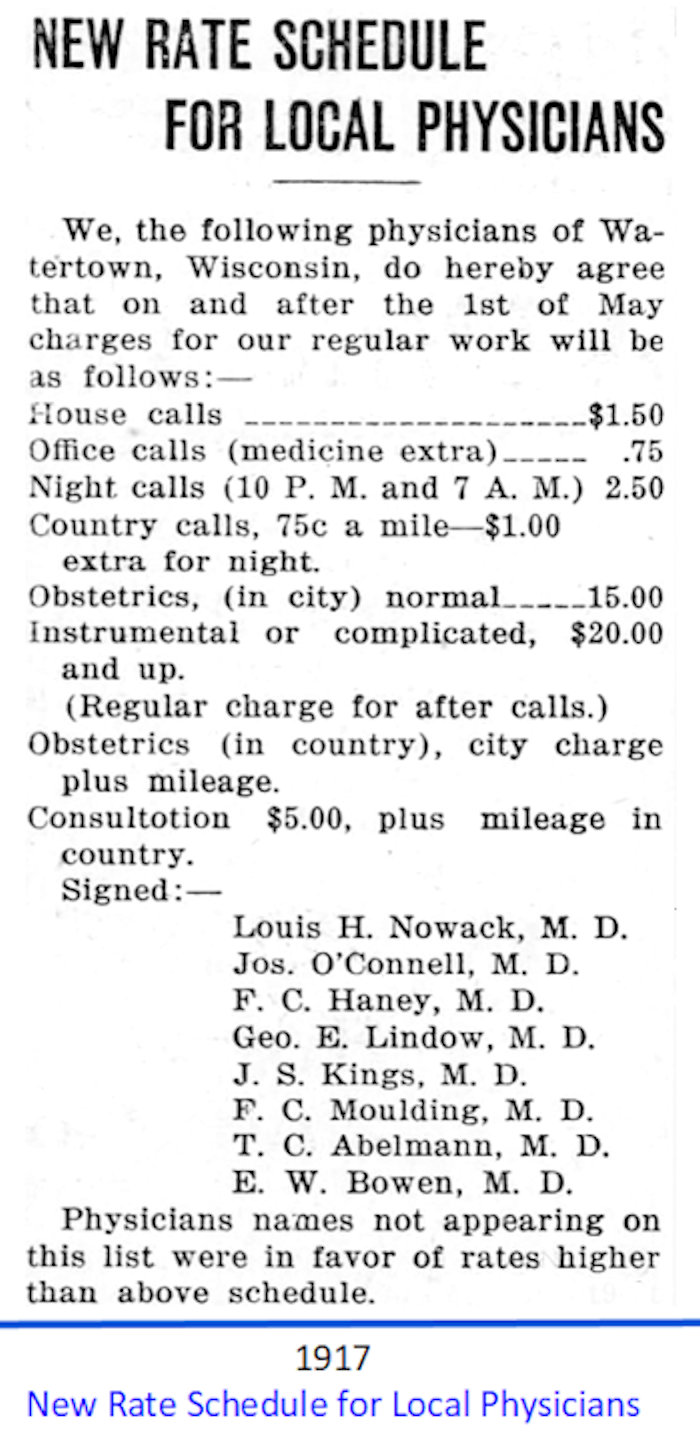
05 16 NEW RATE SCHEDULE FOR LOCAL PHYSICIANS
1918
09 20 NEW ST. MARY’S HOSPITAL NEARING COMPLETION
The new St. Mary’s hospital is
now nearing completion and when finished will be one of the finest and best
equipped hospitals in middle Wisconsin.
It certainly is a building that our city ought to feel proud of. The rates are reasonable and the Sisters,
nurses and physicians are doing all they can to make it comfortable and
convenient for the patients. Some people
may say “It’s a Catholic institution and they show preference to the Catholic
people,” but this is not true; the good Sisters and nurses treat all alike,
which can be proven by the many non-Catholics who have visited the place.
There is but one spirit lacking
in the erection of this wonderful institution and that is the spirit of the
local people and of the surrounding country in helping it along. Of course there are a great many who have already
done their share, but there are quite a number of unfurnished rooms which could
be furnished by some of our prominent and wealthy families, clubs or
lodges. Hospitals in other cities were
furnished completely by the local people, and as we understand it, it took but
a very few days in which to complete the task.
Why not prove to our neighboring cities that we can do the same.
There are a great many farmers who
could do their share in donating vegetables, etc., which would greatly help in
defraying expenses.
Supposing sickness should occur
in their families which would compel them to be removed to a hospital. Where would we take them had we no hospital
here? Our first advice would be
Milwaukee. Think of the extra expense
going back and forth, the inconveniences and then the distance away from your
loved ones. With the completion of our
new hospital you will be able to bring your sick here within thirty or forty
minutes from any part of the surrounding country, and be with them at all
times. Is this not worth a fortune to
both the local people, the people from the country and neighboring towns?
There are a great many transient
people who are taken sick enroute, railroad and automobile accidents, who are
brought here for treatment. Take for
instance, the accident at the Commercial hotel last Friday, and the case of one
of the members of the Jackie band who was taken sick on the train while on his
way to Watertown. What would we have
done without a hospital? Watertown ought
to feel proud to think it has an institution in which they are now nursing one
of Uncle Sam’s proud Jackies back to health. It is a wonderful thing and every loyal
citizen, both in the city and country, ought to give the good cause a helping
hand. Let not religion interfere when
there is a chance to save a human life.
Think of our wounded boys “over
there.” See what the hospitals, nurses
and physicians are doing for them and we are sure everyone will gladly give a
helping hand when called upon to do their bit. The Watertown News, 20 Sep 1918
1919
January NEW HOSPITAL IN BACKGROUND OF NORTHWESTERN
COLLEGE
Although everyone enjoys the warm weather and the
bright sunshine, about three weeks before Christmas we all began to wish for
snow, so that Santa Claus could bring our presents in his reindeer sled. Then one Sunday afternoon Mother Goose shook
her feather-bed and our wish was granted.
We awoke the next morning to find the ground covered with a
beautiful mantle of white. Of course, to
the collegiate [students at NorthWestern College] this
was a pleasing sight, but for the students of the Preparatory Department it
meant, “Get the snow shovels out!” How
much nicer everything appeared in its new coat of white. The college park is especially picturesque in
the evening. The many lights in the
dormitory cause the tall pine trees to throw dark shadows on the white
background, bringing out a beautiful contrast.
Beyond the college hill the dark waters of the Rock River flow
between banks of white, winding among the trees above the banks. Already the students are awaiting the time
when the ice will be solid enough for skating.
The campus
also makes a much better impression now,
with the new hospital in the back ground.
This building is three stories high, built of red brick, and is a
decided improvement over the old frame structure. At night it looks especially nice with the
many lights shining out on the snow covered earth. But for all its beauty I do
not believe there is one of us who would like to be taken there. (The Black and Red [Northwestern College], 01 1919)
07 14 RELIEVING SUFFERING HUMANITY
On an eminence of rising ground
sloping gently from the bosom of Rock River in the eastern part of the city of
Watertown, stands a new structure devoted to the cause of relieving suffering
humanity. This structure, which bears
the name of St. Mary’s Hospital, has just been completed at a cost of more than
$100,000 under the inspiration and efforts of the Missionary Sisters Servants
of the Holy Ghost, Institute of Techny, Ill., the head house of which is at
Style, Holland, who took up the burden after the establishment of St. Mary’s
hospital several years ago by some of the local physicians.
This institution means much for
the city of Watertown and the country adjacent thereto, and in time will be of
incalculable benefit for humanity in its wide scope and most modern equipment
to keep in touch with all that tends for the alleviation of suffering and
bringing back to health those who place their confidence in the conduct of the
institution and are relieved of the anxiety which anyone may have in entering a
hospital.
St. Mary’s is certainly a
homelike institution. Mothered over by a
sisterhood of women engaged in the greatest and most ennobling task that can
fall to anyone, without chance of pecuniary or other reward this side of the
gates of paradise, these women, devoting a life long struggle for the benefit
of manhood have created and reared a monument in the city of Watertown far
greater in dimensions and far greater in its scope of work that any monument
hewn out of granite or iron.
Watertown has reason to be very
proud of St. Mary’s. It asks no
questions, whether you are white or colored, whether your ancestry was from
Alaska, The Orient, Africa or in any zone on God’s footstool. That you are a human being appeals to these
sisters only. Russian or Jew, Catholic
or Protestant, the same roof shelters them all and the same treatment is
willingly given. WDT
c.1927
1929
 1929 view
  Training School for Nurses diploma, Agnes
Caughlin
Training School for Nurses diploma, Agnes
Caughlin
1936-37
SCHIFFLER HOME TORN DOWN AND WING ALONG CONCORD AVE ADDED
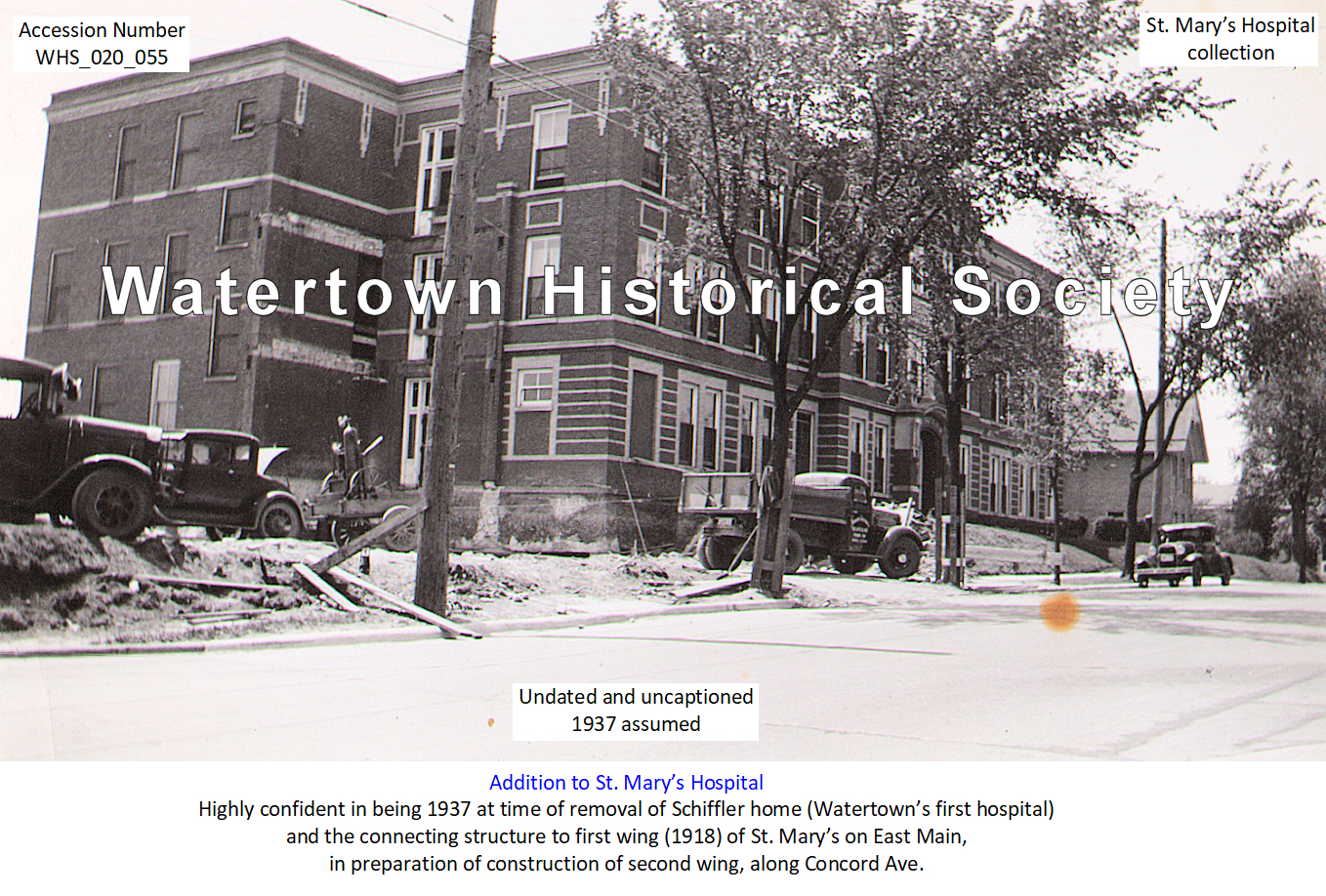
1937
05 19 NEW HOSPITAL ADDITION IS
DEDICATED
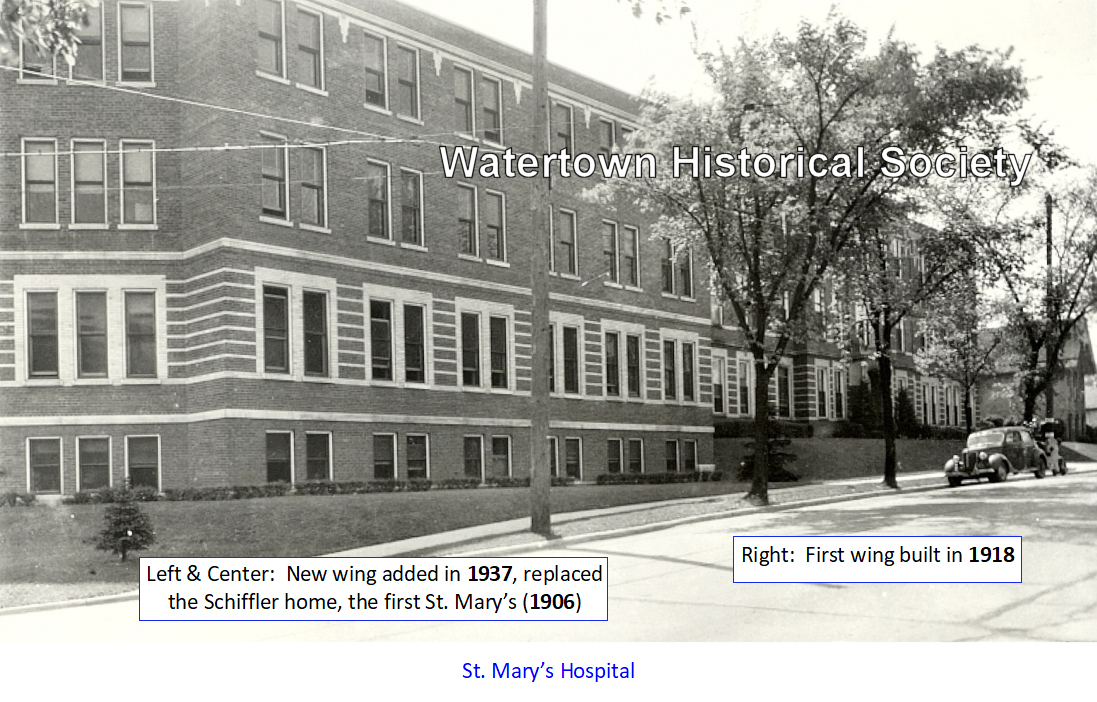
St Mary’s Hospital’s new $132,000 addition was dedicated at appropriate
ceremonies at the hospital chapel, located in the new addition, Friday
afternoon.
His Excellency, the Most Rev. Samuel A. Stritch,
archbishop of the Milwaukee archdiocese, officiated at the dedication, assisted
by a large number of clergymen.
The ceremony was conducted in the presence of a
large number of persons who filled the chapel and the corridor nearby.
Archbishop Stritch, in a short talk in the chapel,
commended the Sisters for the efficient manner in which they have conducted St.
Mary’s hospital and lauded their courage in erecting so fine an addition.
“I have heard many favorable comments about this
hospital,” the archbishop stated at one point of his address. “The new facilities which the new addition
will afford will make it possible for the Sisters to achieve even greater
attainments,” the archbishop predicted.
A hospital too often is just taken for granted, just
as water, electricity and many other every day necessities are taken,
Archbishop Stritch said in another part of his address. “We do not realize how
valuable it is until we become ill and need its services.” Often times, too, the fine charitable work
the Sisters, who are serving without compensation, are doing is not
realized. “The hospital represents one
of the finest creations of Christian charity,” he declared.
Assisting Archbishop Stritch were the archbishop’s
assistant, the Rev. Roman Atkielski; Rev. Francis
Xavier Schwinn, of St. Henry’s parish here; Rev. Fr. Hess of Waterloo; Rev.
Patrick Haggerty, C. S. C., of St. Bernard’s parish here; Rev. John Devers, C.
S. C., of Sacred Heart College here; Rev. Alfred Wiemer of St. Henry’s parish
here; Rev. Edward Malloy, C. S. S. R., rector of the Redemptorist Seminary of
Oconomowoc; Rev. Ray Miller, C. S. S. R.; Rev. Fr. Zingen
of Jefferson and Rev. Edward Hertel of Waterford.
The growth of St. Mary’s hospital is truly a story
of achievement. The beginning of St.
Mary’s hospital dates back to 1906, when Dr. T. F. Shinnick, now of Beloit, and
Dr. C. J. Eichelberg of Reeseville took over the Charles Schiffler residence
and remodeled it into a hospital. Until
the new addition was built, the building continued to serve as the maternity
section of the hospital.
The Sisters took over the hospital on January 6,
1914. Plans were soon launched for more
room and better facilities. In September
of 1918 more room was provided by a new building containing 38 rooms.
As the years passed even this became crowded and
during the last few years the over-crowded condition became acute. As high as 18 beds had to be placed in the
hospital to accommodate the patients.
The new addition provides 37 additional beds.
The entire sum of $132,000 has been borrowed by the
Sisters. While the burden on the Sisters
is great, the Sister Superior and the other Sisters felt that the situation had
advanced to the point where there was nothing more to do but to erect an
addition, thus providing Watertown and this entire community with a hospital
second to none for a city this size
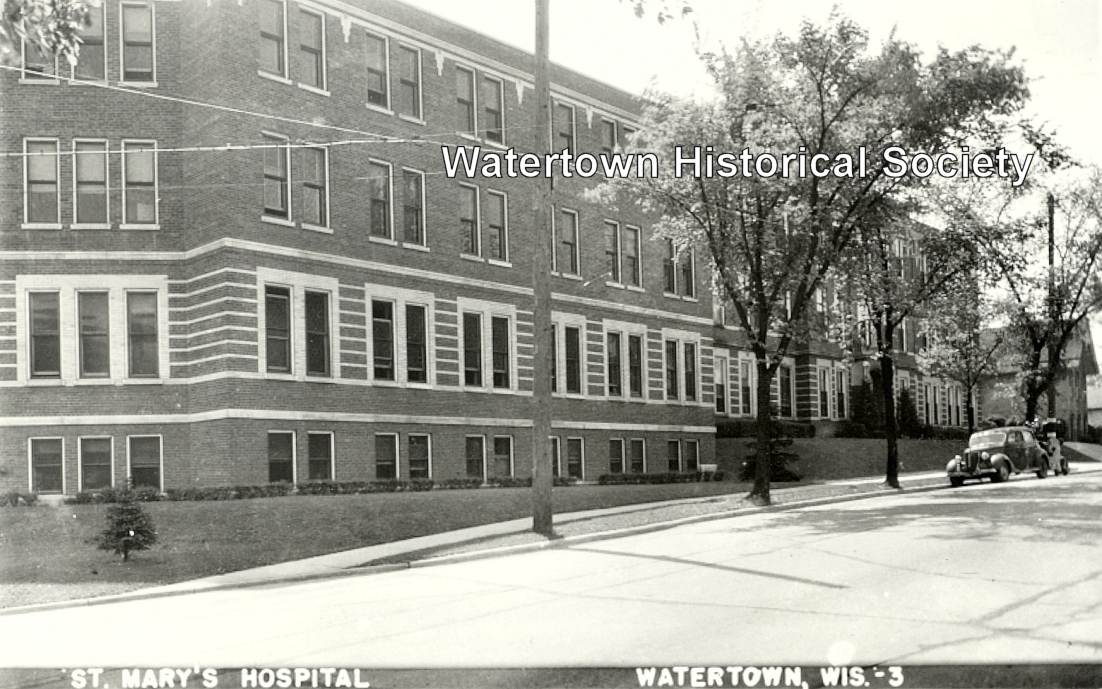
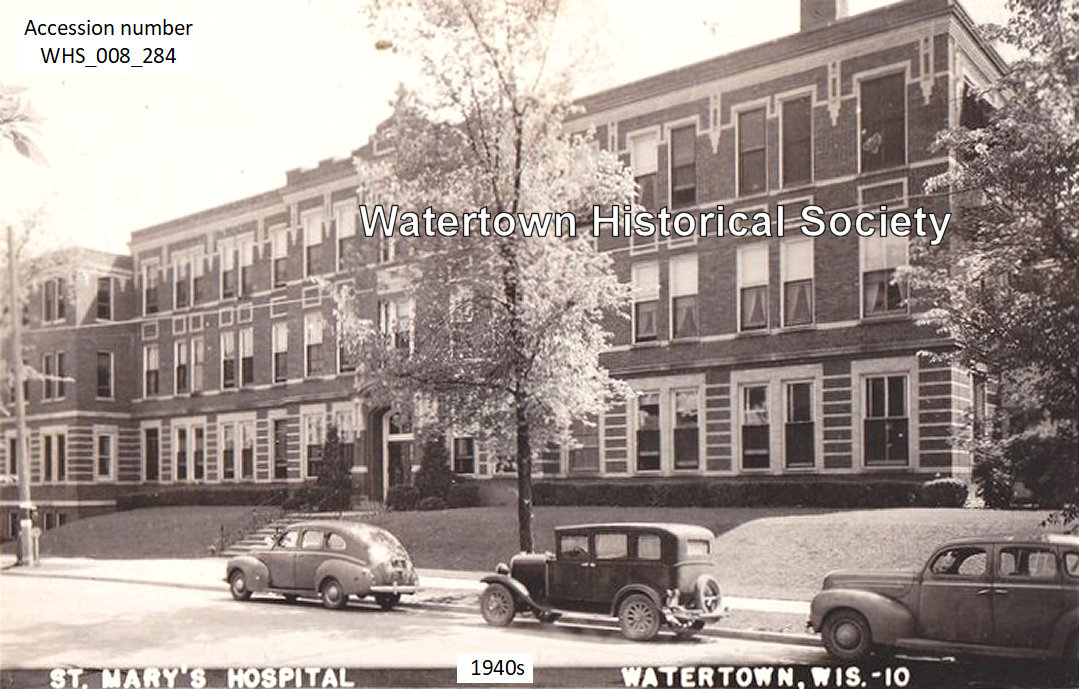
c.1940s
1943
05 28 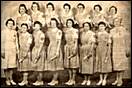 Watertown’s
First Nurses Aide Class
Watertown’s
First Nurses Aide Class
1950
09 27 AUXILIARY OF HOSPITAL to Open
Season
St. Marys
Hospital auxiliary will open its season on Monday afternoon, Oct. 2 at 2:30
o'clock. The sessions will be held in the
lower dining hall of the hospital. The
committee in charge of programs has been working during the summer to bring
before the group an interesting and informative course based on health and
allied subjects.
At the first meeting, it has been
arranged that Dr. E. A. Miller of this city, chief of staff of St. Mary's
hospital, will give a brief talk on the work of an auxiliary. Another speaker will be Mrs. William C. Koernschild of Milwaukee who will address the group on
"The Volunteer Service—Its Variety and Scope." Mrs. Knoernschild was one of the speakers at
the 35th national convention of the Catholic Hospital association held in
Milwaukee from June 12 to 15 of this year. T his
convention was attended by several sisters and nurses of the local hospital and
members of the auxiliary. Mrs.
Knoernschild has been president of St. Anthony's Hospital guild for many years
and has been associated with the auxiliary of St. Charles boys' home as well as
with- many other civic enterprises. She has been decorated by his holiness,
Pope Pius XII with the medal pro Ecclesia et Pontifice
for her generosity and untiring work.
The local organization has taken
for its aim and motto, "The Hospital auxiliary can be developed as a
dynamic force to assist and advance St. Mary's hospital."
Ways in which the members have
volunteered to assist are by sewing garments, folding papers, serving at the
visitors' desk, making children's scrapbooks, donating for the food sale, and
also assisting at the employees' picnic this past summer. The same projects will be continued during
the present year and new projects may be added with the approval of the sister
superior. All the work is purely
voluntary.
A food sale has been planned for
Friday, Oct. 27 at the Wisconsin Gas and Electric Company.
All those who have been doing
sewing or paper folding may bring them to the next meeting and check them with
the sewing committee: Mrs. H. E. Kwapil, chairman,
Mrs. Herman Harder or Miss Mary Stacy.
Those desiring to join the
auxiliary may call any one of the membership committee: Mrs. Francis Bertel, R.
N., Mrs. Harold Hargraves, R. N., Mrs. R. H. Bohlman, R. N., Mrs. Emil Tanck or
Mrs. O. L. Deist
The present officers are:
Honorary president — Sister Regine, S. Sp. S.; president — Mrs. William J.
Gormley; vice president — Mrs. Clifford M. Fritz; treasurer — Mrs. Roy V.
Harte; secretary — Mrs. Clifford Warren.
WDT
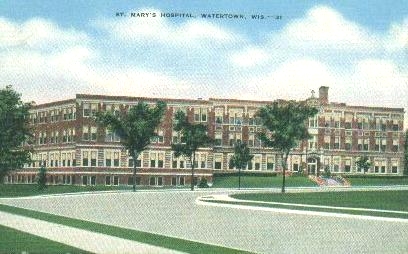 1950
1950
1956
05 30 St. MARY'S HOSPITAL IS UP FOR
SALE
For a number of weeks it has been
rumored that the local hospital will be sold by the Missionary Sisters Servants
of the Holy Ghost, which has operated St. Mary's Hospital for the past 42
years. The rumors now have been
definitely confirmed by the head of the religious order in Rome. In a letter from M. Margarethis,
Mother General, the reports are definitely confirmed. Confirmation also comes in a letter from
Sister Michael S.Sp.S., Provincial of the order at
Techny, Ill. St. Mary's Hospital is
under the direct supervision of the Provincial at Techny. The reason for the decision to put up the
“for sale” sign on St. Mary's Hospital, the Mother General at Rome states, is
that there are not enough nuns available to take care of a new and modern
hospital which is proposed for Watertown, and which, from reports of doctors
and others, is badly needed. For this
primary reason, the Mother General states, the order is pulling out of
Watertown, and putting the hospital building up for sale. 05 30 WDT
1957
09 21 HOSPITAL ASSOCIATION TO BE FORMED
At a citizen's meeting
held last night in the lower hall of the Elks Club, a decision was made to form
a hospital association, so that an organization will be in existence to cope
with whatever problems may arise in connection with the decision of the Missionary
Sisters Servants of Holy Ghost to sell St. Mary's Hospital. On May28 of 1956, the Sisters, who have
operated the hospital since 1914, announced that the hospital was for sale. Lack of nuns was the reason given for the
decision. Since the May 28 announcement,
officials of the order have confirmed the decision, despite great pressures
that have been exerted to induce the order to reverse its decision. On June 7 of this year it became known that
the sale of the property has been placed in the hands of the B.C. Ziegler
Company of West Bend, which specializes in institutional financing. WDT
Watertown Hospital Association Formed
1957
10 16 WATERTOWN HOSPITAL
ASSOCIATION, INC., FORMED
At a citizens’ meeting,
held last night at the Elks Club, Watertown Hospital Association, Inc., was
formed “to assure the existence of a hospital in the Watertown, Wis., area.”
Approximately 40 persons were in attendance. The association was formed so that
an organization will be in existence to meet any situation that may develop in
connection with the decision of Missionary Sisters Servants of Holy Ghost to
discontinue operation of St. Mary’s Hospital here. WDT
1958
-- -- PERSONNEL POLICIES BOOKLET Link to
pdf file
05 13 ELECTION OF
OFFICERS
Officers of
the Watertown Memorial Hospital Association elected. WDT
1959
05 17 “OUR BABY’S FIRST SEVEN YEARS” Record Book
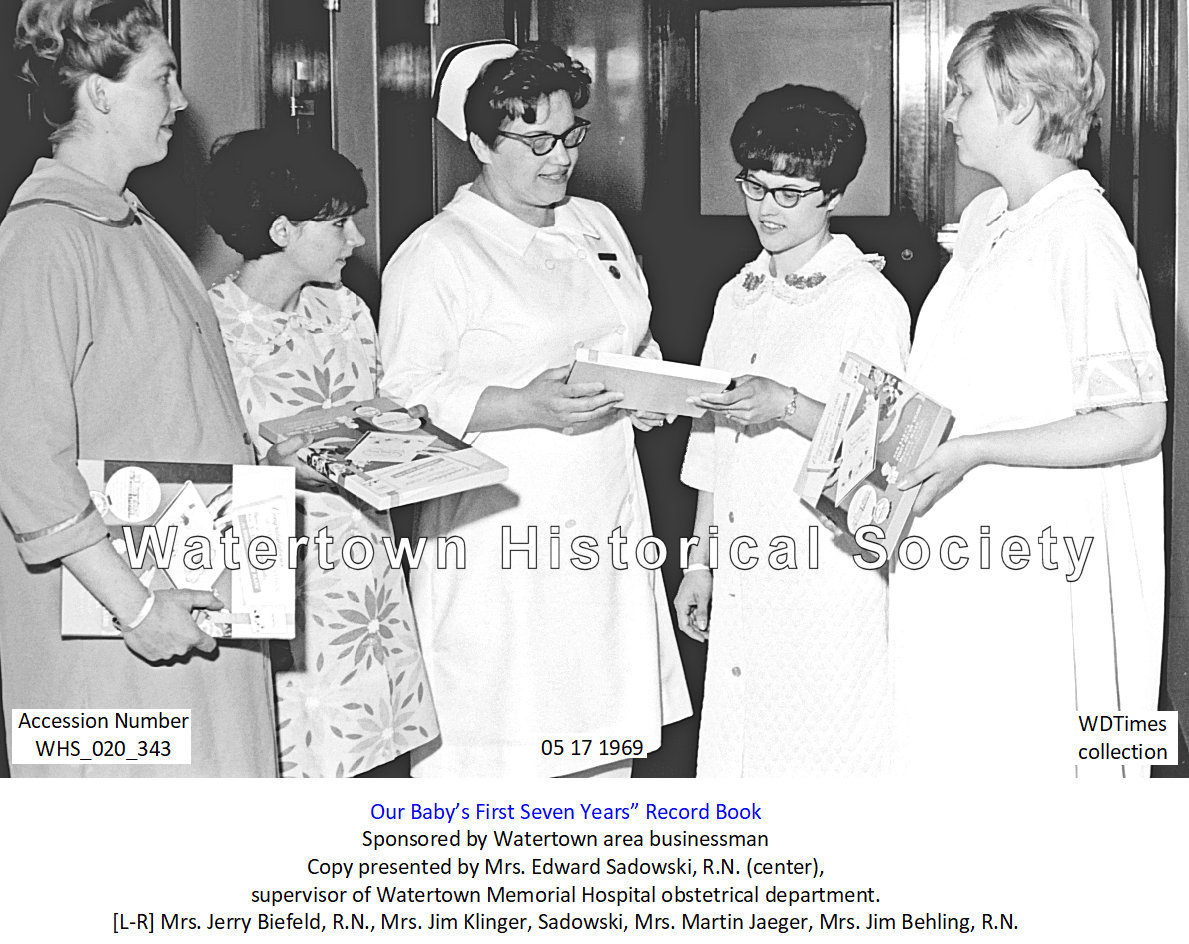

Sponsored by Watertown
area businessman
Copy presented by Mrs.
Edward Sadowski, R.N., supervisor of Watertown Memorial Hospital obstetrical
department.
Mrs. Jerry Biefeld, R.N., Mrs. Jim
Klinger, Sadowski, Mrs. Martin Jaeger, Mrs. Jim Behling, R.N.
1960
04 26 New hospital
possibility, federal Hill-Burton Act
WDT
1961
05 03 ELECTION
OF OFFICERS
Erwin Bilse yesterday afternoon
was elected to a one year term as president of the Watertown Memorial Hospital
Association at a meeting of the board of directors. Paul C. Kehrer was named vice president, Miss Catherine Jean Quirk, secretary, and
Robert Wills, treasurer. Arthur W. Hilgendorf who was elected a director at the
annual meeting of the association on April 27, was welcomed to the board at
yesterday’s meeting. His term is for
three years. Other directors are William
Guyer, Roy Childers, Attorney Roland F. Dierker and L.J. Lange. WDT
04 27 At last night’s annual
meeting of the Watertown Memorial Hospital Association, held in the lower hall
of the Elks Club, the board was urged, in a resolution adopted, to look for a
site for a new hospital, and when found secure an option upon the land. The resolution also urged that a membership
drive be held in order to secure additional funds for the association. The resolution was offered by Roy Childers, a
board member. He and others pointed out
in the discussion which preceded the vote that Watertown, at least eventually,
will need a new hospital building — maybe that may be years from now, as
Childers pointed out — and that now is the time to acquire the necessary
land. WDT
06 27 St. Mary’s Hospital of
Watertown has been offered for sale specifically to the Watertown Memorial
Hospital Association. In a meeting held
yesterday at St. Mary s, attended by the association’s board of directors and
Sister Michael the Mother Provincial of Missionary Sisters, Servants of Holy
Ghost, the basic groundwork for possible sale of St. Mary’s to the Watertown
association was laid in a two hour conference.
Sister Eugenio, a member of the Missionary Sisters Council, also
traveled from Techny, Ill., headquarters of the order in the United States,
with the Mother Provincial to attend the conference.
06 30 The Watertown Memorial
Hospital Association’s board of directors at a meeting held yesterday afternoon
took action to arrange for a meeting with officials of the B.C. Ziegler Co.
next week relative to the offer for the sale of St. Mary’s Hospital here. Monday’s offer was made in a two hour
conference, attended by Sister Michael, mother provincial of the Missionary
Sisters, Servants of Holy Ghost, and Delbert Kenney, president of the B. C.
Ziegler Company, West Bend, agents for the sale.
1962
04 28 CONSIDERATIONS
REGARDING NEW HOSPITAL
The acquisition of land and the
construction of a new hospital unit for Watertown are included in the subjects
to be considered at Monday night’s meeting of the Watertown Memorial Hospital
Association, Ervin Bilse, president, stated today. The annual meeting of the members of the
association will be held in the lower hall of the Elks Club, at 8 o’clock. Another item on the agenda is the report on
the state of negotiations between the association and the Missionary Sisters,
Servants of the Holy Ghost, owners and operators of St. Mary’s Hospital in the
city, for the purchase of the hospital on behalf of the community. Important details of these negotiations and a
report on the board’s contact with Bishop William P. O’Connor of the Madison
Diocese are to be disclosed. WDT
05 01 A new hospital for
Watertown, the size to be determined by the amount of money raised, was
unanimously agreed upon at the fourth annual meeting of the Watertown Memorial
Hospital Association, held last night at the Elks Club. The motion to erect a new hospital was
offered by Dr. E. Allen Miller, and seconded by Miss Gladys Mollart. Under the provisions of the motion, a
determination of the amount of money which it is thought can be raised should
be made by the board of the directors, and it was indicated that a professional
fund raising organization will be contacted to help determine the amount of
money that it is felt can be raised. WDT
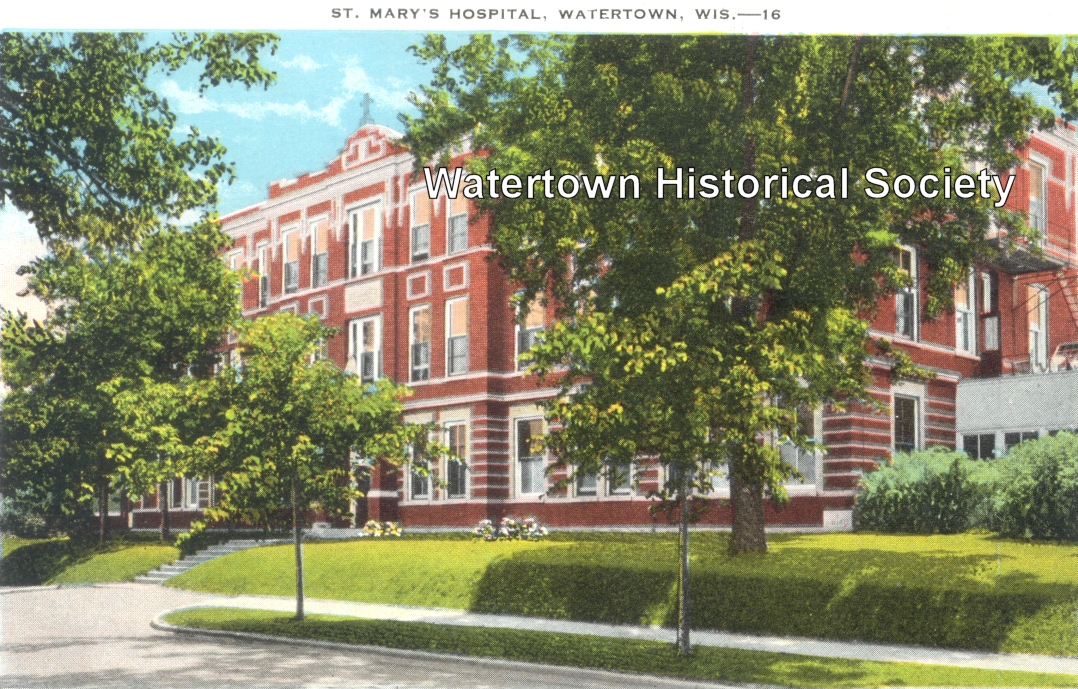 uncertain date
1963
01 24 A $60,000 safety
improvement program has been completed at Welbourne Hall, an 80-bed residential
center on East Main Street, according to administrator Bill Mollway. Mollway also
announced that the third floor of the building, designed for exclusive senior
citizens use, will be open in the near future.
The safety program included an automatic sprinkler system, smoke
detector system and several smaller renovation projects designed to increase
smoke and fire protection throughout the center. WDT
06 19 St. Mary’s Hospital,
which has been for sale for the past seven years, will be sold to the Watertown
Memorial Hospital Association, an organization which was formed in Watertown
Oct. 21, 1957 to assure continued hospital service in Watertown. For over two years the local association has
been negotiating with Missionary Sisters, Servants of Holy Ghost, for the
purchase of the hospital after it appeared that all efforts to interest another
Catholic order in taking over the hospital had been to no avail. WDT
10 04 PRESSURES HAD BEEN EXERTED FOR NEW HOSPITAL
The Watertown Memorial Hospital
Association never at any time exerted any pressure upon the sisters who operate
St. Mary’s Hospital, Sister Anna Rose, superior at St. Mary’s, said today. In a talk which Sister Anna Rose delivered
before St. Mary’s Hospital Auxiliary she indicated that extensive pressures had
been exerted by individuals upon the order to erect a new $3,000,000 hospital
in Watertown, and that these pressures were the primary reason for the decision
of the order to sell the hospital. WDT
1964
01 31 St.
Mary’s Hospital Becomes Watertown Memorial Hospital
The end of one era and the
beginning of another in the history of the city of Watertown occurred
yesterday, as officials of the Watertown Memorial Hospital Association, Inc.,
made the final arrangements which is to enable them to assume control of St. Mary’s
Hospital tomorrow, Feb. 1. The actual
taking over of the hospital was made possible by an interim financing
arrangement completed with the help of five participating financial
institutions. St. Mary’s Hospital, which
has been operated for nearly a half century in this city by a Catholic
religious order, the Missionary Sisters, Servants of the Holy Spirit, will be
known after Feb. 1 as the Watertown Memorial Hospital.
02 05 PAUL KEHRER ELECTED PRESIDENT
Paul C. Kehrer last night was
elected president of the Watertown Memorial Hospital Association at a meeting
of the board of directors which elected a slate of officers to serve until the
annual meeting of the total membership is held.
That meeting is scheduled for late in April. Elected last night
were: Paul C. Kehrer, president; Robert
E. Wills, vice-president; Catherine Jean Quirk, secretary, re-elected; Arthur
W. Hilgendorf, treasurer.
02 19 PLANS FOR HOSPITAL AUXILIARY
An overflow crowd of about 300
women was present last night at the American Legion Green Bowl to launch plans
for the auxiliary of the Watertown Memorial Hospital. Mrs. Oscar L. Deist was elected chairman of
the meeting, and Mrs. Oscar L. Schmutzler, Jr., was appointed secretary pro tem. Leo C. Bargielski, hospital administrator, extended a warm
welcome, to the women and expressed his gratification at the turnout.
02 20 The Watertown Memorial
Hospital Association has set a goal of $400,000 for the fund raising campaign
to provide for the purchase of the hospital and to increase hospital services,
it was announced today by Paul Kehrer, president of the board of directors. Mr. Kehrer said the goal was set after a
complete analysis of all data. Factors
studied include the original purchase price, anticipated renovation, and the
purchase of new equipment.
03 05 CHAIRMAN OF CURRENT FUND DRIVE
Mrs. Raymond P. Welbourne of
Watertown has been named honorary chairman of Watertown Memorial Hospital’s
current fund drive to raise $400,000, it was announced today by Paul C. Kehrer,
president of the board of directors. “Mrs. Welbourne, the unanimous choice of
the board, was asked to serve and has graciously accepted,” said Mr. Kehrer.
“Her husband, the late Dr. R. P. Welbourne, was largely responsible for the
medical excellence achieved in this community as a result of his 12 years of
practice here.
03 07 The Watertown Memorial
Hospital campaign for capital funds is getting off to a flying start, according
to Robert Wills, vice president of the board of hospital directors. He said today that Dr. J. R. Casanova, local
dentist and well-known community leader, has agreed to be general chairman in
the hospital drive to raise $400,000.
03 14 A spokesman at the
Watertown Memorial Hospital campaign headquarters this morning announced the
acceptance of A. E. (Mike) Bentzin, 1435 Oconomowoc
Avenue, as chairman of arrangements committee in the hospital’s drive to raise
$400,000. Mr. Bentzin
is one of Watertown’s outstanding citizens in civic affairs. As a member of the
city’s business community he worked hard to bring new industry to this
city. He was formerly a member of the
board of police and fire commission. He
is past exalted ruler of Watertown Lodge No. 666, B.P.O.E.
04 09 The Watertown Memorial
Hospital Association’s drive to raise $400,000 in Watertown and the Watertown
hospital area formally was launched last night at a “kick-off’ dinner gathering
held at the gym of the Watertown High School.
The gym was packed, with approximately 650 persons present. A sum of at least $400,000 is needed to cover
the purchase of the hospital from Missionary Sisters, Servants of Holy Ghost,
which operated the hospital here for over 50 years, for operating capital; and
for remodeling and much needed improvements.
04 11 In a pretty setting of
colorful flowers, birdcages, birds and trellises, about 250 women attired in
equally gay colors, met yesterday afternoon for tea at the American Legion
Green Bowl to launch the new auxiliary of the Watertown Memorial Hospital. Each woman was given a brightly colored paper
tulip to wear, on which was written her name.
These were made by Mrs. Paul Corbin, a member of the arrangements
committee. Tea and coffee, with light
refreshments, were served from two beautifully appointed tea tables. Pouring were the past presidents of St.
Mary’s Hospital Auxiliary: Mrs. William J. Gormley, Mrs. James F. Rothschadl,
Mrs. Oscar L. Deist, Mrs. Arthur R. Jaeger, Mrs. Walter Schuenke, Mrs. John
Brennan, and Mrs. Frank Sazama; also one of the first officers, Mrs. Clifford
Warren.
04 25 Nearly 1,500 visited
the Watertown Memorial Hospital Saturday and Sunday during “open house,” a
spokesman at the hospital reported today.
He said many expressed approval of the plans to replace the elevator,
relocate the emergency room and to renovate and modernize the facilities as
groups of ten were conducted on tours with Auxiliary members in charge. Great interest was shown in the changes
already made as group after group reviewed the admitting room, cashier’s
office, business office, laboratory and new conference room.
05 10 The Watertown Memorial
Hospital capital funds drive got another boost Saturday when the Watertown Gymnastic Association, better known as the
Turners and the Auxiliary jointly pledged $1,500 to the campaign fund and paid
$1,000 of that amount to Martin Uttech, a captain in the advance gifts section
of the campaign organization. It is
understood that the subscription is being made equally by both the Turners and
the auxiliary with the women paying their subscription in full. According to the president of the Turners,
William H. Ulm, it will be necessary for them to make special effort to raise
necessary additional funds over the three years. This spirit of community responsibility is
being hailed by campaign leaders.
05 21 The capital fund
raising drive for the Watertown Hospital has gone “over the top” and has gone
“over the top” in spectacular fashion. At a well attended
meeting of campaign workers, held in the gym of the high school last evening,
announcement was made that thus far $476,872 had been raised through cash
contributions and pledges. The goal was $400,000. This morning campaign
headquarters announced that the figure has climbed to $478,477 with more
contributions and pledges anticipated.
-- -- HOMES REMOVED FOR PARKING LOT
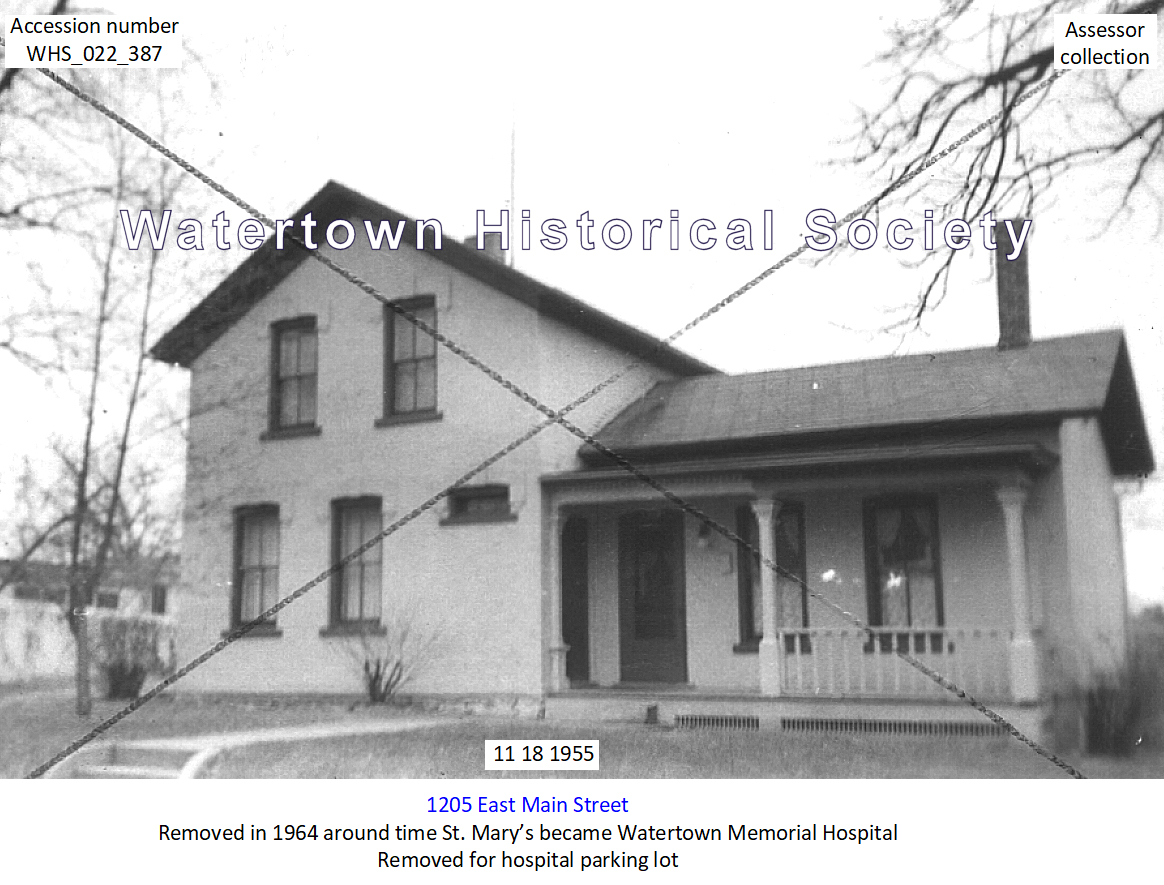
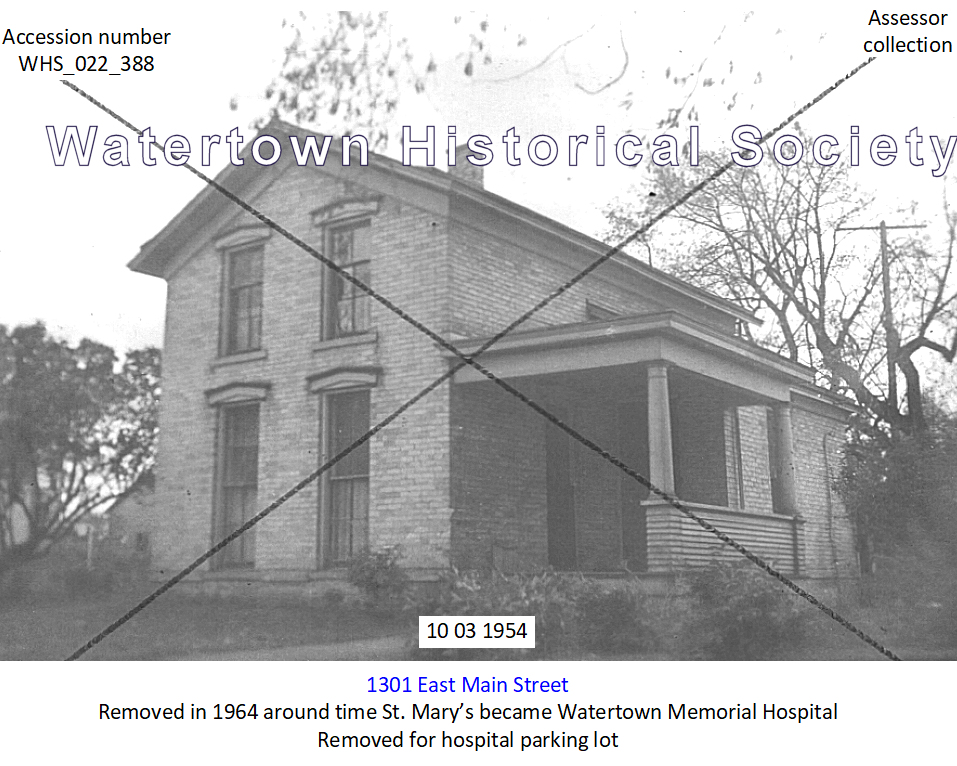
08 20 DURRANT AND BERGQUIST, ARCHITECTS
A giant step forward in the improvement of the Watertown Memorial
Hospital was announced today, with the engagement of the firm of Durrant and
Bergquist, architects. The announcement
was made by William Loeb, a member of the hospital board of directors, and
chairman of the Building and Grounds Committee.
The architectural firm, based in Watertown and in Dubuque, Iowa, has had
extensive experience in designing hospitals, schools, nursing homes, churches,
court houses and other public buildings throughout Wisconsin, Iowa and
Illinois.
1965
06 22 REMODELING AND
REFURBISHING PROGRAM
A major improvement program for
the hospital authorized at a special meeting of the board of directors of the
Watertown Memorial Hospital Association held Monday night at the hospital, has
been announced by the board president, Paul Kehrer. In making this announcement Mr. Kehrer
pointed out that this remodeling and refurbishing program was promised the
public during the $500,000 fundraising campaign held in the spring of 1964. Funds already collected have been applied to
repaying with interest the loan received for purchasing the hospital and
providing operating capital. WDT
11 25 CONSULTANT ENGAGED TO DETERMINE FUTURE PLANS
A consultant is to be engaged by
the Watertown Memorial Hospital Association to help the association’s board of
directors determine future plans for the hospital, it was announced last night
at the annual meeting of the association membership, held in the basement area
of the Watertown Municipal Building.
With the patient load gradually increasing, and with Medicare to place
an additional load on the hospital, as well as all hospitals, the board feels
it necessary to take a look into the future, the meeting was informed by Paul
Kehrer, president. WDT
11 28 FORMER ST. MARY’S BECOMES WATERTOWN MEMORIAL
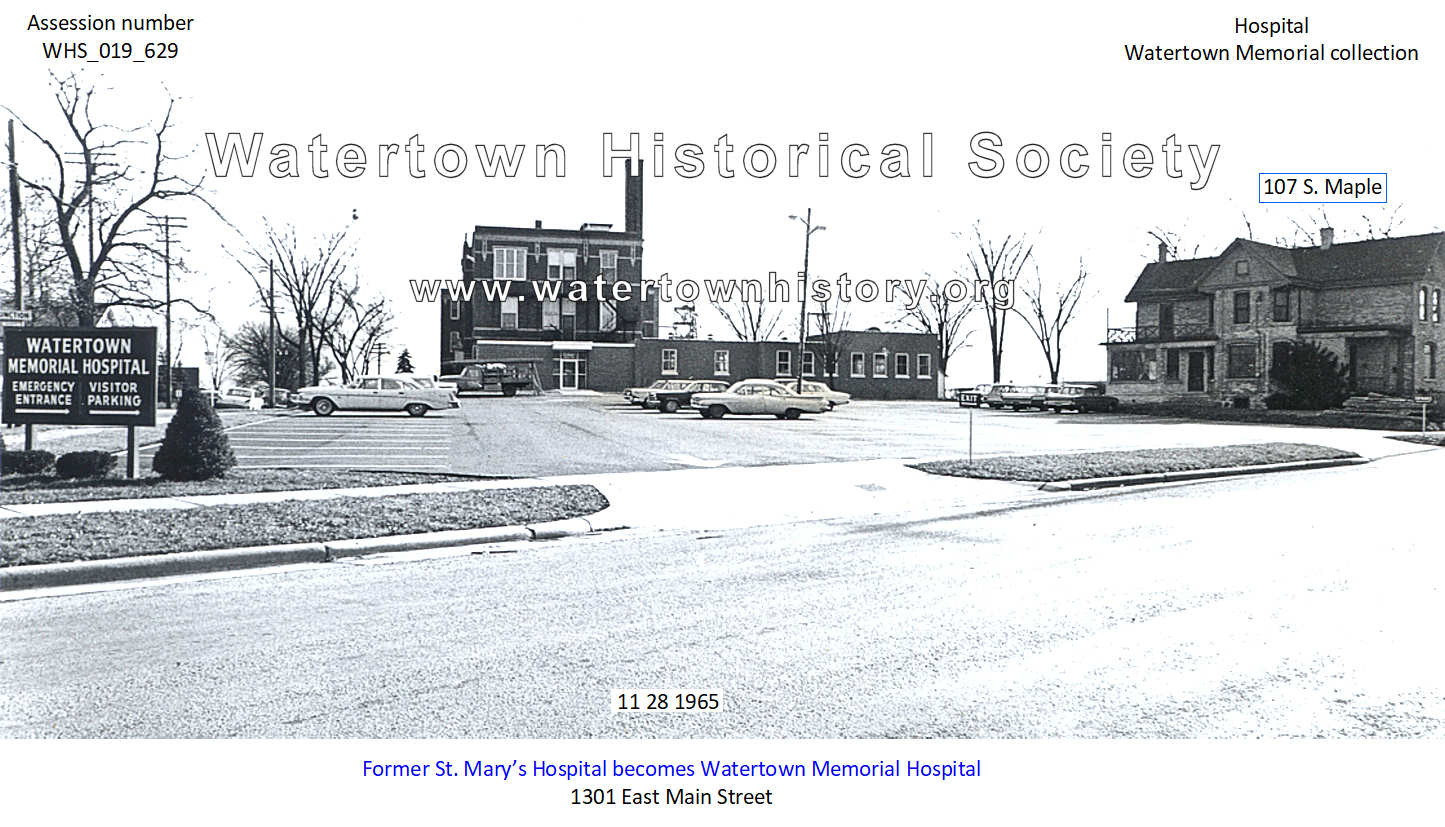
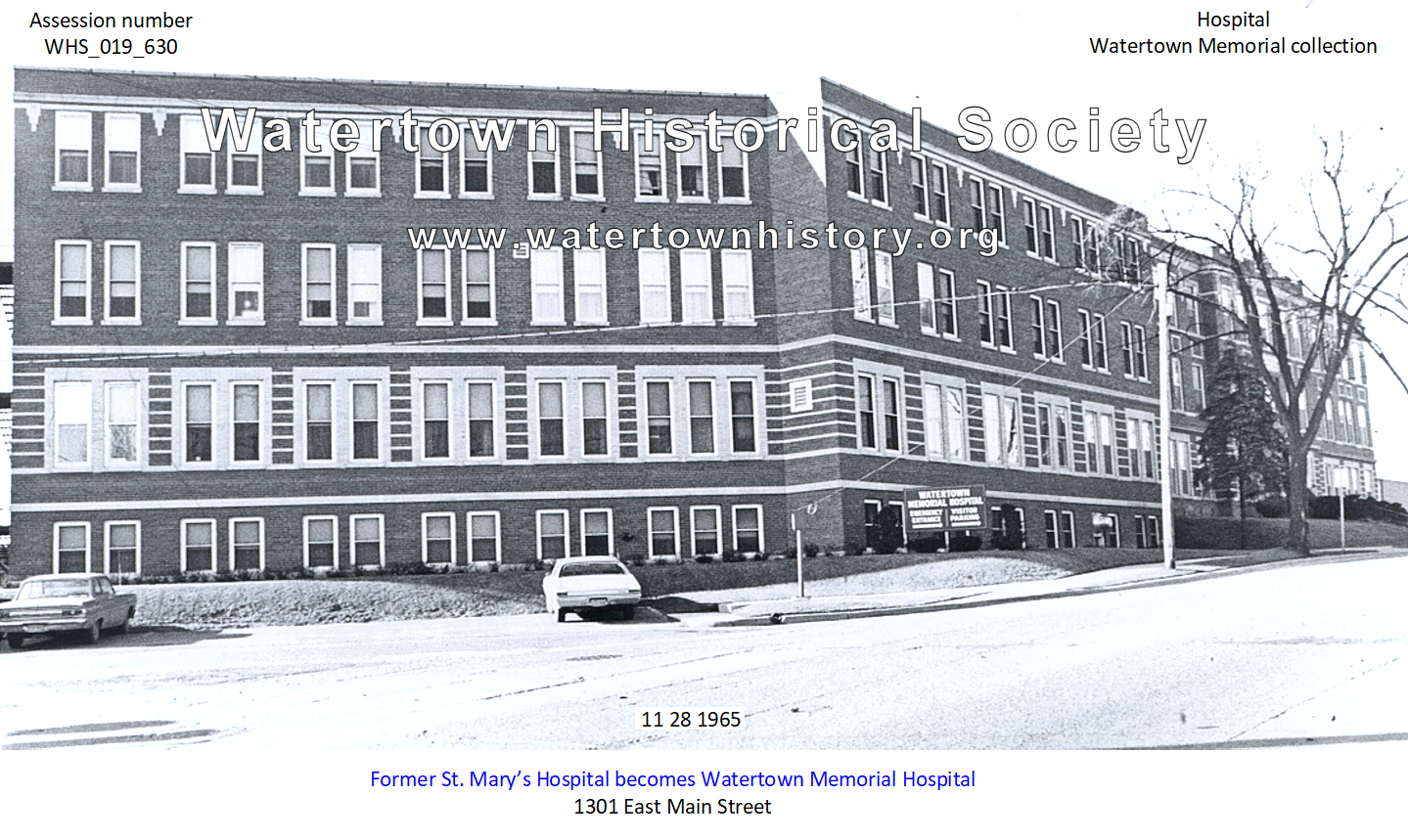
Dec ANNUAL CHRISTMAS VISIT
Visit of “little angels” and the Christ
Child to Watertown Memorial Hospital.
12 30 ANNUAL 20-YEAR CLUB
PARTY
On behalf of the Brandt Automatic Cashier Company, E. James
Quirk, president of the company, presented a check for $5,000 to the Watertown
Memorial Hospital Association Inc., to be used for the purchase of additional
equipment that is needed by the hospital.
In making this gift Mr. Quiik stressed that
Brandt, a local industry, was vitally interested in supporting this worthwhile
community project and wanted to take this opportunity of wishing the Watertown
Memorial Hospital Association continued success. WDT
1966
01 12 REMODELING AND
REFURBISHING PROGRAM
On Friday the Watertown Memorial
Hospital Auxiliary brought to a close the most ambitious fund-raising project
undertaken since its organization two years ago. A check in the amount of $5,402.27,
representing the entire proceeds of the recent successful Harvest and Holiday
Bazaar was presented to the Hospital Association for the specific purpose of
purchasing and installing new draperies, rods and shades for patient rooms
throughout the hospital. Mrs. Edwin
Hulbert, general chairman of the bazaar, and president-elect of the auxiliary,
presented the check to Miss Catherine Jean Quirk, board member and chairman of
the decorating committee for the hospital.
WDT
05 11 OPEN HOUSE
More than 1,000 people
visited Watertown Memorial Hospital Sunday afternoon during the hospital’s open
house. Interest ran high over the many
improvements seen. These improvements
include a new emergency room, a new physiotherapy department, a new elevator
and a new patient area, and several remodeled areas, with redecorating
throughout. The administrator, Leo C. Bargielski, and the board of directors expressed their
gratification at the turnout which enabled the public to see the many changes
made possible by their continued honoring of their pledges made during the
hospital’s campaign in 1964. With one
year of the pledge program still to be completed additional improvements are
scheduled, they pointed out, most of them on the second and third floors. WDT
11 25 NEW HOSPITAL PLANNED
A new hospital for
Watertown is being planned. Plans for a
new hospital were discussed at the annual meeting of the Watertown Memorial
Hospital Association, held last evening at the Municipal Building. Steps have been taken to make this move
following recommendations received from a hospital consultant, Dr. Anthony J.J.
Rourke, of New Rochelle, New York. The
present hospital, the meeting was told, will be retained and utilized as an
extended care nursing facility. WDT
1967
04 14 SCHEMATIC DESIGN
STUDIES
The board
of directors of the Watertown Memorial Hospital Association announced today
that it has retained the services of S. C. Smiley & Associates, a
Minneapolis, Minn., based firm of architects, to begin immediately the
preparation of schematic design studies for a new hospital for the Watertown
community. Following an exhaustive study
and survey by the association’s building and grounds committee this firm was
selected as one having the best record of successes in designing and
supervising the construction of hospitals of the size being considered for
Watertown.
04 14 Hospital
News and Views column, WDT
09 25 HILL-BURTON GRANT
A
Hill-Burton Grant of $1,066,000 has been approved for the Watertown Memorial
Hospital Association for construction of a new hospital to accommodate 84
general beds and 70 long term beds, according to word today from the office of
Congressman Robert W. Kastenmeier in Washington, D.
C. The application for the grant was
signed by Paul H. Kehrer, president of the hospital association here. It had been pending for some time. Total cost of the Watertown project is listed
at $2,700,500.
11 24 CONSTRUCTION WILL
BEGIN JULY OF 1968
Construction
of a new 94 bed hospital in Watertown will commence before July 1 of next year,
with the hospital scheduled to be completed and occupied in the summer of 1970,
it was announced last night at the annual meeting of the Watertown Memorial
Hospital Association, held at the Municipal Building. The cost of the hospital is estimated at $3
million, with 40 per cent, or $1,200,000 to be provided by the federal
government under the Hill-Burton Act. Of
the remaining estimated $1,800,000 needed, from $700,000 to $ 1,000,000 is
scheduled to be raised in a fund drive and the balance will be borrowed.
11 25 ROBERT WILLS
ELECTED PRESIDENT
Robert Wills last night was elected president of the Watertown Memorial
Hospital Association at a meeting of the board of directors held following the
annual meeting of the association at the Municipal Building. Wills succeeds Paul Kehrer, who had been
president since February of 1964, succeeding Erwin C. Bilse. Kehrer declined reelection. Wills, along with Andrew McFarland, own and
operate Busse’s Pharmacy; and Kehrer is president of the Watertown Savings
& Loan Association. Wills had been
vice president. He was succeeded in this
office by Raymond Kaercher, president of the Globe Milling Company.
1968
Feb 200 BED DISASTER HOSPITAL
The Packaged Disaster Hospital is
a unit of sufficient medical supplies, cots, bedding and pharmaceuticals to
establish a complete 200 - bed hospital.
In time of disaster, nuclear or natural, Watertown Memorial Hospital can
use this unit, Carroll said, to expand its capacity or, if necessary, set it up
as a subsidiary facility in another building.
The unit will be stored at Bethesda Lutheran Home until Memorial
Hospital completes its present building plans.
Packaged Disaster Hospitals [PDH's] are affiliated with local hospitals
meeting federal and state criteria for emergency planning and location. This new programming assures that there will
be a physician to direct the use of the emergency hospital and will help assure
adequate professional staffing of the unit in time of need.
03 03 HOSPITAL FUND
DRIVE
The
Watertown Memorial Hospital Fund Drive to raise $800,000 needed in connection
with the construction of a new hospital here is off to a flying start. At last night’s “Kick-off” dinner, held at
the high school gym, it was announced that $208,500 already has been
pledged. This includes $40,370 pledged
by the employees at the hospital. It was
announced last night that the pledge goal of $40,000 for the 144 full time
employees was “over the top.”
03 15 PLEDGES RECEIVED
The total
pledged in the Watertown Memorial Hospital campaign reached $422,350 Thursday
night when 35 members of the advance gifts committee met at Elks Hall and
posted an additional $122,350.
Industrial gifts accounted for $70,000 with Brandt Automatic Cashier Co.
pledging $30,000, G. B. Lewis Company, $20,000 and Durant Mfg. Co.,
$20,000. At an earlier report meeting
Lindberg Hevi-Duty, which has a plant in North Carolina where a hospital
campaign is also being conducted, pledged $25,000.
05 02 FUND DRIVE TARGET
EXCEEDED
The goal of
$800,000 in the Watertown Hospital Fund Drive has been exceeded by $48,675.37,
it was announced last night at the victory celebration held at the high school
gym. The figure of $848,675.37 was
dramatically revealed on large cards held by 11 Watertown Memorial Hospital
nurses, all dressed in the white uniforms of their profession. The figure was unfolded with the “7” first,
the “3” next, the period next, etc. The
large crowd of workers on hand broke into loud and spontaneous applause as the
nurses from the stage revealed the figure.
04 06 ROBERT FRANZ
APPOINTED TO BOARD
Robert
Wills, president of Watertown Memorial Hospital Association Board of Directors,
today announced the appointment of Robert Franz, local business man in a
directorship on the board of directors. Mr. Franz is a native of Watertown and
has been quite active in community affairs. He is past president of the
Watertown Rotary Club, president of Fin ‘N’ Tail Foods Inc. and president of
Chef Pierre’s Caterers. Mr. Franz replaces William Loeb, who recently resigned
due to heavy business commitments.
06 14 HOSPITAL FUND
DRIVE LEADERS
Three Watertown men who played a big role in the Watertown Hospital Fund
Drive were singled out for special recognition at last night's dinner meeting
of the Watertown Area Chamber of Commerce, held at the Legion Green Bowl. Named "Citizens of the Year" were
Robert Wills, president of the Watertown Memorial Hospital Association; and Dr.
J.R. Casanova and Dr. Clarence Golisch, executive director of Bethesda Lutheran
Home, both of whom were co-chairmen of the drive. Wills and Casanova were presented with plaques
by Mayor A. E. Bentzin. Golisch was unable to attend last night's
meeting.
09 11 CONSTRUCTION
BIDS
Construction
bids for the new Watertown Memorial Hospital Center were opened yesterday
afternoon in the council chambers of the municipal building, but it was
announced today that more detailed study of the bids will have to be made
before any decisions are possible. Seven
general contractors, nine electrical contractors, and twenty-one mechanical
contractors submitted sealed bids.
Apparent low bidders were the Maas Brothers Construction Company of
Watertown, general electrical contractor, with a base $2,054,000; the Staff
Electrical Company of Milwaukee, electrical contractor, with a base bid of
$322,931; the Wesley Plumbing Company of Milwaukee, plumbing contractor, with a base bid of $249,500;
and the W. & H. Heating and Ventilating Company of Milwaukee, heating and
ventilating contractor, with a base bid of $479,800.
10 11 GROUNDBREAKING
CEREMONY
Ground was
broken on Wednesday afternoon for Watertown’s new 120-bed hospital, to be
erected on a knoll on the northeast part of the city, just beyond the highway
16 by-pass. The ceremony was conducted
on a dreary afternoon, with a drizzle before the program was completed. Despite the poor weather, a large crowd was
on hand for the ceremony. The first
shovel of ground was turned by Robert Wills, president of the Board of
Directors of the Watertown Memorial Hospital Association. Dr. J. R. Casanova, who was co-chairman of
the successful finance drive, was master of ceremonies. He introduced a large number of persons, some
of whom gave brief addresses.
11 21 DOCTOR
SHORTAGE
Strenuous efforts have been made this past year to induce more doctors
to locate in Watertown, it was reported last night by Robert Wills, president
of the Watertown Memorial Hospital Association, at the association’s annual
meeting. Wills said that the need for
more doctors in Watertown is very real, and because it is very real, and
because it is so acute, he urges everyone to help in any way possible. Watertown residents, and residents of the
hospital area, who have friends in medical schools, or in internships, were
urged by him to try to induce them to locate in Watertown. He said the association board has met with
the local doctors, soliciting their help in bringing more medical men into the
city.
01 25 BOND SALE
The B.C. Ziegler Company of West Bend, specialists in institutional
financing, reported today that the sale of the $1,400,000 Watertown Memorial
Hospital Association bond issue was highly successful. One-hundred and fifty persons from Watertown
and area purchased $450,000 in bonds.
The sale of this area was handled by Howard J. Griffin, resident manager
of the Ziegler firm’s office in Fort Atkinson.
In charge of advance sales was Robert French, West Bend, assistant sales
manager for the company.
1969
06 04 NEW
ANESTHETIST
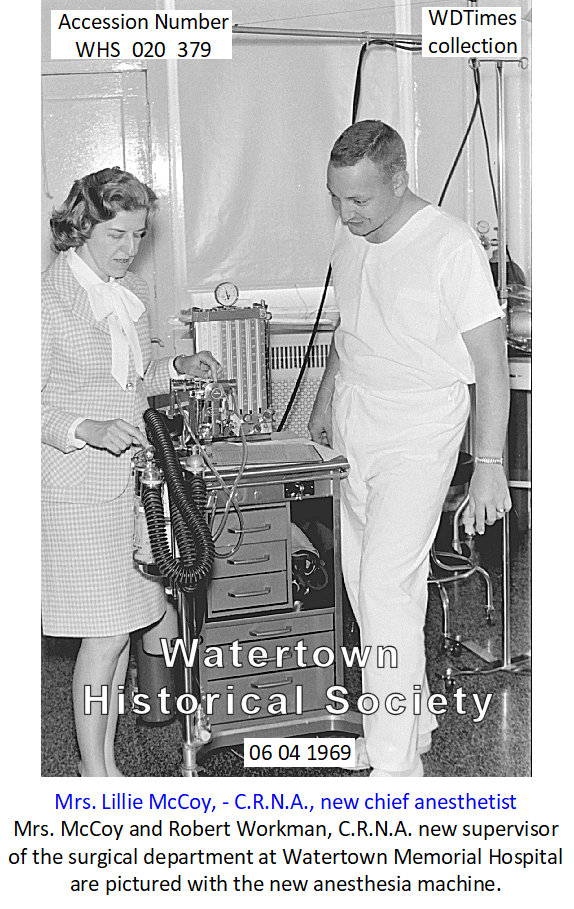
Mrs. Lillie McCoy, C.R.N.A., will succeed Robert A. Workman, C.R.N.A.,
as chief anesthetist on the staff of the Watertown Memorial Hospital. She is a 1950 graduate of Norwegian American
Hospital School of Anesthesiology and has been on the staffs of Norwegian
American Hospital, South Shore Hospital, and St. Francis Hospital, all of
Chicago; and St. Luke's Hospital of Racine.
She has served on the board of The Illinois State Association of Nurse
Anesthetists as Secretary and President.
She has also been on the Executive Committee for Infant Health and
Welfare for the State of Illinois. Mrs.
McCoy's husband, Charles R., is Professor of Chemistry at Wisconsin State
University, Whitewater. They have a five
year old son.
Robert Workman, C.R.N.A., has accepted the position of supervisor of the
surgery department of the hospital succeeding Mrs. Louise (Bobbie) Hartman who
has held that position since 1964.
Workman has been an anesthetist on the hospital staff since June,
1966. His knowledge in this specialty is
considered a benefit in his capacity as Surgical Supervisor. Workman will be responsible for the complete
operation of the hospital's surgical department.
It was with reluctance that the hospital accepted the retirement of Mrs.
Hartman who has served the hospital with dedication and faithfulness for many
years.
She began work as an R.N. in
1932. She has returned intermittently
between raising a family and since May, 1961 without interruption.
12 03 MEMORIAL HOSPITAL BUILDING ON EAST MAIN SOLD
Former St. Mary’s to be become retirement home
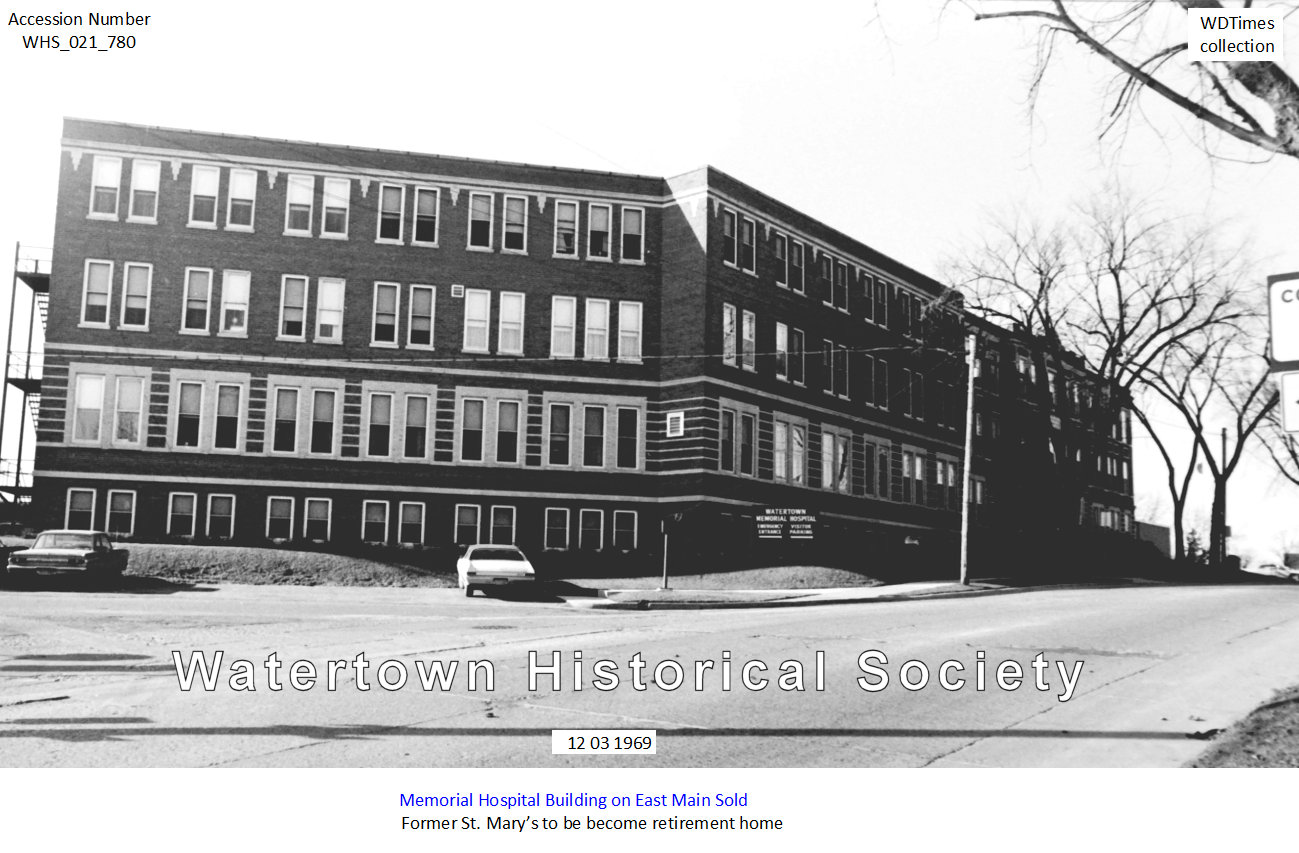
10 17 NEW
SURGICAL AND CORONARY INTENSIVE CARE UNIT READY FOR USE
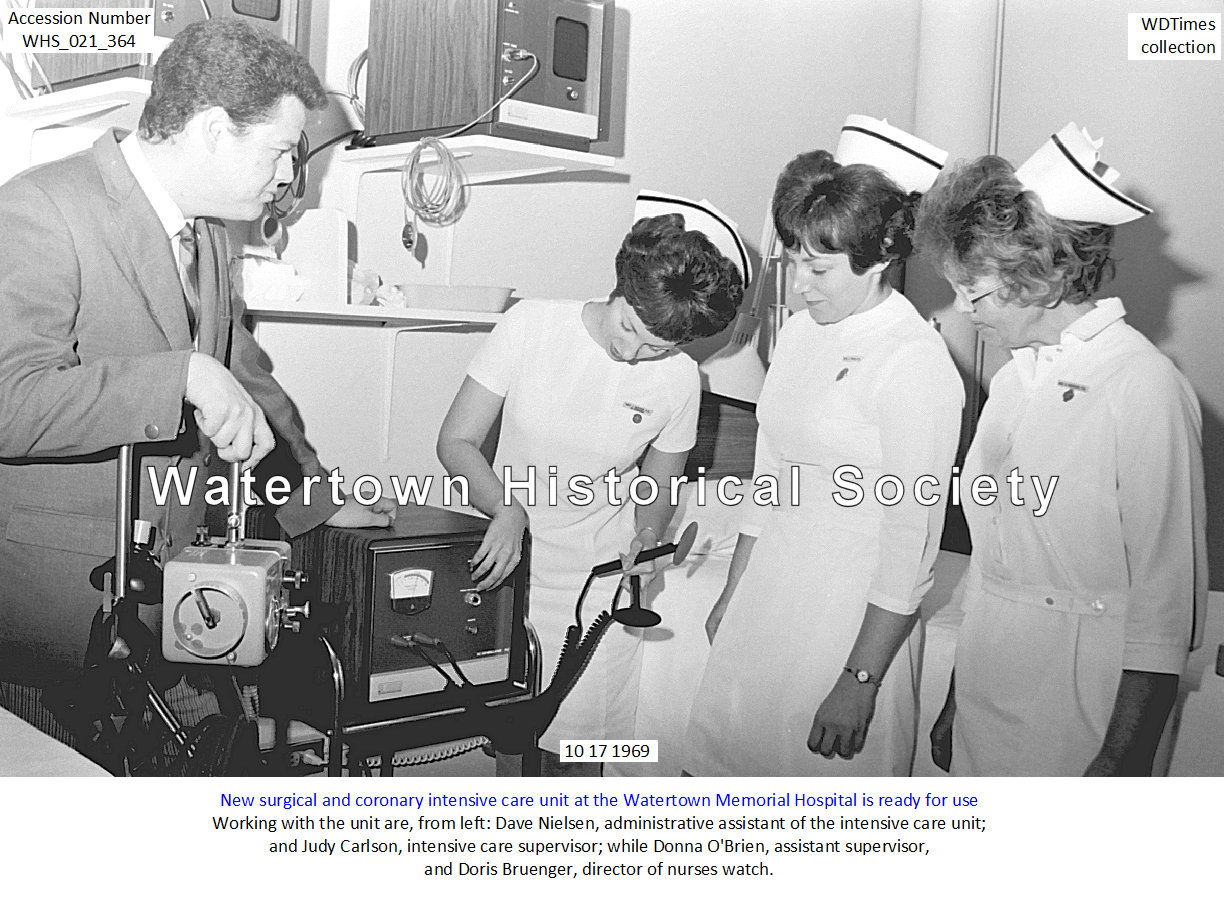
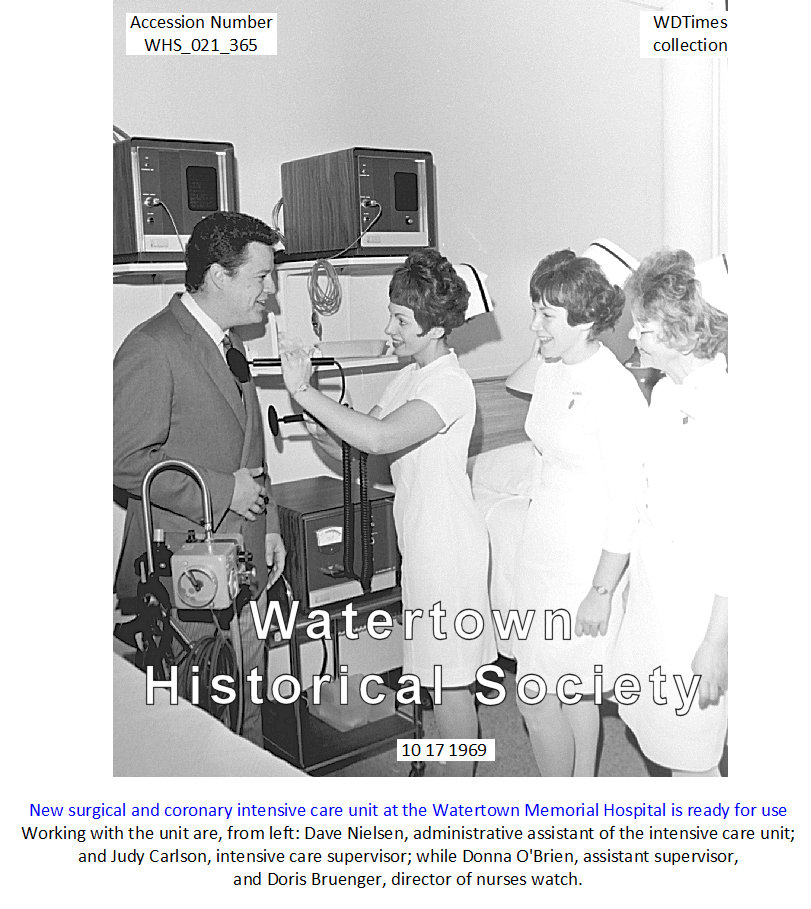
“The finest patient-care
improvement made to date at our community hospital.”
The service was established so
that patients whose conditions are potentially reversible during a critical
phase of illness may receive highly specialized and concentrated care. Exceptionally skilled nursing care services
under medical supervision will be provided within the unit around the
clock. The most advanced electronic monitoring
and treatment equipment will be immediately on hand. All known life-saving
supplies and medications will be available within the room.
-- -- WATERTOWN
MEMORIAL HOSPITAL CONSTRUCTION
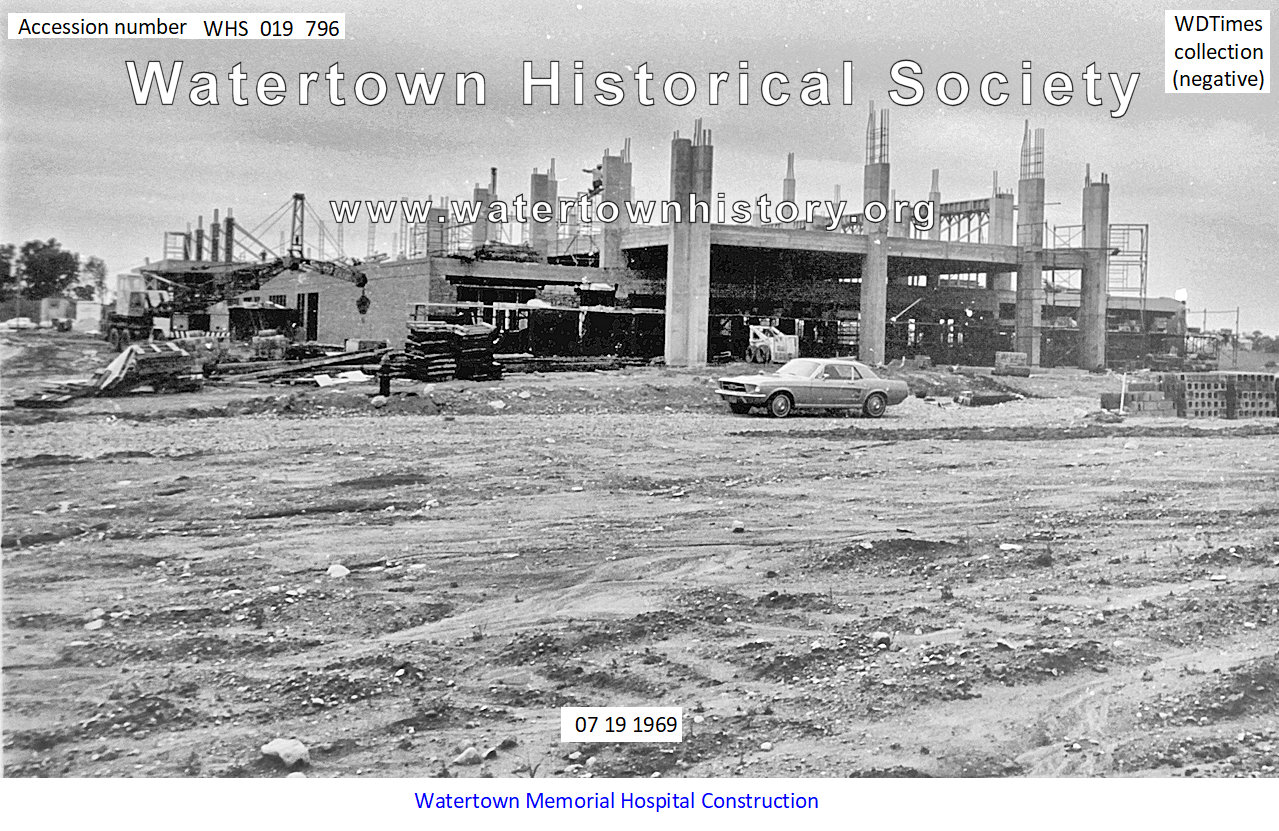
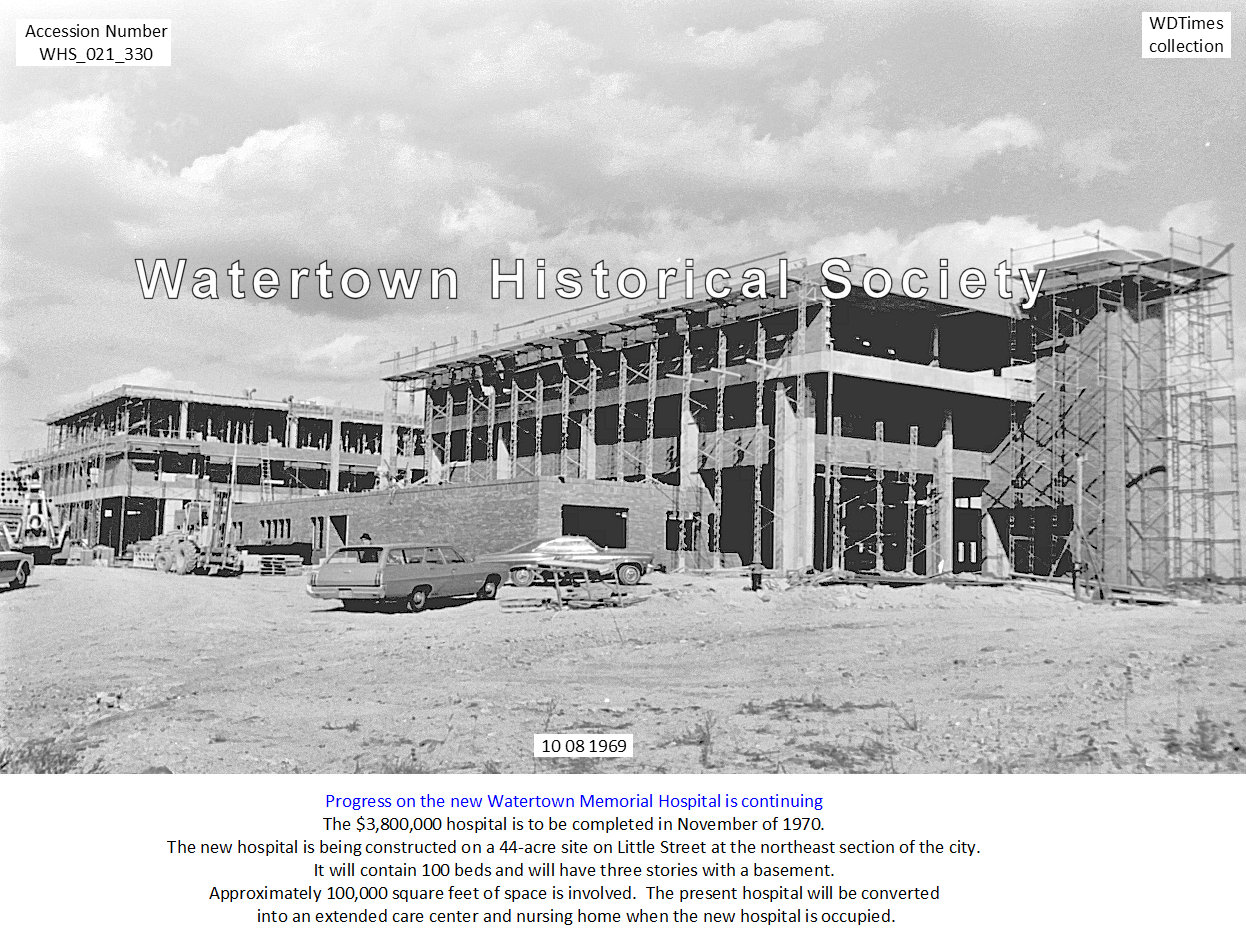 125 Hospital Drive, Watertown
Constructed by Maas Bros.
Scroll through image set within portfolio
1970
05 09 NEW AREA HEALTH CARE CENTER
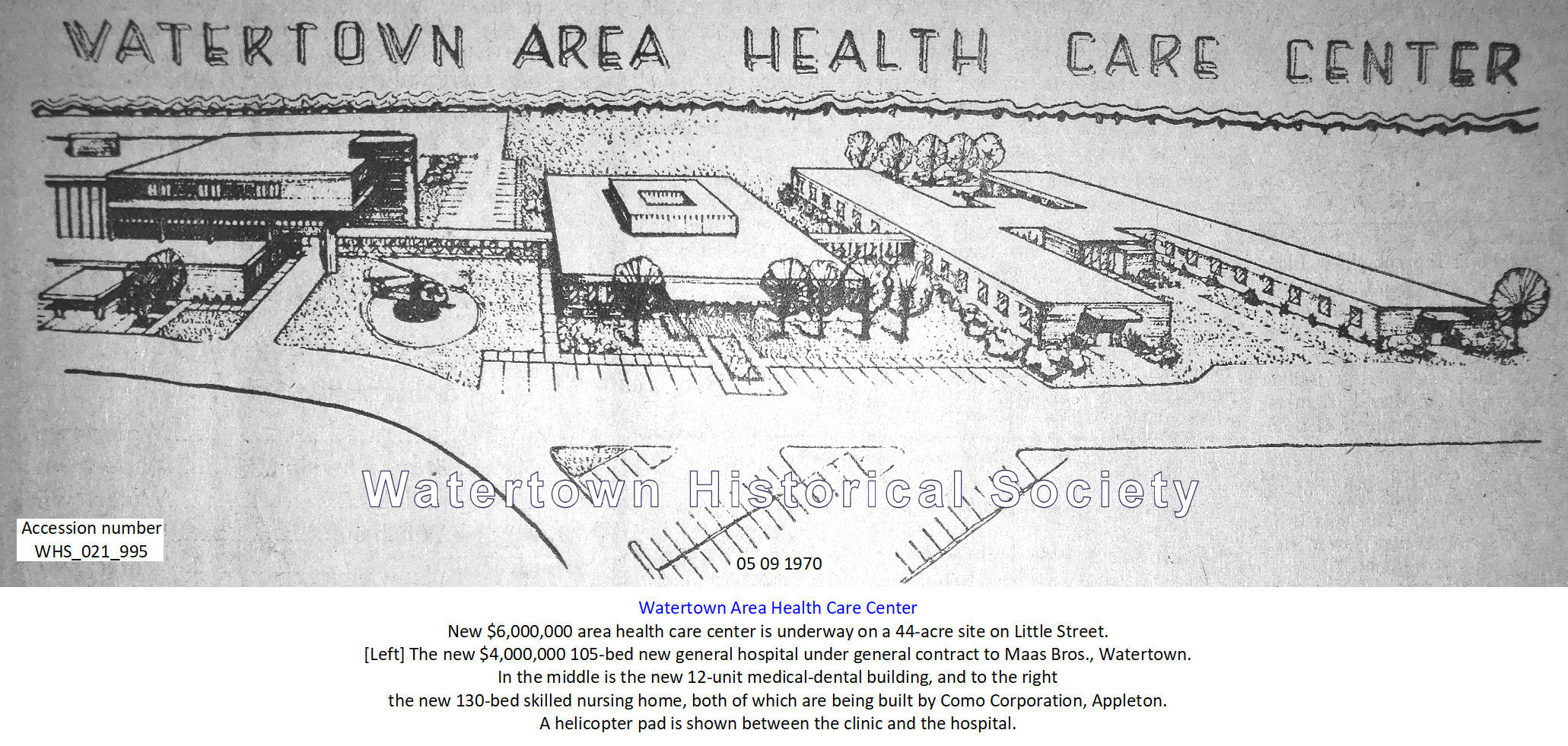
Watertown's new $6,000,000 area
health care center is underway on a 44-acre site on Little Street.
The new $4,000,000 105-bed new
general hospital designed by S. C. Smiley Co., Minneapolis, and under general
contract to Maas Bros., Watertown.
The new hospital, already
erected, is owned and will be operated by the Watertown Memorial Hospital
Association, which sold the present hospital downtown, to the Como Corporation,
Appleton.
When the old hospital is
vacated it will be operated by them as a residential care unit.
In the middle is the new
12-unit medical-dental building, and to the right the new 130-bed skilled
nursing home, both of which are being built by Como.
A helicopter pad is shown
between the clinic and the hospital.
All three new buildings are
compatible in design, and the same face brick will be used throughout. All are easily expandable.
The design of the nursing home
will be similar to the Heritage Home built by Como in Beaver Dam. The clinic will connect with both the
hospital and the nursing home by an enclosed surface walkway. Ample parking is provided for each of the buildings. The entire project is scheduled for
completion in early 1971.
05 27 GROUND
BREAKING CEREMONIES
for the new
extended care nursing home and doctor’s clinic
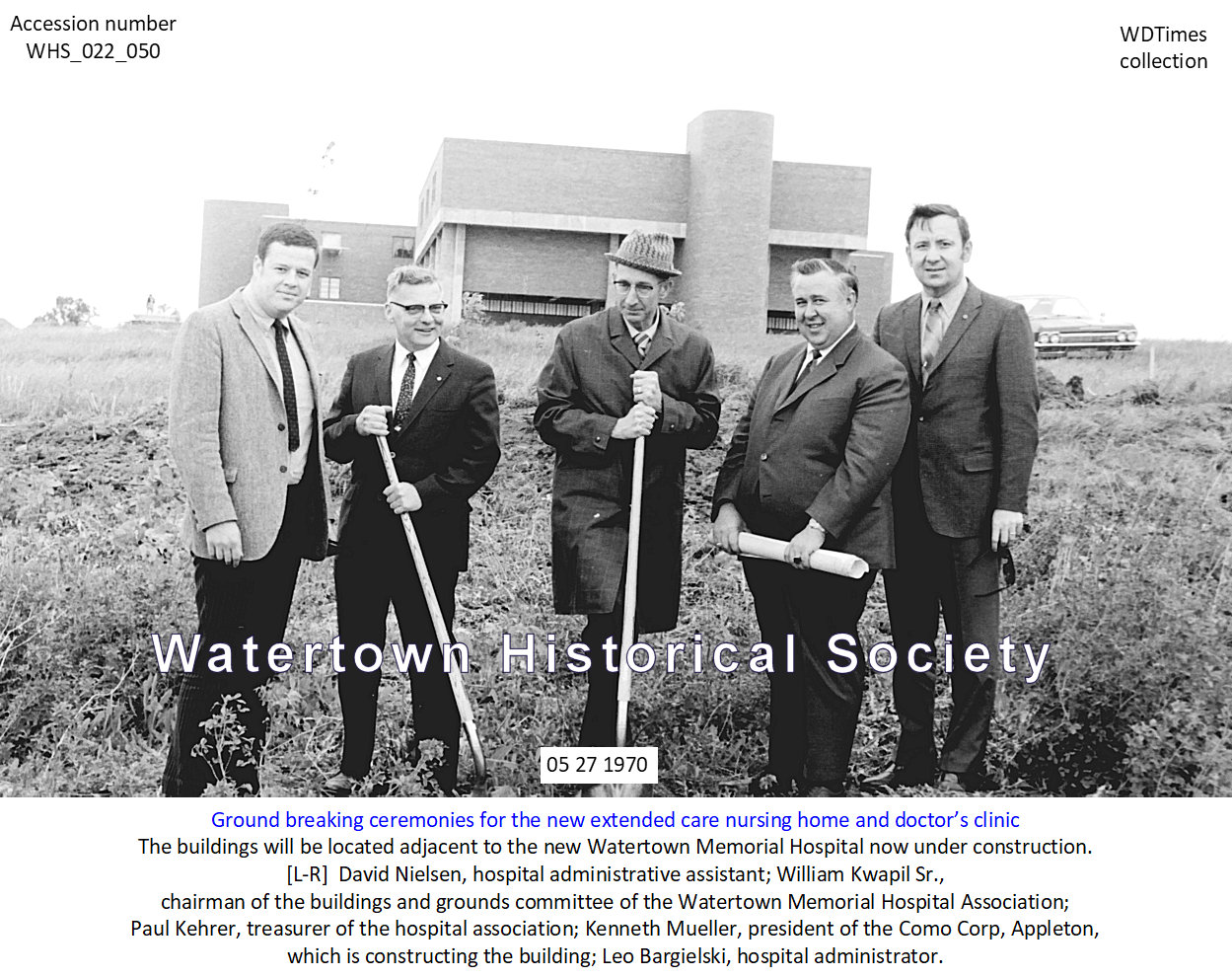
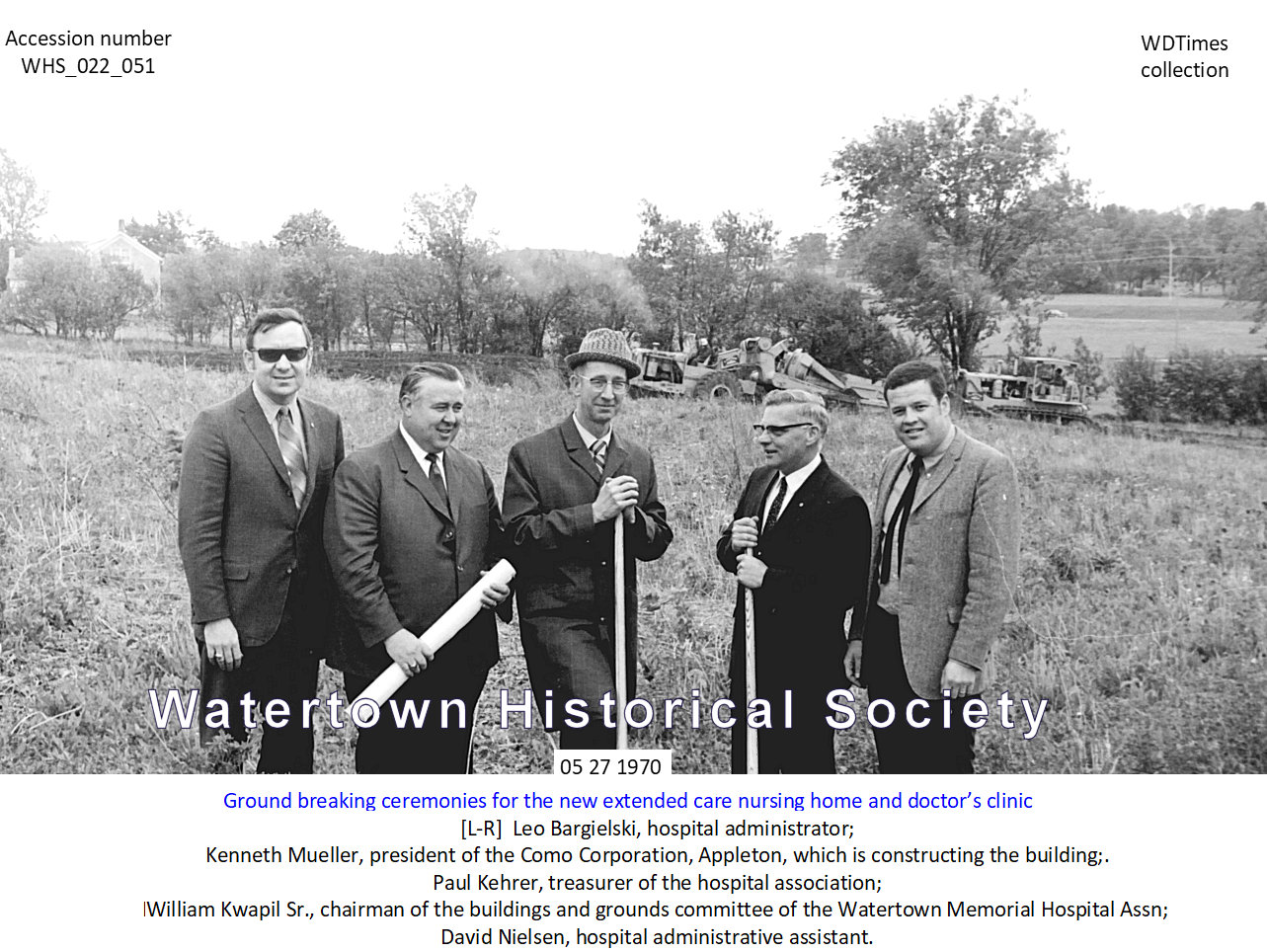
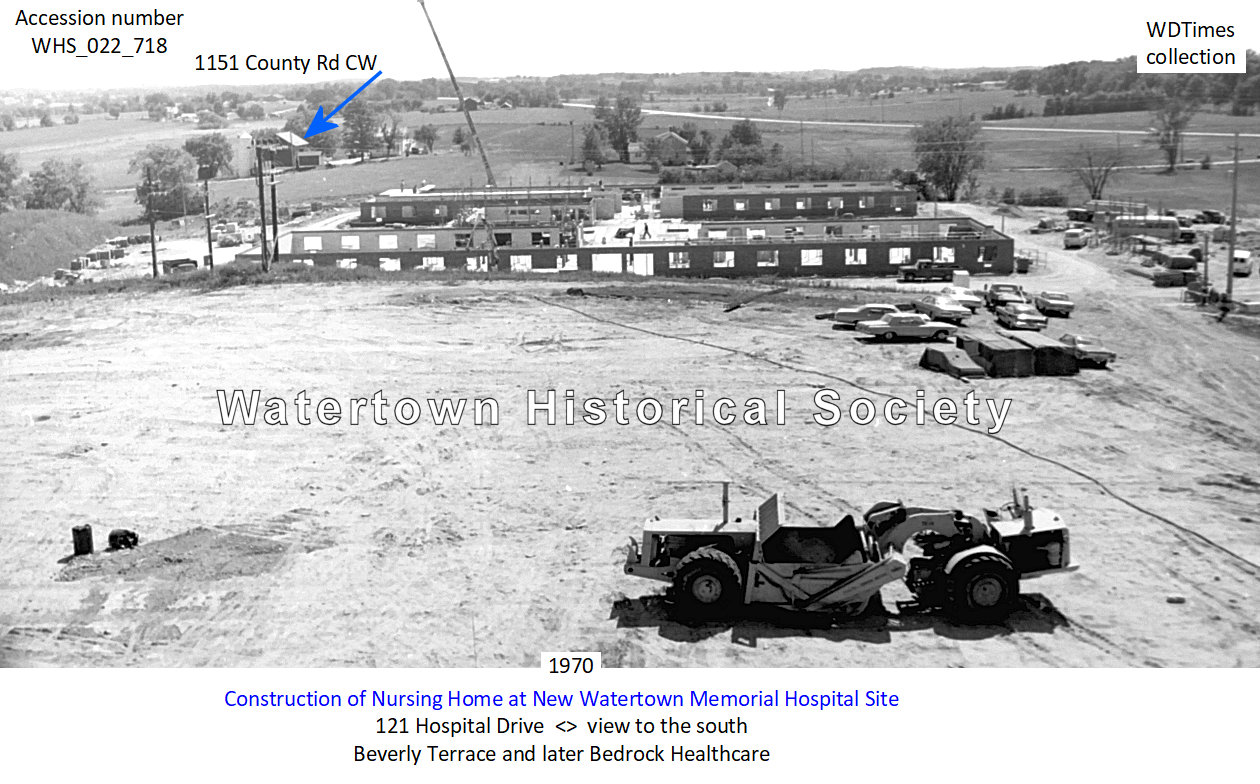
The buildings will be located
adjacent to the new Watertown Memorial Hospital now under construction.
David Nielsen, hospital
administrative assistant; William Kwapil Sr.,
chairman of the buildings and grounds committee of the Watertown Memorial
Hospital Association; Paul Kehrer, treasurer of the hospital association; Kenneth Mueller, president of
the Como Corp, Appleton, which is constructing the building; Leo Bargielski, hospital administrator.
06 11 “OUR BABY'S FIRST SEVEN YEARS" RECORD BOOK
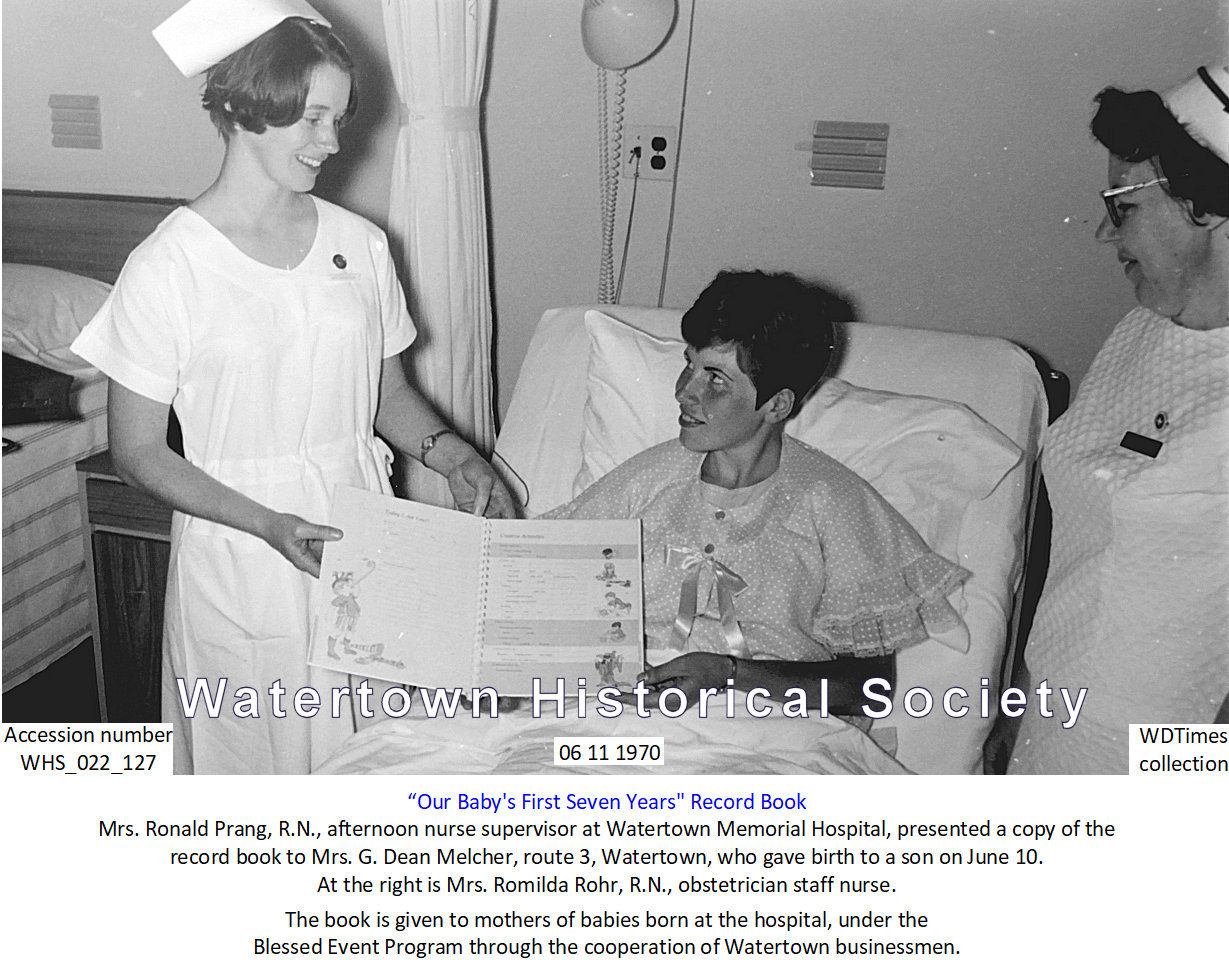
Mrs. G. Dean Melcher, route 3,
Watertown, who gave birth to a son
Mrs. Ronald Prang, R.N.,
afternoon nurse supervisor,
Mrs. Romilda Rohr, R.N., obstetrician staff
nurse
07 03 Dr.
AMEER DIXIT WELCOMED
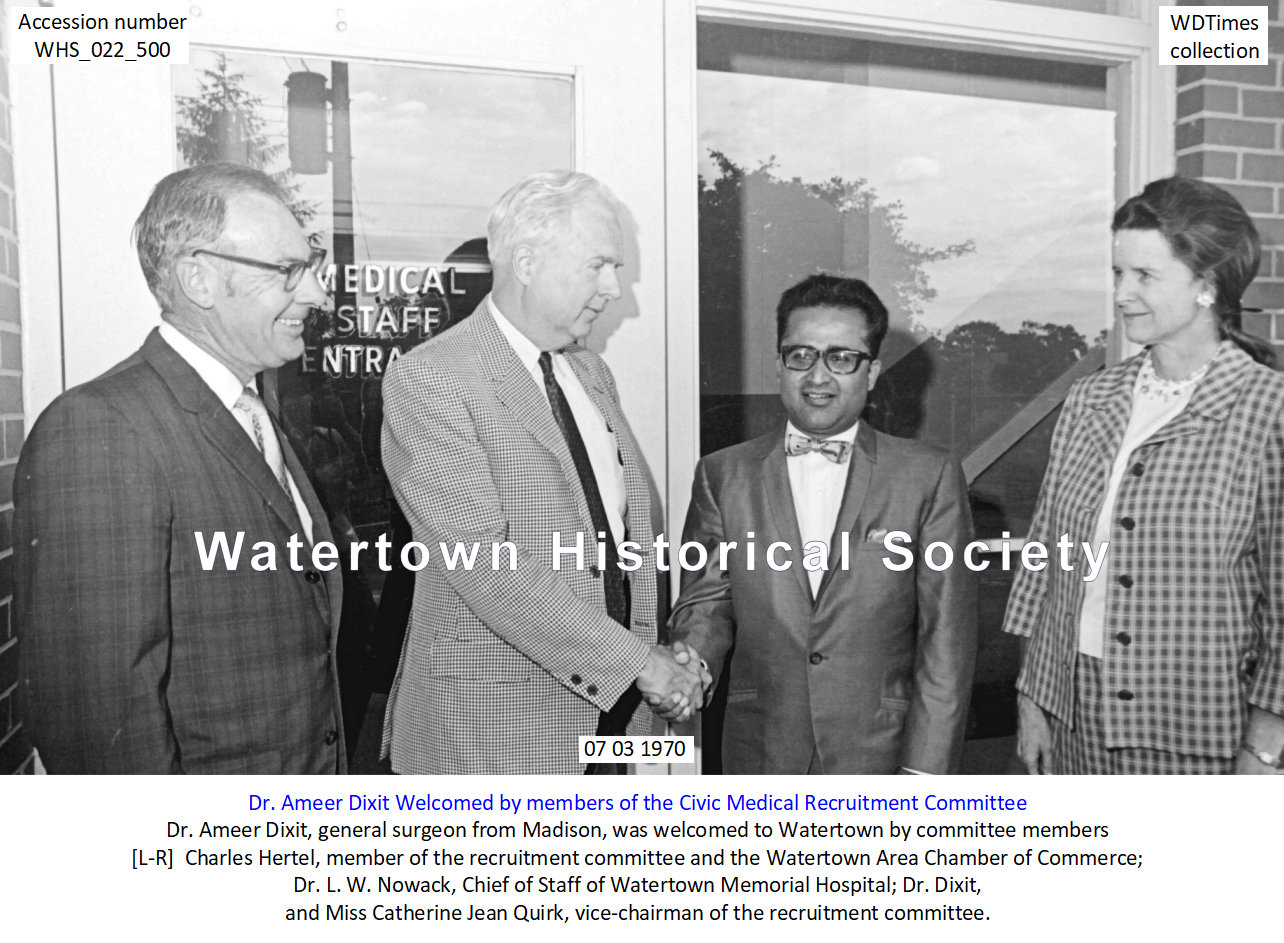
Dr. Ameer Dixit Welcomed by
members of the Civic Medical Recruitment Committee. Dr. Ameer Dixit, general surgeon from
Madison, was welcomed to Watertown by committee members; Charles Hertel, member
of the recruitment committee and the Watertown Area Chamber of Commerce; Dr. L.
W. Nowack, Chief of Staff of Watertown Memorial Hospital; Dr. Dixit, and Miss
Catherine Jean Quirk, vice-chairman of the recruitment committee.
07 09 THE
PANTSUIT IS IN
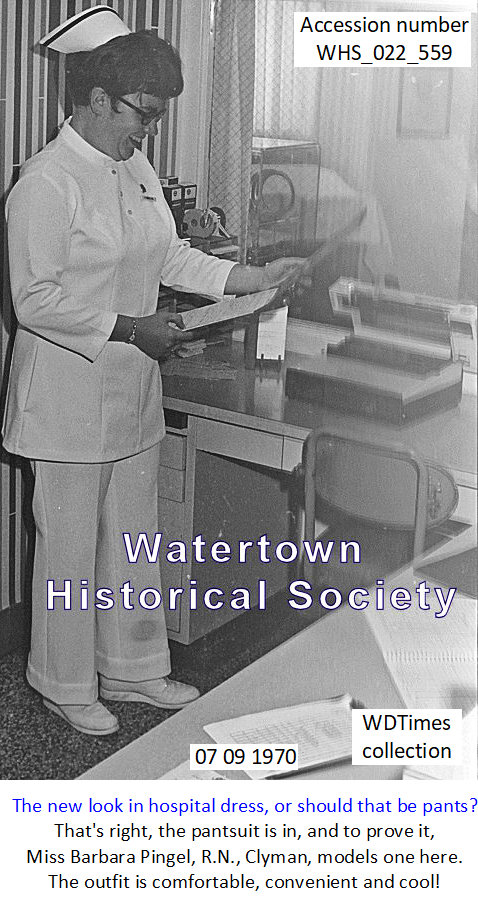
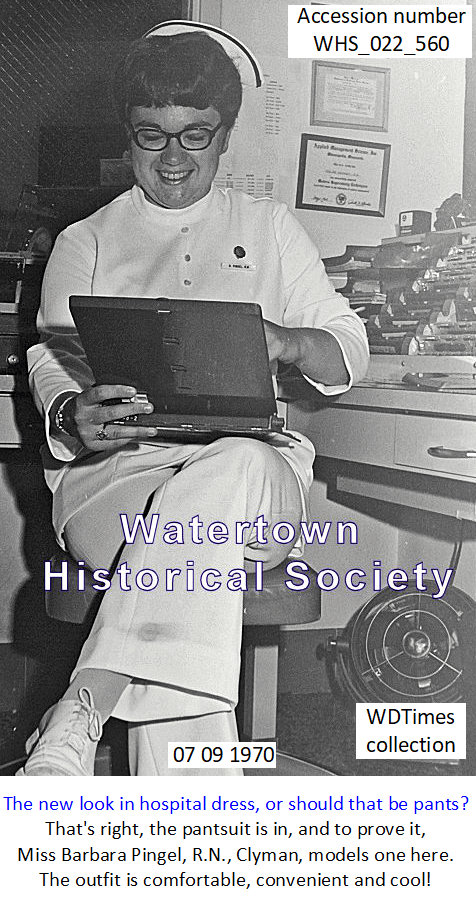
The new look in hospital dress,
the pantsuit
08
12 CIVIL DEFENSE DISASTER
DRILL
Mock
explosion at Lindberg Hevi-Duty resulted in simulated injuries to 30 young
persons, treated at the scene and then transported to Watertown Memorial
Hospital.
09 14 HOSPITAL EXTERIOR BEING PAINTED
BLUE-GRAY
Other Projects Planned in Future
Painting of the exterior of the
hospital building on East Main Street is underway under the direction, and at
the expense of the building's new owners, the Como Corporation of Neenah who
purchased it in June of this year. The company, which will convert the building into a
retirement home, has stated that considerable interior renovation is planned,
some of which has been started, but most of which will be completed after the
hospital operation is transferred to the new hospital on Little Street. Pending the opening of the new hospital
early next year the Main Street building still in use as a hospital is being
leased from the new owners.
1971
01 29 REFERENCING BLUEPRINTS BEFORE DEDICATION
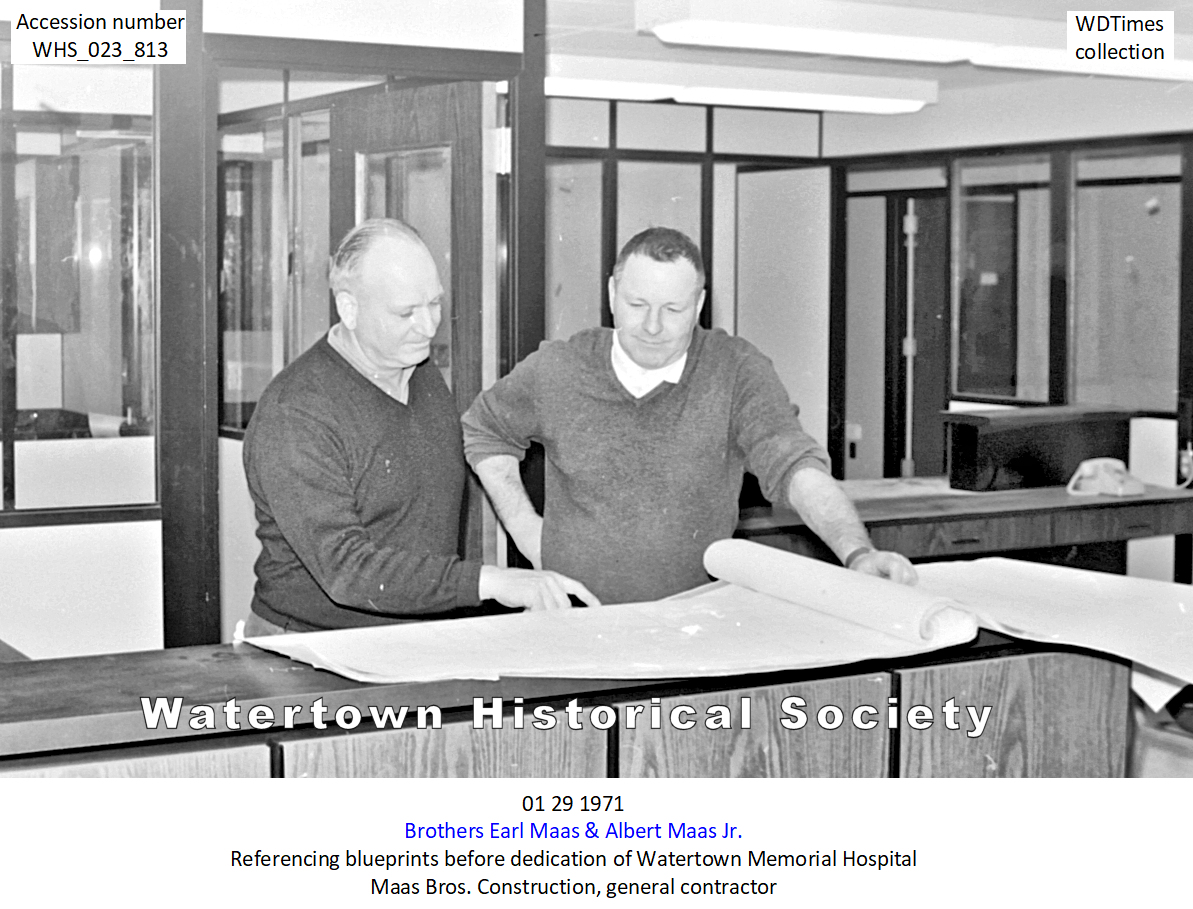
Brothers
Earl Maas & Albert Maas Jr., Maas Bros. Construction, general contractor
--
-- WATERTOWN MEMORIAL HOSPITAL RELOCATED TO NEW FACILITY at 125
Hospital Drive.
-- -- WATERTOWN MEMORIAL HOSPITAL DEDICATION EVENT
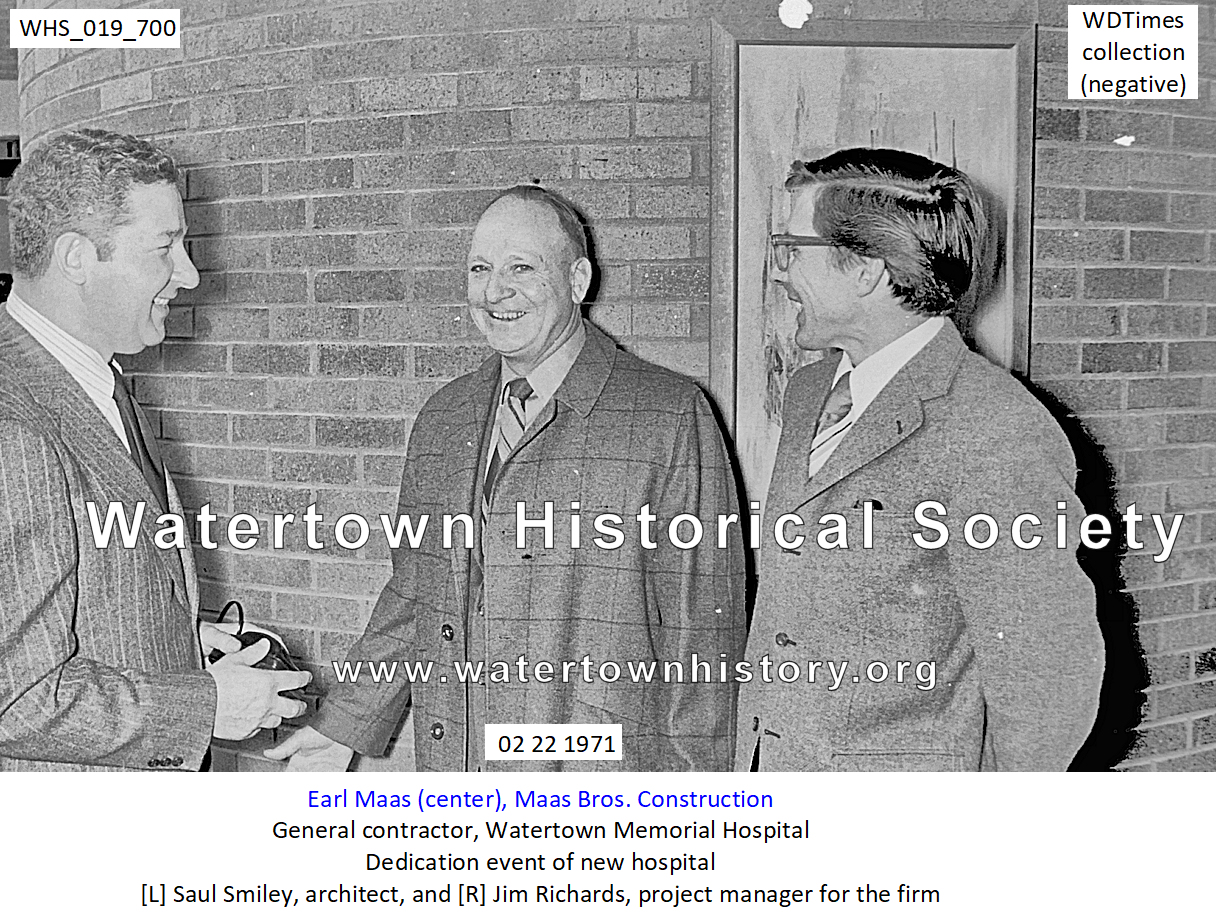
02 22 1971:
Earl Maas (center), Maas Bros. Construction
General contractor, Watertown Memorial Hospital
[L] Saul Smiley, architect, and [R] Jim Richards,
project manager for the firm
06 18 HERITAGE DAY PARADE FLOAT
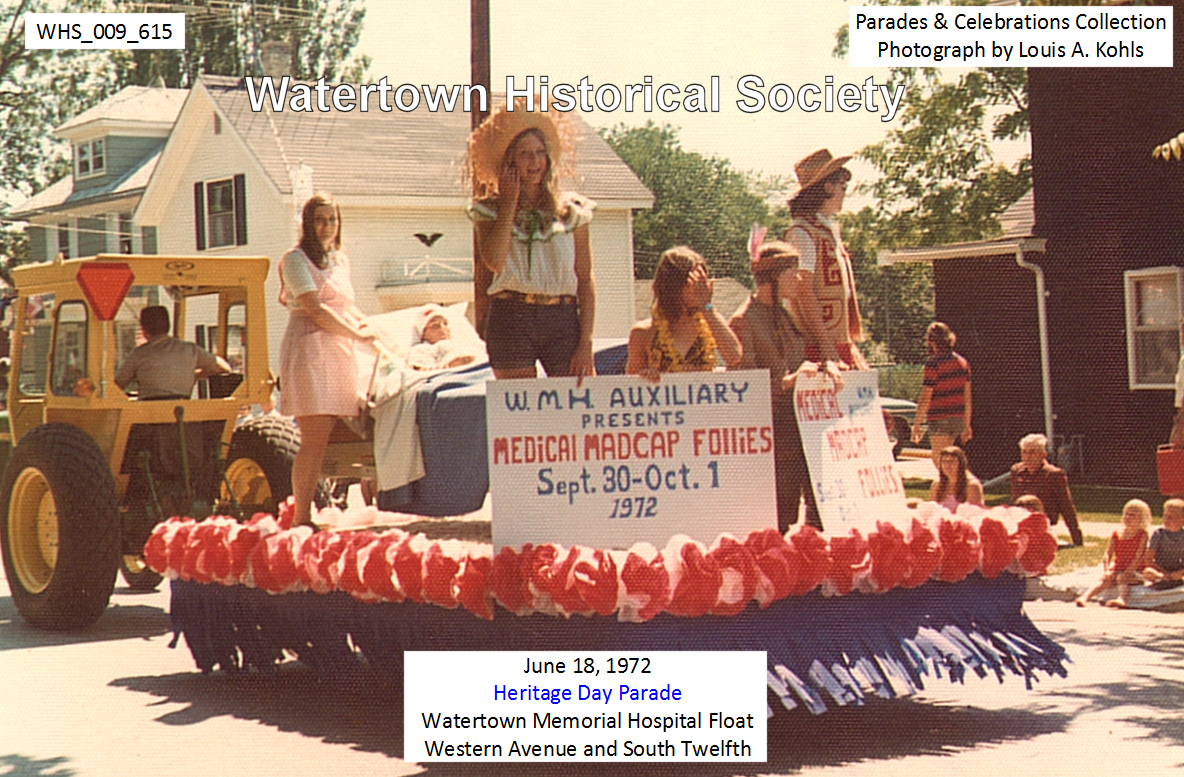
1977
07 12 NOWACK
FUND USED TO PURCHASE EQUIPMENT
Proceeds from the Nowack fund
have been used to purchase equipment for the Emergency Department of Watertown
Memorial Hospital. The fund was started
by friends and patients of Dr. Louis W. Nowack
following his recent retirement. The
money, which was donated to the local institution at his request, will be used
for the purchase of three new patient carts and a vacuum attachment for the
cast cutter. The fund will also be used
to help underwrite the educational costs of local students entering a health
field. A total of 338 persons
contributed a total of $7,867 to the fund.
A bronze plaque recognizing fund donors and honoring Dr. Nowack has been
placed at the entrance to the emergency room.
1978
12 22 ANNUAL CHRIST CHILD
PAGEANT AT THE HOSPITAL

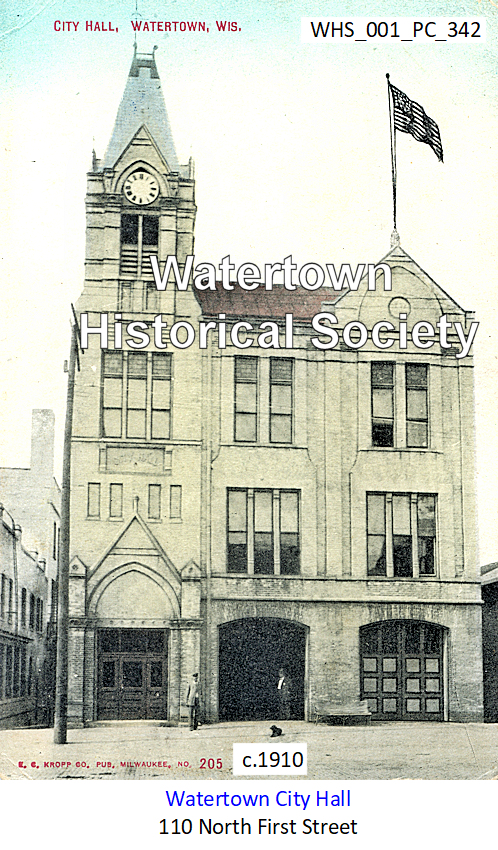
Julie Long as Mary; Tony Bilgrien, Baby Jesus; and Todd Triplett, Joseph.
1981
11 08 DIRECTIONS CLINIC PURCHASED BY HOSPITAL ASSOCIATION
Directions Clinic, Inc., 129
Hospital Drive, has been purchased by Watertown Memorial Hospital Association,
Inc., according to an announcement by Leo Bargielski,
president of the hospital association, and John Gordon, director of the
clinic. The purchase culminated six
months of discussions on the purchase.
Directions Clinic, an alcohol and drug abuse outpatient center, will now
be known as Directions Clinic, a service of Watertown Memorial Hospital. The
papers approving the purchase were signed Monday, and the facility is now
operating as part of the hospital facility. Purchase price was $320,000. The
price is for all of the assets of the clinic, including the newly constructed
facility. WDT
1982
02 15 The recent
Watertown Memorial Hospital’s 1981 “New Horizons Fund” raised $12,000. The development fund established by the board
of directors’ Financial Development Committee was conducted in October and
December 1981 by a letter sent to past and prospective donors. “Most of the funds received were a direct
result of the letter request,” according to Gerald E. Flynn, committee
chairman. Funds raised are used to
purchase important new equipment, such as an optic viewing arm for a microscope
used in eye surgery, three-channel electrocardiograph equipment for heart
testing, and a digital electronic pediatric scale. Flynn said, ‘“New Horizons Fund’ enables your
hospital to continue to provide quality health care to the community.” WDT
09 29 Approval has
been received from Wisconsin Hospital Rate Review authorities granting an
increase in rates for room and board services and other patient care services
effective Oct. 1. A new room and board
rate will be $160 per day. The new
average rate, the combination of room and board charges and other related care
charges, will be $349.73 per day, representing a 12.79 percent increase over
last year. WDT
1983
07 22 Royce Rowedder resigned from the
association's board of directors WDT
08 29 NEW LOGO AND SLOGAN
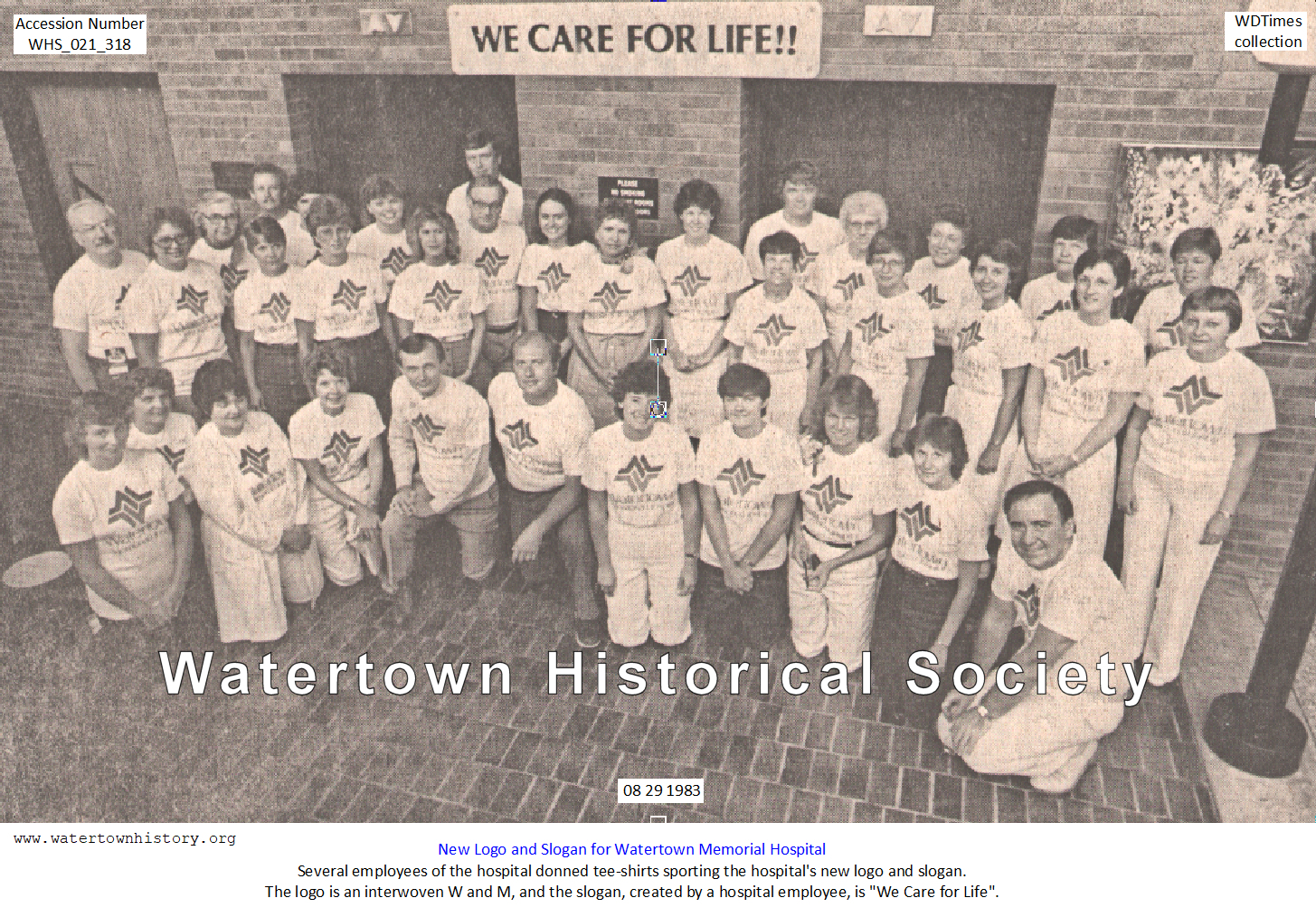 "We Care for Life"
New Logo and Slogan for Watertown
Memorial Hospital. Several employees of
the hospital donned tee-shirts sporting the hospital's new logo and
slogan. The logo is an interwoven W and
M, and the slogan, created by a hospital employee, is "We Care for
Life".
09 27 Computerized tomography (CT)
scanning to be offered WDT
12 01 Sally Flegner, R.N., appointed department head of the Newbirth Center WDT
12 03 Hospital Auxiliary tea, officers, Volunteer
of the Year WDT
12 30 The
“Flight for Life” emergency helicopter unit to serve the Watertown
area WDT
1984
01 21 HMO’s approach
Watertown businesses WDT
04 06 Hospital joins suit against the state and
order to cease offering mobile CT scans
WDT
1986
02 28 Watertown Memorial Hospital has announced the appointment of
John Schloemer as its new pharmacy manager.
Schloemer, who graduated with a bachelor of science degree in pharmacy
from the UW-Madison, was appointed the new position in January. Since graduation, he has spent 11 years in
pharmacy. WDT
1987
02 23 A “rural” designation
cost Watertown Memorial Hospital $877,000 in 1986.
12 21 Watertown Memorial Hospital will receive a revenue influx of over
$1 million annually as the result of President Ronald Reagan’s signing two
budget bills. Officials of the hospital
were elated today as the months of intensive lobbying to get the hospital’s
Medicare reimbursement designation change from rural to urban resulted in an
early Christmas present. That change,
which was culminated with the signing ceremony, will insure a financially
strong facility that can continue to meet the expanding health care needs of
this community. Although local officials
had originally hoped that the new designation would be effective immediately, a
meeting between the House and Senate budget conferees resulted in the new
funding being effective on Oct. 1, 1988.
Because Watertown Memorial Hospital was designated as being in a rural
county, its reimbursement for Medicare patients was substantially less than in
an urban hospital. That difference
amounts to about $1 million annually.
Medicare reimbursement is an extremely important portion of the hospital
budget. It currently amounts to about $5
million and will rise to about $6 million under this new law. WDT
1988
01 12 Watertown
Emergency Medical Service
Officials at Watertown Memorial
Hospital are studying a letter from Mayor David R. Lenz that suggests that the
hospital begin a service that would transport patients from Watertown to other
hospitals in an emergency. The Watertown
Emergency Medical Service provides transportation within the city to Watertown
Memorial Hospital, but does not transport people to hospitals outside of the
city, except in life-or-death situations.
In severe cases, Flight for Life from Milwaukee and Med Flight from
Madison provide transportation.
Non-emergency transportation is available from Pederson Funeral Home and
FISH, a volunteer service for the elderly.
WDT
11 29 $1.9 million addition and remodeling of the
outpatient facilities
Was endorsed by the board of
directors of the hospital association.
The board authorized The Durrant Group, a Madison-based architectural
firm, to begin to develop specific plans and a cost estimate of the proposed project. A continued increase in the outpatient
service needs has prompted the need for the addition, according to Leo Bargielski, president of the association. He said, “Like most hospitals across the
country, we’ve seen a continuing increase in utilization of outpatient services
and a decrease in inpatient census.”
1989
01 12 New
Medical Library Planned / Catherine J. Quirk
The new medical library being
planned at Watertown Memorial Hospital will be named the “Catherine J. Quirk
Health, Science and Education Resource Center” in honor of her longtime
association and support of the hospital.
The hospital’s medical staff had previously recommended that the new
library be named in her honor and the hospital’s board of directors unanimously
approved the decision this week. The new
library will be completed sometime next year as part of the hospital’s
outpatient department expansion:. Quirk
served on the Watertown Memorial Hospital Association Board of Directors since
the inception of the association in 1985.
She served as association secretary from the first board meeting on
April 21, 1958 until Nov. 11, 1966.
Quirk continued to serve on the hospital board until Dec. 1, 1983, a
span of 25 years as an active board member.
WDT
02 22 John
Graf VP of Fiscal Services
John A. Graf has been selected as
the new vice president of fiscal services at Watertown Memorial Hospital. Graf
joined the hospital’s administrative team today, succeeding George Sexton, who
has served the hospital in the position for 19 years. During the next four
months, Graf will work with Sexton to make the transition smooth and orderly.
Graf will officially assume full responsibility for fiscal services on June 1.
Graf has been vice president of operations at St. Michael’s Hospital in Stevens
Point. Prior to holding that position, he had been vice president of finance
and support services at Hartford Memorial Hospital. WDT
07 29 Catherine
J. Quirk Health, Science and Education Resource Center
The new medical library being
planned at Watertown Memorial Hospital will be named the “Catherine J. Quirk
Health, Science and Education Resource Center” in honor of her longtime
association and support of the hospital.
The hospital’s medical staff had previously recommended that the new
library be named in her honor and the hospital’s board of directors unanimously
approved the decision this week. The new
library will be completed sometime next year as part of the hospital’s
outpatient department expansion. Quirk
served on the Watertown Memorial Hospital Association Board of Directors since
the inception of the association in 1985. She served as association secretary
from the first board meeting on April 21, 1958 until Nov. 11, 1966. Quirk
continued to serve on the hospital board until Dec. 1, 1983, a span of 25 years
as an active board member. WDT
11 15 Ban
All Smoking
After March 1, 1990, Watertown
Memorial Hospital will be free of cigarette and cigar smoke, as the hospital’s
board of directors has voted to ban all smoking in the hospital building after
that date. The board took this step in
an effort to encourage the good health of patients, visitors and employees and
to emphasize the dangers of smoking, according to hospital officials. “According to health-care authorities,
smoking is dangerous to one’s health, indeed, is the No. 1 cause of preventable
death in our country today,” said Leo Bargielski,
hospital president. “The hospital is
dedicated to the preservation of good health.
Therefore, smoking in the hospital is not compatible with our mission.” WDT
11 29 Addition
to Hospital
Bids totaling $4,230,000 for an
addition to Watertown Memorial Hospital were accepted by the board of directors
of the hospital association on Wednesday afternoon. The addition and renovation of a large area
of the hospital will commence on Monday, Leo C. Bargielski,
president of the association, said today.
The addition and remodeling of the hospital will be focused primarily on
the increasing need for outpatient services.
Most of the remodeling will be concentrated on the south end of the
building where the current emergency and outpatient areas are located. The addition will be located south of the
existing building and will necessitate removal of the walkway between the
medical center and the hospital, Bargielski
said. WDT
1991
09 30 INCINERATOR
SHUT DOWN
Watertown Memorial Hospital will
shut down its incinerator within the next year to comply with new air pollution
rules. Vice president Dennis Bennett
said the hospital has chosen hauling infectious waste off site rather than
upgrading its incinerator to meet new standards. "We studied this over the past year and
found it more cost effective to have our waste hauled," Bennett said. Bennett said the hospital will consider other
alternatives in the future, including the possibility of joining with other hospitals
to share the incinerator.
1992
04 03 NEW
MEDICAL BLDG ADJACENT TO HOSPITAL
A $1.6 million medical building will
be constructed adjacent to Watertown Memorial Hospital, according to an
announcement today by Leo C. Bargielski, hospital
president. The new facility will be
located immediately west of the present medical office building, and the two
will be connected by an all-weather “skywalk.”
The location and the skywalks will make it convenient for physicians to
move to and from their offices and the hospital. Plans for the facility have been approved by
the hospital board of directors and bids are now being sought. The building is being designed by The Durrant
Group of Madison and Maas Brothers Construction Company is the construction
manager. The current schedule calls for
construction to begin this spring with completion in the fall, and occupancy
before the end of the year.
08 14 NEW
MEDICAL OFFICE BUILDING CONSTRUCTION
In preparation for the
construction of a new medical office building, Watertown Memorial Hospital will
have a new access road to its main and emergency entrances. Once the road is completed, construction of
the new 21,590-square-foot office building will begin. With the permission of Beverly Terrace
Nursing Home, a temporary parking lot for the existing medical office building
will be located in front of the Beverly Terrace front parking area. A new, permanent medical office building
parking lot with 170 spaces will be constructed in front of the new office
building after the construction project is completed in January of 1993.
12 08 RESTRUCTURE
OF HEALTH CARE
Watertown Memorial Hospital must
restructure health care in the community to meet changing social needs, an
expert in hospital management said Monday.
David McKee, president of VHA-Wisconsin, spoke to more than 20 hospital
administrators, personnel and members of the board of directors about the
changing focus of health care. McKee has
been president of VHA-Wisconsin, a regional health care system of the Voluntary
Hospitals of America, for five years. He
is involved with a national task force focused on meeting community needs. “This is probably one of the most exciting
times I can remember,” McKee said, noting that he became interested in health
care many years ago as an orderly at age 15.
McKee is a consultant to health care officials in areas such as
republics in the former Soviet Union, New Zealand and Eastern Europe..
1993
03 22 NEW
MEDICAL BLDG OPENED
Watertown Memorial Hospital will
open its new $1.6 million medical office building Monday. Four practitioners
will begin accepting patients Monday, with additional moves taking place as the
office suites are completed, hospital officials said. Seven of the eight office
suites are rented. The two completed portions of the building will open Monday.
A third portion has been constructed but will remain closed until it is needed
for further expansion, officials said. A fourth portion will be constructed at a
later date. The building was originally expected to open in January.
1994
09 26 20-BED
RESIDENTIAL FACILITY PLANNED
Watertown Memorial Hospital is
planning a 20-bed residential facility for elderly housing. Hospital officials
presented their plans for the community based residential facility to the
Watertown Planning Commission Wednesday afternoon. The facility would have 19 living units for
residents, including one double room that could be used for a married
couple. The facility would be built just
north of the hospital on Hospital Drive.
John Graf, vice president of finance for the hospital, said the facility
is intended for people who have medium to higher order physical and mental
decline as a result of their advanced age.
1995
JOHN KOSANOVICH NAMED CEO
1996
06 20 NEW URGENT CARE CENTER
Watertown Memorial Hospital
opened the doors to its new urgent care center.
The center is designed to offer medical service to people at a
substantially lower cost to the patient.
The urgent care center is housed in the emergency department at the
hospital. WDT
10 06 WATERTOWN HEALTHCARE PHYSICIAN HOSPITAL
ORGANIZATION (PHO)
Watertown Memorial Hospital and
38 physicians in the community have formed a new organization to encourage
employers, insurance companies and health maintenance organizations to include
Watertown hospital facilities and personnel in their health care plans. The new
organization, called the Watertown Healthcare Physician Hospital Organization
(PHO) is a business approach taken by local health care providers to deal with
local needs in issues of insurance and health maintenance organizations. The primary objectives of the Watertown PHO
are to maintain high quality health care, have a local influence in employers
health care decision-making, encourage fair contracting with managed care
entities and respond to the diverse needs of employers and insurers in the
community. The formation of this organization allows the physicians and
hospital to speak with one voice. In working together as a larger organization,
the PHO allows physicians and WMH to have more input as to how insurance
companies relate to local employees. WDT
1997
02 23 $1.1 MILLION RENOVATION PROJECT
Watertown Memorial Hospital’s
$1.1 million renovation project is designed to reflect the growing trend toward
shorter hospital stays. The project,
which begins Wednesday, will be conducted in two phases, according to Eileen
Sailer, vice president of patient services.
All construction is scheduled to be completed for an open house in
November. “It really is taking us into the next century,” Sailer said about the
project. “That’s our goal.” Two floors
of the hospital will be completely renovated to reflect new philosophies in
health care, Sailer said. Many of the changes reflect information obtained from
the community through surveys and focus groups in the past year, she said. WDT
06 20 Watertown
Area Health Services, associated with hospital
WDT
1998
01 08 An
excellent financial year in fiscal 1997 has allowed Watertown Memorial Hospital
to undertake several major capital projects, according to President John
Kosanovich. He said the substantial
growth in revenues from all areas of the services the hospital provides has
allowed the replacement of the CT scanner and other equipment in the radiology
department. All totaled about $1 million
in new equipment has been authorized for that department. Another major capital project under way at
the hospital is the installation of a new information system that will tie all
aspects of health care into one comprehensive computer system.
12 13 Two new directors elected WDT
1999
04 09 100 units of senior
housing; Watertown Area Health Services (WAHS) WDT
07 29 Health and Wellness
Center to be located at the former high school, 415 S. Eighth St WDT
___ 2000 __________________
05 14 Watertown Women's
Center at Health and Wellness Center WDT
06 02 Inter-facility Transport Program. A fire
department service in which Watertown patients are transported to hospitals
in cities such as Milwaukee and Madison has been revived after a several-month
hiatus. A measure to reinstate the
inter-facility transport program was signed recently by Mayor Fred Smith,
Interim Fire Chief Henry Butts and Watertown Memorial Hospital Emergency
Department Medical Director Dr. Kathleen Hargarten. An inter-facility transport occurs when the
Watertown Memorial Hospital calls to ask the department to transport
nonemergency patients to hospitals in Oconomowoc, Waukesha, Madison or
Milwaukee for specialized care not available in Watertown. On- or off-duty department personnel then
take the patients in department ambulances to their destinations while ensuring
the department is sufficiently staffed for city emergencies. WDT
06 22 Apartment building for seniors, northeast
of hospital WDT
___ 2001 __________________
04 28 A move to make Watertown Memorial Hospital more welcoming and warm
is under way, from providing more private rooms to quieting the echoes in the
hallways. Relocation of several areas of
the hospital will make way for the improvements. Administrative offices will be moved to the
Watertown Area Health Services’ Center for Women’s Health to allow for the
expansion of emergency and urgent care services. Remodeling on the second and third floors of
the hospital will result in more private patient rooms than ever before. WDT
05 04 Health
Connection -- An
effort to reach out to the community was launched in January when Watertown
Area Health Services held its grand opening celebration for Health
Connection. Health Connection is a
community wellness link, providing all kinds of resources that promote healthy
lifestyles, said Diane Olson Hubacher, who has led the agency since December.
Olson Hubacher, a registered dietitian with a master’s degree in nutrition, is
also a certified diabetes educator. WDT
09 26 HOSPITAL
ACCREDITATION
Watertown Memorial
Hospital scored in the nation’s top 16 percent in its accreditation from the
Joint Commission on Accreditation of Healthcare Organizations. “We voluntarily seek joint commission
accreditation as a means of improving quality and safety for our patients,”
according to Watertown Area Health Services Chief Executive Officer John
Kosanovich. “We are proud to participate
as a means to raise quality to a higher level.
This year we can be particularly proud of our quality measures. Watertown Memorial Hospital scored 96 on the
survey and our home health department scored 95. Only 16 percent of hospitals nationally
achieve a score of 96 or above.” The
joint commission continually strives to improve the safety and quality of the
nation’s health care through voluntary accreditation. The joint commission’s on-site survey of
Watertown Memorial Hospital occurred in August. WDT
___ 2003 __________________
ST. LUKE’S MEDICAL CENTER, affiliation
with
09 30 Vastly
improved cardiac services will be available to Watertown area residents under a
new agreement between Watertown Memorial Hospital and St. Luke’s Medical Center
in Milwaukee. Officials of the hospital
announced today that the new affiliation will begin in October and will bring
the expertise of St. Luke’s nationally recognized program to patients in
Watertown. John Kosanovich, chief
executive officer at the hospital, said, “We make every effort to listen to the
members of our community when making important health care decisions. That’s why, when local physicians and
community members asked for more consistent access to quality heart care, we
began the search for a partner which is proven in the field.”
___ 2004 __________________
UW CANCER
CENTER JOHNSON CREEK
01 31 Watertown
Memorial Hospital will join forces with two other medical entities to bring a state-of-the
art cancer treatment center to the area.
The hospital will team with Fort HealthCare and UW Health to construct
the clinic just south of Interstate 94 and state Highway 26. Groundbreaking for
UW Cancer Center Johnson Creek is expected to take place in April with
completion expected by January 2005. The
center will provide patients and families with cutting-edge research and
treatment protocols. Affiliated with the University of Wisconsin Comprehensive
Cancer Center, the 13,500-square-foot facility will be located south of the
outlet mall and adjacent to the Johnson Creek Medical Center on Doctors Court.
___ 2006 __________________
TWO-STORY ADDITION TO WATERTOWN MEMORIAL HOSPITAL
03 05 Watertown
Area Health Services officials said Friday they are excited to be embarking on
the next phase of an ongoing master plan with a two-story addition to Watertown
Memorial Hospital over the next two years. The new building will house
state-of-the- art surgical and interventional rooms and a new intensive care
unit (ICU). A new set of dedicated patient elevators will provide added privacy
during in-hospital stays, and the day surgery department will be moved to be
close to the operating rooms, increasing privacy and convenience for patients.
The construction project will also result in a more welcoming lobby and
additional parking. “This is the next step in a carefully thought out master
plan for the Watertown Memorial Hospital campus,” John Kosanovich, CEO of Watertown
Area Health Services, said. “The objective of the project is to create a
clinically excellent, state-of-the-art environment for our patients, physicians
and associates. This will be accomplished through the building of contemporary
space, the addition of new equipment and technology and the re-engineering of
our clinical, operational and support systems.”
___ 2006-07 __________________
FORMER
WELBOURNE HALL CONVERTED TO SWIFTHAVEN ASSISTED LIVING
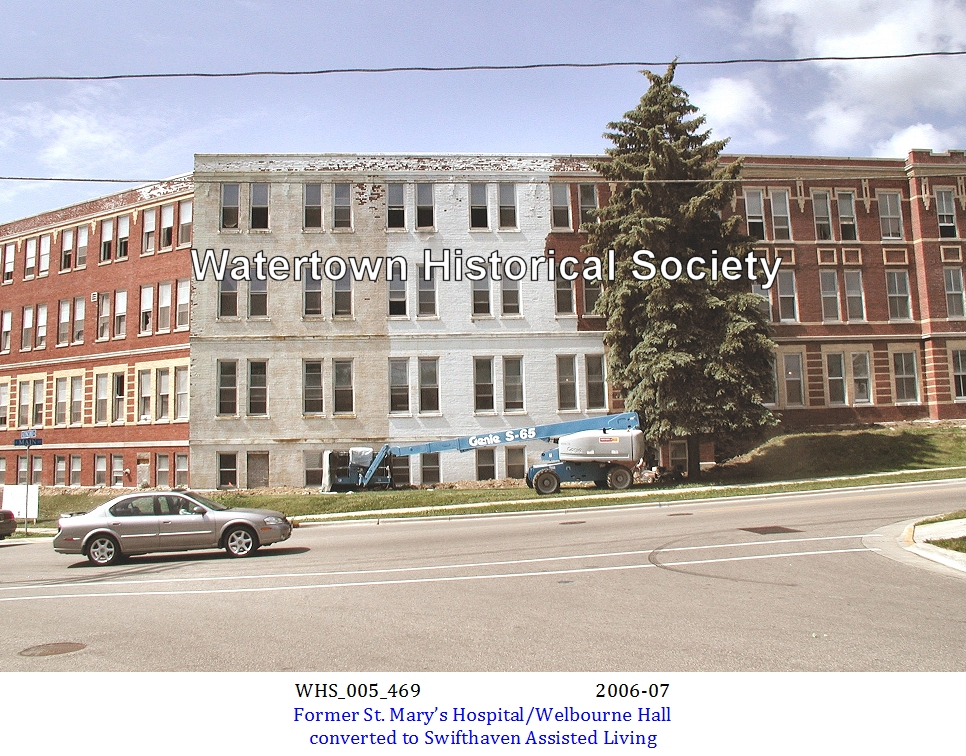
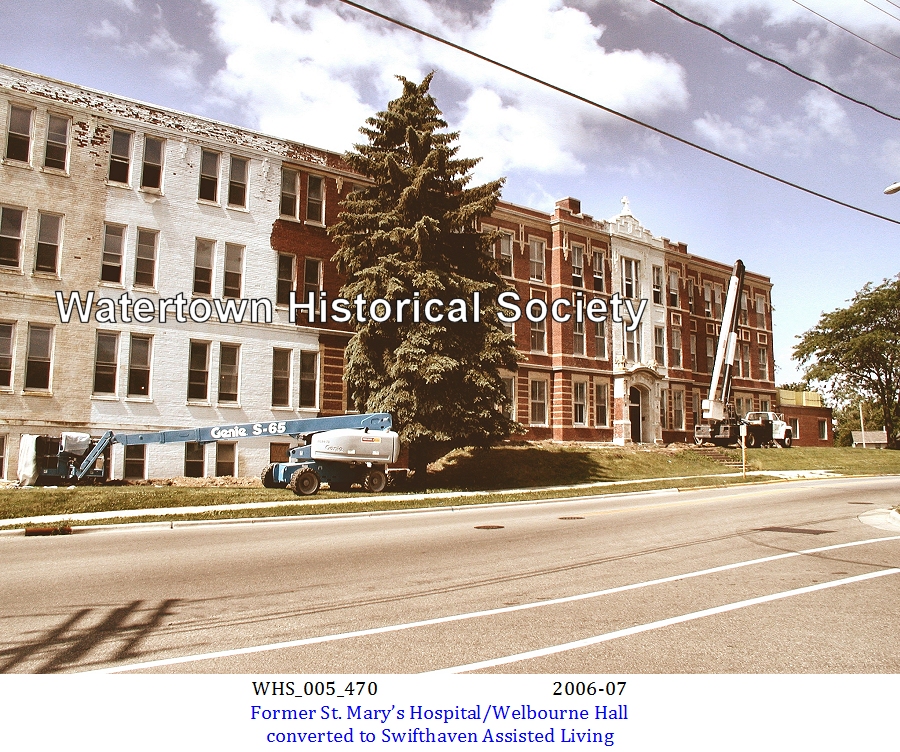
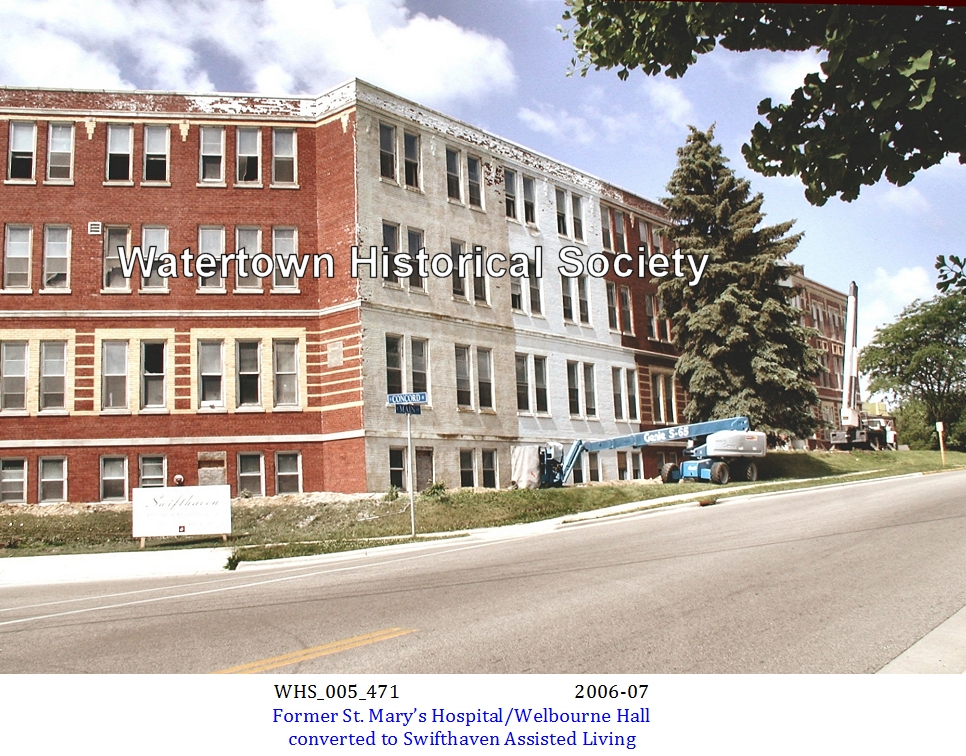

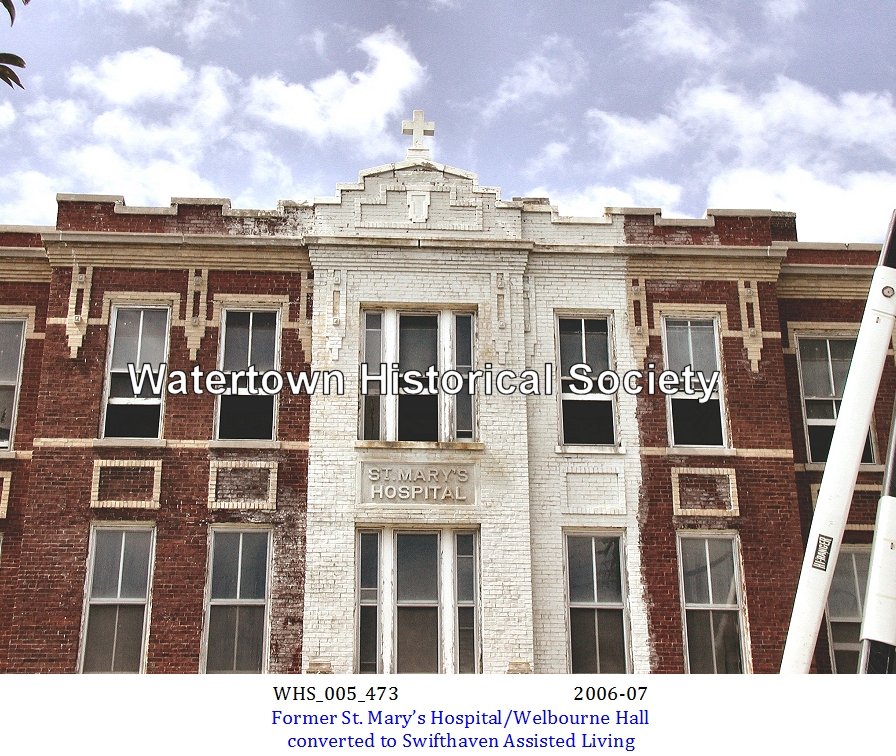
Former St. Mary’s Hospital
transformed; Welbourne Hall reopened as Swifthaven Community Assisted Living Facility. For some reason, when the building became
Welbourne Hall the original red and cream brick was covered over with a hideous
gray paint. This paint was removed in
2006 and the building restored to its former splendor.
___ 2007 __________________
03 21 GRAY PAINT EXTERIOR REMOVED
A little less than a year ago one
of the first things a motorist traveling to Watertown from the east saw was a
rundown gray colored building that was full of broken windows. But now all of the bland paint has been stripped
off, the windows have been replaced and the former Welbourne Hall on East Main
Street has been transformed into the Swifthaven
Community Assisted Living Facility. One
of the most noticeable changes to the 55,000-square-foot building is the old
paint has been removed from the exterior, which makes the original red brick
visible. Watertown Mayor John David said
he has already received numerous calls from residents who have made positive
comments on the exterior of the building.
WDT
08 18 CONSTRUCTION PROJECT SHOWCASED
Watertown Memorial Hospital's new
$26.5 million construction project will be showcased with an open house Sunday
afternoon. Completion of this project is
a major milestone in the hospital's history.
The year 2007 marks the 100th anniversary of hospital services in
Watertown and it's also a year marked by significant developments. The multimillion-dollar project is accompanied
by a clinic which is scheduled to open in the coming weeks in the new ISB
Community Bank building now in final construction stages just off of state
Highway 16 and Marietta Avenue in Ixonia, and a new clinic facility in Juneau
which is also scheduled to open later in the year. The project is nearing completion and all of
the facilities are expected to be placed into service in early September,
making Sunday a rare opportunity for the public to see the surgical center
before it is in full operation.
11 15 WATERTOWN MEMORIAL HOSPITAL AND UW HEALTH
AFFILIATION
Watertown Memorial Hospital and UW Health in Madison today announced
an affiliation that will link Watertown's independent community hospital and
physician network to the extensive resources of UW Health.
Officials of the local Hospital and UW Health have been in
discussions over the potential for a partnership agreement over the past 18
months, and those discussions are now moving quickly toward completion.
John Kosanovich, hospital chief executive officer, is
conducting briefings with the hospital staff today and in the coming days will
be meeting with the medical staff and others directly involved in local health
care service.
Kosanovich said, “the mission of Watertown Area Health
Services is to provide the best in health care to our patients. We firmly
believe that an affiliation with UW will help us achieve that mission. We are
excited about the possibilities created by a partnership between Watertown
Memorial and UW and believe the patients in the communities we serve will
benefit from the enhanced programs and services we will be able to provide
through this collaboration.”
Dr. Jeffrey Grossman, senior associate dean for clinical affairs
at UW School of Medicine and Public Health, said, “Watertown Area Health
Services has shown a commitment to be a leader in both the quality of care and
the delivery of excellent customer service. UW Health has built a national
reputation in those areas, and so the idea of forming a partnership was
appealing to us. ”
Kosanovich and Grossman said that, in addition to patient
benefits, each organization would gain from working more closely with the
other. UW Health's research and educational efforts would be strengthened
through the link to the community, and it is expected that UW Health and
Watertown will jointly work on advances such as electronic health records,
continuous quality-improvement programs and the implementation of best
practices in health care.
With the health care field changing
rapidly, Kosanovich said he and the hospital board of directors
believe this affiliation will ensure quality health care here and well into the
future. He said these discussions “will allow us to chart our next steps so we
can continue to compete in this highly competitive market and remain a viable
and successful organization. The future of our organization is based on
clinically excellent, patient centered care and that's exactly what this
affiliation will give us.”
The hospital executive said the affiliation will not change
control of local health care. It will remain independent and intensely local,
he said. The hospital and its other services will continue to be led by a local
board of directors.
Pat Caine, chairman of the hospital's board of directors, said,
“One of the main tasks of the hospital board is to ensure this community asset
is viable today and into the future. Our affiliation with UW allows us to offer
additional services while maintaining local control of the hospital.”
Representatives from the medical staffs of UW Health and Watertown
Memorial Hospital are also involved in the affiliation discussions and are
focusing on clinical program development and collaboration. Leaders from both
organizations are in the midst of finalizing details to expand and formalize
areas of partnership. Kosanovich estimated that a definitive
agreement would be signed early in 2008.
The hospital also plans to host a series of update meetings for
the entire staff on Nov. 28. Those meetings will offer more information on the
new strategic direction for the hospital and will offer more details on the
progress of the affiliation talks.
The affiliation with UW hospital is an extension of the
relationship that is already in place. The hospital has a partnership in place
with UW Health for the Cancer Center in Johnson Creek, for heart and vascular
services and in other areas.
The hospital has been moving aggressively forward in health care
services. Earlier this year a new $26.5 construction project was completed.
This project includes a new surgical wing, new heart and vascular suite, GI
surgical rooms, minor procedure room, ambulatory care areas, a new MRI suite
and a new intensive care unit.
In addition, the hospital has new partnerships with a hospitalist
group, cardiologist group, perinatologist group and GI providers and
others.
UW Health includes University of Wisconsin School of Medicine and
Public Health; UW Hospital and Clinics in Madison; the brand-new American
Family Children's Hospital, which opened in August; a variety of clinics
throughout the region; and UW Medical Foundation, the largest group practice in
the state. It also includes the state's only federally designated comprehensive
cancer center. The School of Medicine and Public Health expends millions of
dollars in clinical research studies, which offer opportunities for patients to
receive the most advanced treatments available.
Watertown Area Health Services is an independent, non-profit provider
of health care and well-living services to area communities. With Watertown
Memorial Hospital as its cornerstone, Watertown Area Health Services has grown
over the last decade to include comprehensive centers of excellence in women's
health, bone and joint health and a brand new Heart and Vascular Center;
clinics in Watertown, Juneau, Lake Mills and Johnson Creek; senior housing
ventures in Watertown and Waterloo; mental health counseling; wellness and
prevention services; a unique cancer care partnership at the UW Cancer Center
Johnson Creek; Watertown Area Health Services has consistently ranked in the
top ten percent in the country for patient satisfaction and has earned repeated
recognition for its use of technology to promote the highest quality medical
care. Watertown Daily Times, 11 15 2007
___ 2008 __________________
A new partnership for the greater good
UW Health teams with Watertown
Two systems are better than one. Emphasizing their
common vision, leaders of Watertown Area Health Services (WAHS) and UW Health
in Madison announced an affiliation that will link Watertown’s independent
community hospital and physician network to the extensive resources of UW
Health.
Although WAHS will remain independent, the new affiliation
includes plans to expand the range of specialized health care services provided
in Watertown to patients of the region. If patients requite more
advanced Kenner, they will have easy access to the comprehensive medical and
surgical services available at UW Health.
FOR IMMEDIATE RELEASE
February 27, 2008
On Monday, February 25, Watertown Area Health
Services and UW Health said that the leadership of both organizations have
approved the agreement that will link Watertown's independent community
hospital and physician network to the extensive resources of UW Health.
Both organizations said the new relationship would make highly
specialized services more accessible to Watertown-area residents without
duplicating services. By working together, both Watertown and UW Health will be
able to enhance primary and specialty care in a cost-effective manner.
John Kosanovich, CEO, said, “Watertown Area Health Services
is very committed to keeping local health care strong. We firmly believe that
an affiliation with UW Health will help us achieve our mission of providing the
best in healthcare for our patients. This partnership will allow local
residents convenient access to UW’s world class medical specialists, clinical
programs, and health research.”
Dr. Jeffrey Grossman, senior associate dean for clinical affairs
at UW School of Medicine and Public Health, said, “The opportunities for mutual
benefit are considerable. This partnership will enhance care, medical education
and research. ”
Kosanovich and Grossman agreed that the two organizations
will jointly work on advances such as electronic health records, continuous
quality-improvement programs and the implementation of best practices in health
care.
The hospital and its other services will continue to be led by a
local board of directors. With the healthcare field changing rapidly, Patrick
Caine, Board Chairman for Watertown Area Health Services, said the affiliation
will ensure quality healthcare in the community well into the
future. “Joining with UW Health will allow us to continue
successfully competing in our region, and to do so on the basis of outstanding
quality and service,” said Caine.
“This partnership is a model for how UW Health serves the people
of Wisconsin through collaboration and sharing of resources,” said
Donna Katen-Bahensky, president and CEO of UW
Hospital and Clinics. “I am delighted that we could join in this
important endeavor.”
Representatives from UW Health and Watertown will be working
behind the scenes over the next several months to develop an affiliation
implementation schedule.
UW Health includes University of Wisconsin School of Medicine and
Public Health; UW Hospital and Clinics in Madison; the brand-new American
Family Children's Hospital, which opened in August; a variety of clinics
throughout the region; the UW Paul P. Carbone Cancer Center; and UW Medical
Foundation, the largest group practice in the state. The School of Medicine and
Public Health expends millions of dollars in clinical research studies, which
offer opportunities for patients to receive the most advanced treatments
available.
Watertown Area Health Services is an independent, non-profit
provider of health care and well-living services to area communities. With
Watertown Memorial Hospital as its cornerstone, Watertown Area Health Services
has grown over the last decade to include comprehensive centers of excellence
in women's health, bone and joint health and a brand new Heart and Vascular
Center; clinics in Watertown, Juneau, Lake Mills, Johnson Creek, Ixonia, and
Waterloo; senior housing ventures in Watertown and Waterloo; mental health
counseling; wellness and prevention services; a unique cancer care partnership
at the UW Cancer Center Johnson Creek Watertown Area Health Services has
consistently ranked in the top ten percent in the country for patient
satisfaction and has earned repeated recognition for its use of technology to
promote the highest quality medical care.
___ 2008 __________________
02 27 UW HEALTH PARTNERS WATERTOWN REGIONAL
MEDICAL CENTER
Watertown Area Health Services
will be known by a new name, a reflection of its affiliation with UW Health of
Madison. The new name, UW Health Partners Watertown Regional Medical
Center, will be implemented in August.
WDT
05 08 NEW NAME, UW Health Partners Watertown
Regional Medical Center
Watertown Area Health Services
will be known by a new name later this summer, a reflection of its affiliation
with UW Health, headquartered in Madison.
The new name, UW Health Partners Watertown Regional Medical Center, will be
implemented in August, according to John Kosanovich, president of the local
health care organization. Kosanovich
made the announcement as part of the local hospital's celebration of National
Hospital Week which has the theme of "Where Healing Happens Every
Day."
06 06 AMBULATORY CARE CENTER
Watertown Area Health Services
has opened its new Ambulatory Care Center which will provide day surgery and
other outpatient care. The renovated
area boasts 16 private rooms equipped with a private bathroom, something not
available in the previous unit. The
center is conveniently located on the main level of the hospital, allowing for
more privacy as the patient travels within the area from surgery to recovery. In addition to the private rooms, the unit
features Internet access, flat screen TV’s and modern conveniences that make
the recovery process easier. Specially
trained nurses staff the floor and promote relationship-based care with
patients and their loved ones. The unit
is designed with warm, soothing colors and custom lighting to create a relaxing
and healing environment. WDT
06 14 WILLS, CASANOVA AND GOLISCH HONORED
Three Watertown men who played a
big role in the Watertown Hospital Fund Drive were singled out for special
recognition at last night's dinner meeting of the Watertown Area Chamber of
Commerce, held at the Legion Green Bowl.
Named "Citizens of the Year" were Robert Wills, president of
the Watertown Memorial Hospital Association; and Dr. J.R. Casanova and Dr.
Clarence Golisch, executive director of Bethesda Lutheran Home, both of whom
were co-chairmen of the drive. Wills and
Casanova were presented with plaques by Mayor A. E. Bentzin. Golisch was unable to attend last night's
meeting. WDT
07 20 NEW MEDICAL PARTNERSHIP CELEBRATED
The community is invited to celebrate
the new medical partnership with UW Health with a Concert on the Lawn on
Wednesday, Aug. 6, at Watertown Regional Medical Center on Hospital Drive. The Wisconsin Singers and the UW Band will
entertain guests from 6:30 to 8 p.m. A
light picnic supper will be served starting at 6:30 p.m. Guests are asked to bring a picnic blanket to
sit on. Effective Aug. 1, Watertown Area
Health Services will be changing its name to UW Health Partners Watertown
Regional Medical Center. “UW Health is
one of the most widely respected health providers in the country, and we are
thrilled to offer this unparalleled service to the community,” said John
Kosanovich, CEO. “We are proud to change
our name to reflect our growing geographic reach and scope of services.” WDT
09 29 BOUTIQUE AND MEDITATION ROOM
UW Health Partners Watertown
Regional Medical Center opened its newly remodeled boutique and meditation room
as part of its last phase of construction.
The boutique is staffed by volunteers and all proceeds go to the
volunteer organization to be used for scholarships and equipment pledges. The newly constructed meditation room was
completely funded by the volunteers. The
group has also helped fund equipment for pacemaker patients, wheelchairs for
hospital entrances and lobby artwork, along with three scholarships to local
students pursuing careers in the medical field. WDT
___ 2009 __________________
03 24 Opening of new Neurology Center WDT
07 29 FIRST
ANNIVERSARY: AFFILIATION WITH UW HEALTH
Watertown
Regional Medical Center celebrated the first anniversary of its
affiliation with University of Wisconsin Health.
The local
health care facility, formerly known as Watertown Memorial Hospital, officially
changed its name to UW Health Partners Watertown Regional Medical Center on
Aug. 1, 2008.
To help
commemorate the first anniversary, Watertown Regional Medical Center will be
hosting a Concert on the Lawn celebration on Thursday.
The
complimentary event will start at 6 p.m. with a performance by the Wisconsin
Singers. Children's entertainment will begin at 6:30 p.m. and the UW
Band will give its famous fifth quarter performance at 7 p.m.
Since its
partnership with UW Health last year, Watertown Regional Medical Center has
gone through a number of changes to increase access to specialty patient
services and bring world class care to the area. The hospital
recently rolled out Wisconsin's first Telestroke
program, which uses telemedicine to provide regional residents with 24/7 access
to physician stroke specialists at UW Health. This program's
advanced telemedicine technology allows UW Health neurologists to interact with
patients at the Watertown hospital and provide specialist consultation and care
for stroke patients and their families.
Watertown
Regional Medical Center has also expanded its heart and vascular
center. UW Hospital and Clinics is one of the nation's top heart and
vascular providers. The development of the heart and vascular center
resulted in the region's first full-time community cardiologist as well as a
state-of-the-art cardiovascular catheterization lab.
Other
enhanced specialty services at Watertown Regional Medical Center include
maternal and fetal medicine, spine care, a neurology center and advanced pain
management interventional services.
Watertown
Regional Medical Center was recently recognized as one of the nation's most
wired small and rural hospitals by Hospitals & Health Networks Magazine,
the official publication of the American Hospital Association.
Healthcare
Information and Management Systems Society Analytics has also recognized the
local health care organization for “stage 6 electronic medical record
integration,” which has only been accomplished by 1 percent of hospitals
nationwide.
UW Health
Partners Watertown Regional Medical Center has other health campuses in Lake
Mills, Waterloo, Juneau and Ixonia. The health care organization also operates
the UW Cancer Care Center in Johnson Creek.
On the
local level, UW Health Partners Watertown Regional Medical Center provides 716
jobs and directly brings nearly $76 million in revenue to the community. WDTimes, 07 29
2009
12 02 UW Health Partners Clinic expansion
[Johnson Creek] WDT
___ 2011 __________________
02 25 CHILDREN'S WING UNVEILED
American Family Children's
Hospital at Watertown Regional Medical Center will serve children who need
diagnostic testing, outpatient treatments, ambulatory surgery and general
inpatient care. The unit will provide specialized care that recognizes the vital
role that family, emotional care and social care play in healing.
The children's' unit, which
marks the next phase of the pediatric partnership, is the cornerstone of
Watertown Regional Medical Center's pediatric programming. The first phase of the pediatric partnership
was launched in early 2010 with the addition of UW Health pediatric specialty
physician consultation at the UW Health Partners Johnson Creek Clinic. The first phase also included the addition of
the Watertown Safety Center, which is located at the Center for Women's Health
on Hospital Drive.
___ 2012 __________________
“BUBBLE TECHNOLOGY” used in hospital
construction project
Oct Today's
Dietitian article: An 11,000-sq ft garden in backyard; plans to
open a restaurant and demonstration kitchen.
12 22 HOSPITAL IS TRAINING CHEFS
Made-to-order meal service
part of renovations at facility. The
seven students, all Watertown Regional Medical Center employees, are in the
midst of an intense, five-month course called the White Toque Chef School,
being taught by the medical center’s executive chef Justin Johnson. The course is an essential step for the
hospital as it transitions from a factory-style kitchen to a made-to-order meal
service as a part of the wider renovations being completed at the
hospital. When the kitchen re-opens in
the spring of 2013 there will be three outlets for the new made from scratch
food. The first being patients’ meals,
which will be delivered room service style, Johnson said. The second will be at the hospital’s new
restaurant, which will be split into two areas, the Market and the Cafe. The third outlet will be a catering service
which would range from a fruit basket and pastries for a morning meeting to full
course dinner meals. WDTimes
article
___ 2013 __________________
11 23 HARVEST MARKET RESTAURANT OPENED
The restaurant, along with
the hospital’s 11,000 square foot kitchen garden, are a part of the hospital’s
initiative to provide a positive, healthy food environment for patients,
employees and community members. WDTimes
article online
___ 2014 __________________
12 19 HARVEST MARKET RESTAURANT:
Farm to Hospital Bed.
“It’s a restaurant that
happens to be in a hospital, not a hospital restaurant.” Modern Farmer mag article.
___ 2015 __________________
06 30 NEW
IDENTITY AND LOGO

Watertown Regional Medical
Center (WRMC) is celebrating another milestone for health care in the greater
Watertown community today with the launch of a new brand identity.
WRMC is preparing to finalize a
joint venture with Life-Point Health that is designed to further accelerate
WRMC’s transformational journey.
The new logo includes brighter
green and orange colors to reflect the many ways the hospital has innovated to
enhance community health.
Once finalized, the joint
venture with LifePoint Health will commit $100 million toward investments in
WRMC and the Watertown community over the next decade, including significant
advancements in technology, the expansion of clinical services and initiatives
and facility improvements.
A sizable community health
foundation will be created with the proceeds of the transaction to provide
resources for advancing health across the region. WRMC
press release
07 29 WRMC,
LIFEPOINT JOINT VENTURE APPROVED
Online pdf
document, 8 pgs
08 14 KEDDINGTON
WILL BE NEXT CEO
Richard Keddington has been selected
to serve as the new chief executive officer of Watertown Regional Medical
Center, according to an announcement by the regional medical center’s board of
directors and LifePoint Health.
Keddington will join WRMC on
Sept. 14, following the completion of the joint venture transaction which is
expected to be finalized on Sept. 1. He will replace John Kosanovich, who will
retire after serving as WRMC’s CEO for 20 years. An experienced hospital administrator,
Keddington served for the past five years as CEO of Select Specialty Hospital,
a two-campus, 63-bed hospital in Milwaukee, where he managed the hospital’s
daily operations and implemented an overarching strategic plan. In this role,
Keddington enhanced physician relationships and improved patient satisfaction.
Keddington will join the
hospital on the heels of a joint venture between WRMC and LifePoint. The joint
venture will invest more than $100 million in WRMC. The WRMC Board will use the
proceeds of the transaction to create a substantial foundation that will be
devoted to community health.
09 25 JOHN KOSANOVICH RETIRES
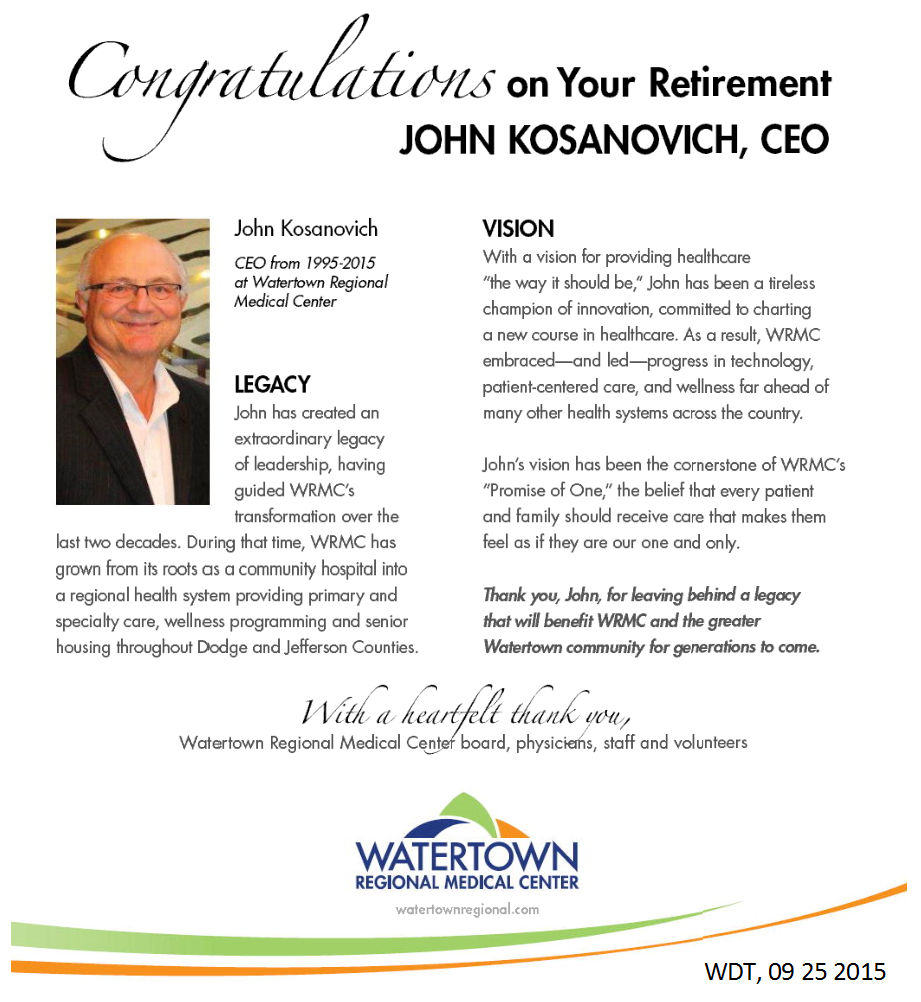 CEO
from 1995-2015
CEO
from 1995-2015
___ 2017 __________________
04 21 "STILL THE BEST FOOD SERVICE
PROGRAM IN THE COUNTRY
___ 2020 __________________
05 10 WRMC
MARKS NATIONAL HOSPITAL WEEK, HONORS HEALTHCARE HEROES
Watertown Regional Medical
Center is proud to join the American Hospital Association and healthcare
organizations around the country in celebrating National Hospital Week, which
is observed May 10-15. Each May, National Hospital Week provides an opportunity
to pause and honor the millions of healthcare professionals who dedicate their
lives to taking care of people in their greatest times of need, and to
recognize the positive difference hospitals and healthcare organizations make
in the communities they serve.
“As our community continues the
fight against COVID-19, the pivotal role our healthcare workers play in the
well-being of society is clearer than ever,” said Richard Keddington, Chief
Executive Officer (CEO) of WRMC. “Their tireless efforts on the front lines of
this disease and their commitment to quality care and patient safety year-round
are critical to our mission of Making Communities Healthier. We proudly honor
these heroes during National Hospital Week and commend their inspiring efforts
to serve others.”
WRMC will be postponing
celebrations marking the national observance until fall.
The hospital plays an important
role in supporting the health and vitality of Watertown and the surrounding
communities all year long. From welcoming 35 new providers and expanding
services, to investing more than $1.5 million in new clinical technology and
facility improvements, WRMC is committed to meeting the evolving health needs
of the community and enhancing access to high quality care close to home.
As one of the region’s economic
leaders, the organization employs more than 730 staff members and contributed
more than $5.7 million in taxes to the local and state economies last year.
Additionally, it is proud to sponsor a number of local community organizations
and non-profits, including Lake Mills EMS, Rainbow Hospice, Waterloo EMS,
Watertown Area YMCA and more. Ensuring that everyone has access to the
high-quality and compassionate care they need is a top priority for the
organization and fundamental to its mission. In 2019 alone, WRMC provided
nearly $6.5 million of charity and other uncompensated care, regardless of
patients’ ability to pay.
“Watertown and the surrounding
communities are a wonderful place to call home, and we are privileged to have a
significant impact on its health and economic well-being,” said Kim Erdmann,
chair of WRMC’s board of trustees. “As we celebrate National Hospital Week amid
unprecedented challenges this year and begin to look to the future, we are
aware that healthcare – like other aspects of life – might look a little
different. What will not change, though, is our mission and our commitment to
this community. We will continue to put the health and well-being of our
neighbors first, ensuring safe places of care and a healthier community for us
all.”
03 02 WRMC TO
ADD ORTHOPEDIC SPORTS MEDICINE CLINIC
Construction
started on new rehabilitation and sports medicine clinic located inside the
Medical Office Building next to the hospital.
A Maas Brothers Construction project.
07 28 HISTORICAL
PHOTOS LINE HALLWAY OF HOSPITAL
08 25 ROBOTIC-ASSISTED
SURGERY OFFERED
Watertown Regional Medical Center (WRMC) is now
offering robotic-assisted surgery using the da Vinci® X™ robotic surgical
system. This addition to the operating
room provides surgeons and patients with another option for minimally invasive
general and gynecological surgeries, including hernia repair, gallbladder
surgery, hysterectomies, endometriosis, and more.
09 20 URGENT
CARE TEMPORARILY CLOSED
In another sign the delta variant
surge of COVID-19 is challenging health care providers, Watertown Regional
Medical Center said it is temporarily closing its urgent care so staff can
assist in the emergency department.
“Due to a significant and
sustained rise in Emergency Department patients (COVID and non-COVID related),
we are temporarily reallocating resources from Urgent Care to the Emergency
Department to help treat these patients in a more timely manner,” the hospital
said on its Facebook page in a response to a question about the announcement.”
10 20 115
YEAR CELEBRATION
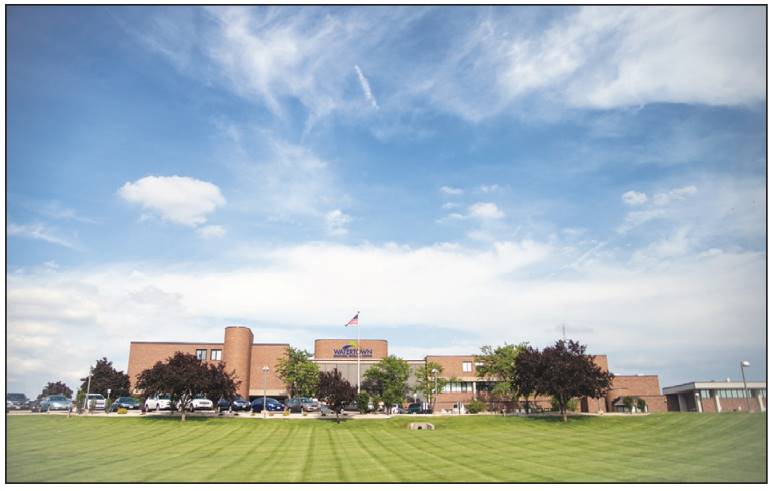
Watertown Regional Medical Center
is celebrating 115 years of providing care for the people of Watertown and the
surrounding communities this month.
Originally located on Main Street
in the building formerly known as the Schiffler residence, the hospital, then
called Watertown – St. Mary’s, first opened its doors on Oct. 1, 1906.
The hospital’s popularity was
evident from the start, filling to capacity on only its second day of
operation. This popularity would continue and on Jan. 5, 1914, a sisterhood
took over control of the hospital from the physicians and decided to erect a new
building adjacent from the original hospital.
Building a hospital during a
World War wasn’t easy but the project was completed towards the end of 1918 and
the new addition featured equipment that was said to be the best available at
the time and second to none in the country.
In 1960, the Watertown Hospital
Association and the City of Watertown, took control of the facilities and
changed the name to Watertown Memorial Hospital. After more than a decade of
planning, a new, 120- bed, hospital was created at its current location in the
northeast part of the city, just beyond the highway 16 by-pass. After years of
additions, including the most recent additions of Harvest Market and the
state-of-the-art emergency and obstetrician departments, Watertown Memorial
Hospital joined forces with LifePoint Health in 2015 and became Watertown
Regional Medical Center.
In 2020, WRMC added 28 employed
and affiliated providers, made more than $1.4 million in capital improvements,
distributed a payroll of over $48 million to more than 700 employees and
donated more than $5 million in services to those in need.
10 27 BECAME
PART OF NATIONAL HEALTH SYSTEM SCIONHEALTH
Watertown Regional Medical Center
today announced that it is among 18 LifePoint Health hospital campuses and
associated sites of care selected to become part of a new national health
system called ScionHealth.
Watertown Regional Medical Center
is currently part of LifePoint Health, which announced earlier this year plans
to acquire leading post-acute provider Kindred Healthcare. As part of that acquisition, the companies announced
today that they intend to create ScionHealth,
a new company that will be comprised of 61 long-term acute care hospitals
from Kindred and 18 of LifePoint’s hospital campuses and associated sites of
care – including Watertown Regional Medical Center.
As part of ScionHealth,
Watertown Regional Medical Center will continue to have access to capital to
invest in its facility and community, as well as resources and support to
accelerate its ongoing efforts to enhance healthcare delivery and expand the
services available in Watertown and the surrounding communities.
Watertown Regional Medical Center
will remain a joint venture, with ScionHealth taking
over the 80% stake from LifePoint Health and the Greater Watertown Community
Health Foundation keeping their 20% stake. The Greater Watertown Community
Health Foundation will continue to provide a local voice and leadership by
retaining 50% of the board seats in this joint venture. Pending regulatory approval and satisfaction
of customary closing conditions, LifePoint and Kindred expect the launch of ScionHealth to be completed by the end of the year.
12 03 GENERAL
SURGEON ADDED
Dr. Panna Codner, a general surgeon
with experience in a broad-spectrum of surgical procedures, has joined the
general surgery clinic. Codner joins Dr.
Adam Dachman and Dr. Garrett Fleming at the general
surgery clinic which provides surgical services using the latest technology and
minimally invasive techniques. WDTimes
article
12 24 OFFICIALLY
JOINED SCIONHEALTH
Watertown Regional Medical Center
officially became part of ScionHealth, a new company
that launched Thursday following the finalization of LifePoint Health’s
transaction with Kindred Healthcare.
Headquartered in Louisville,
Kentucky, ScionHealth operates 79 acute and postacute care hospital campuses in 25 states. As announced
in October, the new health system’s founding facilities include 61 long-term
acute care hospitals from legacy Kindred Healthcare and 18 of LifePoint
Health’s community hospital campuses.
___ 2022 __________________
01 24 NEW
BOARD OF TRUSTEES MEMBERS
Watertown Regional Medical Center
has announced two community leaders, Dr. Brent Yaeggi
and Tim Roets, have joined the board of trustees. In addition to the new board members, a new
board chairwoman, Kathy Wagner, and a new vice chairman, Jason Polzin have been
appointed.
Yaeggi, WRMC’s immediate past chief of
staff, is a podiatrist at Rock River Foot & Ankle, which has an office
located in the medical office building attached to the hospital.
Roets is a long-time Watertown
resident and the former chief of police for the Watertown Police Department.
05 03 RETINA
SPECIALIST ADDED TO MEDICAL STAFF
Watertown Regional Medical
Center has announced
the addition of Dr. Ryan Vogel, medical and surgical retina specialist, to
the medical staff. Vogel will provide
comprehensive treatments for retinal diseases like age-related macular
degeneration, diabetic retinopathy, retinal tears, macular holes, vitreous
floaters, and retinal detachment.
04 05 eICU TECHNOLOGY
Critically ill patients at
Watertown Regional Medical Center now have access to critical care doctors,
24/7, through the use of technology acquired by the facility.
The hospital’s representatives
said the use of eICU technology in hospitals is a
growing trend, much like the use of telehealth or “e-visits” in primary and
specialty care. The technology used at
Watertown Regional Medical Center allows critical care doctors, called
intensivist, to video chat with patients, family, nurses and fellow doctors,
giving them secure access to assist in the care of critically ill patients.
This technology, according to the
hospital, along with assistance from the hospitalist and specialty trained ICU
nurses, allows the intensivist to diagnose and treat, providing the same level
of care as if they were physically present at the hospital.
06 23 BEST
MATERNITY HOSPITALS 2022
Watertown Regional
Medical Center was recently named to Newsweek’s list of Best Maternity
Hospitals 2022. This distinction recognizes facilities that have excelled in
providing quality care to mothers, newborns, and their families.
Based on information from the data firm Statista, the goal of this list is to
help people pick the best place to achieve the happy outcome of a healthy child
and a healthy mother.
08 15 WRMC
RECEIVES PRESTIGIOUS BABY-FRIENDLY DESIGNATION
Watertown Regional
Medical Center announced that it has achieved the prestigious international
Baby-Friendly designation after a rigorous review process conducted by
Baby-Friendly USA, the organization responsible for issuing this certification
in the United States. WDTimes
article
08 24 EXECUTIVE DIRECTOR OF HUMAN RESOURCES
Watertown Regional
Medical Center announced that Ryan Lessner has joined its team as the new
executive director of human resources.
Lessner, who was born and raised in Watertown. WDTimes
article
09 26 CADENCE
REMOTE MONITORING OFFERED
Watertown Regional
Medical Center has launched a new remote care management program for patients with
chronic conditions like hypertension (high blood pressure) and heart
failure. Using technology, the Cadence
remote monitor delivers personalized care and intervention-as-needed, from the
comfort of home by collecting, analyzing and responding to patient’s
vitals. Daily readings are then
monitored by clinicians for changes in a patient’s condition and provide
virtual care support when needed. WDTimes
article
10 22 ADDITION
OF ELECTROPHYSIOLOGY SERVICES
Watertown Regional
Medical Center has announced the
addition of electrophysiology to the services at the Heart and Vascular
clinic. Dr. Marcie Berger is a
board-certified electrophysiologist who is available for appointments in
Watertown.
12 05 VELYS™
ROBOTIC-ASSISTED SOLUTION
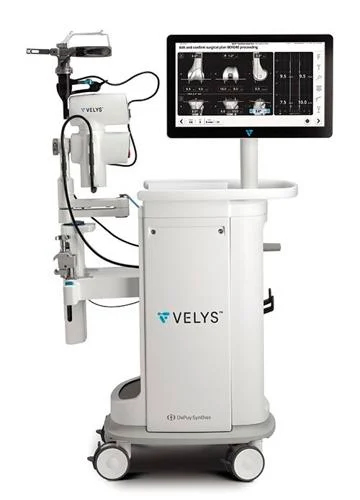
Watertown Regional
Medical Center now offers the VELYS™ Robotic-Assisted Solution, the latest
advancement that helps orthopedic surgeons perform knee replacement surgery
that is tailored to each patient with the goal to get patients back to the life
and activities they love doing, faster.
“We are excited to
announce we’ve received our VELYS Robotic-Assisted Solution for total knee
replacements and have successfully completed our first procedure using the
technology,” said Richard Keddington, CEO, Watertown Regional Medical Center.
“The addition of this technology gives residents of Watertown and the
surrounding communities access to the latest technology and improved outcomes.”
In 2019, there were
approximately 900,000 primary knee replacements performed in the United States.
Patients requiring this procedure are often looking for the latest technology
as they aim for improved outcomes, increased movement, and shortened recovery
time.
Dr. Jason Habeck, a
fellowship trained orthopedic surgeon at Watertown Regional Medical Center, has
prior experience using robotic-assistance and is now using the VELYS
Robotic-Assisted Solution at Watertown Regional Medical Center to aid him in
performing these procedures with increased accuracy.
“Every knee is
different, as is every patient requiring a knee replacement procedure,” said
Dr. Habeck. “This technology helps me perform a knee replacement with the use
of precise data that’s tailored to each patient’s anatomy. Helping to ensure
predictable results to improve outcomes, increase mobility, and help patients
recover faster.”
The VELYS
Robotic-Assisted Solution works in tandem with the ATTUNE® Knee System, which
is an innovative knee implant designed to work more closely with an individual
patient’s anatomy. The ATTUNE Knee can help increase stability and reduce pain,
providing better range of motion and preventing the unstable feeling some
patients experience during everyday activities, such as bending and walking up
and down stairs.
With these systems
working together, there is now a local option for patients who are seeking the
latest technology designed to provide digital precision in knee replacement.
___ 2023 __________________
05 04 FULLTIME PROVIDERS WITH PAIN
MANAGEMENT CLINIC
Bringing stability to
their Pain Management Clinic with full-time providers. Dr. Philip Conrardy and nurse practitioner
Jeanne Denk.
08 17 Dr. SALIM SHAMMO MEDICAL DIRECTOR OF CARDIOLOGY
Shammo is an
interventional cardiologist who has been with the organization part-time for
over 29 years. Recently, he took a
full-time position at the Watertown hospital as an interventional cardiologist,
allowing him to see more patients in-clinic and perform more procedures in the
newly renovated Cath lab.
12 04 WATERTOWN REGIONAL MEDICAL CENTER UPGRADES MRI TECHNOLOGY Online
article

 < PORTFOLIO OF PICS
TWO REVIEW ARTICLES:
1938
25th Anniversary of Hospital Observed
Sisters took
over Jan 5, 1914
Mark Occasion with Banquet and Program
Work of Sisters Praised By Speakers Here Last Night
Watertown Daily Times, 12 02 1938
The 25th anniversary of St.
Mary’s Hospital was observed last night at a banquet and program held in the
dining hall of the hospital.
Approximately 50 doctors attended, in addition to several priests and
other guests.
Glowing tributes were paid the Sisters
of the Missionary Sisters, Servants of the Holy Ghost which operates the
hospital. Their untiring efforts to give
Watertown and this locality one of the finest hospitals to be found anywhere,
the many sacrifices they have made to provide the facilities now available, and
the fine manner in which the sick are being cared for were lauded by the
speakers who took part in the program.
The many achievements that have been made in the quarter century that
the Sisters have been operating the institution were mentioned by several of
the speakers who outlined the growth of the hospital.
Some of the early history of the
hospital was recalled by the Rev. Dean F. X. Schwinn, pastor of St. Henry’s
congregation, who came to Watertown about the time the Sisters took over the
institution. The much fine work that the
Sisters have done at the local hospital was emphasized by Father Schwinn who
has seen the hospital grow from its first location in the Schiffler residence
to the institution it is today.
Early Need Seen
The need for a hospital was seen
by the early doctors who operated the first hospital and by the Sisters who
followed in the operation of the hospital, Dr. T. F. Shinnick of Beloit,
declared. The expansion program which
the Sisters undertook shortly after they took over the old hospital here was
lauded by Dr. Shinnick who, referring to the Sisters said that the ”owners and
operators had confidence in themselves and their God” and went ahead and built
a hospital that was finer than Watertown and the locality ever had before.
Dr. Ivan G. Ellis, Madison, X-ray
specialist who calls at the local hospital once each week, declared that St.
Mary’s Hospital was one of the finest he has seen. He highly praised the Sisters for the
splendid work they are doing and the manner in which they are operating the
hospital.
Other speakers, all of whom
expressed a deep gratitude for the excellent work the Sisters are doing and the
fine manner in which they are operating the hospital, included Dr. E. J.
Eichelberg of Reeseville, who with Dr. Shinnick founded the hospital which was
the immediate predecessor to St. Mary’s; Dr. M. Wilkenson of Oconomowoc, who
named some of the doctors who practiced in Watertown years ago; Dr. Harlow
Caswell of Fort Atkinson; Dr. L. H. Nowack of Watertown; Dr. G. J. Fiebeger and Dr. Philip Leight of Waterloo; Dr. O. Goetsch
of Hustisford; Frank P. McAdams, Watertown, member of the hospital board; Rev.
Joseph Burke, C.S.C., pastor of St. Bernard’s congregation; Rev. John Devers,
C.S.C., chaplain at Sacred Heart College, and Rev. Stephen Klopfer, hospital
chaplain.
Sisters Talk
Among the Sisters who addressed
the gathering last night was the Venerable Sister Margaretha, Mother Provincial
of the order. She as well as Sister Majilla, the Sister Superior at the hospital; expressed
deep appreciation for the co-operation received from the doctors who use the
hospital. Other sisters who talked were Sister Dolorita, who is in charge of
surgery, and Sister Gertrude, who is in charge of the X-ray room.
The Rev. Christian Glassauer, who became chaplain at the hospital 22 years ago
and who is now retired, also received recognition during the program for his
long period of service.
All those present paid a tribute
to the memory of the late Dr. E. J. Hoermann,
local dentist and member of the hospital board, Dr. Hoermann worked in behalf
of the hospital for many years and during the hospital drive two years ago was
treasurer of the St. Mary’s Hospital Fund Committee and one of the spark plugs
in the successful effort to raise $12, 500 for room furnishings.
A huge cake, containing 25
candles, the insignia of the Sister’s order and the insignia of the medical profession was placed on
the banquet table.
Dr. T. C. H. Abelmann,
Watertown, served as toastmaster.
1914
Taken Over in 1914 [by Missionary Sisters]
St. Mary’s hospital was taken over
by the Missionary Sisters, Servant of the Holy Ghost, on January 6, 1914.
Previous to that the hospital had
been privately owned and consisted of a wooden building which had been the
Charles Schiffler residence located on the present site of the hospital. Three years after the sisters came here to
operate the institution they began work on plans for a new building,
constructed of brick and forming the nucleus of the present modern St. Mary’s
hospital.
1918
The building was opened in
September 1918. The original wooden
building continued to serve as a unit of the hospital, being used as a
maternity section. This was demolished
when the new addition to the hospital was built on the site, thus forming the
present large building.
1937
The new addition was dedicated by
Archbishop Samuel A. Stritch on May 21, 1937.
The present hospital has 75 beds,
modern operating and X-ray rooms and laboratories and other modern facilities.
Early History
1906
While the operation of the
hospital by the religious order dates back to 1914, the actual history of the
hospital is older, going back to 1906 when Dr. Thomas Shinnick, now of Beloit,
and Dr. C. J. Eichelberg of Reeseville, sponsored a movement to obtain hospital
facilities for Watertown. The Rev.
Philip Schweitzer, then pastor of St. Henry’s Catholic Church , also became
interested in the movement and the Schiffler residence was purchased and
remodeled to serve the needs of a
hospital. It had an operating room,
X-ray room and wards to accommodate 16 persons.
The property was purchased by the two doctors mentioned, with the
assistance of Rev. Schweitzer. The late
Dr. C. J. Habhegger also became interested in the hospital movement and gave it
his support, serving as secretary and treasurer with Dr. Shinnick the first
president. Dr. Eichelberg was the first
vice president. The first superintendent of the hospital when it was opened was
Miss Clara Lehmann (1). Later her sister, Miss Lydia Lehmann served as
superintendent.
1913 and 1914
In 1913 Dr. Shinnick left
Watertown for Beloit and sold his interest to Dr. Eichelberg and Dr. Habhegger
who retained possession of the place until 1914 when they sold their interest
to the sisters.
Capacity Doubled
Since that time the hospital has
grown from its small beginning in the Schiffler property to the modern
structure and institution it is today.
The new addition, which doubled the size of the institution, was built along
the same lines and of the same material as the original brick structure which
replaced the wooden building and so today the two units look like one.
1903
First Hospital
The hospital housed in the
Schiffler residence was not the first hospital Watertown had, however. For long before that there was a one room
affair in South First Street which
served as a hospital for the city. It
was opposite the present Hotel Carlton and
near what was then known as Specht’s
harness shop. This one room hospital
was started by Dr. Shinnick and Dr. J. M. Sleicher,
who latter went to Chehalis, Wash. No actual record of when it was opened
exists, but it was about 1902 or 1903.
The city provided $100 to equip it and also paid the rental. Its first patient was Tom Gibson, who was
better known as “Blind Tom” because he had his eyes blown out during blasting
operations.
In the days when the one room
afforded the city’s only hospital facilities, it was kept heated only when in
use. Patients were few. There was still
a general public apathy toward hospitals.
Small Beginning Marked
St. Mary’s Hospital in City
Watertown Daily Times, 12 08 1927
The present St. Mary’s Hospital
grew from a small beginning to its present efficiency and on this anniversary
of the sister superioress twenty-five years of service the following historical
sketch will be appropriate:
1907
In the year 1907, an attempt was
made by the Rev. Phillip Schweitzer, pastor of St. Henry’s Catholic Church, to
interest all the physicians of the purpose the establishment of a hospital in
the city of Watertown. The result was
the purchase of a modern 8 room house located at 1301 Main Street. With the conversion of the largest rooms on
the second floor into a modern operating room, and with a few minor changes the
hospital was ready to enter on its first year of service. At the end of the first year the building was
found to be too small and was then remodeled and enlarged and the present St.
Mary’s Hospital began its existence.
1908
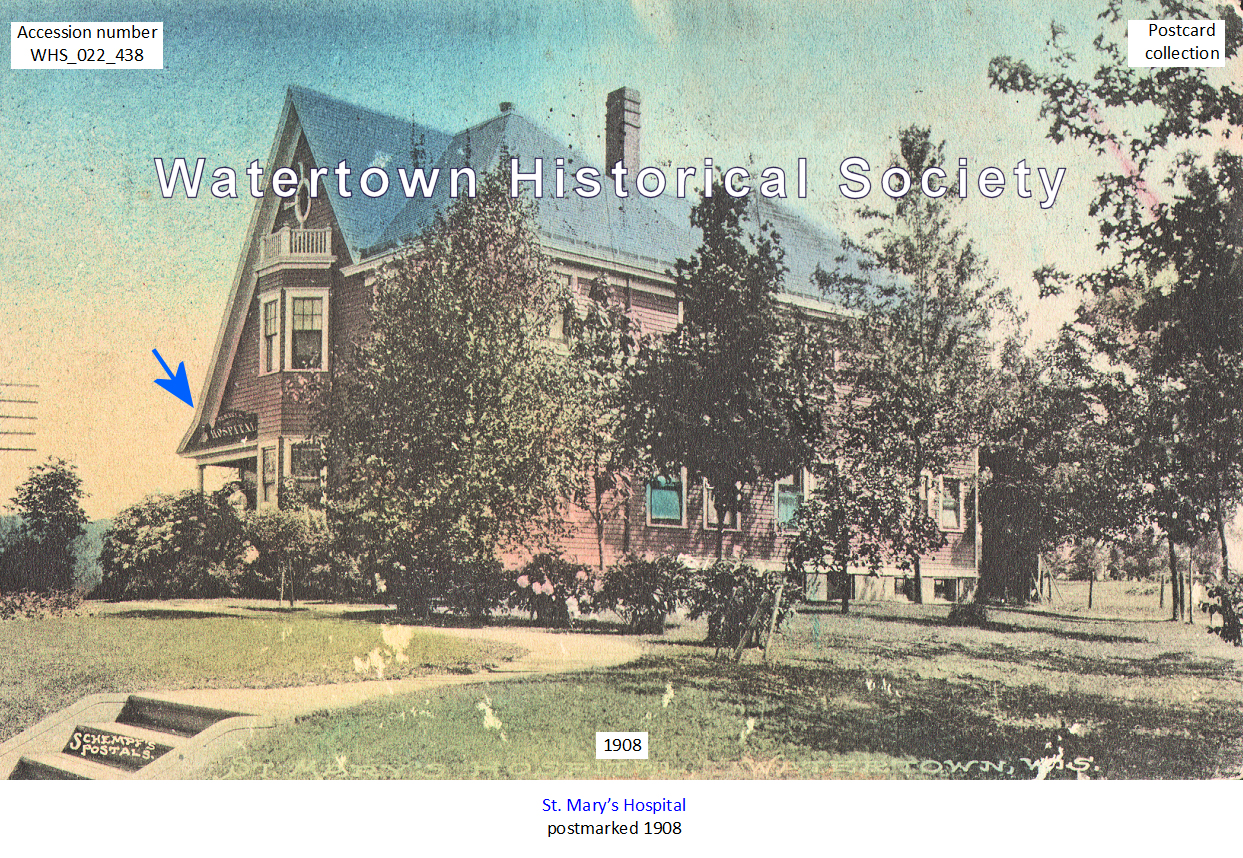
Postcard
postmarked 1908
1914
In 1914 the Missionary Sisters, Servants
of the Holy Ghost, under the direction of Sister Mary Euphrasia, S.Sp.S., took charge of the hospital which they had
recently purchased from Dr. D. J. Habhegger under whose patronage the hospital
had been conducted. Shortly after the
transfer of the hospital property and the change of management a banquet was
held at St. Henry’s hall on January 23,1914 for the purpose of calling together
the physicians and business men of the city. Those present under mutual
agreement promised their aid, loyalty, and will co-operation with the
institution. This was a great encouragement to the sister, and was also the
underlying foundation of the establishment on a permanent basis.
In the first six months the
sisters were in charge 85 patients were admitted and cared for and fifty-four
of these were surgical cases. On “tag
day” that year the people of Watertown and vicinity showed their liberal
generosity together with their kind and willing cooperation toward the
hospital. The liberal donations received
by the sisters were far beyond their expectations, and they were highly
appreciative.
1915
On January 1, 1915, the first
year, two hundred and twelve patients were admitted. The year 1915 proved a very busy and active
year. The hospital seemed too small, and
at one time five emergency cases were unable to receive care for want of room.
1916
1917
A bequest of $10,000 in 1916 from
the estate of the late Mr. Michael
Carroll encouraged the sisters to proceed with further building and plans
were drawn bids let, contracts drawn and excavation began August 25, 1917 after
the Watertown city council closed Summit Avenue and presented the narrow tract
of land to the hospital management thus enabling the sister to connect two
pieces of property previously purchased for the hospital expansion. The corner stone was laid December 3 the same
year.
1918
Following this occasion cold
weather set in and work was somewhat delayed.
The building progressed slowly and at times the workmen were
handicapped, being unable to obtain the desired material. The following summer work progressed rapidly
and about September 1, 1918, the building neared it completion.
Furnished Rooms
About this time the people of
Watertown and vicinity were contributing most generously to the furnishing of
the rooms of the new hospital. Great
credit is due them for their liberal generosity and manifestation of their
kindly feeling toward an institution of this kind.
1918
About October 1, 1918, the first
patients were admitted to the new hospital.
In the course of time the various departments were equipped with their
individual and necessary furnishing: In
September 1919, an X-ray machine was installed at the cost of $5,000 in
connection with which a very successful drive instituted financially covering
the expense of the same, the latter through the efficient supervision of a
committee especially appointed to supervise this drive.
The present hospital capacity is
50 beds, twenty private rooms, four rooms with bath connected, two wards three
beds each, the remainder semi-private rooms, two beds in each room, serving an
average of about 1,200 patients a year.
The operating and delivery rooms
are completely equipped. The electric
treatment rooms are furnished with very modern equipment adapted for various
treatment of disease such as the oxygen vapor generator, therapy lamp, kromayer quartz lamp, alpine sun lamp, universal mode
electric bath cabinet and shower baths.
The laboratory is equipped with all the necessary apparatus. The X-ray department is equipped with the
latest and best appliances. It is also
equipped with both electrical and X-ray treatments having portable
equipment. The X-ray department with its
interrupter less transformer, high tension current and a Collidge
transformer is capable of doing excellent work both radiographic and
fluoroscopic, and a great deal has been accomplished since its installment.
A General Hospital
Since establishment, St. Mary’s
Hospital has been maintained as a general hospital accepting all kinds of
patients except those suffering from contagious, mental or tubercular
diseases. The institution is non-sectarian. No distinction is made as to creed or
nationality, while the poor receive the same attention as those more
fortunately situated. The attending
physicians and surgeons are men of high professional standing, some of them
holding positions of public trust.
Acknowledgment is due them for their devotion to duty and their constant
car, which has done so much to place St. Mary’s Hospital on a level among
similar institutions. The local
attending physicians also comprise the teaching faculty of St. Mary’s Training
school and are actively engaged in giving courses on instruction on the
required subjects to the nurses in training.
In the conduction of the hospital and superioress, Venerable Sister Mary
Suphrasia, the jubilarian, is ably assisted by the devoted services of fifteen
Missionary Sisters, Servants of the Holy Ghost, as well as the services of
nearly two dozen nurses and attendants.
Cross-References:
No 1: 2007, Watertown Memorial Hospital website
No 2: 1906, Incident with janitor
(1) June 26, 1907 - Watertown Daily Times - Miss Clara
Lehmann of the town of Watertown, . . . was united in marriage at 5 o'clock
last evening at the home of the bride's parents to Dr. R.L. Smith of Milwaukee
Š The couple were unattended . . . The
ceremony took place under an arch of roses and lilies of the valley . . . The
dining room decorative effect was pink and white. The lawn was brilliantly
illuminated with Japanese lanterns. The
wedding, while a very pretty one, was attended by only the immediate
relatives. The bride has resided in the
town of Watertown and this city all her life with the exception of about a year
and a half spent at Albany, N.Y. For the
past few months Miss Lehmann and her sister Miss Lydia Lehmann, have been
employed as trained nurses at St. Mary's hospital . . .

History of Watertown,
Wisconsin