website watertownhistory.org
ebook History of Watertown, Wisconsin
Turner Hall has had a Varied Life
Armory
Mask Balls, Great Plays
Staged at Turner Opera House
The
Turner movement started in the United States in 1848 in Cincinnati.
The
first Turner organization in Wisconsin was in Milwaukee in 1853,
just
seven years before Watertown's was formed.
ACTORS AND SPEAKERS
The
old opera house had housed many notable events and famous personages who came
here to appear before the public. Joseph
Jefferson, the celebrated America actor, appeared there, as did Charles Grapewin, who later became an outstanding motion picture
actor. Col. Robert G, Ingersoll, the
agnostic (some called him atheist) lectured there, as did Col Henry Watterson,
famous editor of the Louisville Courier-Journal, and others. Many celebrated American politicians and
orators gave speeches there during campaigns.
Carl Schurz and Fighting Robert M.
LaFollette, Sr., spoke there several times.
Then
on March 9, 1928, fire destroyed the Turner Opera house and with
it old records and equipment.
If
Watertown's Turner Hall and its predecessor, the old Turner Opera House, could
speak they would relate a most interesting series of events which they housed,
from great plays to modern dances, conventions, union meetings, mask balls,
political rallies, wrestling matches and home shows. The Turner Hall has been a virtual community
center in Watertown.
1860
The
Turner movement was launched here in 1860 with the organization of a group for
the purpose of learning and teaching gymnastics, promoting physical improvement
and also to promote musical and theatrical
performances and general cultivation of the fine arts and sciences.
The
first meeting of the Watertown Gymnastic Association, the formal name of the
group, was held on Aug. 21, 1860. It was
held at Charles Watson's saloon, which was located near the present Plattdeutscher Hall.
The
purpose of the organization as set forth at the time it was started has been
carried on through the years. In addition to the members, many young people of
the city have attended classes. In the early days of the association many of
the young men of the community who later became leaders in business and the
city's community life were pupils in the "turning" classes which were
held in the gymnasium of the hall.
In
earlier days gymnastic exhibitions, theatrical performances, such as home
talent plays given by members, were in great vogue and were much enjoyed by the
many large audiences that gathered for each of the programs. Later traveling troupes were booked, some of
them playing a solid week locally with a change of program nightly. In the days
of the waltz and two-step public dances were given as many as three and four
times a week and the Turner hall served as the community center of an earlier
Watertown.
1865
07 20 THE
FOURTH IN WATERTOWN
The ceremonies of the celebration were
gotten up mostly under the auspices of the patriotic German Turners of
Watertown. A handsome grove near the
residence of Mr. Enos had been selected as the spot where the people were to
assemble to hear the oration, and to this place the procession of Turners and
citizens marched . . .
1876
07 04 JULY
FOURTH OF 1876
July 4 marked the 100
years from July 4, 1776, when the unanimous Declaration of Independence was
signed by 13 states at the Continental Congress in Philadelphia. A parade was the topic of conversation for
miles. With Emma Charboneau, the Goddess
of Liberty, on the lead float, the parade started at old Turner Hall, moved to
Cady Street, then back across the bridge to Main Street and thence to Richard's
Grove. The Centennial celebration began
at sunrise with music by three bands. Luther Cole was president and orator for the
day. Charles
Salick led one section of the parade on horseback and Herman Bentheimer of
the town of Emmet drove a pair of oxen, to indicate the mode of travel when the
Declaration of Independence was signed.
Marching soldiers wore Continental uniforms. There was fun for thousands, ending with a
fireworks display.
06 26 The Turner Society is busy making preparations for celebrating
the glorious Fourth. A series of
amusements, consisting of athletic, gymnastics and acrobatic performances, will
be presented in Turner Park, where a good time generally is anticipated. Charles Cech is announced to deliver an
oration in German, and it is the intention of the Society to secure also
someone to address the people in English . . . In the evening Prof. Richert
[Reichert?] will make a grand display of fireworks, something entirely different
from anything that has ever been exhibited in this city. The chief attraction in this display will be
a cannonading balloon, one of the finest articles ever got up in the line of
fireworks. It will be made to discharge
at various elevations a continuous stream of meteors, bombs variegated showers,
gold rain, etc. etc. WR or
WD
08 16 The man Roscoe, from Chicago, who came
here with the Atwater-Allen troupe, and commenced a theatrical season of a
week, at Turner Hall, beginning Monday evening of last week, proved himself a
shyster, dead-beat and confidence gamester of the first order. After Thursday evening's performance, he
disappeared with all the funds that had been taken in up to that time leaving
all his bills unsettled, and the members of his company to shift for
themselves, and get out of town as best they could . . . Roscoe took nearly two hundred
dollars with him, as profits of his deliberate piece of rascality. He is one of
those insinuating, plausible, smooth and oily individuals "who can smile
and be a villain still. [August Wiggenhorn
also a victim] WR
1877 TELEPHONE SERVICE INTRODUCED
The first telephone was installed in 1877 by
photographer John B. May, the line running from his office on Main Street to
Turner Hall.
1879
07 03 EXERCISES BY HIGH SCHOOL STUDENTS – An
Immense audience assembled in the Turner Hall last Thursday evening to witness
the exercises performed by the pupils of the Watertown
High School. After the introductory
address by Supt. Ninnam the pupils proceeded to read
their essays, which were on the whole well and
carefully prepared. The most pleasing
feature of the exhibition was the singing.
And this the pupils acquitted themselves splendidly, their voices are
well trained, proving conclusively that the teachers who have them in charge
know how to put them through a proper course of discipline. WD
07 03 GYMNASTIC AND ACROBATIC EXERCISES, popular games and plays for boys, will take place in Turner Park on
the Fourth of July. WD
07 31 19th ANNIVERSARY
OF FOUNDING
The Turners will celebrate the 19th anniversary of their organization
as a society [in Watertown], on Sunday, the 17th of next month. A picnic will be held in the park during the
day, and in the evening a dance will take place in the hall. WD In 1948 the U.S. Post Office issued a
3-cent commemorative stamp marking the 100th anniversary of the
movement in the United States.
c.1880
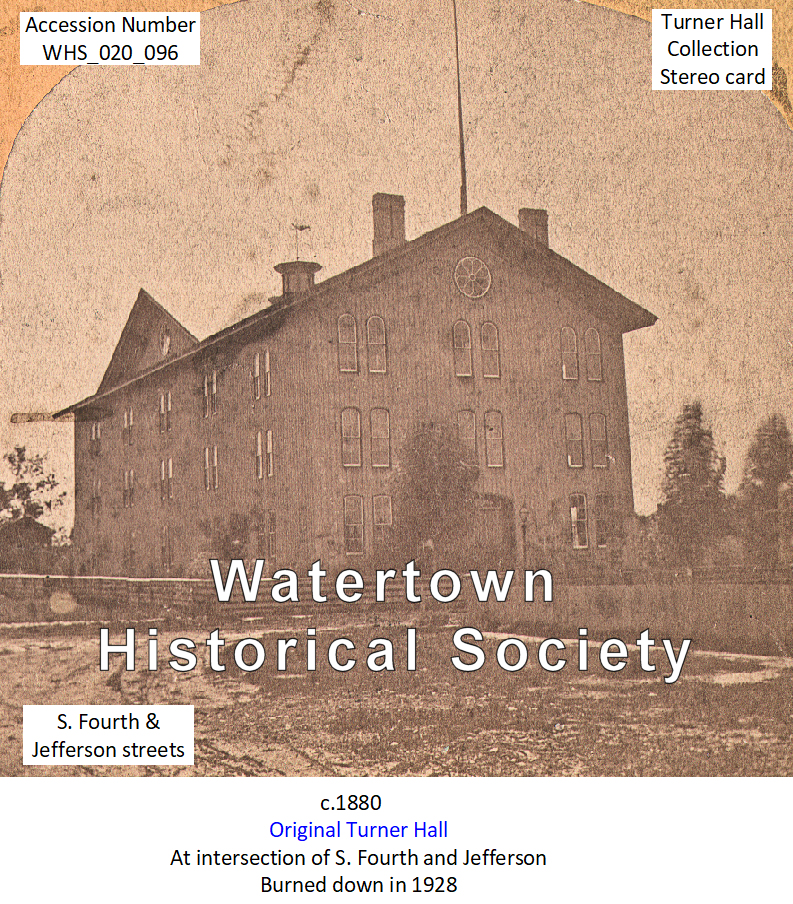
1883
06 22 Fourth of July
will soon be here and every patriotic American citizen is expected to celebrate
the day in a becoming manner. The Watertown Rifle Company and the Turner Society
will furnish amusement for all on that day, at Turner Park. In the evening in Turner Hall the festivities
of the day will close with a ball. WG
1886
05 21 LADIES OF THE TURNER SOCIETY
A grand May ball is to be held Saturday
evening at Turner Hall by the ladies of the Turner Society. The finest dressed lady present will be
crowned May Queen. Admission, gents, 50
cents; ladles, free.
04 11 CAMP-FIRE
IN TURNER HALL
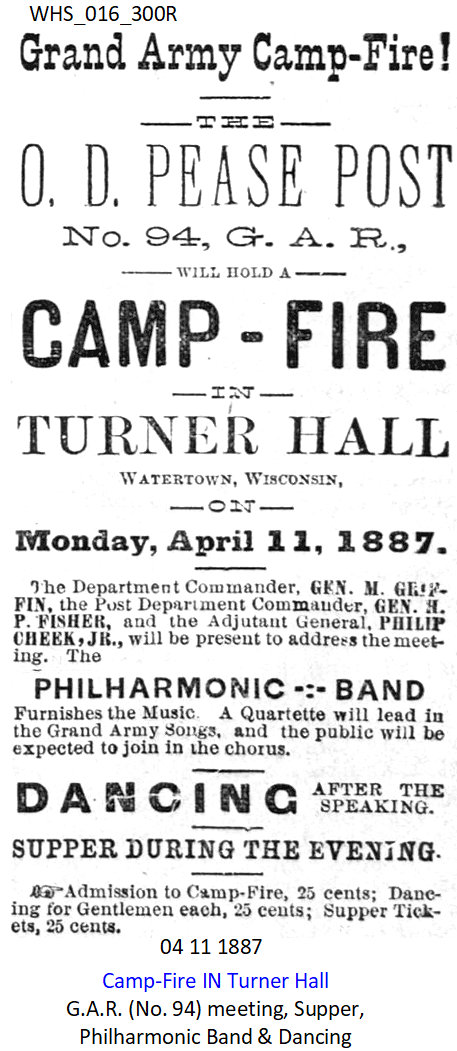
G.A.R. (No. 94) meeting, Supper, Philharmonic
Band & Dancing
1887
-- -- KINDERGARTEN HELD IN TURNER HALL, MISS IDA KOENIG, TEACHER
1888
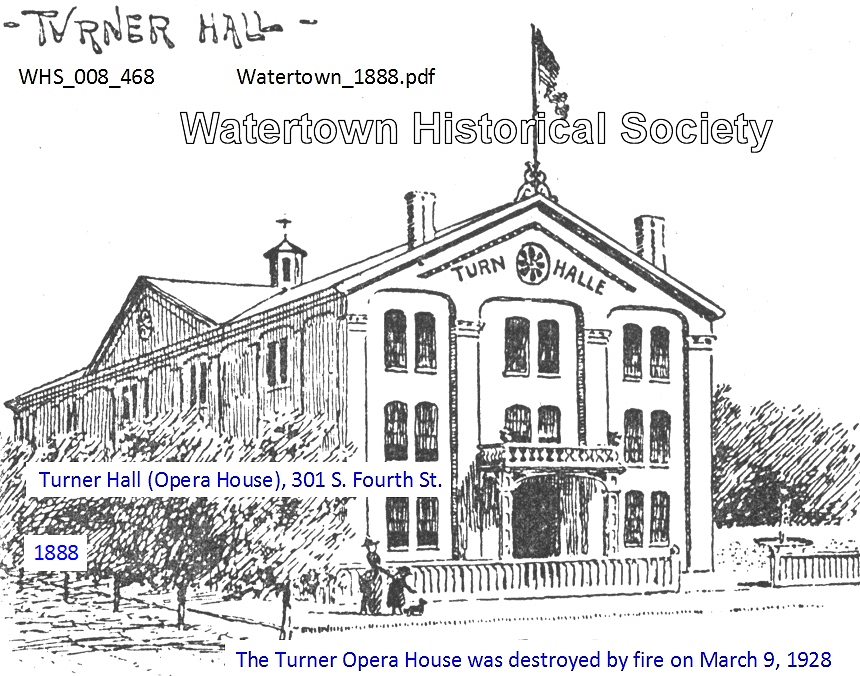
1888
01 11 FIRST PROFESSIONAL WRESTLING MATCH IN CITY
For the first time in
Watertown a professional wrestling match takes place at Turner Hall next
Saturday evening, January 14, 1888, between Charles Moth, champion Graeco-Roman
wrestler of the world, and Bert Scheller, champion catch-as-catch-can wrestler of
Illinois. The regular printed wrestling
rules will govern the match. The winner
is to take 65 per cent, and the loser 35 per cent, of the door receipts. Tickets for the match can be procured at the
Post office, Gates & Martin’s and Fuermann & Ditschler’s.
There will
no doubt be a large attendance of those interested in sporting not only among
our citizens, but from the surrounding towns.
Mr. Scheller has been on the ground here since Tuesday of last week
waiting to hear from his adversary and perfecting the arrangements for the
match. He is a pleasant gentleman and
evidently means to tackle Moth for all he is worth in the muscular line. W Republican, 01 11 1888
12 06 ATTEMPT TO SET TURNER HALL ON FIRE
The Old Lindon House
Barn with all its contents totally consumed [not same as Tremont House fire,
which occurred on 09 11 1895]; James Casey’s Warehouse burned to the ground;
Conley’s Saloon slightly damaged and several other places badly scorched. An attempt to set Turner Hall on fire.
12 20 ”IVY
LEAF” COMPANY
The ”Ivy Leaf” Co., at Concordia opera house last Saturday evening, did not
give very good satisfaction. With the exception of the characters Murty Kerrigan and
Darby Flynn, the members of the company did some very poor acting, the lady
portions especially. Their special stage
scenery was the finest ever seen here.
WG
1890
02 19 MASQUERADE
BALL
The masquerade ball of the Turner Society held at the opera house, Saturday
evening, was a perfect jam in point of numbers, every seat being taken, and
each inch of room occupied by masqueraders and spectators. The tableaux Were on a grand scale, gotten up
with considerable care and expense. Loud
applause followed the presentation of each of the allegorical scenes so finely
rendered. The height of enjoyment was
realized by all present and everybody was agreed upon the success of the
entertainment. WR
05 23 FLOWERS
FOR THE PARK
Walking through our
beautiful park this morning my thoughts ran thusly: What a fine thing it would be, to see this
park unfold itself into here and there a flowerbed; here a verbena, there a
pansy, and then a tube rose, and so on.
A foliage bed in the center with some tall ornamental plant in the midst of it, and so sloping down to the edge, would
be exceedingly becoming. And then the
thought - let’s do it — it is just the proper thing to do. So then I call on
all who are like-minded to come together in the park Saturday, May 24th
at 9 o'clock a.m., and bring with you a growing plant of the flowering kind,
and before noon we will have the park all glorified and beautiful to
behold. Bring along your picnic basket
and invite your husband and son. We will
make them welcome in their working suits, serve them lunch promptly at 12 p.m.,
and dismiss them in time for the circus.
Come one, come all; fathers, mothers, children, all with a flower. Other
wards not excluded if they feel inclined to come.
A FIRST WARDER.
P.S. Aldermen take
notice, a few benches would be in order.
WG
1891
01 30 CIGAR-MAKERS'
BALL
The cigar-makers' ball at Turner opera house last Saturday night was the
event of the season, being very largely attended and a grand success
socially. The hall was handsomely
decorated with red, white and blue bunting and United States' flags. A very large model of a cigar, suspended in
front of the stage, was a conspicuous feature of the decorations, and it was a
most appropriate design on this occasion.
The vast crowd present had a most delightful time, and the management
are to be congratulated on the great success of their undertaking. All their patrons were well treated, and
everything about the affair passed off in a remarkably pleasant manner. WG
02 13 "INDEPENDENT
OIL REFINER”
Among the characters at the Turner masquerade last Saturday night none
attracted more attention than that of the "Independent Oil Refiner,”
represented by Jake Eiffler. The part
was well taken, and on at first sight one would be lead
to think that Mr. Eiffler was playing the part of oil inspector. The large audience, however, caught on and
eagerly sought one of circulars he was distributing explaining the merits of
the "Brilliant Illuminator.”
Interested spectators shortly sought Jake and filled his brand new oil can with "illuminator." It was a little off color, but revived the
drooping spirits of the inner man with as good effect as the Brilliant
Illuminator cheers up the good housewife.
WG
03 20 LARGEST
ADVANCE SALE
The announcement that "The Muenchener" would appear at Turner
opera house in this city on Thursday, March 12th, was received with
unprecedented enthusiasm. The advance
sale of seats was the largest ever known here.
The surrounding towns almost without exception were represented by large
delegations, Jefferson taking the lead.
Watertown is probably the only city of its size in this country which
succeeded in making arrangements for a performance,
thanks to a few of our enterprising and art-loving citizens, who were obliged
to guarantee a large amount to secure the entertainment. WG
05 08 "THE
COUNTY FAIR" at the Turner

"The County Fair," Neil Burgess New York success, will be at
Turner opera house, Tuesday, May 12th.
The plot of the piece hinges mainly upon a horse race at the county
fair, which is run at full speed for three-quarters of a mile in full view of
the audience.
One of the horses belongs to Miss Abigail Prue, whose prim curls, old
maidenish ways, honesty, big-heartedness and willingness to take the whole
world into her sympathy, always wins the hearts of the audience. The colt has been injured by her boy of all
work, who has heard of the mortgage on her little home, and
is anxious to save the place to his benefactress. Of course, "Cold Molasses," for
that's the horse's name, wins, and the dear old lady is saved further
anxiety. The race is bonafide, with
mechanism for revolving tracks. Besides
the race scene, there is a husking bee on the great floor of the old country
barn, which is equally true to nature, which will appeal with fully as great
strength to memories as bygone days.
Then there is the characteristic old country dance, full of music,
merriment and motion, and as likely original as one pea is like another.
The company is said to be a powerful one, every member especially
selected for his or her fitness for the character to be impersonated and
includes the "County Fair" quartette.
The "County Fair" is rural in its intent, but it is
realistically rural.
09 16 "DOWN
THE SLOPE"
The big explosion to be seen in "Down the Slope" is a marvel
of realism. The scenic and mechanical
effects are said to be of a most startling nature, realistic in the extreme. The scenery is of the highest order, being
specially painted for this production.
To be seen for the first time in this city at Turner Opera house one
night only, September 17. Purchase your
tickets early and avoid the rush. WR
1892
06 22 TURNER
PARK ILLUMINATED
Turner park is now illuminated with an arc
light which lights up the grounds in a beautiful manner and will add greatly to
the pleasure of evening entertainments. WR
1895
04 17 WATERTOWN
CHORALE UNION
Monday evening the
Watertown Chorale Union made its initial appearance in concert and a signal
triumph in every particular was achieved. Nothing but unqualified success marked the
debut. The strains of the orchestral
introduction sounded. Turner Opera house
was completely filled by as fine and large an
assemblage as it ever contained. The
best classes of town people were in attendance, together with splendid
delegations from Oconomowoc, Columbus, Fort Atkinson, Jefferson and other
neighboring places. The receipts of the
house reached about $600 and notwithstanding the enormous expense of the
production the union reaped a handsome surplus.
05 22 NEW
FENCE
An
eight-foot board fence, with advertisements of business houses thereon, is to
be erected by the Turner Society around its park in the First ward.
09 25 "MALONEY'S WEDDING"
A great many people wonder and ask why on
earth Dan Maloney ever selected the Turner Opera House as a place for holding
his wedding on Sunday evening, September 29.
More especially those who are
aware of the fact that the intended bride's parents strongly object to
the union. Maloney gives as his reason
that he has an untold number of friends, a large majority of whom he expects to
attend, consequently he secured the Turner Opera house, on account of its
capacity and location, as he expects everybody to make merry and laugh as loud
as they choose; and he will exert himself to make each and
every one enjoy themselves that evening, sure. WR
10 02 "MALONEY'S WEDDING" at Turner Opera
house Sunday night was not largely attended.
The play is of the rough-and-tumble order, the comedy elements being not
those which appeal to the higher senses.
A few of the company, notably Mr. McCabe as MaIoney, interpreted
abundant amusement of the kind offered.
WR
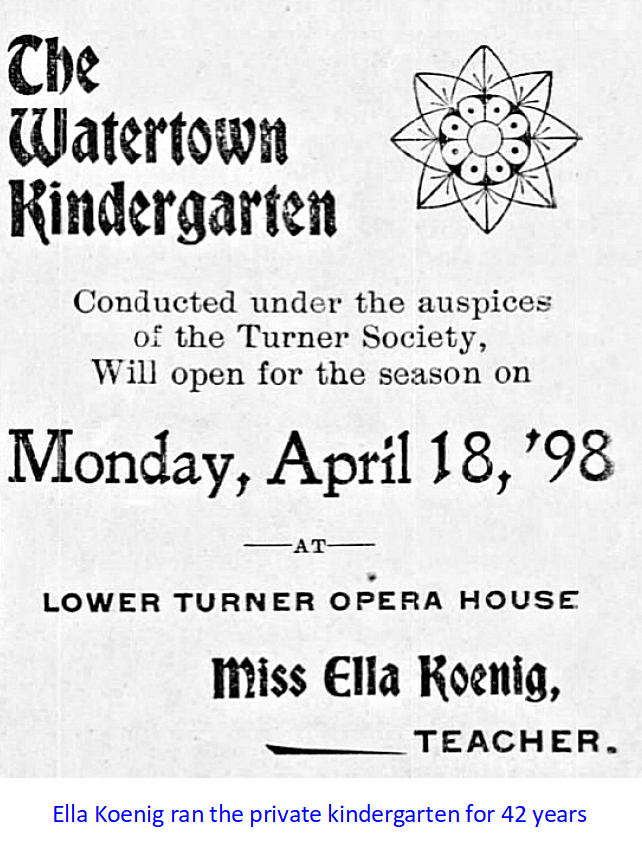
1898
04 18 KINDERGARTEN
CONDUCTED IN TURNER HALL (lower level)
Under auspices of the Turner
Society
1899
01 04 SYLVESTER BALL
A merry crowd danced the old year out and the
New Year in at the annual Sylvester ball at Turner Society Saturday night. WR
02 01 PARK PORTION SOLD
An effort will be made by the Turner society
to sell the south 100 feet of its park, located in the First ward, and
adjoining Turner Opera house. If the
property is disposed of the proceeds will go towards defraying some of the
society's indebtedness. The members have
found it difficult to make ends meet and keep their large property in good
condition, the revenues not being adequate to the demands that have been made. WR WR
02 15 ANNUAL MASQUERADE BALL
That great
pastime of the "colored aristocracy" - the cake-walk - was much in
evidence at the Turner Opera House Saturday night, when was held the annual
masquerade ball of the Turner Society.
It was of different grades of quality good, bad, indifferent but it
nevertheless provided genuine amusement for the throng of spectators who filled
the large hall. There were considerably
more maskers than a year ago, and taken all together
the ball was a great success. The stage
features were well conceived and carried out with precision under the able
direction of Paul Thom. One of the
numbers was a cake-walk in which several well-known
citizens competed, the prize being awarded by vote of the spectators to Ed
Schultz and Mrs. G. Glaser.
05 30 Lewis
Monument dedication participant.
1900
-- -- KINDERGARTEN HELD IN TURNER HALL, MISS ELLA
KOENIG, TEACHER
02 20 ANNUAL MASQUERADE BALL of the Turner Society
Bear in mind
that the grand masquerade of the Turner Society, February 24. The program will include rubber neck giants,
a Spanish castmette dance by sixteen people, a large caterpillar turning into
twelve beautiful butterflies who perform a fancy dance, Prince and Princess
Carnival and court, and many other interesting features.
08 17 NEW SCENERY
E. W.
Smith and H. Schindler have just
completed the painting of new scenery for Turner Opera House, as well as two
new curtains. The work is very fine and patrons of the house will appreciate it very
much WG
10 05 AUDIENCE VERY DISPLEASED
“A Wise
Member” at Turner Opera House last Monday night was about the biggest sell in
the amusement line that has ever been produced here, the audience being very
much displeased with the performance.
The management of Turner opera house did not play
the company here, and were not responsible for its
appearance. Such combinations as this
prevents people from patronizing better attractions when they appear, and it is
to be regretted that there is not some way of exposing such poor attractions in
advance. WG
10 05 WILLIAM J. BRYAN SPEAKS
[same
date] William J. Bryan, the champion of the people. Was met with an enthusiastic reception from
the dense throng which filled the spacious building to overflow, every
available foot of room being filled with men and women who were determined to
see and hear the next president of these United States. WG
1900c
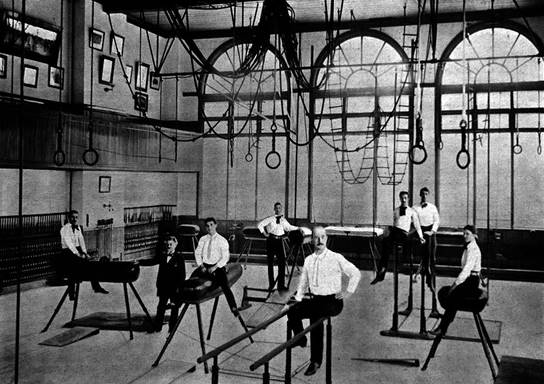
Milwaukee
Bundesturnhalle
Gymnastics
room in the National Gymnastics Hall at Milwaukee, ca. 1900
1901
04 12 EASTER
MONDAY DANCE
A
delightful dancing party was opened Easter Monday night at Turner Opera House
under the auspices of the Young American Athletic club, the patronesses of the
hall being Mrs. Otto Hahn, Mrs. Geo. H. Stanchfield and Mrs. Lilia Parks. The punch bowl was presided over by the
little Misses Emily Weber and Lydia Schmutzler.
The opera house was most beautifully decorated for the occasion, purple
and white ribbons suspended from the ceiling, falling festooned, and several
arches were trimmed in light colors, and hung with Japanese lanterns, making a
very pretty effect. Potted plants ferns
also added beauty and interest to the scene.
Music was furnished by Blaesius’ orchestra. The affair was a very incredible one. WG
09 20 PRESIDENT
MCKINLEY MEMORIAL SERVICE
Last
Monday evening in a mass meeting of citizens called together at the city hall
by Mayor Brusenbach about memorial service at Turner opera house at 2 o’clock
P. M. on Thursday, September 19, 1901, commemorative of the funeral of our lamented President, Wm.
McKinley. There were a large number
present, and the meeting was called to order by Mayor John J. Brusenbach, who
was also selected to preside at the meeting, ex-Mayor Henry Mulberger was
elected secretary. . . . Business was quite generally
suspended during the afternoon; the banks closed at noon and the usual holiday
hours were observed at the post office.
The public schools held memorial services shortly after the time of
school in the morning, and then
11 08 “HARD
TIMES” PARTY
One
evening of last week a “Hard Times” party was given by a
number of Watertown young ladies at Turner Opera House, and it proved to
be one of the most novel and entertaining social affairs ever given here. Many of the costumes worn were very
grotesque, and several of them may have been in the ark with Noah, or probably
resurrected from the ruins of Pompeii.
Hambitzer’s orchestra, of Milwaukee, furnished music for the occasion,
and a delicious luncheon was served on the stage. Miss Clara Saksky and Oscar Wertheimer were
awarded the souvenir prizes given by the management of the affair for the best
costumes. WG
11 22 WATERTOWN
DRAMATIC CLUB
AND AMATEUR MUSICAL CLUB
Turner
Opera House was well filled with people Thursday evening of last week to
witness the entertainment given by the Watertown Dramatic Club, and the Amateur
Musical Club, assisted in vocal numbers by Miss Lula Bertram, and Wm.
Sproesser. Edw. L. Schempf directed the musical part of the program in his
customary efficient manner. The music
furnished was high-class and was most excellently rendered. The singing of Miss
Bertram and Mr. Sproesser was very much appreciated, both responding to
enthusiastic encores. Miss Lydia Pease
accompanied the former, and the latter was accompanied by his wife.
“Mr.
Bob,” presented by the Watertown Dramatic Club is a very funny little comedy
and in every detail was perfectly portrayed. Mrs. W. J. Lee
as Patty, was very clever indeed, and came in for a good share of the
applause of the evening. John Chapman,
as Jenkins, with whom Patty was in love, provided a capital actor; and John W.
Schempf, as Phillip Rayson, was placed in so many ludicrous predicaments that
he furnished no small amount of the amusement of the evening. The whole affair was excellently carried out,
and about $135 was realized. WG
1902
03 14 JOHN PHILIP SOUSA
performs in Watertown
Our music-loving people
have not been given such a treat for many a day as was vouchsafed to them last
Monday afternoon when John Philip Sousa and the famous band visited our city,
giving one concert. Turner Hall Opera
House was filled with a most admiring and appreciative audience, composed of
some of our best people, and quite a large contingent from neighboring towns , special trains being run to accommodate them. From the moment that Sousa, with his fine
military bearing and the numerous decorations bestowed upon him during his
recent visit to Europe, made his appearance on the stage, until the close of
the concert, the interest manifested was intense; each number was
enthusiastically applauded and the musicians were very
generous in responding to encores. The
trombone solo by Arthur Pryor, the soprano solo by Miss Maud Reese Davies, and
violin solo by Miss Dorothy Hale, were all very much enjoyed and heartily
applauded. While every number was good,
we think the ones most enjoyed were the part from La Tosca and "The Night
Hall." Sousa went from here by
special train to Fond du Lac. WG
Cross Reference: http://en.wikipedia.org/wiki/John_Philip_Sousa
1903
04 22 STREET LIGHT IN FRONT
OF HALL
Common
Council: Resolved, That the Watertown Electric Company keep burning the electric
arc lamp now placed in front of the Turner hall the same nights and length of
time that the other city electric arc lamps burn throughout the year, and that
said company be paid for so doing twelve dollars ($12.00) per year in addition
to the money paid for street lights annually.
1904
07 22 WILLIAM BETHKE, MGR. /
HALL REMODELING
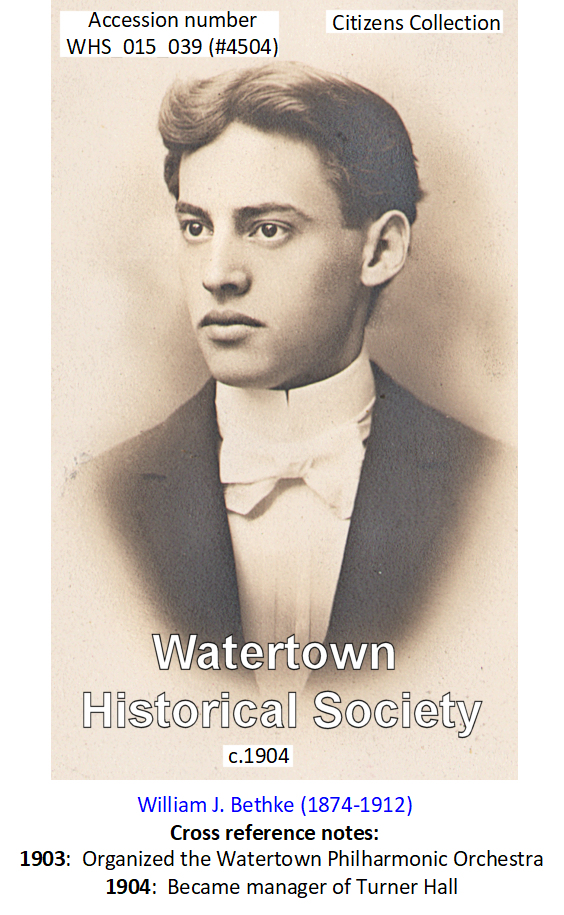
William
J. Bethke will hereafter be manager of Turner Opera House.
The
Turner is to be improved in several ways, among the improvements to be the
enlargement of the stage, which will allow any show on the road to be staged at
this popular theater.
Mr.
Bethke will book only first-class attractions.
WG
Cross reference note: In 1903 William Bethke organized the
Watertown Philharmonic Orchestra.
1905
12 15 “TAMING
A HUSBAND”
The
management of the Turner opera house was unfortunate in booking the musical
farce comedy - “Taming a Husband,” which appeared at that place Thursday
evening. It was certainly the worst kind
of a farce from beginning to end, so much so, that it was a comedy of
idiocy. The aggregation could neither
sing nor act, and there was nothing in the plot and the small audience, which
should have been much smaller, soon tired of the farce, for it was such in
fact. The management was not to blame
for it came highly recommended and was booked as a first-class attraction and
reliance was placed upon the representations made. There is one thing in connection with the
play that deserves condemnation and that was the hissing indulged in by some in
the audience. If they were dissatisfied they should have retired and not have disturbed
those who desired to remain and suffer the agony of which they were the
victims.
1907
02 16 TURNER
MASQUERADE BALL
To say
that there was an immense gathering at the grand prize masquerade ball of the
Turner society last evening would be a mild expression. The Turner opera house was taxed to its
utmost capacity and some idea of the enormity of the crowd can be conceived
when it is stated that there were nine hundred paid admissions. Nothing like it was ever before experienced.
The dancing floor was crowded like a box of sardines and comfort in stepping
the light fantastic was out of the question.
While
no foreign costumer was here to carry away a large sum in the loan of costumes,
there were nevertheless a large number of handsome
costumes on the floor.
Many
of them were historical, although we fear that the wearers took very little
interest in the sentimental part of the business. What they cared for most was that the
disguise fitted them perfectly and gave them a good appearance . . . As it was,
the mingled pageantry and mystery of the whole show, the costumes, the light,
the music, the company, the flittering uniforms, the handsome ladies, etc., . .
. were so dazzling that this reporter came down onto Main Street after midnight
feeling as if he had been pushed from the clouds where he had been leading a
romantic life for ages into an ill-lighted Rough and Ready dam wrangling
miserable world.
12 27 The Turner
society gave their annual ball at the Turner opera house last evening. There was a good attendance
and it goes without saying that there was a good time. The inspiration was furnished by the
Weber-Stube orchestra. WL
1908
02 01 TURNER
MASQUE BALL
Quite a treat is in store for the public of Watertown and
vicinity. Years ago, as is well
remembered by most of our citizens, the Turner Masque Ball was the talk of the
town, although for the last years this has dwindled down to a, so to say,
common affair. The committee in charge
of this year’s event has spared no time nor expense to bring it back to
standard again and has made arrangements with the
Carnival Costume Co. of Milwaukee, (the same company which furnished the
elaborate costumes etc. for the Imperial Minstrels the last two seasons) which
will enable them to furnish costumes of any character and description at a much
more reasonable price than they could be rented elsewhere. The public is urged to help make this Masque
Ball a unique and nice affair as of old, by leaving orders with the committee
or any Turner in due time. LET US HAVE
ONE GREAT MASQUE BALL. WL
05 07 Application for the transfer
of a liquor license rejected WL
11 13 Week day production booked
because many do not attend theatres on Sunday; Mgr Bethke has
booked "The Two Johns" WG
1909
02 19 Watertown
Imperial Minstrels performance WG
04 02 Greatest aggregation of dramatic talent
ever put upon any stage in Watertown; "Union Depot for a Day" WG
06 11 Nortense Nielson
Henry Ibsen’s “A Doll’s House” WG
06 25 Eighth grade graduation exercises held at hall WG
07 02 Watertown High School commencement
exercises held at hall WG
08 13 Redecorated; new opera seats added WG
1910
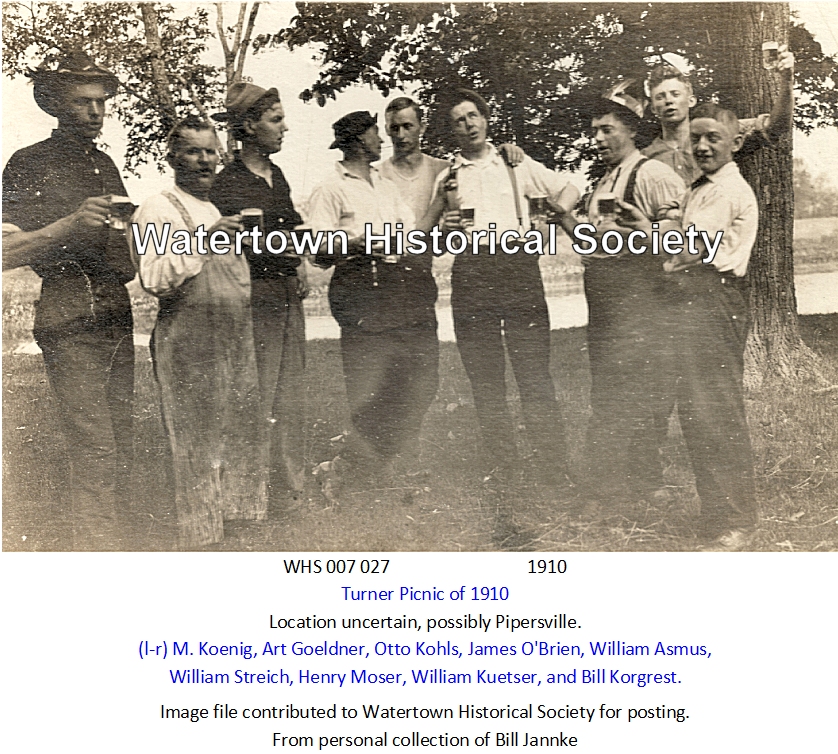 M. Koenig, Art Goeldner, Otto Kohls,
James O'Brien, William Asmus, William Streich, Henry Moser, William Kuetser,
and Bill Korgrest.
M. Koenig, Art Goeldner, Otto Kohls,
James O'Brien, William Asmus, William Streich, Henry Moser, William Kuetser,
and Bill Korgrest.
01 21 “The Gay Morning Glories” WG
03 04 Stanley, "The Great," peer of
all hypnotists WG
03 11 High School inter-class basketball
games at Turner WG
04 15 Lawrence University Glee Club concert WG
06 10 Senior class play WG
06 24 High School commencement at
hall WG
August The old Turner Opera House, as the
predecessor of the present hall was known, was one of the busy places here and
the Turners were an energetic and busy lot, working toward clearing the debt on
the building. This was finally
accomplished with a mortgage burning ceremony held in August of 1910.
07 29 Will
Celebrate 50th Anniversary — Sunday evening, August 7, at Turner Opera
House, the Watertown Turner Society will celebrate the 50th anniversary of the
founding of their society in this city.
A banquet and other amusements will be furnished. Emil Tanck will act as toastmaster at the
banquet. WG
07 29 50th
anniversary, Watertown Homecoming coincides with WG
08 07 50th
anniversary celebrated by Watertown Turner Verein WG
08 12 Musical
Comedy “Mother Goose Up To Date" WG
08 12 Southern play
"Tempest and Sunshine" WG
09 16 "Paid in
Full" WG
09 30 "Ishmael" WG
11 18 THE ENTERTAINMENT
COURSE
The initial number in
the entertainment course was given Monday evening at Turner Opera house. A fair sized
audience greeted Sarah Wathena Brown and the Chicago Boy Choir. Mrs. Brown announced to the audience that she
did not present the boys as finished musicians, but she wished to show what
could be done by patience, perseverance and good hard work. She contended that any boy that can talk, can
sing if he is only taught right and the tones properly managed; certainly the four boys who accompanied her possessed very
sweet, clear voices. They appeared first
as Scots in highland kilts and plaids, playing the bagpipes; after singing some
Scotch ballads, they danced the highland fling.
As choirboys in cassock and cotta, they sang a number
of familiar hymns. Later they
appeared as Irishmen, Germans and as very natural school boys, tired of study
and looking for some fun which they got in a game of baseball which was so
naturally played that the audience gave them the most hearty
applause. In all their work Mrs. Brown
accompanied them on the piano. The harp,
a most beautiful instrument, with full, rich tones, was expertly handled by
Mrs. Brown and she rendered several beautiful selections. She also recited a number
of short poems to musical accompaniment, all of which were much
enjoyed. The management is to be
congratulated on so auspicious a beginning of the winter's program. WG
12 16 THE
BARTOLOTTO CONCERT
The
second entertainment in the course being given this season occurred Thursday
evening, December 8th, at Turner Opera House.
It was a pity that a larger audience was not present as the concert was
very fine indeed. Signor Giuseppe
Bartolotto is possessed of an exceptionally fine tenor
voice and when he reached the higher notes the opera house fairly
resounded. His voice is compared
to Caruso's and he is credited with being a pupil of
the great tenor; we are surprised that he is not a member of some of the grand
opera companies. His little mannerisms
were quaint and piquant. As a reader and
impersonator, Miss Chaffee was excellent; she was at a disadvantage in her
first number, as so many late arrivals were being seated that it was an
interruption . . . WG
1911
02 23 THE
MUSIC MAKERS Next Monday Night
The last attraction on the Popular Entertainment Course comes to the Turner next Monday night in the shape of the
Music Makers, Musicians, Singers and Comedy Artists. This bids fair to be not only the best
attraction on the whole course, but one of the best shows seen here this
year. Seat sale now on and the
management has reduced the price to 25c for the best seats, and 25c for the
balcony. The Music Makers are clean,
manly young fellows, ambitious and musical to their finger tips, with a “style
and presence" that immediately captures the audience. These are the qualities that have made the
past tour of "Musicmakers" but little short of sensational. With Ralph Dunbar of Dunbar Company, as a
pilot, they have been safely guided around the shoals that wreck many new
companies. Theirs is new and it
"moves." No tiresome waits. When they undertake the classic
they do it so perfectly that even the devotees of popular music enjoy it. If they launch out on one of George Cohan's
Syncopated effusions, it is performed with such perfect rhythm and balance that
the lovers of classical music are not offended, and when they take up the
strains of one of "Loves Old Sweet Songs" or one of the old
"hymns" it is done with a reverence and a grace that is at once
satisfying. Comedy encores with action
are a feature, as are the vocal solos and "stories in verse and
song." But it is as a
"Marimbaphone Band" and when rendering selections such as the
"Poet and Peasant" overture, the "American Patrol” or the
"Light Cavalry” overture that the work of the company becomes
sensational. WG
02 23 LOCAL
THEATRICALS [same date as preceding]
Monday evening there was a large audience at Turner Opera House to
witness an advanced vaudeville performance by Watertown's own artists for the
benefit of the Popular Entertainment course.
Dr. E. J. Hoermann looked after the stage settings and Miss Lydia Pease
was piano accompanist for the various numbers.
Raymond H. Fuermann opened the program with his original ragtime musical
act, musical medley of airs, and other very clever musical stunts, all of which
brought forth great applause. Two
recitations by Miss Edna Chadwick, Watertown's talented young elocutionist,
followed, Miss Chadwick was at her best and acquitted herself most creditably,
and judging by the great applause given her, she pleased her audience
greatly. Some very clever artistic
dancing was done by Miss Marion Thom, which was greatly appreciated, and this
was one of the very best numbers on the program. The vocal numbers by the Misses Anna Smith
and Miss Genevieve Mullen were decidedly good, and as on all previous occasions
when they sang to the public, the Misses Smith and Mullen were on this evening
received with great favor. Frank P.
McAdams' and Mrs. S.
E. Holmes' interesting dramatic sketch "Forget-Me-Nots” was very
cleverly rendered, and elicited much applause. The musical five, Watertown High School
students, Kathyrn Blair, pianist, Ben Thauer, violinist, Rachael Cooley
violinist, George Henke, celloist, Herman W. Walthers, flutist, did excellent work,
and their number proved a decidedly popular one. The readings of Mrs. E. J. Hoermann were very
good, as was also the farce "Lend Me Five Shillings." The Imperial
quartette composed of Messrs. Franklin Edwards, E. C. Wolfram, Will Schlueter
and Richard White closed the entertainment with a beautifully rendered
"Good Night" song. WG
May  Eagles May Ball, 1911, possibly Turner Hall
1911
-- -- PARTICULARS
Turner Opera House. William J.
Bethke mgr. Joe Glaus treas. S. c.,
920. Prices vary according to attraction
all the way from 50c., 35c. and 25c. to $1.50, $1 and 50c. Illum gas and elec. Volt 112 alternating. H Moser elect. Stage dimensions: Width prosc, opening 30
ft. Height 28 ft. Depth footlights to back wall 37 ft. Distance curtain line to footlights 5 ft. Between side walls 53 ft. Distance between fly girders 40 ft. Height to rigging loft 48 ft. Scene room.
Fred Justmann, prop. man. A. Henze
stage carpenter. Wm. Weber orchestra
leader, 6 in orchestra. Wm. J. Bethke
bill poster. Transfer Co., E. Roth. Express offices, U.S. and American. T.F. Shinnick physician. Davis & Mulberger lawyers. Newspapers: Daily Leader, Times, Republican, Gazette and German paper. Hotels: Commercial $2 single, $1.50 double; Otto's $1
single and double; Washington House $1.25 single, $1 double; Wisconsin House $1
single and double. Railroads C M &
St P, Geo W Webb agt. CNW, F.M. Newton
agt. Publishers of programme: Glaus
& Jaeger. Empire Theatre Vaudeville
only, Joe Oppenheimer mgr., S. c. 6oo.
Opened February 1 1909 [Source]
05 02 THE MILWAUKEE THEATRE
COMPANY in "Ein Gluecklicher Familienvater" at
Turner opera house last Friday evening drew a large audience. The comedy is a very amusing one and it was
well put on. The large audience
thoroughly enjoyed it. WG
03 19 "THE SHEPHERD OF THE HILLS"
Harold Bell Wright, who is said to be the most popular of the younger
American novelists, with the assistance of Elsbery W. Reynolds, has made a
dramatization of his most widely read novel, "The Shepherd of the
Hills." Its initial production in
this city will take place at the Turner Opera House for an engagement of one
night only, Thursday, Sept. 5th.
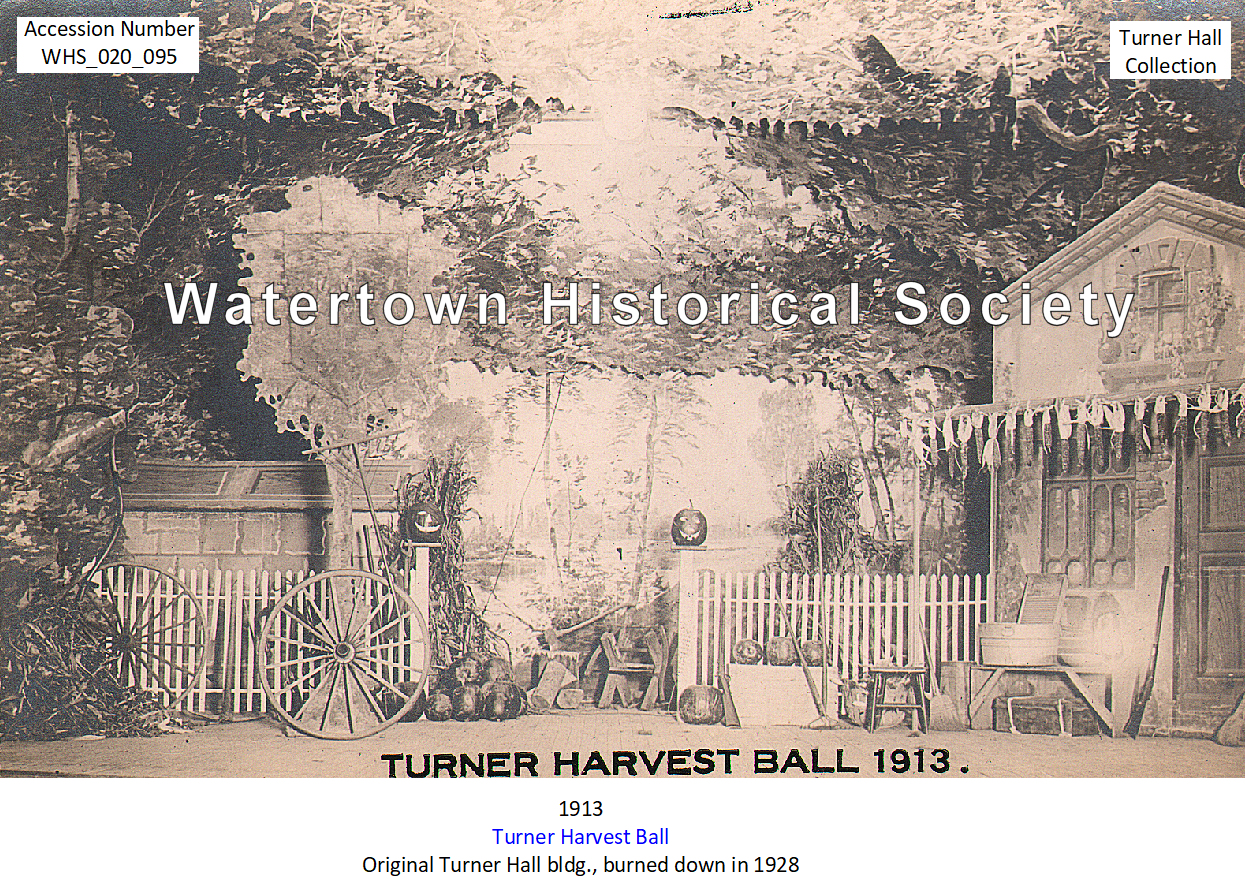
1913
-- -- TURNER HARVEST
BALL
10 02 POWHATAN
AT TURNER OPERA HOUSE
A crowded house greeted the production
of Powhatan at Turner Opera House last Tuesday evening under the direction of
W. A. Raker and given under the auspices of the Congregational Church. The piece is full of interesting scenes and they were beautifully portrayed on
this occasion and the vocal and instrumental music rendered would do credit to
professionals. Those
worthy of special mention taking part in this entertainment were: Miss Ethel Bates as Pocahontas, Miss Margaret
Emmerling as Laughing Star, Lewis W. Parks as Captain Rolfe, J. Wolfram as King
Powhatan, Miss Elsa Schempf, Miss Louise Sproesser, Miss Mabel Triplett, Miss
Florence Heismann, Will Richards, Jack Racek and Tom Williams. WG
c.1913
SIGNAGE ON MAIN STREET
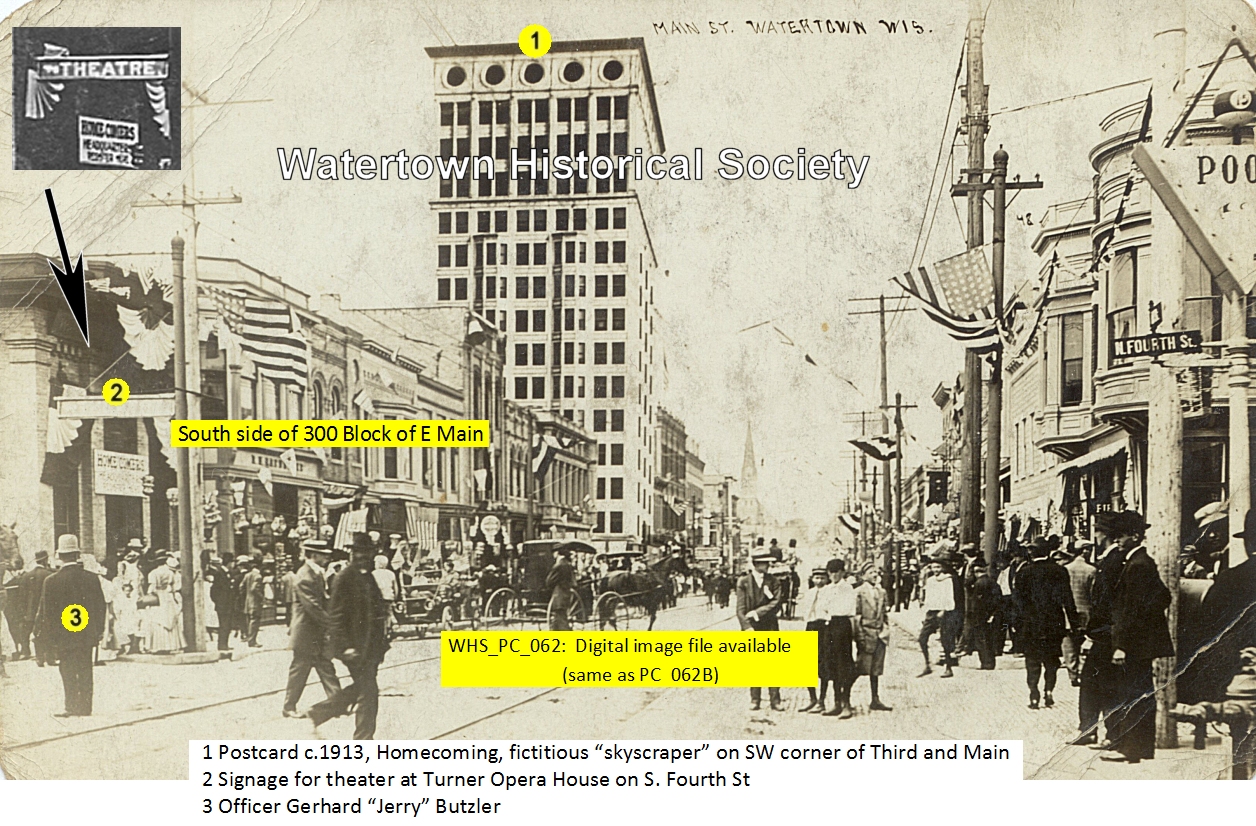 for theater at Opera House
1914
03 19 BUILDING IMPROVEMENTS / NEW TURNER MEMBERS
The annual meeting of the Turner Society last Thursday
evening 15 members were added to the role of the society. A banquet was served, at which City Treasurer
Emil Tanck officiated as toastmaster, and William Weber led in the musical
program given. The society decided to
make several fine improvements this year in their opera house, including toilet
and wash rooms. The following officers were
elected for the ensuing year: WG
President — Emil Kehr
Vice President — Arthur
Kleck
Fin. Secy. — Herman
Hilgendorf
Cor. Secy. — Carl Block
First Treasurer —
Edward Specht
Second Treasurer — E.
Peters
Gymnasium Instructor —
A. Henze
Theatrical Director —
William Grossert
Theatrical Manager —
Joseph Glaus
04 30 INDOOR FAIR A GREAT SUCCESS
The indoor fair at Turner Opera House during the past
week has been a great success. The
attractions and amusements were all of a wholesome
character and all who attended had a splendid time. Miss Alma Neitzel was voted the diamond ring
at the fair and William G. Pritzlaff secured the splendid davenport. WG
1915
03 18 ANNUAL MEETING
At the annual meeting of the Turner society held last
Thursday evening the following officers were elected:
President — Arthur Kleck.
Vice President — Carl Block.
Secretary — Herman Hilgendorf.
Corresponding Secretary — Archie Erickson.
First Treasurer — Edward Specht.
Second Treasurer — Ernst Peters.
Turning Teacher — Arthur Ullrich.
Theatre Director — William Grossert.
Theatrical Manager — Joseph Glaus.
The Weber-Stube orchestra furnished music and an
elaborate luncheon served in the dining room on the lower floor was a big
feature of the evening. WG
03 19 MASS MEETING: NEUTRALITY IN WWI
A mass meeting
of citizens is called to meet in Turner Opera, under the auspices of the German-American Club of Watertown. Neutrality in the present European war will
be the subject.
1916
01 14 “Birth of A
Nation” moving picture shown at Turner.
-- -- TURNER HALL, ASSUMED
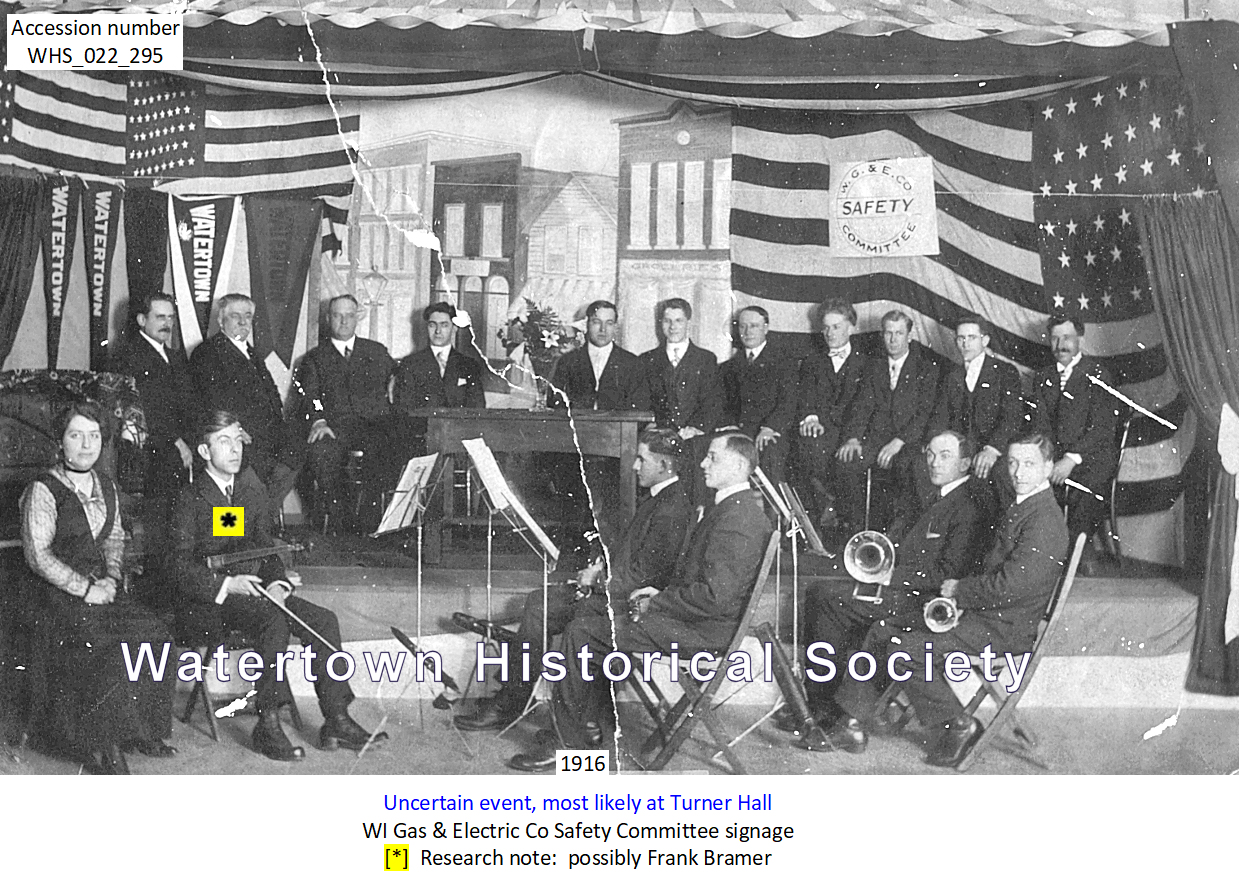
12 08 EDISON PHONOGRAPH DEMO
BIG
CROWD HEARS MOST SEVERE TEST
Singer’s
Voice put in comparison with Re-Creation.
RESULT
AMAZES MOST SKEPTICAL
Saturday evening was the date of the Helen Clark
recital at the Turner Opera House, Watertown, when, by previous arrangement,
the well-known mezzosoprano consented to sing with the Edison phonograph
allowing her voice to be compared with the laboratory recreation of the
wizard’s perfected instrument, the most severe test to which any mechanical
tone reproducer was ever subjected.
The curious, the critical and the skeptical were
there. All came away convinced that
Edison recreation is as nearly like the original voice
as could possibly be imagined. Every
test was greeted with hearty applause from the great audience which packed the
Turner to the doors. The recital was not
only a revelation but a rare musical treat as well.
Miss Clark sang in unison with her own voice. Some of the numbers were “Face to Face” by
Johnson; “Nightingale Song” by Keller; “For You” by Montague and “Bells of Lee”
by Adams. Except perhaps for the
difference in the volume of the tone, one could not be sure when Miss Clark
sang and when she did not. It is true,
her lips could be watched, but some of those who sat close to the stage are
quite sure that at times Miss Clark formed words with her lips but in singing
of “Bells of Lee” the lights went out. The volume of tone increased materially
at the end. Perhaps the
majority of the audience believe that Miss Clark was adding her voice to
that of the instrument, but when the lights flashed on again, she was not upon
the stage.
Perhaps the most charming feature of the entertainment
was Miss Clark’s “duet with herself”, “Swing High, Swing Low,” by Bennett. In singing with this record, she sang a
counter melody to that originally recorded in the laboratory. The duet was a most remarkable one in many
respects, for it would be manifestly impossible to find any two artists who
would be in such complete accord as to enunciation and interpretation as Miss Clark
with herself, or two voices so alike in quality as the same voice. The blending of tones was perfect;
the whole effect superb, and a fitting climax to a most convincing test. – Juneau Telephone newspaper
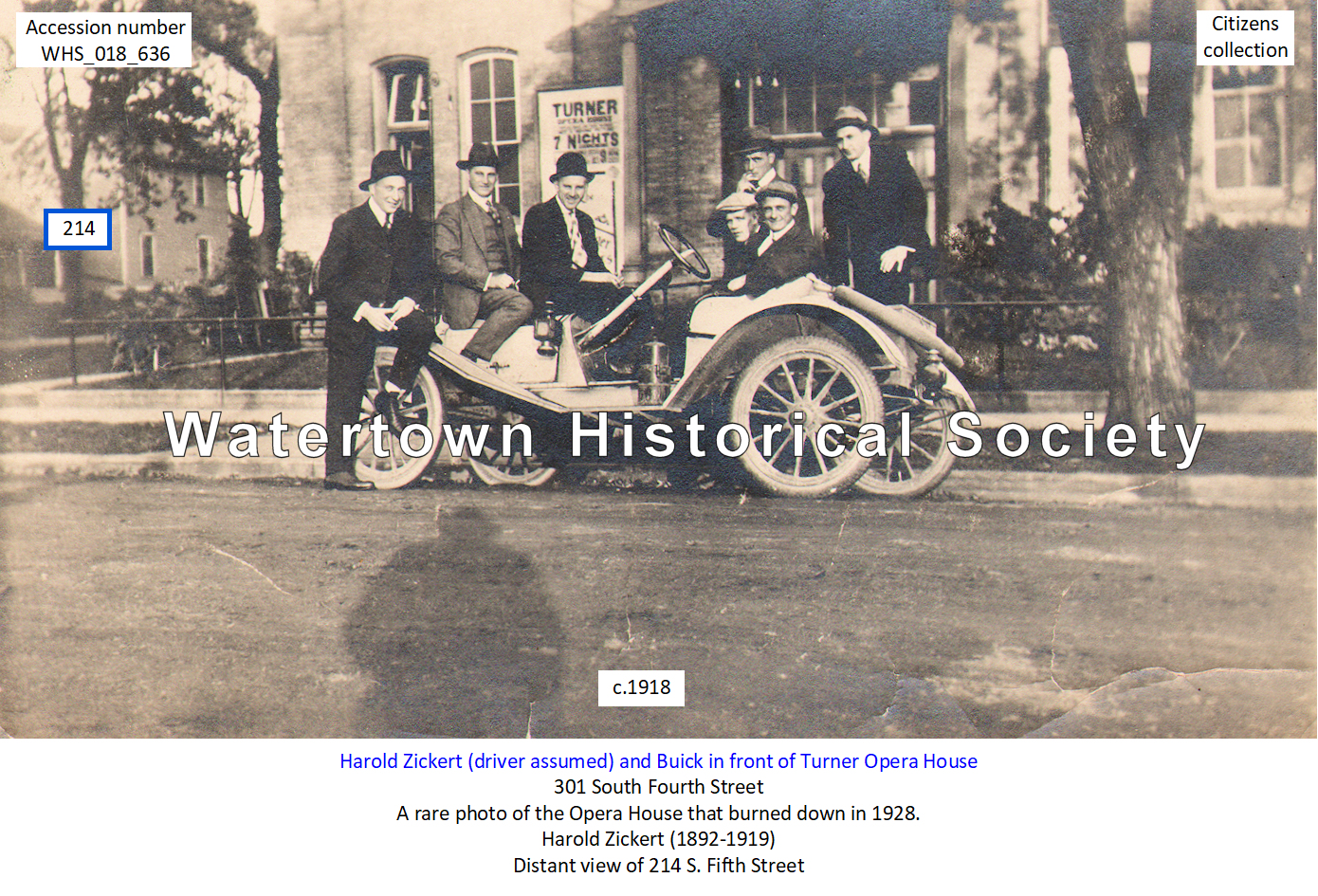
c.1918
-- -- HAROLD ZICKERT AND
BUICK IN FRONT OF TURNER OPERA HOUSE
1925
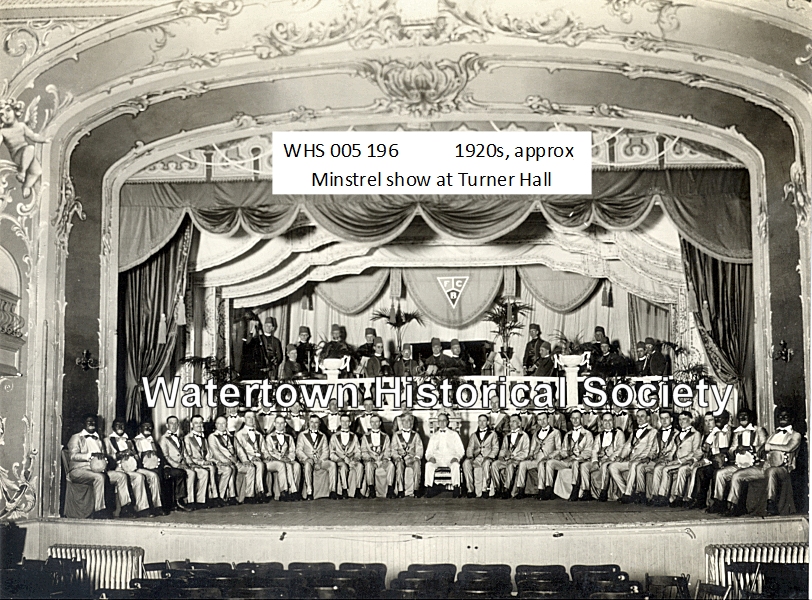
04 16 K. OF P. MINSTREL SHOW AT TURNER HALL
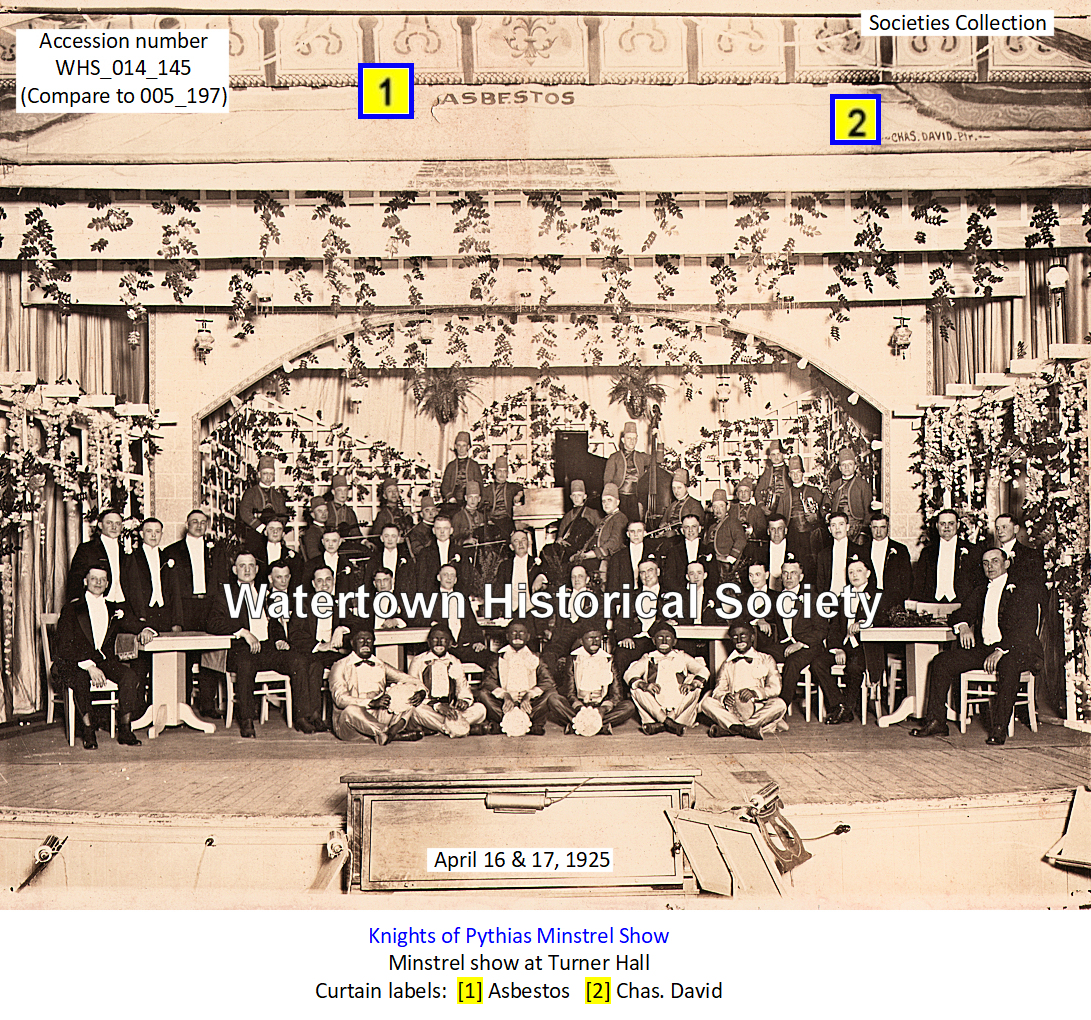
1920s
K. OF P. MINSTREL SHOW
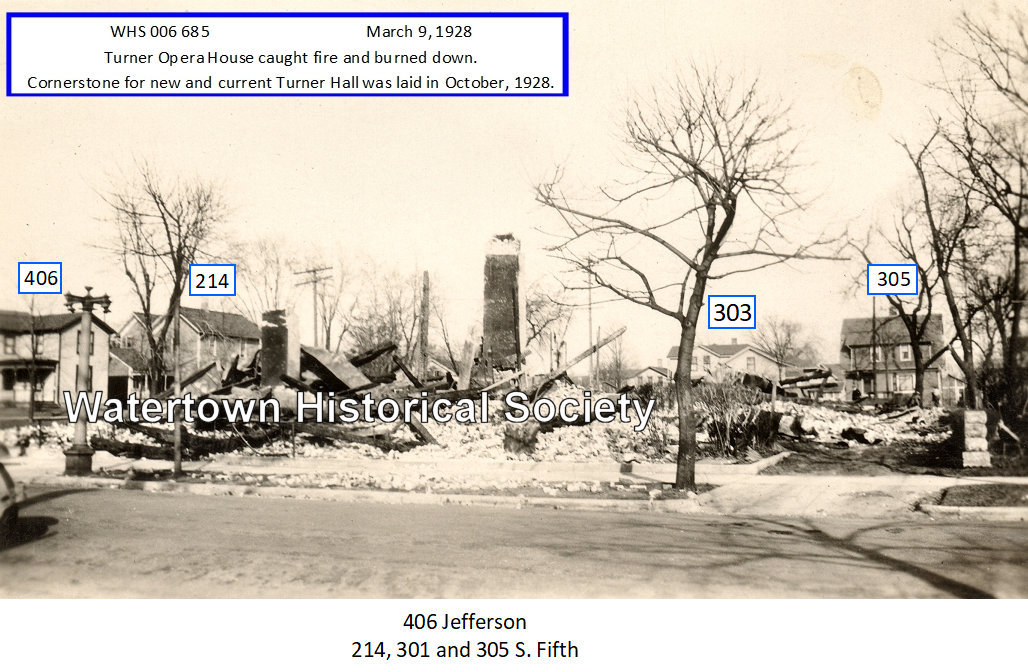
1928
FIRE
Special thanks to Leonard Kottwitz for his help in providing much of the
research for this article.
It was a sad day in Watertown, when, on March 9, 1928, Turner Opera
House caught fire and burned down. Not
only did the Turners lose their entire facility, but a performing show lost $10,000 worth of equipment
and the National Guard, which was headquartered
there, suffered another $10,000 loss of weapons and a huge arsenal of
ammunition. The wintry setting helped
prevent the fire from spreading off-site, but it did not minimize the spectacle
of Watertown's oldest building being ushered into history by a rising crescendo
of exploding-shells.
The
fire swept through the building just hours after the annual meeting of the
organization had concluded.
A
$19,000 insurance payment helped meet the cost of rebuilding. The cornerstone
for the new, and current Turner Hall was laid in October, 1928, with the grand
opening the following January. Amazingly, the entire structure cost only
$54,000 to build.
The Watertown Historical Society has a set of images of the 1928 fire.
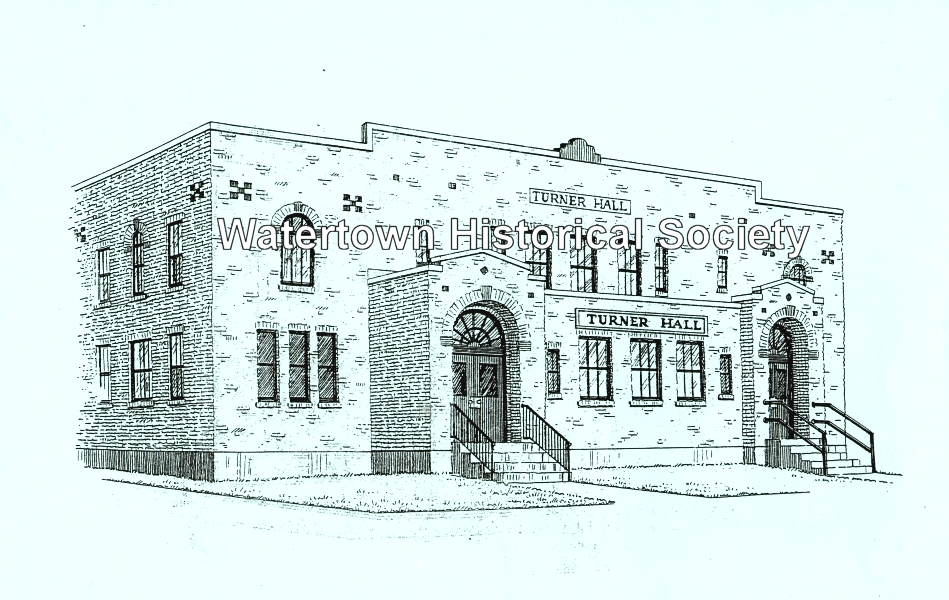
SET OF ARCHITECTUAL
PLANS (1928)
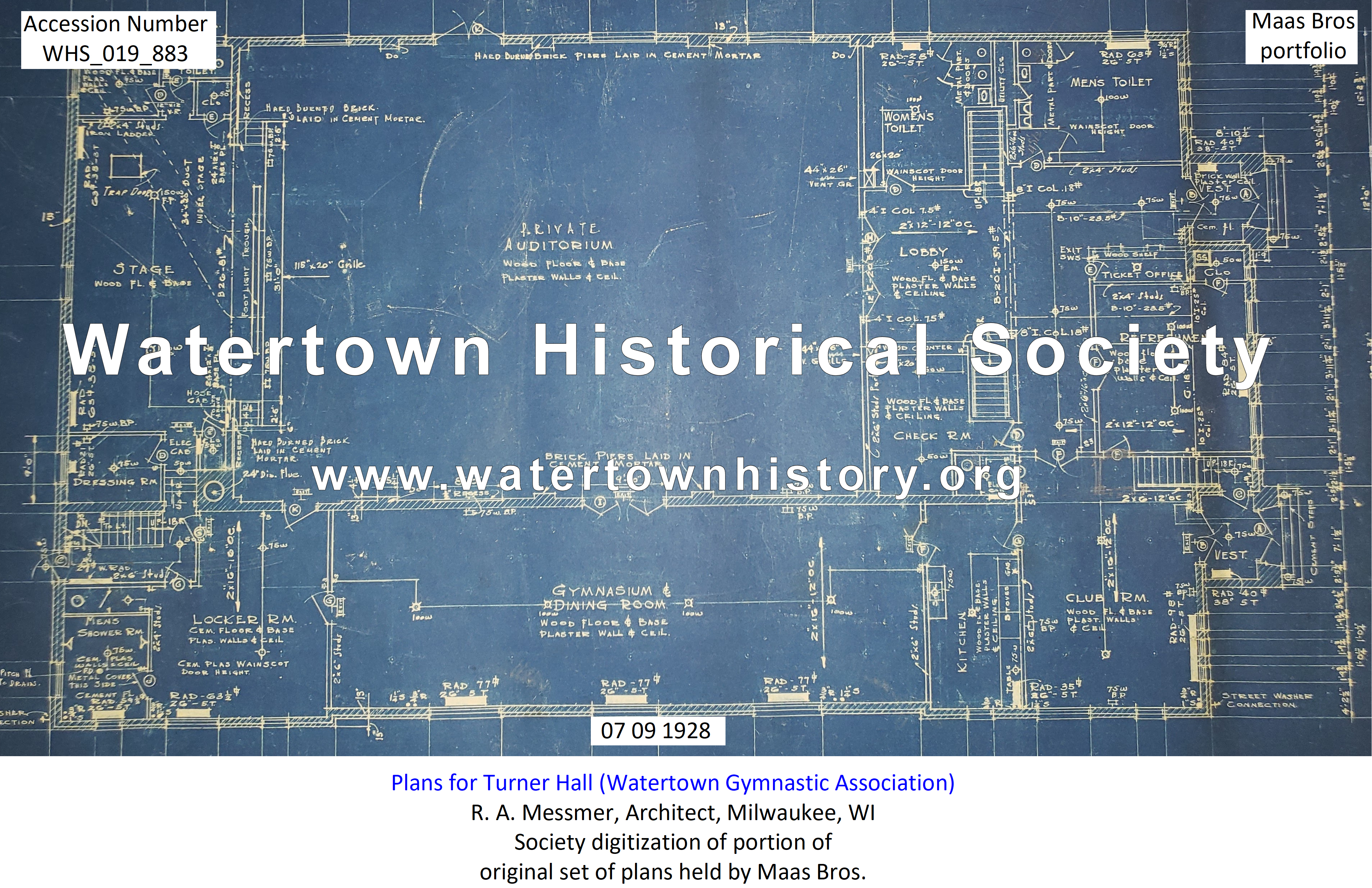
Maas Bros. Construction project
SELECTED
SPECIFICATIONS FOR TURNER HALL,
built
for Watertown Gymnastic Association
Tidbits
derived from 27-page set of specifications by architect
.
. . CONCRETE - The water used in mixing concrete shall be fresh, clean
and free from all earth, clay, loam or sewerage, or other impurities liable to
injure the concrete.
Concrete
for walls, footing, columns or floors placed on earth or cinders must be mixed
in proportion of one part cement, two parts sand and four parts stone. Concrete for beams, reinforced slabs or
lintels much be mixed in proportions of one part cement, one and one-half parts
sand and three and one half parts stone.
All
concrete shall be machine mixed. No hand
mixed concrete of any description will be tolerated. The concrete shall be mixed wet, sufficient
water being used to make a mass they will flow readily, and be of such
consistency that the reinforcing steel will become thoroughly coated with a
protecting coat of fine mortar, but at the same time an excess of water must be
carefully avoided, as it causes a separation of the materials. . .
.
. . FLAG POLE – Furnish and place wood flag pole 36 ft. long x 7 ½
inches turned diameter at base by 3 ½ inches diameter at top. Flag pole to be complete with rotating Lignum
vitae truck and sheave, brass rod, 20 oz. spun 9-inch diameter copper ball,
halyards and fastening cleat. Top
fixture to be made to cap top of wood pole to prevent rotting. Carpenter to paint flag pole four good coats
of lead and oil paint before erecting.
Completion
of the building ushered in the era of basketball in the main hall, professional
wrestling matches on Friday evenings and Sunday night dances. As the years went
by the Turners found it more and more difficult to compete with other halls and
businesses that offered large group facilities. A primary reason was the lack
of a liquor license.
Up to
that time, the Turners had a license to sell beer, but did not have a license
to sell hard liquor. It was a long and difficult fight but matters finally came
to a head in 1965 when the Turners announced the facility would be closed and
the building sold unless a liquor license was granted. The Watertown Common
Council relented and a liquor license was granted.
With that new beginning, the Turners continued to enjoy tremendous
success in fulfilling their historic purpose. In the 138 years since their
founding, the Turners' organization has been an inseparable part of Watertown's
progress and history. While it is easy to focus on the beautiful landmark that
has been the center of their activity, it is the Turners themselves that have
made the greatest mark for good in the community.
Perhaps the finest glimpse of the Turner Society and their commitment to
service and Christian charity was conveyed through a prayer given at the 100th
Anniversary Banquet in September 1960:
"O
Lord, we pray that Thou woulds't continue to make this Christian organization a
blessing to the community and to all men. Christian fellowship and wholesome
Christian recreation is also a blessing. Enable us as
members of the Christian organization to continue to live in love and in
harmony one with another. Make us all mindful of what love means in an
organization. As we thank Thee this evening for this Christian fellowship, yes,
of some 100 years, we are made very mindful of Thy love and what it means to an
organization and to a world."
1929, Opening
The
corner stone of the present hall was laid on Oct. 14, 1928. Dedication ceremonies of the present building
were held with the opening of the hall on Jan. 29, 1929.
Home
talent plays are still in vague, but radio shows and talkies have largely
replaced the old-time stage plays and the waltz and two-step have given way to
modern forms of dancing.
The
present Turner members have worked hard and long toward the goal of clearing
the debt on the present building and wiping out the mortgage.
Movement
Found Momentum in Watertown
Mention
the name "Turner Hall" and the first thing that comes to mind may be
great fish fries, gymnastics, or the beautiful building that has hosted so many
community celebrations and private receptions over the years. But the
long and colorful history of the Watertown Gymnastic Association, more commonly
known as Watertown Turners, is far richer than the gourmet food they have
served for decades. In fact, it is inspiring.
The Turner movement began in Europe in the early 1800's, an outgrowth of
both lofty ideals as well as practical innovation. It was the era of
Napoleon and the empire that he was piecing together encompassed most of
western Europe, including the German principalities. While historians
have praised his military skills and emphasized his many accomplishments,
Napoleon governed as a typical military dictator.
Napoleon oppressed freedom everywhere, yet he was especially harsh in
the conquered lands. Meetings for any political purpose were banned but it was
permitted to gather for athletic activity. So
Friedrich Ludwig Jahn, the "father of gymnastics" and a fervent
German patriot, began organizing Turnverein (gymnastic clubs) all across
Prussia. Jahn believed that physical education was the key to national vitality
and equally important in strengthening individual and national character.
Members of the gymnastic clubs, which always included large numbers of
German youth, would gather after each workout to discuss political goals and
their dreams for freedom and justice. After Napoleon was defeated in 1815, the
powerful combination of gymnastics and politics continued to influence the next
generation of Germans. When the Revolution of 1848 broke out, the prospect of
achieving the freedom which had been so commonly discussed at the Turnverein
led mand "Turners" to support the revolution.
When the revolution was suppressed, those who had supported it were
forced to flee and many emigrated to America. Some of the political refugees
settled in Wisconsin, and quickly formed Turnverein. However, with freedom in
their new land already a reality, Turner Societies broadened their purpose to
include the "cultivation and improvement of the
faculties of the body and mind of its members and the management of musical
and theatrical entertainment for amusement of the society and public as
well."
Watertown Turners, originally named the Independent Gymnastic Society of
Watertown, was formed on Aug. 21, 1860. Early
meetings were held in the old Cole building at the corner of South Second and Main streets (at
the location of the former Kline's Department Store). Within a year, the
Turners had put on their first theatrical performance.
By 1869, the original Turner Hall was constructed at a cost of $28,000.
It was located at 301 S. Fourth St., the site of the vacant circus grounds and
the same location as the present Turner Hall. On Dec. 11, 1869, the new
three-story hall opened. An audience of 1,300 people enjoyed a performance of
Mozart's "The Magic Flute.”
Interestingly, there was a prejudice against theaters in those days. So,
to avoid needless criticism, the first Turner Hall was called Turner Opera
House. For the same reason, when the Concordia Musical Society purchased the
building which is now the Elk's Club, it was called the Concordia Opera House.
Whether the performance was a play, musical, or concert, it apparently met with
greater acceptability when viewed in an opera house.
For 59 years, Turner Opera House was the center of cultural events in
the city. The Turners used the building to fulfill their original purposes in
the broadest sense - "entertainment for amusement of the society and
public." In addition to the theatrical use, the building hosted dances,
weddings, conventions, union meetings, political rallies, wrestling matches,
and of course, many gymnastic events.
1929
08 25 DEATH OF EMIL TANCK
Was
theatrical manager of the Turner Society; one of Watertown’s Best Citizens
1931
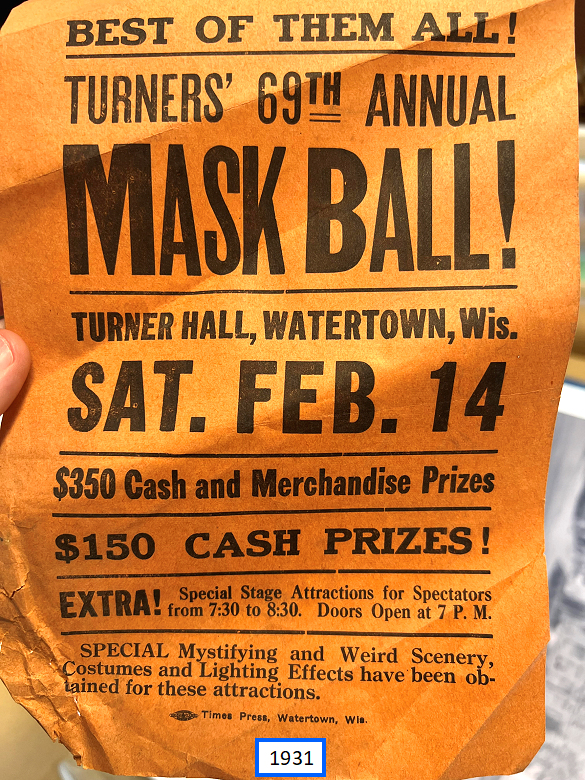
02 14 69th ANNUAL MASK BALL
1936
1950
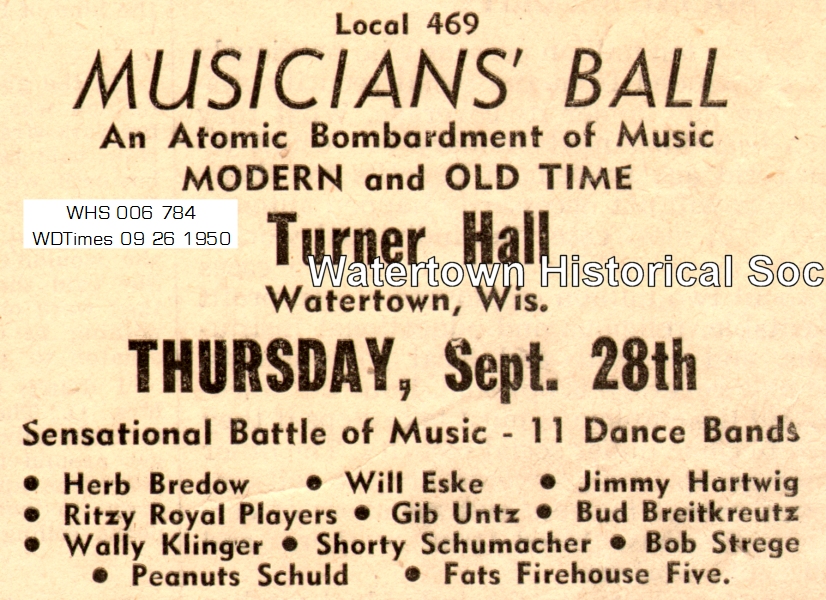
09 28 AN
ATOMIC BOMBARDMENT of Music
1952
04 15 WATERTOWN SPORT
SHOW
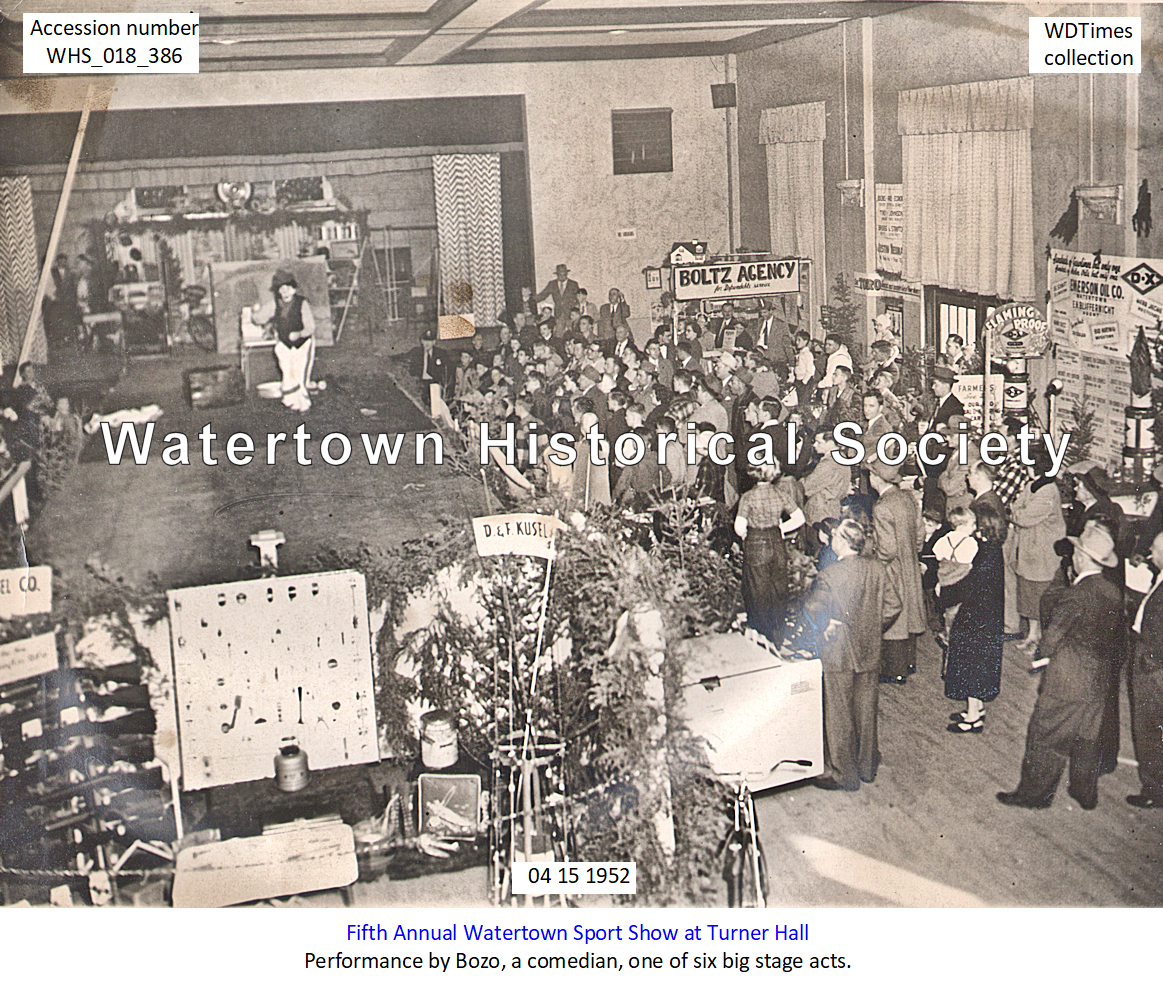
1954
-- -- WATERTOWN CENTENNIAL PARADE
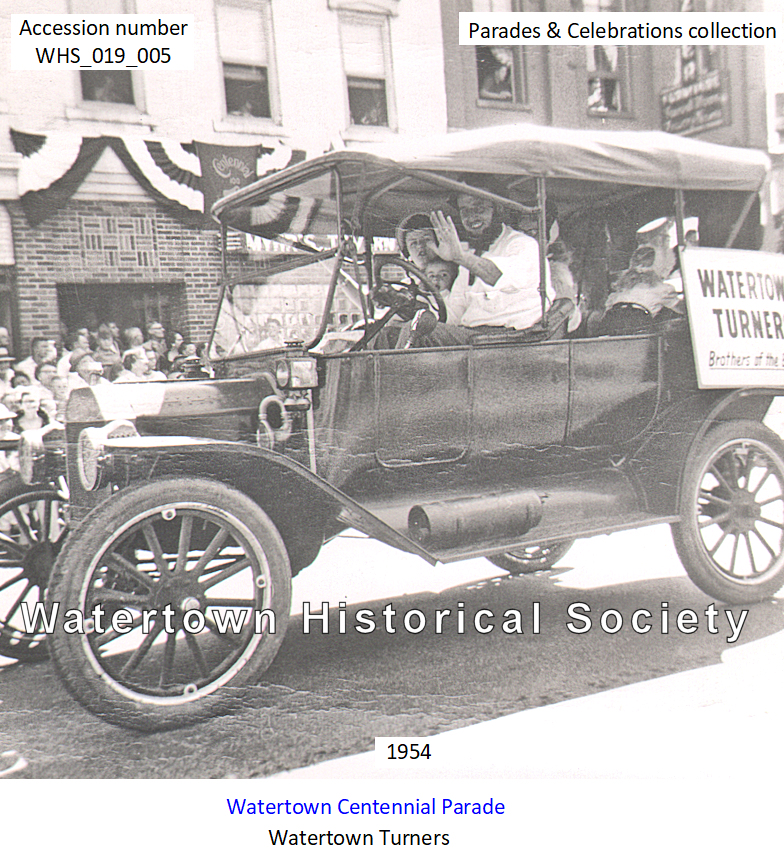
1956
04 29 OFF-STREET PARKING LOT ABANDONED
Officials of the Watertown Gymnastic Association announced that they
have decided to withdraw their offer to the city regarding possible off-street
parking lot plans for the vacant property they own at Turner Hall. The Turners have decided, it was said, not to
cause any ill will among property owners and residents in the vicinity and have
therefore decided to drop the proposal which they made to the City Council some
weeks ago. 04 29
1956 Legal question with the pending transfer of tavern license. 03 25
1959
02 23 Cooking school among events at Turner
during ’59.
07 30 Supermarket proposed for Turner Hall site;
new Turner Hall proposed WDT
09 16 PLANS FOR 100 YEAR CELEBRATION IN 1960
The Watertown Turners will be 100 years old as an
organization in 1960 and plans have begun to stir for observing the
event. Harley Lehmann, president
of the Turners, has named a steering committee to launch the movement for the
centennial. Fred Loeffler
has been named chairman, Waldo Potter, secretary. Other members are:
Orval Steffen, Clifford Hanson, Marvin Bredow, Don Gerth, Emil Kihslinger,
William Schultz, Howard Weihert, Charles Graff, Ernest Kubly, Duane Steffen and
Henry Schaller, publicity.
-- -- ROCK AND
ROLL SHOW
Watertown's First Rock and Roll show there in 1959.
1950s
-- -- HILL FOR
SLEDING
MEMORY: There is a slight little "hill"
behind the hall. In the 1950's all of us
in the neighborhood used to sled there in the winter. . . .
Best memories! Also used to go to Turner
Hall every New Year’s Eve!
1960
06 09 TURNER HALL SITE PROPOSED FOR DEVELOPMENT
Edward Hinterberg,
president of the city council, plans to come up with a new proposal in
connection with the general plans for a new post office building for
Watertown. Under his plan the city would
enter into direct negotiations to sell the site of the
present recreation building to the federal government. At the same time the city would explore the
possibility of acquiring the Turner Hall and several nearby lots which were
announced as available last year for the site of a new supermarket, a plan that
did not materialize. If the Turner Hall
site is still available and the lots can also be secured, Mr. Hinterberg
believes that the hall could be turned into a recreation building, centering
all recreation activities there. WDT
-- -- TURNER HALL OFFERED TO CITY FOR POLICE & FIRE
STATION, $75,000
 City Assessor Note
06 22 TURNERS CENTENNIAL CELEBRATION DATES, 1860 - 1960
The Watertown Turners have set the
dates for the celebration of their centennial which is being observed this
year. The dates are Sept. 19 to 25 and
work on the plans is now well underway.
Chairmen of the various committees in charge of the celebration have
held several meetings and the next general meeting of the committee is to be
held July 11 at 7:30 p.m. at Turner Hall at which additional phases for the
jubilee will be discussed. Members of
the steering committee are: Marvin Bredow, Clifford Hanson, Emil
Kihslinger, Ernest Kubly, Harley Lehmann, Waldo Potter, Henry Schaller, William
Schultz, Duane Steffen, Orval Steffen, W. C. Strache and Howard Weihert. WDT
09 22 ANNIVERSARY BANQUET
The Watertown Turners,
who over a period of 100 years have dispensed and experienced the well-known
brand of Watertown gemuetlichkeit, enjoyed some on Saturday night when
they sat down to long banquet tables in Turner Hall to celebrate the 100th
anniversary of the organization. The
event, which had been observed all week, wound up with a banquet and program
that drew 90 per cent attendance of the members. The large hall was completely
filled, both members and their ladies attending.
WDT
1961
01 07 Mrs. Leonard Kresinske was
elected president, succeeding Mrs. George Sauer. Other officers named were Mrs. Robert Kehr,
vice president; Mrs. Earl Weihert, secretary; and Mrs. Fred W. Borchardt,
treasurer. WDT
03 10 Charles F. Haven,
manager of the Ace Hardware Store, elected head of the Watertown Gymnastic
Association. Other officers are: Donald Gerth,
second speaker; George Zoelle Jr., first secretary; William Hertel, second
secretary; Arthur A. Ullrich, first treasurer; Wayne Saniter, second treasurer;
Donald Brink, gymnastic director; Arden Piper, theatrical director, and Harley
Lehmann, manager of Turner Hall. WDT
05 24 The Watertown Gymnastic Association at a
meeting last night voted to make the Turner Hall property available to
prospective buyers, according to a statement issued today by officers on behalf
of the organization. It was reported there are several prospective buyers but as yet no decision had been
reached. Two of the offers are for purchases of the property for a new
supermarket site. Some years ago the Turner Hall was
offered for sale but the deal was not consummated. WDT
1962
02 08 TURNER
HALL PROPOSED FOR SUPERMARKET OR CITY REC DEPT
The common
council committee recently delegated to meet with representatives of the
Watertown Turners to obtain information about the availability of the Turner
Hall property for city recreation department purposes held such a meeting last
night but there were no final developments.
The Turners recently indicated the property is for sale, since there are
no options outstanding on it at the present time. At one time a food chain was interested in
the property for a supermarket but this project did
not develop. It was made clear at the
last council meeting that the meeting with the Turners would be only to learn
what price range they have in mind and that there was no direct intention, at
this time, for the city to acquire the property. WDT
09 07 LIQUOR
LICENSE RELATION TO PROPOSED SALE OF TURNER
The granting
of a liquor license in connection with the offer of the Turner Hall building to
the city was not a condition of the proposed sale, the board of directors of
the Watertown Turners Society said. The
building had been under consideration as a possible location for the Watertown
Recreation Department. Now plans call
for locating the department in the basement of the new municipal building, to
be erected on Memorial Park. At a
special meeting of the Common Council, Mayor Robert P. White stated that the
granting of a liquor license was a condition to the proposed sale and that the
council is not in favor of acquiring the building with this condition
attached. WDT
1963
03 11 Mayor Robert P. White has called for a
definite decision on the part of the council on the application filed by the
Watertown Turners for a liquor license at Turner Hall. At present only a class “B” beverage license,
beer, is carried at Turner Hall. WDT
08 06 The Watertown Turners last night lost
their latest attempt to secure a tavern license for Turner Hall, the vote by
the common council being 7 to 6, but there is still one chance that a license
may be granted, providing the present city tavern ordinance is amended. Such a move was begun last night in the council and it will come up for a test at the Aug. 20
meeting. Last night’s council action on the latest license application was the
third time this year that the council has refused to approve the license. WDT
09 03 The Watertown Gymnastic Association
announced today that petitions bearing 937 names are being filed with the
office of the city clerk for presentation to the common council at its meeting
tonight supporting the Turner Hall liquor license request. The council is due to vote on the second
reading of the ordinance tonight which would pave the way for granting a
license to the association to operate a bar in Turner Hall. The first reading was approved by a one vote
margin — 7 to 6, with one alderman absent.
WDT
09 07 Mayor Robert P. White announced that he
has vetoed the ordinance adopted at Tuesday night’s meeting of the common
council under which the Watertown Gymnastic Association would have been able to
file a new application for a liquor license for the Turner Hall. The council vote was 8 to 5. The mayor had informed the Times yesterday
morning that he definitely decided on a veto
today. He had also stated on Aug. 20,
when the council approved the first reading of the ordinance, that he would
veto it if it was adopted on its second reading. WDT
09 17 Five members of the common council last
night supported Mayor Robert P. White in his vote of the ordinance designed to
pave the way for the Watertown Turners to obtain a tavern license for Turner
Hall. Alderman Charles Yeomans made the
motion to sustain the veto, thus blocking the way for a Turner Hall license.
Voting with Yeomans in support of the veto were four other aldermen — Paul
Archambeau, William Wiegand, Marvin O. Niehoff and James Bloor. The nine
aldermen who voted against supporting the veto were Wallace Block, Herman
Gerth, Christie P. Coogan, Floyd Shaefer, Ronald Moser, Melvin Lange, Armund
Turke, George Shephard and Eric Nuernberg.
WDT
1964
02 06 WAYNE
KING
Wayne
King, “The Waltz King,” and his famous orchestra at Turner Hall Thursday
night, Feb. 6, when they play for a dance.
03 24 ANNUAL
ELECTION OF OFFICERS
The
Watertown Turners today announced results of the annual election of
officers. Named were: First speaker,
William Ulm; second speaker, Donald Cowan; first secretary, Robert Lischka;
second secretary, Edward Zubke; first treasurer, A. A. Ullrich; second
treasurer, Wayne Saniter; hall manager, Leonard Kottwitz; gymnastic director,
Ronald Bohn; theatrical director, William Kehl.
Henry Schaller was appointed publicity director. Various committees are
to be named at a future meeting.
05 10 PLEDGE TO HOSPITAL
FUND DRIVE
The Watertown Memorial Hospital capital funds drive
got another boost Saturday when the Watertown Gymnastic Association, better
known as the Turners and the Auxiliary jointly pledged $1,500 to the campaign fund
and paid $1,000 of that amount to Martin Uttech, a captain in the advance gifts
section of the campaign organization. It
is understood that the subscription is being made equally by both the Turners
and the auxiliary with the women paying their subscription in full. According to the president of the Turners,
William H. Ulm, it will be necessary for them to make special effort to raise
1965
07 22 APPLICATION FOR A BEER AND LIQUOR LICENSE
An application for a beer
and liquor license for the Watertown Gymnastic Association, which owns and
operates Turner Hall, filed with the common council last night, was referred to
City Attorney David Fries, in order to check into
several legal aspects. The Turner Hall
had previously been denied a license because of certain conflict with state
statutes but since then there have been several new developments and the
possibility of securing a license now appears a bit brighter. WDT
08 15 LIQUOR LICENSE DENIED
Based on provisions in
present city ordinance the common council cannot grant a liquor license to the
Watertown Gymnastic Association, owner and operator of Turner Hall, City
Attorney David J. Fries said last night in a written opinion which he presented
to council members. The opinion
confirmed what he had previously told the council following a study of the subject but the opinion spelled out the facts in
detail. The attorney also pointed out
that if the council members wish to change the existing ordinance provisions to
enable issuance of such a license they may do so, but the present working will
not allow a license for Turner Hall. WDT
09 14 LIQUOR LICENSE DENIED
Based on provisions in
present city ordinance the common council cannot grant a liquor license to the
Watertown Gymnastic Association, owner and operator of Turner Hall, City
Attorney David J. Fries said last night in a written opinion which he presented
to council members. The opinion
confirmed what he had previously told the council following a study of the subject but the opinion spelled out the facts in
detail. The attorney also pointed out
that if the council members wish to change the existing ordinance provisions to
enable issuance of such a license they may do so, but the present working will
not allow a license for Turner Hall. WDT
09 14 ONE COURSE ONLY STILL IS OPEN
[same date] One course and
one course only still is open for the possible granting of a tavern license to
the Watertown Gymnastic Association for its Turner Hall operation and that step
could be taken at next Tuesday night’s meeting of the common council. The only course that remains, following at
least three previous rejections by the council, is for some aldermen to move
for the introduction of amendments to the present city ordinance covering
liquor or tavern licenses that will meet legal state and city
requirements. One of the changes refers
to wiping out the present provision that calls for taverns to be at ground
level, or at least at such a level that a routine police check can be made from
the street. The other deals with the
limitation involving neighborhood dwellings and distances from churches, etc.,
of the building to be licensed. WDT
09 18 LIQUOR LICENSE LOST
The
Watertown Gymnastic Association last night lost its chances of obtaining a
liquor license for Turner Hall from the present common council when the
aldermen voted 9 to 5 not to amend one of two ordinances designed to pave the
way for granting the license. The
amendment to the measure would have changed the section referring to taverns in
residential areas.
09 22 TURNERS TO DISBAND
The
Watertown Turners held a special meeting with the Turner Auxiliary last night
and it was decided to sell the Turner Hall and possibly disband the
organization which is more than 100 years old and
which has been an integral part of Watertown’s community life for well over a
century. Sale
of the property is being advertised in Milwaukee, Chicago and Madison
newspapers, following last night’s decision, it was announced this
morning. The Turners also canceled
several coming attractions, including the famed Sammy Kay and his Band as well
as Guy Lombardo and the Royal Canadians who were scheduled to come to the
Turner Hall for an appearance the second Sunday after Easter. The Turners however,
will fulfill their local contracts. WDT
10 03 TURNERS INCH CLOSER TO LIQUOR LICENSE
As a result
of action by the common council at its meeting last night, the Watertown
Turners inched just a bit closer toward an opportunity to secure a liquor
license for Turner Hall. But still ahead lie four more council roll call votes
before such a license can be issued. Last night council voted to reconsider its
previous vote, taken on Sept. 21, by which it had rejected acceptance of the
first reading which provides for a change in the city ordinance relating to
taverns in residential areas. WDT
10 19 OBSTACLES CONFRONTING TURNERS LIQUOR LICENSE
Mayor Robert
P. white last night broke a 7 to 7 tie vote in the common council
and this removed another of the obstacles confronting the Watertown Turners in
their quest for a liquor license for Turner Hall. The council can take no action on the actual
granting of the license until its Dec. 7th meeting. Last night’s tie vote came on a motion to
adopt an ordinance which enables the granting of a liquor license in a
residential area. WDT
11 02 TARGET DATE FOR GRANTING A
LIQUOR LICENSE
Dec. 7th
remains the target date for granting a liquor license to the Watertown Turners
to operate a bar at Turner Hall. At last
night’s meeting of the common council the second to the last remaining hurdle
was passed when the aldermen, by a vote of 11 to 3, approved the first reading
of the one remaining ordinances that will make it
possible to grant a license. The 11 to 3
vote came as somewhat of a surprise, since the
previous ordinance, which was also a step in the direction of a license, passed
only after Mayor Robert P. White broke a 7 to 7 tie vote of the council. WDT
1969
04 18 NEWLY ELECTED OFFICERS; TURNER AUXILIARY
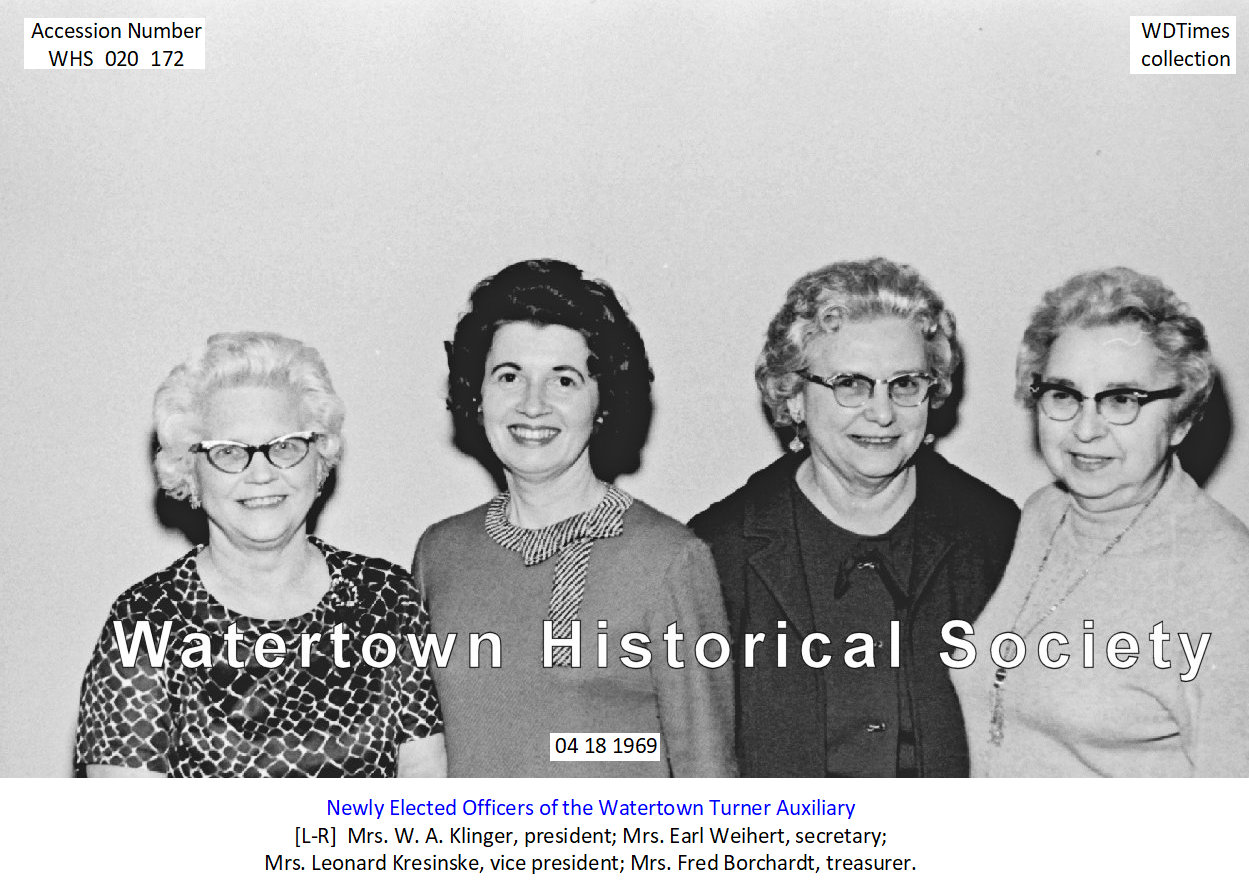
Mrs. W. A.
Klinger, president; Mrs. Earl Weihert, secretary; Mrs. Leonard Kresinske, vice
president; Mrs. Fred Borchardt, treasurer.
1970
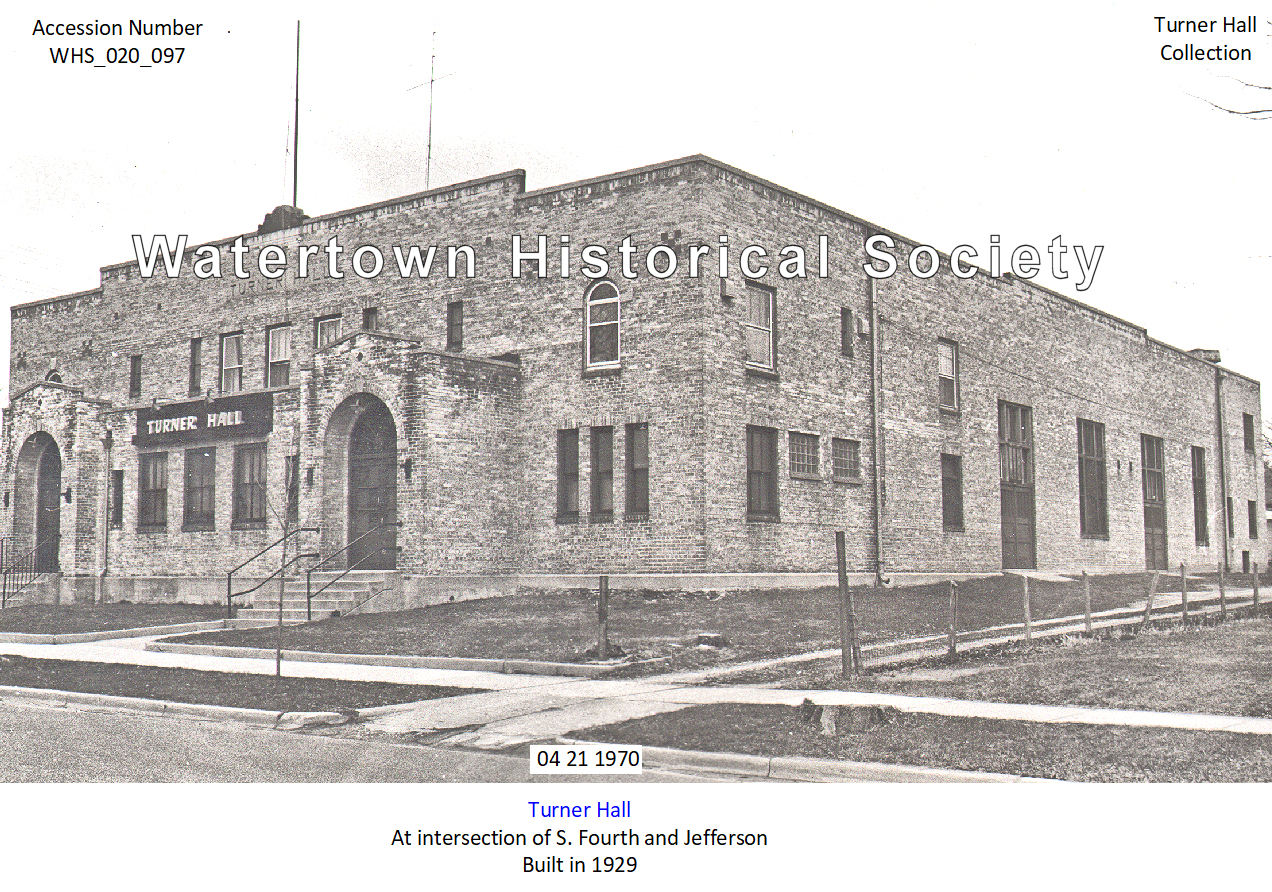
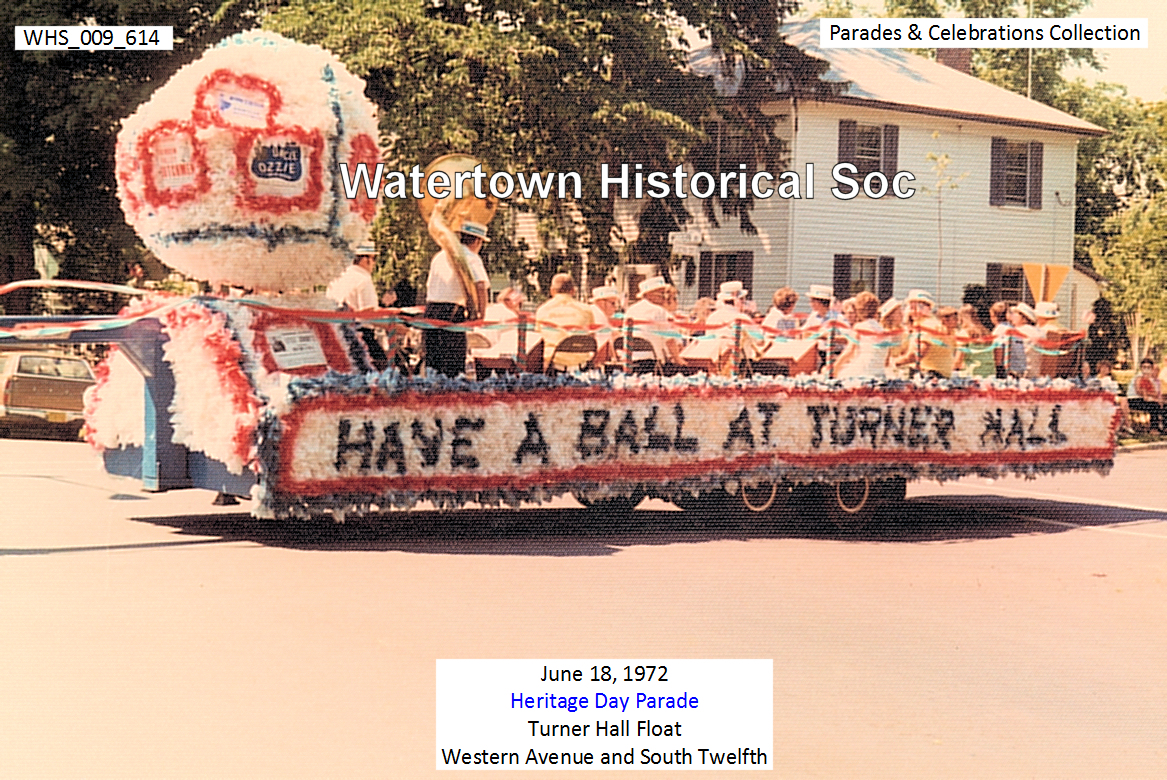
1972
06 18 FLOAT IN HERITAGE DAY PARADE
1977
01 05 LOSS OF TAX EXEMPT STATUS
The
Wisconsin Department of Revenue determined that the Watertown Gymnastic
Association, Inc., Watertown, Wisconsin, does discriminate in its membership on the basis of race and have terminated the income tax
exception granted them under Section 71.01(3)(a) of the Wisconsin
Statutes. Letter from WI Dept. of
Revenue to John Surdick, Watertown City Assessor. Filed in City Assessor Collection with
document WHS_013_046 (301 S. Fourth St).
1981
07 04 FLOAT IN FOURTH OF JULY PARADE
1982
04 17 WATERTOWN GYMNASTIC ASSN ANNUAL BANQUET
The Watertown Gymnastic
Association, better known as the Turners, held its 122nd annual banquet at
Turner Hall. Officers were
introduced. They are:
Donald Borchardt, president; Warren Schmidt, vice president; Sam Stangler,
first secretary; Stanley Kuehl, second secretary; Robert Lischka, first
treasurer; Mark Othmer, second treasurer; Harley Rupprecht, hall manager;
William Richter, theatrical director; Leonard Kottwitz, gymnastic director; and
Henry Schaller, publicity director. WDT
06 16 BUILDINGS WITHIN 300 FEET OF TURNER HALL
The common council at its
meeting last night learned that a report prepared by City Attorney O. Harvey
Krause, in compliance with a request made at Monday night’s council committee
meeting, shows that there are buildings in the area of
Turner Hall, which lie within the 300-foot radius of the Turner building. Of the 45 structures, 33 are residential and
12 are commercial. WDT
1984
01 02 REZONE PROPERTY AT
TURNER HALL
An ordinance to rezone
property at Turner Hall was tabled Tuesday by the Watertown Common Council to
allow the organization to work out a compromise with a neighboring property
owner. The Turners have asked for B-2 (business)
zoning for 301 S. Fourth St., the location of their existing building, and an
adjoining vacant lot at 310 S. Fifth St.
The property currently is zoned R-3 (multifamily residential), even
though the use has been commercial in nature.
The Turners need the rezoning to allow expansion of their building onto
the vacant lot. In its recommendation to the council, the planning commission
is requiring the rezoning and combining of the two parcels before the expansion
can take place.
01 06 PUB ROOM RENOVATION
Renovated Pub Room on second
floor WDT
1985
09 11 125th ANNIVERSARY
The old phrase “you're not
getting older, you're getting better” was obvious Saturday night as the
Watertown Turner members reminisced as they celebrated the society's 125th
anniversary. The Turners, also known as
the Watertown Gymnastic Association, celebrated the anniversary with a private
dinner and dance for members Saturday and opened the hall to the community for
a large dance celebration Sunday with four bands performing. The Turners are one of the oldest
organizations in the city. The group was
organized on Aug. 21, 1860, solely for the purpose of cultivation and
improvement of the faculties of the body and mind of its members and the
management of musical and theatrical entertainment for amusement of the society
and public as well. WDT
1980s
-- -- THE TURNER HALL WOMEN / Seeking ID’s
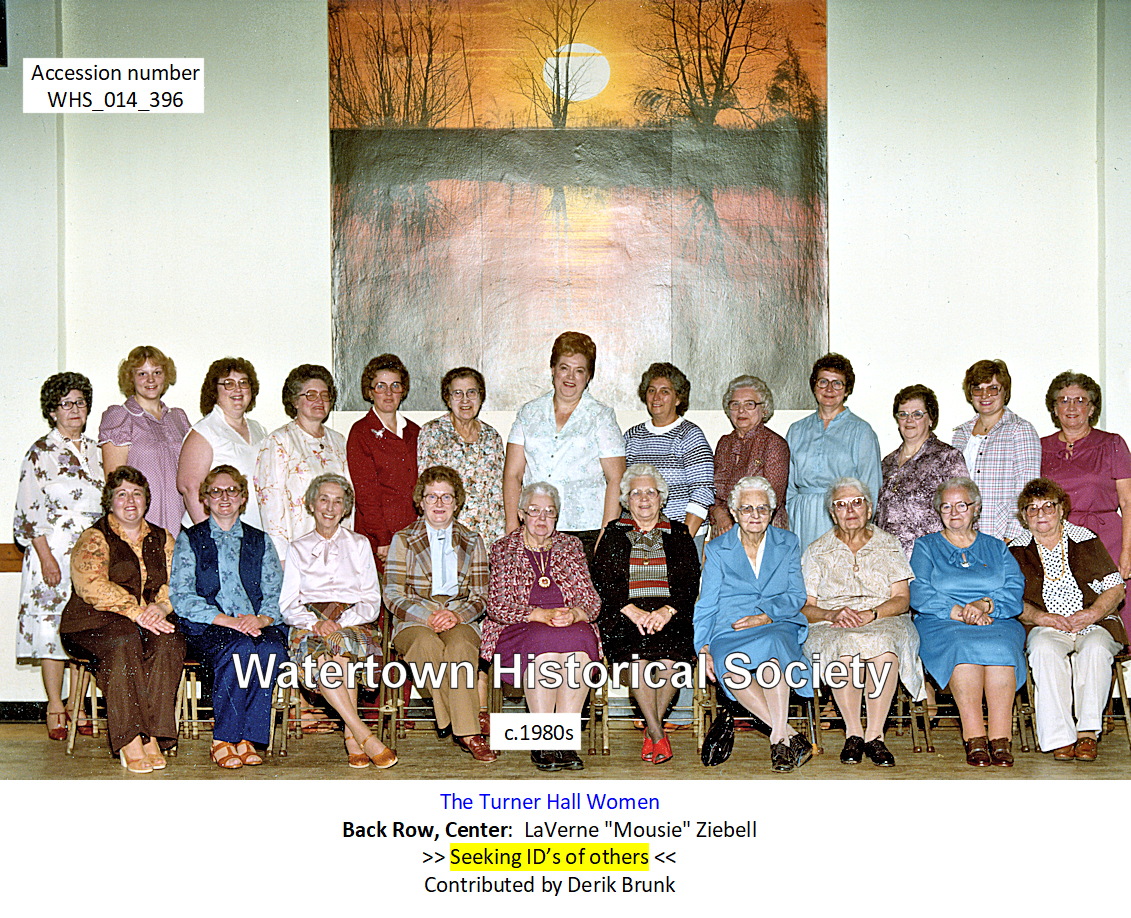 Back
Row, Center: LaVerne
"Mousie" Ziebell
Back
Row, Center: LaVerne
"Mousie" Ziebell
04 20 NEW OFFICERS AND
COMMITTEE CHAIRMEN
New officers and committee chairmen were
introduced at the annual Watertown Gymnastic Association annual banquet
Saturday night at Turner Hall. New
officers and committee chairmen are Bill Connor, first speaker; Dale Lenius,
second speaker; Gene Kelm, first treasurer; Matt Von Rueden, second treasurer;
Shawn Stangler, first secretary; John McConville, hall manager; Richard Doman,
theatrical director; Mike Peirick, gymnastics director; Leonard Kottwitz,
publicity; Don Borchardt, upstairs bar; Leonard Braunschweig, assistant; Jim
Arndt, downstairs bar; and Doman, Richard Buss, Stangler, Peirick and Gary
Zastrow, entertainment committee. WDT
1994
01 31 BUSINESS ZONING
APPROVED
Despite several objections
about spot zoning, the Watertown Common Council Tuesday approved business
zoning for property owned by the Turners’ organization. The council voted, 6-2, to adopt the second
reading of the ordinance, which will change the zoning to downtown business
(B-2) on Turner Hall, 301 S. Fourth St., and an adjoining vacant lot at 310 S.
Fifth St. The previous zoning
classification was multifamily residential (R-3). The zoning change was required by the
planning commission to allow the Turners to expand their building upon the
vacant lot. The two properties will be
combined into one lot as well. The
organization wants to increase its kitchen facilities through the project.
2004
06 12 SITE PLAN FOR ADDITION
TO TURNER HALL
The city of Watertown
Site Plan Review Committee recommended on Monday to approve the site plan for
an addition to Turner Hall. Turner Hall
is proposing to build a 3,600-square-foot one-story addition south of its present building at 301 S. Fourth St. The proposal will now go before the Plan
Commission for review. Rich Doman,
manager of Turner Hall, said the Turner organization wants to combine the two
bars in the hall into one bar in the new addition, which would be located on a
lot south of the current building and owned by the Turners. Currently, the hall
has a bar upstairs and a bar on the main level.
The plan also calls for the bar on the main level to be converted into a
meeting room where smaller gatherings could be held. The new addition will also be used to expand
freezer facilities.
08 08 PERMIT FOR ADDITION TO
TURNER HALL
With the stipulation that a parking lot expansion must take place within
a year of building occupancy, the Watertown Plan Commission approved a
conditional use permit to allow an addition to Turner Hall. The expansion will take place on the
southeast corner of the building and will provide a new entrance and courtyard
off South Fourth Street. This will allow
the Turners to consolidate two bars into one. The
conditional use permit was approved by the commission Monday, but not until
after a public hearing was conducted.
Several people who represented the Apostolic Gospel Lighthouse Church
that is in the neighborhood of Turner Hall said they
feared an expansion of the hall would compound an already challenging parking
situation in the area. WDT
2005
09 22 THOSE UNDER AGE 21 AND
UNACCOMPANIED BY A PARENT CAN ATTEND TURNER
MADISON — Prompted by an incident at a 15-year-old’s coming out party at
Turner Hall in Watertown last winter, the Wisconsin Assembly and Senate
unanimously passed Assembly Bill 460 and Senate Bill 266, which will clean up
an outdated Wisconsin law that restricts anyone under 21 unaccompanied by a
parent from attending wedding receptions and similar events where alcohol is
served. The bill will, under specific
certain instances for the purposes of such ceremonies similar
to weddings, bar mitzvahs and quinceaneras, allow those under the legal
drinking age unaccompanied by a parent to participate in the commemoration even
if the establishment holding the ceremony has a liquor license. WDT
2009
Watertown Gymnastic Association still
resided at Turner Hall.
2011
01 31 Amateur boxing returned to Watertown;
event held at Turner Hall WDT
2016
02 10 CLEANING AND PAINTING
Employees at the
Johnsonville Sausage facility in Watertown have been volunteering around the
community since a fire in May 2015 shut down meat-processing operations. Most recently employees have been giving Turner Hall a fresh coat of paint. Adolfo Contreras paints trim at the hall and
Erasmo Arguijo paints near the ceiling in the upstairs bar. Employees have been working at Turner Hall
for about two weeks. Employees have also
deep cleaned the kitchen. So far about
60 gallons of paint have been used to paint the walls and ceiling. It’s been about 15 years since the walls at
the hall have been painted and the ceiling had been painted for many years
before that.

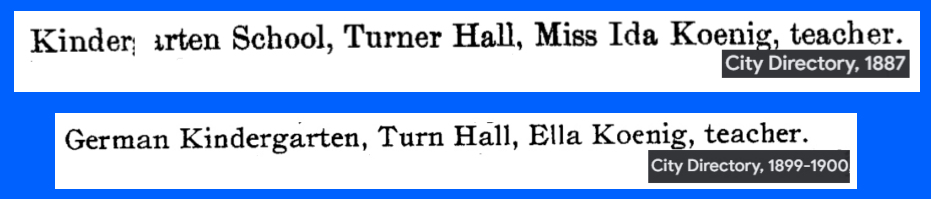
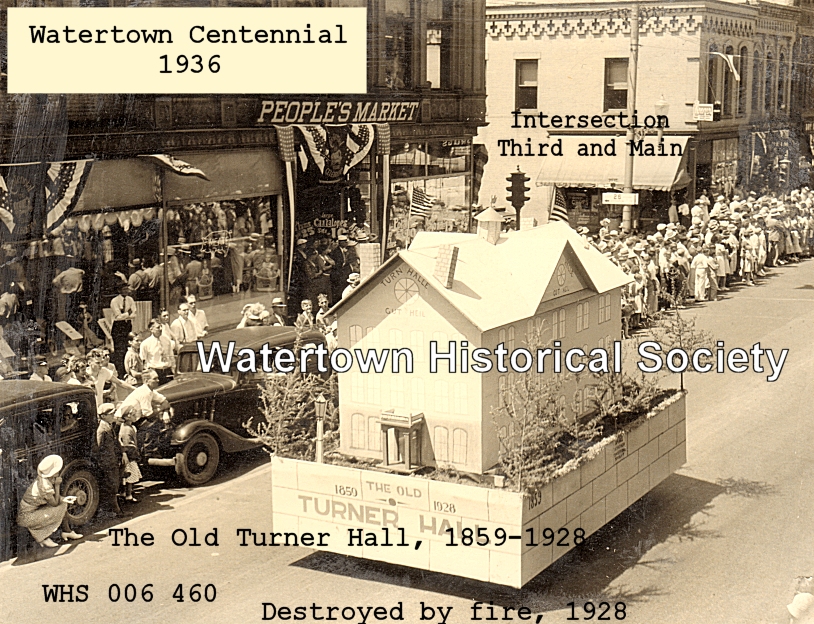
____________________________________________________________________________________________
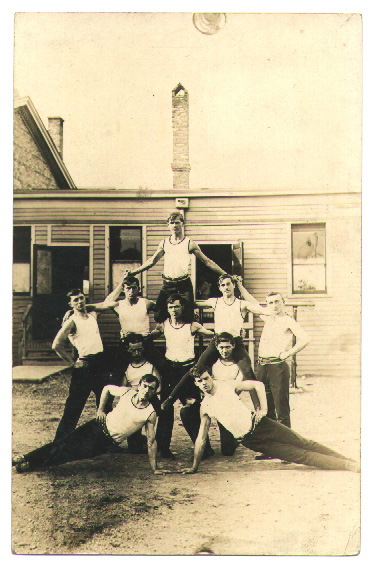
Watertown Gymnastic Troup - Real Photo Postcard, 1910's.
Cross
References:
During his early career Prof. Hardege was director of the musical
department of the Turner Society.
THE
MEMORIES-----dances after the football games!!!

History of Watertown,
Wisconsin