website watertownhistory.org
ebook History of Watertown, Wisconsin
410 S Fourth
Edward
J. Brandt
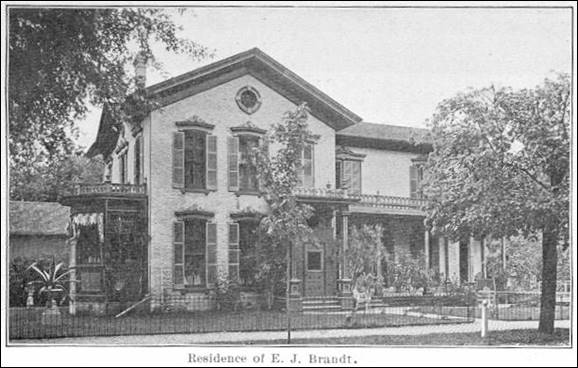
Built in 1875
(1980 Owner:
Catherine Jean Quirk)
Frederick William Brandt,
great-grandfather of Miss Quirk, built this house in modified Greek revival
style at the beginning of the Civil War.
Until recently it housed two generations of the family, and at times
three, with separate quarters for parents and grandparents.
Mr. Brandt, a native of
Lippe-Detmold, Germany, came to Watertown in 1853. He was the city's first
drayman and later established a general store which was carried on by his elder
son and grandson and eventually became a dry goods store, F. W. Brandt &
Son Co., on southeast corner of Main and Third Streets.
Early in this century, after the
death of his parents, Edward Julius
Brandt, younger son of F. W. Brandt, remodeled his parents' house to
accommodate his daughter and family, the Earl William Quirks. He created two front entrances and built an
attached garage and porte-cochere. About
twenty years later Mr. Quirk further remodeled the house on the north side,
adding a bay window, fireplace and many decorative
furnishings. He eliminated the double entrance, but maintained the two-family interior division.
A three-inch thick inner entrance
door with double elongated panels and transom of etched glass, some parquet
flooring, tile fireplaces, decorative moldings and door panels, marble wash-
bowls and porcelain doorknobs attest to the age of the house as do the plaster
medallions and coving in the south part of the house and the carved scrollwork
at the base of the south front stairway.
The plaster work was executed by
a family friend and artist, J. B. Murphy, following
the direction of Mr. Brandt, who also placed the imposing ionic pillars in the
living-dining areas and designed a lyre motif that is carved in the base of the
column in the music room.
Many musicals were held in this
room, and here Mr. Brandt often improvised on the little pump organ he bought
with his early savings. He became a
leader in local musical affairs and president of the Concordia Musical Society. In 1921 he composed a "Festival
Gloria" for St. Bernard's Church choir which
he directed for nearly fifty years. He
participated in church and community musical programs as baritone soloist, in
duets with his wife, Thekla Wiggenhorn Brandt,
soprano, and with his daughter, Eugenia Brandt Quirk, as accompanist.
As civic leader Mr. Brandt headed
the Board of Park Commissioners when Riverside Park
was established and in 1905 organized the Outdoor Art Association for the
beautification of homes.
Mr. Brandt's inventive talent
came to the fore while he was employed as a cashier in the Bank of Watertown following his studies at Northwestern College. Tiring of counting money for railroad
payrolls, he invented an automatic cashier and in 1890 founded his own company
to manufacture this product, known now as Brandt Inc.
In 1926 upon Mr. Brandt's
becoming Chairman of the Board his daughter's husband, Earl William Quirk,
succeeded him as president of the company; the latter upon his death in 1960
was succeeded by their son, Edward James Quirk, who was president until 1980
when he became Chairman of the Board and Chief Executive Officer. His son, James Brandt Quirk, Assistant Vice
President, is the great-grandson of the founder.
Brandt Inc. has expanded its line
from the original cashier to a comprehensive line of money-handling equipment
and sells its products throughout the world.
_______________________________________________________________
The history of the Brandt Quirk
family is well known by Jim and Deborah Quirk.
Jim is a member of the Watertown Quirk family. The couple recently purchased the 1875
Victorian mansion after it spent years as a bed and breakfast. The Quirks are working to register the house
as a historical building and plan to make it into a museum.
Edward Brandt, inventor of the
Brandt Automatic Cashier and founder of what was known as Brandt, Inc. for many
years, purchased and converted the once two family
property into a family home when he remodeled it in 1919. At this time he also
enlarged the Brandt home to 5,500 square feet with a maid's quarters on the
second floor.
1890
02 12 CHURCH CHOIR
AND St. CECILIAN SOCIETY MEETING
Mr. and Mrs. E.J. Brandt entertained a large company
of friends at "drive whist" at their residence on Fourth Street,
Monday evening. Mrs. J. B. May won the
ladies' prize, while Mrs. M. Maldenar received the
booby trophy. Fred Prentiss was the
winner of the gentlemen's prize and C. E. Emmerling
carried off the booby honor for his sex.
Miss Emma Bernhard, a scholar of Luening's conservatory, Milwaukee, and
Miss Bertha Miller presided at the piano during the supper. The spacious rooms were decorated with potted
plants. The guests departed at a late
hour having passed a delightful evening.
WR
1892
06 17 CHURCH CHOIR
AND St. CECILIAN SOCIETY MEETING
The first regular monthly meeting of St. Bernard's church choir and St. Cecilian
Society met on last Tuesday evening at the home of Mr. And Mrs. E. J.
Brandt. There was almost a full attendance
of the society present, and all enjoyed a pleasant evening. After the business meeting was concluded, the
social part of the program followed, and refreshments were served by host and
hostess. The next meeting of the society
will be held at the home of the Misses Angeline and Eva Boyne. WG
1898
03 30 CONCERT IN OCONOMOWOC
Father McBride has about completed arrangements with
St. Bernard's choir for a sacred concert in Oconomowoc shortly after
Easter. St. Bernard's choir is under the
direction of Edward J. Brandt, and is one of the best choirs in the state
outside of Milwaukee . . . WR
1899
09 26 ED
BRANDT’S DIAMOND STOLEN
Friday was the day set for the preliminary examination
of George Harey, arrested during the carnival on a
charge of take Edward J. Brandt’s diamond from his person. The prisoner asked for a continuance until
September 27, which was granted. WR
1901
10 18 UNDERGOING
TREATMENT
Edw. J. Brandt, undergoing treatment at the Waldheim
sanatorium at Oconomowoc for a month past, visited over Sunday at his home
here. He has almost fully recovered and
expects to be able to attend to business in a few weeks. He returned on Monday to the sanatorium. WG
1911
02 02 WAS VOCAL SOLOIST
Last Sunday at the
concert given in the auditorium in Milwaukee by Bach’s Milwaukee Symphony
Orchestra, Edward J. Brandt of this city was the vocal soloist. He sang a Recitative Aria from Hayden’s
Creation with orchestral accompaniment.
He responded to an encore, with the “Evening Star” from Wagner’s
Tannhauser. WG
1923
04 25 LECTURE ON "FOREIGN CATHEDRALS”
Given
by Mr. and Mrs. E. J. Brandt
WG
1952
ASSESSOR IMAGE
01 08 BRANDT FAMILY MEMBER BACK ON BOARD OF DIRECTORS
The Bank of Watertown held
its annual meeting last night. Elected to the board of directors are
Ray J. Kern, Edgar J. Kellmeran, L. J. Lange, A.
W. Weihert, L. B. Kramp,
Gerald E. Flynn and E. James Quirk. Mr.
Quirk is the newest member of the board of directors. This rounds
out the board membership by bringing in a Watertown
industrialist. This brings a member of the E. J. Brandt family back
into the Bank of Watertown organization, Mr. Quirk’s grandfather, the late E.
J. Brandt, having been cashier of the bank many years ago.
1974
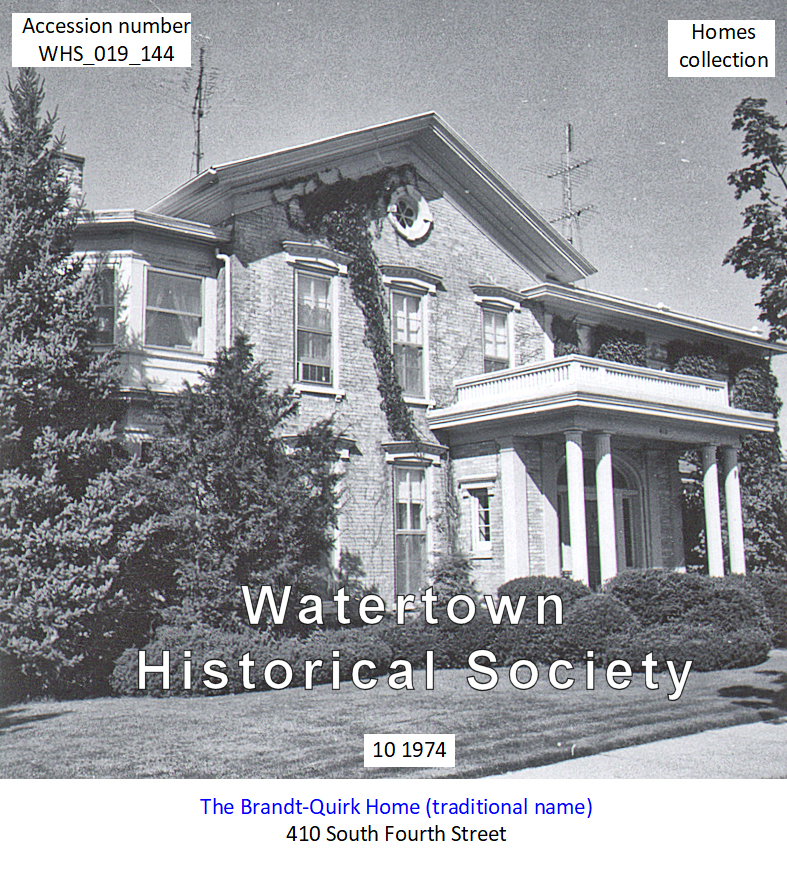
1980
08 24 Miss Catherine
Jean Quirk, 410 South Fourth Street, is a new member of the Board of Governors
of Mount Mary College, Milwaukee, it was announced by Sister Ellen Lorenz,
president of the college. She is a
member of the Advisory Council of the Elvehjem Art
Museum of the University of Wisconsin-Madison.
She also is a charter board member of Watertown Memorial Hospital, the
Humane Society and the Arts Council, all of
Watertown. She serves on the advisory
board of the Historical Society and is secretary of the League of Women Voters,
both of Watertown. She is a member of
the Woman’s Club of Wisconsin and the University Club, Milwaukee. WDT
1988
08 12 Two members
of a prominent Watertown family were honored by having the downtown Main Street bridge named after them during
ceremonies at Riverfest Friday evening at Riverside Park. E. James Quirk and Catherine Jean Quirk,
members of the family that formerly owned
Brandt, Inc., were selected for the honor from a list of names submitted to
the Watertown Clergy Roundtable. The
award was presented by the Rev. T. Thomas Nustad of
Christ United Methodist Church, president of the clergy roundtable. WDT
1989 WOMEN OF MERIT RECOGNIZED
06 11 Two prominent Watertown women have been
recognized as Women of Merit by the Watertown chapter of American Association
of University Women. Eileen M. Scott,
Cambridge, and Catherine
Jean Quirk, 410 S. Fourth Street, were honored for their
civic involvement and influence. She has
been in education from elementary through graduate levels all
of her professional life. She
began her teaching career at a rural school.
After many years of classroom teaching, and after the attainment of
higher educational levels, she became a school counselor and held positions
related to guidance and counseling until her acceptance of the area coordinator
for the Madison Area Technical College campus in Watertown in 1975. She has since retired from the position.
Quirk is the third generation
member of the AAUW. Her grandmother,
Lillian Park Quirk, was a charter member of the chapter in which Catherine Jean
was born, San Diego, Calif. Her mother,
Eugenia Brandt Quirk, was a member of the Watertown branch. Quirk was also a member of the Watertown
branch, having served as program chairman, publicity chairman and served as a
delegate to the national convention. She
also served on the state’s board as publicity chairman.
1989
07 29 CATHERINE J. QUIRK Health, Science and Education Resource Center
The new medical library being planned at Watertown Memorial Hospital will be named the
“Catherine J. Quirk Health, Science and Education Resource Center” in honor of
her longtime association and support of the hospital. The hospital’s medical staff had previously
recommended that the new library be named in her honor and the hospital’s board
of directors unanimously approved the decision this week. The new library will be completed sometime
next year as part of the hospital’s outpatient department expansion. Quirk served on the Watertown Memorial
Hospital Association Board of Directors since the inception of the association
in 1985. She served as association secretary from the first board meeting on
April 21, 1958 until Nov. 11, 1966. Quirk continued to serve on the hospital
board until Dec. 1, 1983, a span of 25 years as an active board member. WDT
1990
09 01 RESTORATION OF THE 115-YEAR-OLD HOME
Memories of the Civil War were still very fresh in
people’s minds when Frederick Quirk completed his 17room mansion at the corner
of Fourth and Spring streets in 19th century Watertown. Today, thanks to a meticulous restoration
project by its new owners, the 115-year-old home looks little different than it
did just after its initial construction.
“Except for new paint and wallpaper we’ve tried
to keep the home as close to its original state as possible,” says new owner
Wayne Zuleger of his summer-long restoration
effort. “We have furnished the guest
rooms with antiques as much as possible and hope some day
to have the home on the Historic Register.”
WDT
Chicago Tribune, Sept. 9,
1990

Date for home should be 1875, not 1865
2003
04 29 BRANDT QUIRK MANOR OPEN HOUSE
The Brandt Quirk Manor is one of
three bed and breakfast inns in the area that plan to host open houses on
Sunday, May 11, from 1 to 4 p.m. Brandt
Quirk Manor at 410 S. Fourth St. in Watertown, Sweet Autumn Inn at 1019 S. Main
st. in Lake Mills, and Stoppenbach
House at 244. E Racine St. in Jefferson are joining over 120 bed and breakfast
inns in the Wisconsin Bed and Breakfast Association’s statewide Open House Inn
Tour to be held on Mother’s Day.
Brandt Quirk Manor specializes in
period antiques, coffee at the room and chocolates on the bed. Owners Wayne and Elda Zuleger,
former teachers, have been welcoming guests at the manor for 12 years. “We are delighted to share the former
Brandt/Quirk home with its Victorian charm,” Wayne Zuleger
said. The home was built by Frederick
Brandt in 1875. The 27-room home was
constructed in Greek revival style architecture, and
was originally built as a two family side-by-side.
2004
01 10 PURCHASED BY JAMES AND DEBBIE QUIRK
A historical Watertown home once owned
by the prominent Quirk family is again back in the hands of family
descendants. Brandt Quirk Manor bed and
breakfast, 410 S. Fourth St., has been purchased by James and Debbie Quirk of
Oconomowoc. James is a descendant of the
family that originally built the home. Brandt Quirk Manor has been operated as
a bed and breakfast for over 13 years by Wayne and Elda Zuleger,
who purchased the home from the Brandt Quirk estate following the death of
Catherine Quirk, a relative of James.
The Zulegers, both retired teachers, plan to
move to a smaller home in Watertown.
2007
10 24 REGISTER OF HISTORIC PLACES
The Brandt House in Watertown and
a historic house barn in the town of Emmet have both been placed on the state’s
Register of Historic Places in recent days — and both are now likely candidates
for inclusion on the National Register of Historic Places. The placement of the two structures on the
state register occurred at a recent meeting of the Wisconsin Historic Preservation
Review Board at the Frank Lloyd Wright Visitor Center near Spring Green . According to Wisconsin Historical Society National
Register Coordinator Daina Penkiunas,
the Brandt home, built in 1875, is of substantial historical value because of
its architecture, as well as its close association with Edward Brandt. Brandt was an inventor and industrialist who
created the Brandt Automatic Cashier, a money-counting machine. Brandt also started the Brandt Cashier Company,
a major industry in Watertown in its day.
2008
05 10 NATIONAL REGISTER DESIGNATION
The Wisconsin Historical Society
today announced the listing of the Brandt House in Watertown on the National
Register of Historic Places. National
Register designation provides access to certain benefits, including
qualification for grants and for rehabilitation income tax credits, while it
does not restrict private property owners in the use of their property.
Friedrich and Wilhelm`ine
Brandt built the original Brandt House in 1874.
By 1884 their son, Edward J. Brandt, was the Bank of Watertown’s
cashier, or manager. While managing the
bank, in 1893 Brandt invented the Automatic Cashier, a machine that
revolutionized cash handling for payrolls and banks. It would be a great success and was the
foundation of Brandt, Inc., a manufacturer of cash-handling equipment and
supplies that was an industrial leader in Watertown during the 20th century.
Cross References:
2007 - The Edward J. Brandt
House is being
considered for placement on the National Register of Historic Places WDT 10 10
1964: E. James Quirk elected to board of directors,
Bank of Watertown. This brings a member of the E. J. Brandt
family back into the Bank of Watertown organization, Mr. Quirk’s grandfather,
the late E. J. Brandt, having been cashier of the bank many years ago.

History of Watertown,
Wisconsin