website watertownhistory.org
ebook History of Watertown, Wisconsin
“Ideals are like
the stars:
we never reach
them,
but like the
mariners of the sea,
we chart our course
by them.”
- Carl Schurz,
American statesman
Carl
Schurz,
German
American
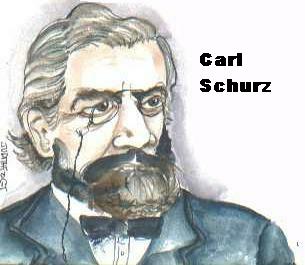
Carl Schurz,
one of the most celebrated German Americans, was born on March 2, 1829, in Liblar near Cologne, and died on May 14,1906, in New York.
In 1929, on the 100th anniversary of his birth, Germany's Foreign Minister
Gustav 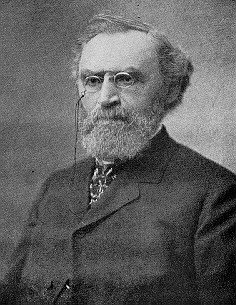 Stresemann characterized him in
the following way:
Stresemann characterized him in
the following way:
"Carl
Schutz managed to combine his love for Germany with a loyalty to his American
homeland in a marvelous unity reflecting the striving of his great personality
which, here as well as there, was concerned with profound moral goals that are
not restricted to a single nation, but apply to all mankind."
While
a student in Bonn, Schurz joined what would become the German revolutionary
movement of 1848. He participated in the rebellions in the Rhineland, the
Palatinate and in Baden. After the defeat at Rastatt, Schurz escaped via
Strasbourg to Switzerland, and later to Paris and London. From there he shipped
out in the fall of 1852 to New York, along with his wife, settling in 1854 as a
farmer in Watertown, Wisconsin, where he gained admittance to the bar to
practice law.
He
became a dedicated supporter of the still young Republican Party and campaigned
for Lincoln in Illinois, Indiana, Missouri, Ohio, Pennsylvania, New York and
Wisconsin. After the election, President Lincoln appointed him U.S. envoy to
Spain. The first defeats of the Union Army in the Civil War occasioned his
return to play an active part as Union general in the war against the
Confederacy and the struggle for the emancipation of the slaves.
After the
devastating war had ended, leaving 600,000 dead, Schurz returned to civilian
life, working as Washington correspondent for the New York Tribune, then as
editor-in-chief of the Detroit Post and after l867 as co-editor and part owner
of the German-language Westliche Post in St. Louis,
Missouri. In 1869, he was elected U.S. senator by his new home state. Thus at
the age of forty, only sixteen years after arriving in America as a homeless
fugitive, Carl Schurz became a member of his adopted country's highest
legislative body, an institution often more powerful than the president in
those days.

As secretary
of the interior under President Rutherford B. Hayes from 1877 to 1881, Schurz
had the opportunity to begin his long championed civil service reform and make
improvements in the Bureau of Indian Affairs.
He then moved to New York City, where he helped found the New York
Evening Post. From 1892 to 1898 Schurz wrote the editorials for Harper's
Weekly. He became nationally famous as a political writer and reformer,
especially in the field of civil service administration.
During extensive lecture tours and new journalistic endeavors after his
service in the Cabinet Schurz continued
He died in New York on
Some of his quotes:
"Our ideals resemble the stars, which illuminate the night.
No one will ever be able to touch them. But the men who, like the sailors on
the ocean, take them for guides, will undoubtedly reach their goal."
"My Country! When right keep it right; when wrong, set it
right!"
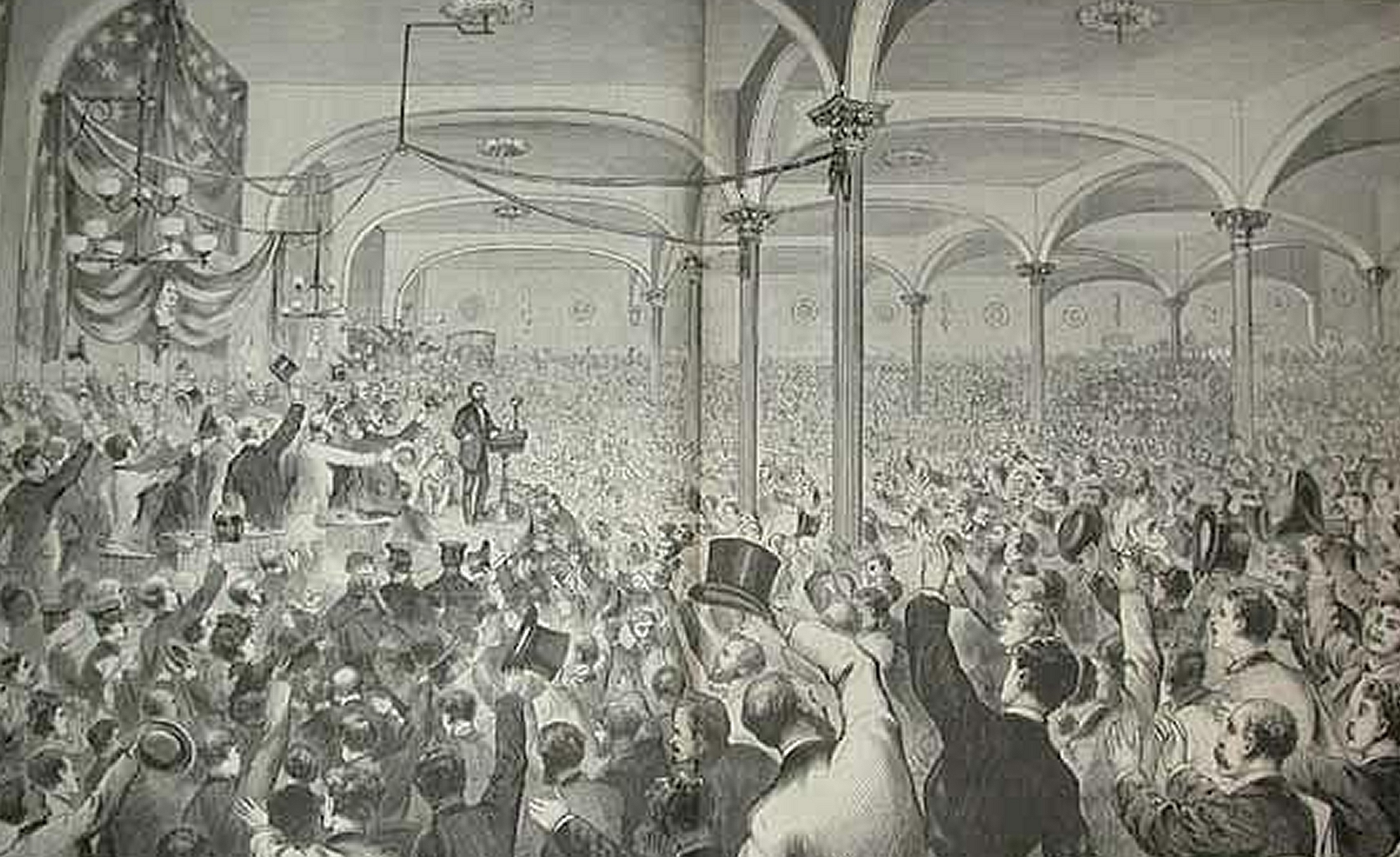
Senator
Carl Schurz addressing rally in Cincinnati
Image
from an 1872 issue of German magazine "Über Land
und Meer"
Carl Schurz was born in 1829, near Cologne, in Liblar,
Germany, to parents who were the local school master and daughter of the
"tenant in chief" to the Wolf Mettemich
feudatories. He was born under
feudalism, living in a "chateau" or castle, surrounded by a moat.
His school master father had a library full of Schiller, Goethe, and
Shakespeare, and told him that "George Washington was the greatest man who
ever lived." His father read Schiller's poems to him, as well as G. E.
Lessing's Nathan the Wise. The boy became an expert pianist, who later
performed for Lincoln, Hayes, and other Presidents.
 Thus,
Schurz was still a "teenager" when the 1848 revolutions broke out,
and he followed his teacher, Gottfried Kinkel, into "battle", or such
that the aborted "revolution" could be characterized, even though it
was more a disjointed protest against the relic of feudalism which still ruled
Germany, but was crumbling everywhere.
Thus,
Schurz was still a "teenager" when the 1848 revolutions broke out,
and he followed his teacher, Gottfried Kinkel, into "battle", or such
that the aborted "revolution" could be characterized, even though it
was more a disjointed protest against the relic of feudalism which still ruled
Germany, but was crumbling everywhere.
Schurz gained fame in revolutionary circles when he rescued his teacher/
leader from prison, and led him into exile into London by 1851. There he met
with all the other revolutionaries, including Mazzini, and even led a German
delegation welcoming the Hungarian Kossuth into his British (later Italian)
exile.
Soon, however, he followed the other "48ers" to America,
migrating to Watertown, Wisconsin because of relatives having settled there.
While most Germans had gravitated towards the Democratic Party, and about 1
million Germans left for America in the 1850's, the '48ers started a new trend
to support the Whig Party, and later the Republican party, because of its more
anti-slavery stance.
Schurz led
this trend in Wisconsin, and fast became a leading orator of the new formed
Republican Party, traveling to Illinois in 1858 to see the famous
Lincoln-Douglas debates. Lincoln was already subsidizing a local German paper
there, realizing the importance of weaning the German-Americans away from the
Democratic Party. Schurz became dedicated to Lincoln for the rest of his short
life.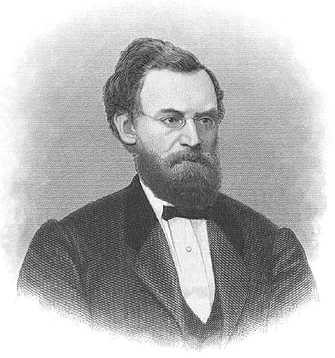
Meanwhile,
Schurz and his wife created a cultural storm in the prairie wilderness of
Wisconsin, performed operas, holding concerts, and even forming a new movement
started by Frederic Froebel in Germany, as they created a "kindergarten"
in Watertown, Wisconsin. However, Schurz also had a lifelong romantic fling
with Wagnerian operas and music, which showed the destructive force of this
cultural rebellion in European Enlightenment.
Schurz
became the major German American orator for Lincoln's 1860 election campaign,
and swung enough German voters into the Republican Party to win that election.
Lincoln was very grateful, and showed his respect by showing Schurz his
Inaugural Address before he left Springfield for Washington in late 1860. After
the inauguration, Lincoln appointed Schurz to Ambassador of Spain; he only
served there a short time, but quickly told Lincoln that he could win over
Europe with an Emancipation Proclamation, which would make the main issue of
the war the abolition of slavery.
Lincoln did
issue this proclamation after the "victory" at Antietam, actually a draw,
but it repelled Lee from the North until Gettysburg. Lincoln did this before
Congressional elections of 1862, which cost him some Republican seats in
Congress, but won him enough European support to counteract British aid for the
Confederacy.
Shortly,
thereafter, Schurz returned to fight as a Brigadier General to lead the huge
number of German Troops in the Army of the Potomac. He was attached to General
Fremont's corps, whose staff officers were colorfully garbed Hungarian 1848ers!
He maintained an impetuous correspondence with President Lincoln, who respected
him enough to answer his tactless questions about military strategy, including
several White House visits.
Soon the
German corps were caught up the battle of Gettysburg, where one artillery unit
near Culp's Hill held off desperate Confederate flanking attacks: one Southern
officer reached the guns and declared, "This Battery is ours!" while
a German trooper speared him with a shaft, and yelled, "Nein, dis battery ist unser!"
German
artillery units then mowed down Pickett's last charge with devastating fire,
while the Yankee lines broke out with victorious sounds of "John Brown's
Body" to the retreating confederates.
In 1864,
Schurz again rallied the German American vote for Lincoln. However, Lincoln's
death left him and many Americans without sound leadership, and he was soon
embroiled in the bitter impeachment of President Johnson. He toured the South
to document trampled civil rights and reconstruction, and his Congressional
Testimony was reprinted in 100,000 copies.
In 1868,
Schurz traveled back to Germany as an American Icon, and Bismarck greeted him
with a private hour and half interview, followed by more conversation at
dinner. When some North German jurists and Privy Counselors attended the
dinner, they did not recognize Schurz, until Bismarck introduced him to his
former enemies, much to their discomfort.
Schurz asked
Bismarck why he did not attack France right after he routed the Austrians in
1866, and Bismarck told him that he had not consolidated South German support
yet, and to defeat France then would require raising of Hungarian troops, which
was anathema to the Austrian Hapsburgs! However, this shows confirmation that
the Hungarians were working closely with Bismarck against Austria, which
resulted in the 1867 compromise by Austria allowing home rule by the Hungarians
who had rebelled in 1848, and defeated Austria on the battlefield until Russia
intervened.
Meanwhile,
back in the United States, the Grant Administration had poured millions of
dollars into northern internal improvements, while the Democratic Party vetoed
all monies to the occupied South, which remained prostrate while the Northern
industrial revolution boomed. This untenable situation was exploited by various
"scandals" such as Credit Mobilier in order to split the Republican
party asunder. This resulted in the great "compromise of 1877", after
the Tilden/Hayes election, which seated Hayes in the disputed White House in
return for withdrawing all Federal troops from the south, thus ending
"reconstruction."
Schurz
returned to America to become a St. Louis German paper editor, and then a
Senator from Missouri, where he vigorously opposed New York (GOP) Senator
Roscoe Conkling (Wall Street Agent) in hearings on arms sales during the Franco
Prussian war. However, while Senator he also broke completely with the Grant
Administration, and James Blaine, in particular.
Subsequently,
Schurz was in and out of the GOP, leaving in 1872 to support Greeley on the
Third Party ticket, returning to elect Hayes in 1876, and become Secretary of
the Interior, thence supporting Garfield in 1880, but slipping away again when
Arthur replaced the assassinated Garfield, and appointed Conkling to the
Supreme Court.
Thereafter,
he left elected and appointed office for good, reestablishing himself as a
journalist with Henry Villard's Nation. He became a leader of national
civil service reform, which was a catch all of Wall Street agents and
anti-silver populists. He disliked Blaine so much he supported Grover Cleveland
in 1884, although the defection of New York's Conkling, who hated Blaine with a
Wall Street venom, may have done more damage to Blaine, than Schurz did with
the German American voters.
However, Schurz
did come back to his senses when he saw various oligarchical currents revive
anti-Semitism in Europe and anti-black racism in America in the late 19th and
early 20th centuries, submerged under the cover of renewed
"imperialism". On this issue he broke with Theodore Roosevelt
completely, and organized an Anti-Imperialism League in America in the last
years of his life, which ended in 1906.
Interestingly,
a fact missed by Schurz's latest biographer, Hans Trefousse,
a Brooklyn College Professor, is that Governor Robert LaFollette of Wisconsin,
who was the national leader of the Lincoln Insurgents in the GOP at the turn of
the Century, feted Carl Schurz in Wisconsin in June, 1905 by endowing a Carl
Schurz Professorship at the University of Wisconsin.
Schurz
addressed LaFollette in Madison, Wisconsin by saying:
"I am so happy to know that what I have been striving for all my life has been taken up by a younger man. Go on with the good work, Governor, do not lose courage, and may God bless you. "
Authored and contributed by:
Glenn
Mesaros
Minneapolis,
MN
gmeszaros@email.msn.com
[ Address
added with permission of the author ]
1854 CARL SCHURZ ARRIVES IN WATERTOWN (via Plank Road)
Going west to St. Louis, Schurz wrote: "I am taking a lot of notes
and having many experiences which will come in handy. I am more and more
convinced that we should be on easy street here in a couple of years. . .
." So it seems he was positively bent on getting rich quickly. When he
reached Chicago on his return trip he found letters from his uncle, Jacob Juessen, who urgently invited Schurz to visit him and his
family at Watertown, forty miles west of Milwaukee. He must have had such a
side excursion in mind, for the uncle's letters were doubtless in response to
suggestions of his own; otherwise the time of his arrival in Chicago would not
have been known. On that trip he experienced for the first time the natural
charms and material enticements of southern Wisconsin. The beautiful moonlight
voyage on Lake Michigan by boat from Chicago to Milwaukee prepared him for a
cheerful, but not quite openminded appraisal of the Badger metropolis. He found
the combined rail and stage ride to his destination enjoyable rather than the
reverse, a "splendid plank road" contributing to his
satisfaction. Schurz was impressed with all he saw, calling Wisconsin a
beautiful land. The development of the southern part of the state surprised
him; he had expected to find it less well settled. It was already a fine,
prosperous farming region. From
“Margarethe Meyer Schurz – A Biography” by Hannah Werwath
Swart, reprinted by the Watertown Historical Society and is now available in
two formats, ebook and soft cover.
1856 SCHURZ FAMILY MOVED TO WATERTOWN
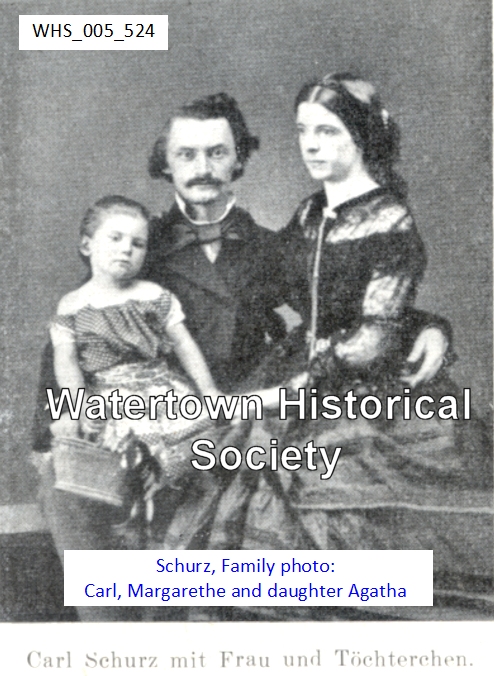
Margarethe Schurz was
born to a prominent family in Hamburg, Germany, on August 27, 1833, that
encouraged her to pursue the arts and education.
Schurz and her sister
Bertha studied under kindergarten founder and advocate Friedrich Froebel for
two years and learned about the 10 gifts he believed helped children use
exploration to awaken thoughts that would to lead to higher stages of
development.
Bertha went on to
establish the first kindergarten in England, but became very ill. This was at the time of the failed 1848
German Revolution. Schurz traveled to
London to help her sister in her kindergarten and there met exiled
revolutionary Carl Schurz. They were
married in 1852, emigrated to America and lived in Philadelphia, Pa.
Carl was restless and
wanted to move west. He went ahead and
purchased a farm in Wasserstadt,
in what is now the 700 block of North Church Street in Watertown, while Schurz
returned to England and gave birth to
their second child. In 1856 the family
moved to Watertown.
With her
children so small, (her older child, Agatha, was then 4) Schurz remembered her
training with Herr Froebel. She invited neighborhood children to sing, play and
march about the big sitting room of her home with its bright red carpet.
Froebel’s “10 gift boxes” were ready each day for the children — bright balls
and blocks of wood divided into curious sections. They were a series of 10 toys
developed by Froebel, the first educator to emphasize the importance of play in
a child’s development, noting their instincts to explore, try out, take apart
and look inside, all part of early learning. Other parents were so impressed at
the results that they prevailed upon Schurz to also help their children, so she
opened a small kindergarten.
While Schurz
gained credit for establishing the first kindergarten in America in Watertown,
Carl became more active in politics.
They left Watertown in 1858 when Carl was admitted to the Wisconsin Bar
and began to practice law in Milwaukee.
He spoke on behalf of President Abraham Lincoln during the 1860s and
went on to be Secretary of the Interior.
Schurz died at age 44 in Washington D.C. in 1876, three days after the
birth of a son. After the family’s
departure, others took over the kindergarten in Watertown: Carl’s cousin, Miss Juessen,
followed by Mrs. Rose Kunert and Mrs. Kunert’s sister, Tante Elle Koenig who
ran it as a private kindergarten for 42 years.
1856 PROPERTY SUBDIVIDED, scathing article about
1857
The “Volks
Zeitung and People’s Gazette,” a German paper, was started through the instrumentality of
Carl Schurz, most three years since, and is now published under the
editorial management of Herman Lindeman.
1858
01 21 Lecture before the Young Men’s Association
09 16 Appointed
Regent of the University of WI
12 02 Special
Election to fill vacancy occasioned by the resignation of Ald. Schurz WD
1859
01 12 Beaver Dam Democrat gives currency to charges against Carl Schurz WTranscript
05 05 Schurz is as prolific as Queen Victoria,
although their tastes are somewhat different
WG
1850s
-- -- FLOUR
FOR CAKES FOR FIRST
KINDERGARTEN KIDS
In the 1850's that outstanding statesman and soldier, Carl Schurz,
settled in our community and came regularly to the [Globe] mill, driving in
from his hill-top home, the Karlshuegel of today, on the northern outskirts of
the town, taking with him the flour for the little cakes so eagerly awaited by
the children in his wife's kindergarten.
This was the first school of its kind to be established and maintained
in the United States. Derived from the booklet "The Globe Milling Company, Watertown, Wisconsin,
1845-1945."
1860
09 28 Extracts
from speech of Carl Schurz, New
York, Sept 13, 1860
I think it was Sen. Pugh
who once said that that if Douglas were struck down by the South, he would take
his bleeding corpse and show it to the youth of the Northwest, as an example of
southern gratitude. Let that modern Mark
Anthony come on with his dead Caesar (pardon me, it is neither Caesar dead nor
Mark Anthony alive) (applause and cheers); let him bring his bleeding corpse
and I will suggest the funeral oration.
Let him say to the youth of the American Republic: This is Douglas. Look at him.
For every wound the South has inflicted on him, he has struck a blow at
the liberties of his countrymen. Let him
serve as a warning example that a man may be a traitor to liberty, and yet not
become a favorite of the slave power.
Mark him. By false Popular
Sovereignty he tried to elevate himself, and true Popular Sovereignty strikes
him down. (Loud applause)
If the youth of America
profits by this lesson, then it may be said that even Douglas has done some
service to his country. (Laughter) Then
peace be to him—his mission is fulfilled.
But now we have to
fulfill ours. False Popular Sovereignty
is down. Freemen, it is for you to see
to it, that true Popular Sovereignty triumphs (applause).
Citizens of New York,
when, after the adjournment of the convention which nominated that great and
good man, Abraham Lincoln, for the presidency, I addressed the people of my
state again for the first time, I said to them:
Let Wisconsin stretch her hand across the Great Lakes and grasp the hand
of New York. WR
1861
03 21 CARL
SCHURZ New York Times
We are glad
to see confident statements in intelligent quarters that the President intends
to offer Carl Schurz some high and honorable office in recognition of his
talents and political services. We
opposed his appointment to Sardinia, or to any of the leading diplomatic posts
in Central Europe, not from any disposition to underrate his abilities, but
because we consider the circumstances of his past career likely to destroy his
usefulness there, and needlessly to embarrass our relations with those countries. Our Government undoubtedly had the right to
send him as our Representative to the Government which had exiled him—but no
one, we presume, would deem it a wise or a friendly act. And our objections to sending him to Sardinia
were similar in kind, though less in degree.
But Mr. Schurz is a gentleman of great ability, an earnest Republican,
and abundantly worthy of recognition and promotion at the hands of the
Administration. He rendered effective
service to the Republican Party during the canvass, and has a right to look for
the reward which such services usually command.
The objection which has been raised, in unfriendly quarters, that he was
paid for his campaign speeches, is entitled to no weight—as that was a matter
exclusively between himself and those who engaged his services. We trust, therefore, that the President will
confer upon him some position which will indicate a satisfactory recognition of
his political labors. WD reprint of NYTimes article
06 13 GONE TO EUROPE
The steamship New York and Edinburgh sailed for Europe on the 8th
inst. Among the passengers were Carl
Schurz and family, the United States Minister to Spain. There is a report from Washington intimating
that he will not be received at the court of Madrid as representative of our
government and the Spanish Minister have said.
While we do not question Mr. Schurz’s talents, his appointment, under
the circumstances, was decidedly improper and made by the President contrary to
the advice of the Secretary of State. WD
1863 CARL SCHURZ
TIE TO ZEPPELIN AIR BALLOON
. . . . Reflection
of the past, noted in 1913
During the Civil
war in the United States a young German lieutenant was attached to GEN. CARL
SCHURZ'S brigade of the federal army of the Mississippi, and it was decided to
send up a balloon to spy out the confederate position. This young German not only volunteered, but
begged to be allowed to make the ascent. He was permitted to go, although he
had never before made an aerial flight.
Today [1913]
that same German, Count Ferdinand von Zeppelin, crushed and broken in the
evening of his life by the series of tragic disasters to his gigantic ships of
the air, is still unshaken in his confidence in his aircraft . . .
_____________
CROSS
REFERENCE NOTES:
[1] With the
endorsement of German-born Carl Schurz, who was a general in the Union Army,
and the support of others, Zeppelin
received a pass signed by President Abraham Lincoln which enabled him to travel
with the northern armies.
[2]
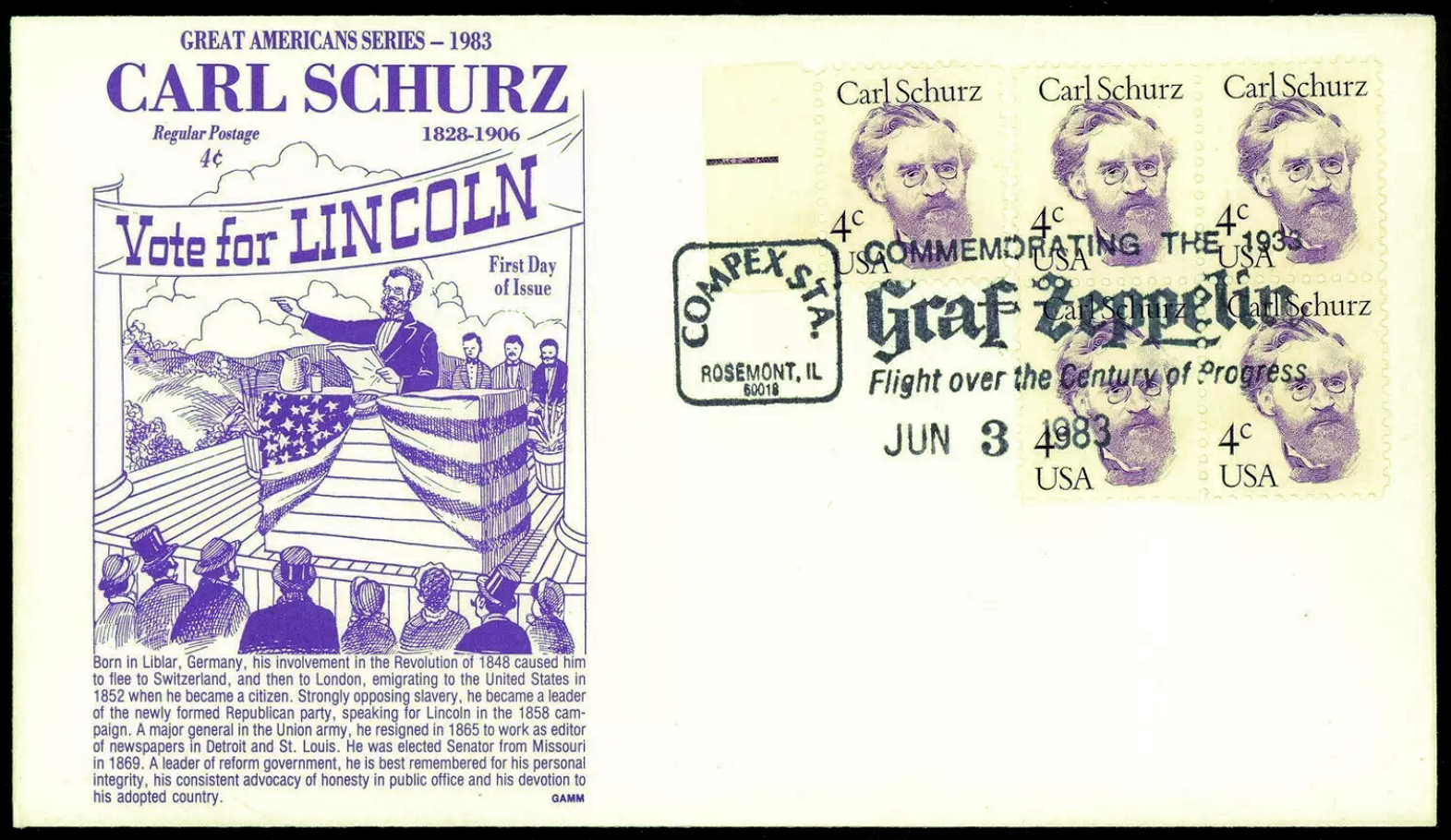
commemorating Graf Zeppelin Flight, Carl Schurz
stamp and cachet
1872
08 24 “CARL IS DISGUSTED
WITH AMERICAN POLITICS”
 Harper’s
Weekly cartoon
Harper’s
Weekly cartoon
03 22 DEATH OF MRS. SCHURZ
Mrs. Schurz,
the wife, of ex-Senator Carl Schurz, died last Wednesday afternoon, at her
husband's residence in New York, of puerperal fever. She gave birth on the evening of Sunday, the
5th inst., to a boy -- her fifth child.
Great anxiety had been felt ever since by the physicians as to her
condition. For some days she seemed
easier, but on Tuesday morning the fever appeared to reach its crisis, and
since that time she had been gradually sinking.
Mrs. Schurz
was the daughter of a well known and wealthy Hamburg family. Her marriage to the ex-Senator was
essentially a love match ... Mrs. Schurz leaves two grown daughters, a son
three or four years old, and the infant boy born ten days ago. WR
1888
11 28 RETURNED
FROM EUROPE
Carl Schurz,
with his two sons and two daughters, reached New York, from Europe, last
Saturday. He begged to be excused from
being interviewed. Mr. Schurz wisely
refrained from coming home until after the election. WR
1890
12 17 FRAIL
APPEARANCE
A
correspondent writes: "I meet Carl
Schurz on lower Broadway now and then and am impressed with his somewhat frail
appearance on the street, but seated at his club, his length of tenuous limbs
concealed, he looks and acts the young man.
His manner is still vivacious, his smile genial and his wit ready. His hair, too, retains much of its original
warm brown, in spite of coming frost."
WR
12 31 AGENT
AND COUNSEL
Carl Schurz has
dropped into an easy line of life as agent and counsel for a large steamship
company, and with a salary practically assured to him as long as he lives, he
can enjoy as he pleases, his duties not being arduous. His fondness for music takes him to all the
great musical events, and he is sought as a dinner-table guest. WR
1893
12 17 FORESEEING
PEARL HARBOR / PERSPECTIVE BY CARL SCHURZ
It will not
be denied that in case of war with a strong naval power the defense of Hawaii
would require very strong military and naval establishments there, and a fighting fleet as large and efficient as that
of the enemy. . . . . Attempts of the enemy to gain an important advantage by a
sudden stroke, which would be entirely harmless, if made on our continental
stronghold, might have an excellent chance of success if made on our distant
insular possession, and then the whole war could be made to turn upon that
point, where the enemy might concentrate his forces as easily as we, or even
more easily, and be our superior on the decisive field of operations. . . . .
We would no longer possess the inestimable privilege of being stronger and more
secure than any other nation without a large and costly armament. Hawaii, or whatever other outlying domain,
would be our Achilles' heel. Other
nations would observe it, and regard us no longer as invulnerable.
-From
"Manifest Destiny" by Carl Schurz, Harper's, October 1893.
CROSS
REFERNCE NOTE regarding 1893:
In January
1893, a revolutionary “Committee of Safety,” organized by Sanford B. Dole,
staged a coup against Queen Liliuokalani with the tacit support of the United
States. On February 1, Minister John
Stevens recognized Dole’s new government on his own authority and proclaimed
Hawaii a U.S. protectorate.
Watertown
Historical Society Collection
CARL
SCHURZ DIES AT AGE 76
1906
05 15 1906
Carl
Schurz who was widely known as an orator and writer passed away at his home in the
city of New York at an early hour yesterday morning in the 76th year of his
age, having been born in Cologne, Germany,
CARL SCHURZ TO BE HONORED
Watertown Daily Times, 02
10 2001
Carl
Schurz, general in the Union Army in the Civil War and one of Watertown's most
famous residents, is scheduled to be inducted into the Wisconsin Conservation
Hall of Fame in Stevens Point this spring.
We
learned of this honor for a great American statesman in a call from a strong
friendship we made in our years in the newspaper industry. Bill Berry, former
editor of the Stevens Point Journal, called us with the information. Bill is a
friend whom we had not heard from since he left his newspaper career to pursue
a little slower pace of life as a freelance writer and also as head of public
relations for this conservation group.
Bill
said he thought we would be interested in knowing Carl Schurz was scheduled for
this great honor. The induction will take place on Saturday, April 7, in a
program from
Carl
Schurz is known in Watertown for his great oratorical skills, his political
leadership and also for his famous wife, Margarethe Meyer Schurz, who
established the first kindergarten in the United States. It was founded right here in Watertown at the
southwest corner of North Second and Jones streets. That's now a municipal parking lot, but there
is a stone monument marking that as the location of the first kindergarten.
Many
years ago the actual first kindergarten building was moved from its original
location to the Octagon House grounds where it can be toured.
We
didn't realize the strong role Carl Schurz played in conservation efforts for
the United States back in the 1800s and up to the turn of the century. Here's a
little background on this famous man. It was included in the information Bill
sent to us this week.
Carl
Schurz was born in Liblar, Germany on
He
settled in Watertown in 1854 and remained one of Watertown's famous citizens
until 1860 when he was appointed envoy to Spain.
It was
during his years in Watertown that he became deeply involved in politics. He
ran unsuccessfully for the position of lieutenant governor of the state in
1857. He was elected chairman of the Wisconsin delegation to the Republican
National Convention in Chicago in 1860. He campaigned for the re-election of
President Abraham Lincoln in 1864 and was a United States senator from Missouri
from 1869 to 1875.
From
1877 to 1881 he served as secretary of the Department of the Interior under
presidencies of Rutherford B. Hayes and James A. Garfield. In his tenure at
that position he opposed the spoils system, advocated enlightened treatment of
Indians, made Civil Service reforms, prosecuted forest/land thievery and had
vast impact on conservation efforts nationally.
He was
a great influence on the American Forestry Association and other foresters and
he played a key role in the adoption of the 1891 Forest Reservation Act.
Carl Schurz
wrote extensively throughout his life.
He was an editor of Harper's weekly from 1892 to 1898, also edited the New York Evening Post and The Nation, published a history of the
United States and a biography of Henry Clay.
He also wrote a three-volume book of memoirs titled
"Reminiscences."
He was
a brigadier general and then a major general in the Union Army and served in
the military at the Battle of Gettysburg.
The
Carl Schurz Society in Germany was founded in 1926 and is active to this day. A
Carl Schurz Memorial Foundation was established in Chicago in 1930. A large
statue in Oshkosh proclaims him to be the foremost German-American in the
country's history.
Here's
a little more information about his conservationist views as researched by our
friend Bill Berry:
That
Carl Schurz merits mention in American history is beyond discussion. A German
immigrant, Schurz was a Civil War hero, a reformer and political activist. He
was a writer and author, a brilliant orator and a keeper of company like
Presidents Abraham Lincoln and Rutherford B. Hayes.
Schurz
was a man of many interests and activities. Even when focusing only on his
conservation activities, his importance to the cause is hard to summarize.
For
instance, Schurz is credited with helping to bring about Civil Service reform.
On the surface, this might not seem related to conservation. But the late
Steward L. Udall put the two together in his book, "The Quiet
Crisis." Udall noted that Schurz's first act as Secretary of the Interior
(1877-81), "was to initiate an intensive study of forest depredations, and
his first report, in 1877, singled out lumbermen who were 'not merely stealing
trees, but whole forests.'"
Udall
added that when Schurz set out to regulate these practices, he found trouble
within his own agency. "... he soon discovered that his fieldmen in the
General Land Office, who were supposed to be looking after the forests, were
spoils appointees inclined to wink at trespass and timber theft."
As
secretary, Schurz acted quickly to remove politics from everyday forest
management. New job candidates and those proposed for promotion were required
to take an examination, noted Schurz biographer Joseph Schafer ("Carl
Schurz, Militant Liberal," 1930). "All applicants, no matter how
politically strong their support might be, found themselves obliged to go
through this testing process and to abide its results," Schafer wrote.
Next
week we'll continue with more of the commentary from Bill Berry on Watertown's
Carl Schurz.
TLS
MORE ON CARL SCHURZ
Watertown Daily Times, 02
17 2001
In
last week's column we told our readers about the high honor Carl Schurz, one of
Watertown's most famous citizens, is scheduled to receive in April. Schurz, a
famous American who was born in Germany in 1829 and died in New York City in
1906, had lived in Watertown in the 1850s and 1860s.
He
became famous as a statesman and was deeply involved in politics. He served in
Cabinet positions under several United States presidents. Lesser known to most
of our readers was his strong interest in the environment. Carl Schurz was
secretary of the interior and a champion of preserving our country's natural
resources.
It was
his devout interest in protecting our country's environment that led the
Wisconsin Conservation Hall of Fame to select him for induction on April 7 at
the conservation organization's large parcel of forestland outside Stevens
Point. The ceremony will begin at
Our
column of last week included some background on Carl Schurz and also started a
narrative by our friend Bill Berry on Schurz's history and why he was selected
for this honor. Here we are concluding his narrative:
Carl
Schurz's causes were many, but historians give plenty of attention to Schurz's
keen interest in conservation and land use.
In his day, the duties of Interior Secretary were many, but "his
heart was clearly in the two subjects of forestry and Indian affairs,"
wrote Schafer.
Schurz
battled against views still prevalent at that time that saw "forests as an
obstacle to civilization, fit only to be slaughtered and burned."
Appreciation of forests for conserving soils and governing stream flowage was
still absent in America of the 1870s, noted Schafer. The belief that timber
resources were inexhaustible still prevailed.
"Schurz,
by reason of his knowledge of world conditions, realized the tragic
shortsightedness of such views and made it one of his special duties, as the
officer charged with the oversight of the forests on public lands, to educate
congress and the people upon that subject," wrote Schafer.
Schurz
sought to end timber thievery, the taking by private operators of government
timber. An unsympathetic Congress instead passed a law that all but legalized
the practice in some states.
As
secretary, Schurz succeeded in passing a measure to penalize those who set
fires on forestlands. He exempted timber areas from homestead or pre-emption
claims and regulated the sale of government wood to miners and settlers, who he
said had been "denuding the national domain whenever and wherever they saw
fit to do so."
Schurz,
like other early conservation figures, was ahead of his time. Historian Henry
Clepper wrote "Crusade for Conservation, The Centennial History of the
American Forestry Association." In that history, he referred to Schurz as
"the first authentic conservationist to hold cabinet rank."
He
would also be called "The Father of the Forest Reserves" for his
efforts to rescue and reinvigorate America's forests. It was Schurz's job to
educate, so that others would later act. As secretary, Schurz called for
establishment of a system of federal forest reserves, initiation of
reforestation practices, charges to the users of natural resources, stiff fines
for willful setting of forest fires and empowerment of the president to appoint
a commission "to study the terribly instructive laws and practices of
other countries." He also called for a campaign of public education on the
conservation of forests, trees and soil.
Most
of his agenda was squashed or ignored. "Deaf was Congress, and deaf the
people seemed to be," Schurz later wrote. Secretary Schurz also encouraged
the country to adopt land management practices for America's West, based on the
recommendations of Major John Wesley Powell. The Powell Plan was a broad vision
for land use in the West, taking into consideration the need for a reservoir
system for irrigation and many other land use practices employed today.
Congress dallied on his recommendations, but Powell's ideas were to be
vindicated several times in the future. The Reclamation Act was passed in 1902.
The Dust Bowl era of the 1930s finally brought an introduction of many of the
practices recommended by Powell.
In a
letter to Herbert Welsh in 1899, Schurz reflected on his years as secretary:
"What I did with regard to the public forests was simply to arrest
devastation, in which I partially succeeded, and for which I was lustily
denounced, and to strive from year to year to obtain from congress legislation
for the protection of forests, in which I largely failed."
Schurz
continued to lobby the cause after leaving office. He sought to rally support
for a national forest policy with the American Forestry Association, and
momentum built for reform. In 1891, Congress empowered the president to
withdraw forest reserves from the public lands, creating the Forest Reservation
Act. Presidents William Harrison, Grover Cleveland and, especially, Theodore
Roosevelt, laid away 132 million acres as national forests before Congress
repealed the Forest Reservation Act in 1907. This is still the major part of
the National Forest System.
It was
Carl Schurz who first called for establishing federal forest reserves. He lived
to see that happen.
Wisconsin
is quick to claim Schurz, even though he lived here for but eight or nine
years. Schurz moved to Watertown from
his native Germany in 1852 and stayed in the state until 1860. He immersed
himself in many causes while in the state.
He quickly became part of the anti-slavery movement. He ran unsuccessfully for lieutenant governor
in 1857. He set up a law office in Milwaukee.
He campaigned for Abraham Lincoln with both natives and foreign-born. He
was a Wisconsin delegate to the National Republican Convention in Chicago.
But
for a brief return to the state after serving as a general in the Union Army
during the Civil War, that fairly well sums up the time Schurz actually spent
in Wisconsin.
He
was, of course, the first and only Interior Secretary from Wisconsin, and he
lives on in the state's history books. He and his wife, Margarethe, are both
listed in the standard reference, "Wisconsin Biographies." His
three-volume "Reminiscences," holds a place in the Wisconsin section
of state libraries to this day.
The
Schurz home was a historic attraction in Watertown. Margarethe Schurz is generally recognized as
having established the first American kindergarten, in Watertown.
Like
many early conservation figures, Schurz's main job would be to educate people
about the need for change. By most accounts, the conservation movement wasn't
born in America until the mid-19th century.
As
noted by historian Henry Clepper, Schurz was the first conservationist to be
appointed to a cabinet position. Schurz, like the other early conservationists,
must by necessity be measured in no small part by the deeds of those who
followed. Such is the lot of people with vision and foresight beyond the normal
scope.
Watertown
residents should be proud that one of this community's famous sons has been
honored for his conservation efforts.
We're glad Bill passed this information on to us. It helped us to learn
more about this important figure in American history.
TLS
_____________________________________________________________________
1860
08 30 Popular Sovereignty Doctrine: Extracts from Speech of Carl Schurz WD
11 02 LIKENESS OF CARL SCHURZ
We have had left at our office two
lithographs of this distinguished orator and statesman. The larger of the two, taken in tint, and the
other plain, will at once be recognized by his friends and acquaintances, but we
hope to see a more bold and full picture, of which he is certainly worthy. They will be sold at 50 and $.25. WR
1900
04 10 Our former townsman, Hon. Carl Schurz, expects to attend the great
musical festival to be held in Milwaukee next month and take part in the
program. No doubt Mr. Schurz will find
time to run out to Watertown and shake hands with his old neighbors. WR
08 03 Herbert Schurz, son of our former townsman, the Hon. Carl Schurz, of
New York City, died in London, England, on Tuesday, July 24, 1900. WG
10 26 Carl Schurz, in a recent speech in New York, did not mince words
in disclosing his views of President McKinley in refusing self government to
the Filipinos. He said in part:
"Let me say at the start that I consider the manner in which the
imperialistic policy is being commended by some persons to popular approval the
highest confidence game ever practiced upon a free people. In my whole along
life I have never known of such systematic use of distortion of history,
hypocritical cant, garbling of documents and false pretense. I am here to speak
a word for truth and injustice, and in doing so I shall call things by their
right names." WG
1906 Mr.
Carl Schurz devotes the eighth chapter of his “Reminiscences of a Long Life” in
McClure's to a description of his adventure in Paris after his flight from
Kinkel from his own country. And the adventures are surely exciting. Schurz
almost without money, struggling along in a hotel carnet in the Latin Quarter,
trying to keep body and soul together by correspondence with German socialistic
papers, was followed by the spies of Louis Napoleon, just then planning his
coup d'etat which was to make him Emperor of the French. Mr. Schurz, all
unsuspecting that his revolutionary record would make him of interest to
Napoleon, went placidly on his way until he was arrested and thrown into a cell
with a common thief from which he was taken only to be warned to leave the
country immediately. This incident, exciting as it is, is only a small part of
the good things in this installment. There are charming descriptions of life in
the Latin Quarter and of the writer's encounters with famous artists and poets
of the period. Mr. Schurz is always entertaining, but in this installment he
outdoes himself, and one regrets that it is not twice as long as it is. 06 12
June Harsh criticism upon the 1906 death of
Carl Schurz Mother Earth magazine
_____________________________________________________________________
1908
04 02 Contributions being
received for the Carl Schurz memorial
fund. Apathy on part of the people
of Watertown.
05 01 Watertown
fund raising for Carl Schurz memorial.
Carl Schurz Memorial Professorship.
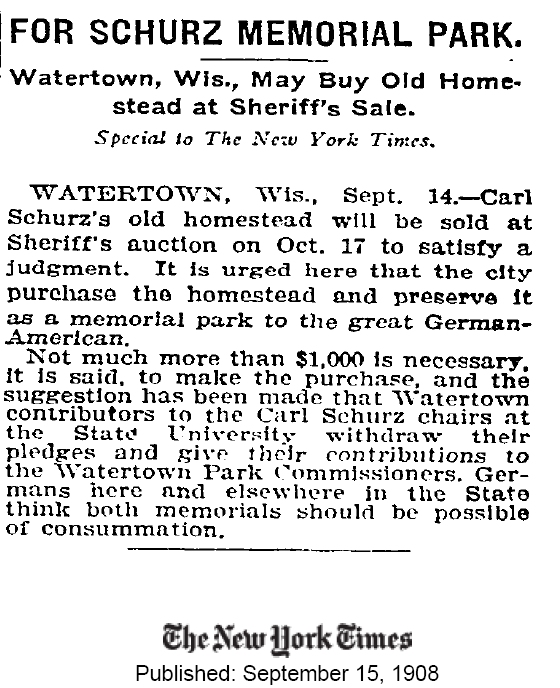
09 15 Schurz
home sold to honor judgment. City
urged to buy for memorial and withdraw funding Carl Schurz chair at UW NY Times
1909
11 05 HALLOWEEN
PARTY AT SCHURZ HOMESTEAD
One
very brief, two sentence commentary in the Gazette of November 5, 1909,
unknowingly told an additional tale. It
reported that the Junior Children of Mary Society of St. Bernard’s had held a
Halloween party several nights earlier “at the Schurz homestead in North Church
Street.” It is quite likely that none of
the group, youngsters or their elders, knew one background story about Carl
Schurz who had built the rococo-style home half a century earlier. Schurz had been a Catholic in his youth. He had attended a Jesuit school back in
Germany, but dropped his Catholic heritage while still a young man. Built
on Irish Faith, by Charles Wallman, pg. 267.
1913
02 20 CARL
SCHURZ PROFESSOR RETURNS TO EUROPE
Professor Eugene Kuehnemann of the University of
Breslau, who has been Carl Schurz Memorial exchange professor at the University
of Wisconsin since last fall, has returned to Europe. His presence for one semester at the
University of Wisconsin was made possible by the contributions of
German-American citizens of the state to the Carl Schurz Memorial Fund. WG
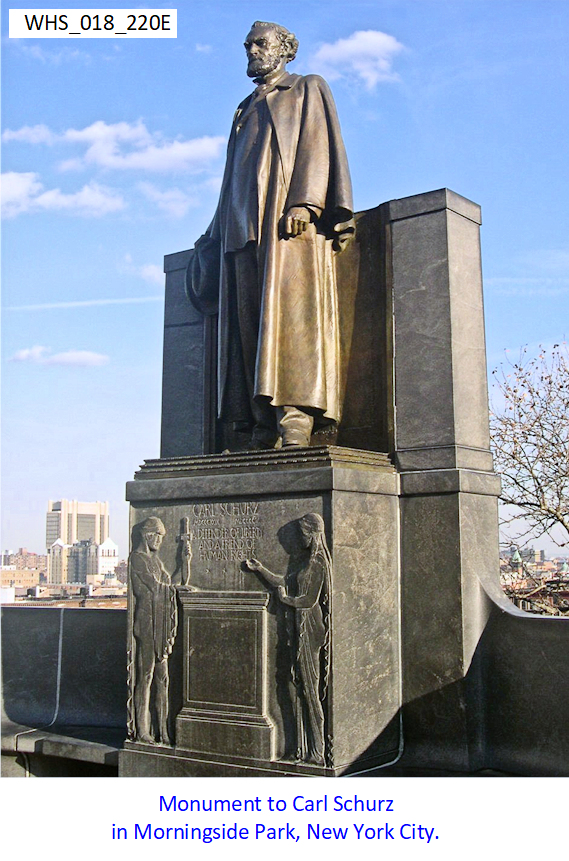
MONUMENT DEDICATED IN NEW YORK PARK

New Yorker magazine article on a
Carl Schurz monument in New York park.
"By our lights today, he’s neither a good guy nor a bad guy, and
elements of the monument that seemed progressive when it was dedicated don’t seem progressive today."
1914
05 28 ST.
LOUIS HONORS SCHURZ / Citizens Unveil Memorial to Him and Other
War Editors.
 St. Louis, May 26 — A memorial was
unveiled to Carl Schurz, Dr. Emil Preetorius and Carl Daenzer,
German-American newspaper editors, who, in St. Louis during the Civil War,
directed their influence both to save Missouri to the Union and to uphold the
Union cause generally. The bronze statue
is that of a nude woman of heroic size.
In each hand she grasps a torch, symbolic of enlightenment. The funds for the memorial were raised by St.
Louisians, headed by Ben Altheimer. The
late Adolphus Busch subscribed $20,000.
WG
St. Louis, May 26 — A memorial was
unveiled to Carl Schurz, Dr. Emil Preetorius and Carl Daenzer,
German-American newspaper editors, who, in St. Louis during the Civil War,
directed their influence both to save Missouri to the Union and to uphold the
Union cause generally. The bronze statue
is that of a nude woman of heroic size.
In each hand she grasps a torch, symbolic of enlightenment. The funds for the memorial were raised by St.
Louisians, headed by Ben Altheimer. The
late Adolphus Busch subscribed $20,000.
WG
07 04 OSHKOSH: THE CARL SCHURZ MONUMENT.
Among the
chief works of art in the City of Oshkosh is the monument to the memory of Carl
Schurz, Wisconsin statesman, who represented one of the truest types of
American patriots, with the highest ideals as to democracy and loyalty. This beautiful statue is located at the foot
of Washington Street, with the waters of Lake Winnebago and the hazy east shore
as a background. Upon one side of it is
an imposing city recreation center, formerly the clubhouse of the Oshkosh Yacht
Club, and upon the other the municipal water plant.
The
donor of the monument, Col. John Hicks, went to the studio of Karl Theodore
Francis Bitter, of New York, for the statue of the great apostle of
democracy. It was on the date of
Saturday, July 4, 1914, that this magnificent work in bronze, upon marble, was
dedicated, and the event marked a new epoch in the history of Fourth of July
celebrations here. A parade was held,
led by the Arion Band, in which there were automobiles carrying those having
active part in the unveiling, and the members of Companies B and F of the
Wisconsin National Guard, the Oshkosh Kriegerverein and the Oshkosh Maennerchor
marched. A huge crowd of citizens
gathered about the monument, and those taking part were seated on and spoke
from a raised platform decorated in the patriotic colors. The Arions played “Star Spangled Banner,” and
Rev. Theodore Irion, of St. Paul’s Evangelical church, delivered the
invocation.
The
Maennerchor rendered a song in German, and the monument was disclosed to view,
Miss Marianne Schurz, one of the daughters of Carl Schurz, performing the
ceremony.
Gen.
C. R. Boardman presented the gift in behalf of the donor, stating that Carl
Schurz was the greatest American of German birth this country had ever
known. The response of acceptance for
the city was made by Mayor John Mulva, who emphasized the “wise and generous
philanthropy of that distinguished fellow citizen, who has done so much to
beautify our public places.” Judge Emil
Baensch, of Manitowoc, was the principal speaker, his address being an eloquent
tribute to Schurz, whom he termed a type of active American citizenship, the
immigrant, and whose character and career he sketched in detail. Oshkosh Public Library Digital Collections
07 09 OSHKOSH
SCHURZ MONUMENT UNVEILED
Oshkosh,
Wis., July 4 — While a daughter of Carl Schurz hauled the veil from the statue
of the German-American statesman, thousands of citizens and visitors from
Watertown and other cities cheered to the echo.
Gov. McGovern, Judge Emil Baensch and Gen. Boardman spoke of the career
of the famous adopted citizen of Wisconsin.
The mayor and Col. John Hicks, the donor of the heroic bronze, also
spoke. The ceremonies were preceded by a
great parade through the principal streets, the guests of honor riding in autos. Two companies of the National Guard, the
Spanish War veterans, Sons of Veterans and the German Krieger Verein
marched. The Maennerchor sang during the
program.
Cross Reference:
Link
to info on Oshkosh monument
1915
07 01 CARL SCHURZ PROFESSORSHIPS AT UW
A large audience was at Turner
Opera house Friday evening to hear the lecture of Prof. Kuehnemann, holder of one of the Carl Schurz
professorships at the University of Wisconsin.
He spoke in English and German, and presented the Germany-Austria side
of the present war in Europe in a masterly manner. WG
1917
12 17 CARL SCHURZ CIGAR
 Among brands manufactured by Wiggenhorn Bros.
1918
06 21 USS SCHURZ LOST
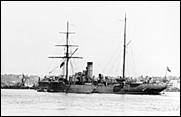
Named after the famed writer, Union Army general, Senator, Secretary of
the Interior, and one-time Watertown resident Carl Schurz. Originally known as the SMS Geier, the
255-foot long German cruiser was built in 1894 in Wilhelmshaven, Germany. The USS Schurz is the only German Imperial
Navy warship captured by the U.S. Navy during World War I.
c.1920
-- -- MARIANNE SCHURZ “Pussy”
(1857-1929)
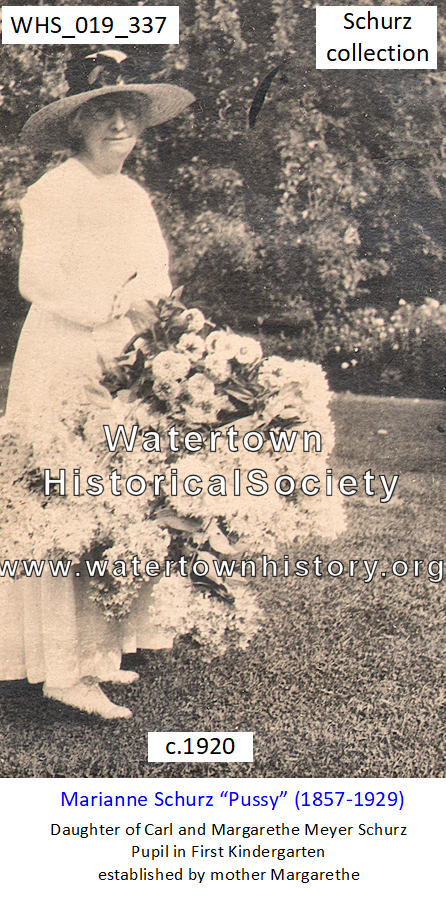
Daughter of Carl and Margarethe Meyer Schurz. Pupil in First Kindergarten established by
mother Margarethe
1932
FUESS WRITES A GOOD BOOK ON CARL SCHURZ
Chicago Tribune, 05 11 1932
Accurate Study of Noted German-American.
"Carl Schurz” by Claude M. Fuess.
[Dodd-Mead.]
Claude M. Fuess, author of the distinguished and scholarly biography
of Daniel Webster, presents us with the first complete life of Carl Schurz, the
most notable of German-Americans. This
biography has been carefully put together, with an ample and discriminating
bibliography and many illuminating notes.
Claude Fuess’ biographical method does not fall in with the new trend
which emphasizes psychology and perhaps even sensationalism, but is serious,
sound, interesting, and accurate.
"No one who ever saw Carl Schurz walking jauntily down Fifth
Avenue was likely to forget that slender, erect figure, usually a little
cramped in a tight fitting frock coat; that noble head, crowned with a mass of
grizzled hair; that mustache and beard, giving him a foreign appearance in a
land of smooth shaven males; those sharp, twinkling, sometimes whimsical eyes,
behind steel rimmed spectacles; and that bearing of conscious intellectuality
and power which befits only those who have matched their abilities successfully
against potentates and presidents."
Thus is this amazing man, vividly described.
Early Interest in Politics.
Carl Schurz, a middle class German, born In Prussia, was in his early
youth a thoughtful boy interested in books and culture. When he went to college he soon became
interested in politics in his native land and allied himself, as most youthful
Germans at that time did, with the revolutionary forces. He effected a striking rescue of a
revolutionary leader and was for many Germans a romantic hero. He was practically exiled from his native
land, found himself unpopular in France where Napoleon the Third was trying to
effect the change from republicanism to monarchy, and landed in England where
he joined many of his friends in the German colony. Though he soon came to America, he never lost
his passionate enthusiasm for a united Germany.
Arriving in America with his bride at the age of 23, he, within six
months, learned to speak and write fluently the English language. With this amazing accomplishment he began the
career that was to lead him to the highest places ever reached by a
German-American. His gift as an orator,
his vital interest in politics and his passion for justice and honesty soon put
him before the eyes of the public. His
zeal and efforts undoubtedly helped to elect Abraham Lincoln, who upon
attaining office appointed him as minister to Spain. He soon returned, however, to this country
and took an active part in the civil war.
Perhaps the only discreditable phase of his career, discreditable only
in that it was unwise and short sighted, was his attitude toward Andrew Johnson
and his reconstruction policy. In his
lifetime Carl Schurz became a senator and a secretary of the interior, and
adviser, friend or enemy to every President from Lincoln to Roosevelt, always
advocating the honest and the just in politics even to the extent of changing
parties often and organizing a third party.
His main doctrines were anti-slavery, sound money, civil service reform,
anti-imperialism, international peace, conservation of natural resources and
clean government.
Respected by Good Citizens.
Though he was not always successful, he was a person forever to be
feared by the corrupt and vacillating and respected by the good citizen, no
matter where he lived or to what party he belonged.
Carl Schurz's career was perhaps one of the noblest in the history of
American public life. Furthermore, it
was one of the most astonishing, considering the enormous handicaps under which
he attained distinction. He became, in a
few short years after his arrival in this country, an Americanized-German of
the highest order and never once did his allegiance to the United States
waver. Carl Schurz was a not altogether
attractive personality however. His
dogmatism and his oftentimes childlike but nevertheless annoying egotism, his
reforming zeal that many times antagonized the presidents he took upon himself
to advise, were not traits that endeared him universally to the public. There has never been a doubt, however, of his
consistent honesty in times of the most flagrant corruption and his invaluable
contribution to the public life of America.
Claude Fuess writes disinterestedly of his hero. He is not blind to the repellent features of
this German- American reformer, but he gives him his due in a biography that is
interesting, well written and stimulating.
- M. D.
1935
09 04 SCHURZ MONUMENT PROPOSED FOR WATERTOWN
Plans for Watertown’s centennial were discussed last evening at a meeting of the directors of the
Watertown Historical Society held at the library. The directors last night decided to make a
determined effort to have the Schurz monument, which is to be purchased by the
Federation of German Societies in Wisconsin, erected in Watertown. The society [Federation of German Societies
in Wisconsin] has asked the state for permission to erect the monument on
either the state capitol grounds or the University of Wisconsin campus.
1936
07 05 NOTED
IN 1936 CENTENNIAL CELEBRATION
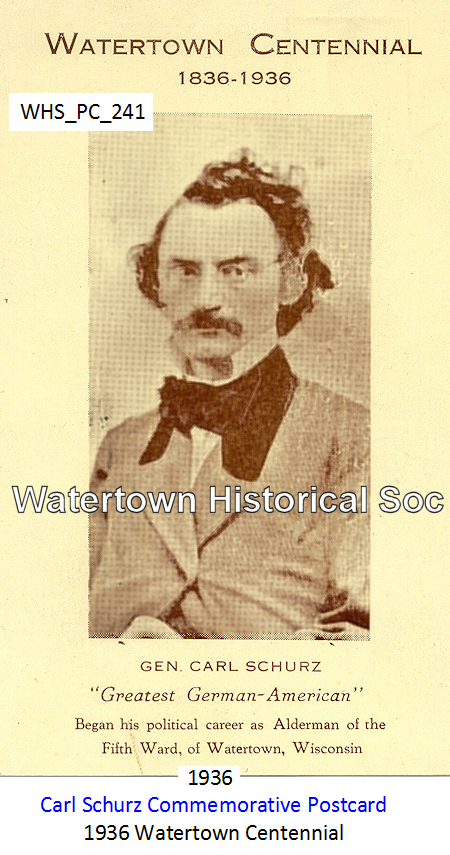
1937
07 09 HONORED
IN MADISON
Carl
Schurz, German-American patriot and one time Watertown resident will be honored
at a German Folkfest in Madison on 8/8/37.
The affair will be held at Olin Park.
A program is now in preparation.
Plans for erecting a statue to Mr. Schurz in Capitol Park, at the State
Street entrance, was recently voted by the Wisconsin Legislature and a
state-wide fund for the monument is to be launched. WDTimes
1938
03 22 Schurz Memorial proposed for Madison,
instead of on Octagon House grounds in
Watertown
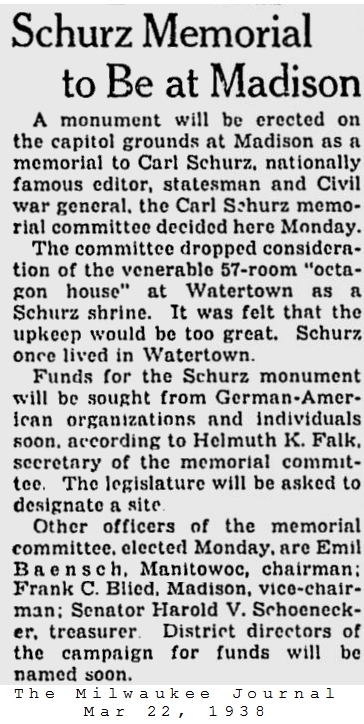
1952
05 03 CARL SCHURZ CENTENNIAL GRANT
The St. Louis Post-Dispatch,
a leading American newspaper, has informed the state department that it will
award the Carl Schurz centennial grant to a West German newsman. The year 1952 is set aside as the centennial
of Carl Schurz’ arrival in the United States from Germany. He lived in Watertown after his arrival and
began a notable career here. A sketch
about him appeared in the Times on
Monday of this week. The St. Louis paper
said that the winner of the grant will be assigned to the Post-Dispatch for six months as a regular reporter and special
feature writer. The office of the U.S. high
commissioner for Germany, the State Department and the St. Louis newspaper
jointly will select the award winner. WG
1983
05 08 COMMEMORATIVE
STAMP ISSUED
U.S.
stamp honoring Carl
Schurz.
Cross-References:
Chapter
on Schurz home and fire
Carl
was a nephew of Catharine
Gaebler, wife of Emil C. Gaebler
Daniel Kusel, Sr. was persuaded to stay in Watertown by
his friend, Carl Schurz
The Weltbuerger, one of the oldest German paper in
Wisconsin, had many able editorial writers, among them being the Hon. Carl
Schurz
Carl
Schurz on "True Americanism" (I)
Carl
Schurz on "True Americanism" (II)
Forest
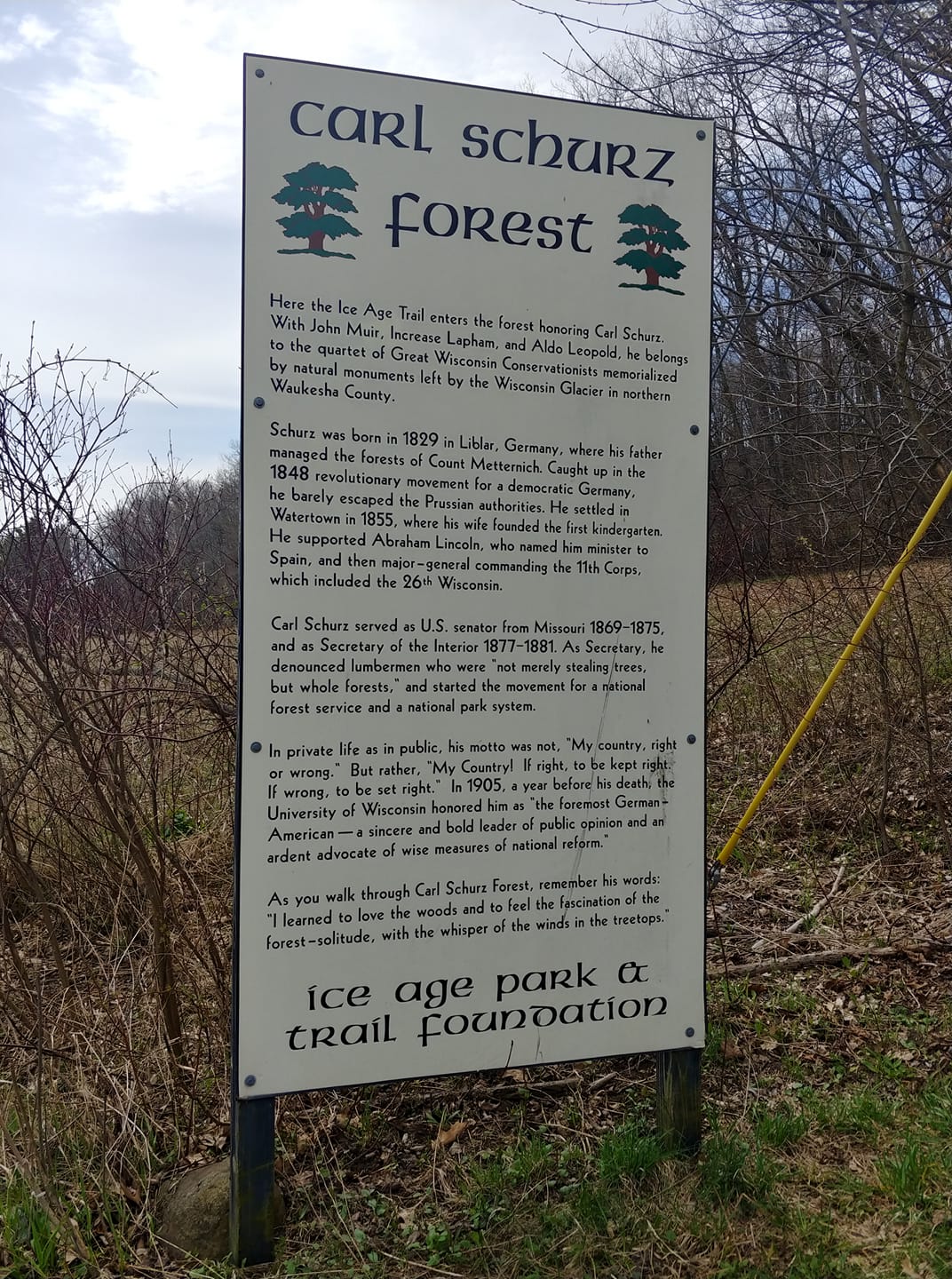
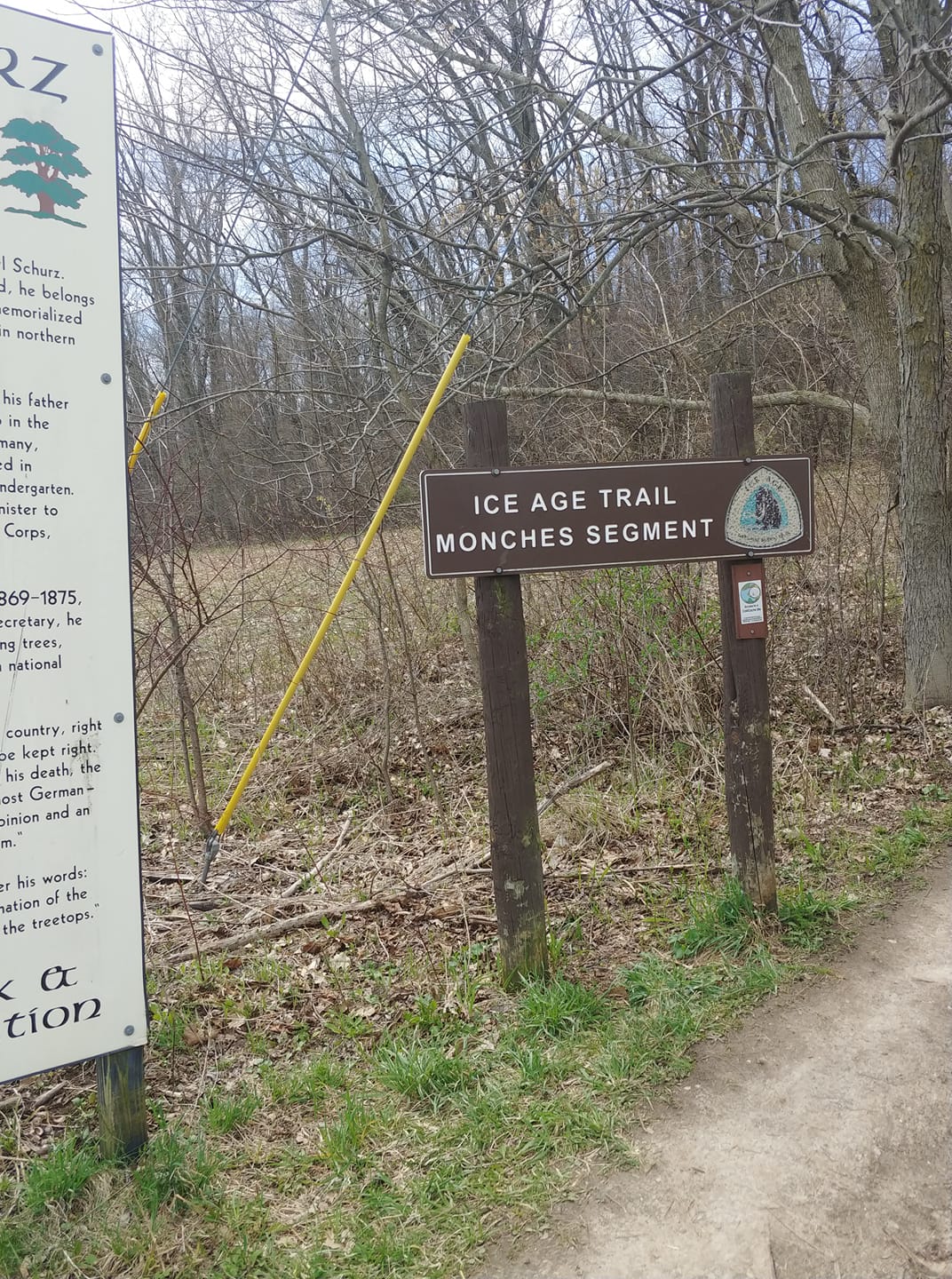
named for Carl Schurz: The Monches
segment of the Ice Age Trail. jsonline article
Two
letters that describe the essence of the American identity, one which we’re
struggling to recapture now. Hermann
Herald article
The
Statesman and the Socialite: Carl Schurz and Fanny Chapman:
Secret Love, Letters, and Life in the Gilded Age, by Peter Lubrecht
NEW YORK CITY MONUMENT to Carl Schurz in Morningside Park
FOREST
NORTH KETTLE MORAINE area, trail, 2020, 1 of 2, 2 of 2
Margarethe
Meyer Schurz – A Biography

The book
“Margarethe Meyer Schurz – A Biography” by Hannah Werwath Swart has been
reprinted by the Watertown Historical Society and is now available in two
formats, ebook and soft cover.
E-BOOK:
play.google.com/store/search?c=books&q=margarethe+schurz
The
FIRST KINDERGARTEN IN AMERICA was started in 1856 in Watertown by Margarethe
Meyer Schurz, wife of Carl Schurz, the famed revolutionary who went on to
become Lincoln's Minister to Spain, Hayes's Secretary of the Interior and the
first German-born citizen to sit in the U. S. Senate.

History of Watertown,
Wisconsin