website watertownhistory.org
ebook
History of Watertown, Wisconsin
High School
South Eighth Street
LINK
TO FORMER HIGH SCHOOL ON EAST
MAIN STREET

PREVIOUS HIGH SCHOOL LOCATIONS:
1863-1882 Ducasse building
THE
FIRST HIGH SCHOOL BUILDING IN THE CITY
Pranks
and Intellectual Feats Are Revealed; Building Stands
The
old-fashioned building at the corner of North Fifth and Jones streets was the
first high school building in the city.
It was built by Justice Ducasse, who for many years was a police justice
in Watertown in the early days.
It
may be said here that it was in the Watertown High-School that the first text
books in Wisconsin were issued, and it was there, too, that a commercial course
was offered to a high school class for the first time in the history of our
state.
The
first principal of the school was Professor Theodore Bernhard. William Rohr was assistant. Other teachers were Mrs. William Norris and
Miss Cooley. Among the pupils of the
Civil war period or late in the 50's were Honorable W. F. Voss, C. H. Pacobi
[Jacobi], Edward Racek, Louis Merkel, Henry Bertram, Charles Fuermann, Max
Gaebler, John Mallaney, Mrs. A. J. Earling nee Peebles, Oscar Cole and Henry
Peebles.
The
following sketch was written by a former student and is well worth
reproduction:
"The
quaint old Ducases building, about 50 years ago, housed the beginning of our
public high-school. The faculty
consisted of Theodore Bernhard, William H. Rohr, Misses Vestey, Cooley and
Merriam. The studies were not as
numerous as they are today, but the upper class did trigonometry, and surveying
and the pupils could recite history by the page, though they had never looked
into a history book. In those days,
people were too poor to buy many text books and the teachers were obliged to do
real teaching.
"Professor
Bernhard was a remarkably successful teacher. When a pupil showed precocity in
a certain direction, he would coach him on that line and develop an exhibition
stunt for the public examination at the end of the year. A merchant named Arnim offered prizes to the
pupils at this examination and William Voss, fourteen years old, took the first
prize with a remarkable geographical recitation, and Max Gaebler, twelve years
old, did the Pythagoras theorem.
Professor Bernhard, to the end of his career, frequently would refer
with much pride to these feats of his pupils.
1883-1896 Western Avenue
1897-1917 Union School No.1 (later Armory)
1918 South Eight Street
There
were many different colors used as class colors in the early days. Purple and gold, for example. Possibly at one time each class had their own
colors. It was until the 1930s that blue
and white became the "official" school colors.
_________________________________________________
1890
06 26 GRADUATION
CLASS OF 1890
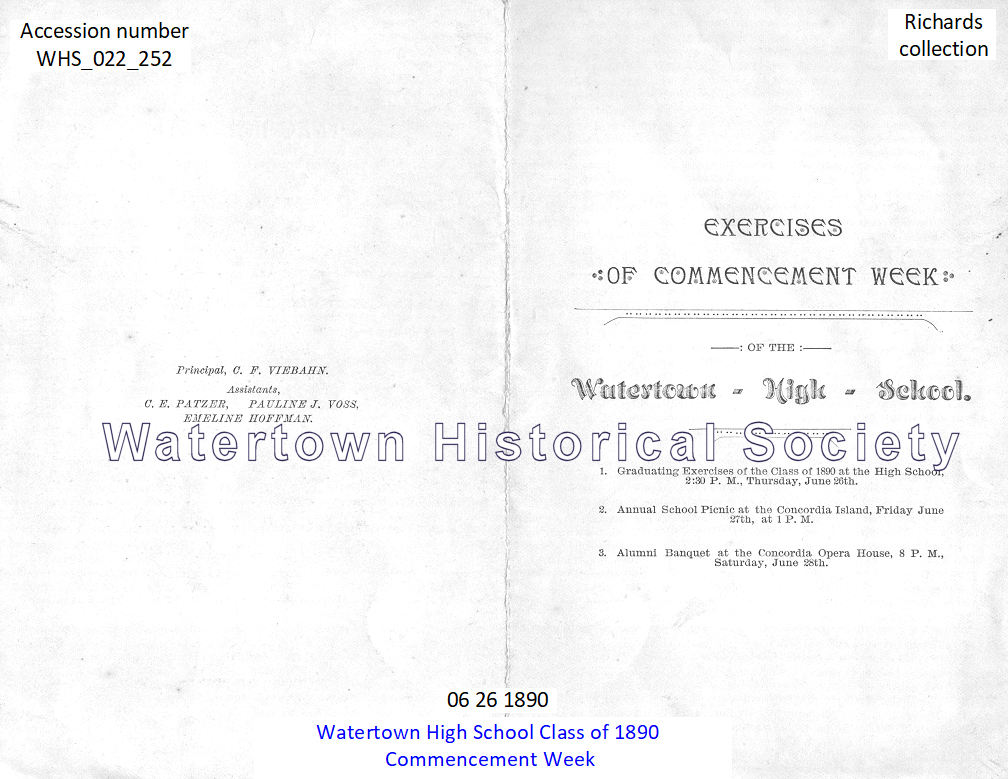
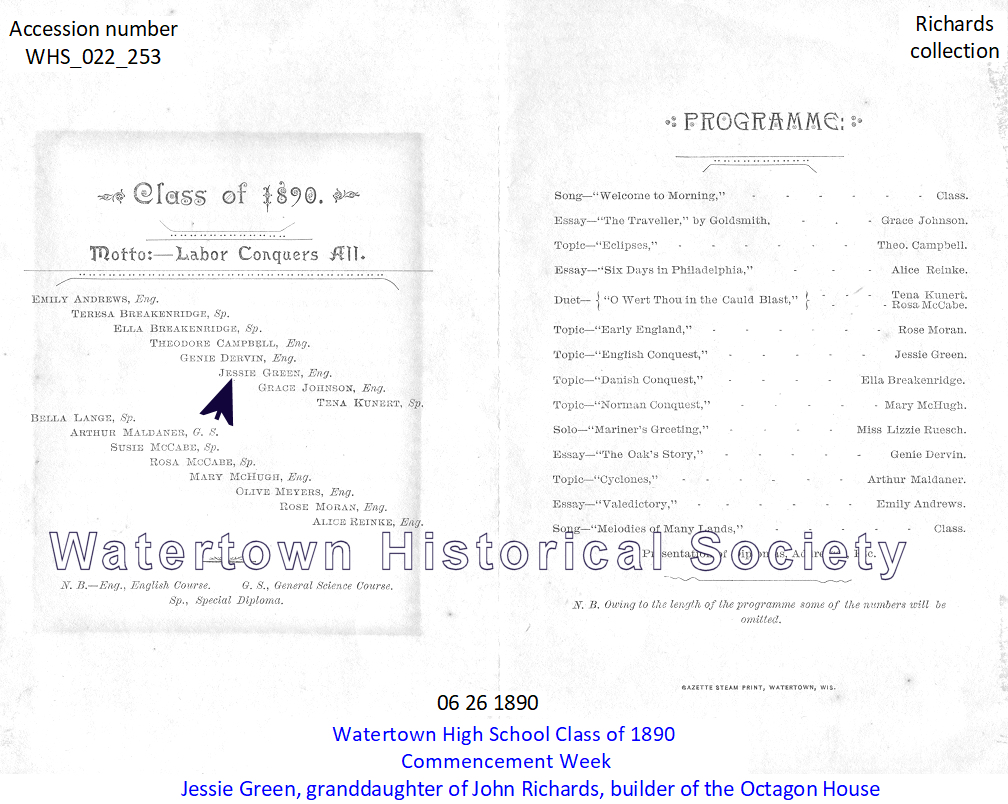
Emily Andrews, Teresa Breakenridge,
Ella Breakenridge, Rosa McCabe, Theodore Campbell, Genie Dervin, Jessie Green,
Grace Johnson, Tena Kunert, Bella Lange, Arthur Maldaner, Susie McCabe, Rosa
McCabe, Mary McHugh, Olive Meyers, Rose Moran, Alice Reinke.
1913
10 02 WATERTOWN
DEFEATED BY MILWAUKEE
At Milwaukee last Saturday the
Watertown High School football team was defeated by the East Division High
School team of that city by the score of 21 to 14. The Watertown lineup was as follows: Butler le, Bandelin lt Henke Ig, Keel c,
Schultz rg, Keck rt, T. Williams re, Lewandowski q, Hollenbeck If, Koenig rh,
L. Williams fb, Buffmeier and Brumm subs.
WG
11 14 LONGTIME
SCHOOL JANITOR RECOGNIZED
The superintendent presented
the following communication to the board: I hereby inform you that I have
appointed Mr. Albert Krueger to the position of janitor of high school in place
of William Welk, resigned. The
appointment is made subject to confirmation by the board of education. Action on this appointment was deferred until
the next regular meeting.
The following resolution by
Mr. Gile was unanimously adopted by the hoard:
Whereas; Mr. William Welk has served the city of Watertown as janitor of
the high school and other school buildings for a period of thirty-seven years
and during this time has in the highest sense proven himself an industrious and
faithful servant, always courteous and obliging to those with whom he worked,
and, Whereas; On account of advancing years and the infirmities of age he now
deems it necessary to resign the position he has so long and faithfully held,
therefore be it Resolved: That the board of education of the city of Watertown,
hereby express hearty appreciation for the efficient services rendered the
schools by Mr. Welk. and admiration for his faithfulness to duty. Resolved further: That we convey to Mr. Welk
our sincere friendship and wishes for a long and happy life among us — his
fellow citizens and neighbors. Resolved:
That a copy of these resolutions be spread upon the journal of this body and
also that an engrossed copy be sent to the retiring janitor. Adjournment. Carl R. Feld, Clerk. The Watertown Weekly Leader, 14
Nov 1913
1914
06 25 HIGH
SCHOOL COMMENCEMENT
Presentation Speech by Louis Bandelin.
Fund for frieze in assembly room of new high school.
1915
03 18 NEW
HIGH SCHOOL ASSURED
PROCEEDINGS
Of a special meeting of the
Common Council of the city of Watertown, Wisconsin, held March 10, 1915.
The meeting was called by
the mayor for the purpose of receiving and considering the report of the Board
of Education in relation to the construction of a new high school.
The following communication
was presented:
To the Common Council and
the Board of Education of the city of Watertown.
Gentlemen:
At a meeting of the Business
Men’s Association held on Tuesday evening, March 9, the following resolution
was presented, and unanimously adopted:
“Resolved, That it is the
sentiment of the members of the Business Men’s Association of Watertown,
representatives of heavy tax paying interests, that Watertown should have a
new, substantial high school building, capable of accommodating its local pupils
and also the children of our farming community who desire to avail themselves
of our excellent educational facilities, and any action our school board and
city council may take toward the erection of such new high school building will
meet with the hearty approval of this association.
Very truly yours, Business
Men’s Association, Max Melzer, Secretary.
The same was placed on file.
President Voss of the school
board then presented the matter of the new high school, stating, among other
things, that a new high school was a necessity; that the old building is
overcrowded, is not adapted to the needs of modern service and is defective
owing to improper ventilation. He stated
that the cost of a building of the type and size required would be about
$100,000. This building would
accommodate 350 pupils in the assembly room, allowing fifteen square feet of
space to each pupil, or 400 pupils allowing twelve square feet for each. That the enrollment at present is about 300
with an attendance of about 280. The new
building would therefore call for an additional seventy to 120 pupils.
He stated further that the
proposition of rebuilding the present high school building to conform with
present requirements is not feasible, for the reason that during the wrecking
of the old and the construction of the new, a period of approximately one and
one-half years, it would be impossible to secure suitable quarters in which to
hold school.
Furthermore, the estimated
cost of such rebuilding would be $86,000 as compared with $100,000 for the new
building, not a great saving. Also that
the lot occupied by the present high school building, with dimensions of 200 x
216 feet, is too small to properly contain the new building, which is about 170
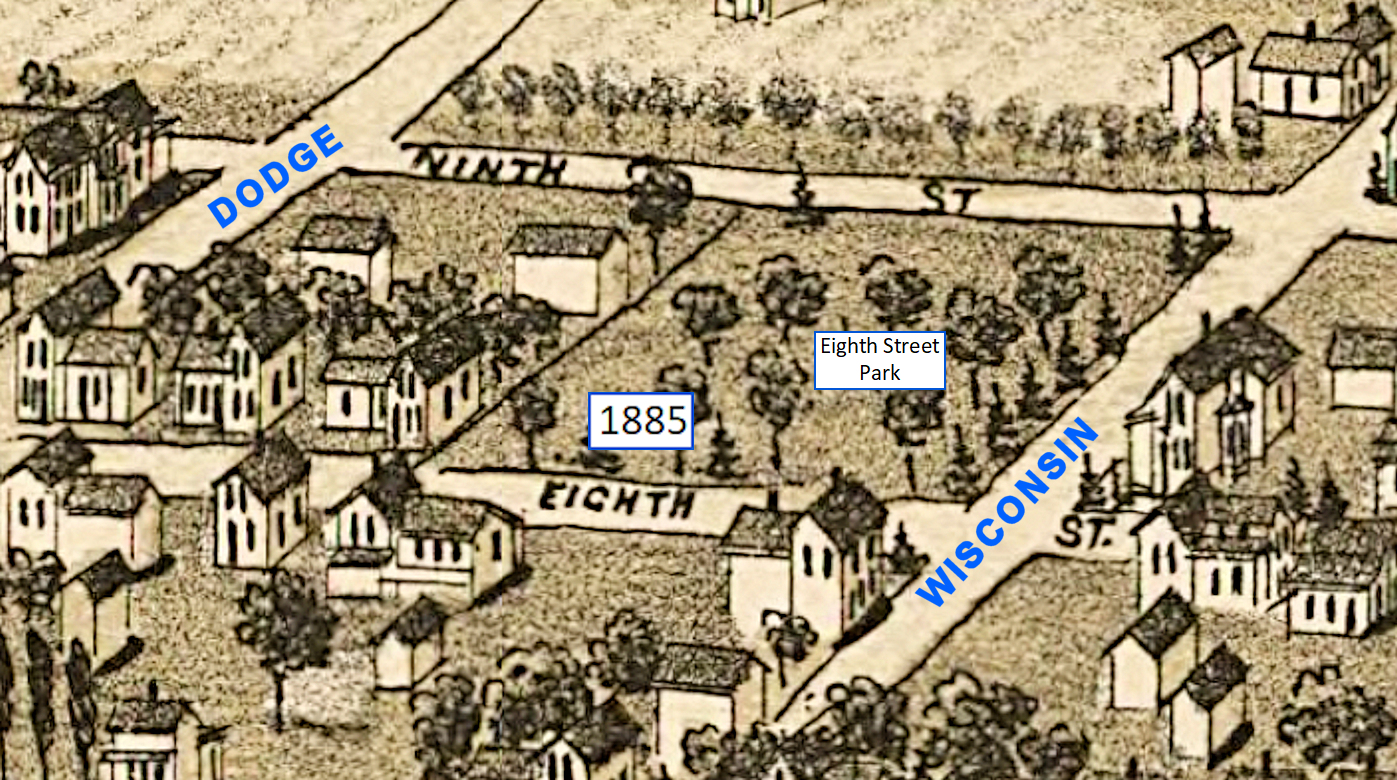
x 160 feet. The so-called Eighth
Street Park, bounded by Eighth, Ninth and Wisconsin streets, being 242 feet
north and south and 294 feet east and west, was pointed out as being the most
feasible and economical site for the proposed new school.
Health commissioner Haney
stated that the ventilation of the old building is very defective, has been criticized
repeatedly by the state board of health and was unfit to be used for high
school purposes.
During the ensuing
discussion, participated in by the members of the school board and common
council, various other points were brought out, among them that the school
board was unanimous in the opinion that a new building was necessary and that
such building should be built along the lines of the plans suggested. Pencil sketches of the proposed plan were
presented and explained by members of the board. The plan proposed provides for what is
commonly known as a fireproof building.
Upon the conclusion of the
discussion it was the sense of the meeting that the school board should present
at the next regular meeting of the common council a formal report and
recommendation of its requirements for a new high school building, with pencil
sketch attached, for further consideration of the common council.
The council adjourned.
Frank S. Weber, City
Clerk. WG
03 18 NEW
HIGH SCHOOL ASSURED (same date)
City Council Takes Favorable
Action.
At a regular meeting of the
city council last Tuesday evening the following resolution was passed, which
assures the city a fine new high school building. Watertown has differed in several things
agitating the people here of late, but it is very gratifying to note that there
is almost a unanimous feeling in our city that a new high school building be
erected. This speaks well for the future
of our city, and where its educational interests are so enthusiastically looked
after we may rest assured it will have a most wholesome effect on the moral and
material interests of Watertown.
Whereas, A certified copy of
a resolution of the Board of Education has been submitted to this Common
Council, wherein it is recited that a public necessity for a new high school
building has been demonstrated to the satisfaction of the said board;
And Whereas, The said board
has submitted pencil sketches of a new building to cost about $100,000, the
same having a seating capacity of 350 pupils in the assembly room, allowing
fifteen square feet for each pupil;
And Whereas, Said sketches
have been examined and all matters in connection with the construction of a new
high school building have been thoroughly considered by this common council;
And Whereas, It is also the
opinion of this common council that necessity exists for the construction of a
new high school building in this city;
Be It Resolved, That the
resolution of the Board of Education, first above mentioned, be and the same is
hereby approved, and that the said board be and is hereby directed to secure
full workable plans and specifications in accordance with said pencil sketches
from the architects, the payment for which is hereby sanctioned.
Resolved Further, That the
Board of Education be and it is hereby directed to advertise for proposals for
the construction of said new building in accordance with such plans and
specifications, and to report the result of the advertisement to this Common
Council.
Resolved Further, That it be
and is the sense of this common council that this building be built upon the
so-called “school lots” between Eighth and Ninth streets in the Ninth ward.
The resolution was adopted
by the following vote:
Ayes – Beurhaus,
Gruetzmacher, Harte, Kerr, Kessler, Knick, Kohn, Lutovsky, Richards, Schmechel,
Wedemeyer, Werner—12; Noes—Glatzel—1; Excused—Klemann—1 WG
04 01 HIGH
SCHOOL ALUMNI HOP
The annual Easter ball of the Alumni
Association of the Watertown High School has been set for April 5, Easter
Monday. The ball will be held at the
Masonic Temple and Bramer’s four-piece orchestra will furnish the music. Net proceeds of the ball will be applied on
the deficit of the reception and banquet to be held next June for the class of
1915.
The ball is being arranged and will
be in charge of the officers of the association, who are as follows:
President — Mrs. E. L. Schempf.
First Vice President — Ray Reichardt.
Second Vice President — Mrs. Walter
Schlueter.
Secretary — Miss Mabel Triplett.
Treasurer — Louis Bandelin.
Tickets are now on sale and may be secured from the officers. WG
A graduating class of 37 will be
given diplomas at the high school graduating exercises to be held at Turner
Opera house Wednesday evening, June 16.
The commencement address will be delivered by Paul F. Voelkert, secretary of the department of instruction of
the state university. Following is the
list of graduates: Paul H. Conway, Mabel King, Lucile S.
Liebermann, Doris A. Meyer, Margaret Mueller, Daniel L. Brooks, Hannah E.
Cowen, Ruth B. Johnson, Florence Lenz, Arnold Nickels, Herbert A. F. Rodeck,
Marcella A. Sette, Viola I. Volkmann, Myra Wieting, Marguerite E. Goodnetter,
Elsa E. Schwendke, Ruth Ellen Tyson, Ruth Marie Archie, Anna I. Biefeld, Selma
Spohn, Edna Ullrich, Mary Wieman, Helen
Cecilia Belrose, Robert A. Brumm, Henrietta M. Buege, Edna C. Hertel, Ewas G.
Hub, Ben R. Krueger, Joseph Lange, Hannah C. Lewis, Arthur R. Linnes, Helen A.
Maede, Gertrude S. Nickels, John F. Moriarty, Herbert Radtke, Elsie H. Schur,
Anna Maass.
Class Honors by Rank - Roedeck,
Lucille Liebermann, Daniel Brooks, Arnold Nickels, Helen Belrose. Class Honors by Election - Daniel L. Brooks,
president; Joseph T. Lange, vice-president; Margaret Mueller, secretary; Ruth
M. Archie, treasurer.
Class Colors - Purple and white. Class Flower - Blue aster. Class Motto - “Nothing Too Much”
10 14 NIGHT
SCHOOL TO OPEN
Superintendent T. J. Berto announced
on Tuesday that the public night school would be opened for the winter session
at the high school building Thursday evening.
A competent corps of teachers will be in charge of the school, which
will offer a wide range of subjects for study.
There will be classes organized in commercial subjects, including beginning bookkeeping, advanced
bookkeeping, beginning shorthand, advanced shorthand, arithmetic, typewriting,
penmanship, spelling, letter writing, rapid calculation, classes in reading in
English, in mechanical drawing and manual training, and in any other subject
desired by a sufficient number of students.
Night school will be open to all persons over 16 years of age and persons
between the ages of 14 and 16 years who are not now attending school. No tuition will be charged and the text books
will be furnished free of charge. A
deposit of $1.50 at the time of receiving text books will be required. This deposit will be returned at the close of
night school upon the return of the text books.
Students should enroll Thursday evening and determine
to remain until the term closes in the spring.
Sessions will be held in the high school building Monday evening and
Thursday evening of each week at 7:15 o'clock. WG
11 04 BREWERY
BRICKS FOR NEW HIGH SCHOOL BUILDING
Carl H. Block and Mallow &
Kaddatz were the lowest bidders for tearing down the old
Fuermann brewery plant, at the foot of North First Street, recently
acquired by the city, their bid being $7150.
The bid includes tearing down the building, cleaning the bricks and
hauling 800,000 of them to the site of the new high school building, drawing
all nails from lumber and storing lumber.
WG
11 04 NEW
HIGH SCHOOL HEATING CONTRACT
On Monday evening the contract for putting in the Kewaunee
smokeless heating plant in the new high school building was awarded
to Kehr Bros.
of this city.
Following were the bids submitted:
Thomas Heating Co., Racine, $9392
H. Kelly & Co., Minneapolis, 9830
Otto Biefeld & Co., Watertown, 9786
Kehr Bros.,
Watertown, 9265
Gen. Heating & Ventilating Co., Milwaukee, 9560
Ind. Heating & Eng. Co., Milwaukee, 9640
Downey Heating Co., Milwaukee, 9575
Healey
Plumbing and Heating Co., St. Paul, 11,670 WG
11 11 BAUMANN,
SUPERINTENDENT OF CONSTRUCTION
The Board of Education has appointed
A. F. Baumann, superintendent of construction of the new high school
building. The selection is a good one.
11 11 CONSTRUCTION
PARTICULARS
Kewaunee Tubular boilers with Hawley Down
Draft will be installed in the new high sehool building. An amendment was offered by Com. Woodard to
install Kewaunee No. 118 Smokeless Fire Box boilers, which was adopted.
On motion by Com. Woodard, Kehr
Brothers being the lowest bidders were awarded the contract to install two
Kewaunee No. 118 Smokeless Firebox Boilers with Sturtevant apparatus in the new
high school building for the sum of $9265.00, all voting in the affirmative.
On motion by Com. Woodard, the
application of A. F. Baumann for the position of inspector for the new high
school building was laid over until the next regular meeting of the Board.
Motion by Com.
Conway to purchase Streeter’s Shale Tex brick, like samples delivered to Board,
for facing of the new high school building and to be delivered F.O.B. cars to
Watertown, Wis., any time when needed before April 1st, 1916 and to be paid for
30 days after delivery at $14.50 per thousand.
Adopted. WG
1916
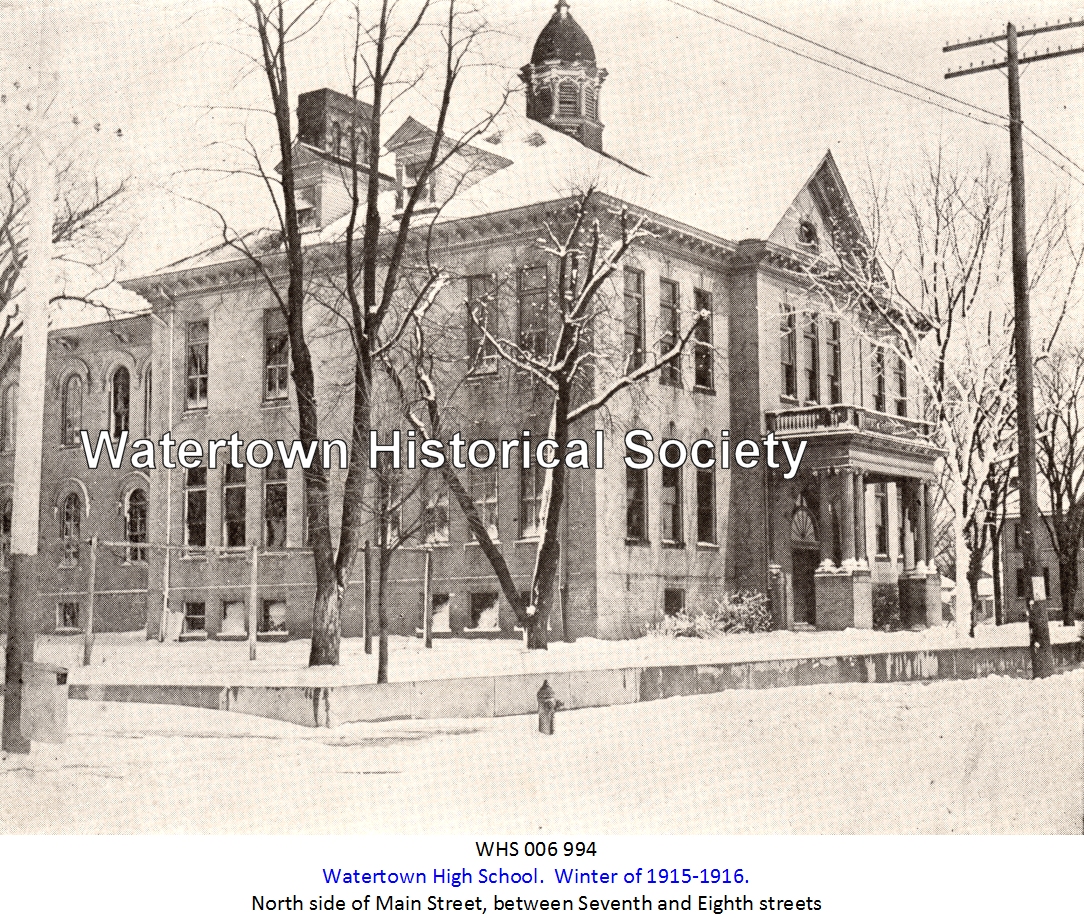 Winter of 1915-16
THE HIGH SCHOOL AS A COMMUNITY
CENTER
During the last decade
cities have come to look upon the provision of a place open to the public for
recreation, inspiration, and education as a proper function of city
government. Municipalities in the United
States are now providing free public music centers, playgrounds, assembly
halls, bathing beaches, museums, and libraries.
The Board of Education of the city of Watertown will have in the
splendid new high school building, now under process of construction,
facilities for some of the various activities of present-day city life.
The new high
school building is situated upon a lot [South Eighth St] which will give ample
room for tennis courts, football, baseball, and other games for all who wish a
play place, whether they be children or adults.
The building has in it features that will promote the health, comfort,
and pleasure of the citizens of Watertown.
The building is provided with a splendid gymnasium, 87 feet by 59 feet,
surrounded on three sides by a gallery eight feet in width. The gymnasium may be reached by a side entrance,
thereby making it unnecessary to open the whole building and making it possible
to use the gymnasium at a time when school is in session, without disturbing
classes.
The gymnasium has
a stage 21 1/2 feet by 15 1/2 feet, providing a suitable platform from which
lectures, concerts, or dramatics may be presented. The room is well lighted and well ventilated. Immediately off from it are shower baths and
dressing rooms for men and women. Even
if equipped with only moderate equipment for general gymnastics, the room will
make an excellent place in which business and professional men may exercise and
relax through indulgence in games of handball, volley ball, indoor baseball,
basketball, etc.
Well-equipped,
modern laboratories will be a feature of the second floor of the building —
laboratories in which citizens may have tests made, may have scientific
problems solved. The chemistry
laboratory will have equipment such that simple analyses may be made and
chemical reactions tested. In physics
the strength of metals, laws of physics, and use of mechanical devices may be
proven. In the biology and botany room
the germination of seeds may be tested and analyses of common plants may be
made. The assembly room of the building
will be an ideal place for evening entertainments, for lectures on civic
development and on matters of general municipal interest. The assembly room is equipped with an outlet
for a lantern, so that a stereopticon can be used.
The city of
Watertown is expending a large sum of money for its new high school building
and should plan to make the widest use of that building. It is not looked upon as good business policy
to erect an expensive plant in any industry and then allow that plant to lie
idle for several months of the year, for several days in every week and for
over half of each day. The movement for
a wider use of the school plant has been anticipated by the Board of Education
in the adoption of the plan of the new high school building. The building will be a beauty spot in the
city, a place of which all of us will be proud.
It should be more
than that; it should be a place in constant use, a real civic center of the
city. 1916 Watertown High School Orbit, pg 8.
-- -- VIEW OF NEWLY CONSTRUCTED
WATERTOWN HIGH SCHOOL
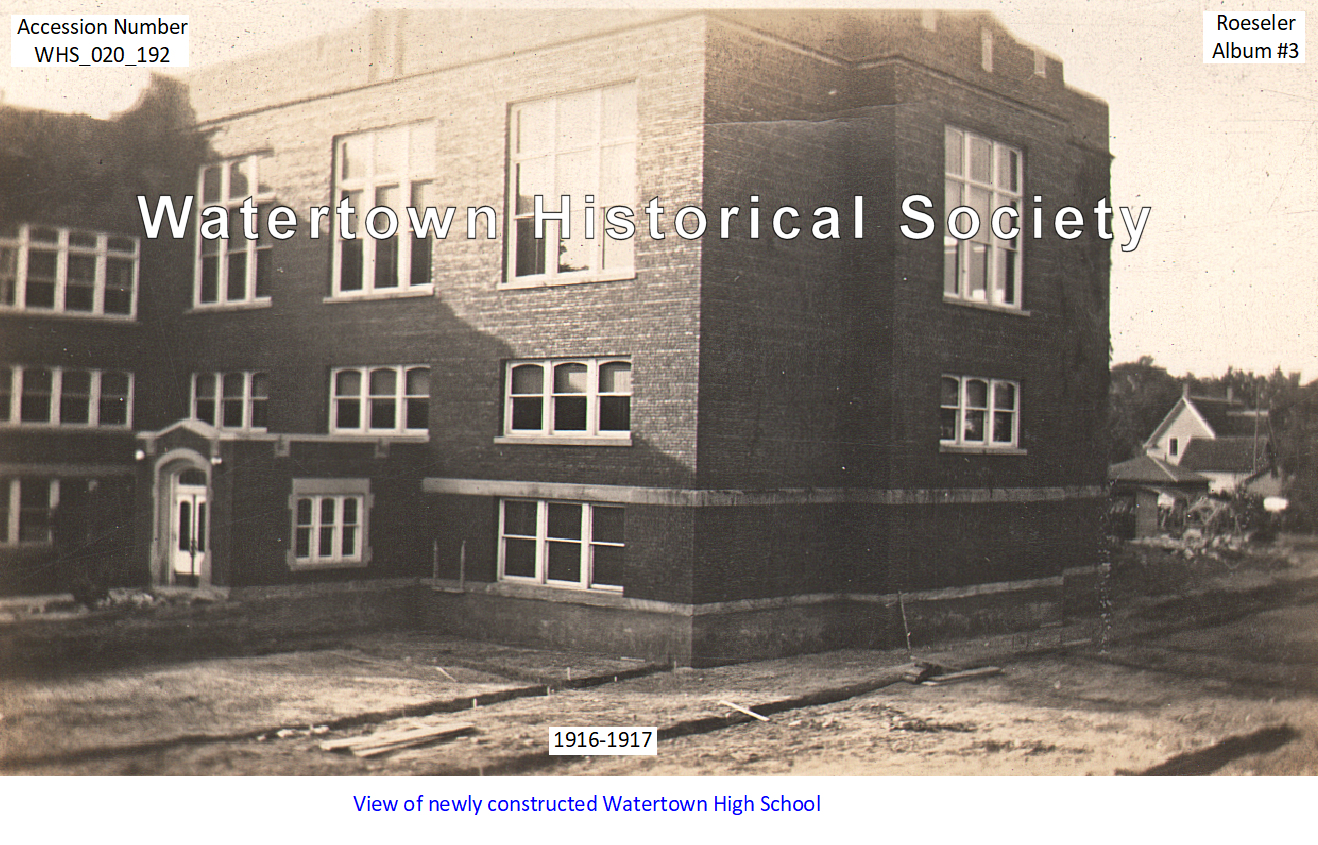
1917
WATERTOWN HIGH SCHOOL IMAGES
|
Assembly
room |
|
|
Assembly
room |
|
|
Chemistry
lab |
|
|
Domestic
science kitchen |
|
|
Gymnasium |
|
|
Lower
corridor |
|
|
Main
entrance |
|
|
Manual
training work shop |
|
|
Physics
lab |
|
|
Reference
library |
HIGH SCHOOL
BASKETBALL, CHAMPIONS OF 1917
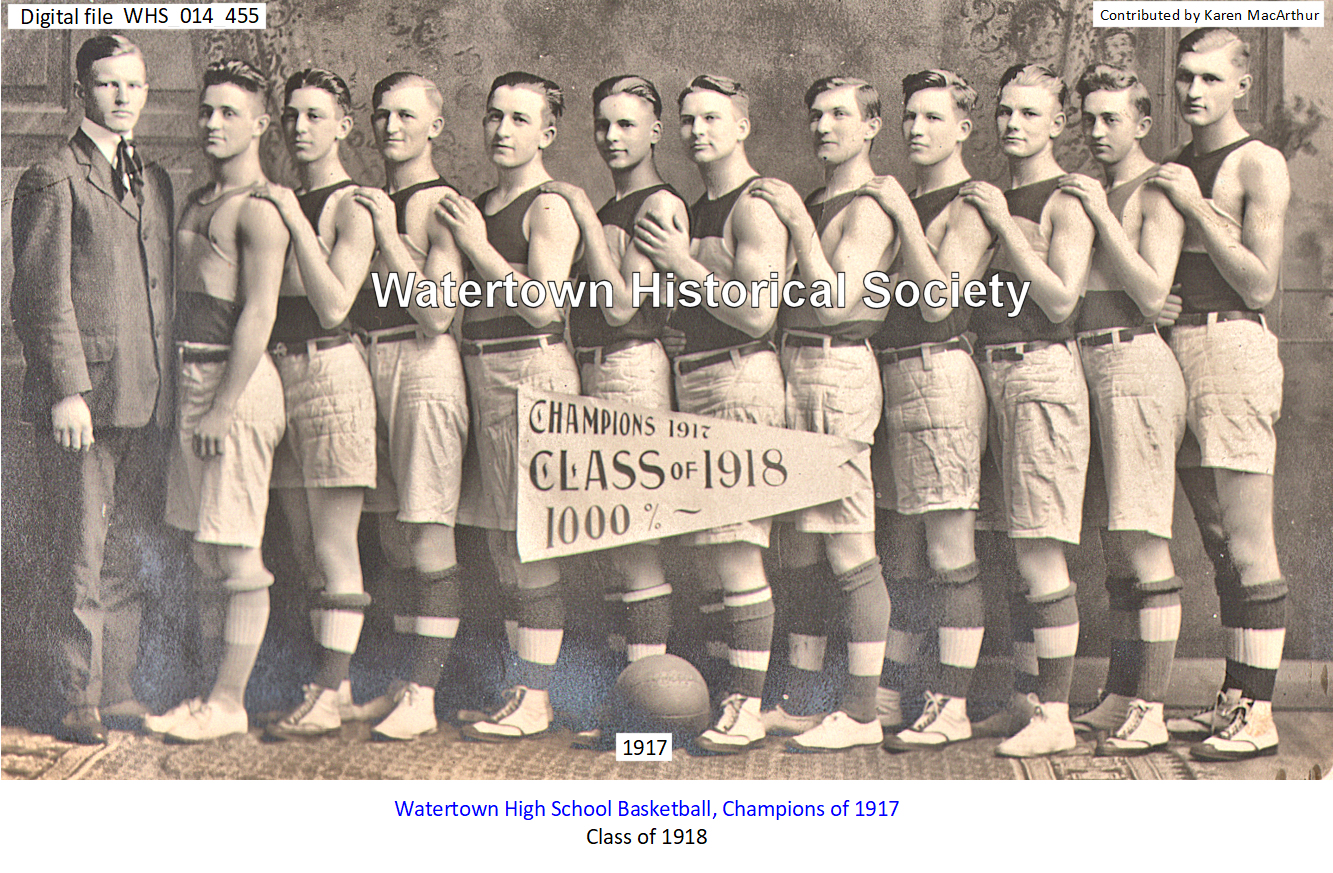 <
Champions of 1917 / Class of 1918
<
Champions of 1917 / Class of 1918
1918
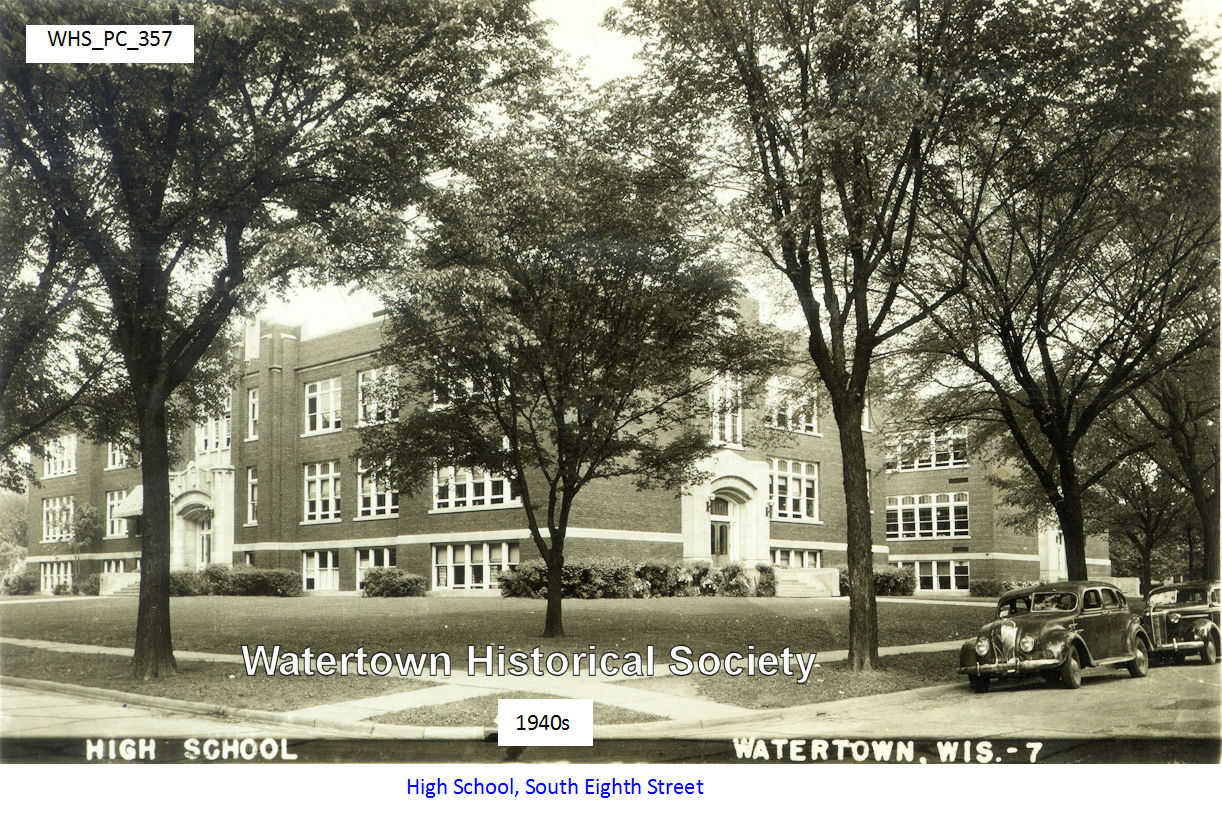
05 26 THE NEW HIGH SCHOOL BUILDING
The Watertown High
School is an artistic, modern, fire proof building, constructed of brick and
tile. It is situated on an open plot of
ground on Eighth, Wisconsin and Ninth streets.
It was erected in
1916 at a cost of $100,000 and was first occupied for school purposes in June,
1917. It is 169 ft. long on Eighth
Street and 152 ft. deep, with a separate boiler room and coal storage
room. There are entrances on the north,
the west, and the south sides. A wide
corridor extends completely through the building on each floor. In the basement are the shops, shower rooms
and domestic science rooms. On the first
floor are the offices, class rooms and toilet rooms. On the upper floor are the assembly, the
laboratories, commercial rooms and toilet rooms <>
W. C. Streblow, No.10A/36
1919
CLASS OF 1919 /
50-year reunion

[06 02 1969]: A. E. Bentzin,
Harold Hartwig, Wallace Buffmire, Meta Donner Schmutzler, Harold Achtenhagen,
Aileen Daw Gottschalk, Arthur Mallow, Aileen O'Byrne Craig, F. E. Henke, E. W.
Simdar and Edward J. King, Verna Ebert Saniter, Hazel Hathaway Frater, Cora
Maass Kaercher, Mabel Bock Schmidt, Hattie Lange Dunn, Florence Amadon Swenehart and Irene Collins,
Mary Bell Gallagher Stanrecheck.
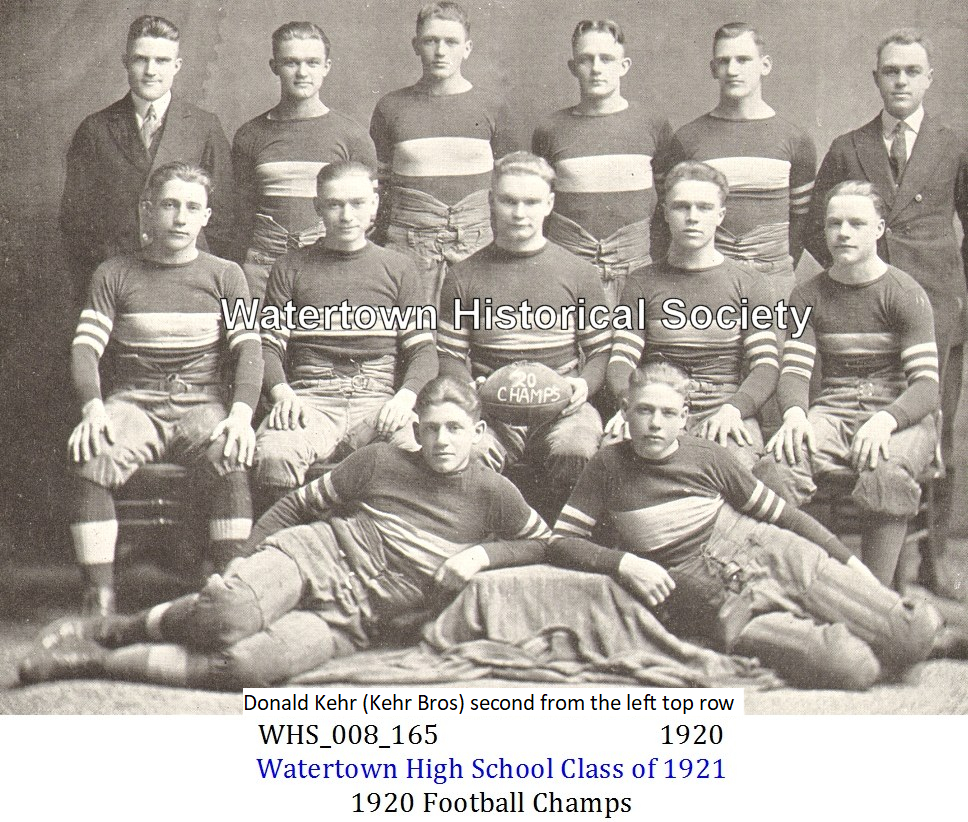
1920
FOOTBALL CHAMPS
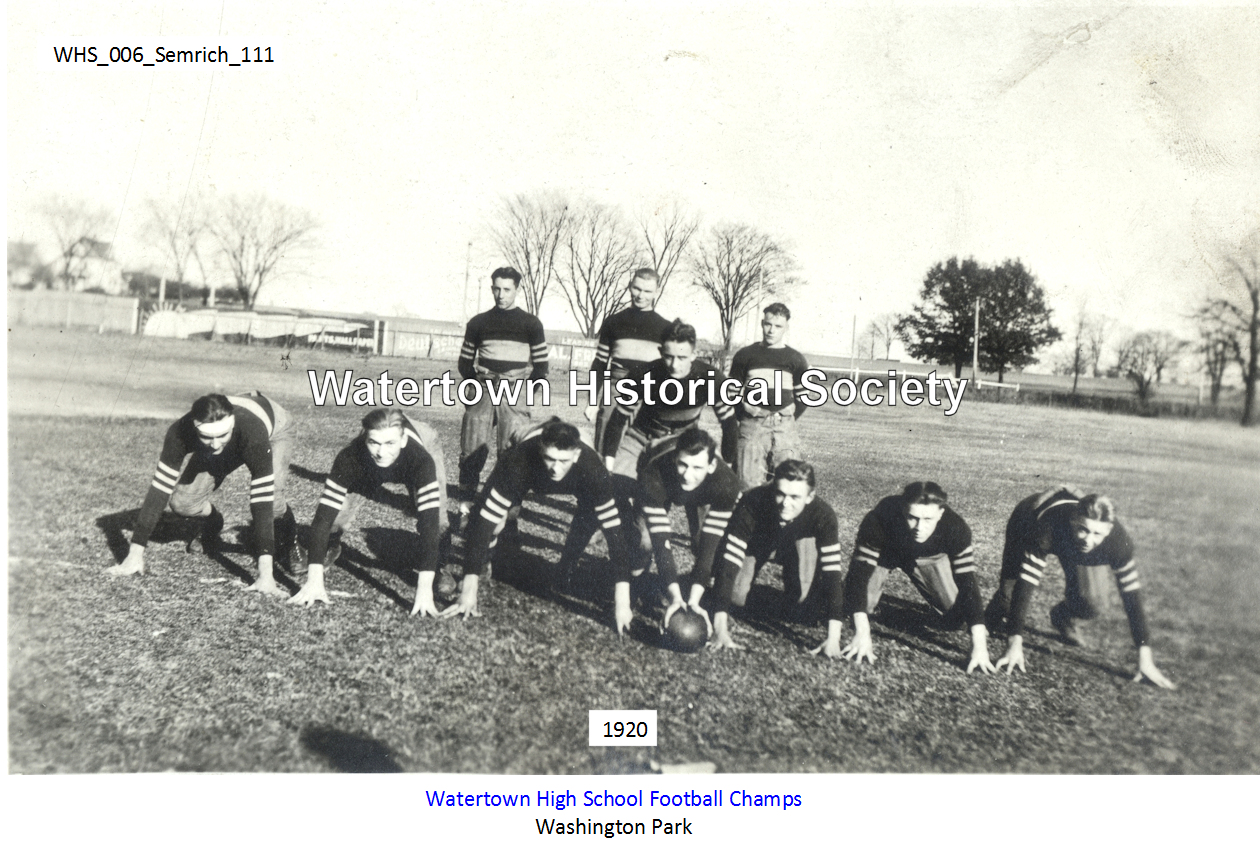
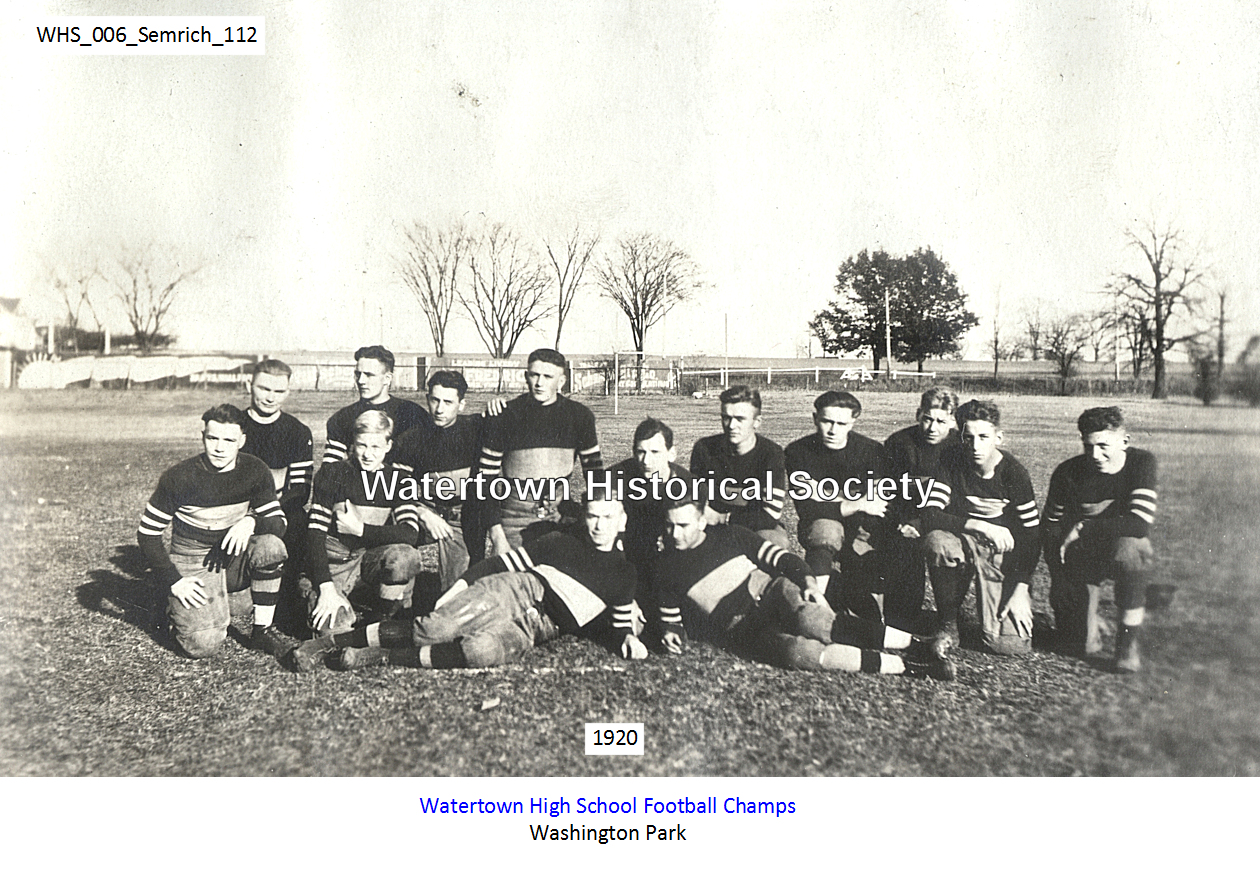
04 14 DEATH
OF JOSEPH BRANDENBERG, senior class
WDT
04 14 “THE
JUNE BRIDE” / WETTER DRAWING ON EXHIBITION
1921
1921
Orbit yearbook available in eBook format
1923
01 18 Death of Joseph Brandenberg, senior class WDT
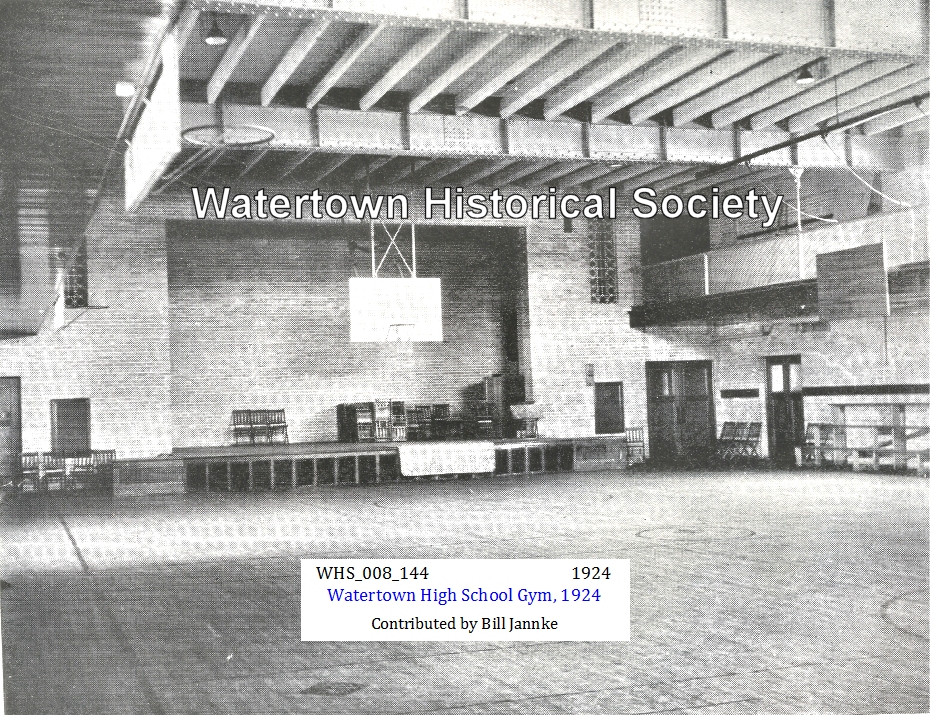
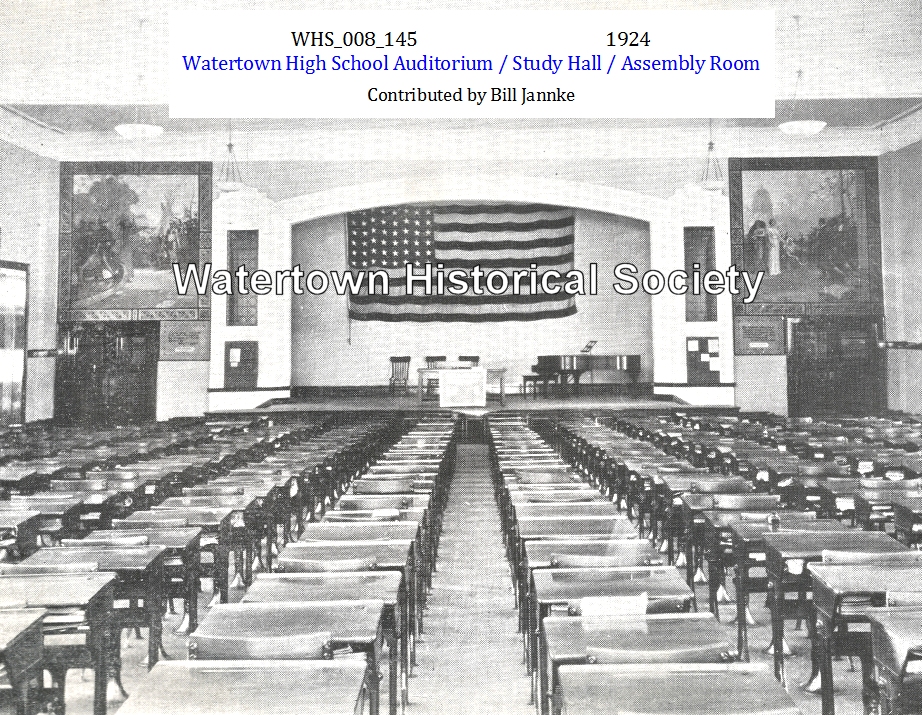
1924 GYMNASIUM AND ASSEMBLY ROOM
c.1925
ASSEMBLY ROOM
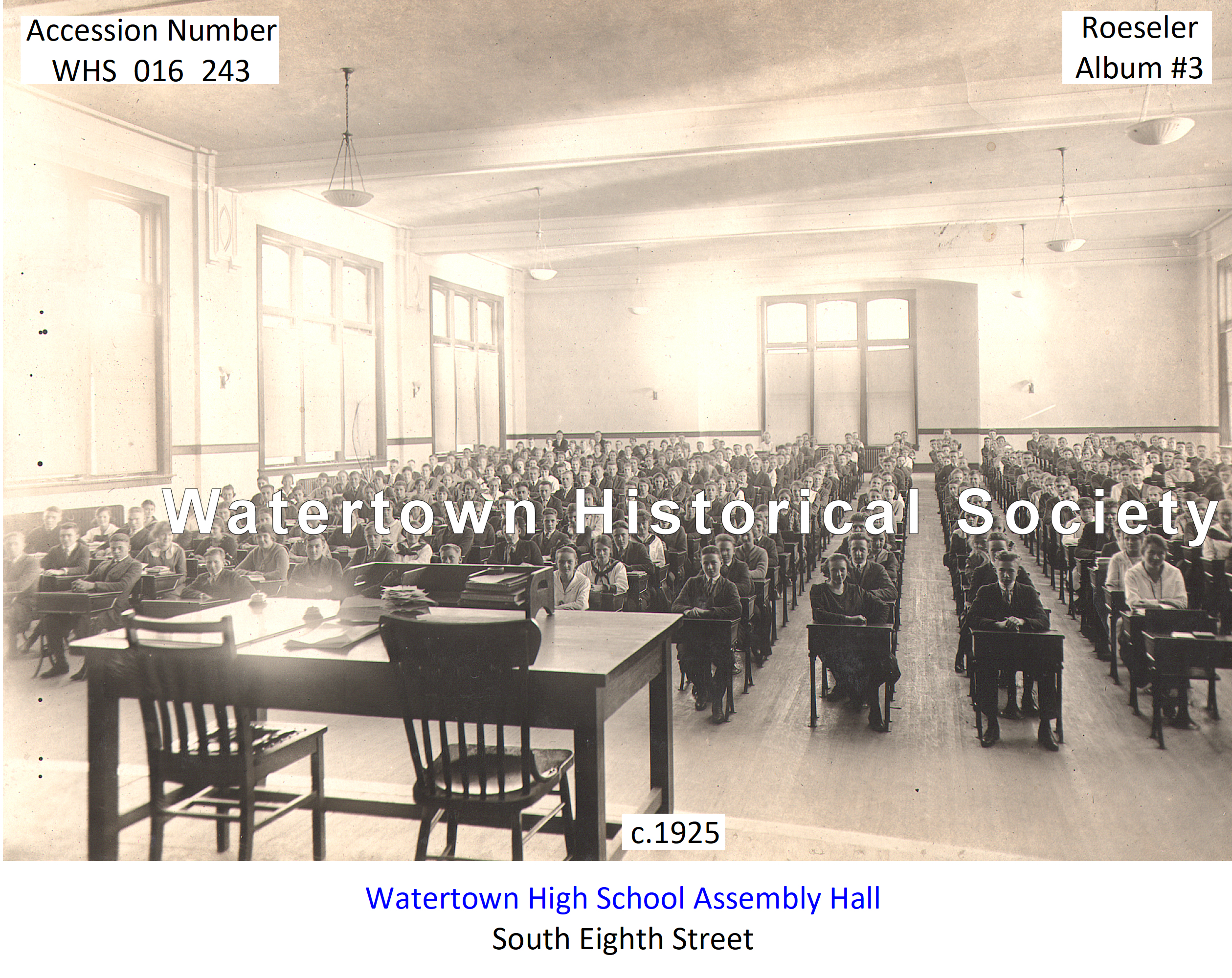
CONFIRMATION: There
has been an unusual number of well-meaning comments following the posting this
morning of this image, wondering if this was indeed the c.1925 assembly room of
Watertown High School on South Eighth Street.
On page 86 of the 1917 Orbit there is a collection of nine
thumb-size photos of the then new high school on S. 8th and one of them is of
the very same room, taken from a slightly different angle.
1931
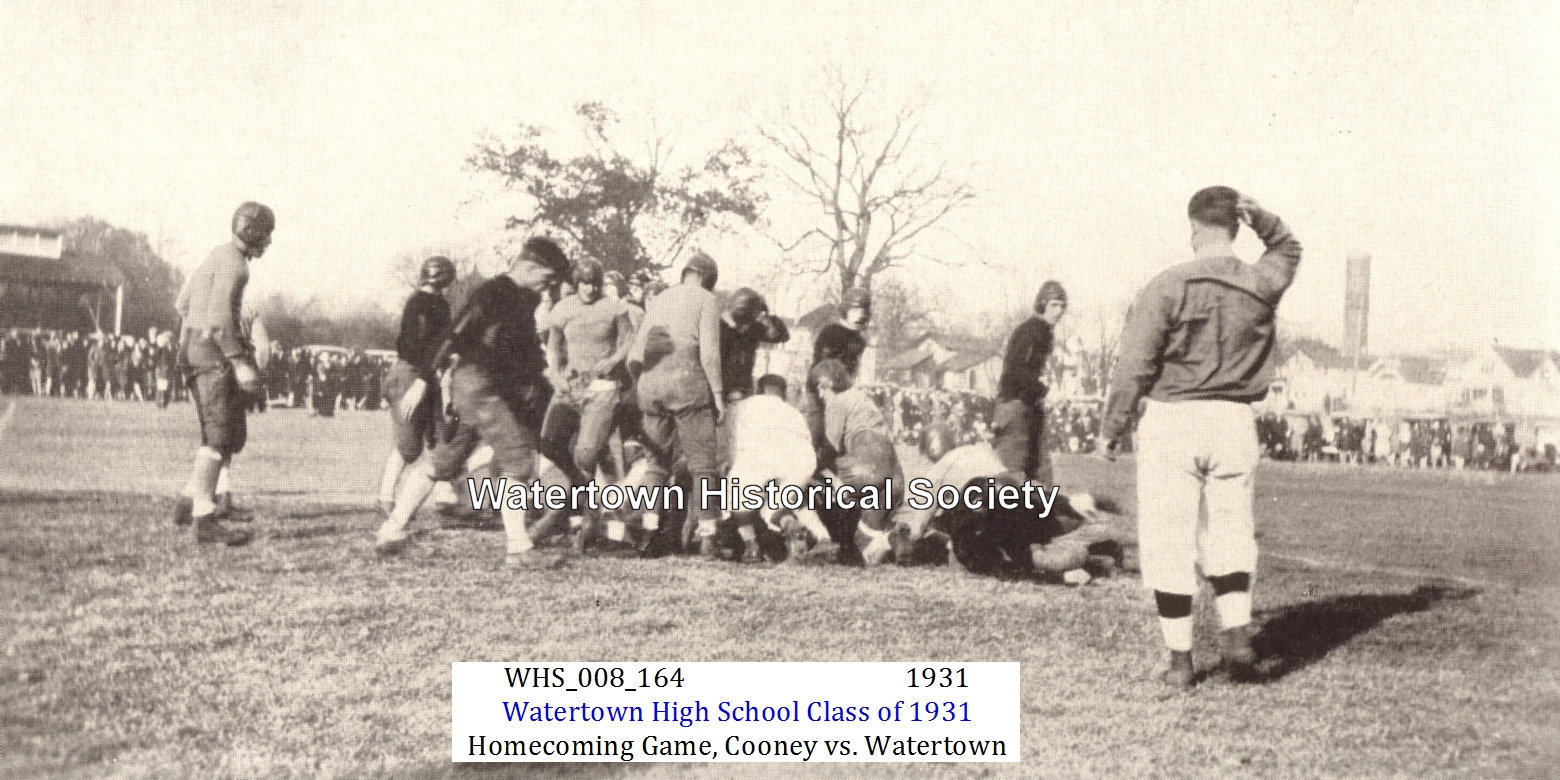
HOMECOMING GAME, Cooney vs. Watertown
THE KLUB
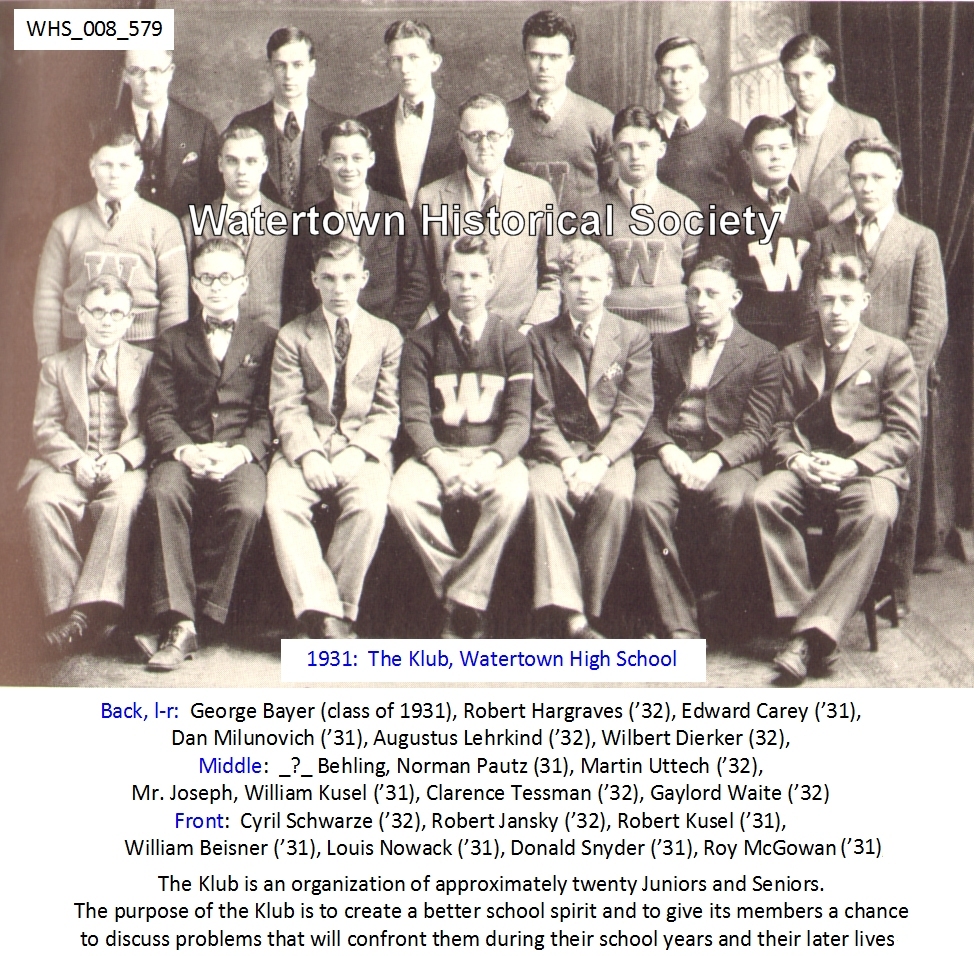
George
Bayer, Robert Hargraves, Edward Carey, Dan Milunovich, Augustus Lehrkind,
Wilbert Dierke, ?_ Behling, Norman Pautz, Martin Uttech, Mr. Joseph, William
Kusel, Clarence Tessman, Gaylord Waite, Cyril Schwarze, Robert Jansky, Robert
Kusel, William Beisner, Louis Nowack, Donald
Snyder, Roy McGowan
The Klub is
an organization of approximately twenty Juniors and Seniors. The purpose of the Klub is to create a better
school spirit and to give its members a chance to discuss problems that will
confront them during their school years and their later lives. The Klub meets regularly every week and when
the occasion demands it, there are meetings after supper. The Klub endeavors to get men to speak to
them on whatever subject they think important.
Such problems as audience courtesy, national defense, choosing one’s
vocation are just a few of the subjects that have been discussed.
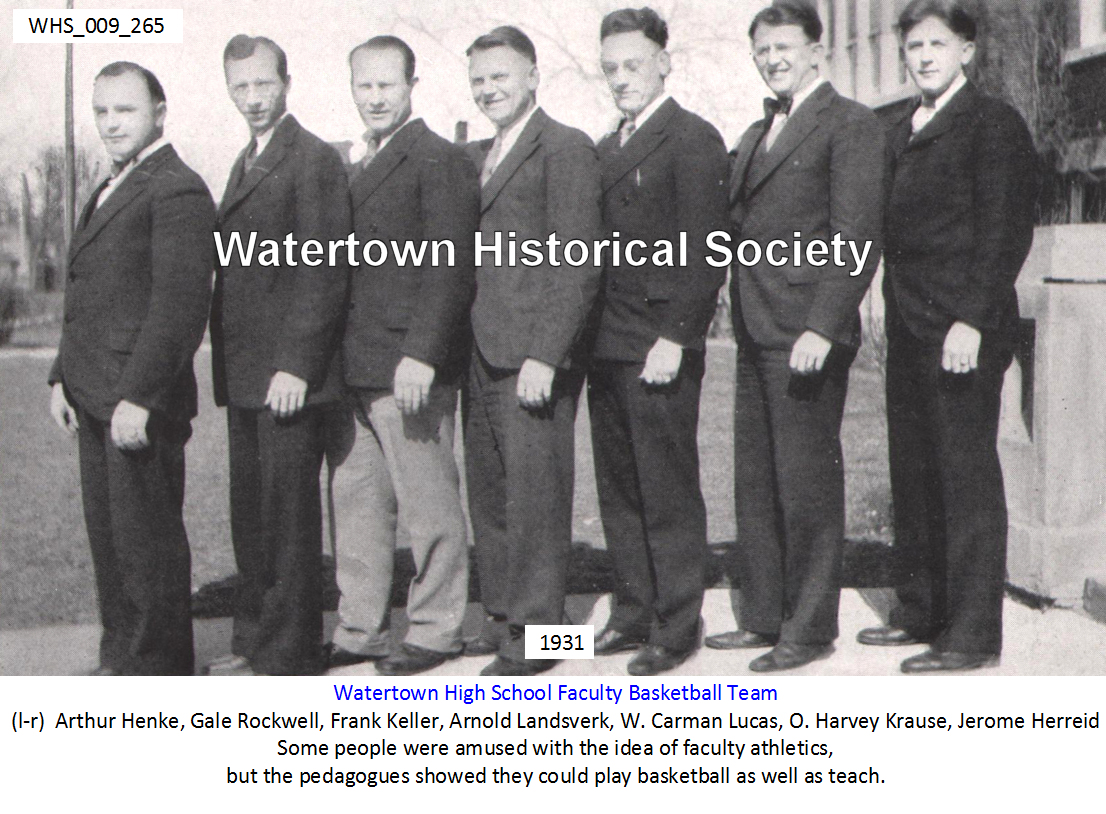
FACULTY BASKETBALL
 1931
Watertown High School Orbit
1931
Watertown High School Orbit
Arthur Henke,
Gale Rockwell, Frank Keller, Arnold Landsverk, W. Carman Lucas, O. Harvey
Krause, Jerome Herreid.
Besides
interscholastic and intramural basketball the Watertown High School was
represented by a faculty team. They
played two games against the Waupun faculty, one ending in a 22-22 tie, and in
the other Waupun proved the stronger, winning 32-26. They defeated the
Watertown Lion's Club 44-10, and defeated the Vocational three times in
practice scrimmages. Landsverk, Henke, and Lucas were the best bets for the
teachers. Some people were amused with the idea of faculty athletics, but the
pedagogues showed they could play basketball as well as teach.
FIRST HIGH SCHOOL CAFETERIA
The cafeteria is a new
department at Watertown High School.
During the few weeks of its existence it has really proved itself a
great asset. Those students living at
such a distance that it makes it impossible for them to go home for their
dinner need no longer try to stop their hunger with a candy bar and a bottle of
pop or an apple, but can now enjoy regular meals at our new cafeteria. Surely the cafeteria is something for us all
to be proud of and enjoy. – 1931 High School Orbit
FIRST CAFETERIA SERVICE OFFERED
After a successful
season the cafeteria closed early in May.
This is the first year that W. H. S. has had a cafeteria. It was also something new in Watertown.
Under the
experienced hands of Miss Fischer and her helpers it flourished. It not only furnished meals at a very low
cost to those students of both J. H. S. and S. H. S. who wished to eat there,
but was also the scene of several banquets and other entertainments where lunch
was served. The basketball banquet which
included as guests the basketball team and the tournament help and the coach,
took place in the cafeteria. A very
delicious meal was served. Then too,
during the exhibition, ice cream and cake, and sandwiches and coffee were
served here.
The students who
took part in the Tri-City Festival were served both dinner and supper in the
cafeteria. Sundaes were served between
meals. Pupils from both Cooney and
Beaver Dam could not praise the cafeteria enough, as neither has one in their
high school. Those who were at the last
two school parties enjoyed refreshments in the cafeteria. It was the first time that this was tried and
it was a great success, as both teachers and pupils enjoyed the refreshing
sundaes after an hour or so of dancing.
The food was
served at all times at the lowest possible price, and was not a money-making
proposition.
As there are but a
few weeks of school left, no one will miss the cafeteria much now, but I am
sure that next year everyone will be waiting the opening of it.
The Blue and White, 06 1931,
Published by the Students of Watertown High School
JUNIOR HIGH STUNT CLASS
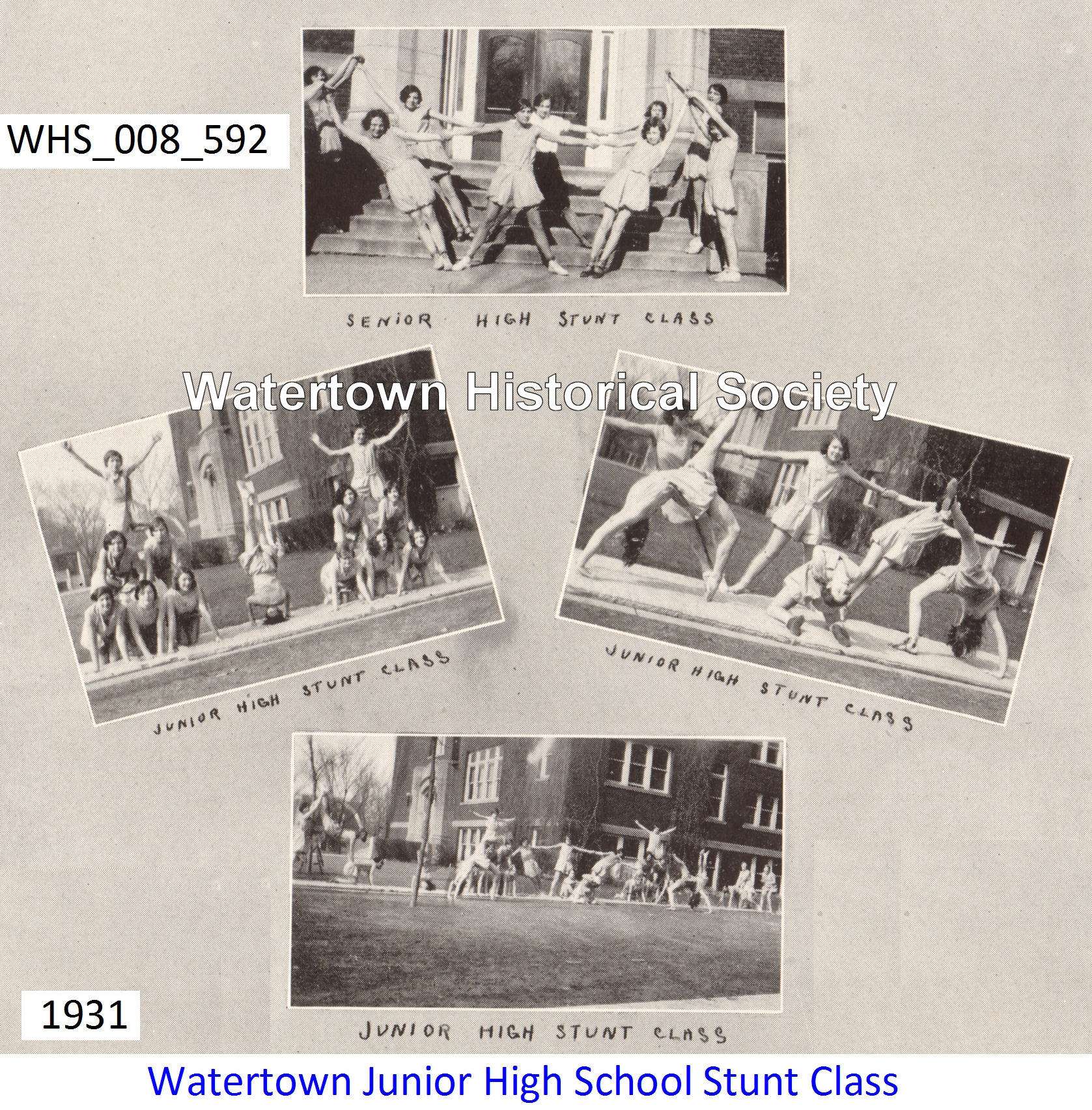
1931
09 21 CLASS
OF 1931 HELD 65th REUNION
IN 1996
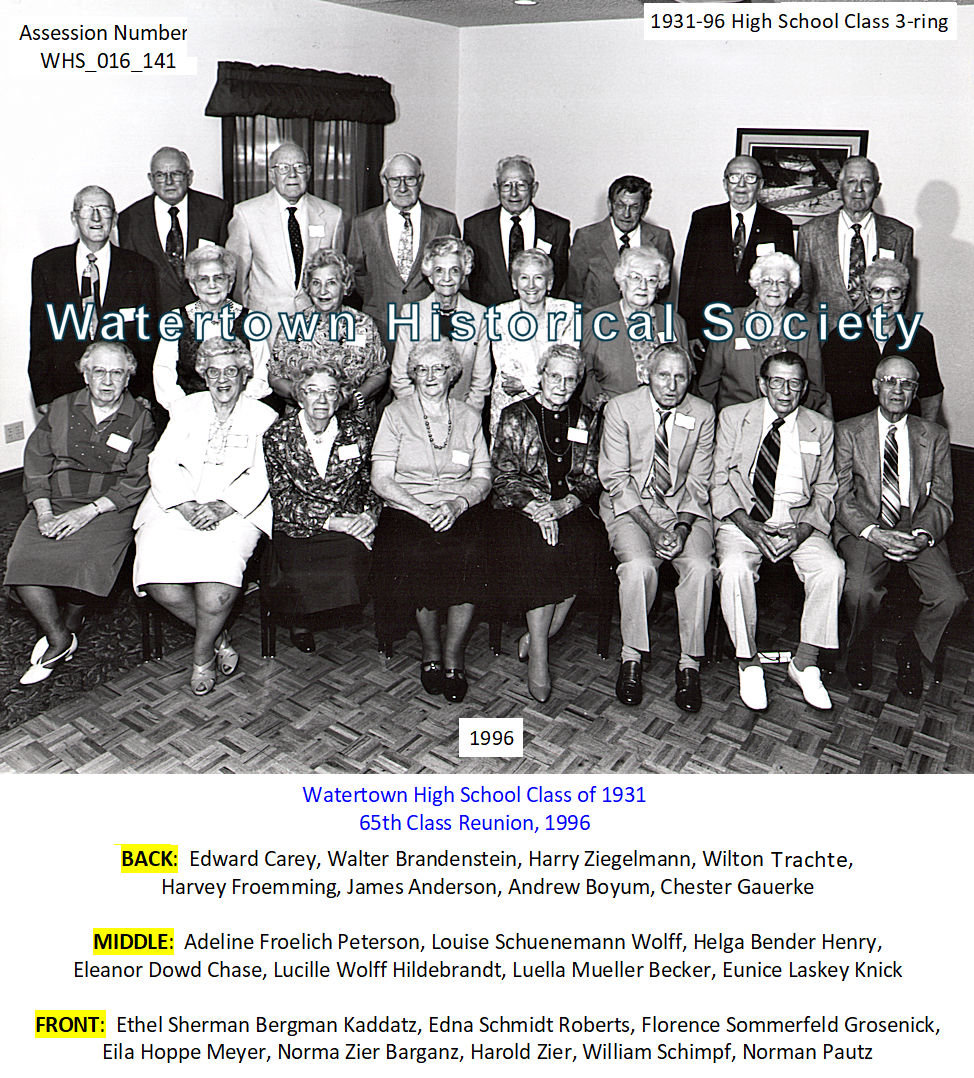
Edward
Carey, Walter Brandenstein, Harry Ziegelmann, Wilton Trachte, Harvey Froemming,
James Anderson, Andrew Boyum, Chester Gauerke, Adeline Froelich Peterson,
Louise Schuenemann Wolff, Helga Bender Henry, Eleanor Dowd Chase, Lucille Wolff
Hildebrandt, Luella Mueller Becker, Eunice Laskey Knick, Ethel Sherman Bergman
Kaddatz, Edna Schmidt Roberts, Florence Sommerfeld Grosenick, Eila Hoppe Meyer,
Norma Zier Barganz, Harold Zier, William Schimpf, Norman Pautz.
1934
 Orbit
Orbit
 Class of 1934 dedicated the Orbit to Miss Skinner
1936
FIRST HIGH SCHOOL FEATURED ON
CENTENNIAL POSTCARD

1937
ACES IN THE FIELD OF MUSIC
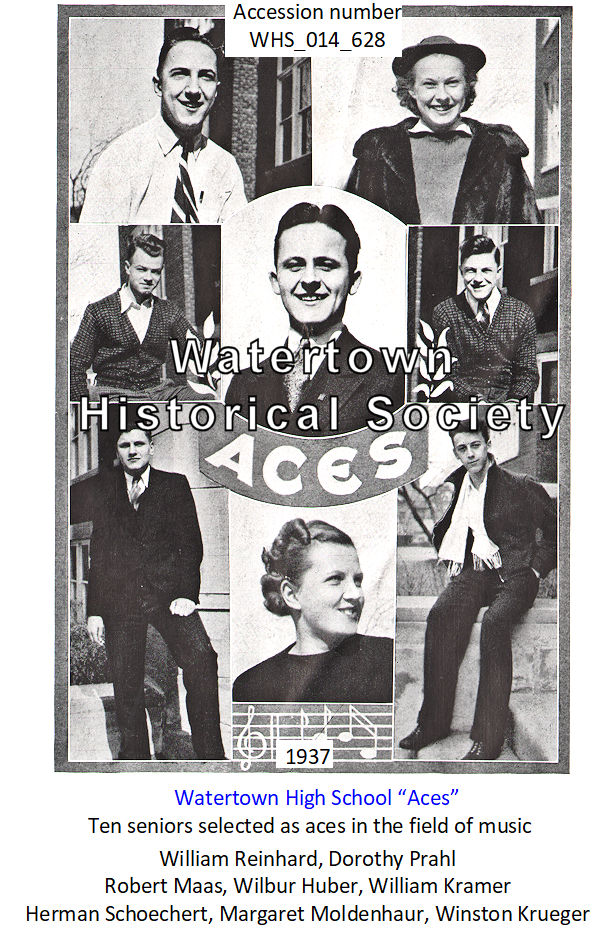
William
Reinhard, Dorothy Prahl, Robert Maas, Wilbur Huber, William Kramer. Herman
Schoechert, Margaret Moldenhaur, Winston Krueger
AUTO MECHANIC
CLASS, possible
An
adult education course, the sort of forerunner to MATC? Certainly does seem to be the old shop room on
the lower level of the old high school.
They had windows like these facing 9th St. and it is believed they also
had a sort of garage door that would have allowed the entrance of a car.
1938 & 1939
REPORT CARD
COLLECTION, boxed item in archive
1939
1939
WATERTOWN MEN’S STATE CHAMPS
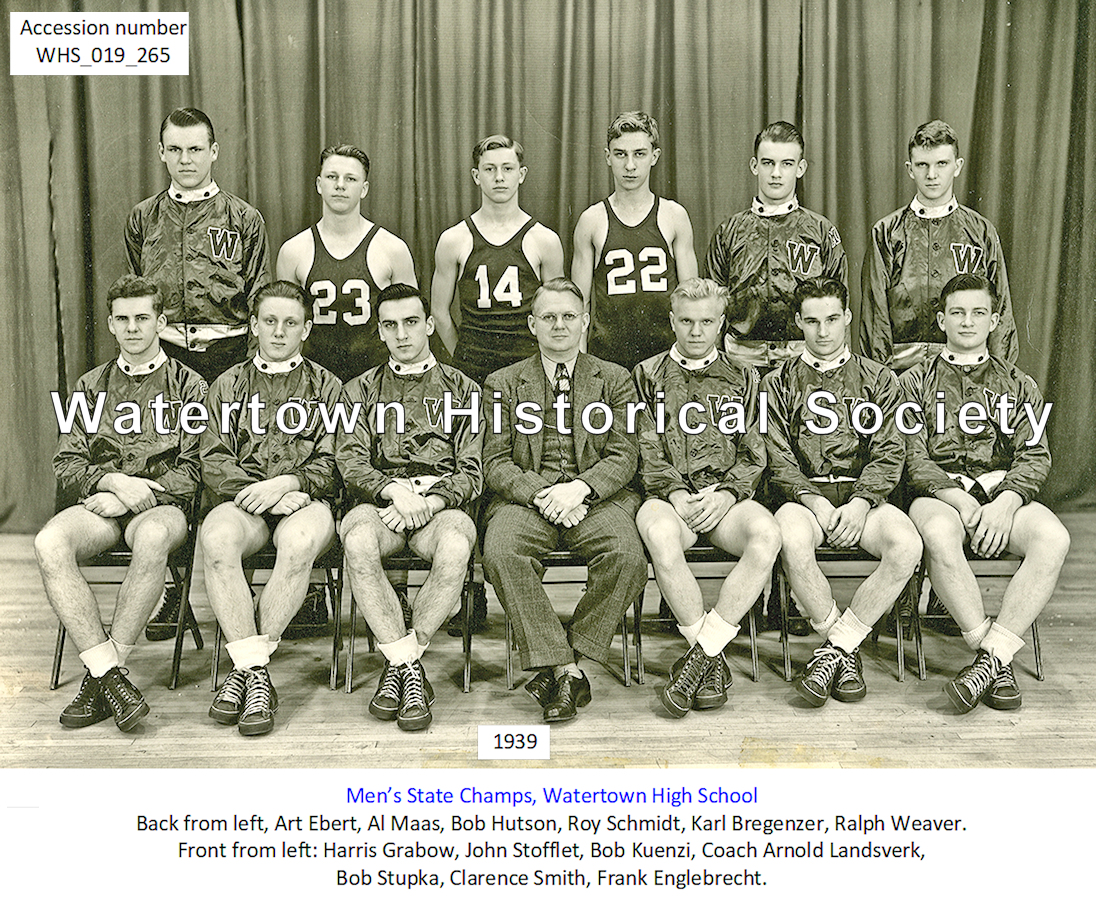
Back
row from left, Art Ebert, Al Maas, Bob Hutson, Roy Schmidt, Karl Bregenzer,
Ralph Weaver.
Front row from left: Harris Grabow, John Stofflet,
Bob Kuenzi, Coach Arnold Landsverk, Bob Stupka, Clarence Smith, Frank
Englebrecht.
06 11 ANNUAL
CLASS DAY PROGRAM
The annual class day program of the high school
senior class was held this afternoon, part of it outdoors on the school
campus. Eugene Iffland, president of the
class was chairman. The program opened with
a swing trio, including Lucille Peterson, Ruth Felten, and Jane
Zimmermann. This was followed by
presentation of the senior awards. They
were made by Robert Kuenzi. A vocal
trio, consisting of Arleen Krahn, Ruth Felten, and Patricia Simon, followed
with a selection. The class will was
read by Albert Joda. Miss Joan McAdams
was chairman in charge. The crowning of
the king, Harris Grabow, was held out of doors.
The queen was Helen King. The
crowning was done by Evelyn Keller and Mike Davy. The attendants in the royal party were
Caroline Wendt, Lucille Peterson and Sydonna Buckley, Robert Usher, Francis
Kuenzi, and Robert Hayhurst.
1939
GRADUATING CLASS pictured in novel
arrangement WDT
1940
06 08 The honor students of the Watertown high
school senior class are Karl Sonnemann, son of Mr. and Mrs. H. M. Sonnemann,
809 Division Street; Miss Elinor Eberle, daughter of Mr. and Mrs. Sidney
Eberle, North Washington Street; Miss Verona Minning, daughter of Mr. and Mrs.
Arthur Minning, North First Street; Miss Mary Jane Byington, daughter of Mr.
and Mrs. Glenn R. Byington, 213 South First Street and Miss Margaret Reichardt,
daughter of Col. and Mrs. Walter F. Reichardt, 1326 Thomas Avenue.
Class
of 1940, held 50th reunion in 1990.
1941
1941 Orbit
released. Dedicated to J. H.
Herreid, popular member of the faculty.
c.1941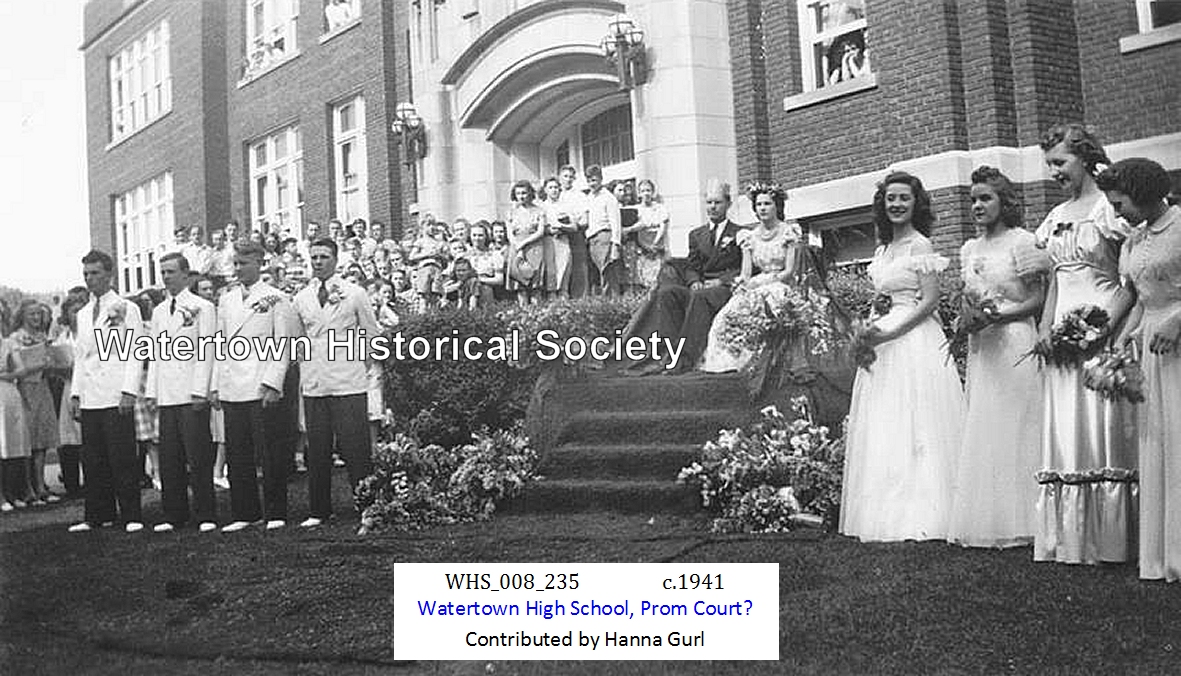
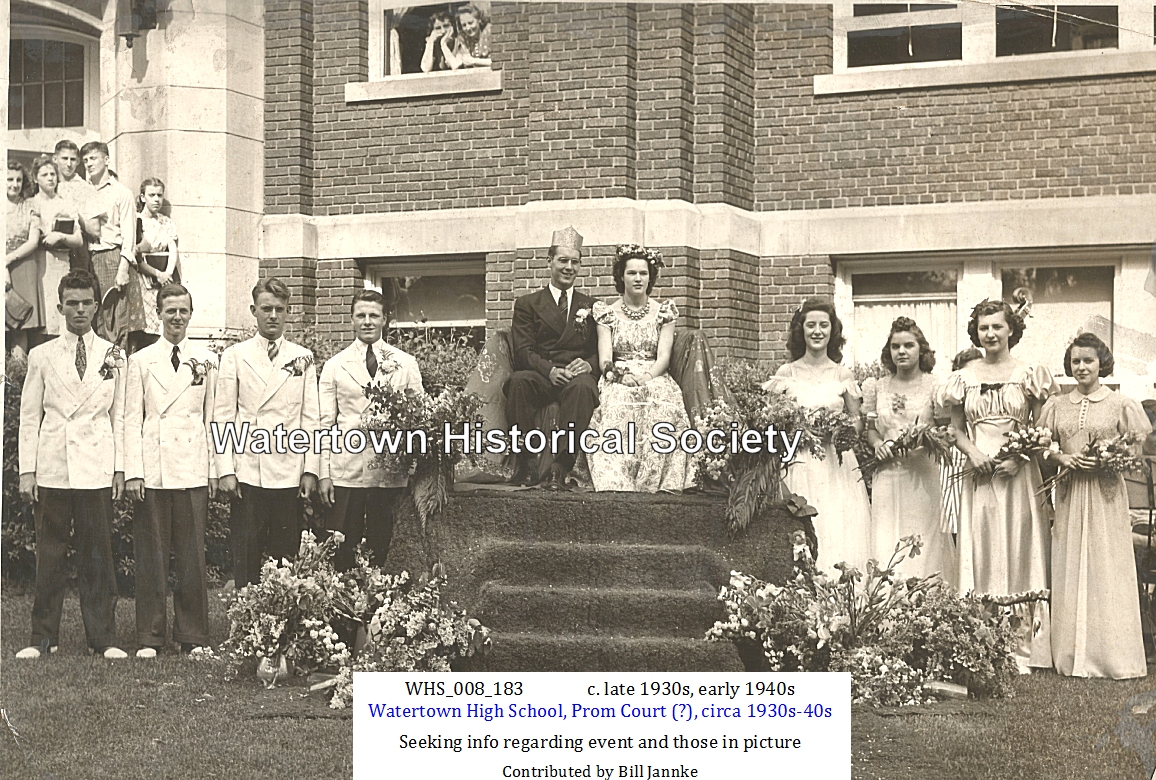 Prom Court (?), circa 1930s-40s
1942
07 16 Watertown
High School Girl Wins High Scholastic Honor
1944
WAR ACTIVITIES OF PATRIOTIC STUDENTS

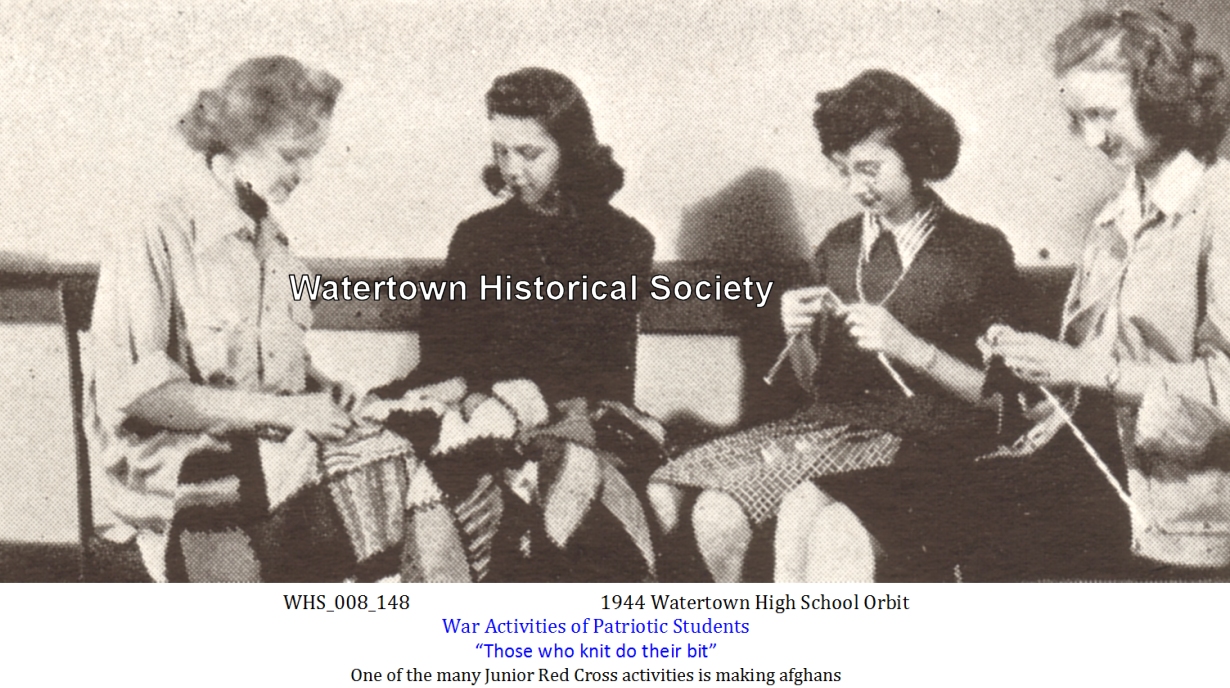

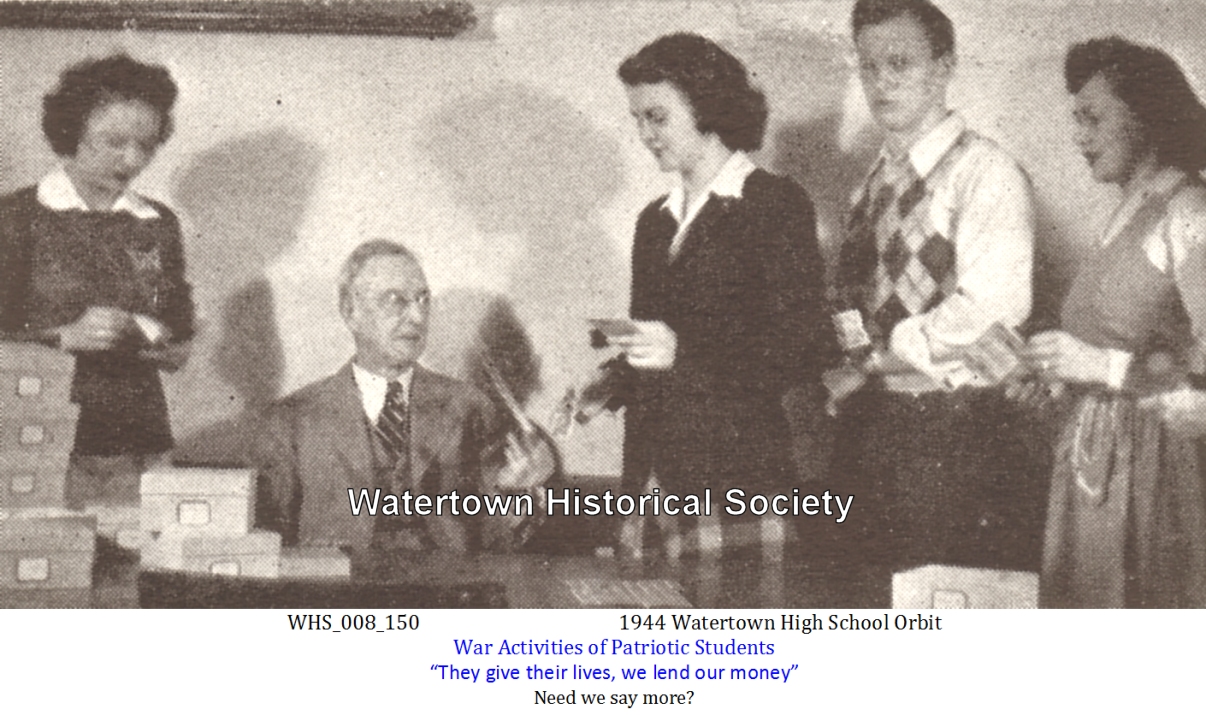
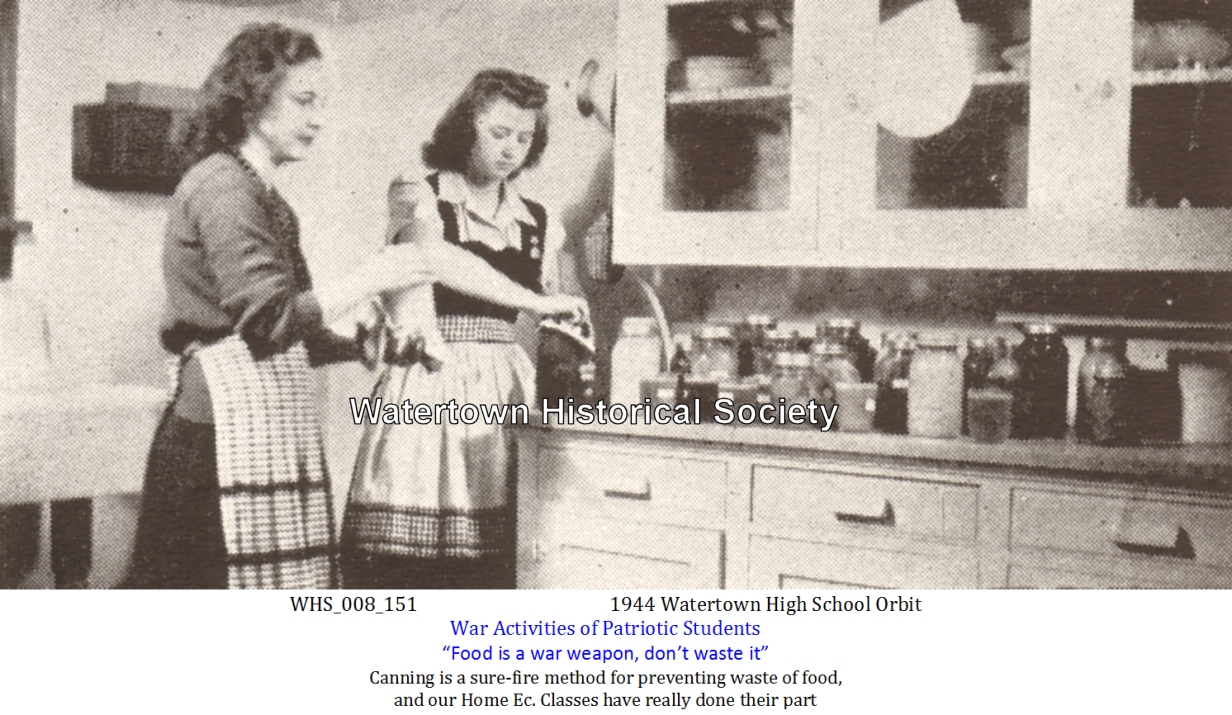
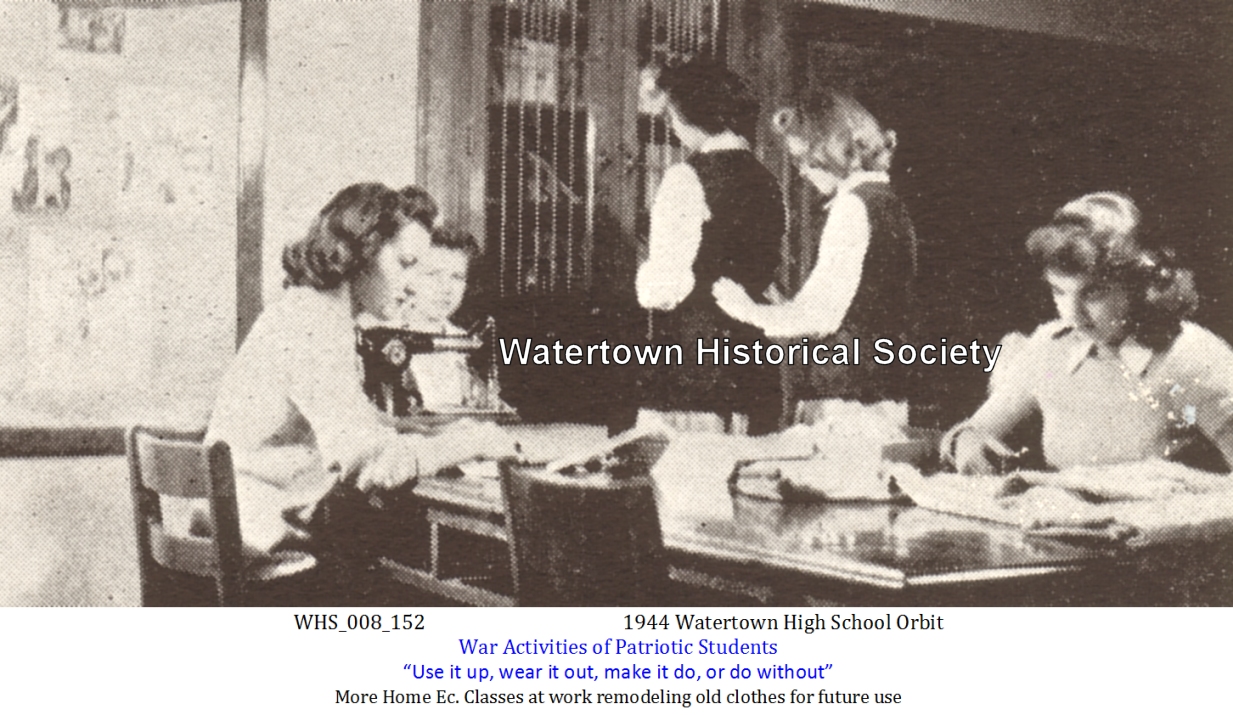
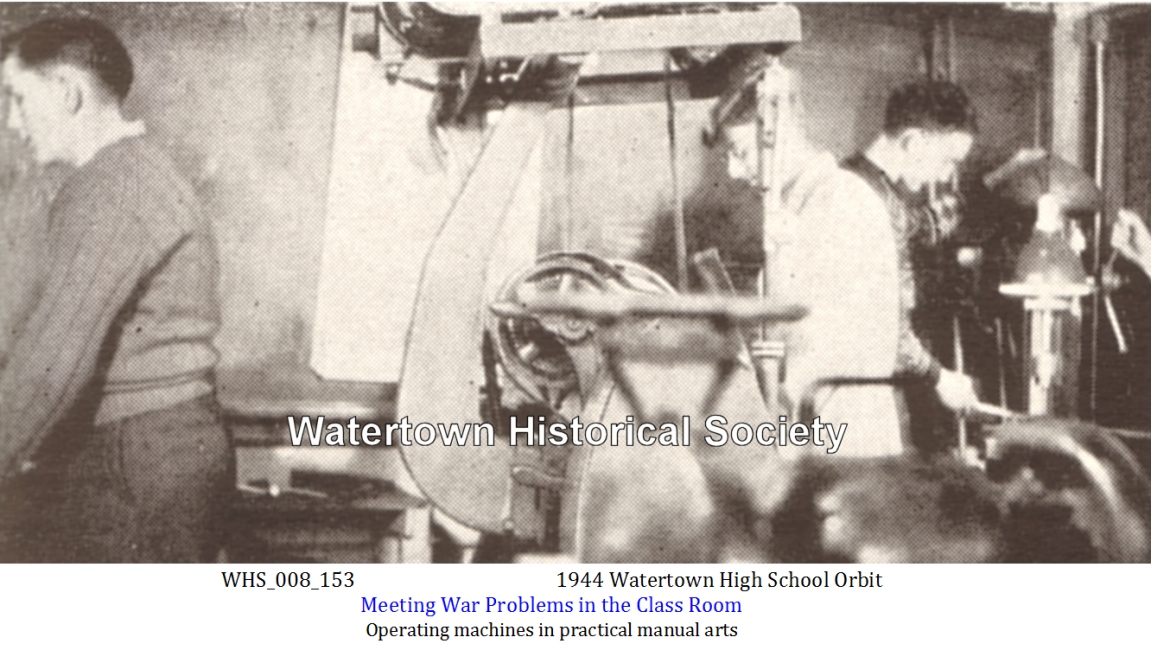
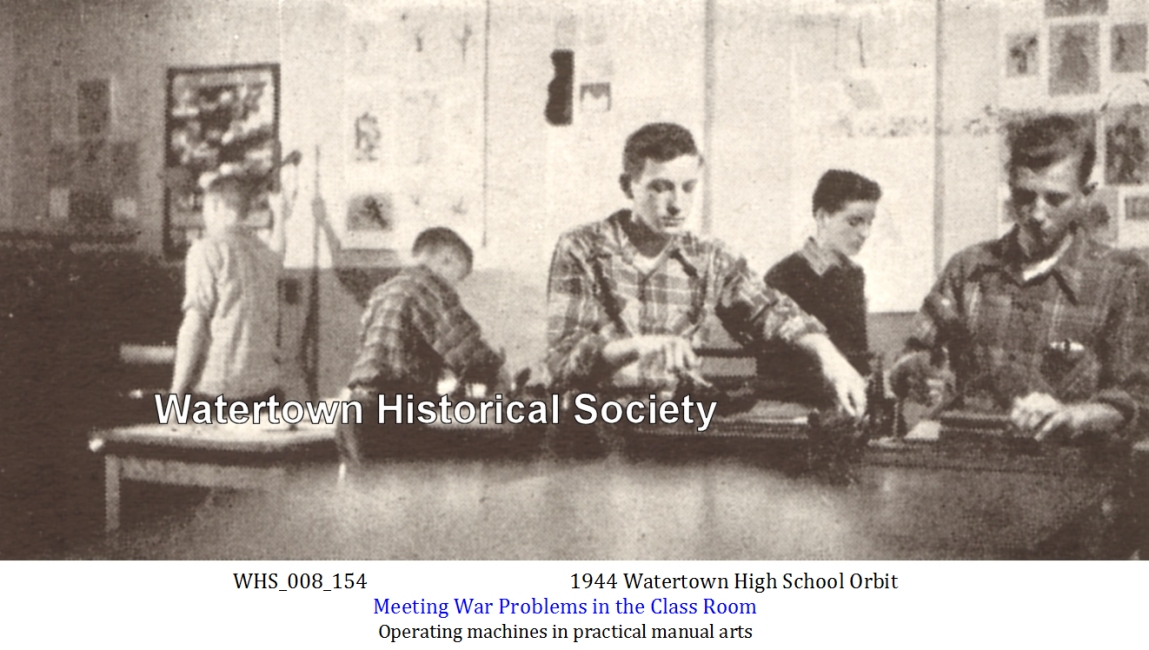
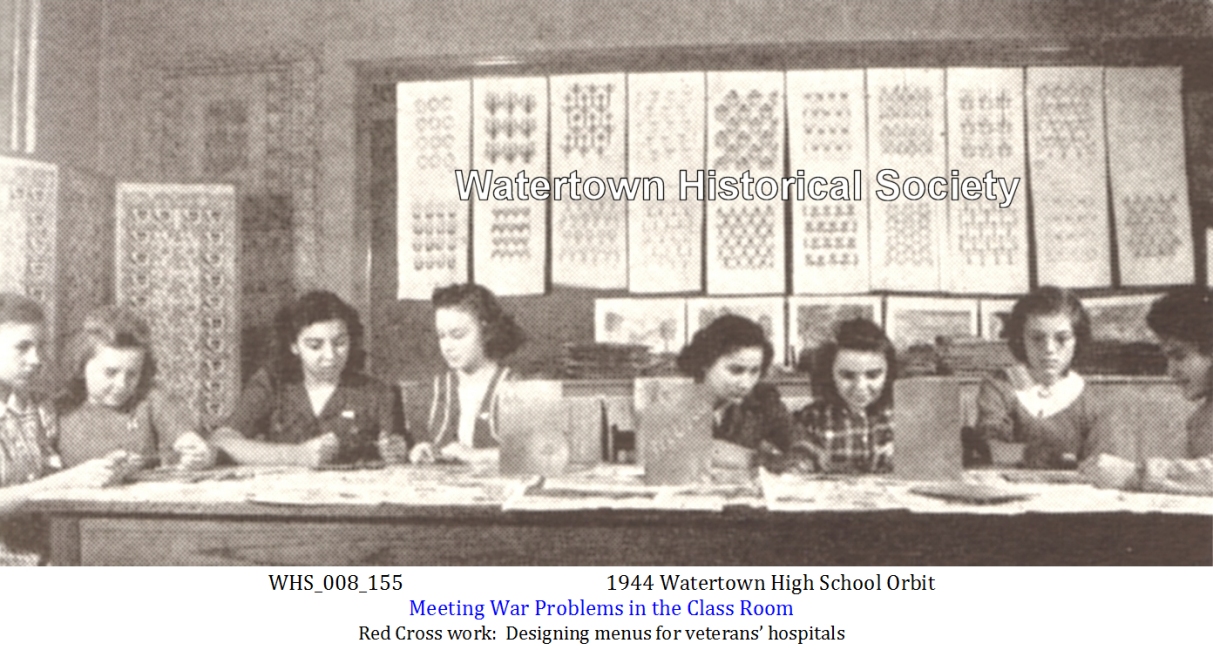

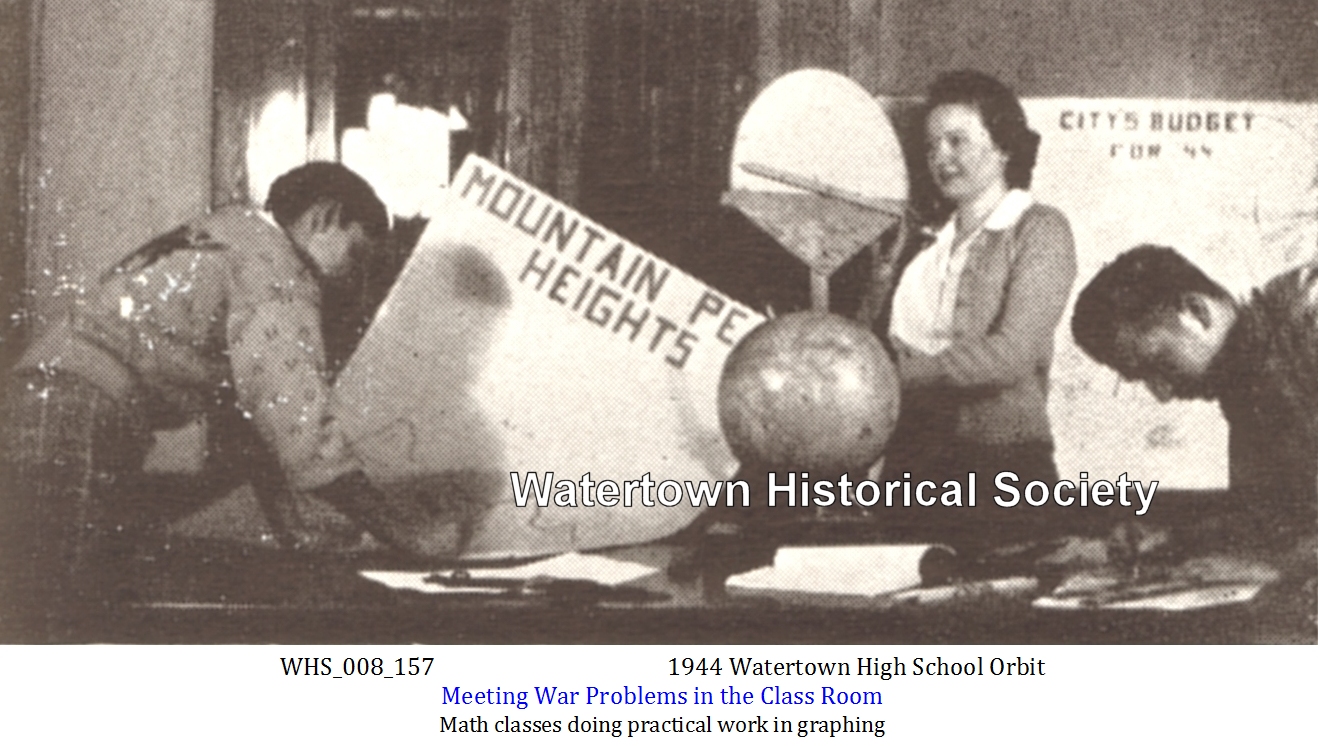

Click on to enlarge. 1944 Watertown High School Orbit
1944 FOOTBALL

1945
or 46
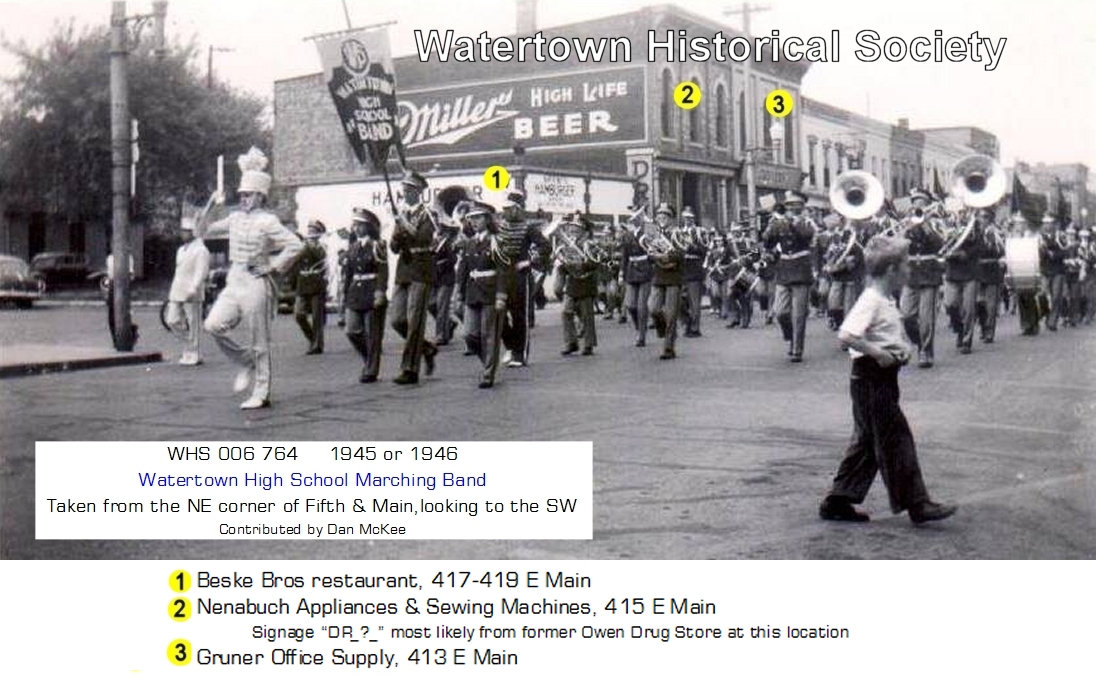 High School Marching Band, 400 block of E Main St.
1946
1946 ORBIT WILL RETURN TO HUMOR
Lighter
theme is chosen this year with war at end
With much
of the seriousness of the war a thing of the past, the 1946 Orbit staff has
decided on a humorous theme for its annual.
This year’s theme will be “The Circus.”
The circus theme fits into the activities of the high school student,
and the staff feels it will prove to make this year’s high school annual
especially interesting. The theme, as
usual, will be carried out in the introductory pages to all the sections. The art work of this year’s Orbit is being
done by the senior high art classes under the direction of Miss Elsie Hotvedt,
art supervisor in the public schools.
The
organizations will be portrayed in the annual by action pictures characteristic
of the particular club. For instance,
the Future Farmers of America will have a picture of the boys testing soil. The Girls’ club will be seen folding
Christmas stamps to be sent to residents of Watertown. A picture of students working in the library
represents the work done by members of the Library Service club.
The
staff has decided to have the major activities of each club presented which
should prove more interesting than the usual procedure of group pictures of
members of the club. WDT
_________________
Orbit features
service members
1948
06 06 ANNUAL HIGH SCHOOL
SENIOR CLASS PLAY REPLACED
Centennial Pageant Premiere
draws cheers at Watertown
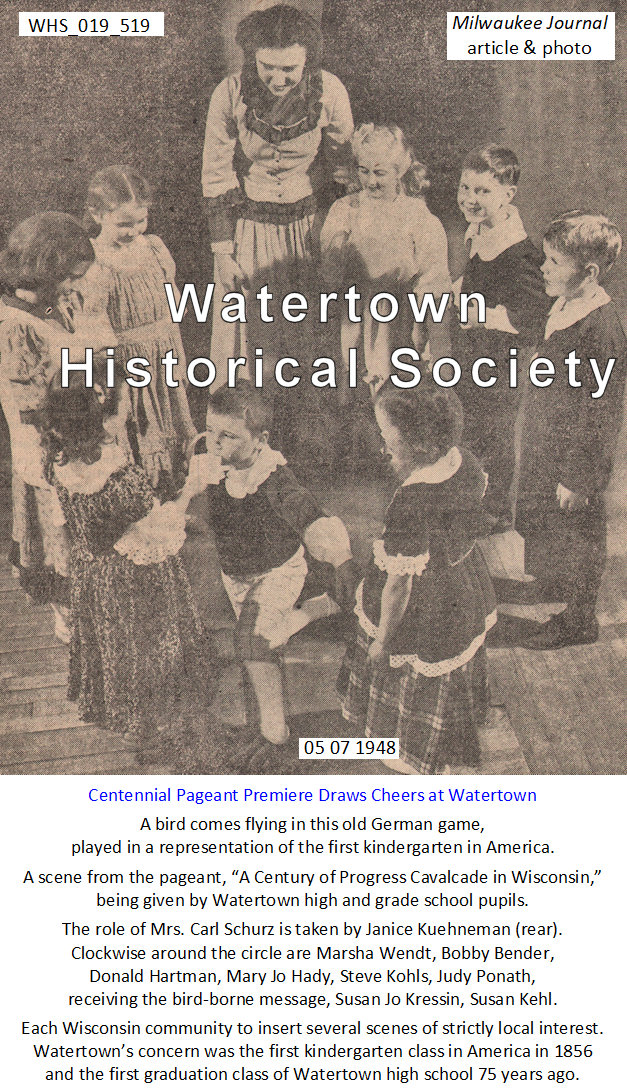
The role of Mrs. Carl Schurz is taken by Janice Kuehneman
(rear). Clockwise around the circle are
Marsha Wendt, Bobby Bender, Donald Hartman, Mary Jo Hady, Steve Kohls, Judy
Ponath, receiving the bird-borne message, Susan Jo Kressin, Susan Kehl.
Watertown, Wis. — The state premiere of the “Century of
Progress Cavalcade in Wisconsin,” a pageant for Wisconsin’s centennial, was
held here Friday afternoon. The audience
was an enthusiastic auditorium full of school children.
Before the year is out, the pageant, written by Miss Ethel T.
Rockwell, will be given in scores of celebrations throughout the state. Miss Rockwell, of Madison, centennial
pageantry adviser and coordinator, wrote the drama for distribution to any
Wisconsin groups which wished to mark their celebrations with a pageant.
The 200 pupil cast of the pageant will give its first
performance to an adult audience at the high school auditorium Friday
night. They’ll repeat Saturday
night. For six weeks the high and grade
schoolers have been practicing under the direction of teachers.
The pageant consists of many scenes and tableaux, with
narrators relating the stories. Some of
the scenes, generalized so that they may be presented anywhere in the state,
concern the lumber industry, conservation, dairy industry, educational
progress, government and the many war periods.
Each community is expected to insert several scenes of strictly local
interest. Watertown’s concern was the
first kindergarten class in America in 1856 and the first graduation class of
Watertown high school 75 years ago.
The pageant is being presented here to replace the annual high
school senior class play. Milwaukee Journal article
1949
1949 stud
handbk 42 pgs HL to, from here
File name
follows
PDF_1949_HighSchool-StudentHandbook
Available
upon request
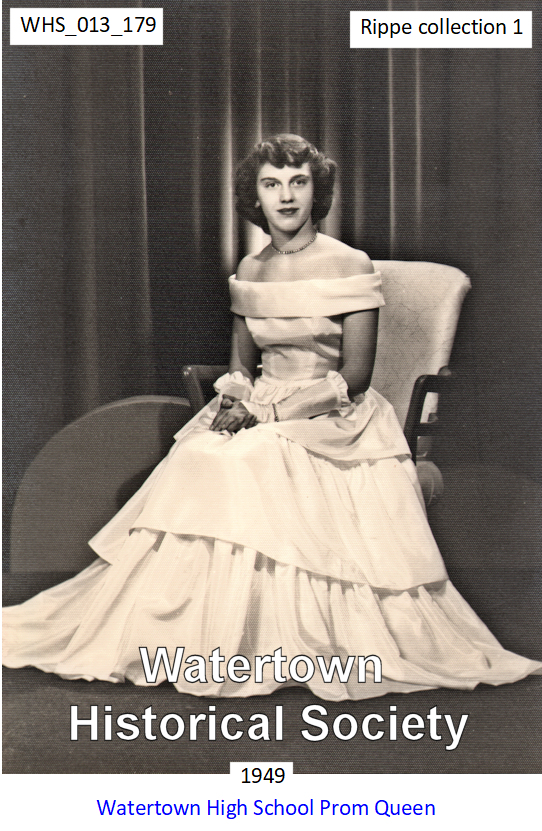
PROM QUEEN
06 06 ANNUAL MUSIC
FESTIVAL
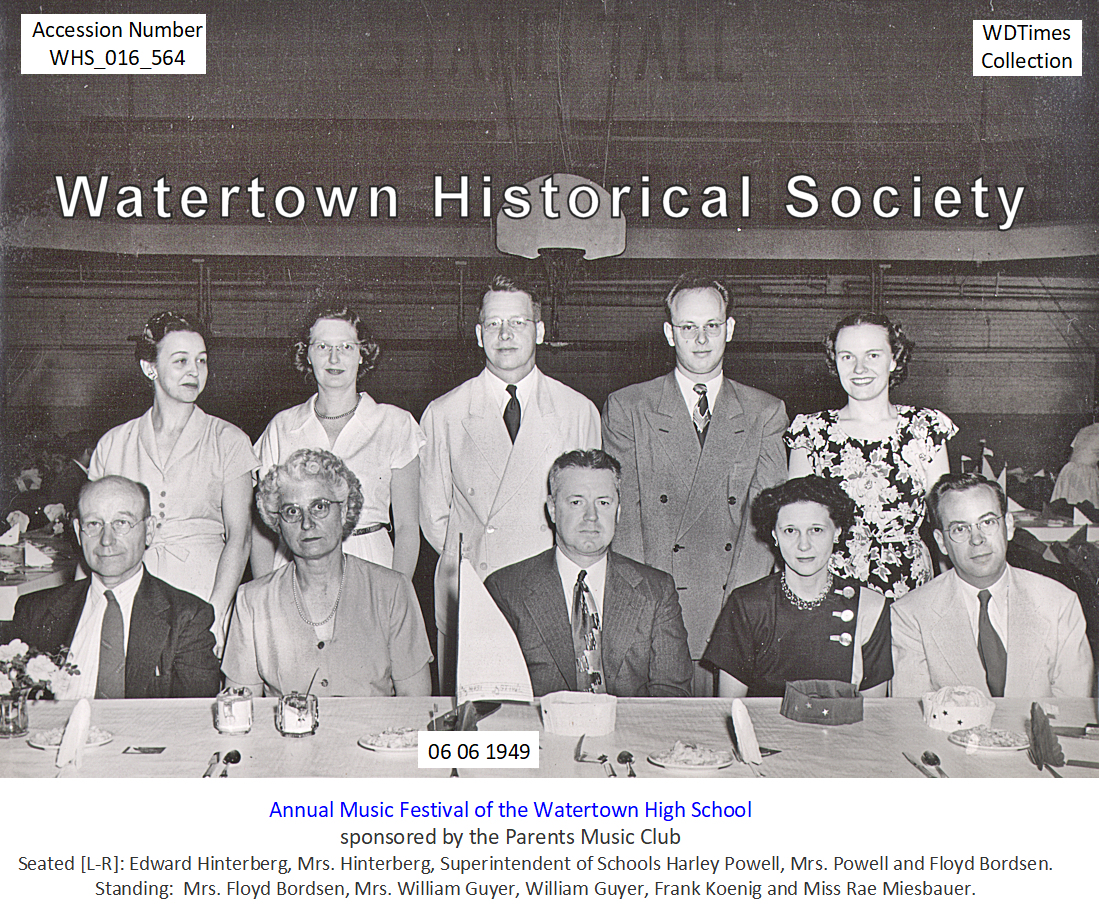
Prior to the annual music festival of the Watertown High School held
Saturday evening, members of the chorus, orchestra and band and other guests
attended the annual banquet sponsored by the Parents Music Club. The banquet was held in the high school
gymnasium and master of ceremonies was Jack Bentheimer. The decorating committee, headed by Mrs. H.
Engelke, bedecked the tables in a gay blue and white nautical theme with fleets
of sailboats and blue and white napkins.
Sailor caps were placed on each chair and bowls of yellow iris were
placed on the tables. Ruth Ebert, who is
a chorus member, gave the response for the senior class; Bob Casanova, chorus
member, junior class response; sophomores Bob Niere, band member; freshman Ruth
Knight, band and orchestra member.
Guests of the Music club are shown in the above photo. They are:
seated, from left to right: Edward Hinterberg, principal of the high
school, Mrs. Hinterberg, Superintendent of Schools
Harley J. Powell, Mrs. Powell and Floyd Bordsen. Standing:
Mrs. Floyd Bordsen, Mrs. William Guyer, William Guyer, Frank Koenig and
Miss Rae Miesbauer.
-- -- MATHEMATICS
& SCIENCE TEACHERS
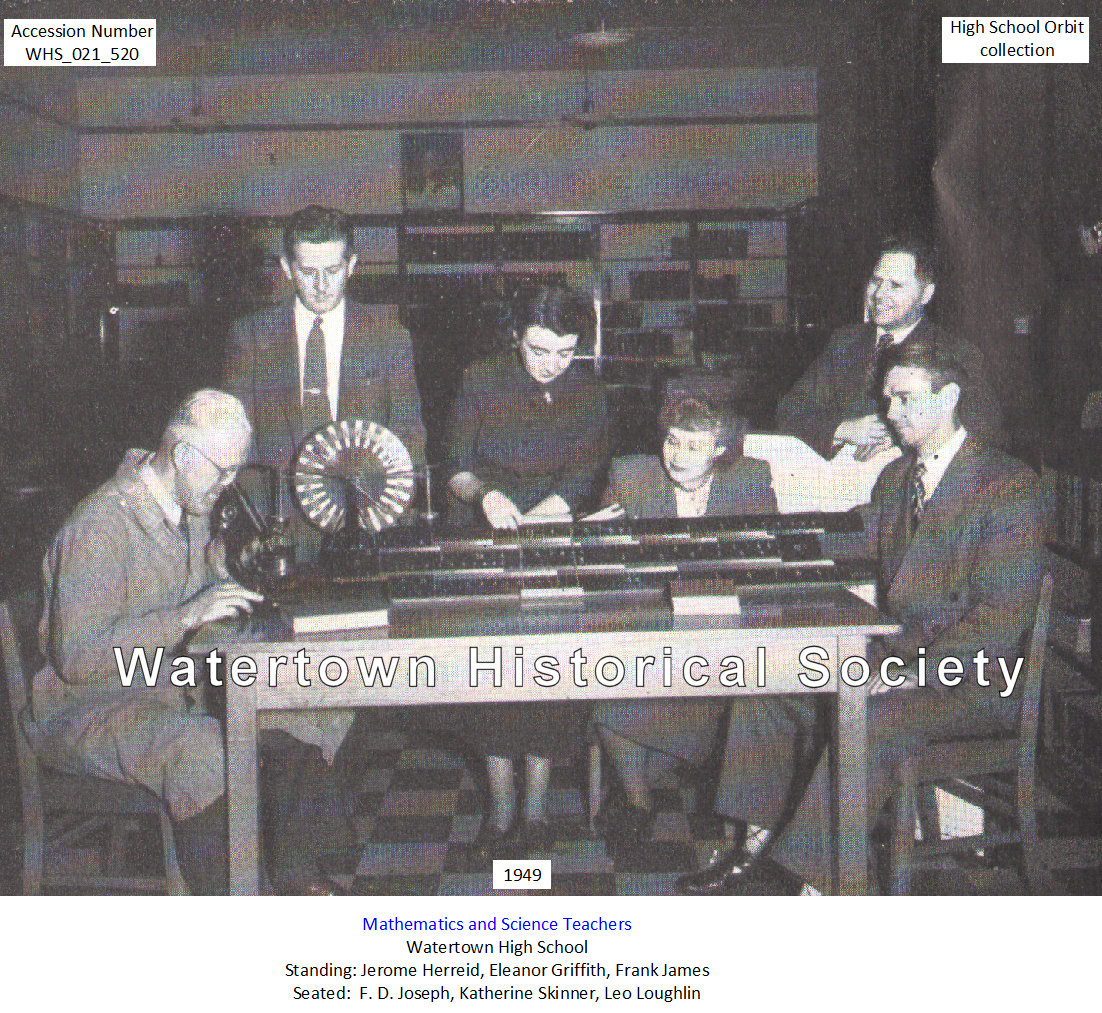
Jerome
Herreid, Eleanor Griffith, Frank James, F. D. Joseph, Katherine Skinner, Leo
Loughlin
1940s
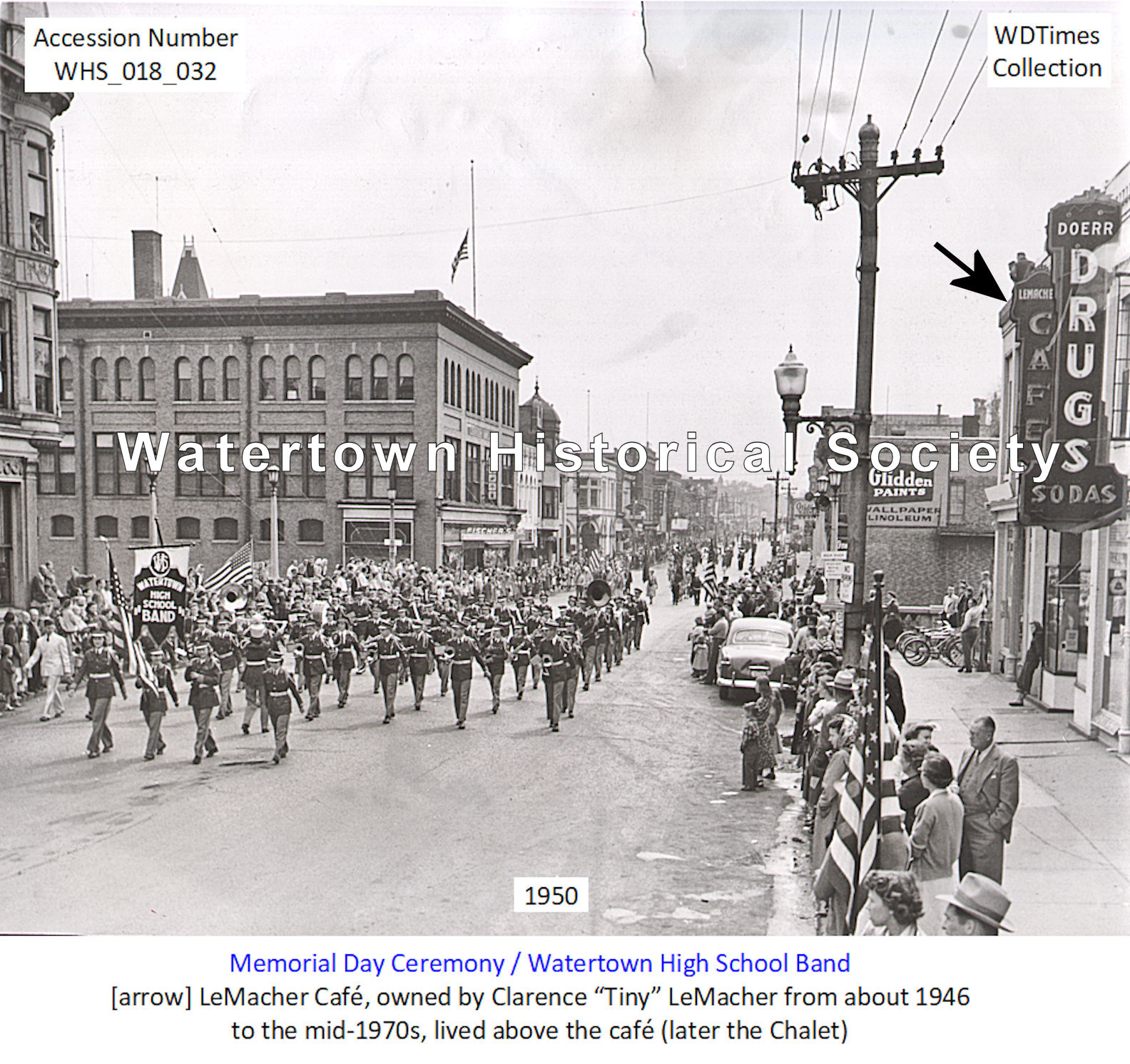
1950
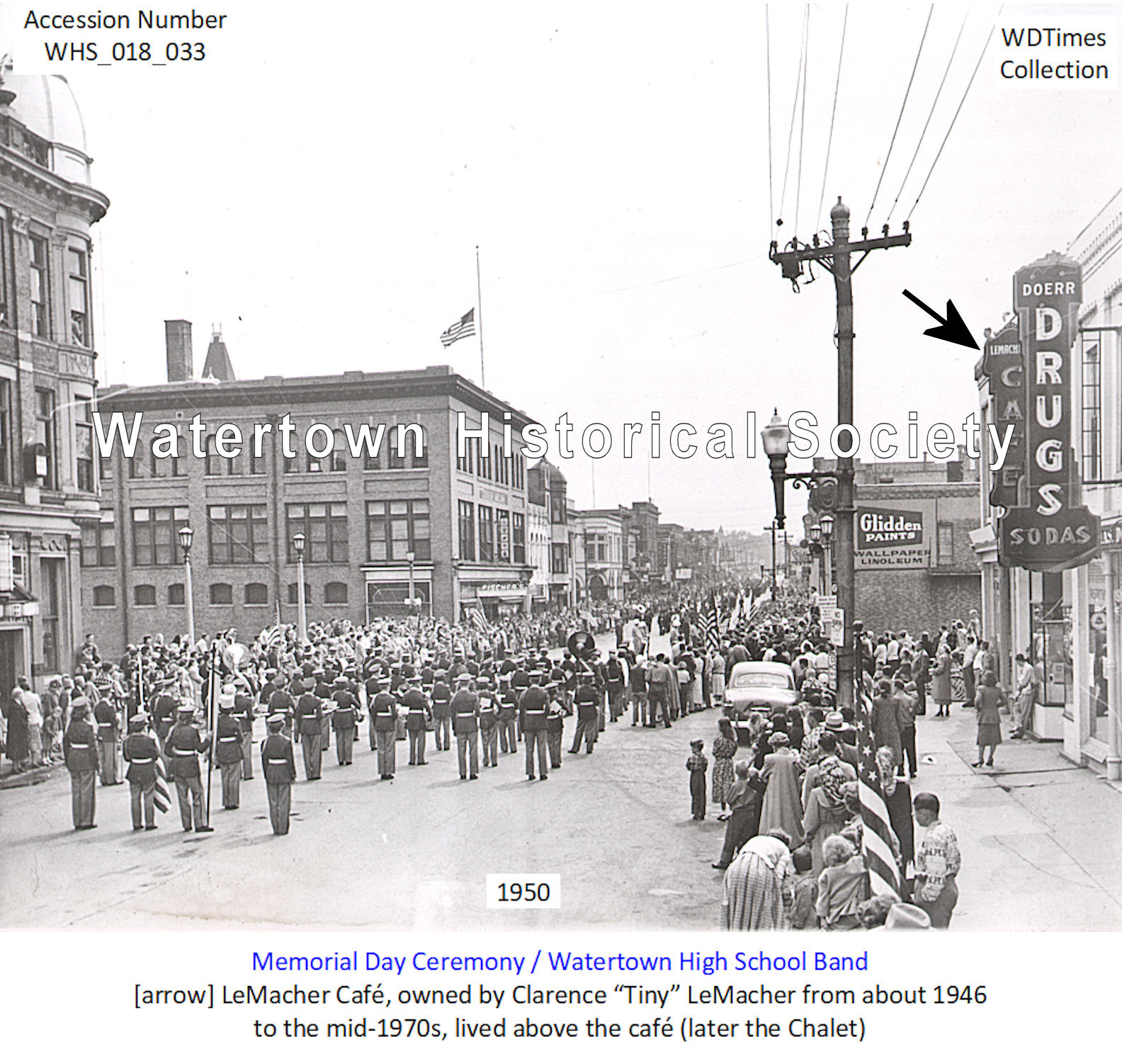
05 31 BAND IN MEMORIAL DAY CEREMONY
-- -- CHEERLEADERS
Includes
Catherine Schumann nee Hrobsky
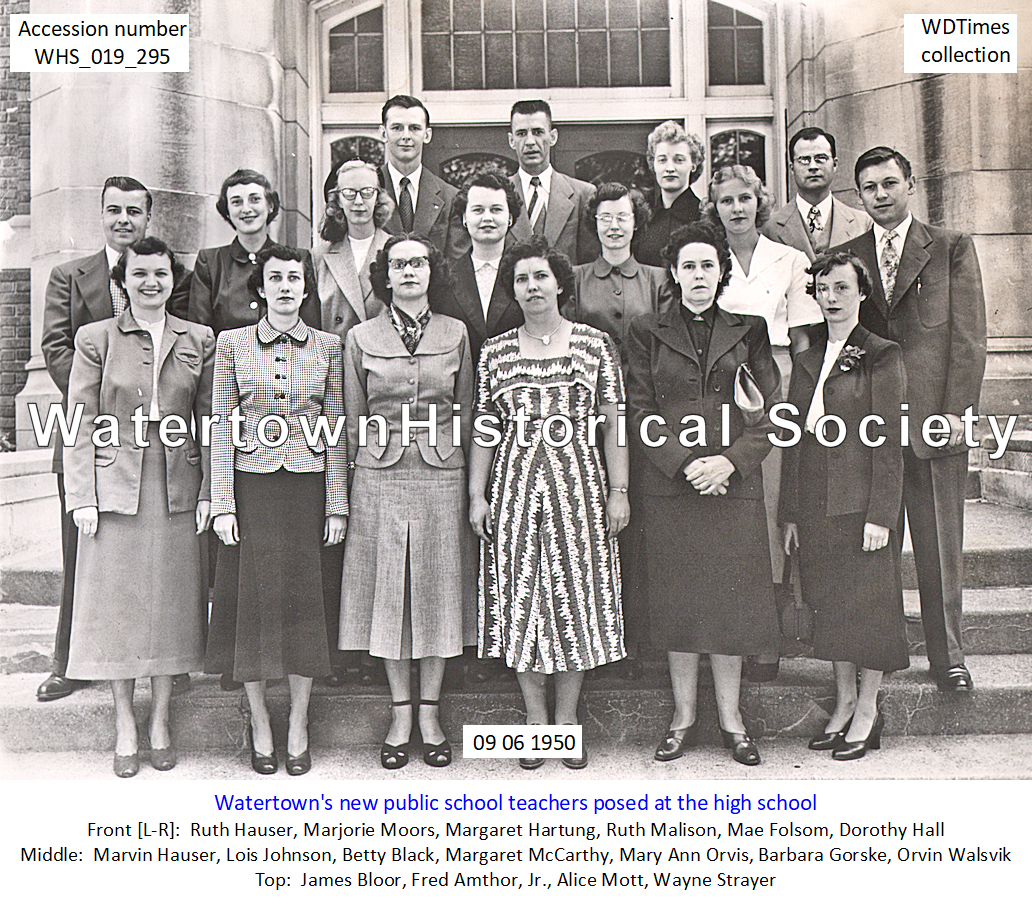
09 06 SEVENTEEN
NEW TEACHERS IN WATERTOWN PUBLIC SCHOOLS
10 25 FOOTBALL
STRATEGY SESSION
 Watertown High vs. Ripon
Head
Coach Arnold Landsverk, Quarterback and Captain Glenn Braunschweig, Assistant
Coach Harris Grabow.
12 15 CHRISTMAS
PAGEANT

Helen
Eske, Eugene Zurheide, Elden Beerbohm, Edwin Buchert, Ulysses Wegner, Richard
Goodlette, Gordon Baumann, Fred Heim, Jim Bentheimer, William Pugh, Frank Wolf,
Mary Ann Pugh, Robert Wood, Mary Radke, Carol Bredlow, Donna Murray, Patricia
Krueger, Dorothy Mallow, Jerry Ann Fendt, Donald Stannard, Thomas Curtis,
Brendt Schmidt, Herbert Zoeller, Mary Ann Meyer.
Other
students appearing in the annual pageant and not shown on the picture include:
Eric Wimmer, Tom Bredow, Don Mallow, Dennis Wilde, Dolores Klingbeil, Nancy
Rome, John Platos, Stuart Grulke, Melvin Nass, Jane Johannsen, Rita
Braunschweig, Margaret Zoelle, Margaret Barnes, Barbara Riemer, Edna Goodlette,
Valerie Krueger, Carla Hobus, Louise Kaercher, Sandra Buss, Barbara Swailes,
Lucille Johnson, Phyllis Galster, Janet Lamb, Helen Kowalke, June Johannsen,
Joan Bentheimer, Pat Steffen, Katherine Kading, Lucille Johnson, Mary Jo
Sazama.
12 16 STAFF OF THE HI SCRIBBLER

Jane
Weaver, Carolyn Seefeldt, Bob Crupi, Caroline Recklin, Joan Sprenger, Joyce
Raether, Ruth Knight (editor), Jean Schroeder, Cornelia Trachte, Patricia
Swailes, Barbara Swailes, Donna Shearier, Betty Stoll, Polly Zimmerman, June
Johannsen, Nancy Edwards, Gail Gruner, Virginia Pfieffer, Connie Mann, Jane
Johannsen, Barbara Draeger, Dianne Frasser, Mary Jo Sazama, Shirley Johnson,
Ardith Welles, Pat Hoffer, Lois Kaercher, Louise Kaercher, Jake Sproesser,
Gerald Rabbach, Carol Schultz, Ronald Steckling, Robert Wackett, Robert Niere,
Beverly Bublitz. Miss Arleen Erickson,
advisor, is not pictured.
12 20 STAFF
FOR THE 1951 ORBIT
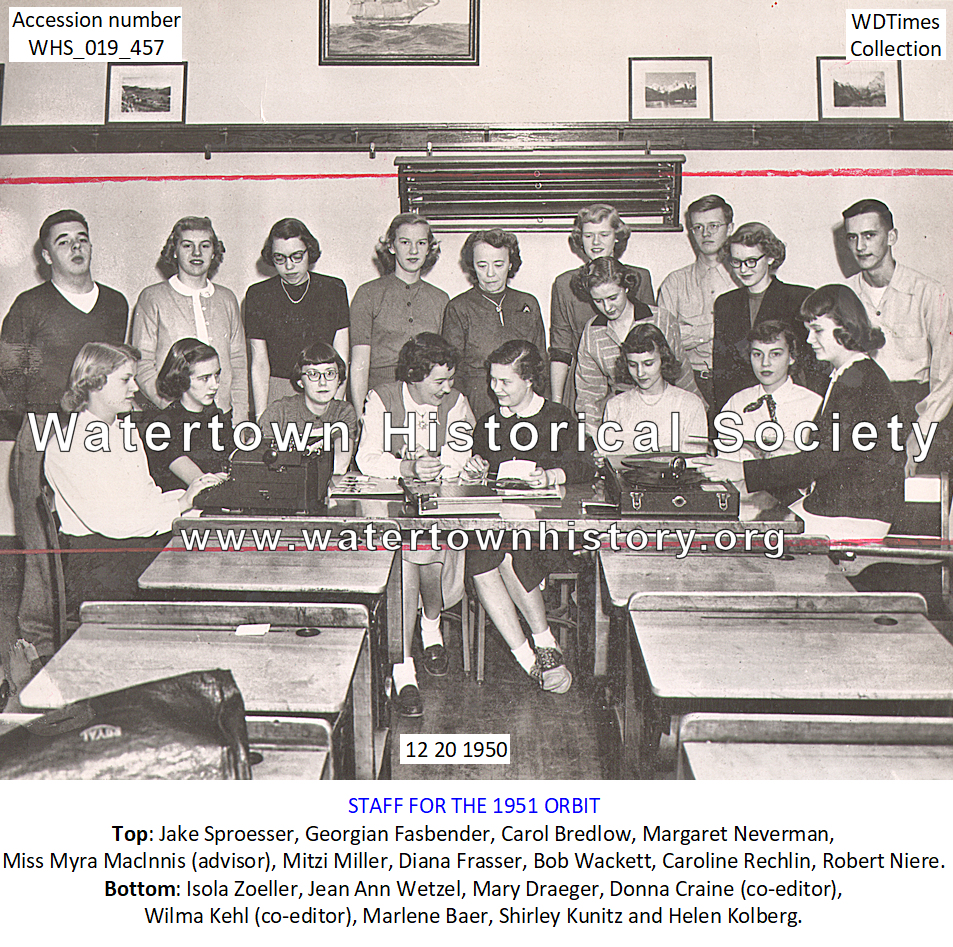
Jake
Sproesser, Georgian Fasbender, Carol Bredlow, Margaret Neverman, Miss Myra
Maclnnis (advisor), Mitzi Miller, Diana Frasser, Bob Wackett, Caroline Rechlin,
Robert Niere, Isola Zoeller, Jean Ann Wetzel, Mary Draeger, Donna Craine
(co-editor), Wilma Kehl (co-editor), Marlene Baer, Shirley Kunitz and Helen
Kolberg.
04 24 HIGH
SCHOOL PROM COMMITTEE
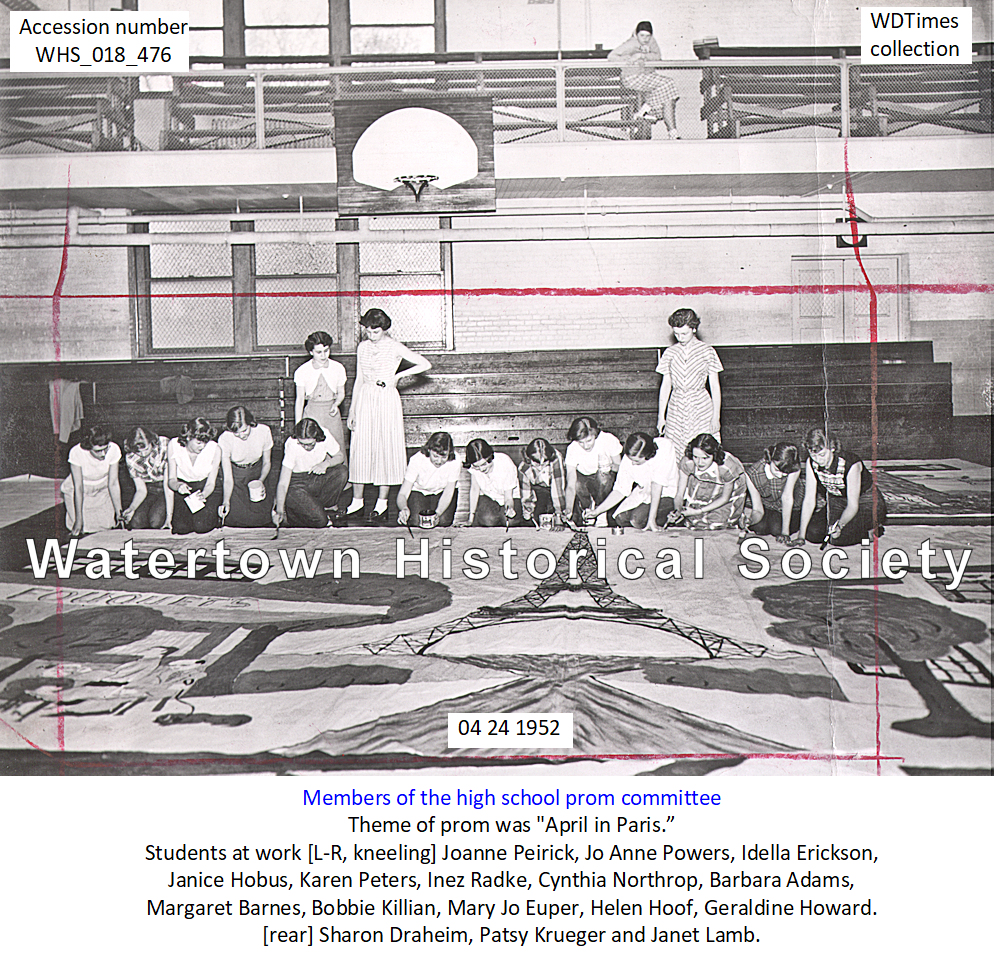 Theme of "April in Paris”
Joanne Peirick, Jo Anne Powers, Idella
Erickson, Janice Hobus, Karen Peters, Inez Radke, Cynthia Northrop, Barbara
Adams, Margaret Barnes, Bobbie Killian, Mary Jo Euper, Helen Hoof, Geraldine
Howard, Sharon Draheim, Patsy Krueger and Janet Lamb.
04 26 COMMITTEE
ARRANGING POST-PROM PARTY

To be held in the upper hall of the
Elks club after the prom on Friday, April 25.
The committee is taking over the decorating of the upper hall for the
party. Members of the committee (L-R
seated) — Bruce Schlueter, Paul Kaercher, Ruth Knight, Donna Shearier, Bill
Casanova, Ronald Juderjahn, Lucille Johnson, Joan Bentheimer; Second row —
Jerry Rabbach, Mary Euper, Janet Lamb, Ferne Robbins, Helen Hoof, Joan Zickert,
JoAnne Powers, Mary Donahue; Back row—Dale Uttech, Don Pugh, Jerome David, John
Beggan, Phyllis Sellnow, Carl Stallman, and Bob Madzar.
04 26 PROM NIGHT
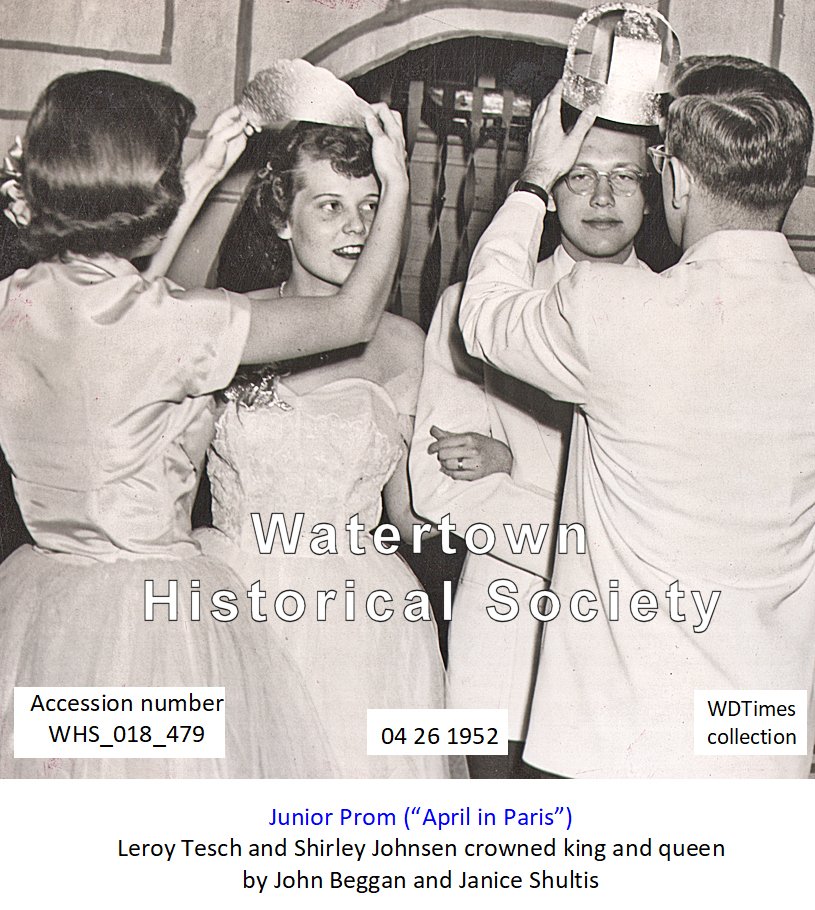

Rose Berg,
Gale Uttech, Mary Jo Sazama, Don Kapheim, Carla Hobus, John Beggan, Marilyn
Kennedy, Dan Archie, .Helen Hoof, Fred Hein, Barbara Jurick, Don Pugh, Joan
Bentheimer and Bob Barfknecht, Shirley Johnson, queen and Leroy Tesch, king. Crown bearers were Sue and Sara Shultis.
05 27 FIRST
POST-PROM PARTY
First Watertown High School senior
class to have a post-prom party at the Watertown
Elks Lodge.
c.1952
-- -- FIRST
LETTER IN GOLF
David
Henry Leiknes had the honor of being the first person at Watertown High
School to earn a letter in golf
1953
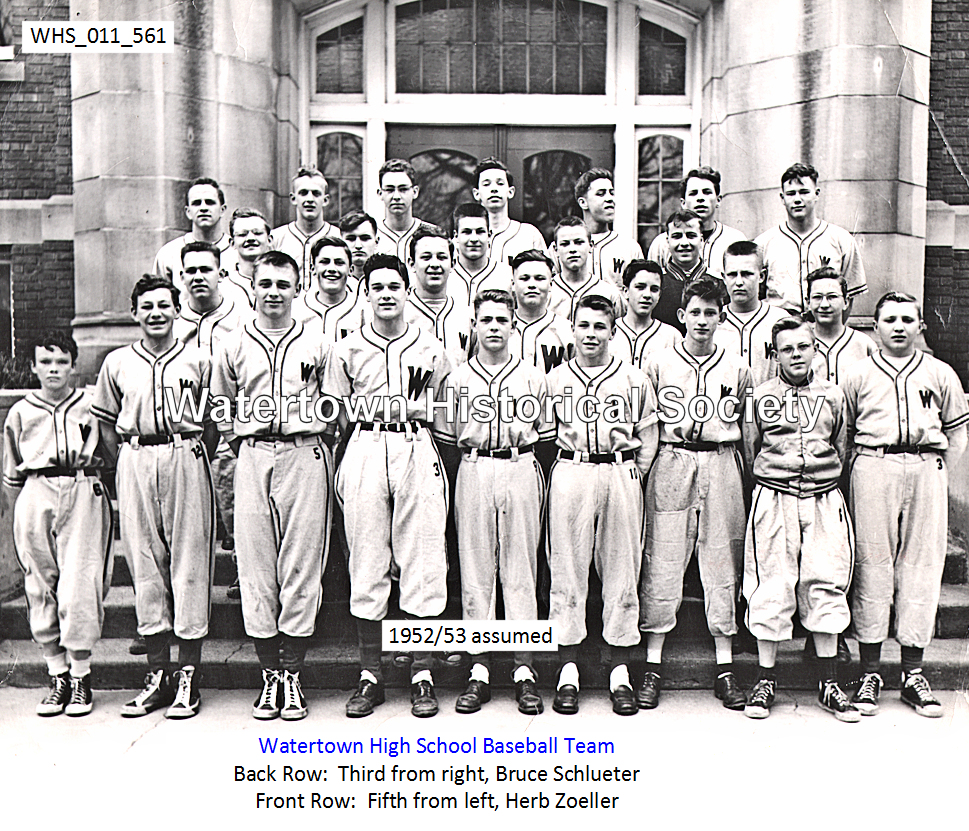
HIGH SCHOOL BASEBALL TEAM
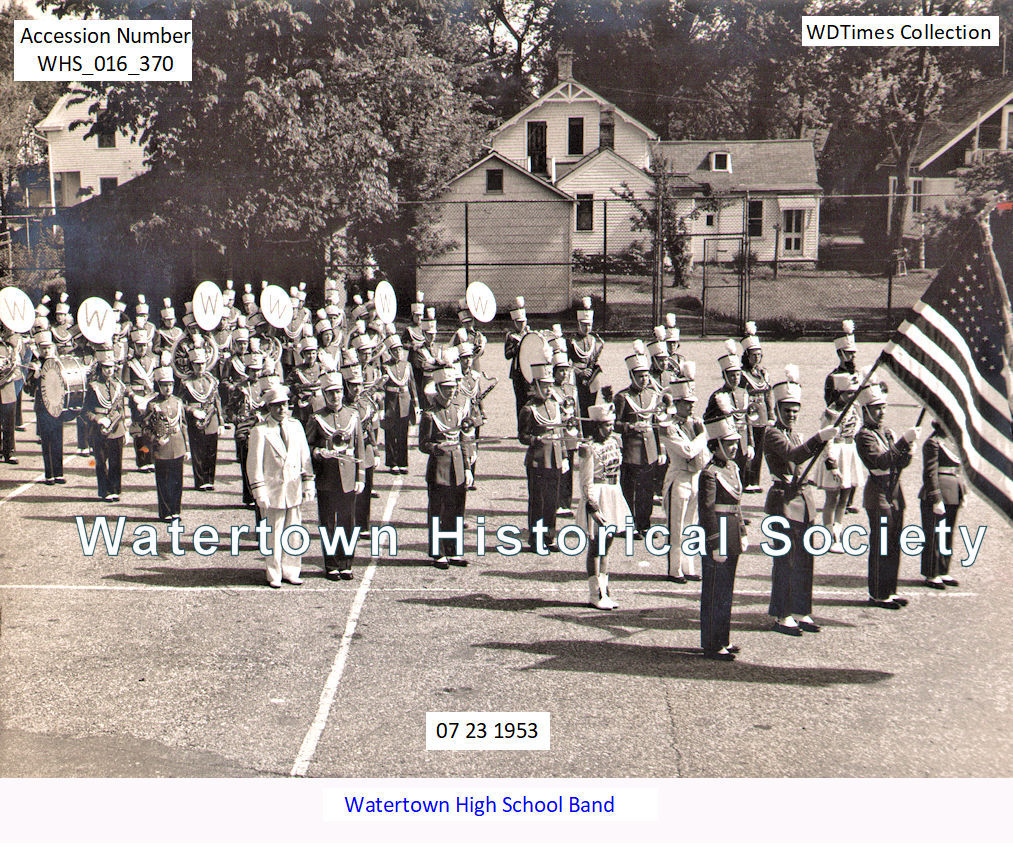
HIGH SCHOOL BAND
08 21 SEVEN
FOOTBALL LETTERMEN
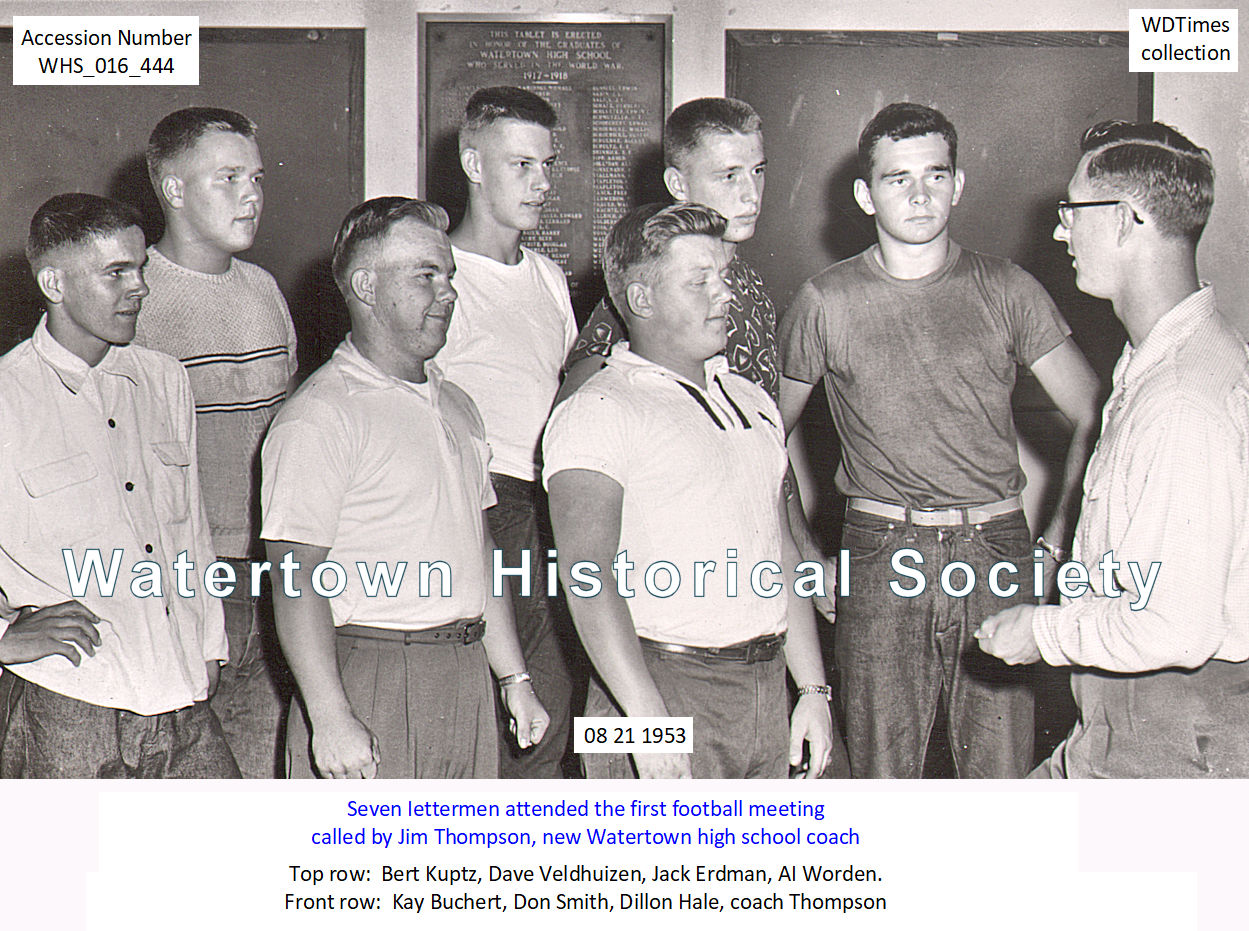
Seven
Iettermen attended the first football meeting called by Jim Thompson, new
Watertown high school coach.
Bert
Kuptz, Dave Veldhuizen, Jack Erdman, AI Worden, Kay Buchert,
Don Smith, Dillon Hale.
BACKGROUND: TABLET “ERECTED IN
HONOR OF THE GRADUATES OF WATERTOWN HIGH SCHOOL WHO SERVED IN THE WORLD WAR,
1917-1918.”
08 26 HIGH
SCHOOL GYM: NEW ALL-AUTOMATIC SCOREBOARD
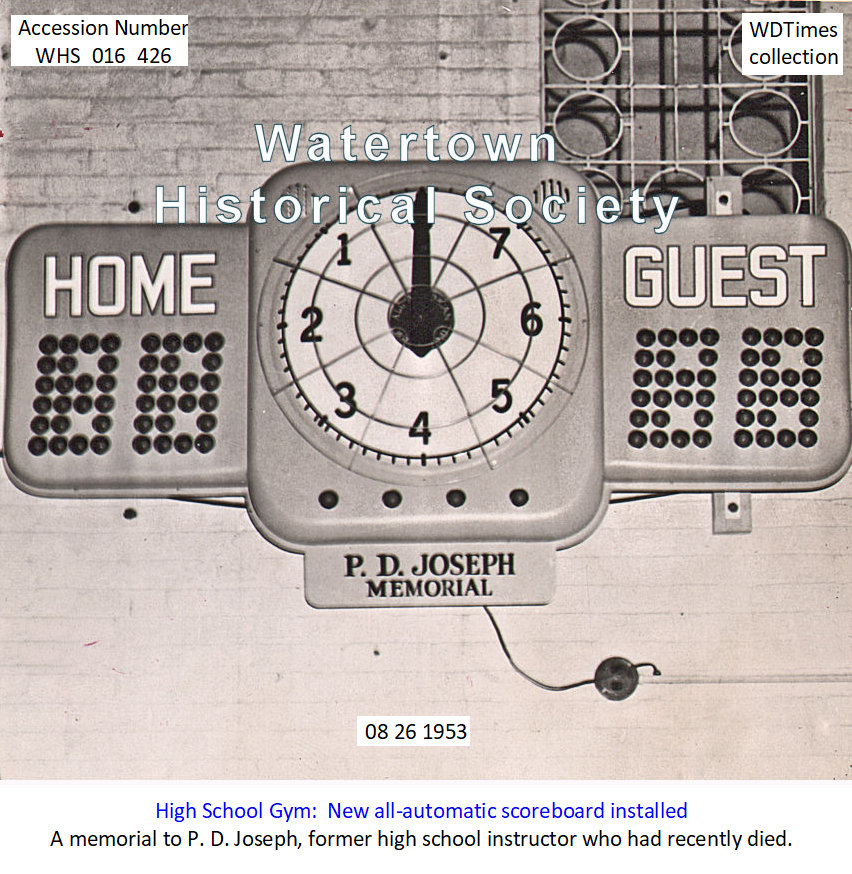
A memorial to P. D. Joseph, former high school instructor who
had recently died.
The
new board is over six feet long and about three feet high.
The
timeclock operates automatically once it is started and a horn blows at the
expiration of each period. In addition,
the face of the clock is lighted with a green light during the final minute of
each quarter. The clock can be reset so
that periods of varying length can be timed.
Four lights at the bottom of the clock indicate the period and a series
of light combinations at the sides show the score. They are activated by controls at the
scorer’s table.
Joseph
was intensely interested in athletics and at his death his many friends
contributed toward a memorial. A
committee, which included Mrs. Joseph, school officials and teachers, decided
to use a portion of the funds for the scoreboard.
09 09 FOOTBALL
COACHING STAFF
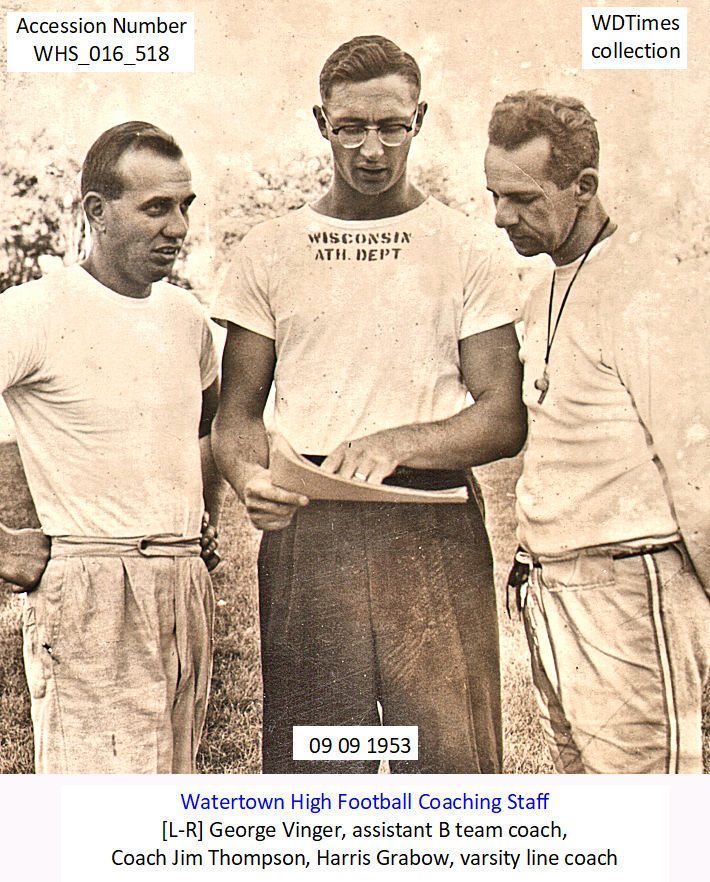
George Vinger, assistant B team coach, Coach Jim Thompson, Harris
Grabow, varsity line coach
09 10 GOSLING’S STARTING OFFENSIVE LINEUP
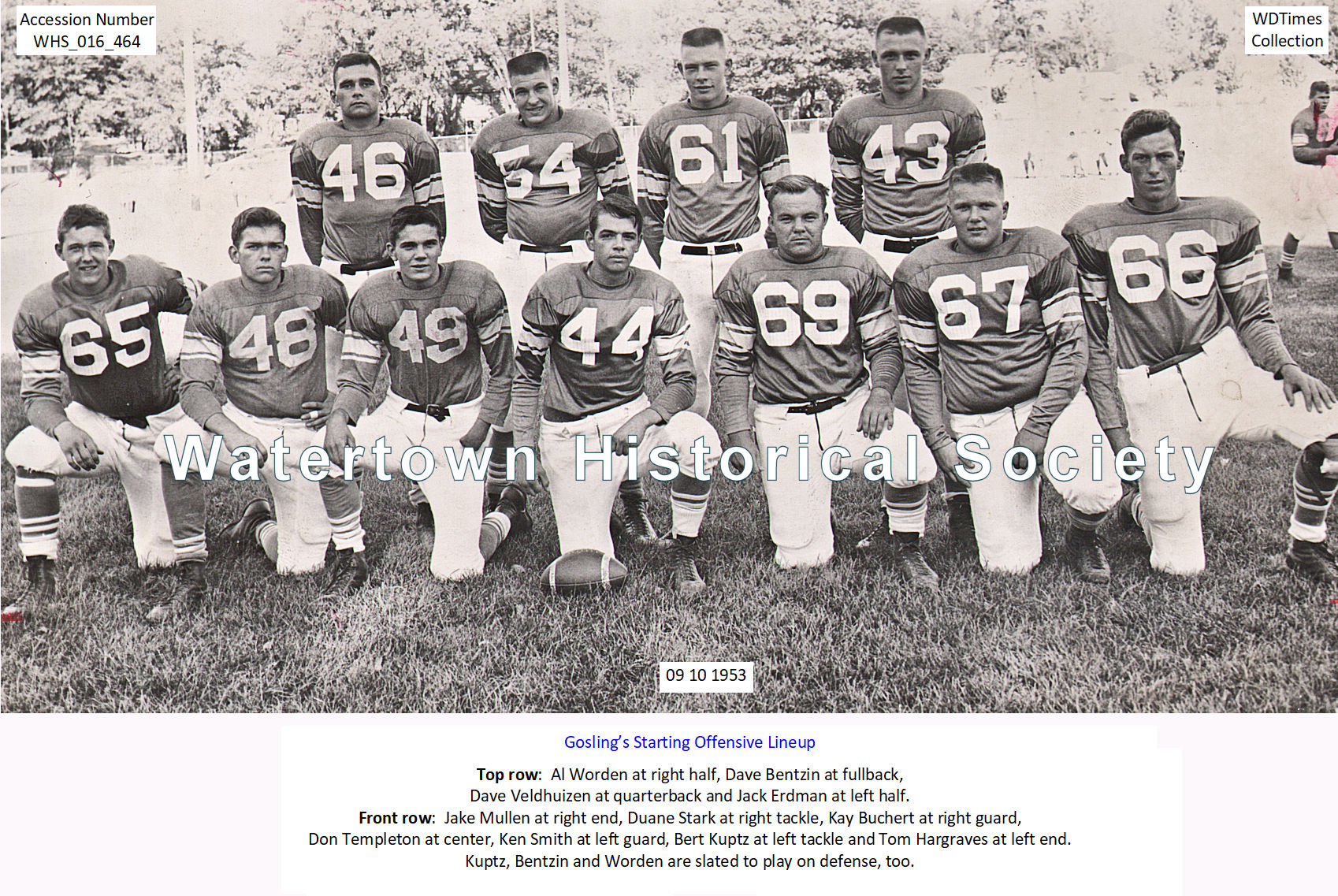
Al Worden at right half, Dave Bentzin at fullback, Dave
Veldhuizen at quarterback and Jack Erdman at left half. Jake Mullen at right end, Duane Stark at
right tackle, Kay Buchert at right guard, Don Templeton at center, Ken Smith at
left guard, Bert Kuptz at left tackle and Tom Hargraves at left end. Kuptz, Bentzin and Worden are slated to play
on defense, too.
09 16 WATERTOWN
HIGH SCHOOL’S B FOOTBALL TEAM
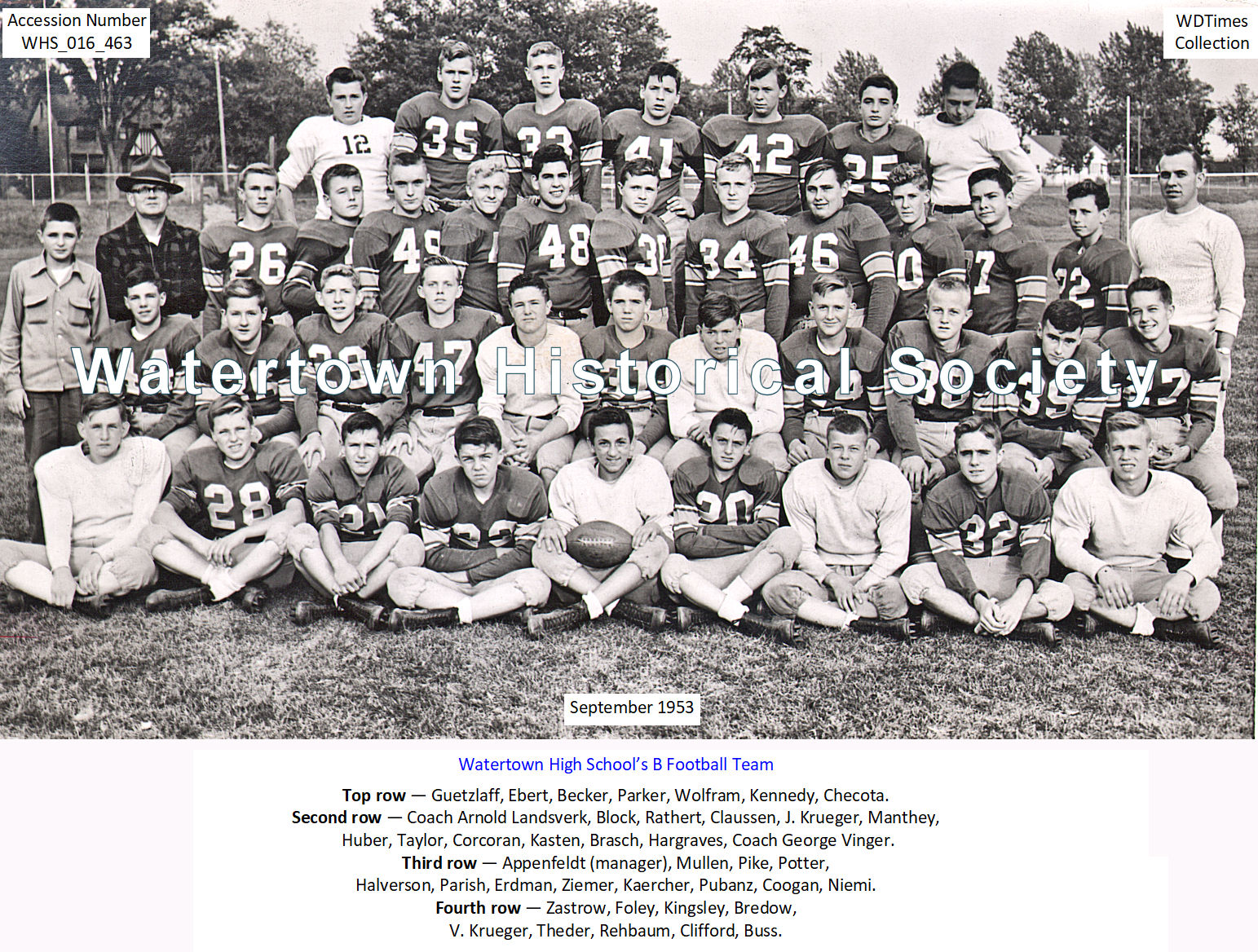 playing a
six-game schedule this season
playing a
six-game schedule this season
Guetzlaff, Ebert,
Becker, Parker, Wolfram, Kennedy, Checota, Coach Arnold Landsverk, Block,
Rathert, Claussen, J. Krueger, Manthey,
Huber, Taylor, Corcoran, Kasten, Brasch, Hargraves, Coach George Vinger,
Appenfeldt (manager), Mullen, Pike, Potter, Halverson, Parish, Erdman, Ziemer,
Kaercher, Pubanz, Coogan, Niemi, Zastrow, Foley, Kingsley, Bredow, V. Krueger,
Theder, Rehbaum, Clifford, Buss.
1954
CENTENNIAL PARADE:
HIGH SCHOOL BAND
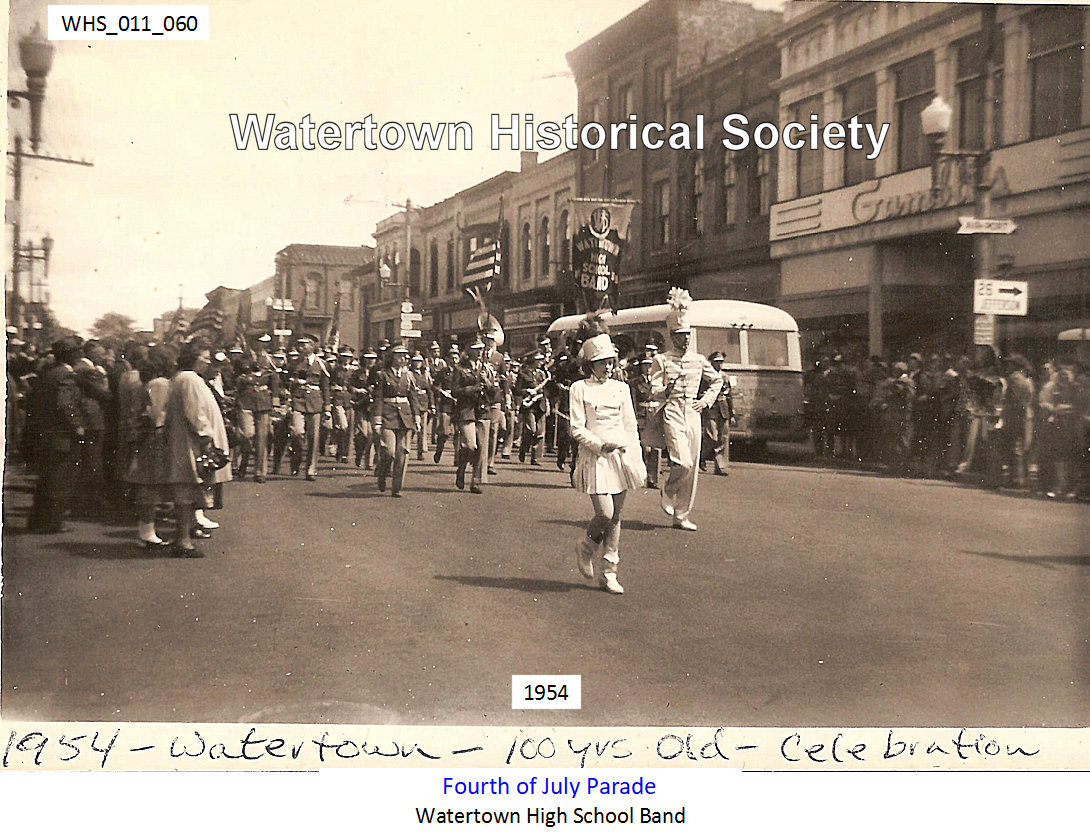
Fall HIGH
SCHOOL JUNIOR BAND
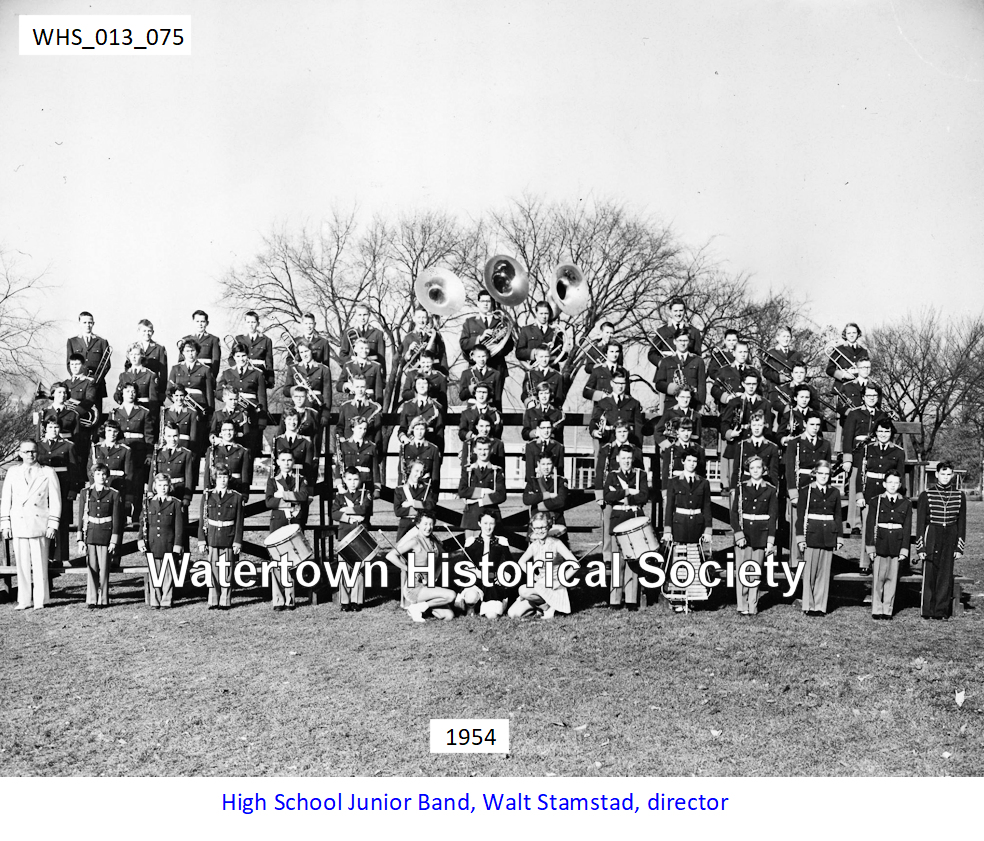 Walt Stamstad,
director
Walt Stamstad,
director
1955
-- -- STATE
CHAMPION WATERTOWN HIGH SCHOOL BASEBALL TEAM

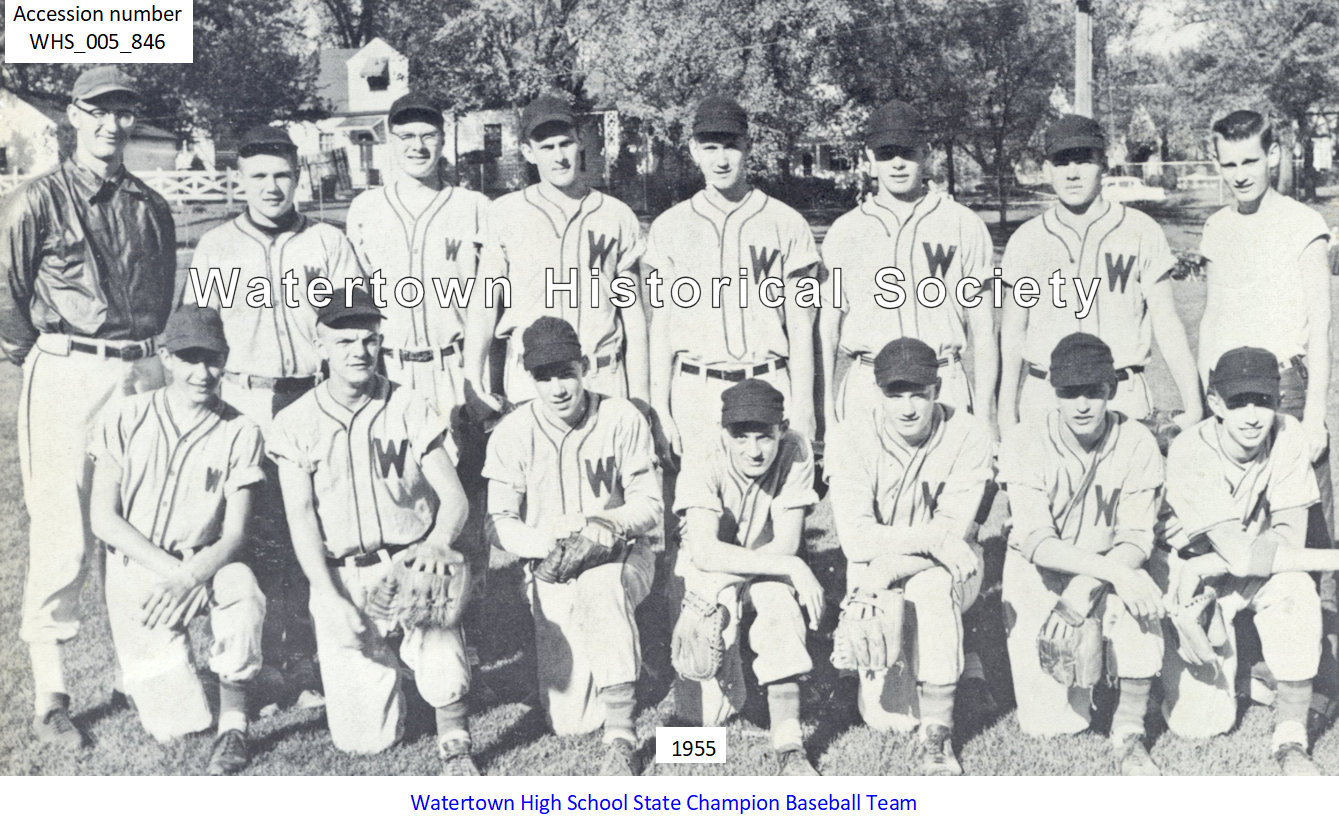
The Watertown Goslings won the
state baseball championship. It was the
first time for such an achievement. A planned
article will document the occasion by commemorating the team and team
players. The author, Dave Stalker,
researched the newspaper clippings and box score's associated with each game
and contacted most of the championship team members so to add updating
information and perspective.
1956
05 27 DETAILS ON SCHOOL ADDITION
The
Times is able today, for the first time,
to reveal some of the details of the new unit which will serve the Watertown
Junior High School, the Watertown Senior High School and the Watertown
Vocational and Adult School. Not only
will there be a new unit to the north of the present school, but by the time
the work is completed on remodeling and rearranging the present school building
that structure will hardly be recognizable.
So many are the changes that are involved in the general overall
plans. The new unit will be two stories
high and its exterior will conform pretty generally with the present building,
though it will be such that it can be readily set off as a “new school. A gymnasium-auditorium will be located in the
new unit. It will seat 3,000 persons,
have a large stage and a partial balcony.
There will be a spacious lobby in the new unit, with the main lobby
entrance at South Ninth and Dodge Streets.
WDT
08 23 PLACEMENT OF BICYCLE RACKS
The
lawns around the Watertown High School building, especially on the west side of
the building, fronting on South Eighth Street, are in for some rough usage
soon. School authorities are faced with
the necessity of placing the large number of bicycle racks elsewhere than in
the customary places north of the present building, now that that area is to be
the scene of building activities in connection with the new high school
addition project. According to school
authorities they plan to place the racks on the lawns west of the present
building and the many students who ride bicycles to and from school will
utilize that area for the purpose, once the new term gets underway and building
activities make the relocation of the racks necessary. WDT
-- -- WATERTOWN
HIGH SCHOOL BEGINNERS BAND
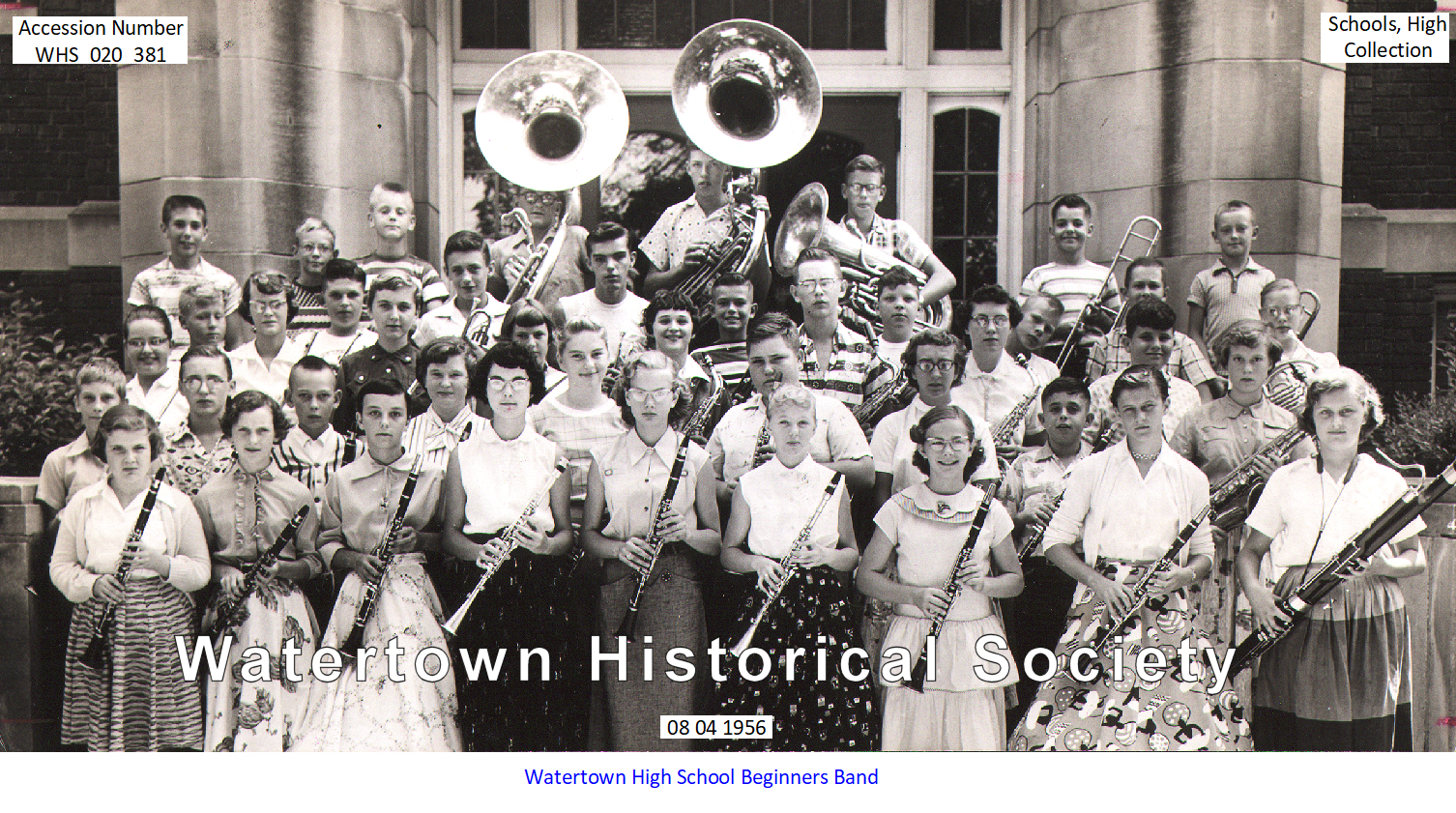
1957
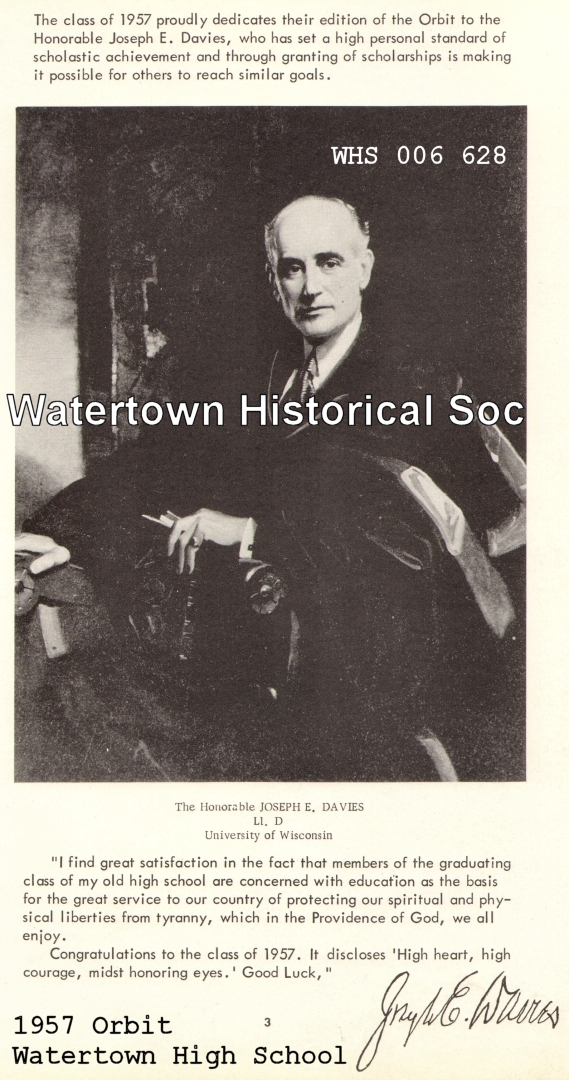
WATERTOWN HIGH SCHOOL ORBIT DEDICATED TO JOSEPH
DAVIES
Basketball,
Squad A
01 31 TEENS AGAINST
POLIO (TAP) CAMPAIGN
01 31 ROTARY
CHOOSES KRESSIN BOY OF THE MONTH
Louis Kressin, chosen by the Rotarians as their January Boy of the Month, has proven by
his activities that he's quite worthy of this honor. . . As the first
Student Council president to be elected in the system of school-wide balloting,
he leads this student-governing body with a practiced ability.
GRADUATION CEREMONY
 < link to set of 9 images
-- -- NO TWO CLASSMATES
ARE THE SAME
Editorial by Pat Zeimis, 1958 High
School Scribbler
There are basically two types of students in
every high school, those that are in school because they have to be, and those
who are here because they want an education.
The former are characterized by apathy, the latter by ambition.
Some of the people in category number two
participate in athletics and, because of this, are automatically in the
limelight. Others have dramatic ability,
are given the starring roles in a play, and the spotlight is turned on
them. If a student has musical ability,
he or she is a school celebrity.
However, there is another group of students
perhaps more deserving of recognition than any of these. It consists of those who are accomplishing
their purpose in high school-working for and earning a high scholastic average.
Many of these people are not very good at
kicking extra points or making free throws.
Few among them can reach the high notes in the "Star- Spangled
Banner." It is improbable that
there is a John Barrymore in the group.
Nonetheless, ten years from now it will probably be these people, the
top fifteen or twenty in their graduating class, who will be real successes in
life.
Perhaps this would be an opportune time to
give to these students the recognition they deserve. Since semester examinations have taken
priority over everything else, it is those who excel scholastically who are now
in line for congratulations.
To say that the ardently ambitious are
rewarded with success one hundred per cent of the time would be wishful
thinking. However, in this world of
rising scholastic standards, a good high school education is the foundation for
all that follows. It would be well to
recognize those who have worked for and have earned superior grades this first
semester.
The rest of the school
year offers a challenge, not only to these people, but to every student in high
school, to stamp out complacency and work for something better.
1959
Link to 1959
Orbit (1 of 2)
Link
to 1959 Orbit (2 of 2)
1950s
Civics or
Government Class or Society
05 24 1960
ORBIT
The 1960
edition of The Orbit, senior class
publication of Watertown High School, is out.
This year the book, the 48th issue, is dedicated to the Watertown
Community — for providing a new high school building, a rich curriculum and a
limitless opportunity for education.
This year, for the first time, the edition carries a photo of the city
council and the city manager. There also
is a photo of the board of education, a beautiful view of the new high school
addition at night, views of the building’s interior, in addition to many other
pictures of school activities and groups.
The book this year is as handsome and attractive as any in the long line
of Orbits that have come off the
press since the first one was published 48 years ago. WDT
-- -- JOSEPH
E. DAVIES SCHOLARSHIP AWARDS
06 02 MISS
KATHRYN SKINNER
If anyone ever sits down and writes a history
of the Watertown Public School system and enumerates some of the outstanding teachers
who have served this community the name of Miss Kathryn Skinner most assuredly
deserves to be included in any such list.
Miss Skinner is ending her school work here, having retired this week
with the close of the 1959-60 school year.
She has been a teacher of mathematics in the Watertown High School. Aside from that, her great interest in school
work, in students and in helping turn out first rate future citizens of the
community, have been a tremendous influence for good. WDT
1961
10 year class
reunion, class of ’61.
15 year class reunion,
class of ’61.
20 year class
reunion, class of ’61.
1962
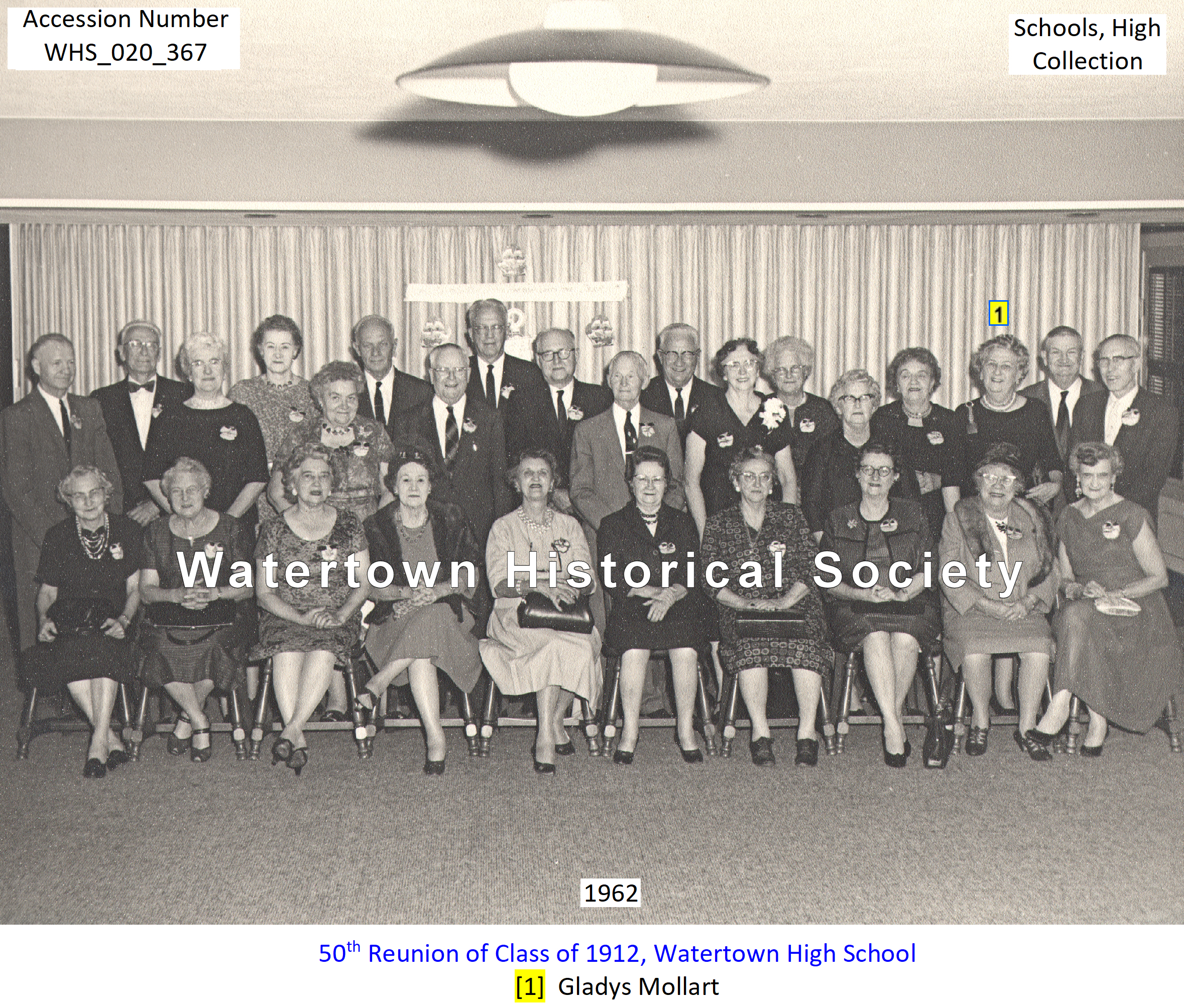
-- -- 50th
REUNION OF CLASS OF 1912, Watertown
High School
12 19 FOUR AND ONE-HALF ROOM ADDITION
The board of education last night approved a
resolution which is the first step for a referendum next April to let the
people decide whether they want a four and one-half room addition to the
present high school building. The
resolution was adopted by a vote of 7 to one, with commissioner Lee Block
casting the only vote in opposition, but later in the meeting he asked
permission to change his vote and make adoption unanimous. The resolution was introduced by Commissioner
Joseph Rhodes and was strongly supported by Commissioner Edward
Hinterberg. WDT
1963
01 13 NORMAN
L. LARSON, Superintendent of Schools.
Watertown’s new superintendent of schools, Norman L. Larson, is due to
move to Watertown tomorrow and take over his duties at the high school next
Monday. Mr. Larson, who has been serving
in a similar capacity at Markesan, accepted the Watertown position last Oct.
14, following the resignation of Eugene W. Tornow who now holds a position with
the University of Wisconsin. WDT
04 13 PLAN REVISION
The plan for a four and one-half classroom
addition to Watertown High School, originally proposed by the board of
education last year as a means of solving the immediate growing space needs at
the school will be revived shortly, it was indicated today. This development came as a result of the
recent rejection by the voters in the April 2 election of two alternate plans —
one calling for a new junior high school of a seventh and eighth grade, and the
other calling for a new junior high school of a seventh, eighth and ninth
grade. WDT
04 18 ASSISTANT
SUPERINTENDENT position created; Russell
Twesme principal. The board of
education last night created a new position, that of assistant superintendent
of schools, and then named the principal of the high school, Russell Twesme, to
the post starting July 1 at no increase over his present salary. The promotion is still subject to Mr.
Twesme's acceptance. The vote to
establish the new position was approved 6 to 1, with O. L. Wesemann casting the
lone dissenting vote. He said he did it
because he thought the matter should be delayed until next year. WDT
04 19 As expected, the board of education last
night revived the plan for a four and one-half room addition to the Watertown
High School and at the same time adopted a resolution calling for utilization
of the Watertown
Airport as the site for a new high school building, either junior or
senior, as a long range plan for solving the growing space problem at high
school. Both proposals will go to the
common council at an early date. WDT
04 23 The junior prom of the Watertown High
School will be held this spring in the high school gymnasium. “Souir Paree” is the theme of this year’s
prom. The grand march will start at 10 o’clock
and will be followed by the presentation of the king and queen and their court
of honor. Reigning as king and queen
will be Richard Claas and Connie Wegner. Members of the court of honor are:
Frank James, Jeanne Mueller, Lee Ebert, Mary Theder, Kieren Lordahl, Kathy
Schmutzler, Sharon Pike Alan Peters, Joan Wolf, James Schwartz, Neil Gamroth
and Cynthia Yahn. WDT
05 04 The largest graduating class in the
history of Watertown High School is due to bow at the school's 90th annual
commencement exercises on Wednesday evening, June 5, at which time the speaker
will be William C. Kahl, first assistant superintendent Wisconsin Department of
Public Instruction, Madison. As of now,
a class of 245 seniors is scheduled to graduate. Last year's class numbered 204. WDT
06 06 Last night’s graduating seniors at
Watertown High School presented a check to provide shrubbery at the high school
grounds as their class gift in departing from the school. It was a record class, with 236 diplomas being
issued. Presentation of the class gift
was made by Susan Krueger, the class treasurer and was accepted by Principal
Russell Twesme. He lauded the class for
its decision in selecting a gift. WDT
08 05 LUTOVSKY
FARM
The common council at its meeting tonight is
scheduled to act on a resolution calling for an appraisal of the Charles
Lutovsky farm in the Boughton-Hall Streets area which has been proposed as a
site for a future Watertown High School, either senior or junior under a
long-range school expansion plan. The
appraisal is the first step in the plan to acquire the property, a move viewed
favorably by the city administration, according to general discussion held at
last night’s council committee meeting.
Mayor Robert P. White reported that the asking price for the farm,
reportedly consisting of 37.5 acres, is $60,000. WDT
09 04 Negotiations to acquire the Charles
Lutovsky farm property as a site for a future high school, either junior or
senior, were authorized by a common council resolution adopted last night by
unanimous vote of 13 aldermen present at the council meeting. Mr. Lutovsky
offered the property for school purposes some months ago and the site has been
unanimously approved by action of the board of education. Under terms of the
resolution approved last night, Mayor Robert R White is delegated to carry on
the negotiations. Mr. Lutovsky has asked
for $60,000 as the price. Two independent appraisals made for the city have
placed a fair price value of about $54,000 on the property, the mayor said last
night. WDT
09 19 Russell Twesme, who is assistant
superintendent of schools in Watertown, last night was appointed acting
superintendent as of Sept. 16 and as such was authorized to co-sign the
activity account checks and carry out all other duties inherent in the position. The appointment was approved by unanimous
vote of the board of education which also set an additional $150 per month in
salary during the time he will serve. WDT
10 01 HOMECOMING
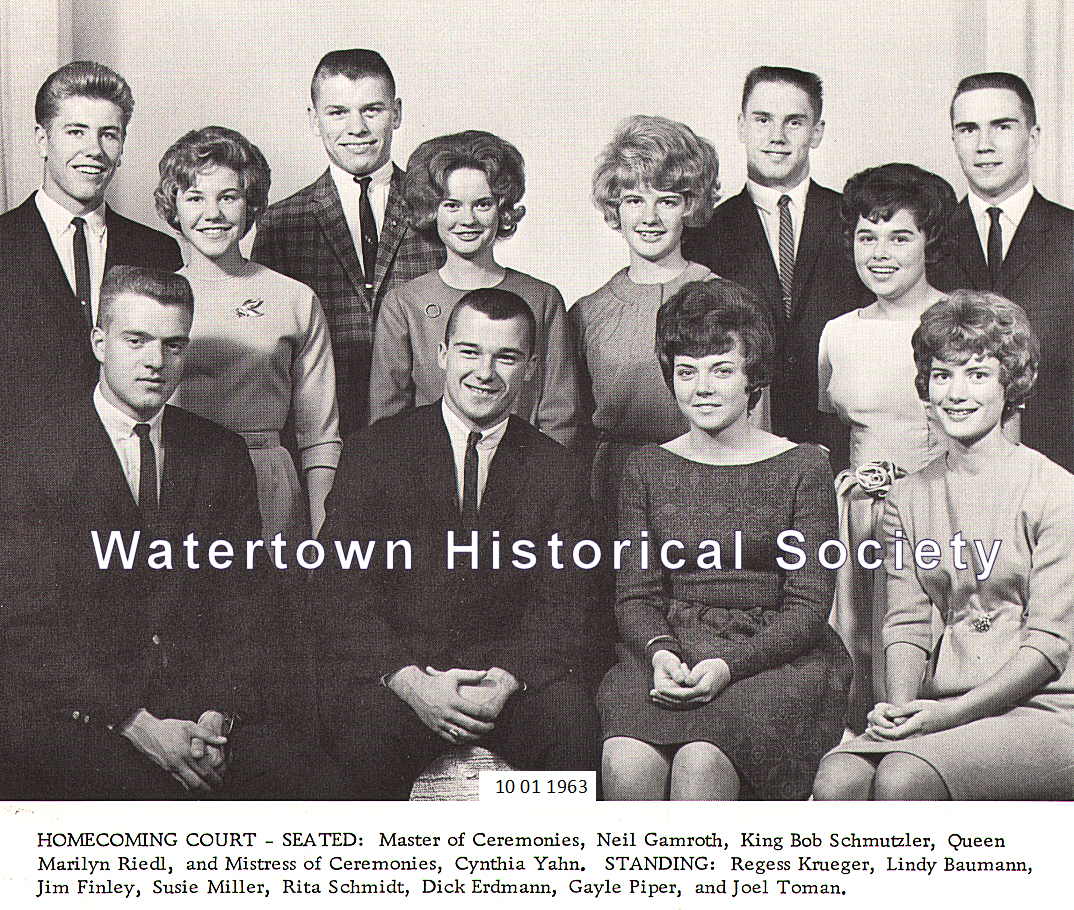
Homecoming festivities of the Watertown High
School this weekend will include skits to be presented in the gym Friday
afternoon, the parade at 5 p.m. Friday with the lineup including floats, the
homecoming court and the football players, the game between Watertown and
Mayville and the homecoming dance Saturday evening. Members of the court of
honor are Marilyn Riedl and Robert Schmutzler, homecoming king and queen; Gayle
Piper, Linda Bauman, Rita Schmidt, Susan Miller, Joel Toman, Regess Krueger,
Richard Erdman and James Finley. WDT
1964
02 10 1964
GRADUATION
Watertown High School this year will graduate
the largest class in the history of the school. The commencement exercises are
to be held on Wednesday evening, June 3 in the high school gymnasium. There are
251 seniors in the class at the present time. Even with last minute “flunking
out,” the class will still be the largest to date. The largest previous class
in the history of the school was that of 1963 when 236 seniors received their
diplomas. In 1962 there were 204 graduates and in 1961 there were 228. WDT
04 03 LUTOVSKY
FARM
The Charles Lutovsky farm, consisting of
slightly less than 38 acres, which the board of education had recommended to
the common council last September for purchase as a site for a future school,
has been sold to private out of town interests which plan a development. H. M. Dakin of the law firm of Dakin and
Dierker, confirmed the report and told the Times that the preliminary papers
have been signed and that $65,000 is the sale price. WDT
05 15 FIVE-ROOM
ADDITION
The Watertown Board of Education has received
the support of the City Planning Commission in its plans calling for the
construction of a five-room addition to the present high school building as a
means of solving the immediate space needs at the school. The planning commission will recommend to the
common council Tuesday night that the school board be allowed to construct the
addition. WDT
05 22 THE
’64 ORBIT
The 1964 edition of The Orbit, senior class
publication at Watertown High School, has been issued. It is the 52nd annual
publication. The new edition is dedicated to three teachers — Robert Miller,
Everett Moore and Wilbert Leys, all in the guidance department. In addition,
Mr. Leys teaches citizenship. The dedication page, bearing a photo of the three
men, says: “Because of a sincere interest in our activities and hopes for the
future, the guidance counselors extend their vocational programs to assist all students.
When troubled by a personal problem, we are offered their understanding and
encouragements. In appreciation, we dedicate this 1964 edition of The Orbit to
Mr. Miller, Mr. Moore and Mr. Leys.”
05 29 91st
ANNUAL COMMENCEMENT
Details of the 91st annual commencement
exercises at Watertown High School were announced today.
The event will take place in the school
gymnasium on Wednesday evening, starting with a half hour concert program at
7:20 o’clock. Willard Buchholtz will
direct the high school orchestra in the half hour program. Donovan L. Richards, high school principal,
will open the program with introductory remarks, followed by the welcome which
Nancy Winkenwerder, senior class president, will deliver. Two honor students will deliver
addresses. They are John Eggert and
Caryl Lewandowski
05 31 FIVE-ROOM
ADDITION DEFEATED
The
board of education’s plan for a five-room addition to the high school building
went down in defeat at last night’s common council meeting at which township
chairmen from rural areas which help make up the Watertown Public School
District sat in, but the group also held open for future action acquisition of
a site for a proposed new junior high school, which is part of an overall plan
to relieve the growing space problem at the high school.
07 05 LAND
ACQUISITION FOR PROPOSED NEW JUNIOR
HIGH SCHOOL
The City Planning Commission has
taken no action on the matter of putting its approval on or making a
recommendation regarding acquisition of the Lutovsky farm site for the proposed
new junior high school. Also involved in
the site is additional acreage which would be secured from Dr. E. Allen Miller
and the Oak
Hill Cemetery Association. An
announcement made today stated that the planning commission members had
discussed the proposals but it had been decided to lay it over “for the
purposes of obtaining financial information.”
At the last joint session held by the board of education with the common
council and the township chairmen who help make up the Watertown Public School
District, a resolution was adopted instructing the proper city authorities to
negotiate for the site with Charles Lutovsky, Dr. Miller and cemetery
association officials.
10 30 LUTOVSKY
FARM
A
conference on how best to speed up consideration of acquiring the Charles
Lutovsky farm as a site for the proposed new junior high school was held at the
municipal building this morning. It was attended by city officials and
representatives of the board of education and others. One of the portions of
land under consideration is the Charles Lutovsky farm and also property in the
vicinity which is owned by Dr. E. Allen Miller and also a piece of land owned
by the Oak Hill Cemetery Association. WDT
11 03 SALE OF OLD
REC BUILDING
The
common council at its meeting last night took three important — but not
unexpected — steps. It voted to sell the
old city hall to the most suitable bidder and to advance plans for the sale of
the old recreation building site in Main Street. The council also approved a resolution
calling to proceed with negotiations for the purchase of the Charles Lutovsky
farm as part of the site for the proposed new junior high school at a price not
to exceed $65,000. WDT
-- -- MYRA
MACINNIS (1898 – 1992) ("Miss Mac"
or "Mac”)
Myra L. MacInnis, 94, died Nov. 14, 1992 due
to infirmities of old age. She taught
world history at Watertown High School from 1926 to 1964. She taught at Watertown High School for 38
years and was a teacher for a total of 44 years. She earned a Master of Arts degree in history
from the University of Wisconsin-Madison.
(link
to obit)
1965
01 29 JUNIOR
HIGH, RATHER THAN SENIOR, PROPOSED
The reasons for the Watertown Board of
Education’s decision to propose the erection of a junior high school, rather
than a senior high school, the plans for a four and one-half room addition at
the high school, and the problem of a site for the proposed junior high school
were discussed by Norman Larson, superintendent of schools, at Monday’s weekly
luncheon meeting of the Rotary Club, held at the Legion Green Bowl. Erection of a junior high school will be less
costly than the construction of the senior high school, he told the club. And with an elementary school also planned
for the site, he said, it is best that elementary students are not in the same
area with senior high school students. WDT
01 30 LUTOVSKY
FARM PURCHASED
After nearly two years of debate and argument
the common council last night voted 10 to 3 to authorize the purchase of the
Lutovsky farm — now owned by Behrndt, Perkins and Knodl of Milwaukee — along
with the Dr. E. Allen Miller property and a piece of land owned by the Oak Hill
Cemetery Association, representing in all between 44 and 45 acres as a site for
the new Watertown Junior High School. WDT
03 28 NATIONAL
HONOR SOCIETY
Eighteen Watertown
High School juniors and nine seniors were initiated into the Watertown Chapter
of the National Honor Society before an audience of teachers, parents and
students. Initiates are: Seniors — Carol
Cayan, Cheryl Ertl, Andrea Hahn, Robert Hutson, Steve Luchsinger, Charles
Mundt, Steve Reckner, Donnella Schlegel and John Wiley. Juniors - Kathleen Allsage, Suzanne Becker,
Christine Beltz, Diane Bloedom, Peter Burke, Jan Christensen, Joseph Ertl,
Margie Kelm, David Kron, Rose Marie Langer, John Maas, Judy Miller, Susan
Miller, Ronald Neumann, Georgia Prahl, Patricia Trachte, Linda Utrech and
JoAnne Wildes.
03 30 FIVE
ROOM ADDITION
Basic bids for the new five room addition to
Watertown High School total $90,880, according to figures announced this
morning following the opening of bids at a meeting of the board of education
last evening. The low bidder on the
general contract is Wisconsin Products Co. of Mauston. Its figure was $68,900. WDT
04 18 CONSTRUCTION
BEGINS
Work on construction of the five-room
addition to Watertown High School to help relieve the growing space problem is
due to begin next week. A meeting of the
contractors is to be held here on Friday at which time plans for the work
schedule and preliminary construction plans will be outlined. Approval of the addition and the financing of
it was the final official act of the old common council members who served on
the fiscal body for the Watertown Public School District when the plan was
approved 17 to 2. WDT
05 09 JUNIOR
PROM
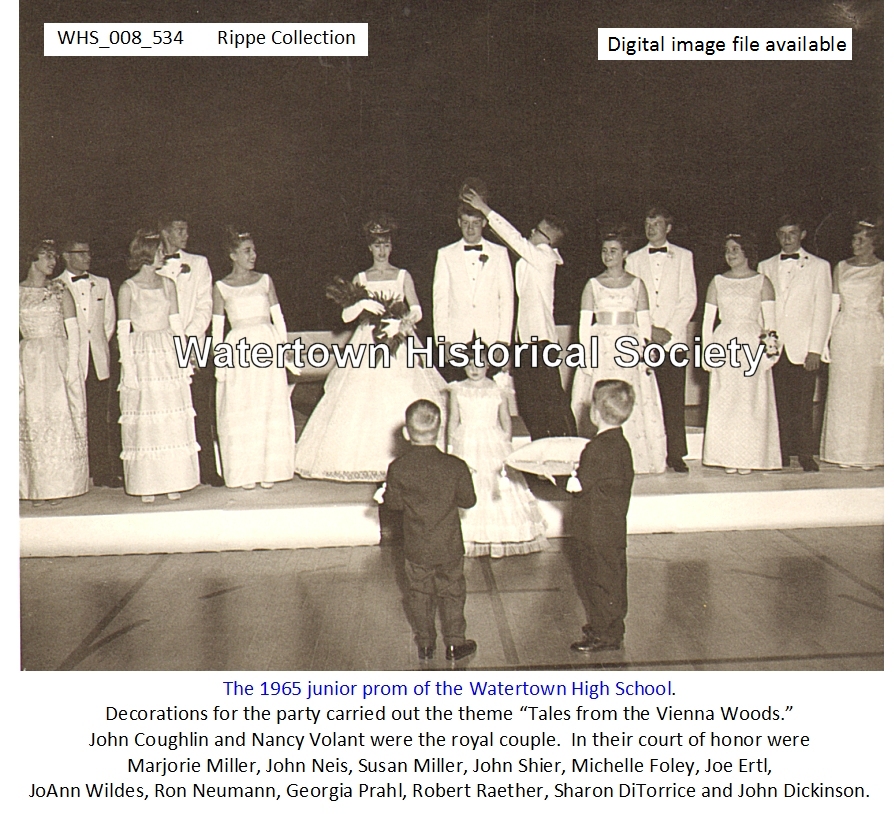
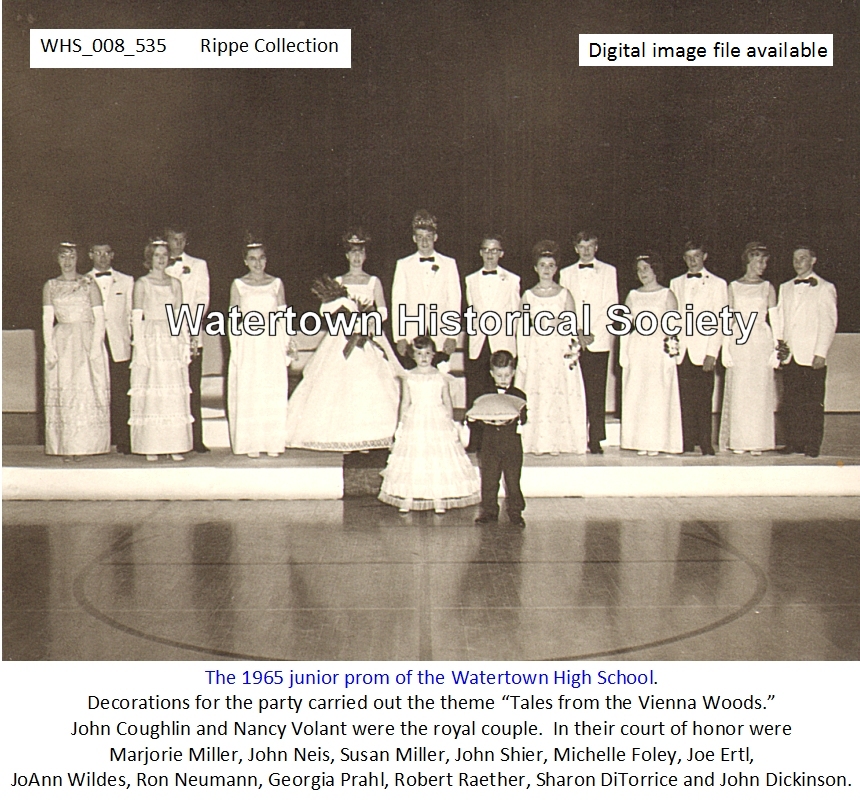


The 1965 junior prom of the Watertown High
School, the top social event of the year, was staged Friday evening in the
gymnasium of the high school.
Decorations for the party carried out the theme “Tales from the Vienna
Woods.” John Coughlin and Nancy Volant
were the royal couple. In their court of
honor were Marjorie Miller, John Neis, Susan Miller, John Shier, Michelle
Foley, Joe Ertl, JoAnn Wildes, Ron Neumann, Georgia Prahl, Robert Raether,
Sharon DiTorrice and John Dickinson. WDT
 Labelled “1965 prom” but likely mistaken
05 21 NEW JUNIOR HIGH SCHOOL, sketches and plans
Preliminary work on the sketches and plans
for the new junior high school here is underway. The Madison architectural firm of Law, Law,
Potter & Nystrom is in charge of the work and will submit its preliminary
sketches within a short time. Members of
the board of education will be called into session to view them and discuss
general plans as soon as a date is set.
The common council has already purchased the greater portion of the new
school site — the former Charles Lutovsky farm in Hall Street, and the other
parcels of land, one from the Oak Hill Cemetery Association and another from
Dr. E. Allen Miller are still to be acted on.
WDT
05 23 NEW JUNIOR HIGH SCHOOL, formal approval of
The board of education at its meeting last
night gave formal approval to the preliminary plans for the proposed new junior
high school when it adopted a resolution accepting the plans prepared by the
architectural firm of Law, Law, Potter and Nystrom of Madison. Last night’s resolution also instructed the
architects to proceed with the necessary working plans for the school. The plans for the new school provide for
110,000 square feet of space and accommodations for from 1,000 to 1,100
students. WDT
05 29 1965
ORBIT: RICHARD CONLEY
Richard B. Conley, English and Latin teacher,
today has the distinction of being honored with the dedication of the 1965
edition of “The Orbit,” the senior class publication of Watertown High
School. The dedication to Mr. Conley,
published under a page-size photograph of him, reads” “For his ceaseless
interest in the welfare of each of his students, for the extras that he gives
to his job as English and Latin teacher, for his efforts to give us new and
rewarding experiences, and for all the qualities which are most important for
an understanding relationship between teacher and student; we dedicate the 1965
Orbit to Richard B Conley.” WDT
06 11 92nd ANNUAL COMMENCEMENT; CLASS OF 1915 HONORED
Watertown High School last night held its
92nd annual commencement exercises, graduating the largest class in its history
— a total of 298 seniors. The outpouring
of parents, friends and others for the program also set a near record. During the opening part of the program
recognition was extended members of the class of 1915 who were present
following the golden jubilee reunion and dinner which members attended earlier
in the evening. Donovan L. Richards, the
high school principal who made the introductory remarks opening the program,
made mention of the golden jubilee reunion and asked members of the class to
stand, a special section having been reserved for them. There were 39 members in the class of 1915
who received diplomas just a half century ago.
WDT
09 09 ADDITION UNDER CONSTRUCTION
The addition now under construction at the
Watertown High School is due to be completed and ready for occupancy within the
next few weeks. This project was
scheduled to have been ready for occupancy before school started, but delays in
delivery of materials and work of contractors has caused the need for temporary
teaching accommodations to be provided in other parts of the building, it was
pointed out today. The new addition,
referred to as five rooms, consists of one large double room, two classrooms separated
by a folding door, plus one additional classroom. The building addition also includes a large
food storage room for the cafeteria kitchen and locker facilities for 110
students. WDT
09 23 NATIONAL HONOR SOCIETY
The following seniors of Watertown High
School have been selected by the faculty as members of the Watertown High
School Chapter of the National Honor Society:
Robert Brandenstein, Ross Damrow, John Dickinson, Michele Foley, Diane
Mueller, Catherine Schmeling, Mary Schultz, Peggy Schwartz, Judith Semon and
Shari Vinger. WDT
addition also includes a large food storage
room for the cafeteria kitchen and locker facilities for 110 students. WDT
10 14 HOMECOMING 1965
Wayne Le Macher and Shirley Sterwalt will
reign as king and queen of the homecoming activities of Watertown High
School. The parade will be held Friday
at 4:30 p.m. The homecoming game with
Mayville is scheduled Friday evening.
The dance will be held Saturday evening in the high school
gymnasium. Members of the court of honor
are: Richard Kuckkan and Chris Beltz, Tom Moore and Lynn Snyder, Peter Burke
and Susan Miller, William Clark and Bernadine Hoeft, Richard Witte and Sally
Theder, James Beaver and Gayle Gorder. WDT
1966
01 07 DEMOLITION
COMPLETED / New Riverside Junior High School
Demolition of Watertown’s old high school building
at North Eighth and Main Streets, later a federal armory and still later
utilized as a recreation center has finally been completed. The work of tearing down the old building was
begun last June 9 after a Milwaukee group of developers — Berndt, Perkins &
Knodl, acquired the property from the city for $35,000 as part of the deal
whereby the city secured the old Charles Lutovsky farm which constitutes the
major portion of the site for Watertown’s new Riverside Junior High School in
Hall Street. The Milwaukee developers
plant to construct a motel and related facilities on the former recreation
site. Under the agreement, the site is
to be utilized by construction of a complex costing no less than $250,000 and to
begin “construction of the improvement within 61 days after final approval by
the common council and planning commission or within 61 days after the
structure on the premises at present is demolished, whichever is later.” WDT
03 16 GRABOW AND McQUOID RETIRE
The Watertown High School athletic coaches,
both veteran in their fields, announced their retirement from major sports
Wednesday night. Coach Harris Grabow,
basketball coach at the school for 19 years, will drop the coaching reins in
favor of Eli Crogan, and Coach Weir McQuoid, grid coach for six seasons here
and for 19 years overall, has given up football coaching but will continue as
wrestling coach where his teams here won 30 straight dual matches. No football successor has been named. WDT
04 -- CLASS OF ’66, TRIP TO WASHINGTON, D.C.
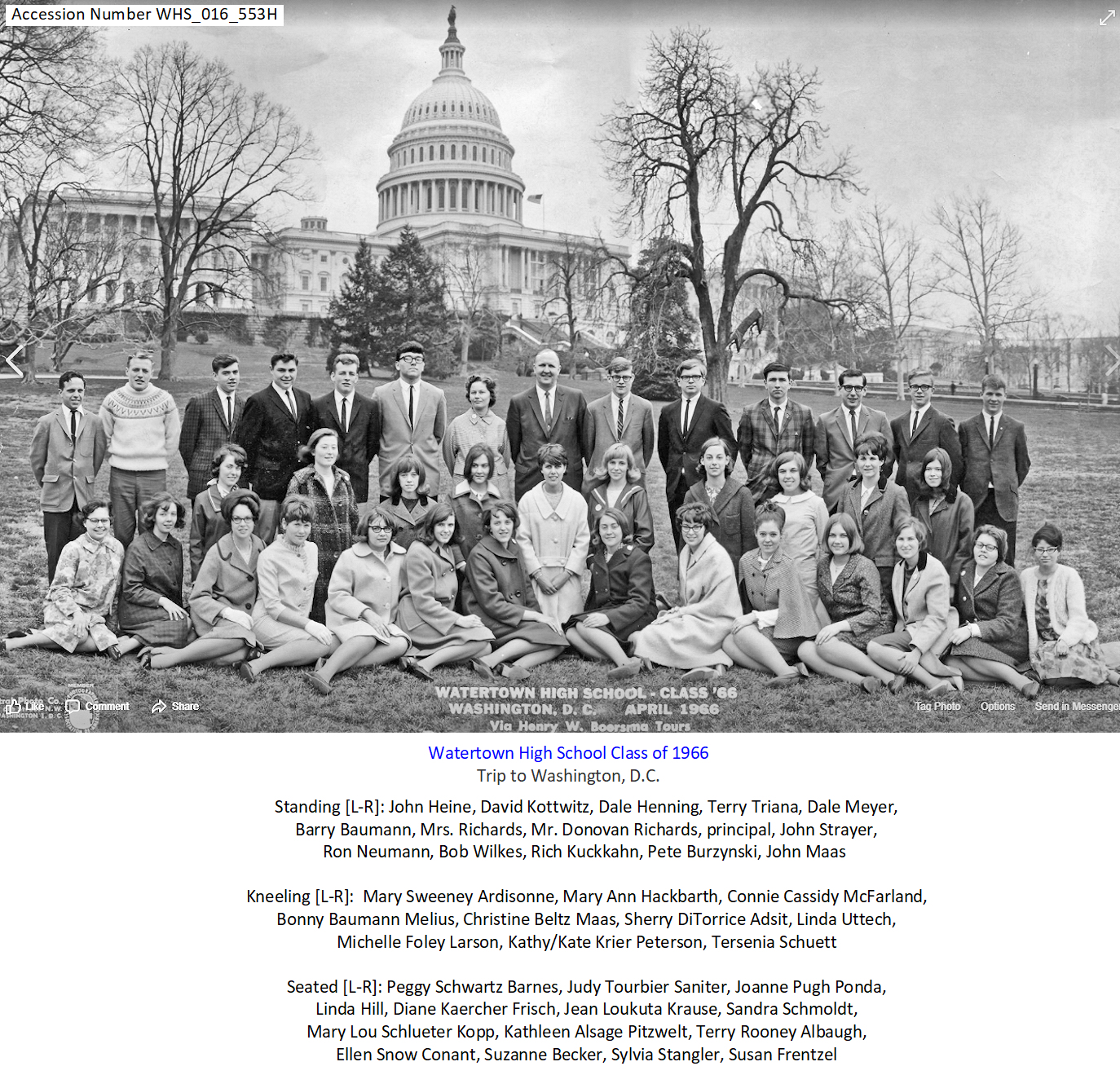
John Heine, David Kottwitz, Dale Henning,
Terry Triana, Dale Meyer, Barry Baumann, Mrs. Richards, Mr. Donovan Richards,
principal, John Strayer, Ron Neumann, Bob Wilkes, Rich Kuckkahn, Pete
Burzynski, John Maas, Mary Sweeney Ardisonne, Mary Ann Hackbarth, Connie
Cassidy McFarland, Bonny Baumann Melius, Christine Beltz Maas, Sherry DiTorrice
Adsit, Linda Uttech, Michelle Foley Larson, Kathy/Kate Krier Peterson, Tersenia
Schuett, Peggy Schwartz Barnes, Judy Tourbier Saniter, Joanne Pugh Ponda, Linda
Hill, Diane Kaercher Frisch, Jean Loukuta Krause, Sandra Schmoldt, Mary Lou
Schlueter Kopp, Kathleen Alsage Pitzwelt, Terry Rooney Albaugh, Ellen Snow
Conant, Suzanne Becker, Sylvia Stangler, Susan Frentzel
05 09 RIVERSIDE JUNIOR HIGH SCHOOL PLANS APPROVED
Voters of the Watertown Public School
District in yesterday’s special election rallied to the support of the board of
education in its plans for a $2,465,000 Riverside Junior High School in Hall
Street. The vote was almost 2 to 1 in favor of the referendum No. 1, which the
school board had proposed. The final count was 1,791 for and 944 against. The
referendum carried every ward in the city and in the ten townships it lost only the town of Emmet and the town of Lebanon. In the
city the vote was 1,521 for and 687 against. In the townships the vote was 270
for and 257 against. WDT
06 11 RIVERSIDE JUNIOR HIGH GROUND BREAKING CEREMONIES

Ground breaking ceremonies were held at 9 a.m.
today for the new Riverside Junior High School to be erected in Hall
Street. The new school, a $2,465,000
project, was approved by the voters of the Watertown Public School District by
a 2 to 1 vote on May 11. At today’s
ceremonies were Joseph Rhodes, school board member, Edward Hinterberg, board
president, James Potter of Law, Law, Potter and Nystrom, Madison, the
architects, Russell Twesme, school superintendent, John Verg, school buildings
and grounds superintendent, Delwin Hintzmann, board member, Al Maas of Maas
Bros. Construction Co., Watertown, the general contractors, George Wolff and
Lee Block, board members, John Findlay of the architectural firm, and Orville
Wesemann, board member. WDT
06 17 JEROME H. HERREID, 1908-1966
Had been a
faculty member here for 36 years and taught physics and general
science.
06 25 PERMIT FOR GENERAL CONSTRUCTION OF RIVERSIDE JUNIOR
HIGH
City
Building Inspector Orville Rettig announced that a permit for the general
construction of the Riverside Junior High School has been issued to Maas Bros.
Construction Co. of Watertown. The
permit for that part of the work lists the sum of $1,111,100. The cost of the entire project, according to
contract quotations at the time bids were opened and adjusted, will be well
over $2,000,000.
11 03 CROGAN REPLACES GRABOW
Defense has been the name of the game
for Watertown High's cagers as they started their first week of drills under
the guidance of Eli Crogan, new head coach.
Crogan coached at Soldiers Grove and Fennimore before coming to
Watertown. Last season he guided the
Watertown junior varsity to an 11-6 record, and moved up to the head coaching
position in the spring when Coach Harris Grabow. retired. The new mentor has already established his
early season pattern of work.
"We're going to spend 65 per cent of our time on defense and
rebounding because we feel those are two vital phases of the game," Crogan
stated. "We aren't too concerned
about offense for the time being because we think that that will come along all
right."
12 21 REPAIR WORK AFTER FIRE
Repair work, along with reconditioning and replacing
the fire damaged equipment and furnishings in the Watertown High School
auditorium, will require at least a period until May or June, it was concluded
at yesterday's survey made by the Maas Bros. Construction Co., school
administrators and representatives of stage equipment and seating concerns.
Structural damage will require extensive repairs and just how much repair work
will be needed to restore heating and ventilating ducts is still unknown.
However, the damage appears to be more extensive than visible signs indicated
at first, Russell Twesme, superintendent of schools, said. WDT
1967
01 02 RICHARD CONLEY, outstanding young educator
Richard Conley, a member of the Watertown High School
faculty, today carries a new honor. Last
night he was named Watertown's outstanding young educator of 1966 at a dinner
meeting held at the Plattdeutscher Hall by the Watertown Jaycees. Stan ley
Chandler, another faculty member, made the announcement on behalf of the panel
of judges who made the selection from a list of nominees. A senior English and
Latin instructor, Mr. Conley will represent Watertown in the State Jaycee OYE
finals to be held at the Holiday Inn Central at Milwaukee.
01 18 MISS
MARGARET OTT Retires
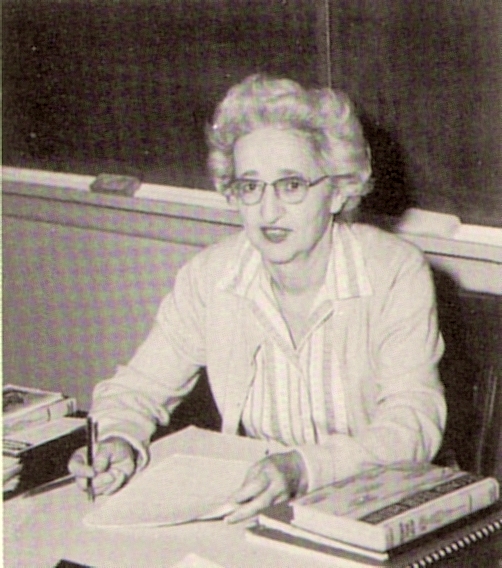 1960 photo
The
retirement of Miss Margaret Ott, veteran teacher of German at Watertown High
School, takes from the school system another longtime and dedicated school
teacher. Effective Jan. 20. Miss Ott has chalked up an almost enviable
record as an instructor and faculty member and the hundreds and hundreds of
boys and girls who studied in her classes and came under her influence can look
back with pride on her work. Miss Ott's
father, the late Dr.
John Ott who spent so many years as instructor of English and librarian at Northwestern
College, was one of the state's outstanding educators and among the city's
leading residents whose influence on and off the college campus is still felt
today. WDT
01 31 FUNDING DRIVE FOR ANNUAL POST-PROM PARTIES
Plans
now are being formulated for a finance drive to provide needed funds for
Watertown’s annual post-prom parties.
The annual post-prom parties started in 1952 but now have become an
institution in Watertown. The parties
were established in order to provide a place to go following the close of the
prom at the high school. While the Elks
Lodge sponsors the parties, handles all the arrangements and furnishes the
manpower for each party, the money required is provided by business firms,
professional people, industrial concerns and others. Approximately $700 is required for each
party.
02 24 REPAIR WORK AFTER FIRE
Work has begun at Watertown High School to repair the
damage caused by the fire which swept much of the school auditorium last Dec.
13, Russell Twesme, superintendent of schools, told the Times this morning. The work
is being done by the Maas Bros. Construction Co. of Watertown which is also the
holder of the general contract for the new Riverside Junior High School now
under construction. Mr. Twesme said that
no date has been fixed for the completion of the repairs in the auditorium but
that school officials hope it will be ready by the end of May. No events are being scheduled in the
auditorium for the balance of the current school year.
04 28 JUNIOR PROM
Outstanding decorations carried out the theme of the
junior prom of the Watertown High School held Friday evening in the
gymnasium. Murals portrayed the tales of
the 1001 Arabian Nights. There was a
colorful market place in the lobby featuring booths with wares and a mosque
with the hallway leading to the gym.
Huge camels idled near striped tents.
Three-dimensional murals depicted a mystical Arabian city. Highlight of the room was the grand march
when King Mike Groehler and his queen, Sheila Imming and their court of honor
were introduced. In the royal court
were: Carol Sweeney, Dean Strauss,
Colleen McFarland, Jack Stallman, Karen Christians, Dick Chandler, Sandy
Schmutzler, Steve Grabow, Kathy Drachenberg, Rick Schuett, Val Hintzmann and
John Hrobsky. Junior attendants were Stanley Chandler, Jean Sweeney and Madonna
Imming.
05 15 1967 ORBIT
The 1967 edition of The Orbit is out. It is a handsome, rich looking
publication. This edition is dedicated
to Miss Betsy Blazek, girls’ physical education director and cheerleader
director. The dedication is brief and
simple, stating: We gratefully dedicate
The Orbit of 1967 to Miss Blazek.” . . .
It then quotes these words from the writings of Sir James Matthew
Barrie: “Those who bring sunshine to the
lives of others cannot keep it from themselves.”
05 17 JEROME HARRIS HERREID SCIENCE AWARD
A new student honor will be presented during the Scholastic
Awards Day program at Watertown High School on May 24 in memory of Jerome
Harris Herreid who served on the faculty from 1930 to 1966. The award will be known as the Jerome Harris
Herreid Science Award and will consist of a plaque in the center of which
appears a satin bronze etching of the former teacher. Surrounding the etching are smaller plates on
which the names of the recipients will be inscribed. Since the memorial will be presented as an
annual award, it will be kept on display in the high school. Each recipient will also receive a personal
gold medal that may be worn on a tie-chain or necklace. A sum of money will also accompany this
personal award.
08 31 STANDARD PHY ED UNIFORM FOR BOYS
The Watertown Senior High School has adopted a standard
uniform for boys in physical education.
The girls have had a standard uniform for several years. The uniform will be required according to the
following timetable: Seniors:
Optional. Sophomores and Juniors:
required by the end of the first semester.
The uniform chosen will last a student several years depending on use
and care. Labeling space is provided to
insure identification. The uniform also
has a reversible top for team games.
Uniforms are available at Fischers and Kerns.
09 27 CLASS
GIFT
Trophy Case is Gift of Graduating Class /
94th Annual Commencement
A trophy case, of special design and which is
to be constructed and installed at the Watertown High School, is the 1967 class
gift to the school, it was announced during the 94th annual commencement
exercises held in the high school gymnasium.
The gift was announced by the treasurer of the graduating class, Carol
Mann, on behalf of the seniors who graduated.
The program was presided over by the class president, John Hrobsky who
welcomed the audience. The evening
opened with a half hour concert by the high school orchestra directed by
Willard Buchholtz. There was no
commencement speaker. Instead, there
were student speakers, including Judith Nowack, James Frater, and Michael Bausch. Two Foreign Exchange students who graduated
with the class and who will be returning to their homelands shortly after
spending the past school year here, also spoke . They are Ermyas Admassu of
Ethiopia and Luis Mattioli. of Argentina.
Delwin Hintzmann, president of the board of education presented the
diplomas. The high school mixed chorus
sang the traditional “The Halls of Ivy” and “Alma Mater” was sung by the
class. Donovan Richards, high school
principal, and Superintendent Russell Twesme also took part in the program. WDT
09 27 B. C. Trueblood
B. C. Trueblood, 715 Market Street, retired Watertown High School manual
training instructor and later director of the Watertown Vocational and Adult
School as it was then known, is leaving Watertown after spending the greater
share of his life here. Mr. Trueblood
came to Water-town and began his duties as a manual training instructor under
the late Superintendent of Schools Thomas A. Berto. That was in 1912. He remained in the school system here until
1946 when he resigned because of the illness of his wife who had suffered a
stroke.
1968
01 23 NATIONAL HONOR SOCIETY
Nineteen members of the Watertown
High School junior class have been selected for membership in the Watertown
Chapter of the National Honor Society.
The selection of candidates is based on four areas: scholarship, character,
leadership in ability, and services performed in school and the community. Candidates are selected by a faculty
committee. The students are: Leslyn
Amthor, Annette Archambeau, Gerald Beltz, Tim Block, Davis Bothe, Robert Byrne,
James Christian, Glenn Herold, James Kehrer, Robert Kopplin, Kirk Krempel,
Sydney McQuoid, Janice Paradies, Fred Pontzloff, Ruth Richter, Steve Schaefer,
Patricia Tessmann, Amy Thies, Robert Weisensel.
03 01 DEDICATION DELAYED
Formal dedication of the new
Riverside Junior High School, which is now nearing completion, will not take
place until next fall. Work on the
building was delayed several times during construction due to strikes and shortages
caused by strikes in other parts of the country but the work is now nearing
completion and the building is now due to be ready for occupancy during the
Easter recess in April and not by April 1 as was first indicated. Even after occupancy some work will remain
but this will not substantially interfere with the school’s operation.
04 09 1968 JUNIOR PROM
“Land of the Rising Sun” is the
theme of the 1968 Junior Prom of Watertown High School. Reigning over the
festivities will be Davis Bothe, son of Mr. and Mrs. Oscar Bothe, 1301 South
Third Street, and Linda Wilkes, daughter of Mr. and Mrs. Verne Wilkes, 908
Lyndell Street. The prom will be held on
April 25, beginning at 9 p.m., in the high school gymnasium, with the grand
march at 10 p.m. The public is cordially
invited to view the prom. Doors will open at 8:20 p.m. for the spectators and
Merlin Braasch’s Orchestra will provide music from 9 p.m. until midnight.
-- -- “FINIAN’S RAINBOW”
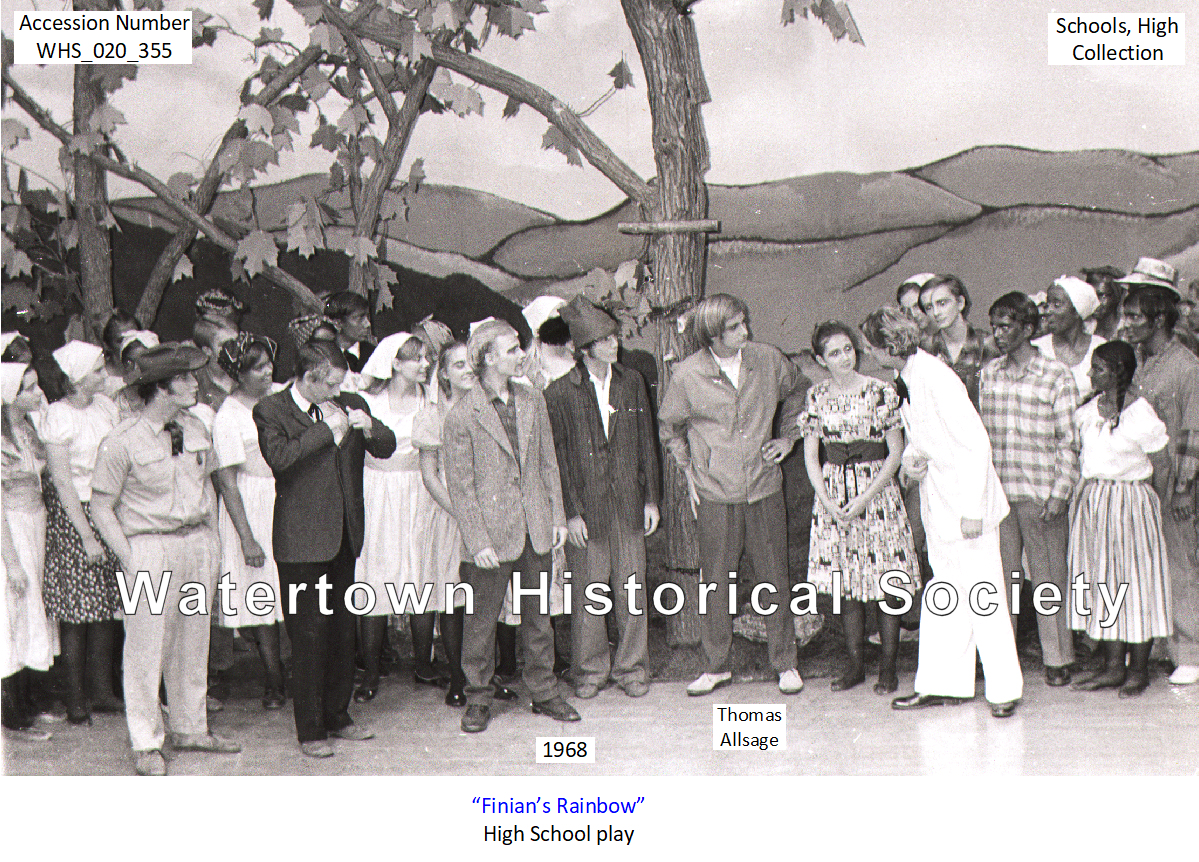 High School play
05 17 56th EDITION OF THE ORBIT
The 56th edition must be classed as
among the most handsome annuals issued since the first edition came off the
presses 56 years ago. The cover is
simple and attractive and the entire book boasts a sturdiness that makes
evident its fine quality. This year’s
book, covering 144 pages, is dedicated to no particular individual as was the
case in the past. This edition is
dedicated to the “Citizens of Watertown.”
06 08 CLASS GIFT
The class of 1968 which graduated
from Watertown High School at exercises last night before a capacity crowd in
the school gymnasium presented as its class gift a check for a microfilm reader
for the school library. The presentation
was made by Thomas Opps, treasurer of the class. Last night marked the 95th commencement of
the school. The class consisted of 314
seniors who marched across the stage in caps and gowns to receive diplomas from
Orville Wesemann, president of the board of education of the Watertown Unified
School District.
10 10 HOMECOMING
Lester J. Herro and Karen
LeMacher will reign as king and queen of the homecoming festivities of
Watertown High School this weekend.
Members of their court of honor are Gary Christenson and Linda Niay, Dan
Weber and Tina Tesch, Roy Krubsack and Sally Feld, Bob Busler and Mary
Fischer. The king and queen will be
crowned Saturday evening at the homecoming dance. Les Palmer and his band will play for the
dance, which will be held from 8 p.m. to midnight in the senior high school
gymnasium. Tickets will be available at
the door for $1.50 each.
10 20 LANDSVERK FIELD
Arnold (Rosie) Landsverk, who
died here on the evening of July 5, was one of the most popular and beloved
athletic coaches in the long history of sports at Watertown High School and
when the new Riverside Junior High School is dedicated Sunday afternoon the new
athletic field which is located on the grounds will also be dedicated to his
memory and in tribute to him as a man and as a coach. The new field was named in his honor,
“Landsverk Field,” by action of the board of education of the Watertown Unified
School District in tribute to the coach who contributed so greatly to athletics
and the physical education program at Watertown High School.
10 23 DEDICATION OF NEW JUNIOR HIGH
Robert Van Raalte, assistant
superintendent of the State Department of Public Instruction, said he was much
impressed with the new junior high school here.
In his talk at the dedication of Riverside Junior High School on Sunday
afternoon, he called attention to the very fine junior high school erected in
Watertown. He extended congratulations
to both the Board of Education and to the community for putting up so fine a
building. Yesterday afternoon’s
dedication program was well attended.
During the Open House a large number of persons visited the various
areas of the school, and all were impressed with the triangular classrooms, one
of the features of the new building.
-- -- MIXED
CHORUS
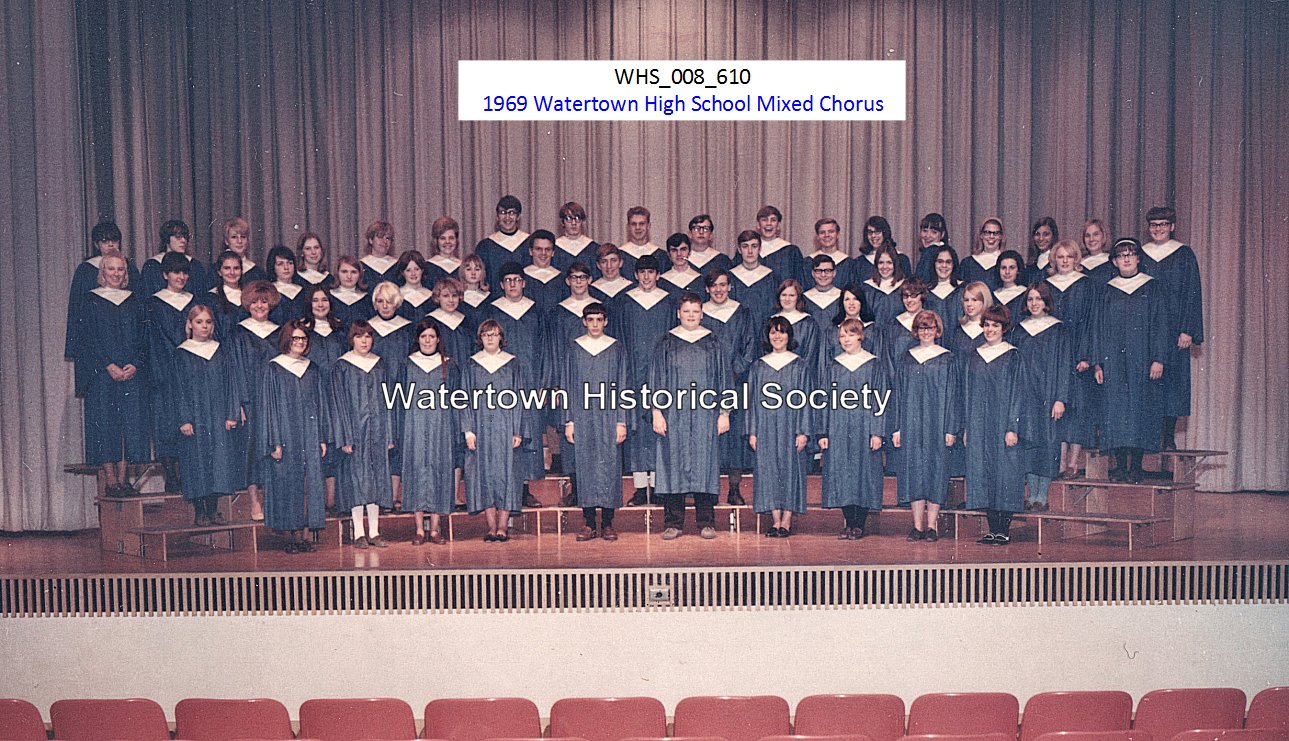
02 27 DRESS CODE ISSUE
About 20 students at Watertown High School Thursday defied an
administration policy regarding school dress.
The girls came dressed in culottes and pant-dresses. The student council proposed to the
administration that "the present dress code be modified to include
culottes and pant-dresses for girls.
These outfits must be of acceptable length. The reply from the administration was
"It seems reasonable that if students are not now able to dress so as to
promote modesty and dignity of dress that they would not insure acceptable
length and style of culottes and pant-dresses.
Therefore, the wearing of culottes. pant-dresses and other styles of
divided skirts will be prohibited."
High school principal Donovan Richards stated that between 10 and 12
persons were sent home up to noon Thursday to change their clothes to comply
with the school dress code. He said the
students sent home were wearing everything from culottes to bermuda shorts.
04 11 POST PROM ENTERTAINMENT CHANGE
The post prom party will have a different format this year for
the first time in its 18-year history.
Those attending the party, which is held annually at the Watertown Elks
Club, will be entertained by a popular rock and roll band. in contrast to the
orchestras and variety acts hired for the event in past years. Tony's Tygers, a top rock band from
Milwaukee, will provide the entertainment.
The band, which is frequently hired for events of this type, had a
record on the national record chart several months ago. The record, "Little by Little," is
known well by the young set across the nation.
04 18 POST PROM PARTY COMMITTEE
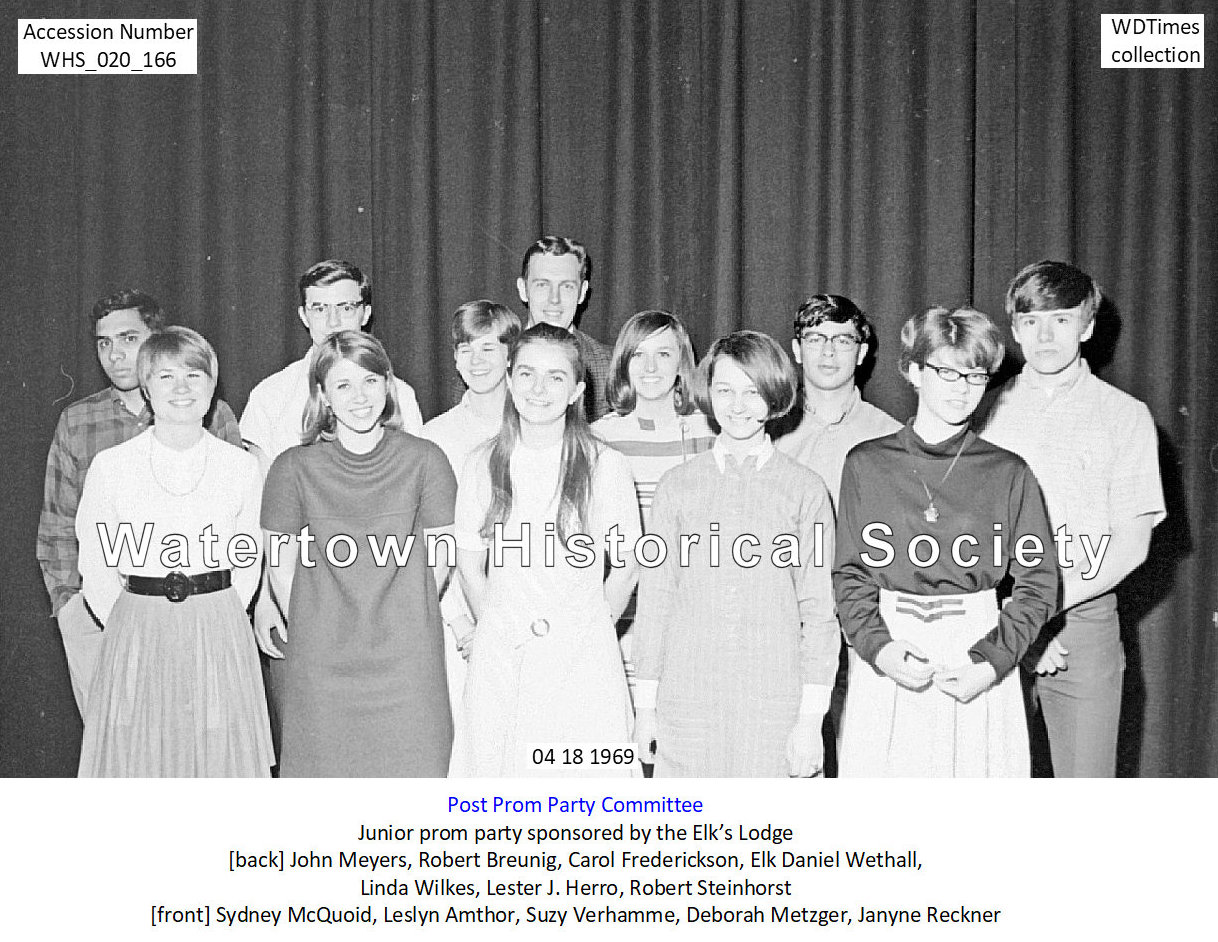 Junior prom party
sponsored by the Elk’s
Junior prom party
sponsored by the Elk’s
John Meyers, Robert
Breunig, Carol Frederickson, Elk Daniel Wethall, Linda Wilkes, Lester J. Herro,
Robert Steinhorst, Sydney McQuoid, Leslyn Amthor, Suzy Verhamme, Deborah
Metzger, Janyne Reckner
05 05 1969 PROM
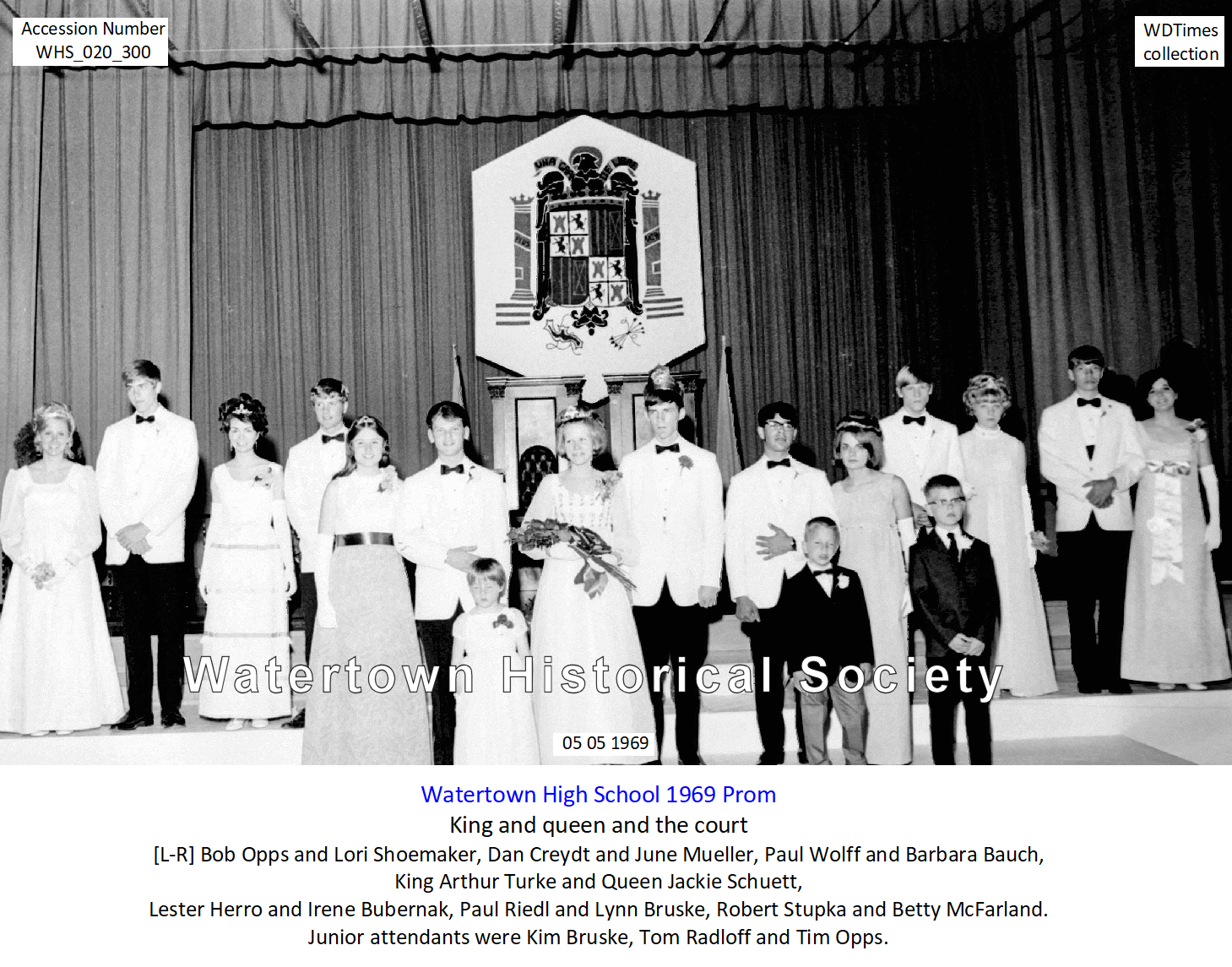
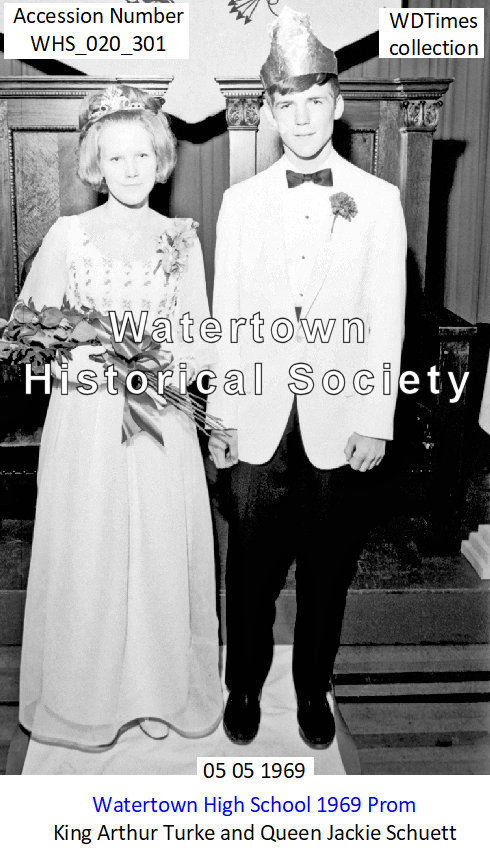
Bob Opps and Lori Shoemaker, Dan Creydt and June Mueller, Paul
Wolff and Barbara Bauch, King Arthur Turke and Queen Jackie Schuett, Lester
Herro and Irene Bubernak, Paul Riedl and Lynn Bruske, Robert Stupka and Betty
McFarland. Junior attendants were Kim
Bruske, Tom Radloff and Tim Opps.
05 19 THE CHAMPS, 30 years later
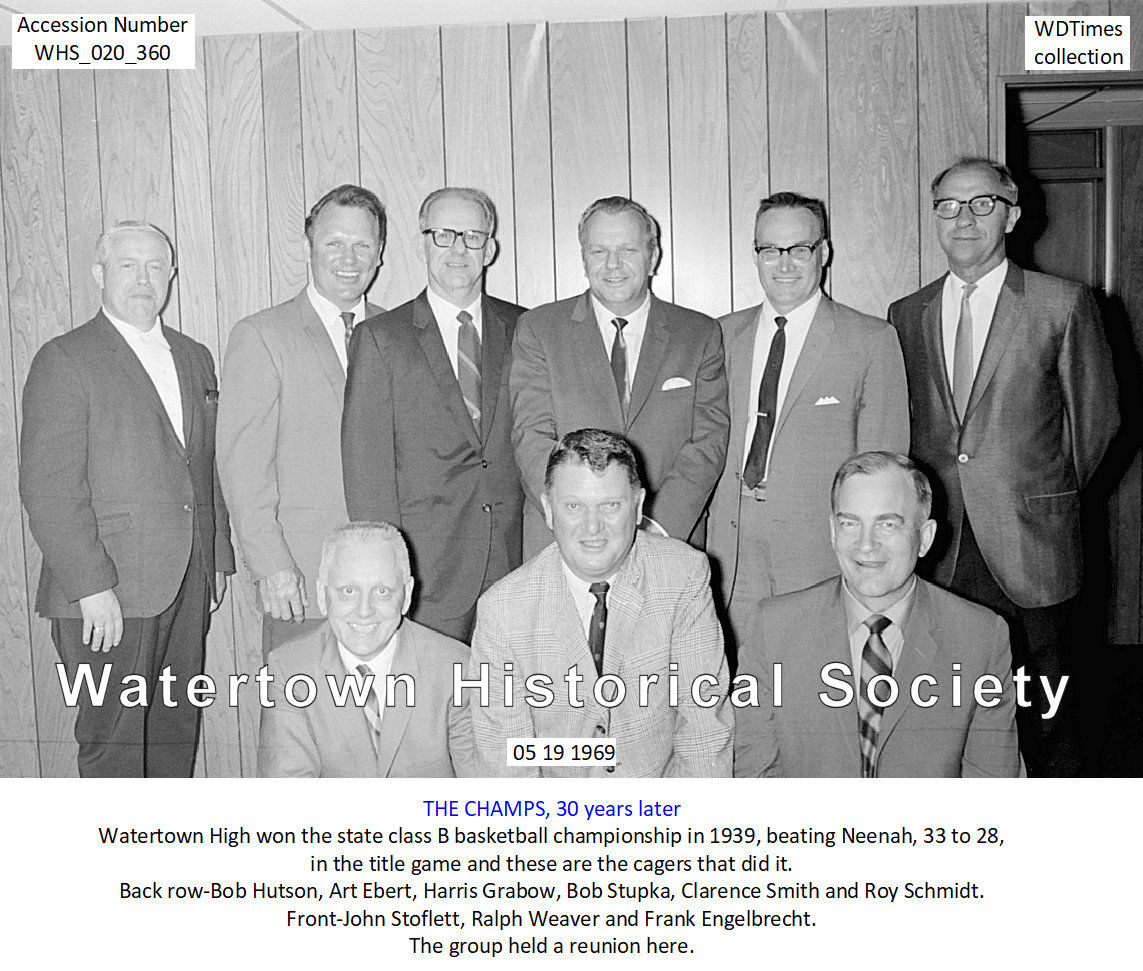
Watertown High won the state class B basketball championship in
1939, beating Neenah, 33 to 28, in the title game and these are the cagers that
did it.
Bob Hutson, Art Ebert, Harris Grabow, Bob Stupka, Clarence Smith,
Roy Schmidt, John Stoflett, Ralph Weaver and Frank Engelbrecht.
05 20 STUDENTS FOR FOOD CAMPAIGN


Robert Kopplin, Fred Mueller, Peg McFarland, David Willeford and
Fred Pontzloff.
The food has been turned over to the Jefferson County Welfare
Department for distribution to needy families.
One hundred high school students were involved in the canvass.
05 24 SCHOLARSHIPS AWARDED
Scholarships valued at $101,355
were awarded to Watertown High School seniors today at the annual scholarships
award day program which began at 9:20 a.m.
Heading the large list of awards were four Joseph E. Davies scholarships
totaling $12,800. The presentation of
the Davies scholarships was made by Lee Block, president of the board of
education of the Watertown Unified School District. The four winners are Janice
Paradies, Davis Bothe, Fred Pontzloff and Robert Kopplin.
06 02 CLASS
OF 1919 / 50-year reunion
A. E. Bentzin,
Harold Hartwig, Wallace Buffmire, Meta Donner Schmutzler, Harold Achtenhagen,
Aileen Daw Gottschalk, Arthur Mallow, Aileen O'Byrne Craig, F. E. Henke, E. W.
Simdar and Edward J. King, Verna Ebert Saniter, Hazel Hathaway Frater, Cora
Maass Kaercher, Mabel Bock Schmidt, Hattie Lange Dunn, Florence Amadon
Swenehart and Irene Collins, Mary Bell Gallagher Stanrecheck.
06 04 1969 EDITION OF THE ORBIT
The 1969
edition of the Orbit, which is the senior class publication of Watertown Senior
High School, was issued to subscribers this week. This year’s theme is “Turn of the
Wheel.” This issue, which is the 57th
edition of the annual publication, is dedicated to Al Rippe, former Watertown photographer who recently sold his studio
here and moved to La Crescenta, Calif.
The dedication reads “The Orbit Staff of 1969 dedicates its Orbit to Mr.
Al Rippe, a well-known photographer in Watertown for many years. Through his efforts and countless hours of
hard work, patience, and understanding, he has enabled Watertown High students
to capture memories through pictures in the Orbit.”
“One thing about the Orbit
dedication which affected me emotionally was the fact that it turned out to be
a father and son honor. You see, the
Orbit had been dedicated to my dad sometime in the mid 20's. He was the custodian of high school at that
time and evidently was pretty well liked.
I remember him telling how he would sneak the boys into the boiler room
during the half time at basketball games, so they could have a smoke. At that time you wouldn't dare have a
cigarette within a block of the school.
I know he liked the students and they liked him.”
10 15 HOMECOMING FESTIVITIES / WATERTOWN vs.
OCONOMOWOC
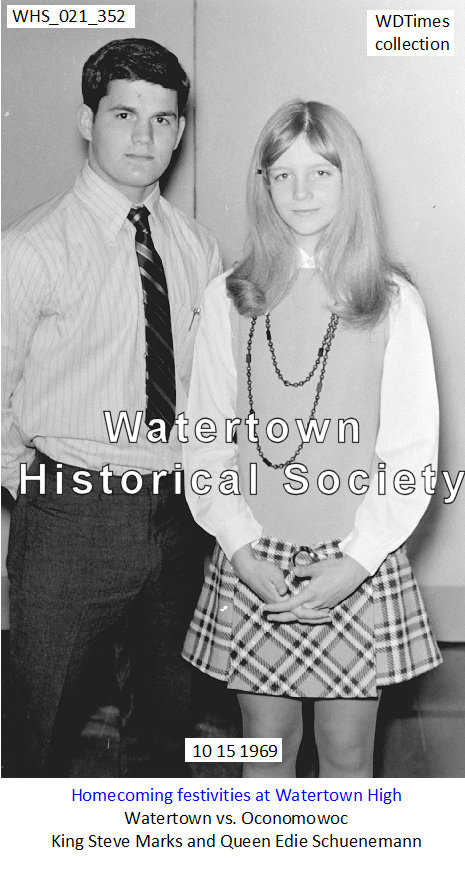
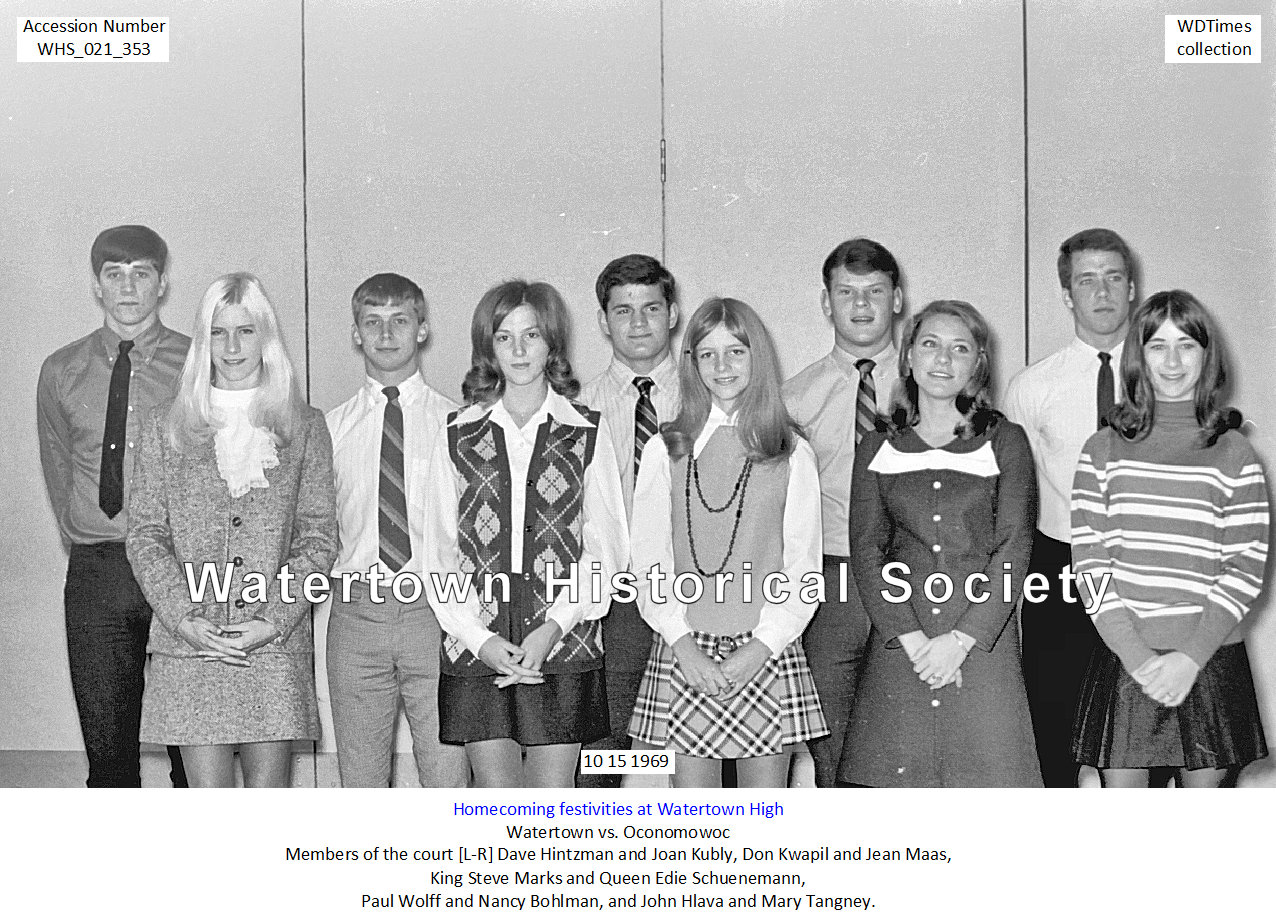
Members of the court: Dave Hintzman and Joan Kubly, Don Kwapil and
Jean Maas, King Steve Marks and Queen Edie Schuenemann, Paul Wolff and Nancy
Bohlman, and John Hlava and Mary Tangney.
11 20 NATIONAL HONOR SOCIETY CANDIDATES

Ten seniors of Watertown High
School named candidates for the local chapter of the National Honor
Society. Glen Siferd, Dave Martin, Kiara
Kritz, David Dettmann, Jim Schultz, Yvonne Retzlaff, Jean Fendt, Jill Uttech,
Janice Huebel and Debbie Usher
1970
06 04 COMMENCEMENT EXERCISES

Ray Kubly, president of the board
of education of the Watertown Unified School District and Superintendent of
Schools Russell Twesme present a diploma to Takaaki Hirai, foreign exchange
student from Japan. John Hlava, Jeffrey
Ertl, David Wolff, Jean Peirick, Myriam Montano, Elizabeth McFarland.
10 07 HOMECOMING ROYALTY
Reigning over homecoming activities: King Ed
Dehnert and Queen Barbara Golper.
10 30 NATIONAL HONOR SOCIETY
Eleven Watertown Senior High
School students selected to
become members: Michael Schmidt,
Edward Frami, James Wrass, Thomas Klecker, Robert Nowack, Kale Butenhoff, Diane
Stueber, Mona Miller, Sherri Kohlhoff, Jacquie Burbach and Chris Grosnick. High School Principal Russell Loven.
1970-76
-- -- JOHN DAVID, History teacher and football coach

While at Indiana University John
had played football and was a member of the 1968 Rose Bowl team. Upon graduation, he taught US history and coached
football at Watertown Senior High School from 1970 to 1976 before joining the family business with his dad and brother. He served as the Mayor of the City of
Watertown for 12 years. Obituary
-- -- CLASS OF 1971
Class
reunion held in 2022 (due to Covid)
1972
-- -- CLASS OF 1972 had 50-year
reunion in 2022
01 26 ELEANOR GRIFFITH, 1902-1975
Miss Eleanor Griffith, 72, of 102
Tivoli Drive, a former Watertown Senior High School teacher, passed away Sunday
evening at the Watertown Memorial Hospital following a lingering illness. A memorial service will be held at the First
Congregational United Church of Christ Wednesday afternoon at 2:30 o’clock with
the Rev. Robert Tully officiating. The
body of Miss Griffith has been donated to medical science. Memorials may be given to the church missions
of the First Congregational United Church of Christ or the Cancer Fund. The Schmutzler Funeral Home is in charge of
local arrangements.
Miss Griffith was born in
Columbus, September 15, 1902.
Miss Griffith was a graduate of
Ripon College and did graduate work at the University of Wisconsin, University
of California, Northwestern University in Illinois, Colorado State University,
Indiana University, Arizona State University and New York University. She taught mathematics at the senior high
school from 1925 until her retirement in 1967.
She had been the Girls’ Club advisor since 1944 and also served as the
junior class advisor. Miss Griffith was
an excellent and truly dedicated teacher.
She was interested in all phases of extra-curricular activities at the
high school. She was a member of the
First Congregational United Church of Christ, served on the church board for a
number of years, and was currently a member of the diaconate.
1976
-- -- HIGH SCHOOL PROM, 1976
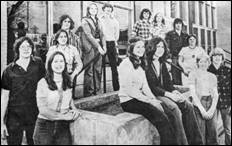
Bev Spoerle, Randy Leys, Pat Zillmer, Ed Klebig, Jeanne Kuehl, Steve Kwapil,
Scott Walters, Nancy Crandall, Mike Saniter, Linda West, Jack Weihert, Judy
Christian, Mike McDonald, Pam Bartee.
1977
09 27 1977 HOMECOMING EVENT
The 1977 Homecoming will be held during the week
of Oct. 10 through 15 at Watertown High School.
This year Homecoming has been re-organized to promote more participation
by students, alumni, and the community.
An evaluation of the 1976 Homecoming was conducted last year by a
committee of students and teachers who produced a set of guidelines by which
this year’s Homecoming will be conducted.
The Homecoming Committee for 1977 consists of Anne-Marie Condon, student
council president; Vicki Joyce, student council vice president; Lauri Bush,
senior class president; Carey Bergdoll and Kim Veldhuizen, junior class
representatives; Dennis Nicoski, sophomore class representative; and Jim
Bauman, representing the student body-at-large.
This committee has worked for weeks to produce the 1977-78 Homecoming
Handbook which contains all of the rules and regulations, entry blanks, judging
criteria, and due dates for all activities to be conducted during Homecoming
Week. WDT
1978
06 09 GRADUATION
Diplomas were awarded to 328 graduating
seniors at Watertown Senior High School commencement exercises Saturday
afternoon. Most students said they were
hot and nervous as the temperature rose into the 80s before the program. One student asked if hair pins would hold the
mortarboard securely so it wouldn’t fall off.
But the nerves were controlled and the temperatures endured as graduates
and spectators listened to the commencement address by George Walter, professor
emeritus at Lawrence University. WDT
1981
Oct “MOST
DRAMATIC WIN IN SCHOOL HISTORY”
Watertown vs West
Bend East
Barry Vredenbregt contribution: It was more than 25 years ago when then
Watertown High School football coach Dan Herbst was cleaning out an office and
gave me a 16-millimeter film canister that held the game vs West Bend East from
October 1981. The game had, what is
believed to be, even to this day, the most dramatic win in school history: An 80-yard TD with six seconds remaining. So with the Class of 1982 having its 40th
class reunion on Saturday at the Elk's Club, I had the film digitized. Two of the three main people involved in the
play were at the reunion: Quarterback Jeff H. Harris and Tight End, Brian
Wegner. Unfortunately, Jon Moldenhauer, who caught Harris' pass that was tipped
by Wegner, and then ran for a touchdown as the clock expired, is no longer with
us. https://www.youtube.com/watch?v=Ws5IEBhUmQs
1985
03 02 W.I.A.A. REGIONAL CHAMPIONSHIP BASKETBALL
GAME
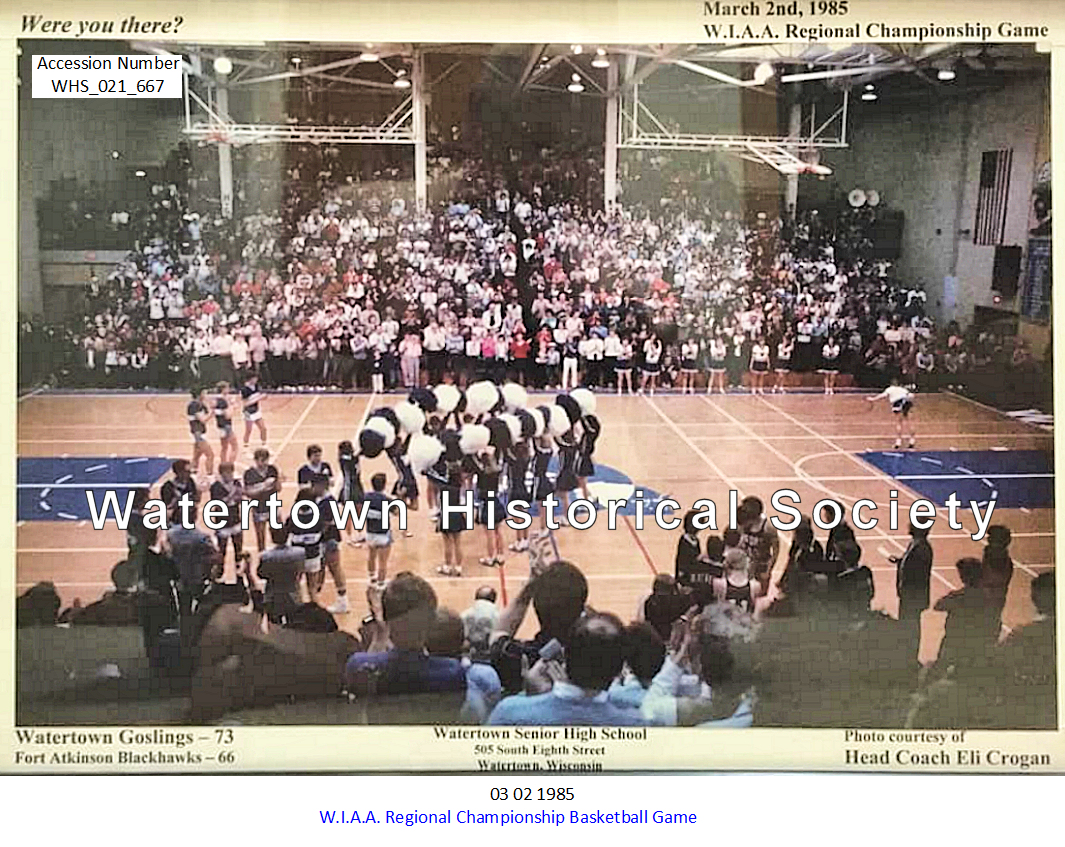
07 15 A new chemistry lab to meet the needs of
expanding enrollments in that subject was approved by the board of education of
the Watertown Unified School District.
The new lab will be constructed in room 332 of the high school and will
cost $18,965. In addition, there will be
costs for minor remodeling as well as some electrical and plumbing work. Total cost of the project is estimated at $26,695. The lab will handle up to 24 students and is
designed to be moved to a new location or a new building in the future. The lab is being purchased from School
Interiors, Inc., of Milwaukee. WDT
09 07 “The Dawn of a New Day” is the theme for this
year’s Watertown Senior High School yearbook to be distributed starting
today. The theme combines maximum
coverage of school activities with a new layout style in the opening section. The publication contains 152 pages with seven
full-color pages. Color section includes
homecoming, the musical “Oliver,” student life and full-color page of the
school. There are also sections on Snow
Week, the spring play, prom, sports and clubs.
The new layout style features candid school scenes in the junior, sophomore
and faculty picture sections, and also within the index at the end of the
book. Individual cameo photos of seniors
are pictured on a black background. Two
pages are covered with senior signatures.
WDT
10 11 A high school facility in Watertown
should have about 321,000 square feet of space, more than double what the
current high school has, according to a “Suggested Final Space Program” which
will be discussed by the board of education of the Watertown Unified School
District Wednesday evening. Members of
the board of education have received the proposed space allocation study and
its results will be discussed briefly by Dr. Richard Stolsmark, superintendent
of schools, at the meeting Wednesday. T hese space needs are being proposed for
the three options being considered by the board to improve the high school
facilities. Those options are complete
renovation of the existing high school, changing the junior high school to a
high school and construction of a new facility.
WDT
1987
04 16 GYMNASIUM FLOOR
Costs to repair, resand and repaint the
gymnasium floor at Watertown Senior High School are components of the
maintenance segment of the proposed 1987-88 school budget. The operations and maintenance budgets of the
Watertown Unified School District were presented to the board of education
Wednesday night. The two budget segments
were presented by Dennis Mudler, business manager, and Bruce Saniter,
supervisor of buildings and grounds.
Mudler said wooden boards beneath the two main baskets in the high school
gymnasium have become so worn that when they are stepped upon, the opposite
ends of the boards actually become elevated.
WDT
1988
03 08 MICHAEL PTACEK
Michael Ptacek is the new principal of
Watertown Senior High School. He had
served as acting principal since the resignation of Charles W. Dill in
February. Ptacek was previously the
assistant principal of the high school since June of 1983, when he was named to
succeed JoAnn Truss. WDT
05 01 TOP STUDENTS
The top 10 students in the class of 1988 of
Watertown Senior High School have been announced by Michael Ptacek,
principal. The top students are selected
on the basis of academic achievements and grade point average for their high
school years. The top 10, in
alphabetical order, are Matthew Arpin, Andrew Crawford, Abbigail Endres,
Michael Krolnik, Robert Lemke, Loren Mach, Michelle Mueller, Tracey Nickels,
Sue Ullrich and Jennifer Welbourne. WDT
05 09 1988 PROM
About 375 students danced to the music of
Interface at Watertown High School’s junior prom Saturday night, according to
chaperone Diane Schmidt. The theme of
this year’s dance was “Stairway to Heaven,” the classic hit by Led
Zeppelin. Post prom activities were
highlighted with a performance by Tohjah, a band from southern Illinois. The dance went smoothly, Schmidt said, adding
that the students “were very cooperative.
We had a very good showing.”
Steve Andrews and Alisa Harris reigned as prom king and queen. The court included Brian Raguse and Rachel
Quest, Cheng Yang and Amy Scheiber, Todd Schumann and Jan Neubauer, John
Fischer and Valeri Lampman, and Chris Buescher and Jenny Kwapil. Crown bearers were Matt Scheiber and Tera
Rowoldt. WDT
06 08 CLASS OF 1988
On a sun-drenched morning at Riverside Park,
252 seniors from Watertown Senior High School received their diplomas Saturday,
graduates who hoped their futures would be as bright as the cloud-free
sky. Students were in a celebratory mood
as they reflected upon the culmination of their high school days. Beach balls bounced from graduate to
graduate, occasionally straying onto the stage.
Enthusiastic cheers greeted the announcement of the more popular
students and even air horns were sounded.
“The school is proud of you, not because you graduated, but because you
are winners,” said W. Charles Dill during his welcoming speech. Dill recently resigned as high school
principal to accept a similar position at Johnsburg High School in McHenry,
Ill.. WDT
1989
01 20 BEST
SITE IS HWY
109, NORTH OF HWY16 BYPASS
The city’s plan commission heard
reasons from Watertown school officials why the proposed school site is the
best currently available. Dr. Richard
Stolsmark, superintendent of schools for the Watertown Unified School District,
told commission members that the proposed site, one of seven reviewed by school
officials, seemed to be the best location available when the district purchased
the former Stangler farm. “We thought it
was as good as we could do — we were aware the bypass was there, but we feel
that’s a problem that can be solved,” Stolsmark said. The proposed location of the school, planned
at state Highway 109 just north of the Highway 16 bypass, has become an issue
for the district’s referendum election on Feb. 21. Voters will be asked to approve bonding for
$16 million to finance the construction of a new high school.
02 08 VIOLATION
OF BUILDING CODES
Watertown Senior High School was one
of 437 old schools in the state that were inspected and found to be in
violation of some current state building codes.
The study was conducted by the Wisconsin Department of Industry, Labor
and Human Relations (DILHR). Watertown
Senior High School, more than 70 percent of which was built in 1917, was among
those listed as having some violations related to fire safety. The DILHR report
listed three violations at Watertown Senior High School: (1) The facility lacks automatic door-closing
devices in its stairwells; (2) The facility lacks smoke detection devices in
its basement; and (3) The facility lacks proper exit lighting.
02 10 SMITH
FARM OPTION. The
Watertown Area Chamber of Commerce Promotive Corporation has entered into an
option to purchase the 300-acre Warren Smith farm, and offer about one-third of
it for sale to the Watertown Unified School District as a site for the new
Watertown Senior High School. The land
is located in the northwest section of the city and its western property line
is the eastern property line of soon-to-be developed Quarry Park, a 174-acre
park which is owned by the city. The
farm is located west of North Church Street, north of Elm Street and east of
Carriage Hill Drive and the Mary Knoll Subdivision. The board of education of the Watertown
Unified School District supports the acquisition and has made the site its
prime location for the new high school which is the subject of a referendum on
Feb. 21. This site will eliminate
opposition expressed by some that the Robert Stangler farm, purchased by the
school district in 1985 as the high school site, was a dangerous location
because of the need to cross the Highway 16 bypass to gain access.
02 12 MAYOR
IS KISSED. Two
weeks ago, it seemed unlikely that Mayor David R. Lenz and Richard Stolsmark,
superintendent of schools for the Watertown Unified School District, would find
common ground on the location for a new high school. But a voters' forum Thursday night, not only
were both men sitting next to each other, smiling and in agreement on the
latest proposed site, but Stolsmark even kissed
the mayor on the top of his head at the conclusion of the meeting. The night's final question jokingly suggested
that Stolsmark had promised to kiss the mayor if the city worked out a deal on
a new site. The superintendent of
schools obliged the audience of about 50 people with a peck on the mayor's
head.
03 19 INDUSTRIAL
ARTS DEPARTMENT — TECHNOLOGY EDUCATION
As Watertown High School moves
to the 1990s its Industrial Arts Department — now referred to as Technology
Education — needs to modernize its facilities and enlarge its curriculum. That was the opinion of the department’s
teaching staff as they presented school board members with plans for updating
technology education at the high school.
“The bottom line is we need to prepare a better student,” said machining
instructor Bruce Magnuson. “This program
needs to be dynamic. Presently I have no
academic facility at all to work in.
It’s basically a shop and I struggle with that every day.”
04 22 SMITH
FARM OPTION REJECTED
The Watertown Area Chamber of
Commerce Promotive Corporation has decided not to exercise its option to
purchase the Warren Smith farm, a move that seriously jeopardizes that site as
a potential new high school location. City Attorney Robert A. Bender, a member
of the promotive corporation, said the board decided Wednesday that the asking
price for the land, about $5,000 an acre, was too much. “We elected not to
pursue the option. We had some difficulty in reaching agreement with Mr.
Smith,” Bender said.
05 16 “TIME
IN A BOTTLE”
The theme of
the 1989 Watertown Senior High School prom Saturday when students danced the
night away to tunes from the top 40 hits at the high school gymnasium. The king and queen, Pam Da Walt and Steve
Meyers, were crowned by the 1979 king and queen, Kevin Conley and Jean Sweeney
Kohlhoff. In keeping with the theme for
the evening, couples traveled through a “time tunnel” for the grand march and
walked over a large clock on the floor.
Silhouettes from the 1930s, ‘40s and ‘50s decorated the walls. Couples enjoyed dancing to music provided by
a band called “Toys.”
06 10 307
GRADUATING SENIORS
Despite gray skies and steady rains outdoors,
the mood inside Watertown Senior High School was upbeat and festive Saturday,
as 307 graduating seniors bid their final farewells to teachers and classmates
during annual commencement exercises.
Graduation ceremonies were to be held outdoors at Riverside Park, but
were relocated to the high school gymnasium at the last minute due to
threatening weather. It turned out to be
the right move by administrators as a steady downpour began to fall just prior
to the ceremony’s scheduled 10 a.m. start.
1990
05 07 “ALMOST
PARADISE”
For more than 200 students, Saturday night
was “Almost Paradise.” That was the
theme of the Watertown High School junior class prom held at the high
school. There were about 246 individuals
attending the prom activities at the high school, according to organizer Kathy
Wagner. The final count was down about 70 students, she noted. Wagner said the prom committee had
anticipated about 350 students because of the expansion of the ninth grade at
the high school. “We expected the
attendance to be up,” she said. Wagner
thought maybe the cost deterred several students from attending.
06 02 CLASS OF 1990
Despite strong gusty winds
and the persistent threat of rain, Watertown High school’s class of 1990
successfully graduated 244 seniors during outdoor commencement exercises
Saturday morning at Riverside Park. Under ominous gray skies, the students were
greeted by class secretary Amy Endres, who introduced this year’s class song,
“Forever Young” by Rod Stewart. The graduates then heard from a number of their
fellow classmates, including student council president Jennifer Hanson, class
treasurer Jim Beranek, foreign exchange student Frede Lei, Erin Boyd and Brooke
Nustad representing the top 10 students and Chris Brom, senior class
representative. WDT
09 24 HOMECOMING
THEME: “THE JUNGLE”
Homecoming activities
are in full swing at Watertown Senior High School this week, according to
organizers of the event. The 1990-91
Watertown Senior High School Student Council is making a special plea to alumni
of the school to participate in the activities during the weekend. This year’s theme is “The Jungle.” Alumni are welcome to support the Gosling
football team when it takes on the West Bend West Spartans Friday at 7:30 p.m.
at Washington Park. King Tony Meyers and
Queen Jenny Wilson and other members of the homecoming court will be introduced
at halftime. The high school band and
cheerleaders will also entertain at halftime.
WDT
12 11 CHOICE
BETWEEN STANGLER AND SMITH SITES
There is a good chance
Watertown voters will be deciding where to build a new high school before they
actually decide whether or not they want to build the school itself. Members of the Watertown School Board’s site
committee have decided to propose an advisory referendum in April providing
citizens with a choice between the Stangler and Smith sites for a future high
school facility. The entire board will
vote on the committee’s recommendation at their regular monthly meeting
Wednesday in the Educational Service Center, 111 Dodge St. That meeting begins at 7:30 p.m. The school board purchased the 108-acre
Stangler farm in the fall of 1985 for $2,500 per acre. Since that time, questions have been raised
pertaining to the safety of its location for a high school. City residents would have to cross the
Highway 16 bypass to reach the site, located near Watertown Memorial Hospital
on the city’s far northeast side. The
Smith farm is located on the city’s northwest side and was not for sale in
1985. Since that time negotiations
between the owners and the school board have taken place and a sale agreement
is believed to be possible. WDT
1991
02 16 STANGLER
AND SMITH SITES FOR NEW HIGH SCHOOL
By approving a referendum in April on a
choice between the Stangler and Smith sites for a new high school, the
Watertown Board of Education Wednesday evening effectively rejected a fourth
potential site. The fourth site first
came up for discussions when the site committee met Monday. That group reviewed the Stangler, Smith and
Darcey sites as well as a new proposal for the Endres farm. The Darcey site is located along Boulder Road
(old County Trunk Highway M), and the Endres site is located on West Road in
the town of Watertown. Ed Kileen
appeared before that committee to offer that 78 acre parcel of land at a cost
of $390,000 which is $5,000 an acre.
04 29 POST
PROM PARTY SALVAGED
The post prom party,
which has been a tradition after Watertown High School proms for almost 40
years, was salvaged this week after nearly becoming extinct. Kathleen Wagner, a guidance counselor at the
high school, said a group of students came forward with suggestions that may
keep the party alive for years to come.
Declining attendance at the party for the past several years left the
status of this year’s party in doubt.
Wagner said several student groups were approached for ideas that might
make the party more popular. “We tried
to get a feel for what they really wanted,” she said. “We wanted students to get involved in
planning the party and getting the attendance back up.” When the student groups failed to respond to
administration inquiries, the 39-year-old tradition was in danger of fading
away. WDT
05 11 1991
JUNIOR PROM
About 110 couples
attended the 1991 junior prom at Watertown High School Saturday. The theme for the prom, held in the school
gymnasium, was “Hold On to the Night.”
Students danced to the music of Johnny Law. Queen Dana Richter and King Dominic Alvarez
reigned over the festivities. Selected
in voting by the junior class in March, they were announced during the grand
march. Other members of the court were
Crist Harris and Kelly Brusenbach, Jason Wesemann and Tammie Nass, Joel Herbst
and Stacy Schneider, Brenda Behlke and Brad Thompson, Kate Hornickle and Elliot
Clark, and Keye Bruske and John Ehlinger.
WDT
06 14 GRADUATES
ARE LIKE BUBBLES
Students in the
Watertown High School 1991 graduating class are like bubbles, each is
different, some drift far away, while others stay close to home. That was how Watertown High School senior
class representative Andrew Mullen described the future to his fellow
classmates at commencement ceremonies Saturday morning at Riverside Park. Under a bright, cloudless sky, Mullen
demonstrated his concept by blowing bubbles into the air. He explained how the container is the high
school and the liquid is the graduates leaving school. "Each is different, each goes a
different way," he noted. He also
expressed the need to live for the present and not the past. "The present is all that exists,"
he said. WDT
07 02 KATHY
WAGNER NEW PRINCIPAL
Kathy Wagner, assistant
principal for Watertown Senior High School, will become the new principal on
Aug. 1, according to Dr. Suzanne Hotter, superintendent. Wagner was offered the position Monday
evening following an executive session of the board and accepted the contract
on Tuesday. The board is expected to
formally approve the contract at a meeting on Aug. 24. Wagner succeeds Michael Ptacek who accepted a
principalship in a Minneapolis suburb. WDT
08 24 1991
WATERTOWN HIGH SCHOOL ORBIT
The 1991 Watertown High
School Orbit will be distributed in the Dodge Street lobby from 1 to 5 p.m.
Wednesday. The theme of this year’s
yearbook is “Showcase,” a tribute to the talents and abilities of students who make
the high school their showcases. The
189-page book has a silver and blue cover with embossed lettering and red
accent color. The red accent color is
picked up in the opening section of the book and the blue is used as a
background color in the senior color section.
Endsheet artwork on the inside of the front cover depicts a blue stage
curtain opening. A closed stage curtain
is depicted on the inside of the back cover.
Theme sections in the yearbook include “For All to See,” which
highlights special events during the school year, “Spectacular Performance,”
which chronicles Gosling sports, “Exhibits of Interest,” which displays the
photographs of students, faculty and administration, and “On Display,” in which
students are quoted on their views of the high school, music and what
constitutes “style.” WDT
11 04 SUPPORT
CONSTRUCTION OF NEW HIGH SCHOOL
The Watertown High School has had
a history of additions and renovations since its original construction in
1917. One question facing the Nov. 12
referendum is whether residents think the school is still able to meet the
educational needs of students. Another question is whether they can afford the
$20 million price tag. Three additions
have been made onto the high school since it was built in 1917. The additions increased the size of the
building from its original 96,953 square feet to the current size of 131,746
square feet. Since then, regular
maintenance has kept the building structurally safe but repairs are becoming
increasingly complex. Proponents of a
new school said it is time to stop patching up the building. Instead, they support the construction of a
274,810 square foot facility on a portion of the 180-acre Warren Smith
farm. The last time the high school
received a face-lift was in 1964 - almost two decades ago. Science and technology of the future cannot
conform to the space limitations, especially in the 76-year-old portion of the
building, administrators stress.
1992
01 13 BACK TO THE AGE-OLD TRADITION OF
GRADUATION
Four years
ago Jerry Kreitzman attended a graduation ceremony at Watertown High
School. He never forgot what he
saw. Instead of young adults passing a
milestone in life, he saw rowdy teenagers throwing balloons and disrupting the
procession. It was then he vowed to
bring dignity back to the age-old tradition of graduation. The ceremony has
been revamped little by little since Kreitzman came to the rescue. As a teacher of history and government at the high school he has tried to instill
appreciation in his students of the finer points of pomp and circumstance. His crusade got a boost Wednesday evening
when the board of education approved the purchase of academic robes for faculty
members who wish to attend the June 6 graduation. For Kreitzman and administrators, it
signified the board’s respect of academia.
05 06 1992
HIGH SCHOOL PROM
As hundreds of people
looked into a mystical medieval world Saturday night, juniors Stacey Mathews
and John Daniels felt the magic of being crowned queen and king of the
prom. The prom drew 135 couples,
Principal Kathy Wagner said. The number
was up from last year’s attendance of 110 couples. “That’s a good turnout,” she said. “I’m pleased with it. For a couple of years I was concerned about
lowering attendance but now it looks good.”
The prom, hosted by the class of 1993, took on the aura of its theme —
medieval magic. A castle which reached
to the ceiling of the Watertown High School gymnasium and murals of trees took
those in attendance to Sherwood Forest. WDT
05 26 EARL
HENNESSY
A teacher who has
worked in the Watertown Unified School District 29 years has been given the
Lawrence Award for Outstanding Teaching in Wisconsin. High school history teacher Earl Hennessy has
been notified by Lawrence University in Appleton. that he is one of two
teachers selected. Hennessy was
nominated by a former student, Leslie Hanson, who is now a senior at
Lawrence. Hennessy will be awarded a
cash prize of $1,000 and a separate amount of $250 for high school library
acquisitions at Lawrence's commencement ceremonies June 14. The university. will release additional
details at that time. "When I got
the letter (announcing the award) I read it three times." he said.
"Then I called and asked if this was on the level."
05 30 GROUNDBREAKING
FOR $20 MILLION HIGH SCHOOL
A milestone in the
construction of the $20 million high school is planned for the last weekend in
May. Ground breaking for the 300,000
square foot school will take place at 2 p.m. Sunday at the corner of Fremont
and Elm streets on the northwest side of Watertown. The high school is located near Quarry Park,
a 168-acre parcel under development by the city of Watertown. Shared outdoor facilities for environmental
studies, physical education stations and athletics are part of the arrangements
in the design of the two facilities. WDT
06 01 START
OF CONSTRUCTION OF $20 MILLION HIGH SCHOOL
The official start of
construction for a $20 million high school was marked Sunday afternoon as
honorary guests turned over the first clumps of ground at the site. About 50 people gathered on a grassy hill at
the Smith farm for a short ceremony marking a new phase of the school building
project. Casually sitting in lawn chairs
and leaning against cars, the onlookers came to witness the site one more time
before it is transformed into a four-wing, 300,000-square-foot community
center. “As we turn the first shovel of
dirt this afternoon, we are about to start construction of the biggest project
our community has ever undertaken,” school board President Glenn Schwoch told
the onlookers. “We cannot predict the
future but this building project is concrete evidence . . . that the people of
Watertown want to be prepared for that future.” WDT
06 06 1992
GRADUATION
With a feeling of uncertainty
and a prominent sense of urgency, Watertown High School graduates took the
stage at Riverside Park Saturday to receive diplomas. The sun shone through the clouds just before
the 241 anxious young adults began receiving their diplomas in front of a sea
of instamatic cameras held by beaming relatives and friends. Thousands of onlookers crowded the park to
catch a glimpse of the ceremony and more than 100 kindergartners were bused in
to witness the ceremony in order to remind everyone of how fast time
passes. During the traditional
commencement exercises, which lasted about an hour, student speakers thanked
their parents and teachers for helping them through the years. Student speakers remarked about the
challenges ahead and what it will take to succeed when the economic forecast
seems dismal at best. WDT
07 27 COMBAT
TRUANCY
Administrators at
Watertown High School will be prepared to combat truancy with their toughest
policy yet when doors open this fall.
Beginning this fall, students will only be permitted two unexcused
absences that are not made up in detention, Principal Kathy Wagner said. Previously, students were allowed four such
absences before losing credits in a course.
A minimum attendance requirement of 85 percent will also be dropped
under the new policy. Instead, students
will earn credit based solely upon the completion of course requirements with a
passing grade. WDT
11 16 CONSTRUCTION
UPDATE
Despite losing four
weeks to wet weather, construction on the Watertown High School is speeding
along, the site manager said this week.
Bill Heraly of Miron Construction, the construction management company,
said the academic wing of the building is quickly taking shape. The second floor on the wing is being put in
place and all signs indicate that portion of the building will be enclosed by
the end of December, he said.
Precipitation has been a looming problem to construction workers, Heraly
said, as thick mud on site sometimes makes operating equipment impossible. Rain today put masonry work on hold but crews
installing pre-cast plank were on site, he said. He expected masonry crews to be back on site
Monday regardless of the weather. “We’re
really used to the mud by now,” he said with a laugh. “It’s something we had to learn to live
with.” WDT
12 05 AIR
CONDITIONING AND GREENHOUSE BIDS
A $2 million contract
for heating, ventilation and air conditioning for the new Watertown High School
was awarded Wednesday evening. The
contract includes air conditioning for the entire school. The board of education for the Watertown
Unified School District accepted the low bid of $2,701,500 from Kilgust
Mechanical of Madison. In addition to
total air conditioning, the contract includes a small greenhouse. Original plans called for air conditioning of
only the core areas of the facility. “We
received very competitive bids on the rebid and that’s what we were looking
for,” said site manager William Heraly of Miron Construction. The project was rebid and redesigned after
the district received few proposals during the main phase of bidding, all of
which were over budget. WDT
1993
05 02 1993 JUNIOR PROM
More
than 200 students
in Watertown Saturday night attended the 1993 junior prom. The prom decorations were centered around New
York’s Central Park, but the selection of the court drew the most interest. For the first time ever, prom court was
selected by a random drawing after the grand march. In the past, members of the junior class
would vote for the court weeks ahead of the prom. Erika Batzko and Andy Luchini reigned as
queen and king for the evening. Their
court was Sara Suhr and Dale Stangler; Jennifer Cook and Matt Quest; Rebecka
Seeber and Scott Fanello; Lisa Jackson and John Velez; Jessica Hilker and Chad
Frentzel; and Heather Fredriksen and Shane Waller.
06 06 APPLIED SCIENCE AND MATHEMATICS TECHNOLOGY
CENTER
The Watertown Unified
School District has exceeded the $83,000 needed to ensure the construction of
an applied science and mathematics technology center. Almost $113,820 has been earmarked toward the
project through grants, said Superintendent Dr. Suzanne Hotter. Besides grants, money spent by the district
on mathematics or science technology was applied to the $83,000 goal. Hotter said members of the Jeffris Family
Foundation of Janesville were “very supportive” when she met with them last
week. The foundation has granted the
district $116,000 to construct the unique facility in the new high school on
the condition that the community and school district each contribute $83,000
toward equipment in the center. The community
reached the goal in March. WDT
06 11 SENIORS GRADUATE
More than 1,000 people
filled Riverside Park Saturday as 249 Watertown High School seniors
graduated. As the sun shone through on
the cloudless day, students donned sunglasses and smiles during the morning
ceremony. Students forming a sea of
royal blue gowns listened intently as classmates offered their final farewell
to high school. "Education,
experience and memories are three things no one can take away from me,"
said student Lara Buescher, reciting a poem.
07 16 MODEL FOR
TECHNOLOGY-BASED LEARNING
Almost half a million
dollars has been awarded to Watertown High School to designate it as a model
for technology-based learning, the governor said this morning. Watertown High School is one of five state
schools selected for the Governor’s Wisconsin/Ameritech 1993-94 K-12
SuperSchool Initiative. The grant gives
a boost to the new high school’s planned applied math and science technology
center, which was spurred by a $116,000 grant from the Jeffris Family
Foundation of Janesville. The school
district and community raised matching funds of $83,000 each.
07 16 ANOTHER TECHNOLOGY
GRANT
Watertown High School
will add another technology grant to its already long list through a $520,000
on-line telecommunication network. The
school is one of 50 Midwestern schools chosen to participate in a $2.6 million,
two-year Ameritech communications network pilot program. In Wisconsin, the “Ameritech Learning
Village” will be created by directing $520,000 each to Watertown and nine other
schools. A representative of Ameritech
will brief the school board about the proposal at a meeting tonight. The board will determine whether to
participate in the pilot project.
10 24 AN AMERITECH
SUPERSCHOOL
The governor was in town
Monday to name Watertown High School as an Ameritech SuperSchool. During a brief address, Gov. Tommy G.
Thompson praised the Watertown Unified School District for its efforts in
promoting technology in education.
“Today in Watertown, you’ve made a giant step forward,” the governor
told more than 200 residents, educators and students in attendance at the
Rotary Club meeting. “This is something
that every one of us can be proud of.
Tomorrow in Watertown is going to be a better place to live and to work
and to play because of what you’re doing today.” The high school was named in July as one of
five state schools selected to share in a $2.2 million Ameritech SuperSchool
grant. Watertown High School is expected
to receive $350,000 to $450,000. The
grant names the five schools as demonstration sites for technology-based
learning.
11 16 REPAIRS TO 1956 PORTION
OF SCHOOL
Repairs to the 1956
portion of the high school, should it be retained by the school district, would
cost approximately $920,000, officials say.
The figures were released by administrators of the Watertown Unified School
District for a group studying the building’s fate. That group has already decided to recommend
the oldest portion of the building be razed.
Officials said the $920,000 reflects immediate needs for operation and
maintenance in the school, not any remodeling costs. That figure includes $250,000 for a new
boiler, $175,000 for site improvements and $150,000 for demolition of the 1917
portion. Other items included in that
cost are $125,000 for window replacements, $100,000 for asbestos removal,
$75,000 for reroofing and $45,000 for tuckpointing and caulking. The reroofing and window costs would be
eligible for rebates.
1994
02 28 HIGH SCHOOL FOR SALE
FOR SALE: Watertown High
School. Centrally located, includes just
over 3 acres of property. Yes, the board
of education for the Watertown Unified School District has decided to put
Watertown High School on the market. By
an 8-0 vote Thursday, the board supported a report calling for the sale of the
entire existing building to a private developer in an effort to get it back on
the tax rolls. WDT
03 13 APPLIED SCIENCE / MATH
CENTER
Construction of the applied science/
math center for Watertown High School began last week, the site manager
said. Footings for the $271,434
center were poured Thursday and the foundation was started Friday, said Bill
Heraly of Miron Construction. He said he
expected the structure to be up and enclosed soon so it won’t delay outside
site work in that area. The center is
located behind the north wing, or auditorium. WDT
05 08 1994 JUNIOR PROM
More than 200 students filled the Watertown High
School gymnasium Saturday evening for the 1994 junior prom. The event marked the last school prom which
will be held in the building. Next year,
pupils will dance the night away
at the new school. Kevin Tucker, who
headed the prom committee, was selected by random drawing to reign as
king. Kristin Hansen was selected as
queen. Other prom royalty, also selected
by random drawing, were Jessie Crim and John Johnson; Stacy Mann and Pat
Martin; Stacy Barriere and Tony Lenius; Rebecca Weber and Matt Prickette;
Lauren Clark and Jim Romlein; and Shelley Bovee and Blaise Denault. Miniature king and queen were Trayven Weihert
and Stephanie Huebner.
05 15 TOP GRADUATING SENIORS
The top 10 graduating seniors at Watertown High School have been named by
Principal Kathy Wagner. These students
have the 10 highest grade-point averages in their class. In alphabetical order,
the students are Erika Batzko, Mike Cassaday, Jeremy Eppler, Julie Gremmels,
Heather Hensler, Brad Klein, Jackie Kwapil, Gayle Lenz, Andy Schauer and Tom
Stendel.
05 18 EIGHTH STREET PARK
RECALLED
Nostalgic memories of the old high school will be recalled this weekend
with the final farewell to the old alma mater.
The memories are many for Eleanor (Nack) Schroeder of Watertown, who was
there from the beginning. She can
remember when the site of the old high school was a park. Nack, 82, lived at 504 S. Eighth St. for 52
years. "I was born there in 1912
and the high school wasn't built until 1917," she recalled. "It wasn't much of a park, but I have a
picture of me when I was 5 standing in front of the park. You can look from Eighth Street right across
to the houses on Ninth Street."
1885 birdseye of
Eighth Street Park,
bounded by
Eighth, Ninth and Wisconsin streets
05 23 CLOSED CAMPUS
CONSIDERED
The probability of a closed
campus at Watertown High School next year will result in changes to the lunch
program, the food service director said. Food service expenses in the district
are expected to increase 26 percent, while revenues from about 400 additional
high school students will result in about a 27.84 percent increase. The 1994-95 food service budget was designed
assuming there will be a closed campus at the high school, said Jean
Kwapil. A closed campus means students
are not allowed off campus for lunch.
05 25 PROTEST T-SHIRT BAN
About 40 Watertown High School students were at a board of education
meeting Thursday to protest the banning of a T-shirt earlier in the week. School board members remained tight-lipped,
though, acting on advice from legal counsel.
"Legal counsel has recommended you refrain from any comment or
asking any questions," Superintendent Dr. Suzanne Hotter told board
members at the onset of the meeting. She
said discussion of the issue would have to take place at the next board
meeting, June 9, when it could properly be put on the agenda. She added that at that time it should be
discussed in closed session because it regards student discipline issues. Some students were suspended Tuesday morning
after staging a sit-in in the school office, protesting an administrative ban
on a T-shirt. The students say
administrators wrongly deemed the T-shirt offensive. The shirt depicts a local student dressed
only in white briefs participating in an "air jam," pretending to
play a bass guitar. That student was
suspended earlier this year for his performance.
05 31 CLASS OF 1994
Through an
inspirational, sometimes humorous, ceremony, the Watertown High School class of
1994 was honored by parents, friends and faculty Saturday morning. The temperature neared 80 degrees at
Riverside Park as 234 graduates took their seats for the commencement
exercises. About an hour and a half
later, gripping their diplomas, the young adults hugged and posed for picture
after picture as the high school wind ensemble played. Later that day, 39 students graduated with
High School Equivalency Degrees from Madison Area Technical College. About 130 people attended the ceremony. Guest
speakers were Bill O'Brien, president of Wisconsin WetGoods, and class
representative Beverly Babcock.
06 10 AND THE MOVE IS ON
Boxes and books from Watertown High School began the trek to the new
facility this week, looking for new homes in the offices and library. All that remains to be done pertaining to the
construction of the school are some odds and ends, said construction manager
Bill Heraly of Miron Construction. The
board of education will vote tonight whether to spend $9,000 to hire Reynolds
Transfer and Storage Company, Inc. to move equipment and furniture. Four vendors toured the school and were asked
to give proposals to move supplies and equipment. Only Reynolds bid on the project. The funds are included in the building
budget.
08 16 NEW HIGH SCHOOL OPENS
The new Watertown High
School will open its doors for students the morning of Aug. 24. Droves of teen-agers and parents, trying to
find their way into and around the new building, are expected. Officials have received calls about the lack
of sidewalks on the 300-plus acres of property leading to the school and
members of the board of education are wondering what to do. “We’ve really got a problem here and have to
work with the city,” Business Manager Dennis Mudler said at a meeting
Thursday. Mudler said sidewalks and
paths to the school were going to be put off until officials could see the
“traffic patterns,” or where students were walking. However, concerns from parents wondering
about sidewalks have sped up discussions.
WDT
08 26 NEW HIGH SCHOOL OPENS
(2)
Sounds of students
talking and laughing echoed through the halls of the new Watertown High School
today as its doors were opened for the first day of classes. The opening follows years of debates, plans
and construction. For the first time
since 1917, the high school on South Eighth Street sat vacant on the first
day of school. Before school this
morning, teachers quietly put finishing touches on their classrooms. A few students walked through the sparkling
glass and burgundy-trimmed doors of the entrance. The pupils wandered through the hallways, the
smell of a new building was everywhere.
“Everything’s ready to go,” said a confident Kathy Wagner, principal of
the school. WDT
08 28 POLICE LIAISON at High School
A workshop about a police liaison at Watertown High
School will be held by the board of education and the Watertown Police Department Thursday evening. Sgt. Mark Meddaugh of the Watertown Police
Department will conduct the discussion during a board meeting at the
Educational Service Center. The board of
education earlier this summer had requested information about the possibility
of having a police officer work as a liaison at the school. Police Chief Charles McGee has indicated an
interest in developing ways to work with the school district in juvenile
issues. Several area districts have a
police liaison program, where an officer works closely with the high school but
is not stationed in the building. WDT
09 03 PRAIRIE RESTORATION
PLANNED
The weeds are knee-high
on the property on the outskirts of Watertown High School. Teachers Dave Gruenewald and Jane Haag
know. They spent Wednesday afternoon
wading through the foxtail and rye. Gruenewald, Haag and other educators joined
experts from the University of Wisconsin-Madison Arboretum in the grasses
across from the newly-opened school. The
experts are helping to plan a prairie restoration on some of the school’s 180
acres. The prairie will be used for
various aspects of education — from environmental studies to art. The prairie eventually will be restored on
property along Endeavour Drive, from Carriage Hill Drive to Highway 26.
09 16 DEDICATION ACTIVITIES
It was quite a sight
Friday evening, seeing hundreds upon hundreds of people coming out to catch
their first glimpse of the new Watertown High School and participate in
dedication activities. There were crowds
everywhere — far beyond what was anticipated.
The parking lots, huge by normal standards, were filled to the brim long
before game time. Many people had to
park on the grass or on nearby streets.
The Watertown Athletic Booster Club’s “tailgate party” was so well
attended they couldn’t make the brats and wieners fast enough. At times the line stretched a city block
long.
“Pretty amazing.”
That’s how former student Brian Dopke described Watertown High School
Sunday prior to the ceremony dedicating the $20 million facility. The description was repeated often by
residents who attended weekend tours and events at the school. Sunday marked the official dedication at the
school, with 1961 graduate and former astronaut, Dan
Brandenstein, delivering the keynote address. But residents didn’t wait for Sunday to get a
glimpse of the school. There were 939
residents who signed guest books during tours of the school Friday afternoon,
and about 3,000 fans flooded the Arnold Landsverk Field for the first on-site
football game of the season that night.
Watertown defeated West Bend East, fittingly breaking in the field. WDT
09 21 OLD HIGH SCHOOL BACK ON
TAX ROLLS
The old Watertown High School is on its way back to the
tax rolls, pending approval of contract details. The board of education for the Watertown
Unified School District Thursday night gave its OK to a proposal from James B.
Grunewald of Milwaukee. Grunewald offered $333,000 for the building and its
property. The school and the 3.2 acres
it sits on have been appraised at $920,000.
Grunewald submitted the only offer to the school district, said Business
Manager Dennis Mudler. He said six
potential buyers toured the building. Mudler said Grunewald indicated that he
may use the property for apartments.
09 25 EXPANSION OF LIBRARY
SERVICE
Watertown High School
and Madison Area Technical College-Watertown are working together to expand
library service to students and the community.
The schools have a long history of joint projects — beginning with the
formation of the vocational school at the high school in the 1920s. Beginning Monday MATC students will have
access to the library. “This does not
happen in a lot of other places,” said Lynn Hertel, administrator of MATC.
1995
09 28 GRADUATION
’96
Will
be held in the gymnasium at Watertown High School. Several concerns about holding the ceremony
at its traditional site, Riverside Park, led to the decision, said Principal
Kathy Wagner. School board member Denise
Barker and student board member Jessie Groose urged that seniors be allowed
input into the decision. Last year,
seniors were allowed to vote on where to hold the ceremony. They selected the park.
“Students
should have a big part in that decision,” Groose said. Wagner listed several concerns of the
ceremony at Riveside Park, including difficulty for older and handicapped
residents in parking and getting to the site.
The sound system is better in the gymnasium and it will be comfortable
no matter what the weather is. She noted
that it costs $2,000 in overtime to set up the park on the morning of
graduation, something that could be avoided by setting the gymnasium up ahead
of time.
1996
09 21 65th REUNION,
CLASS OF 1931
Edward Carey, Walter Brandenstein, Harry
Ziegelmann, Wilton Wrachte, Harvey Froemming, James Anderson, Andrew Boyum,
Chester Gauerke, Adeline Froelich Peterson, Louise Schuenemann Wolff, Helga
Bender Henry, Eleanor Dowd Chase, Lucille Wolff Hildebrandt, Luella Mueller
Becker, Eunice Laskey Knick, Ethel Sherman Bergman Kaddatz, Edna Schmidt
Roberts, Florence Sommerfeld Grosenick, Eila Hoppe Meyer, Norma Zier Barganz,
Harold Zier, William Schimpf, Norman Pautz.
1997
12 15 FORMER
HIGH ON S. EIGHTH PURCHASED
Finding good uses for an old building was one
of the reasons for purchasing the old Watertown High School facility, said Bill
Ehlinger, one of the owners of the Watertown Athletic Club. “We are in the process of taking over the
whole project,” he said, noting that developer Peter Hanson will no longer be
one of the owners as of Jan. 10. After
Jan. 10, the entire old high school facility will be
the property of the Watertown Athletic Club owned by local residents
Ehlinger, Bill O’Brien, Bob Long and Dan Rullman. The Watertown school district sold the old
high school last January to Hanson, a resident of Oconomowoc, and the Watertown
Athletic Club for the sum of $226,000.
Hanson had at the time wanted to convert the older portion of the former
school into apartments but later decided not to continue with that plan.
1998
08 30 PEACE
GARDEN
What began as a nondescript bus turnaround on
a miniature model of Watertown High School more than five years ago [c.1993] is
now a blooming example of what students and a devoted teacher can do when they
set their minds to it. That bus
turnaround, once an island of grass surrounded by parking lots and sidewalk, is
today a sea of color in the form of a peace garden. WDT
2000
EARLY
PORTION OF SCHOOL WAS DEMOLISHED DURING THE WINTER OF 1999-2000

The entire old high school facility had become
the property of the Watertown Athletic Club
01 09  HIGH
SCHOOL DEMOLITION -
HIGH
SCHOOL DEMOLITION -
06 09 CLASS
OF 2000 / Matt Teuteberg Memorial
A mass of Gosling blue filled Watertown High
School gymnasium Saturday morning as 311 students graduated as the class of
2000. The day’s festivities began in the
Peace Garden as students gathered with mixed emotions. Sara Cahoon and Eric
Hamme dedicated a bench in the garden in
memory of former classmate Matt Teuteberg, who died in an automobile
accident in late March. “Today is not just a celebration for us,” said Cahoon.
“We have all experienced many great times together, but we have also had to
deal with many heartaches.” WDT
08 18 HEALTH
& WELLNESS CENTER APPROVED
Renovation plans for the Health &
Wellness Center of Watertown were approved by the site plan review committee
Wednesday. Plans include a playground
and parking lot to replace the original red brick school at the south side of
the two-city block complex at 415 S. Eighth St.
Razing of that portion of the former high school was completed this
month. The playground and parking lot,
along with renovations to the building, should be done Oct. 1, said Dr. William
Ehlinger, center president. Other
projects will be done in the future. The
center has removed asbestos from the building and remodeled parts of it. It plans to install lighting for the 65-space
parking lot and complete other improvements.
WDT
2003
04 23 “Glitz and Glamour, Spend a Night in
Hollywood,” is the theme of the 2003 junior prom. Grand march and coronation of king and queen
will be held at 10 p.m. The traditional
post prom will be hosted at the Elks Lodge
and will be open from midnight until 3 a.m.
Entertainment to be offered includes pool, casino type gambling, music
and loads of free food. A large number
of door prizes will also be available. WDT
05 17 The Watertown High School class of 2003
will honor its valedictorian and salutatorian at the graduation ceremony on
Saturday, June 7, at 10 a.m. in the High School gymnasium. Valedictorian is Kevin Burleson, son of Polk
and Elizabeth Burleson. He has achieved
a 4.000 grade point average in his high school career. Salutatorian is Brielle
Hulick, daughter of David and Cindy Hulick.
She has a 3.992 grade point average.
Both have been on the high honor roll, received academic letters and are
members of the National Honor Society. WDT
08 03 The sound of children still filters
through the hallways and rooms on South Eighth Street at the former Watertown
High School building . In what is now the Health and Wellness Center (HAWC),
which houses 10 nonprofit agencies and one for profit business, youngsters can
exhaust their energy in HAWC Fitness’ new Kidz Gym. The Kidz Gym opened in early spring and is
filled with a variety of fun-filled activities for children age and younger. The gym features activities and equipment
such as scooters, hippity hops, ball pit, large rainbow colored balls,
basketballs and basketball hoop, hula hoops and a foam balance beam. The gym is located in the balcony of the old
high school gym. There is an island in the center containing padding for the
children and hard floor around the padding for children to use scooters,
etc. Sara Jappinen, youth and family
programs coordinator at HAWC Fitness, said, children love to explore the gym to
see what activities are available. WDT
10 03 The 2003 Watertown High School Carolers
have been selected. The Carolers will be
available for performances in the Watertown area throughout December. The group sings about 20 minutes of holiday
music dressed in traditional caroling costumes.
Members of this year’s group include: sopranos Brianna Duffy, Marissa
Floyd, Karen Kneer, Molly McFarland, Rachel Niemann and Sara Woodard; tenors Josh
Cochrane, Nick Herold, Alex Mackyol, Zack Miller and Ryan Moldenhauer; altos
Megan Heiden, Mandy McVeigh, Beth Miller, Molly Pfister, Kelly Sina and Gina
Symkowski; basses Ben Allen, Tim Anderson-Hereth, Noah Ash, Jodie Hall, Zack
Stueber, Justin Wagner and Geoff Wood. WDT
11 04 HEALTH
AND WELLNESS CENTER FUNDRAISER
The gym of the former Watertown High School
will be transformed into a nostalgic homecoming dance Saturday to raise money
for the Health and Wellness Center that now occupies the building. The event will be held from 7 to 11 p.m. Vintage dress is optional, but a prize will
be given for the most authentic homecoming look. WDT
2004
05 12 CLASS
VALEDICTORIANS
Seven Watertown High School seniors will
share the honor of class valedictorian at the annual commencement ceremonies
June 12 in Watertown High School gymnasium. The seven, all of which will finish
their high school careers with perfect 4.0 grade point averages, are Brianna
Duffy, Marissa Floyd, Jordan Goetzke, Kendra Gurnee, Janelle Hoffman, Mary Beth
Holden and Nicole Miller. Duffy is the
daughter of Kristopher and Janice Duffy, Floyd is the daughter of Duane and
Jackie Floyd, Goetzke is the son of Dale and Janis Goetzke, Gurnee is the
daughter of Brian and Cathleen Gurnee, Hoffman is the daughter of Gerald and
Arlene Hoffman, Holden is the daughter of Dr. Rick and Ellen Holden, and Miller
is the daughter of Doug and Kathy Miller.
WDT
06 14 COMMENCEMENT
EXERCISES
The senior class of 2004 filed into the high
school gymnasium one last time Saturday morning for Watertown High School’s
commencement exercises. Hundreds of
proud family members and friends were on hand for the event. Molly Pfister and Kelly Sina, student council
representatives, welcomed the nearly 300-member senior class and guests with a
humorous list of pros and cons of graduating from high school. They said in two months students will wish
they were eating a gourmet meal in the high school cafeteria rather than living
off of food cooked in a dorm room.
Pfister and Sina reminded students sharing a bathroom with family
members won’t seem as bad once they’ve experienced sharing one with 20 other
people. Although students thought their
lockers were small, it won’t be compared to the jail-size dorm room they’ll be
living in this fall. WDT
2005
04 16 SHOW
CHOIR SPECTACULAR
After two years of creating characters, a
plot, songs, dance moves and lyrics the locally written musical, “Career Day,”
will make its debut Friday night. “As
seniors come closer to the end of their high school career they find themselves
thinking about their next step in life and what they should become,” David
Zimmermann, director of the performance, said.
“That’s what the musical is about.
It hits close to home for many of the students in the performance
because they’re going through the same thing as the characters.” The musical will be part of the Show Choir
Spectacular and will be presented by the Watertown High School Rhapsody in Blue
Show Choir at 7:30 p.m. in the high school auditorium. The Girl’s Show Choir and Men In Blue will
also be presenting musical performances at the event. WDT
05 06 2005
PROM
Watertown High School juniors Ben Zautner and
Autumn Dettmann took a stroll by the bubbling water fountain, near the park
benches, next to the Statue of Liberty decorations and onto the dance floor in
the high school commons Saturday night after being crowned king and queen of
prom. Prom court was chosen by the
junior class through a ballot vote.
Couples were put together by the number of votes each person received
and the two who received the most votes were crowned king and queen. The rest of the prom court included Tony
Roche and Kimmie Albertin, Brandon Gilbertson and Jeanette Muth, Scott Kohlhoff
and Katherine DePover, Mark Sina and Kaylee Zastrow, Mike Gates and Brittany
Braasch, and Patrick Nichols and Jenny Krueger. The miniature king and queen were
Matthew Engel, son of Paul and Patsy Engel, and Abigail Vinz, daughter of Scott
and Connie Vinz. WDT
05 16 PROJECT
LEAD THE WAY
The Watertown High School is the first of
about 70 schools in the state to receive its official certification in Project
Lead the Way, a pre-engineering program, taught by Bryan Kind. Project Lead the Way was implemented this
year at the high school through a $ 100,000 grant the district received from
the Kern Family Foundation. John Farrow,
director of the program for the state and professor at Milwaukee School of
Engineering, visited the school Monday morning to give the class the official
banner of certification. Three weeks
earlier Farrow and a number of Project Lead the Way founders from New York
observed the class for certification. WDT
06 26 CLASS
OF 1950; 55th REUNION
Watertown High School juniors Ben Zautner and
Autumn Dettmann took a stroll by the bubbling water fountain, near the park
benches, next to the Statue of Liberty decorations and onto the dance floor in
the high school commons Saturday night after being crowned king and queen of
prom. Prom court was chosen by the
junior class through a ballot vote.
Couples were put together by the number of votes each person received
and the two who received the most votes were crowned king and queen. The rest of the prom court included Tony
Roche and Kimmie Albertin, Brandon Gilbertson and Jeanette Muth, Scott Kohlhoff
and Katherine DePover, Mark Sina and Kaylee Zastrow, Mike Gates and Brittany
Braasch, and Patrick Nichols and Jenny Krueger. The miniature king and queen were
Matthew Engel, son of Paul and Patsy Engel, and Abigail Vinz, daughter of Scott
and Connie Vinz. WDT
09 02 2005
ORBIT
A number of Watertown High School students
were able to pick up their 2005 Orbit Wednesday night at a high school open
house. Other students will receive their
yearbook Tuesday from 3:05-5 p.m. in the commons. The black cover titled with silver printing
reading, “Never Before ... Never Again,” is embossed with a Watertown Unified
School District seal. The inside front
and back pages picture a double spread of the graduated class of 2005 on the
school bleachers. WDT
12 30 NEW BAND INSTRUMENTS
Watertown High School band students will be
using newer instruments this year after the district’s board of education
approved purchasing $89,972.50 in replacements during Thursday night’s regular
meeting. “This has been long overdue,” Superintendent Dr. Doug Keiser
said. “Many of the instruments used now
were purchased in the era of the 1950s and are falling apart. The music
department has really worked hard to make them last.” Instruments to be
purchased include oboes, tubas, trombones, horns, saxes, cymbals, xylophones,
cellos, drum sets and others. The board
approved a four-year equipment lease with option to purchase instruments with
low bids from Interstate Music at $57,746.50, Ward-Brodt Music Co. at $5,430, White
House of Music at $26,025, and Taylor Music at $771. WDT
2006
02 02 THE
BLUE ZONE
What was once a closet and storage space has
been turned into “The Blue Zone,” the Watertown High School store. The student run store sells sweatshirts,
hats, beads and other Watertown Gosling apparel. “It’s really been quite the project,”
marketing teacher and adviser Rhonda Nachtigall said. “The marketing class has been working on this
since September. It’s just amazing what
they’ve been able to accomplish by turning this closet into a store.” The marketing and business students spent
last semester working with vendors, creating displays, pricing, cleaning and
working with school administrators to create the store name. The students also
surveyed students, staff, parents and business members in the community to
learn what products interest people. WDT
08 20 NEW FITNESS CENTER
The Watertown Unified School District will be
the fiscal agent for the construction of a new fitness center at the high
school. Project leaders hope to break
ground next week. “At this time we have
over $360,000 pledged for the project with a goal of $450,000,” Jon
Moldenhauer, of the Optimist and Booster clubs, said. “We’re in a position to break ground in a
timely manner for the students and before the winter weather starts.” Moldenhauer said the clubs have collected at
this time almost $200,000 with pledges due in the upcoming months. Three local banks have agreed to finance the
project to help start construction. WDT
2007
05 04 JUNIOR
PROM
The bright lights and cameras of “Hollywood”
shined on Watertown High School Saturday night while juniors Kai Ludwig and
Emily Merritt were crowned king and queen and hundreds of students wore their
finest to the annual event. About 475
students spent Saturday dancing from 8 p.m. to midnight in the high school
commons area which was decorated around the theme, “A Night on the Red
Carpet.” High school parents checked
coats, served drinks and assisted with valet parking for students who attended
the event. Many arrived and departed in
limos that lined up in front of the high school. Students entered the school, checked their
coats and walked down a red paper carpet and onto the “Walk of Fame.” Juniors sold peel and stick stars for the
“Walk of Fame” for $1 last week allowing students to write their names on the
stars and find them the night of the dance.
Other decorations included giant paper Oscars, a water fountain, movie
cameras and paper cut-outs of stars such as Marilyn Monroe. WDT
05 17 GRADUATION
CLASS
The top 10 students for the Watertown
High School graduating class of 2007 have been announced by Principal Scott
Bostwick. The valedictorian of the class this year is Jesse Koehler and the
class salutatorian is Jacqueline Krubsack. Others in the academic top 10 list
are: Samantha Christian, Kallie Henze, Lyndsey Rein, Tim Schilling, Rachel
Zeman, Alec Bakke, Ryan Moldenhauer and Kelly McGorey.
06 08 GRADUATION
After 13 years of education and
preparation, members of the Watertown High School class of 2007 walked into the
gymnasium as students one last time Saturday morning during the annual
commencement ceremony and left as graduates.
Families, friends and teachers filled the high school gym and watched
and cheered as the 275 students made their final steps across the podium
dressed in blue caps and gowns and received their diplomas. "There will be no more raising your hand
to talk, no more passes needed to go to the bathroom," Elizabeth
Warpinski, class representative, said.
"We've waited the past 18 years, six months and 21 days for
this. Now we will enter a brave new world
and change the way others view us."
08 30 2006-07 ORBIT
Watertown High School students will be able
to pick up the school yearbook from 4:30 to 7 p.m. today during the open house
in the commons area. The gray cover
shows a picture of the entrance to the high school and reads, “Guess you had to
be there.” The inside front and back
pages picture a double spread of the graduated class of 2007 on the school
bleachers. The class of 2007 seniors are
pictured again individually in color with a light blue background in the center
of the book. Black and white pictures of
freshmen, sophomores and juniors are also included in the Orbit volume 94. WDT
2008
01 06 NEW HEALTH AND WELLNESS CENTER CLINIC
A dream became a
reality Saturday for those who have donated their time and efforts to establish
a free medical clinic in Watertown for low income residents and the working
uninsured. Members of the Watertown Area
Cares Clinic Committee and a group of local contractors and volunteers gathered
Saturday to celebrate the kick-off and demolition project at the future home of
the new clinic at the Health and Wellness Center on South Eighth Street. “Before it was all theoretical,” said Tim
Strauch, director of information services for Watertown Memorial Hospital. “Now it’s real and that’s really exciting.”
05 03 JUNIOR
PROM
Hundreds of
students dressed in their finest danced around paper dragons, bamboo shoots and
oriental decorative fans at Watertown High School’s annual prom Saturday. Juniors Des Smith and Kailey-Jo Krueger were
crowned king and queen of the annual event.
About 435 students spent Saturday dancing from 8 p.m. to midnight in the
high school commons area which was decorated around the theme “Shanghai Moon.” High school parents checked coats, served
drinks and assisted with valet parking for students who attended the event.
2009
05 09 TOP STUDENTS IN GRADUATING CLASS
The top 10 students
for the Watertown High School graduating class of 2009 have been announced by
Principal Scott Bostwick. The
valedictorian of the class is Moses Balian and the class salutatorian is
Elizabeth Miller. Others in the academic
top 10 list are: Anum Samdani, Desmond Smith, Lauren Holterman, Ashley Schuett,
Lindsey Ryan, Pierce Luker, Jessica Callaway and Quincy Eckert.
05 14 SCHOLARSHIPS AND AWARDS
Scholarships and awards
valued at nearly $500,000 were presented to Watertown High School seniors at
the annual awards program Sunday afternoon in the school’s auditorium. Heading the list of locally administered
scholarships were Quincy Eckert and Daniel Jurczyk, who each received one of
two Betty J. Joseph scholarships valued at $26,000 over four years. Eckert is
the daughter of Ken and Amy Eckert. Jurczyk is the son of Dave and Debbie
Jurczyk.
06 08 GRADUATION
CLASS
Proud parents and family members applauded
and snapped photos at a rapid pace as the sea of blue that was the Watertown
High School class of 2009 spilled into the school’s gymnasium on Saturday for
one last time. Donning dark blue gowns
and mortarboards, hundreds of Watertown High School seniors waved back at the
audience with beaming smiles as they collected their diplomas during Saturday’s
graduation ceremony held in the school’s gymnasium.
09 09 2008-09
SCHOOL YEARBOOK
Watertown High School students may pick up
the 2008-09 school yearbook at the bookkeepers office during school hours. The light blue cover with a picture of the
school’s street sign reads, “At the End of Endeavour Drive.” The inside front and back pages pictures a
double spread of the graduating class of 2009 on the school bleachers. The class of 2009 seniors are pictured again
individually in color with a blue background in the center of the book. A special section is a tribute to the memory
of the late Ben Richter. The two-page
spread includes color pictures of Richter with his friends and fellow
classmates throughout his school career.
Richter died of injuries he sustained from a lightning strike near his
home on July 7, 2008.
2012
CLASS OF
2012 VIDEO DEDICATION
 < YouTube video
2013
STUDENT BODY VIDEO PRODUCTION
03 10
 Video includes over 50 clubs and sports, over
1100 students.
Video includes over 50 clubs and sports, over
1100 students.
SCOTT MANTEI
NEW HIGH SCHOOL PRINCIPAL
05 15 
2014
12 06 STANLEY CHANDLER (1924-2014)
Stanley Chandler (1924-2014), taught at Watertown High School from 1957
until his retirement in 1986. Stan was
not just a social studies teacher, he was also the audio visual director,
started the school print shop and coached the high school tennis team.
2015
04 28 MOCK PROM CRASH SCENARIO, Watertown
High School

07 14 SCOTT MANTEI RESIGNS AS PRINCIPAL
Watertown High will start the 2015-16
school year with a new principal. Scott
Mantei has resigned to take a job as principal of Grafton High School.
-- -- GRADUATION, Class of 2015
06 18 KUSEL STEPS UP TO HELP AT HIGH SCHOOL
Kusel steps up to help
at Watertown High School
With help from local industry, Watertown High School's
manufacturing courses are getting a makeover for the 2018-19 school year.
Over the past 18 months, work has been completed to finalize
curriculum, acquire board approval, select equipment and secure funding to
update next year's classes. Courses next year will be welding, machine tool and
metal fabrication.
Jesse Domer, Watertown High School's manufacturing
instructor, said, "Partners like Kusel Equipment are making updates to our
welding and machining courses possible. These updates are providing better
educational training for our students at WHS."
The program has been soliciting donors over the past nine
months to raise the $60,000 price tag to accomplish these changes. Kusel
Equipment Co., a Watertown business, recently donated $6,000, making it a
"Welding Booth Sponsor" for this initiative.
"Educational opportunities can take shape in many
different ways," Dave Smith, CEO of Kusel Equipment Co., said. "Kusel
is committed to helping those Watertown High School students explore a future
path either in a trade or a specific manufacturing career that suits their
interests."
As the oldest company in Watertown, Kusel Equipment Co. has a
deep and distinguished history that has only continued to flourish since its
inception in 1849.
With beginnings as a tinsmith that grew into one of the
leading cheese equipment makers in North America, to starting the stainless
steel drain industry in the United States, Kusel Equipment Co. continues to
deliver on its promise of quality products coupled with superior customer
service. Today, Kusel continues its heritage of designing and manufacturing all
of its products where the company was founded -- Watertown.
Jeremy Walker, vice president of manufacturing for Kusel
Equipment Co., said, "We are excited to be partnering with the Watertown
Unified School District, especially with our investment to expose students to a
solid welding experience. We've all learned that an advanced, traditional
educational path isn't for everyone. Giving students other options for their
futures will provide them with the tools to succeed." WDT
2019
06 08 CLASS
OF 2019
2021
06 07 HIGH
SCHOOL NHS DONATES TO WATERTOWN FIRE DEPT.
The
Watertown High School National Honors Society chapter used funds raised through
an Emil’s Pizza fundraiser and donated $500 to the local fire department. The fire department partnered with Watertown
High School and the NHS chapter to offer two CPR training classes next year so
Watertown students will have the opportunity to be better prepared to handle
certain medical emergencies.
07 26 JOSH KERR NEW WATERTOWN HIGH
SCHOOL PRINCIPAL
Succeeds
Brian Loss, who resigned June 30. Kerr,
who had served as associate principal for seven years at Watertown High School,
has been with the district a decade, starting as a high school social studies
teacher and a varsity soccer coach. WDTimes
article
08 25 CLASS
OF 1954 67th REUNION
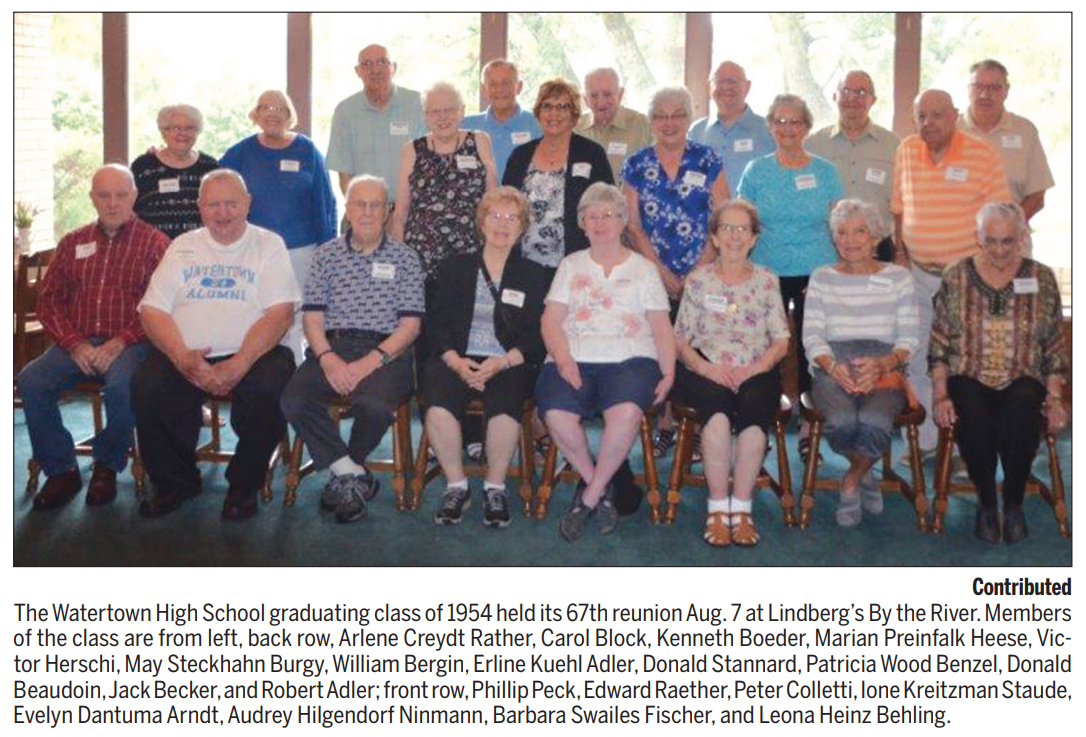
The
Watertown High School graduating class of 1954 held its 67th reunion Aug. 7 at
Lindberg’s by the River
Arlene
Creydt Rather, Carol Block, Kenneth Boeder, Marian Preinfalk Heese, Victor
Herschi, May Steckhahn Burgy, William Bergin, Erline Kuehl Adler, Donald
Stannard, Patricia Wood Benzel, Donald Beaudoin, Jack Becker, and Robert Adler;
front row, Phillip Peck, Edward Raether, Peter Colletti, Ione Kreitzman Staude,
Evelyn Dantuma Arndt, Audrey Hilgendorf Ninmann, Barbara Swailes Fischer, and
Leona Heinz Behling.
10 25 CLASS
OF 1960, 60th CLASS REUNION
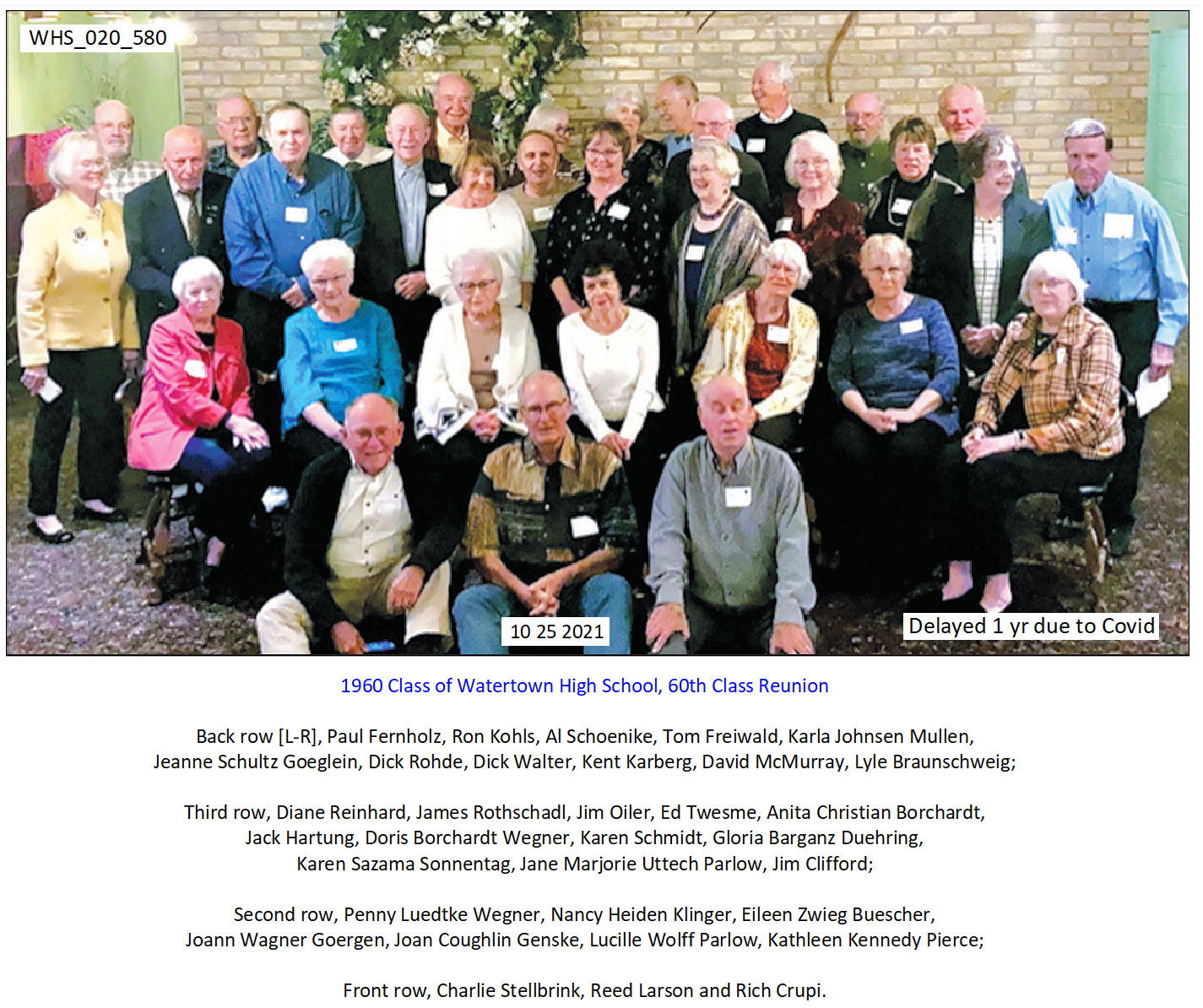
Paul Fernholz, Ron Kohls, Al Schoenike, Tom Freiwald, Karla
Johnsen Mullen, Jeanne Schultz Goeglein, Dick Rohde, Dick Walter, Kent Karberg,
David McMurray, Lyle Braunschweig, Diane Reinhard, James Rothschadl, Jim Oiler,
Ed Twesme, Anita Christian Borchardt, Jack Hartung, Doris Borchardt Wegner,
Karen Schmidt, Gloria Barganz Duehring, Karen Sazama Sonnentag, Jane Marjorie
Uttech Parlow, Jim Clifford, Penny Luedtke Wegner, Nancy Heiden Klinger, Eileen
Zwieg Buescher, Joann Wagner Goergen, Joan Coughlin Genske, Lucille Wolff
Parlow, Kathleen Kennedy Pierce, Charlie Stellbrink, Reed Larson and Rich
Crupi.
2022
05 07 JUNIOR
PROM COURT, JUNIOR & SENIOR
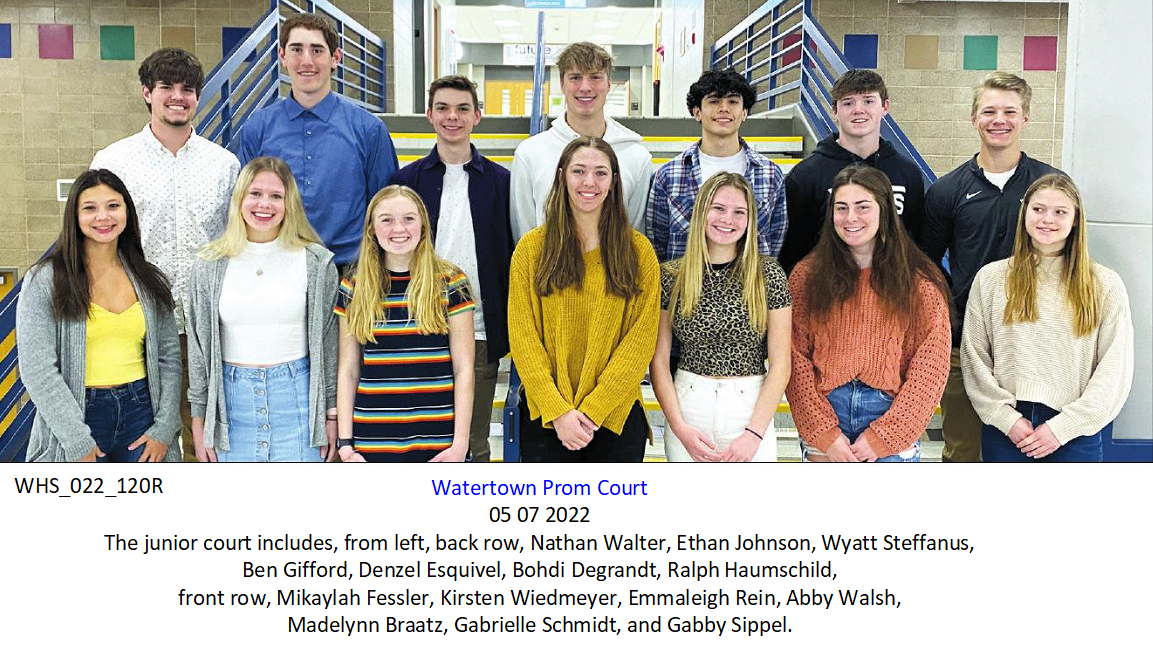
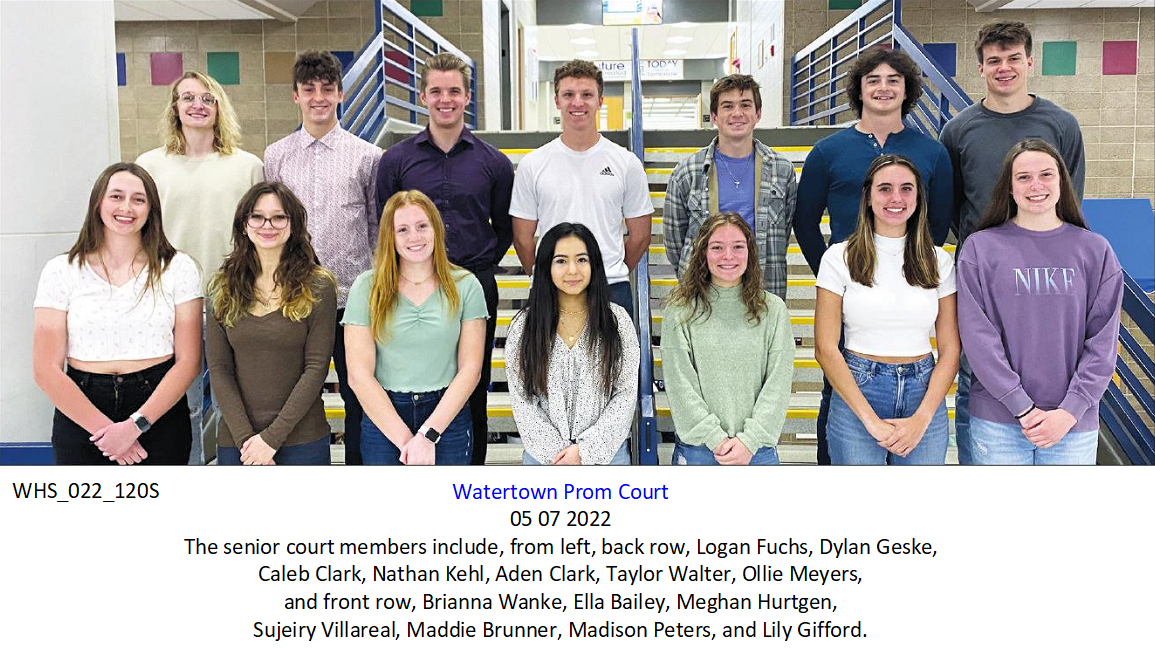
The
junior court includes Nathan Walter, Ethan Johnson, Wyatt Steffanus, Ben
Gifford, Denzel Esquivel, Bohdi Degrandt, Ralph Haumschild, front row, Mikaylah
Fessler, Kirsten Wiedmeyer, Emmaleigh Rein, Abby Walsh, Madelynn Braatz,
Gabrielle Schmidt, and Gabby Sippel.
The
senior court members includes Logan Fuchs, Dylan Geske, Caleb Clark, Nathan
Kehl, Aden Clark, Taylor Walter, Ollie Meyers, and front row, Brianna Wanke,
Ella Bailey, Meghan Hurtgen, Sujeiry Villareal, Maddie Brunner, Madison Peters, and Lily
Gifford.
07 26 2022 DISTINGUISHED ALUMNI
Eric
Rimm is the 2022 Distinguished Alumni.
Rimm, who hails from the Watertown High School Class of 1982, attended
University of Wisconsin-Madison. He completed his doctoral degree in
epidemiology at Harvard University in Cambridge, Massachusetts. WDTimes
article
2022
10 08 CLASS OF 1972 had 50-year
reunion in 2022
2023
09 29 WATERTOWN 2023 HOMECOMING

Watertown
2023 Homecoming King Callen Smith and Queen Alora Thomas get a free ride down
Main Street during their parade.

2024
June 2024 GRADUATION CLASS
08 21 JAMES PTASCHINSKI (07
13 1930-08 21 2024)
Jim taught art for 32 years, mainly at Riverside Junior High. He designed
the original Watertown Gosling mascot, which hung in the lobby of the old high
school for years.
10 04 HOMECOMING COURT image

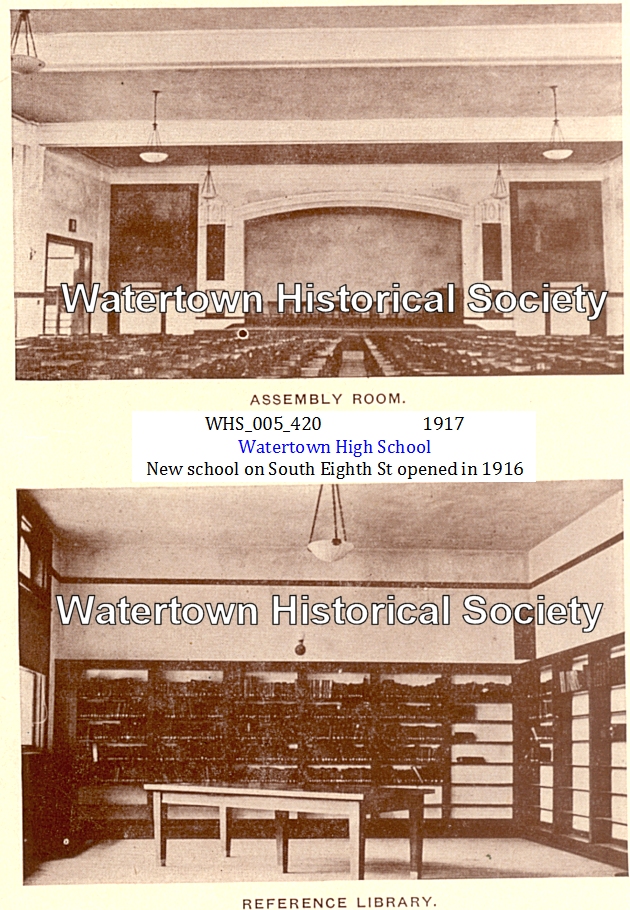
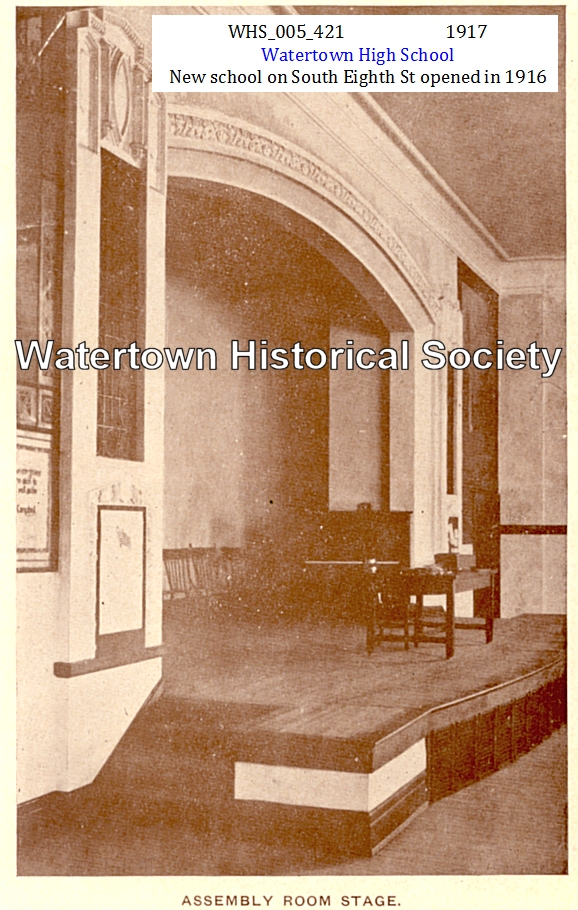
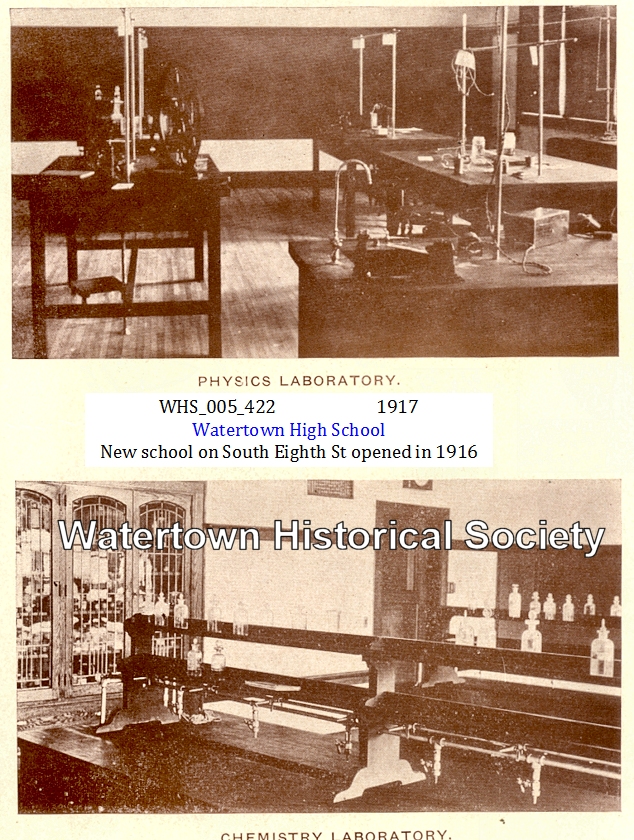
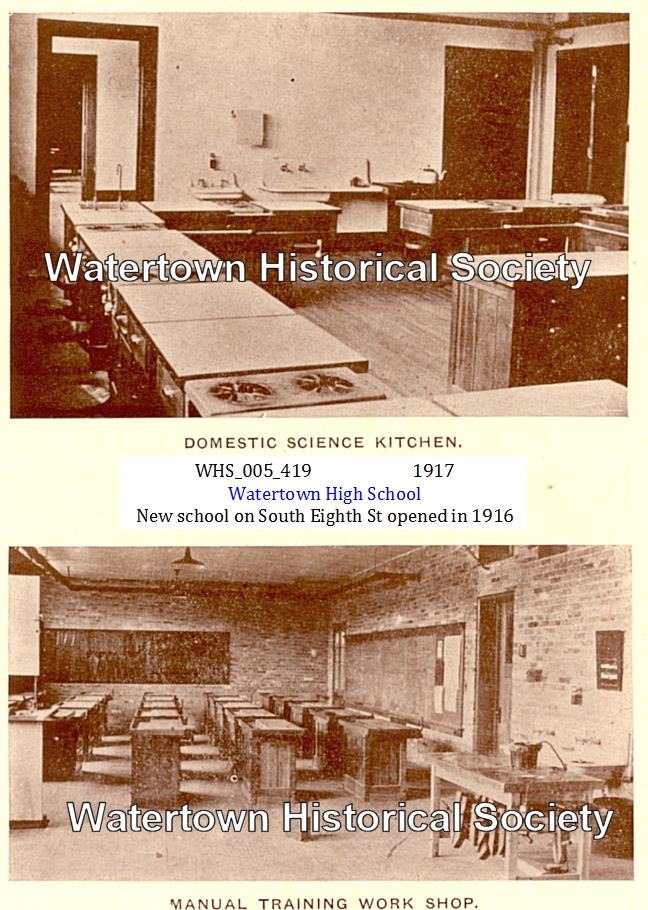
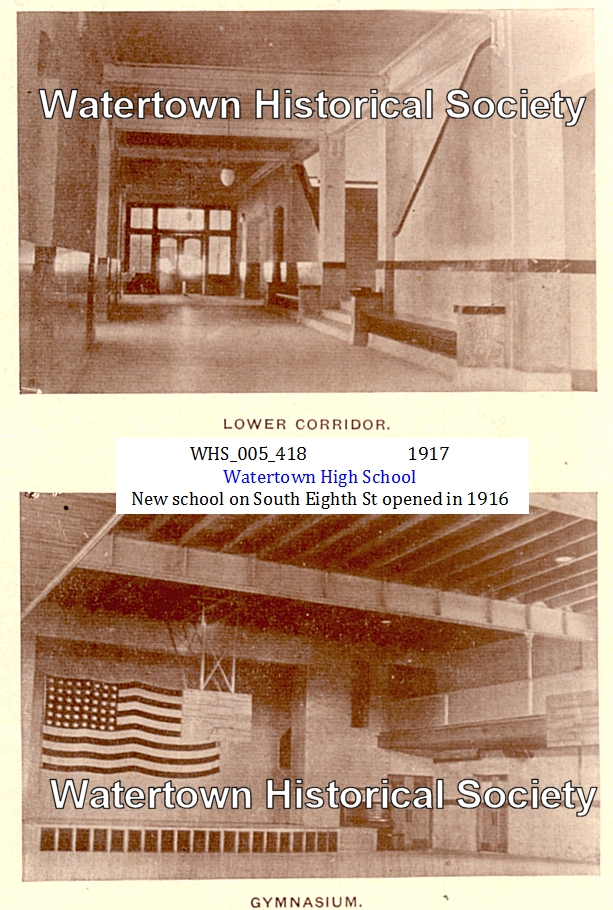
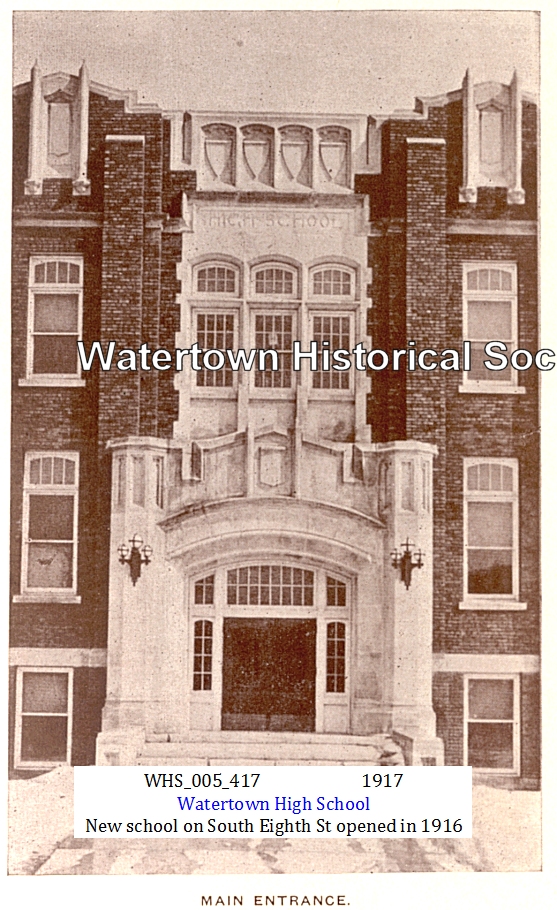
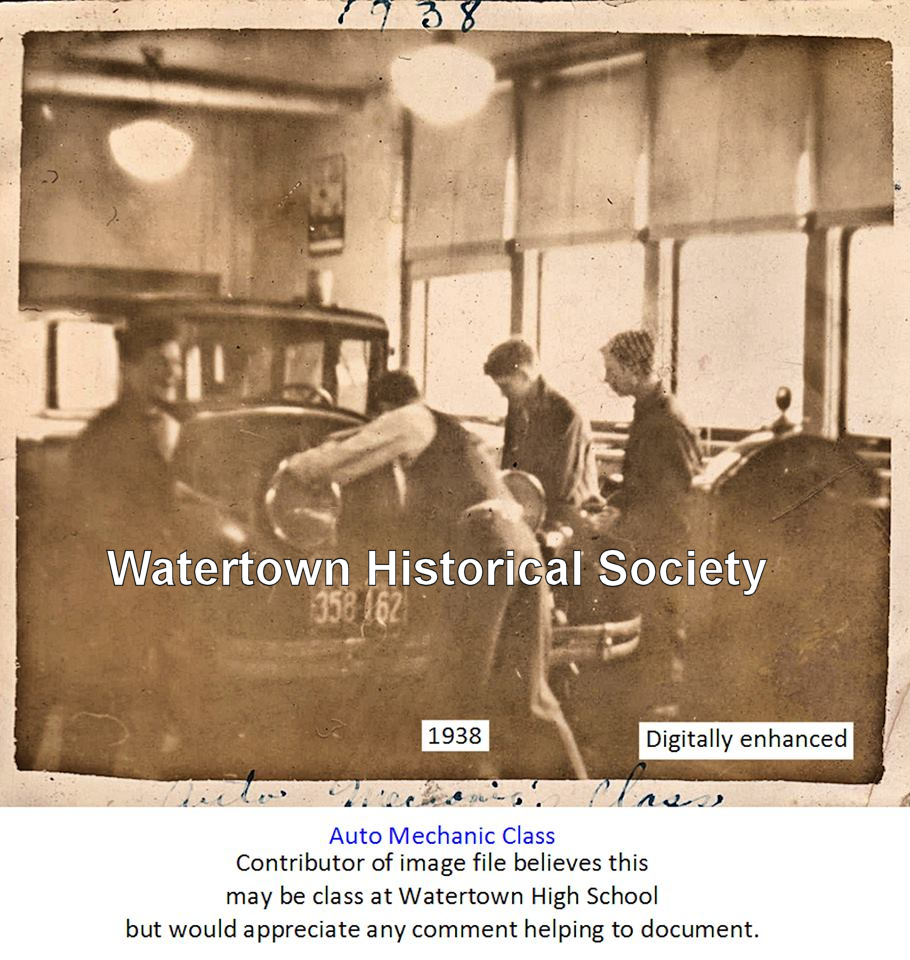
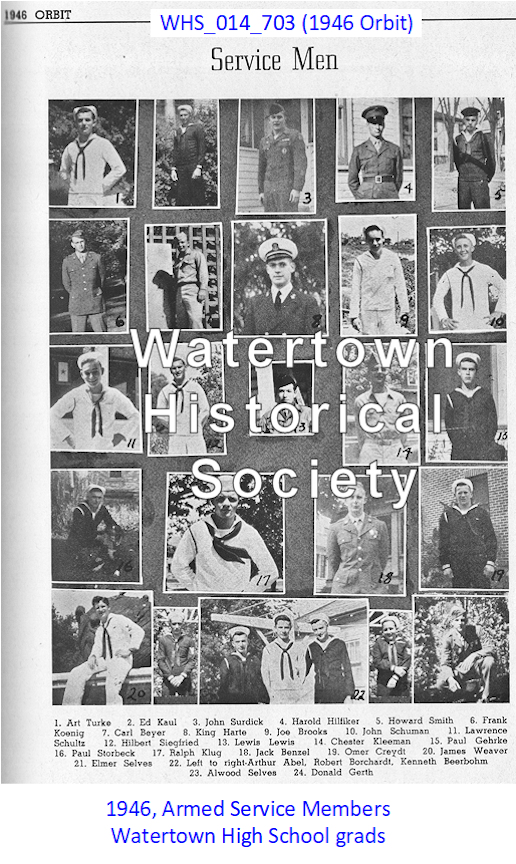

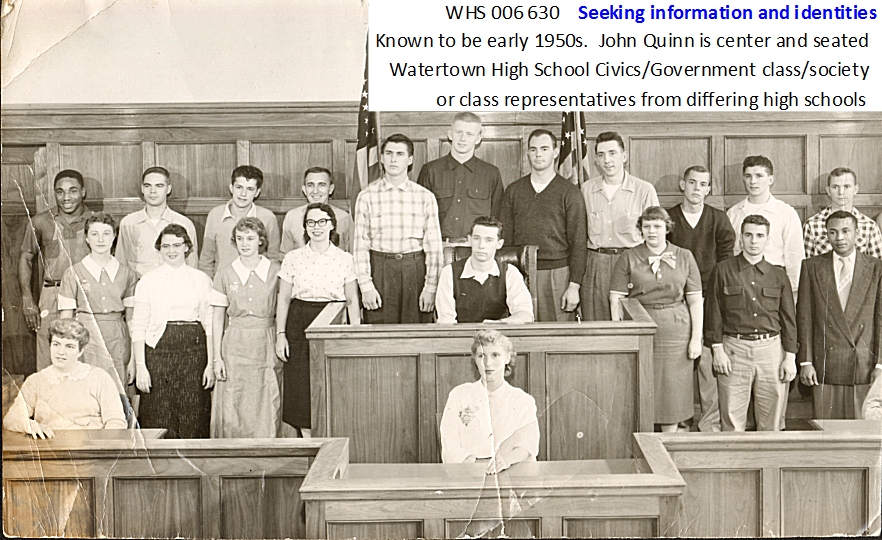
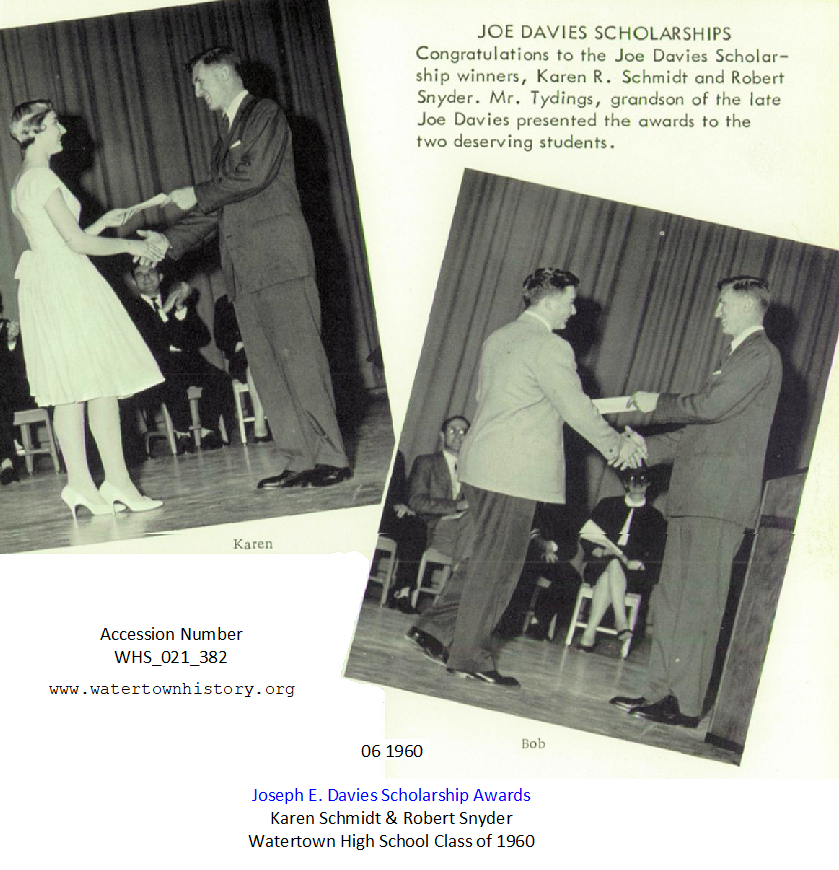


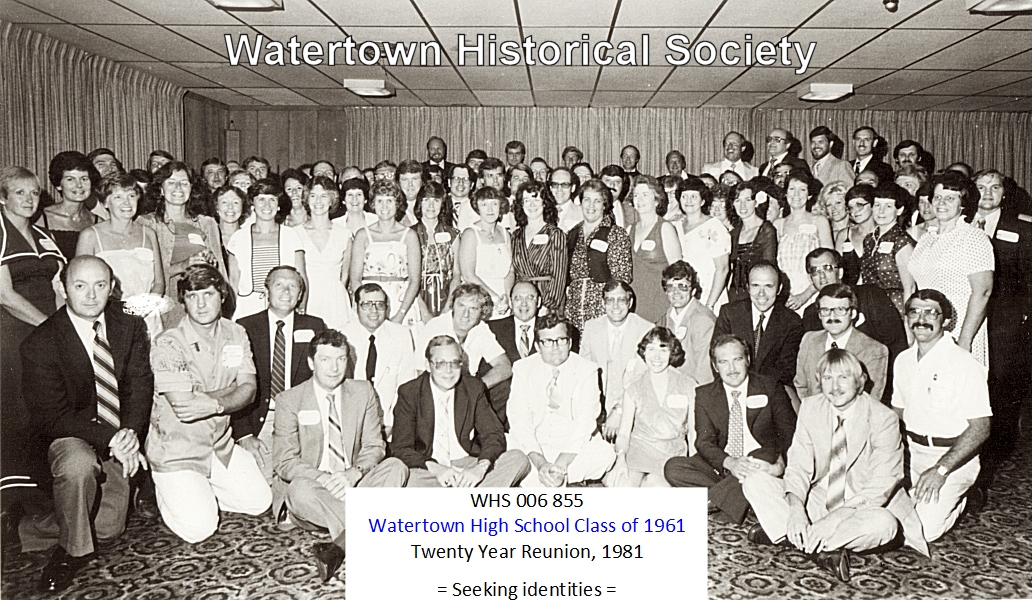
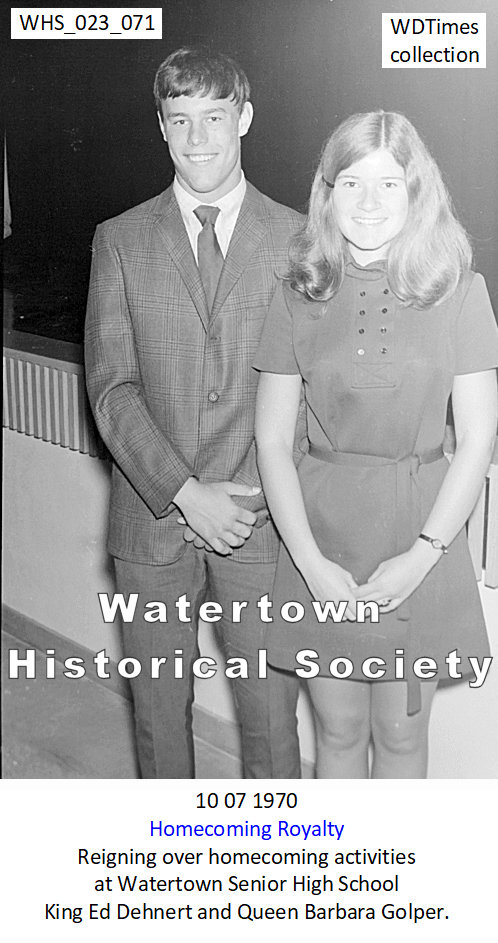


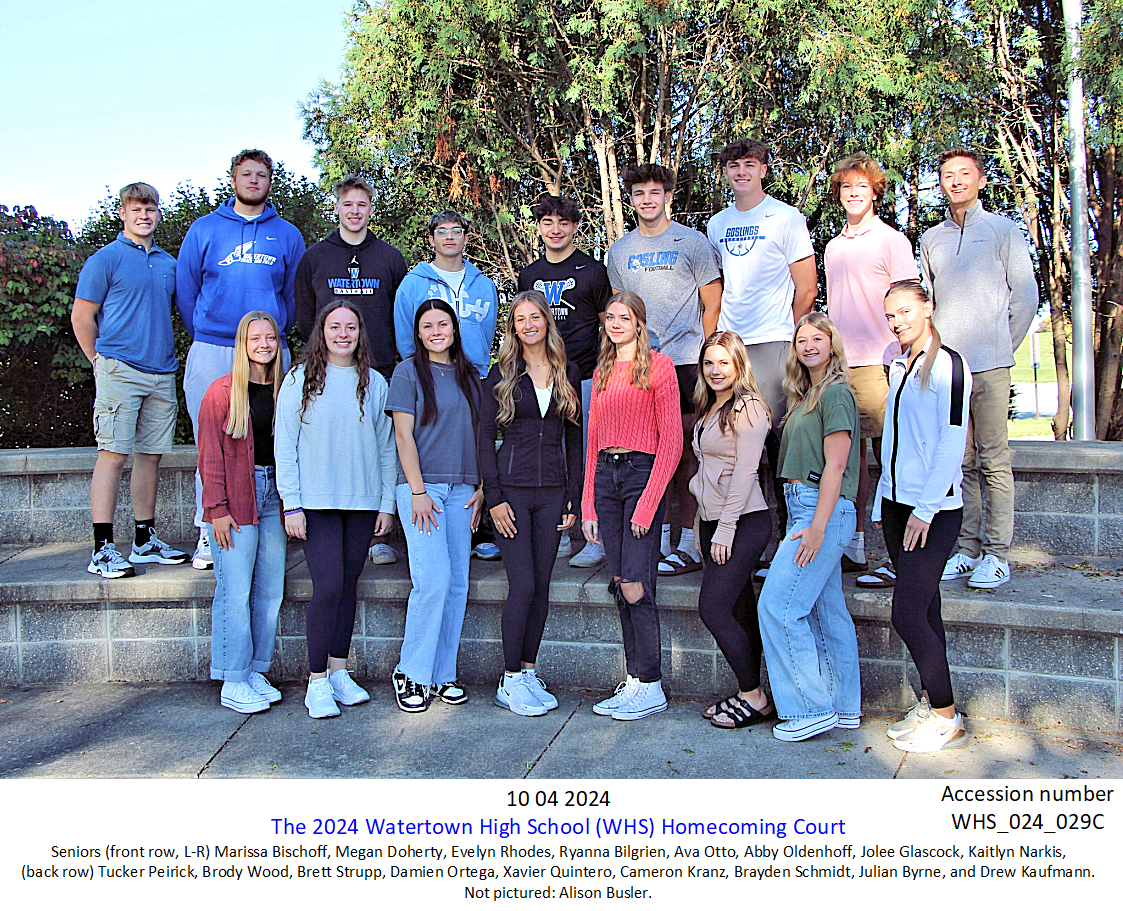
Cross References:
