website watertownhistory.org
ebook History of Watertown, Wisconsin
Link to Octagon
House Museum website
Watertown’s Historic Octagon House
John Richards and Family
|
Watertown
Historical Society Phone (920) 261-2796 To many area residents the title "Watertown Historical Society" and "The Octagon House" are one and the same. In fact, they are at best interrelated, with one depending on the other. |
|
House open to Visitors from May through October
Credit or debit cards accepted MUSEUM HOURS May: 12-3 pm, Sat & Sun
(other by appointment) June, July & August 12-3 pm, Every day except
Tuesdays, Closed July 4th September 12-3 pm, Sat & Sun
(other by appointment) Closed Labor Day and October 31 Tours
are fully guided every hour at noon, 1pm and 2pm in an air-conditioned museum. |
Other buildings on the Octagon House grounds
Miniature Octagon House
The Octagon
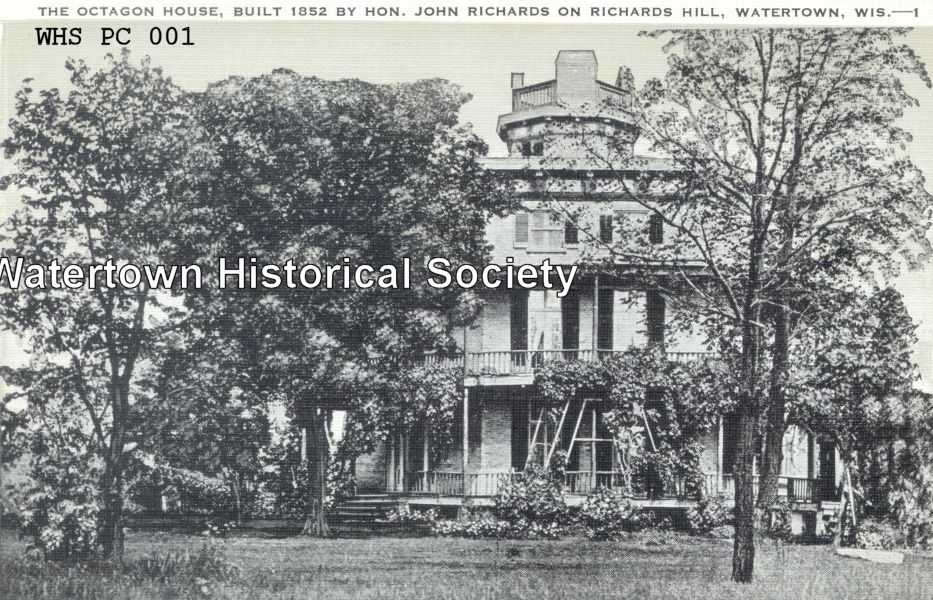
House, five floors of solid brick construction completed in 1854, was designed
and built by John Richards, a pioneer Watertown settler. The House is one of the largest single-family
residences of the pre-Civil War period in Wisconsin
Richards
arrived in Watertown, on foot, in the spring of 1837. Once here he became the
first lawyer in Jefferson County, as well as the owner of several mills. In 1849 he married his sweetheart, the former
Eliza Forbes. He promised to build her
the finest home in the Wisconsin Territory if she would marry him.
Its
construction includes central heating, running water and ventilating
systems. In addition to those
"modern conveniences," the house features a central spiral staircase
which rises from the first floor to the tower room.
The Richards
family and their descendants resided in the home until 1937, when grandson
William Thomas passed away. At that time the remaining family members were
faced with what to do with the family home, which had become one of
Watertown's' most recognizable landmarks.
The Richards
family offered to sell it to the city for $ 1, but opposition from the city
council and several citizens prevented that from happening. The fledgling Watertown Historical Society
then came forward and arranged to purchase the home from the Richards family on
condition that it always be used as a public museum.
Since 1938
the Octagon House has been open to the public.
The Octagon House
John Richards and Family
John
Richards
John
Richards, born in Hinsdale, Mass., in 1806, son of Revolutionary War forebears,
graduated from Williams College and was admitted to the Massachusetts bar. He
taught in a well-known school “Egremont” near where he lived, and later joined
the trek across Midwestern states for adventure and homesteading in Wisconsin.
The whole Northwest Territory was wide open for government land grants in the
1840's and 1850's and many young men from New England joined in the “go west,
young man” [*] movement. Richards, while
in college, had been influenced by a new concept in building that swept across
America a few years later - the octagon shaped house.
[* a
favorite saying of the nineteenth-century journalist Horace Greeley, referring
to opportunities on the frontier]
Cross reference note: 04 22
1937: JOHN RICHARDS WAS ACTIVE IN AFFAIRS OF COUNTY
(The
following article on Hon. John Richards, builder of the famous Octagon House,
was contributed by Hans D. Gaebler, president of the Watertown Historical
Society.) The name of John Richards,
the man who built the Octagon House, appears in many of the early county
records, and shows how varied were the activities of this pioneer citizen.
Besides
being one time mayor of our city and surveyor
of the Plank Road, Mr. Richards was active in the earliest organization of
Jefferson County. A court order of
January 1840, on file at the county court house, records an allowance for
services as district attorney and an even earlier record is a bond and oath
signed by Mr. Richards, October 11, 1839, as justice of the peace.
A
contract for the building of the first county court house was made with William
Sanborn on January 8, 1839, and signed by three county commissioners, Robert
Masters, Mark Clapp, and John Richards.
From 1843 to 1849 Mr. Richards’ name appears frequently in important
county records. WDTimes,
04 22 1937
Cross reference note: RICHARDS
FAMILY TREE / GENEALOGY
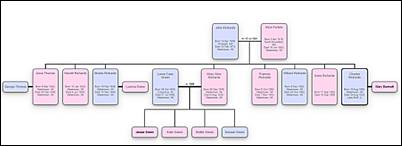
FAMILY TREE:
Green family tie of Richards family
Lewis Cass Green (known as Cass
Green) was the first regularly appointed mail carrier in Watertown. His home was built by John
Richards in 1869 at the time of his daughter Mary Alice's marriage
to Lewis Cass Green. Cass Green was the
first regularly appointed mail carrier in Watertown.
Arrival in
Area
Richards
and two companions came to Wisconsin in 1837, partly as the result of the
financial panic of 1837 in the east. Watertown's first white man, Timothy
Johnson, arrived shortly before that time. Richards walked and studied the
areas in this part of the state and found exactly what he wanted in the
navigable Rock River in Watertown. Good land was plentiful, there were hills
and forests, but much work needed to clear trees and stumps. He bought farm
land on the east side of the river and built a small log house. Some years
later, in 1846, he completed the purchase of 140 acres of wooded land west of
the river [*], including the high bluff which he had visualized as the site for
the home he had in mind. This home would give him a commanding view of the Rock River valley.
[* First owner of the 140 acre parcel
was Silas W.
Newcomb who acquired the land in 1838 from the United States
government [cross reference]. In 1846 he sold
the land to John Richards, builder of the Octagon House. The land was
surveyed for individual lots in 1870]
Eliza
Richards
In 1840 Richards returned east to marry
Miss Eliza Forbes of Great Barrington. Her father, Moses Forbes, was the owner
of the Old Post Road stage coach line which ran between Hartford and
Albany. To allay the fears of his bride
for life as a pioneer in a new land Richards promised she would have the finest
home in the area.
There were friendly Indians around when
Richards lived in Watertown - and timber wolves. In the Octagon House today is
a rug made from the skins of four timber wolves and baskets and other artifacts
given later to Mrs. Richards in exchange for loaves of her fresh bread.
Richards and his bride began planning
the fine home in the octagon shape.
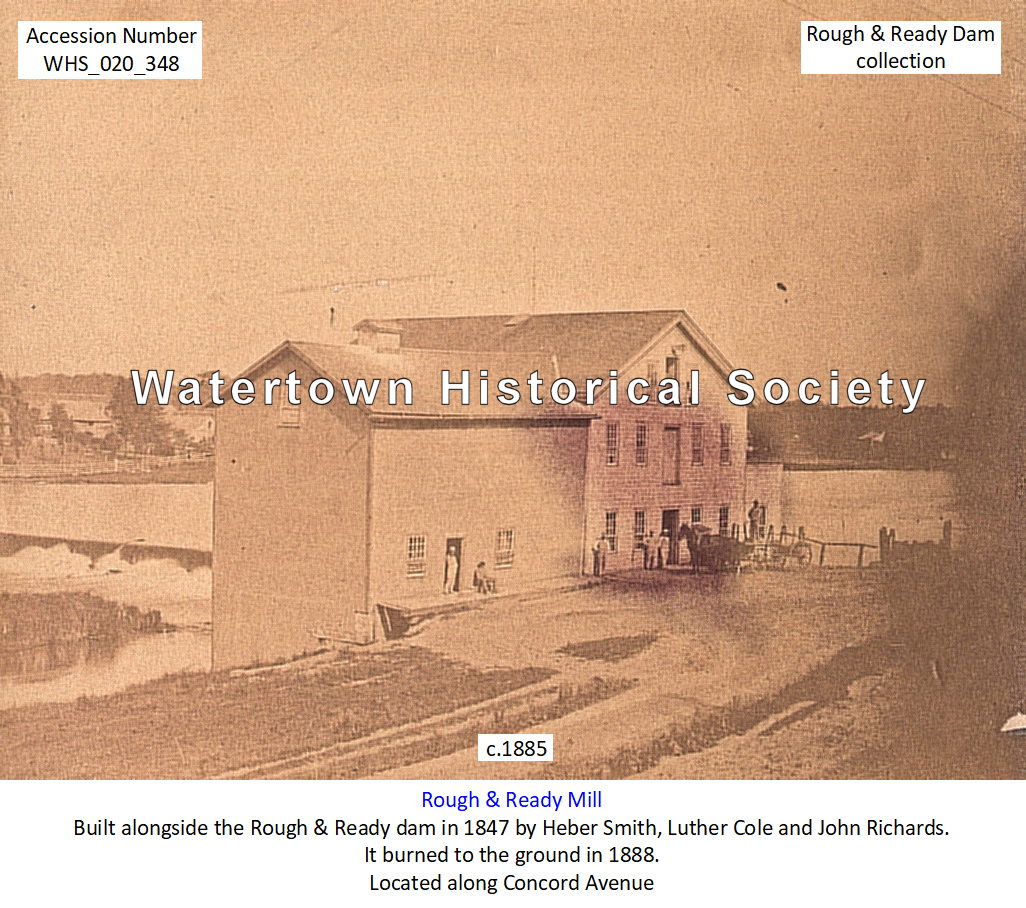
During this time Richards built a dam across the river and established a
grist mill on the east bank. This
flour mill burned in 1888. It was not
rebuilt. Today the electric company
power plant stands on the site of the former mill. This was a time of
prosperity for Watertown; its population grew from 1,500 in 1850 to 8,500 in
1855, making it the second sized city in Wisconsin. Richards milling operations
made Richards increasingly wealthy and he decided it was time to build the
large home for his family and build it of a size that would also take care of
housing and feeding some of the mill hands or lumbermen he employed.
The original Richards cabin was in an
almost primeval forest but land was cleared and some rented out to others. The
Octagon House on the west side of the river was some years in the planning and
three years under construction. In 1854 this beautiful home was completed and
the family moved in. The original sketches and diagrams for the house made by
John Richards are on display in the Octagon House today.
Richards ran the mill, supervised the
farm and did some law work. This pioneer lawyer did not actively set up a law
office in Watertown, but did certain amounts of legal work when asked, He was
the first district attorney in Jefferson County, helped set up a county system,
was a member of the Watertown school board, was elected mayor in 1869-70, was
also a one-time member of the Wisconsin legislature.
The House
He also engineered the construction of
his dream home.
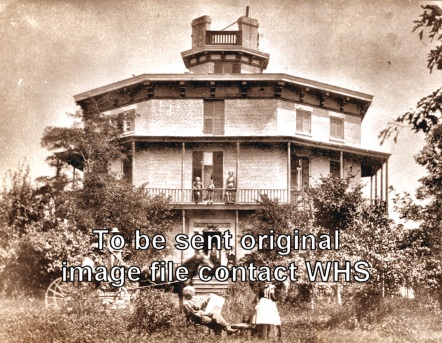
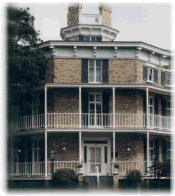 The
Octagon House, the beautiful home built on Richards
Hill in 1854, was owned and lived
in by Mr. and Mrs. John Richards and their descendants until 1938 when the
family presented this generous gift to the Watertown Historical Society. For
the past 38 years the society has owned and maintained the home open to the
public from May 1 to Nov. 1 each year. This Watertown landmark has lured
thousands of visitors to what is probably the largest pre-Civil War single
family dwelling in Wisconsin, a home with a unique place in Watertown history.
The
Octagon House, the beautiful home built on Richards
Hill in 1854, was owned and lived
in by Mr. and Mrs. John Richards and their descendants until 1938 when the
family presented this generous gift to the Watertown Historical Society. For
the past 38 years the society has owned and maintained the home open to the
public from May 1 to Nov. 1 each year. This Watertown landmark has lured
thousands of visitors to what is probably the largest pre-Civil War single
family dwelling in Wisconsin, a home with a unique place in Watertown history.
"The Octagon House, a Home for
All" by Orson
S. Fowler, was published in 1848, although he had written individual
articles on the subject earlier. Fowler, a phrenologist and publisher, had long
been a writer on fresh attitudes toward living. “Nature's forms are mostly
spherical," Fowler wrote, "Then why not apply this form to
houses?" After publication of his Octagon House book many barns, houses,
churches and schools in octagon shape sprang up, mostly in eastern United
States.
There are a number of octagon shaped
barns in this area in Ozaukee (WI) County. By 1857 at least 1,000 such houses
had been built throughout the country. Fowler believed the octagon shape, which
approximates a circle, provided the greatest utilization of space. John
Richards, a typical down east Yankee and a man of many talents, was also a
visionary and agreed with this principle of a home in octagon shape.
The house was the talk of the town when
it was built, and Richards took great pride in the house and the many
innovative features he had installed.
The perfect octagon measures 50x50 feet in any direction and sets on a
17- inch foundation entirely beneath the ground.
Octagons put edge in houses:
Renewed interest in style based upon utopian ideals
New York Times News Service, 03 11 2005
While most housing designs are based on
rectangular shapes, there are some homes with an unusual eight-sided floor
plan. These octagonal houses have been turning heads for more than 150 years.
The concept of the octagonal house was
idealized by Orson Squire Fowler in his 1853 book "A Home for All: Or a
New, Cheap, Convenient and Superior Mode of Building."
Fowler, a phrenologist who deciphered
the contours and bumps on the human skull, advocated octagonal-shaped buildings
because the walls of an octagon enclose more area than a square or rectangle
with equal wall space. Fowler reasoned octagon houses were cheaper to build,
eliminated dark corners, were easier to heat and remained cooler in summer.
About 3,000 octagon structures were
built in the mid-1800s, most of them in New York and Massachusetts. Octagon
structures built as a result of Fowler's book and other octagon-construction
books of the day included houses, churches, schools, barns, carriage houses and
outbuildings. [And Watertown’s Octagon
House]
Watertown
Brick
Three courses or rounds of brick form the
13-inch walls; the inner two rounds are Watertown brick from the local and
newly established brick yards which began work in Watertown in 1847. The
outside brick layer was Cream City brick hauled from Milwaukee by ox and horse
teams over the new plank road. Most of
the lumber, basswood, cherry and oak came from the Richards woods. Some pine
was used. This had been floated down the river and was prepared in the Richards
mill.
Many Rooms
The large three-story home, plus
basement and windowed cupola, has 57 rooms counting halls and closets. The main
rooms are square, the corner rooms used for children's or sewing rooms. The
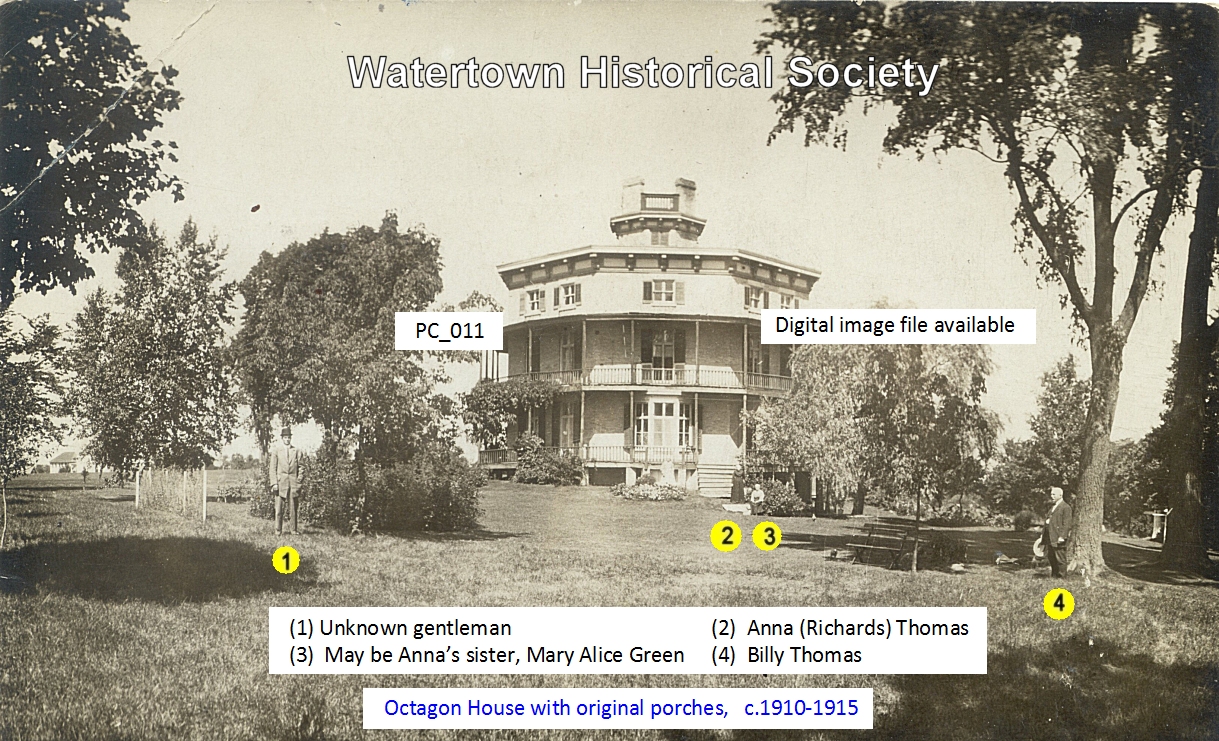
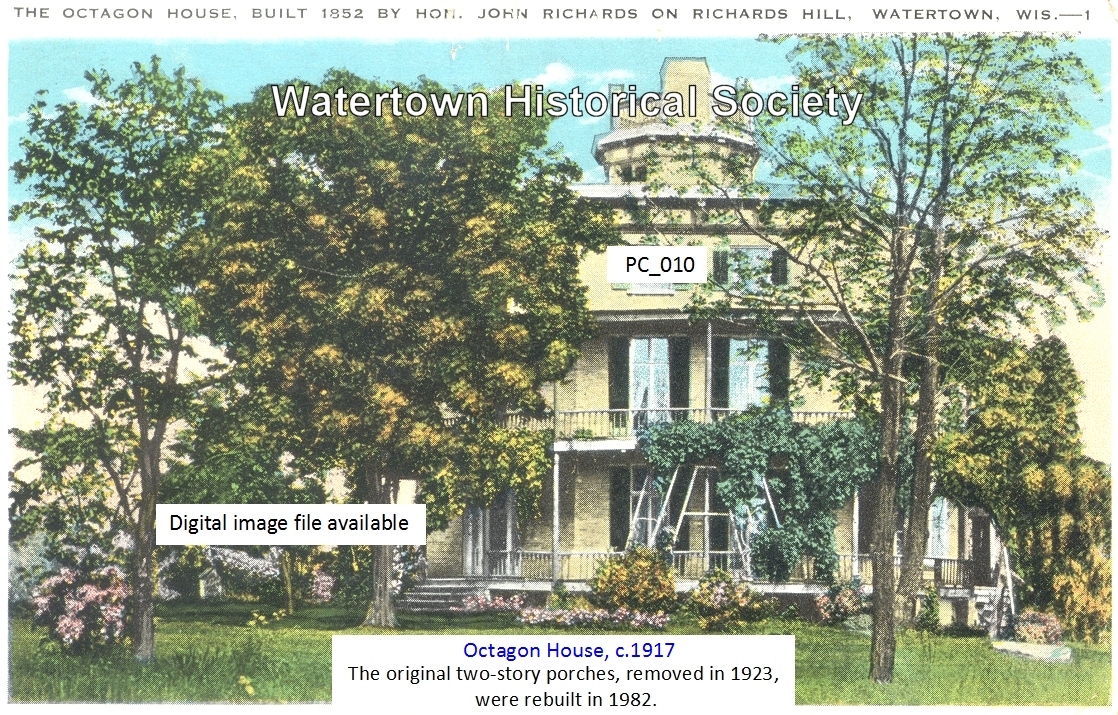
original house had narrow verandas which encircled the house on the first and
second levels. When they became unsafe they were removed. A good sized replica
of the Octagon House, with the porches, is on the grounds to show visitors the
original design.
The first floor rooms, a music room,
living room, dining room, butlery and conservatory are 10 feet, 10 inches in
height. A dumb waiter functions between the dining room and kitchen in the
basement level, and a large chest of drawers was built into the south wall of
the dining room for linens and storage. Large family bedrooms with accompanying
small corner rooms for the small children are on the second floor. The ceilings
at this level are 9 feet, 9 inches. The third floor had been added to Richards'
original design in order to accommodate the young men who worked in his mill.
Above the third floor is the sizeable
cupola with chimneys extending from the corners. The third floor ceiling slopes
toward the center to follow the pitch of the roof line. This slope is necessary
to take care of one of one of the most unusual features of the house - a system
for running water.
An over 12x6 foot size wooden water
tank made of basswood and lined with zinc is suspended above the floor. The tank held rain water which flowed in from
the funnel-shaped roof. This water was
then diverted to faucets on both the second and third floor stair landings, to
the kitchen, to a basement cistern and the run-off drained to the bottom of the
hill toward the river.
Light which comes through the cupola
windows falls on the spiral cantilevered hanging staircase, with its hand
molded cherry rail, the work of skilled artisans of well over a century ago.
The stair, known to be one of the few of its kind in the country, is
unsupported on one side but securely anchored into the brick walls in the
stairwell so that there is not a creak after the many years since its
construction.
Air
Conditioning
Richards built a form of air conditioning
into his home with louvers that opened at night to trap the cool air,
circulated it throughout the walls, and the louvers closed during the heat of
the day. Much of the work and time of the household centered in the basement
level, where there was the kitchen, a cider room, vegetable room, cistern,
pantry, wood storage and furnace room. A large Dutch oven in which 24 loaves of
bread were baked at a time helped feed both the family and the mill hands. A
furnace capable of heating all these stories in the house burned as much as a
cord of wood a day. Exit from the basement level is on the ground level in
back; the lower hall is paved with bricks.
Authentic furnishings and artifacts of
the Richards' era are in the Octagon House. Much of the furniture was family
furniture presented to the Historical Society with the home. The first piano
brought to Wisconsin, a Gilbert square, was purchased by Richards for the music
room. The dining room furniture belonged to the Richards family and some fine
pieces were donated by the John W. Cole family. Certain rugs, curtains and
other pieces had to be replaced throughout the years but were carefully
selected from the same period. The dining room windows have always had wide
white window shades trimmed by hand. Original kerosene chandeliers hang in the
downstairs room and in the Richards bedroom on the second floor. Second floor rooms were bedrooms and
contained a replica of the Lincoln bed, the same as used in Lincoln's home in
Springfield, IL, and in the Richards' bedroom one can view the cannonball bed,
so called because of its interesting construction. There is also the child's
cradle made by Richards.
Bunks like those used by the mill hands
are along the wall of a third floor bedroom. Also in the room is an old
fashioned zinc lined bathtub and articles used by the mill hands for
entertainment in their off hours. These men, in addition to working in the
mill, frequently floated logs down the Rock River. Kitchen cupboards hold many
cooking utensils used by Mrs. Richards. The old fashioned wood range is located
near the Dutch oven. In short, the home shows authentic articles of daily
living used or typical of being used during the over 80 years the family
occupied the home.
Hospitable
People
Both John Richards and Mrs. Richards
were hospitable people. Many old letters in the files attest to this
hospitality. Richards was big hearted and generous and never denied his family
anything. His bookkeeping system, however, left something to be desired. He
kept no accounts, marked sales and money due him on a handy shingle or forgot
the transaction entirely. Mrs. Richards found this difficult after he died when
she took over management of the farm and found no record of back debts listed
for her to collect, though she knew there were many.
The couple had eight children, five of
whom lived to adulthood in the Octagon Home; Anna Richards Thomas, Alice
Richards Green, Moses Richards, Willie
Richards and Charles Richards.
John Richards died in 1874. Mrs.
Richards in 1902. Their daughter, Mrs. Thomas, lived in the big home until 1936
when she died at the age of 94. Her son, Willie, died the next year. He was the
last family occupant of the Octagon House.
In 1938 Estelle Bennett Richards, widow
of Charles Richards, the youngest Richards son, signed the deed which turned
over ownership of the home to the Watertown Historical Society with the
condition that in the future the house be open to the public at stated times.
There had been desire on the part of
Mrs. John Richards that the family do something for Watertown with the house,
and this plan was followed through by her family. Harvey Richards, a son of
Estelle Bennett Richards and Charles Richards, and grandson of the original
builder, John Richards, worked with G. H. Lehrkind, Historical Society
president in 1938, and Attorney Wallace Thauer to transfer title of the
property. Hans Gaebler, a real historian and most interested in the
preservation of historic sites, was in many ways responsible for organization
of the Watertown Historical Society.
The Articles of Incorporation for the
Watertown Historical Society were signed in 1933 by John D. Clifford and Jane
Lord, two of the charter members. Other charter members were Mrs. G. C. Lewis,
Tom Lewis, William Thomas, Claire Herrman and Gladys Mollart. Persons who greatly helped put the new
society on its feet and helped with much of the original planning were, in
addition to the above, Mrs. Lydia Wiggenhorn, Mrs. Dan Thauer, Mrs. Eli
Fischer, Sidney Northrop, Prof. E. C. Kiessling, Dr. A. C. Hahn, James
Anderson, Marcella Killian and Miss Ella Wilder.
As of 1976 five men had served as
president of the Historical Society:
Hans Gaebler, G. H. Lehrkind, Dr. Oscar Meyer, Byron Wackett, Lee Block
and Fred Kehl. There had been two
curators to that date: Mrs. G. C. Lewis, 1939 to 1945 and Gladys Mollart, who
served since 1945.
Three
Buildings Added
Three buildings have been added on the
Octagon House grounds since the Historical Society was presented with the
house. The first American kindergarten,
founded by Mrs. Carl Schurz in 1856, was moved from its former location at 2nd
& Jones streets.
A pioneer barn was moved from the east
side of Watertown, where it stood at one end of the Plank Road as the toll
house, to the Octagon grounds, and a new building, the Gladys Mollart tour
center, was completed in 1969 and dedicated to Miss Mollart.
In addition to the buildings much help
has been received in landscaping the grounds and many symbols of Watertown's
past have been donated to the Society for preservation of some of Watertown's
early history. During many years the
Octagon Garden club has planted and tended an old fashioned herb garden just
outside the kitchen door.
Watertown
Firsts
To name just a few of Watertown's
firsts which are located on the grounds:
The bronze bell from Watertown’s first
city hall, dated 1869.
The fountain
statue Phillis, originally given to the city by Mrs. Carrie Mowder Hill but
presented to the Historical Society when the new municipal building was built.
The anvil used by the A. Kramp Company
for 115 years for pounding out horse shoes or steel tires or rims for the wagon
wheels for the army quartermasters corps, presented to the Society in 1972 by
Leonard Kramp.
The historic old
trunk marked for Margarethe Meyer Schurz “Margarethe Meyer via
Frankfurth M. Bremen nach New York Amerika” ended its travels in the room
in which she taught, presented by Mrs. Gerald Fahl, through her child's
kindergarten class in Oconomowoc, after she found it at a farm auction.
A cobbler's bench from the first shoe
factory Fridolin Ruesch
began in the 1850’s and operated by that family for several generations,
presented by Mrs. Dean Lawrence.
The Indian which adorned Watertown's
West Main Street in the late 1880's.
A large heavy "Buhrstone"
mill wheel ordered from France in 1878 and used by the Empire, later the Globe
Milling Co., presented by the Floyd Burnetts, last owners of the property on
which the mill wheel had been mounted.
An early beehive and slatted wooded
crate manufactured by G. B. Lewis Co., the bread box made to ship food to
American troops in World War I, thousands of miles from home base.
Painting of
Octagon House
Mathilde
Schley painting of the House is preserved in the museum.
JOHN RICHARDS WAS ACTIVE IN AFFAIRS OF COUNTY
Besides
being one time mayor of our city and surveyor of the Plank Road, Mr. Richards
was active in the earliest organization of Jefferson County. A court order of January 1840, on file at the
county court house, records an allowance for services as district attorney and
an even earlier record is a bond and oath signed by Mr. Richards, October 11,
1839, as justice of the peace.
A
contract for the building of the first county court house was made with William
Sanborn on January 8, 1839, and signed by three county commissioners, Robert
Masters, Mark Clapp, and John Richards.
From 1843 to 1849 Mr. Richards’ name appears frequently in important
county records. WDTimes,
04 22 1937
c.1845 <> JOHN RICHARDS PARTNERED WITH HEBER SMITH
Heber Smith came to Wisconsin from Canada and settled here somewhere about
1845. He was a partner of the late John
Richards in running the old sawmill which stood on the east side of the river
[across] from the Rough & Ready mill, destroyed by fire last fall.
1846 <> JOHN RICHARDS PURCHASED 105
ACRES (RICHARDS
HILL)
1849 <> BAGS STOLEN FROM
GRAINRY
Those Bags!
In case this may meet the eye of the
person whom it may concern, that person (and in once and a half trying I can
guess who it is) is most sincerely invited to return the bags taken out of my
grainry [granary] one night last week.
The wheat and oats I don’t ask for, but the bags I need very much, they
having been all I had.
<> JOHN RICHARDS, Watertown, June 4, 1849.
P.S. I will throw in the corn taken by
the same person last winter! Watertown
Chronicle, 06 27 1849
CROSS
REFERENCE NOTE: John Richards lived in a log
cabin prior to the construction of Octagon House. The house was some years in the planning and
three years under construction. In 1854
this beautiful home was completed and the family moved in.
1852 <> OIL MILL FOUNDATION
John Richards Esq., informs us that the
foundation for an oil mill is laid, near the Rough & Ready Mills, and that
the building will be pushed forward, so to be ready to purchase the crop of the
coming season. We are glad to see this enterprise under way, as we are
satisfied that it will prove profitable to the farmers and all concerned. - Watertown Democratic State Register.
CROSS
REFERENCE NOTE: John Richards has a saw mill
and oil mill or turning shop on the east side (of the river). [Source: City of
Watertown, Wisconsin, Its Manufacturing & Rail Road Advantages and Business
Statistics, 1856, published by order of Watertown City Council]. Oil mill produced linseed oil. Linseed oil,
extracted from flax seed, is used as a preservative for wood and an ingredient
in paints, varnishes, and stains. Also used in soaps, inks, and in the
production of linoleum (the first three letters of linoleum are lin... for
linseed). Rough & Ready dam (the
upper dam) was built in 1847.
Watertown's Octagon House was built by pioneer settler John Richards and
completed in 1854. The Octagon House was
one of the largest homes built prior to the Civil War in Wisconsin. Its only
occupants have been members of the Richards family. Following the passing of Anna Richards Thomas
in 1936, the mansion was donated in 1938 to the Watertown Historical Society.
1854 <> CONSTRUCTION COMPLETED
The house was some years in the
planning and three years under construction.
In 1854 this beautiful home was completed.
1869 <> CASS GREEN HOUSE CONSTRUCTED
John Richards built the Cass
Green house at the time of his daughter Mary Alice's marriage to Lewis Cass
Green.
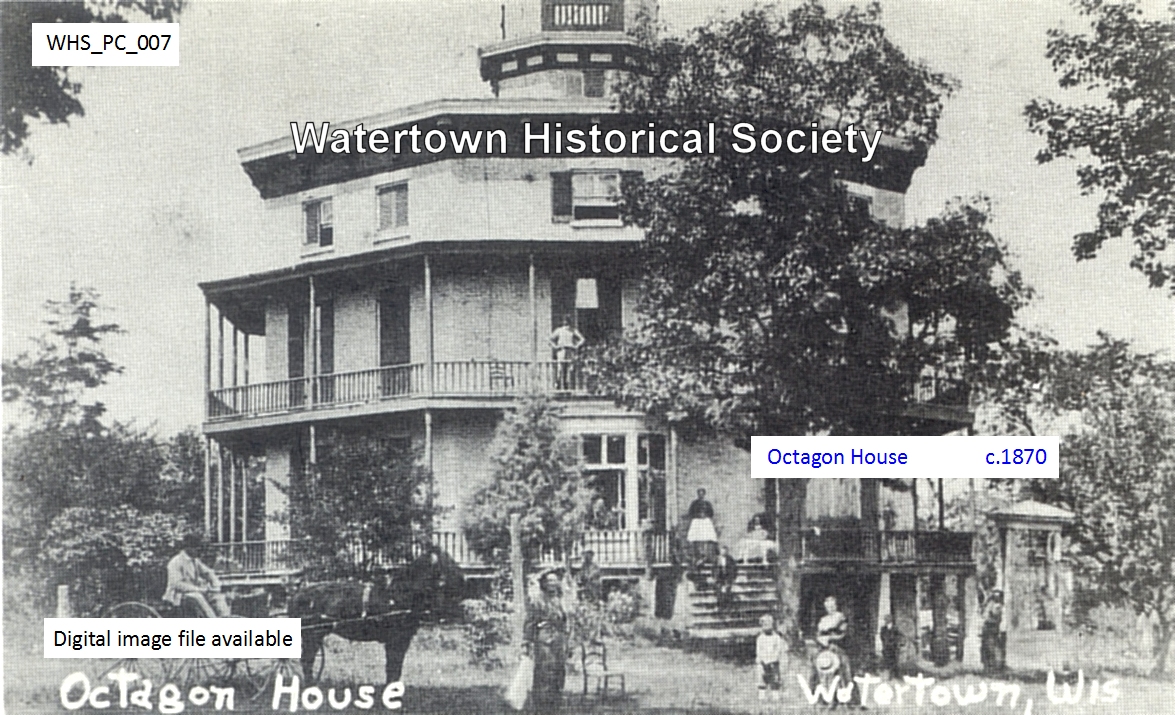
c.1870
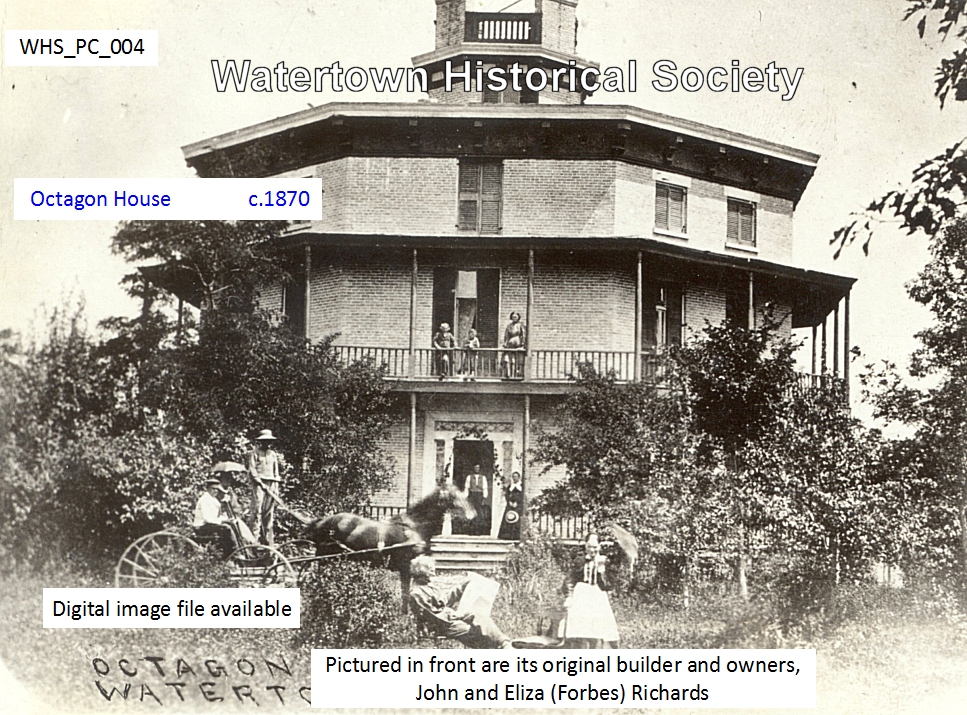
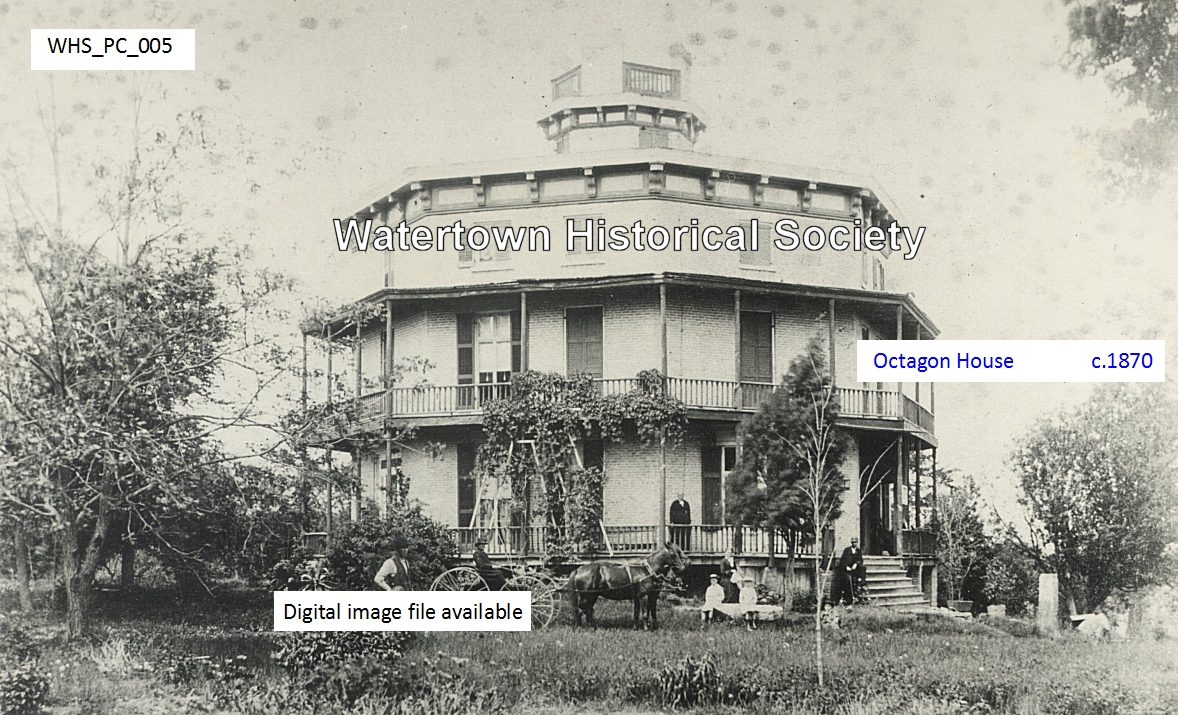
1874
02 26 <> JOHN RICHARDS FUNERAL
The
funeral of the late Mr. John Richards, one of the earliest pioneers of this
city, took place last Friday, the 20th inst., at his residence in the First
ward. It was very numerously attended,
and the ceremonies on the sad occasion were simple and impressive, as became
his life and character. Many old
settlers - companions of his early days, but now venerable in age - were
present to pay the last tribute of respect to their departed friend. The pall bearers were:
L. A.
COLE
J. W. Cole
P. V.
Brown D.
Jones
A.
Boomer <>
P. Rogan
T.
Prentiss
J. Hamlin
Amidst
tears and sorrow, he was borne to his final resting
place in Oak Hill cemetery, where he sleeps the sleep of peace that no
mortal turmoil can disturb or awake.
WDem. 26 Feb 1874
1885
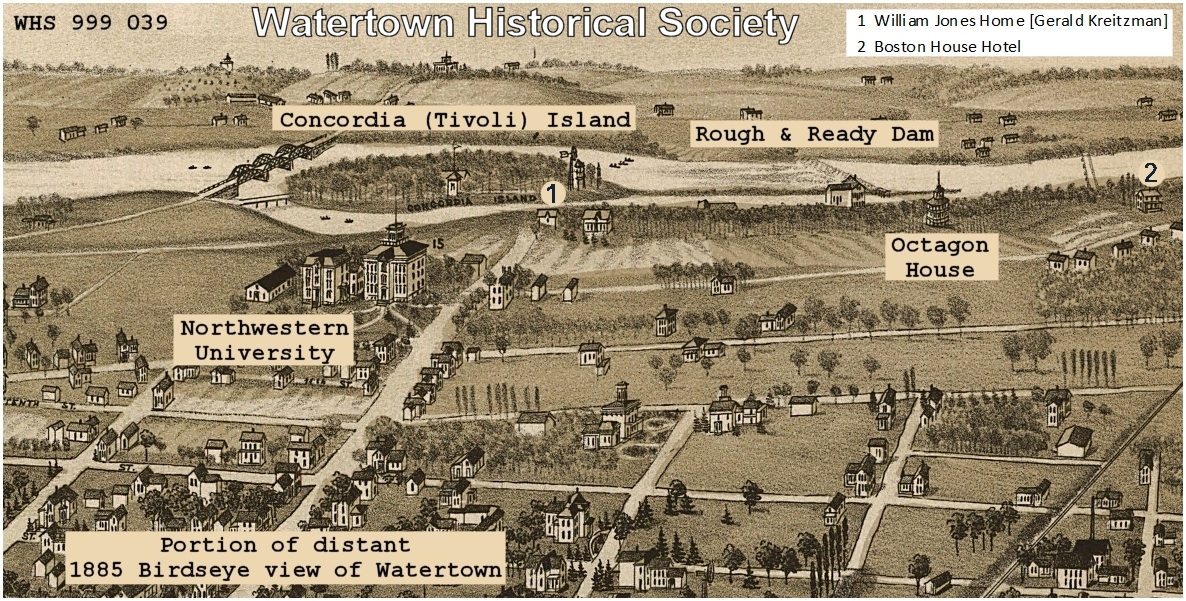 Portion of birdseye view
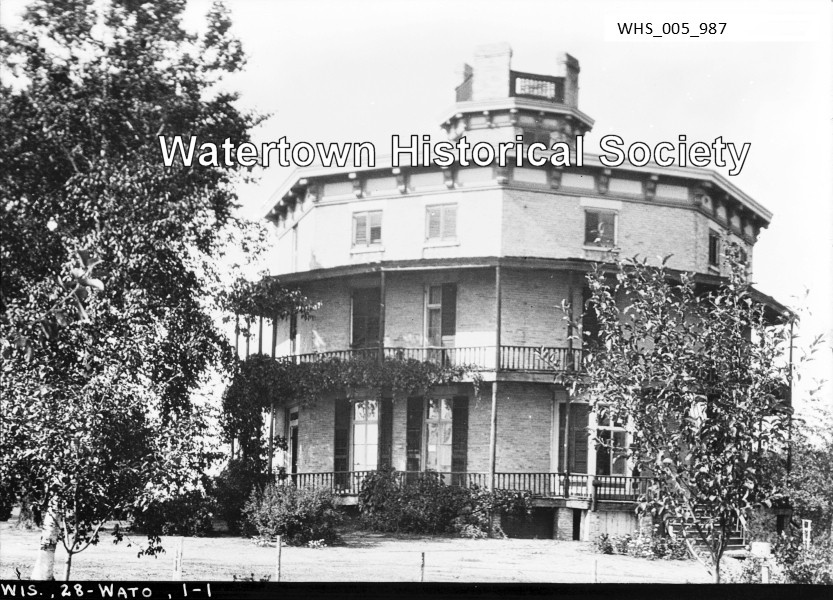

c.1897
ANNA THOMAS & ELIZA RICHARDS (aunt
& niece)
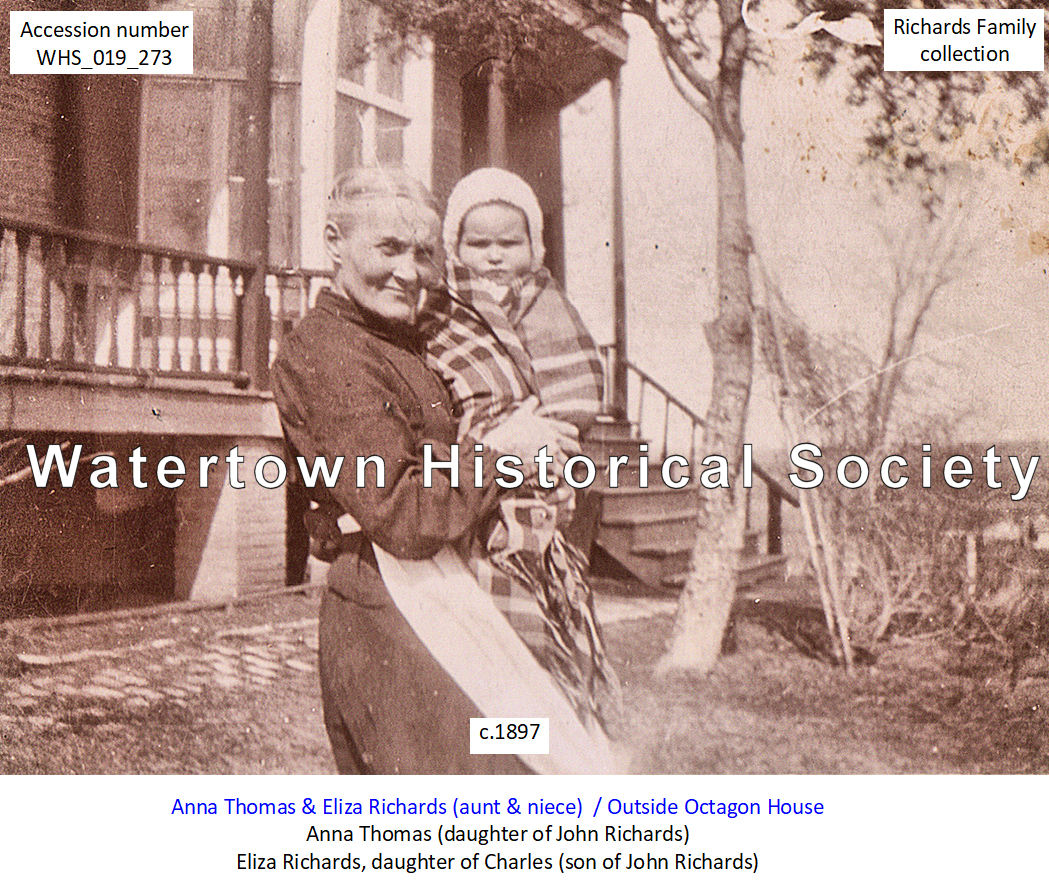
Anna Thomas (daughter of John Richards).
Eliza Richards, daughter of Charles
(son of John Richards).
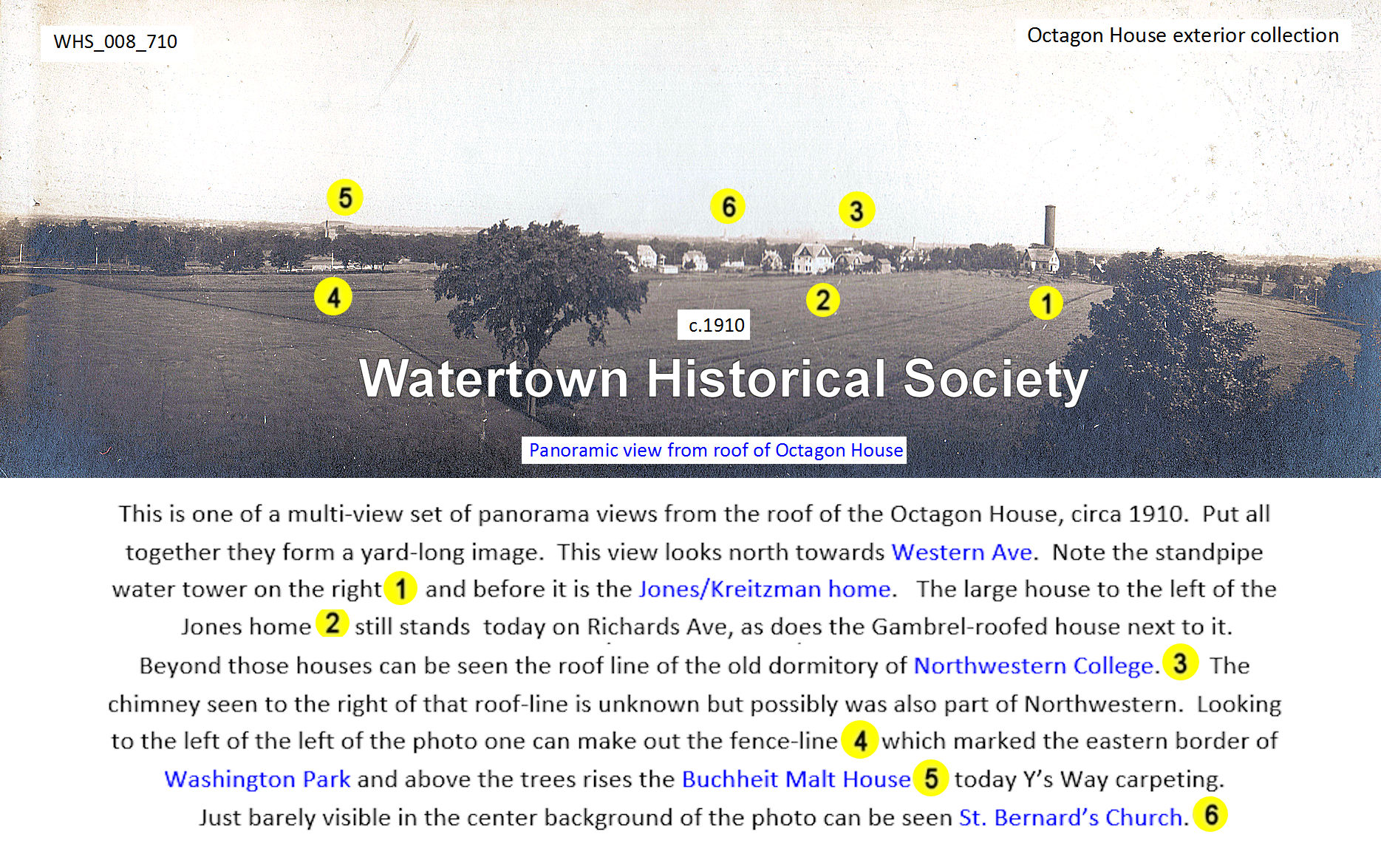
c.1910
VIEW FROM ROOF OF
OCTAGON HOUSE
FAMILY GATHERING ON SOUTH LAWN
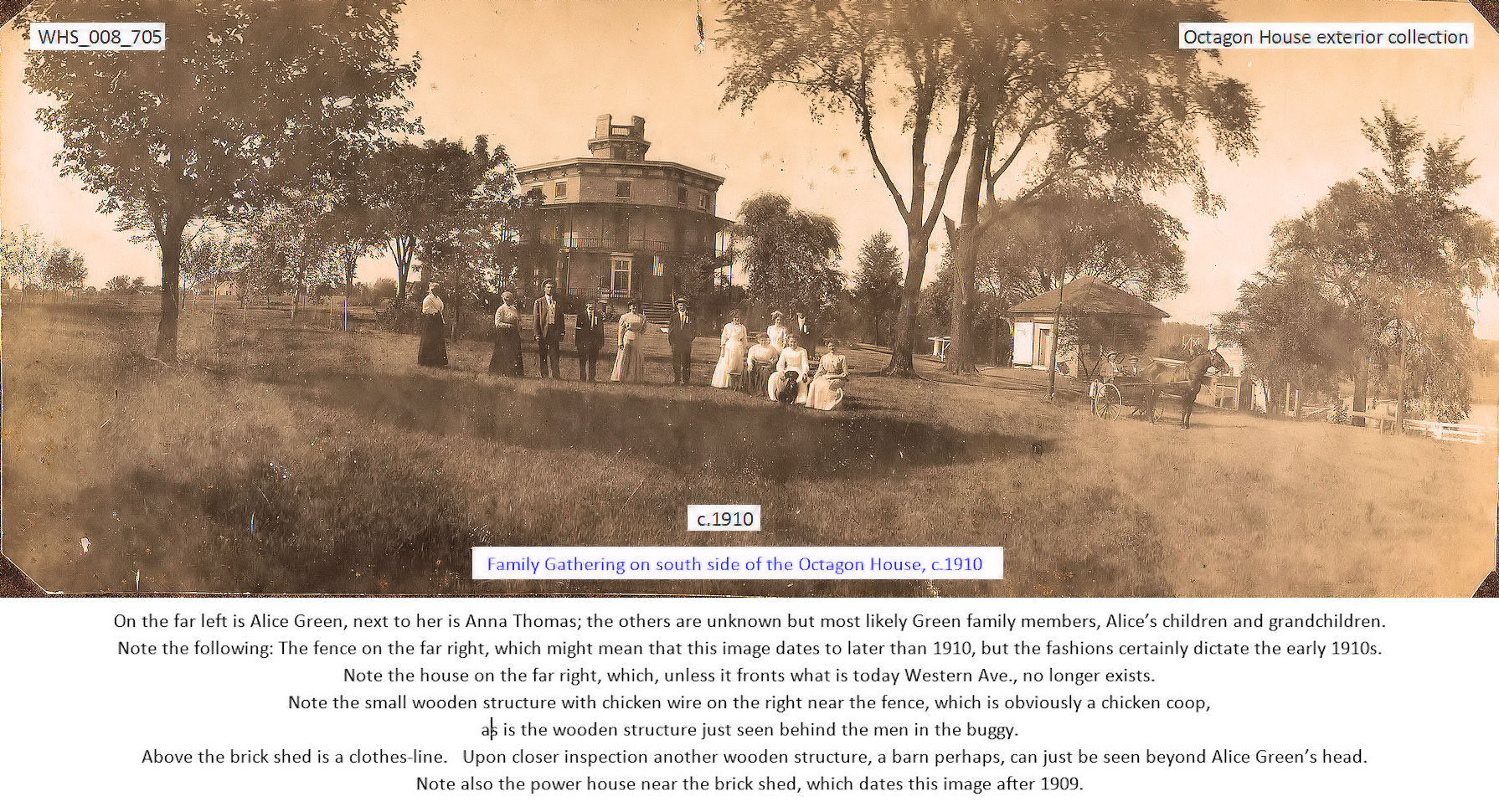
Alice Green and Anna Thomas; the others are unknown
but most likely Green family members, Alice’s children and grandchildren.
THE GREEN AND RICHARDS FAMILIES
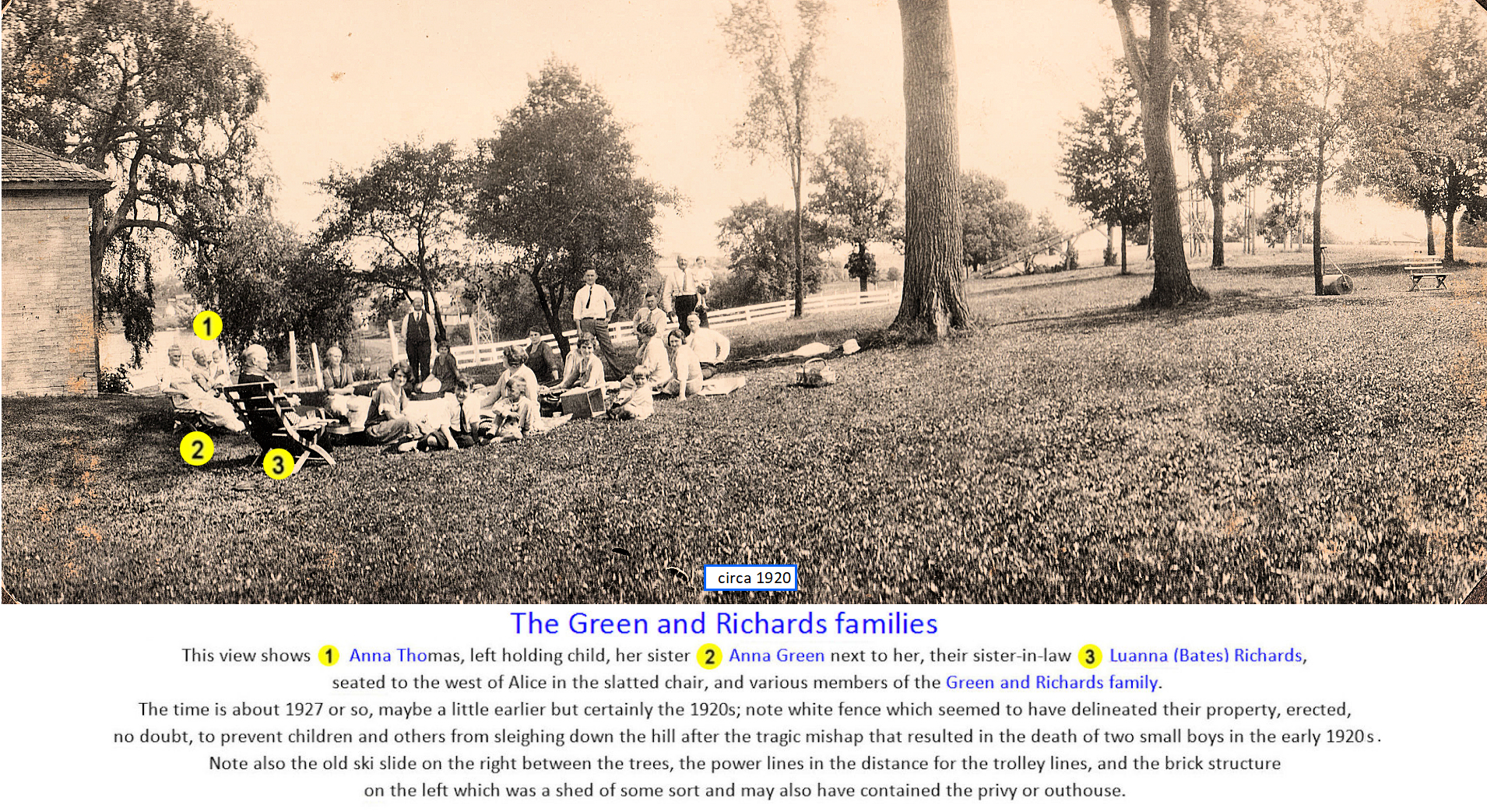
Anna Thomas, her sister Anna Green, their
sister-in-law Luanna
(Bates) Richards, and various members of the Green and Richards family.
c.1910-1915
BILLY THOMAS IN HIS CANNA BED
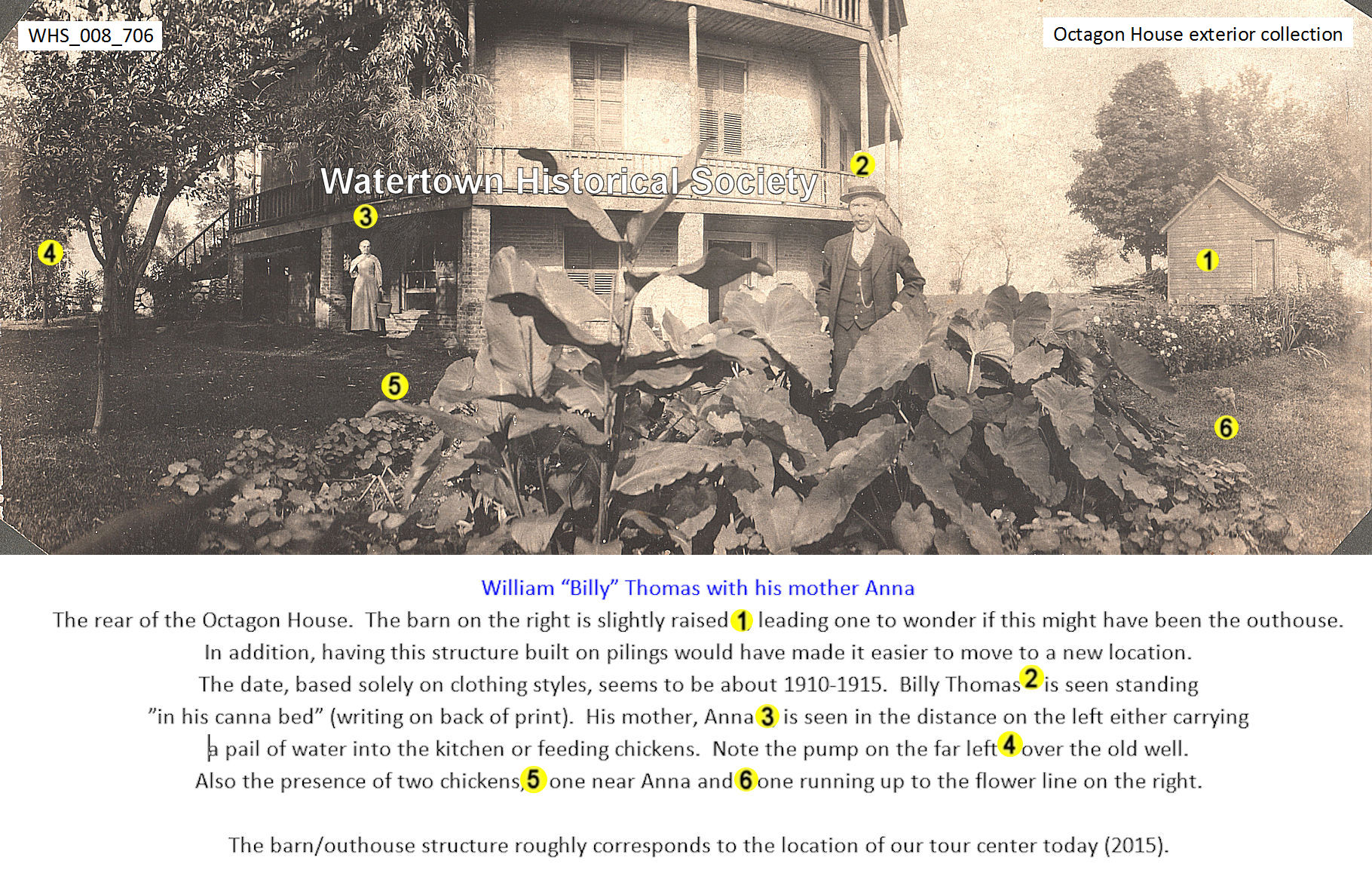
William
“Billy” Thomas with his mother, Anna.
Anna
Thomas was a daughter of John and Eliza (Forbes) Richards. John built the Octagon House.
ANNA THOMAS IN CANNA BED
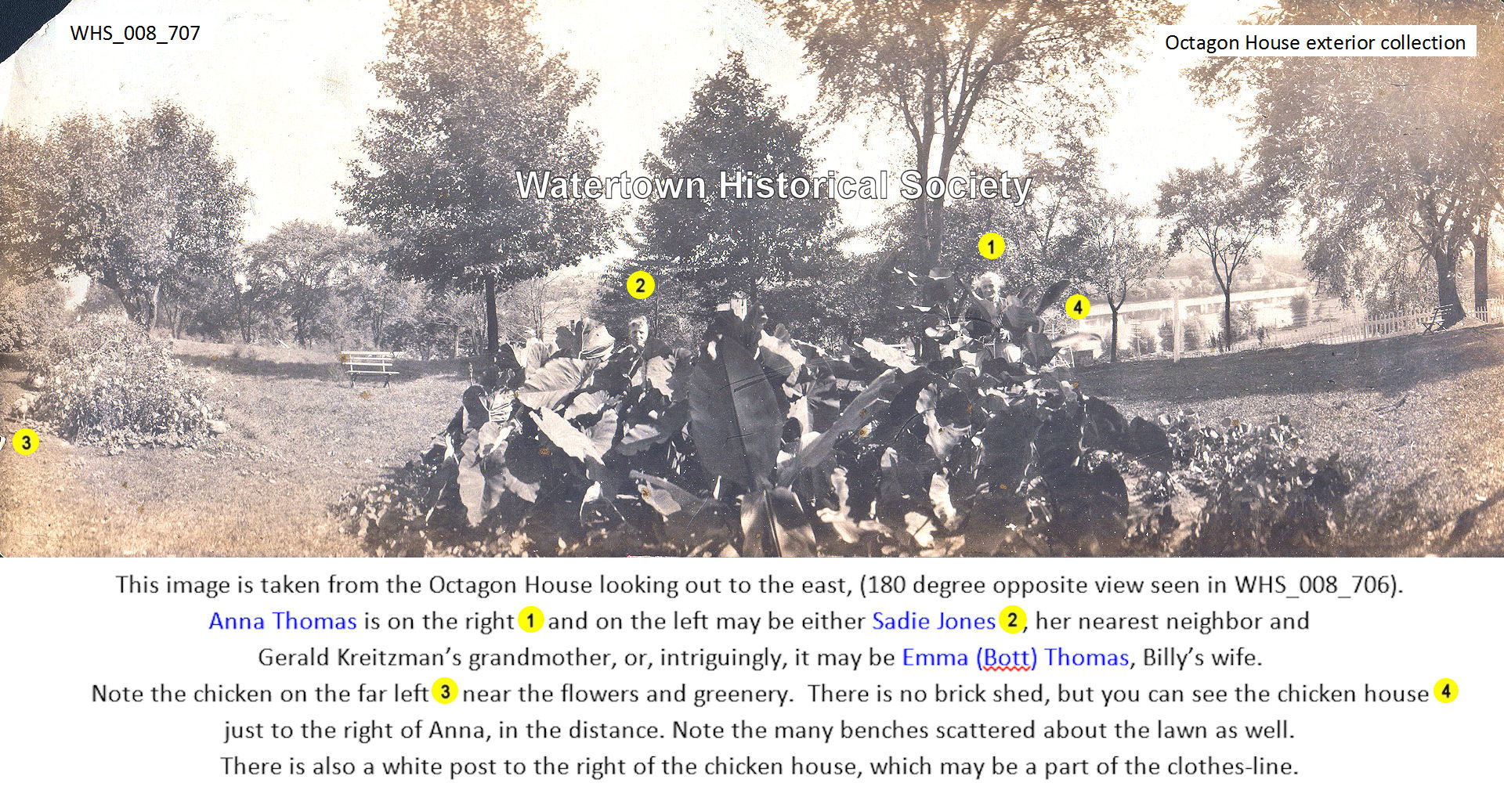
Anna Thomas and perhaps either Sadie
Jones, her nearest neighbor and Gerald Kreitzman’s grandmother, or Emma (Bott)
Thomas, Billy’s wife.
FAMILY
GATHERING ON SOUTH SIDE OF THE OCTAGON
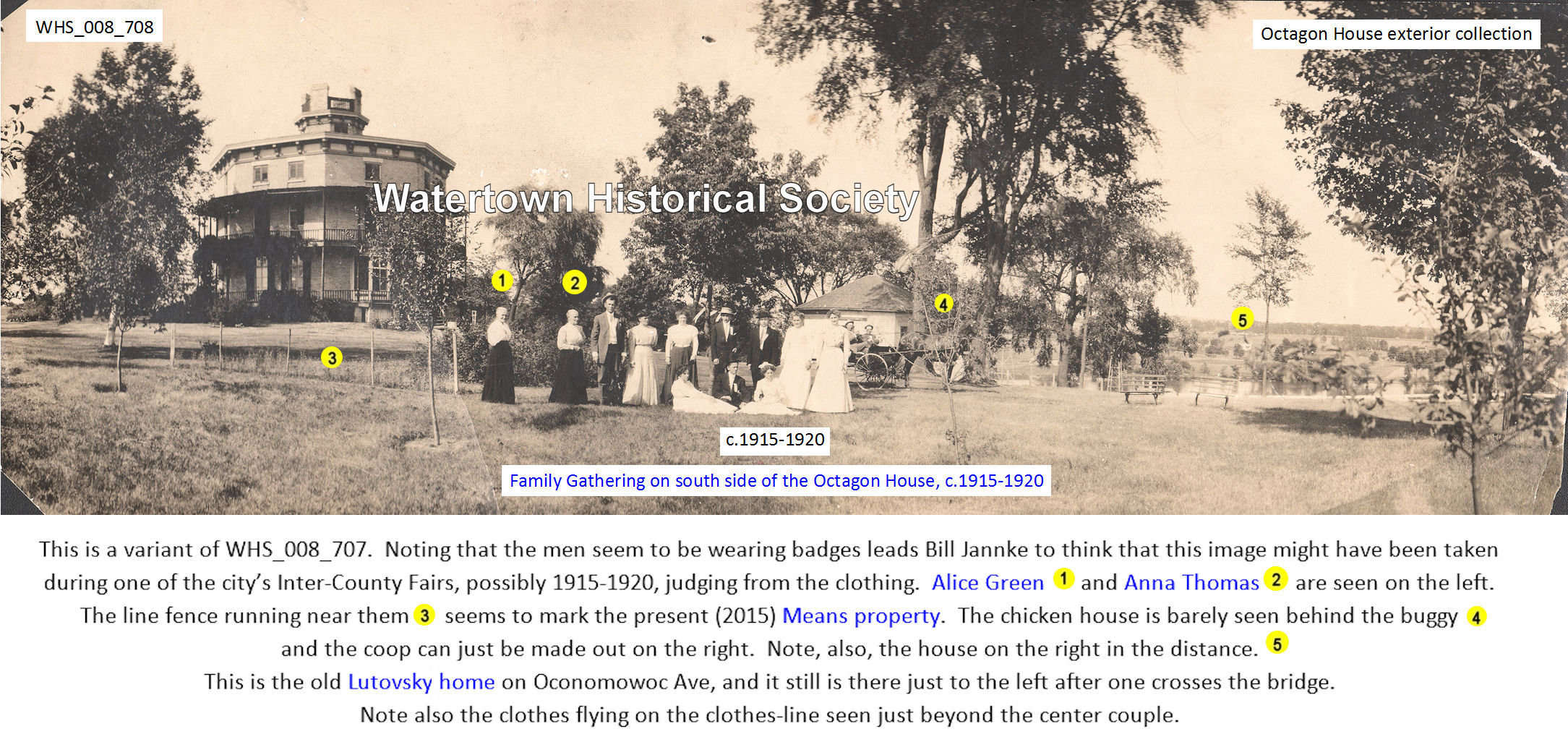
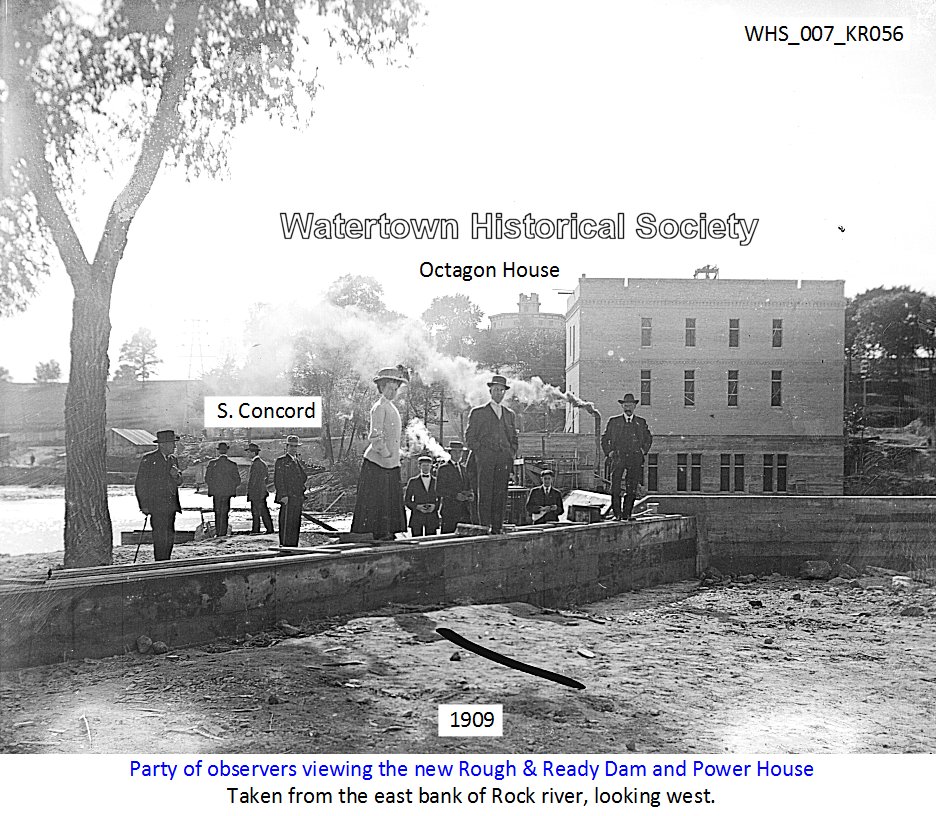
1909
VIEW FROM ROUGH & READY DAM
c.1915
OCTAGON HOUSE WITH ORIGINAL PORCHES
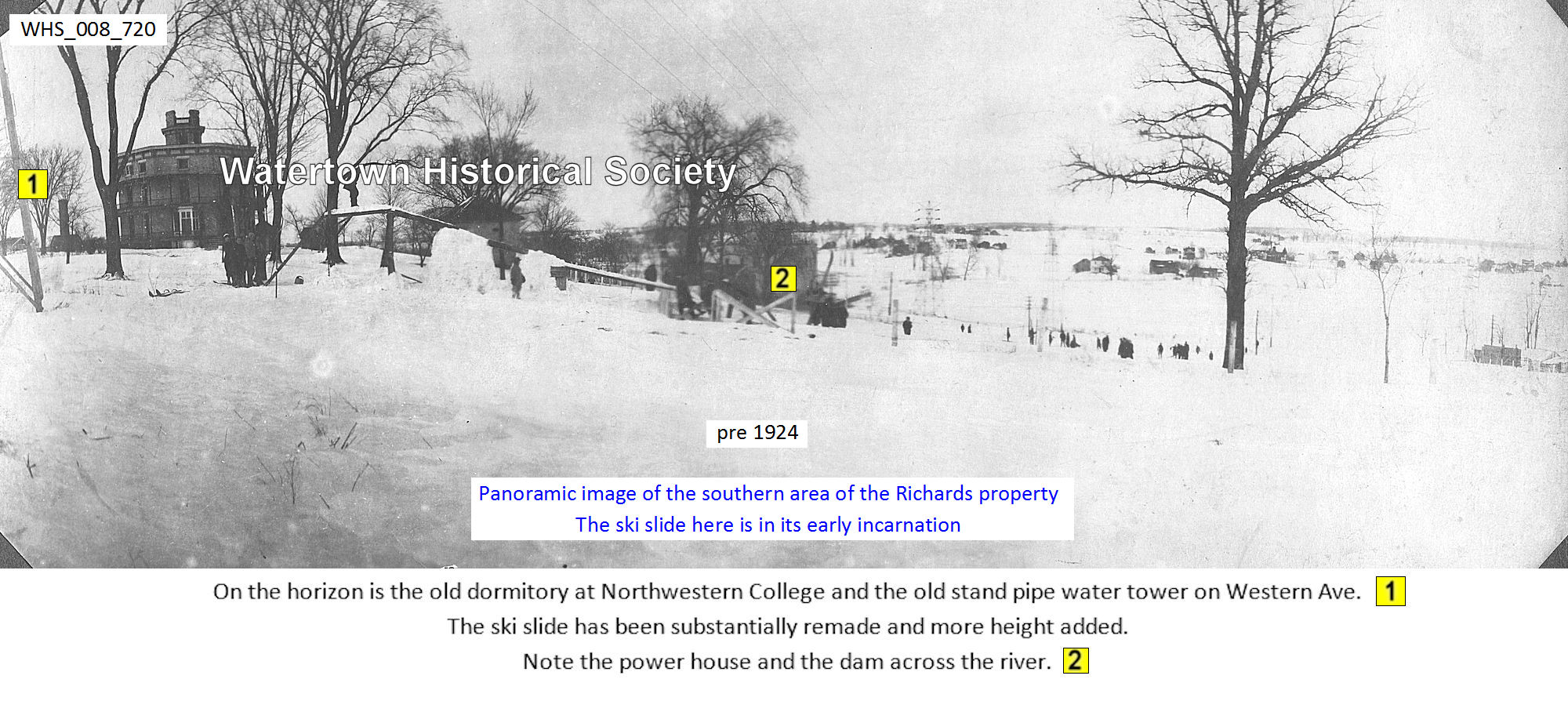
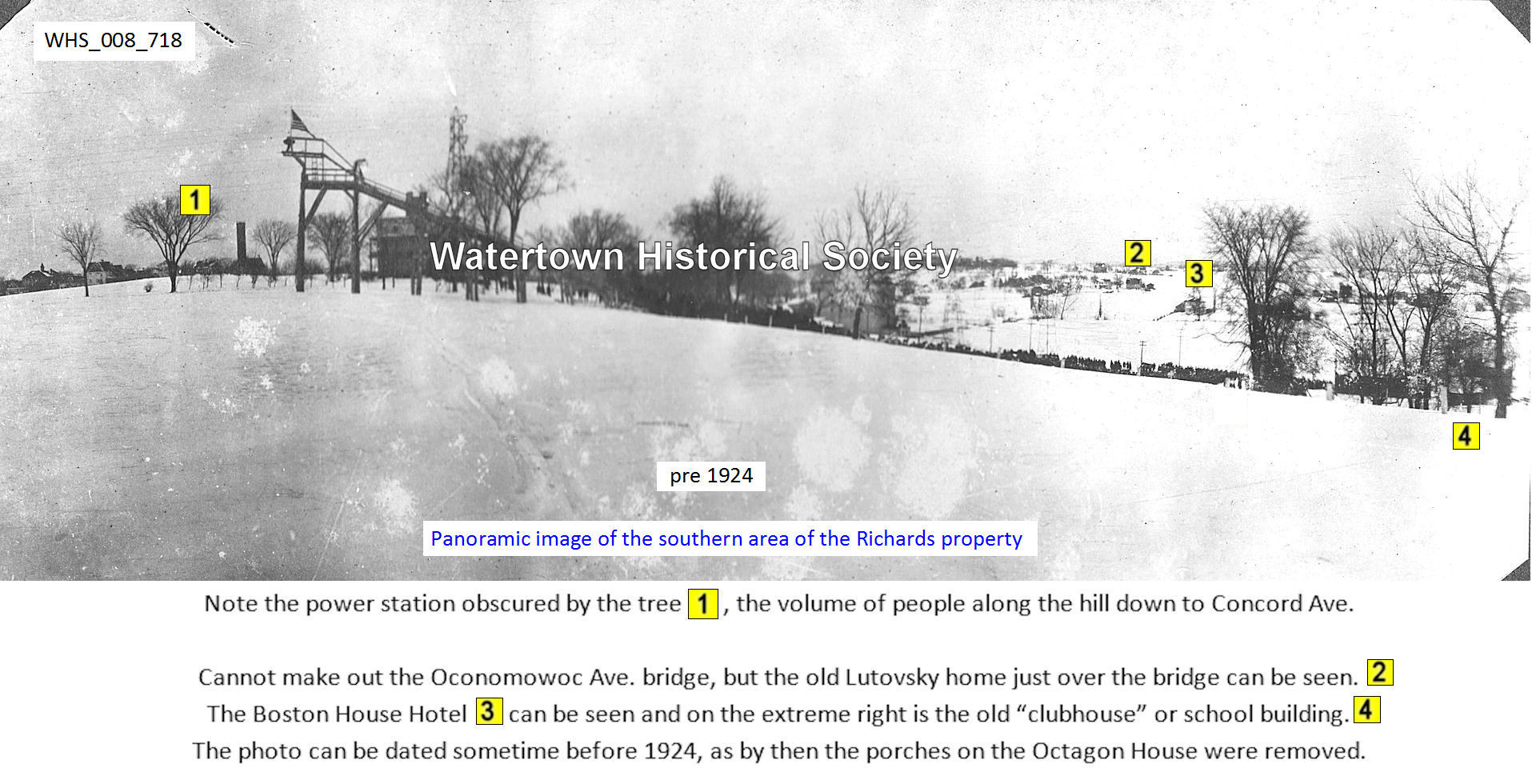
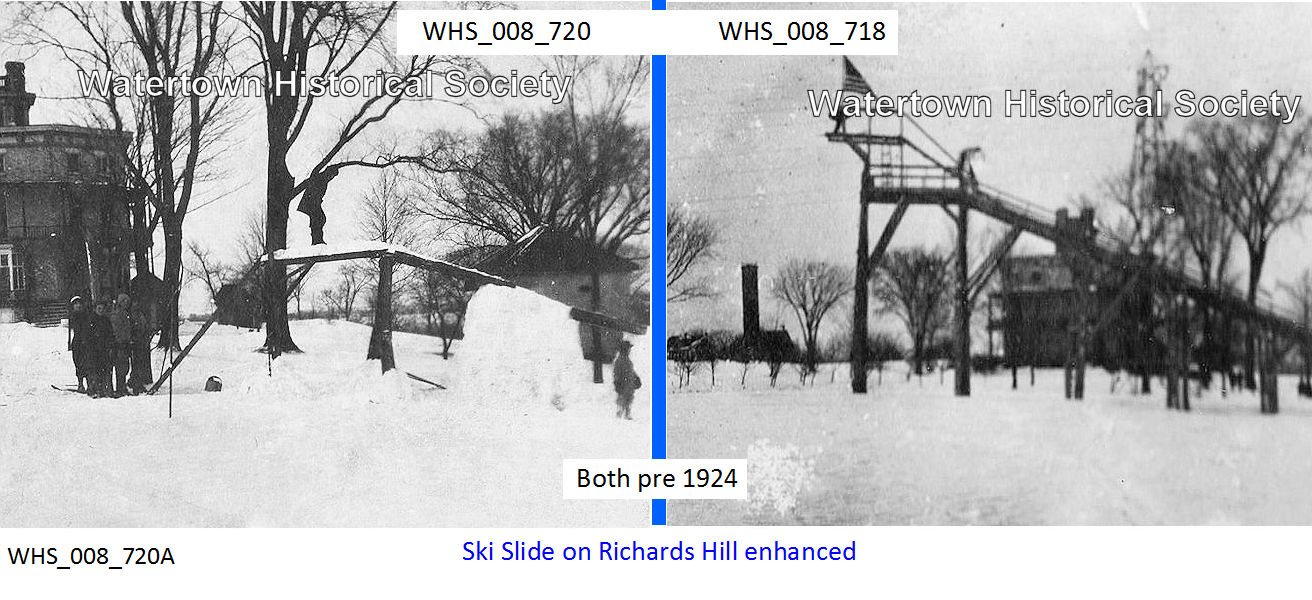
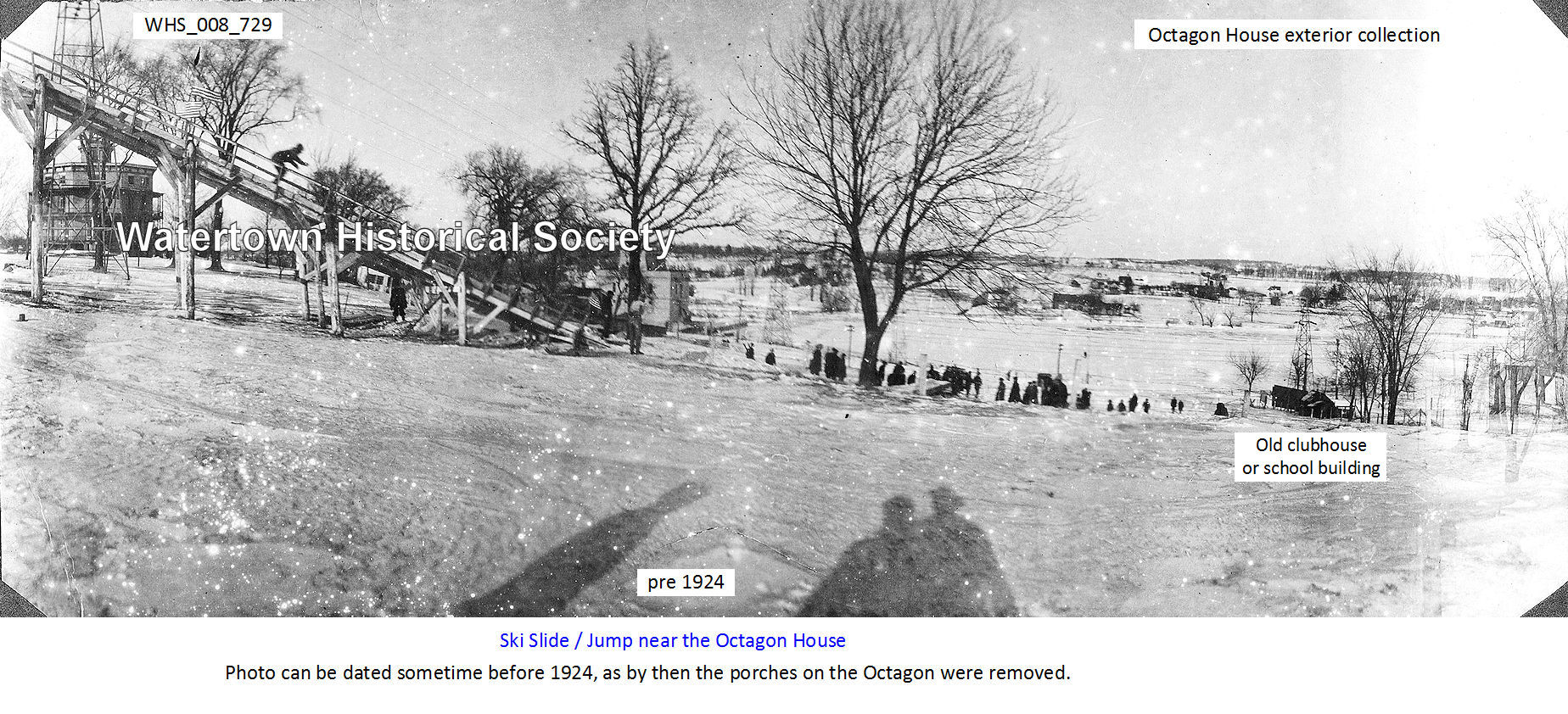
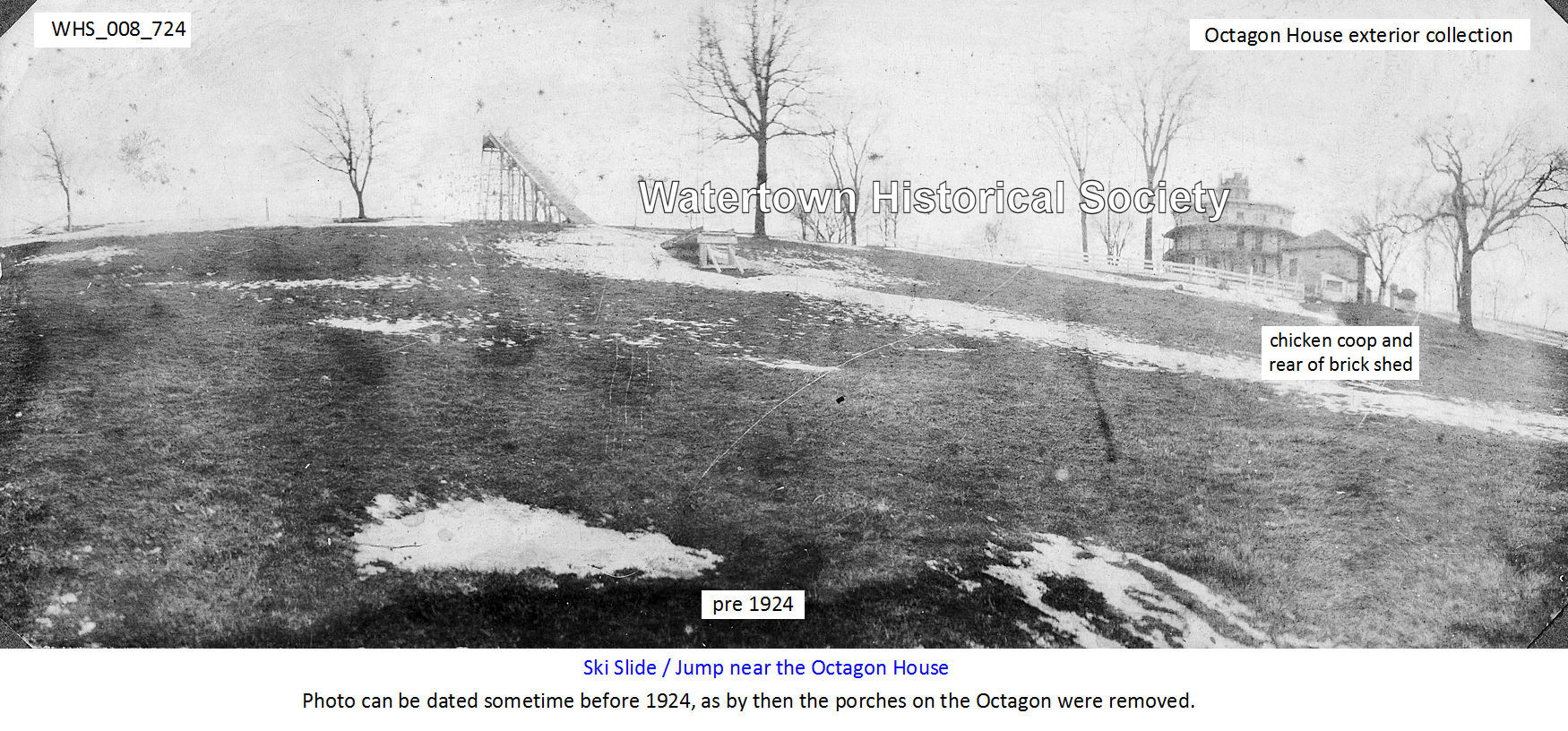
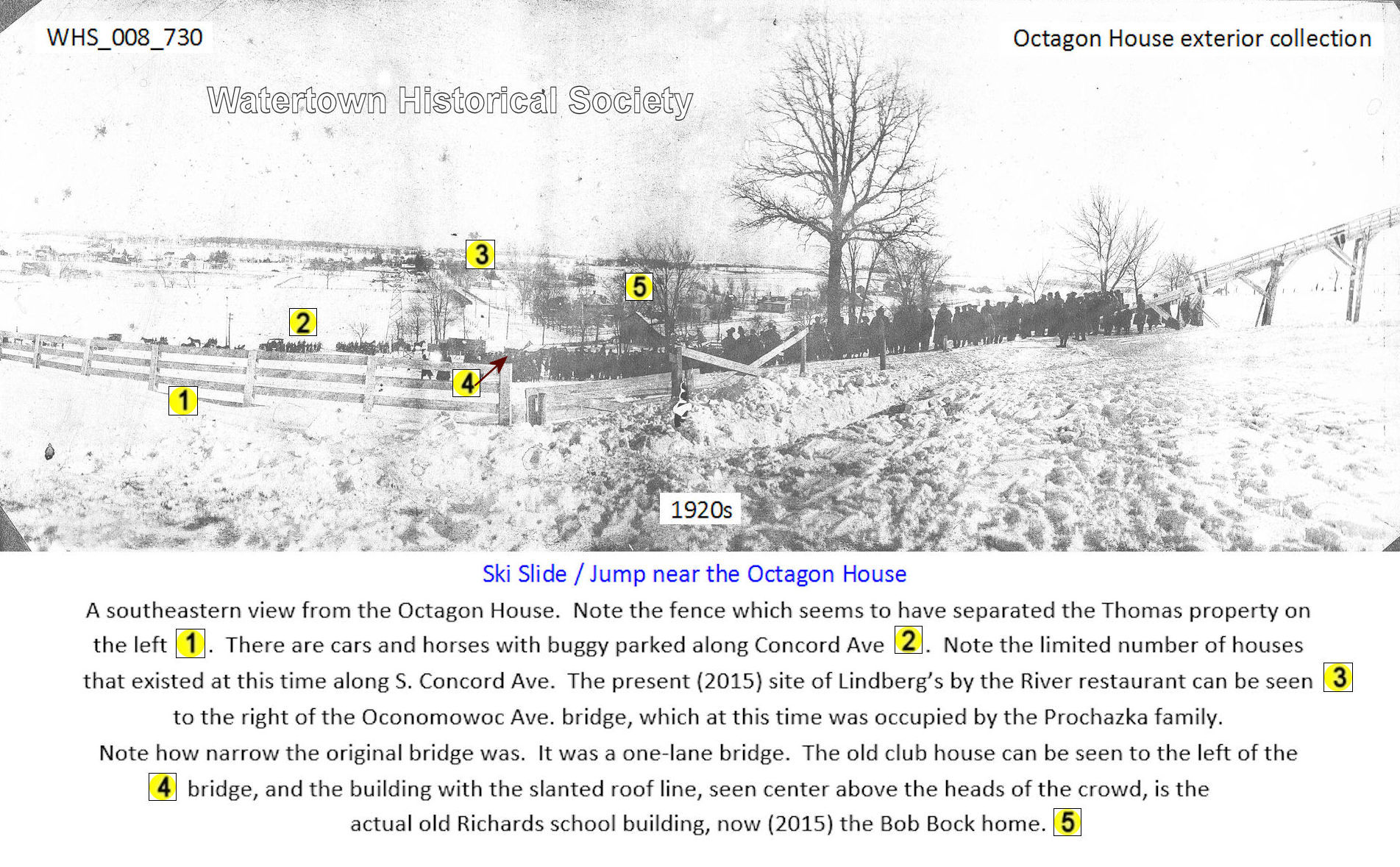
pre 1924
SKI SLIDE/JUMP, Octagon
porches were removed in 1924
Cross reference:  Video
segment on ski slide
Video
segment on ski slide
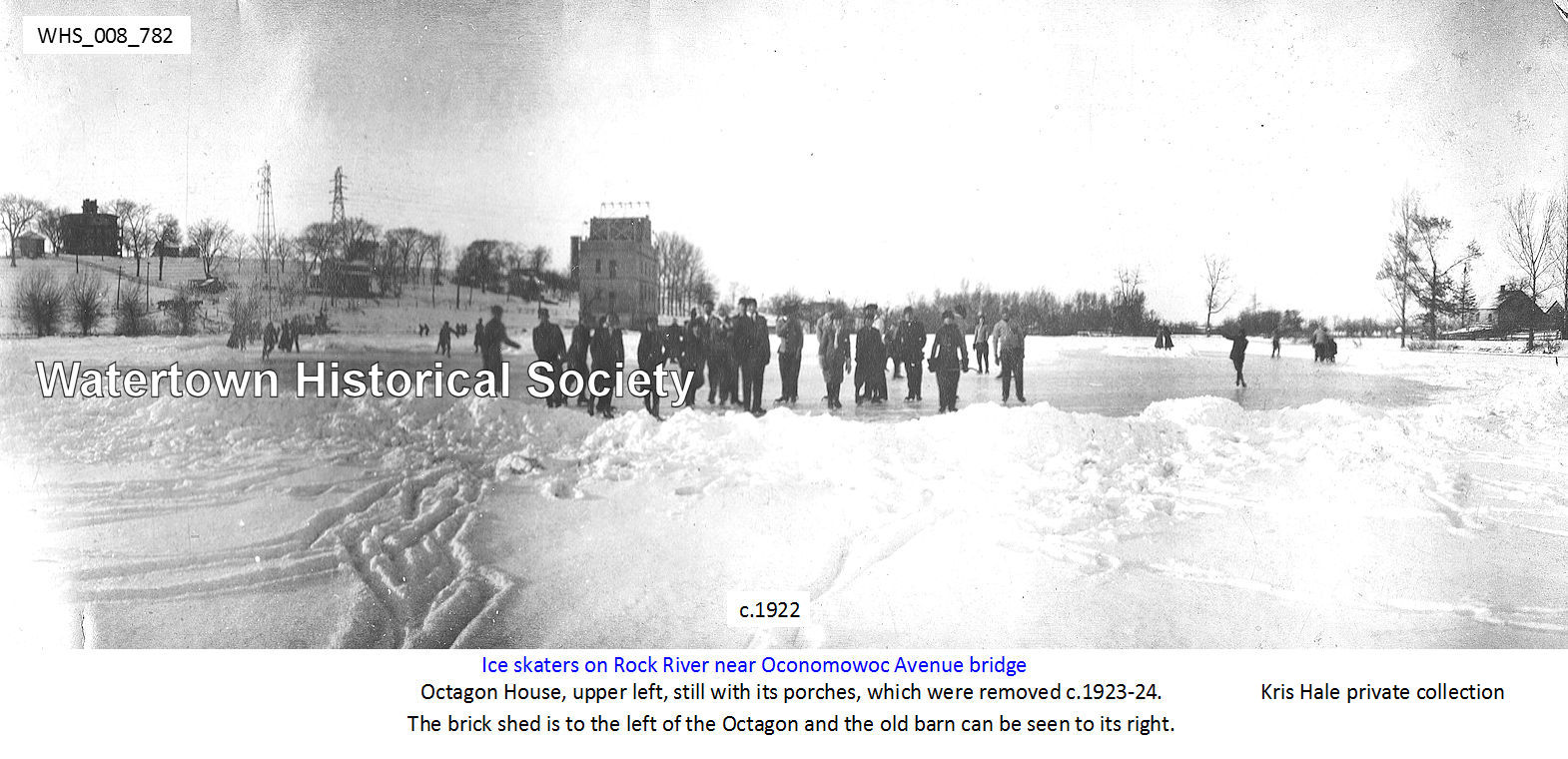
c.1922
ICE SKATERS BELOW RICHARDS HILL, NEAR BRIDGE
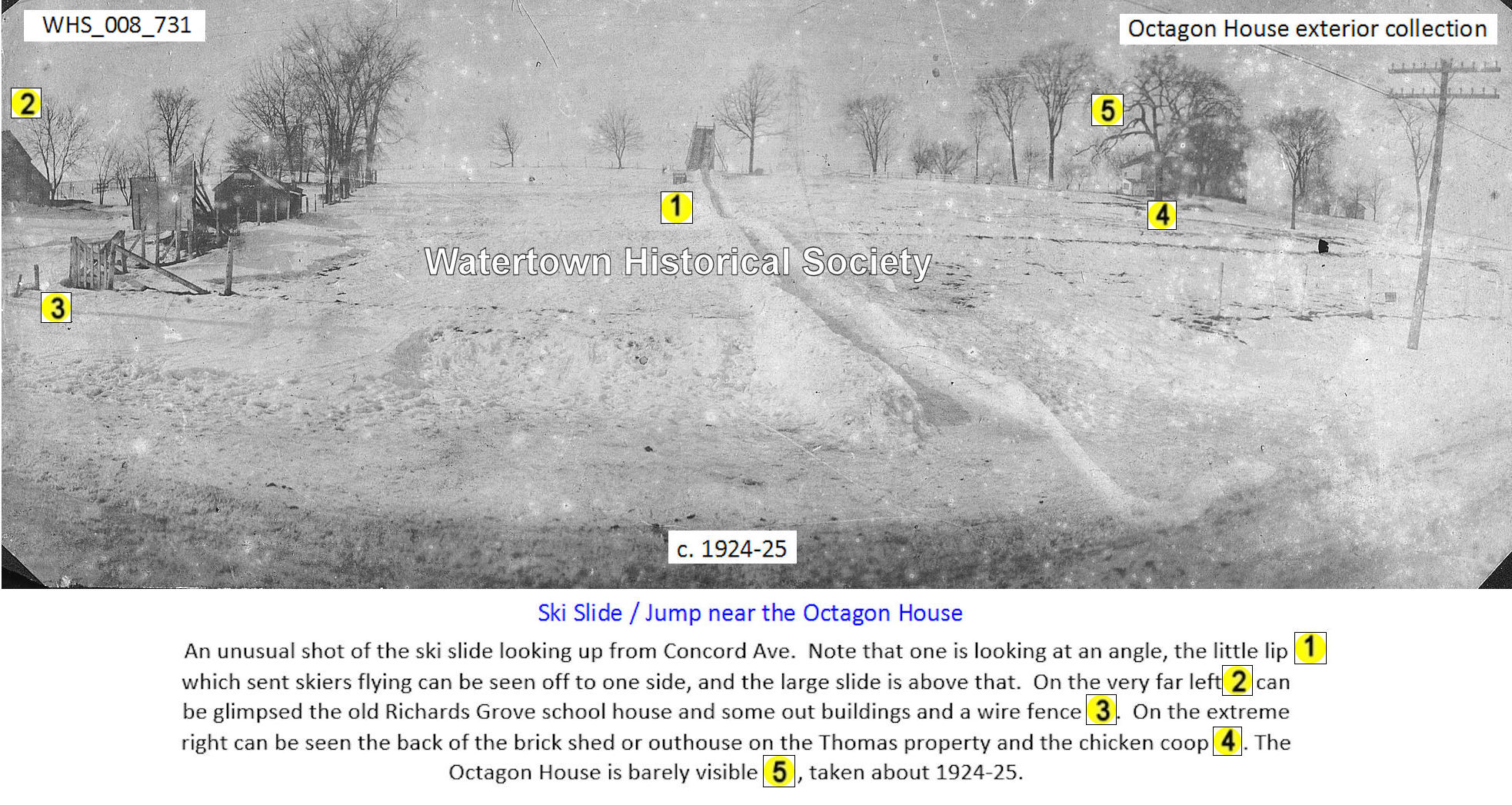
1924 <> PORCHES REMOVED
1924-25
SKI SLIDE/JUMP
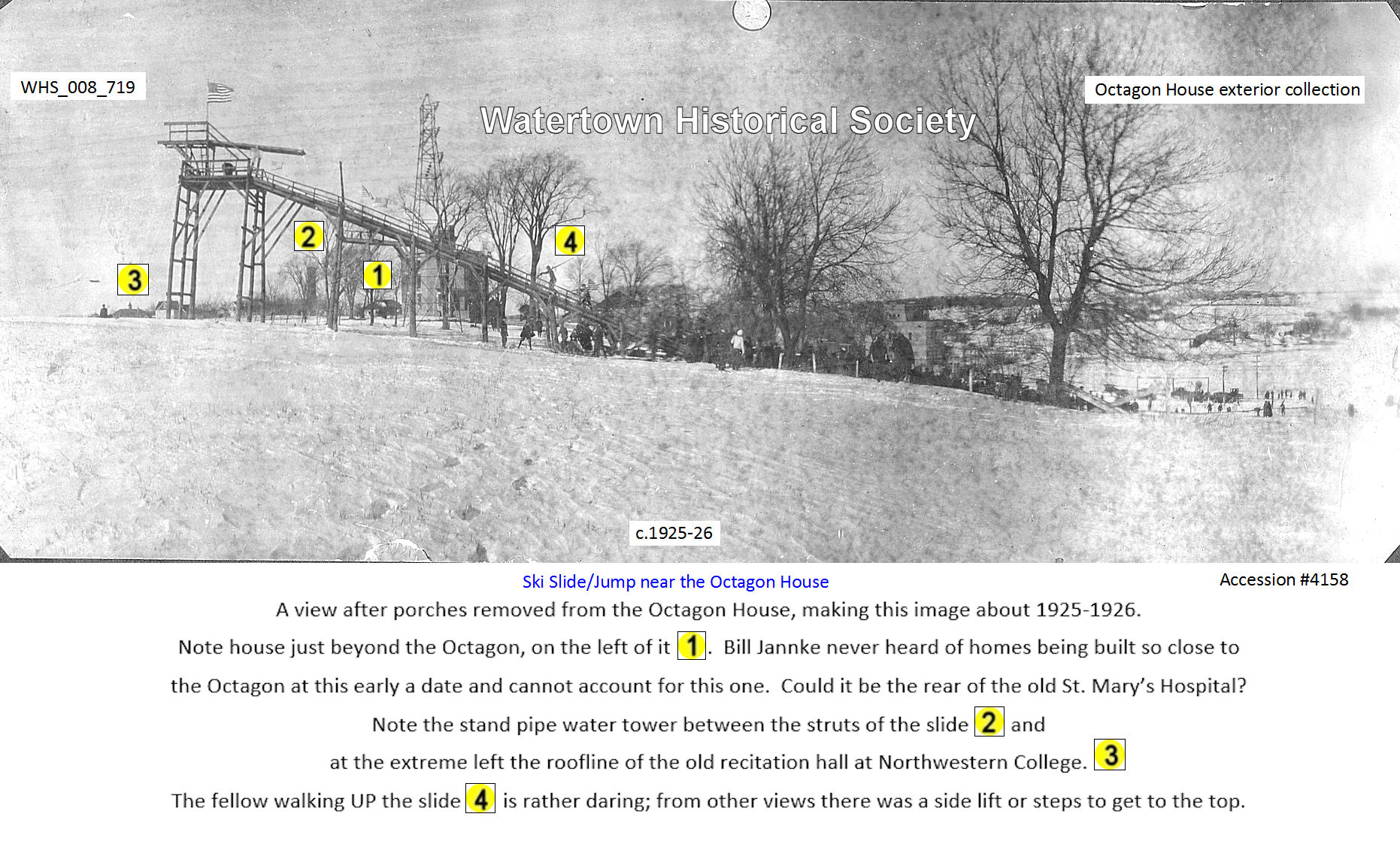
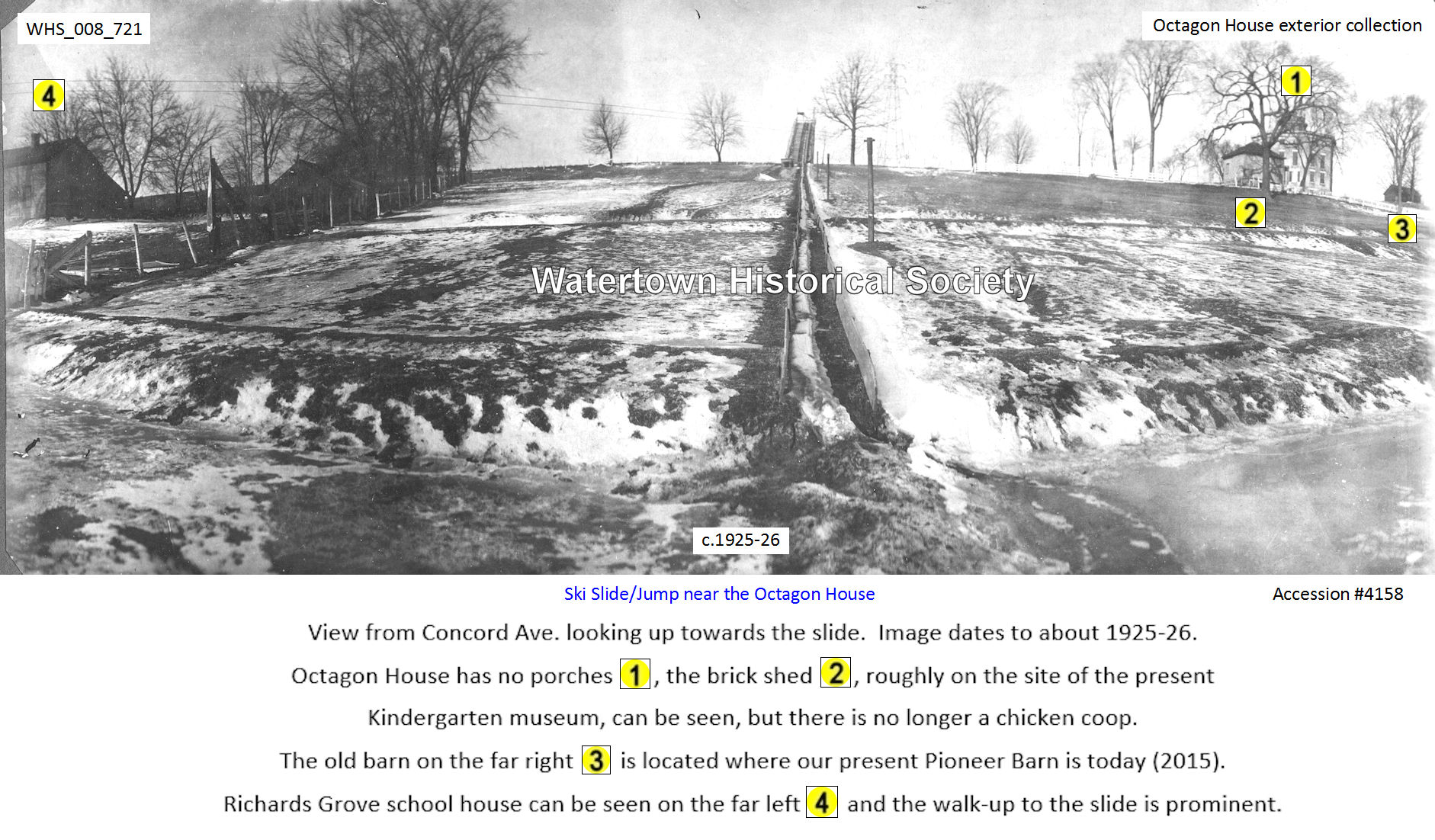
c.1925-26
SKI SLIDE/JUMP
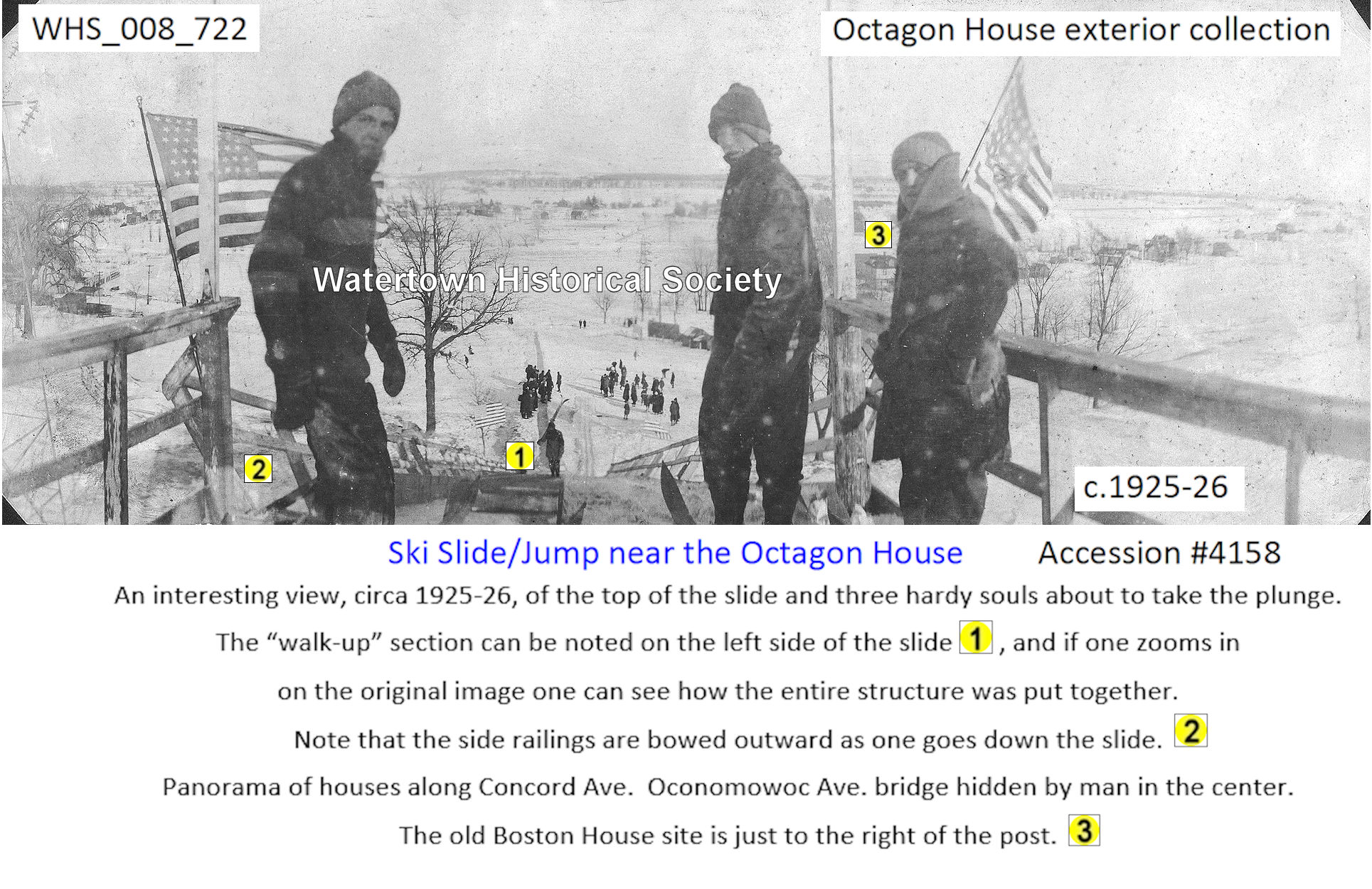
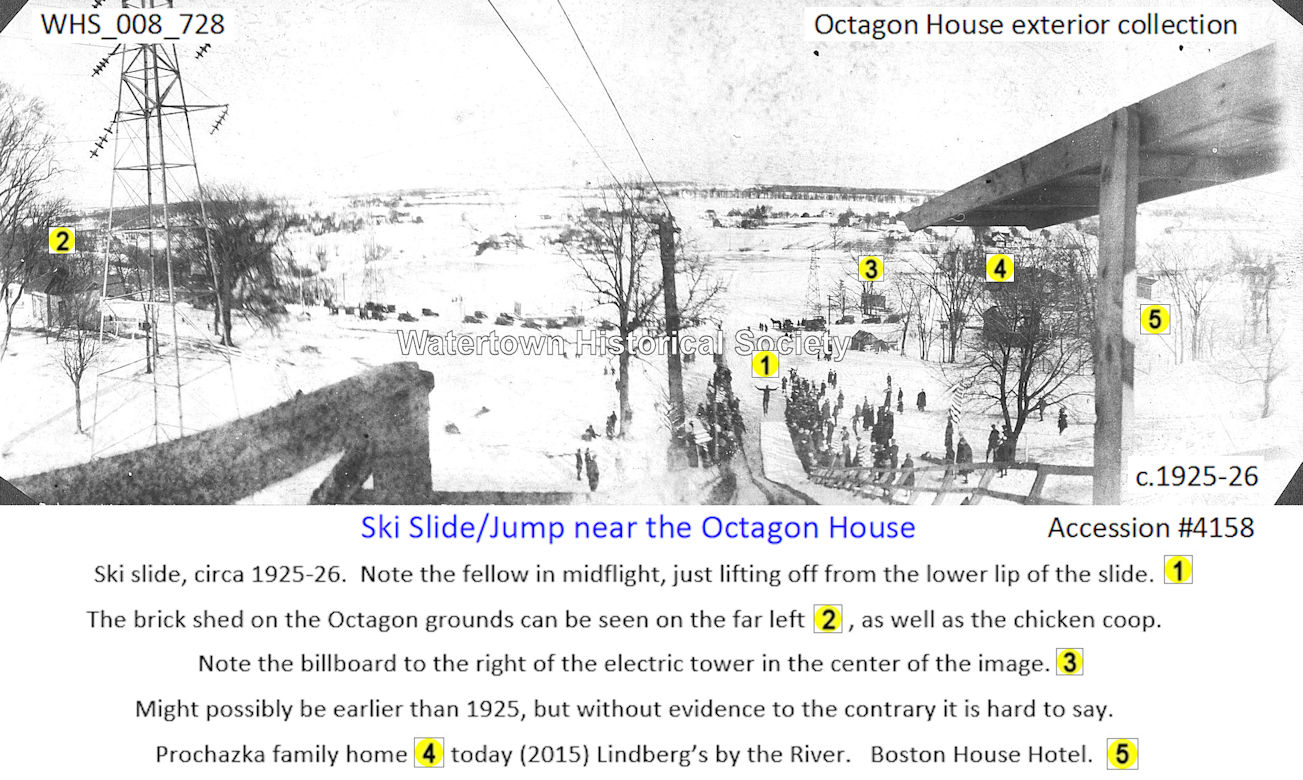
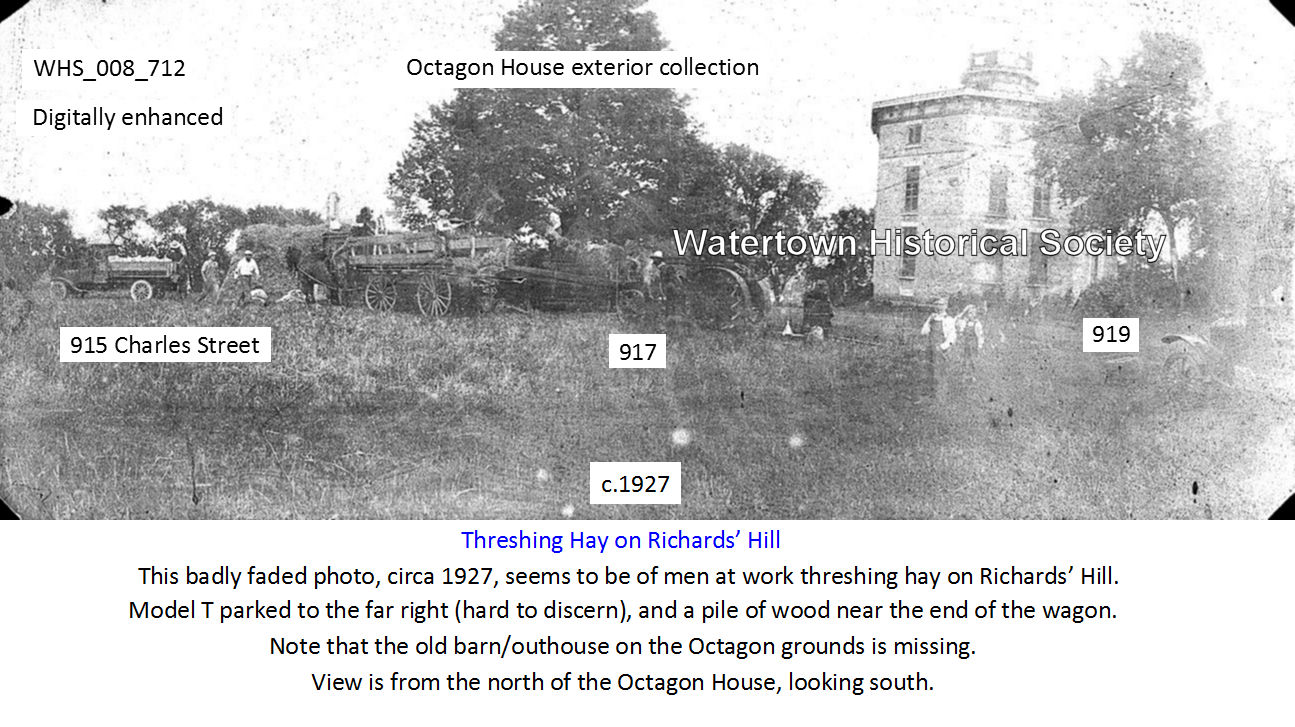
c.1927
THRESHING HAY ON RICHARDS HILL
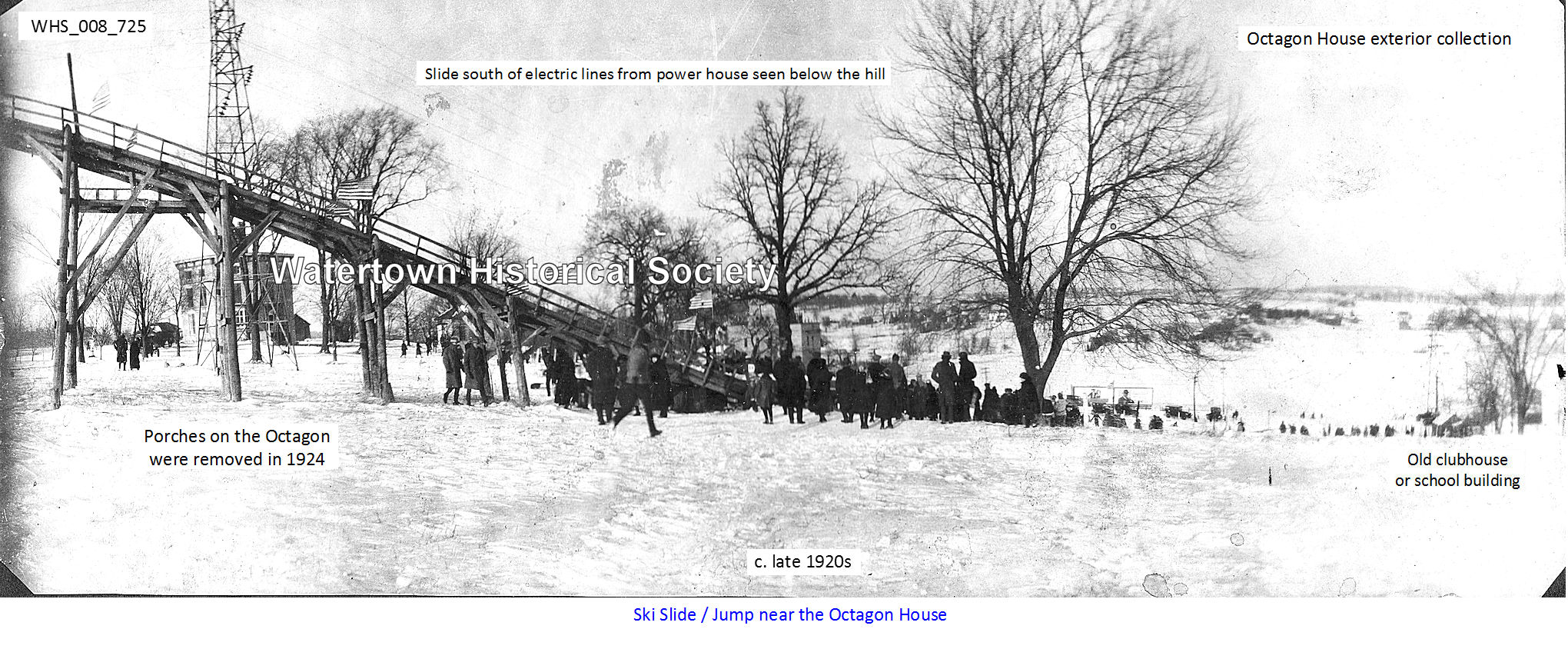
1920s, late
SKI SLIDE/JUMP, Octagon porches were removed in 1924
PICNIC ON
FRONT LAWN OF THE OCTAGON
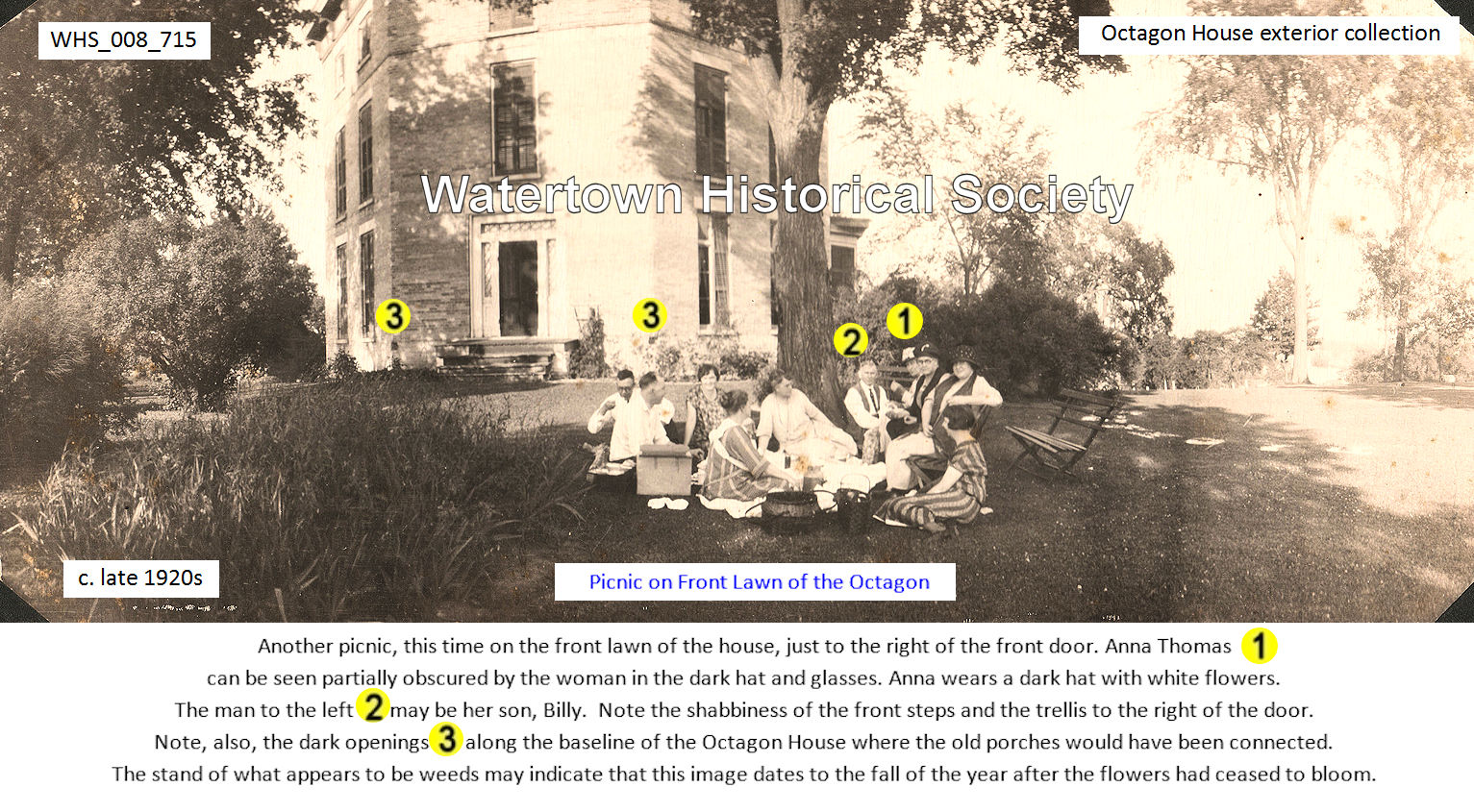 Anna
Thomas and son Billy
Anna
Thomas and son Billy
Note dark openings along the baseline of the
Octagon where the old porches would have been connected.
Can be seen: those the white stones on the
right that spell out “Richards” were
there in late 1920s !!!
FAMILY GATHERING OR PICNIC ON
SOUTH LAWN
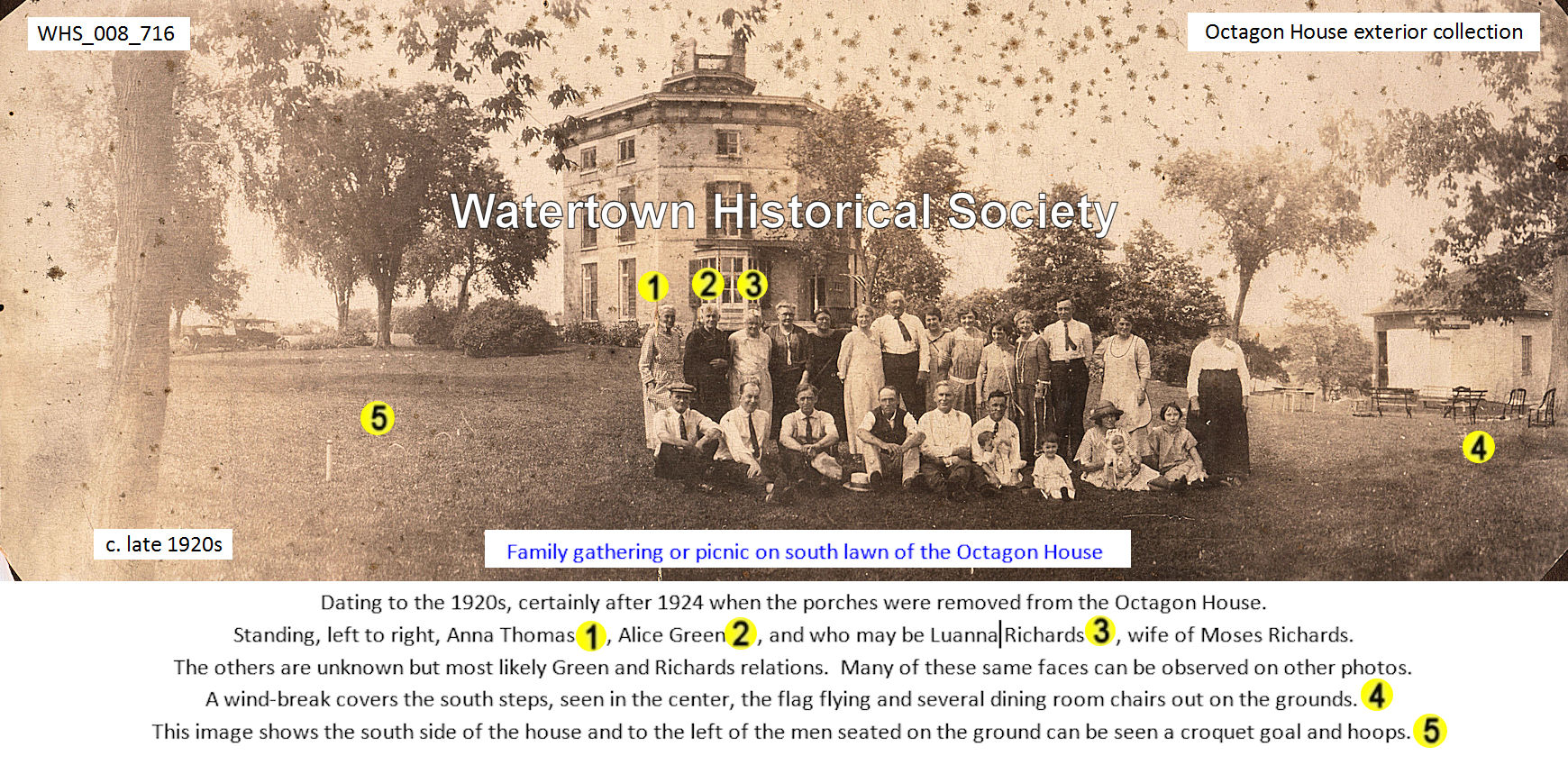
Anna Thomas, Alice Green, and who may be Luanna Richards,
wife of Moses Richards.
1933
04 10 <> OCTAGON HOUSE, WHERE RELICS ABOUND
The
first step in the formation of a historical society in Watertown
“Oh,
mommy, lookit at that big, around house on that hill,” cried the little
curly-haired girl as she pressed her nose against the window of a Milwaukee Road
train while it slowed its pace on entering Watertown.
“That’s
the ‘Octagon House’ – the old Richards home, girlie,” the conductor intervened
as he strolled through the coach. “It’s
one of the most famous landmarks along this route. Almost everyone asks about it on my run. Folks in Watertown don’t pay much attention
to it though, it’s been there so long.”
The
little child listened and stared, just as countless other little girls and
grownups alike have admired it for years – the old mansion of the Hon. John
Richards, Watertown pioneer, business leader and statesman.
May
Become Museum
As
the conductor mused – folks in Watertown don’t pay much attention to it. It’s been there so long – he probably spoke
the truth, but Watertown folks are beginning to take more than casual pride
over this architectural gem. They plan
to make it a museum of Watertown relics, the headquarters of the
newly-organized historical society. How
the association plans to accomplish its goal still is undecided, yet that is
the aim.
Erected
on a high bluff of the roaming Rock River valley, the Richards home has seen
three generations pass as it looked down like a fortress from its lofty,
natural acropolis. Since 1853, for 80
years, the eight-sided brick home has housed the Richard family.
Today
two persons occupy the rooms which once were those of a large family, Mrs. Anna R. Thomas, daughter of the
Hon. John Richards, and her son, William
R. Thomas, realtor whose present ambition is to see the old homestead
developed into a Watertown museum.
Houses Many Treasures
Truly
a treasure house is this old home. Many
a simple bauble or home and farm implement of another day has become a relic to
be cached away in this great Watertown relic that once was a shining example of
domestic building grandeur.
Three
stories above the ground this home remains intact in all effects as it was the
day on which it was built. A builder’s
level proves that the structure has not sunk its well-planned foundations in
its battle with the elements during those long 80 years. In all it is unchanged. No electric lights shed their twentieth
century glow over the fancily-decorated rooms; no radio barks out jazz notes
and oily gutturals of crooners; no roller shades to keep out the strong summer
rays of the sun.
Blinds Shade Windows
Instead,
oil lamps, which replace their crude predecessors – candles – years ago,
provide the only light after the sun had departed for the day. For music there is an old spinet-style piano
in one of the parlors for those who would play on it. Old, wooden blinds cover the many windows on
the structure’s eight sides.
When
John Richards went to build his home 80 years ago, he did so with a resolution
that it should be totally apart from anything in the city. A journey to the grounds and through the home
will prove to the most skeptical that he accomplished his purpose. From Milwaukee came the thousands of bricks,
the real cream brick which gave the Wisconsin metropolis its nickname. With an octagon for a geometrical pattern, he
selected the plans for the remarkable house which wastes not an inch of
precious space.
Bible Stands on Table
Entering
from the west door a few feet from the ground, one finds himself in a parlor,
oddly shaped, yet beautifully decorated in the finery of a hundred years
ago. In the center of the room is a low
table with the family bible standing on it.
To the right are chairs and a lounge all of which have passed the
century mark in age. To the left is the
oblong spinet piano, the first instrument of its kind in Watertown. Piled on its closed hood are photographs,
albums and trinkets, each having some honored connection either to the Richards
family or to Watertown.
This
room Mr. Thomas plans to turn over to the historical society temporarily, so
that it may preserve the other objects of interest, which it has gathered, here
in one of the oldest homes in the city.
A
door to the right leads to a second parlor, decorated with bright wall paper
and its ceiling ornate with carved moldings.
Chairs, cabinets, stools and tables, all homemade of valuable woods and
carefully preserved, dot the room.
These, too, have stood in their places since the earliest days of the
home. Their master looks with pride upon
them for to him they are more than antiques.
Both he and his mother have grown from childhood about them; they are
relics.
Oil
Lamp Hangs Above
Overhead
a fancy oil lamp of chandelier proportions hangs. Windows, with blinds turned ajar, permit the
deep sunlight to filter through the finely-paned glass.
Continuing
the walk along the lower floor, the visitor passes through an anteroom off of
the east door and finds himself in still another section of this mammoth
octagon. This time it is the dining
room, with chairs lining the long linen-covered table, and the buffet carefully
serviced with valuable old silver and china.
Paintings line the walls of this room just as they did the others,
carefully hung and safely preserved.
A
door to the right again leads back to the first parlor where the visitor
entered but a few minutes before. The
trip about the lower floor is ended, the octagon has been circumscribed.
Stairway Winds Upwards
In
the geometric center of the house is erected a circular stairway, exactly as
constructed by hand labor years ago. Its
fine railing is turned perfectly and the stairs spiral their path upward to the
cupola from where one can scan for miles around the countryside of Watertown –
the winding river to the east, the business section to the west and the fringe
of the city and the adjoining outskirts to the north and south, with the tall
spires of churches piercing up from lattice of roofs that covers the vista.
The
second floor is given over totally to bedrooms, furnished with soft,
comfortable appearing beds, carved of fine wood and finished with all the turns
and curves that characterized interior decoration of generations past. Bureaus and wardrobes all are finely kept and
possess the luster that the years have failed to blemish. Curiously, on the second floor the interior
octagon is divided once more into a polygon of 16 sides and where, on the first
floor, one room stood, here two, a large bedroom and a smaller one, complete
with window and closet, take up the space.
The designer of this home well knew the means of conserving space.
Cross reference to info on stairway
Soft Water Runs
At
each landing on the spiral stairway is a small door, inside of which one will
find a little faucet from which flows soft water. As the rain pours onto the tin-covered roof
above it drains into a tank, well-hidden, from whence the water is fed to the
series of tappets on each floor.
Up
the stairway once again is the third floor, all given over, except for one
room, to the store space for furniture, clothing and other belongings.
Treasures Fill Room
In
the one room set aside are to be found a myriad of old treasures. Along the walls, on the floor and on the
table in the center, are countless gewgaws that have played parts in the
growing life of Watertown.
On
the floor are old trunks, good in their day, but hardly strong enough to stand
the knocks of modern day rail handling.
Against the wall lay oxen yokes and on the side hangs an old saddle
which had been in the Richards family long before the house was erected. In one corner is a sample of Indian beadwork,
brought from the then territory of Montana.
Against one wall hangs maps of the United States in 1854, the western
states of 1849 and Jefferson county in 1872.
Photos Cover Walls
Quaint
old etchings of such scenes as the “Fall of Richmond” in the Civil War,
photographs of the home and grave of Jesse James in Missouri and pictures of
early Watertown streets and people, adorn other sides of the wall.
Below
is a book on an antique desk used by Mr. Richards in his mill. This is the register which Mr. Thomas has
started and in which tourists from coast to coast, a thousand or more of them,
have inscribed their names. Along the highway, they have noticed the house,
paused and found a genial host and guide in Mr. Thomas to show them about.
In
the center of this curio room is a table on which innumerable articles are
kept. Here is a little dinner bell, set
up in a fancy bronzed frame adorned with mother-of-pearl. Next to it is the bell which one day called
carefree pupils to the school which John Richards built to the south of his
mansion.
Keep Surveyor’s Chain
Next
to it is the chain which was among those used in surveying the strip of land
for the laying of the famed Watertown Plank Road into Milwaukee years ago. Then there is a toy cannon and a mold for the
manufacture of home-dipped candles.
Nearby rests a candle snuffer.
Most
curious of all is a small bagatelle board with which Mr. Thomas said he played
60 years ago. Bagatelle is the game from
which the now popular marble game developed.
Nowadays it costs a nickel to send 10 or more marbles rolling around the
frame, bouncing off pins and then falling into slots for a score, but this
little box puts on the same entertainment for the player at no cost except the
original payment.
Cradle Still Rocks
In
the corner is the hand-made wooden cradle which has passed through generations
in the Richards family. Mrs. Thomas, now
91 years of age, is one of the many who slept in it in their baby days. On the
table is a leather pouch which another member of the family wore in the Civil
War. In the pouch were carried the
messages from one battalion to the other.
Truly this mute piece of worn leather could tell a romantic tale if only
it could speak.
On
a shelf is a miniature replica of the Richards home which Mr. Thomas fashioned
for an exhibition years ago. The model
shows the house in its original design, which a porch surrounding the entire
structure on each of the three floors.
This porch endured for years on the house, but the wood could not
withstand rain and snow as well as its brick supports with the result that it
was removed.
Lawn Possesses Beauty
And
so the tours ends. The visitor winds his
way down the spiral stairway again and walks out on to the well-landscaped lawn
that rolls like a huge billow to the east and overlooks the winding river
valley. The house in the background
stands in its weather-beaten grey, its blinds setting off the many angles of
its sides. Here is, indeed, a museum of
history of pioneer days. Only the
concerted efforts of the new Watertown Historical Society are needed to make it
one permanently. WDTimes
1935
09 12
<> NATIONAL GEOGRAPHICAL SOCIETY
PHOTOGRAPHER
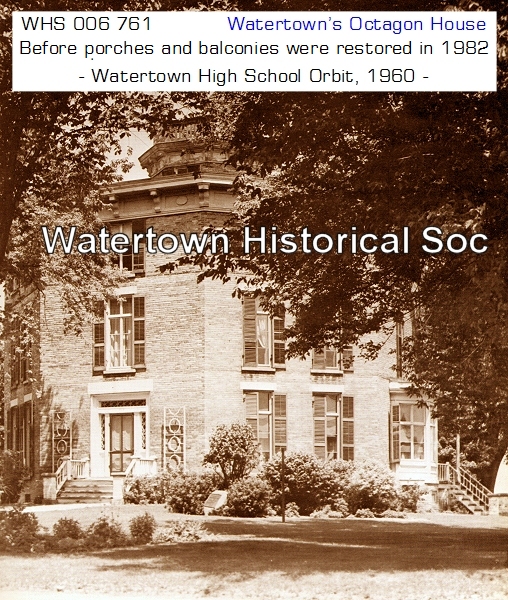
A photographer
from the National Geographical Society was in Watertown Monday, 9/9/35 and in
company with Mayor W. F. Reichardt, he took several pictures of the first
kindergarten. He also took a picture of
the Richards home which is now occupied
by Mrs. Anna Thomas. Watertown Tribune.

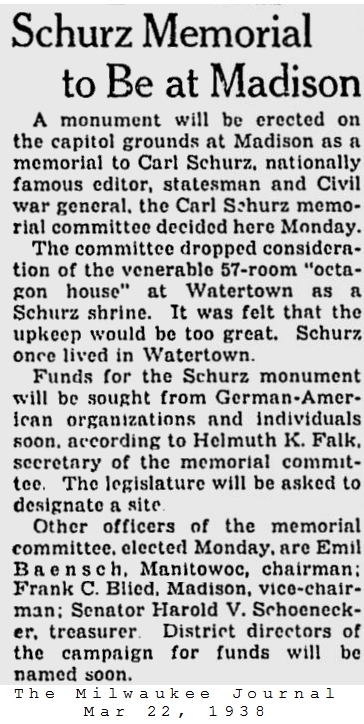
1938
SCHURZ MEMORIAL PROPOSED FOR MADISON; CONSIDERATION OF OCTAGON HOUSE
DROPPED
03 22
<> 
1939 <> FORMAL DEDICATION TOOK PLACE IN JULY OF 1939
Quit deed signed in November of 1938
The
Harvey Richards family and Mrs. Charles D. Richards had an interesting week-end
when they motored down from Phelps, Wis., where they are vacationing, to be
present at the ceremonies held in Watertown, Wis., in which the old Richards
homestead was presented to the Watertown Historical Society by Mrs. Charles
Richards, in memory of her husband, the late Charles Daniel Richards. "The Octagon House," as the place
is called, was built over 100 years ago, on a high hill overlooking the Rock
River, by the Honorable John Richards, and has been occupied by his descendants
ever since. Long an object of interest
to the passers-by for its unique architecture, it will now be open to the
public as a museum, containing the relics of early days of the pioneer
Wisconsin settlers. William Douglas
Richards, a great-grandson of the pioneer builder and first mayor of Watertown,
unveiled the bronze tablet, mounted on a large native boulder, and the
presentation speech was given by Harvey Richards, in memory of whose father the
place was dedicated. Several hundred
friends and members of the Historical Society were present, and the affair
ended with a tea, after which everyone was invited to make a tour of the house
and grounds. The Lake Forester, Lake Forest, IL, 07 20
1936
1940
"The
Board of Directors was often plagued with the question of what constituted good
repairs. Were the porches a part of that
pressing need? As early as June 1940, Architect George Fred Keck offered to draw
plans for the porch restoration project.
A year later a five hundred dollar donation accompanied blueprints for
the restoration of the verandas. These
funds were made available from the Honorable
Joe. E. Davies, Ambassador to Belgium and Russia." - John
Richards: The Hill and The Mill, page 99.
04 14 <> MEMORIAL GARDENS PLANNED
The Watertown
Historical Society has undertaken the restoration of the gardens at the Octagon
House. Local groups and organizations
are being given an opportunity to help in this matter by arranging for the
planting of trees and shrubs and now is the time for all local groups to take
up the subject at their meetings because if any planting is to be done it
should be done soon. The Watertown Rotary Club has already arranged to assist
and several other groups contemplate helping along the plan. The state is assisting to the extent of state
architects laying out the garden plan so that a systematic planting scheme can
be followed.
The
garden is also to be a sort of memorial in that organizations that wish to
plant trees or shrubs may dedicate them to individuals such as early day
residents here and pioneers of the community.
The
society has great plans for the Octagon House.
When Joseph E. Davies was here last May he surveyed the place and agreed
to restore the porches which ran around this unique building.
`
Anyone
interested in joining in the tree and shrub planting program may contact G. H.
Lehrking, president of the historical society.
05 10 <> OCTAGON HOUSE TO REOPEN FOR 1948 SEASON
The Octagon House,
owned and operated by the Watertown Historical Society, will open for the
season on Saturday, 5/15. The board of
directors has resumed the restoration program and many changes have been
affected in the furniture and arrangement of the rooms in this historic old
home for the year.
The music room on the
first floor and a bedroom on the third floor will become permanent features of
the house as maintained by the society.
The windows of the music room will be adorned with the rich, old
cherry-colored drapes that formed an exquisite setting for the early period
furniture [previously] in the beautiful home of Theodore Prentiss.
Mr. Prentiss came to Watertown in February, 1845 and
engaged in the practice of law. Later he
became extensively connected with the railroad and banking interests. Besides being mayor of the city in 1853 and
54 and later in 1871, he was a member of the first constitutional convention in
1846 and '47 and a member of the assembly in 1860 and 1881.
In one corner of the room which was used as a music
room by the Richards family will be the adjustable brass lamp with an especially
designed stand of brass and marble which was given by the faculty of
Northwestern College to Prof. Richard Hardege, a violin virtuoso and
composer here. It was used by him at his
home at 408 Lincoln Street and will be remembered by many of his pupils.
The Felix Henning
bedroom furniture will be again shown.
This furniture with the high, somewhat ornate top, is massive in design
and typical of furniture used in the 18th century.
Another treasured gift
this season is a large chest dated 1833 and donated by the Walter Barganz
family, 916 N. 4th Street. This chest
has been in the family since the time that it was acquired and in early days
such chests were kept at the foot of the bed to store household linens.
05 10 <> NEW
DONATIONS BY DAVIES
Earlier in the season
the society's secretary received a letter from Joseph E. Davies, written on
board the Sea Cloud, Palm Beach, Florida, in which he comments on the picture
of the Octagon House in the Wisconsin State Centennial calendar. Among other things he mentions that he
believes that the Octagon House should be a state historic shrine and that the
Watertown organization ought to be congratulated on the fine service they are
giving to the community and for preserving in permanent form some of the community's
historical things and settings. Later
Mr. Davies sent a check for $200 to Max Rohr, Sr., Merchants National Bank
President, to be used in the restoration program at the house. Both letters contain the very pleasant
information which is that he expects to "see you all in June." Mr. Davies, a Watertown born former U.S.
Ambassador to Russia and Belguim, had previously donated generously to the
society Octagon House fund.
1950
09 08 <> “WAY-FARING STRANGER”
Among 850 who visited the Octagon House in August
1958
-- -- <> FIRST TOUR
GUIDES AT THE OCTAGON AND FIRST KINDERGARTEN
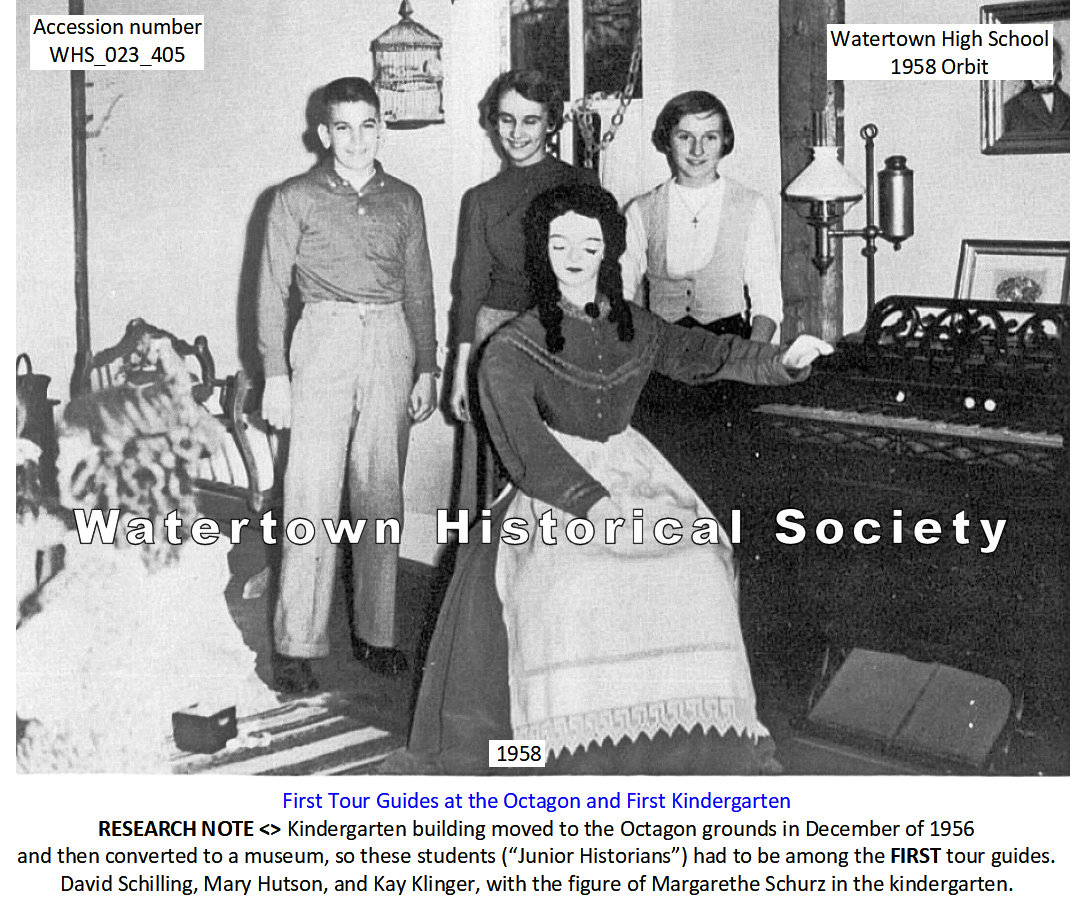
Kindergarten building moved to the Octagon grounds in
December of 1956 and then converted to a museum, so these students (“Junior
Historians”) had to be among the VERY FIRST tour guides. David Schilling, Mary Hutson, Kay Klinger.
c.1950
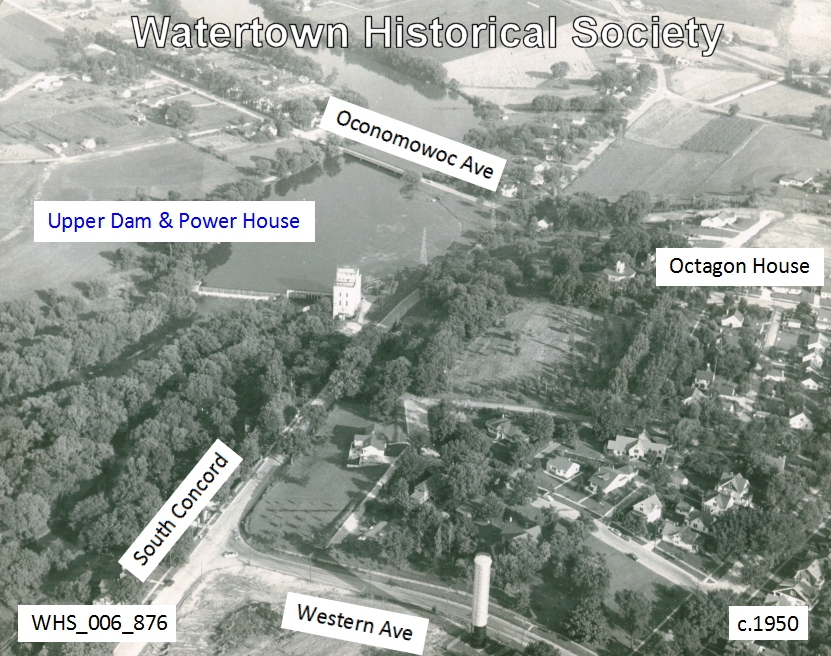
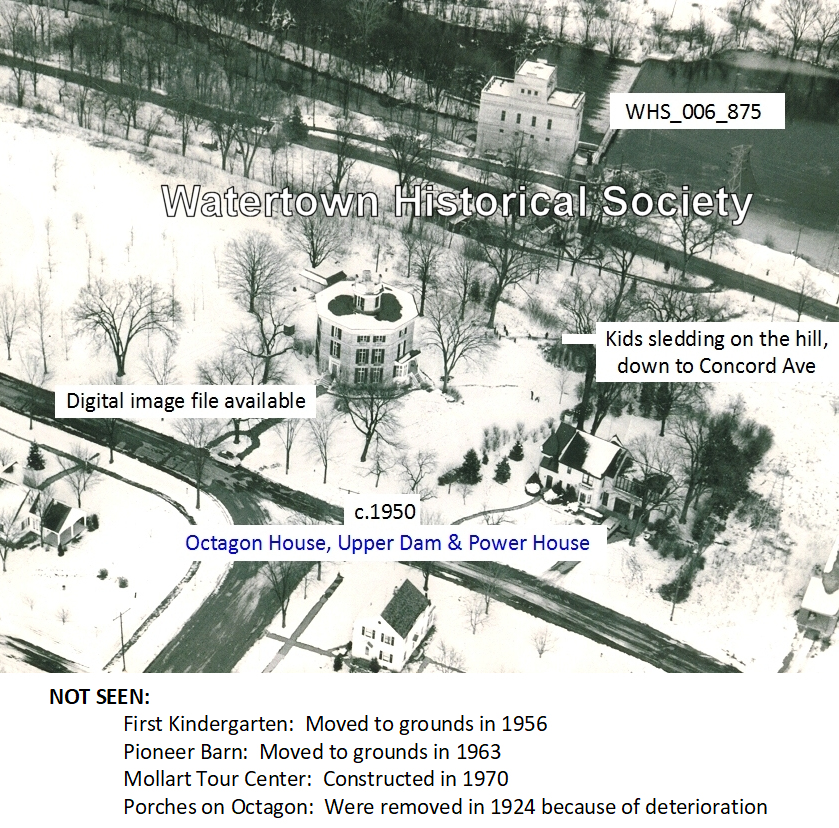 < sledding on hill can be seen
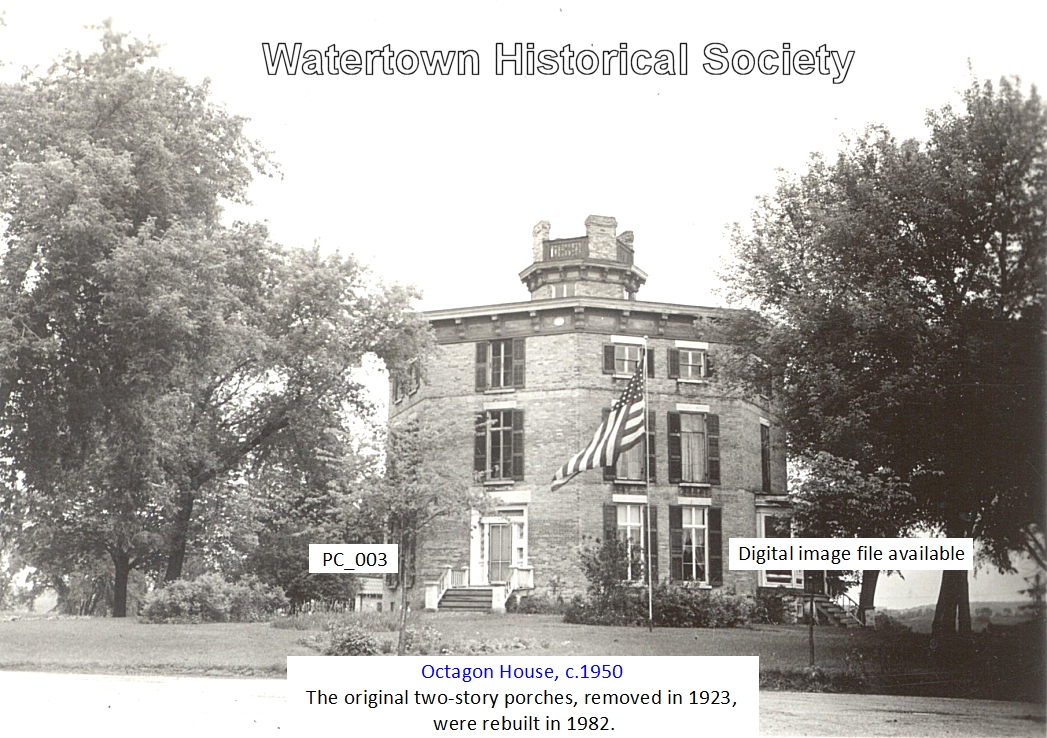
1950s
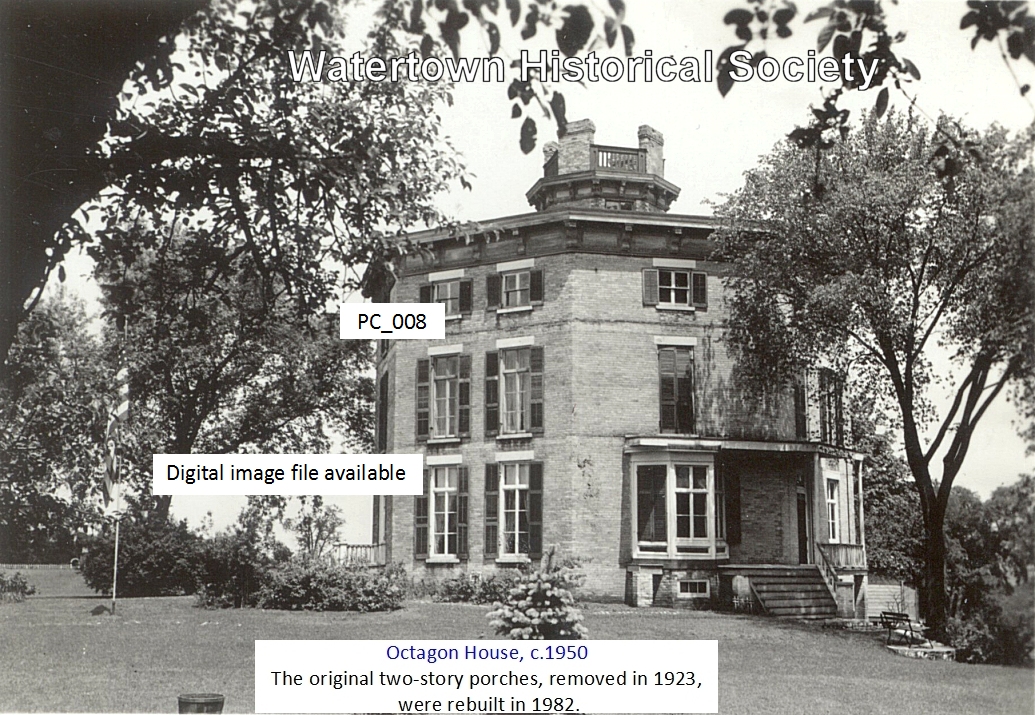
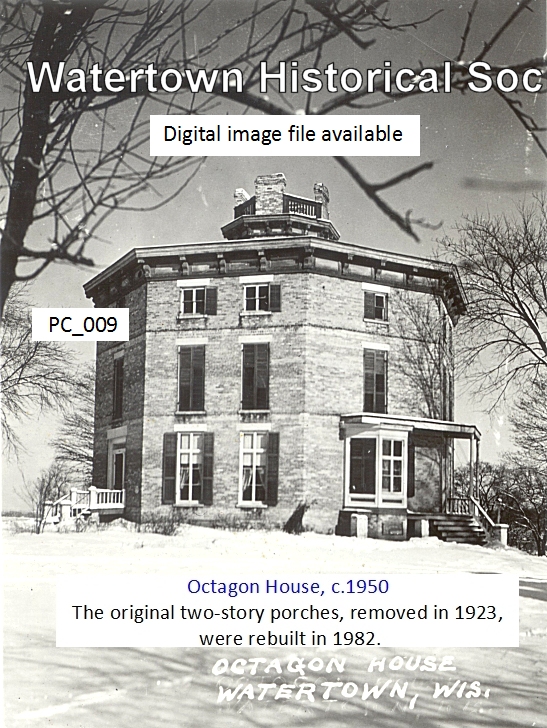
1962
08 07 <> VISITORS FLOCK TO
OCTAGON
The number of visitors to the two Watertown historical
shrines, the Octagon House and the First Kindergarten, may break the record set
last season when well over 8,000 persons registered there. The attendance so far this year has been
unusually heavy. Many of the visitors
compare the house favorable with other Wisconsin sites such as the Villa Louis
and Wade House as well as the Cotton House in Green Bay. In fact many feel it has more early Wisconsin
charm than the others. WDT
09 10 <> CANDLELIGHT
MUSICALE
Watertown's Octagon House last evening relived a page
from its heyday when it was a center of the social life of the community. The occasion was a candlelight musicale which
was presented under auspices of the Watertown Euterpe
Music Club. The Watertown Historical
Society, which owns and maintains the old 57 room mansion, threw open its doors
to make the musical event possible. It
was a fine gesture, for the musicale brought together a large group of people
for both concerts, one at 5:30 p.m. and the other at 8 p.m., to enjoy music in
a setting that is authentic of Watertown's past. Lighted by candles for the first concert, the
setting was further enhanced at the 8 p.m. performance by the addition of old
kerosene lamps which cast their light rays and caused shadows to dance on the
walls and flicker on the ceilings, just as they did in the era when John
Richards and his wife entertained guests.
WDT
1964
05 17 <> CAR OWNERS VISIT
OCTAGON
A cavalcade of rare and antique cars drove into
Watertown Sunday bringing their owners and friends to the city for a visit to
the Octagon House, with a stopover for a buffet at the Legion
Green Bowl. In all there were 285
visitors at the Octagon House on Sunday.
Most of the old cars were left at the Green Bowl while the owners walked
the steep hill to the house. One of the
cars, a 1940 Lincoln Continental with gold trim, is one of only 70 cars of that
type made that year and made especially for a diamond importer. The present owners are two brothers, Dr. Q.
Krafta and Dr. W. Krafta. Mr. and Mrs.
Don Mabie are the resident custodians at the Octagon House. The visitors were much impressed with the
Octagon House and the first American Kindergarten which is located on the
grounds. WDT
1965
10 11 <> REUBEN THWAITES GOLD CUP
AWARDED
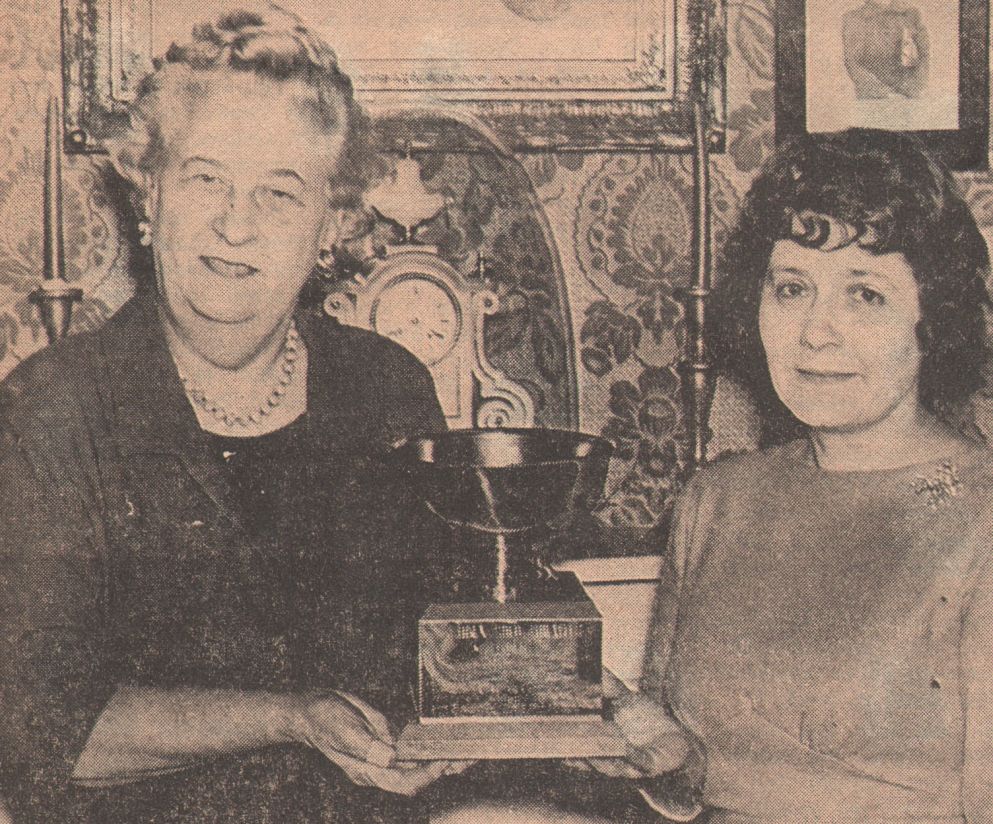
The Watertown Historical Society was given top state
honors Saturday in Madison at the 1965 Institute for Local History when it
received the Reuben Thwaites Gold Cup in recognition for its excellent work in
restoring and maintaining the famed Octagon House and First American
Kindergarten in Watertown. Assembly man
Byron F. Wackett is president of the Watertown society. The cup is shown in the above photo with Miss
Gladys Mollart, the society's curator, and Mrs. Donovan Mabie, custodian of the
Octagon House.
1969
07 16
<> DRESS COLLECTION OF OCTAGON HOUSE ON DISPLAY
30th year of operation of the Octagon
House
A committee from the Saturday Club, local branch of the Wisconsin
Federation of Women's Clubs, has placed models gowned in dresses from the
Octagon House collection in display windows at both Fischer's and Kline's
during the current week. There will be
other window displays from time to time with the cooperation of local merchants
as a feature of the 30th year of operation of the Octagon House by the
Watertown Historical Society.
The committee from the Saturday
Club functions as a cooperative unit with the Historical Society as part of the
Saturday Club's community improvement program.
09 21 <> 30th YEAR OF OPENING
OF THE OCTAGON HOUSE TO THE PUBLIC
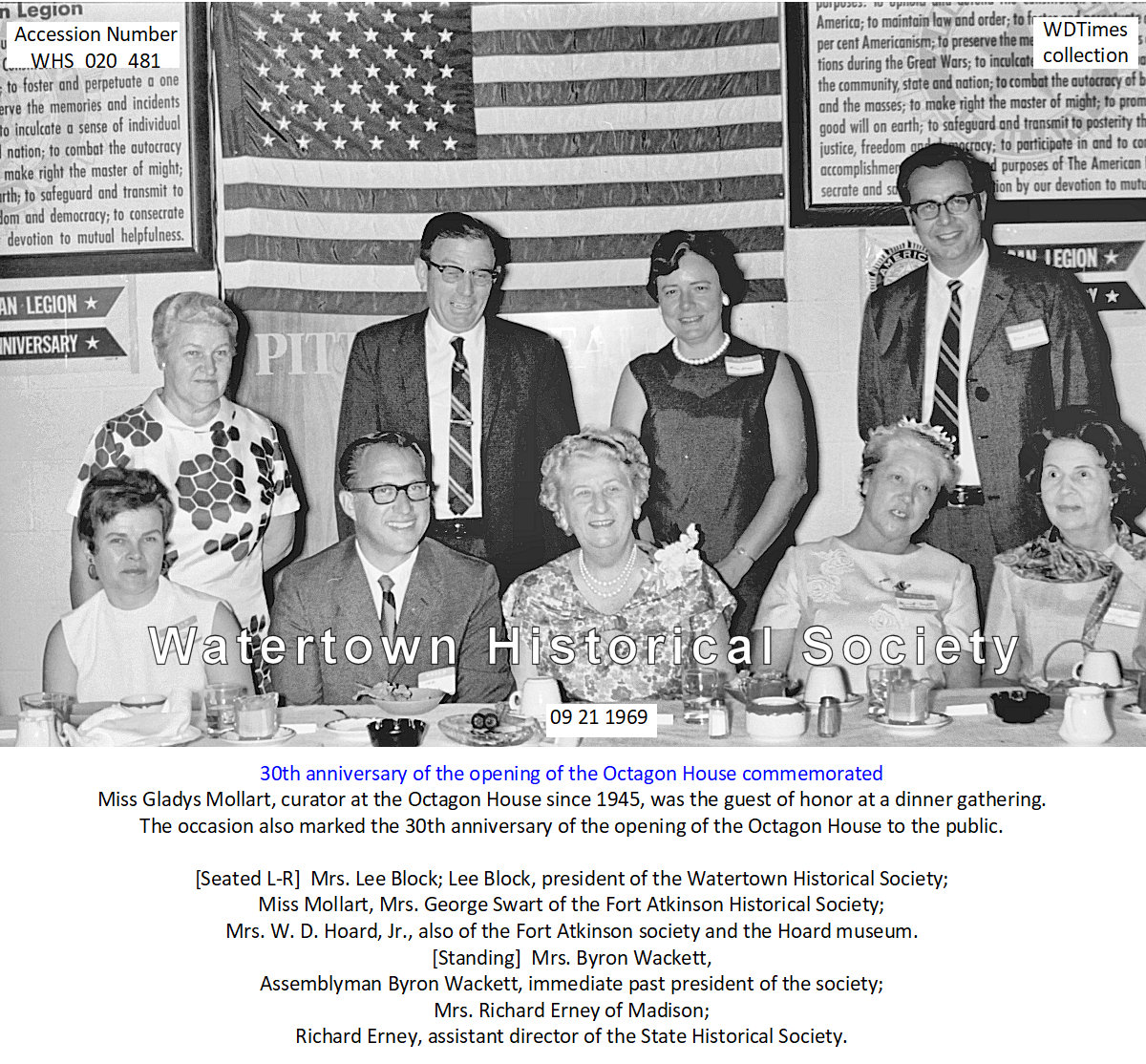
Miss Gladys Mollart, curator at
the Octagon House since 1945, was the guest of honor at a dinner gathering.
Mrs. Lee Block; Lee Block,
president of the Watertown Historical Society; Miss Mollart, Mrs. George Swart
of the Fort Atkinson Historical Society;
Mrs. W. D. Hoard, Jr., also of
the Fort Atkinson society and the Hoard museum; Mrs. Byron Wackett; Assemblyman
Byron Wackett, immediate past president of the society; Mrs. Richard Erney of
Madison; Richard Erney, assistant director of the State Historical Society.
1970
06 10 <> HARVEY B. RICHARDS DIES IN FLORIDA
Was
Last Grandson of the Builder of Octagon House
Watertown Daily Times, 1970
The last grandson of John
Richards, builder of the Octagon House, passed away during last week.
Harvey Bennett Richards, age 78,
died June 10, in Ft. Myers, Fla., where he had lived for the past 20 years.
He is survived by his wife, Eliza
Patch Richards, a son, William D. Richards, of Winter Haven, Fla., and one
daughter, Elizabeth, Mrs. George Beemer of Fort Myers, and six
grandchildren. A sister, Eliza Richards
Prahman, preceded him in death.
Harvey Richards' father, Charles
of Chicago, the youngest son of John Richards, was the last owner of the
Octagon House. After his death his
widow, Estelle Bennett Richards generously deeded the house to the Watertown
Historical Society at the instigation of her son, Harvey, who had been an
interested and beneficent sponsor since that time. His deep concern during the years since 1939
for the success of the society, had been a great boon to the preservation and
maintenance of Watertown's famous historic site.
His interest and enthusiasm never
failed. He was planning to come to the
opening of the new tour center dedication in August, a project he heartily
favored.
The society has lost
a devoted friend and benefactor.
Oct <> 1970 FALL
TOURS AT OCTAGON HOUSE
11 24 <> TOUR GUIDES
ENTERTAINED
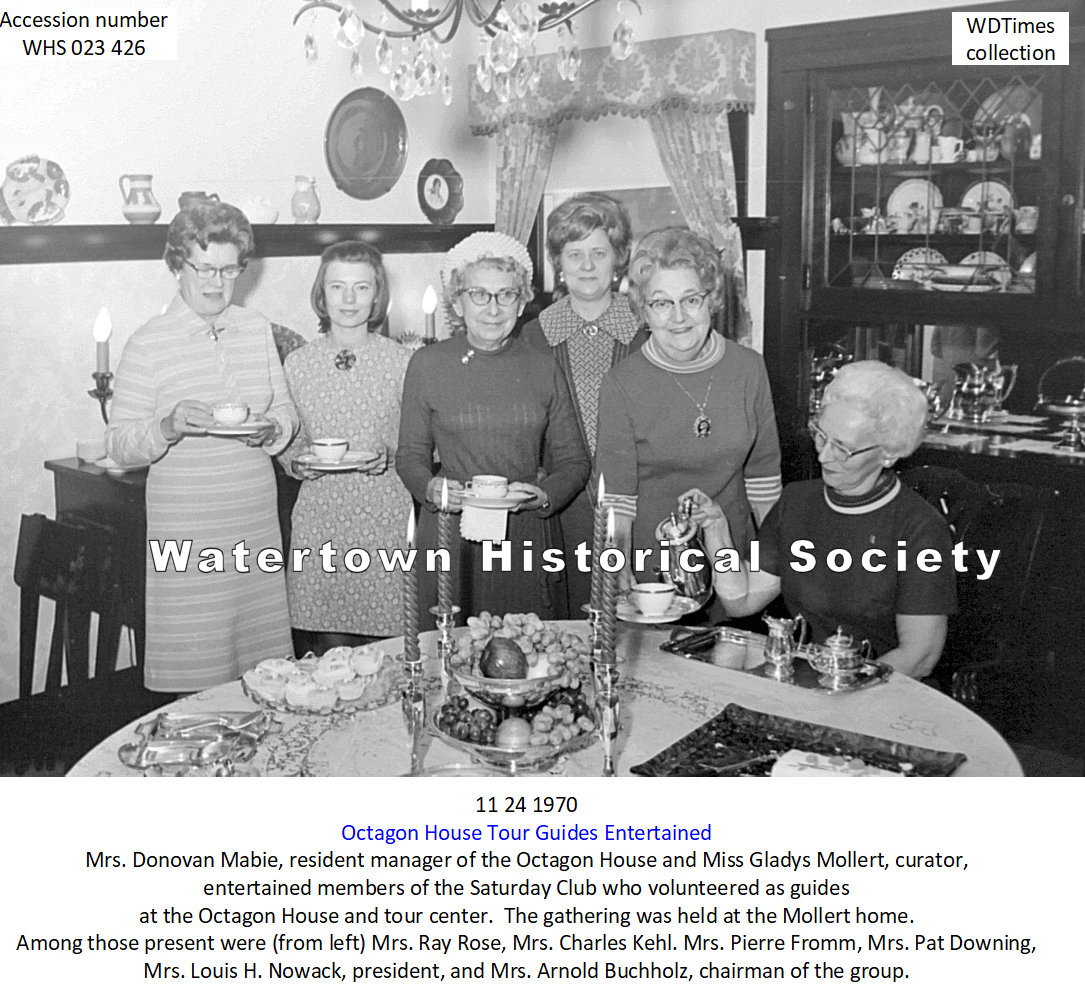
Mrs.
Donovan Mabie,
resident manager of the Octagon House and Miss Gladys Mollert, curator,
entertained members of the Saturday Club who volunteered as guides at the
Octagon House and tour center. The
gathering was held at the Mollert home.
Mrs. Ray Rose, Mrs. Charles Kehl. Mrs. Pierre Fromm, Mrs. Pat Downing,
Mrs. Louis H. Nowack, president, and
Mrs. Arnold Buchholz, chairman of the group.
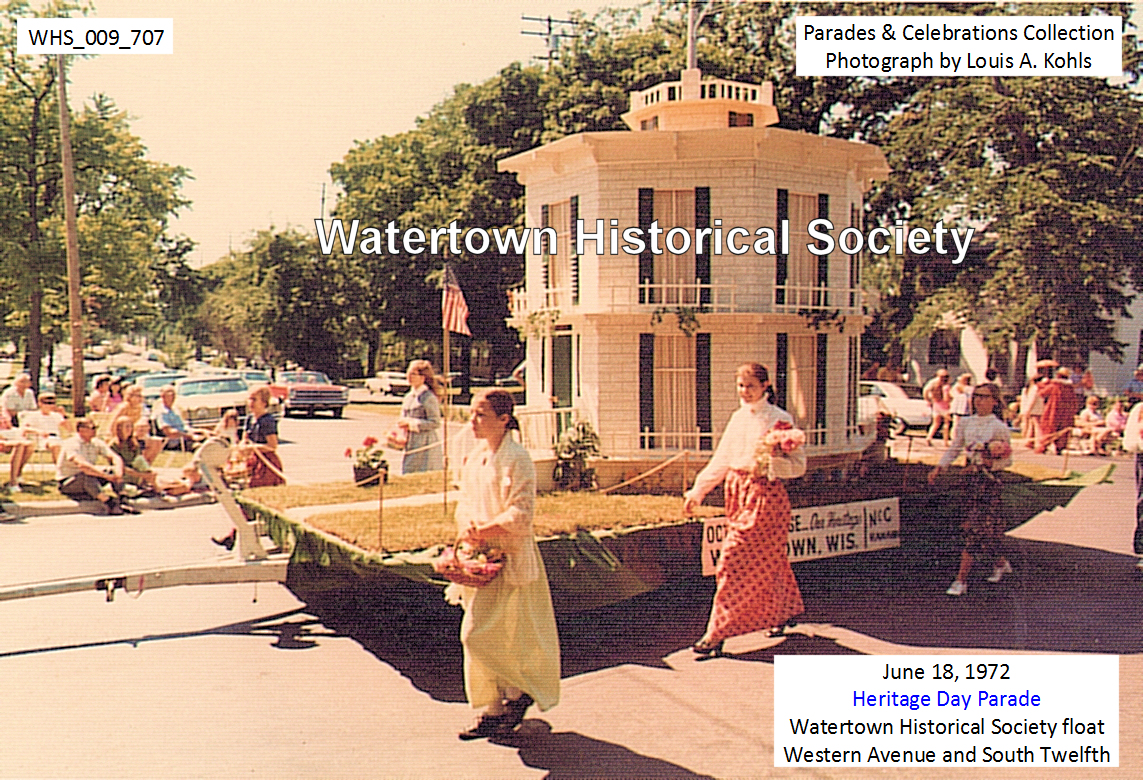
1972
06 18 HERITAGE DAY PARADE (link
to portfolio of large parade)
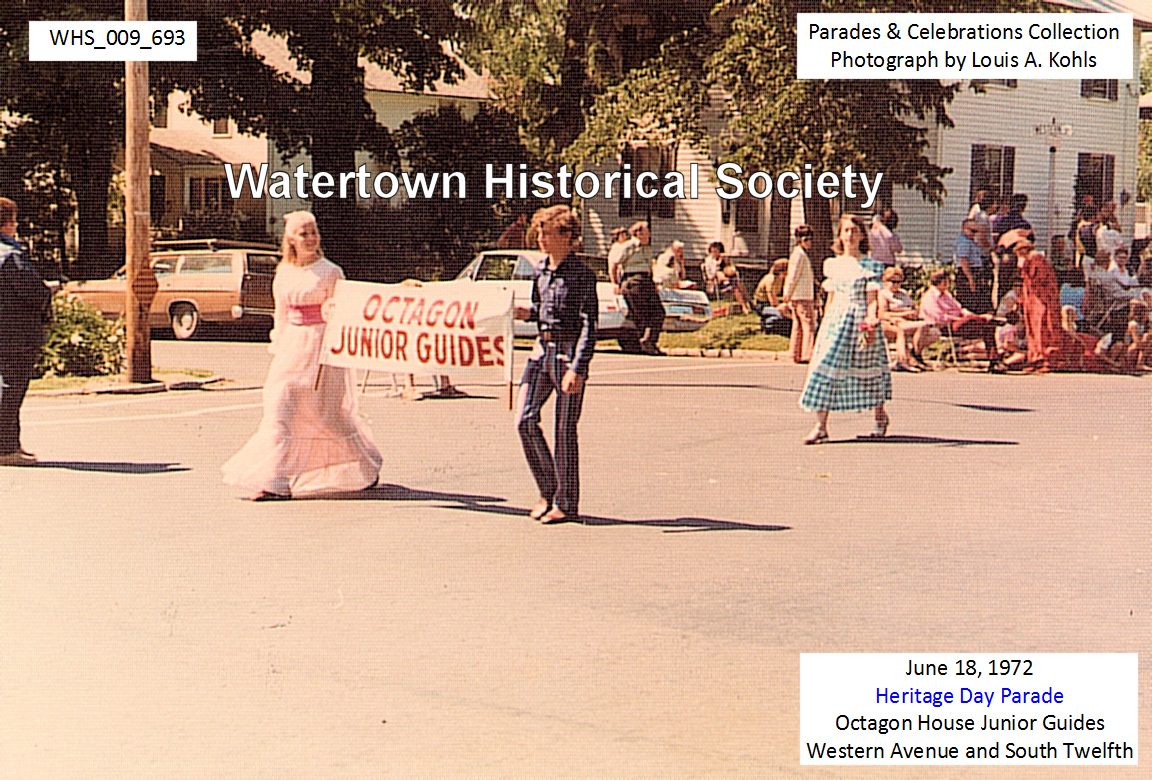
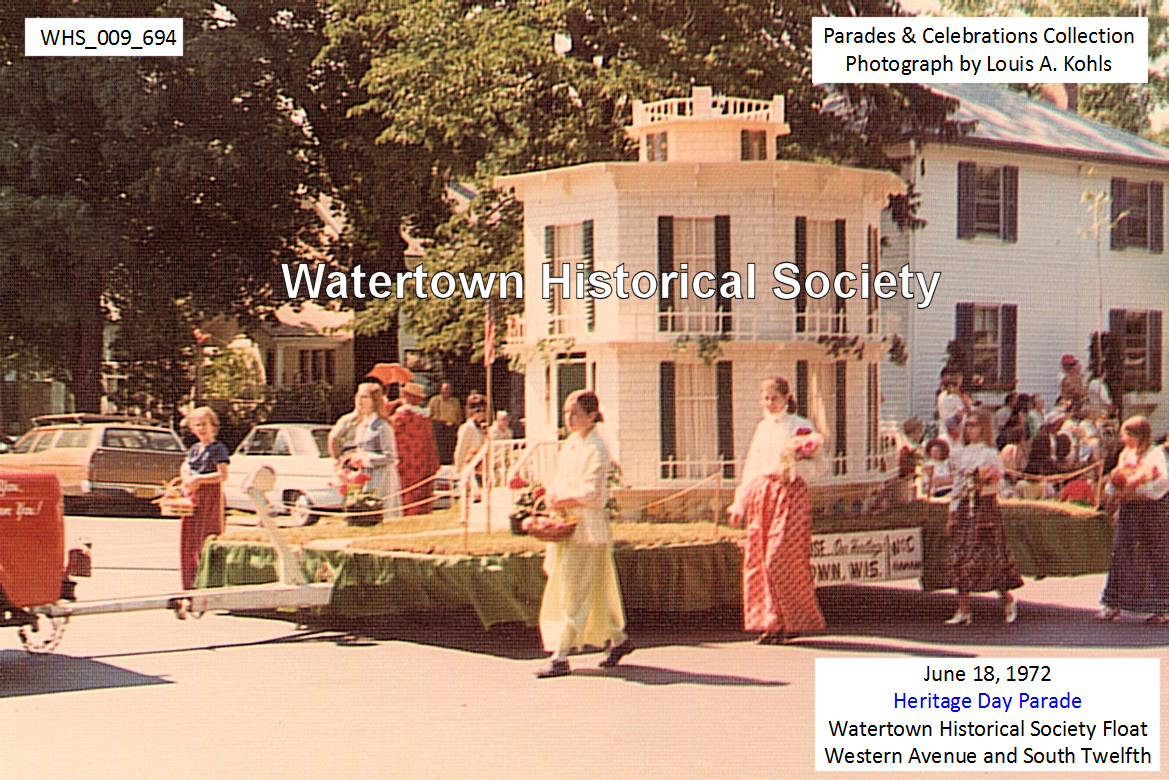
1981
FOURTH OF JULY PARADE ENTRY
1982
07 01 DRIVE UNDERWAY TO RESTORE BALCONIES AT OCTAGON HOUSE
Octagon House, the
beautiful home built on Richards hill
in 1854, was designed, owned and lived in by Mr. and Mrs. John Richards and
their descendants until 1938 when the family presented the generous gift to the
Watertown Historical Society, which has owned and maintained it since that
date. The Octagon House is open to the public from 10 a.m. to 5 p.m. every day,
May 1 to Nov. 1, each year. The Watertown landmark attracts thousands of
visitors each season. They visit and tour the Octagon House complex, then spend
the rest of the day viewing Watertown’s other attractions, dining, picnicking
and shopping.
John Richards, a
lawyer, came here from Massachusetts in 1837. He was particularly attracted to
the bluffs above the river and purchased 104 acres on both sides of the Rock
River. In the past he had been influenced by a new building concept — the
octagon shaped house. He felt the bluffs above the navigable river would give
him a commanding view of the Rock River valley for his dream home.
He returned to New
England for his bride, Eliza Forbes. The couple lived in a small cabin on the
premises while they planned an octagon shaped home. Richards erected mills on
both sides of the river. His milling operations were successful and he became very
wealthy. He began building his home in 1853. It took three years to completely
finish the construction. Land was cleared, sketches completed, and the building
progressed with help of his mill hands. Three rounds of bricks were used in the
first two levels, two rounds on the top level. Loads of Watertown brick was
used and some was purchased and brought from Milwaukee over “corduroy” roads,
by ox and horse teams. Woods used in the house were from his property, oak,
cherry and basswood, in almost primeval forest.
In the 1950s an
architect-contractor visited the home and declared that with but minor repairs,
and proper maintenance, “this house will stand for another hundred years
without major change”.
The home has many
unique features, a cantilevered hanging staircase, a system of air
conditioning, running water from a roof top tank. When the house was complete
Richards added another unique feature —- balconies that encircled the house at
two levels. These were eventually removed when they became unsafe. The
Historical Society has a small replica of the Octagon House showing the
balconies that were on the original house. Visitors see this replica on tours
and frequently ask, “When are you going to put the balconies back?”
The Watertown
Historical Society pondered that same question many times during its 44 years
of ownership. The house needed balconies for authenticity. Gladys Mollart, for
many years the curator, was a stickler for authentic furnishings in the home.
From time to time the Society considered restoring the balconies. The project
would be expensive and was put aside when the roof needed repairs, tuck
pointing for the bricks was necessary, a kindergarten and a pioneer barn were
moved to the Octagon House grounds, and a tour center was built for added
space. The balconies had to wait.
Now help is on the way.
Two years ago, at the annual Society meeting, William Kwapil, a Society member
and Rotarian, suggested that perhaps local service clubs could help with the
project. A study committee from the Society board and advisory board was appointed
to study the feasibility of the project at this time (David Moser, Tom Kwapil,
William Schmidt, David Hertel, Charles Ebert, Gertrude Curtiss and Irene
Triana). At the 1982 meeting the committee reported its findings. Society
members voted to go ahead with the project. Gerald Mallach, Society president,
appointed William Kwapil as chairman of a fundraising committee. In addition to
Mallach and Kwapil members of this committee at the first meeting were Robert
Bauch, Charles Ebert, Gerald Flynn, George Wolf, James B. Quirk, Dale Bowgren,
Evelyn Rose and Neal Loeb.
The contract went to
Donald H. Weisensel General Contractors. The project is underway. The old
footings, of large rocks and lime mortar, have been removed from 36 inches
below ground. Eighteen new footings, with concrete blocks and mortar, will be
spaced at 12 foot intervals around the building at a depth of 42 inches.
Eighteen pieirs of mortared brick will serve as
supports for beams which will be attached to the brick walls with rods seven
inches into the brick walls. The Somerset Door and Column Co., Somerset, Pa.,
is now making the posts and balusters, the same as the originals. It is
interesting to note that there will be additional Watertown brick in the piers,
secured from the recently razed Kellerman building on North Third Street.
Weisensel is aware of the historic nature of this project and everything
possible is being done in keeping with the original.
The project will cost
between $45,000 and $50,000. The fund raising committee hopes to raise about
$30,000 of this from local sources. Several pledges have been received.
The Watertown
Historical Society has long enjoyed cooperation from the community, and hopes
that organizations, businesses and individuals will want to participate in this
new and long awaited project — putting the balconies back on the Octagon House. WDT
1987
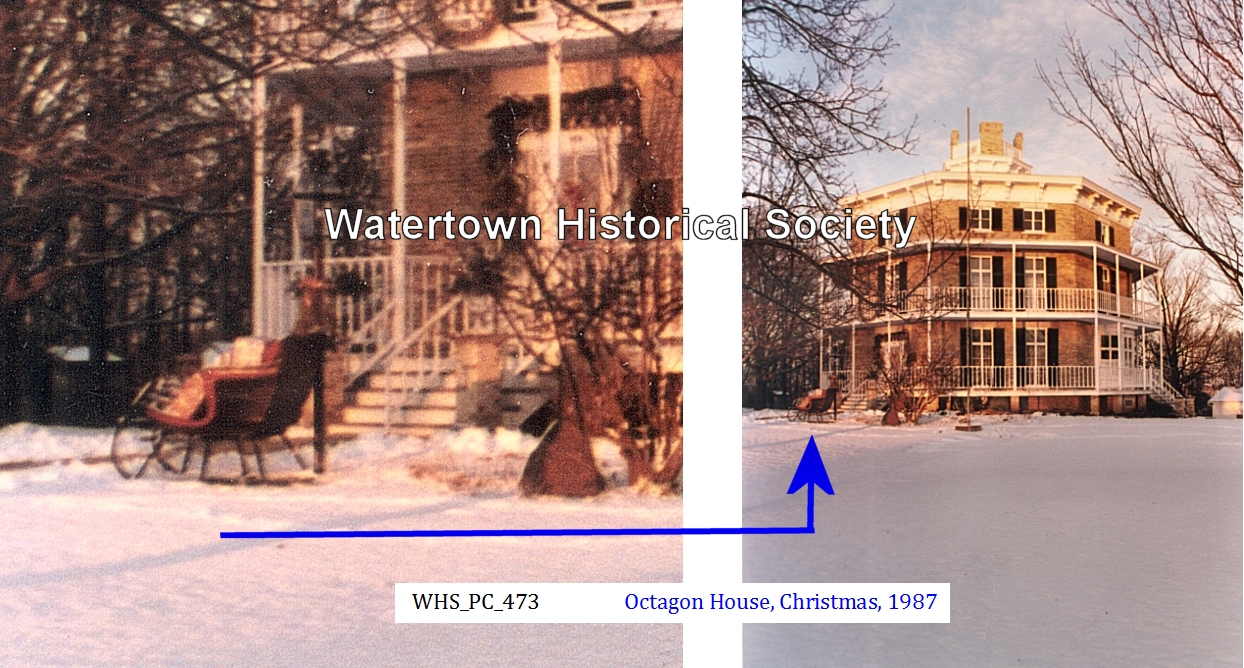

2004 <> 150th Anniversary of
Octagon House, 2004
Watertown Daily Times article
Milwaukee Journal Sentinel article
2006
OCTAGON HOUSE PORCHES RESTORED
With
rotting boards and posts, a recent anonymous donation to the Watertown
Historical Society, allowed for the refurbishing of the characteristic porches.
The Octagon
House was originally completed with porches at its current location in 1854 by
John Richards. In 1924 his daughter Anna tore down the porches because the wooden
boards and beams were rotting and becoming unsafe. For almost 60 years the house sat with no
porches; the only evidence of the porches was from a miniature
three-dimensional model of the house. In
1938 descendants of the Richards family donated the house to the Watertown
Historical Society.
Finally
in 1982 after much fund-raising, the two-story porches were rebuilt at a cost
of $50,000. Judy Quam was manager and
tour guide of the house from 1980 to 1987 during the time the porches were
rebuilt. She still remembers how the
construction workers were able to find the original cement footings for the
porch in the ground. The original
footings were replaced and the porch was rebuilt in the exact same
location. After studying photographs the
porches were also built in a similar style.
The only thing that might be different from the original porches is the
color. Early photographs show that the
porches were either a natural wood color or painted brown. They were not the white color seen today
The
five-level house was built with a number of French doors on the first and
second levels that gave access to the porch.
The historical society has sealed these windows and doors for heating
and cooling purposes. Now the only
access onto the upper level porch is from one bedroom window inside the house
on the second floor. There was a tax in
Watertown on the number of windows a home had, so John Richards made many of
his windows into French glass doors leading out onto the porches to avoid
taxing.
Peter
Welbourne, of Watertown, worked on the porches.
He also installed various storm windows that have been made to help with
insulation.
From
John Richards' original drawings the house was always meant to have porches and
now it is certain the house will never go without porches again.”
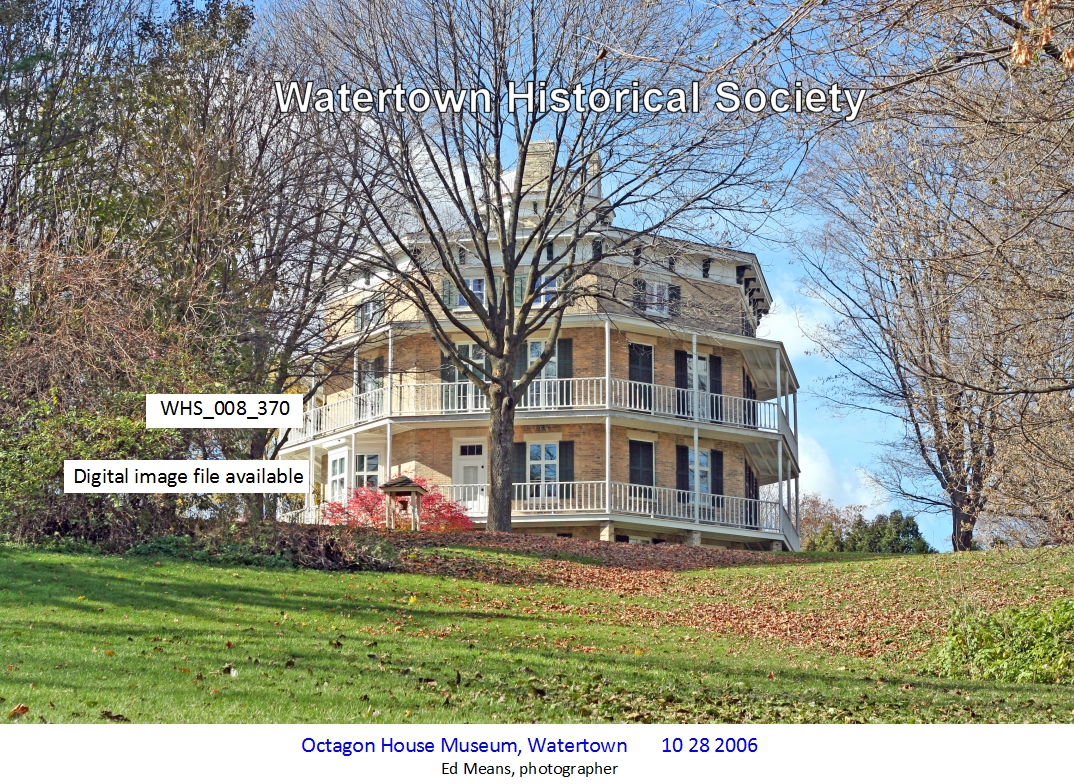 Oct 2006
2010
05 20 Original Watertown bricks that
lined former front walk of Octagon House replaced by stamped concrete; bricks offered for sale
2011
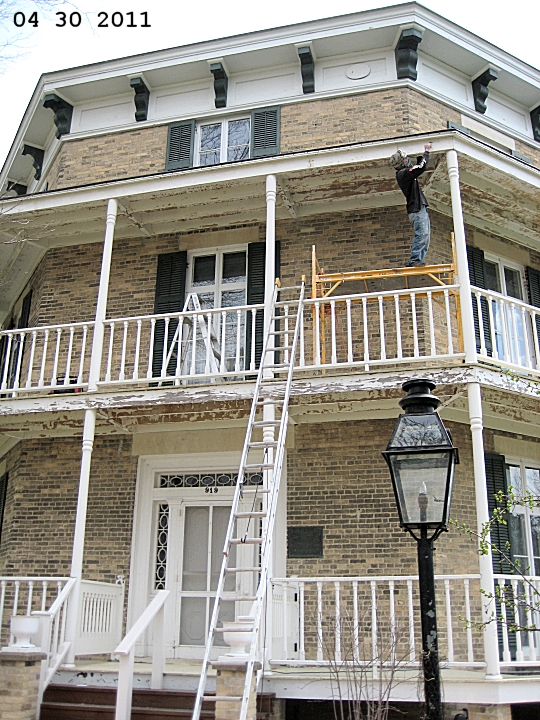
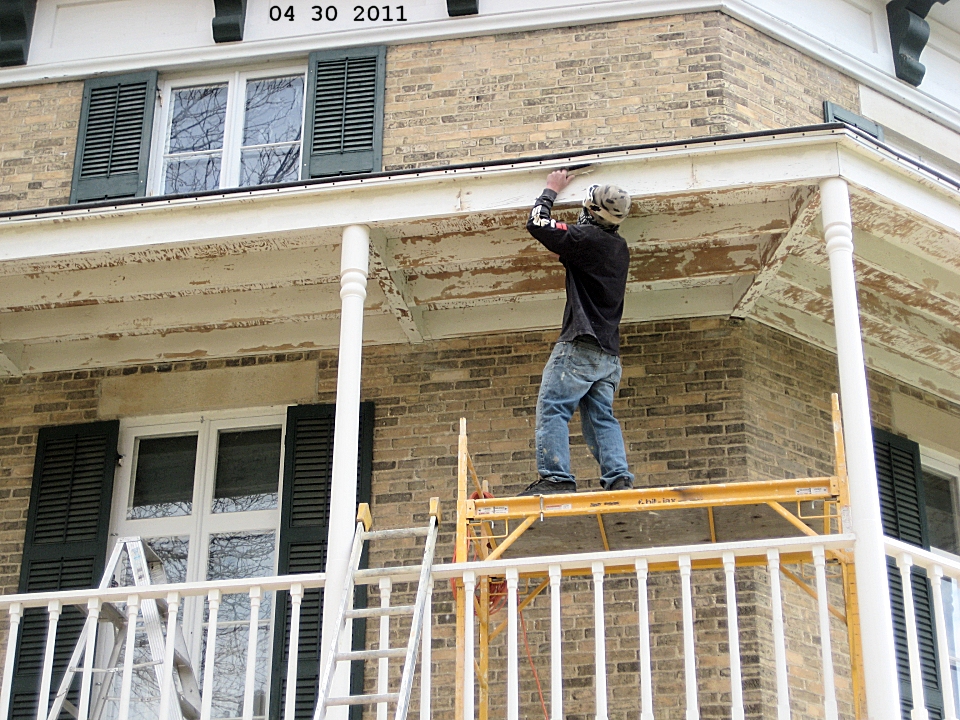
2012
12 22 <> 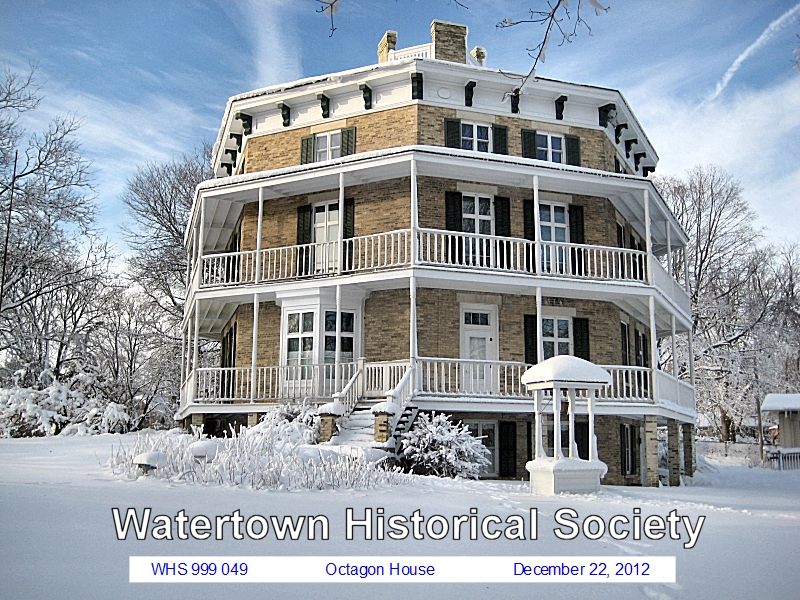
2015
09 17 <> JOHNSONVILLE SAUSAGE MAKERS; WORK CREW AT THE OCTAGON
Sausage
makers use downtime productively.
09 12 <> FIRST
ANTIQUE SHOW ON OCTAGON HOUSE GROUNDS

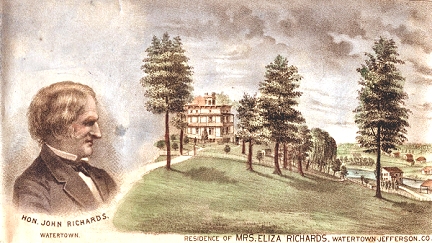


12 28 <> “CHRSITMAS CAROL” IN THE OCTAGON
2017
07 21 <> LAWN MOWING AT THE OCTAGON
Council Proceedings: Exhibit #8502, to authorize the Street Department
and Parks, Rec. & Forestry Department to assume responsibility for lawn
mowing at the Octagon House Museum at no additional cost to the Historical
Society was presented. Sponsor: Mayor
David. From: The Finance Committee. Alderperson Smith moved for adoption of this
resolution, seconded by Alderperson Kilps and carried on a roll call vote: Yes
– 8. No - none.
2022
12 04
<> PARADE OF HOMES ENTRY
 < 7-min video clip
Octagon House beautifully decorated
for Christmas. A 2022 Watertown Parade
of Homes entry
Cross references:
Octagon House
Documentary, MBU Digital Media & Photography class
project, 2023 YouTube video
Image Portfolio exterior
views of Octagon
Image Portfolio interior
views of Octagon
Model
of Octagon House: It is not a doll house and not a replica but
rather a model inspired by Watertown’s Octagon House and built by the late
Walter Reandeau, after touring the Octagon several years ago. Donated by the Reandeau family to the
Watertown Historical Society. Background
story will be written by the daughter of Walter. Link to portfolio of 26
photos.
Inventory of Older Octagon,
Hexagon, and Round Houses
The Armour-Stiner (Octagon) House, Irvington-On-Hudson, New
York

History of Watertown,
Wisconsin