website watertownhistory.org
ebook History of Watertown, Wisconsin
Theodore Prentiss
1818 - 1906
First Mayor of Watertown
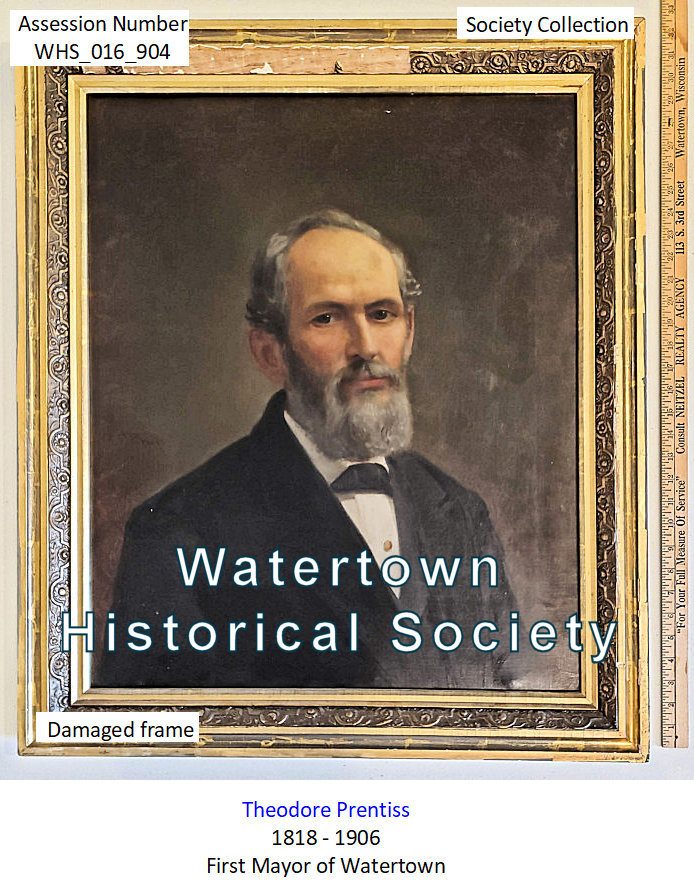
Theodore Prentiss
Click to enlarge
THEODORE
PRENTISS [*] was
born September 10, 1818, at Montpelier, Vermont. He is the eighth son of Samuel Prentiss,
formerly chief justice of the Supreme Court of Vermont, subsequently United
States senator for two terms, and afterwards judge of the United States
district court. His father was a native
of Stonington, Connecticut; his mother, Lucretia Houghton before her marriage,
was a native of Northfield, Massachusetts.
His paternal and maternal grandfathers served in the revolutionary war,
and his paternal great-grandfather was a colonel in the war, from
Stonington.
Mr. Prentiss
pursued a course of study in the academy of his native town, preparatory for
college, and entered the University of Vermont in 1838, but left the same year
by reason of ill health and went south.
He returned in 1842, and studied law in his father's office at
Montpelier, and was admitted to the bar in 1844. He removed to Wisconsin in October, 1844, and
settled in Watertown, Wisconsin, in February, 1845. He was elected a member of the first and also
of the second convention for forming a state constitution; was a member of the
state legislature in 1861, and the same year was elected a member of the Board
of Regents of the State University, and three several times he has been mayor
of the city of Watertown. He married
Martha J. Perry, of Montpelier, Vermont, December 4, 1855, and has three
sons. He has been successful in business
so as to have acquired a fair competence.
The
services of Mr. Prentiss in the Constitutional Conventions of 1846 and 1847-8,
were quite varied and important. In the
first, he was chairman of the committee on the acts of congress for the
admission of the state, and reported the article upon that subject, which,
after a single amendment suggested by himself, was unanimously adopted. In the
second convention, he served as chairman of the committee on schedule and other
miscellaneous provisions, in a manner equally acceptable to his associate
members. While he took but small part in
general debate, his brief speeches upon several pending propositions are
strikingly terse, logical, and to the point, proving a high order of mental
culture, and clear and discriminating judgment.
His services in both bodies bear the impress of marked ability; and the
same is equally true of his subsequent legislative labors.
He has ever held the position of a
prominent, sagacious, and in all senses upright and worthy citizen of a state
whose organic law he so ably assisted to perfect.
[*]
SOURCE: Memorial Records of the Fathers of Wisconsin Containing Sketches of the
Lives and Career of the Members of the Constitutional Conventions of 1846 and
1847-8 with a History of Early Settlement in Wisconsin. Prepared by H. A. Tenney and David
Atwood
________________________________________________________________________________________________
Watertown
was incorporated as a village in 1849, but the first city charter was passed by
the legislature in 1853 and Watertown elected its first mayor.
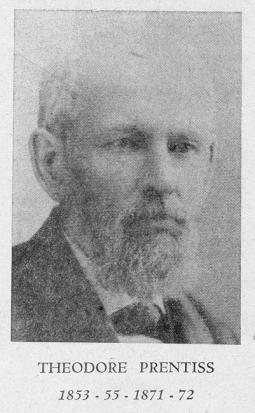
Watertown's first
mayor was a native of Montpelier, Vermont. He was Theodore Prentiss and
held office as the city's first mayor from 1853 to 1855. He was also elected in 1871 and served until
1872.
Mr. Prentiss
was born in Montpelier on
The
Prentiss family, through genealogical sources, has been found to date back to
English and Puritan stock as early as the year 1318.
Stopped in Milwaukee
When
Theodore Prentiss came to Wisconsin in 1845 he stopped in Milwaukee where he
lived for a short time with a cousin, William Prentiss, who was at the time
associated with Solomon Juneau.
Milwaukee
records mention William Prentiss as early as 1836, the same year that
Watertown's first white settler - Timothy Johnson - arrived here. William
Prentiss was Milwaukee's mayor in 1858.
In February,
1845, Theodore Prentiss decided to come to Watertown. He had been here for
several short visits and felt the community offered great possibilities. He
decided to become an attorney here and practiced law. He had purchased
considerable land in Watertown and in time became associated with railroad,
banking and other interests. These interests became so extensive that he was
forced to give up his law practice in order to devote his full time to his own
business interests and investments.
Married in Vermont
In 1855 he
had gone back to Vermont for a visit. While there he was married on Dec. 5, that
year, to Martha Perry, daughter of Dr. Nathaniel Perry who became a Civil War
surgeon and who was at the time living in Burlington, Vt. Mr. Prentiss
and his bride came to Watertown in 1856 and took up residence at the Van Alstine Hotel
in Main Street until their home on [802] Clyman Street was completed.
Three sons
were born to them, Theodore Collins Prentiss, James Fred Prentiss and George
Nathaniel Prentiss. Their old home, which was then listed as being on Clyman and
Pritchard Streets, is now 99 years old and is still occupied by members of the
Prentiss family, which consists of the widow of James Fred Prentiss and two
grandchildren, James Prentiss and his wife, the former Olive Kreuziger, and
Miss Helen Prentiss.
Served State Convention
Mr. Prentiss
had become an active leader in the Watertown community almost from the day be
arrived. He had been a member of the first Constitutional Convention held in
Wisconsin in 1846 and also served the second such convention held the following
year. He also served several terms as alderman and was a member of the State
Assembly in 1860 and 1861.
One of the
city's early day editors, D. W. Ballou of the
Watertown Democrat, a weekly paper here, wrote of Mr. Prentiss as being
"most modest in demeanor, an able lawyer, clear minded and universally
respected."
While in the
Assembly he introduced a memorial for an equitable tariff for freight and
passengers on the La Crosse and Chicago railroad. He also sponsored a petition
governing the duties of assessors and a bill to repeal personal liberty laws.
Watertown's railroad
history, which later became a war in the state, began during the
administration of Mr. Prentiss. At that time $80,000 was voted for railroad
bonds to cover the cost of constructing the Milwaukee - Watertown Railroad. The
bonds were to be secured by a bond from the railroad company and a mortgage on
their property. The bond was executed but the mortgage was never issued.
Soon thereafter the people thought that if one railroad was good, three or
four, which would center in Watertown would be better. Succeeding administrations
then voted to help finance the Watertown and Madison line and the Chicago, St.
Paul and Fond du Lac branch. However, in 1869, Theodore Prentiss was the
trusted adviser of Daniel Hall, another highly respected gentleman of
English-Puritan lineage who fought the case through the courts.
In the
charter election of 1871 Theodore Prentiss was again chosen mayor. However, on
The law
office of Theodore Prentiss was above the Bank of Watertown. His son, James Fred Prentiss, was associated
with him after attending Beloit College and graduating from the Wisconsin
University Law School. The Beloit
College Year Book reveals that William H. Woodard also
attended Beloit College and after graduating in law from the University Law
School began his practice in the office of Theodore Prentiss.
Theodore
Prentiss died
________________________________________________________________________________________________
Early Occupied
building at 315 E Main
This
building was constructed around 1865 for Theodore Prentiss, a pioneer attorney
in Watertown. Prentiss was a Yankee who
came to Watertown in 1845. He was
Watertown's first mayor after the city was incorporated in 1853. He also
attended the first two state constitutional conventions in 1846 and 1847, and
was an assemblyman between 1860-61.
Prentiss had his office here during much of his illustrious career. This building also housed some retail firms.
It was the Brennecke and Steinfort drug store between 1880 and 1885, the Robert
Brennecke drug store between 1889 and 1911, and the William Gehrke drug store
between 1915 and 1930.
___ 1861 __________________
04 11 THE
MEMBER FROM WATERTOWN
Horace
Rublee of the Madison Journal is writing a series of personal sketches of the
prominent members of the Assembly. Among
the rest, he gives the following estimate of the character and services of the
representative from this city.
“Hon. Theodore
Prentiss, of Jefferson County [and Watertown], is held in high estimation
by the members of our Assembly. He has
said but very little during the present session, being in the minority, as he
is of the Democratic school in politics, and also of a rather modest turn of
mind, he has chose to remain rather quiet in his seat, giving strict attention
to the interests of his constituents.
“Mr.
Prentiss is a lawyer by profession and is considered in his own city an able,
clear minded advocate. As a man he is
universally respected. His talents are
of a high order, but his modest demeanor and fine sensibility prevent his
becoming what some would term a leader in the present line of Wisconsin
Democracy. He is a sound, practicable
and most reliable gentleman, and if he should ever feel disposed to join our
Republican party, we would welcome him with all our heart. As a citizen we now regard him every way
worthy of public confidence.” WD
___ 1864 __________________
07 28 NEW
PRENTISS BUILDING
New Block – On
the corner of Main and Fourth streets Theodore Prentiss is laying the
foundation of new brick block, the dimensions of which are 22 feet front and 51
deep, and one story high. When completed
it will be a substantial building and an improvement to the corner on which it
stands. [This building is now second
from the southwest corner, at 315 E Main.
Current corner building was built after 1864.] WD
11 10 Messrs. T. & J. Prentiss have just completed
a new and elegant office on the corner of 4th and Main streets. This edifice is not only a credit to Prentiss
Brothers, but an ornament to our city.
It is built in the latest style of architecture, with all the modern
improvements, out buildings, fences and yards to correspond, and all in the
best of taste. We congratulate these
gentlemen upon their accession to more comfortable and convenient quarters,
while we hope the fate of their former place of business may not be in store
for their present luxurious apartments. [?]
WD
___ 1865 __________________
05 04 JAMES
PRENTISS ELECTED MAYOR
A special
election was held in this city last Tuesday for the purpose of electing a
mayor. James Prentiss was elected by a
vote nearly unanimous. He possesses the
qualifications necessary to make an efficient and popular mayor and we have no
doubt that his official duties will be discharged with promptness and
ability. WD
09 21 PRENTISS ADDRESSES COMMON COUNCIL
COMMON COUNCIL PROCEEDINGS.
The Common Council held a regular meeting on
Monday evening, Sept. 1lth, 1865.
Present — The Mayor, Ald. Baum, Baxter,
Beckman, Brandt, Dennis, Kellerman, Moak, O’Byrne, Prentiss, and Quentmeyer,
Riedinger and Stein,
The Mayor read the following address:
GENTLEMEN OF THE COMMON COUNCIL:
Upon returning after an absence from the city
since the 1st of May, and although meeting you officially the first time, on
account of the lapse of several months since the commencement of the official
year, I deem it neither important, nor do I know of anything that necessarily
requires me to make a lengthy communication or extended remarks.
The situation of the city financially, and
the condition of its schools, were laid before you at the proper time. The condition of the streets is not only
good, but creditable to the city. With a
site for a town naturally unsurpassed any where — a large water power — a city
generally substantially built — with railroad facilities all that could be
desired and not exceeded by any town in the state — surrounded with a rich and
fertile farming country – business thriving and enough for all to do – it would
seem that with a proper, judicious and economical administration there could be
no impediment to our prosperity and success
The only cloud, in fact, that hangs over us
and that has or can in any way impede our constant advance, is the city indebtedness incurred for railroad purposes.
A portion, I understand, has been
extinguished by one of the companies, and if the whole could wiped out
satisfactorily to the city, it would be a lasting and permanent blessing. The importance of relieving ourselves of this
seeming if not real burden is, to my mind, very great, and in which every
individual citizen is deeply interested.
Whatever, if anything can be done to bring
about this desired result, ought and I have no doubt, will, receive your due
and ready action.
In all matters, Gentlemen, coming before your
body, it will be my endeavor, at least, to act faithfully and impartially, and
if, in the discharge of my duties as presiding officer, which are altogether
new to me, I make mistakes, they will be of the head and not of the heart; and
in advance, I must ask your patience and, in indulgence.
J. Prentiss
WD
___ 1893 __________________
07 26 PRIVATE FORTUNE PLEDGED in case of
bank bankruptcy
___ 1915 __________________
10 28 LOCATED IN NEW BANK OF
WATERTOWN
Building operations in Watertown have shown marked activity during the
last year. Many new residences have been
erected, as well as a number of business buildings. The chief pride of Watertown is the new
building of the Bank of Watertown, which
institution is the oldest of its kind in Jefferson county. Its new home, which will be ready for
occupancy about Nov. 1st, stands at the northwest corner of First and Main
streets. The ground floor is equipped
with the most modern of bank fixtures, while the upper floors will house
several commodious office suites which will be occupied by such firms as the
individuals as the Old Line Life Insurance Company, Attorney Wm. H. Woodard, F.
J. Prentiss [T. & J. Prentiss] and W. C. Stone; while the president of the
bank, Mr. F. E. Woodard, will also have private offices above the bank. WG
___ 1920 __________________
Membership in Wisconsin Historical
Society
________________________________________________________________________________________________
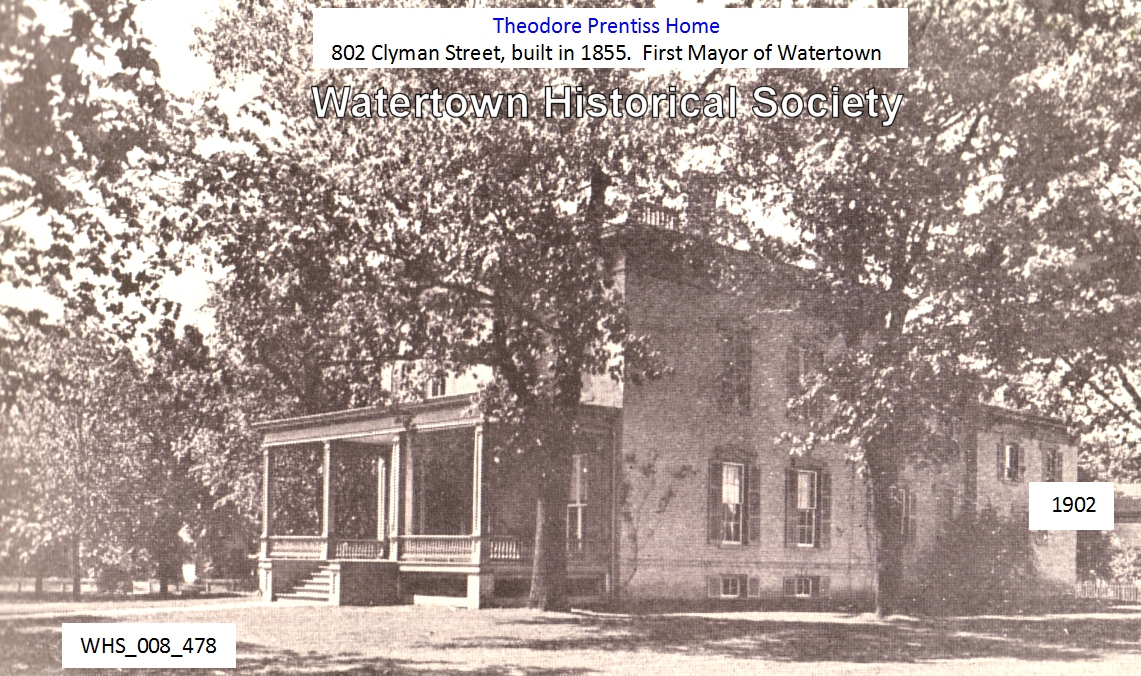
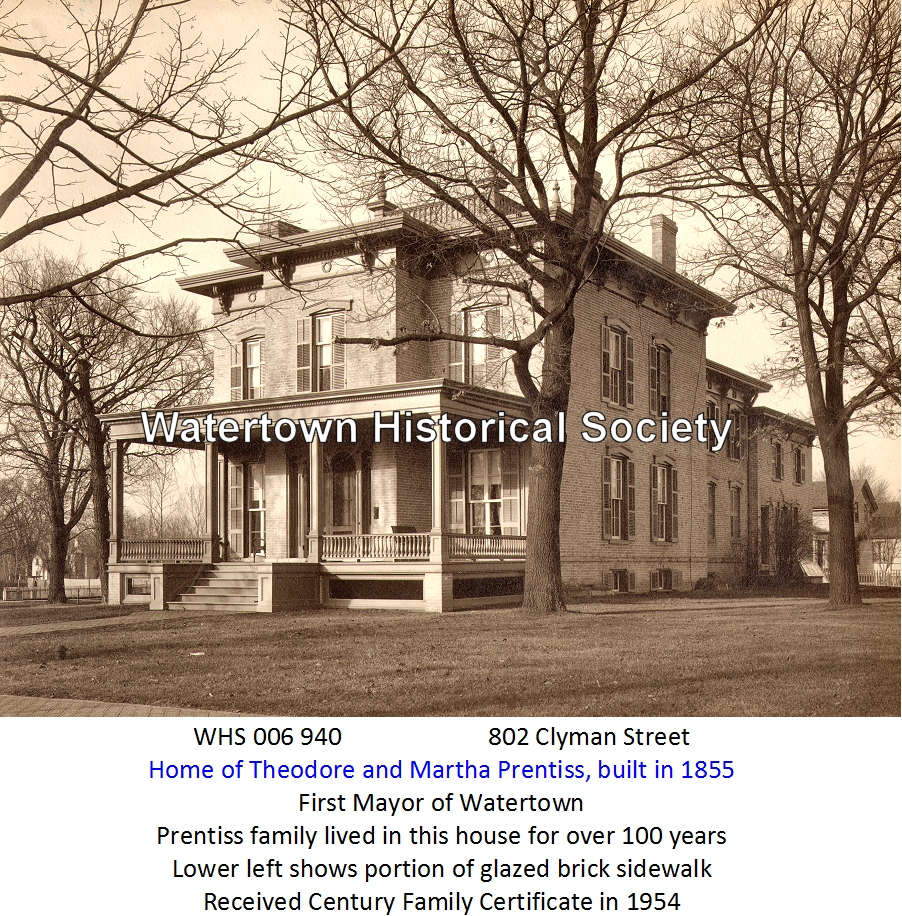
Prentiss
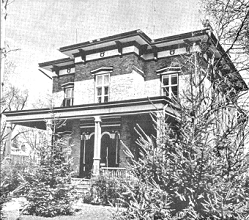
Home 802 Clyman Street
Home of Theodore
and Martha Prentiss at 802 Clyman Street, built in 1855. First Mayor of Watertown.
Prentiss
family lived in this house for over 100 years
Received
Century Family Certificate in 1954
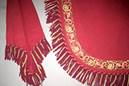 Red drapes - 4 pairs, 4 pieces each, heavily fringed and embroidered,
1870, Theodore Prentiss home, Clyman St.
Red drapes - 4 pairs, 4 pieces each, heavily fringed and embroidered,
1870, Theodore Prentiss home, Clyman St.
In 1855 Prentiss
built his Greek Revival style home at
Elaborate Fireplaces
The home
contains seven fireplaces, though many are closed and only one is used
regularly. Fireplaces in the mid 1800's
were built without dampers, allowing both cold drafts and squirrels to, enter
at will.
Fireplaces
began as simple fixtures for cooking, for heating, and later in the century became
more, elaborate with emphasis on special decorations for the hearth. All the
rooms are large, with high ceilings, and for all these years the home has been
maintained in good condition.
___ 1948 __________________
05 10 PERIOD FURNITURE DONATED TO OCTAGON
HOUSE
The music room on the
first floor and a bedroom on the third floor will become permanent features of
the house as maintained by the society. The
windows of the music room will be adorned with the rich, old cherry-colored
drapes that formed an exquisite
setting for the early period furniture [previously] in the beautiful home of
Theodore Prentiss.
___ 1968 __________________
07 13 BRICK TILE SIDEWALK
PRESERVED
The brick tile sidewalk
at 808-810 Clyman Street, once the property of Watertown’s first mayor, Theodore
Prentiss, is to be preserved as an historical site and a suitable marker will
be placed there, according to terms of an agreement between the common
council’s public works committee and Miss Gladys Mollart, curator of the
Octagon House, Watertown’s historical museum which is owned and operated by the
Watertown Historical Society. Such a
report will go before the council tonight and concurrence is assured. The historical society recently requested
that the Prentiss sidewalk area be exempted from the current sidewalk repair
and replacement program because of its historical nature and as a tribute to
Mr. Prentiss who came to Watertown from Vermont to become a civic leader here.
___ 1969 __________________
02 23 JEFFERSON GETS PRENTISS
PORTRAIT
JEFFERSON — The past week the Jefferson Historical
Society was the recipient of two oil paintings of men who helped to make
history for Jefferson and its surrounding communities. Previously they were in the Wisconsin State
Historical Museum. One painting is of
Theodore Prentiss done by A. Brooks. As an energetic young lawyer, Mr. Prentiss came to the
Watertown area in 1845. Wisconsin was
not yet a state. He was a member of the
first and second Constitutional Conventions in 1846 and 1847, held for the
purpose of writing the constitution for the state of Wisconsin. Prentiss holds the distinction of being the
first mayor of the city of Watertown. He
held the office for two more terms as well as being elected an alderman several
times.

History of Watertown,
Wisconsin