website watertownhistory.org
ebook History of Watertown, Wisconsin

 portfolio of pics
Watertown Public Library
The Carnegie Building
100 South Water Street
Background:
Kiessling,
Elmer C., Watertown Remembered,
(Milwaukee) 1986, pp. 166-170.
The Saturday club, founded in 1885, and the Euterpe club, founded in 1896, are grace notes in
Watertown literature and music. But they
were also instrumental in arousing interest in a Watertown library, since both
clubs needed books and source materials to do research for the papers given in
their ambitious programs.
Long
before the women's clubs began to agitate for a public library, attempts had
been made to provide more reading materials for Watertown readers. Back in 1857 a Young Men's Association opened reading and
debating rooms in the Watertown Bank building
and subscribed to a number of domestic and foreign magazines, which were
"on the table" and available to readers. Late that year the Association took up its
quarters in the larger Cole Hall and expanded its work, purchasing books and
inviting outside speakers to give public lectures. A speech by Horace Greeley on "Europe As
I Saw It" was given in such a drawling tone that it prompted Editor Ballou
of the Democrat to write: "A donkey could roar like a lion as easily as
the renowned philosopher of the press could be an impressive and graceful
speaker." Ballou praised the first
part of a lecture by Carl Schurz "until he lowered himself to the level of
partisan politics" by praising the Republican Party.
Some
years after the Association disbanded, most of the books it had acquired were
turned over to the Northwestern College Library, which was then housed in a
building nicknamed "Die Kaffeemuehle," because it resembled a huge
coffee mill. Most of the books were
destroyed when the coffee mill was struck by lightning one night in July, 1894,
and went up in flames. But one, Hinton
Rowan "Helper's Impending Crisis," is still on the shelves of the
college library. Its bookplate shows
that it was the property of the "Watertown Library Association" and
contains precise rules concerning the borrowing of books from this
organization.
Books
for rental could be obtained in the stores of F. Baebenroth, the bookbinder,
William Buchheit, Romuwald Weis; and Stanley Clark. The last-named opened a stationery store and
circulating library with fanfare in August, 1873. In a series of advertisements Clark announced
that he would operate in all departments of literature and purchase new books
to keep abreast of current fiction. His
terms were 3 cents a day for three days per book and 10 cents thereafter. For $24 a year one could draw six books at
one time. Besides that the borrower had
to deposit the complete price of each book.
The sum would be refunded when the book was returned.
Before
1900 a free public library remained in the realm of dreams and wishful
thinking. In that year Mrs. Frank E.
Woodard and Mrs. George C. Lewis hit on the idea of putting on a benefit play.
Mr. and Mrs. Arthur Johnson of Whitewater directed the production - Bulwer
Lytton's "The Lady of Lyon" - and Mrs. George Lewis was the leading
lady. The play netted only $60 but it
focused attention on the cause of establishing a Watertown library. In May, 1902 some 25 representative citizens
were invited to the home of Mr. Frank E. Woodard, Mrs. Woodard having sent out
the invitations. Here they were
addressed by the secretary of the Wisconsin Free Library Commission, and Dr. J. H. Ott was asked to appoint a committee of
twelve to make arrangements for a mass meeting of citizens at the Turner Opera
House. President A. F. Ernst of
Northwestern College presided, and Mayor J. Brusenbach,
ex-Mayor William F. Voss and Pastor, Haupert
of the Moravian Church spoke in favor of the project. The main addresses were given by F. A.
Hutchins and Miss Lutie A. Stearns of the state library commission. Then and there it was decided to raise $5,
000 in a door-to-door collection.
As
usual in Watertown, the collection went over the top; the German Sixth Ward, in
which Mrs. Samuel Kussel acted as captain, turning in the largest number of
subscriptions. The collection was somewhat
of a course in education besides, for many people believed that a library would
serve only the rich, who already had enough money to buy books. Miss Maud R. McPherson was appointed
librarian, and the
library opened
The
new institution proved to be so popular that in a short time it outgrew its
restricted quarters, and the need for a new building became obvious. It was known that part of John W. Cole's estate would be conveyed to the city
for library purposes after the death of his son and heir, Oscar Cole. Since no other money was available, some
suggested waiting for this bequest. As
it turned out, that would have meant a wait of 25 years. It was decided instead to approach Andrew Carnegie, who
made a hobby out of parting with his fortune by donating money for
libraries. Eventually he endowed more
than 6,000 of them. But Watertown's
first letter to the steel king for $25,000 must have been too bold a plea for
funds because Carnegie's secretary sent back a curt refusal. James Moore and William F. Voss then sent a
more tactful letter, and this time the secretary wrote that Mr. Carnegie would
be glad to donate $20,000, provided that the city furnish a suitable site and
agree to maintain the library.
A bone
of contention now arose between the east and west sides as to the location of the
new building. The Library Board favored
the east side, but the City Council, then under the control of west-siders, had
its heart set on the site of the old Tremont Hotel. After six months of wrangling the Council voted
$6,666 for the site, all the law allowed, the balance, $1,334 being raised
within 48 hours by private subscription, mainly on the jubilant west side. Dedication Day, June 14, 1907, was a happy
one, however, as Watertown citizens proudly viewed the classically styled
structure and were assured by visiting librarians that it was a model library
for the price paid and for a town this size.
The
history of the library since 1907 has been one of continuous expansion. Its affairs are managed by a Board of Commissioners
appointed by the mayor with the approval of the City Council. Dr. J. H. Ott
was the first president of the Board and H. T.
Eberle the first secretary. Miss
Betty Faber has been head librarian since 1940, more than half the years the
new library has been in existence. The
building that seemed to be spacious when it housed a collection of only a few
thousand books is now overcrowded with 57, 000 books and nearly 9, 000 pamphlets. Cole Memorial Hall, added in 1931, provided
comparatively little library space.
A
sinking fund was begun several years ago, and before long the old structure
will have to be replaced. There will be
no Carnegie to supply money, but Watertown has never shied away from a major
improvement because of cost. When the
new library becomes a reality, it is likely to be called another
"model" for a progressive town on the eve of a new century.
1850s
In the
early 1850s there was a young men's association that collected a stock of
books, but after a few years it languished and then disbanded. In the '80s some of their books were turned
over to the Northwestern College Library, but many of these were destroyed in
the fire of July, 1894. However, Hinton
Rowen Helper's "Impending Crisis," containing a book plate of the
Young Men's Association is still on the shelves of the college library.
1859
02 03 Young
Men’s Association effort to expand their library, the only one in the
city WD
1886
05 14 READING
ROOM ESTABLISHED
St. Bernard's Temperance Society have recently fitted
up a hall in the 3d story of the building occupied by Chas. Lynch, in which
they will hereafter hold their meetings.
They have established a reading
room which will be open to the public every evening. This is something that Watertown has long
been in need of, and every encouragement should be given the society to sustain
it. WG
1890
04 02 LIBRARY
ENDORSED
The Republican endorses the movement for a public library, which has been given a
start by the action taken in closing up the affairs of the Y.M.C.A. and hopes
that the project will be followed by a successful issue. But few places in the entire country the size
and importance of Watertown are without a public library, and no good reason
can be assigned why this city should not have an institution of this kind.
04 04 TRUST
FUND FOR NEW LIBRARY
The Watertown Y.M.C.A. The following resolution was adopted: RESOLVED, That the balance of the sum
received from the sale of the society’s goods, after paying all indebtedness,
be held in trust as the nucleus of a fund for funding a public library for the
city of Watertown.
Here is an opportunity. In what better way can wealth and
intelligence unite their forces for the promotion of the welfare of our city
then by the creation of such a fund and the founding of such an institution.
1890s
04 02 FUNDING FOR NEW LIBRARY
In the
'90s a small fund of money, part of the profits of a lecture course, was set
aside as a nucleus for a library fund.
Very few people at that time, however, thought that they would ever see
or have a chance to use this library. In
fact the library made its appearance sooner than any one expected it.
1898 Demolition of Tremont
Hotel, c.1898
03 30 L. E. Stearns, the librarian of the
Wisconsin Free Libraries Commission, will occupy the pulpit of the
Congregational Church next Sunday evening and give an address on "The
Child and His Books." This will be
in no sense a church or ecclesiastical affair, but an address by a library
official, touching on the good of a free public library. There will be no collection taken, nor will
there be anything sectarian in the movement.
Miss Stearns is an interesting speaker and represents a cause worthy of
the serious attention of all our citizens.
An invitation is extended to all, regardless of of their creeds or
church affiliation, to give Miss Stearns a hearing in this matter, Sunday
evening. The businessmen of the city are
especially invited. WD
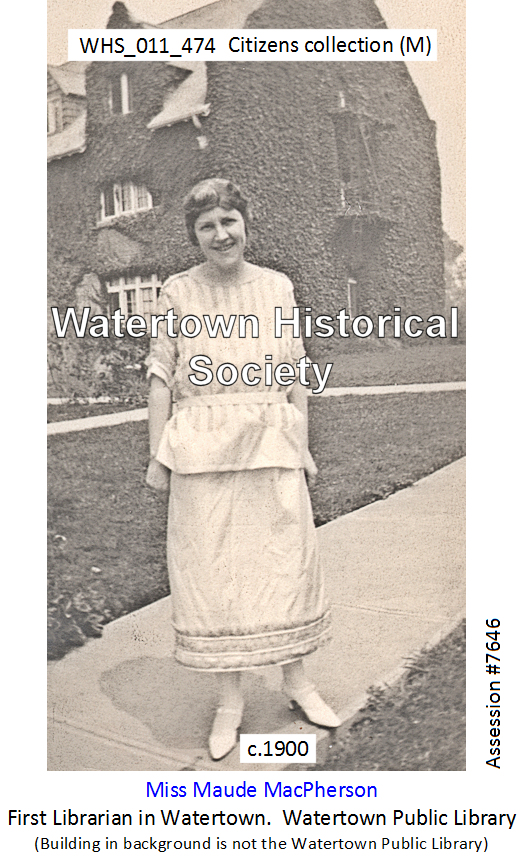
c.1900
MISS MAUD R. MACPHERSON, FIRST CITY
LIBRARIAN
1902
In the
forepart of May, 1902, some twenty to thirty representative citizens were
invited to the home of Mr. Frank E.
Woodard, Mrs. Woodard having sent out the invitations. Here Mr. F. A. Hutchins, the secretary of the
Wisconsin Free Library Commission, addressed the meeting, showing the benefits
of a public library and urging the citizens to establish one. Dr. J. H. Ott, having been asked to act as
chairman, was requested to appoint a committee of twelve to see what might be
done. This committee made arrangements
to have a public meeting of citizens on the 26th of May at the Turner Opera
House. Pres. A. F. Ernst of Northwestern College presided, and Mayor J. Brusenbach, the Reverend Haupert of the Moravian
Church and ex-Mayor W. F. Voss
spoke in favor of the project. The main
speakers were F. A. Hutchins and Miss L. A. Stearns, both of the library
commission. Then and there a committee
of twelve was appointed, Professor Ernst and Mayor Brusenbach being authorized
to choose the committee.
1902
02 15 Effort to expand early library
04
15 Mr. Frank A. Hutchins of Free Library Commission promotes
starting a Free Public Library WDT
05 20 An Odious Distinction
A marked interest has
lately manifested itself among the people of our city in the question of
establishing a public library. There seems to be a growing sentiment that
Watertown shall not much longer have the odious distinction of being the only
city of Wisconsin with a population of 4000 or over that has no public library.
The following are a few of the many benefits that results from the public
library in our city:
1. In general, it may be said that a public
library, to which everybody may go to read and to get books tends more than any
other institution, which it is possible to establish to lessen the unequal
opportunities of life.
2. A public library gives the best opportunity
for self-education, for all who may desire it.
All intelligent people
have occasion at times, to seek information on subjects in which they are
particularly interested.
Our young people should
be brought under all possible influences for good, and one of these influences
is a public library.
An opportunity to get
good reading matter will greatly aid our schools, — both public and private —
in the work of instruction.
A public library would
give to young and old the best recreative reading.
The best thoughts that
have come to great minds, the finest utterances that have been spoken and the
noblest deeds that have been performed are recorded in books; and the reading
of such books cannot fail to influence the reader’s character and
aspirations.
06 14 Movement to establish a Free Public
Library
The Watertown Public Library committee has
issued the following address to our citizens:
We
would respectfully call your attention to a movement in our city that deserves
your support. It is to establish a Free Public Library. At a general mass
meeting recently held at Turner Opera House the unanimous sentiments seemed to
be that steps should be taken in that direction.
In
accordance with the vote of the meeting, the chairman and the mayor of the city
appointed a committee of twelve to devise ways, and solicit means for such a
library. It is proposed to raise by subscriptions at least $5000 with which to
buy the first supply of books, fit up and furnish the rooms, and provide other
essentials for starting the library.
The
payment of the subscriptions will be made subject to two conditions. 1 - That
the total amount subscribed shall be at least $5000; 2 - That the city will
agree to take charge of the library when it is ready to be started and pay for
its running expenses. The subscriptions will be collected as soon as those two
conditions are fulfilled. The running expenses of the library will be for rent,
light and fuel, librarian salary, janitor's services and finer items. The
general expense to the city will be from $1200 to $1600 annually. The taxpayer
whose taxes amounts to $10 will contribute from 15 to 20 cents.
Until
larger means are at our command, it is not proposed to buy or erect a library
building, but to rent a few good rooms convenient in location and adapted to
the purpose. WDT
1903
The
twelve citizens, in the order of appointment, were: J. H. Ott, Julius Wiggenhorn, W. D. Sproesser, Edward Schempf, C. F. Viebahn, G. Terbrueggen, Jas. W. Moore,
F. E. Woodard, H. T. Eberle, John Habhegger,
William F. Voss and Carl Manz.
This committee with the aid of public-spirited women succeeded in
raising $5,000 by October. The city
council looked favorably upon the project, the library all along having the
wholehearted support of Mayor John Brusenbach.
The council then agreed to pay the running expenses of the library; on November 20, 1902, the board of library directors was
appointed by the mayor. They were: Wm. F. Voss, Julius Wiggenhorn, J. W. Moore,
H. T. Eberle, W. D. Sproesser and J. H. Ott, C. F. Viehahn as
superintendent of schools being ex-officio member. The board secured the services of Miss Maud R. McPherson and rented the lower
floor of the building at No. 104 Main
Street. The library
was opened to the public on March 2, 1903. From its very inception the library was
popular, and it can truly be said that it filled a long-felt want.
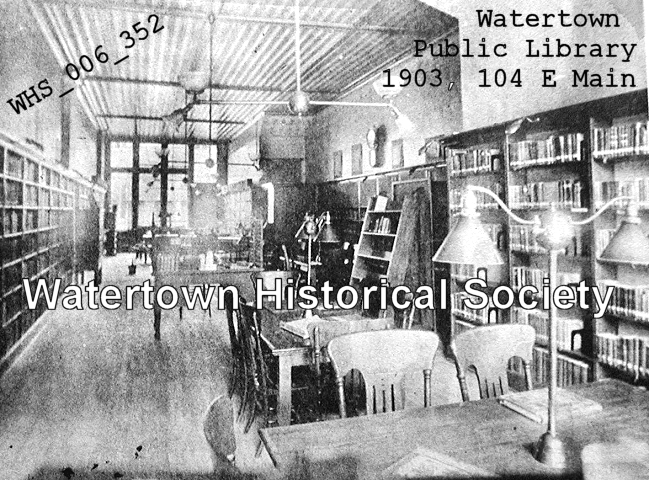
1903
interior view of Watertown Public Library at 104 E Main St [opened March 2,
1903].
Was
located in the building later occupied, among others, by Quality Bake Shop.
Three
years later, in 1906, the Carnegie building opened on W Main.
1903
02 06 LIBRARIAN ARRIVES, FIRST BOOKS DONATED
Chas.
E. Straw has made the first contribution of
books to the public library, being a handsomely bound set of Stoddard’s
works. This is in addition to a handsome
cash donation by Mr. Straw.
Miss Maude Macpherson, the librarian
for our public library, arrived in this city from Pittsburgh last Monday
night. The library building not yet
being ready, Miss Macpherson is using the city treasurer’s room in the city
hall for the preliminary work of getting the library in shape.
02 24 FORMAL OPENING OF LIBRARY
At
The
president of the library commission, Professor Ott,
will deliver a brief address, and it will be responded to by Mayor Brusenbach,
his honor, and the full council having been invited to be present.
All
our people are invited to call and inspect the library on that evening, and, of
course, at any time in the future that they may wish to enjoy their privileges,
they are welcome and entitled to do so.
The
librarian, Miss Maude MacPherson, and her temporary assistant, Miss Mae Mathes,
have all the books properly indexed, labeled, etc., for the occasion, and the
building is now receiving the finishing touches. The library will open with about 2000
volumes, and within the next six months at least 1000 more volumes will be
added.
Watertown
was rather slow in establishing a free public library, but now that she has
started in the matter, it is safe to say that she will, after Monday next, have
one of the best arranged and most up-to-date libraries in any city of this size
in the state.
Great
pains have been taken in the selection of books, and the library commission has
been greatly assisted in this matter by Miss MacPherson, who has had much
experience in the Carnegie library at Pittsburgh, one of the largest and best
in the United States.
Miss
Mathes, her assistant, was sent here by the state free library commission and
one-half of her expenses while here are paid by that commission. In the course of 60 or 90 days, it is the
intention of the local library board to have one or more local apprentices at
the library.
04 11 LIBRARY APPRECIATED AND PATRONIZED
A
Good Showing - Miss Cornelia Marvin of Madison, member of
the state library board, visited the Watertown Public library on Monday, and
found the institution in a remarkably flourishing condition, considering its
brief existence of one month. During the
month of March 3600 books were taken from the library and the names of 1069
registered as patrons of the same. The
librarian, Miss Maud Macpherson, is surprised at the success of the institution
and says it is wonderful for a city the size of Watertown. All this simply demonstrates that the library
is a valuable acquisition and that our citizens are fully awake to the fact.
1904
Public
Library. Catalogue Department... 1048
books have been catalogued, 483 adult, 105 children’s and 450 reference.
Thorough analytical work has been done in order to have all materials
thoroughly available for public use. The printed cards for the children’s
catalogue, used by the Carnegie library of Pittsburgh and the public library of
Cleveland, have been purchased for the children’s books and should be of great
value to the teachers in their school work. During the past year, 36,136 books
have been circulated. Of this number 22,390 were drawn by adult readers and
13,746 by children. The average daily circulation was 117. The largest daily
circulation was 239; the smallest 38. At
the close of the fiscal year, 1903, 1400 borrowers had registered. In the past
year 625 readers have been added to this number, making a total of 2,025. Of
this number 82 have been withdrawn as inactive, making 1,942 active cards in
use. We have registered during the past year but three county subscribers. We
wish we might enter into some satisfactory arrangements with the country people
by which they might receive the benefit of this library and that we in turn
might receive their interest and support.
09 30 SUNDAY HOURS
On and after Sunday, October 2d, the
library will be open for reading from 2 to 5 p.m. The work of keeping the library open on
Sunday is done by the volunteer service of a number of citizens of the city.
The board of Directors and the librarian gratefully acknowledge this kindness.
Dr. Edward Johnson has presented to the
public library a copy of John Finnerty's Ireland
in Pictures. It is a very creditable
work, and shows in pictures many interesting scenes in Ireland, taken by Mr.
Finnerty while on a visit to the green isle. Each picture is accompanied with a
well-written description of the scene presented.
S. A. Hutchins, of the State Library
Commission, Madison, was in the city on Tuesday and Wednesday and visited our
Public Library. He complimented it very
highly and believes out people should now begin to consider a public library
building, and says that we should have no trouble getting Andrew Carnegie to
donate a $15000 building to our city for library purposes.
1905
06 07 At the meeting of the council held
Tuesday evening, the Library Board made a report as to its preferences for a
site for the proposed $20,000 Carnegie library.
The board favored as a first choice what is known as the Kennedy
property and city property in First Street, opposite the post office and
Commercial hotel. This site was given first place by the board provided the
city property was vacated. This site would cost $4000, being 60x100 feet. The
second choice was the Randall corner, west Main and N. Water streets which is
66x158.
The
council strongly favors the Manigold site, however, at the corner of Water and
West Main streets, provided that the same can be purchased at a reasonable
figure.
While
the east side site may be more centrally located, it certainly is true that the
Manigold place is larger, on a corner, is on Main street and the library would
be far more conspicuous than at the Kennedy place.
1905
07 11 The question of a site for the public library
is being agitated and there is a difference of opinion as to which site should
be chosen - the Kennedy site on the eastside or the Randall site on the west
side. The Library Board prefers the Kennedy and the common council at a special
meeting held Friday evening expressed a preference for the Randall location
corner of North Water and Main streets. It is a matter in which every
inhabitant in the city is interested and there should be a full discussion as
to which is the best, both central and available location. It is natural that
individual interests will influence the individual choice but such interests
should be made secondary to the public good in the final determination of the
matter. The Library Board is composed men of good judgment, who are interested
in the betterment of the city. They prefer the Kennedy site. The aldermen are
also men of good judgment and have the best interests of the city at heart. The
question will probably be decided at the regular meeting of the common council
on the evening of the 18th, inst., when an appropriation will be made to
purchase a site, or an appropriation may be refused, which would be an
unfortunate termination of the matter.
1905
07 26 At the last regular meeting of the
common council the annual report of the public library librarian, Miss Maud
Macpherson was read. It showed that the people were readers and library a
necessity. Our space will not admit of our publishing the entire report, but
the following excerpt will suffice to show that the library has been well
patronized:
Total
number of books in the reference department
Total
number of books in the loan department
Total
number of borrowers cards in force,
Total
circulation, 36,543
Accession
department ... 658 books have been added during the year ... 557 were by
purchase, 67 were gifts and 37 were periodical bound.
08 02 At a meeting of the common council held Tuesday evening considerable
business of importance to the city was transacted. . . That the resolution to accept a gift of
Andrew Carnegie for a library was introduced and an amendment being offered it
went under the rules. A communication
signed by four members of the library board relative to the Randall site was
read but the matter of the site was not taken into consideration by the
council. WR
08 29 It now looks as if our new library
building had been lost in the shuffle between the library board and the common
council. The Carnegie donation has not been accepted for a site agreed upon. If
the building is to be erected this season work should begin at an early day, or
the expense will be greatly increased, for as everybody knows it is more
expensive to build in cold than it is in warm weather. Under the circumstances
the library board and council should get together, decide upon a site centrally
located, accept the donation and get the building up and enclosed before the
old weather sets in, so that the work on the interior can be continued
regardless of the cold weather.
1906
In the
forepart of 1906 overtures were made to Mr. Andrew Carnegie for a gift of
$25,000, this amount being suggested by the city council. Mr. Carnegie after some haggling on the part
of his private secretary gave the city $20,000 on the usual conditions. The only available lot on Main Street
suitable for the library was the site of the old Tremont House. The majority
of the library board did not care to go so far away from the center of the
city, and it is doubly unfortunate now, seeing that the new high school is on
Eighth and Wisconsin streets. But since
the library board had to ask the council to pay for the site, and since the old
apportionment into seven wards gave the West Side an inequitable preponderance;
the board, rather than drop the project, chose the only site that would be
accepted by the council. The council
voted $6,666 for the site, all that the law allowed, the balance - $1,334 -
being raised by private subscription, mainly on the West Side.
Claude
and Stark of Madison drew the plans of the new library; on July 10, 1906, the
contract was awarded to Stuart & Hager of Janesville, who agreed to erect
the building for $16,311. The building
with fixtures and sidewalks cost nearly twenty thousand dollars.
1906
01 16 At a regular meeting of the city
council last Tuesday night the library board made a unanimous report for the
purchase of what is known as the Mannegold
or Old Lindon House property, at the corner of West Main and Water streets
as a site for the proposed Carnegie library. The library report stated that the
Board had a 90 days' option on the property from Mrs. Henrietta Mannegold for
the sum of $7500, and agreed to raise $1000 by popular subscription, the
balance to be paid by the city by an issue of library bonds. The report was
unanimously accepted by the council and a resolution unanimously passed by that
body pledging the city council to purchase said site when the sum of $1000 has
been placed in the city treasurer's hands by the library board for the purchase
above stated.
A
large portion of this $1000 has already been pledged and there will be no
difficulty in raising the balance. Plans and specifications will be at once
arranged for, and work on the new building will begin as soon as the weather
will permit in the early spring. Under the state law, only one-third of the
price of a library building can be provided for by taxation for the purchase of
a site, hence the necessity of resorting to a popular subscription for an
additional $1000.
1906
02 07 Library
board reported that the $1,000 for building had been raised and site contracted
for . . . an ordinance was introduced to issue bonds for $6,500 to pay for site
. . . the acceptance of the Carnegie gift and one relating to loan brokers,
junk dealers and dealers in second-hand goods.
1906
04 24 Miss
Maud R. MacPherson, city librarian, has returned from Madison where she spent a
day on business connected with the city library. Miss MacPherson informs the Leader that the
plans for the new city library are completed by the library commission and
Architect Claud of Madison. It is
expected that the work will be commence on the new $20,000 library in time to
have it completed by December 1st.
1906
06 02 Plans for the proposed new Carnegie
library were received yesterday from the architects, Claude & Stark of
Madison. A meeting of the library board will be held soon and proposals for
bids for the construction of the building will be published. The billboards
which have been an eyesore at the corner of West Main and Water streets for
many years were removed yesterday and will be erected on a lot near the
Junction. The new library is to occupy the site.
1906
12 18 Considering the delays in the arrival
of material, Stuart & Hager, the contractors for the new Carnegie library,
have made wonderful progress. The
contract calls for the completion of the building by the first of January, but
in conversation with a Leader reporter yesterday Mr. Hager stated that it would
be impossible to complete the structure by that time owing to the numerous
delays in securing necessary material.
Observations yesterday disclosed the fact that downstairs there has been
placed on the walls and ceiling the second coat of plaster and the first on the
second story. It is expected that the work
of plastering will be completed by next Tuesday. The end is in sight, although it may be two
months or more before the building is ready for occupancy. The question of the library dedication is
being agitated and it is probable that in the course of a few weeks the library
board will take action toward this event.
When completed, the building will be a credit to the city and one in
which our citizens will take a just pride.
1907
05 23 One of the coming big events of the
year will be the dedication of the new $20,000 Carnegie library at the comer of
Main and Water streets, which will occur next month. A meeting of the library board was held
Tuesday evening to lay plans for the affair.
The date decided upon is Friday, June 14th, providing it is possible to
secure the services of Dean E. A. Birge of the Wisconsin university to deliver
the address. The secretary is now in
communication with Mr. Birge and is in hopes of securing a favorable reply in
the course of a day or two. It is the
intention to have an informal reception at the library building throughout the
day, with a musical and literary program at the Turner opera house in the
evening, the principal number on the program to be the address by Dean Birge,
providing the board is able to secure his services.
= = = The old library was closed on June 5,
1907; the new library was opened June 14, 1907, dedicatory exercises and a
reception taking place in the afternoon.
In the evening a meeting of friends of the library was held in the
Turner Opera House, in which Miss L. A. Stearns and Mr. Legier, now librarian
of the Chicago Public Library, were the main speakers.
The
library has been in charge of the following librarians: Miss
Maud R. MacPherson, Miss G. Ackley, Miss E. M. Smith, Miss G. Lutkemeyer, and
Miss V. G. Little, the present librarian. The library now contains about seven thousand
eight hundred books and has a circulation of nearly forty thousand volumes
annually.
The
library has been fortunate in receiving bequests of public-spirited
citizens. Mr. Carl Manz bequeathed $500, Mr. Charles Straw $2,000, and Mr. Michael
Carroll $2,000. According to the
decision of the Supreme Court of Wisconsin the library will some day inherit
valuable property under the will of Mr. John
Cole.
1907
01 11 The furniture for the new Carnegie
Library was ordered Wednesday by the members of the library board and the same
is expected to arrive and be ready for installing upon the completion of the
building. The contractor has assured the
members of the board that he will complete his contract by the first of February,
although one of the members of the board yesterday in speaking of the matter
said that this seemed improbable. He
added that after the contractor had finished, there would be considerable work
to perform and he expressed the opinion that it would be well along in March
before things would be far enough along to hold the dedicatory exercises.
1907
03 01 The new Carnegie library is practically
completed. Only the finishing touches
remain and then the permanent home of our free library will be at the service
of the public bound in one of the finest structures ever erected on an
appropriation of a like amount from the great philanthropist whose memory will
be perpetuated for ages to come. The
process of painting, putting in the lighting fixtures and carpeting is about
all that remains to be done before the receiving of the furniture and fixtures,
which are expected sometime in March from the Library Bureau at Chicago. Considerable interest is now centering in the
dedicatory exercises, which will be held no later than April and possibly some
time the latter part of March. In most
cities where Carnegie libraries have been built, the cost has exceeded the
appropriation. This is not the case in
Watertown, however, and the members of the committee are entitled to credit for
keeping within the bounds of the appropriation, $20,000, outside of the site
which was appropriated by the city.
1907
03 15 On Wednesday H. T. Eberle, secretary of
the Library board, received from Andrew Carnegie a check for $5000, the last
installment of the $20,000 given by Mr. Carnegie for the erection of a library
in this city ...
10 19 Miss Valfrid Palmgren of the Royal
Library, Stockholm, Sweden, was a guest at the Public Library yesterday. She was accompanied by Mrs. Harriet Sawyer of
the State library commission. Miss
Palmgren has been sent by the Swedish government to study library conditions in
this country. She was most favorably
impressed in every respect with our building.
The Libraries visited by her in Wisconsin are Madison, Milwaukee,
Oshkosh and Watertown.
1907
07 08 OVERDUE
BOOK NOTICE
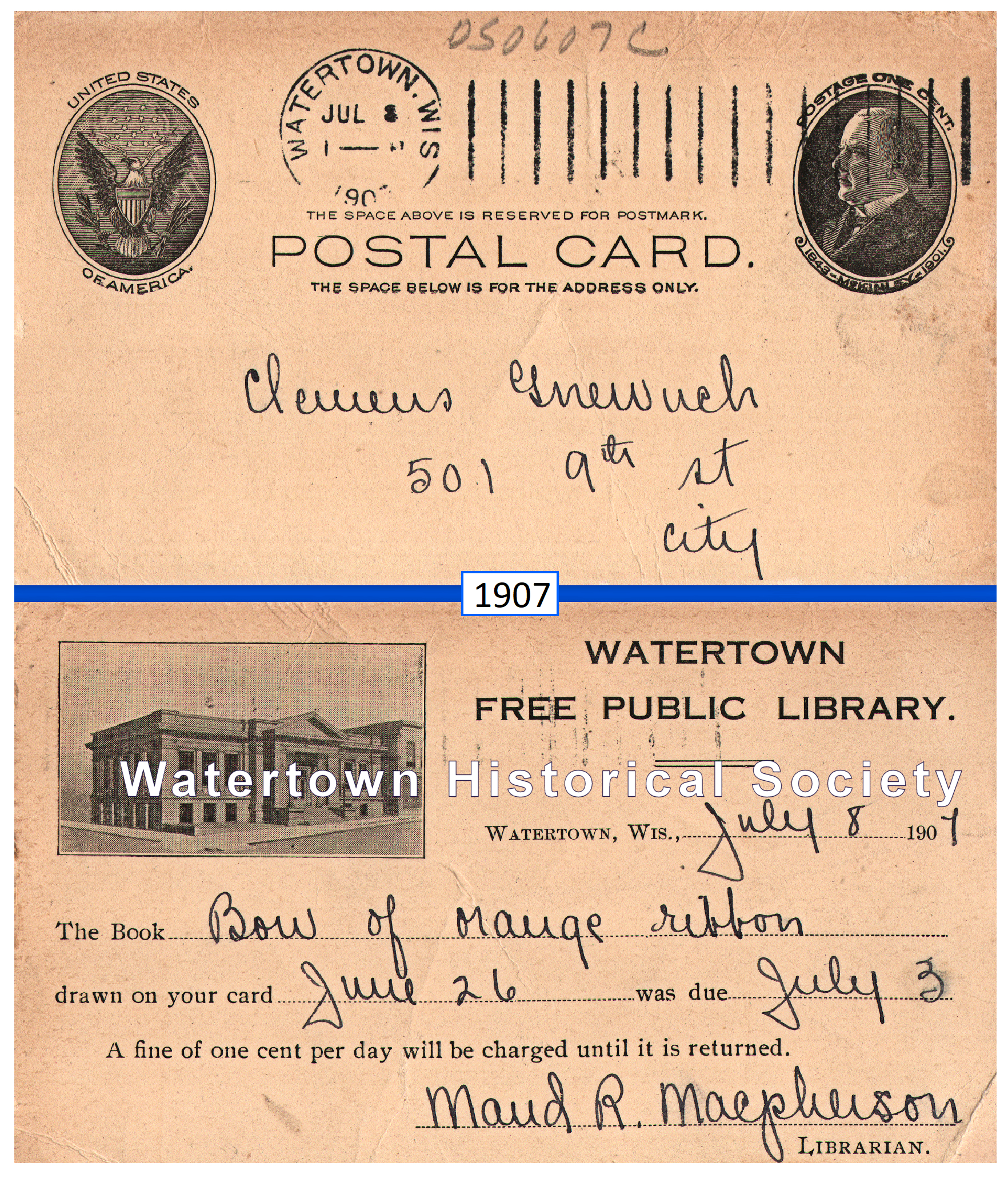
The Bow of
Orange Ribbon / A Romance of New York, by Amelia E.
Barr, Copyright, 1886, 1893.
1908
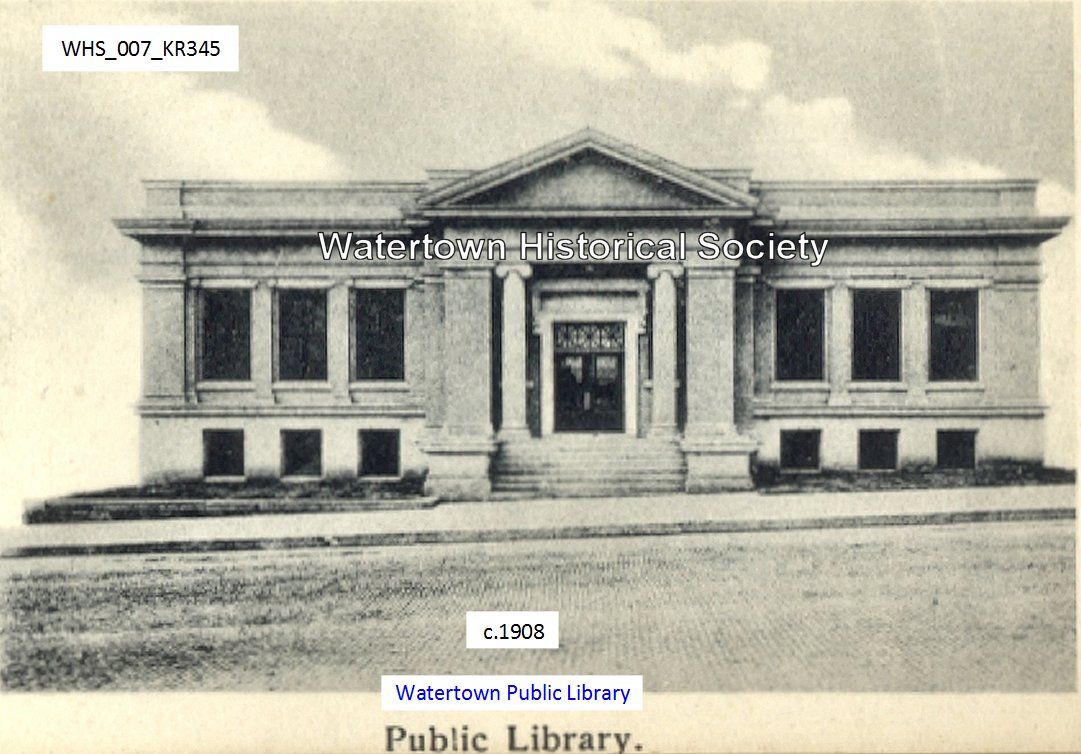
07 10 Alley
proposed behind library proposed as necessity when interurban is running WG
07 10 Voss
and Wiggenhorn to succeed themselves as members of
the library board WG
10 09 Finance
Committee consideration of request of the board of directors
WG
1909
01 15 Euterpe Club has donated $15.00 towards
fixing up the grounds in the rear of the library building WG
01 22 Students
from state library school assigned to library WG
01 29 Miss Maude R. Macpherson resigned; librarian since its establishment
over six years ago WG
02 12 Miss Gabriella Ackley appointed
librarian, to succeed Miss Maude Macpherson, resigned WG
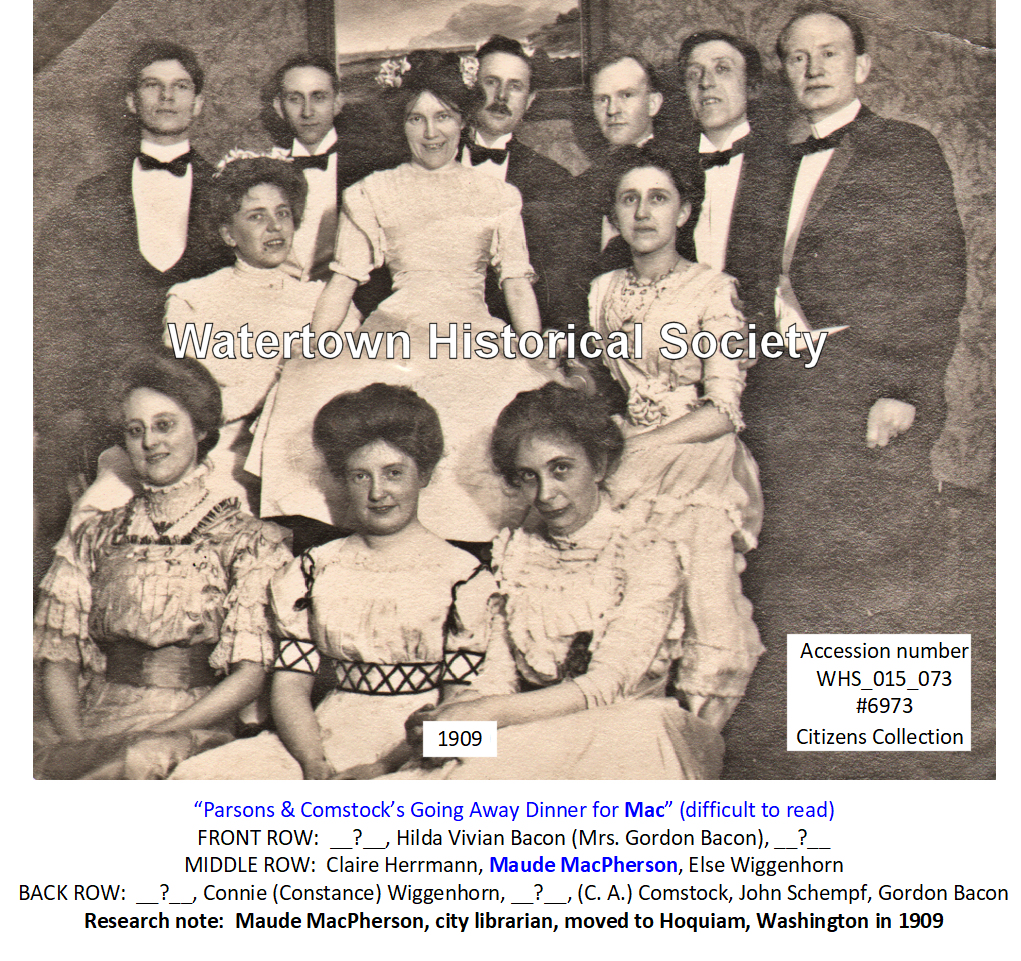
02 26 Reception for Miss Maude MacPherson;
members of the Saturday Club were hostesses WG
GOING AWAY DINNER
FOR MAUDE MACPHERSON
02 26 Miss Hilgendorf,
mentioned as Assistant Librarian WG
04 09 Miss Gabriella
Ackley appointed librarian WG
04 09 Second, Third
and Sixth grades classes held in library during school construction WG
08 13 Miss Clara Hilgendorf, Asst Librarian, resigned WG
09 17 Miss Lilian Mundt,
salary of $5 per month WG
09 24 Miss Clara Hilgendorf, Asst Librarian, married Dr. Louis H. Nowack WG
1910
02 11 Miss
Anna Skinner began practice work; gentlemen’s room open at the
noon hour WG
04 22 F. Kalina, Charles Lutovsky, John T.
Ryan-Standing Committee, Library WG
06 03 Bids for furnishing coal WG
09 23 Librarian’s Annual
Report WG
12 30 Christmas story hour in the club
room WG
1911
01 26 Telephone in Public Library
A telephone has been
installed in the public library, and the public is urged to "call up"
the library for any library business. Books
may be renewed, non-fiction reserved and reference questions answered by
telephone. The telephone is for the use
of the library staff only, in the building.
It is against the rules to allow the public to use it. Gabriella Ackley, Librarian. WG
02 09 Circulation at Public Library
The public library is a
popular place. The circulation for the
month of January exceeded any month's circulation in the library's
existence. Sixteen hundred more books
were circulated than the number of borrowers using the library. The library owns 6,227 books, including
magazines and reference books which do not circulate. The circulation for January was seven-tenths
of the number of books owned. Two
hundred new books (purchased with money from the "Private Secretary"
[benefit] for the children), have brought most of the regular borrowers and
many new ones to the public library.
Every child in Watertown, who has not a good library at home, should use
the public library. The case will be
rare where any child can find as much at home as in the library. Parents and
teachers are urged to see that the children are borrowers. Few children drop the "library
habit" when once it is formed. On
Saturday afternoons every seat in the reading room is in use, the many
periodicals purchased and given being a great attraction. The new telephone has proved its usefulness,
many reference calls having come during the last three weeks. WG
05 04 Elson Print Donation Recalled
06 22 Burn the Books Borrowers
from the public library who have contagious diseases in the family and have
books from the library in their homes at this time, are requested to burn the
books at once and notify the library by telephone that they have done so. No charge will be made for the books and new
cards will issued as soon as the quarantine is raised. WG
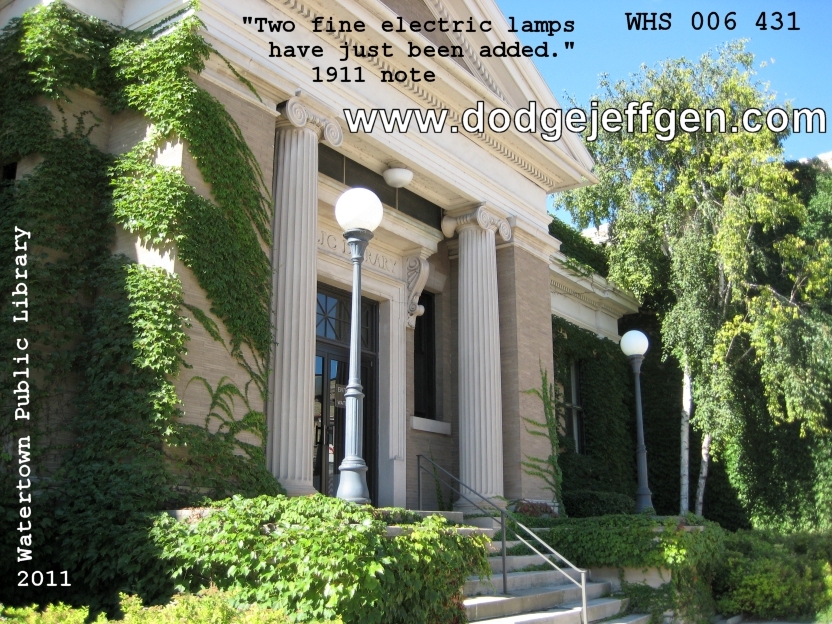
On the West Main Street
entrance to the public library two fine electric lamps have just been added at
an expense of several hundred dollars, the gift of a First Ward gentlemen, who
does not wish his name published in connection with the affair.
The lamps are the only
ones of their kind in the city and add greatly to the appearance of the
library. WG
Cross Reference
Note:
Signed bricks of 1911
discovered in 2017 during disassembling of steps and monument stands for these
lamps. See 2017 section of this chapter.
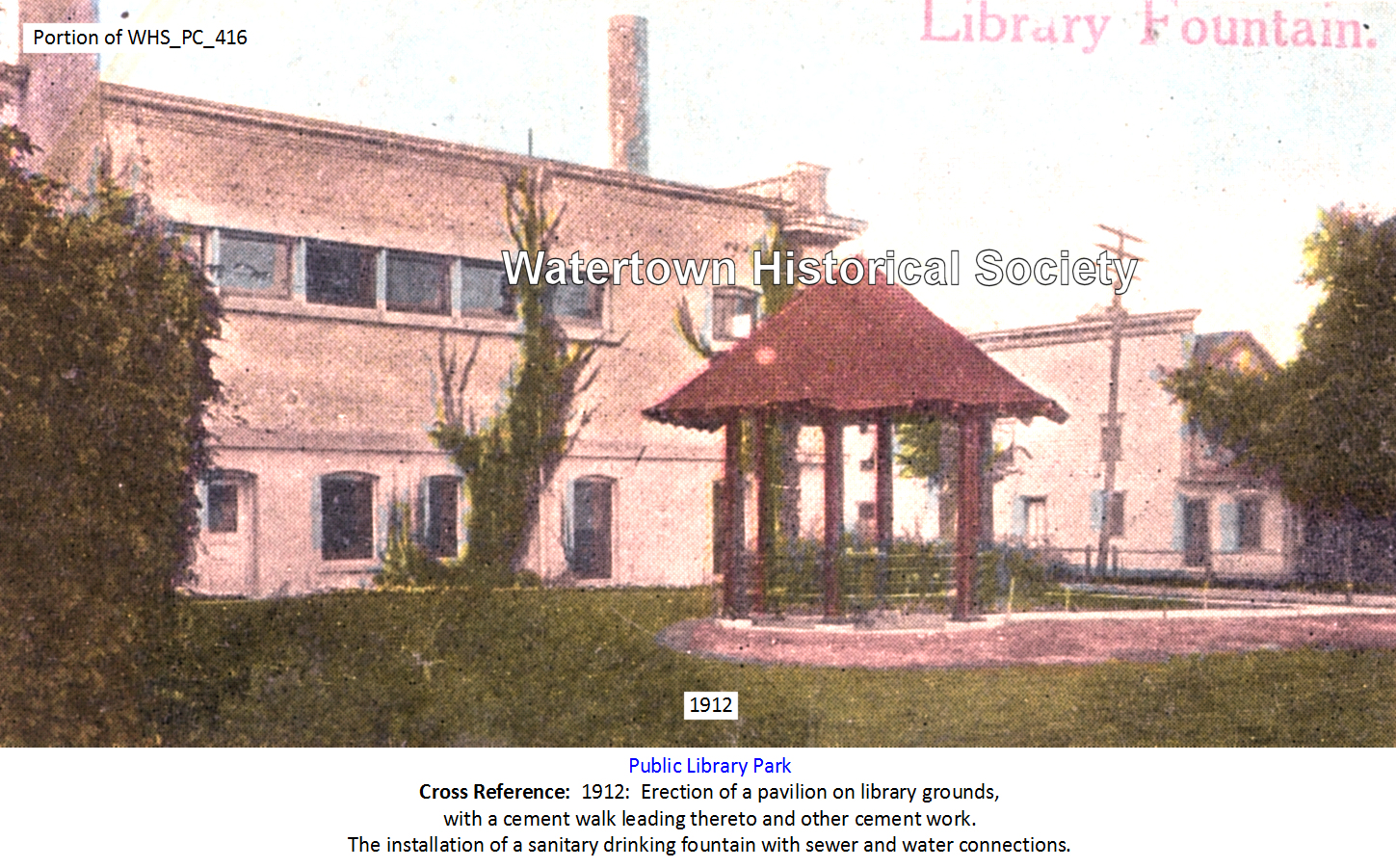
11 16 FOUNTAIN FOR LIBRARY PARK
The board of library
commissioners wish to add a public sanitary drinking fountain to the park in
the rear of the library, build a cement walk to it and a circular walk around
it, as early in the spring as possible, and it is hoped some philanthropic
citizen will donate the fountain before that time. This is an improvement we know will be
greatly appreciated by our people. WG
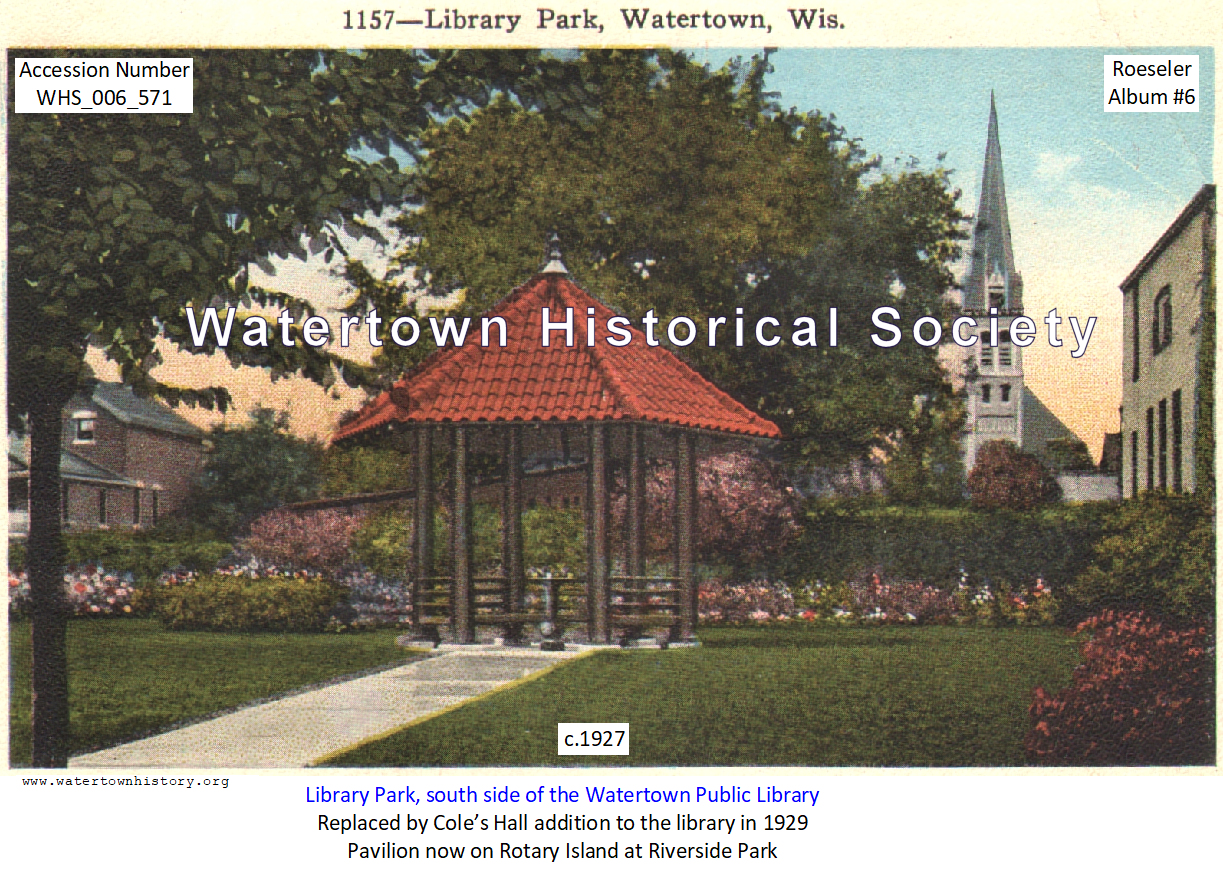
Gazebo relocated to Riverside Park
when Cole Memorial Hall was constructed on the site of Library Park in the late
1920s.
12 14 Miss Lillian
Mundt resigned as assistant librarian; Miss Corinne Bartlett was appointed
successor. WG
1912
02 08 SANITARY DRINKING FOUNTAINS – On account of the
Red Cross Seals sale in Watertown during the holiday season, Watertown is
receiving two sanitary drinking fountains, one of which no doubt will be placed
in the children's room at the public library.
WG
05 29 SEALED PROPOSALS will be received until
4 o'clock p.m., Monday, June 10, 1912, for the erection of a pavilion in the
public library grounds, with a cement walk leading thereto and other cement
work. The installation of a sanitary drinking
fountain with sewer and water connections, all according to plans and
specifications which may be seen at the office of the secretary. The right to reject any and all bids is
reserved by the board of library directors.
– H. T. Eberle, Secretary. WG
06 13 DONATED PAVILION
AND SANITARY DRINKING FOUNTAIN
One of Watertown’s public-spirited citizens has donated a fine sanitary
drinking fountain and a pavilion (gazebo) to the Board of Library Directors to
be erected in the park in the rear of the public library, this being his second
substantial donation to the public library [fountain can be seen under the
pavilion]. Work on the pavilion will
begin at once. The contract was a warded
to Ferdinand Behlke, the lowest bidder, for the entire work at $237, excepting
plumbing, which was awarded to Otto Biefeld for $138. Aside from this, plans and specifications and
other incidentals will make the entire cost about $375. WG
07 11 BIDS FOR COAL
Sealed proposals for furnishing the public library of the city of
Watertown with thirty-five tons of stove size and pea coal will be received by
the secretary up to and including July 26, 1912. – H. T. Eberle,
Secretary WG
07 11 LIBRARY BOARD ORGANIZED
At a regular meeting of the public library board last Tuesday evening,
Julius Wiggenhorn was elected president, W. D. Sproesser, vice president, and
H. T. Eberle, secretary. WG
07 11 ANNUAL REPORT OF
THE PUBLIC LIBRARY
The Public Library has
on July 1st begun its tenth fiscal year.
On March 2nd, of 1913, Watertown will have had a library for ten
years. A suitable celebration will
probably be held at that time.
The following
statistics show something of its usefulness to the public:
Circulation........................ 48239
Borrowers
the first of the year.... 3117
Borrowers
the end of the year...... 3314
Books
purchased.................... 404
Books
given........................ 147
Books
added by binding............. 27
Withdrawn
and worn out............. 176
Total
number of books in library..... 6741
The building has been
greatly beautified by two lamps for
the entrance; the same donor who gave the lamps, has given a drinking fountain and pavilion for the
library park. Plants, shrubs and
ferns given by well-wishers make the library and its park attractive.
Gifts of books by
individuals and subscriptions of magazines by the Saturday and Corby clubs have
added much to the pleasure of the readers.
The library's subscription to periodicals, with its gifts, being very
satisfactory to the public.
The number of borrowers
in proportion to the population is above the average, as the borrowers' cards
are live cards. One hundred and
eighty-nine (189) children borrowers have been added this year, necessitating
buying an unusual number of books for youngest readers.
Several teachers in the
grades, as well as in the High school have helped by suggestion and personal
effort to get the children to read good books.
The Freshmen and
Sophomore classes have been instructed in the use of Card Catalogues and
reference books.
Because the library
must be democratic to fulfill its function, it has been necessary to buy more
fiction than other books; still in spite of the constant demand for fiction, it
is gratifying to know that more books on non-fiction have been issued than ever
before, the greatest increase being in sociology, which is subdivided in books
about political science, political economy and education. Every book purchased on these subjects has
eagerly read.
Books on health and
hygiene have been much in demand, as have dramas, both classic and modern.
References have been compiled
for various clubs, and several "Story Hours" for children held.
The modern library endeavors to be a civic center. The following clubs and societies have held
their meetings in the Watertown Public Library:
Saturday Club, Corby Club, High School Debate Club, French Club, Drama
Club, Classic Club, Anti-Tuberculosis Society, Political Equality League,
Associated Charities, Jefferson County Medical Society. Poles for the voting precinct are located at
the library.
The fines collected
during the year amount to $106.74.
Miss Else Wiggenhorn of
Watertown and Miss Elizabeth Hayburn of Oconomowoc have each completed a six
months course of apprenticeship in the library.
The greatest need the
library has is a larger appropriation so that more money may be used for books
as the increasing circulation means more wear and tear. 2191 books have mended, and 59 recased during
the year.
Added borrowers make a
larger demand than the library can at present afford. WG
08 01 A Fine Sanitary Drinking Fountain – Thanks to one of
Watertown’s benevolent citizens, a fine sanitary drinking fountain and pavilion
now adorns the public library park. The
fountain contains four bubbling cups and by the pressure on a button on each
cup sparkling water flows so that a nice cool drink can be obtained at all
hours of the day and night. The fountain
is of bronze and a fine pavilion is erected over it. It is certain to be one of the most popular places
in the city during the warm months of the year.
The kind donor has and deserves the thanks of all our people. WG
08 08 Industrial Exhibit. The state industrial exhibit of safety
appliances in the men's room of the public library is attracting much attention
here. It contains exhibits and photos of
all the latest in safety appliances for factory machinery, ladder and scaffold
protections for painters, safe-lines and belts, guards for wheels, saws,
machinery, printing presses, etc. It is
well worth a few moments of any one's time to call at the library and look this
exhibit over. WG
08 15 Miss Ackley Resigns – Miss Gabriella
Ackley, librarian at the public library the past three years, handed in her
resignation last Tuesday evening to the Board of Library Directors, to take
effect August 31st. Miss Ackley has been
a most efficient and popular librarian, in fact considered one of the very best
in Wisconsin, and her decision to leave our city is regretted very much by the
Library Board and our citizens in general, and all wish her success wherever
she may be in the future. She has
accepted a position as librarian of one of Chicago's branch libraries at a
salary of $100 per month with a gradual increase to $1500 a year. Miss Mabel Smith of Oconto was appointed her
successor last Tuesday by the library board at a salary of $60 a month. She is a graduate of Terry Hall, the
University of Wisconsin long course library school at Madison and took a
special children's course at the Pittsburg, Pa., library school and has been an
assistant there. She comes to Watertown
very highly recommended. WG
11 28 SUNDAY AFTERNOONS
Beginning with Sunday,
December 1, the Reading Room of the Public Library will be open every Sunday
afternoon from two until five. No books
will be circulated. WG
1913
01 16 OF INTEREST TO FARMERS
The
Free Public Library wishes to announce that persons living along rural mail
routes are entitled to the privileges of drawing books free and extends a
cordial invitation to all to come to the library and make use of its many books
and magazines. WG
01 23 SWORD FERN AND A PRIMROSE PLANT
The
Stuebe Floral Company has given the public library a fine sword fern and a
Primrose plant, which add much to its attractiveness and home-like
atmosphere. WG
02 13 WHAT THE LIBRARY IS FOR
The
library wants to furnish good books to every man, woman and child in this
town. Among the 6,700 volumes in the
library are books for the businessman, the mother and the child; books for the
laborer, the farmer, and the tradesman; books to amuse and books to inspire;
books of laughter and books of tears; in fact books on almost any subject may
be had for the asking. Let the library
be your information bureau.. WG
1914
10 22 LIBRARY OPENS EARLIER
The
public library will open at 9 o’clock in the morning instead of 10 o’clock as
heretofore, the determination having been reached at a conference of the
library board and Miss Lutemeyer, the librarian, at a recent meeting. The library will be open continuously from
the opening until 6 o'clock in the evening, and will reopen at 7 o’clock for
two hours or until 9 o’clock. The first
Sunday in December was set as the date for the opening of the reading room on
Sunday afternoon. Each Sunday from
December to April the library will be open in the afternoon from 2 until 5
o’clock. The library is free and for the
use of the public generally and it is the desire of the board and the librarian
and assistants to make the use of the books and periodicals contained as
convenient as possible. It is a very easy matter to become a patron of the
library. Adults may receive a card
entitling them to draw books by signing a guarantee that they will abide by the
rules of the library. Children under
sixteen years of age may secure cards by having their guarantee slip signed by
some resident adult. The present war in
Europe has increased the interest of the public in books of travel and other
works descriptive of foreign countries and in those magazines which carry
articles dealing with the war. The
Watertown library is particularly well equipped to supply books and magazines
of this kind to those interested. And
for general reading there is a host of good things on its shelves. WG
11 26 PUBLIC LIBRARY NOTES
The Euterpe Club of Watertown has helped the library
purchase “The American History and Encyclopedia of Music.” The set covers twelve volumes in all — a
musical dictionary, instruments, operas, oratorios and masses, American music,
foreign music, essentials, theory, musical biographies and a complete
index. The club has much use for
information on all musical subjects and the use of the encyclopedia will not
only be of service to the club, but to the general public as well. Coming with the set are folios of music
scores. The separate sheets of music may
be borrowed as books from the library.
The reading room will be open Thanksgiving afternoon from 2 to 5 o’clock
but no books will be circulated that day.
The library is closed one day each year in order that the floors may be
oiled. This will be done next Saturday,
November 28, and books due that day will be due Monday. WG
1915
01 28 MOVING
PICTURE BOOKS
The
library now has three books which will interest the maker of moving pictures
and the lover of the picture, its art, technique, etc.
Talbot—Moving
Pictures. The first book to deal comprehensively and technically with the
history of the photograph and the moving picture idea. “Trick pictures” are explained and the pains
and money spent to obtain interesting films.
The extent of the enterprise brought out a valuable book for the
professional maker and one that is also interesting to the general public.
Esenwein—Writing
the photoplay. One of the most helpful books
for the student explaining the qualification of a successful writer, the
essential elements of the photoplay, the sort of material needed, censured
themes and how to market the photoplay script.
Sargent—Technique
of the photoplay. Explains the exact
form and instructions for writing the photoplay. Explicit in its treatment. This is especially helpful to one who is
interested in the writing of the play.
WG
03 25 BENEFICIARY
OF MICHAEL CARROLL WILL
Twelfthly, I bequeath to the trustees of the
Watertown Public Library, $2000.
04 22 SATURDAY CLUB MEETING
The Saturday Club held the last regular meeting of the
season the afternoon of April 20th. Each
member was privileged to bring a guest and the reading room of the public
library was well filled by an interesting audience. The program was commemorative of “Bird and
Arbor Day” and consisted of a talk on “Our Garden at the Library” given by Mrs.
Eli Fischer, who has done so much to
beautify the yard back of the library building. The latest gift to the library consists of
three bird houses, two of which were made by the boys of the manual training
class of the high school and the little wren house was made by Clarence Gloger
of the grammar grade. They were put in
place by Mr. Eli Fischer and the Saturday Club.
The houses were dedicated to the use of the birds in a neat address
given by Miss Lutkemeyer. After the
reading the ladies adjourned to the yard to inspect the houses, the flowers,
the elm tree, which was planted a year ago, the shrubbery and the well-kept
lawn. Returning to the reading room, the
program was continued by the reading of Eugene Fields’ beautiful selection “The
Oak and the Ivy” by Miss Edna Chadwick.
Miss Herrmann told of the “Birds Seen in My Garden” their habits, their
songs and many other interesting things connected with our feathered
friends. They showed pictures of nearly
all the birds commonly seen here. It was
told in a delightful manner. WG
07 16 INTERIOR
REDECORATED
The library interior
was redecorated during the summer.
06 29 SIMPLE
EXERCISES MARK FLAG RAISING AT LIBRARY
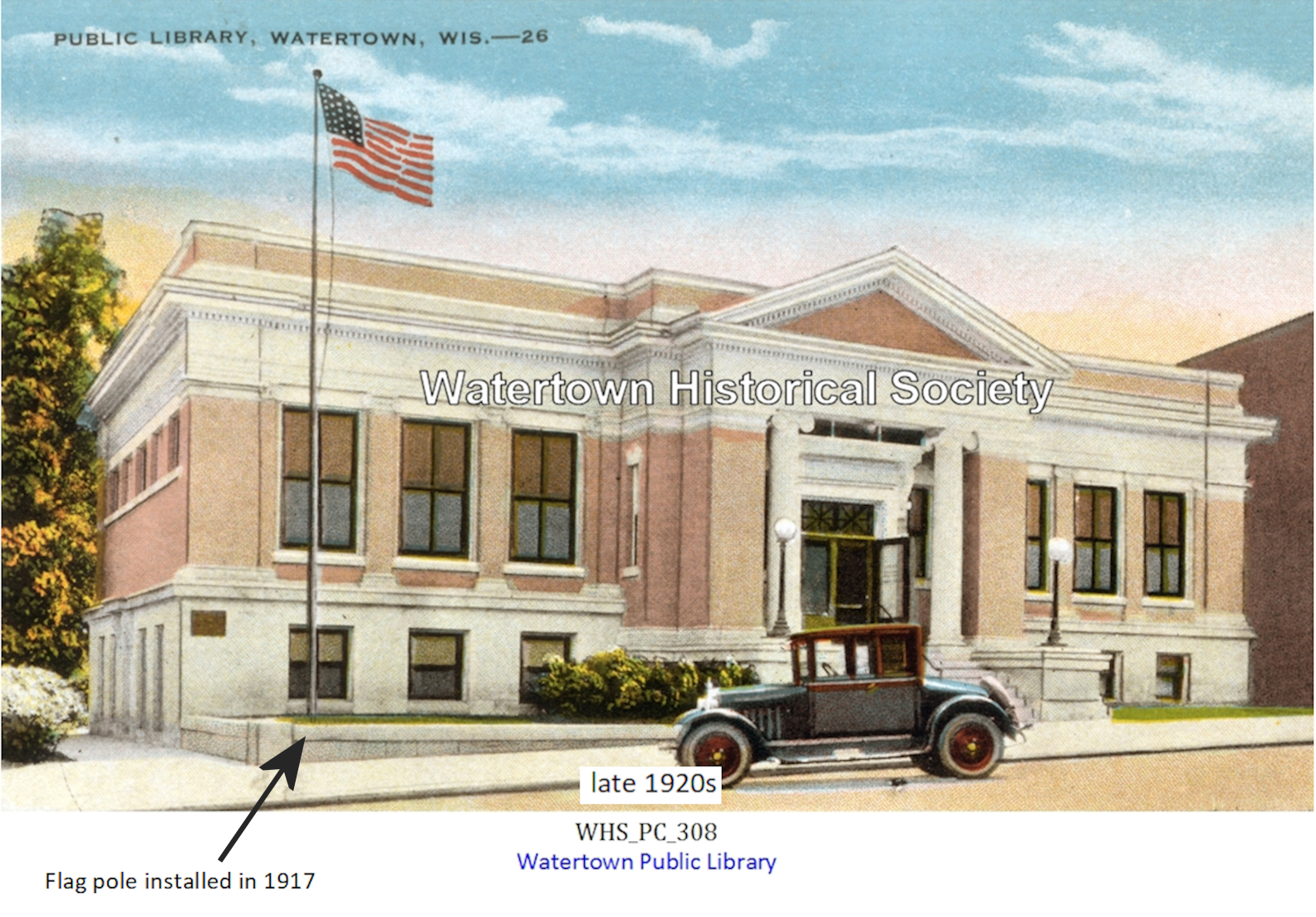
Simple exercises marked the
raising of the new flag at the public library this afternoon. The flagstaff had been set in place several
weeks ago on the grounds nearest the street intersection, and after a short
address by Hon. W. F. Voss, vice president of the library board, the flag was
presented to Miss Maud Macpherson, the first librarian, who hoisted Old Glory
to the top of the staff. Immediately
before raising the flag, Mr. Voss delivered a short address.
A concourse of citizens, including
Mayor Mulberger, members of the library board, city officials and members
of the G. A. R. were present when Miss Vivian
Little opened the exercises and introduced the speaker. She said:
“We have a twofold purpose in
inviting the people of Watertown to be present at the flag raising. The first to do honor to the flag we love so
well; the second to commemorate the tenth anniversary of the public library.”
A quartette composed of Messrs. Max
Rohr, Edward L. Schempf, O. E. Meyer and William Sproesser then sang a
patriotic song, followed by the address of Mr. Voss, who said:
“Fellow
Citizens: We are assembled here today to
commemorate the tenth anniversary of the installing of the public library in
its present quarters owned by the city and the gift of Andrew Carnegie, and the
fourteenth year since its establishment by an act of the common council of this
city.
“In
connection with this the board of directors decided to have a public and formal
raising of our country’s flag, the first that the board has owned since its
creation, in order not to be behind other public bodies in the display of
patriotism.
“Coming
back to the benefits of a public library, I will say that next to the schools it
is the best educator for the people. You
will find on its shelves, books of reference relating to every useful subject
and occupation in which man is today engaged.
The working man, the business man, the manufacturer, and the farmer will
find books helpful in his particular trade or business. That the library is popular is shown by the
number of its patrons, they being now over 3,500.
“I
will now introduce Miss Macpherson, well known to many of our citizens as our
first librarian, who is now temporarily staying with us and who has been
selected for the honor of raising our new flag to its masthead.
“As
that starry banner, our country’s flag, now floats from the top of its staff
calling our young men to w ar, so when this dreadful world’s war is over, may
it be forever the emblem of peace to all nations, to all mankind as well as the
symbol of justice, equality and democracy for our own citizens.“
Hon.
W. D. Sproesser, one of the first members of the public library board, then
presented the flag to Miss Macpherson, who raised Old Glory to the top of the
staff while Mrs. E. J. Hoermann recited the poem, “The Living Flag.” This was followed by the singing of “America”
by the quartette and the audience.
The
flag is 4x8 feet and is of woolen bunting, the stars being embroidered. The
Watertown News, 29 Jun 1917
1920s Frank Meschke, 1011
Vine St., was the custodian at the library in the 1920s.
1927
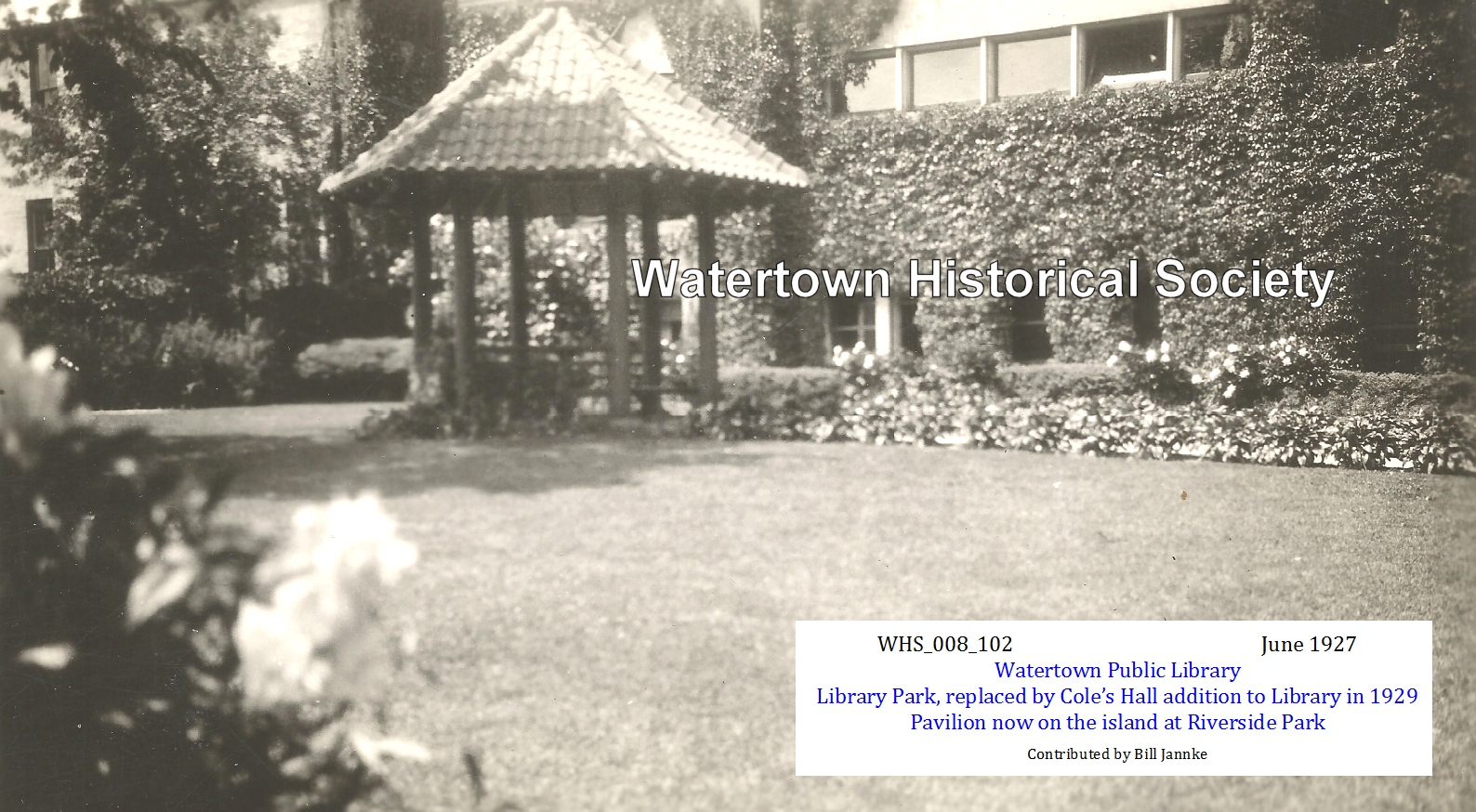
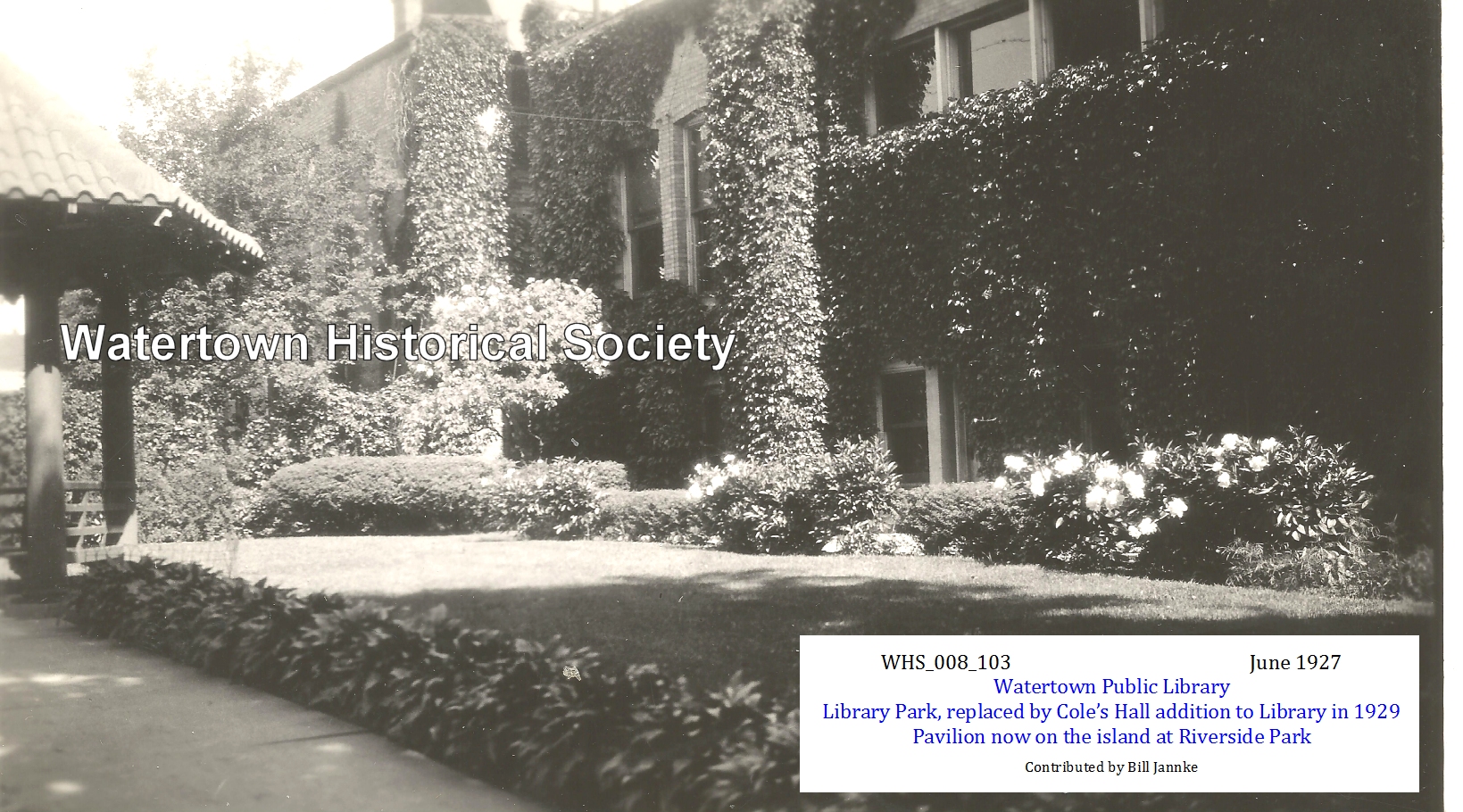 Library Park
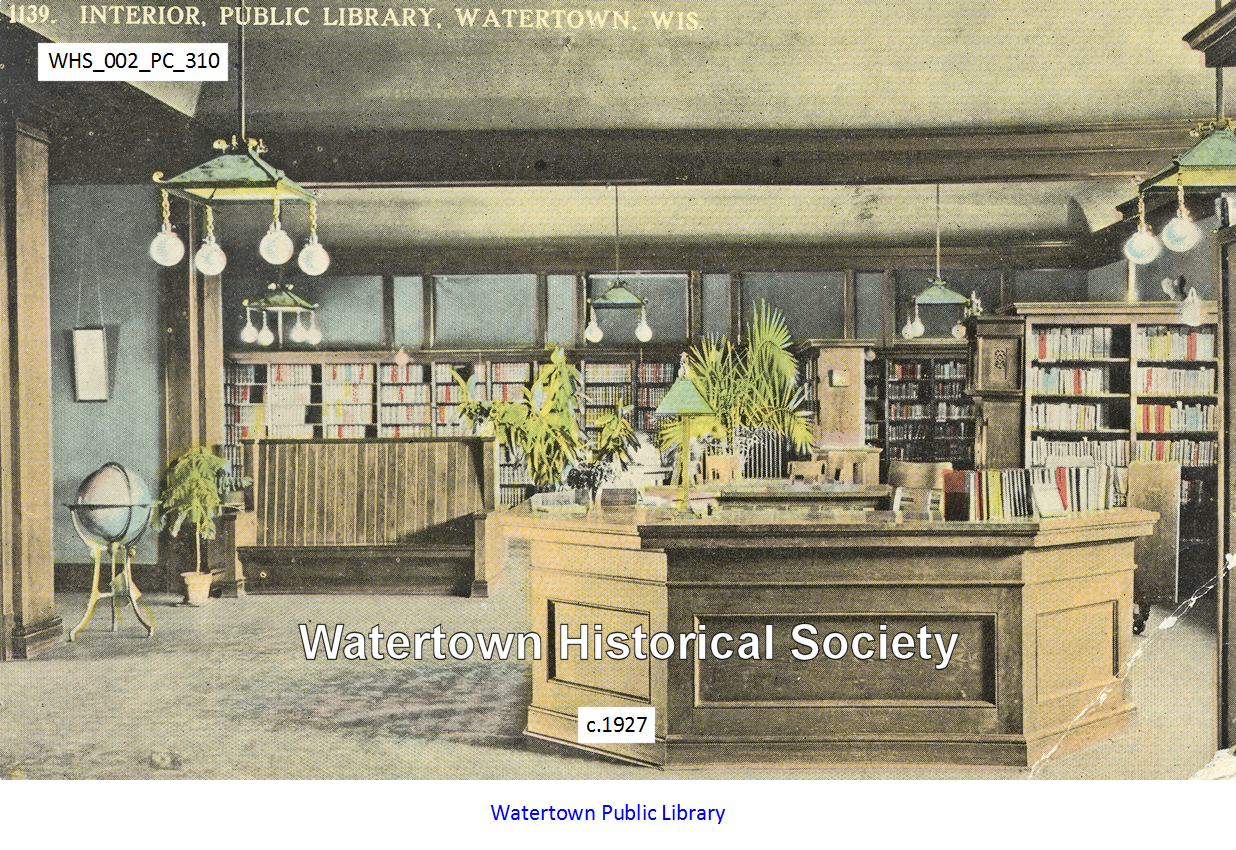
c.1927
1928
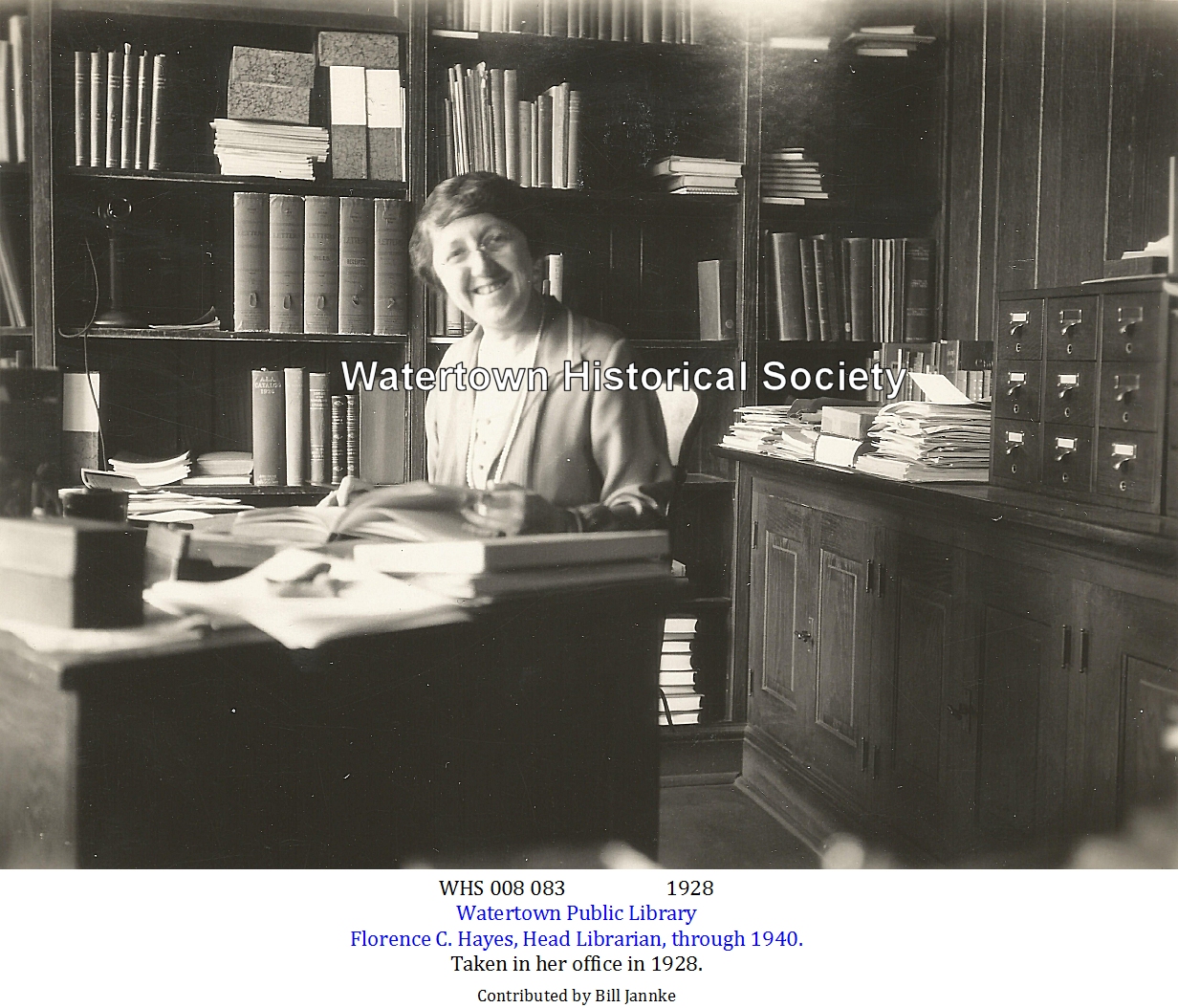 Florence C. Hayes, in her office, head
librarian through 1940.
Florence C. Hayes, in her office, head
librarian through 1940.
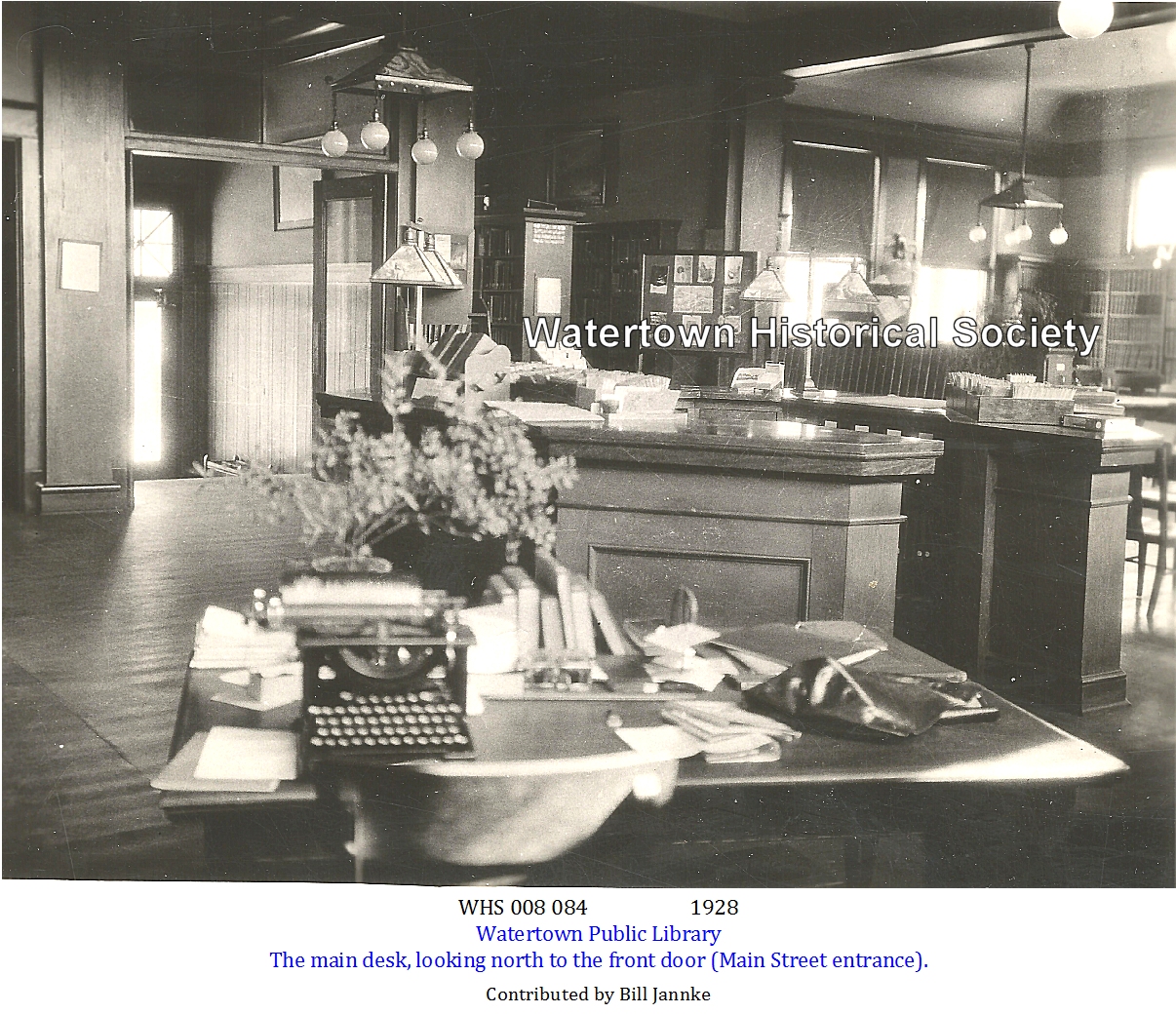 Main
desk, looking north to the front door (Main St entrance).
Main
desk, looking north to the front door (Main St entrance).
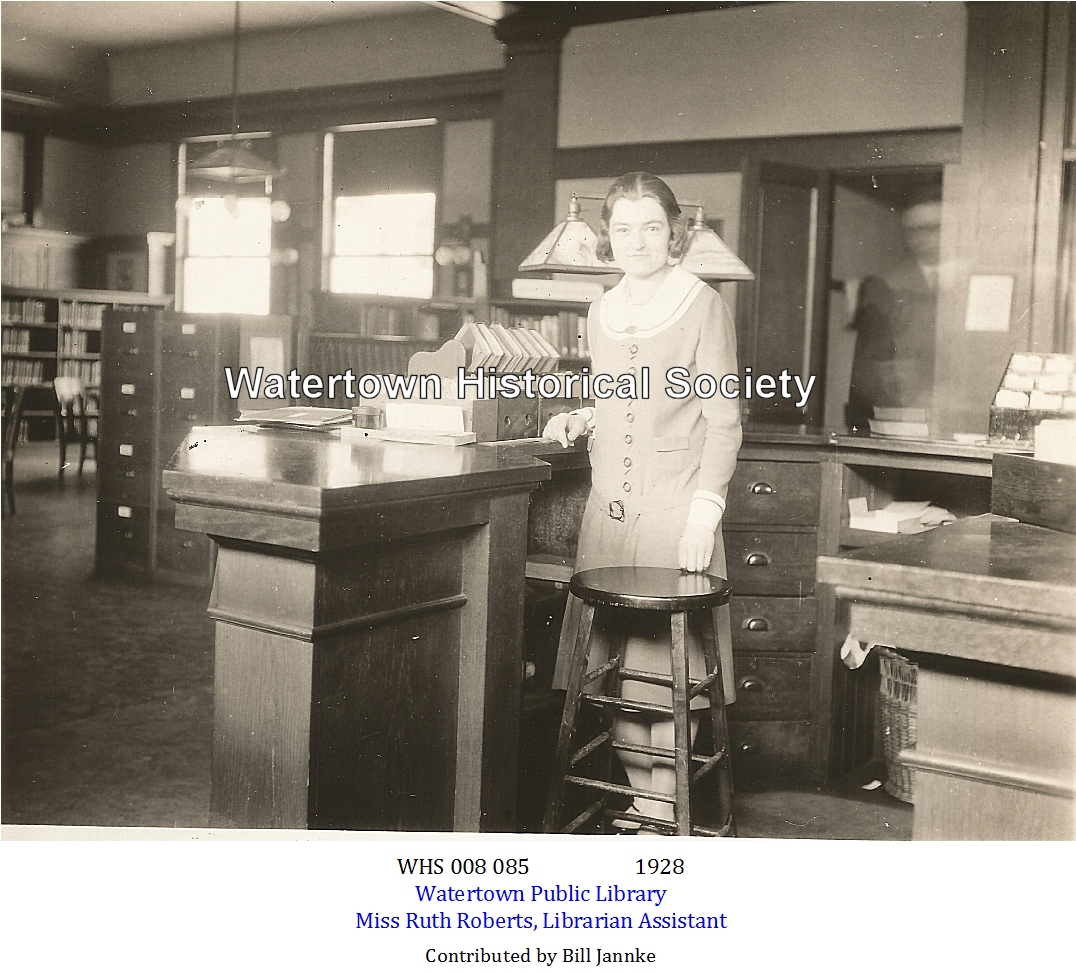 Miss Ruth Roberts, Librarian Assistant
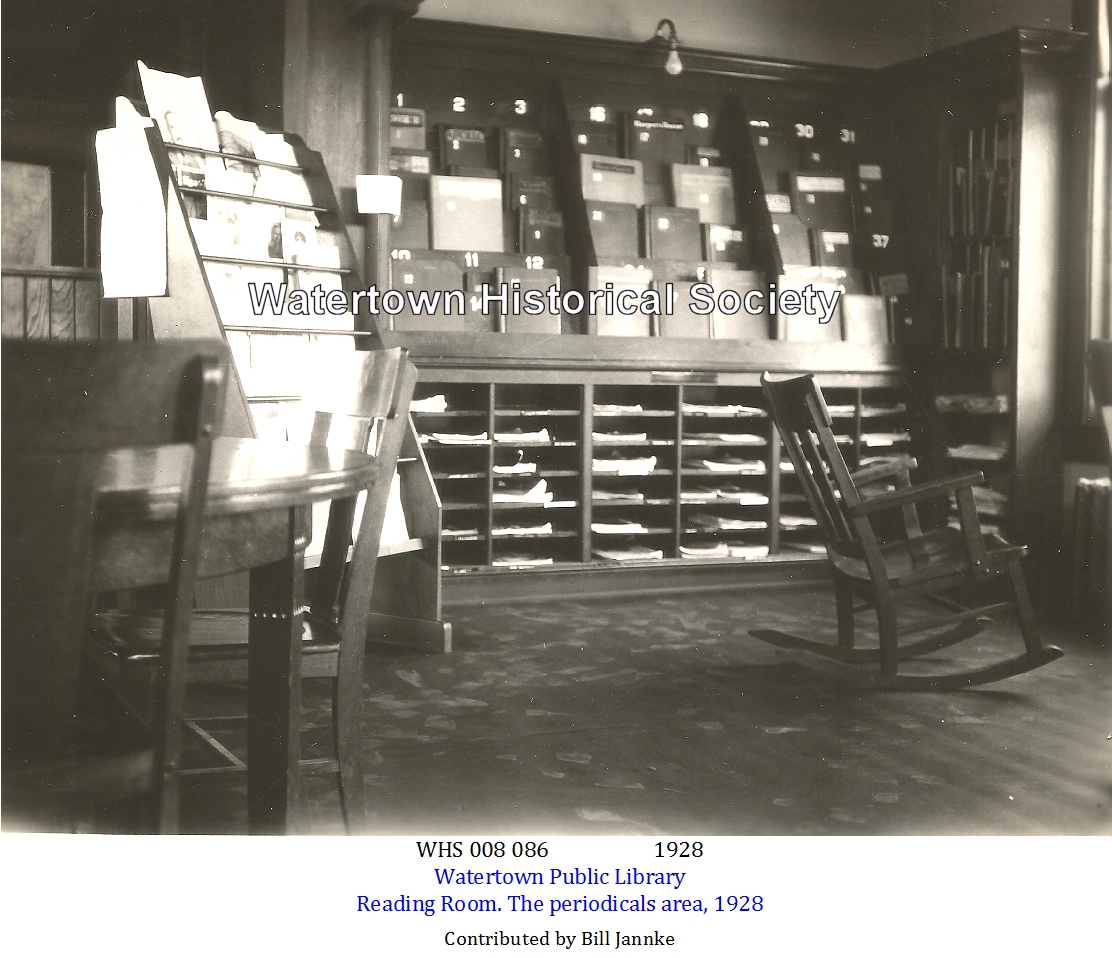 The periodicals area.
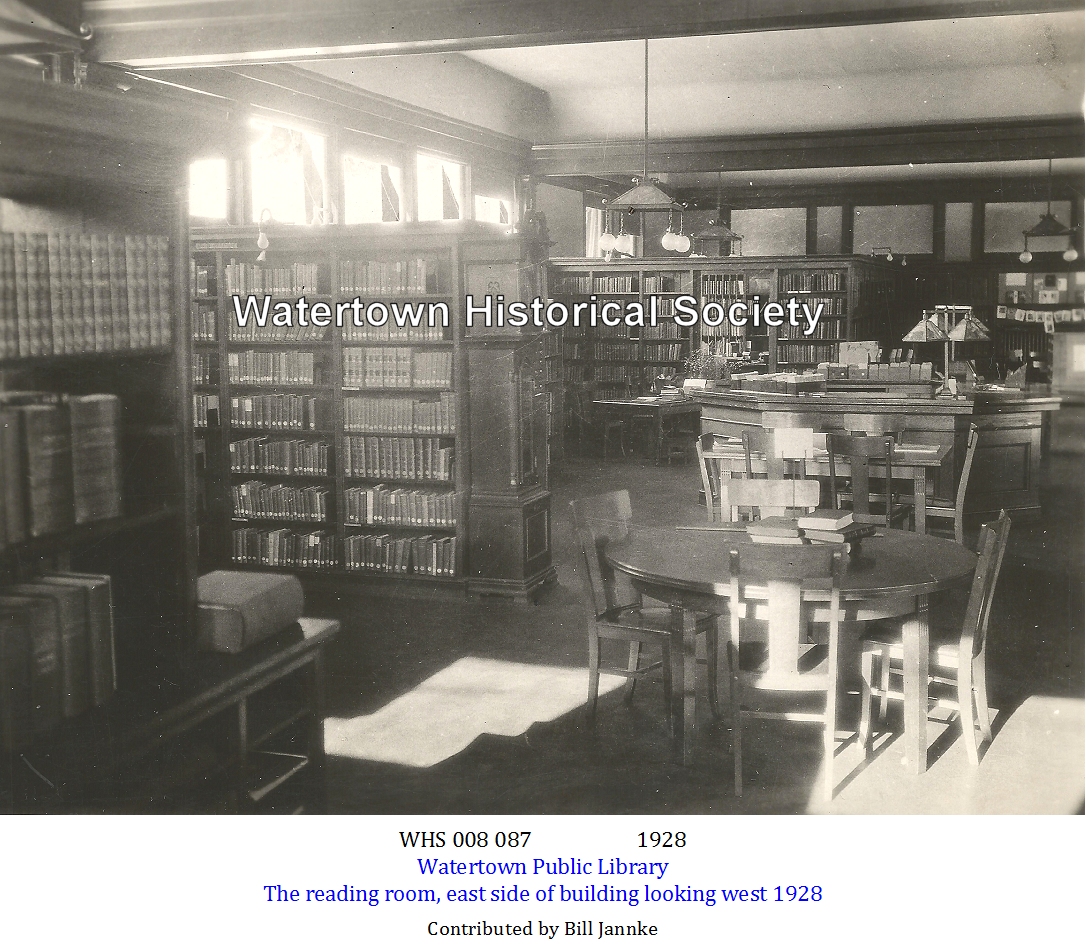 The reading room, east side of building
looking west
The reading room, east side of building
looking west
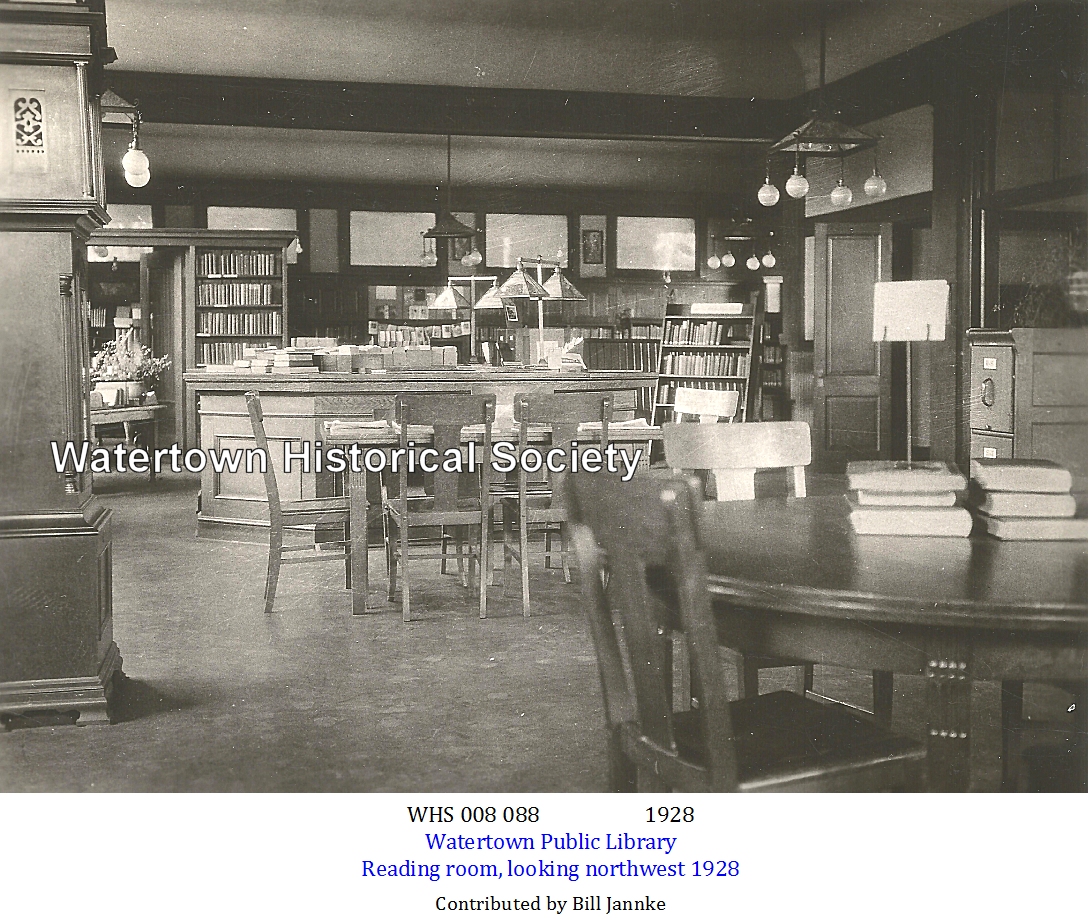 Reading room, looking northwest
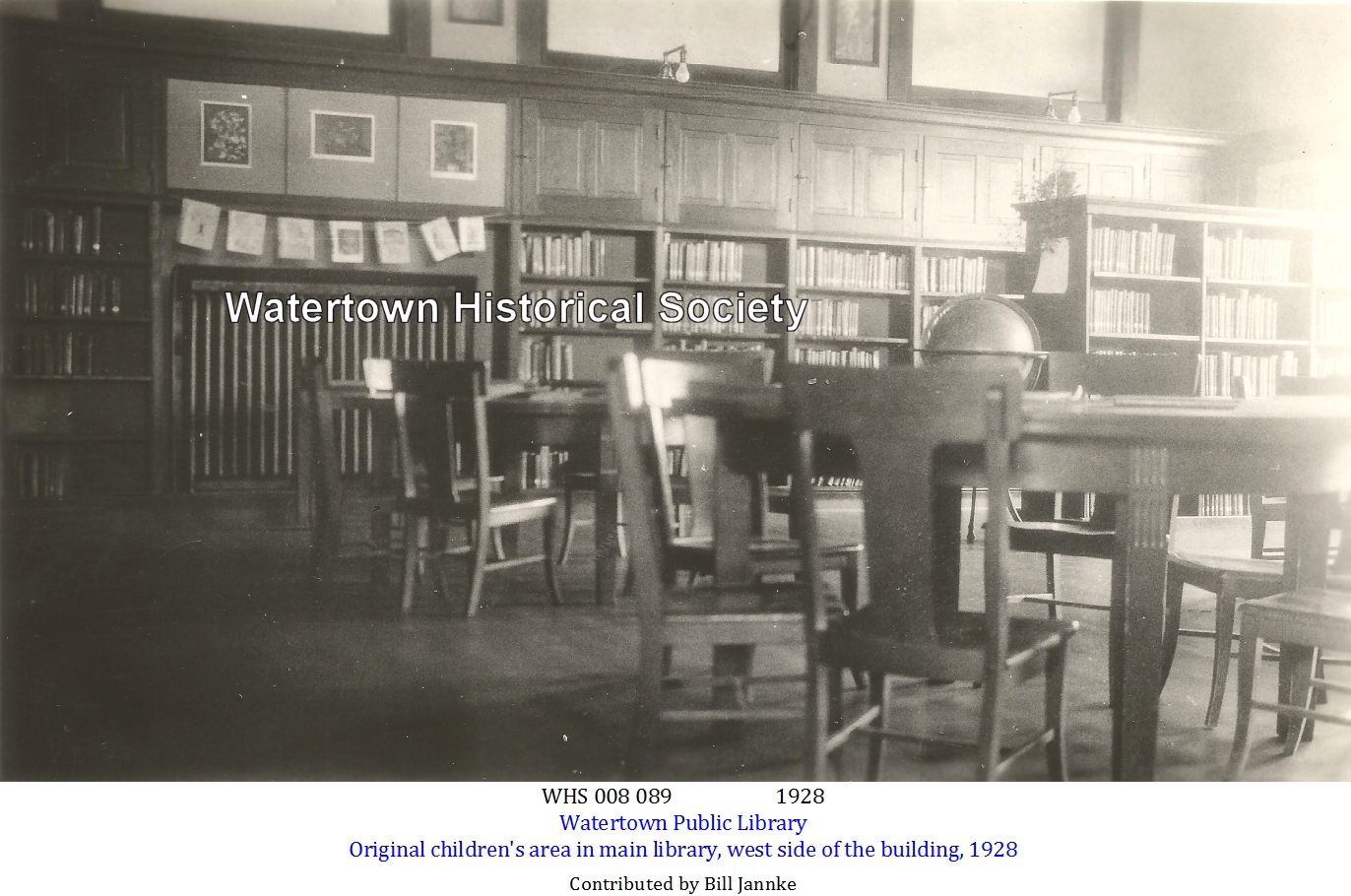 Original children's area in main library,
west side of the building
Original children's area in main library,
west side of the building
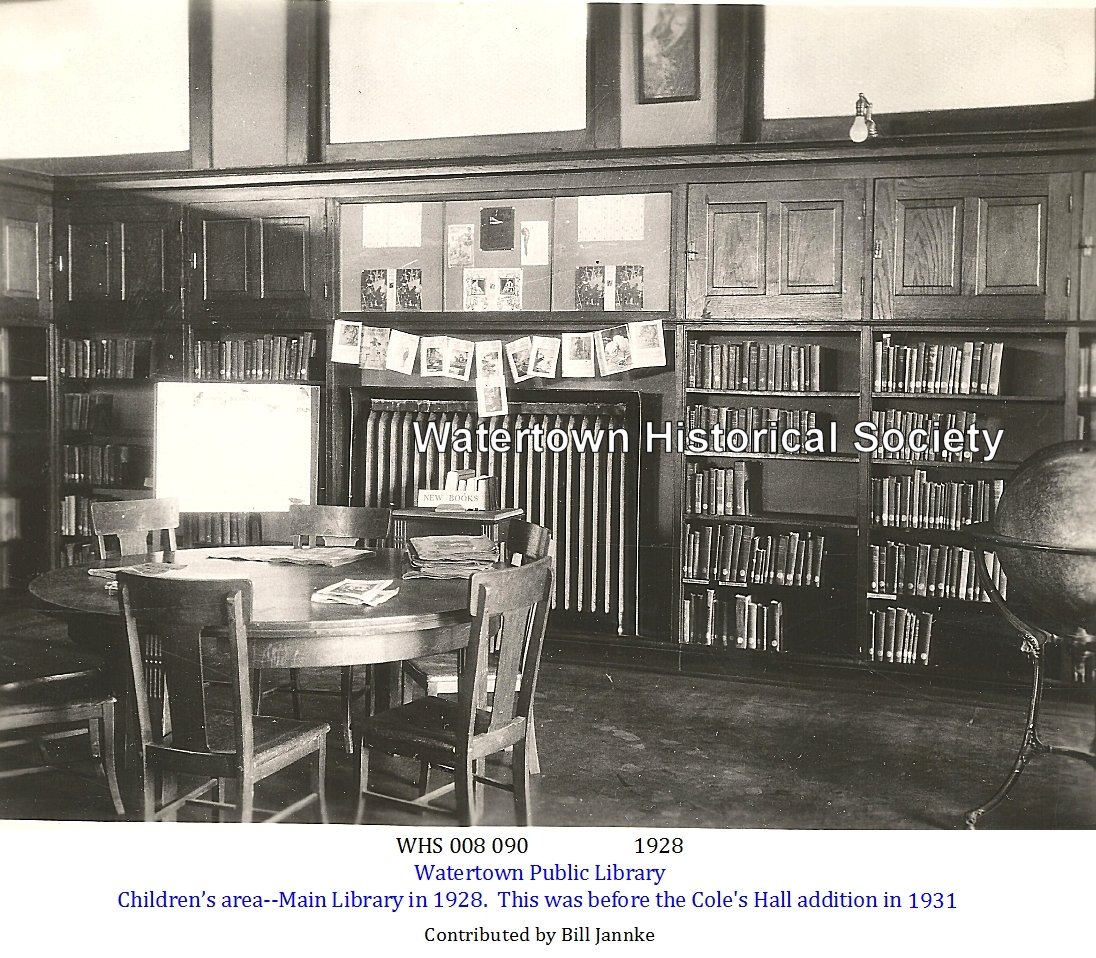 View of the children's area in 1928. Before the Cole's Hall addition in 1929--30.
1929-30
COLE'S HALL ADDITION in
1929-30
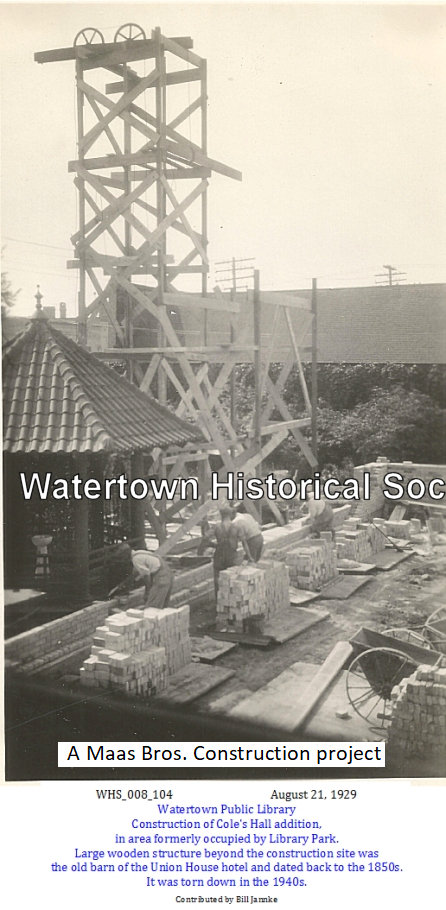
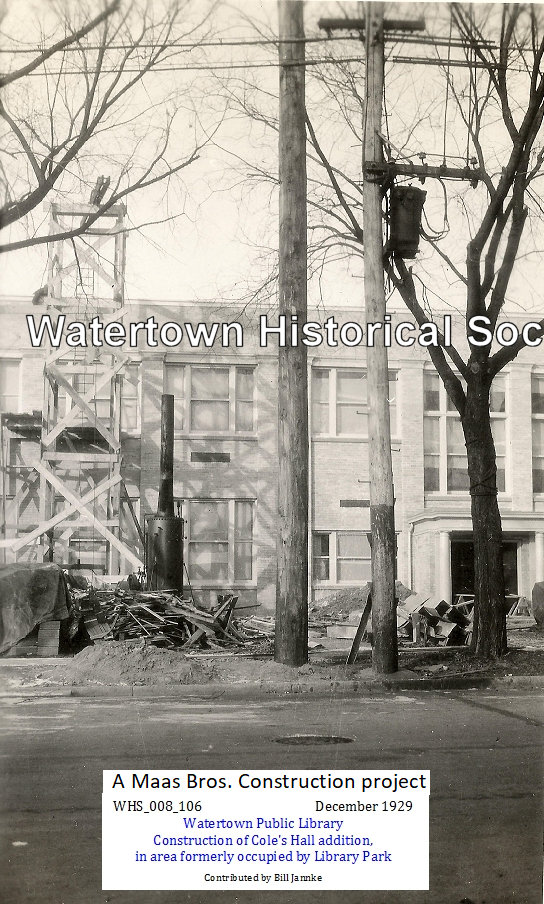
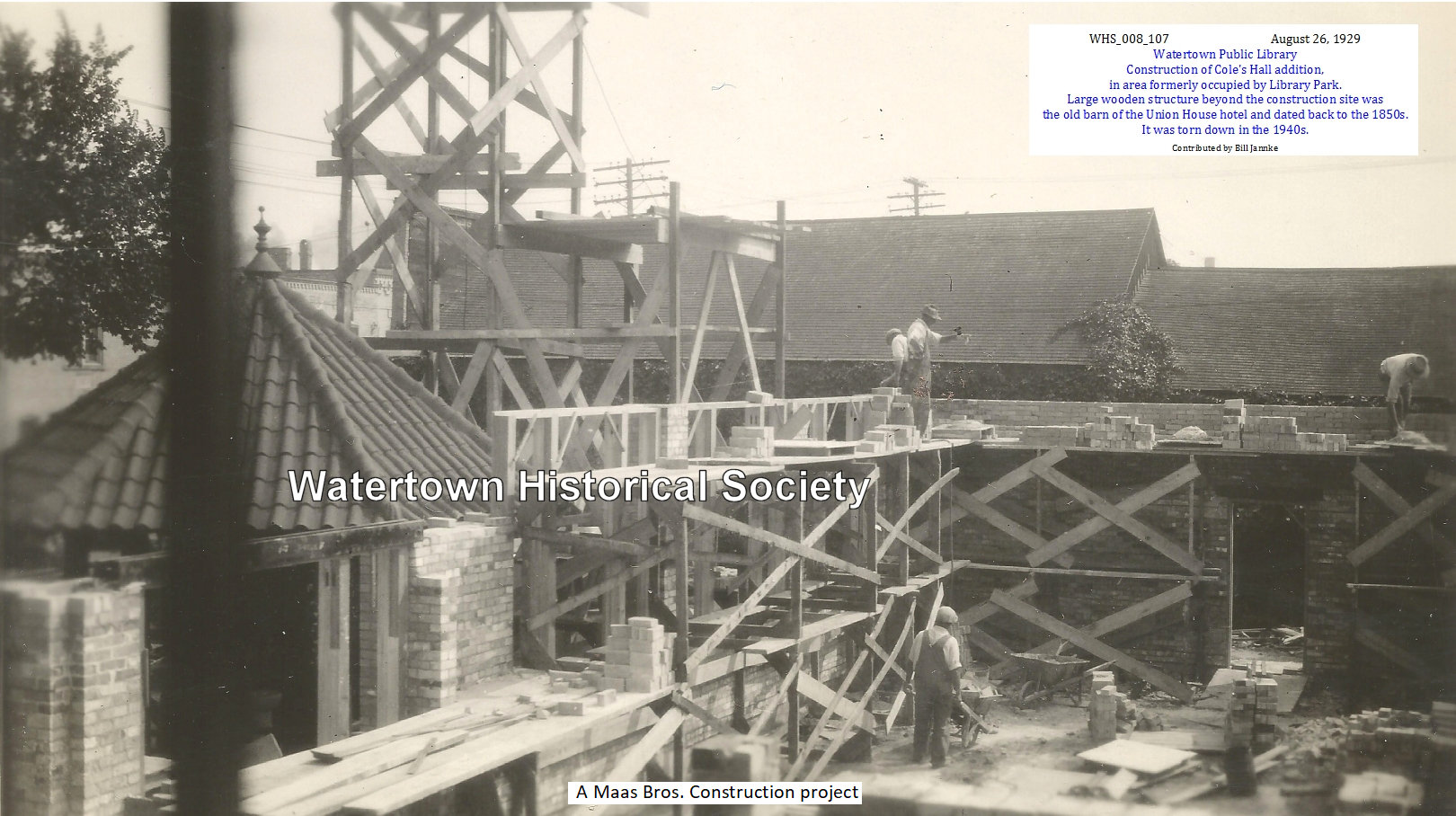
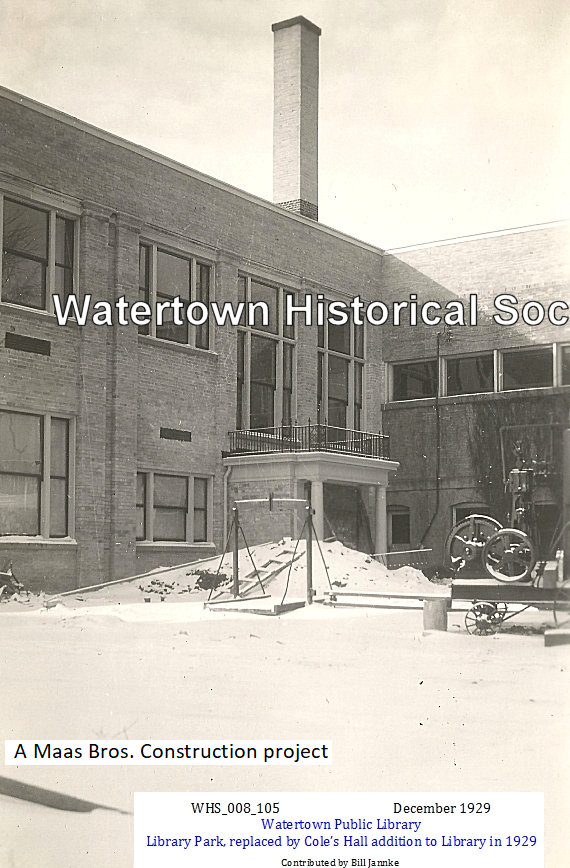
A
Mass Bros Construction project
1930
05 16 COLE'S
HALL ADDITION DEDICATED
Mr. and Mrs. R. E. Evanson
have returned from Watertown, where last evening they attended the dedication
of the new unit to the Watertown Public Library which was dedicated in memory
of Mrs. Evanson's grandfather, John W. Cole. Mr. Cole, a wealthy and prominent pioneer
resident In Wisconsin, was the second white man to settle In Watertown.
Mrs. Evanson
is the only surviving relative of Mr. Cole and as such was given a place of
honor at the program last evening. A
number of speeches featured the program in which glowing tribute was paid to
the man who had made the new building possible.
It Is interesting to note that Miss Florence C. Hays, who was formerly
on the staff at the local library, is librarian in Watertown.
The new addition has a large assembly
hall on the first floor and the second floor is given over to the children's
department and is most attractively appointed. The Oshkosh Northwestern, 16 May 1930
05 17 JOHN W. COLE REMEMBERED AT DEDICATION
The
bouquets of flowers sent to the library for the night of the dedication were
taken to the grave of the man who made it possible, John W. Cole, at the Oak
Hill Cemetery. WDTimes
1930
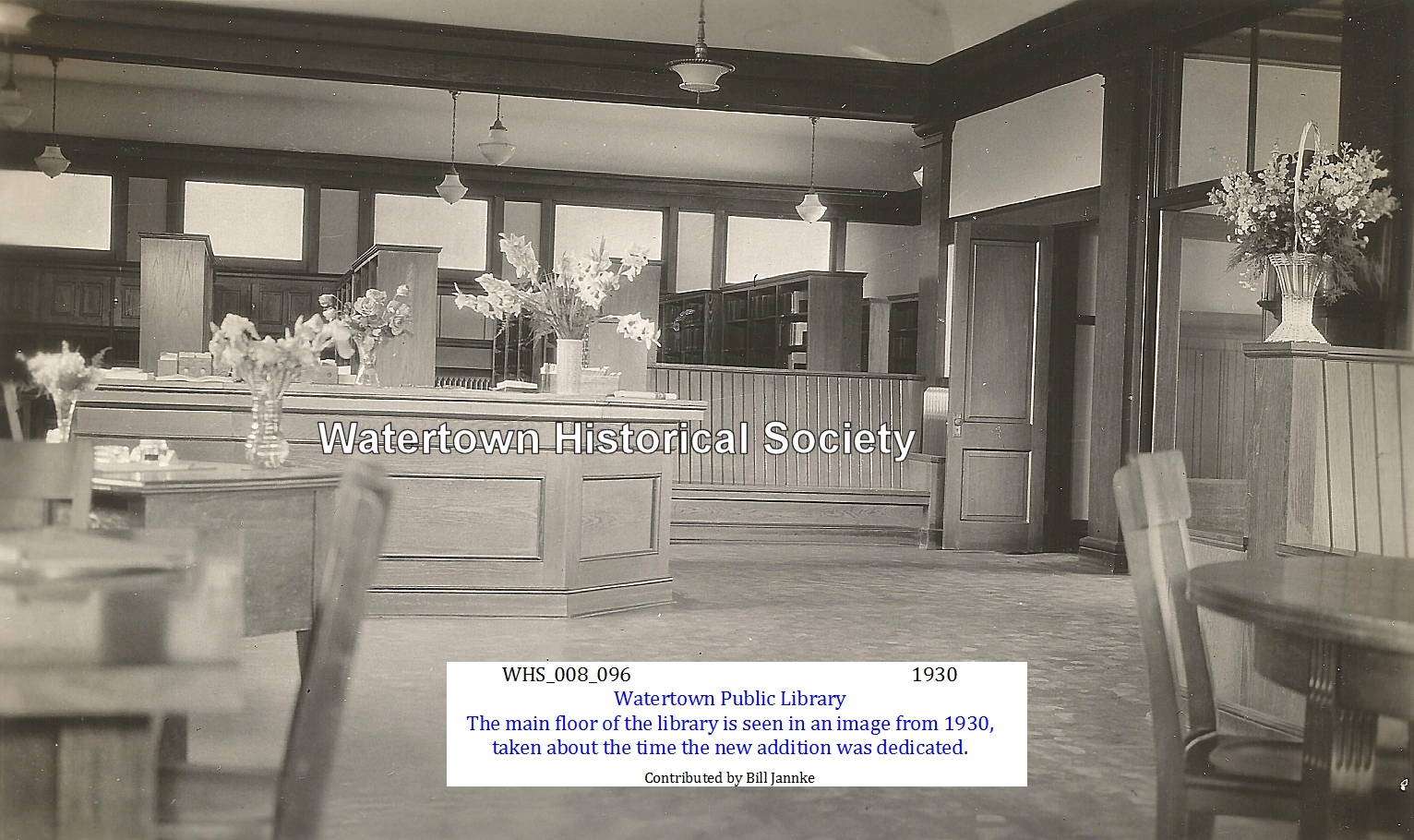 Main floor, taken about the time the new addition was dedicated.
1931
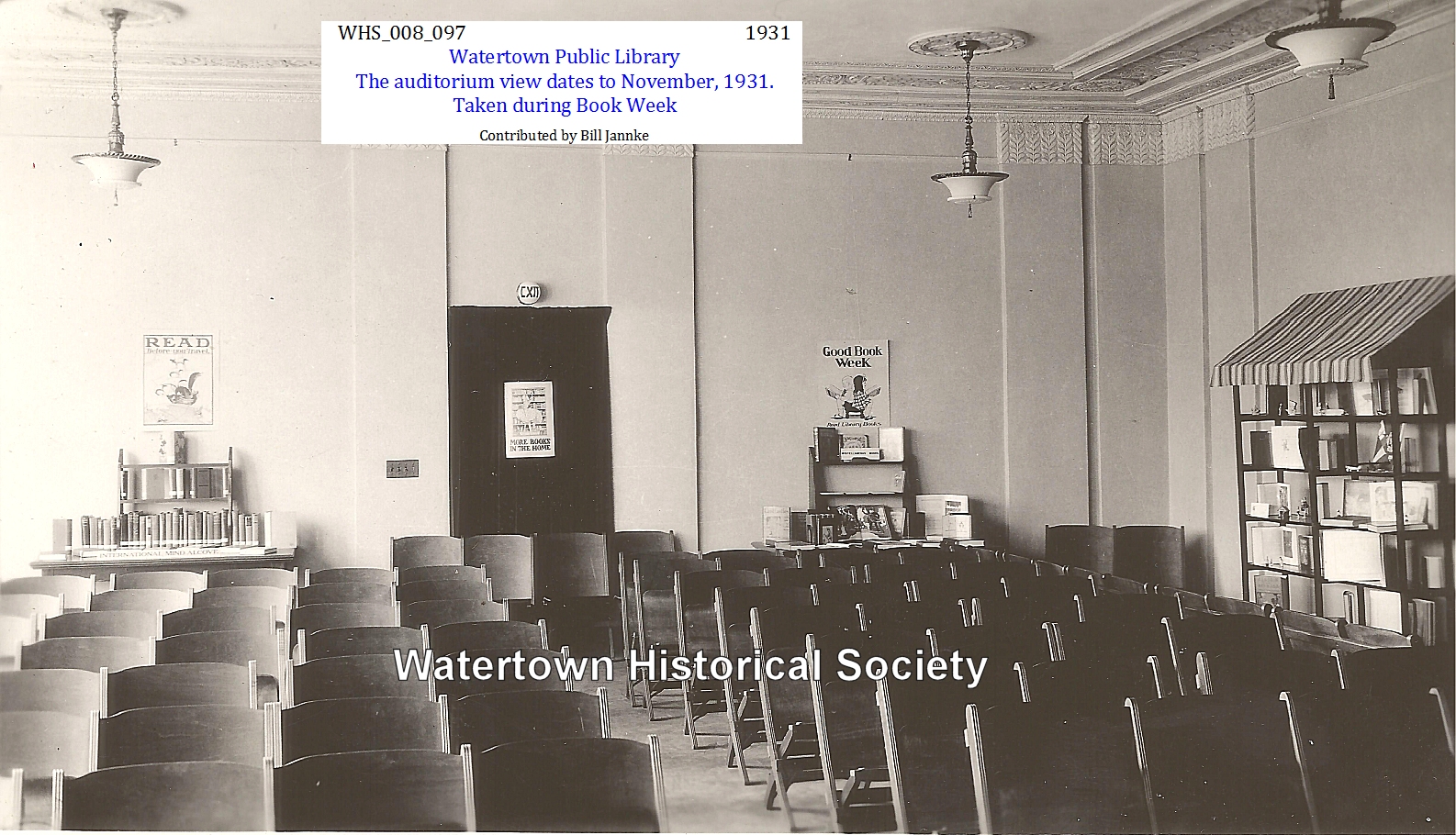 Auditorium view dates to November, 1931;
taken during Book Week
Auditorium view dates to November, 1931;
taken during Book Week
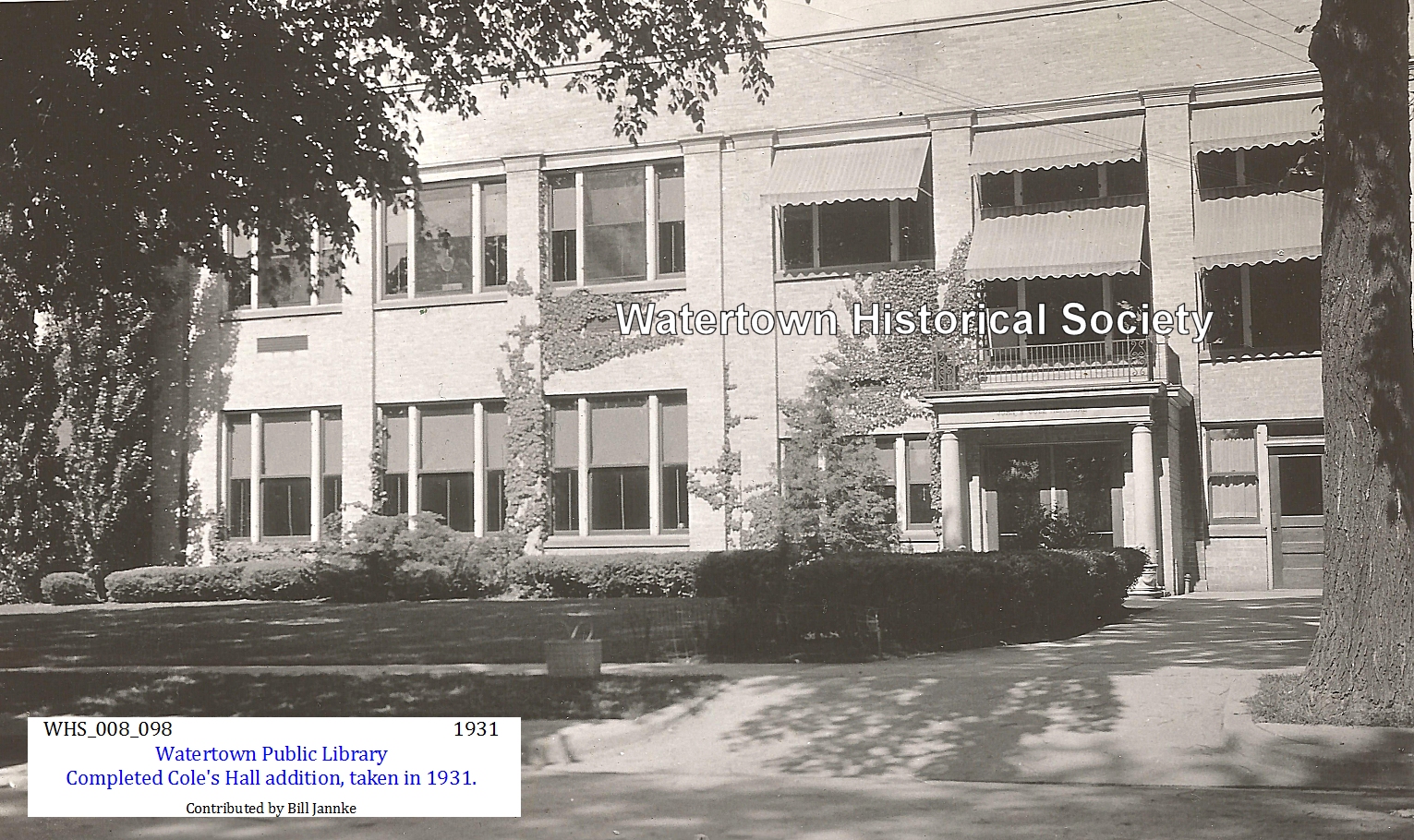 Completed Cole's Hall addition, taken in
1931.
Completed Cole's Hall addition, taken in
1931.
New Children’s Room
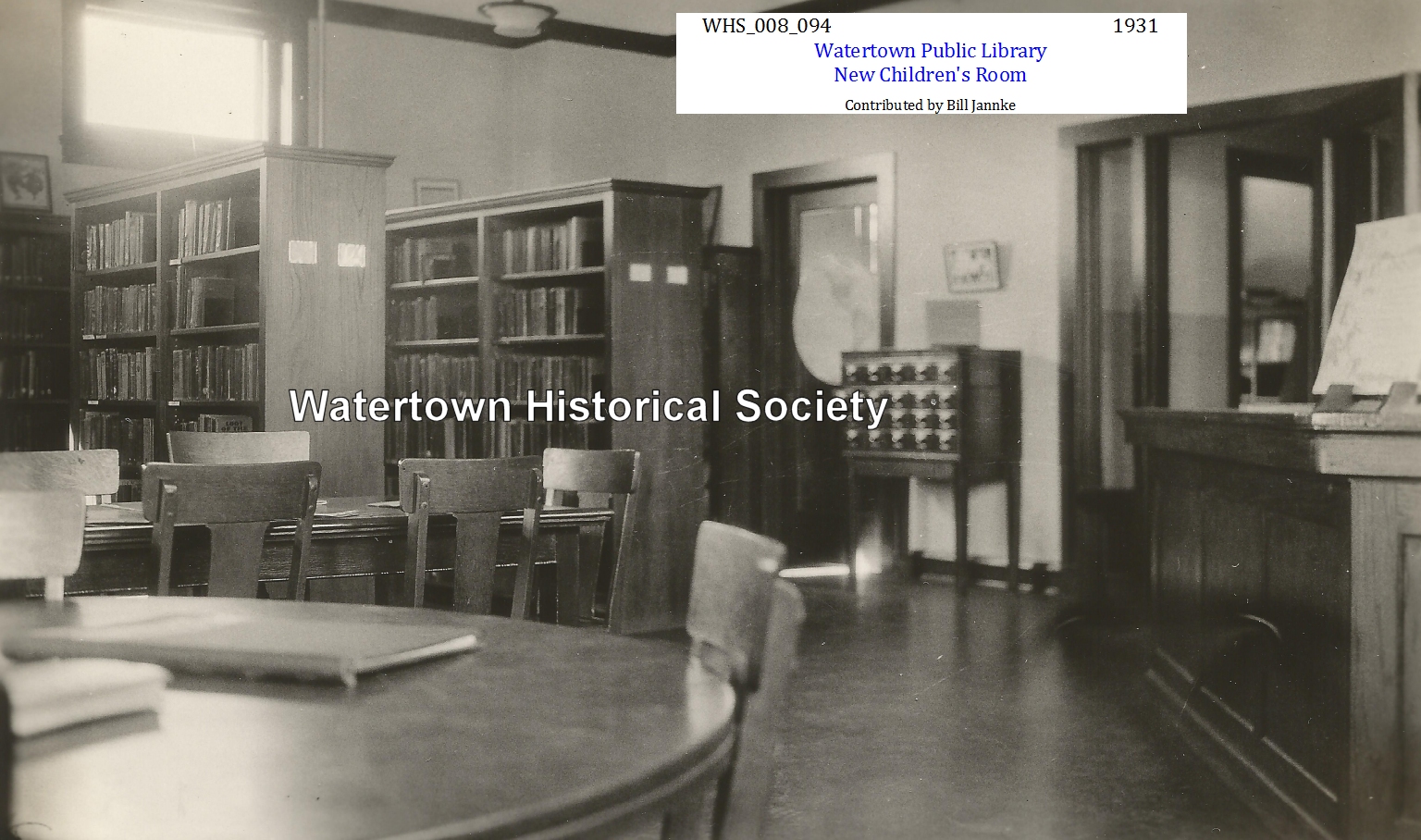
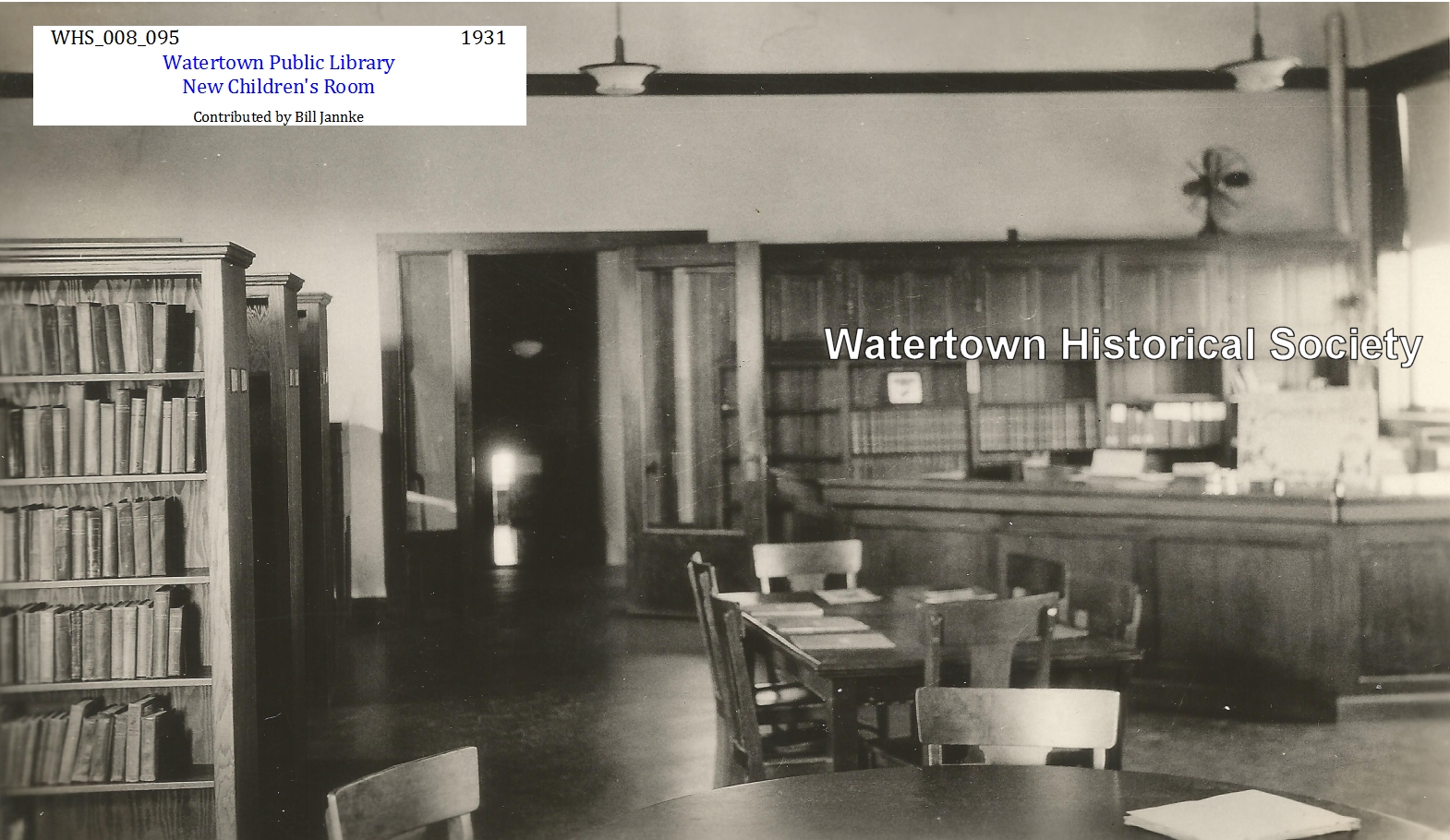
1933
11 11 HISTORICAL SOCIETY DISPLAYS AT LIBRARY
Four second-hand cases, each ten feet long,
are to be purchased and placed in Cole Memorial Hall of the public library by the Watertown Historical Society. Photographs, relics and many other articles
of historical value now are being assembled to be placed in the cases. Later, it is expected, another room in the
library, where the opportunities to expand will be greater, will be obtained.
1934
CATHERINE AND LORRAINE SIMON LEAVING
AFTER STORY HOUR
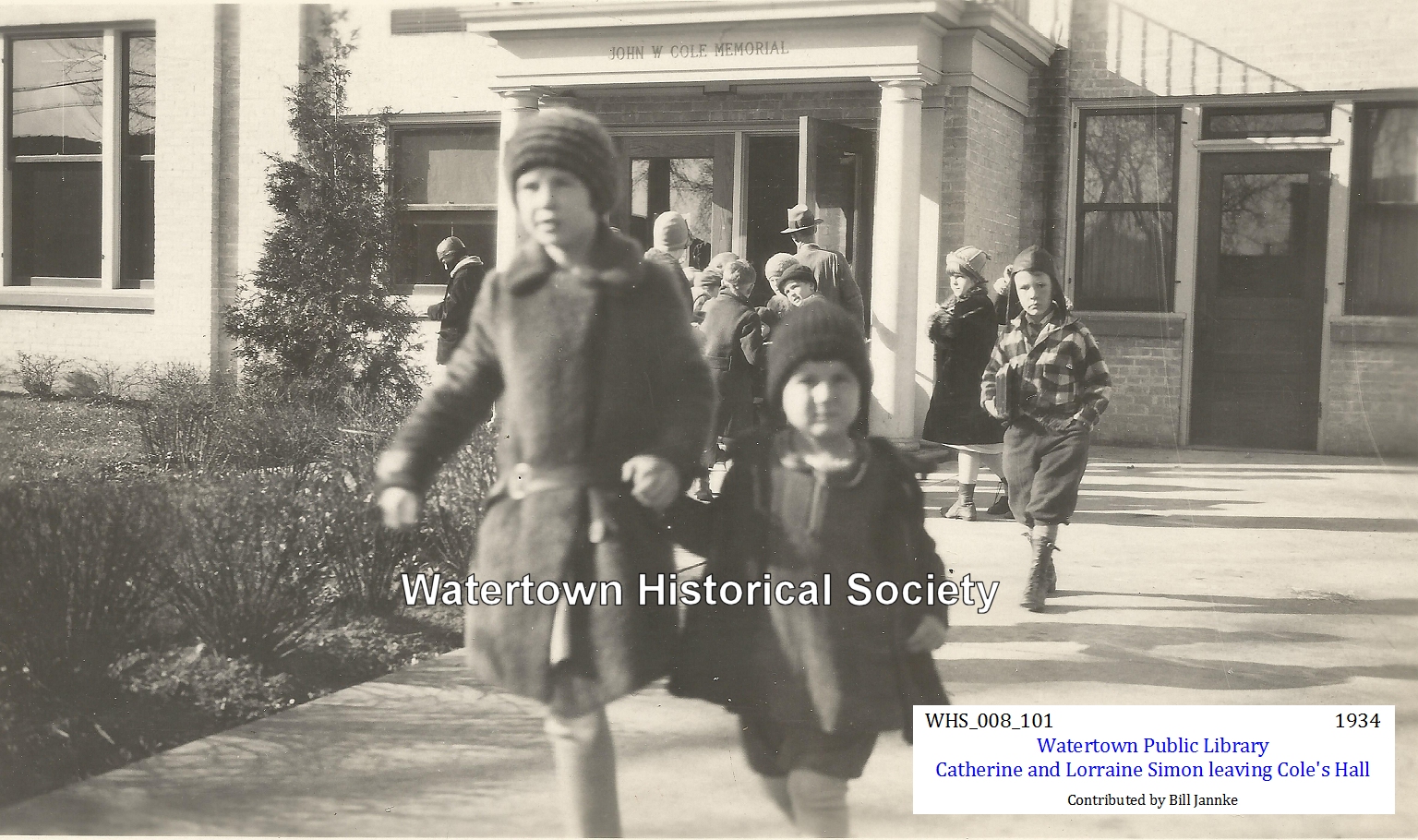
1930 Cole addition to library is noted
06 01 SCHOOL EXHIBIT / HISTORICAL SOCIETY DISPLAY
The school exhibit of the
Watertown Historical Society, the first major one to be arranged by the
organization since it was formed a year ago, is now being displayed on the main
floor of the public library.
Since funds and adequate quarters are as yet unavailable for the
organization further exhibits will be held at the public library. In time it is planned to place a permanent
exhibition on display in quarters of their own. Watertown Tribune; March 8, 1935
1935
05 25 EUTERPE
CLUB EXHIBIT
Persons who visit the music exhibit, now in progress at the public
library, will note with interest the share which the
Euterpe club has had in the city’s development of music, because there has
been no single agency in the community which has played so important a part in
this art.
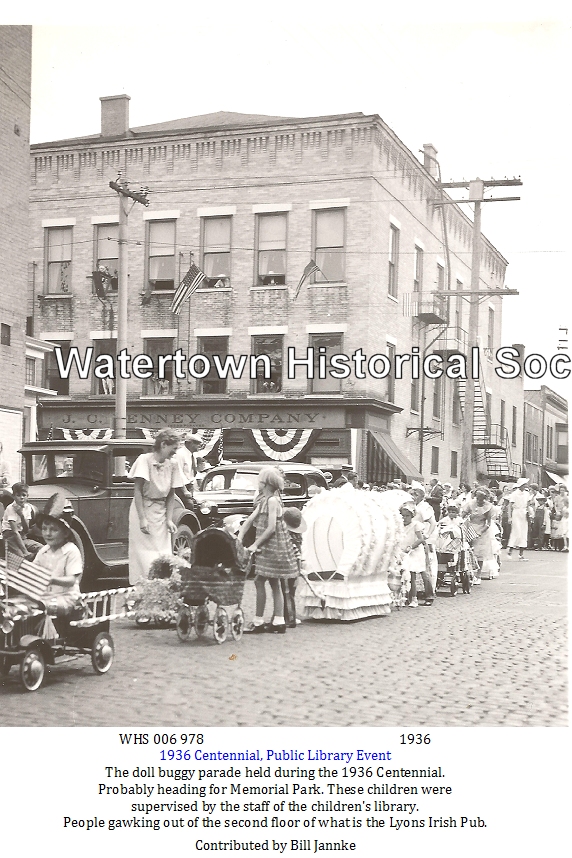
1936
CENTENNIAL PARADE FLOAT
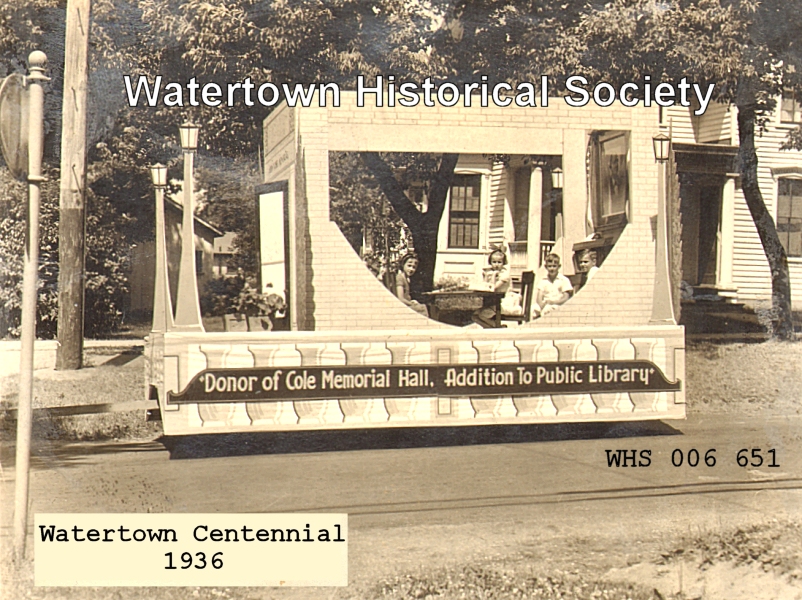
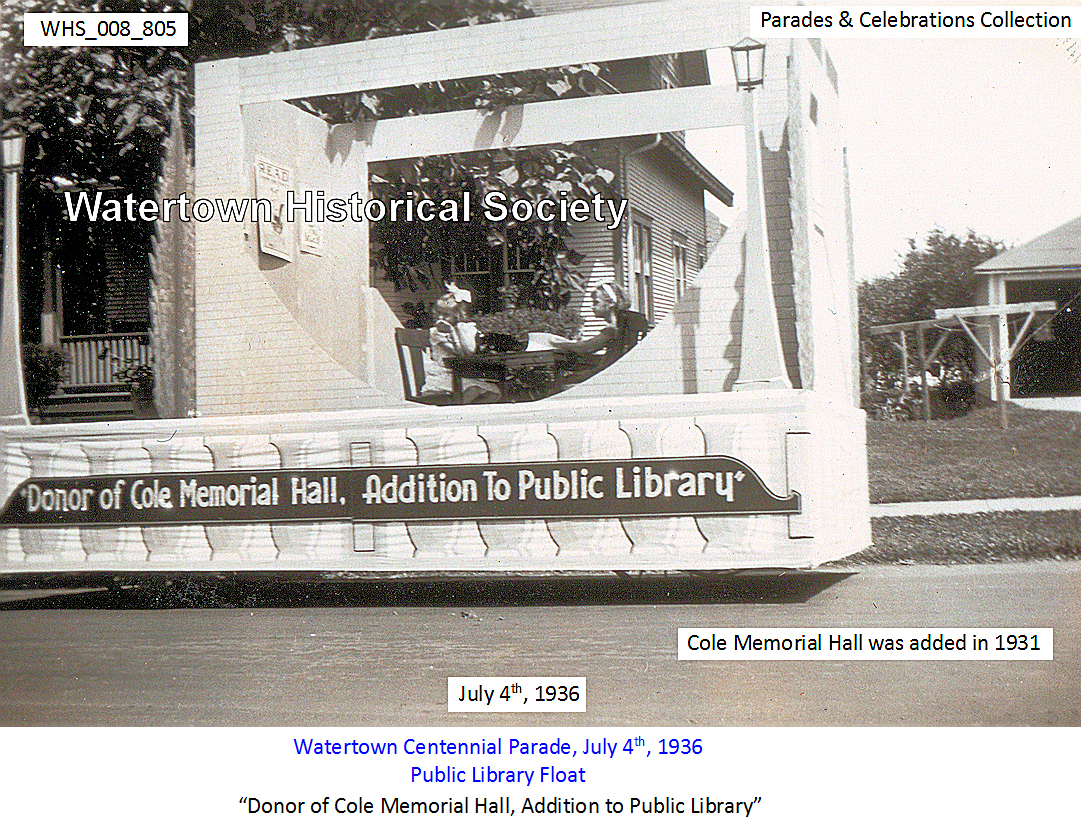
Cole Memorial Hall was added in 1931
“Donor of Cole Memorial Hall, Addition to Public
Library”
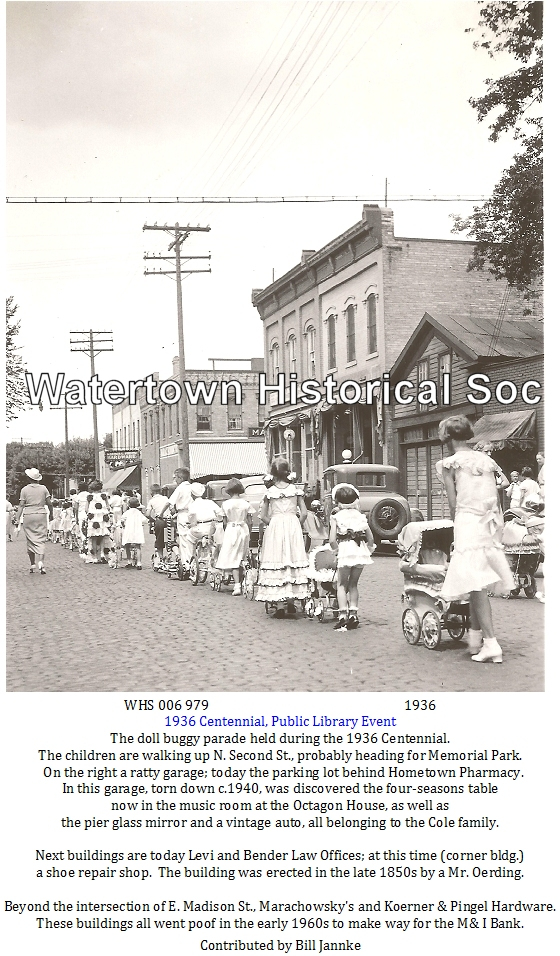
CHILDREN’S PARADE
1940
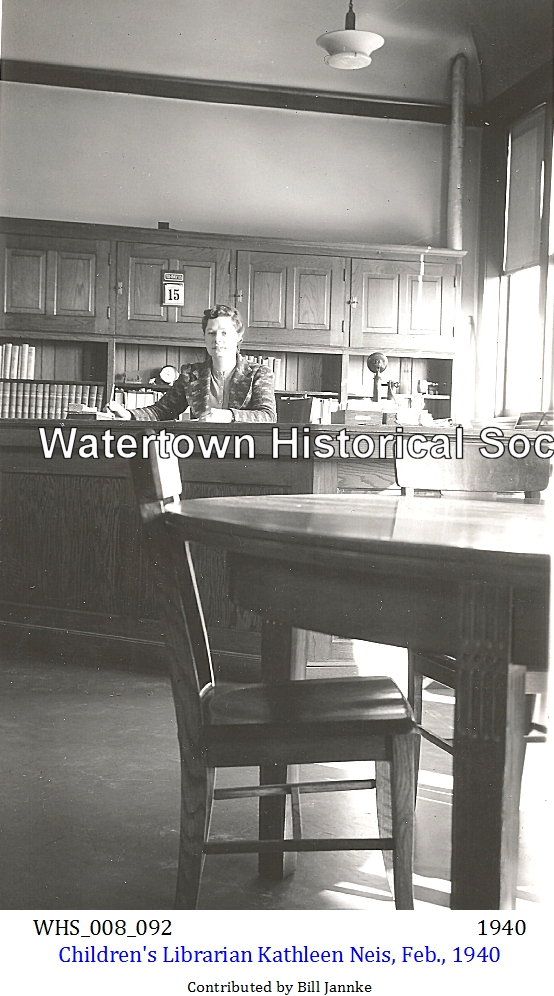
CHILDREN'S LIBRARIAN KATHLEEN NEIS,
Feb., 1940
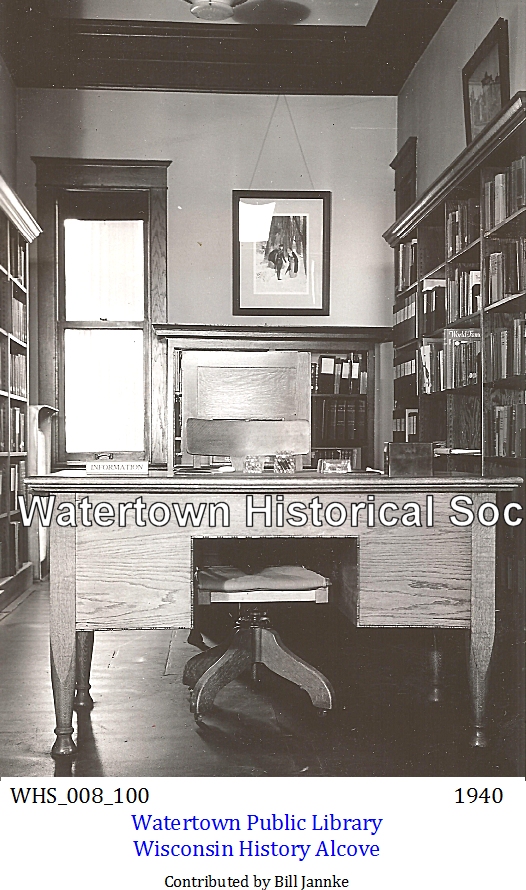
WISCONSIN HISTORY ALCOVE
1950
07
15 MISS
BETTY FABER RETIRES
07 15 108-YEAR-OLD RESIDENT RESEARCHED
We dare say that few persons here are aware of
the fact that a man who lived to be 108 years old lies buried in a cemetery
here.
We didn’t know it until Miss Elizabeth Faber,
Watertown public librarian, informed us of the fact. The man’s name was Daniel Guerin who died
June 4, 1886 at the age of 108. His
grave and marker are in St. Bernard’s cemetery. The grave is located to the south side of the
cement drive which runs through the center of the cemetery and is in the upper
section of the quarters fronting on Milford Street.
The inscription on the stone has been almost
obliterated, but it can be read. It
gives his name and date of death and his age.
It also states that he was a native of County Clare, Ireland.
The files of the Weltbuerger, one-time German
language weekly here, give an account of Mr. Guerin’s death in the issue for
June 19, 1888. The paper, however,
misspells his name; viz: “der irische Farmer Daniel Geerin” and says he died in
the town of Shields and gives his age as 109.
Continuing, the paper states: “Er wird wohl
die aelteste Person im Wisconsin gewesen sein.
Jehtz ruht er auf dem beisigen St. Bernard’s Friedhofe.”
Miss Faber tells us that she had occasion to
check on the grave after she received a letter from a New Yorker requesting
information about a man whose first name was Daniel and who was reported to
have lived here at one time and who died at the age of 108 and was buried in a
local cemetery. She has since sent the
results of her findings, together with the German weekly’s report, to the New
York man.
Miss Faber was given some data by Mrs. E. R.
Parker of Fort Atkinson which helped her in her research. WDTimes
“Times Square” JULY 15, 1950
NOTE: Surname not listed in city
directories so assumed to be an area farming family
1955 The
Watertown Free Public Library received an 1857 map of the city of Watertown
from New Hampshire. The donor is Warren G. Bakie of Kingston, charted 1694, in
that state. When the Bakie Brothers decided
to remodel the map of Watertown, Wisconsin turned up in their archives. As
people in the East are extremely historically minded, Mr. Bakie wrote to the
library and generously offered to send it.
Despite the fact that Watertown was settled by people from the East, a
hurried search both in Kingston and in Watertown failed to disclose any one
from there coming to Watertown so how the map got into the Bakie Brothers
archives is a mystery. 07 26
WDT
1962
01 19 Text
books banned – A new policy which will affect high school students who use the library
from 7 to 9 p.m. for study purposes.
Under the new rule and beginning with the second school semester,
students will not be permitted to bring their text books into the library. The board points out to the people of
Watertown that a public library is not a high school study hall. Too many high school students have been
coming in with text books which can be studied at home, or at school and are
taking up space that should be free for those who want to use library
materials. WDT
1967
AMERICAN LEGION STORY DONATED TO LIBRARY

06
19 DYNIX
AUTOMATED LIBRARY
The
Mid-Wisconsin Federated Library System has approved a contract for purchase of
a satellite automation system from Dynix Automated Library Systems. Funds for the initial purchase and
installation costs will come out of the 1991 general fund carryover and 1992
automation reserve, trustees decided at their May board meeting. In succeeding years, system budget funds
equivalent to the current automation reserve will defray future operating
costs. This program extends the
microcomputer revolution’s benefits to its member libraries in four ways,
trustees said. It liberates current
staff from increasingly overwhelming clerical duties in order to better support
direct public service, secures Dynix’s recognized quality for system member
libraries at a greatly discounted price, establishes the MARC record as the
system’s bibliographic format and creates a central MWFLS union catalog. WDT
1968
08 11 KIESSLING PRESIDENT, BOARD OF
LIBRARY COMMISSIONERS
Dr. E. C. Kiessling, a member of the faculty
of Northwestern College, has been elected president of the board of library
commissioners of the Watertown Free Public Library. Dr. Kiessling replaces L. J. Lange who has
retired after serving on the board for 21 years, 15 of which he spent as its
president. P. E. Burkhalter was named
vice president and Mrs. E. James Quirk was elected secretary. Attorney Roland
F. Dierker is financial secretary.
1970
06
02 MISS
RUTH ROBERTS RETIREMENT
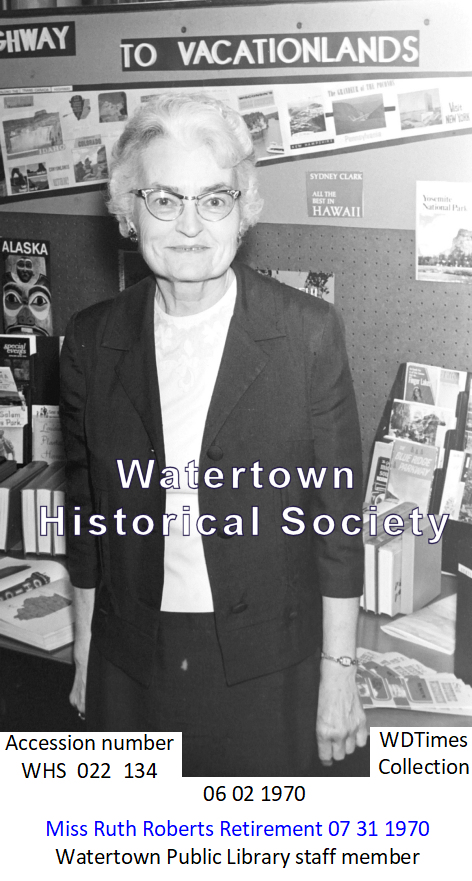
Slated for 07 31 1970
1977
04
15 MISS
BETTY FABER RETIRES
Miss Betty
Faber, librarian in Watertown for 37 years until retiring last month, was
honored at a dinner Sunday evening at Lindberg’s by the River. Miss Faber was presented with several gifts
including a ''custom made” golf club.
Among those participating in the program were Mayor Carl V. and Marcella
Kolata, Dr. Marie Jo Kwapil, a member of the library board; Mrs. Evelyn Rose,
Ray Rose who was master of ceremonies, Miss Faber, and Dr. Elmer and Esther
Kiessling. WDT
1980c
CARNEGIE LIBRARY INTERIOR
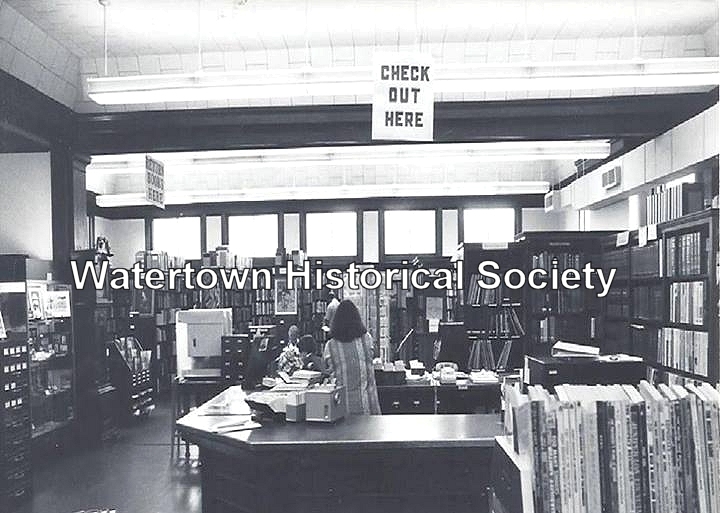 Before the 1983/84 renovation
1981 The
decision to pursue a possible remodeling and expansion program of the Watertown
Public Library was made Thursday evening by members of the library board of
trustees. The panel selected the architectural firm of Sample and Potter Inc.
of Madison to conduct the feasibility study on costs of the renovation and
expansion. In making that choice, library trustees also will request the
Watertown City Council to transfer funds not to exceed $2,500 from the library
building fund to cover the cost of the study. .
11 22 WDT
1982
01 24 On a
unanimous voice vote the Watertown Library Board of Trustees gave architects
from Sample and Potter Inc., Madison, approval for continued study on a $1.7
million library construction program.
Although Thursday night’s plans, presented by Ross Potter and Jeff
Kavanagh, were very preliminary, the pair agreed to make a final presentation
at 7 p.m. Feb. 10. The admitted purpose
of that final presentation will be to solicit community support for renovation
and expansion to the present library. WDT
02 07 Presentation: Remodeling and Expansion. A supportive audience of about 50 city
residents joined the Watertown Library Board of Trustees at the Marine Bank
meeting room Wednesday evening to hear the final presentation on proposed
remodeling and expansion of the local library.
Ross Potter of the architectural firm Sample and Potter of Madison,
showed rough schematics of two building structures and floor plans and
explained the rationale behind those plans. He explained the tour of the
buildings revealed the Carnegie library constructed in 1905 is in good
condition and merits adaptive reuse. Cost for that remodeling is estimated at
about $24 per square foot. WDT
04 20 A
$1 million loan in 1983 for a new library would raise
property taxes by 12.68 cents per $1,000 in the first year, a series of
computations by Robert W. Baird and Company of Milwaukee indicates. The study, completed at the direction of
Mayor Kenneth Thiel, takes into account that the present Watertown Municipal
Building will be paid in full in 1982 and also assumes an interest rate of 11
percent. Thiel pointed out at this
week’s meeting of the Watertown City Council that the tax rate would decrease
by about 47 cents per $1,000 if a library loan would not be utilized, but
cautioned that the actual decrease may be somewhat less because the city’s
state aids may be reduced because of the lower tax rate. WDT
07 12 Major repair projects, estimates on cost
of WDT
1983
02 21 Durrant
Architects Inc. chosen by the Library Board of Trustees to complete design work
for the expansion-renovation project at the local library. Details of the contract agreement are being
worked out. Fee paid to the architect is
usually a percentage of construction costs.
Board said decision was based on a combination of responses on a
questionnaire to the architects, presentations by the seven firms being
considered, and visits to previous work by the businesses and reference
checks. Special consideration was given
to design and engineering expertise, compatibility with the board, construction
supervision and fee structures. WDT
03
26 Expansion and renovation plan approved
by board WDT
04
18 Proposal
to have the library temporarily located in the Job Service offices. WDT
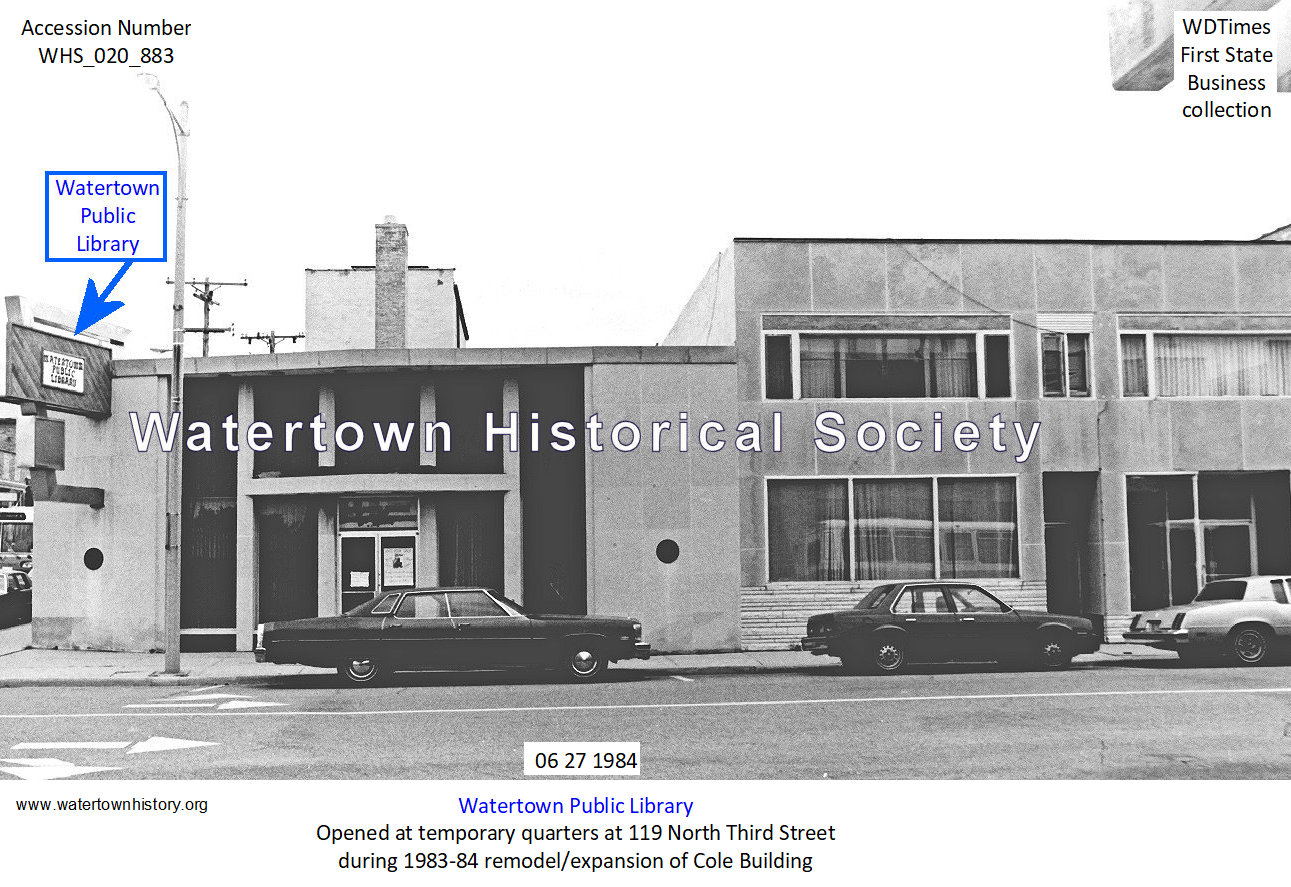
06 05 MOVE TO
TEMPORARY QUARTERS at 119 N Third St.
Library patrons take
heed. The Watertown Public Library
closes its doors at 5 p.m. July 2 to begin the move to its temporary quarters
on North Third Street. Opening at the
interim location is anticipated July 18.
Anyone wanting to help with moving can do so by using their library
card, librarian Mary Carol Powers noted.
She explained the library board will be asking people, the last week of
June, to check out bags and boxes of books for return to the new site.
Any books loaned now
are not due until August, Miss Powers said.
She also noted the board will be looking for volunteers to help pack
books for the move. “I am amazed at the
number of people who have taken an active interest in how we will move the
library,” she said. “I really appreciate
the interest, ideas and offers for help.”
WDT
07 01 BIDS FOR NEW LIBRARY OPENED
Bids for Watertown's
new library were opened Thursday afternoon at the Watertown Municipal Building
and the news was good. The low base bids
totaled $1,054,606, over $100,000 less than originally estimated by
architects. Jerold Dommer, head of The
Durrant Group, said he was pleased with the interest in the project and especially
that the apparent low bids were below estimates. WDT
07 16 REOPEN AT
TEMPORARY QUARTERS at 119 N Third St.
The
Watertown Public Library will reopen in its new temporary quarters at 119 North
Third Street Monday at 9 a.m. Library
employees, volunteers and professional movers are in the final stages of moving
from the existing building and the new location will be ready by Monday,
patrons can be assured. Actual
construction on the library expansion and renovation project is expected to get
underway in early August. Total cost of
the project will be about $1.3 million.
09 10 DEMOLITION OF THE
COLE ADDITION
Demolition of the Cole Addition to the Watertown Public Library finally
got under way this week, about one month later than originally planned. However, that delay shouldn't require any
change in the scheduled completion date of July 24, 1984, according to
officials of Varvil Construction, Inc., Woodworth, general contractor. Demolition was delayed after the discovery
that asbestos was used for some insulation in the building. This discovery started a chain of events,
including the employment of a firm which specializes in removal and proper
disposal of the toxic asbestos. WDT
xx xx First
Kindergarten in America painting by William E. Unger donated to the
Watertown Historical Society.
1984
02 06 Bids for furnishings, new library WDT
06 13 Ornamental Sheet Metal for old
section of Library WDT
08 07 Library to close on Thursdays WDT
09 22 Under
construction for more than a year, the library opens for business Monday at its
new address, 100 South Water Street. The
public is invited to tour the expanded facility Sunday beginning at 1:30
p.m. Although groundbreaking to
re-opening only took about 14 months, work on improving the library began long
before that. Discussions about how to
meet the increasing needs of the community for library services began may years
ago and in November 1981 the library board of trustees decided renovation and
expansion at the downtown site was perhaps the best avenue to pursue. The architectural firm of Sample and Potter
Inc., Madison, was hired to conduct a feasibility study. WDT
09 23 Watertown’s new public
library was dedicated “to enriching the lives of all who enter” at ceremonies
Sunday afternoon. A large crowd attended
the formal ceremonies which were followed by refreshments and tours of the
facilities. The formal ceremonies
consisted of brief comments from officials and setting of the date stone. A number of items were placed in the date
stone before it was set. They included a
brochure about the original library, printed in 1903, the dedication program, a
brochure detailing the floor plan of the new library, directories of city
officials and of the Mid-Wisconsin Federated Library System, the library’s
annual report of 1983, a 1984 street map of the city, a listing of top selling
books, and the library supplement of the Watertown
Daily Times which was published on Friday.
WDT
11 18 Expenditure to allow library to
operate six days a week WDT
1985
06 12 Beonda Ida Wilford will, public library named a
beneficiary WDT
1986
03 19 The director of the Watertown
Public Library has resigned, saying the city library board blamed her for the
attempts of her staff to form a union.
Mary Carol Powers, Watertown's library director since April 1, 1977,
sent her letter of resignation Tuesday to Mayor Kenneth Thiel, members of the
library and her staff. It reads: “With
this letter, I tender my resignation as Director of the Watertown Public
Library, effective June 30, 1986. I
believe the people of the City of Watertown can be justly proud of the library
and library service which they have and I wish the library every continued
success.” WDT
10 21 Watertown native Maureen Hady has been appointed
director of the Watertown Public Library, culminating a comprehensive job
search by the city’s library board. Hady, acting Watertown library director
since June, received the “unanimous” appointment from the library board
Thursday night, Dennis Sotebeer, board chairman, said. Her appointment is
effective Nov. 1. “The board was unanimously satisfied that Maureen possessed
the better experience and credentials than the 17 other applicants,” said
Sotebeer. WDT
1987 80th anniversary
Watertown
Daily Times, 06 13 1987
This
week marks the 80th anniversary of the Carnegie building, the large section of
the Watertown Public Library which was remodeled when the expansion of the
library took place in recent years.
That
library has withstood the test of time and is still one of Watertown's pieces
of architecture.
Members
of two Watertown Women's Clubs - the Saturday Club and the Euterpe Club, were
largely responsible for the "push" that opened Watertown's first
library in 1902.
That building was located at 104 Main Street.
Long
before 1900, however, the idea of a free public library was in the dreams and
wishful thinking of many Watertown residents.
In 1857 the young men's association rented a room and opened a reading
center in the old Bank of Watertown building
on Main and North First streets. So many
readers came that the association moved to the top floor of the Cole building.
In
1900, Mrs. Frank Woodard, a newcomer and a Euterpe Club member, and Mrs. G. C.
Lewis teamed up to help put on a play in behalf of a library. The play was a great success and promoted a
lot of interest in a library. The $60
profit was put into a bank account.
Two
years went by. Finally a mass meeting
was called and held at Turner Hall. This
meeting generated enough enthusiasm for the ladies to outline a house to house
campaign for funds. The campaign went
well over the goal of $5,000. Someone
then suggested the possibility of a Carnegie library.
Carnegie
turned down early requests for a library fund, but when James Moore, editor of
the Watertown Gazette, and William
Voss, a two-term mayor, wrote Carnegie, they received a "yes" answer,
with certain conditions.
When
these were met, a contribution of $20,000 would be sent. The conditions were that the city secure a
site and pass an ordinance for the annual contribution that would maintain the
library. Later, enough money was left when the library was built to complete
its furnishing with Carnegie funds.
The library
was opened to the public for the first time on June 14, 1907. The new building was 45 feet by 80 feet and
was constructed of St. Louis brick. It had a boiler room, coal room,
gentlemen's room and janitor's room on the lower level and the balance of the
library needs were on the upper floor.
The
successful bidder was Stewart and Hager of Janesville at a price of $16,413.
Watertown
Library ‘best born’ in Wisconsin
Contributed by Jim Braughler / 02 20 1998
"The
Watertown Library was the best born library in the state."
So
went the quote on the 15th anniversary of the Watertown Public Library. In just a few weeks this Watertown landmark
will be celebrating a birthday; it is only fitting that the good folks of
Watertown be reminded of the founding and history of this institution which has
well-served its citizens.
Members
of two Watertown women's clubs - the Saturday Club and the Euterpe Club - were
largely responsible for the "push" that opened Watertown's first
library in 1902. Before coming to rest
on its present location, the first site was at 104 Main St. But the history, however, started long before
the turn of the century.
The
Young Men's Association, as early as 1857, rented a room, subscribed to foreign
and domestic magazines, purchased books and opened a reading center in the old
Bank of Watertown building. So popular
was the reading room that they moved the collection to the top floor of the
Cole building. When the Association
disbanded, the collection was presented to Northwestern College. At that time the people of Watertown were
limited to their private collections, or book rentals from stores in town. But the cost was prohibitive; after putting a
deposit down equal to the full price of the book, patrons could then rent the
selections for three cents a day and 10 cents every day afterwards.
A
newcomer to town and a member of the Euterpe Club, Mrs. Frank Woodard inquired
why Watertown did not have a library.
Oconto and Watertown were the only two towns over the 4,000 population
without one. The only solution to the
lack of a library-lending institution was that the John Cole estate would
eventually provide an endowment which was designated for a library. But Mrs. Woodard was unwilling to wait. Soon Mrs. G. C. Lewis joined the cause and
following the presentation of the play - Lord Bulwer Lytton's "The Lady of
Lyons," the fund had $60 and the library was under way. Soon followed mass meetings, information from
the state commissioner of libraries, a house-to-house campaign and the writing
to Andrew Carnegie, known philanthropist and supporter of libraries.
Carnegie
turned down early requests for a library fund, but finally under the writing
skills of James Moore, editor of the Gazette and William Voss, a two-time Mayor
of Watertown, the beginnings of a $20,000 fund (with certain conditions), soon
arrived in Watertown. Those conditions
included a city-obtained site and an ordinance for annual contributions. A plaque is still located on the outside of
the original portion of the library. But
the problems were just beginning.
Location
of the library was a problem. Hassles
went on for six months between the east and west side of town. Everyone wanted the building; but the side of
town that donated the most money won.
The new building was 45x80 feet, of St. Louis brick with a boiler room,
coal room, gentlemen's room and janitor's room in the lower level. Balance of library needs were located on the
upper floor. Additions to the complex
have been made through the generosities of patrons, Andrew Carnegie again,
finally receiving the John Cole estate and most recently the excellent new
addition which wonderfully compliments the original portion.
The
library has come a long way since its early days.
1987
06 30 Public Library visitors are enjoying
replicas of internationally dressed dolls with a wonderful diversity of the
costumes of many nations in the main floor display case, Rebecca Schubert,
grade seven at St. Henry’s School, owner of the collection, acquired the dolls
over six or seven years as gifts. The dolls wear costumes of Egypt, Africa,
India, Poland, United States, Scotland, Japan and others. In addition, Rebecca
has a shelf of dolls dressed as Little Red Riding Hood, Heidi, Cinderella, Snow
White and others. Anita McElhanon furnished items for the children’s display
case, all from her various trips abroad.
WDT
1988
08 09 Dr. Richard Stolsmark has been named president
of the city library board, replacing former president Dennis Sotebeer, who was
not reappointed to the panel. Sotebeer
will be replaced on the board by Dr. William Reed, who is serving his first
term. Lynn Leach and Suzanne Daugs were
reappointed to their positions on the board.
Members serve three year terms.
Board members were appointed by Mayor David R. Lenz, who said he
followed the recommendations of Librarian Maureen Hady. WDT
09 12 The Watertown Library Board voted
Thursday to use library endowment funds to finance the entire purchase price of
a property that may be used for future expansion. The board unanimously adopted
a resolution that asks for common council approval of the purchase, according
to librarian Maureen Hady. The library board originally proposed spending
$28,000 from the endowment fund for a down payment on the building, located at
209-211 W. Main St., and financing the remainder, about $56,000, using the
city’s credit. WDT
09 25 The Watertown Library Board has lost its
opportunity to purchase the Stardust Gifts building 209-211 W. Main St., common
council members learned Tuesday night.
City Attorney Robert Bender had offered, on behalf of the library board,
$65,000 to the Lebanon State Bank for the property last week, but bank
officials decided to accept an offer of $80,000 from a Fort Atkinson
business. Dennis Robus, bank vice
president, said bank officials had wanted to give the city a chance to purchase
the building, but decided to take another offer due to the city’s low
offer. “I think the bank extended good
faith in dealing with the city,” he said.
“I don’t know what they (city officials) expected us to do. We still have to protect the interests of our
stockholders.” WDT
1989
07 28 CIRCULATION AND ATTENDANCE RECORDS
Since moving into its spacious new
facility in September 1984, the Watertown Public Library has experienced continue
steady growth, both in number of patrons and in books circulated. And even thought it has been nearly five
years since the move, circulation and attendance continue to grow, setting
all-time records last month. WDT
1990
10 21 LISA
HOYMAN DIRECTOR
The Watertown Library Board has hired a
library official from Des Moines, Iowa, to fill the vacancy as director of the
Watertown Public Library. Lisa Hoyman,
38, will fill the position. She will
succeed Maureen Hady, who left in August to accept a position as project
librarian with the State Historical Society of Wisconsin. On Thursday, the Watertown Library Board
voted to hire Hoyman after she accepted the board’s offer earlier in the week. She will begin her new job on Dec. 3. WDT
12 08 NEW
DIRECTOR BUT FEW CHANGES
Watertown library patrons should expect
few major changes from the city’s new public library director, Lisa Hoyman, who
began her new job last week. “There’s
not going to be any shake-up,” Hoyman said.
“It really takes three to six months to become familiar enough with the
routine and work flow and mission of the library to start to make
judgments.” Hoyman, who succeeds Maureen
Hady, does have an overall philosophy that may lead to some more subtle
improvements for the library and its patrons.
WDT
1993
10 17 FIRST
STEP INTO AUTOMATION
The Watertown Public Library will take
its first step into automation Thursday when the circulation desk begins using
the new on-line computer system. Library Director Lisa Hoyman said her staff
will start checking out materials for patrons at 9 a.m. Thursday on the new
computer system. The library will be closed on Wednesday so that staff can
prepare for the switch from the old manual system, which is being used through
the end of today. “It’s really exciting,” Hoyman said. “It’s also been a
tremendous amount of work.” For the most part, users of the library won’t be
affected much by the first phase of automation, except for the new, bright
orange library cards that will replace the old cards. WDT
1996
02 22 3M
SECURITY SYSTEM
Watertown
library officials are taking steps to reduce the theft of materials from the
library. A security system, similar to those
found in stores and other libraries, has been installed at the front entrance
of the library. Library director Matthew
Williams said the system, built by 3M, is expected to save more than its
$15,000 cost in a short time. “It should
pay for itself in one year,” he said, noting that the manufacturer guarantees
an 80 percent reduction in theft. Since
the library began using its computerized checkout system about two years ago,
officials determined that materials valued at $30,812 are missing and presumed
stolen. WDT
1999
11 10 INTERNET
CAUSE OF DROP IN CIRCULATION?
Circulation
of materials at Watertown Public Library dropped 4 percent in September 1999
from the same time in 1998. Library
director Matthew Williams said he did not know of a direct cause for the
decline, but said the Internet may play a big part. People may obtain information on the Internet
they would ordinarily seek from the library.
While it’s easy to attribute the decline to the Internet, which is
causing circulation to decline statewide, Williams said, some parts of
circulation have risen. WDT
2001
02 07 INTERNET CAUSE OF DROP IN CIRCULATION?
While circulation figures at some area
libraries are hovering near normal or even slightly declining, the number of
patrons who visit the facilities may be on the increase. Not everyone goes to a library for reading
materials. Nowadays, most area libraries
offer free use of computers with connections to the Internet. “Our circulation is up this month, almost 15
percent, which is unusual, but I would say on the whole circulation has been
going down and Internet use is going up,” according to Watertown Public Library
Director Matt Williams. According to
circulation figures from last year, the Watertown library loaned out 299,841
articles, including videocassettes, music cassettes, audio books and DVDs. Williams reported a slight drop in
circulation along with a slight drop in patron usage. WDT
2002
12 13 100th ANNIVERSARY CELEBRATION
The 100th anniversary celebration of
the Watertown Public Library has begun with a card collection display, but
other events are being planned for the year.
Donna Kerbel, chairwoman of the library’s 100th Anniversary Committee,
said the library plans to have a wall of memories submitted by patrons about their
past experiences at the library, and a photography contest related to reading
books. The committee is seeking
recognition for the anniversary from about 17 authors who have written classic
and favorite books filling the library shelves, and at some point those
greetings will be on display. Tentative
plans also call for an open house celebration in March to coincide with the
same month the library opened. WDT
2003
02 12 100th ANNIVERSARY CELEBRATION
The 100th anniversary celebration of
the Watertown Public Library will be celebrated at an open house to be held
Sunday, March 2, from 1 to 4 p.m. The
Watertown Library Anniversary Committee is planning several activities to
highlight the anniversary. The library
has been serving the Watertown community since March 3, 1903. Presentations will be given by Mayor John
David, Matthew Williams, librarian, and Julaine Appling, member of the library
board and officer of Friends of the Library.
WDT
2005
12 09 MATTHEW WILLIAMS RESIGNS
AS DIRECTOR
After serving as the Watertown Public
Library director for the past 10 years, Matthew Williams will step down from
that position on Jan. 13, 2006. Williams
is leaving Watertown to become the new director of the Kearney Public Library in
Kearney, Neb. Williams became the
library director here on April 17, 1995, after serving as the assistant
director for the Antioch Public Library in Antioch, Ill., for five years. Williams succeeded Lisa Hoyman, who served as
the Watertown library director for five years.
WDT
2006
06 08 PURCHASE GRUNEWALD LAND
PARCEL
A resolution authorizing city officials
to purchase land near the Watertown Public Library to be used for a proposed
21,000-square-foot addition to the current facility will be on the agenda of
the Watertown Common Council. The city
would pay $395,000 for the entire parcel, which is owned by Albert and Darlene
Grunewald. The land was appraised in May
2004 at a fair market value of $435,300.
A needs assessment and feasibility study conducted by the Watertown
Library Board in 2002 identified possible alternative sites for a new building,
but board members elected to pursue expanding the existing facility to retain
the historical character of the structure in the central business district,
internalize economies of scale in addition to construction costs and relocation
expenses and because it allows safer access for children and the general
public. WDT
10 25 UNION CONTRACT DISPUTE
An arbitrator has ruled in favor of the
employees of the Watertown Public Library in a dispute over the first contract
under the newly formed union. Last year employees voted to join the American
Federation of State, County and Municipal Employees, Wisconsin Council 40.
Since that time a number of negotiations had been held on the initial contract
but ultimately when no agreement could be reached, it was placed in the hands
of an arbitrator. A major provision of the new contract calls for the city to
provide a proportionate share of fringe benefits to part-time employees. The
library has the most part-time employees in city government. The few in other
departments are not provided with fringe benefits. WDT
2007
06 14 CENTENNIAL OF THE CARNEGIE BUILDING
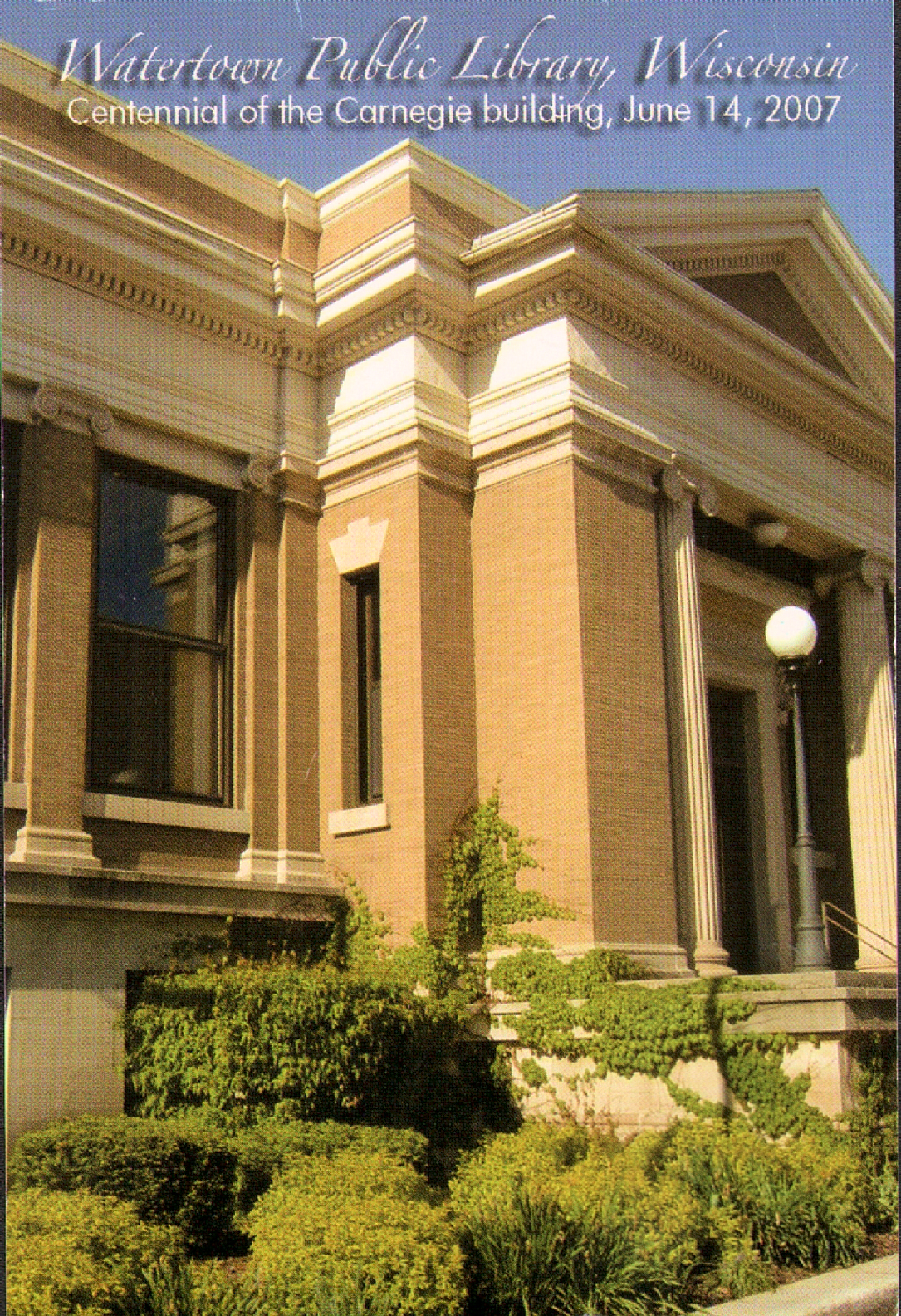
07 16 LIBRARY DIRECTOR HANS BAIERL RESIGNS
Last day on the job will be Aug. 24. Director for the last year-and-a-half.
Decided to resign from his position
because he wants to go back to college in the fall to study Web design. Baierl said he is planning on attending
Moraine Park Technical College in Beaver Dam for about a year and after
graduation he would consider going into business for himself as a Web design
consultant. Baierl has been employed by
the library since May 2000 and was first hired as the assistant director. He was appointed interim director in January
2006 after former director Matthew Williams resigned and took a position at the
Kearney Public Library in Kearney, Neb.
Baierl was appointed the library director in May 2006. WDT
08 02 DIANE JAROCH APPOINTED INTERIM DIRECTOR
Diane Jaroch has been appointed the
interim director of the Watertown Public Library. A 14-year resident of Deerfield, Jaroch has
been with the Watertown Public Library for one year, serving as the assistant
director. She was also the assistant
director for the Monona Public Library for five years. Over the years she has also worked at the
Deerfield Public Library, Kenosha Public Library and the library at Columbia
College Chicago.
12 15 DIANE JAROCH APPOINTED DIRECTOR
Deerfield resident Diane Jaroch has
been selected as the new director of the Watertown Public Library. The Watertown Public Library Board of
Trustees made the hiring decision during Thursday’s meeting and Jaroch, who has
been serving as the interim director since August, accepted the position this
morning. Watertown Library Board
President Pat Ziwisky said Jaroch was chosen to fill the director position out
of the 10 people who applied for the job.
She added the board requested an interview with five of the applicants
and a final interview with Jaroch and another candidate. Ziwisky said the board voted unanimously for
Jaroch to become the new director.
2008
02 13 DELIVERY SERVICE
The Watertown Public Library offers a
delivery service to city residents who are homebound and unable to come to the
library themselves. Library staff will
select several books for homebound individuals and a member of the Friends of
the Library will deliver them. Another
option would be to have a friend or member of the family pick them up. Individuals are asked to call the library and
let staff members know what type of books, titles or authors are their
favorites. The staff will select these
books or talking books, and then they are ready for delivery.
2009
09 30 Fire
Department visit to Public Library at story time
WDT
2010
05 05 CLIFF LUECK, 34 years of service
Watertown Public
Library Congratulations to Clifford Lueck, the "go to" man for maintenance
inside and outside of the library. He recently celebrated his 34
year of employment with the library. He celebrated his milestone by
donating a birdbath to the library's flower garden on Water St.
06 15 DIRECTOR JAROCH RESIGNS
Director Diane Jaroch resigns; July 9 last day; had
been the director since 2007. Served as
assistant director for about a year before she was named the interim director
in August of 2007. Full text, WDT
article
2011
08 08 SECOND FLOOR REMODELING
Library closed for two weeks; new
carpeting and change of layout on second floor. Andrew Stockwell of Y’s Way Flooring pulls up
carpeting from the reference area in the second floor of the Watertown Public
Library and Sheryl Christian helps other library staff members move books onto
rolling shelving units brought in by Yerges Moving & Storage. The library reopened on Monday, Aug. 22, with
new carpeting throughout the building and a rearranged second floor.
12 17 OPEN
SUNDAYS
Library will be open seven days a
week. Starting Jan. 8, 2012, the library
will be open on Sundays from noon to 4 p.m., with the exception of the Sundays
between Memorial Day and Labor Day. WDT
article
12 30 E-READERS
E-readers cause spike in library e-book
downloads. WDT
article
2013


12 17 ACQUISITION
OF 209-211 W. MAIN FOR EXPANSION
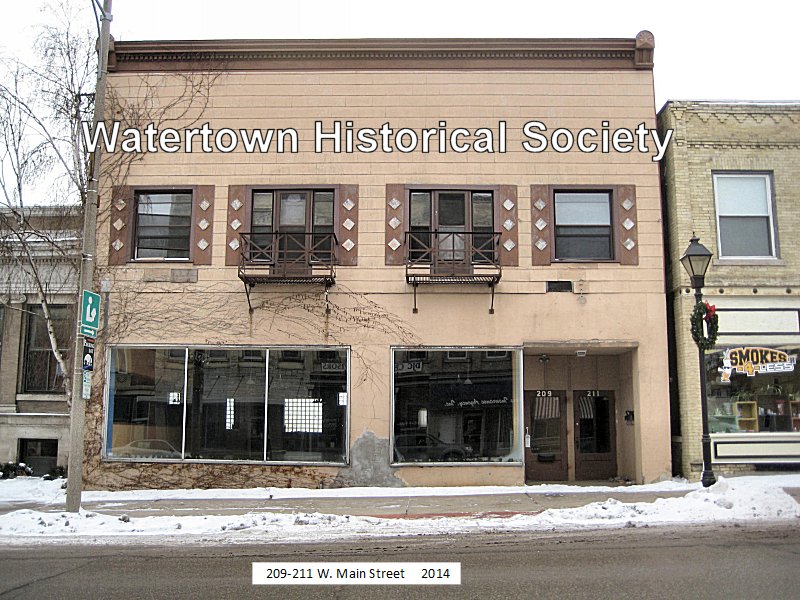 Common Council proceedings of 12 17
2013: RES. #7982, approving and
authorizing the acquisition of property located at 209-211 W. Main Street for
the expansion of the Watertown Library was presented. Sponsor: Mayor David. From: The Finance
Committee and Library Board. Alderperson Zgonc moved for the adoption of this
resolution, seconded by Alderperson Smith and carried on a roll call vote. Yes
– 8. No – 0.
Common Council proceedings of 12 17
2013: RES. #7982, approving and
authorizing the acquisition of property located at 209-211 W. Main Street for
the expansion of the Watertown Library was presented. Sponsor: Mayor David. From: The Finance
Committee and Library Board. Alderperson Zgonc moved for the adoption of this
resolution, seconded by Alderperson Smith and carried on a roll call vote. Yes
– 8. No – 0.
2014
07 15 UPDATE
ON STATUS OF LIBRARY EXPANSION PROJECT
Council
Proceedings: John Ebert, Chairman of the
Board of Trustees of the Library, spoke.
Along with him were Peg Checkai and Erin O’Neil. John was present to give the Council an
update regarding the status of the Library Expansion Project. The building at 209-211 W. Main Street was
recently purchased for $155,000.00. The
next milestone that has occurred is that an architect has been engaged to do
conceptual plans. Studio GC was selected
out of four. The first phase will be
approximately a four to six week period where the building will be prepped for
demolition, along with asbestos abatement.
Once preliminary plans are received from an architect they would like to
make a presentation to the Council. The
board will be doing a Feasibility Study regarding raising private funds. Their hope is that this would be a 50/50
contribution, 50% private, 50% government.
Common Council Proceedings of 07 15 2014.
2015
04 22 SITE PREPARATION OF PROPOSED EXPANSION
 Demolition of 209-211 West Main.
05 24 WEST WALL OF CARNEGIE BUILDING EXPOSED
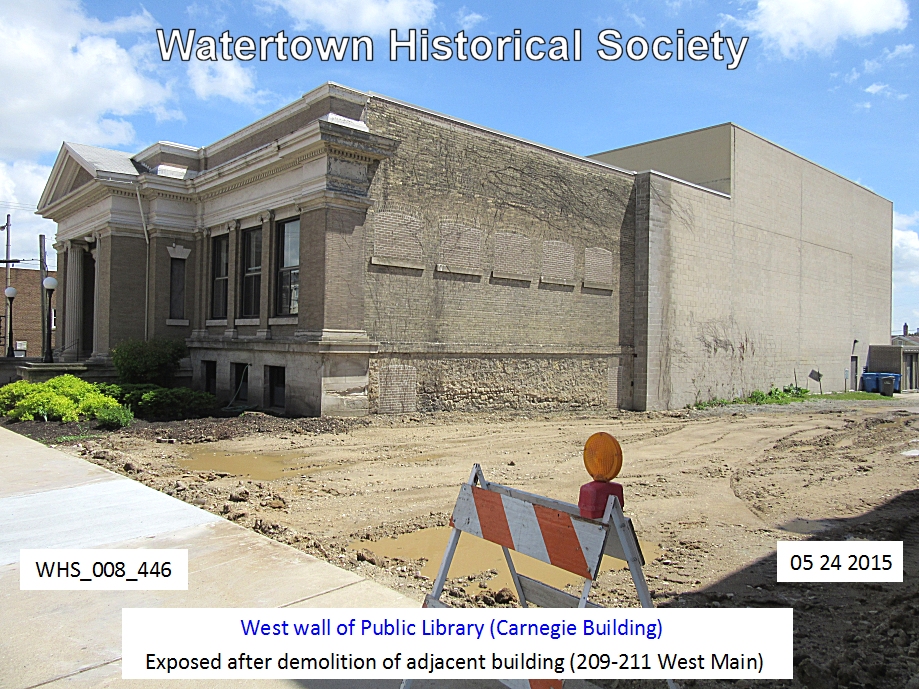
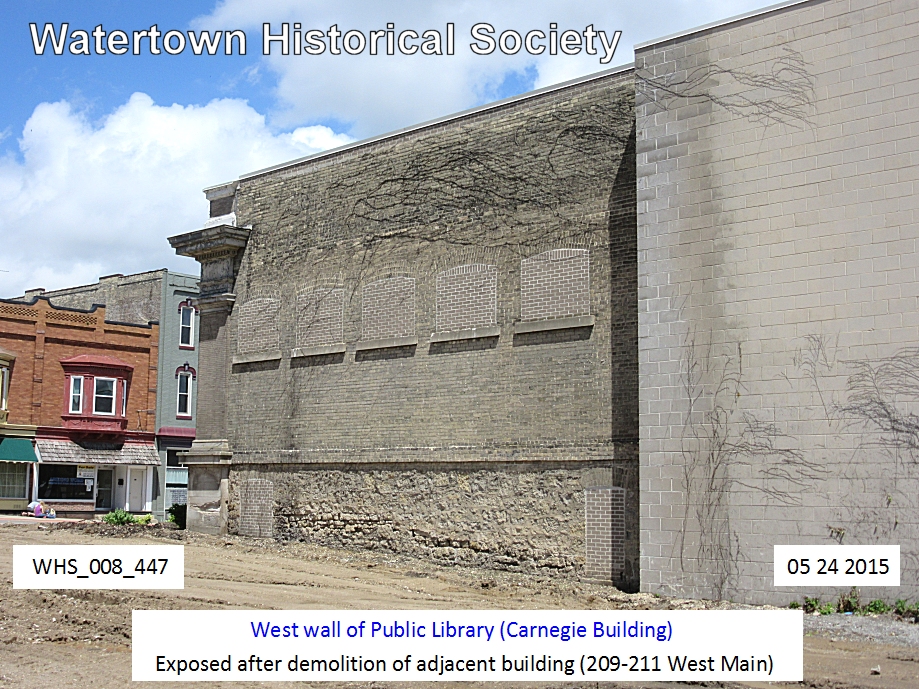
06 19 LITTLE FREE LIBRARY
 225 Arcade Location
06 29 LIBRARY
BOARD OF TRUSTEES MAKES CASE FOR EXPANSION
“A great library builds a great community!”
Decisions will soon be made regarding the redevelopment of our
downtown. The last expansion project at the Watertown Public Library was in
1983, 32 years ago. Imagine how your lives have changed in 32 years. Computers
were a rarity and the Internet wasn’t even heard of at the time. Fast forward
to 2015 and you realize that our public library is still equipped for 1983
library services. We would like to change that with an expansion and update of
the current facility.
Our vision for the future of the library begins with the
belief that great libraries build great communities. We believe an expanded
library, to include the historic Carnegie library in downtown Watertown, will
be an extremely valuable community asset. It will be a gathering place, a
community living room, if you will, where people will learn, create and enjoy
local art, culture and social interaction. Current statistics show that over
550 people a day visit the library. Minimally, foot traffic to the library is
expected to increase by 30 percent with the proposed expansion. With this
substantial increase in pedestrian traffic we believe the library expansion
will act as a catalyst for further downtown redevelopment.
We envision our library as a center of education for all
community members from preschoolers to senior citizens. Our library will be
more than books. We will continue to provide access to information using the
most up-to-date technologies, educational classes and programs, a business
center, outreach efforts and adequate space for both individual and group study. We will build on our
heritage as the home of America’s first kindergarten to educate and entertain
our children along with their families to build stronger family and community
ties.
We also envision the library as a cultural center for
Watertown with an art gallery, a local history and genealogy section, and a
multipurpose community room capable of hosting local theatrical productions as
well as various speakers, lecture series and other performances and gatherings.
We are a proven downtown destination point for Watertown and surrounding
communities.
We plan to provide meeting rooms, spaces and classes where
community members can collaborate and create cultural treasures. We also
envision adequate parking, green space and streetscape to provide a beautiful
and natural setting for what can become a cultural jewel for the city of
Watertown, its citizens and surrounding communities. We think our plans fit
well with the Watertown Downtown Redevelopment Initiative as prepared by Redevelopment
Resources that was presented to the city council in October 2014. We would like
to be the first transformative project that will forever change the landscape
of downtown Watertown.
The library expansion project is ready to move to the next
step. Library trustees have once again devoted considerable library resources
into strategic planning, a needs assessment, a pre-feasibility study and
architectural drawings to help showcase the vision of a modern 21st century
library and to determine building costs. Based on our architectural renderings
several properties along Main Street still need to be purchased. Library
trustees have voted to move forward with a feasibility study but we also need
the support of the city council to effectively reach out to potential donors in our community.
We are excited about the expansion plans and the
contributions a project of this magnitude will bring to Watertown. The vision
is transformative. However, please also contemplate the future of the library
if this project must wait years before it is implemented. There is the adage,
“Never judge a book by its cover,” but in reality many people do make judgments
based on appearances. One of the jewels of the downtown landscape, the 1907
Carnegie building, is a gateway structure for the downtown corridor. This
majestic building, however, shows significant signs of aging, stress and
disrepair. Crumbling masonry and peeling paint are evident on the outside of
the building. The exposed west side of the Carnegie building was not finished
with the same attention to detail as the other sides. Substandard workmanship,
poor quality bricks with holes in the masonry are evident to people walking or
driving by. Deterioration of the outside façade will continue without timely
intervention.
Inside, building amenities struggle to serve a community
of this size. Most disappointing is the lack of compliance with current ADA
standards. The public library should be a welcoming resource for everyone in
the community yet our current building presents barriers for community members
who live with mobility issues. Access to the building, public restrooms,
crowded interior spaces and inadequate meeting rooms contribute to an
environment that creates limitations for library patrons.
Our HVAC is antiquated. The system heats and cools the
building unevenly, is unreliable, expensive to maintain, and in 2014 heating
and cooling costs were $35,000. These costs will continue to rise as the boiler
and HVAC systems age and energy costs rise.
Library staff make the best of library space that was designed to accommodate library services
32 years ago. We did not have computers or the Internet and libraries were not
wired for 21st century technologies. Our wiring infrastructure is pieced
together with over 30 years of technology additions to this building.
Technology is essential to library services and fundamental to remaining
relevant to our community. Postponing improvements to the library will impact
our ability to provide important technology instruction and cutting edge
technologies.
We do not have adequate space for a number of situations
including: a parent and child sitting together in the children’s room, a small
group working together without disrupting other library patrons and a
home-schooling family wanting space to work on a project together. Also,
hosting a summer library event for children at the library and encouraging
children to visit the Children’s Room to learn more about the subject matter
after the program ends is difficult when we have to take these programs
off-site due to the large participation numbers. Inadequate meeting rooms, with
maximum room capacities for 37 people, compromise the quality of services we
provide.
The parking lot adjacent to the library is a valuable
resource but parking is confusing and the gravel surface is dangerous for
pedestrians. While popular with library patrons for convenience, the parking
lot surface will continue to deteriorate and become an eyesore in the downtown.
When decisions are being made about future transformative
projects for the downtown, please consider the positive aspects of doing so
along with the negative impacts associated with delaying the library expansion.
We hope you also support the idea that “A great library builds a great
community!”
08 04 DONATION
TO RESTORE CLOCK
The library received an anonymous generous donation
to have the 1907 grandfather clock restored to working order. The restoration work of the 93 inch tall
mahogany antique clock was done by Les Martin of New Berlin. His expertise work included having a part
fabricated by a locksmith from Indiana.
The grandfather clock was presented to the library by the Saturday Club
in 1907. The clock now chimes at every
hour and half hour.
08 07 LIBRARIANS
RETIRE AFTER OVER 30 YEARS SERVICE
Sharry Lueck, the circulation manager, is retiring
after working there for 35 years and Donna Kerbel, a children’s room library
assistant, is retiring after 33 years.
2016
06 07 CLIFFORD LUECK COMMENDED
COUNCIL PROCEEDINGS / RESOLUTIONS: Commending Clifford Lueck for 40 years of
Service with the Watertown Public Library was presented. Sponsor: Mayor David. Alderperson Tietz moved for the adoption of
this resolution, seconded by Alderperson Larsen and carried on a voice vote.
11 08 RENOVATION/EXPANSION
GOING TO REFERENDUM
2017
01 03 COLLAPSING FRONT STEPS

01 20 SELF-CHECKOUT MACHINE / COLLAPSING FRONT STEPS
Peg Checkai, Director of the Watertown
Public Library, was present to update the Council. Peg stated that the Library
would be installing the first self-checkout machine at the Library, which was
able to be purchased from donations. She
also updated the Council on work on the front steps. They had a Soil & Structural Engineer do
a digging and they have discovered that the steps are supported by cobblestone
with no mortar. They believe the soil
has become eroded under the steps due to the raising of the buildings next door
and the additional water flow. The next
step will be to remove the steps and ledges and store those and then to dig
down to see what is there and refill with proper soil. They are looking to prepare an RFP to have
this fixed.
06 06 REPAIR THE LIBRARY STEPS
Exhibit #8484, authorizing entering into a
contract with Maas Bros. Construction in the amount of $129,605.00 to repair
the Carnegie steps was presented.
Resolution carried on a roll call vote. Council proceedings of 06 06 2017
07 19 
-- -- SIGNED BRICKS OF 1911 DISCOVERED
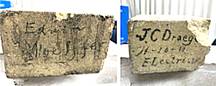
Edwin Woelffer, Stone cutter, Julius
Draeger, Electrician.
08 31 FRIENDS OF THE LIBRARY SUPPORT
The Friends of the Library financially
support projects and programs that are not included in the Watertown library’s
budget. In recent years Friends have
supported the summer and winter library programs and special author events and
speakers. The Friends have purchased
books to boost the children’s room collection of STEM (Science Technology
Engineering Math) materials. Friends
have purchased computers and equipment and the cute and colorful Adirondack
chairs in front of the building. Friends
sponsor the Garden Tales Farmer’s Market and have financed the library’s
participation in Pumpkin Palooza and other fun community events.
08 31 LIBRARY FRONT ENTRANCE OPENED AFTER REPAIRS
For the first time in over three decades, patrons of the Watertown
Public Library are able to utilize the historic Carnegie steps at the original
main entrance to the building. The
announcement comes after months of repairs to the steps and their foundation, a
project that cost the city and library well over $100,000. Earlier this year the steps began shifting at
an increased rate. Engineers determined
that the steps were originally built on fieldstone and mortar, and over the
past century had experienced significant deterioration. Over the years, cement
had been used to stabilize the steps, but their rapid decline in recent years
was becoming a safety issue. Now the
steps are solid stone once again, constructed from both old and new slabs.
04 30 NO
OVERDUE FINES FOR KIDS
The Watertown Public Library will no
longer charge fines for past due children’s and young adult materials for
library card holders ages 17 and younger.
Past fines for children’s and young adult materials will be forgiven but
young patrons will still be responsible for lost and damaged material
fees. Adults will still have to pay
fines, but have a three-day grace period after an item is due. Plus they receive notifications before an
item is due, which give patrons an opportunity to return or renew materials.
06 05 NANCY STADLER RETIREMENT
COUNCIL PROCEEDINGS: Exhibit
#8643, to recognize the retirement of Library Assistant Nancy Stadler was
presented. Motion carried by roll call
vote: Yes–8; No–0.
2019
05 07 213-215 W. MAIN STREET ACQUIRED
COUNCIL PROCEEDINGS: Res. Exh.
#8805, approving a proposed Jurisdictional Offer to acquire property at 213-215
W. Main Street owned by Dean Lenius for the Watertown Library Expansion Project
was presented. Adoption of this
resolution, carried by roll call vote: Yes8; No-0.
07 13 LIBRARY BOARD RECOMMENDS MIRON BID FOR EXPANSION PROJECT
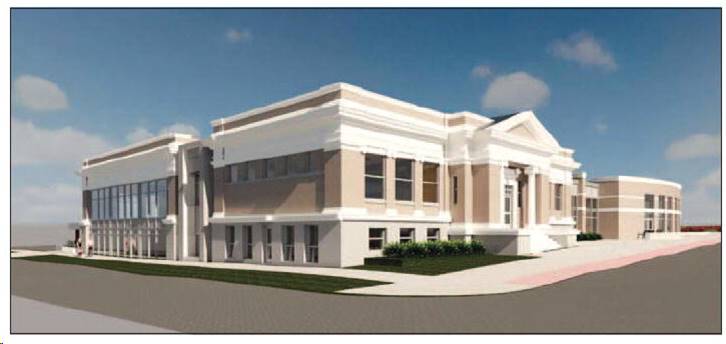
The Watertown Library Board of Trustees will recommend awarding Miron
Construction Co. of Neenah a $6.6 million construction bid for the Watertown
Library Center renovation and expansion project. The recommendation will be presented to the
Watertown Common Council for action at their meeting July 21, pending final
legal review.
11 19 VIDEO CLIP OF EXPANSION
2022
12 04 FEATURED LOCATION IN PARADE OF HOMES
Built on
the site of the Tremont Hotel, which was destroyed by a fire in 1898, the Watertown
Public Library has been a prominent feature on Main St. since 1907.
The
original building was constructed with a $20,000 gift from Mr. Andrew Carnegie,
designed by Claude and Stark of Madison, and built by Stuart & Hager of
Janesville. Construction costs were about $20,000.
After two
additions to the library in 1984 and 2021, the Carnegie Library is an important
asset to the community and library services.
Both renovation projects maintained historical features of the original
1906-1907 project.
The most
recent renovation highlights the stunning dark oak woodwork. All the woodwork in the Carnegie library,
floor to ceiling, was re-stained. In addition, the existing fireplace is now an
operational gas fireplace. New windows, carpet and paint along with new
circular lighting fixtures, with a dark oak band to match the woodwork, were
added. In many areas, the old plaster walls have been maintained and not
replaced with drywall.
The Teen
Room showcases beautiful brick walls, an open ceiling and a gaming area under
the front steps of the Carnegie building.
Visitors to the library will find a beautiful floral arrangement gracing
the original fireplace mantle in the Carnegie Library. The remainder of the library will be
decorated with lots of white lights and a winter/snow theme.

 portfolio of pics
|
|
1907
Construction of Library |
Library,
Early Postcard |
Library,
Early Postcard |
|
Library,
Early Postcard |
Library,
Early Postcard |
Library,
Early Postcard |
Library,
Early Postcard |
|
|
Library
Park, Postcard |
Library
Park, Postcard Same
as WHS_002_PC_309 |
|
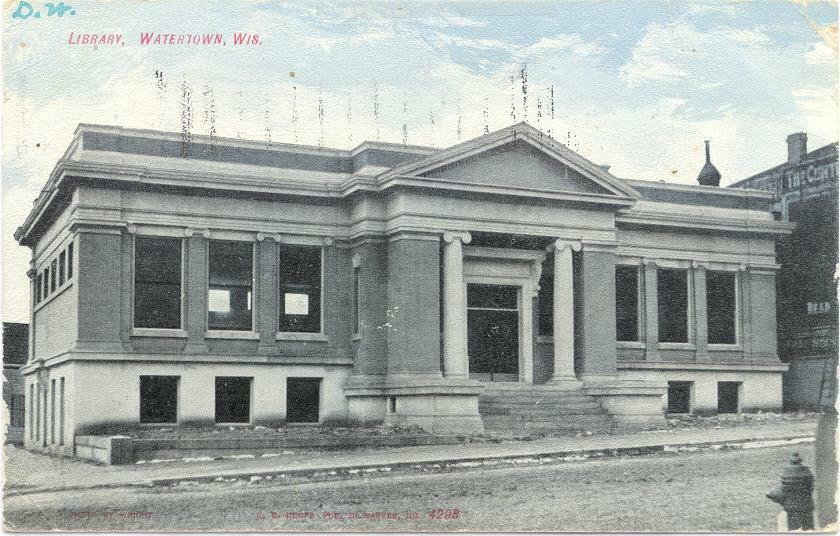
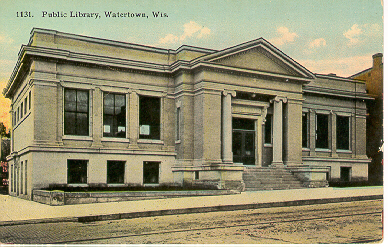
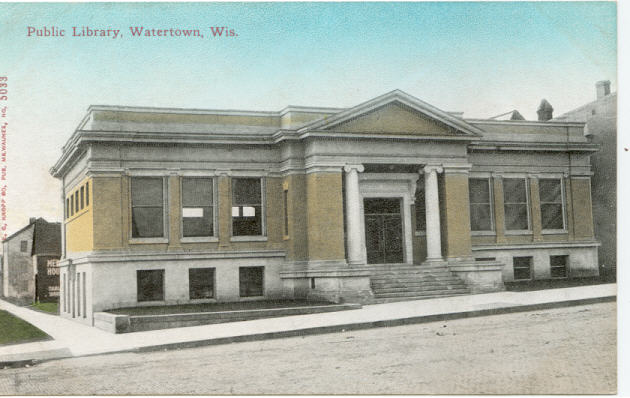
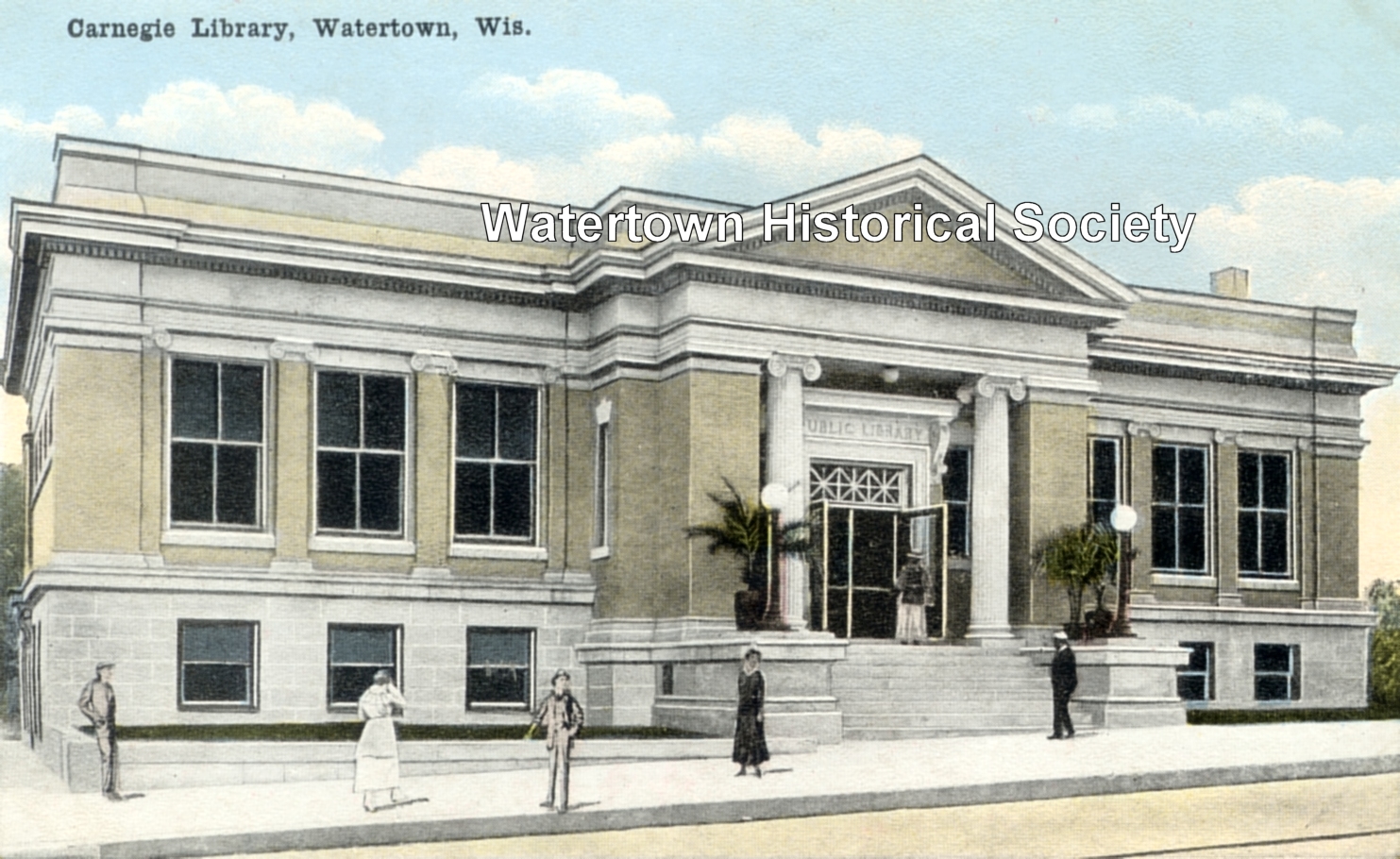
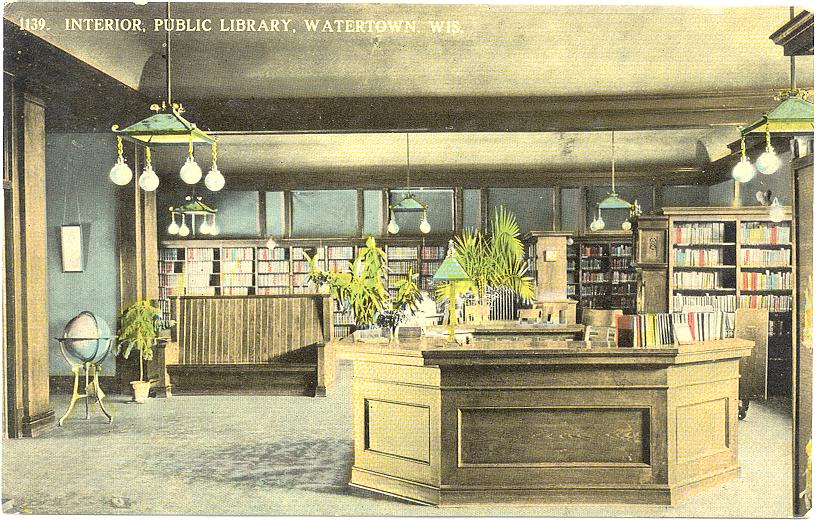
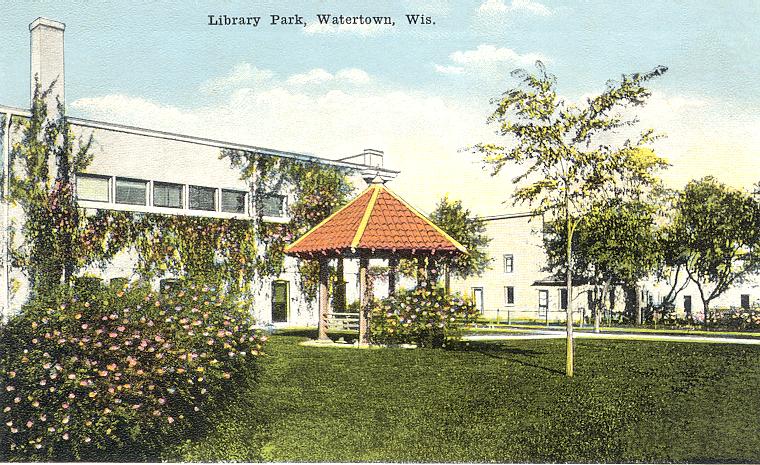


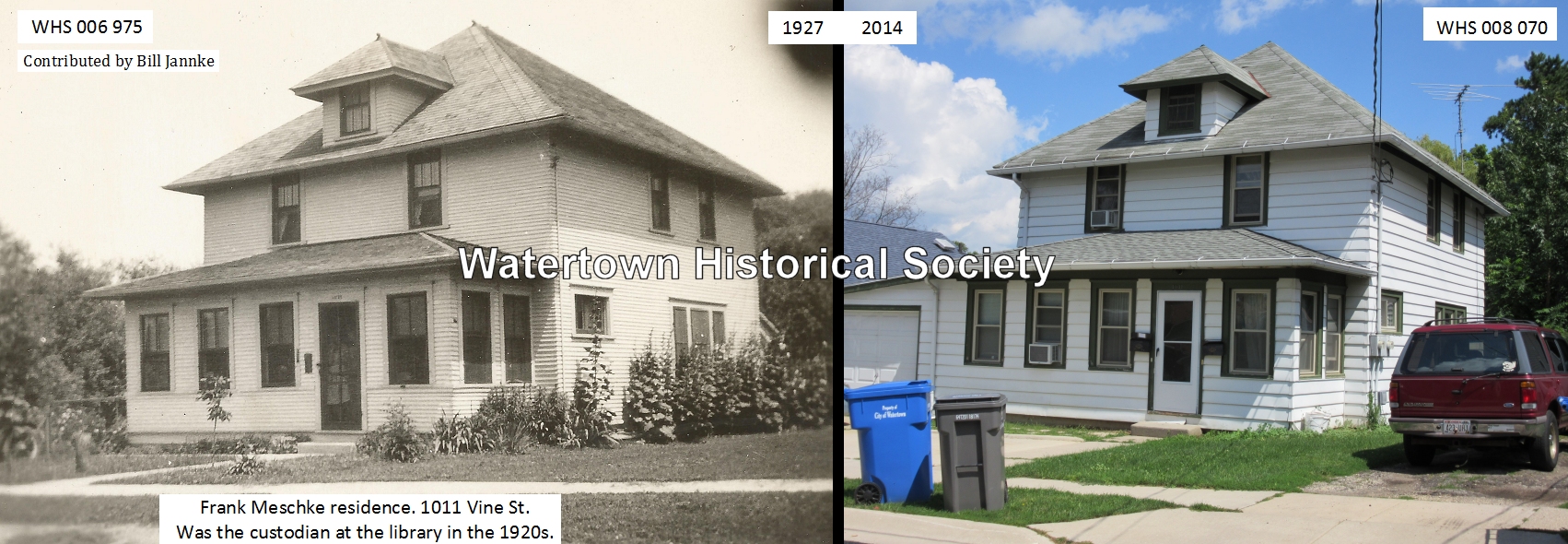
The best candy shop a child can
be left alone in, is the library”
― Maya Angelou
Cross-References:
Miss
Claire Herrmann, member of the library staff
Ruth Wilkowski, member
of staff
I Love My Local
Library video clip
Harriet and Glenn Schwoch
were the co-founders of PALS, now called the Friends of the Watertown Public
Library.

History of Watertown,
Wisconsin