The Bank of Watertown
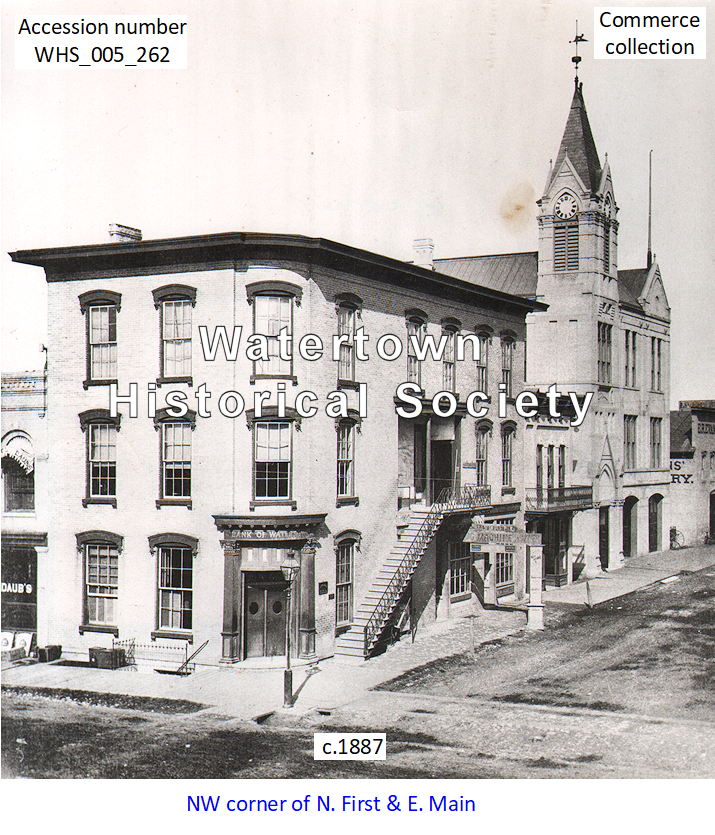
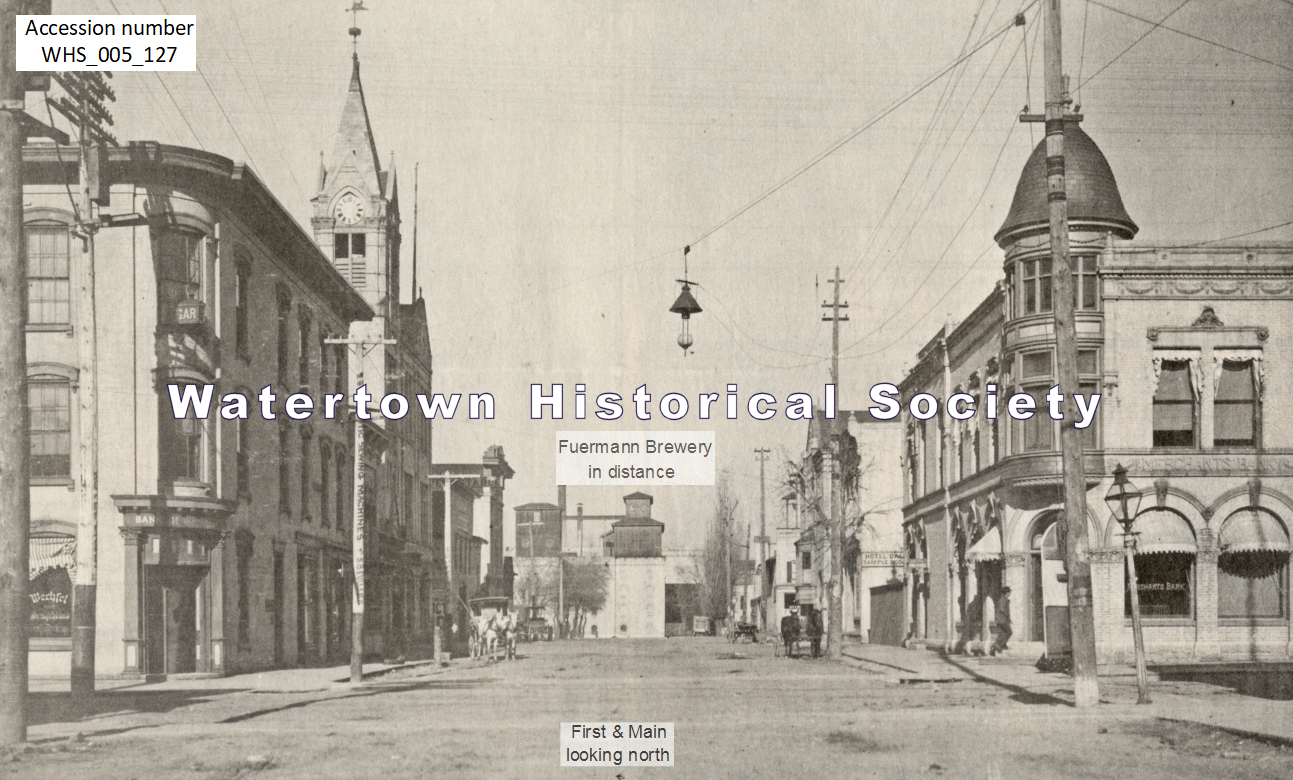
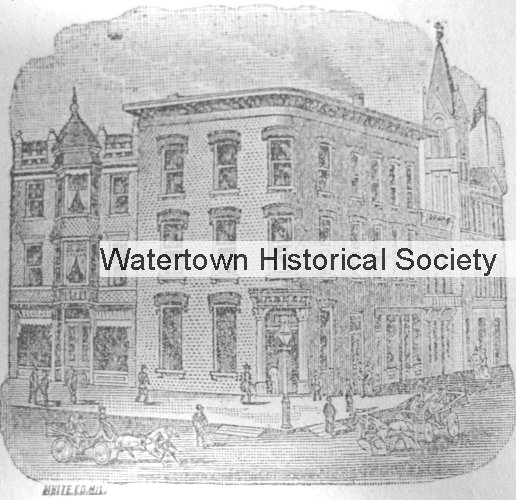
was founded in 1854 by A. L. Pritchard, who was a New York financier. A three-story bank building was erected in
the 1850s. Not only was this an important
bank, but the original building housed the offices of prominent pioneer
attorney Theodore Prentiss, and its upstairs was the early home of Watertown's
most significant fraternal group, the Masons.
In 1916 the three-story
building was replaced by the current two-story structure.
SCROLL DOWN
FOR DETAILED INFORMATION
website watertownhistory.org
ebook History of Watertown, Wisconsin
Bank of Watertown
Incorporated 1854
14 E Main
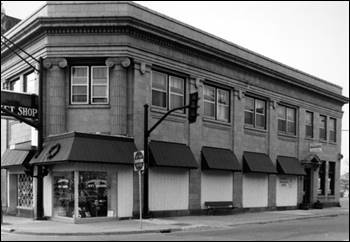
This is the second building on
this site. The Bank of Watertown was
founded in 1854 by A. L. Pritchard, who was a New York financier. The Bank of Watertown built a three-story building
at this location in the 1850s. Not only
was this an important bank, but the original building housed the offices of
prominent pioneer attorney Theodore Prentiss, and its upstairs was the early
home of Watertown's most significant fraternal group, the Masons. On January 29, 1916, the above building was
formally opened to the public
Watertown Gazette, 08 01 1929
The history of the Bank of Watertown
is tied up closely with that of the community itself. Up until a year or so before this bank was
organized, Watertown had no banking facilities, the nearest approach to a
banking institution being Daniel Jones' broker office. When a resident of the community needed a
loan and had no satisfactory collateral, he was very apt to borrow of his
grocer or butcher and repay the loan with the products of his farm or
garden. Then, in 1852, the Jefferson
County Bank was organized in Watertown.
It survived for about nine years but in 1862, according to the files of
the Wisconsin state banking authorities, it liquidated and passed out of
existence after paying all claims against it dollar for dollar.
1853-1863
The years preceding the Civil War
were years of political, social and financial unrest, particularly in the newer
states of the West. From 1853 to 1860
there was constant friction between the pro-and anti-slavery factions. When the war finally broke out in the spring
of 1861, Wisconsin had 109 state banks with an outstanding circulation of
$4,500,000, two-thirds of which was secured by rapidly depreciating bonds of
southern and border states. Within two weeks after the fall of Fort Sumter, 38
of the 109 Wisconsin banks were closed, and public confidence was not wholly
restored until after the great Union victories of 1863.
Throughout this troubled period,
however, the Bank of Watertown was able, as a result of capable and
conservative management, to continue its service and keep faith with its
customers and the community.
1854
A. L. PRITCHARD
City of Watertown, Wisconsin -
Architectural and Historical Intensive Survey Report: 1986-1987. City of
Watertown Historic Preservation Project, August 1987, pp 214-225.
Two of the early banks in
Watertown were begun by Yankees. Daniel
Jones, a native of New Hampshire started the Jefferson County Bank in the
1850s. It was suspended in 1862 and
Jones joined with William Dennis who had formed the Bank of Wisconsin. Together they formed the Wisconsin National
Bank (116 W. Main St). The Bank of
Watertown was founded by A. L. Pritchard, a New Yorker who never moved to
Watertown. Its long-time cashier,
though, was William H. Clark, another New Yorker who came to Watertown in
1854. Its original building (14 E. Main
St.) was replaced by a new structure in 1916
1854
WILLIAM H. CLARK
The History of
Jefferson County, Wisconsin by C. W. Butterfield, 1879
William
H. Clark, cashier of the Bank of Watertown; came to Milwaukee in 1852, and to Watertown
in 1854. He organized the bank that year
and has been connected with it ever since.
Mr. Clark organized the gas company here, in
connection with A. L. Pritchard, and conducted the works for several
years. He has been in the banking
business continuously since August 4, 1854, over a quarter of a century. Mr. Clark is a native of Chemung Co., N.Y.
1854, ORGANIZATION OF
Watertown Gazette, 08 01 1929
In 1854, the year after the
Jefferson County Bank opened for business, the Bank of Watertown came into
existence and has served continuously ever since without even a change in name.
Watertown was incorporated as a
city in 1853, and its first mayor Theodore Prentiss,
was in office when the Bank of Watertown was organized. The population at the
time the city charter was granted was about 4,000, but was rapidly
increasing. Wisconsin was just acquiring
its first railroad facilities, the Milwaukee Road completing its line from
Milwaukee to Waukesha in 1851, to Madison in 1854, and to Prairie du Chien in
1857, while the Northwestern reached Janesville from the southeast in 1855 and
Fond du Lac in 1858.
1854
FIRST
STOCKHOLDERS' MEETING
Among the founders of the bank
are some of the most prominent pioneer settlers of this territory, men who
played a leading part in the early development of the community. At the first stockholders' meeting, held on
August 1, 1854, A. L. Pritchard, Luther A. Cole,
Linus R. Cady, John Richards and Ebenezer W. Cole were chosen directors of the
bank.
A. L. Pritchard was elected
president, and William H. Clark, cashier.
Daniel Jones, Amos Steck, and
John P. Roose were also among those actively interested in the organization of
the bank, and Theodore Prentiss joined the group shortly after. Among the later presidents of the institution
were William Buchheit
and Frank E. Woodard. Among later
officers and directors were Jesse Stone, Marshall
J. Woodard, E. J. Brandt, W. C.
Stone, Constance Wiggenhorn, and C. H.
Jacobi.
1855
ORIGINAL
BANK BUILDING 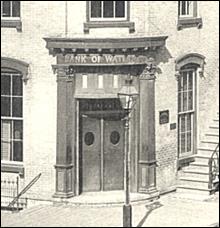
Shortly after the bank was
organized it erected a three-story brick building on the site of its present
structure. That building, which was the
bank's home for sixty years, was regarded at the time of its erection as the
best bank building in the state outside of Milwaukee. It was built of Watertown
brick. Vault doors were brought from New
York City, and the vault, which would seem almost primitive compared with the
one the bank owns today, was hailed as a notable example of advanced
construction.
11 22 BANK
RAISED CAPITAL TO $100,000
The Bank of Watertown has now
completed its arrangements for raising its capital to $100,000. The bills are already struck off, and by the
first of January 1856, the bank will commence operations with greatly increased
means for accommodating one of the most profitable and growing business
communities in Wisconsin. The Bank of
Watertown commenced business in this city a little more than a year ago with a
capital of $25,000. A short time since
its stock was raised to $50,000, and now this latter amount is about to be
doubled in order to keep pace with the calls that are made on it for larger
accommodations. This short and plain
story speaks volumes in favor of our city, and tells with unerring certainty
that rapidly as we are going ahead, we are going along safely. Mr. A. L. Pritchard is the President, and Wm.
H. Clark, the Cashier of the Bank of Watertown—gentlemen in whose experience
and ability the public may repose the utmost confidence. WD
1857 LOCATION OF READING CENTER (pre public library)
Long before 1900, however, the
idea of a free public library was in the dreams and
wishful thinking of many Watertown residents.
In 1857 the young men's association rented a room and opened a reading
center in the old Bank of Watertown building on Main and North First
streets. So many readers came that the
association moved to the top floor of the Cole building.
1857 line
drawing 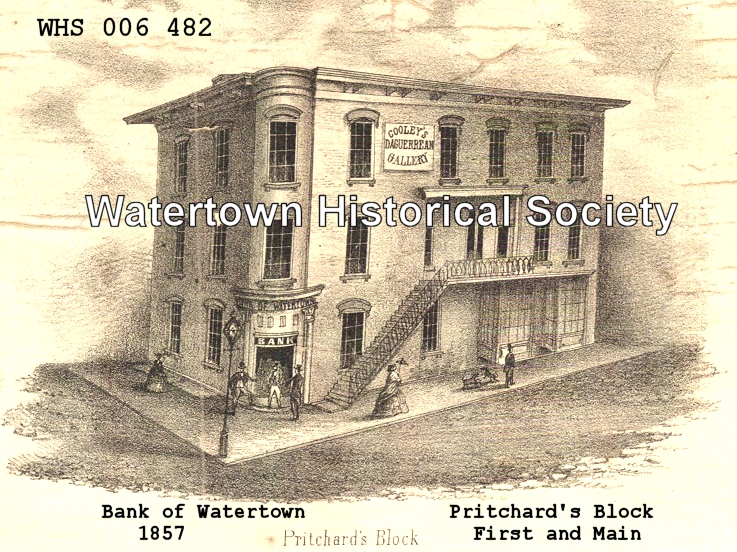
c.1859
MAIN STREET IN DECADE BANK WAS BORN
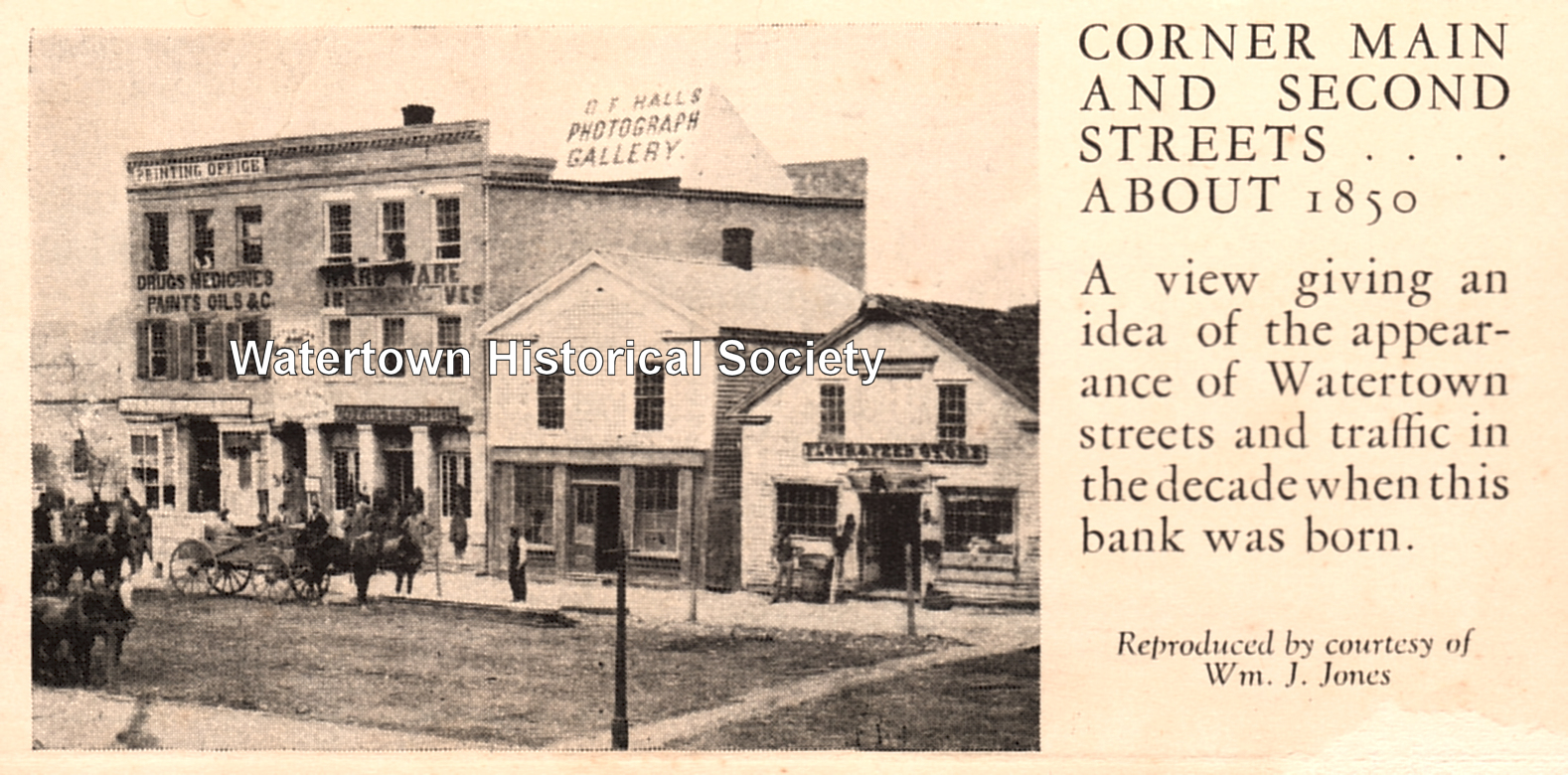
c1860
THEODORE PRENTISS
The law office of Theodore Prentiss
(Watertown’s first mayor) was above the Bank of Watertown.
1868
COL. SOLLIDAY
Upon his arrival in Watertown Col. Solliday opened dental parlors over the
Bank of Watertown, where he remained three years, finally locating on Main
Street (Solliday & Meyer, 117 Main) where he practiced his profession until
his retirement from active duties.
Solliday held several positions
of trust in Watertown, among them four years on the school board, part of the
time its president; alderman of the
1881
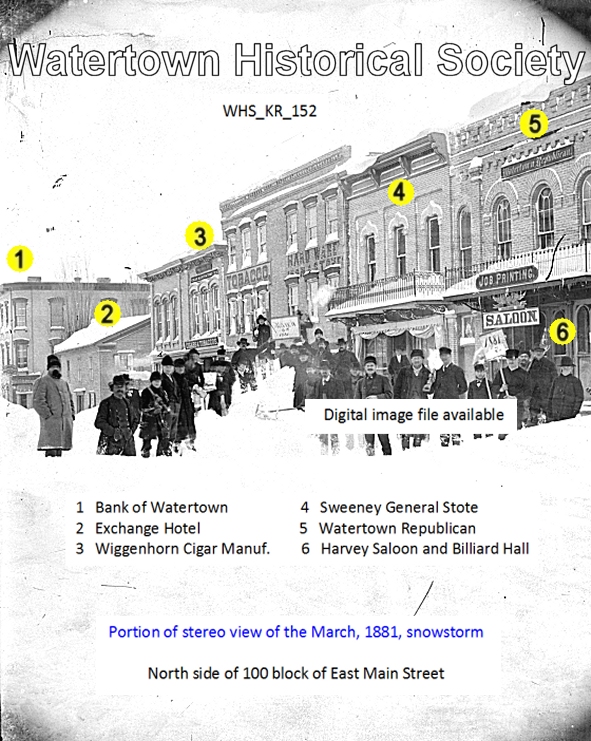 1881 snow storm street scene
1882
10 18 WILLIAM H. CLARK, Cashier of the Bank
of Watertown, death
of wife Charlotte A. Clark WR
10 23 LETTERING ADDED TO WINDOWS
Some very handsome
gilded and tinted lettering was done last week on the south windows of the Bank
of Watertown by W. C. Raue. Watertown Republican, 10 23 1889
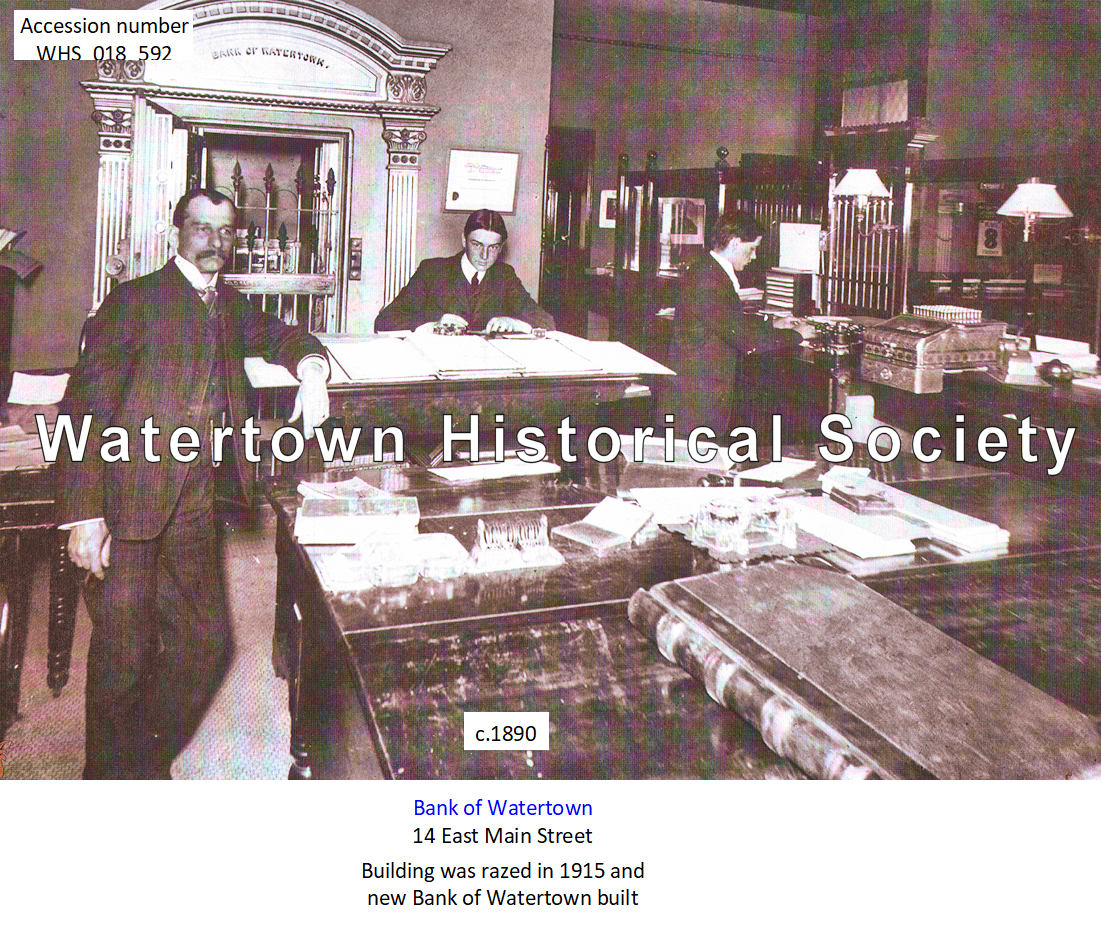
c.1890
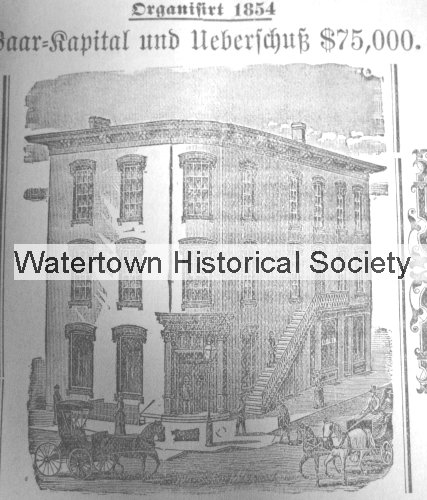
1891
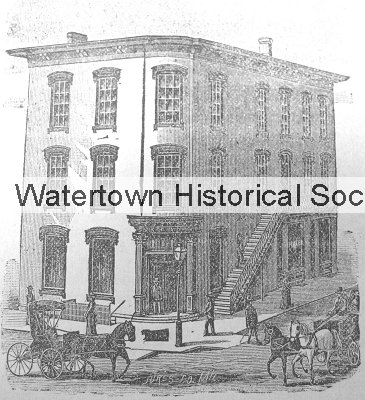 1891 drawing, Weltburger
1892
09 30 SAFE KEEPING
The Bank of Watertown is making several substantial improvements on its
building. Its building was one of the finest
in the state when erected some thirty-eight years ago, its outside walls being
built of pressed brick, and the trimmings of iron. After thirty-eight years the building is in
good condition, and one of the most prominent on Main Street. This institution passed safely through all
financial storms during this long period, and by the sound financial policy of
its present management has placed itself in the front ranks of the financial
institutions of the state. . . . The
principal improvement, will be its steel burglar-proof vault. Its vault, originally built in the most
substantial manner, with very heavy solid walls, the entire interior being of
stone, will be lined with burglar-proof steel plate, the vestibule and doors of
the vault alone weighing 17,000 pounds.
The outer door will have a triple time lock and automatic bolt
work. This door is of immense
weight. It closes air tight and opens
and closes as stated periods automatically, there being no opening nor spindle
through the door whatever. The second
door is a heavy steel plate combination door.
The vestibule also a contains day gate.
Inside of this burglar-proof vault will be placed the deposit boxes
rented to the bank’s customers, and also its burglar proof time-lock safe,
which is also provided with a second steel door. The reserve cash of the bank will thus be
protected by four burglar-proof steel doors, a triple and a double time
lock. WG
1893
TWO DRAWINGS, both from 1893 issues of Weltburger [1] [2]
1893
"NOTICE TO DEPOSITORS"
One episode in the bank's history
in which it takes particular pride, and one that is characteristic of the high
sense of responsibility that has always been a feature of the bank's
management, took place in 1893. That was
a year of financial panic in the United States, and banks in many parts of the
country were in acute distress. The Bank
of Watertown remained perfectly sound, as it had through previous panics, but
gossips aroused by the general lack of public confidence in banks spread rumors
that frightened some of the depositors.
To quiet depositors and restore confidence, on July 26th, the bank posted
in its window and published in the newspapers the following "Notice to
Depositors":
Owing to the present unsettled condition throughout
the business world, we, the undersigned directors of the Bank of Watertown,
hereby guarantee with our private fortunes all the deposits now in the bank and
all deposits made during the year 1893.
There is due depositors in this bank, $220,000. The assets of this bank are $300,000. Added to this ample amount of assets we
pledge our private fortunes.
We take this occasion to thank the business
community, farmers, and other customers for their liberal patronage and desire
to show our appreciation of the same with this absolute guarantee.
Dated, Watertown, Wis. July 26, 1893.
Wm. Buchheit,
Jesse Stone,
M J Woodard,
Theodore Prentiss,
C Wiggenhorn,
E J Brandt
This confidence-inspiring
document accomplished its purpose.
1894
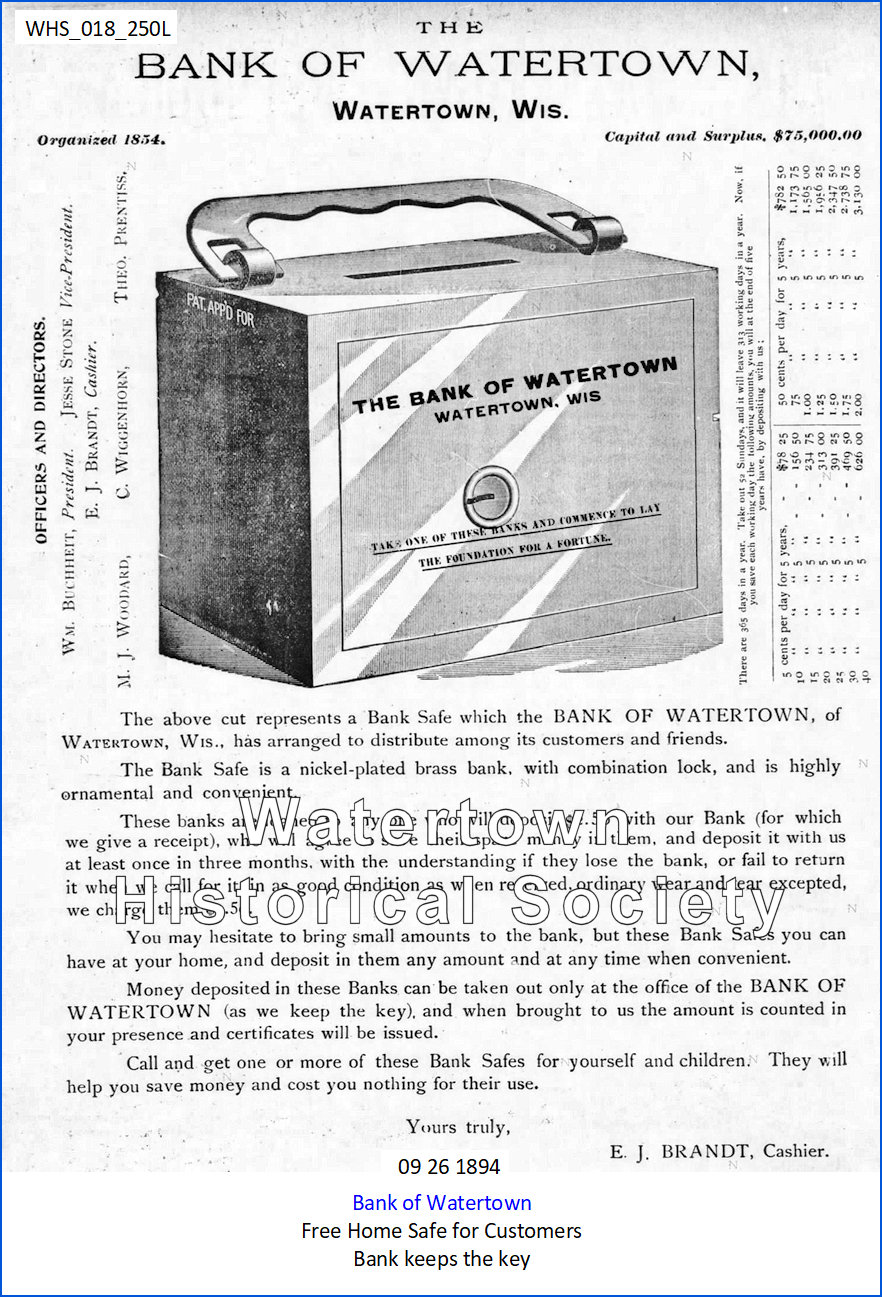
09 26 FREE HOME SAFE FOR CUSTOMERS
Bank keeps the key
c.1897
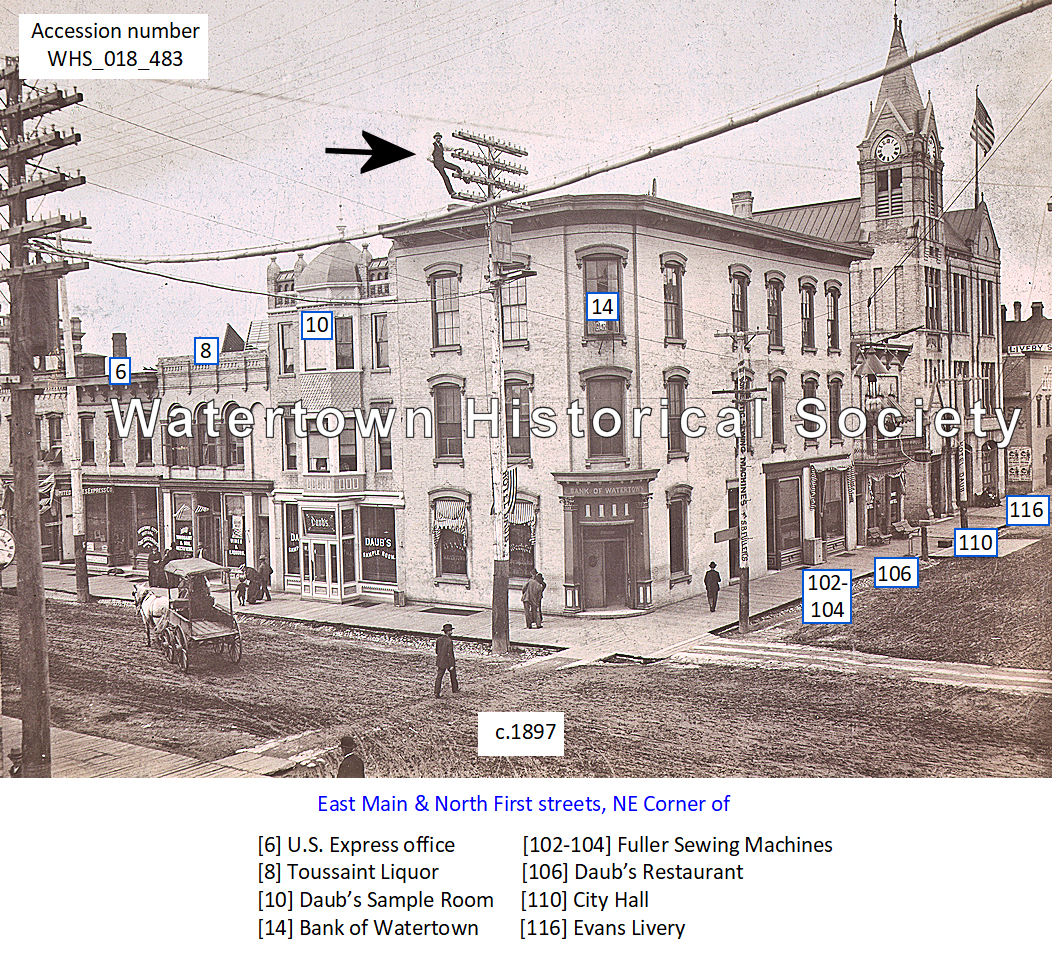
1902
COUNTING
ROOM
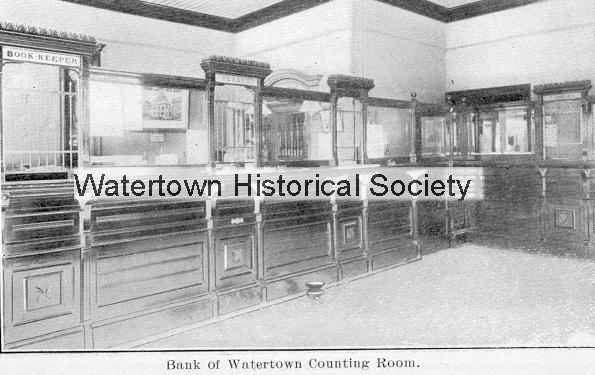
1906
08 09 BURGLAR ALARM SYSTEM
The scene of activity about the
Bank of Watertown the past few days and nights has convinced those who have
watched the preparation that the installation of a burglar alarm system is no
easy task and in fact take a far greater amount of strenuous labor and time
than the average person would imagine. The new system is being installed by the
Invincible Protection Company of Monroe, the equipment being manufactured at
Cedar Rapids, Iowa.
The system is what is known as
the open and closed circuit, the vault of the bank being enclosed in a
veritable network of cables containing electric wires so that it would be
utterly impossible for a burglar to gain access to the vault without giving an
alarm that would almost wake the dead. The work of installing the new system is
in charge of T. J. Weirich of Monroe, who has four experienced assistants
helping him, beside local assistants. The work was started last Saturday, Mr.
Weirich working and supervising the work through to Monday a period of
forty-eight hours without any sleep. It is expected that it will require a
week's time yet to complete the task of installing the system. In the course of
operating it was necessary to drill holes through the steel plates of the
vaults in order to run the cable. It was found that ordinary drills would
scarcely touch the steel, so the process used was by electricity, a common arc
light carbon being used as the drill. This process is a very interesting one to
watch, the display of light being virtually like a miniature electrical storm.
The operation has been watched by many of our citizens and all have found Mr.
Weirich and his assistants very courteous in explaining the details of the new
system. WDT
1907
A deputy factory inspector has
ordered the Bank of Watertown to build a fire escape on either the south or
east side of its building at the north west corner of Main and First streets as
the hall in the third story being used as a test hall (sic). It is passing strange that such an order
should be issued as it is less than four years ago that the owners of the
building put up a good and sufficient fire escape on the north side of the
building. The building is small and
heated with a furnace, the only stove in it being in the Post hall and the
buildings on either side are warmed by steam from the Masonic Temple. To put up another fire escape where ordered
would deface the building and cost at least $200 and is not required for the
safety of those who occupy the building.
1910
11 18 PASSED MILLION DOLLAR MARK
The reports of the Bank
of Watertown and Merchants' National Bank of Watertown show that in capital,
surplus and deposits those two banks have now passed the million dollar mark, which
speaks well for the business interests of Watertown. The Wisconsin National Bank's deposits,
capital and surplus are over $610,000, and judging from its last report, that
old and popular banking institution is also on a solid financial basis. WG
1911
01 06 HAPPY NEW YEAR 1911
In entering upon another business
year we desire to thank our depositors and patrons for the loyal confidence
reposed in this bank during the 56 years in business. It will be our purpose in the future, as in
the past, to place our services at your command—our strength and security at
your disposal. Bank of Watertown. Capital $150,000. Surplus $30,000. Established 1854. Three percent interest paid on time
deposits. WG
07 06 FRANK E. WOODARD ELECTED PRESIDENT OF THE
BANK OF WATERTOWN
At a meeting of the board of
directors. of the Bank of Watertown held on Thursday, June 28, 1911, Frank E. Woodard, for many years the efficient
cashier of the bank, was elected president to fill the vacancy in the office
caused by the death of Wm. Buchheit, and Fred Gamm was elected a member of the
board of directors, and he was promoted from the office of assistant cashier to
that of cashier. The promotion of both
men was with the general approval of all the stockholders of the bank, and
finds great favor with its patrons and the public in general.
1914
05 28 NEW DEPARTMENT in Bank of Watertown. In talking with the cashier of the Bank of
Watertown today he told us [Watertown
Gazette] of a new department to be opened next week in their bank. This new service is to be given free to
everybody who wishes to use it, whether they have ever done business with this
bank or not.
 “The time is forever gone when a bank's only duty was to accept
deposits and return the money when wanted by the depositor,” said Mr.
Gamm. “The up-to-date bank must give
their patrons every possible advantage in their money matters. Few people have the opportunity to study
financial affairs as does the banker and he soon learns of the new methods
worked out for helping his patrons.
While it is true that money was made to be spent, it is also true that
there are many ways to spend it. The man
who gets the greatest [good] from the money spent is an exception to the
rule. Such a man we call thrifty. Thrift means skillful handling of money in
order that the greatest amount of good comes from it.
“The time is forever gone when a bank's only duty was to accept
deposits and return the money when wanted by the depositor,” said Mr.
Gamm. “The up-to-date bank must give
their patrons every possible advantage in their money matters. Few people have the opportunity to study
financial affairs as does the banker and he soon learns of the new methods
worked out for helping his patrons.
While it is true that money was made to be spent, it is also true that
there are many ways to spend it. The man
who gets the greatest [good] from the money spent is an exception to the
rule. Such a man we call thrifty. Thrift means skillful handling of money in
order that the greatest amount of good comes from it.
“Everybody wishes to be
thrifty. Our Thrift Savings Club system
will give them the easiest possible way to develop thrifty habits. A large part of any thrift program is to plan
ahead for the money to be spent. The
vacation trip, the life insurance payment, Christmas expenses, taxes, paying
off a mortgage, building or buying a home and various other matters come up and
must be provided for.
“We have the easiest and best
system for providing for these various funds and cordially invite the readers
of The Gazette to call and have the
system explained to them.”
09 17 NEW BUILDING for Bank of Watertown
Ferd Behlke Secures Contract / An
Investment of $35,000.
Ferdinand Behlke of this city has
secured the contract for the new Bank of Watertown building, exclusive of
heating, plumbing and decorating. Work
on the new building, which is to be erected on the site of the present
building, will begin at once. The rear
half of the building will be completed first and then the front part, so that
there will be no interference with the business of the bank. When the rear part is finished the business
will be conducted therein till the entire building is completed, which will be
during the summer of 1915. The building
will represent an investment of $35,000, and it is designed by A. C. Clas, one
of Milwaukee’s most celebrated architects.
WG
Additional source: Engineering
News, Volume 72. McGraw-Hill Publishing Company, 1914
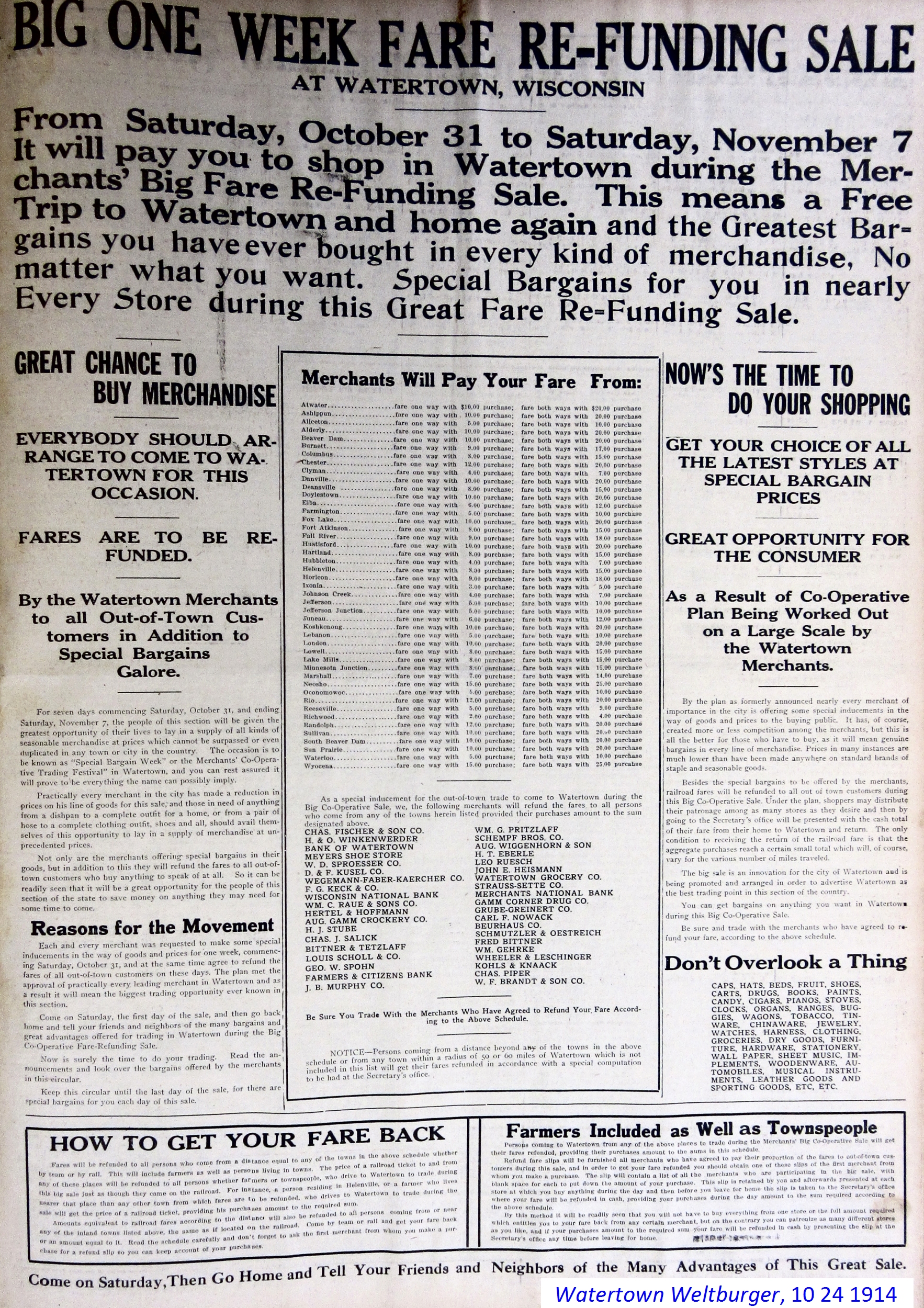
10 24 FARE-REFUNDING SALE, full
page Weltburger
ad
1915
02 25 THREE YEARS IN WAUPUN
On Saturday Judge Grimm in Circuit
Court sentenced R. M. Shogry, alias E. M. Esper, to three years in the state
prison at Waupun. On January 13th Shogry
attempted to defraud the Bank of Watertown.
His home is at Mosonton, Pa. Last
January he called at the Bank of Watertown and deposited a small amount of cash
and a number of worthless checks, and afterward endeavored to draw against the
account, but the bank management was too smart for him and had him
arrested. He plead guilty before Judge
Grimm and received his sentence on Saturday.
WG
--- SITE PREPARATION
FOR NEW BANK
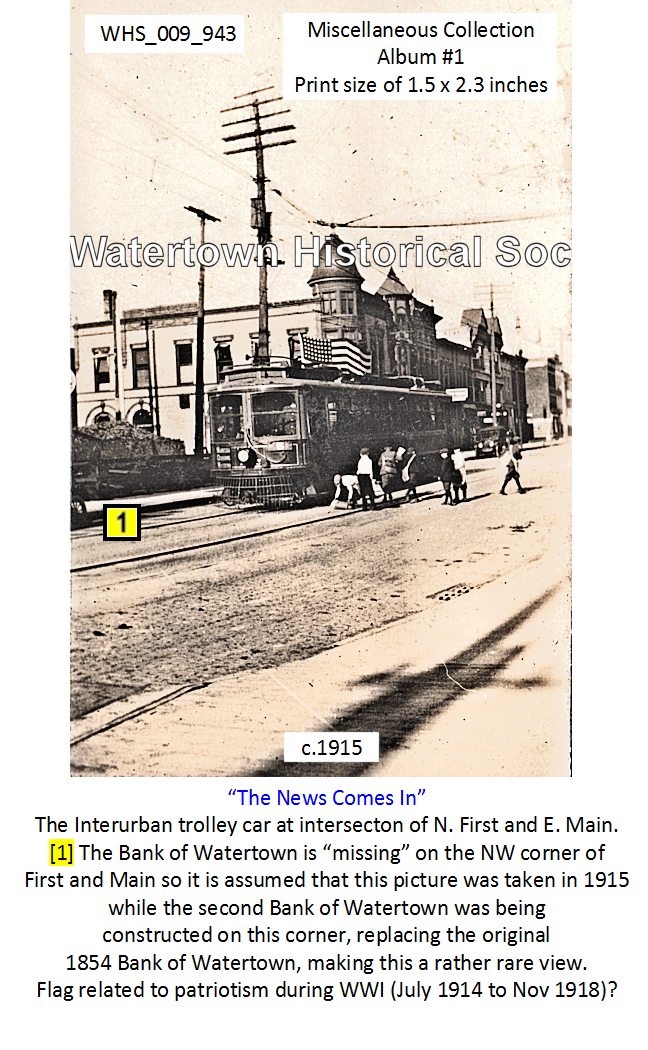
04 20 TEMPORARY QUARTERS IN THE MASONIC TEMPLE
The Bank of Watertown will occupy
temporary quarters in the Masonic Temple
building while the construction of the front part of the bank’s new building
is in progress. When completed,
Watertown will have one of the most handsome and commodious bank buildings in
the state and one of which the citizens of the city may justly feel proud. The Watertown News
10 28 NEW BANK BUILDING UNDER CONSTRUCTION
Building operations in Watertown have shown
marked activity during the last year.
Many new residences have been erected, as well as a number of business
buildings. The chief pride of Watertown
is the new building of the Bank of Watertown, which institution is the oldest
of its kind in Jefferson county. Its new
home, which will be ready for occupancy about Nov. 1st, stands at the northwest
corner of First and Main streets. The
ground floor is equipped with the most modern of bank fixtures, while the upper
floors will house several commodious office suites which will be occupied by
such firms as the individuals as the Old Line Life Insurance Company, Attorney Wm. H. Woodard, F. J. Prentiss [T. & J.
Prentiss] and W. C. Stone; while the president of the bank, Mr. F. E. Woodard, will also have private
offices above the bank. WG
1916
NEW BANK
BUILDING
On January 29, 1916, the present
building was formally opened to the public with a reception at which visitors
were given an opportunity of inspecting the structure and its equipment.
It is interesting to note that,
while the Bank of Watertown grew steadily and paid satisfactory dividends for a
great many years, its most rapid expansion has taken place since the opening of
the present building just thirteen years ago.
An article appearing in the Watertown Daily Times on the day this
building opened [1916] called attention to the fact that the bank's deposits
were then over $900,000 and remarked that the institution "bids fair to be
numbered among the 'million dollar banks' within a reasonable time." That this prediction was extremely
conservative is shown by the fact that deposits in 1929 were about $2,000,000
and total resources are approximately $2,300,000. The present capital is $200,000 - four times
the amount of the original capital - and added to this is $165,000 in surplus
and undivided profits.
02 01 NEW BANK BUILDING DETAILED The
Watertown Weekly Leader, 01 Feb 1916
Scarce would one think of the
Bank of Watertown without calling to mind the history of Watertown; for in its
line of commercial endeavor the Bank of Watertown is the pioneer financial
institution of the city — the oldest now in existence.
When the bank received its
charter on May 1, 1854, the first mayor of Watertown, Theodore Prentiss, was at
the head of the city government.
The first president of the bank
was A. L. Pritchard, and the first cashier was W. H. Clark. The stockholders were men who made Watertown
a commercial possibility, and whose names are indelibly impressed on the city’s
history — Lucius Cady, Daniel Jones, Theodore Prentiss, John Richards, John W.
Cole and Luther Cole.
The officers and directors laid
the foundation for the present substantial financial institution along lines of
safe banking practice, and there has not been an hour since these pioneers
launched the project of banking in the city that any officer or depositor in
the Bank of Watertown has had cause to regret the stability of the bank or the
policies of financial transactions laid down by these men.
Two years after being chartered,
the total bank deposits in Watertown were $105,000, of which amount the Bank of
Watertown boasted $36,500, the remainder being in charge of the Jefferson
County Bank, which liquidated a few years later
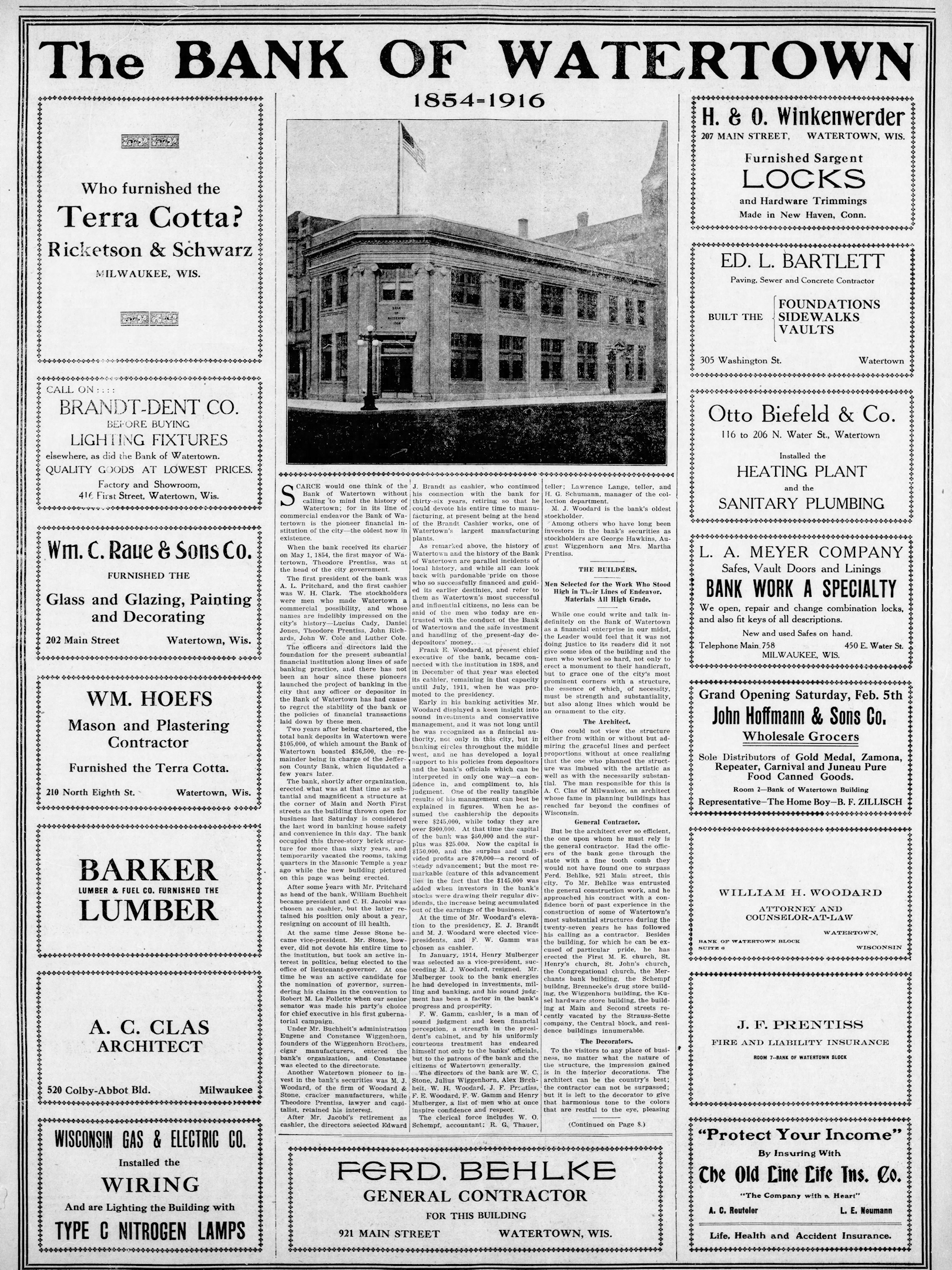 The bank, shortly after
organization, erected what was at that time as substantial and magnificent a
structure at the corner of Main and North First streets as the building thrown
open for business last Saturday is considered the last word in banking house
safety and convenience in this day. The
bank occupied this three-story brick structure for more than sixty years, and
temporarily vacated the rooms, taking quarters in the Masonic Temple a year ago
while the new building pictured on this page was being erected. After some years with Mr. Pritchard as head
of the bank, William Buchheit became president and C. H. Jacobi was chosen as
cashier, but the latter retained his position only about a year, resigning on
account of ill health.
The bank, shortly after
organization, erected what was at that time as substantial and magnificent a
structure at the corner of Main and North First streets as the building thrown
open for business last Saturday is considered the last word in banking house
safety and convenience in this day. The
bank occupied this three-story brick structure for more than sixty years, and
temporarily vacated the rooms, taking quarters in the Masonic Temple a year ago
while the new building pictured on this page was being erected. After some years with Mr. Pritchard as head
of the bank, William Buchheit became president and C. H. Jacobi was chosen as
cashier, but the latter retained his position only about a year, resigning on
account of ill health.
At the same time Jesse Stone
became vice-president. Mr. Stone,
however. did not devote his entire time to the institution, but took an active
interest in politics, being elected to the office of lieutenant-governor. At one time he was an active candidate for
the nomination of governor, surrendering his claims in the convention to Robert
M. La Follette when our senior senator was made his party’s choice for chief
executive in his first gubernatorial campaign.
Under Mr. Buchheit’s
administration Eugene and Constance Wiggenhorn, founders of the Wiggenhorn
Brothers, cigar manufacturers, entered the bank’s organization, and Constance
was elected to the directorate.
Another Watertown pioneer to
invest in the bank’s securities was M. J. Woodard, of the firm of Woodard &
Stone, cracker manufacturers, while Theodore Prentiss, lawyer and capitalist.
retained his interest.
02 01 NEW BANK BUILDING OPENS
[same date] HEARTY WELCOME EXTENDED VISITORS
BANK OF WATERTOWN RECEIVES
VISITORS IN MAGNIFICENT NEW HOME.
Wives and Daughters of Officials
Act as Hosts—Beautiful Floral Pieces.
Historic Relics Shown Visitors,
Probably one of the most
brilliant and whole-hearted welcomes ever extended to the citizens of Watertown
by a business concern was when the Bank of Watertown opened its doors for the
transaction of business Saturday morning.
The finishing touches had been
completed by the contractors on the magnificent new building at Main and North
First streets, and it presented a handsome appearance, both as to exterior and
interior.
Nothing had been omitted by the
bank officials to make visitors feel at home, and those who braved the storm
which raged all day were well repaid.
Wives and daughters of the
officials and directors were hosts to the lady visitors, presenting each with a
flower as a remembrance of their visit.
Officials of the bank extended
welcome to the male visitors, the passing out of cigars being one of the
gracious acts of entertainment.
The guests were in all instances
shown through the bank’s new home, which was a revelation to the visitors in
substantial construction, neatness of finish and conveniences.
Carnations and roses were used in
profusion in the decorations, while palms and ferns were interspersed.
Claude Reynard’s mandolin
orchestra furnished the music and remained on duty until the reception came to
a close at 10 o’clock in the evening.
One floral piece which attracted
much favorable comment was the “Welcome,” made of red carnations, and which was
prominently displayed.
Directors of the other three
Watertown banks sent beautiful floral pieces as their compliments to the Bank
of Watertown entering its new home, as did also some of the business men of the
city.
One interesting souvenir which
the officers displayed was a history of Watertown, in pamphlet form, published
in 1856, by order of the city council, going into extensive detail to set forth
the city’s advantages as a manufacturing center, and explaining the
transportation facilities.
BANKERS
PLEDGE THEIR PERSONAL FORTUNES
A placard displayed was of more
than passing interest, recalling the days when a run on the bank was
threatened. This was during the panic of
1893, in Cleveland’s administration, when banks all over the country were going
into bankruptcy, and to question the stability of any financial institution was
a matter of course. Rumors of a
collapse, not only of the Bank of Watertown, but of any bank, was not a matter
of surprise, and to retain confidence in the bank the following notice was
published in the various Watertown newspapers and displayed in the bank:
NOTICE TO DEPOSITORS.
Owing to the present unsettled
condition throughout the business world, we, the undersigned directors of the
Bank of Watertown, hereby guarantee with our private fortunes all the deposits
now in the bank, and all deposits made during the year 1893.
There is due depositors in this
bank $220,000. The assets of this bank
are $300,000. Added to this ample amount
of assets we pledge our private fortunes.
We take this occasion to thank the
business community, farmers and other customers for their liberal patronage,
and desire to show our appreciation of the same with this absolute guarantee.
Dated, Watertown, Wis., July 26,
’93.
Wm. Buchheit,
Jesse Stone,
M. J. Woodard,
Theodore Prentiss,
C. Wiggenhorn,
E. J. Brandt. Watertown Weekly Leader, 02 01 1916
1929 DIAMOND ANNIVERSARY
Watertown Gazette, 08 01 1929
Bank of
Watertown Observes Its Diamond Anniversary
Observing the occasion with an
open house celebration to which the entire community is invited and with a free
theatre party for the children, the Bank of Watertown on Saturday, August 3rd,
will mark the completion of three quarters of a century of uninterrupted
service. The bank first opened for
business in August, 1854, when Franklin Pierce was President of the United
States.
The bank will be open on Saturday
from 9 a.m. to 9 p.m., and depositors, friends, and the public at large are
invited to attend the celebration.
Officers, directors, and employees of the institution will be present to
receive the guests. The party for the
children will be held at the Classic Theatre
on Saturday afternoon, admission being by complimentary tickets which are being
given out at the bank to children of 15 years and younger.
Present officers of the Bank of
Watertown are H. Mulberger,
president; J. F. Prentiss, vice president; L. J.
Lange, cashier; and H. L. Schumann, manager of the bond department. Directors are E. J. Brandt, Alex Buchheit, F. W. Gamm, H. Mulberger, E. A. Pratt, J. F. Prentiss, F. E.
Woodard, and W. H. Woodard.
The force, the members of which
through courtesy and close attention are an important factor in the bank's
success, are: H. A. Mitzner, E. G. Thompson, Walter Manthey, Mary Burke,
Waldemar Kohn, Anne Kress, and Gertrude Fleischer.
The bank offers a complete range
of modern financial services under the general headings of commercial banking,
savings, safe deposit, investments, and trust service.
1954
07 04 FOURTH
OF JULY PARADE
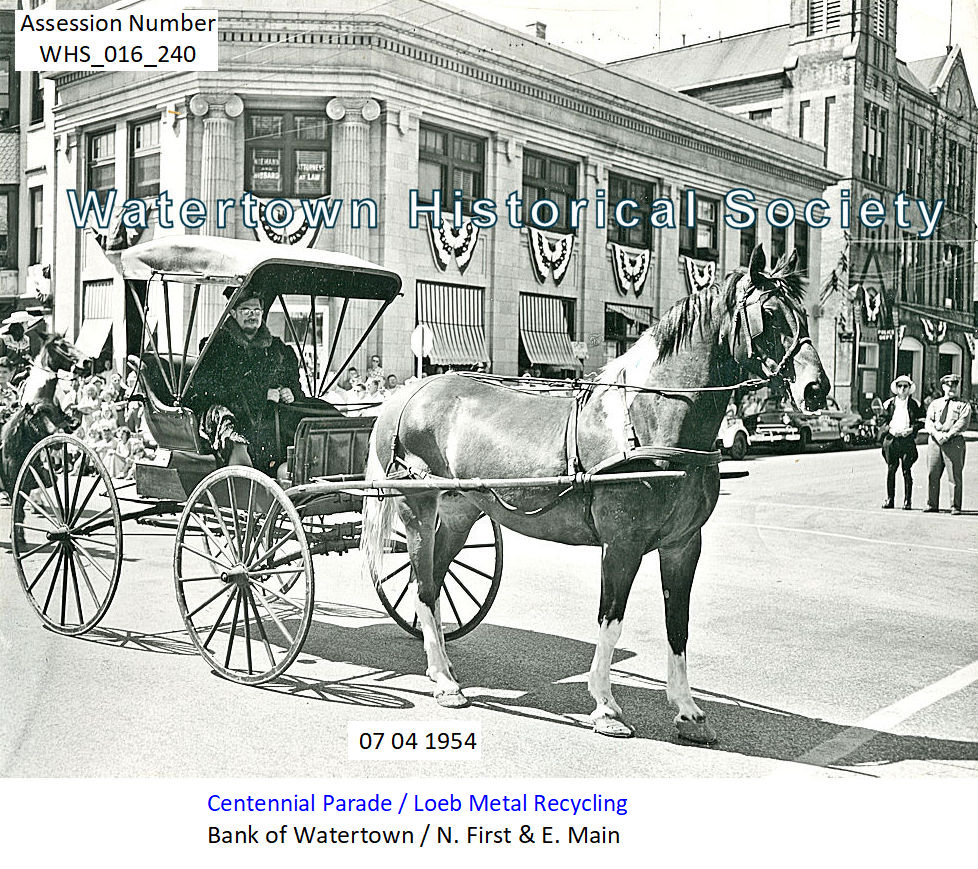
-- -- FORMER BANK BUILDING REMODELED
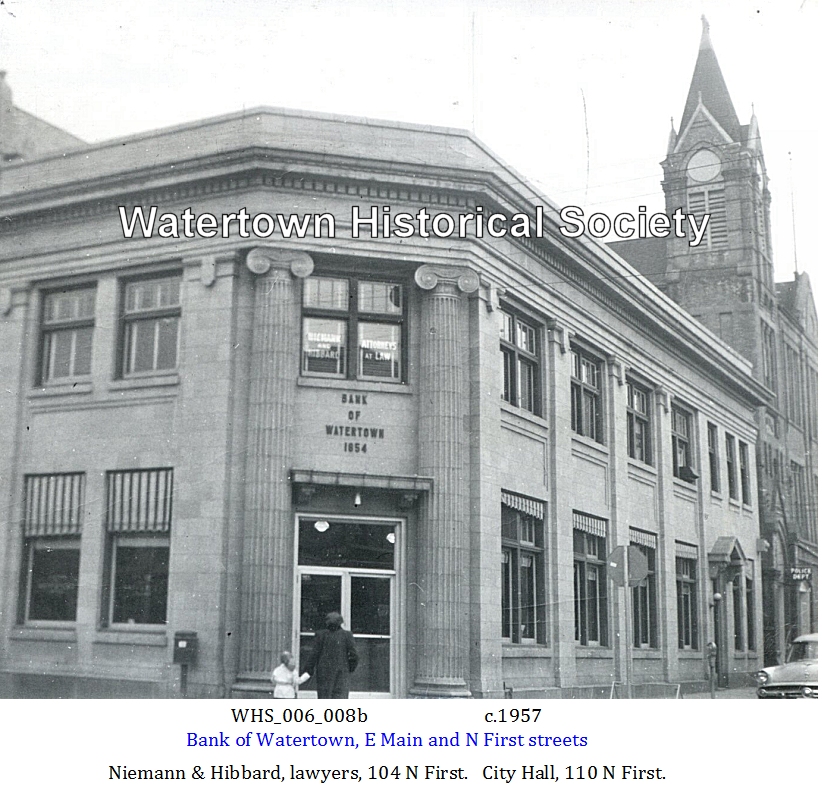
Remodeled in 1954, the former
bank building has been altered by the installation of metal storm windows on
the second floor and by the covering of the majority of windows on the lower
story as well as by the addition of a modern storefront in front of the
original corner entrance. Only two original windows located at the north end
remain on the structure.
08 14 BANK OF WATERTOWN CENTENNIAL OBSERVANCE
Flowers, good wishes and between
2,500 and 3,000 callers marked the open house at the Bank of Watertown Tuesday
afternoon and evening which was part of the institution’s centennial observance
now underway. Callers came from all
walks of life, and some were from out of the city. The flowers came in all colors and arrangements,
sent by Watertown business concerns, individuals and out of town associates. The visitors were shown through the bank’s
recently expanded quarters and routine banking operations were explained. Officers, directors and staff members shared
in greeting the many visitors who kept up a steady stream throughout the
afternoon and evening.
-- -- COMMEMORATIVE PUBLICATION
1956
06 30 FARMERS AND CITIZENS BANK ACQUIRED
After today Watertown will have
but three banks instead of the present four. With the close of business this
evening, the Farmers and Citizens Bank (1957c,
300 E Main, city assessor image) will cease to exist, according to
announcement made public today. The negotiations which led to this step were
underway for some time, but public announcement of the plan was withheld until
today.
As of today the Bank of Watertown
is assuming the deposit liabilities of the Farmers and Citizens Bank. All loans
and mortgages will be payable hereafter to the Bank of Watertown. At a special
meeting of the stockholders of the Bank of Watertown held late Wednesday
afternoon they ratified a plan to increase the capital stock of the bank from
$200,000 to $250,000 and endorsed the proposal previously acted on by the board
of directors to assume the deposit liability of the Farmers and Citizens Bank,
the announcement said. All loans and mortgages will be payable hereafter to the
Bank of Watertown. WDT
c.1950s-60s
Those were the days the Bank
closed at 3:00 and Fridays reopened from 6:00 tp 8:00.
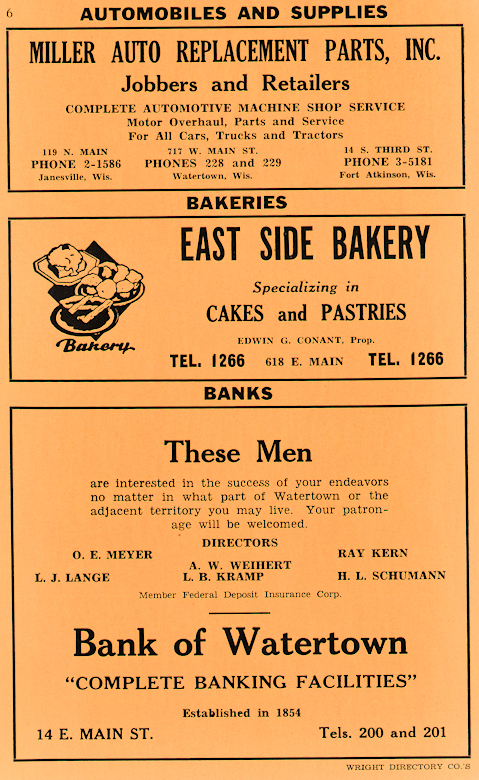
1957 DIRECTORS
City Directory Ad: Meyer, O E; Kern, Ray;
Weihert, A W; Lange, L J; Kramp, L B; Schumann, H L
c.1957
1960
03 26 Bank acquired property; 106 Madison St, 8 E
Main, 10 E Main WDT
12 14 L. J. Lange, 313
Elizabeth Street, president of the Bank of Watertown since 1946, announced his
retirement from banking at the end of this year. His plans to retire did not come as a
surprise since he had made it known last year that this would be his last year
as a banker. He is a member of the board
of directors of the bank. Mr. Lange, who
was born in Watertown, went to work for the Bank of Watertown in 1911. On June 2, 1924, became cashier of the bank,
succeeding the late Fred Gamm who had been cashier for many years. On Jan. 10, 1946, Mr. Lange was elected
president, succeeding Henry Mulberger at the time of his retirement from
banking. WDT
1961
01 12 The Bank of
Watertown elected a new president, Harold L. Schumann. He succeeds L. J. Lange who announced in
December that he would retire from banking.
Mr. Lange was elected vice president and cashier last night. He will remain with the bank until a new man
comes into the institution to join the staff.
Walter F. Manthey was elected assistant cashier, R. J. Hoge was elected
assistant vice president and J. V. Anderson was elected assistant cashier. Directors elected last night are Ray J. Kern,
L. B. Kramp, A. Weihert, L. J. Lange and Harold L. Schumann. WDT
08 02 The Bank of
Watertown last night was granted permission to make use of the city hall alley
in order to carry out its plans for a drive-in banking facility. The vote was 8 to 5. There was little or no debate on the issue
and during the discussion, Gerald E. Flynn, vice president and cashier of the
bank revealed that the bank hopes some day to acquire the present city hall to enable it to
carry out a greater expansion program.
Mr. Flynn said that the day is undoubtedly coming when a new city hall
or municipal building will be constructed in Watertown and that when that time
comes the bank will certainly be interested in an opportunity to acquire the
present city hall site. WDT
12 31 L. J. Lange,
313 Elizabeth Street, finally brought to a close his career as a banker last
evening. More than a year ago Mr. Lange
announced plans to retire from the Bank of Watertown where he has been
associated for a little more than 50 years but circumstances arose in the bank,
including the death of Harold L. Schumann and several staff changes, which made
it impossible for him to sever his connections until now. He still has the
title of vice president and is also a bank director. Mr. Lange formerly served as
president of the bank following the death of Henry Mulberger. Mr. Lange last
year gave way to Mr. Schumann for the presidency and accepted one of the vice
presidencies. After Mr. Schumann’s death, Gerald E. Flynn who had been brought
to Watertown to join the bank staff was elected president and Mr. Lange
continued as one of the vice presidents and a director. WDT
1962
01 02 L. J. Lange,
who retired last week from the Bank of Watertown with which he was associated
for more than 50 years, and James J. Schmied, well known Watertown builder,
announced the formation of a real estate and building partnership to be known
as Schmied and Lange, Inc. Mr. Schmied,
who is president of the Watertown Home Builders Association, has been a builder
here for the past 12 years, specializing in homes. He resides in route 5 on highway 26. Mr.
Lange, who resides at 313 Elizabeth Street, said that the new business will be
located at 112 North Second Street, which for years has been the office
quarters of Kading and Kading. WDT
1963
09 06 The Bank of
Watertown has made an offer, subject to negotiations, to acquire the present city hall property in North First
Street [110 N First] in order to carry out its long standing plans for
expanding its present bank facilities.
The offer was made public last night at the meeting of the common
council. That the bank seeks the
property has long been a matter of record.
In fact some years ago, when Lawrence J. Lange was still president of
the bank, it was announced at a meeting of the council that the bank wanted the
present city hall when and if a new municipal building were constructed. Such construction is now underway in Memorial
Park and the city will occupy the new building late next year, vacating the
present city hall which was erected in 1884.
WDT
1964
01 08 BRANDT FAMILY MEMBER
BACK ON BOARD OF DIRECTORS
The Bank of Watertown held its
annual meeting last night. Elected to the
board of directors are Ray J. Kern, Edgar J. Kellerman, L. J. Lange, A. W.
Weihert, L. B. Kramp, Gerald E. Flynn and E.
James Quirk. Mr. Quirk is the newest
member of the board of directors. This
rounds out the board membership by bringing in a Watertown industrialist. This brings a member of the E. J. Brandt
family back into the Bank of Watertown organization, Mr. Quirk’s grandfather,
the late E. J. Brandt, having been cashier of the bank many years ago.
1965
01 13 RELOCATE FROM FIRST AND
MAIN TO NORTH SECOND STREET
The Bank of Watertown today
announced plans to relocate. It will
abandon its present Main and North First Street building and move to a new and
modern bank building to be constructed in the North Second Street at Madison
Street section. The site which the bank
will acquire, and on which it has held options, runs along North Second Street
from Madison Street to Jones Street and involves the Kopp buildings, the
Schuenemann property and the Kellerman property which now houses the Kroger
Supermarket in Madison Street. WDT
The M&I Bank is now located on land which was acquired from a number
of different businesses. Among them were
Koerner and Pingel Hardware Store, Kopp Sheet Metal, Kroger Food Store, Elmer
and Beats Tavern, Marachowsky’s Grocery Store, Kellerman Insurance Agency, and
Hofbrau Tavern.
1966
01 15 PREPARATION OF NEW SITE
AT NORTH SECOND STREET
Work has begun on demolishing the
first building located on the site of the future new Bank of Watertown. The building being torn down was among the
pioneer bakery establishments in Watertown, at the corner of North Second and Jones
Streets. According to the bank’s plan
for its new building, the new bank site runs along the east side of North
Second Street, from Jones Street south to Madison Street, and includes the
former Schuenemann property, the Kopp buildings and the Kellerman property
which formerly housed the former Kroger Supermarket in Madison Street. WDT
07 07 LEO’S STAR HARDWARE
SITE
The Bank of Watertown, having
acquired the property occupied by Leo’s Star Hardware store in North Second
Street, part of the site which the bank purchased last year for its new bank
building, is planning a closing out sale so the business can be terminated and
work begun on the demolition of the last of the buildings making up the new
bank site. The new bank property runs
along North Second Street, from Madison Street to Jones Street, as well as
property in Madison Street, running up to and including the former site of the
Kroger Grocery store building. Most of
the buildings have already been demolished and cleared for bank construction to
begin. WDT
08 04 LAST BUILDING ON SITE
DEMOLISHED
Wrecking the last building units
on the site of the new Bank of Watertown has started. The bank, designed by Law, Law, Potter and Nystrom,
Madison architects, will be located in North Second Street, between Madison and
Jones Streets, including landscaping and customer parking facilities. Other buildings in the nearly one block area
were demolished earlier. The architects
have been given the word to prepare the final working sketches and will also
construct a scale model. WDT
1967
02 27 BUILDING PERMIT FOR NEW
LOCATION
The new Bank of Watertown project
in North Second Street “saved the day” for new building in the city in February
and helped make a presentable showing in the line of new building permits for
the month. The total for the month stands at $228,600, of which $206,400 is
represented by the permit granted to the bank for construction of its new
building. That is for the building only.
WDT
07 10 SOLD TWO BUILDINGS TO
FISCHERS
The Bank of Watertown, which is
to vacate its present building at Main and North First Streets before the end
of the year and move into its new building in North Second Street, between
Madison and Jones Streets, sold the two Main Street buildings it acquired some
years ago as part of a plan which then called for expanding its present banking
facilities, it was revealed today. The
two buildings, formerly occupied by the New York Market and the Mother Nature's
Cupboard, a health food establishment, has been sold to the Chas. Fischer and
Sons Co. which will utilize the two properties for expanding and remodeling its
store. The Fischer store has for many
years occupied the major area of the Masonic Temple which it purchased last
year from the Masons who will vacate their lodge quarters before the end of the
year and move to a new Masonic Temple in Madison Street.
12 18 CORNERSTONE LAYING
CEREMONY
A cornerstone laying ceremony was
held at the new Bank of Watertown building, located at the second block in
South Second Street. Pictures and other
items were placed in the box. Pictures
included one of the first Bank of Watertown building, erected in 1854, at First
and Main streets; of the present building, built in 1916, at the same location,
and of the officers and directors who participated in the ground breaking
ceremony on February 14, 1967. Other
items placed in the box included: An
issue of the Daily Times of January
15, 1965, which carried a page one story telling of the decision of the
stockholders and board to erect a new bank building, and a Dec. 20 issue of the
Times.
1968
01 30 RELOCATES TO NORTH
SECOND ST.
The Bank of Watertown today began
its operations in its new bank building, located on North Second Street, one
block north of Main Street. Starting
with the closing of the old bank at 8 o’clock on Friday night, the moving
operation began. The biggest single task
in connection with the moving operation was moving the seven-ton vault
door. The door arrived at the new bank
at noon Saturday and was in place by 1:30 p.m., but another five hours was
required to level it. By 6:30 p.m., the
work was completed, and the door was closed and locked at the new bank
building.
02 06 OPEN HOUSE AT NEW
LOCATION
Open House at the Bank of
Watertown’s new home, located on North Second Street, one block north of Main
Street, will be held on Friday and Saturday.
The Friday hours are from 9 a.m. to 8 p.m.; and the hours on Saturday
are from 10 a.m. to 5 p.m. Coffee and
doughnuts will be served during the Open House.
This new building is a one-story structure located on the northeast
corner of North Second and Madison Streets.
The site covers nearly one block.
The new building is complete in every respect, and provides the last
work in convenient and attractive banking facilities. Outside two depository windows are located on
the east side of the building. Parking
space is provided on the north side of the structure.
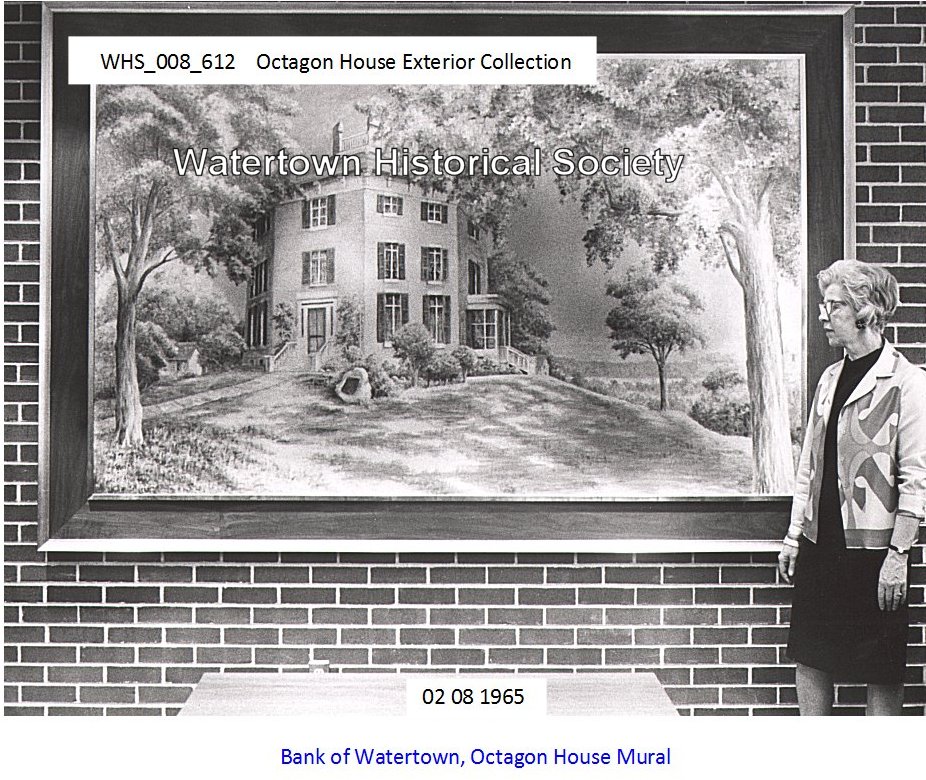
02 08 OCTAGON HOUSE MURAL
07 07 ROBERT WESTRICK
Robert W. Westrick, 32, of
Detroit, Mich., has joined the staff at the Bank of Watertown as of today. He will be replacing Miss Lorraine Schatz,
who will be retiring at the end of the year after over 16 years of service with
the bank. Prior to that she was private
secretary for the late Attorney William H. Woodard who was associated with the
bank. For the past 11 years Mr. Westrick
has been employed with the National Bank of Detroit as a branch manager. He joined the Detroit bank upon graduation
from the University of Notre Dame. His
wife is the former Donna Welsch, daughter of Mr. and Mrs. Bernard Welsch, 597
South Third Street.
12 28 LORRAINE SCHATZ
RETIREMENT
Miss Lorraine I. Schatz, senior
trust officer of the Bank of Watertown, will retire on Tuesday. She was employed by the bank on March 17,
1962, as a secretary after working in a similar capacity for the late Judge
William H. Woodard for a period of over 32 years. Because of her extensive probate background
she was elected to head the bank’s trust department in January of 1962. Gerald E. Flynn, bank president, today
expressed regret over her leaving the bank.
He, the bank’s employees and the board of directors extend to her many
years of true contentment and joy in her well-earned retirement.
1969
10 13 AUTO SHOW SPONSORED BY
THE BANK
Over $190,000 worth of
automobiles were displayed in the parking lot of the Bank of Watertown for the
new car show sponsored by the bank with the cooperation of all city car
dealers. Live music was provided by Tommy
Voigt and his band and free refreshments were served.
Link
to four images within portfolio
1990
04 03 FLYNN RETIREMENT
Herald F. Flynn, who has served
as the president and chief executive officer of M&I Bank in Watertown since
1961, has announced his retirement from that position. Flynn, 63. said his retirement will take
effect on July I, 1991. After July I of
this year, he will continue to serve in a part-time capacity as a consultant to
the bank until he retires. The Kaukauna
native began as vice president and cashier at the Watertown hank in June of
1961. In October of that year, Flynn was
appointed president and chief executive officers. After retiring Flynn plans to continue to
reside in Watertown with his wife. Joan, at 1082 Boughton St. They have three children. “Twenty-nine years is a long time in any job,
let me tell you. I e joyed it, very much
so. We love Watertown, and Watertown has
been good to us." he said.
1991
03 05 M&I BANK REMODELING
The M&I Bank of Watertown has
begun an extensive three phase remodeling project which is expected to be
completed in the middle of May, according to William Shoemaker, president. The initial phase of the project addresses
exterior signage consisting of bronze bank name lettering, parking and traffic
direction signage, illuminated bank logo identifier and customer
information. The second phase, which is
currently underway, addresses the installation of additional exterior windows
along the west side of the building.
Also included in this stage of the remodeling is the relocation of
extensive offices, conference rooms and the establishment of a personal banking
center. The final phase of the
remodeling includes recarpeting, reupholstering of furniture and draperies in
colors and coordinates appropriate to financial institutions. WDT
1992
01 16 OFFICERS & DIRECTORS
William E. Shoemaker Jr. was
re-elected president and chief executive officer of M&I Bank of Watertown
at the annual meeting of the bank Wednesday.
Other officers are H. Bruce Kasten, executive vice president;
Christopher Jurss, cashier and controller; Larry Schuett, vice president real
estate; Patrick Caine, commercial loan officer; Daniel Thousand, vice president
agriculture; Wayne Duris, assistant vice president agriculture; Larry
Braunschweig, vice president retail, and Ora Kuckkan, auditor. Directors reappointed to their positions were
Shoemaker, Kasten, Bertram Beltz, William Kwapil Jr., Edward McFarland,
Alexander Napolitano, George Neuberger, William O’Brien and Jerald Theder.
Re-elected as director emeriti were Edward Dobbratz, Dr. V. R. Bauman, E. James
Quirk, Edgar J. Kellerman and L. B. Kramp.
WDT
06 24 PATRICK CAINE PROMOTION
The board of directors of the
M&I Bank of Watertown has approved the promotion of Patrick J. Caine to
assistant vice president of commercial lending.
Caine is a graduate of the University of Wisconsin-Whitewater and
Marquette University. He comes to
Watertown from the Marshall & Ilsley Corp. in Milwaukee. Caine will oversee the bank’s credit
administration and its regulatory compliance function, in addition to his new
responsibility. WDT
10 17 JOHN EBERT ELECTED
John H. Ebert was elected
president and chief executive officer of M&I Bank of Watertown at a special
board of directors meeting Wednesday evening.
Ebert, 39, succeeds William Shoemaker who resigned as president on Sept.
24. Ebert has served the last four years
as president of M& I Tri-County Bank in Marshfield. Prior to that he spent six years as
commercial lending vice president at M& I First National Bank in
Wausau. Ebert holds a bachelor’s degree
in business administration from St. Mary’s College in Winona, Minn., and a
master’s degree in business administration from the University of
Wisconsin-Oshkosh. A native of
Wisconsin, he has more than 15 years of banking experience. WDT
1993
11 09 M&I BANK AND VALLEY BANK
COMBINE
Upon completion of the M&I
and Valley merger, which is expected in mid-1994, the M& I Bank of Watertown
and Valley Bank will combine, creating a single operating bank with offices in
Watertown, Beaver Dam and Juneau.
Following the merger, David M. Hanson will become chairman and chief
executive officer and John H. Ebert will be named president. Hanson is currently chairman and chief
executive officer of Valley Bank South Central and Ebert is president of M&
I Bank of Watertown. The combined assets
of the M& I Bank of Watertown and Valley Bank South Central will be
approximately $213 million. WDT
1994
09 20 DAVID HANSON MOVES ON
David M. Hanson, chairman and
chief executive officer of M& I South Central, headquartered in Watertown,
has been named chairman and chief executive officer of M& I Bank S.S.B. in
Sheboygan. Hanson will begin his new duties on Monday, Oct. 3. He plans to remain in Watertown for some
months before moving permanently to the Sheboygan area. John H. Ebert, who is currently serving as
president of M& I Bank South Central, will continue in that capacity and
will assume the responsibilities previously held by Hanson. “Dave has been an outstanding member of the
Watertown community and an excellent leader at the bank. He will be missed,” Ebert said. “M& I South Central remains committed to
Beaver Dam, Juneau, and Watertown. We will
continue to focus on strengthening these communities through our business and
civic activities,” he added.
2007
01 20 GREG SCHROEDER VP
Local resident Greg Schroeder,
who works at the M&I Bank offices in Watertown and Beaver Dam, has been
promoted to vice president. Schroeder,
who has over 13 years of financial services experience, is a senior financial
adviser and has been with M& I since 1996.
Schroeder has earned bachelor’s degrees from Hamline University in St.
Paul, Minn., and a master’s degree from Marquette University. WDT
01 20 TODD FISCHER JOINS BANK
Todd Fischer has joined M&I
Bank, 205 N. Second St., as a business banker.
Fischer was the vice president and general manager of Fischer’s
Department Store in Watertown for over 19 years. In his new role as a business banker, Fischer
will assist his business customers with their daily financial needs. Fischer is a graduate of the University of
Wisconsin-Madison and is active in the community as a board member of Watertown
Chamber of Commerce. He was the chairman
for the Watertown Streetscape Committee and is the founder of the Watertown
Central Business Association.
2008
01 26 TODD FISCHER PROMOTED
Todd Fischer, a business banker
with M&I Bank in Watertown, has been promoted to the title of officer. Fischer earned a bachelor’s degree from the
University of Wisconsin-Madison and is a graduate of the Wisconsin Banker
Association Introduction to Commercial Lending School. He founded the Watertown Central Business
Association in 1992 and served as the organization’s inaugural president until
1997. He was the vice president and
general manager of the former Fischer’s Department Store
in Watertown for over 19 years. WDT
07 26 TODD SCHEID HIRED
Todd Scheid has been hired by the
Watertown office of M&I Bank as its new vice president of business
banking. Scheid has over 24 years of experience
in banking, most recently with ISB Community Bank and Town and Country
Bank. Scheid received his bachelor’s
degree from the University of Wisconsin-Whitewater in 1985 and is a graduate of
the Madison Graduate School of Banking.
10 26 PATRICK CAINE
M& I Bank senior vice
president Patrick Caine will become the market president of the local business
starting on Jan. 1, 2009. Caine will
replace John Ebert, who announced his retirement Monday. Caine began his career with M& I in 1985
in Milwaukee and moved to the Watertown office in 1991. In addition to his new duties as market
president, Caine will continue in his role as a business and agricultural
banking manager for M& I’s southwest region. Caine has served the community in various
capacities over the years and is the current board chairman of the UW Health
Partners Watertown Regional Medical Center.
He is also a trustee for the Joe Davies Scholarship Foundation and
serves on the finance committee of St. Henry’s Parish.
2020
08 05 WHITE OAK BUILDERS OCCUPANCY
Remodel
of 14 E. Main (scroll through)
2022
12 04 PARADE OF HOMES LOCATION
The original Bank of Watertown
building built in 1854 has been a staple on Watertown’s Main Street for over
150 years. It has transferred hands and
gone through major renovations in that time to become what it is today.
In 2019, Dan and Maggie Wegner,
owners of White Oak purchased the building with the goal of keeping the
original features and showcasing the grandeur of the space.
The original scrolled plaster
work adorns the 14’ high ceilings and columns in the main showroom area. During renovations they were able to open the
original window openings to allow floods of natural light into the space again.
Keeping with the traditional feel
of the space and encompassing some modern flare they have renovated the main
room to be the show case and retail location for White Oak Design and
Build. Offering general contracting
services for new home construction and remodeling, design services, and unique
home décor. Their focus is to assist
homeowners in bringing their ideas, wants, needs, and concepts for their ideal
home to reality.


|
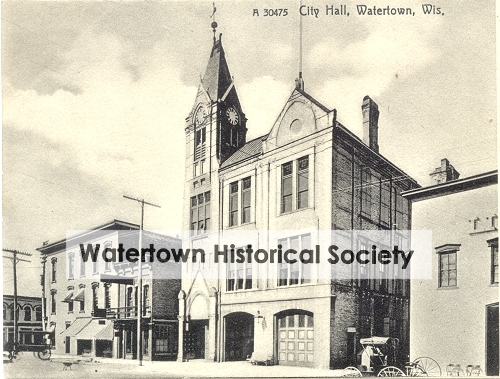
c1897 City Hall right |
c1900 Right. N. First & Main |
c1900 Left. No First St |
|
|
|
|
|
|
|
|
Cross
References:
E J Brandt's inventive talent came to the fore
while he was employed as a cashier in the Bank of Watertown. Tiring of counting money for railroad
payrolls, he invented an automatic cashier and in 1890 founded his own company
to manufacture this product, Brandt Inc.
Death of Richard Hoge, 1983

History of Watertown,
Wisconsin