website watertownhistory.org
ebook History of Watertown,
Wisconsin
Maes’ Shanty
F. P. Brook (Peter Brook)
1835-1909
Brooks & Hawkins
Peter’s Shanty
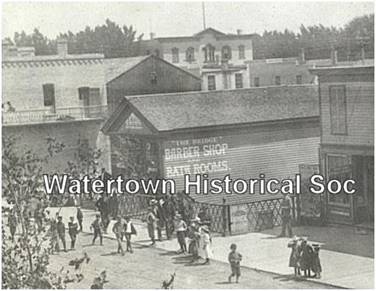
Store,
Shop, Shanty — “The Bridge” Barber Shop and Bath Rooms [portion of image NT051_FarmersPicnic_2_1898]
South side of Main Street bridge
“The History of Jefferson County, Wisconsin”, Chicago: Western Historical Company. 1879.
F P Brook, groceries, fruits and confectioner; was born in Veldenz, near the river Moselle, Prussia, June 22, 1835,
and came to Wisconsin in the summer of 1850 ; located in the town of Watertown,
on a farm that his father purchased from Mr. McCready.
He
then came to Watertown and learned the barber's trade; he remained at his trade
for five years and, in 1857, started a fruit and confectionery, which he
carried on for about eighteen years; in 1866, he started the Red Front Store,
adjoining the Bank of Watertown, which he
carried on in connection with his other store.
For about two and a half years, Mr. Brook quit business, for a rest, and
then started the store he now occupies and in which he is doing a successful
and profitable business.
AD FOR THE RED FRONT STORE
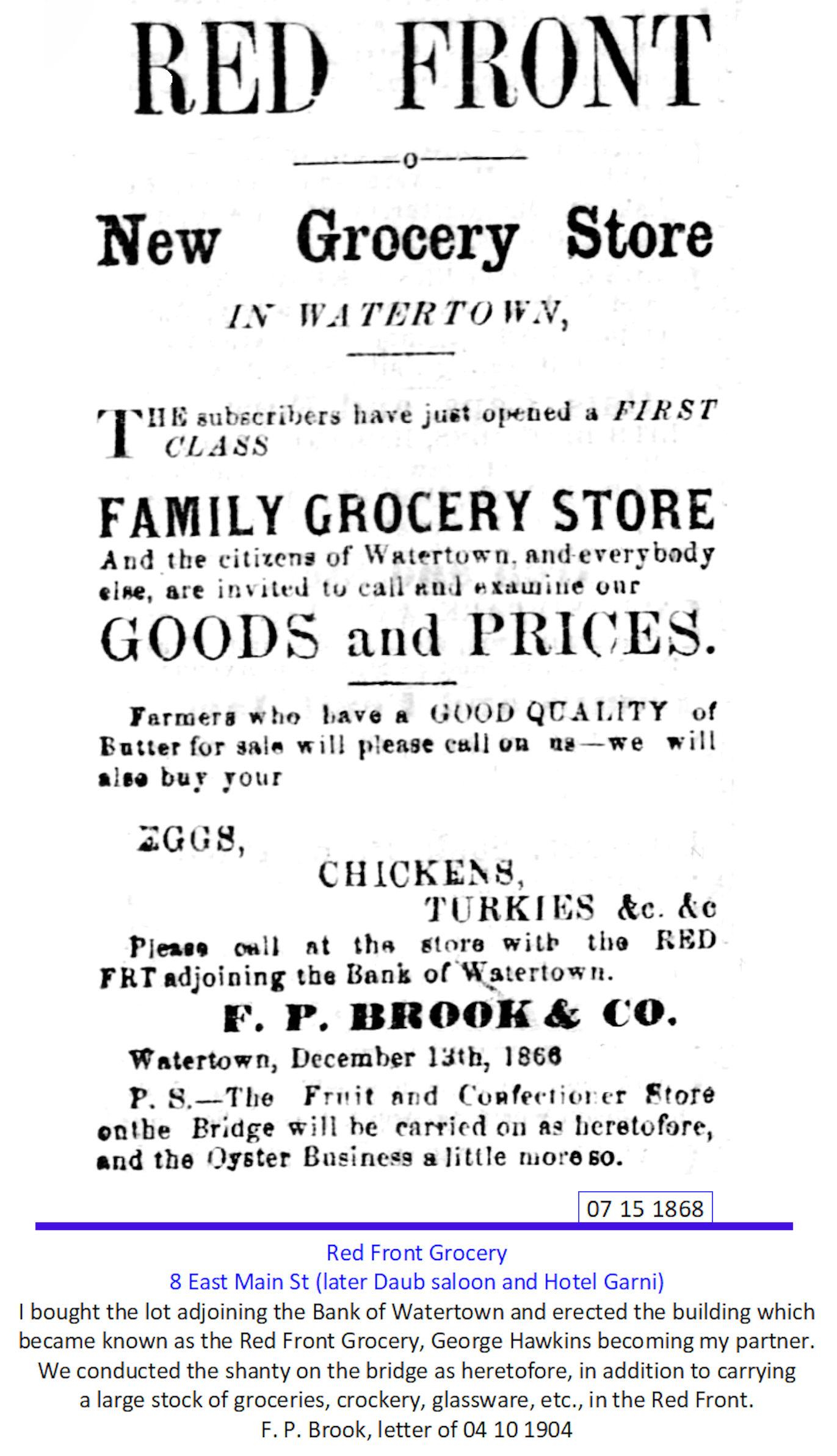 07 15 1868
He was
elected School Commissioner and resigned on account of his business; in 1877, was elected as Supervisor and again in 1879, which
position he now holds.
He married, December 31, 1857, Christiana Esslinger,
of Buffalo, N. Y. He has five children - Amanda, Edward, Emma, Charles and Ida.
1858
07 15 ICE CREAM SALOON—F. P. Brook & Co. have just refitted
their Ice Cream Rooms at their Confectionary & Fruit Store on the bridge,
and are prepared to serve up the Best Quality of Ice Cream Every Afternoon and
Evening. Ice Cream furnished for Parties
or Private Families on a few hours notice, in large or small quantities. Owing to the hard times we shall charge only
ten cents a dish this season. WG
07 22 Tomatoes and early apples are
among the seasonable luxuries to be found at F. P. Brook's Confectionary and
Fruit Store, on the south side of Main Street bridge. In a quiet way, the other day he sent parcels
of each of these articles to our residence, as if he would do us a kindness and
not have us tell where plenty more of the same sort could be found. An excellent place is that to get a glass of
cool and foaming soda, fresh from the pure fountain of health, or a dish of the
most delicious of ice cream. WG
08 12 Fruit in its
Season—Physicians concur and doctors do not disagree in the opinion that ripe
fruit, in its season, is the healthiest of all the varied productions of that
bountiful dame—Mother Earth—and in this sultry weather, when the physical
system is relaxed, and listlessness and lassitude have taken possession of us,
nothing is more invigorating or healthful than the fragrant apple, the juicy
pear, the luscious peach or crispy melon.
Nature that doeth all things well, is just now furnishing the golden
fruits in almost endless variety. And
Peter Brook, on the bridge, is dealing them out in quantity and quality to suit
purchasers. Oranges and lemons, peaches
and pears, apples and melons, in fact everything in his line, to suit the taste
of the most fastidious, may be found at "Peter’s." Give him a call and judge for
yourselves. WG
09 09 Old Stand Renewed—Have fitted up in good style the store on the south side of Main Street
bridge, formerly occupied by Maes & Roper, and
are keeping on hand and a complete assortment of Candles, Nuts, Green and Dried
Fruits, Pickles, Preserves, Oysters, Sardines, Lobsters, Bird Seed, Raisins,
Citron [large lemon-like fruit], and, in short, everything belonging to the
Confectionary and Fruit line. We have a
most complete assortment of Fancy Soaps, Hair Oil, Pomades, Colognes,
Perfumery, and Flavoring Extracts, which we will sell cheaper than anybody else
in the city. Ice Cream and Soda Water
always ready. F. P. BROOK & CO. WG
10 21 A large number of
goods may now be purchased at F. P. Brook’s Fruit Store on the south side of
the bridge. Fresh oysters, sweet
potatoes, delicious grapes, fine apples–most any article that comes under the
head of seasonable luxuries—can always be purchased there. That establishment is one of the necessary
institutions of this city. WD
1859
02 03 Oysters at Peter Brook &
Co. WD
03 03 Fitted up store on the south side
of Main Street bridge, formerly occupied by Maes
& Roper
06 02 Ice cream season has
arrived WD
1860
02 23 “Jeems” This distinguished individual has recently
located in this city—a fact of which our readers may not be fully aware. He serves up the “latest importations” of
oysters, warm and cold victuals, and fluids vulgarly styled refreshments[?], at
the usual rates. He is up at all hours,
can be depended upon in every emergency, and “runs wid der masheen.” He may be found in the small building at the
further end of the bridge on the left side, if you are going that way, or in
the same building, on the right side, if you are coming this way. He is reliable. WD
03 15 Spring has come and so
have tropical fruits at F. P. Brook & Co.
Oranges and lemons, by the box, dozen, or any other number from one to
ten thousand, may be obtained there cheaper than they have ever before been
sold in this city. Only think of it,
oranges at wholesale can be bought there for less money than they are sold in
Milwaukee, and large, fine lemons for a quarter a dozen. New maple sugar we also see displayed in his
window and apples that in size, flavor and soundness cannot be surpassed. WD
06 28 A New
Era—Peter F. Brook is a fast man and keeps up with the times. He has discovered that the evenings are
short, and summer afternoons warm. So he
is going to provide delicious Ice Cream for the public as early as 1 o'clock,
p.m., when all can get a glass by calling at his rooms, down stairs. Cherries he has already had, and now early
apples are among the tempting things that attract public attention to his
establishment. WD
10 12 We know of no one more deserving of praise for cultivating the
public taste then friend Brooke, whose constant and sole labor is devoted to
this exalted work. His is the most
agreeable discipline, to which he treats all who employ his services. Moreover, considering how salutary his
lessons are, the tuition is as low as that term is brief. Therefore, all should attend to the needed
internal improvement at the institution on top of the river. WR
10 26 WATERTOWN OYSTER DEPOT
The subscriber is agent for this city for the sale
of C. S. Maltby's celebrated and renowned oysters, which he will always sell at
wholesale at Milwaukee prices, and at retail in proportion. Oysters received daily and warranted fresh. Depot at the fruit store, middle of Main
Street bridge, where he also keeps candies of every description, the best of
cigars, tobacco, nuts, etc., at wholesale and retail. Oysters, sardines, etc. by the dish at his
Eating Rooms. F. P. Brook WR
12 06 NEW YEAR'S EVE BALL
Mr. Peter Brook is now
actively engaged in making arrangements to give the citizens of this city and
vicinity a brilliant and splendid New Year's Eve party. It will not be surpassed by anything of the
kind that has ever been got up here. No
pains will be spared to make it delightful to all who attend. Fine music, table loaded with all the
delicacies that can be found in the market, a gay assemblage, all will be
combined to render it the festival of the season. Let all who enjoy a dance come, and pass the
last night of the year in social intercourse.
WD
12 13 NEW YEAR’S FESTIVAL
F. P. Brook is busy
with his efforts to render his New Year’s Festival as brilliant and pleasant as
the most liberal expenditures will do it.
He is determined it shall be a success and all who attend have the
opportunity to bid a cheerful adieu to the old year and a happy welcome to the
new year. Strains of animating music
shall attend the departure of the one and the arrival of the other, and a gay
throng keep step to the melody and movements of the passing hours.
Grand New Year’s Ball
and Oyster Supper. At Cole’s Hall,
Watertown, Wis., on Monday evening, Dec. 31, 1860.
Yourself and lady are
respectfully invited to attend. Honorary
Managers: Hon. M. B. Williams, Hon.
Charles R. Gill, Hon. Chas. Billinghurst, D. W.
Ballou, Jr., Hon. Theodore Prentiss, Hon. L. A. Cole, P. V. Brown, Esq., J. T. Moak.
Managers: Joseph Linden,
Dr. G. Shamberg, T. McMahon, C. A. Sprague, E. Stoppenbach, Edward Johnson, E. M. Hall, Dr. James Cody, A. Stein, Watertown; W. S. Green,
Milford; C. P. Mead, R. B. Basford, Waterloo; Dr. Wm. Potter, J. Dutcher, Lake
Mills; Chas. Daniels, Oak Grove; James Thorn, Juneau; Edward M. Mahon,
Jefferson; W. M. Phelps, Farmington.
Floor Managers: O. D. Pease, D.
D. Scott, Peter Rogan.
Table
Superintendent: Jacob Jussen
Music by the Watertown
Brass and String Band
John Fuller,
Prompter. Tickets, including supper,
$2.00. Carriages in attendance.
F. P. Brook WD
1861
06 06 BROOK’S ICE CREAM SALOON
Mr. F. P. Brook is fitting up his Ice Cream Saloon, on the south side of
Main Street Bridge, in a style that will make that pleasant summer resort
attractive to the public. He is
constructing a pair of stairs on the east side of his building, so as to make
access to his saloon more convenient.
With well-furnished reception rooms, the most delicate and delicious of
creams, the choicest of fruits in abundance, we hope he will find his reward
for his enterprise and liberality in the presence of all the visitors he can
attend to in his best manner. WD
1861
10 10 SWEET POTATOES, of a fine quality, from
“the land of Dixie,” can be bought at Brook’s Fruit Store, on the [Main Street]
bridge. Neither his oysters, fruit,
confectionary or cigars are all gone yet.
He has more of each kind left. WD
11
07 BRIGHT AS NEW
F. P. Brook has just
overhauled, repaired and newly fitted up his Fruit Store and made his Eating
Rooms pleasant and attractive to visitors at all hours – morning or
evening. His variety of choice fruit is
always large – no better oysters than his ever find their way to the West – his
cigars are the best brands that can be bought in any market – and he attends to
all calls with promptness and politeness that render it a pleasure to deal with
him.
1862
01 09 ENOUGH LEFT YET
[Advertisement] Notwithstanding the rush of Oysters, Confectionery,
Apples, Tropical Fruit, and a thousand other good things at F. P. Brook’s
during the holidays, he has still a large quantity on hand to please his
customers. And what is more, the price of
Maltby’s best Oysters, fresh from the East, have come down in price and may now
be had for 50 cents a can. A fine
article of Sweet Cider has just been received, which we state for the benefit
of those interested. WD
1863
06 18 FIREWORKS
F. P. Brook has now for sale a large stock of all varieties of
fireworks, consisting of Rockets, Fly-Wheels, Blazing Stars, Torpedoes, Chinese
Crackers – everything that will make a noise and create a brilliant light. He has also a lot of Union Flags of different
sizes, which are neatly and well made.
All who want to celebrate the coming Fourth can get the “fixings” at his
establishment. WD
07 02 FOURTH OF JULY
“The Day We Celebrate” [4th of July] will see F. P. Brook’s delightful
ice cream rooms tastefully adorned and made attractive for the reception of
such parties as may occasionally wish to escape from the throng and heat of the
streets and quietly partake of a dish of the nicest of creams, made in his best
style, which all know is as near perfection as anybody comes. That will be a charming place to take the
ladies for a little rest and refreshment.
WD
12 17 THE CHRISTMAS HOLIDAYS
As usual, E. P. Brook has procured a large and fine variety of
confectionery for the holidays. Sometime
between this and New Year’s, we should not be surprised if Santa Claus made
ravages on his fine stock of curious toys, to the great delight and surprise of
those who will expect a stocking full of something out of which to make a Merry
Christmas. We hope every little one will
get a full share – and none will be disappointed. WD
1864
07 21 APPLES
AND RASPBERRIES
Harvest
apples and raspberries may now be found at Brook’s Confectionery and Fruit
Store. His soda fountain is in full operation,
distilling a healthy and cooling beverage and his reception rooms are filled
with parties warm in their praises of his delicious and delicate creams. Peter gratifies everybody because he always
furnishes the best things for his customers – he has a genius for “the pleasing
art.” WD
09 29 SWEET
CIDER
Brooks is now furnishing customers with a very fine article of new sweet cider
– the first, we believe, sold in the city this season. WD
11 17 ONE
OF OUR INSTITUTIONS
In the multiplicity of past effort, who shall tell of the wondrous
arrivals at that model of all places, F. P. Brooks Confectionary and Fruit
Store, Oyster Depot, Tobacco and Segar Emporium. Seeing is believing and one has need to see
in order to enumerate the choice and splendid stock at Brooks. Apples of all varieties and choicest
kinds. Confectionary in every
grade. Oysters from the shell, raw,
fried or stewed as you like. Tobacco
from Pig-Tail to Derry-Down Twist, including Cavendish, Broad-Side, Plank-Road,
Mrs. Miller’s, Killikanic and Old Virginia. Cigars from old Havana and cigarettes from
Chile and Peru. All may be frond at
Brook’s, where the gentlemanly proprietor is at all times ready to attend to the
wants of his numerous customers, and cater to their taste. And then there is Mr. George Hawkins, who
seems to have almost become a part of the institution – always intelligent,
upright and courteous, waiting on customers at all times with cheerfulness and
alacrity. We hope “George,” as all call
him with respectful kindness, will one of these days have an establishment of
his own, become rich and prosperous, and continue to receive the universal good
will he now enjoys. WD
1865
05 05 NEW
TRIM FOR SPRING BUSINESS
F. P. Brook has been engaged in putting his
extensive fruit and confectionary establishment in a new trim for spring
business. His pleasant and elegant
reception rooms have been neatly painted and improved in various respects. H is stocks of tropical fruit, candies and
segars are as large and fine as anywhere can be found. In fact, there is no better establishment of
the kind in any city in the state. He is
always the first to receive and offer for sale everything that is new and rare
in the market. WD
11 09 DATES
FROM ARABIA
E. P. Brook has quite a novelty at his fruit store
in the shape of genuine dates from Arabia.
Some of the fruit is yet attached to the stems on which it grew, and all
of it retains its original form and flavor.
WD
1867 BIRDS EYE VIEW
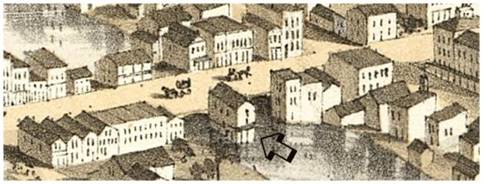
1875
F P Brook, George Hawkins, confectionery on bridge, Main / 1875-6 Watertown City Directory
1898 Farmers Picnic
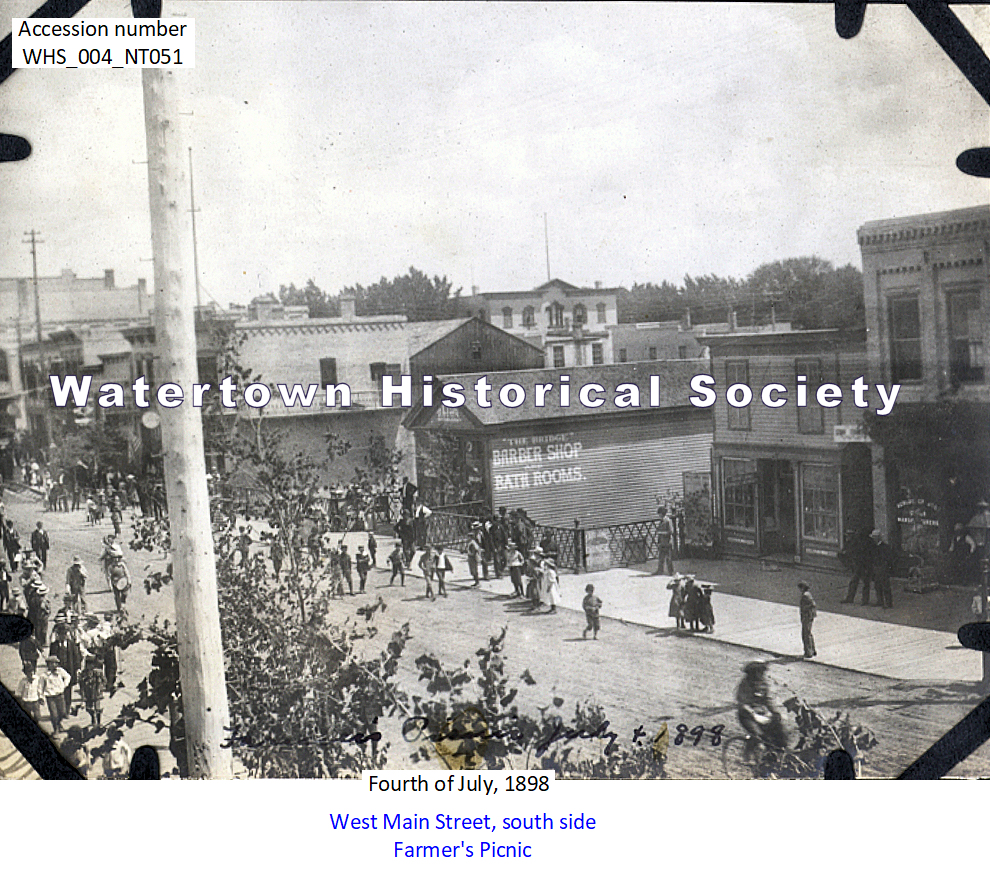 NT051
NT051
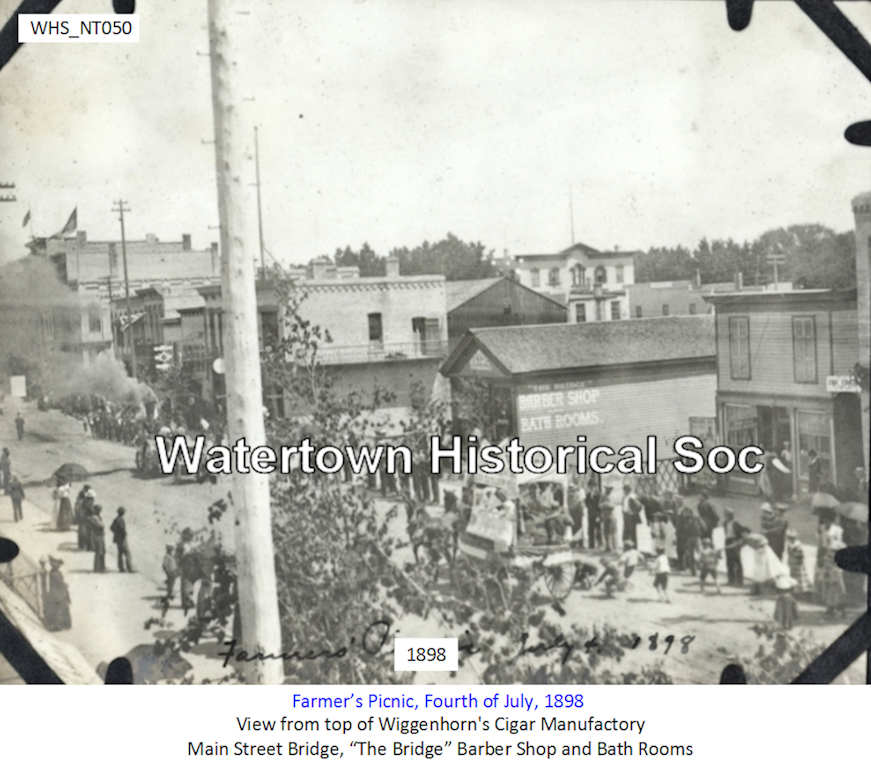 NT050
NT050
1904 Flood takes out Peter’s
Shanty See Featured Article, below
1909
02
26 Died. F. P. Brook died at this home in Green Bay
last Sunday, in which city his remains were interred on Wednesday. Mr. Brook was for many years engaged in
business here with George Hawkins and was one of Watertown’s best known
business men. Deceased was born in Veldenz, Prussia, June 22, 1835, and in 1850 came to
America, locating on a farm in the town of Watertown. Shortly after coming to Wisconsin he learned
the barber’s trade in this city and in 1857 opened a confectionary and fruit
store in the frame building that for many years was located in Rock River on
the south side of Main Street bridge. Several years after engaging in that business
he and George Hawkins formed a partnership and they also conducted a large
grocery and crockery store at W. J. Beach’s present stand in Main Street. While a resident of Watertown he represented
the Fourth ward several years as school commissioner and also in the county
board of supervisors. He also served as deputy city marshal. December 31, 1857, he was married to
Christina Esslinger of Buffalo, N.Y., who survives
him with two sons and four daughters.
Mr. Brook was possessed of an open-hearted and kind disposition and we
believe a man who never willfully wronged anybody. The editor of
the Gazette, after leaving high
school away back in 1874, entered the employ of Mr. Brook in this city and for
over a year had an opportunity of learning him at his true worth. He was kind and generous to his help and by
word and deed always encouraged them in their daily labors. Ever since then the editor has always held
Mr. Brook in the very highest esteem and regarded him as one of his best
friends. WG
_______________________________________________________________________
Featured Article, written by tPeter Brook: Peters Shanty went out with Flood in 1904
Watertown Daily Times, 06 22 1917 Annotated by Ken Riedl. Image added.
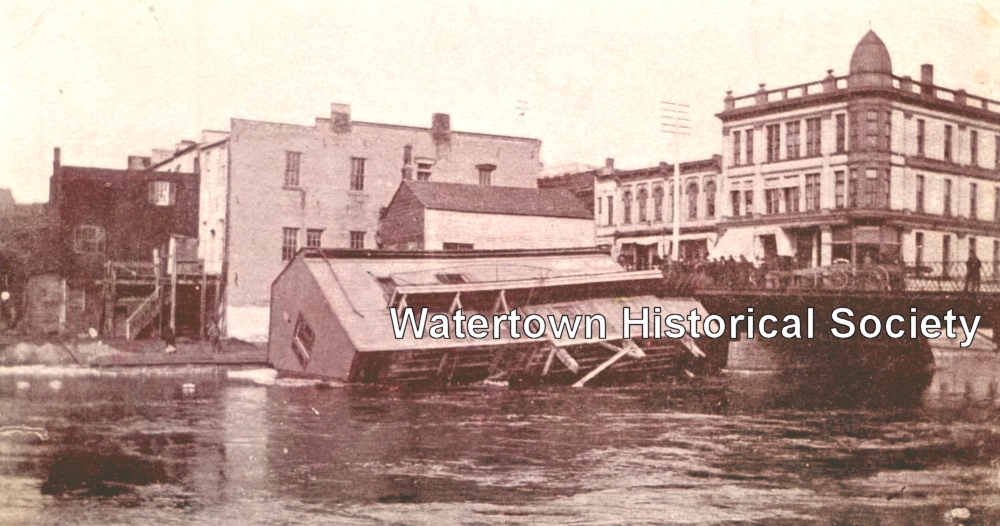
WHS_002_PC_370
The following article
concerning the building which at one time stood on the south side of Main
Street bridge and which was swept out by the flood in the spring of 1904 , was
written several years ago by the late Peter Brook [F. P. Brook, Green Bay,
April 10, 1904] for a local [Green Bay] newspaper, and may prove of interest to
readers now [1917]:
1850-51
The shanty was built
in the winter of 1850-51, Henry Maes having purchased
the right to build of the then owner on the [river] bank, Dr. Edward Johnson, for the sum of $40,
the owners on the bank claiming a “superior right on a non-navigable stream to
the middle.”
1851-52
Within a year or two Werner, the barber, had erected a
long building on the north side of the bridge, [1870,
Werner bldg (with canopy, north side of bridge, washed away in 1881 flood] and among the first
tenants were William Buchheit’s
“bier halle,” Joseph
Salick’s jewelry store, D. Blumenfeld’s Weltbuerger
office, etc.
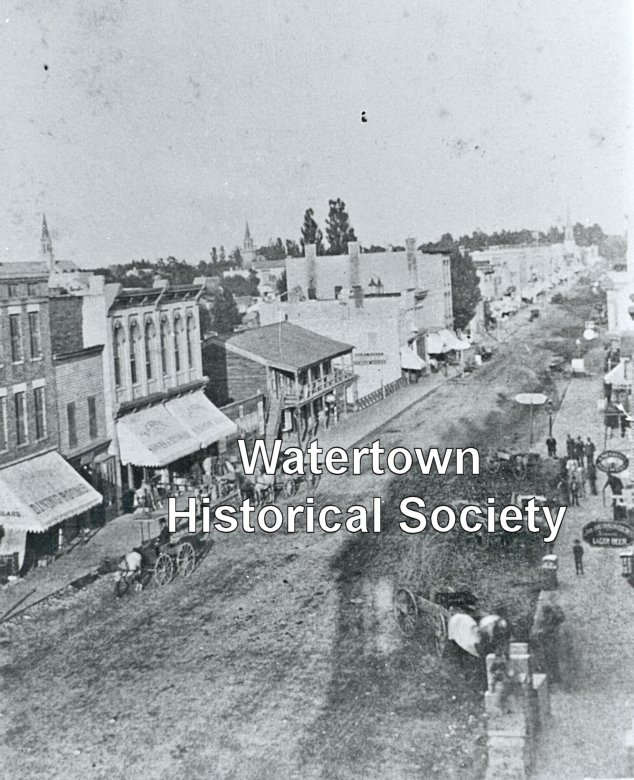
1856
At the same time the new bridge was being constructed by the
Dunn Bros., which was known at that time as one of the finest and most
substantial post bridges in Wisconsin.
Upon the completion of the shanty [on south side of bridge] it was
immediately occupied by Henry Maes as a barber shop,
and a very nice establishment it was.
Soon after the
building was finished Walter Besley and William Chappel [Chappell] stepped into the barroom of the Planters Hotel and told Mr. Turner, the
proprietor, that they had bet the drinks, the loser to pay, inviting Mr. Turner
to drink with them. After the brandy and
sugar had been disposed of in due form it occurred to Mr. Turner to inquire
what the bet was about, when he was told that Besley
had bet that Henry’s shanty [Henry Maes] would fall
down stream and Chappell that it would fall up stream. Now that the shanty has fallen neither up
stream nor downstream and all the parties to the bet having long since passed
to the great unknown, the reader will probably conclude that it had better be
called a draw.
1850
The writer [Peter
Brook] arrived in Watertown on the previous July, or the July of 1850, and soon
moved with his parents onto a farm on Temple’s Hill, where both parents died in
about three weeks after taking possession of the place. Being thus left an orphan at the age of
fifteen and unable to find employment as “storekeeper,” so called by Germans of
that time, I entered the service of Henry, the barber, as an apprentice for a
term of three years, where I soon became quite an attraction, so much so that
the Yankee girls used to come into the shop to see “that handsome Dutch
boy.”
In about two years
after the building had been opened as a barber and bathing rooms [Henry] Maes moved the barber shop into the basement and put a
billiard table on the ground floor .
This billiard room became a popular resort and the first night the table
was being played on, O. D. Pease (later a captain in the army and who lost his
life at the battle of Shiloh) and I hung around until 12 o’clock, when we
played our first game with the mace [Maes?], having no
confidence that we could hit those slippery balls with the cue. The billiard table prospered immensely. Hiram Harder, Perry Harder, Tom Smith, Peter Seaburg and Anton Francel being
the crack players of the town---the writer, spending all of his leisure time
when the table was not occupied, soon could beat the best of them.
When my time as
apprentice was at an end and Maes wishing to quit the
business, I bought out the establishment (such as it was) with a few dollars
left me by my parents and became a full-fledged tonsorial artist, but that I
ever became an adept with the razor I most emphatically deny. About this time Maes
conceived the idea of putting a bar and restaurant into the room in the
basement where my shop then was, so I was bundled off into an 8x16 room under
the platform, in front of the building.
1850
At this time, or
about 1854, S. G. Roper [Samuel G. Roper,
1909, death of]
became associated with Maes, when they branched out
into the wholesale liquor business to a considerable extent. There being no regular bartender at first, a
rule was laid down that anyone going into the basement must whistle all the
time he was gone and failing to do so it was taken for granted that he was
“whetting his whistle,” and compelled to pay 10 cents. Quite an excitement was created one day over
a large cask of gin having been left, in the evening in front of the store now
occupied by J. C. Harrison, when it was found that some miscreant had bored a
hole in the cask (valued at $130) and let the contents run into the
gutter. Maes
and Roper then occupied the basement of that building with their stock of
liquors. George H. Bott was accused of
having tapped the cask, but the evidence was not sufficient to convict.
1855
About 1855 the people
demanded a new bridge on account of the three heavy railings dividing the wagon
tracks as well as the sidewalk, scarcely a day passing without some greenhorn
taking the wrong or left hand track and being met by some mischievous driver
half way or more, would be compelled to back off the whole distance as best he
could. The new bridge constructed by Mr.
Steger was the full width of the street and about three feet higher than the
old one, which compelled Maes to move the shanty back
about three feet and raise the ground floor about the same amount.
About
this time a determination manifested itself in the communication with the
bridge. By what means the railing in
front of the Werner building [on the other (north) side of the bridge] was
removed I cannot call to mind. As to how
that in front of Maes’ shanty was taken down I
remember very well. While two men took
the night watch [watchman] up town and
filled him with beer, two others pretending to be drunk, sawed the opening and
threw it into the river.
During the time the
shanty was being remodeled so as to accommodate itself to the new bridge, my
barber shop was removed to the basement under Miner’s drug store, now August Wiggenhorn’s jewelry establishment, where in a short time I
sold out to M. F. Paulfranz for the $20 gold
pieces.
The building in the
river being in a condition to be occupied, and Maes
and Roper having been attacked by the western fever, sold out their liquor
business and moved to Minnesota with family, bag and baggage, locating at or
near a place where Owatonna is now situated.
Being now out of business and the shanty vacant, I rented it of Henry Maes at $300 a year and on account of a lack of sufficient
capital became associated with Fred Brandt under the firm name of F. P. Brook
& Co., and started a fruit, confectionery, cigar and tobacco store on the ground floor, with ice cream and
oyster rooms in the basement. Alonzo W. Straw being our first clerk, I
believe.
High rent, ignorance
of business methods and general heedlessness, soon reduced our stock so that
Joe Giles used to say I had to set my soda crackers up edgewise to fill up the
shelves, and the probability is that in maturer years
I would have given up the business as a fizzle.
Nevertheless, at the very time when my worldly affairs were in the most
deplorable condition I got married, paying the Rev. Mr. Niles $3 for performing
the ceremony, it being all the money I had—boarded a few mouths with Jerry Mowder and then went to housekeeping in the basement of the
shanty, using the furniture, dishes, etc, connected with the ice cream and
oyster room, for family purposes, and while thus keeping house in the lower
story of the building our first child was born.
My first associates
in Watertown were almost exclusively Americans, not by design, but, and for
reasons that I have never been able to explain, unless it was that Mrs. P. B.
Basford, finding me rather a likely boy, took me under her wing and got me to
join the Cadets of Temperance where I was considerably lionized as being the
only member of German birth and on account of which I incurred the enmity, so
to speak, of such Germans as disapproved of all temperance moves, being most
frequently spoken of as “Yankee Peter.”
Those cadets were principally young boys and at every meeting one of the
members had to read an essay on the temperance cause, and when it came my turn
to do so, though I could scarcely speak any English, I produced one of the most
wonderful addresses ever heard in the hall; in consequence of which I
immediately became one of the leading spirits of the society, and the speech
was spread on the records in full, though I remained as dumb as an oyster about
the fact that Dr. James Cody had written the composition for me.
1860
Republican Headquarters
This and other circumstances
throwing me into American society, and consequently chiefly among republicans,
it naturally followed that when I became of age I found myself a full-fledged
member of that party, and Peter’s shanty republican headquarters; and let me
say to you, dear reader, that at that period of the history of Watertown, much
pluck and determination was required in a foreigner avowing himself a member of
the republican party, and according to my best recollection Conrad Dippel, Chris May and the writer, were the only members of
German birth of that party. This same
rule held good in almost the entire state of Wisconsin at that early
period.
In Watertown, up to
1860, a republican was expected to keep his mouth shut, and a stranger in the
city failing to observe that rule almost invariably got a good licking before
he got out of town.
Upon the arrival of Carl Schurz in the city, owing to his transcendent
ability and oratory, a new light sprung up for such Germans as were inclined to
shake off the democratic yoke, and the Barstow state administration, laboring
under a cloud of dishonest methods, soon had the natural effect of a large
section of German
democrats entering the ranks of the opposition.
And no wonder, when we consider that the entire German vote of Watertown
was led by “City Henry” (Henry Bergman) and Frank Belrose, the former
controlling the German, the latter the Irish vote; Rock River House Fischer was
also deemed a leading factor in carrying elections for a given candidate.
“Peter’s shanty,”
previously stated, being tacitly admitted as republican headquarters, began now
(1860) to prosper, and at about the same time a young Irish boy, ragged and
dirty, named George Hawkins, applied one evening for employment as clerk. The writer, having had his eye on the boy
(being only a few feet away), his energy and business methods, for some time,
engaged him on the instant and from that moment F. P. Brook & Co.’s
business success was assured. The
presidential campaign being now in swing, drawing large crowds of republicans
called wideawakes or torch bearers, to the city, and Peter’s shanty being the
natural attraction for such gatherings, the firm made money so rapidly that in
about a year Fred Brandt was able to get out of the business without loss, and
the writer was soon enabled to buy the shanty, besides building himself a small
house.
The election resulted
as is well known in the choice of Mr. Lincoln for president, and on the part of
the republicans of Jefferson County, the victory was celebrated at Fort
Atkinson. The war being now deemed
inevitable Governor Harvey , who was the principal speaker on the occasion, put
the question, “Boys, will you go?”
meaning to the war. Well, kind
reader, I must confess that having been but recently married, and having no
inclination whatever to make a target of my precious body for Southern
marksmen, I didn’t shout worth a cent; in fact, I was about the sickest lamp
carrier you can imagine. I can remember
well the thought flashing through my mind, “For God’s sake, have I been voting
for war.”
Recruiting
for Civil War / $300 and you’re free
The war began as is
well known, at first by volunteer soldiers, and the first recruiting in
Watertown was done in Peter’s shanty, but it was soon discovered that the place
was not large enough for the crowds that gathered, and other quarters were
engaged. In a year or two it was found
that soldiering was not the picnic party that was expected, and drafting had to
be resorted to. Early in 1864, such a
draft was held at Janesville, and a large number of Watertown people went down
there to watch the proceedings.
Returning late in the evening, a mob of democrats bolted into the
shanty, and sang at the top of their voices:
Old rye coffee
Is good enough for me,
Without one grain of sugar
If the nigger can be free.
Having kept this up for
at least half an hour, when at a given signal the entire crowd shouted, “Pete
Brook is drafted,” the said democrats thinking it a joke, whereas I had voted the republican ticket, it was highly
proper that I should go to war. The boys
had a good deal of fun at my expense, but I can assure the reader that I didn’t
appreciate the joke worth a cent. In due
time the mustering day arrived and I went to Janesville to be examined ( at
that time the drafted man having been accepted could escape actual service by
the payment of $300), was told to strip, which I refused to do, was thoroughly
examined by the doctors above the waist, who finally pronounced me unfit for
being a soldier on account of something being the matter with my heart
(probably that organ being in my mouth about that time). In the evening of that day I treated the
draft board, composed of N. S. Greene, L. B. Caswell, Capt. Putnam, Dr. Head
and one or two others, to a nice supper, with ample quantities of wine, at the
leading hotel, came home and immediately set to work to rebuild and enlarge the
shanty which brings us to 1864.
1864
I went into John T.
Slight’s woods, personally selected every tree to be used for timbers, built a
timber foundation and put a new structure joined on to the old one, between it
and the bridge sidewalk, substantially as it was when tipped over a few day
ago. The new establishment soon became a
greater attraction than ever because the proprietor made it a point to have a
better cigar, glass of lemonade, dish of
oysters, the earliest fruits and berries in their season, and a dish of ice
cream unexcelled.
Well in Rock River
Large quantities of
water being used in the establishment, and which had to be carried quite a
distance, I conceived the plan of laying a pipe from the artesian well behind the post office building to the shanty, only the
great expense of doing so deterring me from carrying out the project, when like
an inspiration the thought occurred to me one day, “Why not make a well right
here?” No sooner had the feasibility of
the project presented itself, when I was looking around for a man to do the job
and in a few days the drill was at work under the building on the ice. Before going down, however as deep as I had
originally intended, the ice began to raise and the machine had to be taken
from under the building, having gone down only about eighteen feet. To preserve what I had done from being lost,
I drove a pump log into the hole, having not the least suspicion that water had
been struck, but to be entirely certain that such was the case, I measured with
a small stick the height of the water inside of the log as compared with the
river water, on the outside, and found to my great delight that the water
inside the pipe was a trifle higher than the river water, thus proving without
a shadow of doubt that I had a well at a trifling cost. About this time Robert Howell returned from
the oil fields of Pennsylvania, and instructed me how to insert the pipe into
the bore, and make it a tight joint by means of a seed bag. I followed his instructions and in a few hours had a flow of good water about
three feet above the lower floor, and it is highly probable that this is the
only well ever constructed in the bed of a river.
Smoking Room /
Civil War News
The smoking room became the resort of my
chums, and the leading men of the town, more especially so for such of the
railroad men who were not given to frequenting saloons, but wished to met each
other outside of their homes. Many pleasant
hours were spent in that room by J. O. Pattee, A. J. Earling, W. P. Brown, H. A. Ranous,
H. C. Atkins, Robert Lewis, Jim Nellins, Amos Baum,
George Lewis, Charles Wood, S. M. Eaton, often S. S. Merrill and seldom a day
[without] both Chappell and Dennis. Of
course these men bought cigars, fruit, peanuts, lemonade, soda water, etc., and
in this manner I got well paid for the accommodation furnished them, it being
also the principal locality in the city for the reception and discussion of war
news.
That the younger readers may get an idea of
what war meant, I would state that Bill Brown and I bought 200 bushels of wheat and stored it in the wood house
under the sidewalk, so that our families would have bread when United States
money should no longer be a purchasing power.
After awhile we saw the absurdity of the scheme and sold out at a fine
profit and the place formerly occupied by the grain was filled with stove wood,
which broke the joints of the floor and precipitated the wood in to the river,
and this would probably have been the fate of the wheat if it had been allowed
to remain there much longer.
Silver change being largely taken in our trade,
it was the custom of other business men to get their paper money changed as was
found necessary, when W. P. Brown came in one day and said to me: “Don’t do
that any more but keep whatever silver is taken
in.” I followed his advice, and by the
time silver had gone entirely out of circulation, a large cigar box full had
accumulated containing $280, and which I sold for just double of face value.
Money still flowing
in owing to flush times, caused by the war, I soon bought the lot adjoining the
Bank of Watertown and erected the building which became known as the Red Front
Grocery, George Hawkins becoming my partner.
We conducted the shanty on the bridge as heretofore, in addition to
carrying a large stock of groceries, crockery, glassware, etc., in the Red
Front.
Hawkin’s Shanty
Unfortunately for me,
I entered active politics to the neglect of my business, and, other similar
establishments springing up, Peter’s shanty lost its popularity. A dissolution of partnership followed, the
shanty was bought by George Hawkins and occupied by W. N. Hawkins [cross
reference: Death of Mrs. William
N. Hawkins], who becoming alarmed about the safety of the shanty,
moved into the building next to Johnson’s drug store and soon after the shanty
that had started in 1851 as a barber shop was again used for the same purpose,
and ended a few days ago as it had begun fifty-three years ago.
Thus we can draw the
moral that citizens of fifty years ago have nearly all passed away, and that
even the shanty in the river was not exempt from the ravages of time.
F. P. Brook,
Green Bay, April 10, 1904
___________________________________________________________
Note: The winter before the flood in the spring of
1904 was harsh.
Coldest Weather in
Watertown’s History
Watertown Daily Times, 01 27 1904
Watertown has
experienced the coldest weather in its history during the past week. The cold snap set in Saturday night and has
continued ever since. Saturday night the
thermometer registered 20 degrees below zero, Sunday night 35 below zero, and
Monday night 25 below zero, Tuesday night 20 below, and Wednesday night 10
below.
___________________________________________________________
Kiessling, Elmer C, Watertown
Remembered, 1976.
The north side of the bridge was then lined with business places
resting on piles driven into the bed of the river. In 1881 huge cakes of ice roaring down in
high water ripped out the pilings of these structures and a part of the
bridge. The building on the south side,
a barbershop operated by John Seager, was
spared. Mr. Seager installed three tin bathtubs
- the first in Watertown - in his shop and ran this ad:
The Bridge
in the
Center of Main Street Bridge
5 baths for $1
He did a brisk business, Northwestern
students being among his best customers, until another ice jam in April,
1904, swept away his building. All of
the equipment was salvaged. John Seager,
and his son Charles after him, continued to operate a shop for years at 5 Main
Street. It is now the Downtown Barber
Shop.
Cross References:
Main Street bridge, chapter on
Augustus Cushman
remembers Brook’s barber shop and candy store, middle Main St bridge
Dr. F. J. Parkhurst former employee
