website watertownhistory.org
ebook History of Watertown, Wisconsin
Dr. Edward Johnson
1822 - 1910
The Doerr Drug Store was originally established by Dr. Edward Johnson in
1844.
A soda fountain was
installed one year later and was the first in Wisconsin.
“The Cradle of the Soda Fountain in Wisconsin, 1845,
A
drug store four years before Wisconsin became a state” [Doerr
stationary}
1850-51
Shanty was built on Main Street
bridge, in the winter of 1850-51, Henry Maes
having purchased the right to build of the then owner on the [river] bank, Dr.
Edward Johnson, for the sum of $40, the owners on the bank claiming a superior
right on a non-navigable stream to the middle.
1900
12 07 "OLD BILLY"
"Old Billy," the
family horse of Dr. E. Johnson for the past to 27 years, was chloroformed by
Jas. Roy on Sunday and his existence ended.
The horse did service faithfully in the doctor’s family nearly all his
life, the doctor having purchased him from his brother, the late Doctor Johnson
of Milwaukee. He was over 40 years old,
and was a horse of almost human intelligence.
WG
1901
01 18 PEW-HOLDER AT ST. BERNARD’S
Dr. Edw. Johnson has been a
pew-holder in St. Bernard’s church 55 years,
having paid for an entire pew at St. Bernard’s during all of that time, besides
contributing thousands of dollars for the benefit of that church and
congregation. He paid his yearly pew
rent for the 55th time last Saturday. He
has given very generously of his means not only in this respect, but he has
been very charitable in extending aid, sympathy and assistance in a substantial
way to many others.
WG
1910
FOUND DEAD IN HIS HOME
SHORTLY BEFORE 7 O'CLOCK
MONDAY EVENING
Watertown Gazette, 06 03 1910
Our community was shocked early Monday evening, May 30, 1910, to learn
that Dr. Edward Johnson was found
dead in his home in West Main Street, and for a time the news could not be
credited, for the doctor was downtown during the afternoon and was apparently
in his usual good health. During the
noon hour on that day he ate a hearty meal at the home of his nephew, Edward M.
Stapleton, and joked and conversed with the family on several of the important
events of the day chronicled in the morning papers of that day, and during the
afternoon he walked downtown and was last seen alive about 4 o'clock.
Not having arrived at the usual time for his supper at Mr. Stapleton's home, the latter sent his daughter Laura over to Dr. Johnson's home, which she found locked, but on peering through the window she saw him stretched in his chair and ran back to her home and told her father Uncle Ed. was dead. The latter ran to the doctor's home and not being able to get in also peered through the window and saw the doctor cold in death.
He called Dr. Masterson and Chief of Police Block; the latter forced a window and gained entrance to the home. Dr. Masterson made a hurried examination of Dr. Johnson and gave it as his opinion that he died of heart disease and had been dead about one-half hour, it being then about 7 o'clock.
Watertown's first druggist
Dr. Johnson was a native of Killaloe, County Clare, Ireland, where he
was born July 21, 1822. He came to
America in 1836, locating in New York City, and for a time was employed in
Ohio, Louisiana and Alabama. In 1843 he
came to Watertown and shortly after went to Milwaukee, and again returned here
in 1844 and engaged in the drug business, he being Watertown's first
druggist.
In 1851 he made an overland trip to California with a number of other
Watertown people during the great gold excitement times and left his business
here in charge of others. He returned
the following year and resumed his drug business, which he continued till
November 1, 1873, when he sold out to G & H.
T. Eberle.
In 1846 he was married to Mary Crowley, daughter of the late Daniel Crowley, who resided just east of this city on the Milwaukee road. His wife died February 14, 1904.
Dr. Johnson was a self made
man, and learned the drug business in a thorough manner by hard study and
strict attention to business, and
there was no better posted or more efficient druggist anywhere to be found,
hence the result was that he enjoyed a large patronage and by the time he
reached middle life he retired from active business on a well-earned
competency.
Land League
He always took an active interest in the welfare of our city and in
fact in the entire country. In early
days he held several offices of trust, among those which he held being alderman
and supervisor. Aside from being a
patriotic American citizen he took great interest in the welfare of his native
country and early in its struggle for home rule identified himself with the
land league and was its vice-president.
At the first great convention of the league held in St. Louis he
contributed $1000 to the land league fund, being the first and largest
subscriber at the time. All through life
he kept up this interest, and sent thousands of dollars to Ireland for the
cause which was so dear to his heart.
At the time of his death he was a stockholder in the Wisconsin National Bank and for a number
of years was one of its directors.
Silently he distributed his means in all lines of charitable work,
taking special pride and interest in aiding the poor and needy. He founded a scholarship at Notre Dame,
Indiana, and gave largely of his means toward the support of St. Bernard's Church.
Most of the fine statuary in the church was donated by him, and he also
presented to the church a number of costly sacred articles used in connection
with the Catholic services.
His most munificent manifestation of the interest he took in education was the erection by him of the fine school in West Main Street, now the property of St. Bernard's congregation.
Dr. Johnson's life was certainly an honorable and most worthy one, and though not what is now days considered a rich man, he gave away during his lifetime to our own personal knowledge about $40,000 for educational and charitable purposes, which speaks volumes for the high character of the man whom is now so sincerely mourned.
He was the last member of his family to die, his only surviving relatives being nieces and nephews, among them being Edward M. Stapleton of this city; Mrs. Louisa Ungers, Faribault, Minn; Mrs. Demaire, Brooklyn, N. Y.; Mrs. Hattan, Canada; Sister Benedicta, New York; James Johnson, Oakland, Cal; Edward L. Johnson, Denver.
His funeral will be held Friday
morning at 9 o'clock from St. Bernard's Church, and his remains will be placed
in the family vault in St.
Bernard's cemetery.
Early days in Watertown
Speaking of the early days in Watertown Dr. Johnson recently said:
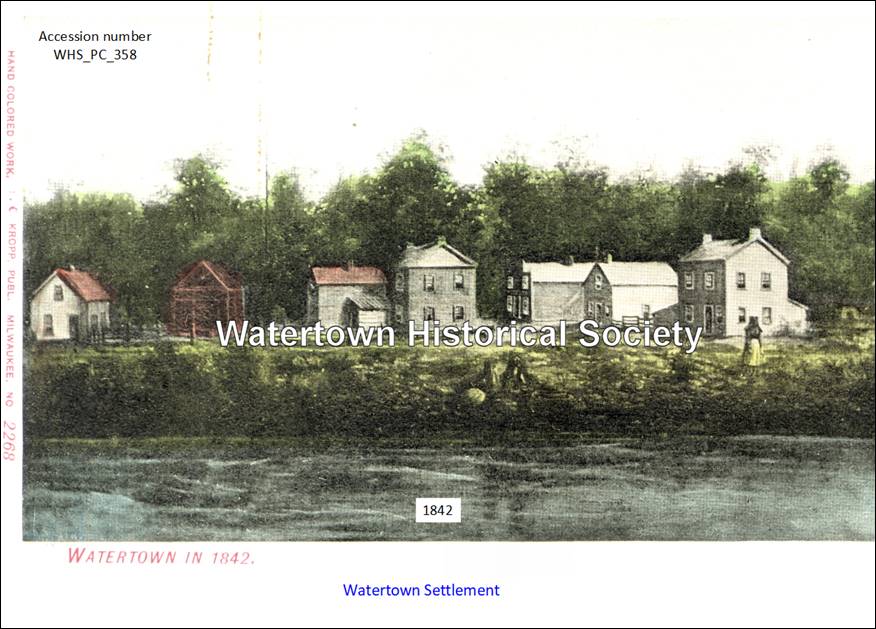
When I stood on the hill near where my house stands (approximately near West Main and Washington streets), I counted twenty-five roofs, including barns, in the little settlement. The hill was much higher then, before so much grading and filling had been done, and you could see all over the town. Watertown was then called Johnson's Rapids, after Timothy Johnson, who was the first settler here.
When I came here there were but three houses on this (west) side of the river; all log structures. In fact, one of the buildings which stood behind the drug store down by the river, which I conducted for years, was the town hall, the school and church combined. The town grew apace for ten years or so and then came the Civil War and it stood still. I well remember the Indians coming through here after the Black Hawk war in scattered parties. Frequently I found Indians asleep on the porch of the store when I opened the door in the morning. The troops were then running them down and sending them west to a reservation.
In the early days of my life in Watertown it was no trick at all to take your rifle in the morning and kill a deer, and you could always take your pick, as they were so numerous that you would see a number of them together down by the river.
A man by the name of Goodhue built the first dam here and ran a sawmill. He bought the water power from Timothy Johnson, and sawed basswood, elm and oak, finding a ready market for the product of his mill with the settlers. There was then no large settlement near here. The principal settlement between here and Milwaukee was Waukesha, which was then called PrairievilIe. Oconomowoc was then only a place where we watered our horses on the road. There was one building there, a little tavern where we sometimes used to stop while going or coming between Milwaukee and Watertown.
In the years of which I speak
the trip (to Milwaukee) used to take four days each way, although once in
awhile we covered it in a week. The road
could be hardly called a road. It was
about as nature made it, and as we had more rain those days, it was a common
thing for us to have to stop and unload our goods in crossing some of the
swales and then pull the wagon out of the mud, carrying the goods to it across the swale.
Cross References:
Johnson, Edward, Dr
1852, Journey to Calif in search of gold
1905, Daniel Jones funeral,
pallbearer
1908, Donation to St. Bernard’s school

History of Watertown, Wisconsin