`
website watertownhistory.org
ebook History of Watertown, Wisconsin
Watertown
Police Department website

 Portfolio of
pictures <> UNDER
CONSTRUCTION
Portfolio of
pictures <> UNDER
CONSTRUCTION
History of the
Watertown Police Department


Serving the
community since 1853
1842-1899 SECTION ON
HISTORY OF
__________________________________________________________________________________________
Additional Segments:
__________________________________________________________________________________________
1842
HARRIS GILMAN AND ELI H. BOUTON, Town Constables
Up to 1842 Watertown operated
under a county system of government and in April of that year Watertown held
its first election for town constables.
Harris Gilman and Eli H. Bouton were chosen.
1849
JOSEPH GILES, Village Marshal
On March 7, 1849,
Watertown was incorporated as a village and a charter was adopted. The village marshal was Joseph Giles.
Joseph Giles was one of
the early day police officers in Watertown.
He was sheriff of Jefferson County many years ago, deputy sheriff,
constable, in fact held office most all his life in Watertown. Joe was always able to manage the tough boys
who came to town . . .
1853
POLICE DEPARTMENT ESTABLISHED
In 1853 Watertown was incorporated as a city, and from then on operated
the law and order department, with justices of the peace, city marshals and constables. There were justices of the
peace in Watertown and sometimes two or three constables in a ward. Occasionally in an old city directory one or
two would be identified as policemen.
CITY CHARTER / AN ACT / To Incorporate the City of Watertown
03 03 . . .
Section 7. The mayor shall be the chief executive officer and head of the police of
the city. It shall be his duty to
recommend in writing to the city council such measures as he may deem
expedient. He shall keep the seal of
said city, sign all commissions, licenses and permits which may be granted by
the city council; he shall endeavor to maintain peace and good order, and see
that the laws of the state and ordinances of the city are observed and
executed; he shall have the power to administer oaths or affirmations, and to
take and certify acknowledgement of deeds and other instruments in
writing. As a judicial officer, he shall
have power, and by giving the bonds required by law, may exercise the
jurisdiction of justice of the peace, and to prevent or suppress riot or other
public disturbance, by may appoint as many special
constables as he may deem proper.
In witness whereof I
have hereunto set my hand a affixed the great seal of
said state, at the capitol in Madison, this third day of March, A.D. 1853.
Charles D Robinson,
Secretary of State. Watertown Chronicle, 03 16 1853
-- -- LUCIUS BRUEGGER
became the first city marshal in 1853 when Watertown was incorporated as a
city.
Lucius
Bruegger named the Sharp Corner saloon [823 E. Main] "The Beehive."
1854-1857
1855
Night Watchman taken up town,
filled with beer, while two sawed Maes’ shanty fence and threw it into the
river
1858
-- -- Harris Gilman, City Marshal
August Tanck elected City Marshal
1859
01 27 Accounts presented and referred . . . W. Bieber & Co., for rent of lock-up to March, 1859,
$18.00
WD
02 10 Confer with Messrs. Bieber & Co. and
ascertain the amount of rent for lock up for the ensuring year WD
03 03 John Staub, candidate for office of City Marshal
03 10 Subject of Police
Jurisdiction
06 02 Special Police or
Night Watch proposed WD
1859-1860
-- -- August Tanck, City Marshal
1860
01 26 August Tank for three months services as
City Marshall, Oct. 1st, 1859, to Dec 31, 1859, $25, allowed and charged to
city general fund. WD
1861
-- -- John Haines, City Marshal
05 23 Office of police justice to be abolished,
remarks by Mayor Williams WD
1862
-- -- Frederick
Herman, City Marshal
1863
-- -- J. STAUB, City Marshal
06 25 NIGHT WATCH
Common Council Proceedings: Resolved, that his Honor the
Mayor be authorized to appoint a night watch if, in his opinion, it is
necessary. WD
10 15 A THIEF CAUGHT
On the night of the 8th
the warehouse of George Peeples was entered by means
of cutting a hole through the floor and a considerable quantity of wool and a number of sheep pelts stolen. Sheriff Giles immediately went in pursuit of
the thief, overtook him at Madison, brought him and the property back, and
after examination before Justice Ducassee, was committed to jail for trial. The name of the burglar is Otto Esche. He will probably have a permanent location at
Waupun before long. WD
1864
-- -- JOHN
HAINES, City Marshal
01 28 KEEPING COUNTY CRIMINALS IN THE CITY LOCKUP
Ald. Dennis moved that the
Mayor is hereby requested to make out the account against the county for
keeping criminals in the city lockup, and that the [Jefferson County] Deputy
Sheriff, Joseph Giles, should be asked to certify on the account that he used
the lockup for the county prisoners, and that such account be presented for
allowance at the next meeting of the county board. Motion carried.
The Clerk read the
report of the election held on the 15th day of January and on motion of Ald. Dennis the Committee of Judiciary was
instructed to report at the next meeting of the Council a bill to be presented
to the Assembly for the passage of an act to legalize all actions had in regard to raising a tax to pay bounties to
volunteers. WD
02 14 MARSHAL SHALL NOT BURY DEAD ANIMALS
Common Council
Proceedings: Ald.
Dennis moved that the Marshal shall not bury any more dead animals at the
expense of the city, but shall inform the owners that
it is their duty to remove nuisances from the streets or in front of their
lots. Carried.
04 21 SALARY OF THE MARSHAL
Resolved, That the
salary of the Marshal of this city for the ensuing year shall be two hundred
dollars and that the sum so paid shall include and be in full for all services
that the said Marshal is performing under the direction of the Common Council. Adopted by unanimous vote. WD
1865
10
05 JOHN HAINS, CITY MARSHAL
Common Council Proceedings: Against General Fund, John Hains, $50,
three months salary as Marshal. WD
1866-1872
-- -- ERNST OFF, CITY MARSHAL
1869 SPECIAL
POLICE
1. The common council,
for the purpose of guarding against the calamities of fire, shall have power to
prescribe the limits within which wooden building or buildings of other
materials that shall not be considered fire proof, shall not be erected or repaired
and to direct that all and any buildings within . . .
7. The common council
shall have power to organize a sack [fire] company,
which shall be known as sack company number one, to consist of not more than
twenty members. Such company shall constitute a part
of the fire department, and at fires shall be subject to the control of the
chief engineer. The members of said company, either collectively or
individually, are hereby authorized and empowered to act as a special police
in and for the city of Watertown, and are hereby vested with all the power and
authority which now is or may hereafter be vested in any police officer of said
city and shall be entitled to all the rights and immunities of the fire
department; at fires they shall take charge of all property which may be
exposed or endangered, and shall, so far as it may be in their power, preserve
the same from injury and destruction . . . Riedl, Ken, Watertown
Fire Department: 1858-2007, 2007, pg 48
1870
Gas supplied to Engine house and Lockup on
S. First St.
1873
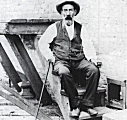
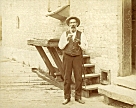
-- -- John “Putt” Reichert [Reichardt], City Marshal
1874
-- -- P.
Dougherty, City Marshal
-- -- J. F.
Barber, City Marshal
c.1875
WATERTOWN'S CALABOOSE
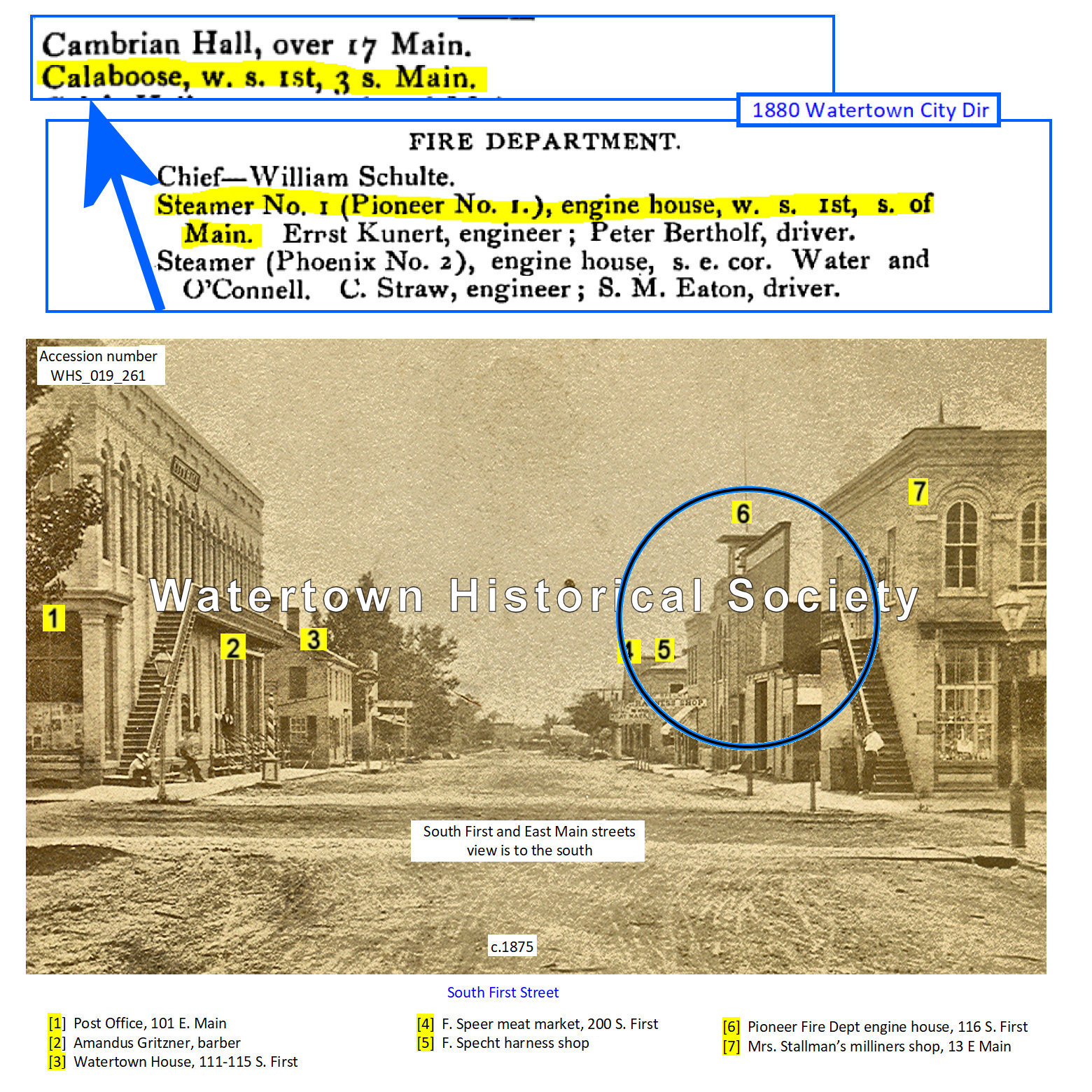
Jail or lock-up located
in basement of early fire house on South First Street,
as noted in
"Watertown Fire Dept 1857-2007" by Ken Riedl, pgs
36-41.
1876
-- -- WATERTOWN SPECIAL POLICE [Fire Police]
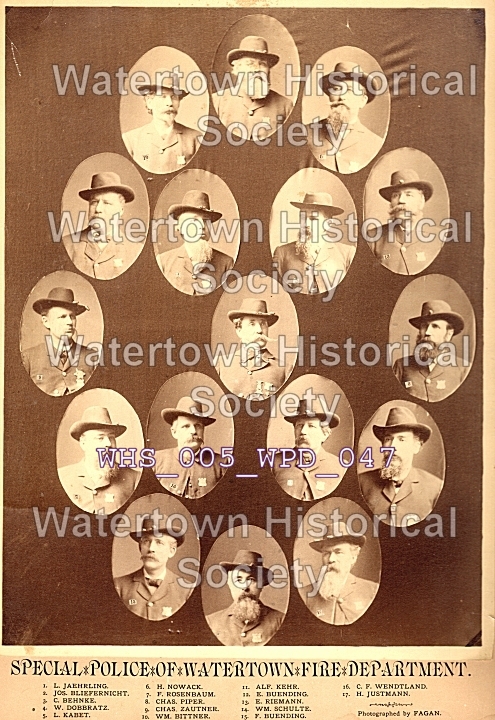 A general desire seems
to prevail among many of our citizens, and the matter will soon be submitted to
the consideration of the Board of Street Commissioners as to the exigency of
organizing a Sack Company, to
act as a reinforcement to our present police force in cases of great
necessity.
A general desire seems
to prevail among many of our citizens, and the matter will soon be submitted to
the consideration of the Board of Street Commissioners as to the exigency of
organizing a Sack Company, to
act as a reinforcement to our present police force in cases of great
necessity.
Although the city
charter expressly provides for an organization of this description [see 1869], still
no force of this kind has yet been formed, and without it the efficiency of
our Fire Department seems necessarily incomplete. The organization, as provided by the charter,
is to comprise not more than twenty men, to constitute a part of the Fire
Department and to be subjected to the full control of the chief engineer.
It is understood that
each member belonging to the company is virtually constituted a police officer,
empowered with the same rights, privileges and authority that are vested in any
emissary connected with our city police.
Watertown Democrat, 06 22 1876 / Riedl, Ken, Watertown Fire Department: 1858-2007,
2007, pg 84
_____________________________________________________
Sack Company No. 1 was
incorporated in 1876 for the purpose of attending fires in the capacity of a special fire police force—few now
know that they even existed, much less what their role was at the time. Special Police or Fire Police were Volunteer
Fire Company members with sworn police powers.
They received special police training and were responsible for traffic
control, crowd control, fire and incident scene security, apparatus security
securing property and, in some instances, station security during calls for
service. They hustled when the alarm of fire was heard, many times reaching the
scene before the firemen themselves.
During times of large-scale or particularly serious small emergencies,
the response system could become overwhelmed.
To that end, having a trained, equipped group of responders who could
supplement fire personnel was an invaluable tool to
incident commanders. Riedl, Ken, Watertown Fire Department: 1858-2007,
2007, pgs 84-86
1877-1878
-- -- D.
Kehr, City Marshal
1879
-- -- GEORGE HENZE, City Marshal
A city marshal
reported, and complained, to the city council in 1879 that he had arrested four
persons as vagrants and brought them to the Justice of
the Peace, who dismissed them all with the injunction "go and sin no
more." Later 17 others were
arrested as vagrants, one was put in jail, 16 were dismissed to "go and
sin no more." WDT article 03 20 1982
c.1880s
-- -- F. P. [Peter]
Brook, owner of a confectionary and fruit store on the Main St bridge, served
as deputy city marshal, date uncertain WG
1883
07 13 FARMER FILLED WITH CORN JUICE DEALT WITH TOO
LENIENTLY
An Editorial: A prominent farmer of Emmet made quite
a disgraceful exhibition of himself on Main Street yesterday afternoon on
account of being well filled with corn juice.
He became quite noisy and when remonstrated with by an officer,
endeavored to convince the arm of the law that he could act just as he pleased
on our streets. Our deputy marshal made an effort to quiet him, found kind words of no avail,
and was compelled to use his cane on the fellow’s head, cutting him
slightly. At this juncture in the
proceedings our rural friend’s wife took a hand in [the incident] and the
officer was persuaded to let the fellow alone.
Such fellows as the subject of this item have
been dealt too lenient with by our officers and they imagine that they can do
just as they please without being interfered with. If this fellow’s head is sore for some time
to come, our verdict is that he deserves not only a sore head,
but should be fined for raising a disturbance. WG
1885
August Charles Kerr,
appointed night patrolman, becomes city marshal and first police chief; served
1885-1912.
09 04 Officer Stylow; chance to show the
public just how adept he was at handling six desperate tramps
1886
05 26 CUSTODIAN OF THE PUBLIC'S PEACE UNABLE TO CONTROL
HIMSELF
A city officer, who is supposed to be a custodian
of the public's peace, could be seen Sunday last
highly intoxicated, unable to control himself, let alone other people, and at
the same time dashing through the streets in a buggy and putting the whip to
the horse in a manner that made said officer liable to be arrested for cruelty
to animals. Should our city tolerate
this state of things much longer? WG
07 16 TRAMPS ARRESTED AFTER STRUGGLE
Sheriff Illing and Marshall
Zautner had quite an exciting time arresting seven tramps who were quartered
near the C. & N.W. Ry. depot. The
tramps made a strong resistance, and the sheriff
found it necessary to draw his revolver and for the marshal to use his billy in arresting them. They were finally captured and placed in the
lockup overnight. Next day Commissioner
Feld examined them. Four were bound over
for trial to the circuit court for being tramps, and two for resisting an
officer. The last of the gang was
sentenced to the county jail for 15 days for using profane language.
1889
-- -- CHARLES ZAUTNER, City Marshal
Night police officer sleeping while on duty,
Zautner prepared formal complaint regarding.
1890
02 07 STOLEN CLOTHES CAN BE CLAIMED
Marshal Zautner has a number of articles of wearing
apparel that he found in possession of a tramp this week. They were evidently stolen from a clothes
line. The owner can have them by calling
on the marshal. WG
04 04 NIGHT WATCHMEN, FORCE OF THREE MEMBERS
Night watchmen was made subject to the control of the
city marshal and they shall be on duty from 8 o'clock
p.m. until 6 o’clock a.m. during the winter months and from 8 o’clock p.m.
until 5 o'clock a.m. during the summer months.
The following- was passed: Police force of the city would consist of 3
members which would be under the control of the city marshal.
05 14 JESSE JAMES GANG MEMBER CAPTURED IN DOWNTOWN WATERTOWN
A young man named T. W. Berry, supposed to be a pal of
one J. M. Officer who is wanted at Ava, Mo., having escaped from the sheriff at
that place, was arrested on Watertown’s Main Street this morning by Deputy
Sheriff Graewe. The desperate character
of the man is shown in his drawing a revolver on Graewe before being
taken. He was placed in the lockup. J. M. Officer is thought to be somewhere in
the city. The Watertown News, 05 14 1890
05 21 JESSE JAMES GANG MEMBER CAPTURED
In our last issue we recorded the capture here of one
T. W. Berry, supposed to be connected with two
notorious characters in southern Missouri, named J. M. Officer and Geo. Scott,
all three having escaped from the hands of Joseph M. Lyon, sheriff of Douglas
county, Missouri, while in his custody to answer to
the charge of the robbery of Samuel Turner’s store, at Arno, Missouri.
Deputies Graewe and Arndt, returning from Jefferson afternoon, after leaving Berry in jail, spotted
Officer and Scott, who had got on board at Janesville. The pair left the train here and started up
town, followed by our officers and Sheriff Hibbard. Officer and Scott went into the Watertown
post office and enquiring for the same mail that Berry had gave assurance to
the officers that they were on the right track.
One was arrested in front of Stallmann’s and the other
at the corner of Second Street. The
prisoners attempted to draw revolvers, both being well armed, but Deputy Graewe
and his assistants were too quick for the fellows. The Missourians were taken down to Jefferson
by the 4 o’clock freight and lodged in jail.
Monday Sheriff Lyon, accompanied by Mr. Turner,
identified the prisoners and a requisition having been obtained from Gov.
Hoard, they started back with their prisoners yesterday morning. A reward of $75 was offered for the arrest of
these men by Sheriff Lyon and Deputy Sheriff Graewe has received his
money. About $200 was stolen from
Turner’s store, but the prisoners are also wanted by the sheriff of Wright
county, Missouri, for breaking into the county treasurer’s office and taking
$7,000.
They are a hard and desperate gang and there is no
doubt they belonged to the Jesse James desperadoes. After committing the burglary at Arno the
fellows were tracked to Memphis,Tenn. about March 31;
from there Sheriff Lyon dispatched to Deputy Graeve that these men would be in
Watertown about a certain time, which happened to correspond to very nearly the
exact day when they did put in their appearance here.
Many are asking themselves why it happens that
Watertown was chosen as their projective point, and what was their inducement
for coming here. There is no doubt that
the prompt arrest of these desperate characters saved us from some fine work, that most likely would have taken place on the night
of the day the capture was made. The Watertown
News, 05 21 1890
08
22 BURST
HIS BILLY OVER HIS TRAMPSHIP'S HEAD
Last
week Thursday, Marshal Kerr had quite an encounter with a tramp named John
Miles near the C.M. & St. Paul depot.
Miles was in company with two other tramps, in Hubers
lumber yard, and the former took hold of Theo. Martin, a laborer therein, with
intent, it is supposed, of robbing him of his money. Martin resisted and summoned aid, when the
tramps skipped away. Marshal Kerr was
telephoned for and hastened to arrest them.
On arriving in that vicinity he found the
tramps and gave chase.
Two of them got away but Miles was induced to stand after the marshal
had emptied two chambers of his revolver as an inducement to have him
stop. On catching up with Miles he
showed fight, and it was necessary for the marshal to burst his billy over his trampship's head
before the fellow would submit to an arrest.
He was a big, burly-looking fellow, weighing nearly 200 pounds, and he
evidently thought his size would scare the marshal if he resisted arrest. He was not long in being convinced, however,
that he had run upon a hornet’s nest and the hind legs of a mule combined in
the person of Marshal Kerr. He was
placed behind the bars in the city lockup for the
balance of the day, and the next morning sentence for vagrancy by Justice Stacy
to five days solitary confinement in the county jail. WG
10
01 TRAMP
BREAKS OUT OF LOCK-UP
A
drunken tramp placed in the lock-up was released last night by a comrade, who
broke down the door of the marshal’s office and was then able to turn the key
in the door of the lock-up, thus giving the fellow inside his liberty. Both tramps made a sudden departure. WR
12
12 FIRE-BUGS
CONFESS TO LEWIS FIRE
In our issue of last week we referred briefly to the arrest of John Schlueter
charged with setting fire to G. B. Lewis & Co.’s bee hive factory in
February. As stated, Mr. Parks, the
junior member of the company, visited the reform school at Waukesha for the
purpose of getting a confession out of Eddy Weigel, a boy 11 years of age sent
from here to that institution last October, with the suspicion hanging over him
that he knew all about the various fires that were kindled here the present
year, involving the loss of over $25,000 worth of property in the destruction
of the G. B. Lewis Co.’s bee hive factory,
the Watertown woolen mill, Geo. W. Evans’ livery barn and the Herzog and Lange
barns.
When Mr. Parks first
began interviewing young Weigel, he was reluctant to telling
all he knew about these fires, but he finally made a clean breast of it. He stated that he fired Evans’ and Lange’s
barns merely for the sake of seeing a fire, and Herzog's barn because some of
the Herzog family were mad at his folks, and called
him names because they did not buy beer at Herzog's saloon, and he fired the
barn to get even with them.
With regard to the Lewis fire, he
stated that he and Schlueter planned this fire because they had applied for
work at the Lewis factory and were refused.
Early in the evening they passed some time in a
barn back of the William Pell house in the 5th ward, and then strolled down
towards Weber’s lumber yard, thence down to the river bank, and waited around
the mills and factory until the electric lights went out. Weigel gave a minute description of the
interior of the factory at the place therein where they started the fire on the
night in question, so that there can be no doubt of his story being correct.
As soon as the electric
lights were turned off, both entered the basement door on the south of the factory
leading from the alley way between there and the woolen mill, Schlueter applied
the match whilst Weigel stood guard outside watching so that they could not be
surprised in their nefarious work. When
everything was ready, Weigel went outside to watch, but returned again to
inform Schlueter that a man was passing by and they
had better wait awhile longer. They did
so, and both returned to their respective posts.
Schlueter applied the
match to a pile of shavings in the fore part of the basement and then skipped
outside, calling to his partner to run. Both started on the run, got separated in Weber's lumber yard, but came together again near Jesse
Stone's residence, and then proceeded to Hughes' barn nearby, where they passed
the night.
On arriving home from
Waukesha, Mr. Parks had Schlueter arrested.
He was closely questioned as to his connection with the Lewis fire, and
told substantially the same story as above. . . .
. . . . It is a relief
to know that older persons were not engaged in this
work. Both boys will probably spend the
best years of their lives in the reform school, if not in the state prison, and
it is hoped that with this as an example before them, other boys here may be
prevented from ever engaging in such despicable work.
The reform
school and state prison, to our mind, is altogether too mild a punishment for
such acts. It now remains to discover
who fired the old Lindon House barn, and let us hope
that the guilty one may also be found out.
WG
1890c
-- -- Police
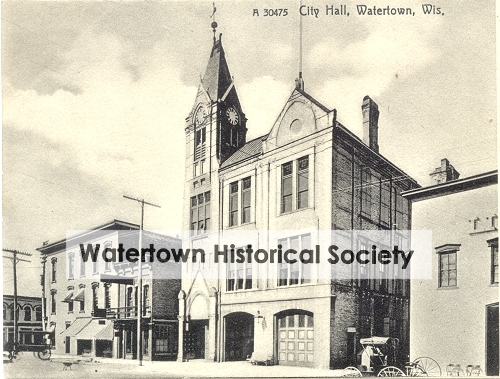
Dept located in City Hall, adjacent to Fire Dept
1892-1895
-- -- CHARLES KERR, City Marshal
1894
01 23 1894 CRIME REPORT
During
the year 1894 there were 226 arrests made by officers in this
city. The statistics as compiled by the chief-of-police show the
nature of complaint and number of arrests as follows: Assault,
29; abusive language,27; drunk and disorderly,
17; petit larceny, 11; carrying concealed weapons,
4; obtaining money by false pretenses, 3; malicious mischief,
3; indecent exposure,2; threats, 2; resisting
officer, 2; bastardy, 1; grave larceny, 1; assault with
intent to rob, 1; non-support, 1; jumping board bill, 1. In addition there were papers served on 121
tramp cases, making the total 226 arrests. Besides, 1,000 persons were accorded free lodging at the jail.
WR
06 29 Julius Schoechert
appointed special policeman WG
x Charles
H. Pieritz appointed to force
1895
01 30 ANOTHER NIGHT POLICE OFFICER NEEDED
West siders are crying for
another night police officer in their section.
It is claimed that one man cannot possibly render service to the
business portion of that part of the city and at the same time keep a watchful
eye on the horde of tramps and tough characters who infest the railroad tracks
from the Junction to the Northwestern coal sheds. It is not deemed safe for a citizen to travel
over that route after nightfall. An
extra officer is urgently demanded. WR
11 13 TRAMP DEMANDS SWEET CAPORAIS
A rude tramp had lodgings
Saturday night at the police station. He
somewhat amused the officers by demanding that they provide him with
cigarettes, specifying Sweet CaporaIs as the only brand that he smoked . Such
luxuries, however, are not furnished at the station. WR
1896-1916
HERMAN C. BLOCK:
Member of police dept: 1893-1916 /
Police Chief: 1896-1916
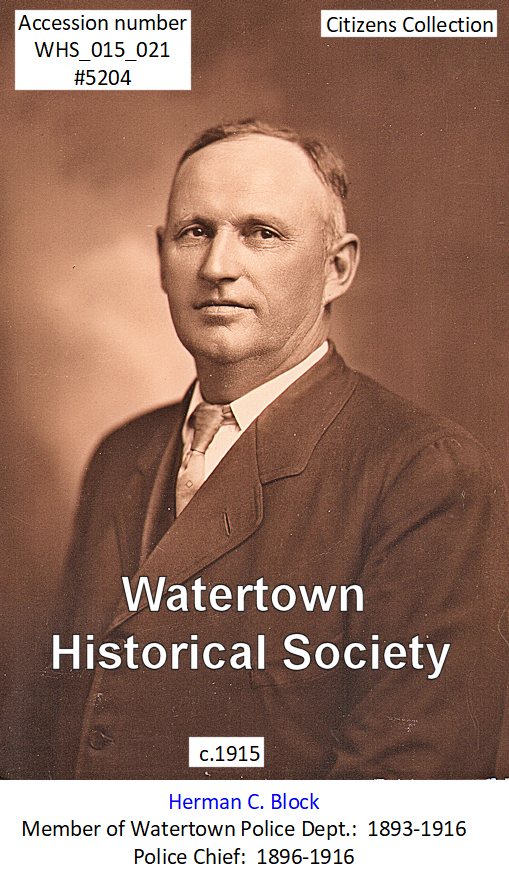 Watertown's first Chief of Police in the modern
sense of that term was the late Herman C. Block. He was first named in 1896 and served by appointment of the City Council from 1903 to 1910, when he
was appointed to the same position by the Board of Police and Fire
Commissioners, serving until 1916 when he resigned and was succeeded by Charles
Pieritz.
Watertown's first Chief of Police in the modern
sense of that term was the late Herman C. Block. He was first named in 1896 and served by appointment of the City Council from 1903 to 1910, when he
was appointed to the same position by the Board of Police and Fire
Commissioners, serving until 1916 when he resigned and was succeeded by Charles
Pieritz.
Mr. Block became a
Milwaukee Road detective after leaving his position here. His home for many years was at South Fourth
and Market Streets, the site now [1954] occupied by the office building of Dr.
A. C. Hahn, Dr. A. C. Nickels and Dr. Vernon P. Smebak.
1897
04 07 FERDINAND LINK ELECTED ASSISTANT
CHIEF ENGINEER
At a meeting of the
Watertown Fire Department Monday evening Ferdinand
Link was elected assistant chief engineer in place of Charles Pientz, whose
position on the police force prevented his qualifying. Mr. Link received 33
votes against 32 for Herman Conrad. Watertown News
1898
03 09 03 09 POLICE SET TRAP FOR TRAMPS
After
resident offers sleigh to officers
A gang of eight tramps
who had imbibed freely of alcoholic spirits held high revelry and caused
considerable trouble in the vicinity of the Chicago & Northwestern railway
roundhouse last Thursday afternoon.
The police department
being notified, Officers Eifiler, Kerr and Pieritz were dispatched to quell the disturbance and arrest
the culprits. At about 5:30 the latter
were encountered, and after a desperate struggle, in which Officer Kerr was
roughly handled but nevertheless succeeded in besting his man, three of the
gang were landed behind the bars of the lock-up. They gave their names as
Charles Carney, William Bates and Thomas Curlen. Subsequently Justice Stacy sentenced Bates to
the county jail for twenty days and Curlen for five
days, the former for using obscene language and the latter for drunkenness.
Carney was held for examination on the 11th inst.
After jailing the above
three the officers went back in quest of the other offenders, who it was
ascertained had kept up their nefarious work in the meantime. They attempted to ensconce themselves in the
roundhouse and, being ordered out by the engine-wiper, Samuel Fluker, had
unmercifully pounced upon the latter and pummeled and kicked him so that he was
rendered unconscious, when they left him and fled up the track. Fluker was found by neighbors in this
condition and taken to his home.
On their way over the
police were notified of what had happened by Station Agent Heimerl and Joseph
Reinehr and chase was given, Mr. Reinehr placing his sleigh at the officers disposal. As
they neared the crossing north of the roundhouse the tramps espied the pursuing
party, but supposing them to be farmers returning home, set about to hold them up. The
tramps were somewhat dismayed upon discovering the trap they had fallen into and their capture was soon effected
by the officers.
The prisoners gave
their names as Robert Gray, Thomas Ryan, John Gukeen,
Charles Haney and James Clark. Saturday
morning Justice Stacy committed them to jail at Juneau to await their
examination tomorrow, when it is expected Mr. Fluker will be able to appear
against them. Mr. Fluker was quite seriously injured, sustaining a broken rib
and some pretty sore bruises, but he is recovering
nicely. His assailants, it is hoped,
will receive their just deserts at the hands of the law.
1899
01 11 POLICE POORLY PAID
The police force of this
city is probably the poorest paid of any like body of men in the state. People must remember that these men are on
duty when they are snugly ensconced in a good warm bed, and that they are
obliged to face the extremes of all kinds of weather. They have to support
their families, and dress as becomes the dignity of their positions. How are they going to do it on $35 per month?
Other cities pay about twice that sum.
Besides, it is a very hazardous occupation. Their work is amongst the criminal classes,
and the liability of bodily injury and the destruction of hard-earned uniforms
continually stares them in the face.
Others might be found to take their places at the same miserable
stipend, but an increase in their monthly allowance would not only be an act of
justice but tend to greater zealousness.
These men have long been in the employ of the city, and their
faithfulness deserves to be rewarded. WR
01 11 TRAMPS LODGED IN LOCK-UP
(same date) Chief of
Police Block reports that during the year 1898 1,648 persons
mostly tramps were given lodging in the city lock-up. The total number of arrests made on warrants
was 171. WR
01 29 PAY INCREASE FOR POLICEMEN
Times, Weltbuerger and Gazette are in hardy accord with the Republican in the movement to increase
the pay of our policemen. The Welbuerger's suggestion of $45 per month
is not a dollar too much. And even that
rate is $15 less per month than Fond du Lac and Madison, and $30 less than
Janesville. WG
09 12 MAN SHOT DEAD BY WATERTOWN OFFICER
At about 2 o'clock
Sunday morning Officer Lucius Bruegger shot and killed Gustave Dumpke near the
corner of West Main and North Warren streets.
Apparently the deed was committed in
self-defense.
It is said that Dumpke,
together with two companions, Edward Gruel and Henry Saum, had been drinking
and carousing downtown Saturday night and the police warned them to desist and
retire to their homes. They had proceeded
a portion of the way when Officer Krueger, on his return from the Junction,
came across them at the place above mentioned.
The men were still boisterous and noisy and Bruegger threatened them
with arrest unless the disturbance ceased.
Thereupon the three attacked the officer, knocking him down, taking away
his billy and unmercifully pounding him.
Bruegger fought bravely, but was badly used up, the injuries about his head being terrible and resulting in much loss of
blood. While lying on the ground and
only as a last resort, he claims, he pulled his revolver and fired,
the bullet hitting Dumpke in the right neck, passing upward and lodging in the
left temple.
As best he could,
Officer Bruegger notified Janitor Krueger of the occurrence. The latter gave the alarm and Officers Kerr
and Pieritz were soon at work on the case, Bruegger meanwhile going to a
physician to have his wounds dressed. WR
12 20 WATERTOWN
GAZETTE CONDEMNS TRAMP
Last week Thursday a
tramp with his arm in a sling was going around the city begging for money. He claimed that he scalded his arm while
working at Janesville and was endeavoring to reach his home in Green Bay. Marshal Zautner took him before Dr. Werner,
who examined his arm and agreed with the marshal’s opinion that the scar
thereon was not induced by scalding, but was
self-inflicted for the purpose of playing on the sympathy of the public, and
thereby extracting money from people who might sympathize with him. He was then placed in the lockup, where he
made a confession to the marshal, saying that he produced the scar by placing
some acid upon his arm for the purpose above stated. He was taken before Justice Stacy and given
ten days solitary confinement in the county jail,
during which time he will have a chance to reflect on the heinousness of his
crime.
Any person who will mutilate his body as this fellow
did, and for the purpose, does not deserve to live. Watertown
Gazette, 12 20 1889

 Portfolio
of Police Dept pictures
Portfolio
of Police Dept pictures
File
on city jail
Fuermann Brewery, Police Dept occupies former
site of
UNKNOWNS
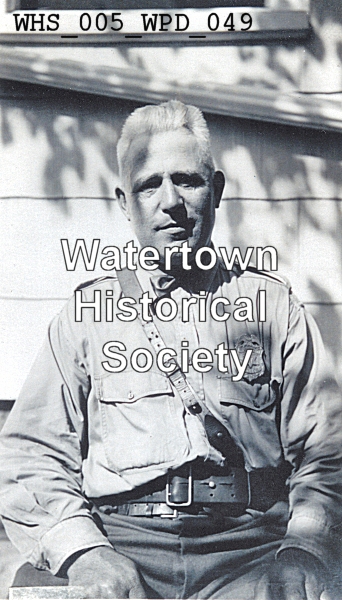 005_WPD_049
 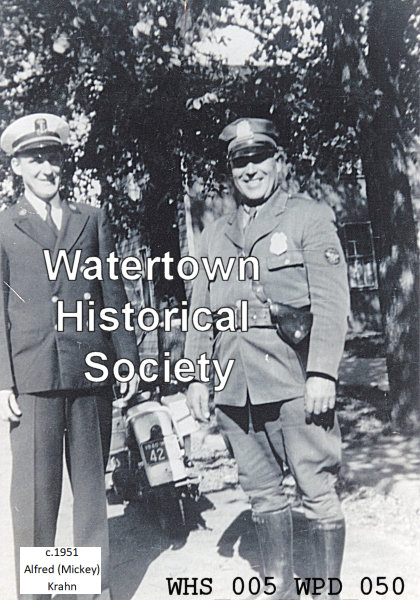 005_WPD_050
__________________________________________________________________________________________
Next Segment  1900-1949 section
__________________________________________________________________________________________

History of Watertown, Wisconsin