website watertownhistory.org
ebook History of Watertown,
Wisconsin
Colonel Daniel Jones, Dead
1866
CROSS REFERENCE:
In 1866, Mr. Donald
Scott, after returning to Watertown, was married to Miss Emma Stewart
Leonard, who died in 1901. She
was a niece of the late Col. Daniel
Jones.
1879 PROFILE OF
Daniel Jones, president
of the Wisconsin National Bank, is a native of Goffstown, N. H. At an early age his parents removed to
Jefferson Co, N. Y., wherefrom after a brief residence they once more removed
to Oneida Co. In 1843 the subject of
this sketch joined the Western tide and came to Milwaukee, where he was engaged
in mercantile ventures, one year of his residence being engaged with a partner
in conducting the American House. In October 1845 he settled in Watertown,
where he carried on merchandising, which was further enlarged in 1852 by the establishment of a banking and
exchange office, which he conducted successfully for many years, the same
finally becoming the Jefferson County
Bank, which was organized under his direction and was largely controlled by
him until 1863, when the bank discontinued business and he identified himself
with the Wisconsin National Bank
which was organized soon after. His
mercantile undertakings were continued most of the time until 1864, when he
turned his attention to the manufacture of woolen goods, being the part owner
of the woolen mills at Watertown, which were operated for four or five years
under the firm name of S. Ford & Co, afterward D Jones & Co., until two
years ago when Mr. Jones leased them to D. P. Price, by whom they are at
present operated. Mr. Jones has been not
less prominently identified with transportation facilities, the plank roads of
the early days and later the railroads, owing, in a large manner, their success
and efficiency to his energy enterprise and foresight. The confidence felt in his judgment and
capacity has found frequent expression among his friends and neighbors, by whom
he has been several times elected Alderman, Chairman of the Board of Supervisors,
and to other offices of honor and trust
SOURCE: The
History of Jefferson County, Wisconsin, Containing Biographical Sketches,
Western historical Company, 1879 - Jefferson County (Wis.)
Banking began at this time with the founding of the first bank in
Watertown, called the Jefferson County Bank, by Daniel Jones in 1853. Jones was a native of New Hampshire who had
come to Watertown in 1845 and opened a store.
He branched out into financial services in 1852. The Jefferson County Bank was short-lived,
however, and it suspended business in 1862.
Jones then joined forces with a new concern, the Wisconsin National
Bank, which was founded in 1858. The
Wisconsin National Bank later became the Valley Bank and, in 1994, this firm
was taken over by the M&I Bank Corporation. SOURCE: Watertown:
A History, by William F. Jannke, III
____________________________________________________
1890
12 31
& NEW TOWER DEDICATED ON CHRISTMAS EVE
01 02 1891
On Christmas eve the
new tower and spire of St. Paul’s Protestant Episcopal church in this city was
completed and the new bell placed in it and used the first time. . . . The tower, spire and bell are a gift to the church
by Col. Daniel Jones as a memorial of his departed wife, who from the
foundation of this parish was his faithful helpmate and co-laborer in every
labor to build up and develop the church in Watertown, so that now she
"being dead yet speaketh." In this work Col. Jones has given another illustration
of how to utilize memorial efforts to the benefit of the community, and the
community in general, as well as the church, appreciates the deed. WR
The tower up to the
bell is of Watertown brick, the belfry is of
massive timbers, and has ample room for a full peal of bells. The spire is very neat and simple, its
graceful outlines calling for no fretted ornamentation whatever, its apex is
surmounted by a well-proportioned gilded cross.
The height from the ground to the top of the cross is 87 feet 10
Inches. The design and execution of the
work has been done by Dornfeld, architect and builder, and is in perfect
keeping with the architecture of the rest of church building, chapel and
rectory, the whole forming a beautiful pile of ecclesiastical structures, an
ornament to the city and a credit to all concerned as well as a cherished mecca
of the church people of Watertown.
The bell is from the Meneely foundry of
Troy, N.Y., and weighs 610 pounds. the following inscription is cast on it:
ST. PAUL’S CHURCH, WATERTOWN,
WIS. To the glory of God, and in memory of ELIZABETH HARGER JONES, who was born
July 21, 1818, and died March 11, 1890.
This bell and tower in which it hangs were erected by her husband,
Daniel Jones, A.D. 1890, for many years Senior Warden of this church. "I CALL ALL" WG
1902
01 03 PURCHASED A FINE CABRIOLET
Col. Daniel Jones has
purchased from J. E. Casey a fine cabriolet,
which is one of the handsomest jobs seen in our streets in years. The design is very artistic and is a
duplicate of the cabriolet which captured the first prize at the Paris
Exposition. It is fitted with the famous
Kelley-Springfield rubber tire and Bradley patents and every particular gives
evidence of excellent quality and workmanship.
WG
1903
09 25 A BEAUTIFUL HOME
Col. Daniel Jones has
just completed having the interior of his home in
Washington Street remodeled and improved, making it now one of the best
arranged and most beautiful homes in the city.
A system of hot water heating has been put in, hard wood floors have
been laid all over the house, the rooms have been all redecorated and otherwise
improved, a bay window has been added to the front part of the residence, and
several other alterations have been made.
The house has had a thorough overhauling at an expense of several
thousand dollars, but a view of the premises will convince anyone that the
money has been well spent. WG
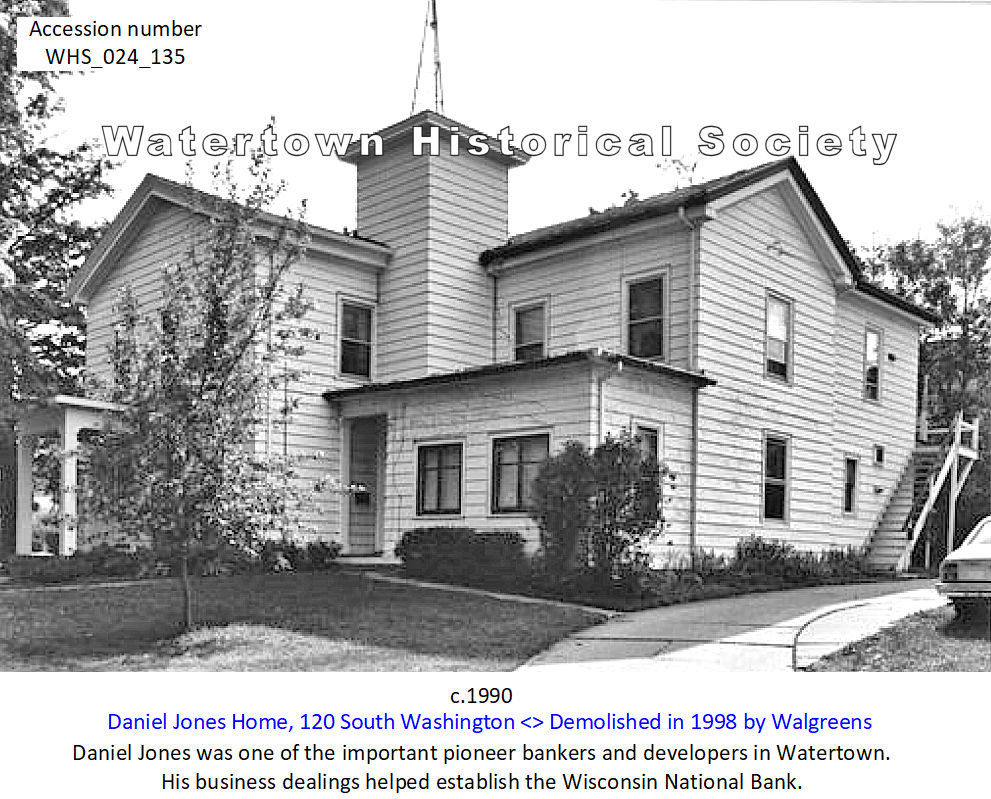
c.1903
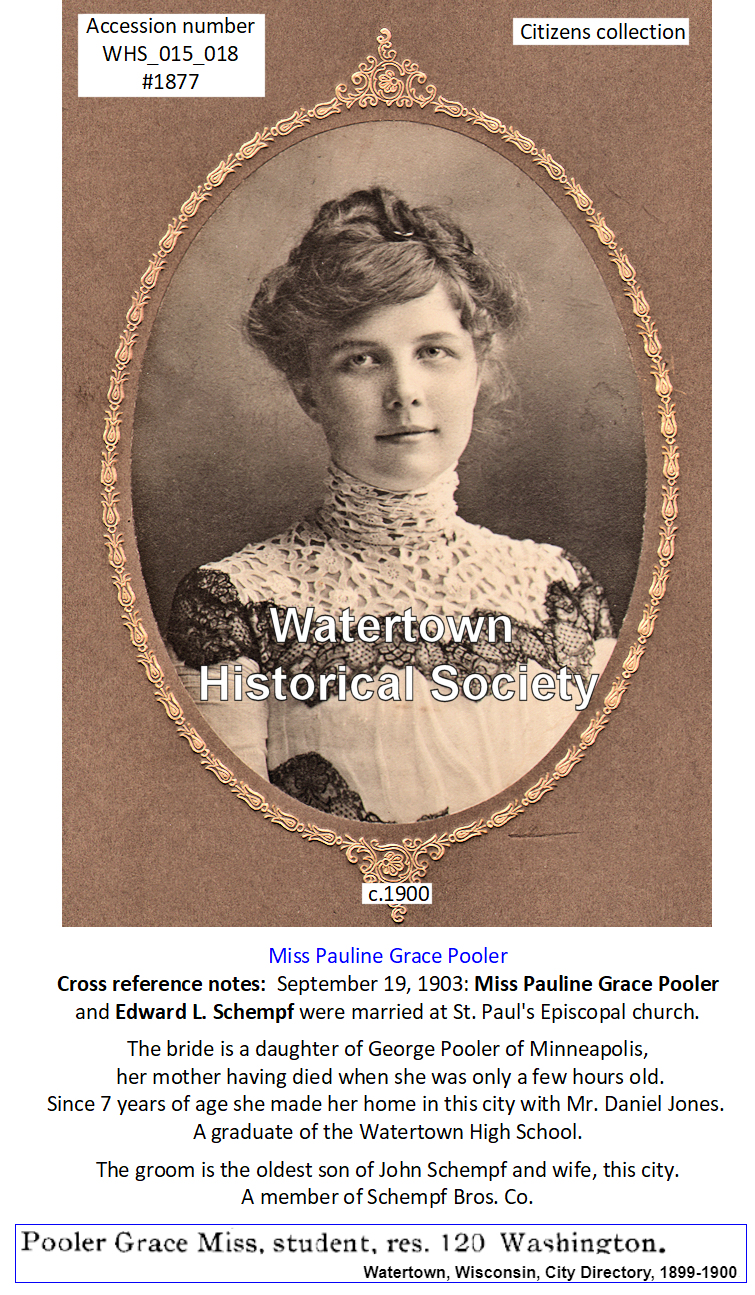
09 19 MISS PAULINE GRACE POOLER
Miss Pauline Grace Pooler is a
daughter of George Pooler of Minneapolis, her mother having died when she was
only a few hours old. Since she was 7
years of age she made her home in this city with Mr. Jones. Miss Pauline Grace Pooler (married Edward L.
Schempf in Sept. of 1903)
1905 DEATH
OF
An Honored Resident of Watertown
For Nearly Sixty Years
Died at His Home on Washington Street in 1905
01 15 Col. Daniel Jones, an honored and
prominent citizen of Watertown for nearly sixty years, died at his home in
Washington Street at 7 o'clock Sunday evening, January 15, 1905.
Though
Mr. Jones was in feeble health for years, his end came sooner than his
relatives and friends expected. On
Thursday he was downtown transacting business, and on Friday he complained of
having a cold. He gradually grew weaker
and passed away as peacefully as a child going to sleep.
His
death was a great surprise to our people, for but few knew that he had been ill
or had been confined to his home. In the
death of Mr. Jones, Watertown loses one of its most successful business men,
and a man who has aided and financed many an enterprise here that has build up
our beautiful city.
Temperament
He was
a conservative, honorable business man, a man whose judgment and word could
always be relied upon, and a man who always dealt justly with all classes,
hence his death is universally regretted here.
He was
a kind neighbor and took much delight in the success of his fellowman, being
particularly interested in the welfare of the young.
Mr.
Jones was born at Goffstown, New Hampshire, October 31, 1815, hence was in his
90th year when he died.
When
quite young he removed with his parents to Jefferson County, New York, and from
there to Oneida County, New York. In
1843 he came west and located in Milwaukee, where he engaged in the mercantile
business and for a year in connection with a partner conducted the American
House in that city.
Arrival in Watertown
Wisconsin National Bank
In
October, 1845, he came to Watertown and opened a store; in 1852 he opened a banking
and exchange office in connection with his store and organized the Jefferson
County Bank in 1853, which he continued until 1865, when the present Wisconsin National Bank was organized by
Mr. Jones in company with the late Wm. M. Dennis, Peter V. Brown, Henry
Mulberger and Charles Jacobi. Mr. Dennis
was president of the bank for many years, and after his death Mr. Jones was
elected president of the bank and remained its president until his advanced
years caused him to retire from active business a few years ago Aside from his banking business he remained
in the mercantile business until 1864, when he associated himself with the late
S. Ford & Co. in the manufacture of
woolen goods, and later conducted the business under the name of D. Jones
& Co. He continued this business till 1877 when he leased it to D. P.
Price.
He was
also personally connected with various other enterprises here, and held many
local offices, at one time serving as chairman of the County Board of
Supervisors.
In
1875 he organized the Marathon County Bank at Wausau and was its president for
many years.
Politically
he was always a democrat and received the title of Colonel as a member of
Ex-Governor Taylor's staff.
October
30, 1843, he was married to Miss
Elizabeth Harger, a native of Denmark, New York, who died March 11,
1890.
St. Paul's Episcopal
He was
a member of St. Paul's Episcopal Church for
over 50 years, which he helped to organize and has been a member thereof during
all that time.
He is
survived by one sister, Mrs. Lydia M. Beaman, who has made her home with him
since the death of his wife.
Reminiscences
Mr.
Jones' life was a very active and eventful one and, when in a reminiscent mode,
he would relate many things of interest that took place in his life in early
days here. Following is one of his
reminiscences of early days in Wisconsin and Watertown; it will prove of
interest to the older citizens here as well as to the younger generation:
"It
was in the spring of 1843 when I landed in Milwaukee and went into the general
merchandise business. I sold everything
from a paper of pins to a log chain. About a year after I reached Milwaukee I
went into partnership with J. L. Bean and we had the American House.
Arrival in Watertown
”In the
spring of 1845 we sold out to a man named Rossiter from Chicago, and I loaded
my goods into a wagon and came to Watertown.
“The
roads were not what they are today. I remember it took me two days to make the
trip in a light wagon with a good team. There were mudholes ten feet deep and
we traveled on corduroy roads. There was nothing here at that time, but people
were coming fast. It was so crowded at the tavern where we stopped that my wife
and myself were obliged to share our room with another young couple, having a
blanket as partition.
D. Jones Exchange Office
“I
started a general store and it was through this that I finally got into the
banking business. Most of the settlers came from the east and they brought
drafts with them. They would buy goods at the store and offer the drafts in
payment. Often they would be larger than I could change and they would leave
them with me to change for them. This had to be done through the Milwaukee
banks and I finally determined to go into the business myself. In the spring of 1852 I opened the D. Jones
exchange office.
Jefferson County Bank
“In
1853 the state banking law was passed, and with my brother-in-law, C. J.
Harger, as a partner [note: also
brother-in-law of Ashley Harger?], the Jefferson
County Bank with a capital of $75,000 was organized. We took circulation to
that amount secured by $56,000 Missouri state bonds and $30,000 California gold
bonds. Everything ran smoothly until the
war and the people began to demand gold for our notes. The Missouri bonds we
had bought at 83c on the dollar and they went down to 38. We sold the California bonds which were
always at par and with this money started in to take up our notes as fast as
they were presented. Gold was at a premium of from 13 to 100 percent at this
time. To help out we shipped produce, beef and pork to New York, ordering gold
back. Sometimes it was a tight squeeze to get enough gold from New York to
carry us through the day, but we did it and I am proud of it. We had succeeded in taking up all but about
$14,000 of our circulation when specie payment was suspended. In the fall of
1854 the Jefferson County Bank was closed.
St Paul Railroad
Chicago & Northwestern
“When
the St Paul Railroad came here it was so
poor that I couldn’t pay for the wood it needed to run its engines. Alexander Mitchell was a great friend of mine
and he told me that if I would pay for the wood he would see that I didn't lose
by it. For two years I bought the wood
for it. When the Chicago &
Northwestern got this far it couldn’t get its iron, which was in bond. With
several others I signed the bond that released the rails and permitted the road
to go on. These acts cost me dear.
Plank Road
“I was
one of the originators of the Plank road,
between Portland and Oconomowoc, and it was a good investment until the
railroads came through. They ruined the
business and I lost what I had in the enterprise.
Wisconsin National Bank
“In
February 1856, the Wisconsin National Bank of Watertown was organized. The organizers were William M. Dennis, Peter
V. Brown, Henry Mulberger, Charles Jacobi and myself. I alone am living.
“In 1876
I organized the Marathon County Bank at Wausau and still retain an interest in
it."
Funeral
Wednesday
afternoon Mr. Jones' funeral took place from his late home to St. Paul’s
Episcopal Church, Rev. John Barrett being the officiating clergyman, who
preached a most eloquent tribute to the memory of the departed.
The
full church choir was assisted by a male quartette composed of Messrs. Julius
Wiggenhorn, Fred Lehmann, William Sproesser
and Max Rohr. The remains of the
deceased were placed in the vault at Oak Hill
Cemetery and later on will be placed in their final resting place in the
cemetery.
The
honorary pallbearers were Messrs. M J Woodard,
Dr. Edward Johnson, William P. Brown, John Robinson, Ex-Senator William F.
Voss, Dr. F. C. Moulding, H. T. Eberle, George Hawkins. The active
pallbearers were Messrs. J. F. Prentiss, Gustav Buchheit, Henry Mulberger, J.
C. Harrison, Jas. W. Moore, Robert Dent.
The Wisconsin National Bank,
of which Mr. Jones was one of the founders and president for many years, was
closed during the afternoon out of respect to his memory. Watertown
Daily Times

History of Watertown,
Wisconsin