website watertownhistory.org
ebook History of Watertown, Wisconsin
THIS FILE IS BEING REFORMATTED AND ADDED TO AT
THIS TIME
G. B. Lewis Company
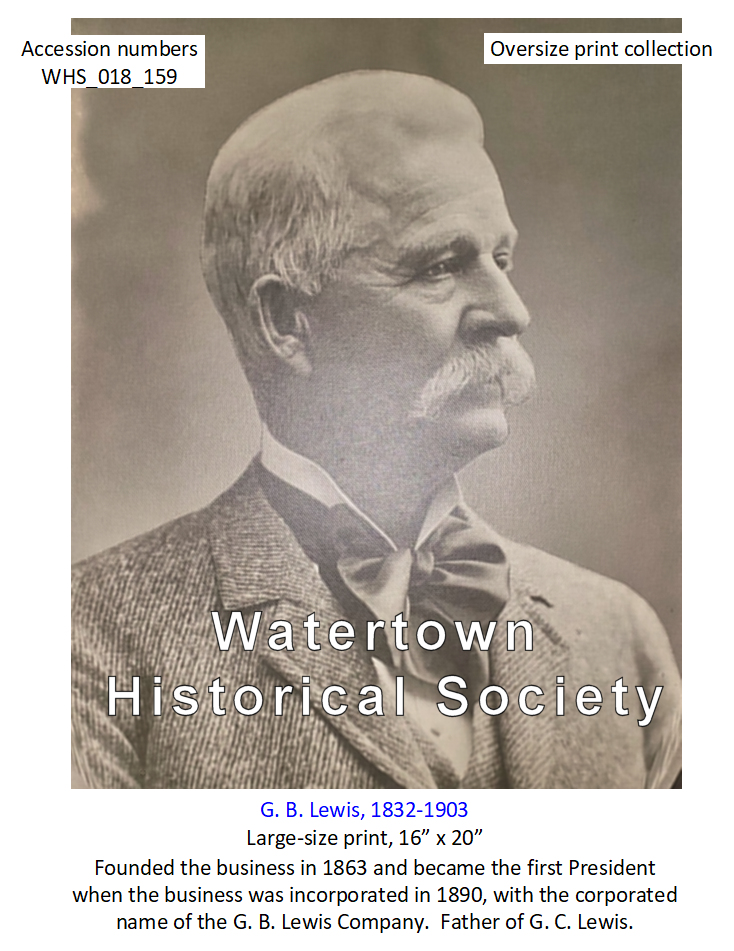
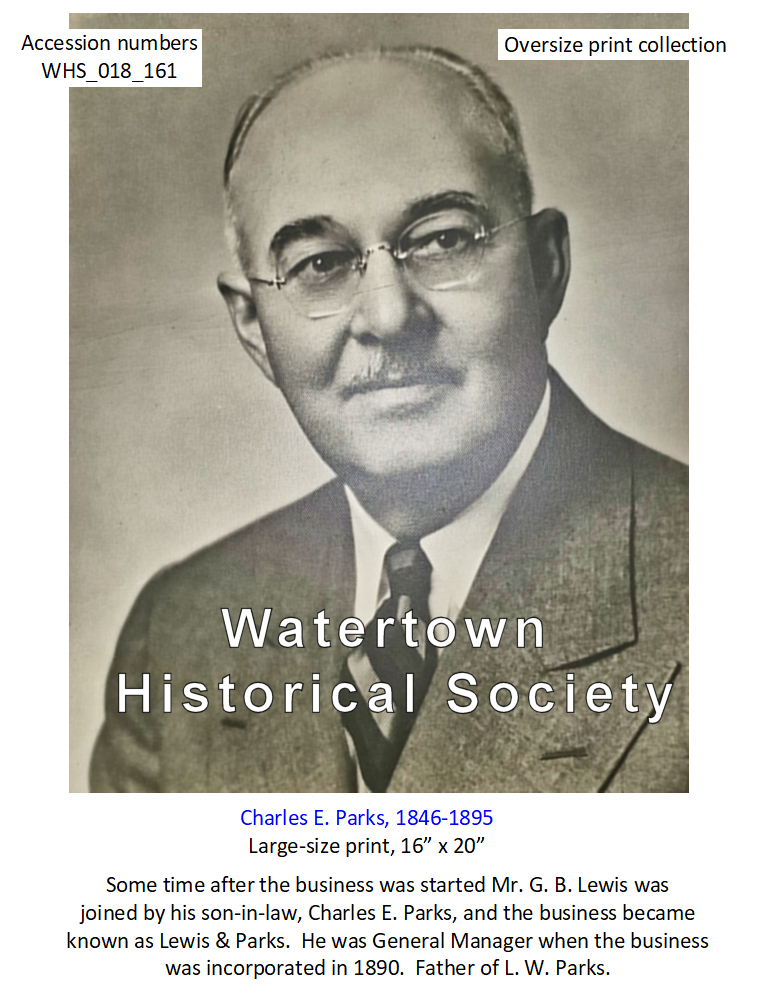
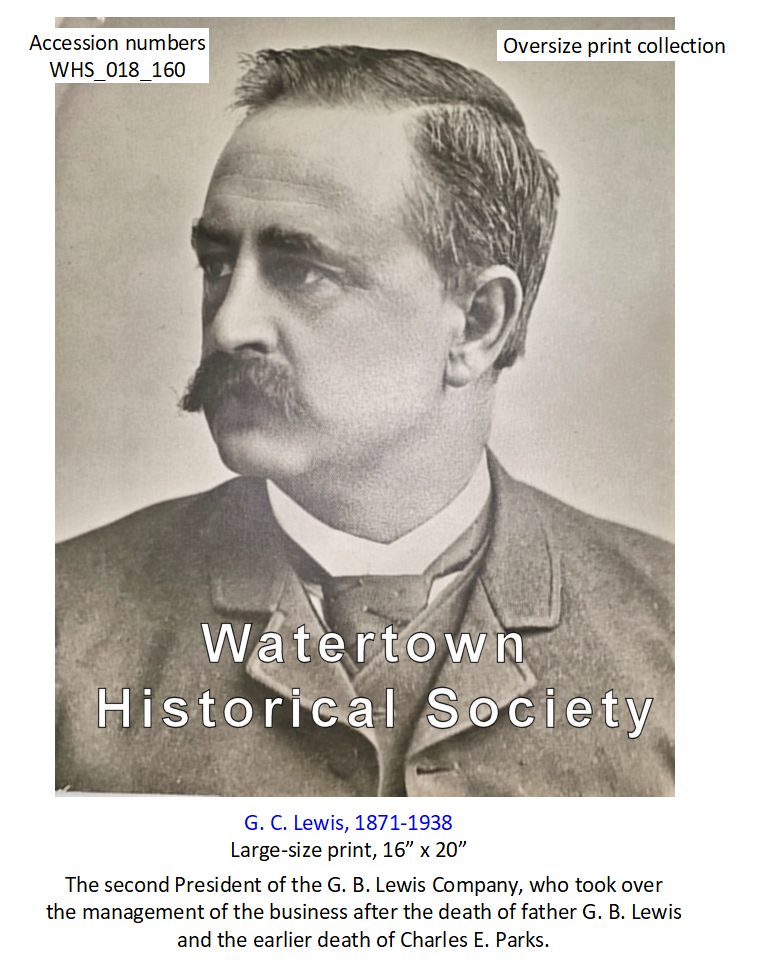
G. B. Lewis, 1832-1903 Charles E. Parks, 1846-1895 G. C. Lewis, 1871-1938
G. B. Lewis, 1832-1903: Founded the business
in 1863 and became the first President when the business was incorporated in
1890, with the corporated name of the G. B. Lewis
Company. Father of G. C. Lewis.
Charles E. Parks, 1846-1895: Some time after the
business was started Mr. G. B. Lewis was joined by his son-in-law, Charles E.
Parks, and the business became known as Lewis & Parks. He was General Manager when the business was
incorporated in 1890. Father of L. W.
Parks.
G. C. Lewis, 1871-1938: The second President
of the G. B. Lewis Company, who took over the management of the business after
the death of father G. B. Lewis and the earlier death of Charles E. Parks.
___ 1863 __________________
FOUNDING OF
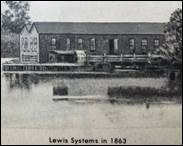
The G. B. Lewis Company's
presence in Watertown dates back to 1863 when it started as a two-man shop.
The company was known for many
years as the world's largest manufacturer of beeware.
___ 1870 __________________
THREATENED
BY FIRE
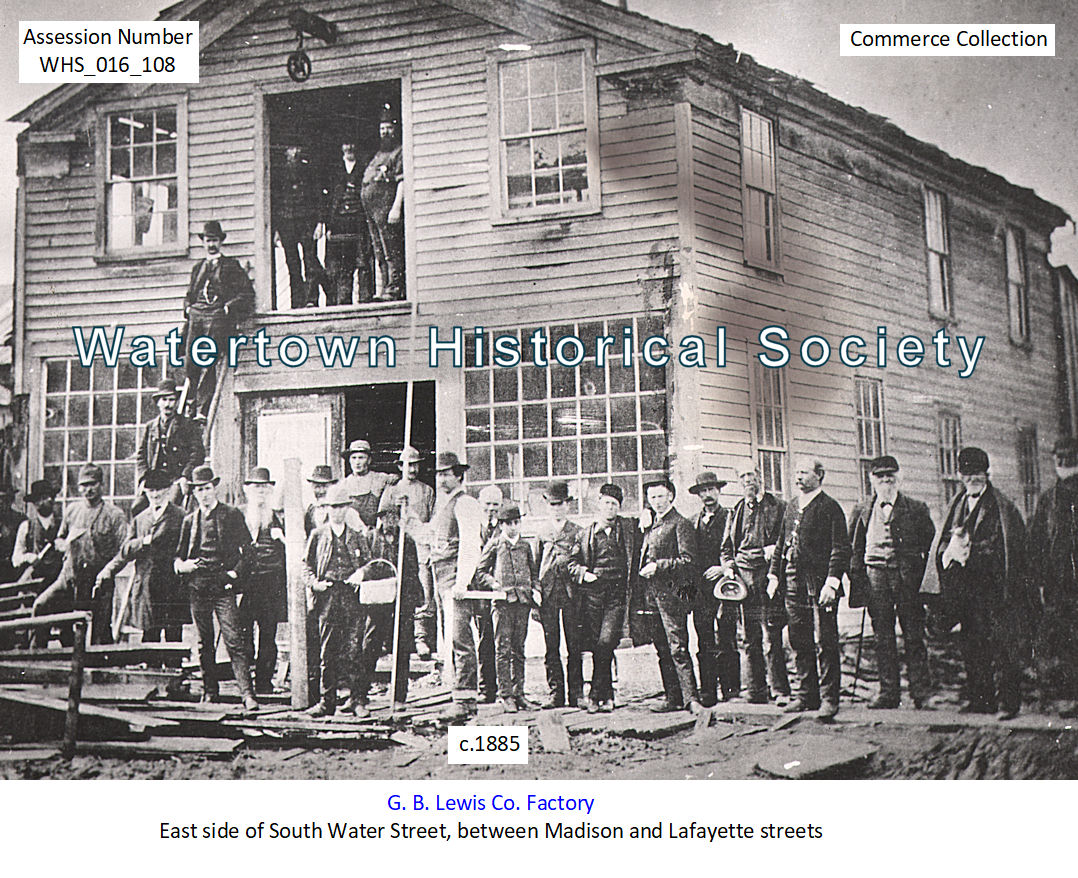
Sash and Door Manufactory of G. B. Lewis threaten by Empire Mill fire.
EMPLOYEES
___ c.1887 __________________
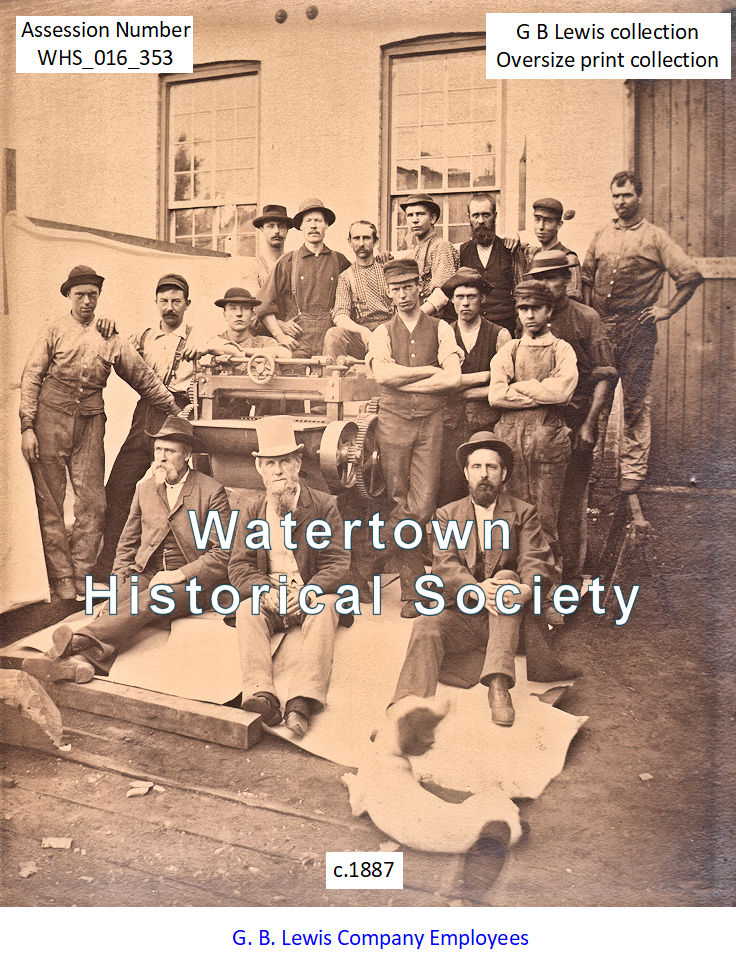
EMPLOYEES
___ 1890 __________________
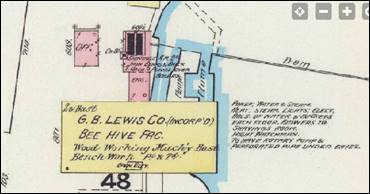
-- -- 1890 SANBORN FIRE INSURANCE MAP
04 25 DESTRUCTIVE FIRE
At 2:30 o'clock last Saturday morning a destructive fire occurred in the
city and at one time it looked as though a large portion of the west side would
be destroyed. The entire box, bee-hive
and section factory of G. B. Lewis & Co. the and Watertown Woolen Mills, owned by Mrs. James Chapman, were totally
consumed. The loss of the former is
about $15,000 insured for $4,500 . . . .
The buildings burned were located adjacent to two large lumberyards, the
Empire flour mills and several frame buildings.
Had it not been for the good service of the fire department the loss
would have been very great. The origin of the fire is unknown . . . . WG
05 14 DETERMINED
TO REMAIN IN WATERTOWN
Messrs.
Lewis & Parks have determined to remain in Watertown, all reports to the
contrary, notwithstanding, and the work of their new Bee Hive and Box
manufactory is to proceed as rapidly as possible. This determination on their part has been
reached in spite of the liberal offers made to the firm by Beloit, which were
very tempting and hard to withstand. The
result, while flattering to Watertown, carries with it a display of loyalty on
the part of Lewis & Parks for which they deserve credit. Tally one for Watertown and now in this same
line let us have a new Woolen Mill. WR
07 30 PROGRESS
ON APIARY SUPPLY BUILDING
Lewis
& Parks are making rapid progress with their new apiary supply
building. It is said to be the largest
building for the manufacture of this line of goods in the United States. WR
08 01 BUILDING
COVERS MORE GROUND THAN ANY OTHER BUILDING
G.B.
Lewis & Co’s, new bee-hive factory begins to loom up in
good shape. It is three stories high and
basement, and covers more ground than any other building in the city. WG
10 22 BEE HIVE AND HONEY SECTION MOVED
G.B. Lewis & Co. have removed their bee hive and honey section
business from the Watertown Machine company's building and now occupy their new
factory on the West side.
11 05 FIRE BUG WEIGEL
Edward Weigel, aged 11 years,
whose home is on North First Street, was taken before Justice Halliger, October 21, under a criminal complaint for having
stolen a watch, the property of G. Boehn, and the youthful culprit was
committed to the Reform school at Waukesha.
Other offenses came out against him in the examination, such as stealing
dinner pails from the children of St. Henri's school, from which is was evident
that he required to be taken care of.
Sometime before the boy had been
charged with tempting to set fire at St. Henri's church, having sprinkled oil,
obtained in the church, on the floor and then scattered matches over the
surface so that a person walking might ignite the matches and set the blaze
going. But Justice Halliger,
from his proofs, decided that there was no cause of action and discharged
him.
And now comes the startling
denouement. When Deputy Sheriff Graewe was leaving the Reform school to return home, young
Weigel confessed to him and the keeper to having set fire to Paul Herzog's barn
and since then the astounding intelligence is received that in addition to this
burning he admits that he set fire to
the factory of G. B. Lewis & Co. and Geo. W. Evans' livery stable,
involving a destruction of some $25,000 worth of property.
It may be this boy is trying to
make a great hero of himself, and that his admissions must be taken with some
grains of allowance, but that he is an evil-disposed youth whose presence is
dangerous to society and should be made to pass through a lengthy penitential
period will not be disputed. WR
11 21 NEW BEE HIVE FACTORY
Long
article about the G.B. Lewis new bee hive factory in W Gazette.
12 05 FIRE BUGS WEIGEL and SCHLUTER
John Schluter a lad 14
years of age of the 5th ward, was arrested Thursday morning on the charge of
being implicated in setting fire to
Lewis & Co.'s factory which was destroyed by fire last February. Mr. Parks visited Waukesha on Wednesday and
called on young Edward Weigel, a lad 11 years of age sent from here to the
reform school at that place October 21st.
It will be remembered that at that time Weigel claimed to have set fire
to several places here, and on Wednesday last told Mr. Parks while in
conversation with him that young Schluter was implicated with him in firing the
Lewis factory. Schluter is now in jail
awaiting his examination. WG
12 12 FIRE-BUGS
CONFESS TO WOOLEN FACTORY FIRE
In our
issue of last week we referred briefly to the arrest of John
Schlueter charged with setting fire to G. B. Lewis & Co.’s bee hive factory
in February. As stated, Mr. Parks, the junior member of the company,
visited the reform school at Waukesha for the purpose of getting a confession
out of Eddy Weigel, a boy 11 years of age sent from here to that institution
last October, with the suspicion hanging over him that he knew all about the
various fires that were kindled here the present year, involving the loss of
over $25,000 worth of property in the destruction of the G. B. Lewis Co.’s
bee hive factory, the Watertown woolen mill, Geo. W. Evans’ livery barn and
the Herzog and Lange barns.
When Mr.
Parks first began interviewing young Weigel, he was reluctant to telling all he
knew about these fires, but he finally made a clean breast of it. He
stated that he fired Evans’ and Lange’s barns merely for the sake of seeing a
fire, and Herzog's barn because some of the Herzog family were mad at
his folks, and called him names because they did not buy beer at
Herzog's saloon, and he fired the barn to get even with them.
With
regard to the Lewis fire, he stated that he and Schlueter planned this
fire because they had applied for work at the Lewis factory and were
refused. Early in the evening they passed some time in a barn back
of the William Pell house in the 5th ward, and then strolled down towards
Weber’s lumber yard, thence down to the river bank, and waited around the mills
and factory until the electric lights went out. Weigel gave a minute
description of the interior of the factory at the place therein where they started
the fire on the night in question, so that there can be no doubt of his story
being correct.
As soon
as the electric lights were turned off, both entered the basement door on the
south of the factory leading from the alley way between there and the woolen
mill, Schlueter applied the match whilst Weigel stood guard outside watching so
that they could not be surprised in their nefarious work. When
everything was ready, Weigel went outside to watch, but returned
again to inform Schlueter that a man was passing by and they had better
wait awhile longer. They did so, and both returned to their respective
posts.
Schlueter
applied the match to a pile of shavings in the fore part of the basement and
then skipped outside, calling to his partner to run. Both started on
the run, got separated in Weber's lumber yard, but came together again near
Jesse Stone's residence, and then proceeded to Hughes' barn nearby, where they
passed the night.
On
arriving home from Waukesha, Mr. Parks had Schlueter arrested. He
was closely questioned as to his connection with the Lewis fire, and told
substantially the same story as above. . . .
. . . .
It is a relief to know that older persons were not engaged in this
work. Both boys will probably spend the best years of their lives in
the reform school, if not in the state prison, and it is hoped that with this
as an example before them, other boys here may be prevented from ever engaging
in such despicable work.
The
reform school and state prison, to our mind, is altogether too mild a
punishment for such acts. It now remains to discover who fired the
old Lindon House barn, and let us hope that the guilty one may also be found
out. WG
CROSS
REFERENCE NOTE:
02 18
1891 <> John Schlueter was found guilty in the Jefferson county circuit
court last week for setting fire to Lewis & Parks' box factory one night in
April, 1890, his motive being to see a large conflagration in this respect his
desire being fully gratified. The fire
involving a loss of some twenty thousand dollars the box factory not only being
destroyed, but the J. Chapman woolen mill also.
Judge Bennett sentenced the youthful incendiary to confinement in the
Waukesha Reform School until he has attained the age of 21 years. He is now 14 years old. WR
___ 1891 __________________
03 04 SHAVINGS CAUGHT FIRE
The alarm of fire last Thursday
evening was caused by some shavings taking fire in the blow-pipe of the G.B. Lewis
company's factory. No harm was done, but the fire department was on hand
prepared for any emergency. WR
09 02 WINTER'S RESIDENCE IN DUNEDIN, FLORIDA
We have been handed a handsomely
illustrated pamphlet, giving a description of Dunedin,
Florida, the home of Lee and Charles Skinner, and the winter residence of
our townsman Geo. B. Lewis. The town is
beautifully situated on the Gulf of Mexica, in a region possessing "the
finest climate on earth," to use the words of the pamphlet. G. B. and C. P. Lewis have acquired title to
eighty acres in the town, which they have laid out in park style. No place offers greater inducement for a
winter's residence than Dunedin. WR
___ 1894 __________________
11 14 BOX-WEAVING MACHINE INSTALLED IN PARIS
Fred Zipsel, an employee of the G. B. Lewis Company, expects to
go to Paris, France, soon to set up a box-weaving machine of C. E. Parks’
patent for a manufacturing concern there.
Unless orders are received to the contrary, Mr. Zipsel
will depart on the 24th inst. He has
secured his passports. WR
___ 1895 __________________
05 01 M/M LEWIS RETURN FROM FLORIDA
Mr. and
Mrs. George B. Lewis arrived home Sunday evening from Dunedin, Fla., where they
made their customary winter’s residence.
Mr. Lewis looks as if he thoroughly enjoyed himself under the warm
Southern skies, and is as brown as a berry.
WR
07 03 DEATH OF C. E. PARKS
Item
about the death of C. E. Parks, a partner in the G. B. Lewis Co. and who held a
number of patents on machinery for making barrels and packing boxes. WR
___ 1898 __________________
05 25 The
G. B. Lewis Company last week shipped the exhibit of bee-keepers supplies which
they intend making at the Omaha exposition.
The exhibit is handsomely finished and when placed in position will make
a very effective appearance. It is
destined to do great credit to the company, as well as to our city and
state. WR
___ c.1899 __________________
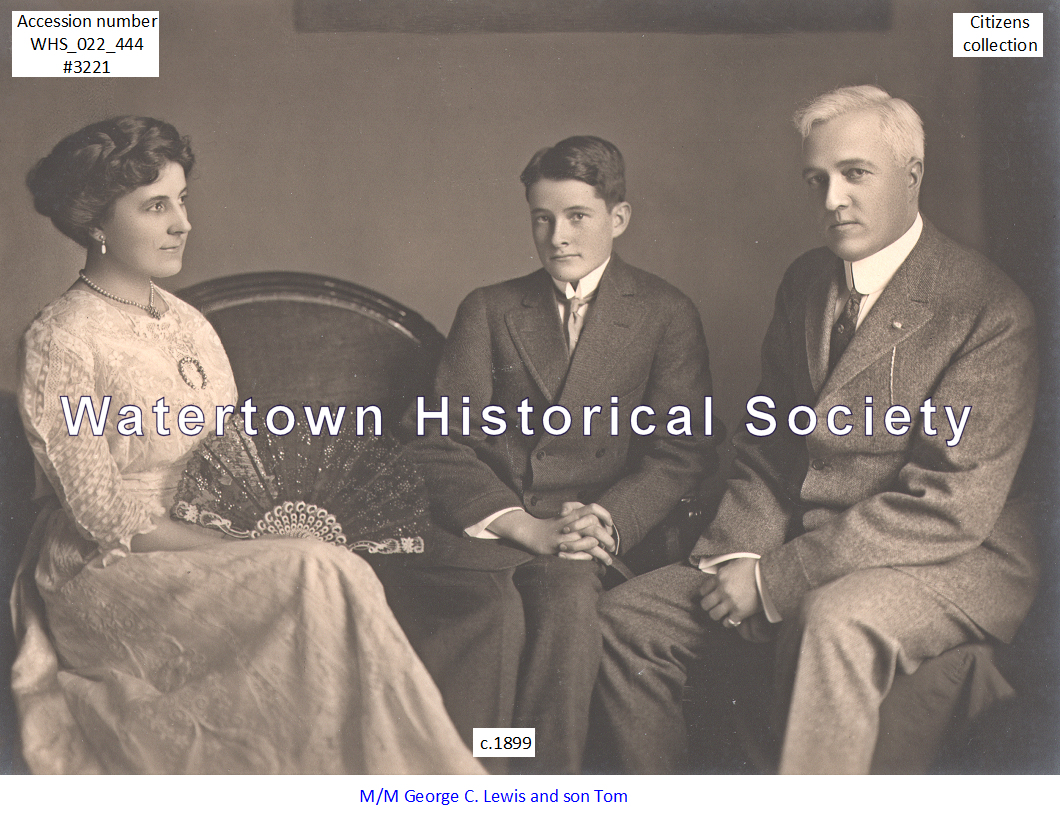
M/M George C. Lewis and son Tom

Mrs. George C. Lewis and son Tom
___ c.1900 __________________
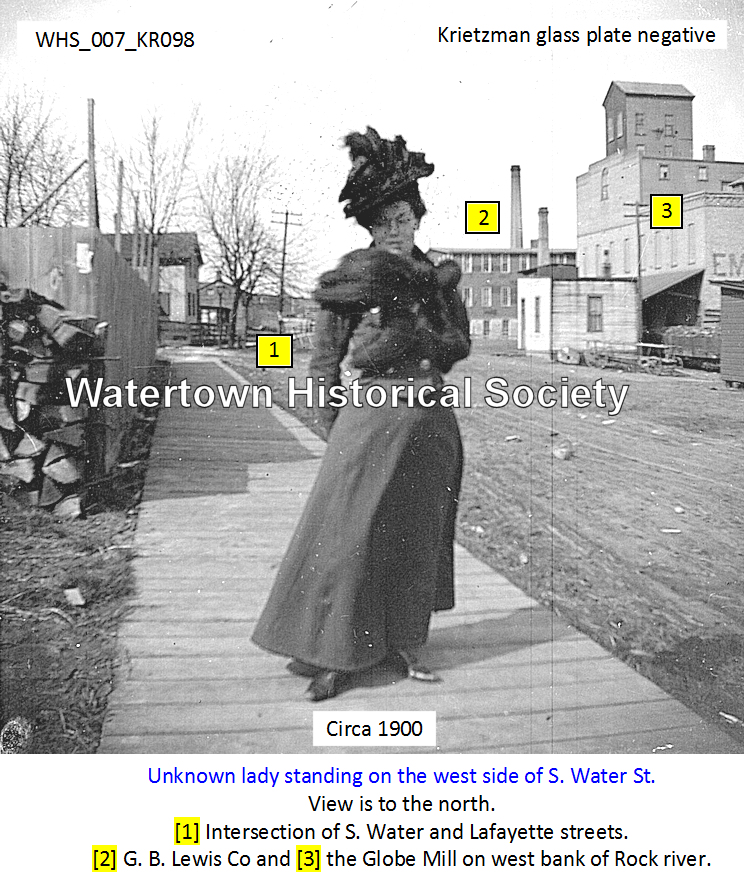
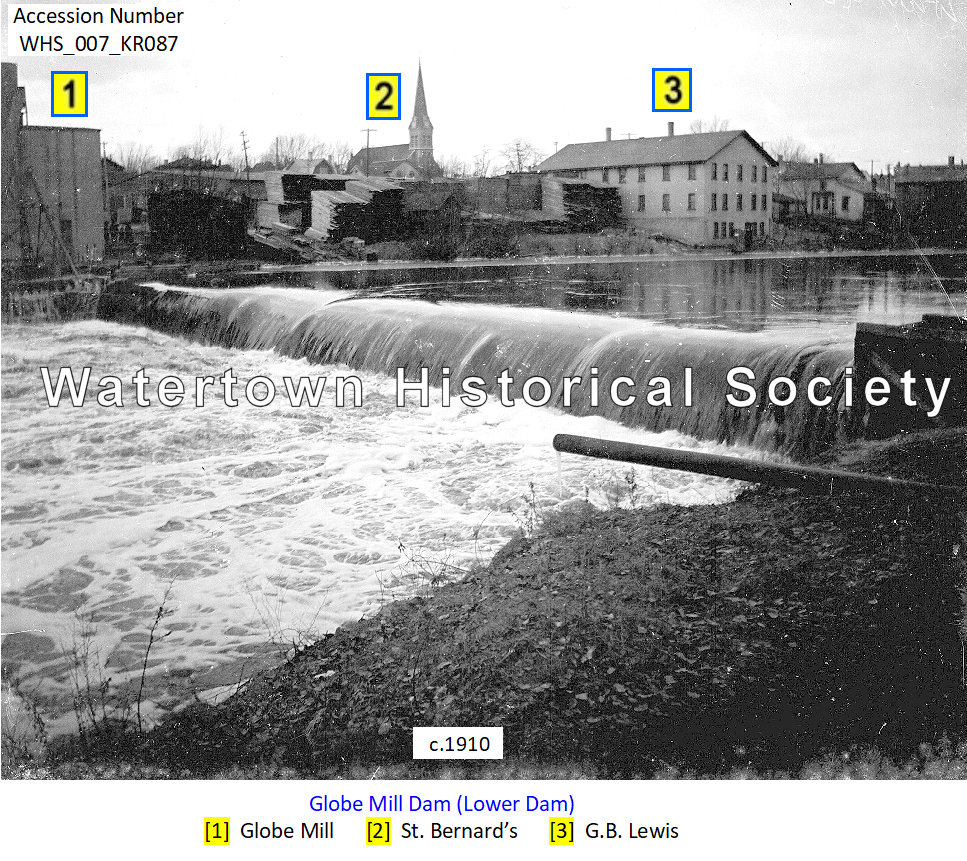
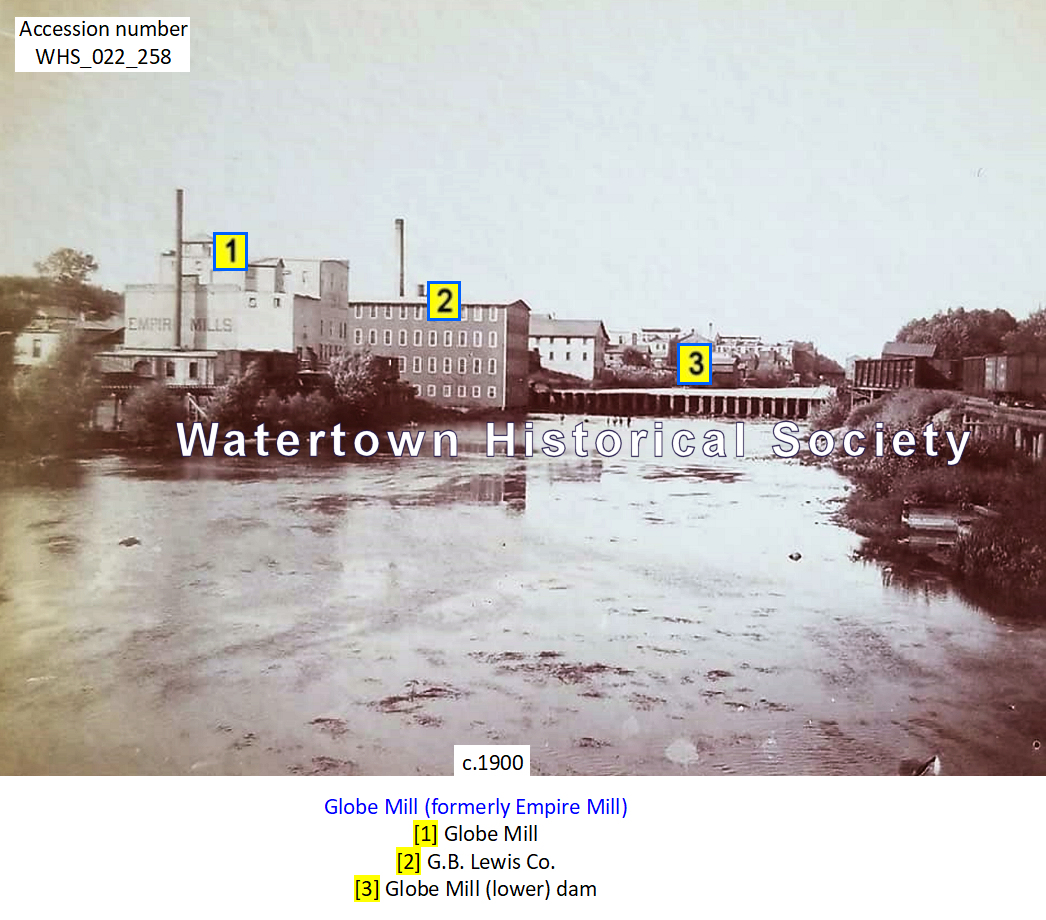
___ 1903 __________________
09 05 RAISING
ROOF FOR ADDITION OF ANOTHER STORY
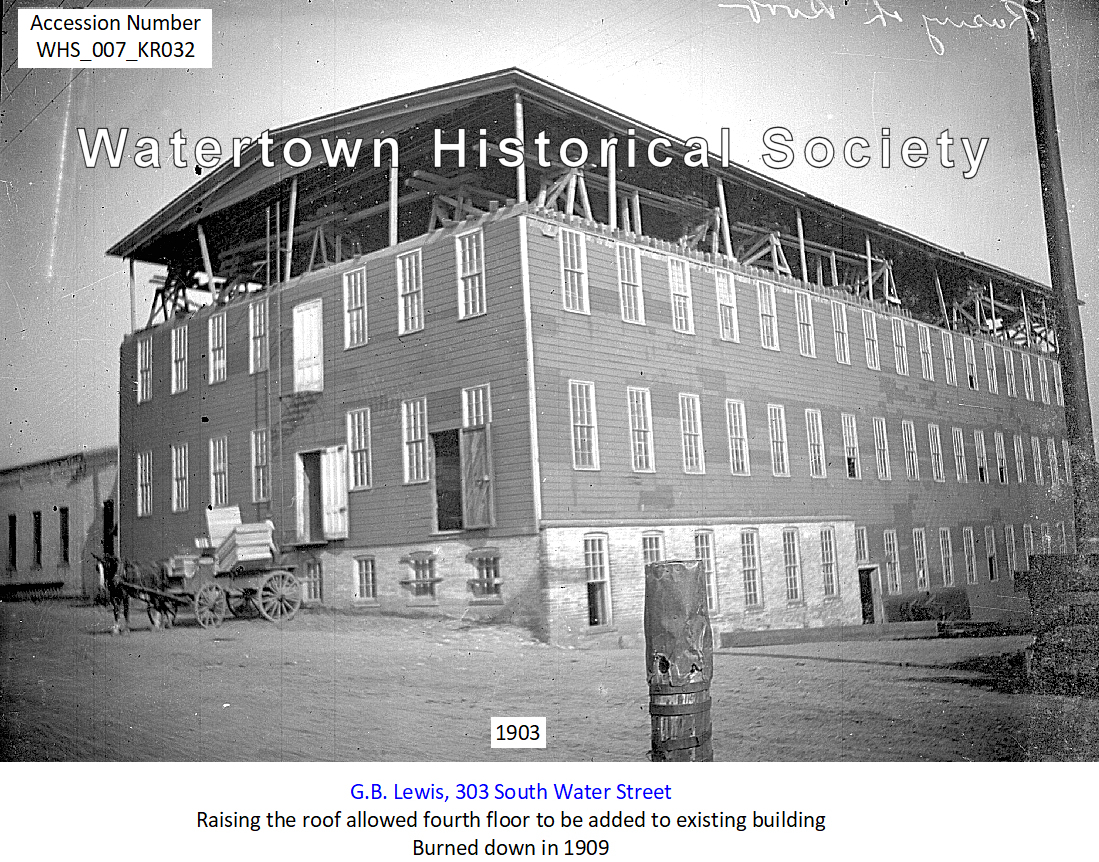
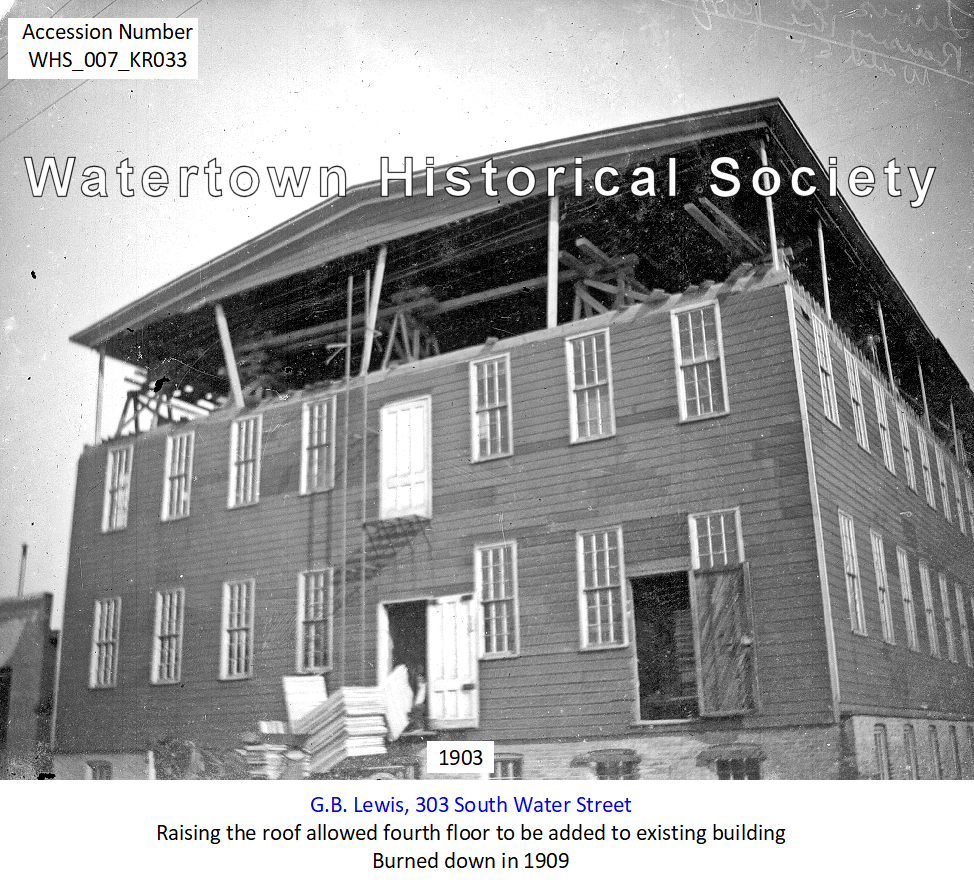
09 08 ADDITION OF ANOTHER
STORY
The G. B. Lewis Co.,
manufacturers of beekeepers' supplies, shipping crates, etc., have let the
contract to Chas. Huenefeld for the addition of another story to their factory
on Water Street which will give them 7800 square feet more floor space, the building
being 60x130 feet. When completed all
the packing and shipping will be done in this building, and the brick building
to the north of the factory will be used exclusively for storage purposes. An addition 12x20 feet is also being built on
the rear of their office building, the increased business of the company
demanding more office room. When these
improvements are completed the Lewis Co. will have one of the largest factories
of this kind in the world, and their products are sold all over. This is one of Watertown's most important
industries, and under its present management the business has been greatly
increased. WG
___ c.1903 __________________
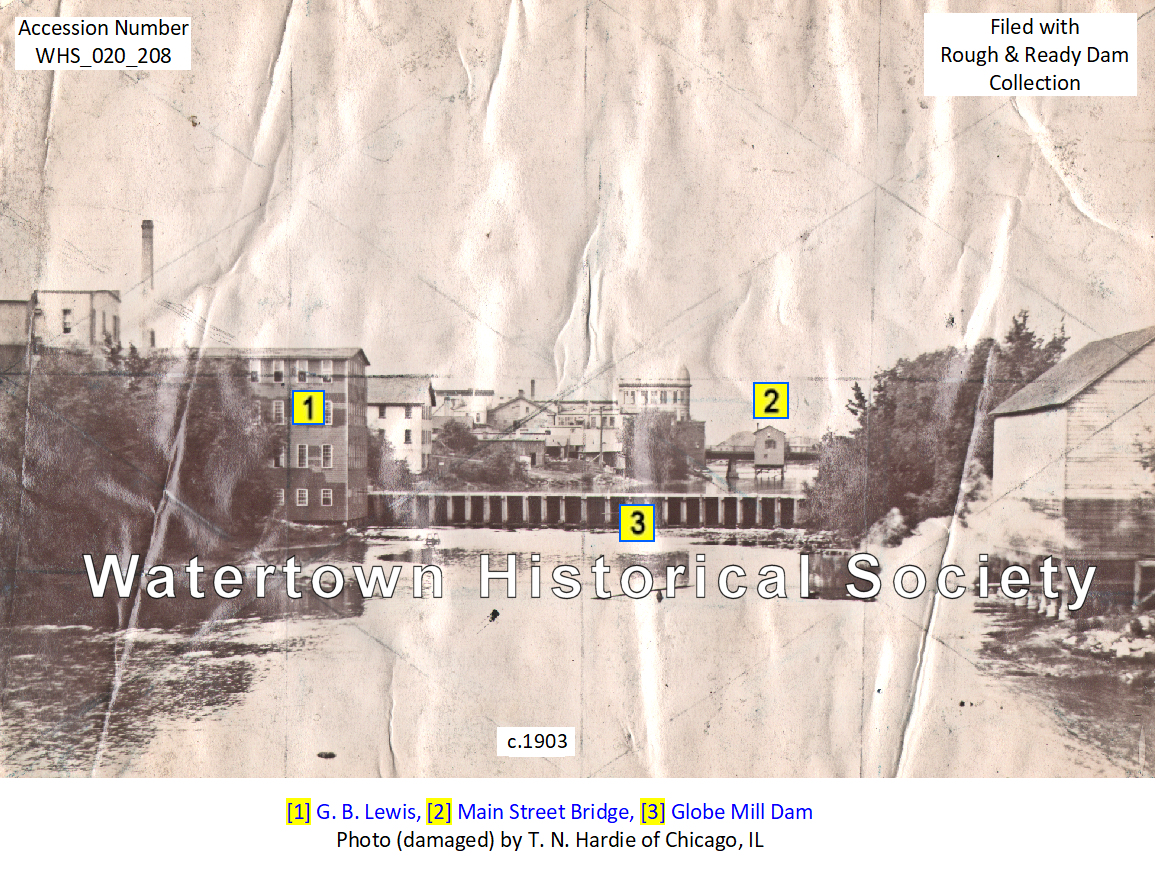
___ 1904 __________________
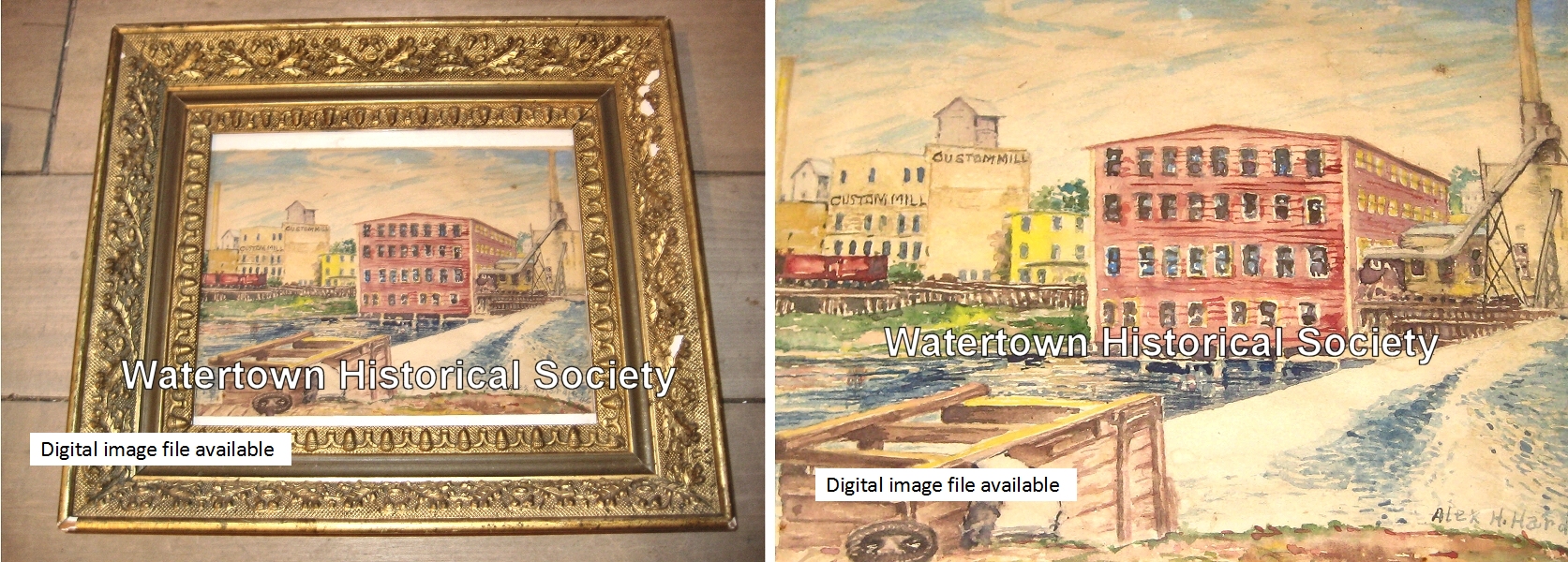
PAINTING
(made in
1946)
 Alex Hardie
1946 painting
Alex Hardie
1946 painting
Old G. B Lewis plant, barber shop on Main Street bridge seen in
the distance ["The Bridge" barber shop,
John Seager painting (1946) ]. Shop
taken out by March 26, 1904 flood.
___ 1905 __________________
 Alex Hardie
1956 painting made from 1905 Hardie
pic
Alex Hardie
1956 painting made from 1905 Hardie
pic
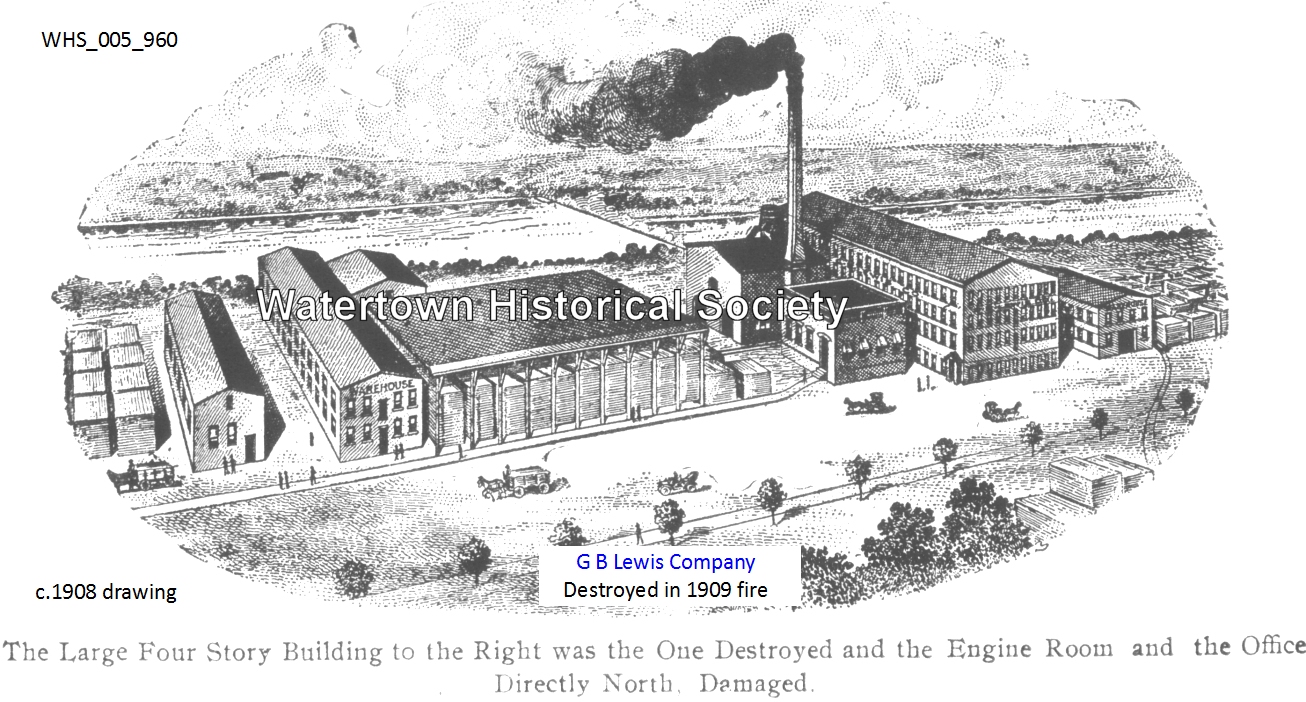
Globe Mill, left; G.B. Lewis center.
Fire destroyed the Lewis Water St. building in June of 1909.
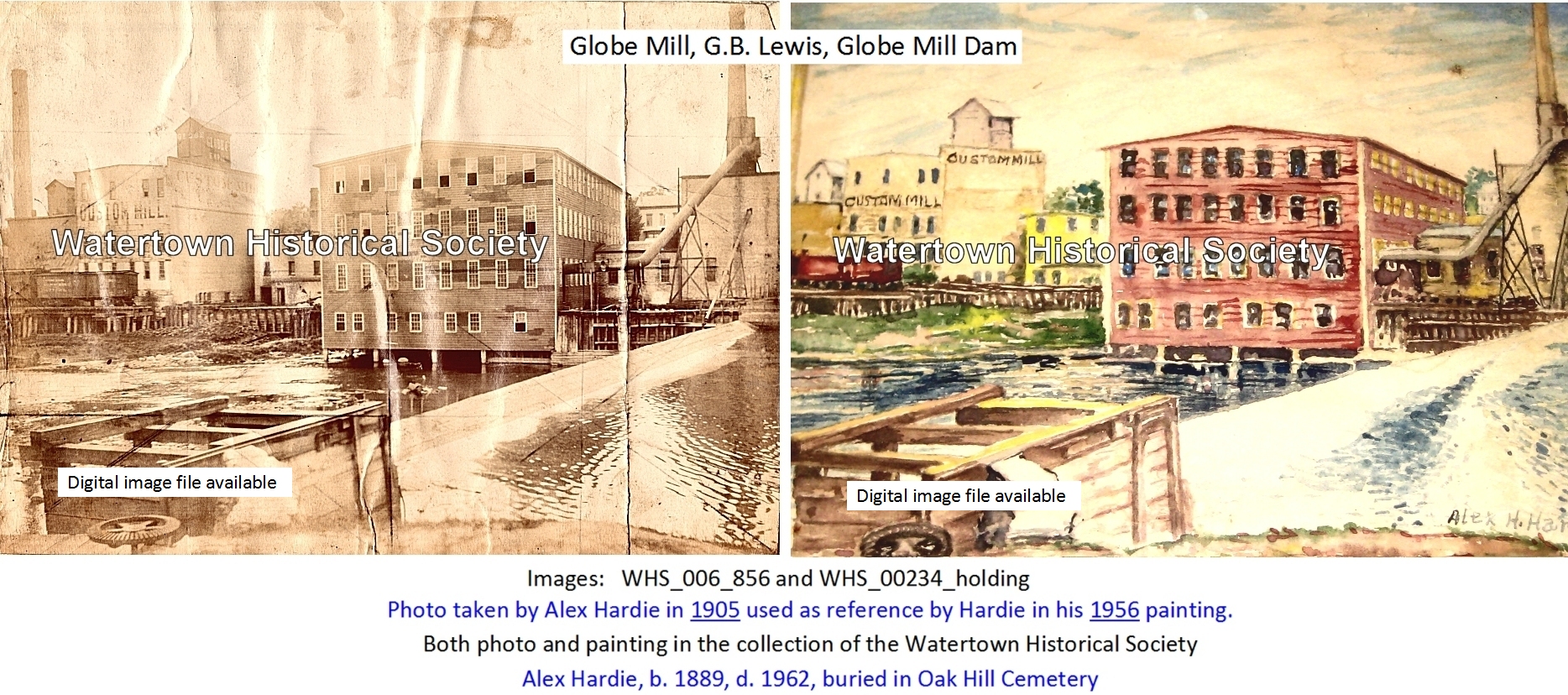 Globe Mill and dam, left; Alex Hardie 1905 picture, used in his painting, 1956
___ c.1905 __________________
EARLY LEWIS BUILDING
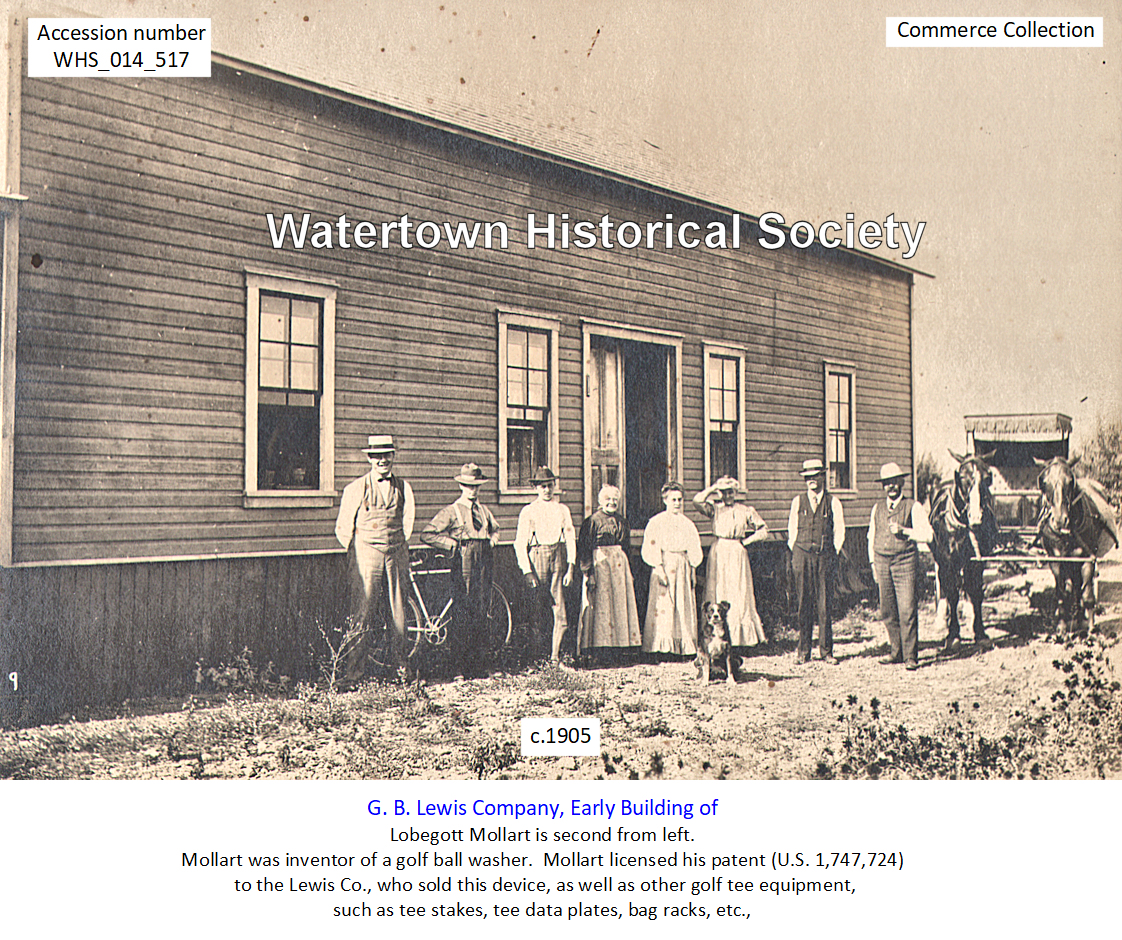 Lobegott Mollart is
second from left.
Lobegott Mollart is
second from left.
___ 1907 __________________
01 26 100,000 CATALOGUES
The office of the G. B. Lewis has
been a busy scene the past few days, the office force and a large extra force
of young ladies being actively engaged in preparing for mailing 100,000
twenty-page catalogues. Some idea of the
enormity of this annual work is shown in the fact that the postage on these
catalogues alone amounts to between $800 and $1,000. These catalogues are mailed to every part of
the United States and Canada, many of them going to foreign countries. It is a means of advertising, however, for
orders pour in from all sections of this country, Canada and several foreign
countries. WDT
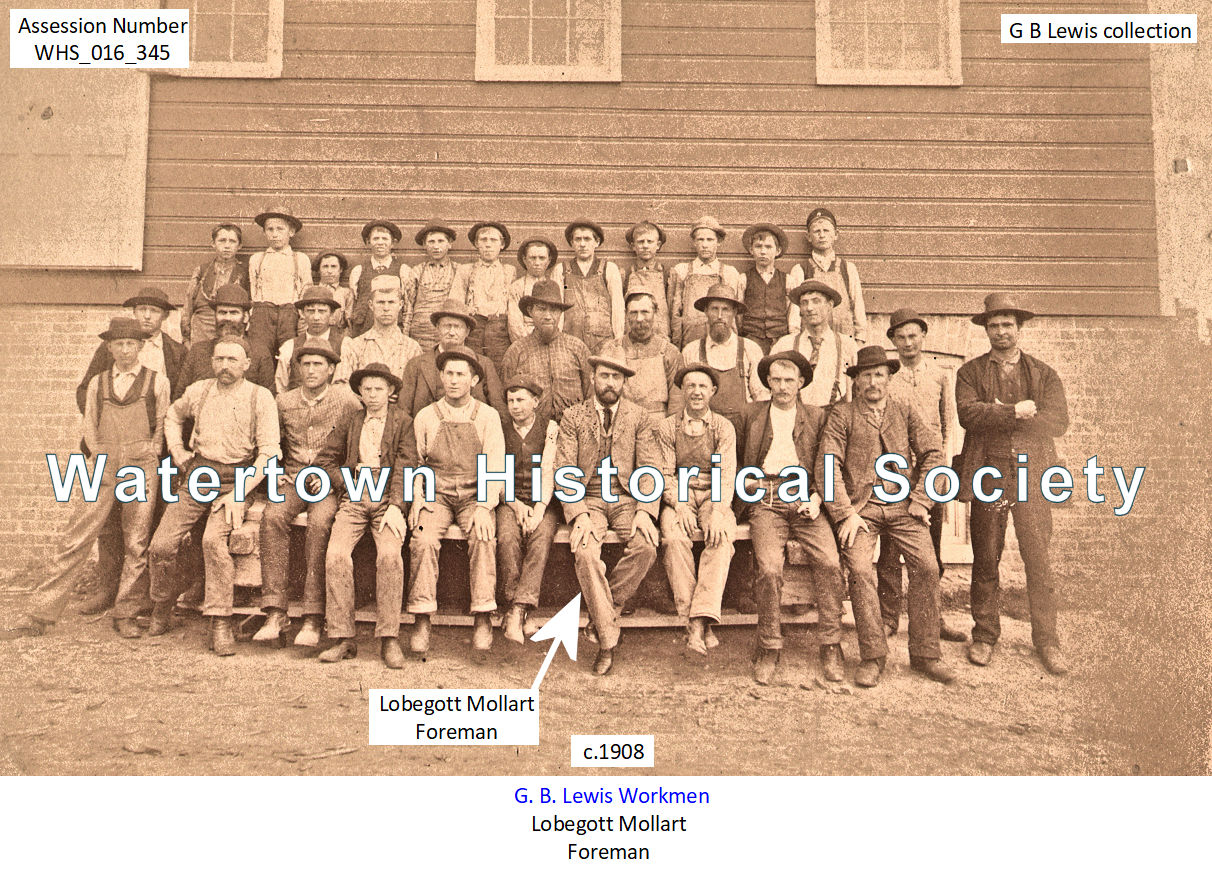 Lobegott Mollart, center, front row
___ 1909 __________________
South Water Street
<> FIRE OF
JUNE 20th, 1909 <>
 <
Scroll
through collection of images <
<
<
Scroll
through collection of images <
<
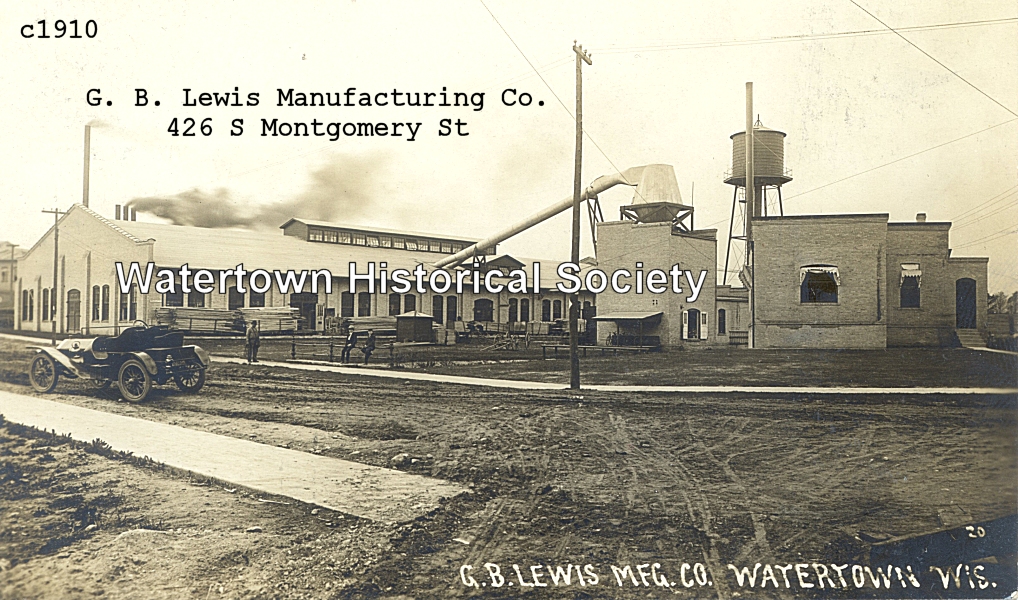
Moved to new location at 426 S. Montgomery St. after the fire
destroyed the Water St. building.
The firm was originally located
in a five-story building on South Water Street along the Rock River at the
location of the present lower dam. The
company moved to a new location at 426 S. Montgomery St. after a fire destroyed
the Water St. building in June of 1909.
As the company evolved throughout
the decades, wood and wire material handling containers, golf ball washers, wooden Venetian blinds and wooden
airplane propellers became the firm's trademark products.
To remain competitive in the
marketplace, in the late '40s the company began an intensive research program
using fiberglass reinforced plastic as a material for industrial handling
containers. In 1949 G. B. Lewis became
the first company to produce a fiberglass tote pan.
-- -- NOTICE
TO WORKERS
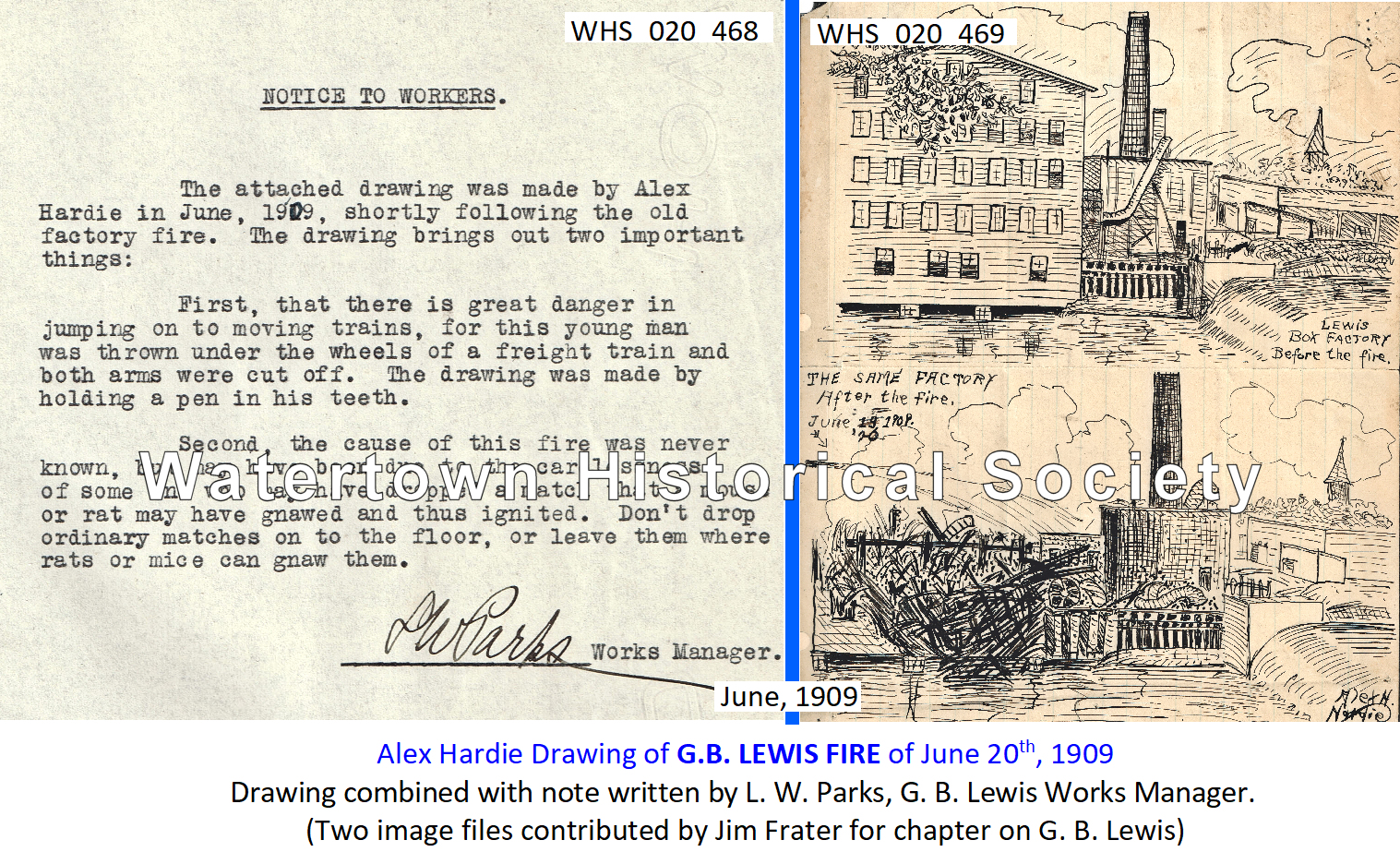 NOTICE TO WORKERS
The attached drawing was made by Alex Hardie in June, 1909, shortly following the old
factory fire.
The drawing brings out two important things:
First, that there is great danger in jumping on to moving trains,
for this young man was thrown under the wheels of a freight train and both arms
were cut off.
The drawing was made by holding a pen in his teeth.
Second, the cause of this fire was never known, but may have been
due to the carelessness of some one who may have
dropped a match that a mouse or rat may have gnawed and thus ignited. Don't drop ordinary matches on to the floor,
or leave them where rats or mice can gnaw them.
L W Parks / Works Manager.
___ 1909 __________________
Watertown Gazette, 07 30 1909
G. B. Lewis Co Rebuilding
New Beeware Plant to be One of the Very
Finest in the Country
The G. B Lewis Go,, manufacturers
of all kinds of beeware, shipping crates, cheese
boxes, etc., have let the contract for the erection of their new plant to take
the place of the one recently destroyed by fire, to the Lynn B. Millikan Co. of
Indianapolis, Indiana, and on Tuesday under the supervision of J. N. Millikan,
the work was begun and in 60 days it is expected the main building will be
completed.
The site of the new plant is the
John Burns property in the Third ward south of Montgomery Street and just north
of the C M & St Paul Ry., which the Lewis Co has recently purchased.
This is one of the most desirable
factory sites in the city, as all goods received and shipped can be unloaded
right at the factory. The main building
will be as fire proof as it is possible to erect it. It will be solid brick and concrete with
steel roof, 209 feet by 80 feet, one story high. The building will be equipped with electric
power and all the very latest modern machinery.
The main warehouse will be solid brick 200 by 80 feet, and the lumber
shed 600 feet long. The power plant will
be of solid brick, concrete and steel and will be separated from the other
buildings, as will be the fire-proof brick office.
The new plant will occupy an area
of five acres and its equipment will be such as to ensure a most excellent
product at the least possible expense, and the Lewis Co. will be able to
truthfully claim the best equipped and finest factory of its kind in the
world.
The old site in Water Street will
be abandoned entirely and disposed of by the company.
09 03 Cunningham-Parks wedding, Lewis W.
Parks, member of the G. B. Lewis Co.
___ 1910 __________________
___ 1911 __________________
April G.B.
LEWIS BOX SEATS . . . at Keck's
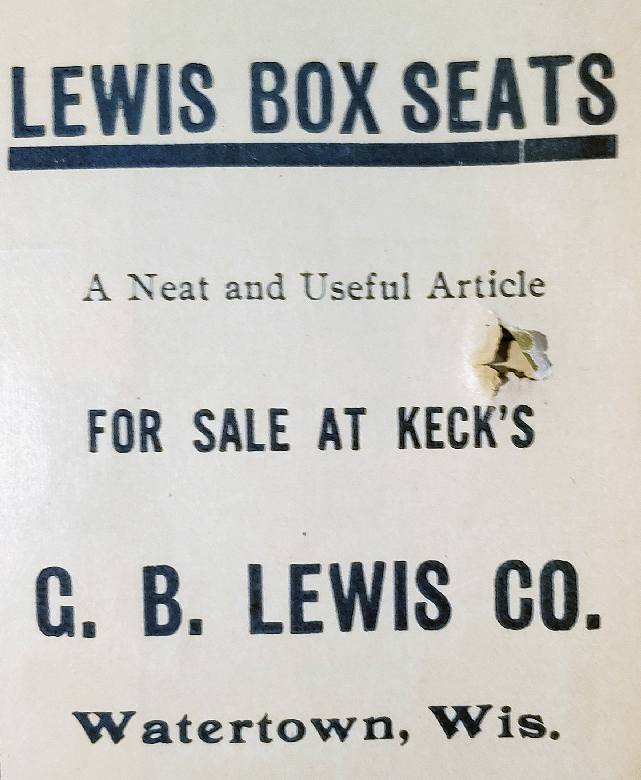
At a loss as to what this was but
could be other than the standard wood and wire boxes made by GBL at their Bee
Hive and Box manufactory.
Boxes-to-use-as-seats, as opposed to box-seats? At Keck’s.
03 28 PROFILE
OF THE COMPANY
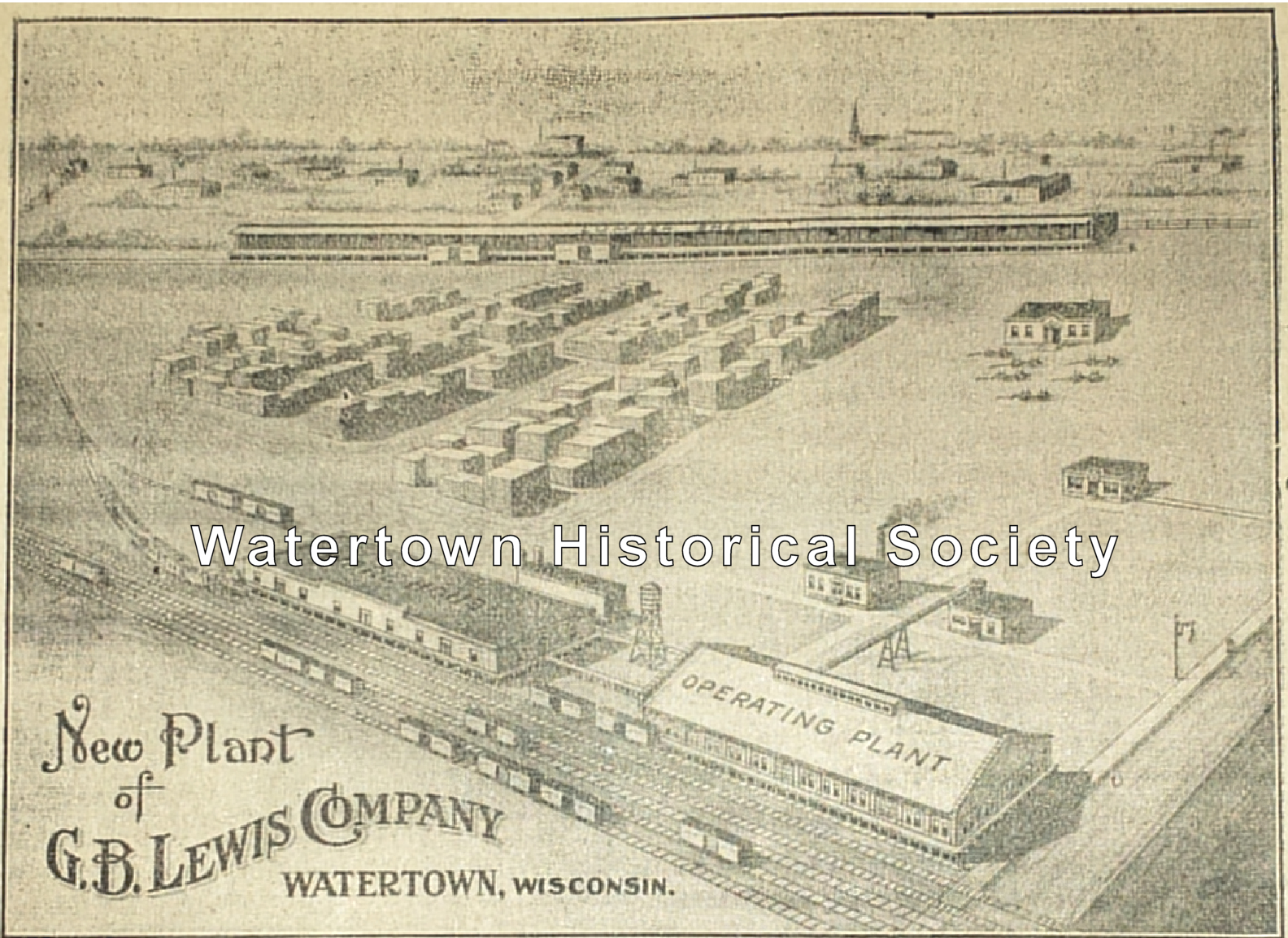
G. B. Lewis Co. of this city is an institution which has been of great
benefit to Watertown. It has disbursed
thousands of dollars in wages, and has aided materially in the upbuilding of
the city, and in its various business dealings throughout the world has made
the name of the town in which it does business famous in its particular line.
The company started thirty-eight years ago in a small way, depending
upon that appreciation from the public which usually follows in the wake of
earnest, conscientious labor and a determination to supply only the best goods
at prices in keeping with the quality of the product.
From the modest start, the factory gradually increased its capacity and
today has the distinction of being the second largest in the Bee supply line in
the United States.
The plant is operated entirely by electricity and is installed with the
most modern machinery and has a capacity for one hundred thousand hives and
thirty million sections. The buildings
cover over five acres of ground, has 40,000 square feet of floor space, besides
two immense warehouses, a five hundred foot lumber shed and one-half mile of
private railroad track.
The company manufactures beekeepers supplies and returnable shipping
packages.
From 100 to 150 people are given constant employment, all of whom are
high-grade skilled employees. The annual
pay roll is about 850,000 and four million feet of lumber is used yearly in the
manufacture of their products. They use
the finest of clean white pine and basswood which is bought from the mills of
Wisconsin and the pure gum lumber they use is shipped to them from the state of
Arkansas.
This concern has thirty distributing houses in the United States, and
two in Europe, one located in England and the other in France, and their
foreign business is a factor which has developed wonderfully and gives every
promise of assuming immense proportions in the future.
The company was incorporated in 1890 with a capital stock of
$100,000. The officers are G. C. Lewis,
president and treasurer; L. L. Parks, secretary: L. W. Parks, superintendent
and G. E. Bacon, sales manager. WDTimes company profile
___ 1915 __________________
-- -- 1915
SANBORN FIRE INSURANCE MAP

 American
Bee Journal, Feb 1915
American
Bee Journal, Feb 1915
08 05 LEWIS CO. EMPLOYEES PICNIC
Last Saturday the employees of the G. B. Lewis Co. of this
city and their families held their annual picnic at Waukesha Beach. Three of the large new cars on the Interurban
Ry. were required to carry the picnickers to and from the beach. All report having passed a delightful day at
this favorite resort. c
09 23 ICE FACTORY FOR WATERTOWN
Cliff Parks will shortly build
an ice factory on the site of the old G. B. Lewis factory just north of the
Globe Mill. Mr. Parks has been greatly
encouraged to build such a plant here and many have given him the assurance of
a good patronage. WG
___ c.1916 __________________
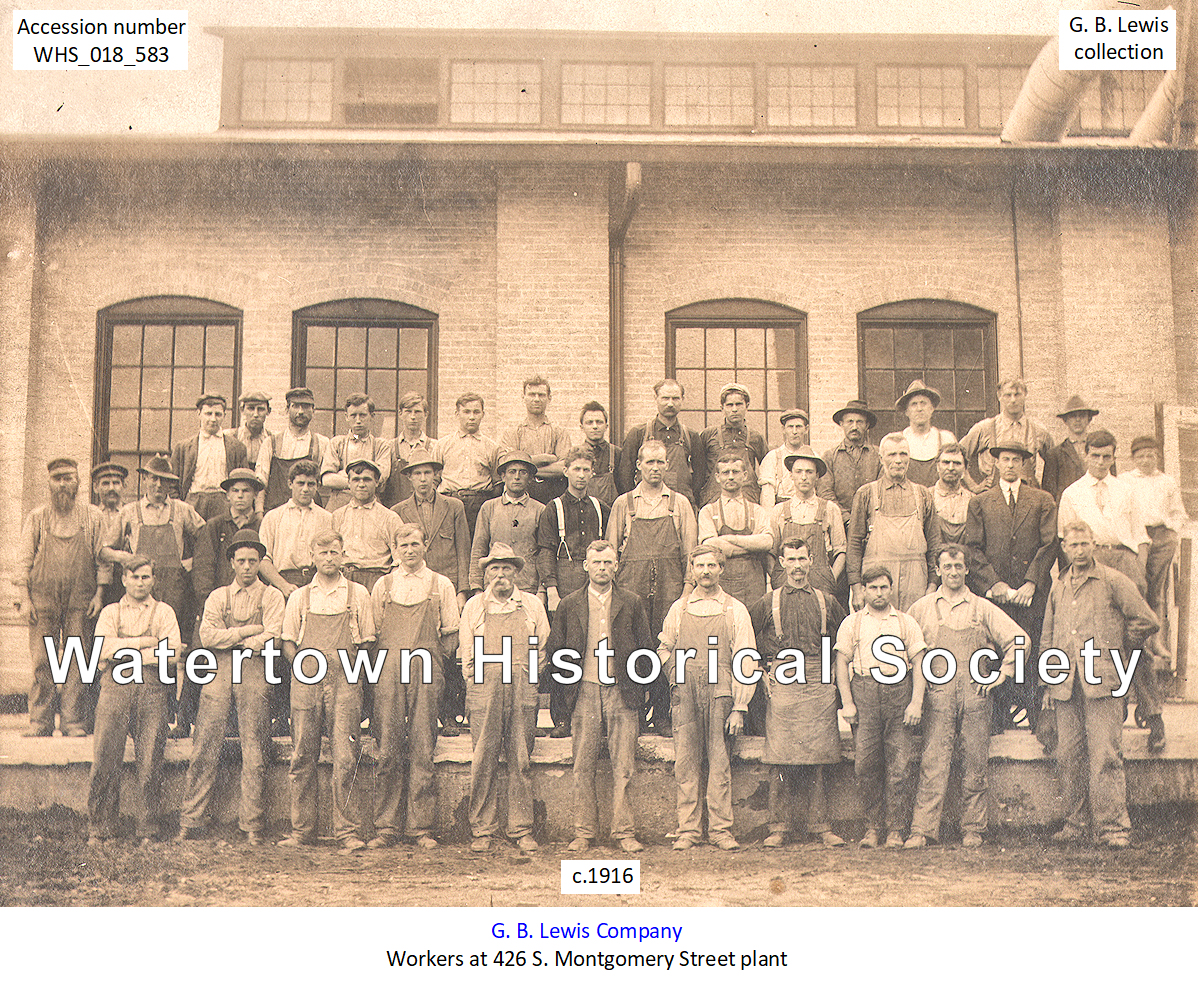
-- -- WORKERS AT 426 S. MONTGOMERY PLANT
GEORGE C AND
MARGARET NELSON LEWIS FAMILY
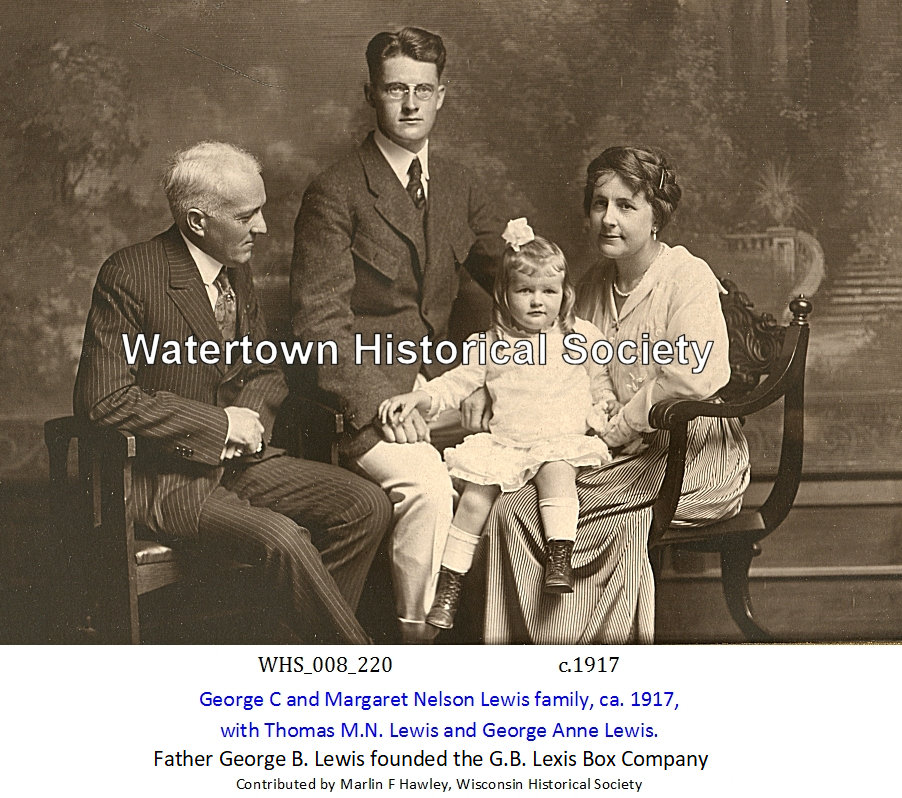
with Thomas M.N. Lewis and GEORGANNE LEWIS.
GEORGANNE
LEWIS / c.1925 SCHOOL YEAR
 Georganne Lewis Coker
__ 1920 __________________
Dixie Beekeeper, Volume 2 (Google
eBook)
Dixie
Beekeeper, Volume 2 (Google eBook)
Dixie
Beekeeper, Volume 2 (Google eBook)
___ c.1920 __________________
STORY OF THE LEWIS BOX THAT WENT TO WAR
 On its arrival back home the box was the
possessor of three gold service chevrons denoting eighteen months of foreign
service, from October 1918 to April 1919, and one wound chevron earned when hit
by shell fragments while in the Argonne Forest.
Construction features of the Lewis Returnable Shipping Box.
On its arrival back home the box was the
possessor of three gold service chevrons denoting eighteen months of foreign
service, from October 1918 to April 1919, and one wound chevron earned when hit
by shell fragments while in the Argonne Forest.
Construction features of the Lewis Returnable Shipping Box.
___ c.1920 __________________
THOMAS MCDONALD NELSON LEWIS Joins
Firm, Arkitoy Toy Division
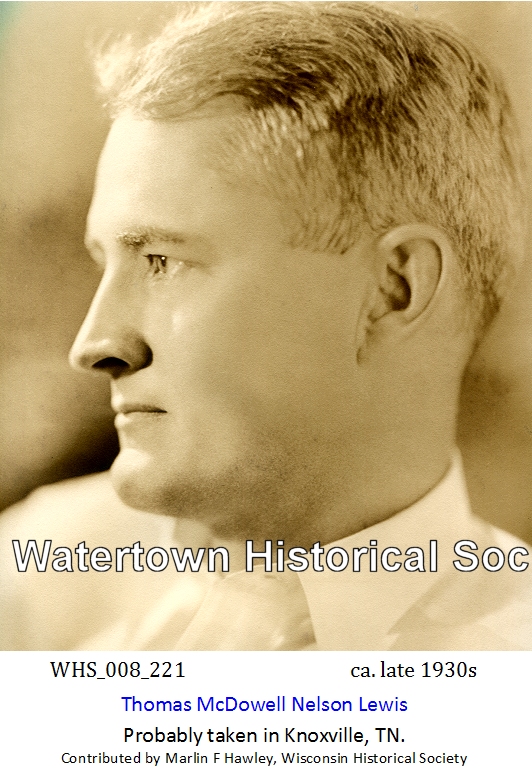 Tom Lewis
MENTORING TOM LEWIS, by
David H. Dye and Marlin F. Hawley
In this article we focus on an
example of a mentoring relationship that is associated with the origins of the
Society for American Archaeology. The
mentoring relationship that arose between W. C. McKern and Thomas M. N. Lewis
was based on the encouragement and nurturing of a Midwestern artifact collector
and toy manufacturer by the first editor of American Antiquity. McKern practiced what he preached by reaching
out to bridge the gap between avocationals and
professionals, and Lewis sought whatever aid he could find to accomplish his
desire to become a professional archaeologist . . .
Thomas McDonald Nelson Lewis was
born in Chambersburg, Pennsylvania, on March 27, 1896, to wealthy maternal and
paternal families who owned numerous entrepreneurial enterprises. He grew up in Watertown, Wisconsin, the
location of his grandfather’s business, the G.B. Lewis Company, which
manufactured bee ware, shipping crates, toys, boxes, and wooden propellers.
Tom Lewis developed an early
interest in collecting from his maternal grandfather, with whom he walked the
fields along the tributaries of the Upper Potomac River near Chambersburg. After military service in World War I,
serving as a boatswain’s mate in the U. S. Naval Reserve Force, he returned to
Princeton, graduating in 1920 with an economics degree. Following in his father’s footsteps, Lewis
took a job in the family business.
Progressing through sales, he was eventually promoted to head of the Arkitoy division; his business travels afforded him the
finances and time to seek out sites and to scout for collections to
purchase. Within a few years, he boasted
of possessing one of the largest private collections in Wisconsin.
When McKern moved to Wisconsin,
he set into motion an ambitious program of survey and excavation across the
state. His affiliation with the Wisconsin Archeological Society (WAS) was key
to both surveys and mound excavations, as he was able to enlist local
collectors with knowledge of artifacts and sites.
While walking the fields near
Watertown in the early spring of 1926, Lewis chanced to meet two members of the
WAS who encouraged him to join the organization, which he promptly did . . .
_______________________________________________________________________________
THOMAS M.N.
LEWIS:
THE MAKING
OF A NEW DEAL-ERA TENNESSEE VALLEY ARCHAEOLOGIST, by Marlin F. Hawley
and David H. Dye
Thomas M.N.
Lewis was a noted Tennessee archaeologist, getting his start as a professional
archaeologist during the heady, early years of the New Deal and Tennessee
Valley Authority (TVA) archaeology program, first under William S. Webb and
then at the University of Tennessee.
Lewis and his associates spent nearly a decade involved in field
activities in advance of the impoundment of the Tennessee River and its major
tributaries. Out of their effort came
several now classic archaeological reports, including Hiwassee Island and
Eva: An Archaic Site, both with Madeline
D. Kneberg. Lewis’s path to becoming a leading
Tennessee archaeologist was a long and complex one, with archaeology initially
pursued as an avocation around his hometown of Watertown, Wisconsin. Lewis parlayed his success (and income) as a
businessman into an expansion of his archaeological interests, venturing far
from Wisconsin to collect and excavate, while devoting substantial portions of
his income to amassing a collection of artifacts from across the United
States. We review what is known of
Lewis’s early life, from his birth in Pennsylvania in 1896 to the eve of his
being hired for the TVA Norris basin project in January 1934. Finally, we chart the influences that led him
to become a professional archaeologist, including his early membership in the
Wisconsin Archeological Society, which served as a model for his development of
the Tennessee Archaeological Society.
___ 1921 __________________
April DISPLAY OF
LEWIS SHIPPING BOXES ON TOP OF BUILDING
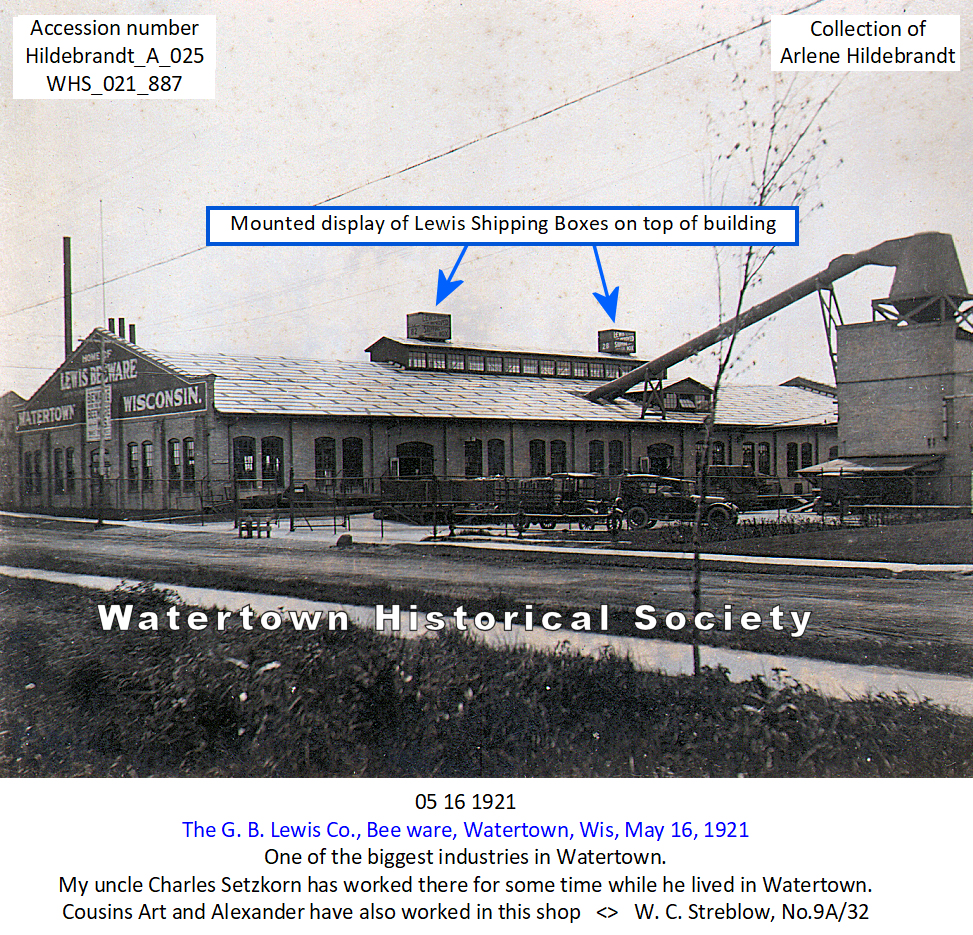
THE LEWIS
SHIPING BOX
Watertown High School Orbit
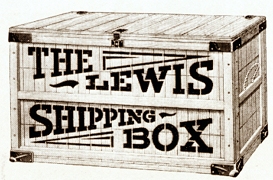
The woven wood and wire
construction of the Lewis Box places it in a class by itself and makes it distinctive.
It is used principally by bakers for the shipment of bread by express. It is the first box of its kind that was ever
manufactured over twenty years ago. By
virtue of the fact that it is light but very strong and durable, as well as
yielding the proper ventilation for its contents, there has been an ever
increasing demand for it. These boxes
are furnished, painted, and lettered in attractive designs and color
combinations, and are used by the baker for advertising purposes as well as for
carriers. You see them at the express
depots everywhere. Lewis Boxes can be
shipped knock down, which saves considerable in freight. They are sent to all parts of the United
States from Florida to Canada, and from Boston to San Francisco. Watertown is widely known throughout the
country among the baking trade as the home of the Lewis Box.
There are four departments
concerned with the manufacture of the bread box. The sawing, the planing,
the weaving, the painting, and the assembling department.
The entire Lewis plant employs
about 130 persons in the manufacturing department and thirty persons in the
office force. In addition to the home
plant there are several large branch houses located in various parts of the
country.
OFFICERS
G.
B. Lewis .... President and Treasurer
L.
L. Parks .... Secretary
L. W. Parks ...
Work Manager
G.
Bacon ....... Sales Manager
___ 1924 __________________
1924
GOLF BALL
WASHER invented by Lobegott Mollart
___ 1925 __________________
1925
EMPLOYEE GROUP PICTURE
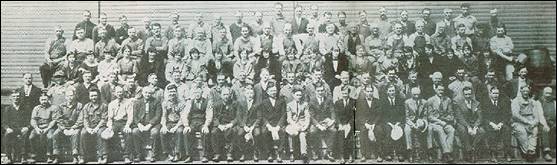
Art
Abel, Elmer Achillis, Florence Amadon Swenehart, Tom
Atkins, Augie Bauman, Frances Baurichter, Walter Blasius, Sam Brasch, Frank Brusenbach, Al Bussewitz, Doffert, Doubleday,, August Dubell, Mike Duffy, Verna Ebert
Saniter, Carl Ebert, Charles Ebert, Fred Erdmann, John Erdmann, Otto Erdmann,
Frank Fisher, Bernice Follensbee, Neil Follensbee, G G
Frater, Dick Gerth, Ben Gilles, Clarence Glatzel, John Gruel,
Paul Haack, Bert Hadley, Chauncey Hathaway, Ken Hawkins, Frank Haznaw, Loretta Irving, Dorothy Jaehrling
Hobus, Edwin Kaercher, Jennie Kaercher, John Kaercher, Lester Kaercher, Walter
Kaercher, Ernst Kelm, Art Killian, Fred Kipfel, Norma
Klingbeil, August Knoll, Tony Koser, Shuster Koshelnick,
Shorty Kraemer, Kuckhahn, Bernadette Lange, Joe
Lange, Fern Lapp Kohn, Louis Lenz, G.
Lewis, Tom Lewis, Agnes Manthey, Francis McCaig, Monroe, Ed Nehmer,
Celia Oestreich, Charlie Oestreich, Albert Otto, Charlie Quade, Alma Raatz
Schliewe, Della Raatz Wollin, Ethel Radloff, Emil Radtke, Albert Reinhard,
Elmer Reinhard, George Reinhard, Marie Reynolds, Herb Riedemann, Ruth
Riedemann, Bill Schleif, Bill Schmitz, Helen Schoeckert,
Louis Schulz, Louis Schumacher, Bob Sell, Fred Sell, Joe Simon, Alva Soldner,
Shorty Soldner, Ben Stiemke, Frank Toesch, Nat
Triplett, Fred Volkman, Alma Weigel, Otto Wendt, Reinhard Wendt, Ed Wiese, Ted
Wiese, Art Wilde, Carl Willie, Ed Willing, Servin Winger, Carl Wolf, Al Zabell,
Carl Zahn, Ed Ziebell, Bill Zoern, August Zoldner,
___ 1930 __________________
ARKITOY TOY DIVISION
 Toy Division of G. B. Lewis Co. Dec, 1930.
Arkitoy Wood Construction sets.
Toy Division of G. B. Lewis Co. Dec, 1930.
Arkitoy Wood Construction sets.
___ 1931 __________________
12 12 DEATH OF GEORGE C. LEWIS, 1871-1938
The
second President of the G. B. Lewis Company, who took over the management of
the business after the death of father G. B. Lewis and the earlier death of
Charles E. Parks.
12 12 ARKITOY TOY BOX COVER
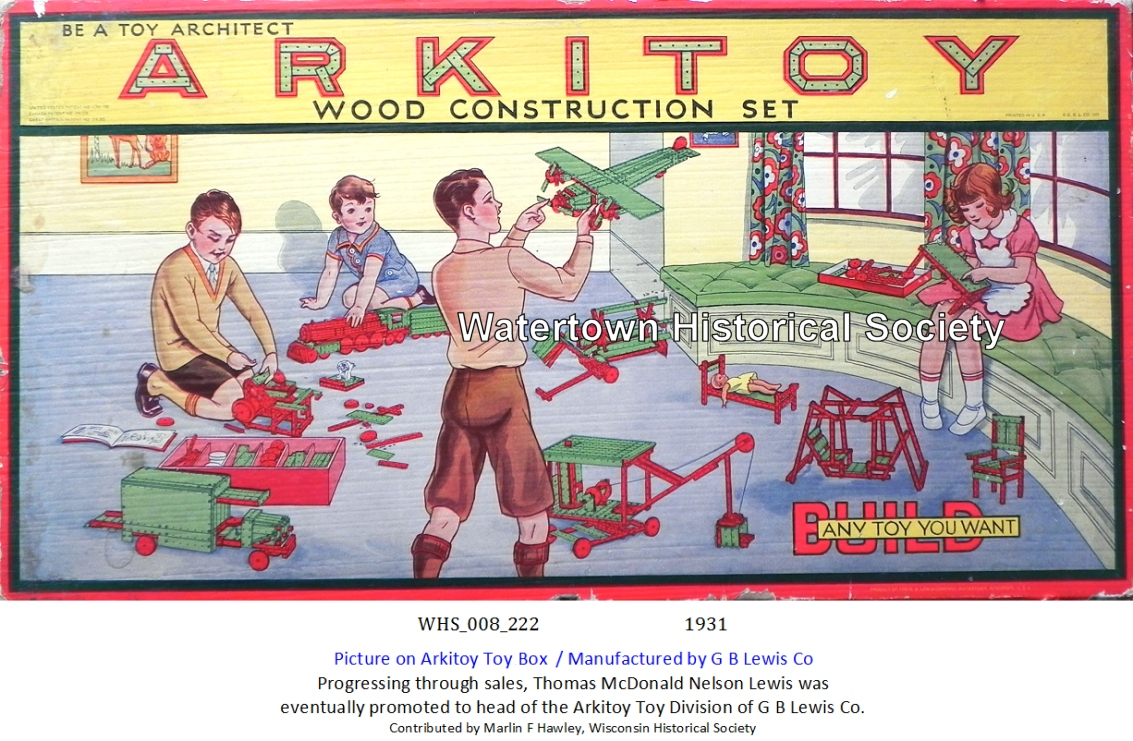
___ c.1931 __________________
ARKITOY TOY SET
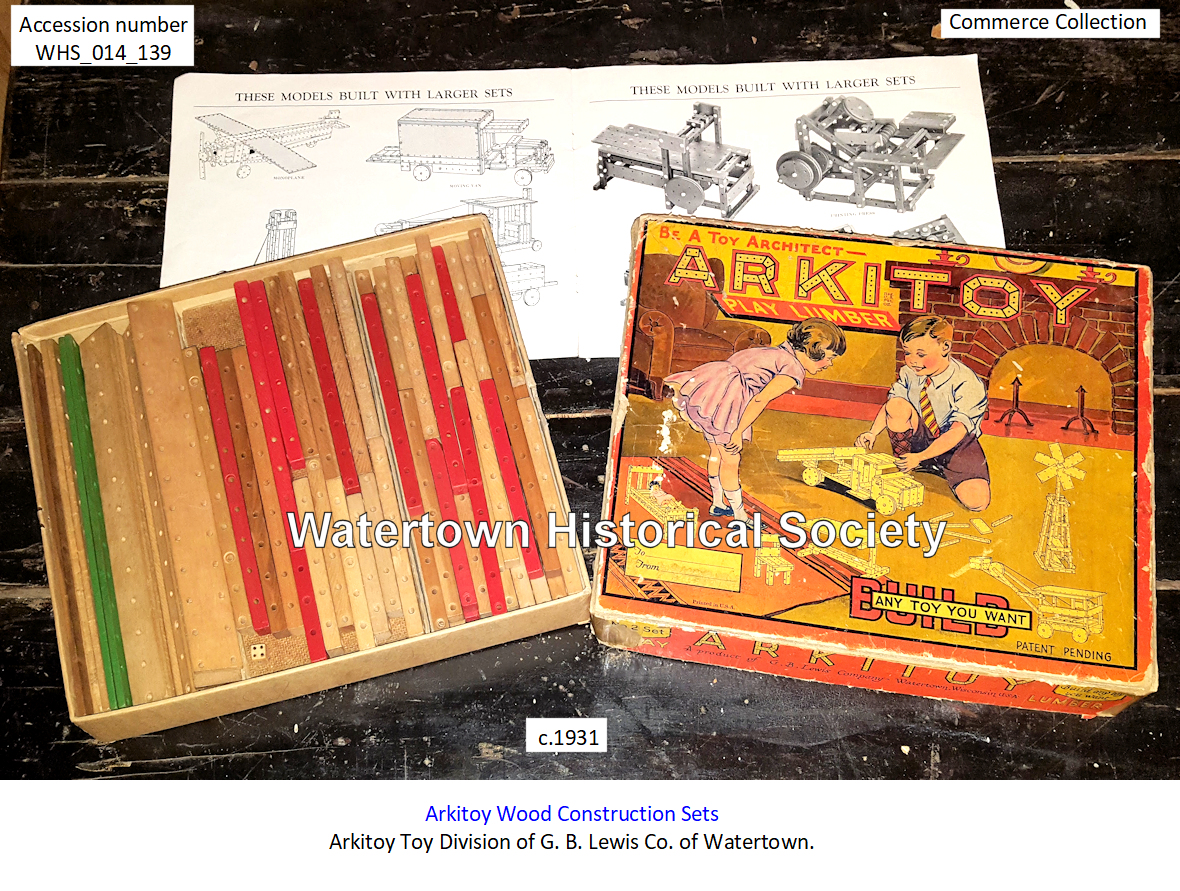
___ 1939 __________________
10 27 EDWIN KAERCHER, auditor and office
manager
Edwin H. Kaercher, 46, residing
at 910 Western Avenue, died at St. Mary’s hospital. Death was due to septic poisoning following
an operation for acute appendicitis.
Throughout the city he was known as “Esky” a nickname that had attached
itself to him when he was a boy. Mr.
Kaercher, who was auditor and office manager for the G.B. Lewis company, was a
World war veteran, serving with the original Company E
of this city.
___ 1942 __________________
GENERAL
OFFICE
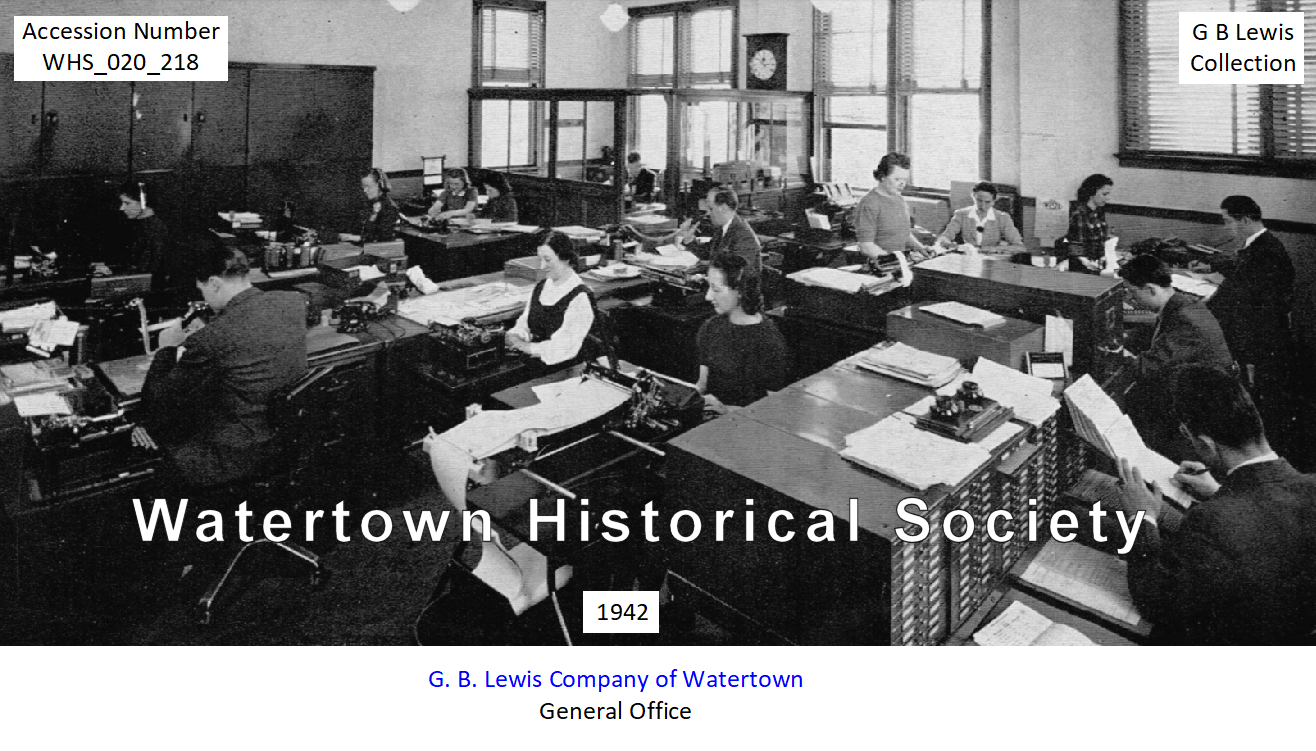
"BLINDLY
SPEAKING" / How Long Will
Venetian Blinds Be Made?
1942
G. B. Lewis wartime newsletter
This country is in process of
going all out to win this war and if the Venetian blind industry cannot develop
and show the War Production Board its value in wartime, we leave it to you as
to how long any such industry will last. . . . Sawdust and sander dust is
collected in bags for carlot shipment. This material is sold to jobbers who in turn
sell it to various industries from which other products such as plastics and
explosives may be made.
GOLF BALL WASHER ad (invented in 1924)
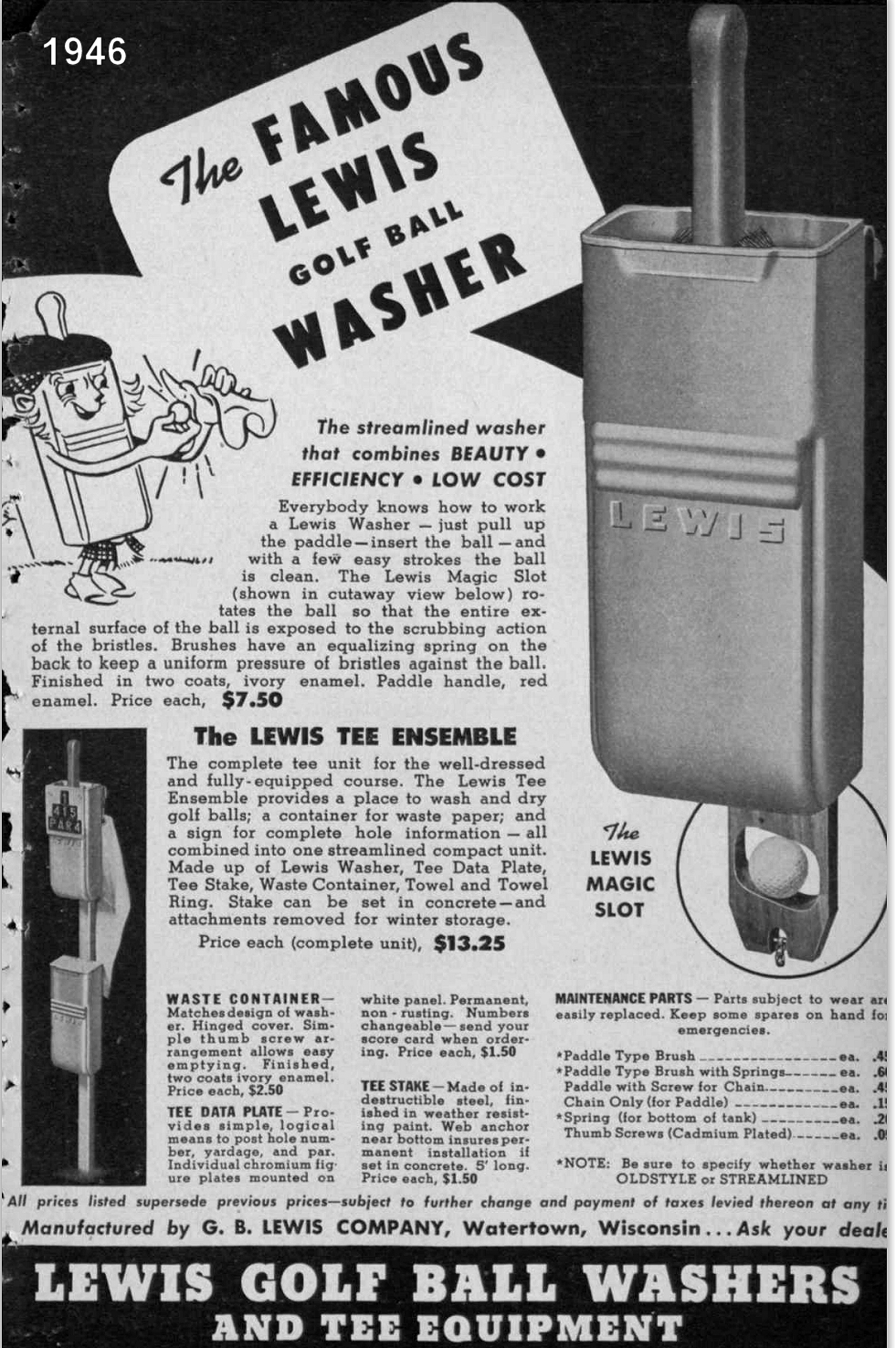
The
streamlined washer that combines beauty, efficiency and low cost.
Everybody
knows how to work a Lewis Washer
— just pull up the paddle
—insert the
ball
—and with a
few easy strokes the ball is clean.
___ 1951 __________________
MENTIONED: Abel, Art; Arndt, Art; Baurichter, Frances;
Behling, Elsie; Bittner, Jr, Freu; Ebert, Charles; Engel, Reuben; Erdmann, Ben;
Erdmann, John; Erdmann, Otto; Follensbee, Neil; Frater, Gordon; Frazer, Jere;
Freitag, Bill; Gerth, Dick; Gilles, Ben; Gruel, John; Haack, Paul; Harahbarger, Leodis; Heller, Pearl; Hiett, A.D.; Irving,
Loretta; Kaercher, Lester; Kaercher, Walter; Kelm, Ernst; Killian, Art; Kunert,
Arnold; Lange, Karl; Miller, Rose; Mollart, L.; Nass, Rose; Parks, Lewis;
Parks, Steve; Rechlin, Caroline; Reinhard, Elmer; Reinhard, George; Riedemann,
Herb; Rueth, Marion; Schlueter, Gus; Schroeder, Hazel; Sell, Robert; Severson,
Walter; Soldner, Art; Stiemke, Ben; Stoeckman,
George; Strohbusch, Hugo; Weigel, Alma; Wendt, Otto; Wiese, Ed; Wollin, Carl;
Zahn, Carl.
___ 1952 __________________
01 21 DEATH OF LEWIS R. PARKS (1881-1952)
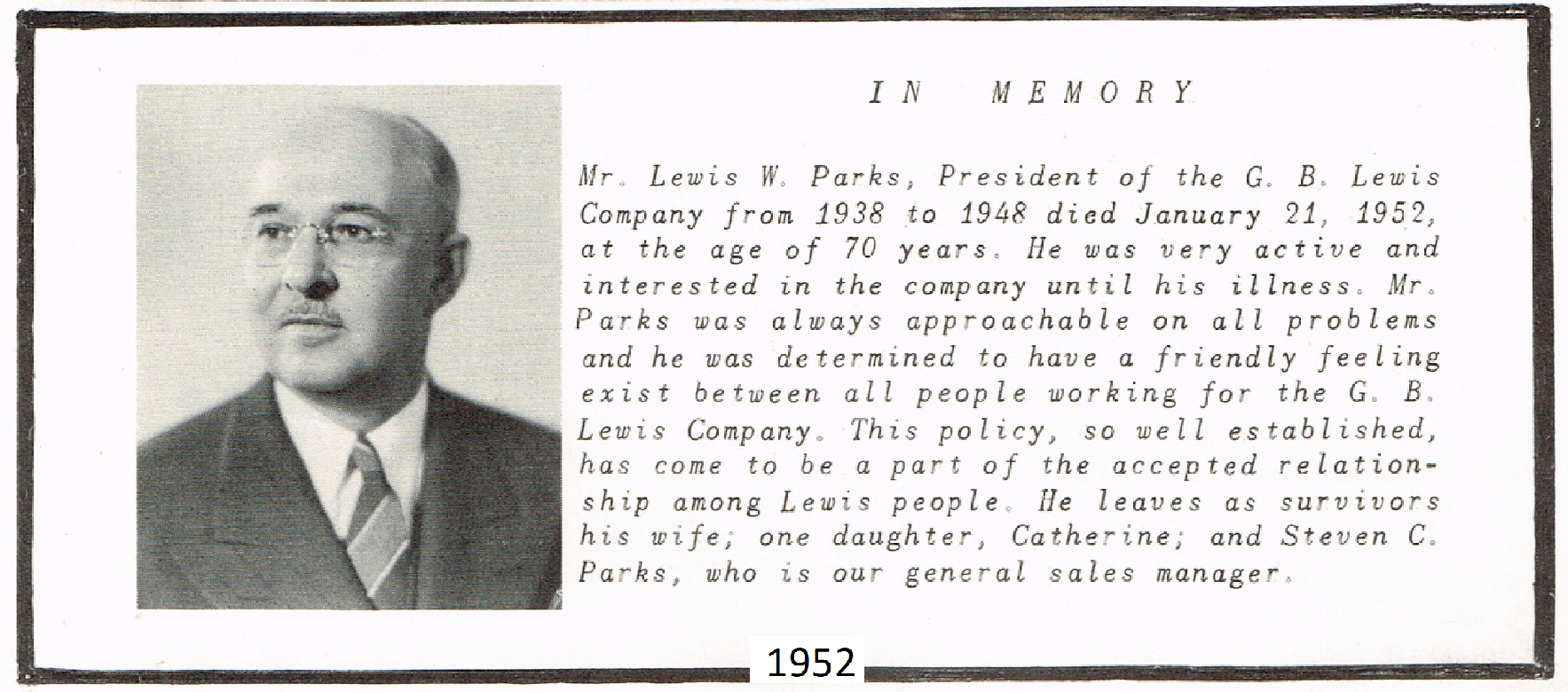
Former
president, 1938-1948
MENTIONED: Braunschweig, Walter; Brooks, Jane; Cahoon,
Herb; Chapman, Elfrieda; Engel, Rueben; Engelbrecht, Shirley; Gilles, Ben;
Graf, Fred; Gritzner, Carl; Hilker, Linda; Jones, Charles; Kaddatz, Walter;
Klingbeil, Harlow; Krueger, Oscar; Kuetbach, Otto; Kunnke, Doris; Lange, Karl; Lange, Karl; Lindegard, Henry; Maas, Edward; Oestreich, George; Parks,
Lewis W; Pastorius, Orville; Saniter, Hazel; Steffen, Ruby.
MENTIONED: Abel, Art (Doc); Adams, Larry; Bittner, Don;
Ebert, Charles; Ebert, Ray; Erdmann, John; Erdmann, Ray; Gruel, John;
Halverson, Art; Jere Frazer, Jere; Killian, Art; Klecker, Rose Ann; Pastorius,
Orville; Reinhard, Elmer; Schimpf, Bill; Schlueter, Gust; Stiemke, Ben; Vest,
George; Wiese, Don.
06 27 DEATH OF STEVEN C. PARKS (1915-1952)
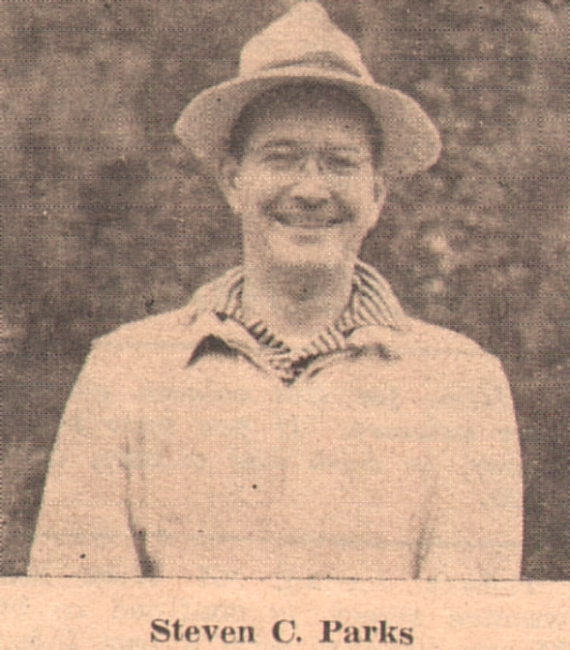 Funeral services will be held Monday morning in St.
Paul's Episcopal church for Steven C. Parks, 37.
Funeral services will be held Monday morning in St.
Paul's Episcopal church for Steven C. Parks, 37.
Mr. Parks, sales
manager and assistant general manager of the G. B. Lewis Company, who died at 3
o'clock this morning at his home, 302 North Water Street from a heart attack.
Mr. Parks, in addition
to his position with the Lewis Company, was secretary and a director of the
corporation.
He was a native of
Watertown and was born May 23, 1915.
He was a son of Mr. and
Mrs. Lewis W. Parks. His father, who was
for years head of the Lewis Company, died on Jan. 21 of this year.
___ 1953 __________________
09 08 LEWIS COMPANY UNION FLOAT, LOCAL 2504
 Watertown’s 1953 Labor Day Parade
___ 1954 __________________
MENTIONED: Baumgardner Frank; Baurichter, Helen; Block, Marion;
Brooks, Jane; Chapman, Elfrieda; Engelbrecht, Shirley; Erdmann, Ben;
Follensbee, Jim; Frater, Gordon; Frater, Milt; Geise, Verona; Gerth, Dick;
Gruel, John; Irving, Loretta; Johnson, Wes; Kaercher, Lester; Kelm, Ernst;
Killian, Joan; Lewis, Tom; Lukas, Dorothy; Perrier, Al; Riedemann, Herb;
Schimpf, Bill; Schlesner, Evangeline; Schmeling, Art; Schultz, Blackie;
Soldner, Shorty; Weigel, Alma; Weihert, Inez; Weihert, Otto; Wendt, Otto;
Winkler, Joan; Winkler, Rita; Wittchow, Jeannette; Yahn, Max.
______________________________
[The big 1954 Watertown
Centennial parade was noted in the June 1954 G. B. Lewis company newsletter]
The weatherman certainly
cooperated beautifully for the big Watertown Centennial Parade. It was estimated that there would be 50,000
people watching it and, by the way the people were packed along the parade
route, that estimate was probably correct.
One of the prettiest floats was
the Queen's Float, on which Faith Blaese, our receptionist, had the honor of
riding as a member of the Court of Honor.
Blackie Schultz was seen in the
parade riding an old bicycle. Shorty
Soldner and his squeeze box made their appearance on a Brothers of the Brush
float. Milt Frater drove some or the
dignitaries in his red convertible.
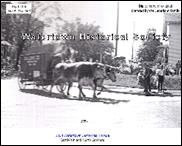
The oxen team sponsored by the
Lewis Company added to the old-time theme of the parade.
Other Lewis employees also aided
in Centennial activities. Quite a group
of our Brothers of the Brush and Sisters of the Swish made a pilgrimage to
Waukesha with an eight-piece band to publicize the Centennial. A loud time was had by all -- nuf sed.
Al Perrier and Wes Johnson lent a
hand with refreshment stands.
Otto Weihert, Bill Schimpf, Les
Kaercher, Inez Weihert and Rita Winkler can be seen each night in the Centurama Pageant.
It's difficult to recognize
individuals in the pageant but if you look hard enough, you may see one or two
of them in either the Indian, pioneer, Civil War, or World War II scenes.
Marion Block, Jane Brooks,
Shirley Engelbrecht, and Joan Killian sang with the large chorus for the
pageant and band shell dedication. . . .
___ 1955 __________________
MENASHA CORP
The G. B. Lewis Company operated as
an independent firm under the ownership of the Lewis family until it became
affiliated with Menasha Corp. in 1955.
Once Menasha purchased 100 percent of the business in 1974, the company
split into two divisions.
Arthur W. Kehl, 1400 North Second
St, announced plans (09 29 1955) for the opening of an office and sales room
here for Lewis-Dadant
supplying a full and complete line of bee hives and bee ware, once the product
of the G. B. Lewis Company. The Lewis
Company, which was sold some time ago to the Menasha Wooden Ware Corporation,
is still turning out the wooden portions of the bee-ware products and will
continue to do so until around Dec. 1 when the machinery for that product will
be moved to Burlington.
Arthur W. Kehl, 1400 North Second
Street, today announced plans for the opening of an office and sales room here
for Lewis-Dadant
The G. B. Lewis presence in
Watertown dates back to 1863. After a
fire destroyed the original five-story building on S Water St along the Rock
River at the location of the present lower dam, the company moved its headquarters
to S Montgomery St.
___ 1955 __________________
08 08 NEGOTIATIONS FOR THE PURCHASE of G.B. LEWIS CO:
It was reported today that
negotiations are underway for the purchase of one of Watertown’s oldest
industries, the G.B. Lewis Company. This
company is considered the second largest producer of beehives in the United
States and the name of Lewis Beeware is known in
beekeeping circles the world over.
Through the years other products have been developed and added to the
output of the local plant so that beeware is no
longer its major product.
Containers
for the handling of industrial products made by Lewis are widely used and among
the better known of the local plant’s customers for this product are the
Continental Can Company and the Minneapolis-Honeywell Company, the famous
producer of heat controls. The Lewis
Golf Ball washer is accepted as a standard item of equipment on all well
operated golf courses. Venetian blind
slats and other similar wood products, once a more important part of the
production, are still made.
08 24 G.B. LEWIS HAS BEEN PURCHASED
by the owners of Menasha Wooden Ware
Corporation together with local men holding management positions with the Lewis
Company, it was announced today. The
sale consummates several weeks of activity, all tending toward the final
satisfactory arrangement to the new owners and the old owners alike. This final action brings together two long
established Wisconsin companies, both of which had their start in the
manufacture of wood containers back in the days when the state was a great
producer of lumber.
___ c.1957 __________________
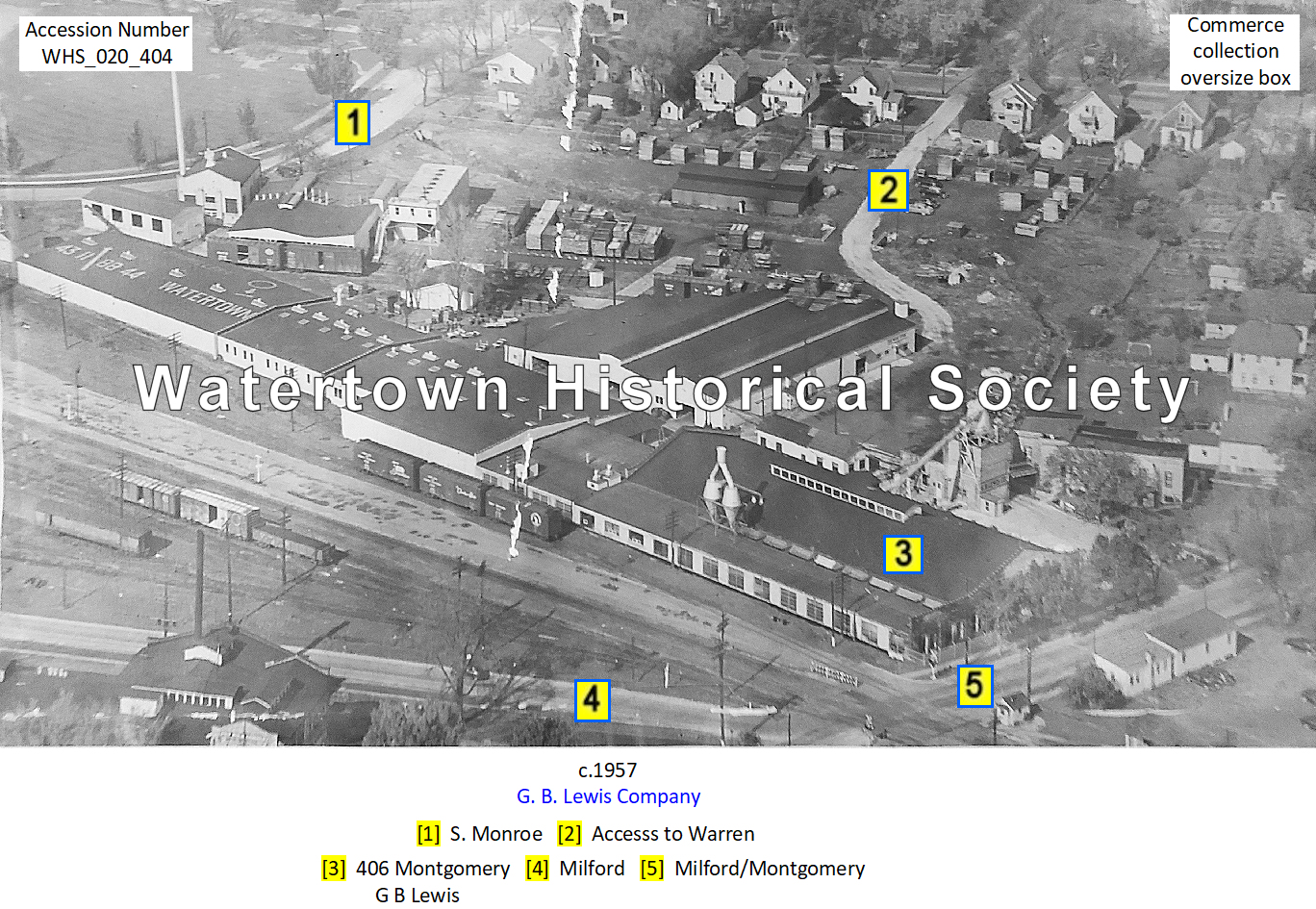
-- -- AERIAL VIEW OF MONTGOMERY STREET SITE
___ 1958 __________________
12 09 25 YEAR CLUB, DINNER MEETING WAS HELD
The
seventh dinner meeting of the G. B. Lewis 25 year club was held
Wednesday night at Otto's Inn. Two new members were welcomed
into the club who had served the company 25 years: Herbert Knoll and Ray
Erdmann. Those in attendance who served the company for 25 to 48
years were: Otto Wendt, Otto Erdmann, Loretta Irving, Edward Wiese, Gordon
Frater, Herman Gerth, Walter Kaercher, Herbert Riedemann, John Erdmann, Karl
Lange, Arthur Killian, Neil Follensbee, Carl Wollin, Carl Stark, Raymond
Erdmann and Herb Knoll.
___ 1960 __________________
08 26 The
G.B. Lewis Co. is expanding its line of industrial material handling containers
to cover new fields. The company is no
newcomer in the production of containers for in plant handling of industrial
products and has supplied many fields to date.
For many years the company has produced a lightweight, but strong and
durable, container made of hardwood slats woven together with wire. This container is widely used in the
lightweight metal parts industry. WDT
11 30 The Lewis Company Twenty-Five Year Club
held a dinner last evening at Otto's Inn in honor of
Otto Wendt, 301 East Water Street, who this year completed 50 years of
continuous employment with the company.
The club has 15 members now in the employ of the company. They are: Otto Wendt, Loretta Irving, Gordon
Frater, Herman Gerth, Walter Kaercher, Herbert Riedemann, John Erdmann, Karl
Lange, Ben Erdmann, Arthur Killian, Neil Follensbee, Carl Wollin, Carl Stark,
Raymond Erdmann and Herbert Knoll, and the seven new members. There are, in addition, 10 retired employees
and members of the club: Carl Zahn, Alma Weigel, Arthur Soldner, George
Reinhard, Ernest Kelm, Ben Gilles, Frances Baurichter, Elsie Behling, Ben
Stiemke and Ed Wiese, most of whom were able to be present as honored
attendants to the meeting. WDT
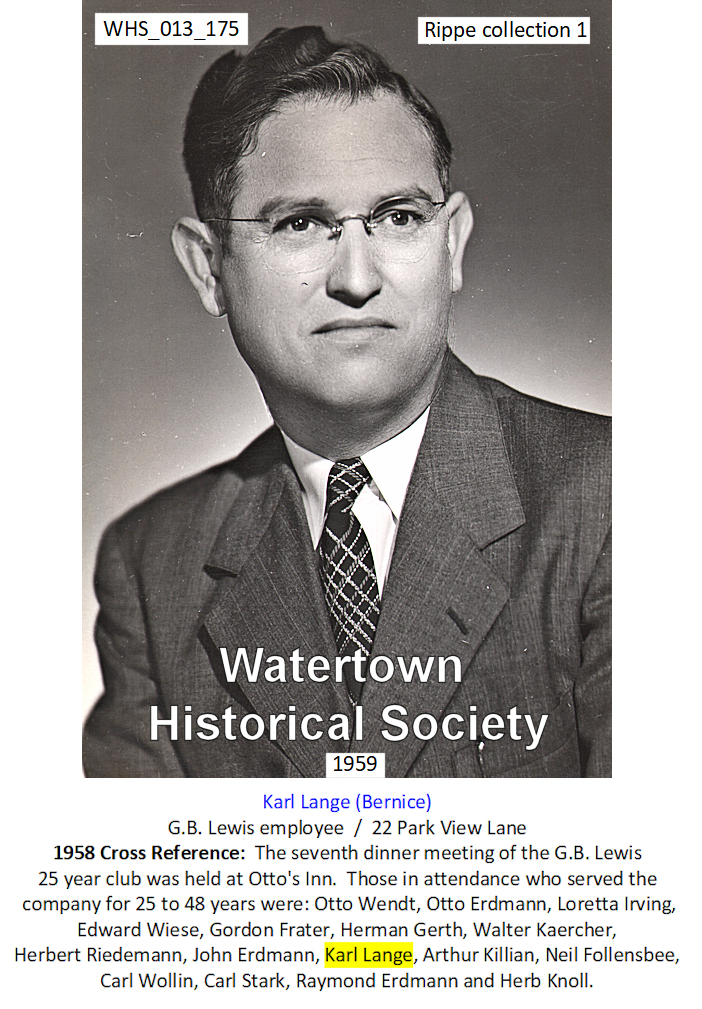 Karl
Lange
Karl
Lange
___ 1962 __________________
MENTIONED: Francis Bilker, Donald Bittner, Jane Brooks, Richard
Buske, James Cowen, Kenneth Delikat, Bernhard Erdmann, Dick Gerth, Herman
Gerth, Fred Graf, Pearl Heller, Carol Heussner, Loretta Irving, Dick Jeanson,
Rita Jensch, Mae Kittel, Otto Kuetbach,
Edna Lauersdorf, Francis Lee, Amelda Luedke, David Mattoon, George Oestreich,
Elmer Olson, Bill (William) Person, Ray Erdmann, Duane Rennhack, Carol Saxby,
William Semon, Marvin Smith, Donald Wiese.
___ 1963 __________________
MENTIONED: Abrahams, Carol, Miss; Barry, Ruth; Bauman,
Thomas; Borchardt, David; Braunschweig, Walter; Budewitz,
Viola; Buske, Dick; Covey, Robert; Cowen, James; Dollase,
Dorothy; Erdmann, Raymond; Gorder, Donald; Guyer, William, Jr; Hall, Robert;
Heussner, Carol; Hilker, Francis; Hobus, Carl; Jones, Charles; Kaercher,
Walter; Kahler, David; Kuester, Alma; Lange, Karl; Maahs, Gerald; Oestreicher,
Joe; Radloff, Oscar; Reed Jasper; Stichmann, Walter;
Sullivan, J P; Timm, Robert; Treloar, Mildred; Widzinski,
Sigmund; Wollin, Carl;
Aug "HOW THE BOSS ALMOST GOT THE
BUSINESS"
Police called for skunk trapped at home of GB Lewis president (Gordon and Hazel Frater home at 228 Elizabeth St)
From August 1963
company newsletter
Much has been written about our business and now comes a story
"HOW THE BOSS ALMOST GOT THE BUSINESS"
It all came about because there is a basement window well right
near the front door of the last house on the South side of Elizabeth Street,
next to the river. On return from church
on Sunday, the boss’ wife gave a gasp, pulled him through the front door, and
quickly slammed it.
Then came the period of trying to solve quite a bad problem. How do you get rid of a skunk that apparently
fell in the window well and couldn’t jump out?
One thing was learned, don’t call the members of the Conservation Club
for information on Sunday, because they are all out conserving.
As a last resort call the Police Department because they are
always on the job, and they advised, "Don’t shoot the animal, because it
will have the last word before it dies.
You might try cyanide gas, but the drug stores are all closed. Anyway, it isn't safe to use cyanide unless
you know how. One of the firemen knows
how, but he is sick in the hospital," and finally, "You might try
putting a board down and maybe the skunk will leave during the night.”
Imagine being a back door Johnny all day Sunday because your front
door is under armed guard.
On the advice of the Police Department, a board was prepared with nice
climbing cleats on it to make it easy for the skunk to exit. Now if you think you can slide a board over
the edge of a metal window well without a sound, just forget it. There was a sound, the skunk moved fast and
so did the boss (around the corner of the house).
Thank goodness the skunk was down in a hole and shoots
horizontally. Incidentally, this story
is on the level, even if the climbing board was on a slant.
During the night the skunk left, probably because he or she didn't
like the odor around the place.
The odor
still remains to prove that the Watertown Police Department are real helpful,
even if they can’t foretell everything that will happen.
___ 1962 __________________
02 14 REINFORCED
PLASTIC RECOGNITION
High honors and national recognition
have come to a Watertown concern, the G. B. Lewis Co., for its accomplishments
in the field of reinforced plastic materials in its production, according to
word out of Chicago today where the exhibition was held. The company not only was awarded a blue
ribbon but received a citation. The
Society of the Plastics Industry has been holding its annual meeting at the
Edgewater Beach Hotel where a huge display of articles made of reinforced
plastic materials was on exhibition. WDT
___ 1963 __________________
05 23 CENTENNIAL YEAR
The first of three Lewis Select-A-Shell
automated storage system units, manufactured by the G. B. Lewis Company, has
been completed for the Western Electric Company. The three units are 26 1/2
feet tall and will be installed at a Western Electric warehouse and repair
facility in King of Prussia, Pa. The Lewis units will be used for the storage
of attractive items stored for Western Electric customers. Western Electric is
the manufacturing and supply unit for the Bell System. WDT
09 10 The nearly 150 employees of G. B. Lewis
Company will find it a red letter, lucky day today. They will receive their weekly wages from an
old-fashioned paymaster at 4 p.m. this afternoon. Today’s method of handling the firm’s payroll
is one of the many events planned to mark the centennial of the company. For the occasion, a payout shack, with a pay
window, reminiscent of its long- departed counterparts, will be set up on the
Lewis grounds. A message to the
employees has been posted on the bulletin board and distributed to them
explaining the reason why there will not be the regular pay check on Friday
noon. They will be asked to go along
with the spirit of the occasion and line up to receive their pay in “old-fashioned
medium of exchange” from the paymaster after working hours. WDT
___ 1964 __________________
02 11 FRANK’S GROCERY PURCHASED
Watertown’s oldest continuous independent
grocery store has closed its doors.
Located at 424 South Montgomery
Street, the little establishment’s last owners and operators were Mr. and
Mrs. Fred Frank. They came here from
Illinois 20 years ago and purchased the business from Mr. and Mrs. W. A.
Schauer who had operated it for a great many years. Before that it had other owners. Mr. Frank died in March of 1962 and since
then his widow has operated the store with the assistance of her son, Jerry. Three years ago the building and adjoining
land were purchased by the G. B. Lewis Co., but the Franks continued to operate
the business. WDT
05 02 LORETTA
IRVING
Miss Loretta Irving, 309 North
Church Street, an employee of the G. B. Lewis Co., since November, 1919,
covering a greater span of years than has been achieved by any person now in
the employ of the company, retired yesterday.
Gordon Frater, company president, told the office employees at a
gathering Thursday in honor of Miss Irving, that Loretta (as she is known to
everyone, a receptionist par excellence) had established an employment record
that might never be equaled by another.
07 31 OPEN
DITCH COMPLAINTS
Gordon Frater, president of the
G.B. Lewis Co., has sent a communication on behalf of the company relative to
conditions arising from complaints regarding the open ditch which runs through
the company’s property. At several past
meetings of the council the ditch has been the subject of discussion and
complaints by aldermen, notably George Shephard, calling for remedies. Mayor Robert White, upon being apprised of
Mr. Frater’s letter, said that the situation is serious enough to call for
detailed study and consideration by the council in an effort to help work out a
solution. WDT
12 11 SAFETY
RECORD
An outstanding safety record of
an entire year (over 301,000 man-hours) without a single disabling injury,
today won special recognition for G. B. Lewis Company from its Workmen’s
Compensation insurance carrier, Employers Mutuals of Wausau, Wisconsin. Gordon Frater, president of the company,
accepted a special plaque from B. N. Dewey, Milwaukee Safety and Health
Services manager for the insurance company.
___ 1966 __________________
08 30 FRATER PRESIDENT OF WATERTOWN ASSN OF COMMERCE
Allen H. Frater, vice-president of the
G. B. Lewis Company, was elected president of the Watertown
Association of Commerce at a special meeting called last evening by the board
of directors for the purpose of electing new officers. Dr. George E. Samquist
was elected vice-president. The meeting
was held at the Association of Commerce office in the Municipal Building and
was conducted by the out-going vice-president, Ira Kritz in the absence of
Gerald Mallach, retiring president. WDT
10 20 MILLION
MAN HOURS WITHOUT LOST-TIME ACCIDENT
William (Bill) Person, G. B. Lewis Co.
safety director, last night was honored at the monthly dinner meeting of the
Watertown Safety Council at the Legion Green Bowl. The surprise development was in recognition
of Mr. Person’s having led the Lewis Company to a record million man hours of
production without a lost-time accident.
Gordon G. Frater, president of the G. B. Lewis Company, presented Mr.
Person with an engraved award in recognition of his accomplishment. WDT
___ 1967 __________________
03 22 BLUE
RIBBON AWARD
Announcement was made today that the G.
B. Lewis Co. has received the 1967 Society of the Plastics Industries Blue
Ribbon Awards in the “Material Handling Division” for their new SN2010-7
fiberglass tote pan. The new one-piece
molded fiberglass reinforced plastic pan, measuring approximately 20” x 10” x
7”, is manufactured in three permanent molded-in colors . . . red, grey and
green. The pans are extremely rugged
with a steel rod molded into the top rim for extra reinforcement. Lightweight, easy to handle, the SN2010-7
Stack-n-Nest container features smooth surfaces which prevent damage to
products while protecting workers against slivers, burrs and sharp edges. These pans resist oil, water, acids,
chemicals and can be easily steam-cleaned.
The patented Lewis design permits these pans to be stacked or nested
within their own dimensions by simply reversing their position. WDT
___ 1968 __________________
06 09 THE CENTENNIAL OF PLASTICS
The year 1968
marks the centennial of plastics, an industry which has revolutionized and
reshaped American industry and home life, and grown faster than any U. S.
industry in the past decade. Co-operating with the Society of the Plastics
Industry, Inc. (SPI) in observance of the 100th anniversary of plastics is the
G. B. Lewis Company of Watertown, one of the largest users of plastic resins in
the state. Lewis uses plastic resins reinforced with fiberglass in its
manufacture of Stack-n-Nest containers and hopper boxes with over 2,000,000
units used by leading manufacturers across the industry for materials handling.
The Lewis trade name for its fiberglass reinforced polyester plastic material
used in Stack-n-Nest pans and hopper boxes is "Plexton." WDT
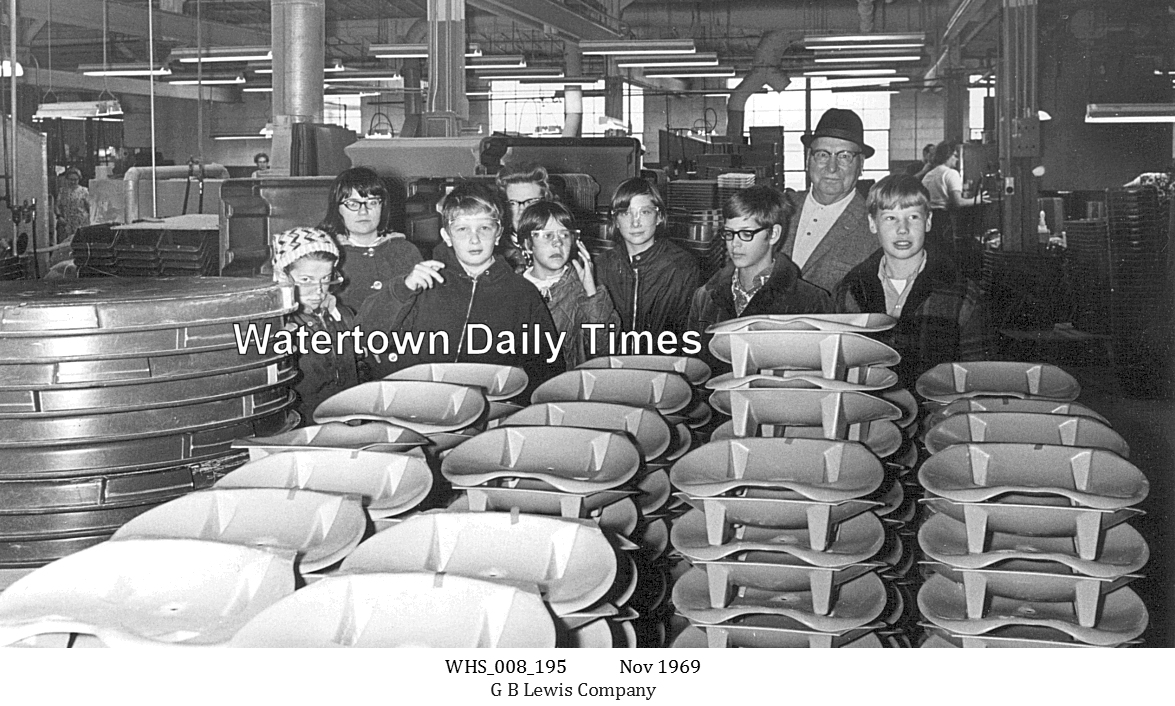
04 04 KARL LANGE RETIREMENT
A surprise retirement party was
held for Karl Lange, a Lewis Company purchasing agent, who has retired after
serving almost 47 years with the G.B. Lewis Company. In paying tribute to Lange, Gordon Frater,
Lewis president stated, “Karl has a record of 47 years of employment with our
company, a record that is seldom equaled.
He was 20 years old when he started in our office, entering orders in
the old bee supply department. His
ability to remember numbers, and to acquire and store away detail of specifications
was soon apparent. As a result, Karl was
soon delegated the exacting job of proof reading the company’s catalog. Never before had the company’s printed
catalog been so nearly free of errors.
05 02 PRODUCTION
CAPACITY INCREASED
Production capacity will be increased from 10 to 15 percent at the
plant of the G. B. Lewis Company when additional hydraulic presses arrive and
are placed in operation. Orders for the
presses were placed several weeks ago, Gordon Frater, company president, said
today. Frater also said that further
expansion will be considered later this year.
“Long term planning is necessary in this amazingly interesting plastic
field in which the local plant is operating,” Frater stated. “For example, the presses just purchased are
built to the company’s own specifications in order to obtain the results
determined by Lewis engineers to be essential to meet the company’s standards
of quality. It takes from six to eight
months to build these fine presses.”
06 03 WINNER OF MAJOR FIRST-IN-CLASS PRINTING AWARD
The in-plant printing department
of G. B. Lewis Company recently earned a major award from the Badger Chapter of
the In-Plant Printing Management Association.
The "First-in-Class" award was presented to the Lewis Company
at the association's annual printing awards dinner held in Milwaukee.
The Lewis Company, a leading
fabricator of plastic and fiberglass products for industrial uses, does 95 per
cent of its printing within its own plant. Its in-plant printing operation is
staffed by Joan Winkler, art and printing supervisor,
and Marc Dean and Mary Kreiziger, printers. Their award-winning entry was a 16 page,
four-color catalog of Lewis Line Golf Equipment.
Association awards were given in
several categories, from small mimeographs to large offset presses. All aspects
of the printed piece were considered from inception to completion, from both
artistic and printing points of view.
The entires were judged by Samuel Gansheroff, art instructor, and Howard Buchta, printing
instructor both faculty members of Milwaukee Technical College.
Lewis Company's in-plant printing
department is equipped to produce printed pieces ranging from inter-plant forms
to multiple-color brochures and mailing pieces.
Facilities include a well-equipped art department, complete dark room
and camera, plate maker, two offset presses, folder, stitcher, collater, power cutter and power punch.
The In-Plant Printing Management
Association is a national organization designed to provide a forum for
management personnel to exchange ideas and promote competence in in-plant
printing.
06 24 INTERNATIONAL TRADE FAIR AT MILAN, ITALY
Lewis Company Booth Attracts Much
Attention
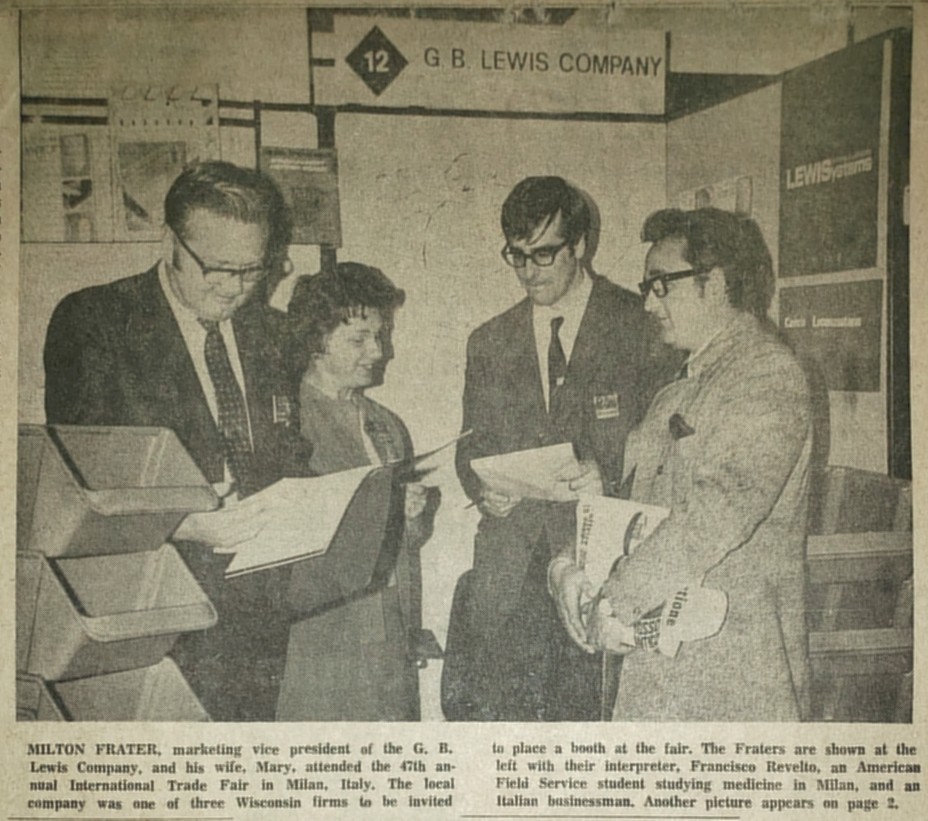 Thanks to the G. B. Lewis
Company, this city is becoming an international market place. This spring the 106-year-old firm was invited
by the U. S. Department of Commerce to display its wares at the 47th annual
International Trade Fair at Milan, Italy.
It was one of three Wisconsin firms to be invited.
Thanks to the G. B. Lewis
Company, this city is becoming an international market place. This spring the 106-year-old firm was invited
by the U. S. Department of Commerce to display its wares at the 47th annual
International Trade Fair at Milan, Italy.
It was one of three Wisconsin firms to be invited.
"We were certainly honored
to be asked to participate," said Milton Frater, marketing vice president
for company. "There were only 25
other U.S. firms represented."
A leader in growing field of
plastics, the Lewis company specializes in materials handling products for
industry. Founded in 1863, when
Watertown a small was agricultural community. Lewis originally made wooden cheese
boxes.
Today, Lewis is still in the
container business, but the containers are now made from stronger-than-steel
reinforced polyester fiberglass. The
company's patented "Stack-n Nest" (R) tote pans and hopper boxes and
the "Plastibox" (R) assembly-storage bins
are used in a wide application in industries.
It was Lewis' leadership in the field that brought the invitation to the
trade fair.
"In our product line,"
said Frater, "we are about a year ahead of anyone else in the United
States and three years ahead of any European competitor. Until the trade fair, however, we had no
licensed manufacturing facilities overseas.
Naturally, we jumped at the opportunity to seek foreign licensees."
Milton and his wife, Mary, were
the official representatives for the company at Milan. Both were impressed by their experience.
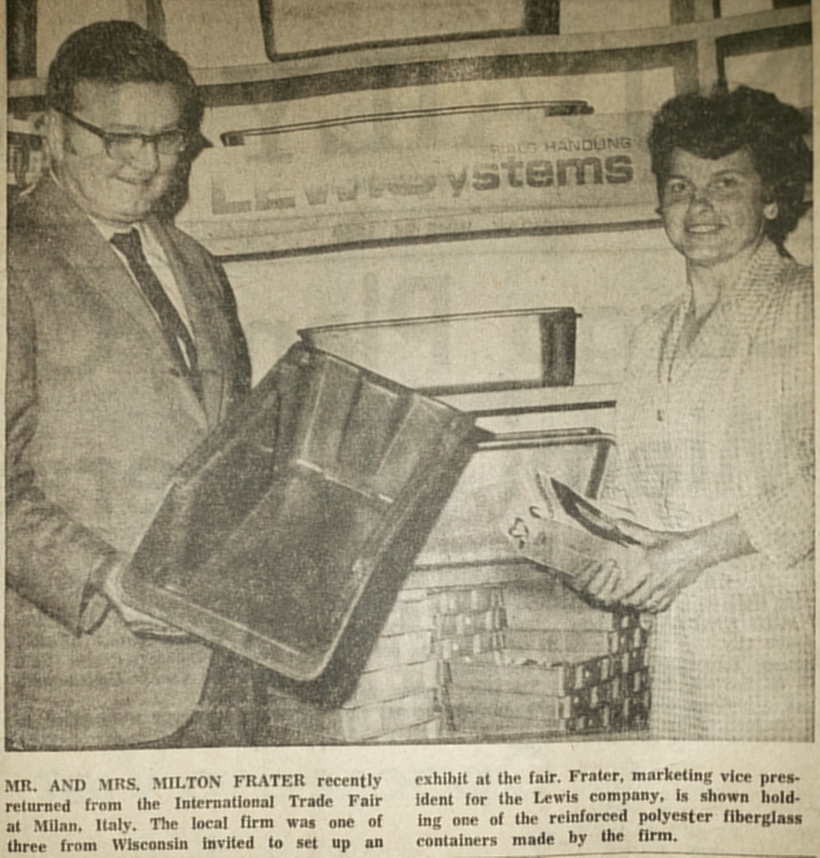
The State and Commerce
Departments did a marvelous job preparing things for us." Frater
said. "They arranged for an interpreter
and checked credit references for us.
The only thing they didn’t prepare us for was the size of the
exposition. It was immense. I guess that is what impressed me the most.
"Our booth was in a building
that was four times the size of Chicago’s McCormick Place. There were four floors and you could have
had three soccer games going on simultaneously on each one. And that was only one building. To give you some idea of the fairgrounds
itself, we had a jogger in our group, a fellow who liked to get up in the
morning and go for long run. It took him
45 minutes to trot completely around. I
don't know if he tried that more than once."
Milan is the Chicago of Italy and
its International Trade Fair is the largest of its kind in the world, Frater
says. Unlike the World Fair, it is held
in the me place each year and specializes in commercial products that range
from huge shipyard cranes. . . .
. . . . When they returned to
Watertown, they brought back a lot more than souvenirs and good will. As a direct result of the Trade Fair the
Lewis Company is negotiating with a number of licenses and agents from many
different countries.
"We had our markets in
Canada and many South American countries before the fair," Frater
stated. “Now it looks as though we will
have licensees who can manufacture products in Italy, Switzerland, Belgium and
Spain. We also acquired sales
representation in Israel, Austria and the Union of South Africa.
07 09 BOYD FLATER SERVES MARQUARDT MANOR
Marquardt
Memorial Manor incorporated under the direction of a local board of
trustees of which Boyd Flater is president.
07 11 COMPANY OFFICERS ELECTED
Milton Frater was elected
president of the Lewis Company by the board of directors of the company at a
meeting held this morning. Allen Frater
was elected executive vice-president, and Boyd Flater the secretary-treasurer. The retiring president, Gordon Frater, will
remain with the company in an advisory capacity. The directors expressed themselves as having
complete confidence in the continued growth of the company under the new
management team. The incoming officers
have had a leading part in the development of the company and are more than
usually competent to expand the business to new high levels.
08 06 SOILED SHEETS DISPLAYED
Soiled sheets were displayed to
the city council Monday evening by residents complaining of air pollution. Those complaining live near the G. B. Lewis
Company, and blame the firm for the pollution.
A petition bearing the names of 71 persons from the area calling for the
Lewis Company to change from coal to gas fired furnaces was presented to the
council. Mrs. Ralph Spoerle, 407
Lafayette Street, a spokesman for the group, showed the council a sheet she had
placed on the wash line to dry. It was
covered with soot. Another person showed
a cloth that was used to wipe off the rear window of the car in the
morning. It also was black.
11 14 MEMBER OF WATERTOWN SAFETY COUNCIL
11 18 14TH ANNUAL 20- YEAR CLUB BANQUET
The G. B. Lewis Company recently
held its 14th annual 20- Year Club banquet at Hartung's Supper Club. Members represent 1,008 years of service.
Honored guest at the party was Karl
Lange, a 47-year veteran employee of the G. B. Lewis Company, who was presented
a set of luggage. He ended his years of
service with the company last March 31.
At the time he retired he was purchasing agent.
This year brought two new
members, George Braeger and James Sherard to the existing 33. Also honored were Fred Graf and Erwin
Kohlhoff, 25-year members and Howard Schultz, 30-year member.
Following cocktails and a dinner
of prime rib, entertainment was provided by Mary McBride, top writer for
Phyllis Diller for 10 years. She gave a
rollicking talk titled "A Funny Thing Happened on the Way to the
Kitchen."
Club Members
Members of the 20-year club
are: Gordon Frater. Herb Riedemann, Ben
Erdmann, Neil Follensbee, Carl Stark, Ray Erdmann, Herb Knoll, Arthur Schmidt,
Thomas Roark, Gust Schlueter, Donald Bittner, George Oestreich, William
Schimpf, Ralph Schmoldt, Harlow Klingbeil, Larry Adams. Howard Schultz, Charles
Jones, Evangeline Schramm, Jane Brooks, Walter Braunschweig, Doris Kuhnke, Fred
Graf, Erwin Kohlhoff, Pearl Heller, Joan Winkler, Lorna Heller, Walter Uttech,
Milton Frater, Earl Greve, Gertrude Ertl, George Braeger, James Sherard.
___ c.1969 __________________
G. B. LEWIS WAS FILTHY
Derived from the book “The Meitners of Waterloo, Wisconsin”, by
James A. Meitner, 2013, p 50.
Howard
finally found this only long-term job at the G. B. Lewis Company in Watertown
where he used his farm-hewn skills to maintain and repair complex hydraulic
presses in a factory that made fiberglass boxes. The factory was filthy because they chopped
fiberglass into flexible shards, blew it into molds, and bound it together with
epoxy resin under heat and pressure. He
would come home from work stinking with resin and his arms glistening with
fiberglass. Mildred washed his clothes
separately from ours, but I remember itching all over when I put on freshly
washed clothes to go to grade school.
There were times that even my clothes glistened in the sunshine from the
fiberglass. Howard worked at G. B. Lewis
for 21 years until he retired in 1976.
Aug PRESS INSERT FOR HAMMOND ORGAN
Hammond Organ phased out wooden boxes
and converted to Plastibox bins and Stack-n-Nest
fiberglass tote pans. G.B. Lewis of
Watertown filled the standardization requirement. Link
to pdf file.
Sept LEWIS SELLS DIVISION
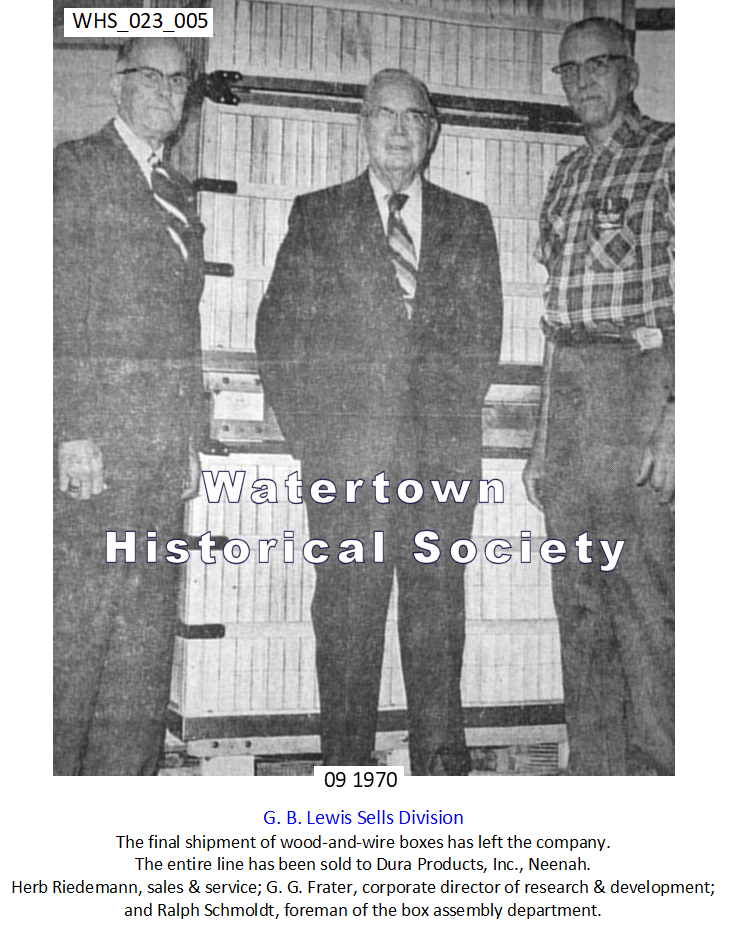
The final shipment of
wood-and-wire boxes has left the G. B. Lewis Company. The entire line has been sold to Dura
Products, Inc., Neenah. With some of the
boxes are Herb Riedemann, sales and service; G. G. Frater, corporate director
of research and development; and Ralph Schmoldt, foreman of the box assembly
department. Gustav Schlueter, foreman in
charge of the mill production department is presently assisting the new owner
of the department in the operation of the equipment.
Dec LEWIS 20-YEAR CLUB HAS PARTY
G. Gordon Frater Is Presented 50-Year
Pin
The Lewis Company's 20 Year Chub
held its 15th meeting at Hartung's Supper Club.
The club now has 29 members actively employed and 15 retired employees.
The total years of employment represented by the club membership equals the
remarkable figure of 1,460 years.
G. Gordon Frater in completing 30
years of work with the Lewis Company began as development engineer in July
1920. During the ensuing period he
became plant superintendent, advanced to general manager and made corporate
president in February, 1941. In July,
1969 his request to be relieved of his duties as president was granted and he
is devoting his time to research and development. He received his 50-year pin at the party.
This year Dave Borchardt became a
member of the club, having completed 20 years with the company. He was presented a recognition pin, and
welcomed into the group by Milton Frater, president of the Lewis Company.
New long term service pins were
presented to Mrs. Pearl Heller, 25 years. Thomas Roark, 35 years, retired, Neil
Follensbee, 45 years, and G. Gordon Frater, 50 years.
Unable to attend were Donald
Bittner and Arthur Schmidt, 35 year members
The gathering enjoyed a program
of humor by Mic Figi who has gained considerable reputation from coast to coast
in bringing humor in a manner to put and keep the audience in a jovial mood.
The evening concluded with photos
being shown of the Lewis fire of many years ago, through the centennial days up
to the present.
___ c.1970 __________________
-- -- AERIAL VIEW OF MONTGOMERY STREET SITE
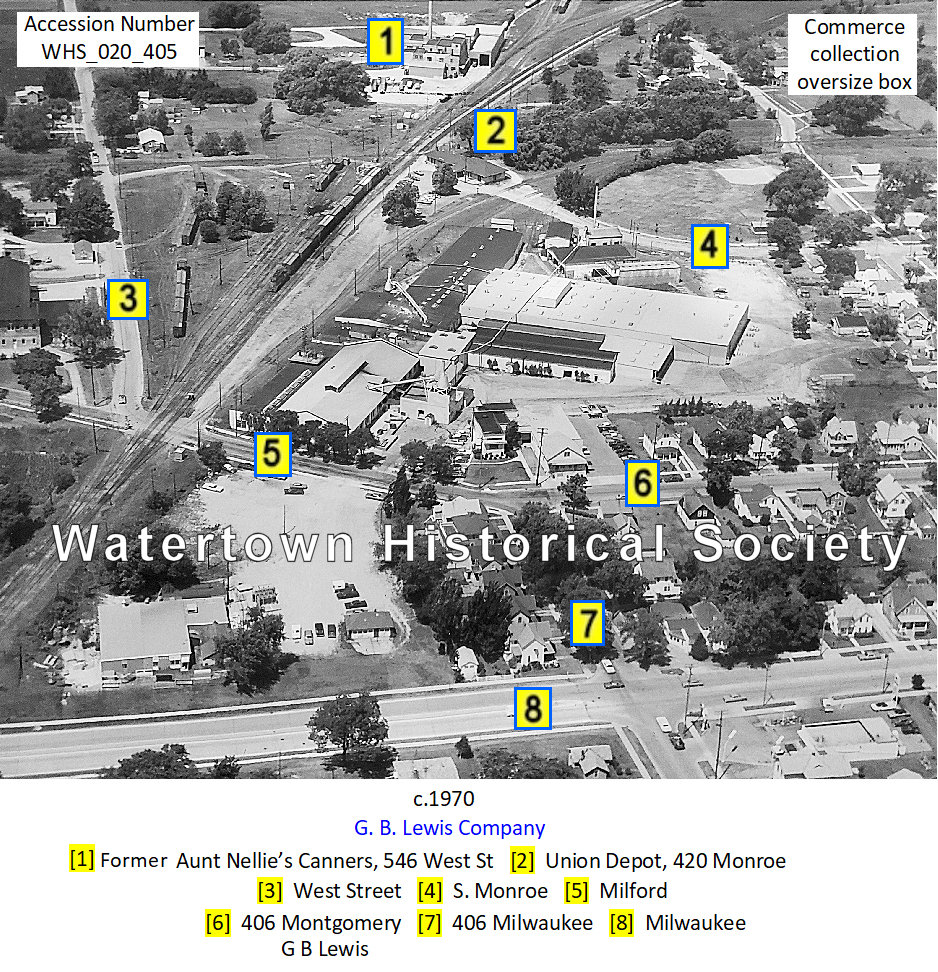 <
c.1970
<
c.1970 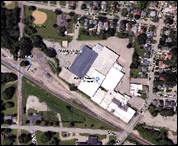 < 2021
___ 1973 __________________
03 03 SALE
OF PROPERTY
Sale of a portion of Union Park and a
portion of Monroe Street to the Forco Corporation for
the G. B. Lewis Company was approved by the Watertown City Council. The council approved the sale of the property
at a cost of $2,500 per acre as had been originally proposed by the Forco Corporation.
The total amount of land in question amounts to approximately 1.08 acres
of land. This is divided up into
approximately .54 acres of land of park property and approximately .54 of an
acre in former street property. The sale
was approved by a 10-3 vote with Aldermen David Lenz, Herbert Guetzlaff and
Eugene Radtke voting in opposition. WDT
___ 1974 __________________
LEWISystems, Orbis Division / One division remained with
Menasha as LEWISystems and later became known as
Orbis Division of Menasha Corp. The
other was the Molded Products division which was sold in 1997. Because of rapid growth, LEWISystems
was moved at the end of 1984 to a new building at 128 Hospital Drive. By the fall of 1996, it had outgrown the
Hospital Drive facility and moved to the Oconomowoc industrial park.
09 11 PLANT
TOUR
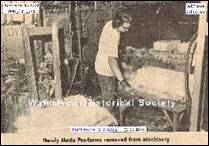 < link to set of 4 images
___ 1981 __________________
10 26 MENASHA CORP “YEAR
CLUB”
The Menasha Corporation “Year
Club” celebrated its 25th meeting with dinner for members and guests at
Lindberg's By the River. Boyd Flater, a
guest of honor, retired after 24 years of service. Flater began working when the firm was known
as the G. B. Lewis Company and Container Equipment Corporation. He has held many positions throughout the
years, including office manager, secretary-treasurer, sales manager and
executive vice president, and at the time of his retirement was general manager
of Menasha Corporation-Molded Products Group.
Flater received a movie projector for his years of service.
___ 1983 __________________
04 23 A SURE SIGN OF SPRING
beekeepers picking up honey bees from Dadant and Sons
A sure sign of spring is the sight
of beekeepers waiting to pick up their orders of honey bees from Dadant and Sons Inc., located off highway 16 east of
Watertown. However, Dick Kehl, manager
of Dadant, said, “Not as many bees were ordered this
year because of the mild winter.
Beekeepers don't have to replace as many.” Usually Dadant
averages seven truck loads every April but this year only needed to order
three. “All of our bees are specially
ordered because they are a live commodity,” Kehl explained. The bees, which are shipped primarily from
Georgia and Mississippi, need an air-conditioned atmosphere. They arrive around the time of the first
fruit bloom and beekeepers have about four days to get them settled in a hive. Watertown Daily Times, 04 23 1983
02 04 MENASHA
PLANS OFFICE BUILDING
Menasha Corporation is planning
to construct a 19,000 square foot office building at the intersection of Boughton
Street, Hospital Drive and highway 16 bypass if rezoning of the property is
given formal approval. The building
being planned is about 120 by 160 feet.
The new facility would be for the sales, accounting and marketing
personnel of Menasha's LEWISystems division which
currently has space in the Menasha complex at 426 South Montgomery Street. WDT
02 19 PLAN
TO CONSTRUCT OFFICE BUILDING APPROVED
The Watertown Common Council
Tuesday evening cleared the way for Menasha Corporation to construct an office
building at 128 Hospital Drive. The
19,000 square foot facility will be the divisional headquarters of LEWISystems and house approximately 100 clerical, sales and
professional employees, according to David Rao, operating engineer of the
firm. The 120 by 160 foot building will
also include a laboratory which will take up about one-eighth of the structure,
he said. Rao compared the laboratory to
that of a radiology department in a hospital. WDT
12 05 LEWISystems, at 128 Hospital Drive
When officials from Watertown’s
Menasha Corporation make a decision to move, they sure don’t waste any time or
effort. City and Menasha officials this
morning formally opened the new division headquarters of the firm’s sales and
marketing branch, LEWISystems, at 128 Hospital
Drive. Less than eight months ago, the
six-acre location across from Watertown Memorial Hospital was empty — no
building, no parking lot, no trees.
Eight months later, a 19,000-square- foot in size office building stands
at the site, ready to begin operations Monday. Menasha, headquartered at 426
South Montgomery Street, manufactures plastic material handling containers for
industrial use as well as a variety of other plastic items.
___ 1985 __________________
05 26 If things go nearly as
well as expected, the new 19,000-square-foot LEWISystems plant on Hospital Drive will just be the beginning for the
122-year-old company. But for the
company's general manager, John Wilde, nearly will hardly be satisfactory. “In the next five to 10 years, I think
business will be two to four times larger,” he said. “If our dreams come true, we'll be the
dominant maker in the industry. It's
unlikely we'll have overseas operations, but I think we'll have strong
affiliation with companies overseas.” LEWISystems, a subsidiary of Menasha Corporation since
1955, designs, manufactures and markets molded plastic container systems for
industry's material handling needs. The
items include shelf boxes, small part bins, hopper boxes and bulk containers
ranging in capacity from 25 pounds in the shelf boxes to 1,200 pounds in the
bulk containers. WDT
___ 1987 __________________
05 26 HILDA HANEY, Executive Secretary to the
President, 1957-87
Hildy Haney chose a career with G.B. Lewis, where
she held the title of Executive Secretary to the President. She stayed with G.B. Lewis through several transitions
and retired in 1987, her 30th year anniversary with the company.
___ 1989 __________________
05 15 Menasha Corporation
Molded Products Division is celebrating 126 years of business in Watertown. The
celebration, entitled “125 — Plus One,” began today with an open house of the
company’s facility at 426 S. Montgomery St.
Employees, their families, neighbors and special guests were invited to
tour the facility. The company that is
known today as the Menasha Corporation Molded Products Division actually began
in 1863 as the G.B. Lewis Company, according to Den Komaromi, general manager
of the Watertown plant. WDT
___ 1991 __________________
08 27 Officials at LEWISystems have an ambitious goal for the first half of
the 1990s — the Watertown-based industry expects to double its sales from 1991
to 1995. “We expect to see some
substantial growth rates,” said LEWISystems General
Manager John Wilde. LEWISystems,
a division of Menasha Corp. of Neenah, sells about $40 million in plastic
products a year, which represents about 7 percent of its market. However, the firm hopes to increase its sales
by going after even more of the potential $00 million market of various plastic
items. Most of LEWISystems’
products are injection-molded plastics used primarily for industrial purposes,
although the firm makes a few consumer goods — sold at Wal-Mart and Target
stores — that have evolved from industrial products. WDT
___ 1994
__________________
06 25 This week’s reduction
of 10 management positions has been difficult, but it promises to pay dividends
in the future, according to John Wilde, general manager of LEWISystems,
a division of Menasha Corporation. Wilde
said the reduction was announced to affected employees over the last several
days. It includes eight based at the
Watertown plant on Hospital Drive, and one each from the Iowa and Ohio
production plants. He said the cuts were necessary to make the LEWISystems division competitive not only immediately but
also through the latter part of the 1990s.
WDT
___ 1996 __________________
1996, ORBIS DIVISION
Orbis is the name of the new
division within Menasha Corporation that will bring four separate operations
under one management structure. The new
Orbis division will operate within the company's existing Materials Handling
operations, including two in Watertown. Those two are Convoy Plastic Pallets
and LEWISystems.
The others include DuraPAK of Cincinnati,
Ohio, and WOLPAC, Inc., of Michigan Heights, Mich., a firm which became a
wholly owned subsidiary of Menasha last month.
___ 1997 __________________
APPLIED
MOLDED PRODUCTS SOLD
The Molded Products division was sold
in 1997 to Universal Partners, a private investment group based in Memphis,
Tenn. That group renamed the facility to
what was known as Applied Molded Products.
11 17 A
downturn in business has caused Applied Molded Products Corp., 426 S.
Montgomery St., Watertown, to inform the Wisconsin Department of Workforce
Development that up to 160 employees could be subject to permanent layoff in as
few as 60 days. A union president
representing Applied Molded Products employees said that the company's
operations manager has given a 60-day notice of the possible permanent layoffs
at the Watertown plant. Larry Ready,
president of United Brothers of Carpenters, Local 2504, said he received a
letter Wednesday from Applied Molded Products operations manager, Donald
Jankowski, warning of the possible layoffs at the plant located at 426 S.
Montgomery St. WDT
___ 2001 __________________
APPLIED MOLDED PRODUCTS CLOSED
Nearly 100 Applied Molded
Products employees were given a permanent notice of layoffs in January 2001
because of a downturn in business. The
entire operation was shut down in April later that year.
The company was a custom
manufacturer of sheet molded composites.
The parts were sold to original manufacturers for use in applications
such as lawn and garden tractors, personal water crafts, parts for buses and basketball
backboards.
___ 2003 __________________
12 28 UP FOR AUCTION
Applied Molded Products Corp.,
which closed its doors in 2001, will be up for auction at a sheriff’s sale Jan.
7, 2004. The 426 S. Montgomery St.,
factory has seen a longtime history in Watertown, dating back to the mid 1800s. G.B.
Lewis, started the company, originally located along the banks of the Rock
River, in 1849 [?]. The business
specialized in making barrels and buckets, other wood handling equipment and
even wooden airplane propellers and bee hives.
___ 2005 __________________
05 12 AUCTION OF PROPERTY
The former location of one of Watertown’s
oldest industries is going on the auction block next month. The former Applied Molded Products property
at 426 S. Montgomery St., for many years known as the old G.B. Lewis Co., will
be sold at an auction at 10 a.m. on June 29.
The property is just under two acres.
The auction will take place on the steps of the Jefferson County
Courthouse and will be conducted by Sheriff Paul Milbrath. The G.B. Lewis Company’s presence in
Watertown dates back to 1863 when it started as a two-man shop. The company was known for many years as the
world’s largest manufacturer of beeware.
06 27 PROPERTY SOLD
The former location of one of
Watertown’s oldest industries was sold Wednesday at an auction on the steps of
the Jefferson County Courthouse. The
former Applied Molded Products property at 426 S. Montgomery St., known for
many years as the old G. B. Lewis Co., was purchased by Mooring Capital Fund
LLC, of Vienna, Va., for $1 million.
According to the Jefferson County Sheriff’s office, Mooring Capital Fund
was the only party to place a bid.
12 10 ON THE SELLING BLOCK, AGAIN
The former home to one of the
city’s oldest industries is once again on the selling block, according to Dipesh
Bhise, director at Mooring Financial Corp.
After purchasing the former Applied Molded Products property on South
Montgomery Street, known for many decades as the old G. B. Lewis Co., in June
for $1 million, Mooring Financial Corp., of Vienna, Va., is offering the parcel
for $1.5 million. Although the
industrial portion and the office space are being marketed as one property,
Bhise said the office area, which is approximately 16,000 square feet, could be
purchased separately for a negotiated price.
___ 2006 __________________
04 14 CITY OFFICIALS TOUR FORMER PLANT
City officials toured the former
home to one of Watertown’s oldest industries Tuesday in consideration of using
the site as a possible location for the proposed public works facility. The
former Applied Molded Products property at 426 S. Montgomery St., known for
many years as the old G.B. Lewis Co., is one of two sites city aldermen and
public works commission members are contemplating for the street department’s
new location. Following the tour of the parcel, members of the public works
commission met in closed session to discuss the possibility of purchasing the
land. Public Works Commission Chairman Gerald Yenser said the city will
continue to investigate the site and purchasing the property would be
contingent on the acceptability of a feasibility study. WDT
06 27 FORMER PLANT PROPOSED FOR PUBLIC WORKS
DEPT.
A Virginia-based financial
company has accepted Watertown’s counteroffer of nearly $1.5 million to
purchase the former Applied Molded Products facility, which will be used as the
new home of the public works department.
Mooring Financial Corp. of Vienna, Va., has accepted the city’s
counteroffer of $1,475,000 for the 10.3-acre property that has 195,000 square
feet of building area. The city made an
original offer of just over $1 million and Mooring had been asking for $1.5
million for the parcel. However, the
accepted offer is contingent on the results of a feasibility study, which must
be completed by Sept. 19. The results
from this study will show if it is cost effective for the city to convert the
Applied Molded Products property to the new public works facility. WDT
09 24 PUBLIC WORKS DEPT. NO LONGER CONSIDERED
It sounds as though the former
Applied Molded Products property on South Montgomery Street will no longer be
considered as the potential home for the proposed public works facility. During a Watertown Committee of the Whole
meeting Tuesday night many of the aldermen who spoke after listening to several
proposals from a representative from a Janesville-based architecture and
engineering firm said they could not defend constructing a building on that
site. The proposals for the new public
works facility presented by Matthew Long of Angus-Young Associates varied
between $8.7 and $6 million. Those
totals include the $1,475,000 to purchase the Applied Molded Products
property. WDT
___ 2008 __________________
03 02 STREET DEPT., TEMPORARY LOCATION OF
The Watertown Street Department
is in the process of temporarily moving its operation to the former Applied
Molded Products building on South Montgomery Street to make way for its brand
new facility on South Second Street.
Street department Superintendent Rick Schultz said today the move is
going smoothly and he hopes to have all of the department’s equipment and
materials at the Applied Molded Products building by the end of March. “All of the equipment and materials are
heading over there and we have about a third of our department moved,” Schultz
said. “We hope to be close to about a
half in the next week and a half. If the weather holds, I would like to have
everything over there and operating on March 31.”
09 20 FORMER APPLIED MOLDED PRODUCTS BUILDING
SOLD
The former Applied Molded Products
building on South Montgomery Street has been sold, the previous owner confirmed
Thursday. According to Dipesh Bhise,
executive vice president of Mooring Financial Corp. in Vienna, Va., the
10.3-acre site has been purchased by Montgomery Properties LLC of
Waukesha. Susan Leverson, a bookkeeper
for Montgomery Properties, said her company is looking to reposition the parcel
in the marketplace. “We expect to take
care of it, find tenants and draw commerce,” Leverson said. “The goal is to take care of any deferred
maintenance and attract tenants into it.
Because the property has been sort of vacant for so long we can
basically do anything. Everything is
open to us. It’s basically an open book
right now.”
___ 2009 __________________
04 16 APPLIED MOLDED PRODUCTS
ROOF FIRE
The roof of the former Applied
Molded Products building on South Montgomery Street sustained about $10,000 in
damages on Tuesday following a fire that was caused by a person using a cutting
torch, according to Watertown assistant fire chief Kraig Biefeld. The Watertown Fire Department was dispatched
to the old Applied Molded Products facility, 426 S. Montgomery St., Tuesday at
12:34 p.m., and the firefighters who first arrived at the scene saw smoke
coming from the northwest corner of the structure.
___ 2011 __________________
04 12 REVOCATION OF CONDITIONAL USE PERMIT
Revocation hearing regarding a
conditional use permit that was recently issued to the owner of the former
Applied Molded Products building. John
Haim of Montgomery Properties LLC, the owner of the old Applied Molded facility
at 426 S. Montgomery St. has prepared to withdraw his application for a
conditional use permit and would agree to nullification or cancellation of that
conditional use permit,” Levi said.
“That withdrawal would obviate the need for an evidentiary hearing.”
When the plan commission approved
the conditional use permit on Dec. 13, 2010, its members included several
conditions to help decrease the amount of noise that is being generated from
the property.
One of those conditions only
allowed outdoor operations to occur from 7 a.m. to 10 p.m. The four businesses that utilize the building
- Up-N-Atom LLC, Wood Graphixs Inc., Kehe
Distributors Inc. and Master Mold Inc. - were also forbidden from using Monroe
Street for trucking operations. In addition, the plan commission prohibited
outdoor storage on the parcel, which includes the refrigerated trailers that
are being used by Kehe Distributors.
By withdrawing the conditional
use permit, Haim has agreed to only allow one business to use the building,
Sager said. The plan commission set a deadline of 45 days for the three other
businesses to move out.
Plan commission members set a
date of May 23 to revisit the possible revocation of a conditional use permit
that was issued in December 2010 to James Haim of Montgomery Properties LLC,
owner of the former Applied Molded facility at 426 S. Montgomery St.
Montgomery Properties was issued
a cease-and-desist order in July of 2010 because the city felt the business
needed to apply for a conditional use permit for a group development. According
to city code, a company needs to apply for a conditional use permit if more
than one business uses a building.
A revocation hearing regarding
that permit was held in front of the plan commission on Jan. 24, but that
hearing was canceled when Haim withdrew his application for the permit. But
city attorney Tom Levi is questioning whether Haim can legally withdraw the
application because the permit has already been granted.
The plan commission on May 23
will consider revoking that permit. If the permit is revoked, Haim would not be
allowed to apply for another conditional use permit for one year.
Krueger said he has been informed
Kehe Distributors LLC will be moving out of the former Applied Molded Products
facility starting April 30. The company is relocating to a structure on Highway
26 in the town of Emmet.
The problem with noise coming from
the former Applied Molded Products building has been an ongoing issue with
neighbors since Kehe Distributors started leasing space in the facility in July
of 2010.
`
Plan commission members also amended a
conditional use permit that was recently issued to Brad Brickham
of Copper Creek Investments LLC.
___ 2021 __________________
12 12 ALLEN H. FRATER / December 7, 1929 - December 12, 2021
G. Gordon Frater and
Hazel Alice Hathaway
Allen Hathaway Frater
(Angela Marie Sabetti)
David Frater (Julia),
Cynthia Frater, Cheryl Jones (Bill), Caran Quadracci
(Joel) Chenequa;
David Frater
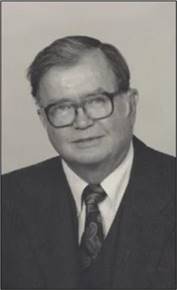
Allen Hathaway Frater,
92, passed away peacefully December 12, 2021, at his home in Fish Creek, WI
surrounded by family.
He was born December 7,
1929, in Watertown, WI to G. Gordon Frater and Hazel Alice Hathaway.
Upon graduation from UW
Madison in 1952 with a degree in Mechanical Engineering, Allen joined the US
Navy and graduated from OCS in Newport RI.
He served at the Pentagon as a missile procurement officer during the
Korean War where he met his future bride Angela
Marie Sabetti. They married March
27, 1954.
LT JG Frater received an
honorable discharge in 1955 and returned to Watertown to join his father and
brother in the family business at the GB Lewis Co. Allen began his long and illustrious career
at the Lewis company as a factory foreman, respected and beloved by his
coworkers as he worked his way to Executive Vice President upon his father
Gordon’s retirement. The company was at
the forefront of the fiberglass industry and held patents for boxes and systems
sold throughout the world.
After 18 years and a
buy-out at the Lewis Co., Allen embarked on the next 40+ years in business as a
consultant, investor and owner in many successful endeavors - his last position
being as an owner and officer at Infocor until his
retirement in 2008, where his daughter Cheryl remains as CEO and president.
In addition to Allen’s
passion and acumen for business, he was also a talented athlete who enjoyed
bowling and playing hockey, basketball and baseball in his younger years; and
ping pong, golf, tennis and skiing throughout much of his life. He had numerous interests and hobbies:
training homing pigeons in his youth; boating, reading, stamp and coin
collecting, fishing, card playing (especially bridge and cribbage) and most of
all, spending time with his family - he loved anything shared with his
children.
Allen is survived by
his children, David Frater (Julia), Fish Creek, Cynthia Frater, Canyon Lake,
TX, Cheryl Jones (Bill), Belgium, WI and Caran Quadracci
(Joel) Chenequa; grandchildren, Allen Coté, Colin Frater (Brittany), Alanna
Fraase (Keith), John Frater, Antony Frater (Kristin), Eric Frater, Aaron
Frater, Alissa Carney (Zach), Meghan Quadracci, Halle
Quadracci and Danica Quadracci;
great grandchildren, Steven, Brooklynn, Willa, Andrew, Patrick, Adeline, Leo
and Emmett; sister-in-law, Mary Frater, and numerous nieces and nephews.
Allen was preceded in
death by his parents, and by his wife, Angela.
A Christian Burial
Service will be held at Stella Maris Parish Baileys Harbor site on Wednesday,
December 22, 2021, at 11:00 a.m. with Deacon Tony Abts officiating. Military Honors will follow at the church.
Burial will be at St. Mary’s of the Lake Cemetery.
Visitation for family
and friends will be from 10:00 a.m. until the time of service at 11:00 a.m. at
the church.
In lieu of flowers,
memorials in Allen’s name can be made to The Peninsula Music Festival (PO Box
340, Ephraim, WI 54211), Stella Maris Parish (PO Box 49, Egg Harbor, WI 54209)
or Unity-Hospice & Palliative Care (2366 Oak Ridge Cir, De Pere, WI 54115).
Huehns Funeral Home, Inc.
& Door County Crematory LLC in Sturgeon Bay are assisting the Frater
family.
The Romance of
"Beeware"
1921, Watertown
High School Orbit
Once upon a time, when southern Wisconsin
was covered with forests of linden and those who had ventured to settle in
Jefferson County had found this to be a beekeeping paradise, two Watertown men
grasped the opportunity of attaining a standing in the world of honey
production.
Beginning with the making of a
few items of equipment for the accommodation of their beekeeper neighbors, the
demand for this line of goods gradually increased, until it became the most
important part of their business. From
an accommodation to beekeeper neighbors, it reached the proportions of an
accommodation to better beekeepers everywhere. The demands for
"BEEWARE" became so heavy that a great factory was erected to be
devoted entirely to supplying the wants of the honey producing industry.
The quality and workmanship of
the goods made in this plant came to stand for a definite necessity among honey
producers, and to give it a distinction, the words "bee" and
"ware" were coined into "BEEWARE" and this registered
trademark has come to mean to beekeepers every- where--something better.
During the past winter several
thousand beekeepers have looked at exhibits of "BEEWARE" at their
meetings. Thousands learned what this trademark stands for, through the
exhibits at many state fairs. In many foreign countries, on several continents,
the word stands for a definite ware, even where the language of America is not
spoken. To warrant this confidence among honey producers, the quality of the
goods is not enough. Through literature and personal representation in fields
afar, the principles of better beekeeping are being taught by representatives
of the G. B. Lewis Company, for we cannot hope to succeed unless our customers
succeed too.
Those who are in touch with this
world-wide interest in "BEEWARE" feel that "Once upon a
time" is a suitable way to begin a resumé of the growth of this company
during its forty-six years of existence. Honey production has grown in that
time from an unknown industry to one which replaced sugar for foreign troops
during the war, to one which increased the resources of Uncle Sam through the
cross pollination of fruiting plants and the conservation of a natural sweet.
Mail and telegraph bring news of
changes in the industry from England and Japan, from Egypt and from Sweden. In
our effort to keep abreast of the little field in which we stand pre-eminent,
we in turn supply to Watertown a portion of its wealth, gleaned in fields afar
and exchanged for labor here. Therefore, there can be a romance even in so
staid a product as LEWIS "BEEWARE."
Cross References:
Patrick
Rogan came to Watertown in 1837. Six
or seven years later he erected a saw mill where George B. Lewis’ factory was
located; carried on the mill until 1858.
Lewis
home, 408 S Washington.
Milton
Frater, patented stack 'n nest containers; reinforcing plastic with
fiberglass.
Gerard
Yenser, Manager, 2008 obit
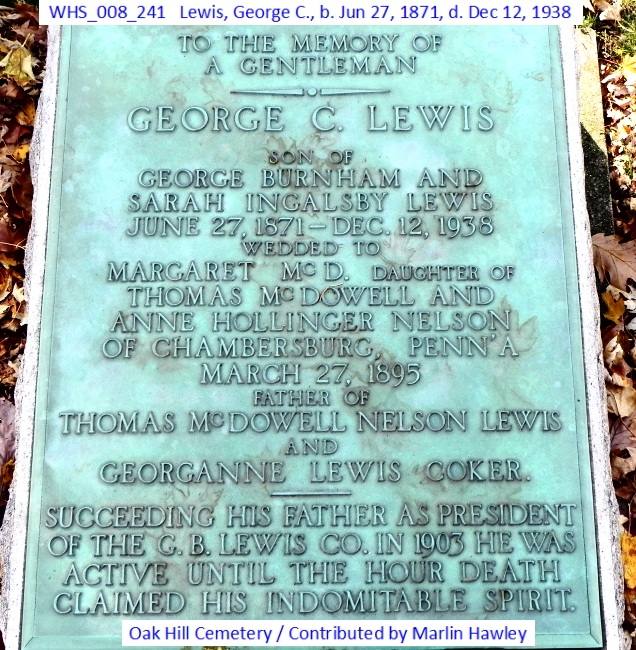
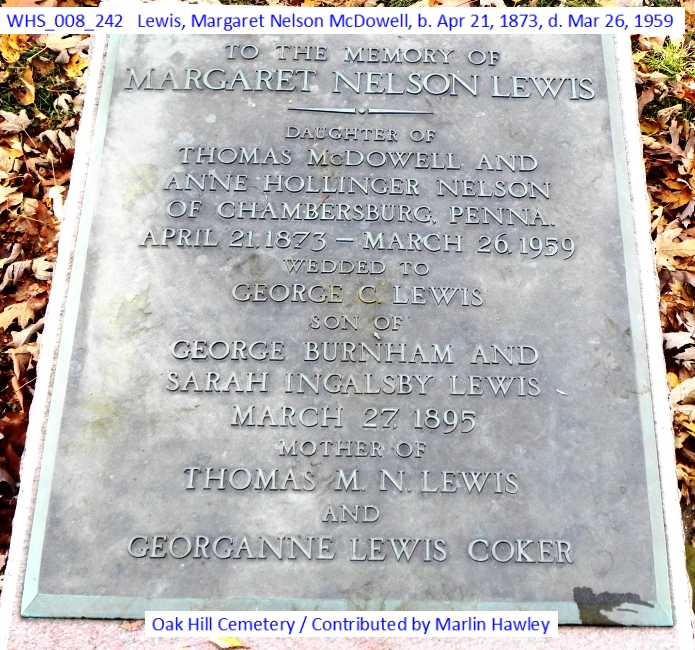
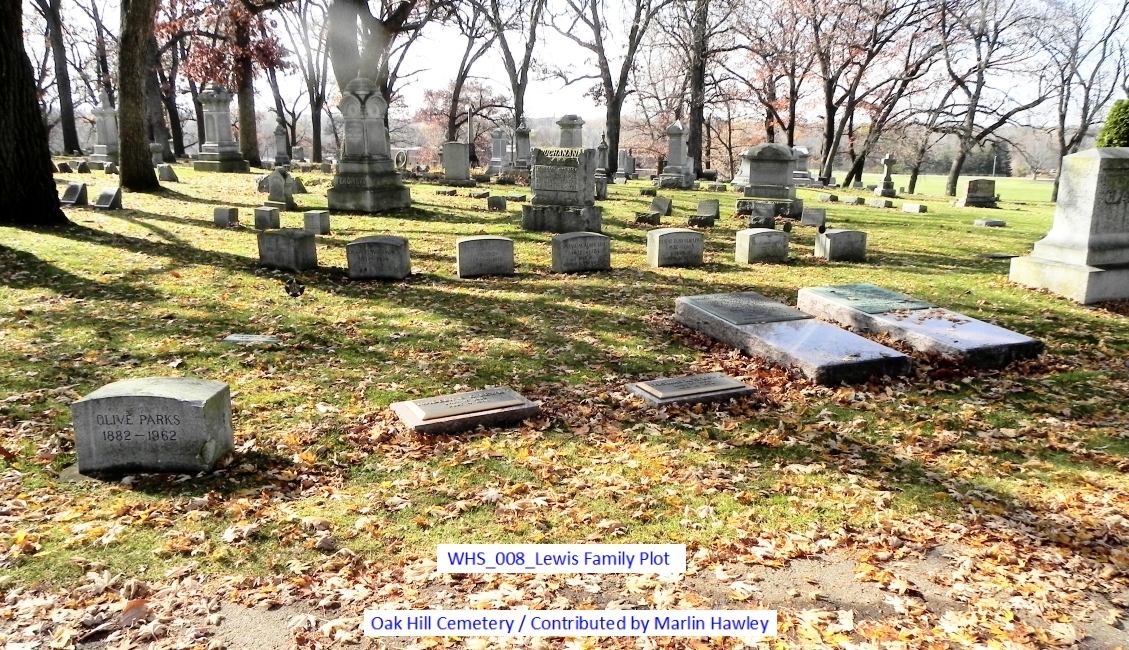


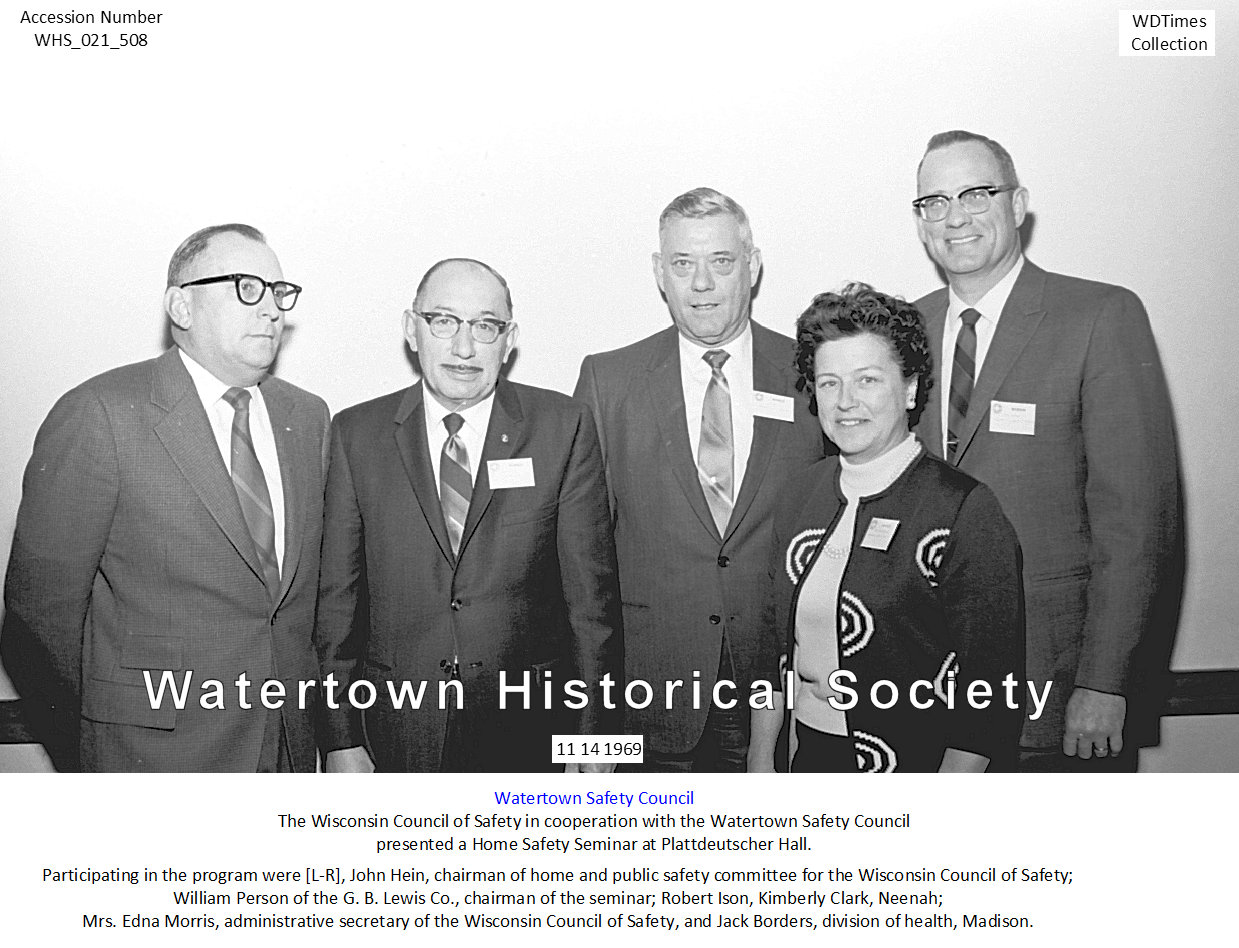

History of Watertown,
Wisconsin