website watertownhistory.org
ebook History of Watertown, Wisconsin
Chapter on Watertown Police Department
City Jail
Lockup
1859
05 26 LEASE FOR LOCKUP
Common Council Proceedings: Resolved, That the Mayor be authorized to
give notice to Keck and Lehmann that the lease between them and the city for
lock-up has expired and that said city has no further use of said room. Adopted.
WG
1860
05 17 Pioneer Engine house; site for jail [lock-up] WD
c.1875
WATERTOWN'S CALABOOSE
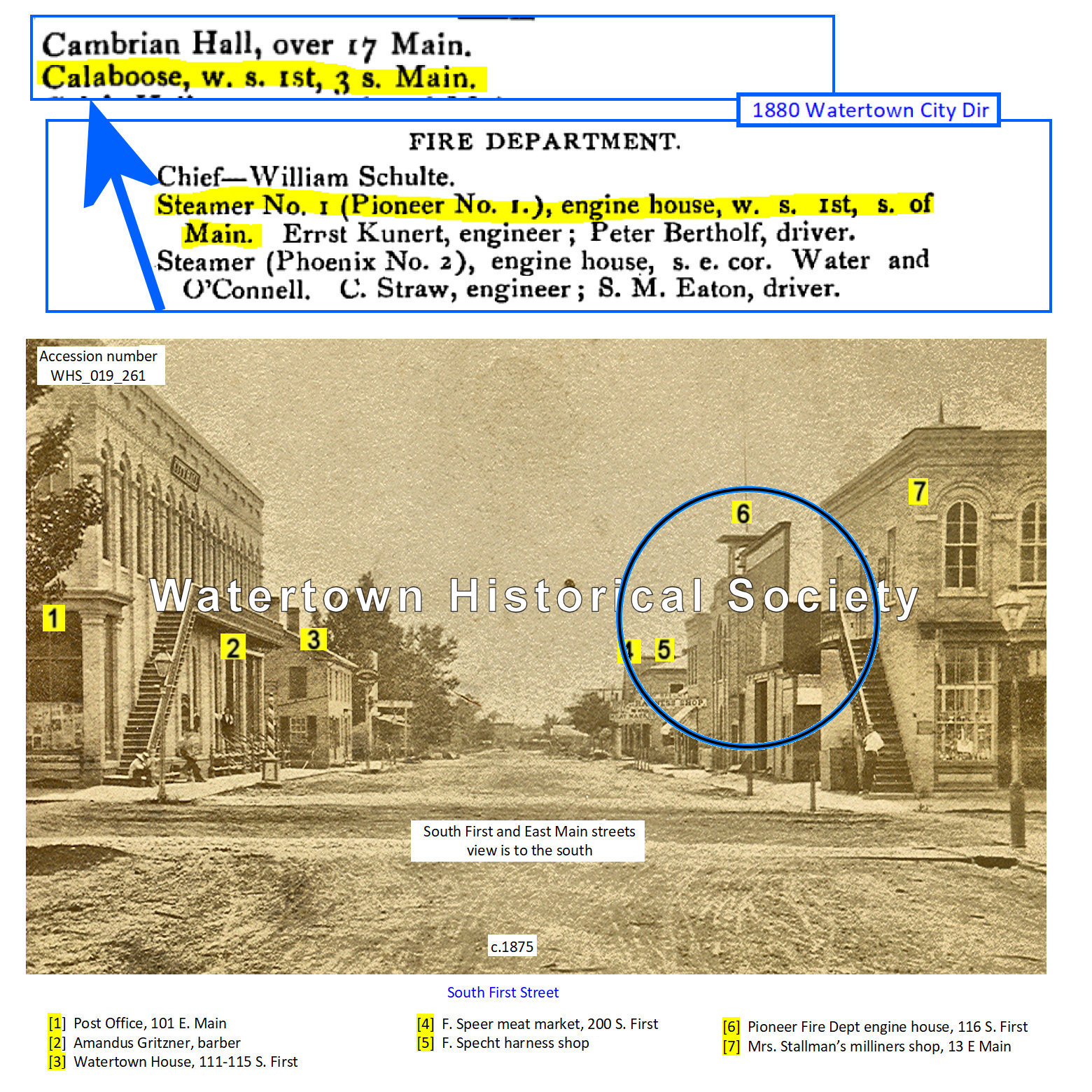
Jail or lock-up located
in basement of early fire house on South First Street,
as noted in
"Watertown Fire Dept 1857-2007" by Ken Riedl, pgs
36-41.
1882
03 10 OUR
JAIL IS FILTHY
We
would call the attention of our city fathers to our city lockup [located in
basement of the fire house on S First Street].
The writer, having heard of its filthy condition, went to investigate
and came to the conclusion that to put a human being into such a place, even
for an hour was simply damnable, yet almost every night some poor unfortunate
is shut up in that reeking filthy hole.
In one
corner is a sort of a trough filled with excrement, which has been accumulating
until the stench from it almost stifles you as you enter, which when taken into
the lungs is productive of typhoid and other disorders.
For
humanity's sake do something towards remedying this crying evil.
We say
build a new lockup, and build it where you can have proper sewerage and
ventilation. It will not cost much, and
is just as necessary, and more so, than many of the so-called improvements made
here, but if a new one is not built, it should be seen to that that black hole
of Calcutta is cleaned out and made fit to hold a prisoner for a few hours
without endangering his life or health.
The city marshal should have attended to this without having the matter made
public, but as he did not we felt it our duty to call public attention to
it. WG
1894
1,000 persons were accorded free lodging
at the jail. WR
12 26 COUNTY JAILS
Queer about the jails
in Dodge and Jefferson counties. It
seems to be optional with the prisoners whether they serve their sentence or
not . When they get tired of prison fare they simply leave without going
through the formality of any legal process.
WR
1905
11 14 Wednesday evening, Jerry Butzler, the policeman, found a “drunk” near the corner of
Main and Third streets. He hunted up a
patrol wagon consisting of one wheel and two sighting rods and loaded his find
and started for the city jail down Main St. accompanied on his journey by a
hundred or more interested spectators who encouraged him on the way and spit in
their hands whenever Jerry became tired and great beads of perspiration
trickled down his face.
When
he reached the jail, the patrol wagon, being provided with an automatic dumping
arrangement, the “drunk” dumped himself upon the ground while Jerry was busy
unlocking the door of the bastille and endeavored to crawl away on his one leg
and hands. The crowd aided him in the
effort, but the officer finally landed his man and is entitled to praise for
his humanity, for the “drunk” would have frozen had he not been taken care of
by the officer.
1905
11 15 Saturday afternoon, a drunk and
disorderly was waltzed up before Judge Henze by Chief
of Police Block who had given him lodging during the previous night. The
complaint being read to him and it being impossible for him to plead otherwise,
he informed the court that he was guilty, and thereupon the court fined him $1,
the price of twenty beers, and the costs, $5.45, one hundred and nine more
beers, which are gone forever. He paid the fine and costs and departed a sad
and dry man.
Harry Kerwin, who is not a Frenchman, as his name will not
indicate, was introduced to Judge Henze. He was
charged with carrying around more booze than was good for his system and good
order, and pleaded guilty. The court informed him that he must dig up $6.45
fine and costs or go down to the Jefferson county jail and break rock for five
days. His appetite for intoxicants having absorbed all his wealth he took the
journey to Jefferson.
1906
12 06 Watertown's City Hall jail, which for
more than 30 years has been the subject of debate and condemnations, is in for
some more changes and temporary “improvements” which will have to serve until
something can be done to replace it with a new and modern structure.
After
receiving another letter from the state, following the most recent jail
inspection, the City Council last night instructed Chief of Police Herbert F. Vehlow the city manager and the city engineer to go into a
huddle and see just what can be done and determine about how much it will cost.
The changes recommended are not too extensive this time. The report is based on an inspection made by
a state officer, G. M. Parker.
1955
08 03 If state authorities condemn the City
Hall jail in Watertown as a firetrap and unfit for occupancy, as is now
certain, the ruling will prove costly to the city. That was the statement made
by officials here this morning following publication in the Times yesterday of
an announcement that a state inspector had reported he would recommend that the
jail quarter be condemned. Condemnation is expected to come later this month,
since the inspector, upon leaving the city after looking over the jail shortly
before noon yesterday, said he is determined to follow through on his course.
The decision did not come as too great a surprise to officials who have had
warnings before. Most of them realized that sooner or later the state was ready
to lower the boom. The city has really been asking for it for a long time. The
condition and situation did not develop overnight. It has been growing for
years. In fact, it dates back to the administrations of various mayors under
the old city type of regime.
1956
04 20 Temporary approval for continued
restricted use of Watertown's City Hall jail was announced late yesterday by
state officials who made another inspection at the request of City manager Dean
Van Ness. The approval is limited to the use of two cells. The actual cell
block still stands condemned. The manager has sought for some time to secure an
agreement with the state whereby use of the present jail would be continued
rather than have the city transport all of its prisoners to either the county
jail at Jefferson or Juneau while they await court arraignment. In recent
months he has visited Madison once relative to his plan and has also carried on
extensive correspondence.
1956
06 02 State authorities have now given final
approval to the continued restricted use of the Watertown city jail, it was
announced today by City Manager Dean Van Ness. The continued use of the jail
was given unofficial approval some time ago after the city requested that it be
given another inspection. At that time the city was asked to also make another
formal application to get official action and this has been done, the manager
said. Use of the jail is restricted to two rear cells. The main cellblock
cannot be used for retaining prisoners. The state's original order had banned
further use of the jail effective last February, on the grounds that it does
not meet modern standards. But after city officials pointed out to the state
that the city is faced with more vital expenditures than having the present
jail replaced, state authorities agreed to give it another inspection and to
reconsider the original order.
1961
03 03 SUB-STANDARD
CONDITION OF POLICE AND JAIL QUARTERS
The city council which
is currently involved in a long standing hassle over plans to provide new
police department and jail facilities got another warning - a stern one and one
that may well be final - from the state last night relative to the present and
long-standing sub-standard condition of police department and jail quarters
housed in the city hall - the same space and quarters the department has been
forced to occupy since the present city hall was built in 1884. Last night's warning, by letter and signed by
V.A. Verhulst, representing the division of corrections, Wisconsin State
Department of Public Welfare, was the latest in a series of proddings
by the state that the city do something to clear
up the jail issue without further delay.
WDT
05 11 The state of Wisconsin, through the state
department of public welfare, yesterday afternoon served notice on the city of
Watertown that it is through waiting for the city to do something about
bringing the city hall jail quarters up to standard and that it is ready to crack
down if something isn’t done within the next six months. The official order was served on city
officials at 3 o’clock yesterday, copies going to the office of Mayor R. P.
White, City Clerk Glenn R. Ferry, Police Chief Herbert F. Vehlow
and City Attorney James A. Fitzpatrick. Mr. Ferry said today that he was
required to sign for the order, to acknowledge receipt. WDT
10 13 The common council last night again
delayed action on its decision relative to the city hall jail issue — which
involves an order from the state welfare department that the jail be closed on
Nov. 7 unless repairs, alterations and improvements recommended by the state
welfare department are carried out by that date. Alderman Herman Gerth,
head of the council committee which has been delegated to investigate the
possibility of transferring all prisoners to county jails while they are in
police custody, the only alternative the city would have if the jail here is
closed, reported that Jefferson County had not given a reply as yet to its part
in such a plan, while Dodge County had set a fee of $2.35 per day for all male
prisoners and a fee of $20.35 per day for all female prisoners. The considerable difference in the rates was
not explained. WDT
Cross References:
File on Police Department

History of Watertown,
Wisconsin