website watertownhistory.org
ebook History of Watertown,
Wisconsin
Globe Mill
317-321 S.
Water
In its day, the old mill on South Water Street was the hub of activity for a farming community.
Hundreds of gears turned as grain was pulverized into flour, generated by power from the Rock River.
GLOBE MILL
1853: One of three mills in town:
1] West side of river,
Built 1848 Red Mill, Big Brick Mill, Blanchard Mill
Empire Mill, former Emerald Mill
Globe Mill
A to Z Farm Center
c1992 Bought by Empire Globe
Corp.
2001 Building destroyed by
fire
2] East side of river, Yellow Mill, built 1842. In 1848 upgraded from water power to steam power
3] East side of river, Big Brick Mill, built 1848.
In 1881, in company with Jonas Sleeper, Fred Miller engaged in the manufacture of flour at the Brick mill, the site of the present waterworks plant. The firm was known as F. Miller & Co., which later became the Globe Milling Co., the output of which at one time was 70,000 barrels of flour a year, and sold out his interest in 1885.
The Empire Mill, first known as the Emerald Mill, was built by Fay & Cramer of Milwaukee on the west side of the Rock River in 1848. On the opposite side of the river, built in 1842, was a mill known as the “Old Yellow Mill” and then, in 1848, another called the “Big Brick Mill”. In 1853 there were three flouring mills as they were then called. This was boom time in Watertown.
____________________________________________________________________________________
1842 OLD YELLOW MILL BUILT
The first of the mills was built in 1842 by Luther A. Cole and Edmund S. Bailey and was known as "The Old Yellow Mill." This was only six years after Timothy Johnson, the first settler appeared upon the scene. Its location was that now occupied by the Electric Power Co. plant at the western end of what was then known as "The Rough and Ready Dam." Ownership changed several times in the first few years. In 1848 the owners of Old-Yellow built another mill on the present site of the City Water Power Plant. This was enlarged in the eighties and was generally known as "The Big Brick Mill." Its capacity, actual, not rated, was 800 bbls. daily and by consolidation it became the main plant of the Globe Milling Co. group. The same year, 1848, there was built "The Emerald Mill" on the site now occupied by the present Globe Milling Company plant. This mill burned in 1871 but was immediately rebuilt.
In 1874,
Mr. Christian May, a successful logging and lumber operator, purchased the
Emerald Mill and shortly after brought about a consolidation with the Big Brick
Mill, operating as the Globe Milling Company, giving the Globe group, as
improvements and expansion took place, a combined capacity of approximately
1,000 bbls. daily.
From that time on The
Emerald Mill was known as The Empire Mill. It was at this time that Mr. Christian May's
eldest son Gustavus took over the management of The Big Brick Mill, while son
Edward managed The Empire Mill.
It is necessary to retrace our steps to 1891 to note the destruction of the Big Brick Mill in that year by fire. It was not rebuilt and the Empire Mill assumed the name of the operating company, and has been known since that date to the present as the Globe Mill.
In 1898 ownership and management of the mill was taken over by Henry Mulberger and Wm. D. Sproesser. In 1904, as a partial offset to capacity lost by the destruction of The Big Brick Mill, Messrs. Mulberger and Sproesser purchased a 250 bbl. mill at Oconto, Wis. This was moved to Watertown and from then on the Mill operated two 250 bbl. units under one roof, one unit grinding wheat, the other, rye.
During the next few years the new owners found it necessary to devote more of their time to their banking and other business interests, and George Manschot, with many years of experience with the well-known milling firm of J. B. A. Kern & Sons, Milwaukee, was engaged to take over active management.
In 1917 still another change in ownership took place. Shane Bros. & Wilson Co., owners and operators of the Milbourne Mills in Philadelphia had entered upon a program of expansion which included not only the erection of new mills, but the purchase of established mills throughout the mid-west.
Included in those purchases were the Globe Milling Co. and a 500 bbl. mill in two 250 bbl. units at Portage, Wis., owned but not recently operated by York Bros. of that city. Extensive improvements were undertaken particularly at the Portage Mill which was practically rebuilt with the addition of a large and well equipped warehouse.
In the meantime the Watertown mill had been turned over to rye exclusively, and by 1919 the rebuilt Portage mill was ready for operation.
At that time the present management came to Watertown with instructions to combine the Watertown and Portage mills financially as well as in general management and sales. It was an unwise decision. The Portage mill was heavily in debt due to improvements and new buildings. It had neither established trade nor brands. The United States public had been forced to use a percentage of substitutes for wheat flour during the war and with the removal of those restrictions wanted nothing to do with substitutes, with which they unfortunately classed rye. It was impossible under those conditions to sell successfully the combined rye capacity of the two mills, totaling 750 bbls. daily.
The Portage mill continued to be a drag on the well established Watertown mill, and it was sold in 1924 to a Chicago contractor thinking to make a miller of his son. It burned to the ground before it had really gotten into operation under the new owners.
The over expansion of the milling industry during the war, with the resulting scramble for business at unprofitable prices combined with the general commodity price collapse in the early twenties was disastrous for Shane Bros. & Wilson Co. in their over-expanded position. They were obliged to relinquish their interests in the two Globe Mills and reorganization of the Globe Milling Co. became imperative. It was at this time that New York and Milwaukee capital made substantial investments and together with the interest held by mill personnel, ownership remains much the same today as then. Since World War I we have been the largest exclusive rye mill in the United States—not an entirely happy distinction under the exigencies of war.
When the Mays
sold their interests in 1898, Edward May established himself as a broker in
Pittsburgh under the name of Edw. C. May & Sons. The business is still carried on under the
same name by Edward's son Harry C. May, and through all these years has sold
Globe flour in the Pittsburgh territory.
The name May has been closely associated with the Globe Mill for the
past seventy-one years.
____________________________________________________________________________________
Changes of ownership in the early days were frequent. The roster of early owners includes such names as Luther A. Cole and Edmund S. Bailey, builders of the original "Old Yellow Mill" in 1842. Subsequent early owners of this mill and two others included in the Globe group were Ebenezer Cole, Linius R. Cady, Jacob Weber, J. H. Sleeper and Philip Quentmeyer. Still later in the mills history are the names of The May Bros., Mulberger and Sproesser.
____________________________________________________________________________________
A country mill, in early days, was something more than just another manufacturing establishment. It was separate and distinct, of the very woof and warp of the communities life and progress. Here came the farmers with their grain to sell and supplies to buy. Here they gathered in visiting groups to discuss their crops, their plans and to roar in rib-racking laughter as some story teller spun his yarn. Here, too, came the towns people for their flour, the feed for the horses, cows and chickens, kept by the thrifty householder to combat the not so high cost of living. The mill no doubt could vie with the historic New England town pump as the source of many a wild tale and rumor. The farm wife, too, brought her eggs and butter to be traded at the general store for needed groceries and calicoes. The mill yard was stacked high with cordwood traded in by the farmers as they cleared their heavily forested land, furnishing a cheap fuel for stoking the mill boilers. Dollars in those early days were scarce, but barter played an important part in keeping the wheels of commerce turning.
____________________________________________________________________________________
1848 EMERALD MILL OPENED
Rock River Pilot,
03 29 1848
The splendid new mill, on the west side of the river, belonging to Messrs. E. & J. Cramer of Milwaukee, and B. F. Fay of this village, went into operation on Thursday last. The mill building is 40 by 45 feet, and five stories high. It was drafted by that able and widely known millwright and machinist, Ira Miltimore of Chicago, and is designed for four run of stone [four run of stone is taken to mean four working pair of millstones], two of which are now working successfully, each being driven by one of Rose’s improved re-action wheels.
A wheel of the same description turns a perpendicular shaft, which passes through all the floors, propelling the machinery that works the smutter [note: a smutter or fanning mill removes the smut, mold, fungus and any dirt clinging to the grain], which is in the basement; the screen, blower, meal conveyors, and return conveyors, which are on the second floor, and the bolts, which are on the fourth or bolting floor. The third floor is occupied by the stones, etc.; the fifth as a grain store. The bolt chest is one of the finest in design and finish we have ever seen. It is 21 feet long, 14 wide, and 14 feet high, and contains five bolts. The whole of the complicated, yet simple and beautiful machinery attached to the main shaft is propelled by 98 inches of water. With 350 inches of water to propel the two wheels, each run of stone has ground wheat at the rate of 25 bushels per hour, and it is believed that 30 bushels per hour can readily be ground by each run of stone. Thus this mill without the additional two run of stone, can convert flour from 3 to 400,000 bushels of wheat annually.
The millwright work has been under the immediate supervision of Mr. Thomas Keegan, a mechanic of no ordinary skill and ability. Mr. Fox, an able and experienced miller, formerly of the Niagara mills, Black Rock, directs the flouring operations. He is assisted by his brother, who is also a master of his profession.
Much credit is due to the proprietors of the mill, for their persevering enterprise, and to the mechanics employed in its construction, for the science and skill they have displayed. No expense has been spared in its completion and everything in and about it has that highly finished appearance so desirable in mills or other buildings but so seldom found in a new country. Those who are competent to judge say that it is unquestionably the best mill in Wisconsin. It is a great acquisition to our village and the surrounding country; and we have no doubt that the proprietors will realize their most sanguine expectations in the deserved success of the Emerald Mill.
1848
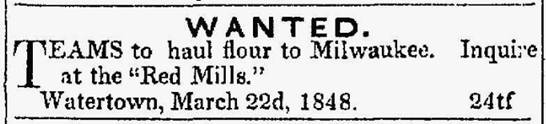
Rock River Pilot, 05 03 1848
1858
07 29 LOWER DAM REBUILT AFTER FLOOD
The New Dam - Mr. W. H. Blanchard and Enos Salsich are now engaged in building a new dam across Rock River, a few rods below Main Street bridge, in place of the one that was carried away some six weeks ago by the great flood. The new structure will be built in such a way as to make it strong and permanent, and capable of resisting any amount of pressure that will ever be made upon it by any accumulation of water that is likely to flow over it. When completed it will furnish a splendid and reliable water power, sufficient to carry all the machinery that is now located on the river, and as much more as it may be profitable to put in operation. A large number of men are now employed on the work, the object being to get the structure done as soon as possible, so that the mills now standing idle may once more be set in motion. The two grist mills that depend on this power for water are among the largest and best in the state. Both are being thoroughly overhauled and repaired, and will be put into the best running order. When driven to their full speed, they are capable of manufacturing daily large quantities of the best quality of flour, and their brands stand among the first class in all markets where they are seen. They give steady employment to a considerable number of men, and their success is a matter of interest to all. WD
1859
09 01 RED MILL UNDERGOING EXTENSIVE REPAIRS
The Red Mill on the west side of the river, carried on by
Messrs. Salsich and the Greens, is now undergoing
extensive repairs and receiving a new run of stone. These
improvements will add largely to the capacity of this heavy milling
establishment to accommodate the large number who daily resort to it with
custom work and also greatly increase its facilities for manufacturing
bread-stuffs. Mr. Enos Salsich is also
doing another good thing in macadamizing that portion of Water Street which
runs from West Avenue (today West Main) to the mills. This timely
improvement will render the establishments down there easily accessible through
every season of the year, and all who may have business to transact can go and
come without being buried in mud and mire, no matter what the
weather. We are glad to see these changes going on, as they indicate
that our business men anticipate busy times ahead. In this
expectation we trust they may not be disappointed. Here is a wide
and inviting field for profitable manufacturing enterprises and it has only
just begun to be occupied. We hope at no distant day to see it more
generally appreciated and made available.
WD
1850s
-- -- CAKES FOR FIRST KINDERGARTEN KIDS
In
the 1850's that outstanding statesman and soldier, Carl
Schurz, settled in our community and came regularly to the mill, driving
in from his hill-top home, the Karlshuegel of today,
on the northern outskirts of the town, taking with him the flour for the little
cakes so eagerly awaited by the children in his wife's kindergarten. This was the first school of its kind to be
established and maintained in the United States. Derived
from the booklet "The
Globe Milling Company, Watertown, Wisconsin, 1845-1945."
1860
07 19 ADDITION TO RED MILL
The Red Mill, on the west side of the river, is among the
best flouring establishments in this state. Since it has been owned
by Mr. Enos Salsich it has been much improved both in
machinery and its capacity to do work. He is now making a large
addition to the south end of the main building, which will not only be a great
convenience but add greatly to the business facilities of the
institution. The flour that goes from this mill has always been
regarded as fully equal to the best in the market and brings the highest price,
which is the best possible proof of its superior quality. WD
07 26 V. D. Green & Co. of the Red Mills purchased winter wheat; Salsich pushing forward addition to mill WD
1863
02 26 RED MILL OWNED BY CUNNINGHAM & CARR
Since Messrs. Cunningham & Carr have
taken possession of the Red Mill on the west side of the river they have
thoroughly overhauled and repaired the whole establishment, refitted the old
machinery, added much that is new, and put all in the best running order. They now manufacture a quality of flour so
fine and pure that their brand stands among the first in the state and readily
commands the highest price and the quickest sale. They have all the facilities for doing custom
work and farmers from the country always find their grists
ground and ready at the appointed hour.
They do their work promptly and well, carefully avoiding all causes of
complaint. They have a large and
well-furnished mill and we are glad to learn they are transacting a business
both extensive and successful. The more
such manufacturing establishments we have in our midst, the better it will be
for the community. There ought to be a
far greater portion of the splendid wheat annually raised around us sent off in
the shape of flour than has heretofore been the case. WD
03 19 A BIG DAY’S WORK AT RED MILL
Messrs. Carr & Cunningham, the proprietors of the Red Mill, on
the West side of the river, with one run of stone, turned out from their
establishment one hundred and sixty barrels of extra fine flour last Friday in
the space of twenty-two hours. We call
that a magnificent day’s work and we hope they will do many more such. We wish more of our splendid wheat could be
made into flour and sent to the Eastern markets in that shape. The more of our products we manufacture here
the better it is for the whole community.
Home industry is the source of home prosperity. WD
1870
12 28 THE EMPIRE MILL AND ITS CONTENTS
DESTROYED. One of the most
serious calamities that ever befell our city occurred on the night of Wednesday
last, the 28th of Dec. 1870, by the total destruction by fire of the
Empire Flouring Mills, on the west side of the river, owned by George Smith,
Esq., together with its contents, including a large amount of flour and wheat.
The fire broke
out at about nine o'clock, and appeared to have originated on the 2nd floor,
although nothing definite on this point is known. Those first in the building were so stifled
and
suffocated with smoke that they were unable to do more than take a few books,
papers and $400 in money from the safe, and soon the flames burst forth in all
their fury.
The alarm being
sounded the Engine and Hook and Ladder Companies
were promptly on hand, ready to render all the assistance in their power.
It was not many
minutes before the fire had gained such an advantage that all attempts at saving
the building seemed futile, and the efforts of the firemen and bystanders were
next directed to the preservation of the surrounding property.
Immediately on the
north side, and within 40 feet of the mill is situated the Woolen Factory, owned by Mr. Daniel
Jones, and containing valuable machinery and stock, and adjoining this building
is the Sash and Door Manufactory of Mr. G. B. Lewis. As a precautionary measure against fire, Mr.
Smith had surrounded his mill, which was a frame building, with brick walls,
and the saving of the Woolen Factory is mainly due to this fore thought on the
part of Mr. Smith for all endeavors to save this building would have been
unavailing had not the north wall of the mill stood as a barricade between the
intense heat and angry flames and the Woolen Factory.
Nevertheless it
was only through the most heroic efforts of the firemen and others that fire
was confined to its original limits and thus a most disastrous conflagration
prevented. The rising flames from the
burning mill lighted up the heavens in such a manner as to be seen by persons
living a distance of 25 miles, creating a sight at once grand and awful, and
the excitement throughout the city became intense, hundreds of our citizens
coming out to witness the terrible ravages of fire.
While the flames
were at the height of their fury, there occurred an appalling accident, which
carried dismay and consternation to all hearts.
Mr. Nathaniel Blanchard, while on the roof
off his own mill, on the opposite side of the river, endeavoring to protect it
from flying cinders, lost his foot-hold and fell a distance of about forty
feet, striking on the ice, breaking both legs and arms, and otherwise injuring
him so fatally, that he survived only twelve hours.
In the meantime the flames
made rapid progress and the devouring element held full sway over the doomed
building. The brick wall, however, still
stood the severe strain and test, and the question as to the safety and
destruction of the Woolen Mill, hung, as it were, in the balance, and could
only be determined by the manner in which the wall nearest the building would
fall. At length the period arrived which
was to decide the fate of some $20,000 worth of property, down came the immense
wall, which had stood as a sentinel, with an immense crash. A loud shout rang from the vast throng when
it was seen that the wall fell favorably, the Woolen Mill was saved and the
further destruction of property saved.
The night was still and cold, with scarcely a breath of air stirring--a most favorable circumstance for the safety of the adjoining property, for had a high wind been blowing the amount of property burned would have been immense.
Mr. Lewis prepared for the worst by removing the stock from his Door and Sash Manufactory, meeting with some loss by its removal. D. Jones & Co. moved most of their removal stock from the Woolen Factory, but luckily did not attempt to take from the building any machinery. Their loss is but slight considering the great jeopardy their property was placed in.
Together with the mill and machinery there were destroyed between 9,000 and 6,000 bushels of wheat, and 45 barrels of flour, making a total loss of about $50,000, covered by an insurance of $21,500, distributed as follows: $6,000 on mill; $10,500 on machinery; $5,000 on stock.
This loss falls with
great severity on Mr. Smith, and would crush and dishearten most men. It is barely six months since his fine
residence and all his valuable contents were totally destroyed by the fire
fiend which has just layed low his flouring
mill. The loss of his extensive mill
cannot be viewed in any other light than that of a great public calamity, the
effects of which are felt by our entire community. Wttn
Rep, 01 04 1871
1877 GLOBE MILL TELEPHONE No. 1 / FIRST PHONE INSTALLED in Watertown
In 1877 the first telephone in service in Watertown was
installed in the office of the Globe Milling Co. by the late John B. May,
prominent photographer of Watertown, who conducted his business on the site of
the present Masonic temple and he resided
in the home now occupied by Owen T. Hughes, [312] Washington Street. Mr. May put in telephone service in Watertown
at his own expense, and operated it for nine years, and in 1884 he disposed of
it to the Wisconsin Telephone Co. WG, 12 29 1932.
The Globe Mill Co.'s
phone number, No. 1, was still maintained as late as 1957, in a City Directory ad
c.1870s
-- -- GLOBE MILL FIRST TO SOUND ALARM OF FIRE
The hum of machinery in a country mill
gave off soft music in the small hours of the night, bringing assurance to the
timid that men were awake and about their business. Its low pitched whistle was
the FIRST TO SOUND THE ALARM OF FIRE, summoning the volunteers to their duties.
It stood sentinel over the sleeping town. "The Globe Milling Company, Watertown, Wisconsin,
1845-1945."
1880c EMPIRE MILL
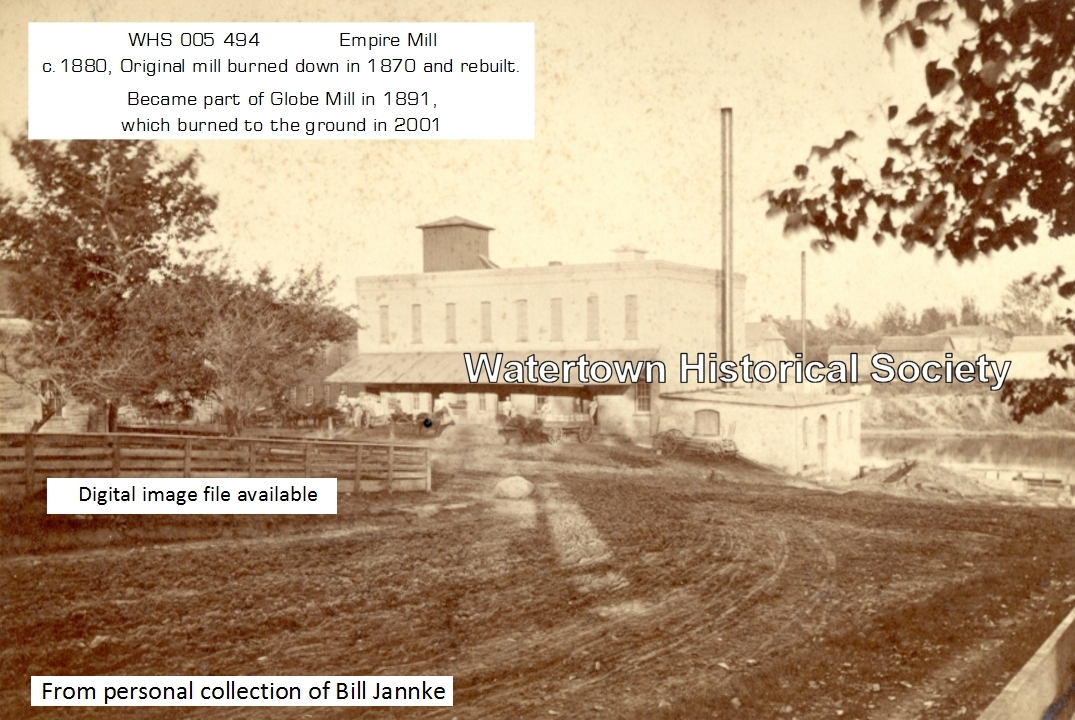 Original Empire Mill burned down in 1870 and
rebuilt. Became part of Globe Mill in
1891
Original Empire Mill burned down in 1870 and
rebuilt. Became part of Globe Mill in
1891
1887
08 12 LARGE NEW BOILER FOR
THE GLOBE MILL
A large new boiler,
which was drawn through our streets last Friday and placed in the Globe Milling
Co.'s mill on the west side, was manufactured at the foundry
and machine shops of Ernest Kunert. It is a fine piece of work and reflects much
credit on its manufacturer. Its
dimensions are six feet in diameter, 16 feet long, with 50 flues and a steam
dome 36x48 inches.
It is as large a boiler
as has ever been manufactured in the state and cost $1.450.
With more capital at Mr. Kunert's back, there is no reason why he could not be made
one of the best boiler manufacturing establishments in the state, and some
effort to this effect should be made.
03 16 ANOTHER STORY ADDED TO EMPIRE MILL
Next week the Globe Milling Company will begin to
build another story on their Empire Mill, west side. New machinery will be placed in the two upper
stories and centrifugal and rounding bolting reels will be added. With this new machinery they will be able to
turn out even better flour than the celebrated brands they are now
manufacturing, and the capacity of this mill will be increased to 300 barrels a
day. WG
1890
01 29 GLOBE MILL MAY RELOCATE
It is not very pleasant to contemplate that any of our establishments shall be taken from us, much less the Globe Milling Company should be one of them. There is some talk of this kind, unpleasant as it may sound. H. Mulberger and Gus. May have returned from a trip to Ashland and West Superior. At the former place they met with all the encouragement they could ask in case they made up their minds to remove the plant. A large-sized site and a bonus of $5,500 in money were offered them if they would start a mill of the capacity they require. The shipping facilities both by rail and water were also found satisfactory. The matter of the Globe Mill being removed from here will be decided within a short time. To remain here it would be necessary for Globe Milling to add another story to their mill and fit it up entirely with new machinery, at a cost of not less than $15,000. . . . WR
02 07 GLOBE MILL WILL REMAIN
The people of Watertown hail with delight the information that the Globe Mill Is to be retained here, and that a 20-foot addition is to be added on top. Between $10,000 and $15,000 will be expended in improvements, and when completed, Watertown will have one of the very best mills in the northwest. The proprietors deserve much credit for their enterprise in enlarging their mill, and for deciding to retain it here, notwithstanding the fine encouragement given them to remove to other quarters. WG
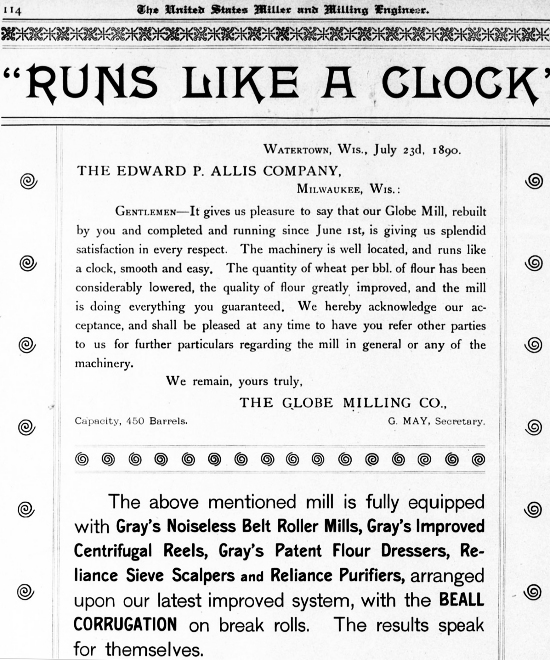
07 23 UPGRADE OF PLANT COMPLETED
12 19 W. J. LEE WINDOW DISPLAY
That winter scene in W.J. Lee's window is admired daily by hundreds of people. The "Globe Mill” and the mill pond, the castle and windmill, all bedecked with "snow;” and the coasting on the hill are so realistic that one almost forgets for a moment that the scene is not a natural one. Mr. Lee has shown himself quite an artist in this arrangement. WG
1894
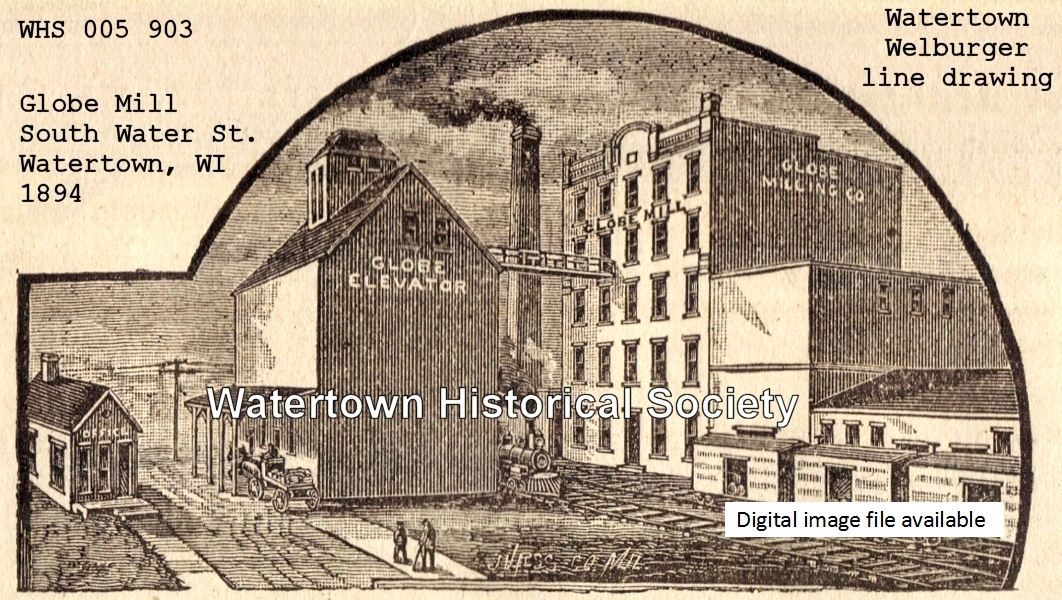
1894
12 26 MOVING EMPIRE MILL SMOKE STACK
Edward May
has a force of men engaged in removing the smoke stack on the Empire Mill from
the present to a new location, so as to connect with an extra boiler which has
lately been put in the mill. It is quite
an engineering feat, but Ed. seems to be equal to it. WR
1895
01 09 EMPIRE MILL FIRE
A fire was discovered at noon yesterday in
the Empire Mill of the Globe Milling company, and for a time it was feared the
company would suffer a loss like that sustained last August in the destruction
of the Globe mill. But the alarm was hastily
given and the firemen were at work without delay, subduing the flames before
any headway had been gained. Several
streams of water were at work, both on the outside and inside of the mill, and
the chances were altogether against the fire spreading. The flames were located in the bran room,
connected with which is a conveyor from the elevator. One of the buckets of this conveyor had in
some manner got out of running order, thereby stopping the movement of the
belting, and the continued revolving of the drive pulley – which was directly
at the head of the conveyor, where the grain was discharged to the bran room
produced a friction on the belting which in time burned the latter. The communication of the flames to the bran
followed, the fact being discovered by William Wurtzler
and others of the mill hands just as they were about to leave for dinner.
Owing to
alterations being made in the flouring department, the mill was running only
its feed department. No material loss
was occasioned by the fire, the principal damage being done by the large amount
of water poured into the building. This affected the machinery and other
contents considerably. It is thought the
loss will be at least $1,500. The property
is amply insured. It was a narrow escape
from a most serious conflagration, and everybody is thankful that if was no
worse. The company will be delayed some
by the cleaning-up process. WR
01 16 The loss
occasioned by the blaze at the Empire mill last Tuesday was not nearly as large
as first reported. It was adjusted by
the insurance company at about $200. WR
03 15 HARD WHEAT
PATENT FLOUR
Now is the time to buy your
flour. The Globe Milling Co. will sell
you a 49-pound sack of strictly hard wheat Patent flour for 90c., delivered to
any part of the city. WG
1898
VIEW FROM MAIN ST BRIDGE
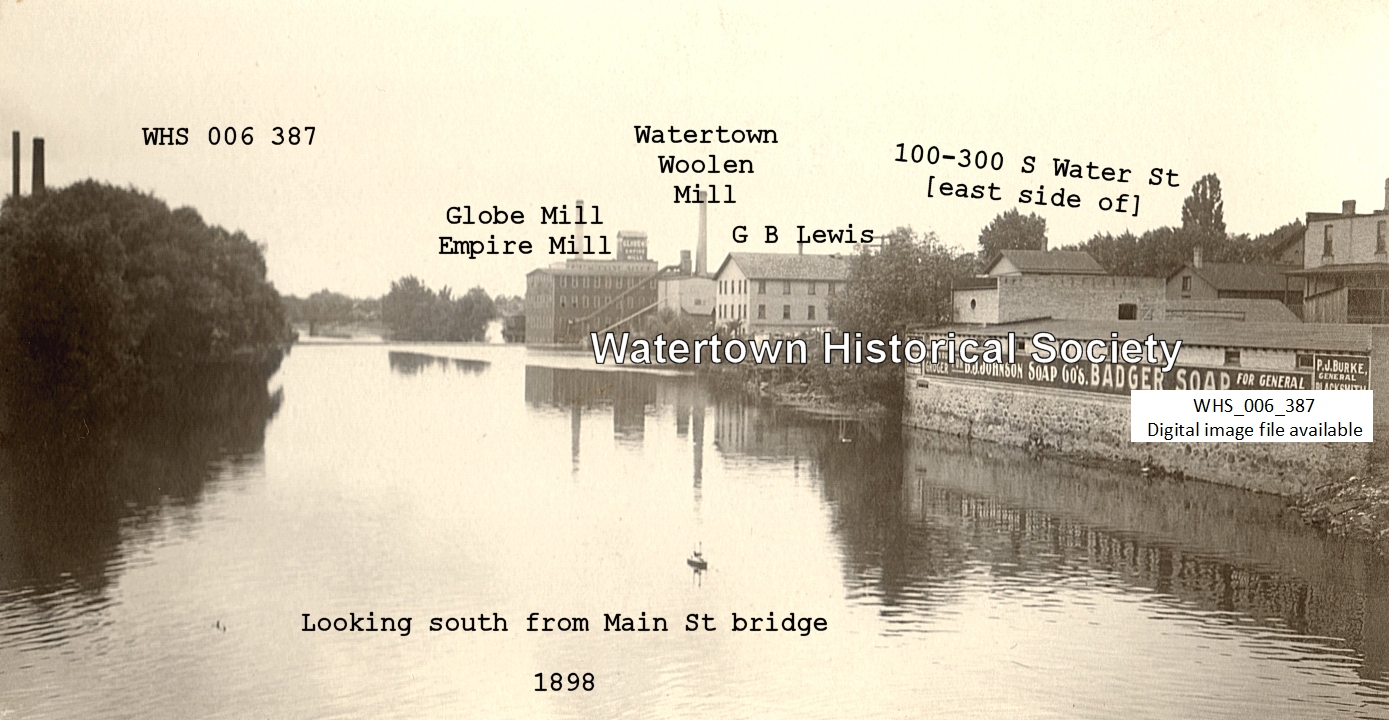
05 25 QUOTATION FOR LARGE ORDER OF RYE FLOUR
Some large
orders for breadstuffs are being placed in these times of war at high
prices. The Globe Milling company has
given quotations to a Pittsburgh firm on a 6,000-barrel lot of rye flour, the
magnitude of which may be realized when it is known that the company’s plant
would require five weeks to mill the order.
WR
1899
05 16 IMPROVEMENT AND ENLARGEMENT OF MILL CAPACITY
The Globe
Milling Company has now received all the machinery which is necessary for the improvement
and enlargement of its mill capacity.
The work of setting up will proceed as soon as the water power
ceases. The flour and feed warehouse
which is being built will soon be ready for occupancy if the weather continues
favorable. WR
1900
02 13 NEW STEAM PLANT
The Globe
Milling Co., manufacturers of the celebrated White Daisy and other well-known
brands of flour, have awarded the Twin City Iron Works of Minneapolis the
contract for a new steam plant. The
specifications called for the 14x24x36 tandem compound condensing Corliss
engine. The engine is to be completed
about May 15 and when installed this concern will not only possess the finest
steam plant in this locality, but will have as economical a power plant as
there is in the state. It will be the
first compound condensing engine in the city.
The sharp competition in the milling industry compels all mills to adopt
the most economical methods, which was the incentive for the company to go to
this extensive outlay. WR
c.1900
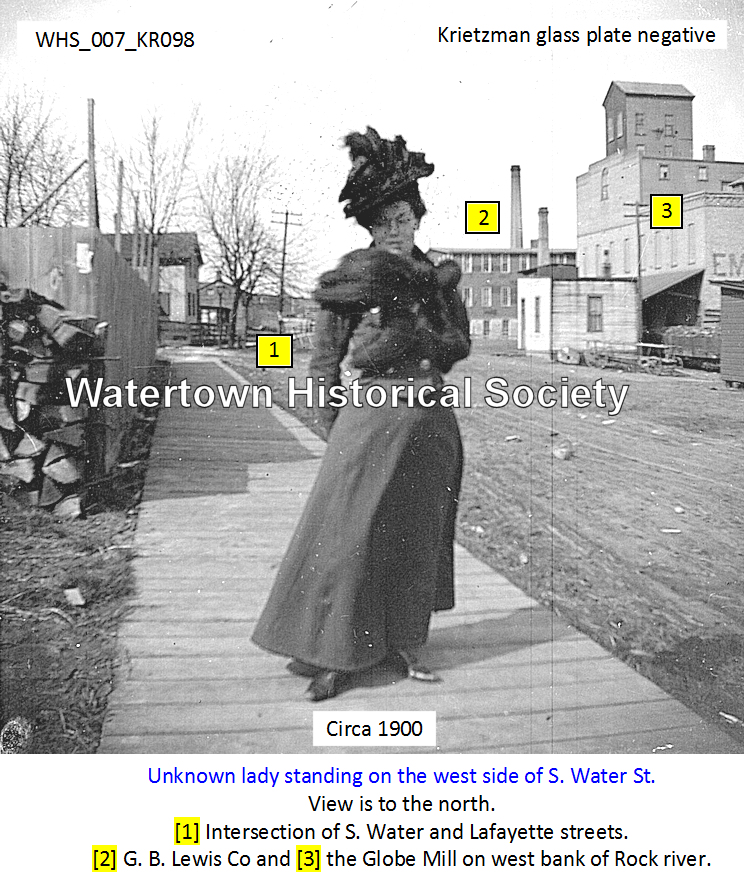
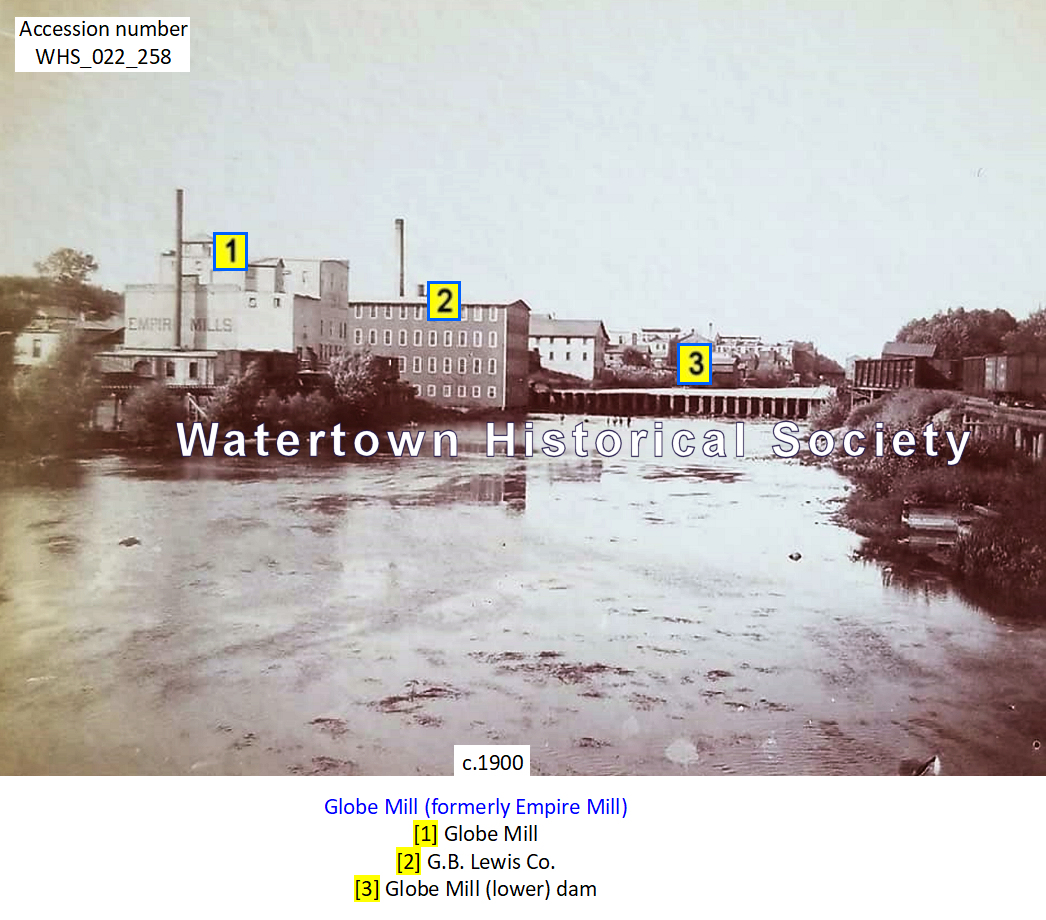
1902
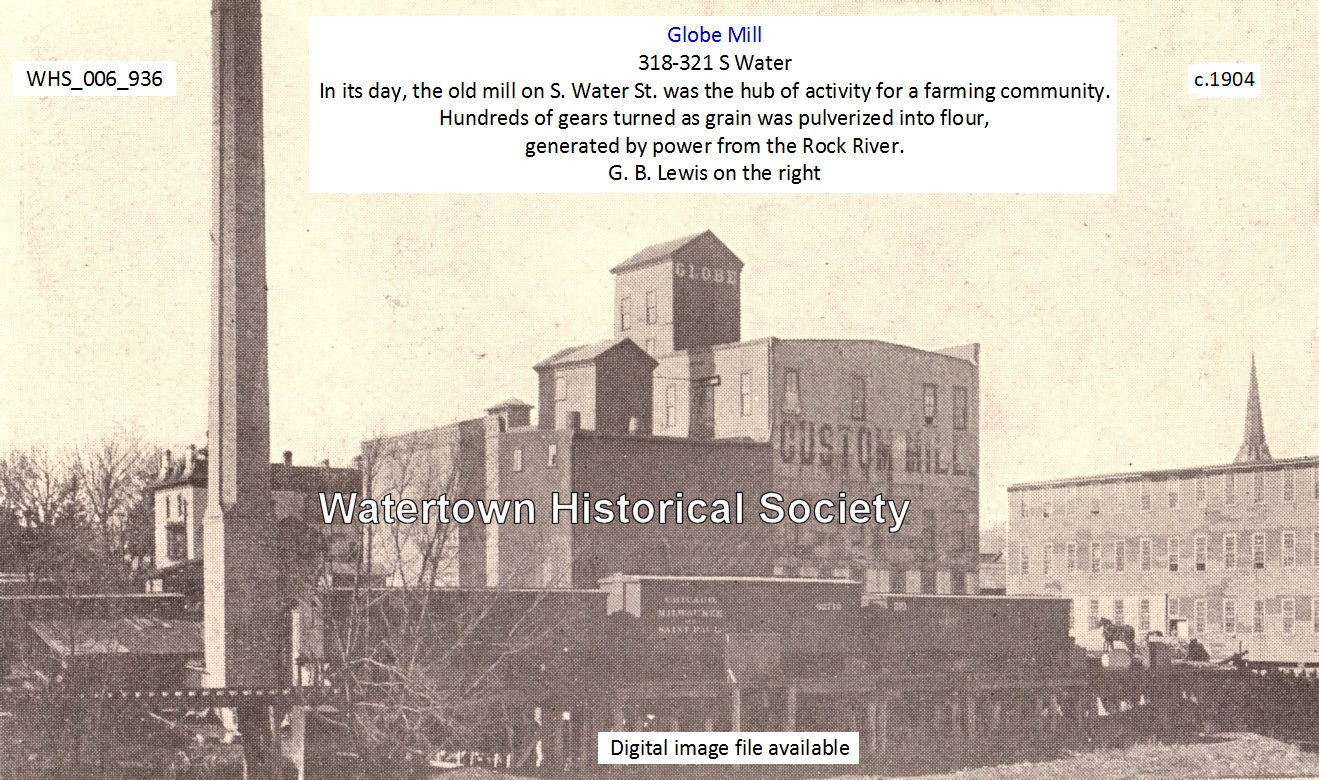
1903
09 11 GLOBE MILL IN FULL OPERATION
The
improvements, under construction at the Globe Mill in Water Street for some
time, have been completed and the mill is now in full operation, turning out
its famous "White Daisy" and other brands of flour and other products
manufactured by it. New machinery of the
very latest kind for milling purposes has been added, and the mill is now one
of the very best equipped in Wisconsin.
At present the mill is being operated entirely by steam, but when the
remodeling of its water power plant has been completed, water power will also be utilized. The Globe Milling Co.'s, product is very
popular in Watertown and vicinity, and the local trade is quite extensive. Some of the largest jobbers and bakeries in
the eastern and central states are also supplied with the product of this mill,
New York City especially taking a large quantity of the flour
manufactured. Over $250,000 in wages has
been paid out by this company in
Watertown since its incorporation 18 years ago, hence it will by seen that it is an industry that certainly
deserves encouragement here, for it is one of our most important
commercial interests. WG
1905
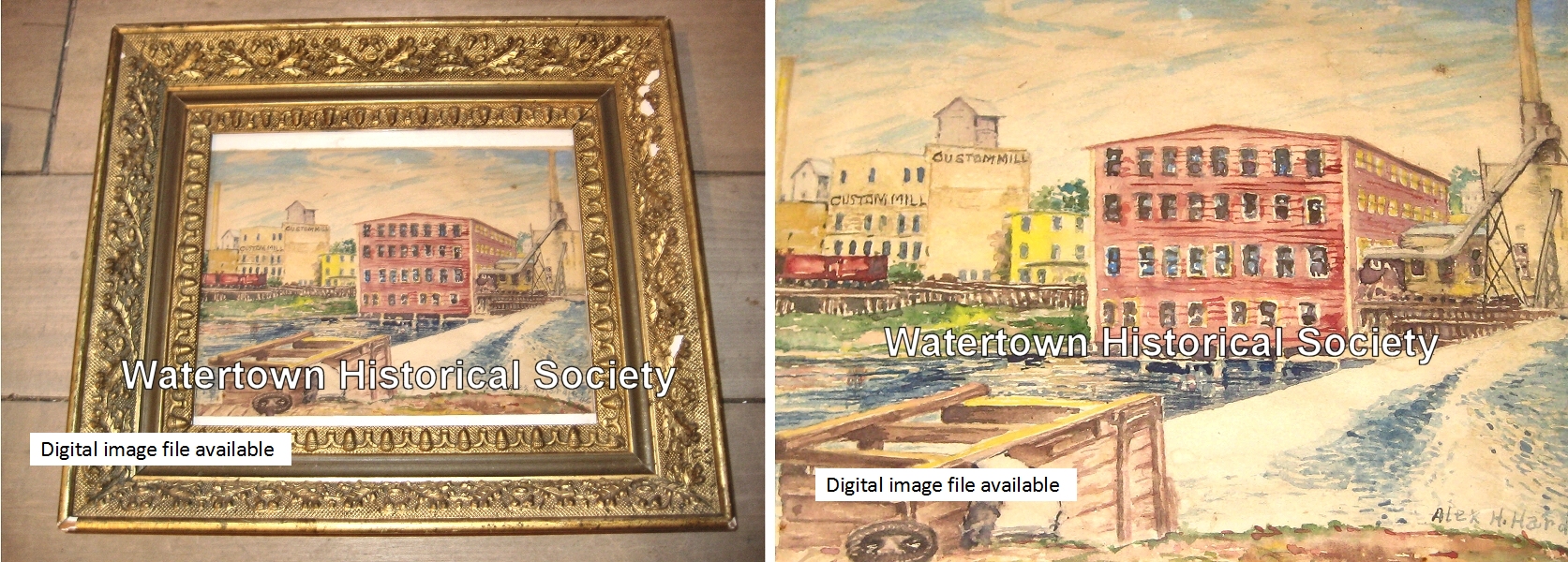 Alex Hardie
1956 painting of Globe Mill in 1905,
left; G.B. Lewis center.
Alex Hardie
1956 painting of Globe Mill in 1905,
left; G.B. Lewis center.
Fire destroyed the Lewis Water St building in June of 1909.
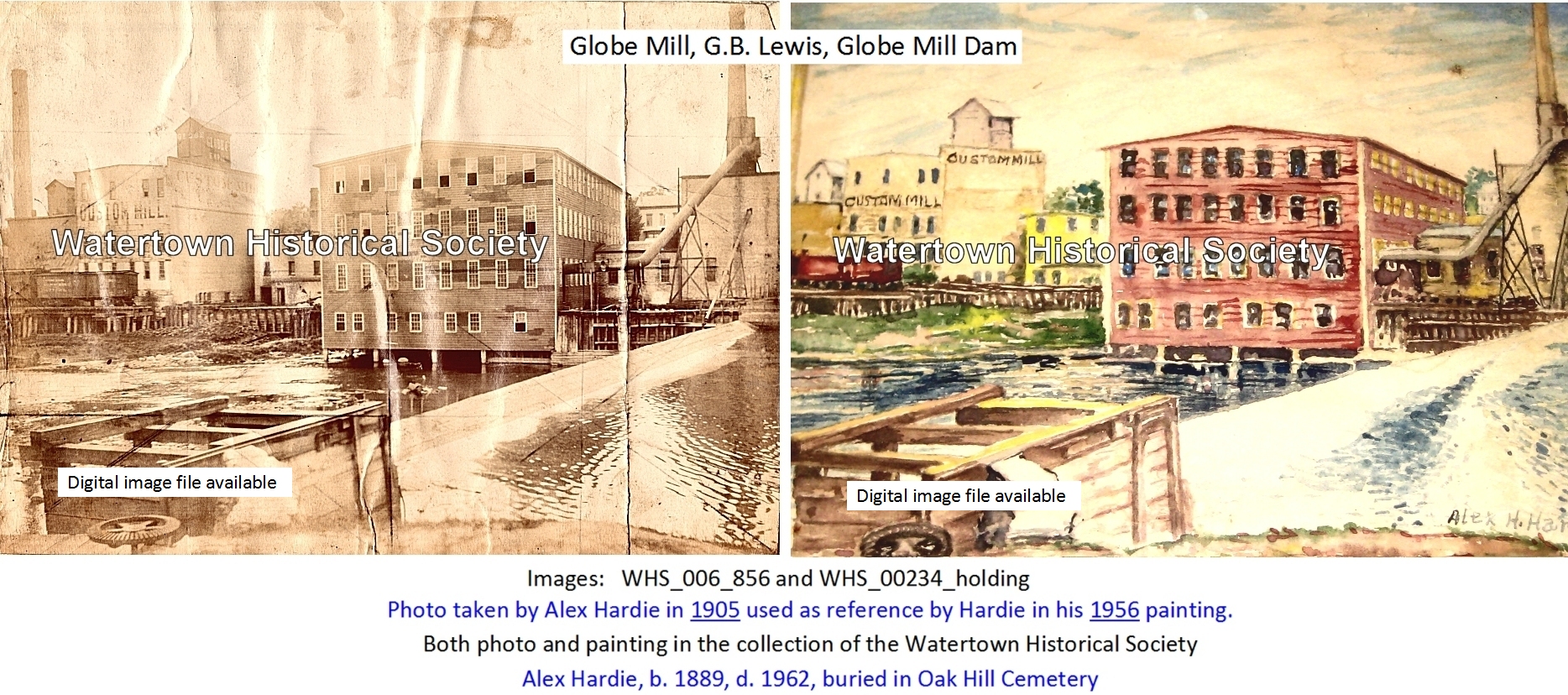 Globe Mill and dam, left; Alex Hardie 1905 picture, used in
his painting, 1956
Globe Mill and dam, left; Alex Hardie 1905 picture, used in
his painting, 1956
1915 Ad

1915
04 29 MULBERGER STRIKES AT TRADITIONAL DOINGS OF
SHARP HORSE TRADERS
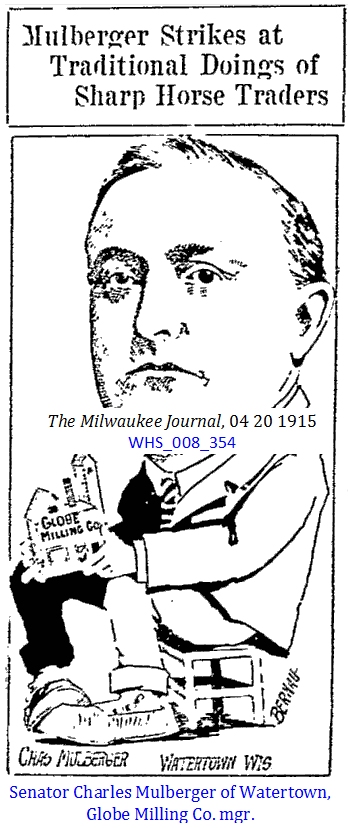
The Milwaukee
Journal of April 20th, printed a good picture of Senator Mulberger and a writeup, under the heading of “Mulberger Strikes at Traditional Doings of Sharp Horse
Traders,” as follows:
“Senator Charles
Mulberger, Watertown, who represents the Democratic
Thirty-third district, was born, reared, educated and elected in his home
town. He has the reputation of being a
good business man, who is much interested in city government. So he was placed on the Committee on
Corporations where he would have opportunity to exercise his special training.
“Mulberger tends
strictly to business, but he does it without making many speeches or
introducing many bills. One of the bills
he has introduced, however, may cause all the David Harums
and other hoss-traders to organize a lobby, because it includes livestock in
the category of things which it is forbidden to fraudulently advertise.
Mulberger graduated from the Watertown high school and the
university law school and has been manager
of the Globe Milling Co. for eighteen years. He was alderman four years, and president of
the fire and police commission the same period.” WG
1917
05 02 GLOBE
MILLING CO. SELLS LOCAL PLANT
PHILADELPHIA CORPORATION TO TAKE POSSESSION OF FLOUR MILLS ON JUNE 1.
Mayor Mulberger Will Retire as Manager After Twenty-Two Years of Service.
The Globe Milling company of Watertown whose
flour mills are located in Water Street has disposed of the entire plant to
Shane Bros. & Wilson Cos. of Philadelphia, one of the big eastern milling
concerns. The price agreement has not
been made public. The milling company
has been one of the widest known in this section of Wisconsin and has been in
business many years. The officers
are: President, W. D. Sproesser; vice president, Charles Mulberger;
secretary, George W. Manschott; treasurer, Henry Mulberger. Mrs.
Mathilda Mulberger is one of the stockholders. It is said that Mr. Manschott
will be retained in the employ of the new corporation and it is probable that
the present office force will not be disturbed.
Mayor Mulberger has
been closely identified with the business for twenty-two years and while
retiring from the firm will still continue a resident of Watertown. He is the present state senator from this
district and will probably take a rest from business cares for awhile.
A Pioneer Mill
The Globe mill has a history far back. In 1848 a mill was built known as the Emerald
mill and later the Empire mill. It was
built by Fay & Cramer of Milwaukee.
It was later leased to Potter & Ford and Enos Salsich,
the latter purchasing the plant which was later sold to the Bank of
Watertown. George Smith and Dr. Hoyt
purchased the mill. Smith later being
the sole owner and during his owner ship the mill was destroyed by fire. This was in 1870. He rebuilt it and later sold it to the First
National Bank, from whom Christian May purchased it and in 1874 a consolidation
of interests took place between Miller & Quentmeyer
and Mr. May, the firm operating three mills on both sides of the river.
The present Globe Milling company was the
outgrowth of a business which was a pioneer in Watertown and its business in
the last twenty years has developed fast.
A rye flour mill was combined with the regular mill several years ago
and the product of both found a ready sale in the markets of the world. The
Watertown Weekly Leader, May
02, 1917
1922
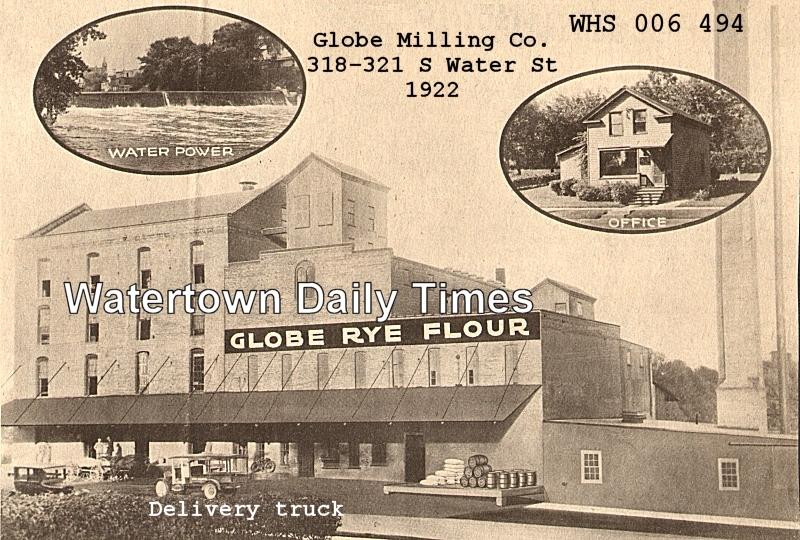
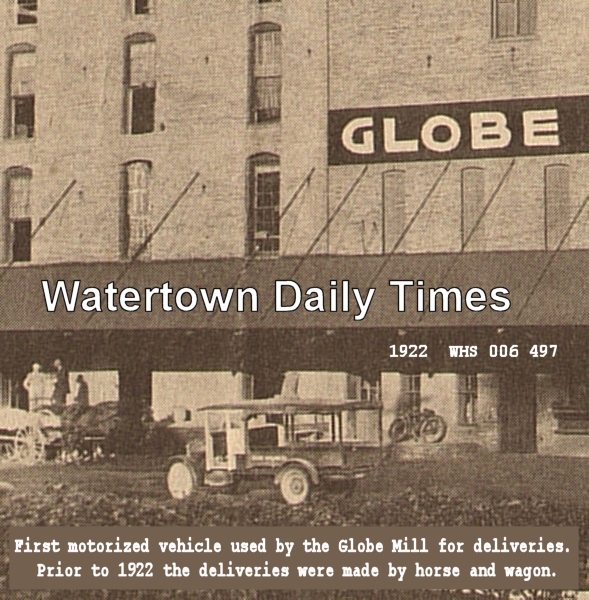
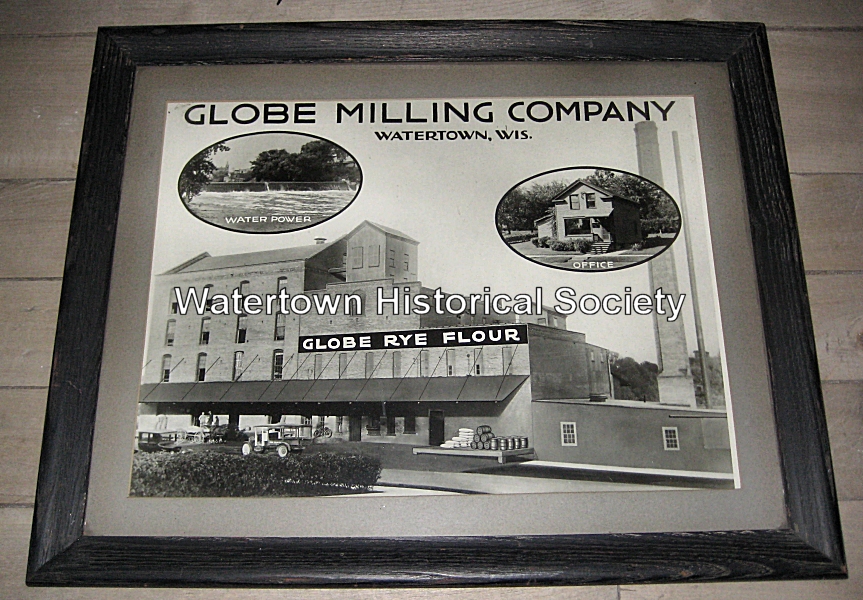
In front of building is the first motorized vehicle used by the firm for deliveries. Prior to 1922 the deliveries were made by horse and wagon.
Print from which above image was derived.
Do you see that little hut on the top of the mill? My Dad got that when they tore down the top of the mill. He used it for our shed . . . . Boy I remember it like it was yesterday – Wayne G Loeffler, 2014 contribution.
1930
WALTER GRAMDORF
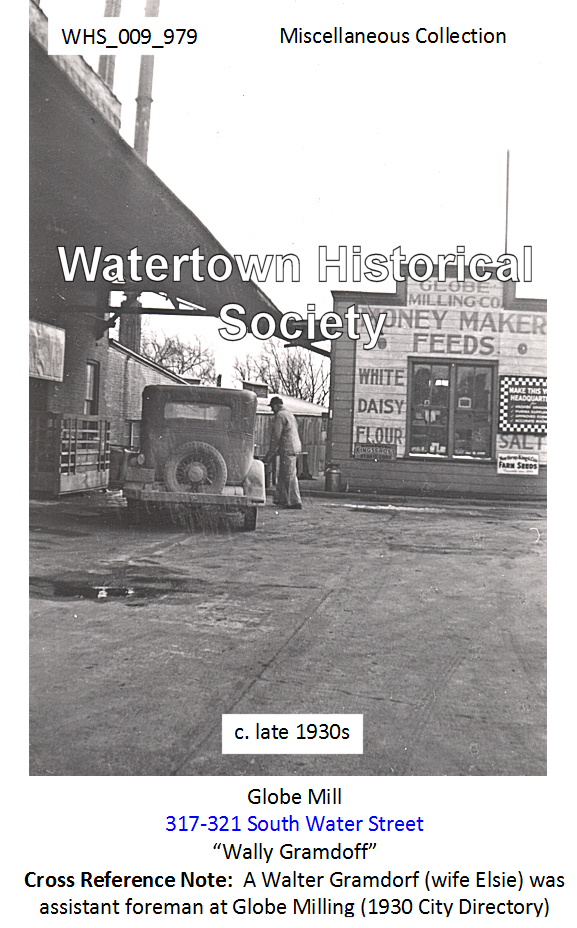 Walter Gramdorf
(wife Elsie) was assistant foreman at Globe Milling
Walter Gramdorf
(wife Elsie) was assistant foreman at Globe Milling

1930 Watertown City Directory
1932
-- -- PRODUCTION EMPLOYEES / GLOBE RYE MILL
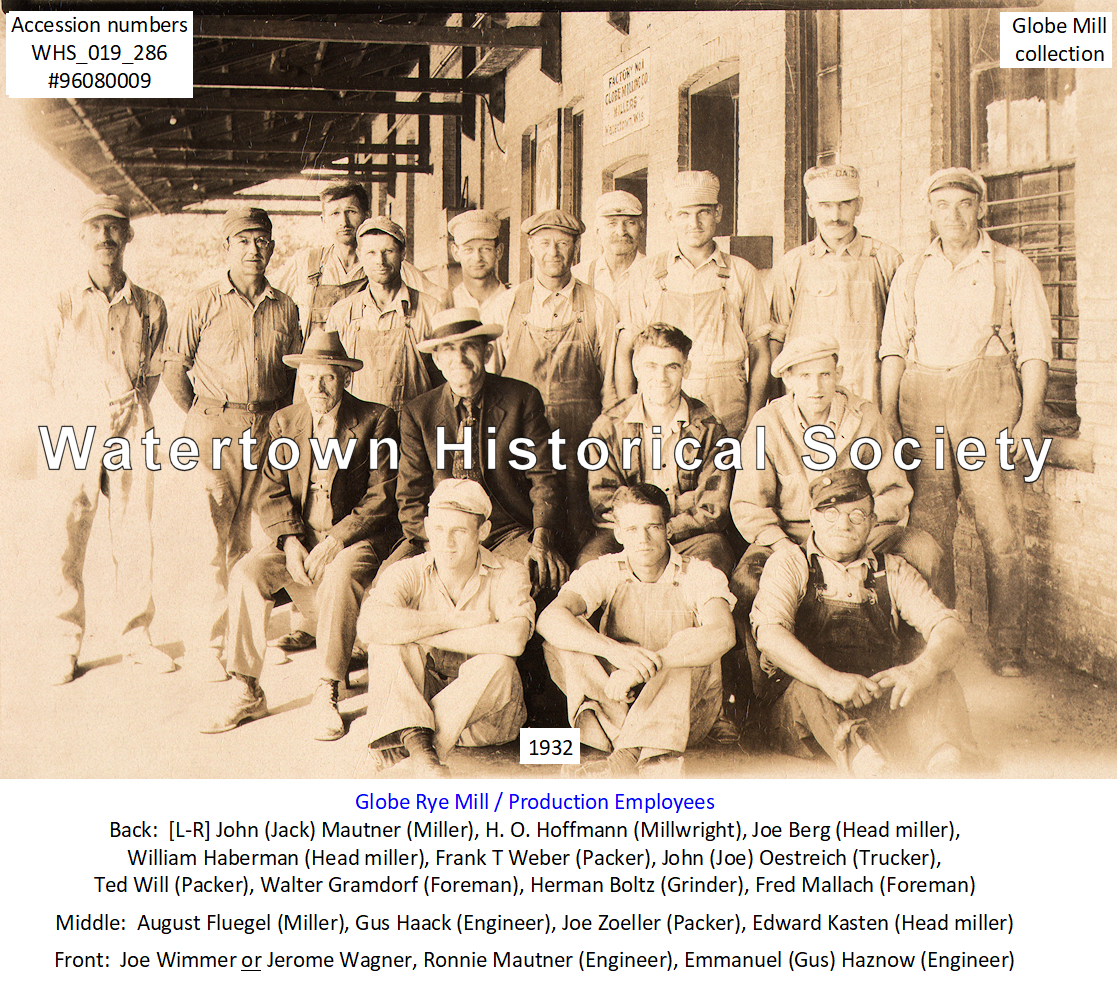
Mautner,
John (Jack), H. O. Hoffmann, Joe Berg, William Haberman, Frank T Weber, John
(Joe) Oestreich, Ted Will, Walter Gramdorf,
Herman Boltz, Fred Mallach, August Fluegel, Gus Haack, Joe Zoeller, Edward Kasten, Joe Wimmer, Jerome Wagner, Ronnie Mautner, Emmanuel (Gus) Haznow,
1936
07 04 FLOAT IN CENTENNIAL PARADE
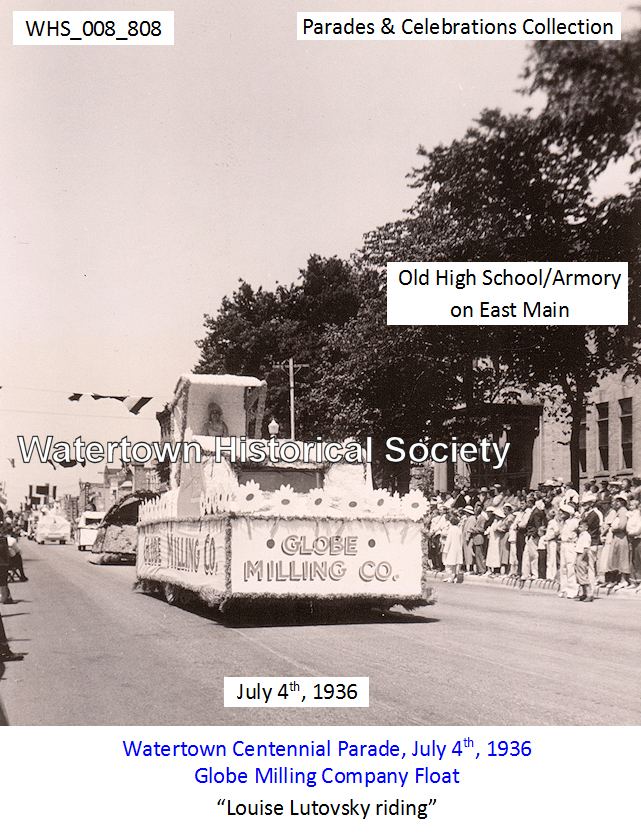

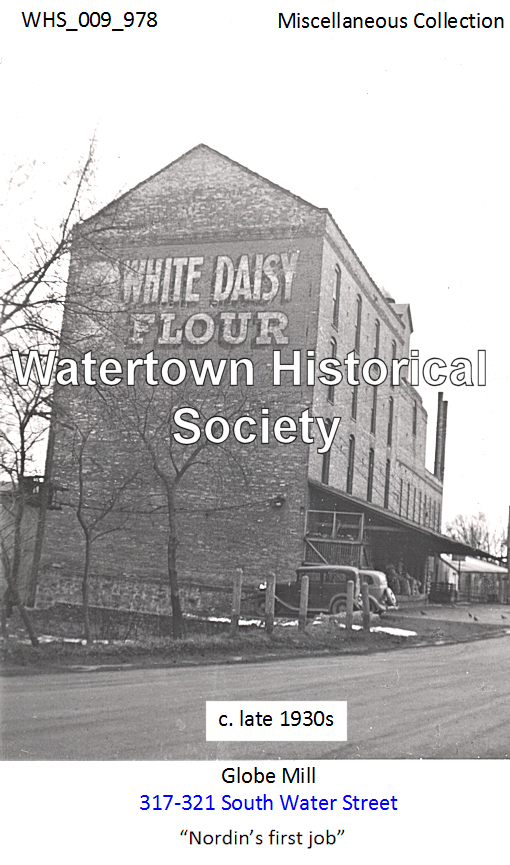
1930s
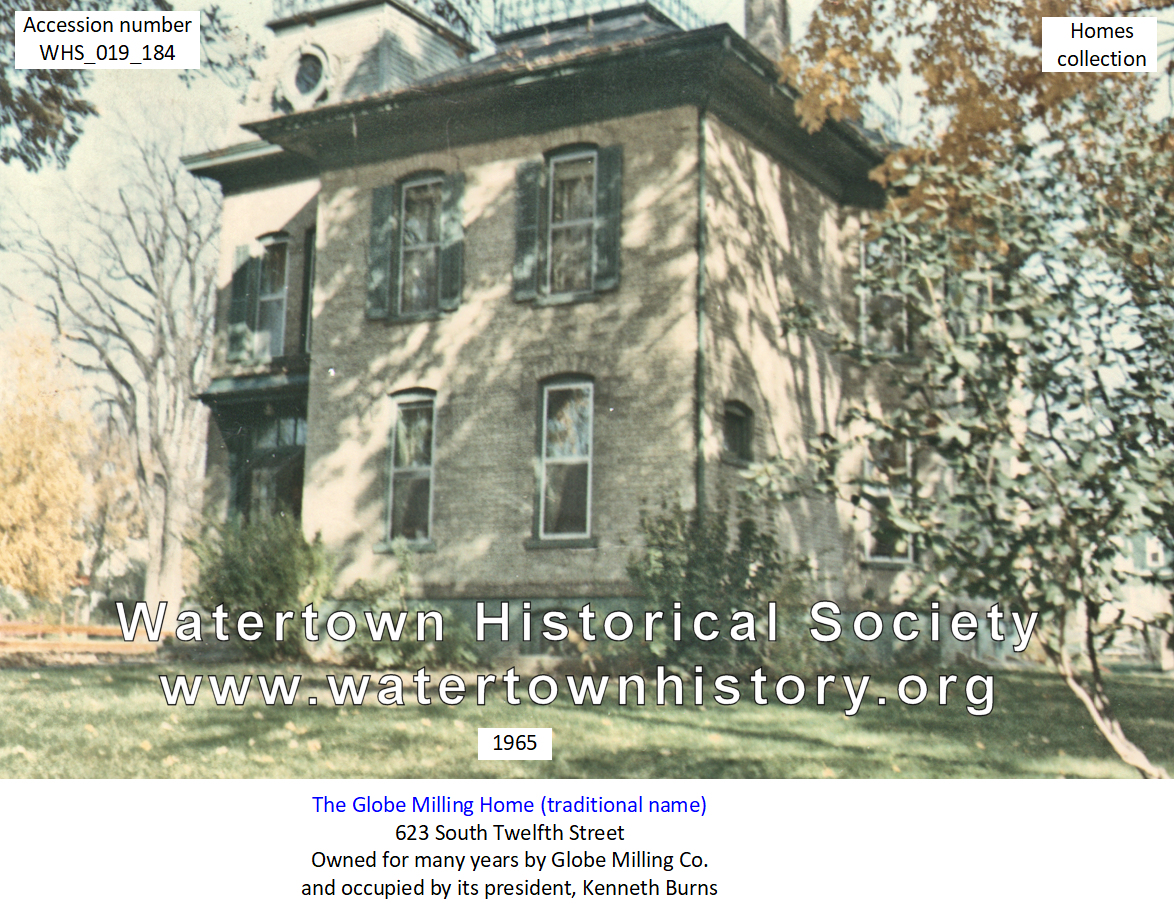
THE GLOBE MILL HOME / Home of president Kenneth Burns
1945
-- -- ED KASTEN, feed grinder
-- -- 1845-1945 CENTENNIAL BOOKLET 14-pg pdf file
-- -- COOPERATION
WITH FARMING COMMUNITY
We are
active in helping to promote and support a Farmers' Institute held in Watertown
each winter. Before the war this was a
two-day affair, but during the war it has been restricted to one day. Faculty members of the University Farm
School, as well as nationally known speakers from industries, discuss farmers'
problems of management and feeding. The
usual attendance is one thousand farmers and their wives, and it is the largest
institute of its kind in the state.
We cooperate with the farming community in securing soil analysis
through the University laboratories, together with their recommendations for
fertilizers, of which we distribute many car loads annually. We arrange for the planting of small adjacent
lots of land for testing different varieties of seeds, recording their
development and output. It may seem a
far cry from baby chicks to milling but we sell up to eighty thousand each
spring, and these together with countless thousands hatched on the farm consume
many tons of feed in their development to laying hens and roasters. The
manufacture and sale of these feeds is strictly within the province of a
country mill. As an additional service
we conduct a Poultry Health Clinic where post mortems or postings are held to
determine causes for flock epidemics or unsatisfactory progress. Remedies are
available on the recommendations of our own men trained for the purpose. We operate two retail branches within a
radius of fifteen miles of the mill, at which are offered all the services and
supplies available at our retail headquarters.
In general, it is our policy to do everything in our power to promote a
more prosperous farming community, a prosperity in which we share.
1952-53
GLOBE MILL BOWLING TEAM
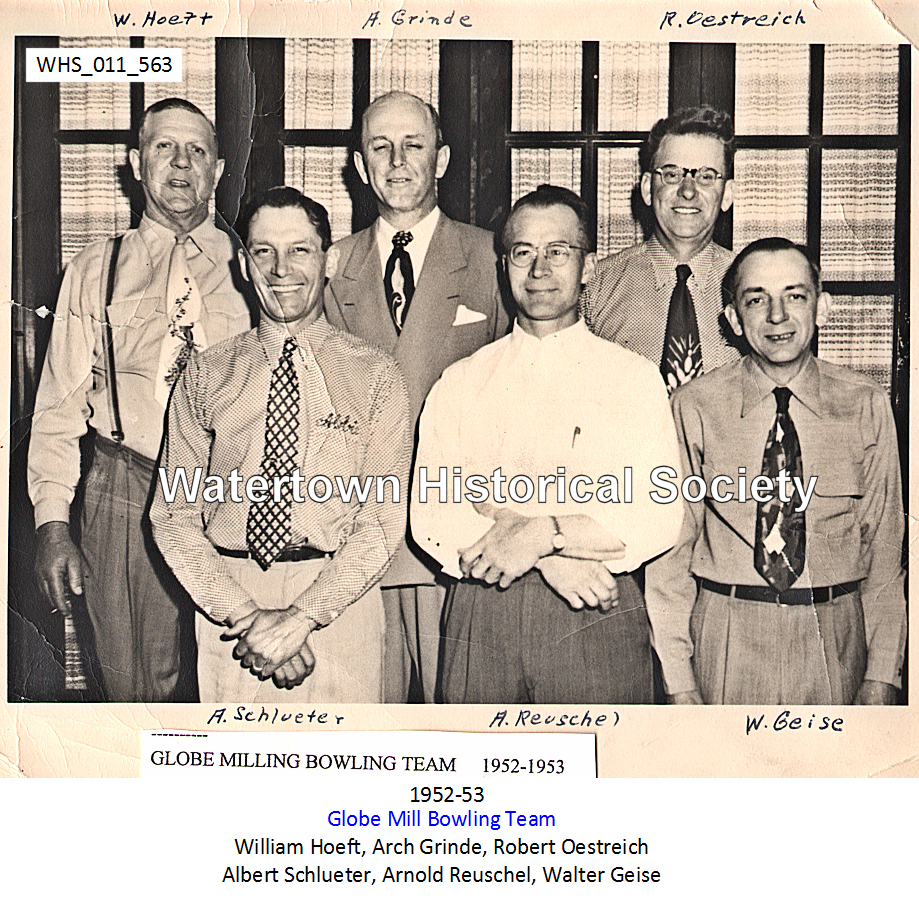
William Hoeft, Arch Grinde, Robert Oestreich
Albert Schlueter, Arnold Reuschel, Walter Geise
1956
06 21 PURCHASE OF HUBBLETON FEED MILL
Announcement
has been made by S. C. Northrop, president of the Globe Milling Company, of the
purchase of the feed mill of the Auer-Braun Lumber Company at Hubbleton. The Globe
Milling Company will take possession July 1 and will operate the business as
the “Hubbleton Feed Mill.” The Auer-Braun Lumber Company will continue
operation of its lumber and coal divisions as in the past. The Hubbleton feed
mill will continue to grind feed and serve the needs of the farmers of the
community and will handle a complete line of poultry, dairy and hog feeds as
well as fertilizers and seeds.
1957
07 24 Ray Kaercher, vice president of the Globe Milling Company, has been selected to direct the Red Feather Drive in Watertown in October. Mr. Kaercher is now lining up division leaders and laying plans for the coming drive. In the 1956 drive Mr. Kaercher served as associate drive chairman working with industry and payroll deduction. WDT
1958
07 02 ROCK
RIVER DIVERSION PROPOSED
City officials and representatives of the Globe
Milling Co., and the Jaeger Milling Co., are going to make a study of what
effect a proposed Rock River water diversion will have on the city and the
milling concerns. The proposed diversion
is to be the subject of a hearing at the City Hall on July 28 by the State
Public Service Commission of Wisconsin.
Curt Kanow, Ixonia farmer, has filed a
petition with the commission for permission to divert up to 1,000 gallons per
minute each year from May to Oct. 1 to irrigate 60 acres of land on his
farm. WDT
1963
06 15 The
Durant Manufacturing Co., through its Milwaukee office, announced today that it
has found its most satisfied customer right here in Watertown where Durant
operates a plant. The customer is the Globe Milling Co. In 1879, W. N. Durant conceived the idea of a
mechanical counting device to tally bags of flour at the Milwaukee Rolling
Mills. Thirty-seven years before that,
in 1842, one of Watertown’s very first industries was established. Recently representatives of these two
companies, now only blocks apart in Watertown, had reason to join together to
look back through some of those years.
Durant manufactures counting and controlling instruments and Globe is a
producer of rye flour. The occasion was
brought about by the discovery that several early model Durant counters were
still being used at the Globe Milling Co. Mill. WDT
1966
07 26 S. C.
Northrop, 506 South Fifth Street, board chairman of the Globe Milling Co.,
Watertown, was honored for his 47 years of service with the firm at a dinner
held Wednesday night at the Green Bowl.
Officers and directors of the company, plus managers of the five company
branches attended with their wives. Mr.
Northrop was presented with a valuable set of stereo recordings. President Ray H. Kaercher
presided and lauded Mr. Northrop for his many years of leadership with the
company. Mr. Northrop went to a
consulting basis as of June 1 this year to be succeeded by Mr. Kaercher. Mr.
Northrop has been a civic leader locally, being active in Rotary, the American
Legion, and served on the school board for 12 years with two years as
president. He has also been an alderman here.
WDT
1967
01 14 REMODELING PROJECT COMPLETED
The Globe Milling Company will hold a “Grand
Opening” on Friday, Jan. 20, to celebrate the completion of its recent modern
remodeling project. In order to better
serve their customers, the mill has installed two platform hoists, which put an
end to shoveling of grain for shelling or grinding. The company has also installed a new large
corn sheller and elevator leg, which, together with a large dump pit, speeds up
shelling. With this new shelling setup,
customers can either have their corn shelled and ground or take some home
either in sacks or bulk. A new five-ton
mixer also gives greater efficient mixing together while speeding up in
service. A large handy bulk-out bin
gives the customer a choice of taking the mixed feed home in bulk or in sacks.
Everyone interested in this new type of service is invited to attend the grand
opening and look it over. WDT
1969
02 05 FIRE AT
THE GLOBE MILL
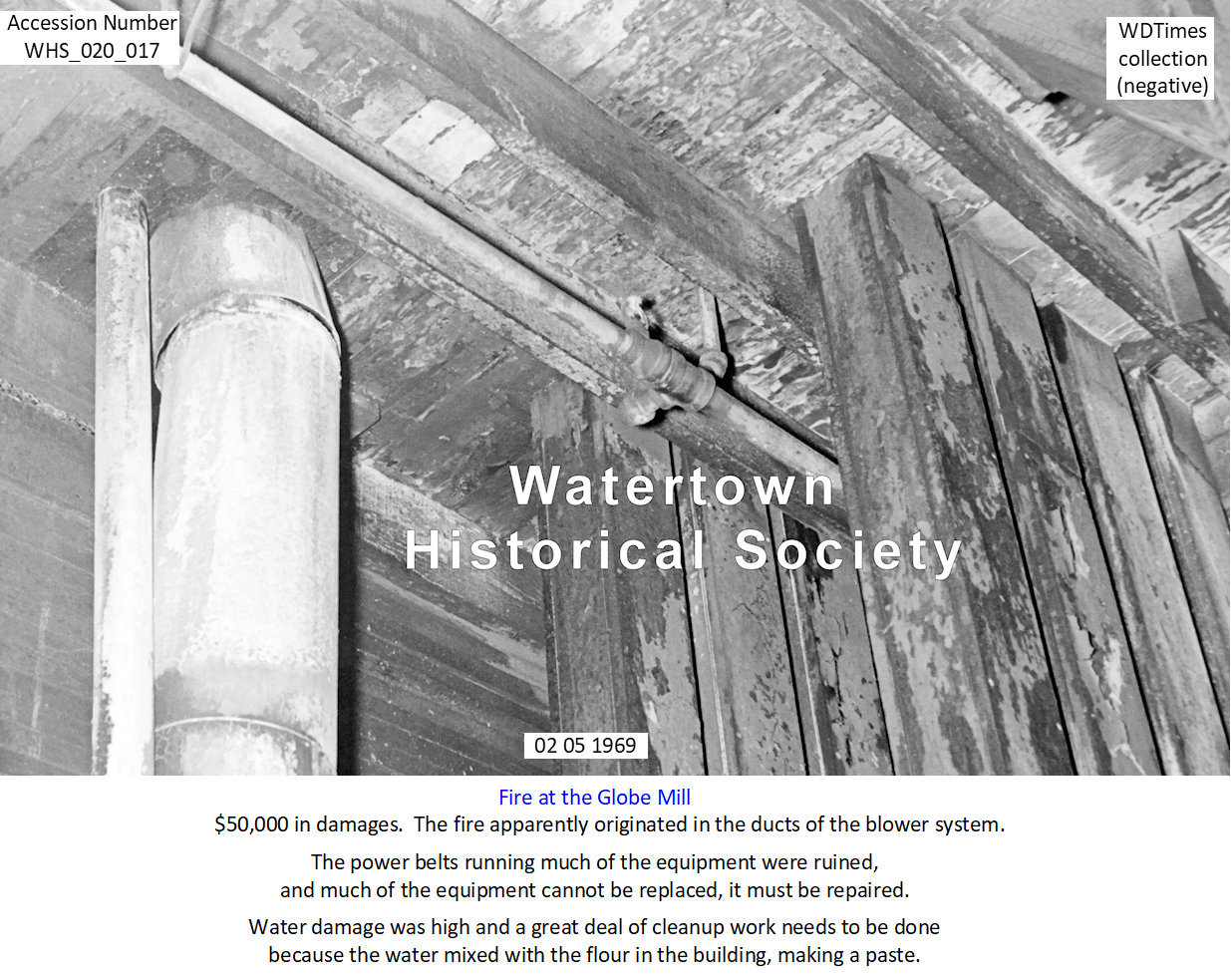
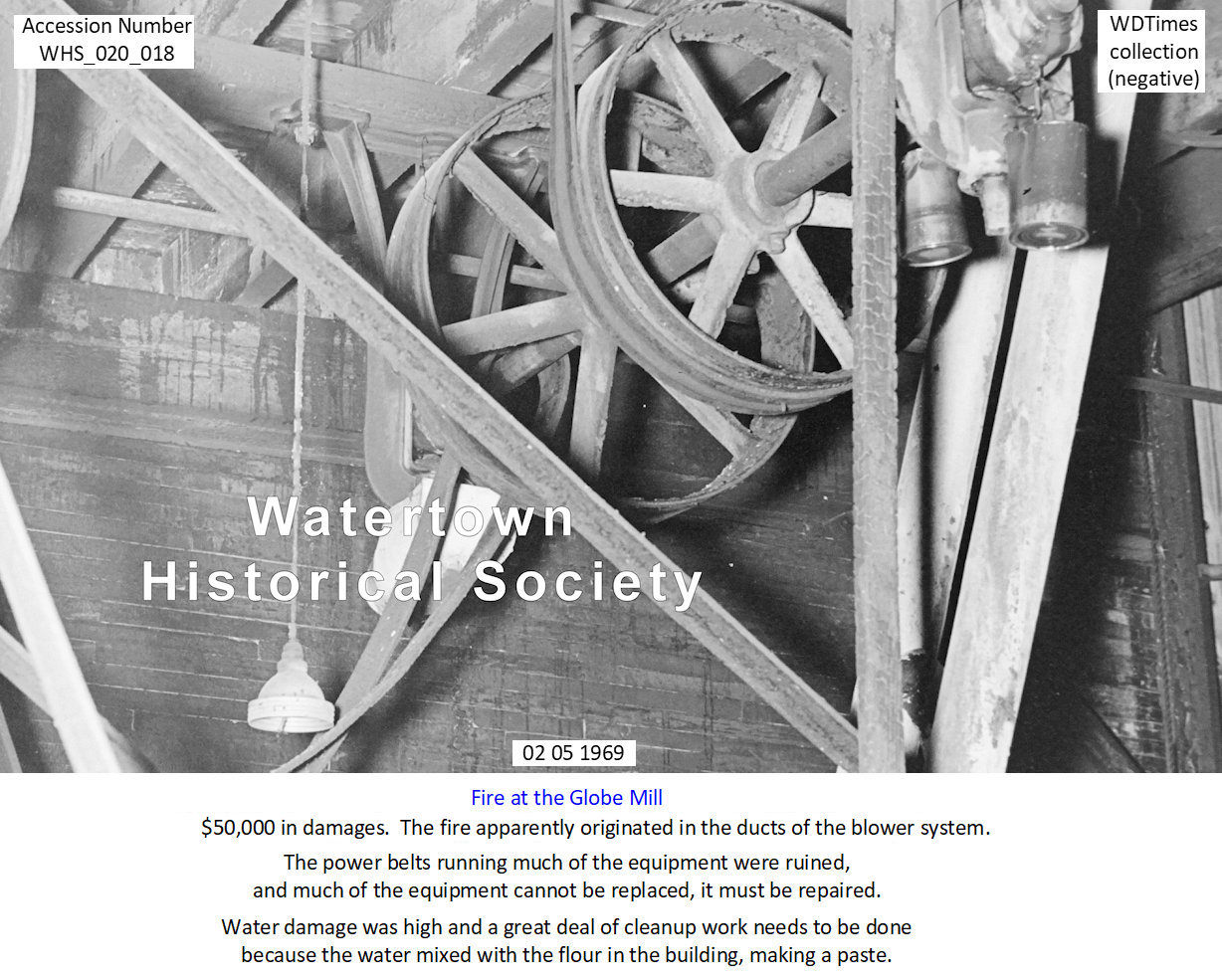
An alarm was received at the Watertown Fire Department at 6:08 a.m. with all firemen and auxiliary firemen called to combat the blaze.
One fireman, Captain Harold E. Hell, was taken to the Watertown Memorial Hospital for back X-rays after he slipped and fell on a stairway.
Gordon Madsen, manager of Globe Milling, stated the malt flour department is not operational. He estimated that this portion of the plant would not be in operation for a month or possibly longer. The feed department was not damage and operations will continue. Madsen stated, “We would have had a total loss without the sprinkler system.”
The power belts running much of the equipment were ruined, and much of the equipment cannot be replaced, it must be repaired. Water damage was high and a great deal of cleanup work needs to be done because the water mixed with the flour in the building, making a paste.
1970
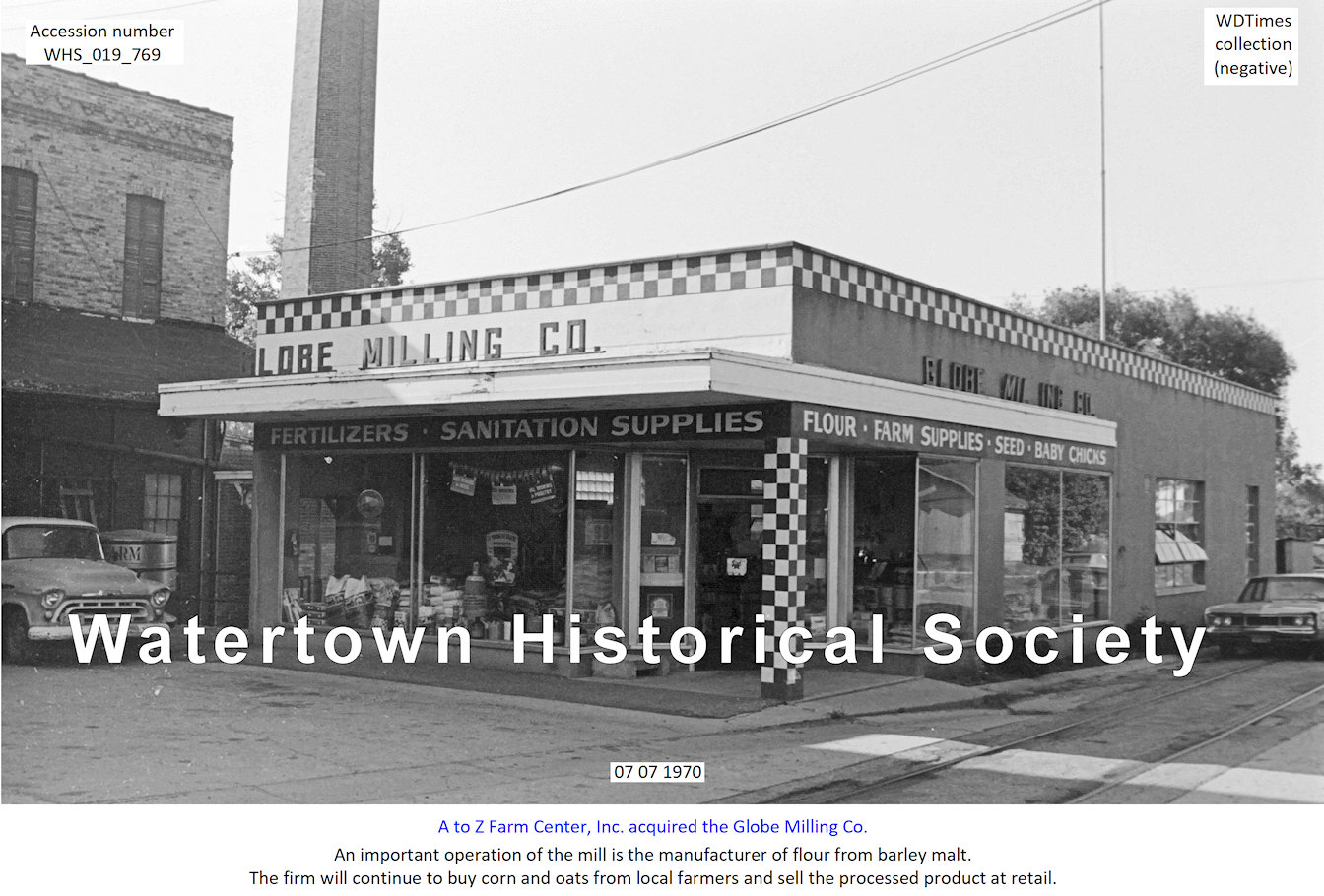
July CITY'S
OLDEST BUSINESS UNDER NEW OWNERSHIP
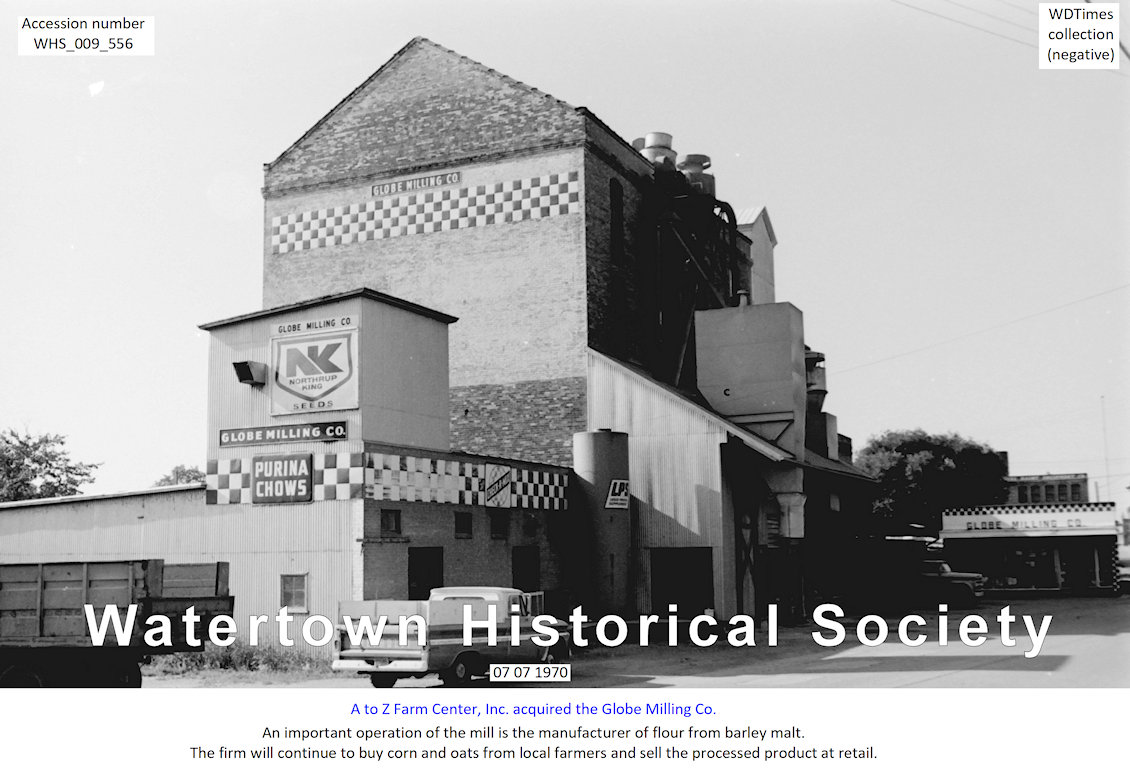
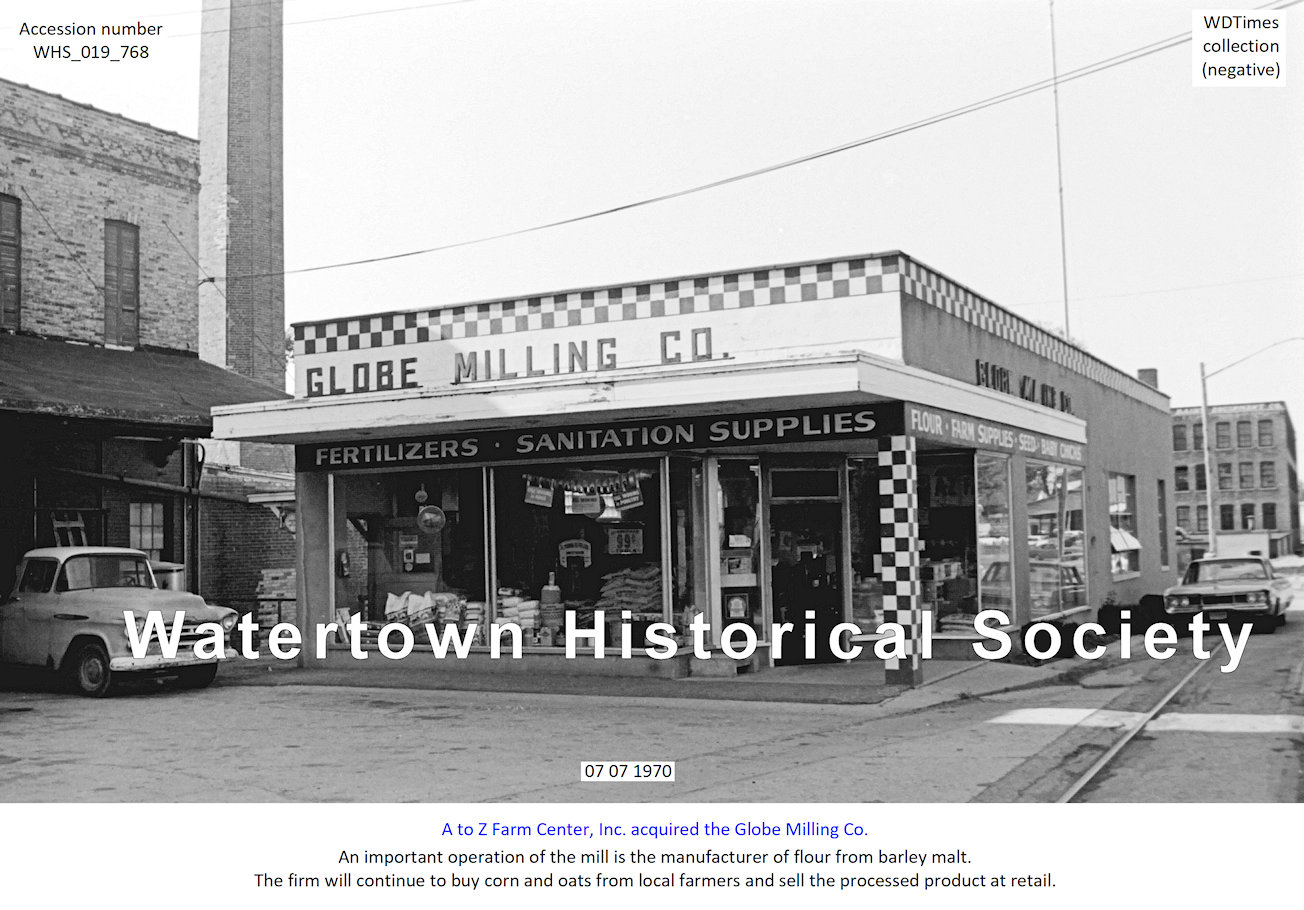
A to Z FARM CENTER, INC
President and general manager is Herbert Johnson of Cambridge. Attorney Donald Rumpf, also of Cambridge, is the secretary-treasurer.
Globe Milling Company is the oldest business in Watertown. It is now in its 125th year.
President of Globe Milling Company was Edward G. Broenniman, Chicago. Allen Rieselbach of Milwaukee had been secretary-treasurer. Gordon Madsen was executive vice president; and Joseph Wimmer was a vice president in charge of flour production.
An important operation of the mill is the manufacturer of flour from barley malt. The firm will continue to buy corn and oats from local farmers, and sell the processed product at retail.
Grind and mix will continue to be offered, and there will be pick-up and delivery in feed along with fertilizers, seed, animal health products and farm supplies. Purina feeds will continue to be sold. To this Wayne feeds have been added.
Until a fire at Globe Milling Company on Feb. 5, 1969, rye flour was milled. Since the fire, this phase of the operation has been discontinued.
The purchase included the acquisition of mills at Helenville, Hubbleton and Hustisford, which had been owned by Globe Milling Company. The Farmington-Rome mills owned by Globe Milling Company, have been closed.
For many years S. C. Northrop was president and in charge of the mill. Following his retirement, the late Ray Kaercher was the manager. Following his death, Gordon Madsen managed the mill. Kenneth L. Burns preceded Northrop in operating the mill. Madsen has been employed by the new firm in an accounting capacity. Wimmer continues in charge of flour production.
07 07 A to Z FARM CENTER ACQUIRED GLOBE MILLING Co.
1990s
1993
11 12 FUTURE POTENTIAL SEEN FOR GLOBE MILL
Most people traveling South Water Street probably don’t visualize the street as a possible draw for visitors from outside the area. In fact, some would say the old mill and other industrial-looking structures are an eyesore. But, local businessman Larry Mistele has looked past the unsightly facades to see the potential in the historic buildings. “I think the mill will become a destination point for southeastern Wisconsin,” he said. “That’s going to be a place for a day trip.” Mistele, who is joined by various investors, is planning a major facelift for the South Water Street area. He already has renovated the old Beals and Torrey Shoe Factory into the Mill Race Terrace apartment building and now he has plans to convert other old buildings — including the feed mill — on the street for retail purposes.
1998
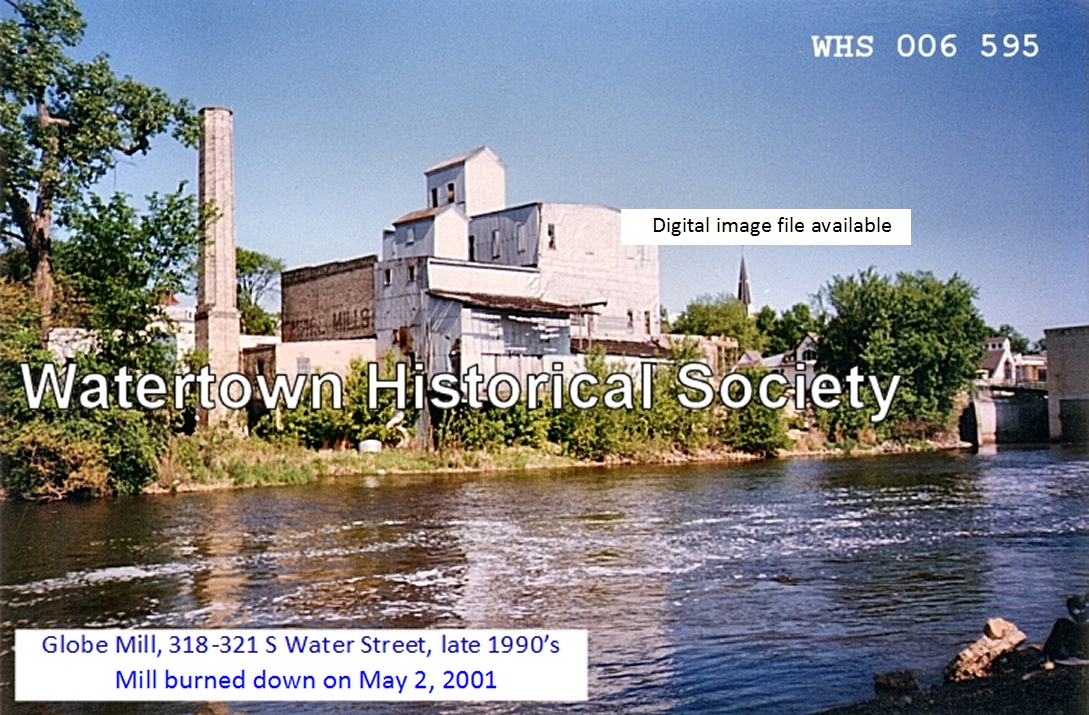
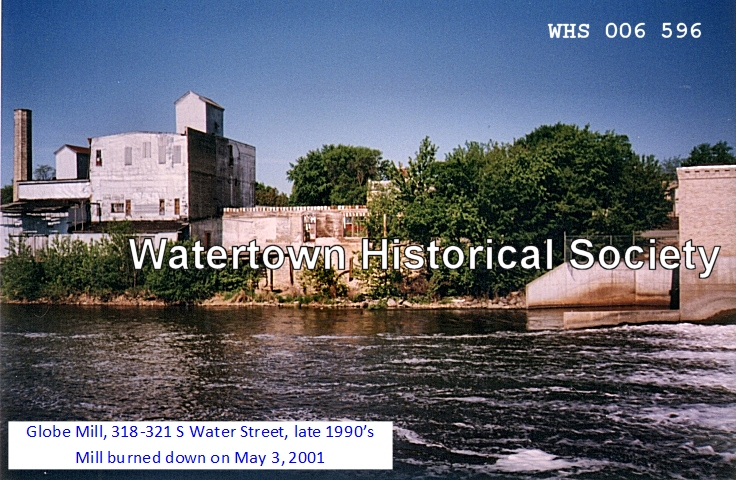
Mill was severely damaged by heavy winds in 1998 and what remained of the structure was destroyed by a fire in 2001.
1999
07 09 GLOBE MILL RETAINING WALL
In its day, the old mill on South Water Street was the hub of activity for a farming community. Hundreds of gears turned as grain was pulverized into flour, generated by power from the Rock River. The fate of the historic landmark was sealed late last year when 70 mph winds whipped through the area, taking with them an entire wall of brick along the east side of the mill facing the river. What was a central supporting wall of the mill is now a massive pile on the shore. Owner Larry Mistele, who renovated a former lumber mill to create The Market across the street, said the loss of the wall made the building unsafe. Heavy equipment was on site this morning to tear down the old mill. WDT
2001
05 03 130-YEAR-OLD MILL BUILDING BURNS
 Image
Portfolio Chapter on
the fire
Image
Portfolio Chapter on
the fire
2003 ROC building, 321 S Water. The ROC was in the Water Street building from Dec 2003 to Oct, 2009.
2007
11 22 POTENTIAL DEVELOPMENT AT FORMER MILL
A group of developers met with city officials Tuesday during a committee of the whole meeting to discuss a potential $31 million development at the former Empire Globe property on South Water Street that includes townhomes, apartments and retail space. According to Rick Andritsch, vice president of VJS Construction Services, the first phase of the project would include a retail building with apartments on the upper floors on the north side of the property and townhomes on the south end of the property. Andritsch said the north building would have 34 underground parking stalls and about 11,000 square feet of retail space on the first floor. The three stories above the first floor would have 45 residential units. The next building to the south would have about 14,600 square feet of retail space on the first floor and 48 living units on the upper floors, Andritsch said. The structure just south of the dam would have 43 underground parking stalls and 52 living units. WDT
12 19 RIVER MILL RESIDENCES
Approval of conceptual plans for the redevelopment of the former Empire Globe property as River Mill Residences. Total project will encompass the area along the west bank of the Rock River just north of the Mill Race Terrace Apartment building and will go north and include the upper and lower city parking lots on the east side of Water Street from the east end of Emmet Street north to include much of the city parking lots. WDT
River Mill Residences images from 2012, WHS_006, 420a, 420c, 420e.
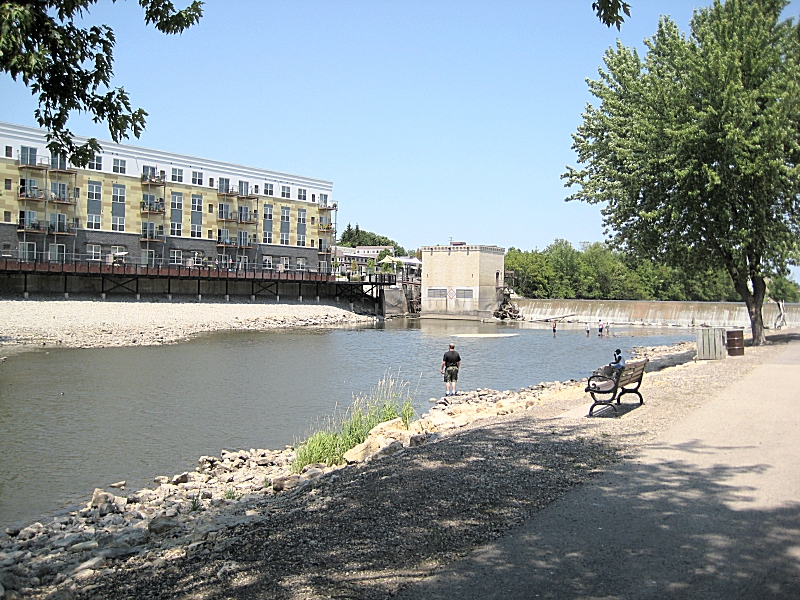
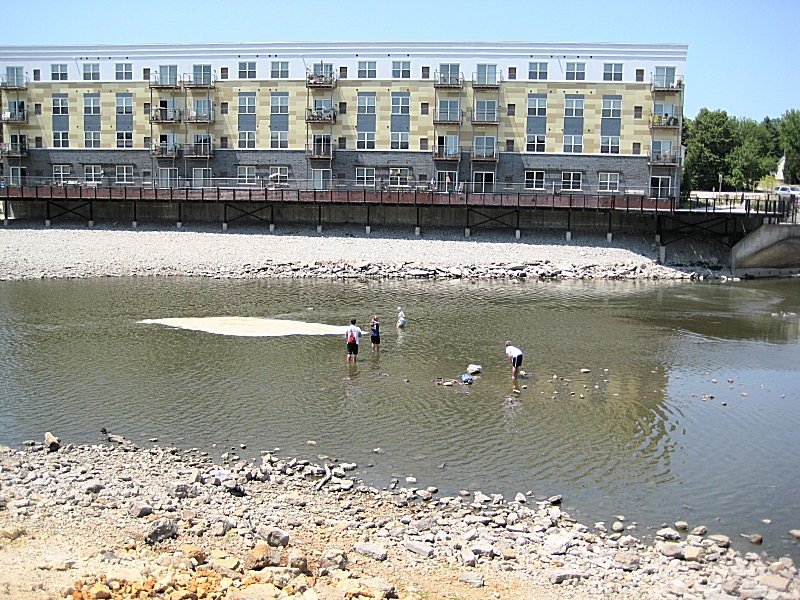
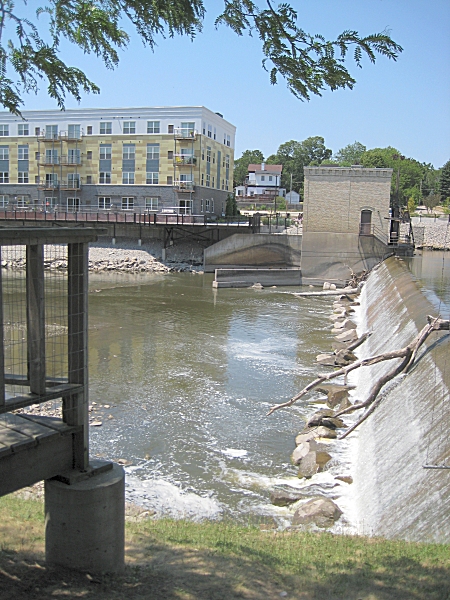
12 20 RIVER MILL INVESTMENTS PLANS APPROVED
The Watertown Common Council Tuesday endorsed a
resolution approving the conceptual plans submitted by River Mill Investments
LLC for the redevelopment of the former Empire Globe property on South Water
Street. River Mill Investments is in the
process of considering the property for a mixed use of development and the city
has previously entered an option agreement with the developing group for the
purchase of the parcel. The first phase
of the project will consist of two structures, one at the north end of the
parcel and five two-story townhomes at the south end. The building to the north of the property
will have about 11,275 feet of commercial space and 75 units for mixed income
senior housing.
2008
03 07 RIVER MILL DEVELOPMENT CONCEPTUAL PLANS
Preliminary conceptual plans for the proposed $30 million River Mill development along South Water Street were reviewed Monday afternoon by the Watertown Site Plan Review Committee. The total project will encompass the area along the west bank of the Rock River just north of the Mill Race Terrace Apartment building and will go north and include the upper and lower city parking lots on the east side of South Water Street. The first phase of the project will consist of two structures, one at the north end of the parcel and five two-story townhomes at the south end. The building on the north end of the property will have 54 units for mixed income senior housing and space for commercial purposes. WDT
03 27 PROPOSED DEVELOPMENT
A proposed development on South Water Street
will result in a new home for a number of senior citizens, but it also means a
local meeting place for teenagers will have to find a new location. CommonBond
Properties and Spectrum Development Group are currently in the process of
looking to build a 54-unit senior housing complex and five town homes on the
east side of South Water Street just south of the lower dam, which is the
current site of the Watertown Recreation and Outreach Center for Youth. The ROC would be razed
once construction on the apartments and town homes begins. The Rev. Timothy Mueller, director of the
ROC, said he and other community members are currently looking for a new
building in the city that the youth center could call its future home.
Cross References:
Ira O. Howe was a miller, 1881
Nicholas Bickner employee
Sanford’s barrels are generally used by our millers
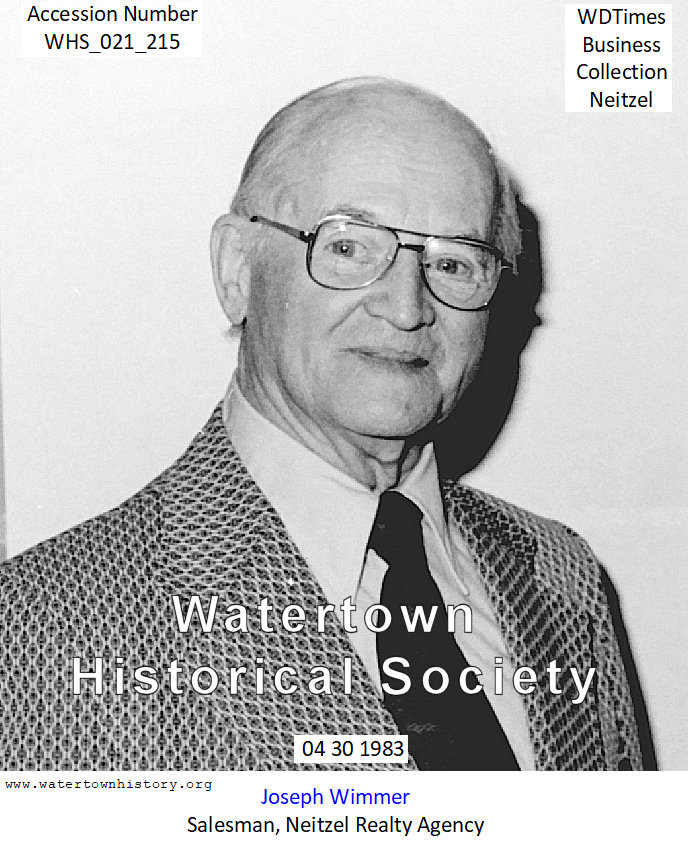
Joseph
Wimmer was the Miller at Globe Milling Company on Water
St. for many years. I was a secretary in the office across the
street. He would bring us
samples of the flour he milled, so we could send them. I always enjoyed talking to him. He also started working some hours at Neitzels at that time. - Faye Petig

History of Watertown,
Wisconsin