website watertownhistory.org
ebook History of Watertown, Wisconsin
James and Patrick Rogan
Rogan Home / Boyle Funeral Home
314 W Main
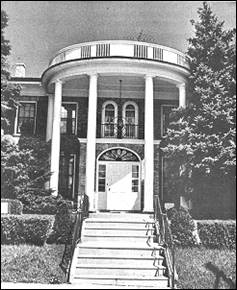
Many
abstracts for properties west of the Rock River began with the name of Capt.
James Rogan, the 'old salt' as he was called. Rogan captained a Great Lakes
vessel, the 'Grampus,' which carried goods from Buffalo to other Great Lakes
ports.
On a
trip inland he saw the beauties of the Rock River valley and decided to cast
his lot here. He was born in Ireland in 1801, his brother Patrick in 1808. Both came to Watertown after living for a
time in New York.
Click on Images
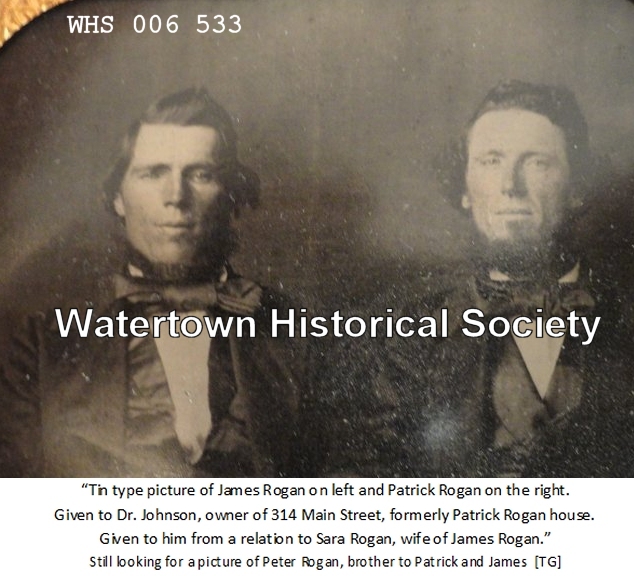
 James Rogan, for the sum of $1, received the
first deed to a land grant given to any individual in the present city limits
of Watertown. He claimed it was first given to him in 1833 by a government
surveyor, but it is recorded in Milwaukee with the date of 1836. (Watertown's
first citizen, Timothy Johnson, made his first land claims at Aztalan, then in
Jefferson and subsequently 1,000 acres in Watertown, but apparently this was
recorded after Rogan's. Both came here in 1836).
James Rogan, for the sum of $1, received the
first deed to a land grant given to any individual in the present city limits
of Watertown. He claimed it was first given to him in 1833 by a government
surveyor, but it is recorded in Milwaukee with the date of 1836. (Watertown's
first citizen, Timothy Johnson, made his first land claims at Aztalan, then in
Jefferson and subsequently 1,000 acres in Watertown, but apparently this was
recorded after Rogan's. Both came here in 1836).
Rogans Set Camp
The
Rogans set up camp in a two room shanty which became headquarters for new
arrivals in the area. It was referred to as the leading hotel in Johnson's
Rapids. Old letters written by James Rogan related that over 400 Winnebagoes
were his good neighbors. His family joined him here in 1837, the second family
in the area.
Homes on South Washington (such
as the Thauer home)
were built on property included in the first land grant given to an individual
in the present city limits of Watertown.
James Rogan received the early deed for $1. It was recorded at the
Milwaukee Register of Deeds office in 1836.
Parcels of Rogan's property passed through many hands.
The original Rogan land grant covered
acres of wooded land on the west side of the Rock River and was at that time
occupied by the encampments and homes of Winnebago Indians. The camps of the
Potawatomis were on the east side of the river.
The
brothers are said to have been influential in having the name changed from
Johnson's Rapids to Watertown, after their former home town of Watertown, N.
Y. This was before the county government
was formed. The brothers farmed and put up a saw mill.
St. Bernard’s Land Donation
Patrick
Rogan shared in ownership of some of the land granted to James. Patrick Rogan
and his wife presented the land to St. Bernard's
where the first frame church was built in 1846. Patrick Rogan was active in
community, church and civic affairs.
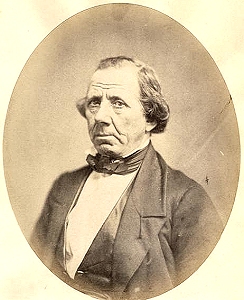
Patrick Rogan
 Watertown
Historical Society Collection
Watertown
Historical Society Collection
“The History of Jefferson County,
Wisconsin”, published: Chicago: Western
Historical Company, 1879.
Patrick
Rogan, farmer; born in County Down, Ireland, Sept. 26, 1808; came to Montreal,
Canada, in 1823; lived two years there, then removed to Jefferson Co., N.Y.,
where he resided until 1837, when he came to Watertown, arriving here May 15 of
that year; made a claim to a fractional quarter-section, Sec. 11; was engaged
in farming where the city now stands, on west side of the river; the spring he
came here, he planted potatoes where the College of the Sacred Heart is now
located; never, since he came here, has he entirely relinquished his farming
interests.
Six or
seven years after he came here, he erected a saw mill where George B. Lewis’ factory is now located; carried on the
mill until 1858, in connection with his other business of contracting,
building, farming, etc.; he has invested largely of his means in the building
improvements of the west side of this city; he has also invested, to a great
extent, in plank roads, railroads and other enterprises likely to benefit
Watertown.
Being
among the most public-spirited of its citizens; he was a member of the first
Wisconsin Constitutional Convention; he has been four times a member of the
State Legislature; he organized the school system
here in 1855, having secured the passage of the act providing therefore; he was Postmaster of this city of eight
years; first appointed by President Tyler, reappointed in 1845, by
President Polk.
He was
one of the original corporators of the Watertown Gas Co.,
also a director of plank road and railroad companies; he has held nearly all
city and town offices within the gift of the people.
He
never attended school but three months; he acquired some book knowledge while
he was employed as errand boy in the office of a Notary Public in Montreal;
experience has been his teacher, and it would be difficult to find better
informed men than Mr. Rogan is at the present time.
He was
married, in Chicago, Jan. 17, 1846, to Rose Crangle; she was born in County of
Down, Ireland; they have six children:
Robert Emmett, Charles Eugene, Edwin B., Louis P., Rose and Ellen E.;
lost one daughter, who died at the age of 6 years. Mr. and Mrs. Rogan are members of the
Catholic Church. Mr. R’s father, Peter
Rogan, died at Rochester, N.Y., three years after he came to America with his
family. “The History of Jefferson County, Wisconsin”,
published: Chicago: Western Historical
Company, 1879.
1839
01 22 Territorial
road from Fort Winnebago to terminate at or near the dwelling house of
James Rogan in the town of Watertown.
1848
05 03 Among the doings of the late storm we are
concerned to record that during its highest rage it effected an entrance,
forcibly, into the oldest and most venerable house in our village. The house lately occupied by James Rogan,
Esq., was the first human habitation raised by the hand of the white man on the
west side of Rock River, and as we are informed, the third erected in this
village. It has withstood the storms of
many years, but that storm was too much for it.
It is a home no longer. Its glory
has departed. In the Shakespearian
language, it is “tenantless, and nothing but a wreck.” Rock
River Pilot
1861
05 09 The following resolution was introduced by Alderman
Steele: Resolved, That James Rogan be
and hereby is allowed to let his swine run at large on his own land that is
open to the commons. Lost. Common Council Proceedings WD
1864
02 20 THE STEAM RENOVATOR
To the Citizens of
Watertown, Wis. Save your doctor bill by
getting your beds renovated, whereby they are made more light, buoyant, sweeter
and cleaner than new feathers. Improve
this opportunity and have your beds renovated, as the subscriber intends to
remain here only a few days with his Steam Renovator . . . Office one door west
of Cramer’s Block, west side of the river.
– Peter Rogan.
Mr. Peter Rogan has put
in working order his celebrated Steam Renovator for cleaning feather beds. He takes the most filthy and dirty feathers,
and after passing them through his Renovator, makes them as good as new. They come out clean, light and dry, making
them far more healthy and pleasant for use.
As he will remain but a few days, those who wish to secure his services
must do so without delay.
1871
It was
in the fall of 1871 that the authorities of the Congregation
of Holy Cross at Notre Dame purchased the 65-acre site from Col. Henry Bertram who had purchased it from Patrick
Rogen. In addition to the land, the
property consisted of a large two-story residence of white brick and other
smaller buildings. That was the original school, and it later became a guest
house.
1872 Adeline
(Rogan) Cody Obituary Daughter
of Capt. James Rogan 08 08 WD
1876
01 27 On Thursday, Jan. 20, some maliciously
disposed person, instigated, no doubt, from sheer deviltry, plunged a
fish-spear into the back of Captain James Rogan's cow. Sometime during the day, Mr. Rogan unloosed
the cow from his stable, so that she could get water at mill-race to drink, and
discovered upon her return home, the spear with about five feet of the handle
dangling on her side. To relieve the
poor animal from so barbarous an infliction, it became necessary to have the
spear cut out, which left, owing to its sharp reverse points, a large
wound. Of all cruelties to animals this
seems to be about as inhuman as any and whoever committed the act aught to
reflect that it was inflicted upon a dumb and uncomplaining creature, which
makes it all the more cruel and cowardly.
WD
1885 JAMES
ROGAN OBITUARY
Watertown Gazette, 12
25 1885
DEATH OF CAPTAIN JAMES ROGAN
1799-1885
The Third White Settler of Watertown
Captain
James Rogan, a person known to every man, woman and child in this city, died of
paralysis at his home in the 2d ward, Friday, Dec. 18, 1885, at 11:30 o’clock
A.M., in the 87th year of his age.
For a
man of his age he was possessed of unusual good health up to the Sunday
previous to his death, at which time the disease which resulted fatally, laid
hold of him. His death is learned with
sincere regret by all old residents here, who bear the fondest friendship for
him and our citizens in general all bear a kindly feeling for the old gentleman
and learn of his death with sorrow.
He
leaves only one child, Mrs. Sarah Jane Tennien, who has lived with the Captain
since the death of his wife about two years ago. His oldest daughter, who died some 13 years
ago [1872], was the first wife of Dr. Cody.
He was
born August 12, 1799, in Down Patrick, County Down, Ireland, and came to this
country in 1823.
In
1836 he came to the present site of Watertown and made a claim and, in the
following year, located here with his family.
Below
he gave a history of his life as taken from the history of Jefferson County,
issued in 1879.
“James Rogan,
farmer; born in County Down, Ireland, Aug. 12, 1799, and came to Wisconsin in
the fall of 1835, locating in Green Bay.
Mr. Rogan was engaged in the distillery business in Zanesville, Ohio; he
then moved to Cleveland, Ohio, and bought a grocery and provision store, which
he continued until he was burnt out, when he bought a lake vessel, the Grampus,
which he ran from Buffalo to other points on the lakes; on March 2, 1837 he
moved, with his family , to Watertown, Wis., and made his claim in sec. 4, Town
9, Range 15 east; in 1848-49, he was appointed lighthouse-keeper at Milwaukee;
he was also one of the committee that named the county and town where he
lived.
He married May 16,
1829, Sarah Duffy, of Ireland; he has one child living-Sarah Jane, now Mrs.
Tennien. Mr. and Mrs. Rogan are members
of St. Bernard’s Catholic Church.
Capt. James Rogan
is one of the few who still live [able] to relate the circumstances of
Watertown’s first settlement. The
Captain is now eighty years of age.
He converses upon
the subject of pioneer days in Wisconsin in the manner of one in the possession
of a good memory, and is gifted with the faculty of depicting the early events
with wonderful detail, and coloring them with that happy Munchausen hue so
faithfully employed by writers of the modern daily press. He acquired
the title of Captain through being the commander of a schooner which plowed
the treacherous waters of Lake Michigan, and belongs to that army of “old
salts” whose weather-eye is ever on the alert for Fortune Harbor. In 1835-36, the Captain made several trips in
his vessel from Cleveland to Milwaukee, and in the latter year he abandoned the
mission of a mariner when in port at the latter village, establishing himself
there in the general merchandise business.
In the summer of 1836, Charles Seaton, who, as already related,
came to the present site of Watertown with Timothy
Johnson and Reeve Griswold, and located a claim, returned to Milwaukee,
where he met Capt. Rogan. The beauties
of Rock River Valley were narrated by Seaton with such eloquent effect that the
Captain concluded to cast his lot in that direction. Exchanging his schooner, which rode at anchor
in the lake, for Seaton’s land claim, he made preparations to remove, with his
family, to the spot predestined to be their home for many years.
In January, 1837,
the Captain came to the Rapids made a claim on the west side of the river,
built a house thereon, and returned to Milwaukee for his family and
friends. The party consisted of Capt.
Rogan, his wife and two daughters (the eldest became the wife of Dr. Cody (died 1872)), Peter Rogan and Ezra
Dolliver. They arrived at Johnson’s
Rapids on the 2d of March, 1837, and camped on the west side of the river. Their first work was the construction of a
double log house on the site now occupied by Woodard
& Stone’s bakery. The Captain’s
shanty at once became the headquarters of all new arrivals, and was for some
time regarded as “the leading hotel at Johnson’s Rapids.” Gov. Ludington and his uncle, Harvey
Burchard, and John Hustis, are among those who have roasted Irish potatoes (the
Captain’s native fruit) in the hospitable fire place of the Hotel de Rogan.”
“Potatoes cost me
twenty shilling a bushel in Chicago,” says the Captain, “and four shillings a
bushel to bring them here from Milwaukee; but I consider them cheap even at
this price, when I think of the good, solid comfort we had baking them in the
ashes and eating them with the jackets on.
When I came here,”
continued the Captain, after a solemn pause, “there were over four hundred
Winnebago Indians camped within half a mile of the place whereon I built my
shanty. But they were the best neighbors
I ever had. I brought with me from
Milwaukee a large supply of that indispensible concomitant which figures so
largely in the complete concomitant of every frontiersman. It was of a good quality too, and when I sold
or traded it to the Indians I refrained from the reprehensible practice of
diluting it with water—a practice which, I am sorry to say, is a prevailing one
among dealers of the present day. The
Indians all liked me and my whisky; and even now the remnants of their race
still living in this vicinity, when they visit Watertown, come to my house, and
they never go away thirsty.
This was the
prettiest valley I ever saw—standing boldly out in its native grandeur; grand
groves of oaks and elms and maples and basswood; the banks of the river on
either side fringed with red cedars; resembling hedge fences. Within the forest abounded herds of
deer. I have seen at one time over one
hundred of these animals gamboling over the very spot where St. Bernard’s Church now stands.
The Captain also
relates the following “fish story:” “The
waters of Rock River were alive with fish.
When the first dam was built the stream
below it was very shallow, and it was a favorite place for teamsters to cross
from one side of the river to the other.
If you’ll believe me, the fish were so thick that hundreds of them were
killed by the feet of the teams, while others would be thrown into the air by
the spokes of the revolving wheels.”
His funeral was
held Monday morning from St. Bernard’s Church, and his remains were laid in
their final resting place in St. Bernard’s cemetery, followed thither by a
large number of sorrowing friends.
Patrick Rogan Obituary
02 25 1898
Shortly
before
c.1910
Click to enlarge
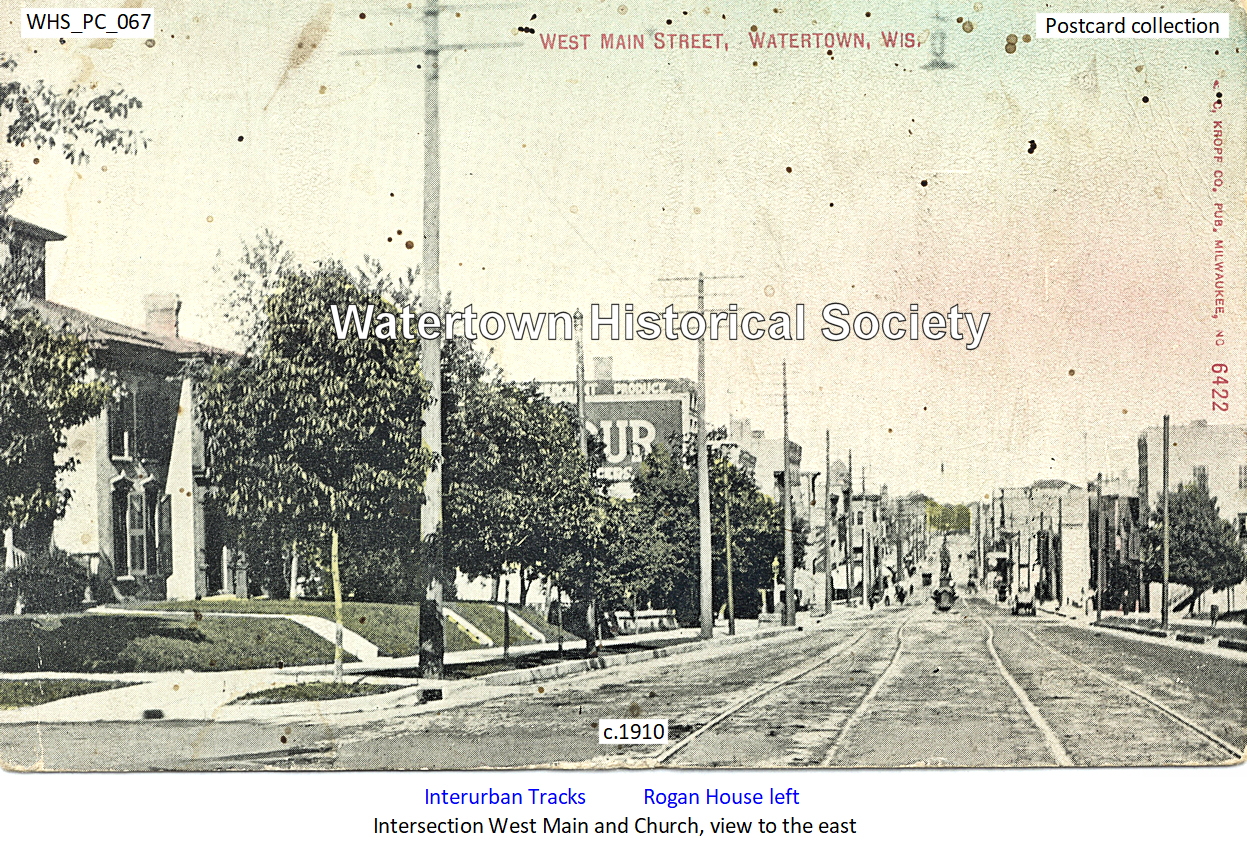 Viewed from Church and Main
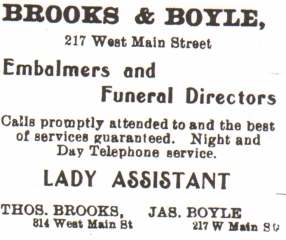
Thomas Brooks, Brooks &
Boyle
Patrick Rogan Home
Boyle Funeral Home, 1941-1978 (1941 or 1939 ? / see 1937 article that
follows)
Patrick
built a beautiful large brick home in the 1860's at what is now 314 West Main
Street. It became the Boyle Funeral Home
which was later owned and also operated as a funeral home by Bernard Helser.
The
Rogan House, a Federal style square house, with Italianate influence, was built
in the 1860s and began as a square house with central hall and main rooms on
both sides. Arched front windows and a
cupula were on the original house, but the porch, two story pillars and the
addition of the east side of the building were completed in 1941 when the home
was converted into a funeral home.
Pleasingly designed in the hospitable manner of a
Southern colonial home. New and modern
equipment including chapel, pipe organ, show room, recreation room and family
room (text from early postcard)
Although
there have been many additions, the cupola was part of the original home, as
were the unusual palladium windows. Under the ownership of Boyle who bought the
home in 1941, additions were made. These included the porch and two story
pillars, a garage, added rooms at the side and the archway over the drive. The
home has beautiful oak woodwork throughout.
Helser was owner and operator of the funeral home from 1959 to 1978 when
the building was purchased by T. W. Weber, president of Weber Realty.
Marriage
of Miss Mary Ann Boyle and Clarence J. Corcoran
1936
Watertown Gazette, 09 10 1936
At St. Jerome’s Catholic Church in
Oconomowoc on Tuesday, September 8, 1936, Rev. Father Haggerty, pastor of St.
Bernard’s Church, Watertown, united in marriage Miss Mary Ann Boyle, daughter
of Mrs. James W. Boyle and the late James W. Boyle, 220 West Main Street, and
Clarence J. Corcoran, son of Mr. and Mrs. L. J. Corcoran of Madison.
The bride’s sister, Mrs. F. H. Carlson of
this city, was her bridesmaid, and Dr. P. C. Dier of Milwaukee was the best
man.
Mr. Corcoran, who is a graduate of River Falls
State Teachers’ college and the University of Minnesota School of Embalming, is
the mortician and funeral director at Boyle Funeral Home. His bride attended Edgewood academy at
Madison and is a graduate of Mercy High School in Milwaukee.
They will make their home at 220 West Main
Street.
Both are well known in Watertown and very
highly esteemed, and enter married life with the good wishes of hosts of
friends, including The Gazette
editor.
1937
Watertown
Gazette, 01 07 1937
Mrs. Rose Boyle, son -in-law and daughter, M/M
Corcoran
Mrs. Rose Boyle, son -in-law and daughter,
Mr. and Mrs. Corcoran, have moved in to their new apartment above the new Boyle
Funeral Home at 314 W. Main Street. The
new home will be opened for public inspection at a later date.
1937
Watertown
Daily Times, 01 14 1937
NEW
BOYLE FUNERAL HOME COMPLETED
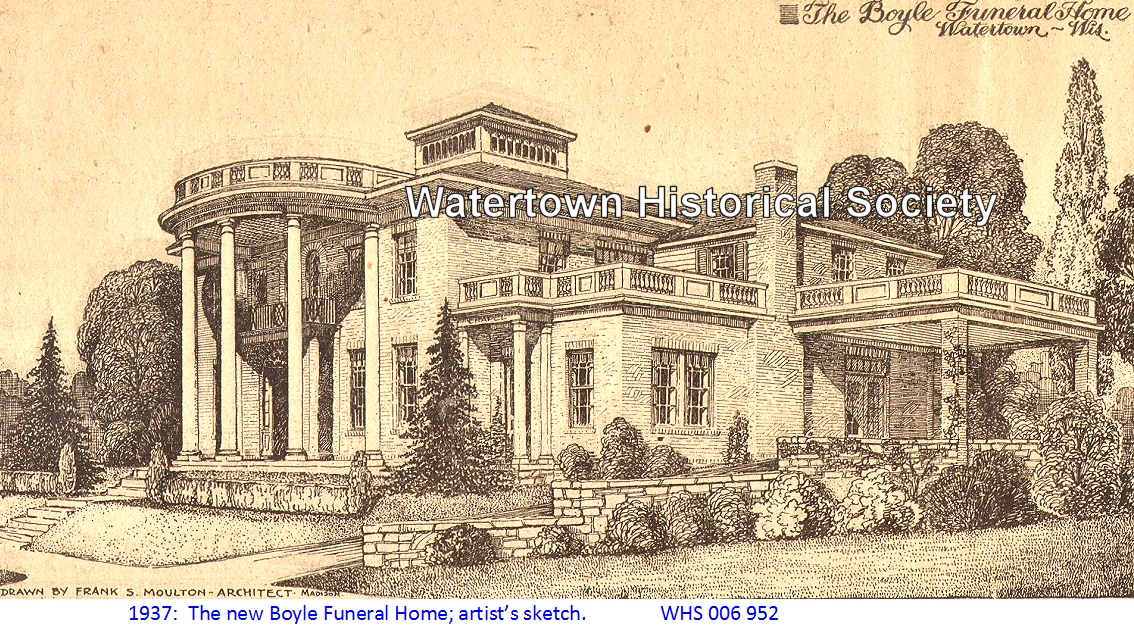
Click
to enlarge
The
new Boyle Funeral Home, shown in this artist’s sketch, has now been completed
and is now ready for business. This was
announced by Mrs. James W. Boyle, who is operating the place with her
son-in-law and daughter, Mr. and Mrs. Clarence J. Corcoran.
The
new home, located in
The
funeral establishment is confined to the main floor, while the private apartments
of Mrs. Boyle and Mr. and Mrs. Corcoran are located on the second floor.
The
main floor contains, in addition to the large and beautiful chapel and
sanctuary, an office, several private and semi-private rooms for mourners and a
large casket display section, besides the modern and complete preparation
room. There is also a music room with
piano and organ. There are several
lavatories on the main floor and there is also a smoking room.
Beautifully
selected furniture is scattered throughout the main floor, giving at once a
home-like and inviting appearance. The
front entrance brings the visitors to a reception hall from which the office
quarters and the chapel lead off on each side.
The stairway to the second floor gives an additional atmosphere of
beauty.
In
converting the old Rogan home into a modern funeral home, the architect, Frank
S. Moulton, of Madison, has achieved everything Mrs. Boyle planned. The general contract for the work was carried
out by George Schleicher, local contractor.
Most
of the old beauty of the original house has been retained. This is especially true of the main staircase
and the woodwork throughout. Another
feature that was retained from the old place is an antique fireplace which has
been moved into and become part of the chapel room.
In
announcing the completion of the new home Mrs. Boyle said that she carried out
the dreams of her husband, the late James W. Boyle, who long before his death
had begun plans for a modern funeral home.
He did not live to see the work begun, but his widow brought them to
completion. She said she feels she has
built a place much as her husband would have liked to have and which, had he
lived, would have met with his fullest approval.
Mr.
Boyle was a resident of Watertown from the time of his boyhood, served this
community as a funeral director most of his life, being active in the
profession until the last. He was in
business for himself, after serving partnerships for some years earlier in his
career. He built up a large practice in
this section and since his death, his wife and daughter, and later the
son-in-law, have carried on the business.
1957

1959
06 20 BOYLE’S SOLD TO M/M BERNARD HELSER
One of Watertown's
older and well known business establishments has changed hands. Mr. and Mrs. Clarence Corcoran, owners of the
Boyle Funeral Home, 314 West Main Street, today announced the sale of the
property and the business to Mr. and Mrs. Bernard G. Helser, East Troy. Mr. and Mrs. Helser have operated a funeral
home at East Troy for the last 11 years.
Mr. Helser is a graduate of the Wisconsin College of Mortuary Science, Milwaukee. Before establishing himself at East Troy, he
worked as a mortician at Rochester, Minn., Ashland, Wis., and at Milwaukee for
two years. He spent three years in the
Air Force. WDT
2022
10 05 HOME IS FOR SALE
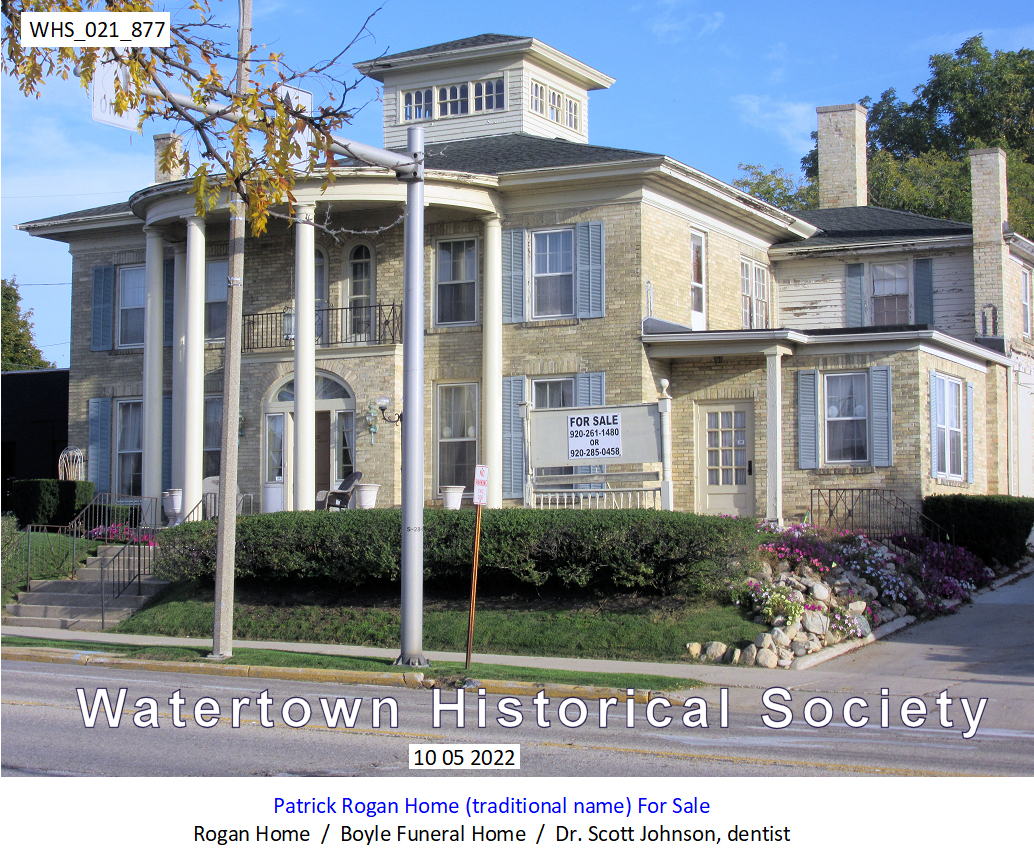
Cross-References:
No 1: Main,
W, 220 1909, Brooks & Boyle,
general mdse, undertakers
1930,
First funeral home: Nowack’s
Main,
W, 220 1935, Jas. W Boyle, undertaker
Main,
W, 314 1937, Boyle Funeral Home
1909 Louis Rogan has
accepted a position as clerk at the New Belvidere
Hotel in West Main Street. Louis is
one of Watertown’s best known and reliable citizens and all his many friends
predict that he will make a success of his new position. WG
09 17 1909
Remembrances:
It was
a grand home. As a kid living nearby,
used to play with the Helsers as they lived up above. It was a really neat home.
Spent
many days with all of the Helser family there.
Helped with moving dead bodies, played in the casket room and general
mischief. Bernie was quite a character.
He had a stroke which made one side of his body useless. He had a bellowing voice.
The
penthouse was treasure for kids. Spent
some time up there.

History of Watertown,
Wisconsin