website watertownhistory.org
ebook History of Watertown, Wisconsin
August E. Needham
b. 1833, d. 1908
1905
08 02 NEEDHAM BLOCK (607-611 E. Main)
More Improvements. A. E. Needham had the ground broken Friday
for a building on Main Street between Sixth and Seventh streets. The structure will be 33x70 feet, two stories
and the basement. The first story is
intended for a store and the second story for living rooms. He expects to have it ready for occupancy
December 1. WR
1908
Soldier’s and Citizen’s Album of
Biographical Record, Grand Army
Publishing Company, Chicago, Illinois, 1899 / R 355.3 So4
August E. Needham, Watertown, Wis.,
a former soldier of the Civil War, was born in Massachusetts, December 19,
1833, and is the son of Joseph and Eliza (Howe) Needham, and claims Yankee
ancestry of unmixed purity. He remained
in his native state until the year after his majority, engaged in varied
employment as long as he remained under his father’s authority, and afterwards
obtained a complete understanding of the trade of a carpenter.
In 1855 he went to Wisconsin,
where he pursued his business as a contractor and builder until the second year
of the war, when, becoming convinced that the struggle was of greater moment
than at first anticipated, he determined to enlist.
He enrolled as a soldier in
Company B, 29th Wisconsin Infantry, and went into rendezvous at Camp
Randall. The regiment was mustered
September 27th and left the state for Cairo November 2nd. He went from Cairo to Helena where the
permanent camp was made across the river and whence he participated in the
several expeditions to the White River, the Yazoo River and the St. Francis
River, in which he saw much service of a varied character without being engaged
in actual battle.
 Mr. Needham was a participant in
all the varied experiences of his brigade which were of heroic character from
the fact that it was composed of veteran regiments, the 29th being the only one
of recent enlistment. He was on the
gunboats when they made a run pas the rebel batteries in April and soon after
fought at Port Gibson. At Champion Hill
he saw the capture of the rebel battery which has been the subject of
dispute. After the fight, his brigade
was left to bury the dead and he remembers seeing 31 dead artillerymen and two
officers, behind whose bodies lay 16 dead horses. During this action he acted in the capacity
of Corporal to which he had been promoted and he was afterward made
Sergeant. He was not in the fight at
Jackson, being in the convalescent hospital, having previously been ill and in
the hospital. When the regiment returned
to Vicksburg he joined it there and obtained a furlough on which he went home
and remained several months.
Mr. Needham was a participant in
all the varied experiences of his brigade which were of heroic character from
the fact that it was composed of veteran regiments, the 29th being the only one
of recent enlistment. He was on the
gunboats when they made a run pas the rebel batteries in April and soon after
fought at Port Gibson. At Champion Hill
he saw the capture of the rebel battery which has been the subject of
dispute. After the fight, his brigade
was left to bury the dead and he remembers seeing 31 dead artillerymen and two
officers, behind whose bodies lay 16 dead horses. During this action he acted in the capacity
of Corporal to which he had been promoted and he was afterward made
Sergeant. He was not in the fight at
Jackson, being in the convalescent hospital, having previously been ill and in
the hospital. When the regiment returned
to Vicksburg he joined it there and obtained a furlough on which he went home
and remained several months.
During his absence the regiment
had been transferred to the Department of the Gulf and he found it in camp near
Franklin, La. He passed about two months
in the varied service in which the regiment was engaged, marching and
skirmishing until the command went into camp at Algiers, opposite New
Orleans. They remained there until
January 5, 1864, going next to Decrow’s Point and
returning within a month to Algiers. The
regiment was next detailed to accompany the Red River expedition and Mr.
Needham was in the battle of Sabine Cross Roads, where his company suffered
severely, going into action with 35 men and returning with 16 able to answer at
roll call.
He was in the difficult and
dangerous return to Grand Ecore, going to Alexandria,
to Cloutiersville, and to many points of less
moment. In May he was with the force
that aided in the construction of Bailey’s dam across the Red River in which
service the regiment won the special commendation of the authorities.
Cross Reference:
Is
buried in Oak Hill Cemetery
1909 Memorial Day Services at Needham Gravesite
Watertown
Gazette, 05 28 1909
Following
is the program outlined by the committees for the observance of Memorial Day on
Sunday, May 30: O. D. Pease Post will
attend St. Paul's Episcopal Church in a body
at 10:30 o'clock service in the forenoon.
The body of church will be tastefully decorated with flags and bunting,
and a choir of thirty-five voices will render the music.
Sunday,
2 P.M. Parade will form at the corner
Main and North First streets in the following order:
Marshal
of the Day and Aides
Northwestern
Cadets and Students
Mayor,
Commander, O. D. Pease Post and Guests in Carriage
Deutscher Kreiger Verein
O. D.
Pease Post No. 94; G.A.R.
Older
G.A.R. Veterans in Conveyance
Children
in Carriage to Decorate the Graves of Mr. and Mrs.
Robert E. Lewis
Watertown
Band
Common
Council in Carriages
Board
of Education in Carriages
Woman's
Relief Corps in Conveyance
Public
Schools
Independent
Band
Parochial
Schools
Citizens
in Carriages
Arriving
at the tower in the cemetery the head of the column will halt, open order, and
present arms while Grand Army Post passes through to music of fife and drum to
the grave of late Comrade A. E. Needham
[August], where services according to the G.A.R. ritual will be held . . .
1913
01 23 Mrs. Alzina Needham, 419 Market Street, died on Sunday, January
19, 1913. She had been ill but a few
days, hence her death was a great surprise to our citizens. Deceased was born November 2, 1833, at
Hartford, Washington County, New York, coming to Wisconsin in 1857, and in
December 1858, was married to the late Augustus E. Needham. In 1850 they came to Watertown and made this
city their home until called away by death.
Two daughters survive her, being the Misses Jennie and Nellie Needham of
this city. Her funeral was held from her
late home Tuesday afternoon, funeral services being conducted by Rev. E. J.
Mathews, pastor of the M. E. Church. The
interment was
in Oak Hill Cemetery. In the death
of Mrs. Needham Watertown loses one of its most esteemed ladies, for she
possessed a sweet and lovable disposition and ever strove to live the life of a
true Christian. A large circle of
friends mourn her death most sincerely.
WG
____________________________________________
Werlich / Needham Home
719 Market Street
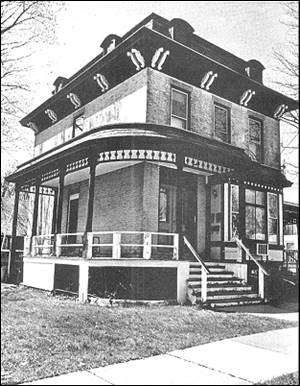
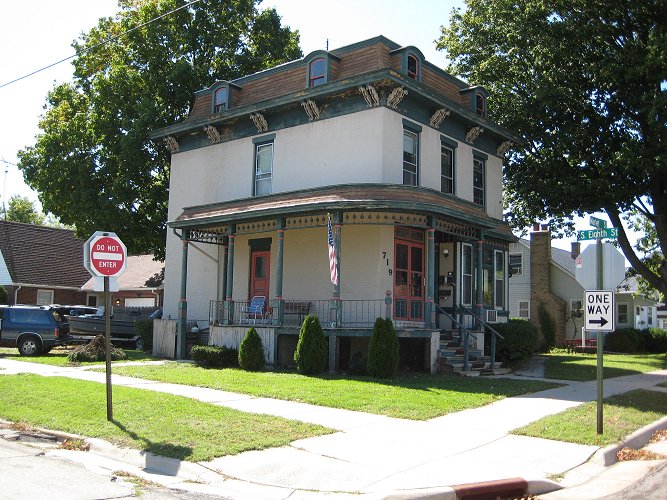
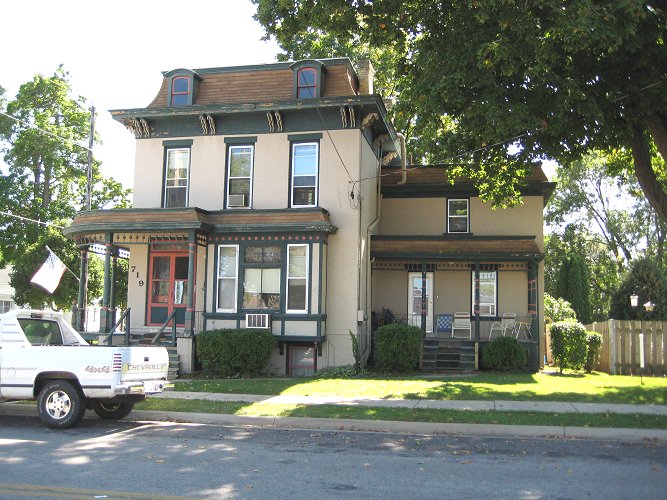
Click upon to enlarge2008 images
Watertown Daily Times, 06 12 1976
An
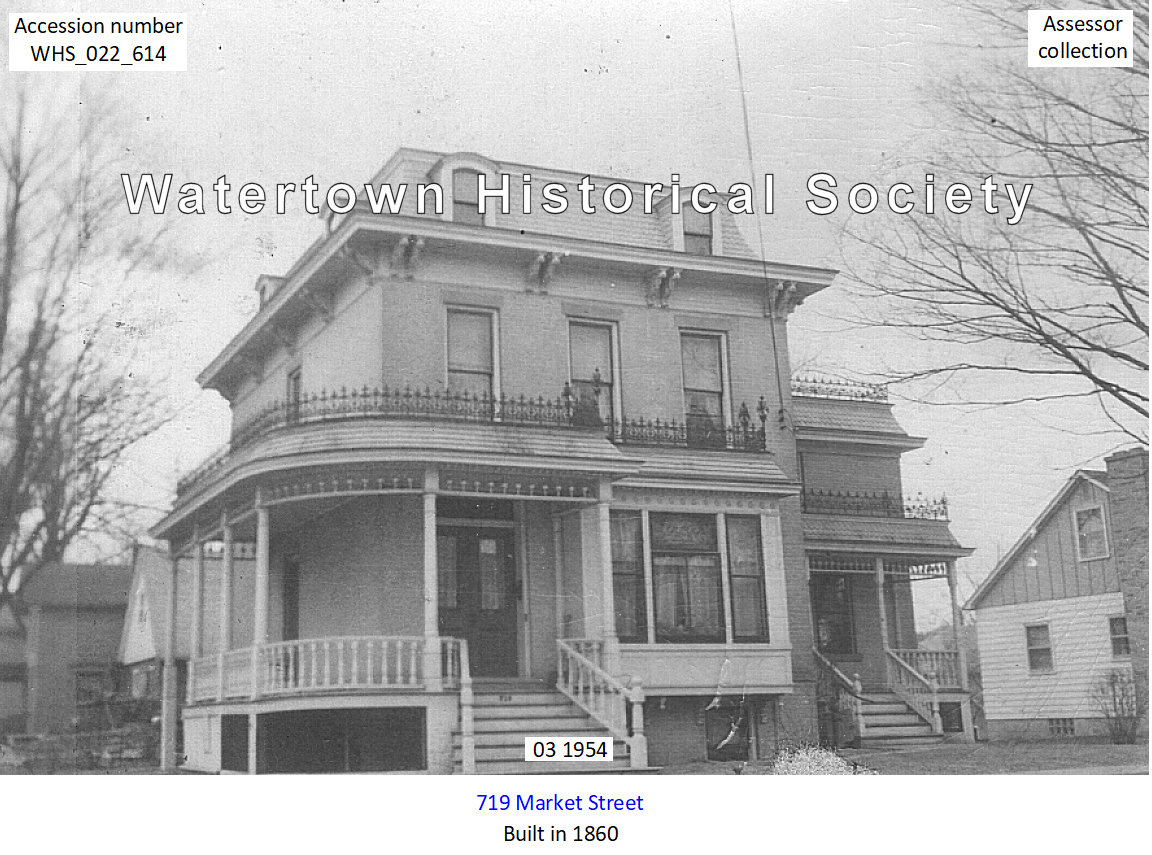
enterprising German realtor, Gustav Werlich, built this Watertown brick Mansard-roofed
Second Empire style house in 1860. At
that time Market St. was called Washington St., and the present Washington St.
was West Washington. The change to Market St. was made in 1890. By that time the house had come into the
possession of the Needham family. August
Needham originally owned and operated the Toll House on the west
end of the Watertown Plank Road. He later became the proprietor of the local
Needham Lumber Co. Miss Nellie Needham,
who taught in rural schools for 20 years, lived in this house for 60 years
until her death in 1956 at age 94, the last surviving member of the
family. There is some evidence that a smaller frame home
occupied the site of the Needham home before Werlich built the large home
(in 1860). The Needhams extensively
remodeled this house in 1910, adding porches on two sides and a front bay
window. Both porches have straight
Mansard roofs, while the one on the attic is concave. The top of the center section of the window
is leaded stained glass.
The
Mosers purchased the house in 1974 from Vivian Ferguson. Particular treasures, reclaimed and polished,
extensively repaired and renovated, were a four-sided lantern-shaped chandelier
and many beautiful and ornate brass door knobs and plates. The original kitchen was in the basement. The house has contained three apartments for
over 20 years.
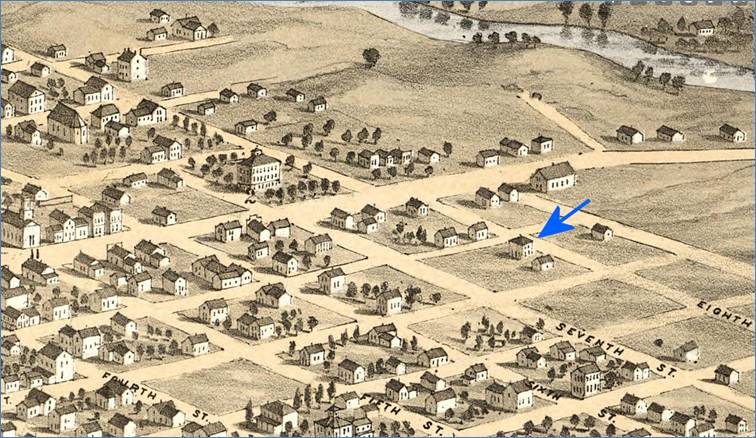
The City of Watertown, 1867
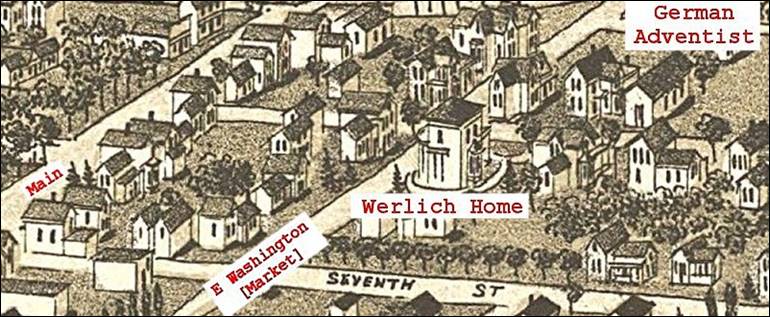
The City
of Watertown, 1885. Annotated to become WHS_005_873
Market
Street of today was East Washington Street in 1872
1842
719 Market Street is one of the
oldest homes in Watertown, known for over 70 years as the Needham home. Records indicate that a small frame home, the
nucleus of the larger home was erected in 1842 before the Watertown brickyards
began functioning and before the Watertown Plank Road was finished to bring
building materials from Milwaukee.
Market Street in 1842 was called
Washington Street and the present Washington Street was then known as West
Washington.
The Needham family lived outside
the city limits for some years and were first listed in the Watertown home in
about 1880. The family lived there until
1956, when the last surviving member of the family, Miss Nellie Needham, died
at the age of 94. The Needhams
extensively remodeled the building in 1910, making it a large imposing
residence of Watertown brick, Mansard roof, porches on two sides with elaborate
fretwork trim, and the front bay window with center section of leaded stained
glass.
Augustus Needham, father of the
family, operated the Needham Lumber Company in Watertown.
The original lot was large, but
much of this has been sold.
David and Mary Moser purchased
the home in 1974 from a Vivian Ferguson and have been busy on this extensive
do-it-yourself project since.
The original kitchen was in the
basement.
1860
Cross
reference note:
1953: BREAKING GROUND, MISS
NELLIE NEEDHAM
- NEW PARSONAGE, FIRST
METHODIST
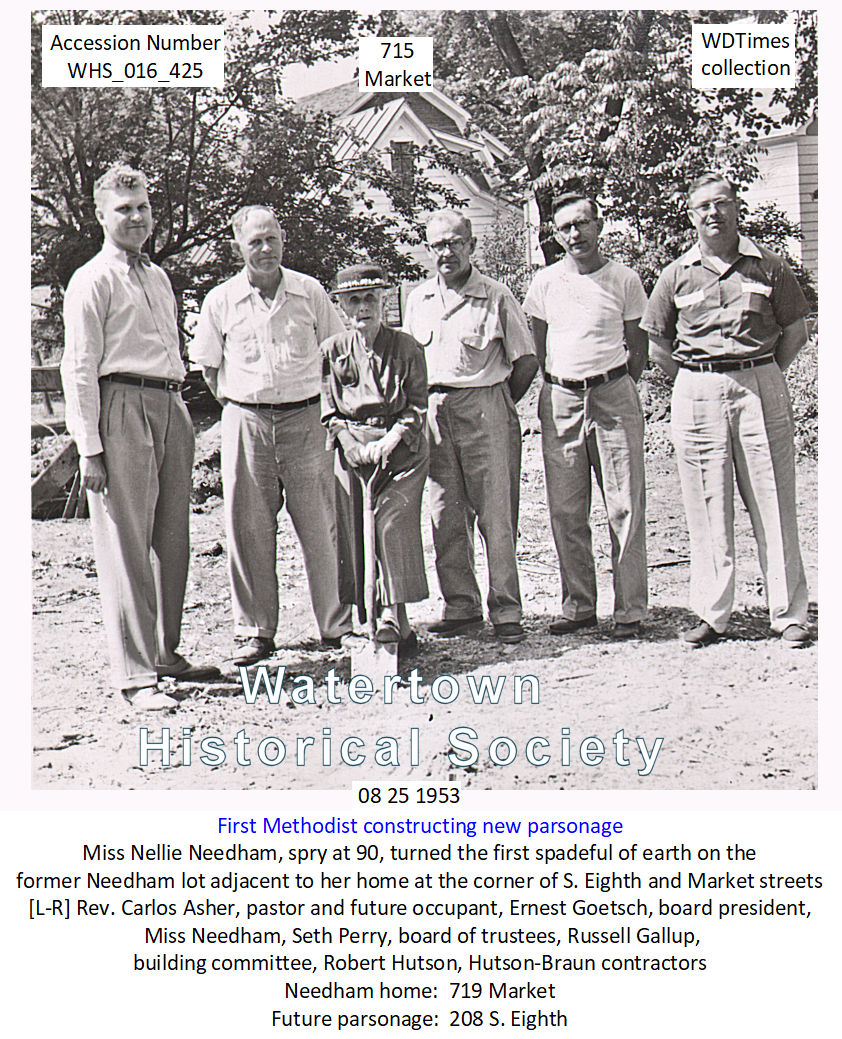
Miss Nellie Needham, spry at 90,
turned the first spadeful of earth on the former
Needham lot adjacent to her home at the corner of S. Eighth and Market
streets. [L-R] Rev. Carlos Asher, pastor
and future occupant, Ernest Goetsch, board president,
Miss Needham, Seth Perry, board of trustees, Russell Gallup, building
committee, Robert Hutson, Hutson-Braun contractors
Needham home: 719 Market; Future
parsonage: 208 S. Eighth

History of Watertown,
Wisconsin