website watertownhistory.org
ebook History of Watertown, Wisconsin
Robert E. Lewis
1825 - 1904
Watertown Daily Times, 12 09 1904
Robert
Emmet Lewis, one of Watertown's most esteemed citizens, died at his home in Washington Street at 10 o'clock on December 8,
1904, at the close of an illness that confined him to his home for nearly a
year. The cause of his death was brain trouble.
Mr.
Lewis was born December 23, 1825, at Morrow, Saratoga county, New York; January
30, 1850, he was married at Glens Falls, New York, to Miss
Fannie Parker, of Parkinsville, Vermont; in 1853
he came west and located in Oshkosh, from where he engaged in the sash and door
business; in 1861 he came to Watertown and in company with his brother, the
late George B. Lewis, bought a sash and door factory located on the present
site of the G. B. Lewis factory in Water Street; in 1869 he sold his interest
to his brother and removed to Iowa; in 1892 he returned to Watertown and has
since made this city his home.
His
wife survives him. Two children were born to them: Hattie, who died in 1868, and Clifton, who
died in 1894.
The
death of Mr. Lewis is most sincerely regretted here, for his was one of
Watertown's most esteemed citizens, and during his residence among us he always
took a great interest in the welfare of our city and its citizens, devoting
generously of his means to every public enterprise and bestowing charity and
benevolence in many ways, in which he was always encouraged and aided by his
devoted wife. May 30, 1898, he donated
to the city the elegant soldiers' monument that
ornaments our city park, and a few years, previous to that erected the fine drinking fountain in West Main Street in
memory of his son Clifton Lewis, who died in 1894.
Besides
being generous in a public way, many people were aided by him privately, and
the manner in which he extended his benevolence was truly edifying, for he did
it in a simple, unostentatious manner, and with genuine sincerity. Very few men
enjoyed the esteem and respect of his fellow citizens at large, as did Mr.
Lewis.
He was
honest in his business dealings with others, kind and good-natured to every one, and always a friend to those in trouble. He was
devoted to his wife and home, kind and genial to his neighbors and his whole
nature was kindness. He lived a most excellent life, and for such a man there
is certainly a reward above. He has passed from earth, but he will live long in
the memory of his friends, and his noble character, his influence for good will
survive him.
Funeral of Robert E. Lewis, 12 16 1904
Sunday
afternoon the funeral of Robert E. Lewis took place from his late home in
Washington Street, the internment being in Oak Hill
Cemetery. From 9 o'clock in the morning until funeral services at 2 o'clock
in the afternoon a large number of friends and citizens called at the home to
pay their last tribute of respect.
Rev.
Thos. B. Thompson, of the First
Congregational Church, and George C. Weis, of Waukesha, officiated at the
funeral services, both paying fine tributes to the departed.
Vocal music
was furnished at the services by a quartette composed of Messrs. Julius Wiggenhorn, William Sproessor,
Max Rohr and Edward Schempf.
Mayor
Wertheimer, members of the city council, of the Board of Education, other city
officials, and members of the O. D. Pease Post. No. 94, G. A. R. was present in
a body.
The
honorary pallbearers were Messrs. Theodore Prentiss, M. J. Woodard, Col. D.
Jones, W. P. Brown. The active pallbearers were Messrs. C. A. Skinner, H. T. Eberle, Fred A. Schmutzler,
Edward J. Brandt, F. A. Hoffmann, J. C.
Harrison.
Note on Passing
Watertown Daily Times, 12
30 1904
At a
meeting of the board of managers of the Old Ladies' Home at Glen Falls, New
York, held December 12, the following was adopted:
Inasmuch
as Robert Lewis, of Watertown, Wis., has been called to his reward, we desire
to express our regret and sorrow on the loss of so public a philanthropist. As
a benefactor to the Old Ladies' Home we shall all cherish the memory, not only
for what he had done, but for the manner in which and for the time he made his
generous gifts.
His
splendid donation comes almost unsolicited, mainly because of his long generous
impulses and desire to do good, has been the mainstay in support of the home
for the past two years, at a time when without his contribution it would have
been impossible to have maintained it on the basis on which the institution has
been left.
But for
this contribution many of the inmates would not have been able to enjoy the
comforts of the home. Surely it can be said without fulsome flattery that the
promise "Inasmuch as ye have done it unto the least of these ye have done
it unto me" applies in its whole meaning to Mr. Lewis.
The
manager and directors of the home feel they have lost a friend, a man of
generous impulses and one whose judgment and discrimination renders him
peculiarly fitted to do wisely and well his full duty to his fellowman.
Annie Lewis
Mrs.
Robert Lewis
1845-1895
WR W ApriI 24, 1895
A
highly esteemed member of society, and a lady enjoying a wide acquaintance, Mrs.
Robert Lewis, of 400 North Church Street, has been called to the heavenly
Father's home, the end coming at 3 o'clock last Thursday afternoon. Her disease was tuberculosis, which about a
year since began to make inroads upon a not too robust constitution. All that the best of medical skill and the
kindest attentions of loving hands accomplished was of no avail toward staying
the inevitable result of the dread malady, and she laid down life's burden,
after this long, patient suffering, when but little past the zenith of earthly
existence, being in her 51st year. She
is survived by her husband and one daughter, Mrs. D. M. Woodard, who in their bereavement
have the tender sympathy of many friends.
[Buried on Oak Hill
cemetery]
Clifton Lewis
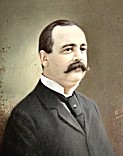
Watertown
Historical Society Collection
Funeral of Cliff Lewis, 1894
Watertown Gazette, 06
29 1894
Cliff
Lewis died of Bright's disease at the home of his parents on Washington Street,
south, on Saturday, June 23, 1894, in the 44th year of his age. Diseased was born in Fort Edwards, New York,
and removed to this city with his parents when quite young. Several years ago he located in St. Paul and
engaged in the cracker business, selling out to the cracker trust a few years
ago, and from which he annually drew large dividends. He was also interested in real estate in that
city, and had extensive interests in Dunedin, Florida.
He had
a large acquaintance throughout the west, all of whom sincerely mourn his
departure. Genial and pleasant in all
his dealings, all who knew him took kindly to him and became his friend.
In
common with our city we extend to his aged parents our sincere sympathy.
On
Monday afternoon his remains
were laid at
rest in Oak Hill Cemetery, a large number of sorrowing friends turning out
to pay the final tribute of respect to him.
1902
03 28 Glenn Falls, N. Y., March 24.—Robert P.
Lewis of Watertown has announced his intention of giving $7,000 in bonds to the
Glenn Falls Home for the Destitute Aged, to become part of the endowment fund.
The above dispatch appeared in the daily papers on Tuesday last. Mr. Lewis has already made this magnificent donation for the charitable purpose above stated, and it is another indication of the good that is in him. Mr. Lewis and his worthy wife has been also very generous donating things of great value to our city, among them being the fine soldiers' monument which ornaments our city park, and the drinking fountain in West Main Street. Wealth in the hands of such people is a great blessings to mankind, and it is indeed a great pleasure to the people of Watertown to have in their midst two so worthy people. Would that a few more of Watertown's wealthy residents (and we have quite a few of them) would come forward and do something for the benefit of mankind with some of their surplus wealth. WG
1909
05 28 Memorial Day,
decoration of graves of M/M Robert E. Lewis
WG
1910
06 03 Memorial Day,
decoration of graves of M/M Robert E. Lewis
WG
1925 Lewis Fund use proposed for new Memorial Park
02 18 A fund of approximately $9,000 is also being held
for the use of the park board in converting the
“brewery lot” into a park. This is
the accumulated interest from a fund which was created by the late Mr. and Mrs.
R. E. Lewis.

History of Watertown,
Wisconsin