website watertownhistory.org
ebook History of Watertown, Wisconsin
Watertown
Goslings
Watertown may be the only city in
the nation that claims the “Mighty Gosling” as a high school mascot.
2007 note <>The current Gosling mascot suit is thought to have
been used for the past 25 years and has been placed into retirement.
The Watertown Athletic Booster
Club is spearheading a project to replace the mascot suit with a brand new Gosling.
The
Gosling tradition dates back to the 1800s when the Watertown Gosling was
well-known up and down the East Coast.
Geese raised by local German farmers were force fed (noodled) to produce
fattened livers. The livers were turned
into pate, a delicacy found on the menus of fashionable restaurants in many
cities. A menu in New York City would
entice customers to the finest liver pate from the Watertown Gosling. Such advertising made the city famous from
coast to coast.
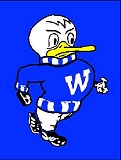 Why the Watertown senior high
sports teams are called goslings
By Evelyn Rose; annotated by Ken Riedl
Derived in part from Watertown
Daily Times, 06 15 1977
Only a
newcomer to Watertown would ask, "Why did the high
school name its athletic teams the Goslings?" Some newcomers think it has something to do
with geese, the V's of handsome Canadas that honk their way over Watertown
spring and fall as they follow the Rock River
either to or from their nesting grounds near Hudson Bay in Canada and the
Mississippi flyway for the journey south.
A good tail wind can bring the speed of these flying geese from their
usual 40 miles per hour to nearly 70.
Many
fly to Horicon marsh, a refuge, within a day's time from Wawa on the north
shore of Lake Superior. The Canada
goose, Wawa to the Ojibway Indians, is the national bird of Canada. Their flying wedges are of real interest to
Watertown residents.
 <=
Click upon to enlarge
<=
Click upon to enlarge
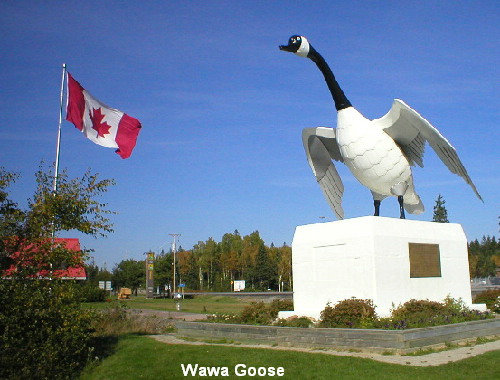
A big
goose marker in Wawa, 27 feet high, commemorates a last link in the
Trans-Canada highway in 1960.
Other
newcomers to Watertown don't wonder about the name "Goslings" at
all. They just know all football and
basketball teams have a name and think Goslings is the name picked at random by
Watertown High School. Not so, and it is
for the edification of newcomers and visitors this story is told. Long time
residents are well aware of the illustrious place geese have played in
Watertown's history.
Watertown's
high school's yearbook, the Orbit, in
1919 made mention of the Blue and Whites, but from 1920 on, although they kept
the blue and white school colors, the official name was always recorded as the
Goslings. Not only the team names, but
the Cady Street bridge keeps alive the memory of
a once thriving and unique industry centered in Watertown half a century ago.
The bridge has the forms of geese in its ironwork.
An old
world vocation grew to a great industry in Dodge and Jefferson counties, with
the hub of the industry in Watertown.
The peak of the industry in Watertown was around 1917. "Watertown
Stuffed Goose" appeared on the menus of America's famous gourmet
restaurants in the east. It was listed
in the dining cars of the Twentieth Century Limited and other cross country
passenger trains, and on the elaborate menu cards of ocean liners, which before
the jet age carried large numbers of passengers to and from Europe, often in
luxurious surroundings.
According
to the late Fred L. Holmes, historian and author of "Old World Wisconsin" and other historical books, the method of
forced feeding, stuffing or "noodling" of geese, as the method was
known, had its origin in Alsace in Europe over 200 years ago. He learned this from Jefferson and Dodge
county farmers who were in the ethnic groups who came from Germany in the late
1800's. They brought knowledge of the
noodling of geese with them.
Holmes
also quotes Dr. William F. Whyte, a long time physician in Watertown well over
60 years ago as saying he believed this noodling was an ancient custom. Dr. White, in his "Chronicles of Early Watertown" published in 1921 and reprinted
in the Wisconsin Magazine of History
writes: "stuffing geese is an ancient custom. In the tombs of the sacred bulls of Egypt,
which are 4,000 years old, I saw carved on the walls a pictorial,
representation of the same process which made the Watertown farmers
famous."
The
call of Woode! Woode! Woode! assembled the flocks in Watertown in the beginning
of this century as it did in Europe for generations before. About 25 days before Christmas the goose was
penned and force fed with noodles of barley, rye and wheat, to prepare for the
Christmas markets in the east. The
proper method of noodling was highly specialized and the birds' flesh became
firm and the livers large. The livers
were the delicacy known as pate de foi gras. The
originator of this delicacy was said to be a cook who prepared the noodled
goose livers for the governor of Alsace long before the industry came to
Watertown.
This
method has long since been abandoned, both in Europe and in Watertown. However, it is remembered
because it put Watertown at the top of a unique industry 60 years ago.
In
order to preserve this interesting ethnic contribution to Watertown's history,
The Watertown Arts Council, in 1969, sponsored the preparation of a display for
the pioneer barn on the Octagon House grounds, with an accompanying history of
a once thriving and nationally known industry.
With the cooperation of Fred Rumler, then the city's only remaining
person with knowledge of this method used in preparing the geese for market,
and Walter Pelzer, a Milwaukee Museum taxidermist, a fine African-Toulouse goose
was noodled and mounted for presentation to the Watertown Historical
Society. The mounted goose display,
shown daily in the pioneer barn on the Octagon House grounds, has been viewed
by nearly 150,000 visitors since its presentation in 1969.
The
Gosling athletic teams preserve this unique heritage of a Watertown industry in
a most hearty and active way. Newcomers
and visitors to Watertown, when next you go to a basketball game and see the
team emblem near the gym entrance, do not think of the figure as just a merry
gosling, but as the emblem of a part of Watertown's heritage. Sometimes at a high school homecoming
football game, note a huge paper constructed float of a goose, its head nods
and its eyes blink when the home team makes a touchdown for the Goslings and
for Watertown's heritage.
1917
04 09 NEW
FIRE TRUCK FEATURED GOOSE PAINTINGS
The city’s new triple combination pumping engine, hose cart and chemical
engine motor truck has arrived at the city hall fire station. It is a mammoth gray bodied affair with the
Watertown goose painted in various portions upon the sides of the driving
seat. The truck was built by the
Seagrave Company of Columbus, Ohio, and represents an expenditure of
$8,150.
08 17 MASCOT FOR CO.
E.
Gosling sent to members
as parting gift
The members of Co. E left for Camp Douglas
today. They have one mascot in the shape
of a little fox terrier.
Saturday morning they will receive another. Whether it will be received as heartily as
the dog is a question.
From all indications it will be royally welcomed, for in Camp Douglas at
the present time are mascots of all descriptions, from a goat to a gold
fish.
The Gosling is a Watertown product for which this city is famous. It is the gift of the Watertown Poultry and
Pet Stock Association. The Watertown News, August 17, 1917
09 01 COMPANY
E’s GOSLING
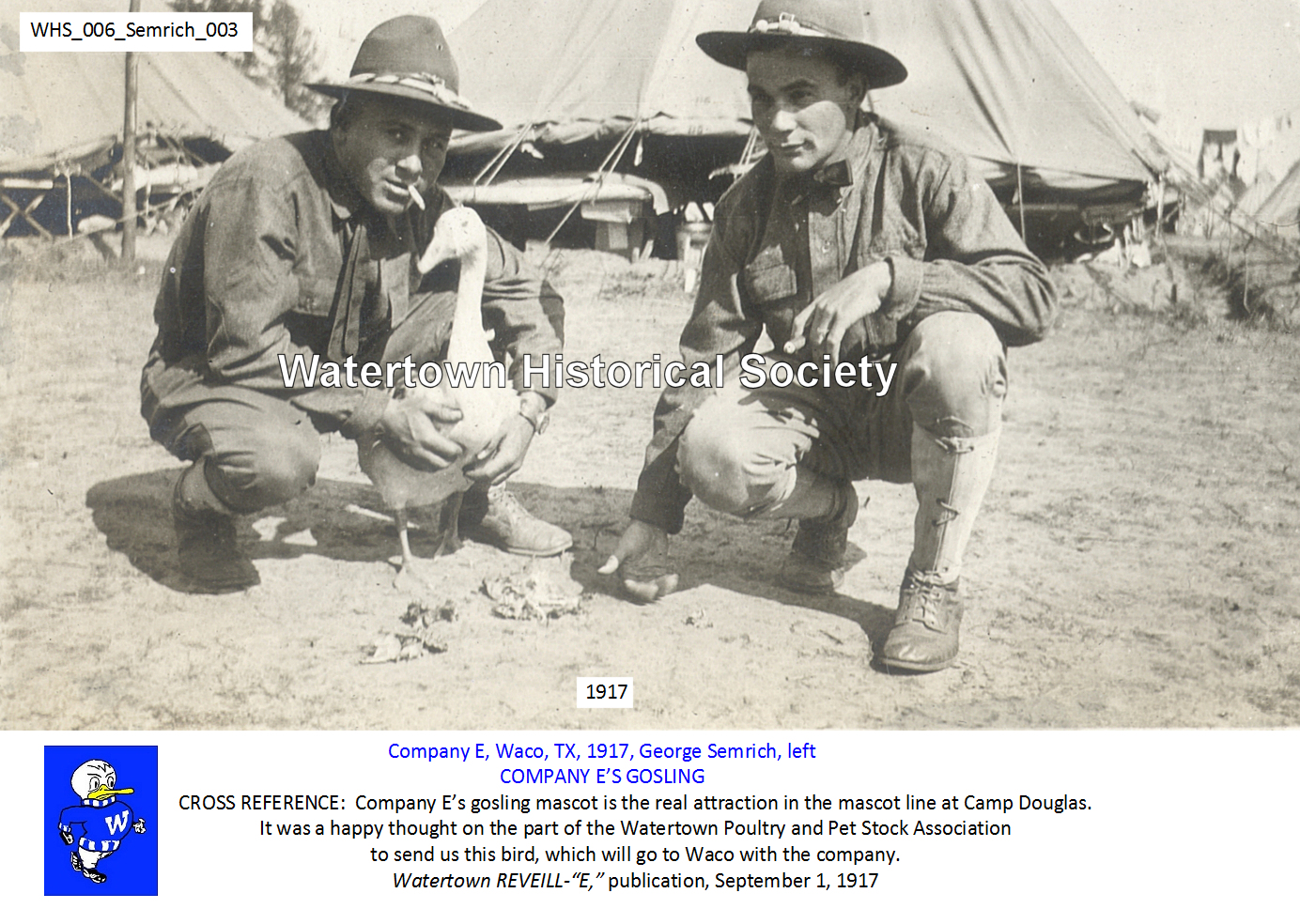
Mascots
come and mascots go, and where there are envious attempts on the part of rival
companies to boost their mascots as the real for-sure-enough wonder of the
camp, such attempts are short lived, for Company E’s gosling is the real
attraction in the mascot line at Camp Douglas.
It was a happy thought on the part of the Watertown Poultry and Pet
Stock Association to send us this bird, which will go to Waco with the company,
and with his “expert” military knowledge, he will no doubt be an attraction of
equal importance there. Watertown REVEILL-“E,” publication of
Watertown’s Company E, Fifth Wisconsin Infantry,
September 1, 1917
2007
11 16 WATERTOWN
GOSLING MASCOT RETIRES
Watertown
may be the only city in the nation that claims the Mighty Gosling as a high
school mascot. In 2007 the then current
Gosling mascot suit was thought to have been used for the previous 25 years and
was placed into retirement.
The
Watertown Athletic Booster Club spearheaded a project to replace the mascot
suit with a brand new Gosling.
The
Gosling tradition dates back to the 1800s when the Watertown Gosling was well-known up and down the East
Coast. Geese raised by local German farmers were
specially fed to produce fattened livers. The livers were turned into pate,
a delicacy found on the menus of fashionable restaurants in many cities. A menu
in New York City would entice customers to the finest liver pate from the
Watertown Gosling. Such advertising made the city famous from coast to coast.
Many
might ask what is fierce and competitive about a baby goose. These creatures
are tenacious and fearlessly take on any foe. Inside their bills are little
sharp teeth that serve well in defending themselves.
Gosling
athletes do well to model this never-give-up attitude against fierce
competition.
The
Gosling mascot is found in the first high school yearbook, The Orbit, in 1913. The teams were known as the Goslings during the
1920s and 1930s. The familiar drawing of the Watertown Gosling was first
created by former art teacher James Ptaschinski in 1961.
The
Gosling has been modified over the years and appeared on jackets, book covers,
tote bags and other memorabilia.
12 14 NEW
GOSLING MASCOT SUIT
The Watertown High School Gosling
mascot suit will be displayed one final time for a fund-raising event at Piggly
Wiggly in Watertown. Watertown High
School student athletes from various sports teams will be dressed in their respective
uniforms bagging groceries for customers.
A new design has been made for the new suit and will be created by the
same company that made the Milwaukee Brewers Klement’s Racing Sausages. The new suit will cost about $4,000.
Cross References:
Watertown
Gosling Mascot Retires, 2007
The earliest use of
the word “gosling” when referring to Watertown High School students is believed
to be in the August 7, 1885, issue of the Watertown
Gazette. “A raid by the Marshal on
the steps of Union School house No. 2 some evening about 9 o’clock would create
a panic among the young “goslings” which congregate there. It has become quite a resort for young ladies
and gentlemen of late after dark.”

History of Watertown,
Wisconsin