website watertownhistory.org
ebook History of Watertown, Wisconsin
Watertown Stuffed Geese
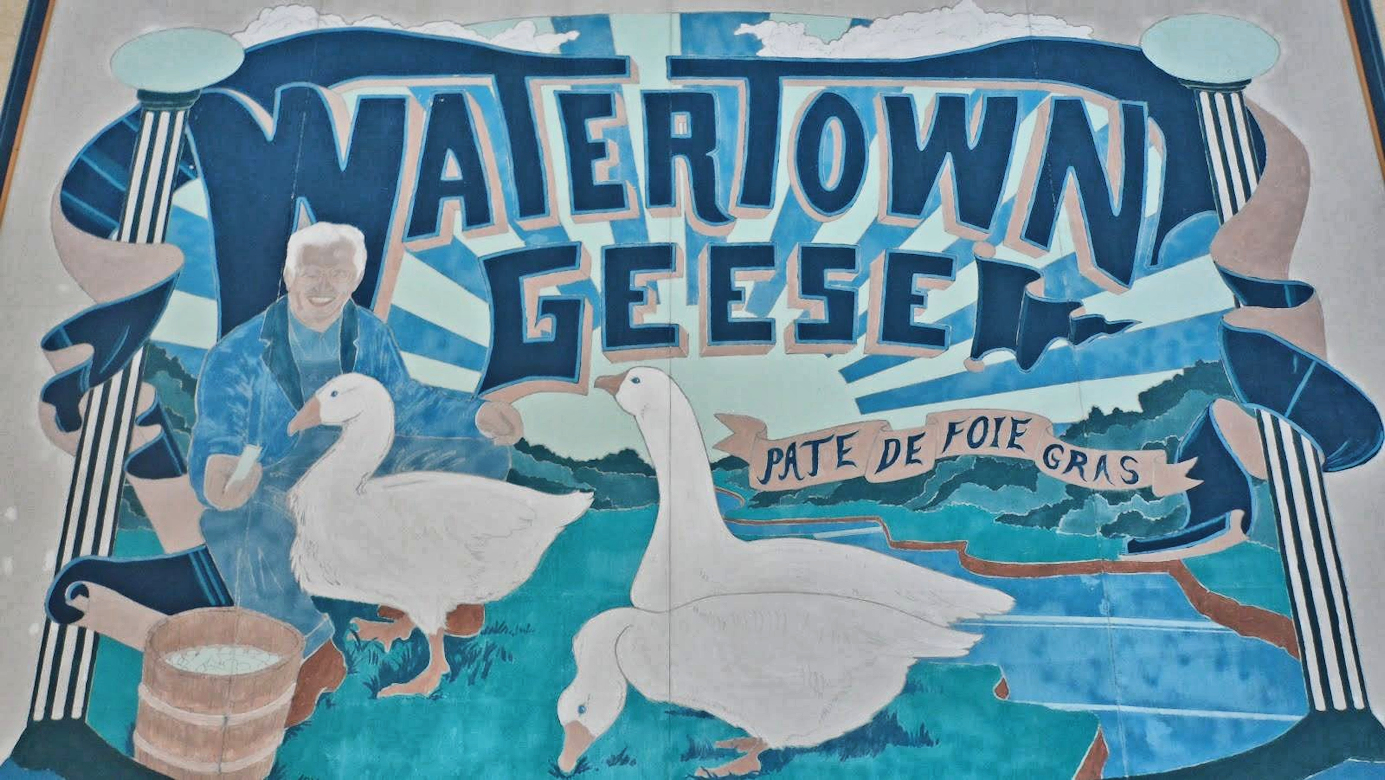
click
to enlarge
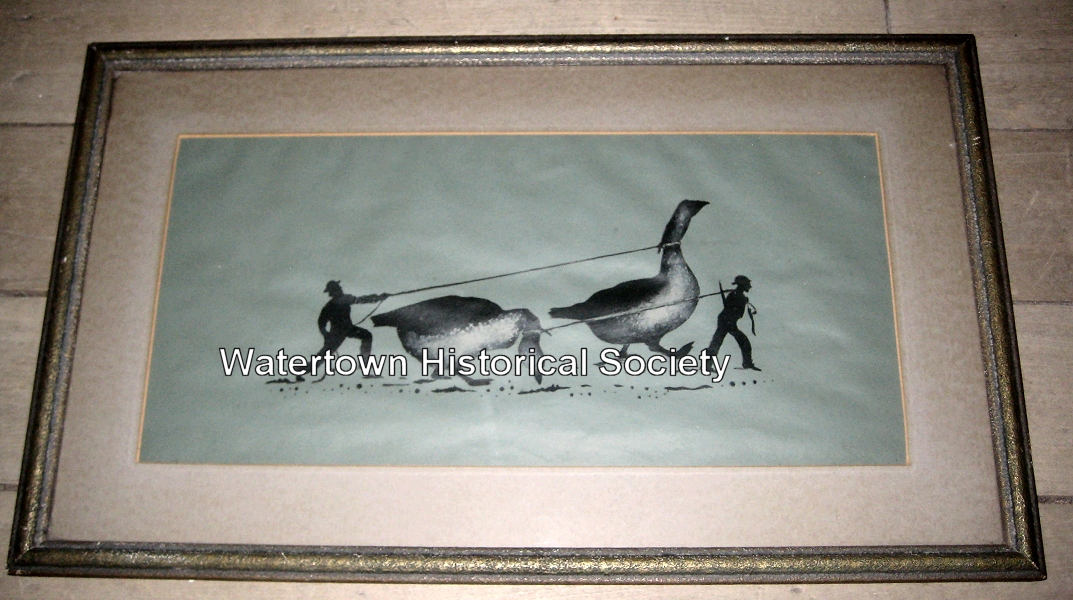
Men
and geese from collection of Oscar Wertheimer.
Artist unknown.
Watertown
may be the only city in the nation that claims the Mighty Gosling as a high
school mascot.
The
current Gosling mascot suit is thought to have been used for the past 25 years
and has been placed into retirement. The
Watertown Athletic Booster Club is spearheading a project to replace the mascot
suit with a brand new Gosling.
The
Gosling tradition dates back to the 1800s when the Watertown Gosling was
well-known up and down the East Coast.
Geese raised by local German farmers were specially fed to produce
fattened livers. The livers were turned
into pate, a delicacy found on the menus of fashionable restaurants in many
cities. A menu in New York City would
entice customers to the finest liver pate from the Watertown Gosling. Such advertising made the city famous from
coast to coast.
1890
12 17 THE
CHICAGO MARKET
Watertown
geese are the preferred breed in the Chicago market, and it is a common
occurrence to intercept the sign "Watertown Geese,” every now and then, in
traversing South Water Street, the great poultry market of Chicago. WR
1895
11 27 REPUTATION
FOR STUFFED GEESE
With
the advent of wintery weather and the Thanksgiving season the poultry business
has become quite brisk and the dealers are shipping in considerable
quantities. Watertown has an established
reputation as a mart for stuffed geese.
WR
12 25 H.
DAUB BOUGHT 64 STUFFED GEESE
Last
Wednesday Fred Albrecht, of Navan, sold to Henry
Daub sixty-four stuffed geese, the consideration being $240.82. This is reported to be the largest sum ever
paid here for one lot of geese. Mr. Daub
ships extensively to the Eastern markets.
H. Werthweimer, H. C. Meyer and A. Buchheit are also large suppliers. WR
1900
12 18 HENRY
MAYER PURCHASE
Henry
C. Mayer this afternoon purchased a consignment of stuffed geese of William Bergthal of Milford.
The consignment consisted of fifty-seven choice stuffed geese,
weighingl214 pounds, over twenty-one pounds a piece. The price paid for the consignment was
$218.52. WDT
12 19 WATERTOWN
GRAIN CO. PURCHASE
The
stuffed geese market set in heavily this week and for the next few days will be
at its maximum. The Watertown Grain
company purchased a lot today from Fred Albrecht of Milford, weighing tol888
pounds. The price paid was$339.84. WDT
1901
01 09 SUNDAY
SENTINEL ARTICLE REPRINTED
There
is another bird industry at Watertown and in the surrounding country which is
unique, and that is the stuffing of geese.
From the stuffed geese the delicious pate de foie gras is prepared, and
the Wisconsin city is one of the few shipping places of this delicacy in the
United States. Shipments are even made
to Germany, the home of the stuffed goose.
Stuffing
a goose is a process which is limited to about sixteen days, for if the process
continues longer than that time the goose gets so corpulent that its layers of
fat will endanger its death by choking.
An ordinary goose is increased by about half its weight by
stuffing. A twenty-pound goose will sell
at 20 cents a pound, while one weighing thirty pounds brings 30 cents a pound in
the market.
When a
goose is stuffed it is put in a darkened box, so small that it cannot turn
around, and fed all it will eat. When it
has eaten all it will, wet corn meal balls are poked down its throat by sticks,
till the crop is full to the brim. The
process increases the size of the goose’s liver until it is out of all
proportion to the size of the fowl. Some
stuffed geese will have a two-pound liver, and if sold alone the liver, which,
by the way, turns perfectly white, would bring as high as $1 a pound. The geese are sold entire, however, and the
white livers form the basis of pate de foie gras.
The
smoking of goose breasts and goose legs. which are sold at a high price,
completes a list of queer food products whose preparation forms one of the odd
things about the old German colony near Watertown. The Watertown Republican, 09
Jan 1901
04 19 The domestic goose holds about the same
honored place in the nutritive economy of Germany that the more delicately
flavored and patrician turkey does in that of the United States. It is the standard grocery of the German
people, and during nine months of the year forms the principal feature of the
table at festive as well as every-day when in season.
Although
every German village has its flock of geese, and notwithstanding the great
numbers that are fattened on farms along the banks of rivers, ponds, and small
lakes, the home-gown supplies fall short of the constant demand, leaving a
large annual deficit to be filled by importation, which comes mainly from
Russia.
The
season for this traffic is now at the highest and the receipts of Russian geese
at the Rummelsburg station in the southeastern
quarter of Berlin, average about 15,000 daily.
A special goose train of from
fifteen cars on ordinary days to thirty-five or forty on Mondays brings the
birds from Russian frontier tier. The cars are specially built and rigged for
this service and carry each about 1,300 geese.
WR
12 13 THE
SEASON FOR STUFFED GEESE IS AT HAND
. . . .
and this article of diet is being marketed here every day. The fowl vary in weight from 20 to 25 pounds
and the price paid varies with the weight.
For instance a fowl weighing 20 pounds would bring 17 cents per pound
and fowl over that weight would bring a higher proportionate price. The geese are shipped to New York, Cleveland,
Cincinnati, Saint Louis, Chicago and San Francisco, beside many other smaller
places where they are prized for their fat and enlarged livers. WDT
12 17 ENORMOUS
AMOUNT OF STUFFED GEESE HAS BEEN MARKETED
An enormous amount of stuffed geese has been marketed here the past two
days. The
Watertown Grain Company of which Mr. H.
Wertheimer is president, has contracted for 1200 stuffed geese and in the
company’s warerooms today 800 geese were packed in rows ready for shipment. The
quality of the geese this year is excellent but they are a trifle light
compared with other years, accounted for by the w arm weather which prevailed
until a few days ago. The average weight
is a trifle less than twenty pounds. Most of the geese will be marketed by
tomorrow but a few orders will be filled for the New Year trade. WDT
1904
12 20 A large quantity of stuffed geese has
been purchased here during the week. H.
Wertheimer paid over $2600 last Saturday for stuffed geese. Fred Albrecht, a resident of the town of
Milford sold 80 to him, for which he received a check for $386, and Mr.
Albrecht says this is only about half of his product this year. This firm also buys other lines of poultry,
and on Tuesday had on sale a 23 pound turkey, which was raised by Charles
Gillis of the town of Watertown.
Landlord Brandenburg of the New Commercial purchased it and will serve
it on Christmas day to his guests.
Henry
C. Mayer has also purchased a large number of stuffed geese during the week,
paying out $351 for 73 geese to one farmer alone. Over 38 tons of stuffed geese were shipped
from here during the week.
1906
Watertown Leader, 12
13 1906
Talk
about stuffed geese - well, the Leader
never saw stuffed geese until yesterday. Happening to go into the office of
Ex-Mayor Wertheimer, the head quarters of the stuffed geese trade, he was shown
the largest goose he ever saw. It weighed 34 pounds and netted the farmer who
brought it to market just $11.56. He also saw 60 geese which averaged 25 1/2
pounds which gives some idea of the value of the business. Mr. Wertheimer has
purchased thousands upon thousands of pounds of geese the past few days and the
end is not yet.
He
ships geese to about every city in the United States and is rushed to fill the
orders that pile in upon him. As has already been said in the Leader, few
realize the extent of the business and the large amount of money which it
brings to the farmers in the vicinity of Watertown. It is simply immense and
growing larger each year as the demand becomes greater.
1906
Watertown Leader, 12
30 1906
Wednesday
and yesterday, W. A. Beurhaus bought over 6,000 pounds
of stuffed geese, one farmer delivering a load yesterday that weighed 2,684
pounds for which he received a fat check, which convinced him that fat geese —
especially when the geese averaged over 22 pounds each — are a good thing about
Christmas time. Several of the geese
received yesterday by Mr. Beurhaus weighed 30 pounds,
and one turned the scales at 32 pounds.
Mr. Beurhaus is packing the geese purchased
for consignment to parties in New York, Cincinnati, Pittsburgh, New Orleans and
San Francisco. Watertown, as has already
been noted in the Leader, is the headquarters for stuffed geese which are
regarded as a delicacy by many people who, being possessed of wealth, can
afford the luxury — for a thirty pound goose costs a sum of money, more than a
poor man can afford to pay.
The art of noodling geese, which many
years ago put Watertown on the map, has completely faded out of the picture
within the past several years. The last family in Watertown to carry on this
practice was Mr. and Mrs. Fred Rumler of 727 North
Church Street.
I
remember the Rumler family on North Church. I knew
them causally as they were members of my church. Their home went all the way
down to the river and they had their geese there. My grandmother made Grieben
Schmaltz (lard) from geese. (Contributed memory)
Watertown Daily Times, 12 22 1953
One hundred and sixty genuine Watertown
stuffed geese will find their way to market this Christmas. The entire supply
of 160 birds is being provided by Fred Rumler of 727
North Church Street, the lone practitioner of what was once a flourishing
"art" here. Most of the birds will go to Luchow’s
famous New York Restaurant. The supply of the much sought after geese is
slightly higher than last year when it had dwindled to a mere 100 or less.
Years ago, when the stuffed goose reigned supreme locally, thousands of them
were raised and prepared for market by German farm families in this area.
Watertown Daily Times, 12 10 1954
The
famous Watertown stuffed goose - the genuine article, but less in number than
in any year since the art of stuffing geese - was carrying the name of
Watertown to New York again this Christmas season.
What
was once a flourishing business in Watertown and farms surrounding Watertown
has dwindled to one lone practitioner.
The
only supply of the famous stuffed geese will come from the Fred Rumler flock at 727 North Church Street. The Rumler family is the last source of supply of the much
sought after and highly prized fowl.
J. O.
Brunelle of Kerr's Poultry and Egg House at 510 [508] West Main Street has
taken over the entire supply of stuffed geese from Mr. Rumler
and the first shipment - between 70 and 80 birds - will be shipped to New York
next Tuesday, with a few more going a few days later.
Practically
all of the geese have been purchased by Luchow's famous
German restaurant in New York which has expressed a desire to take all it can
get. But the available supply is far below what the restaurant would take if it
could get them.
Mrs. Rumler was among the last practitioners of the art of
stuffing geese, having been taught by her parents, the late Mr. and Mrs.
Charles Scheel, who prepared stuffed geese for market for 25 years. The Rumlers had
been stuffing geese for 30 years, retiring from this trade just a short time
ago.
Years
ago when people visited large cities south or east of Chicago during the
poultry season, the eye would catch the sign, 'Watertown Stuffed
Geese." When traveling by train, on
the menu card of the diner would be found, "Watertown Goose.”
The
most prized part of stuffed geese has been the liver which becomes greatly
enlarged because of the “forced feeding."
It is used in pate defoie gras. The
neck, feet and wings were used for making dishes known as "Ganse Klein" and the skin, which was
toasted, was known as "Ganse Grieben.” This
was a favorite dish at Christmas time in wealthy Jewish households.
For
many years the late Fred Albrecht was the "Goose King" of this area,
being among the most successful and largest of raisers dealing in stuffed
geese.
The
geese that were raised and prepared for market in this area found their way to
tables of wealthy people in the east, New York, Boston, Philadelphia, and other
eastern points which usually purchased the bulk of them. Commission men had a
difficult time supplying all the requirements. Orders were placed weeks and
even months in advance and some wealthy families had standing orders from year
to year to be certain of getting them.
After
1930, when the stuffing practice began to wane, some of the limited number of
stuffed geese were sent to a number of customers in California, among them
persons prominent in the motion picture industry.
The
principal reason for stopping the process was that the federal government would
no longer permit interstate shipment of the birds unless a government inspector
was present when they are slaughtered, Since there was never a central
slaughtering point for stuffed geese In Watertown, and since each farm family
which engaged in raising and preparing of the stuffed geese for market did its
own slaughtering, it would be impossible to engage an inspector for each one of
the farms.
However,
the decline began to set in prior to that time because preparing such geese for
market entails long hours and is most tedious work, and each year fewer and
fewer farmers engaged in raising them. Two and three generations ago families
were still willing to put in the time and effort but as their children grew up
and either left the farms or took over the farms, most were no longer willing
to do such work.
The
William Schmidt family, which was located on a farm southwest of Watertown, was
also active in stuffing geese. One year alone 130 geese were stuffed by the Schmidts. Schmidt practiced the art of noodling geese for
30 years. The geese in later years were prepared by his three sons, Edwin,
Erwin and Rudolph.
The
art of noodling geese was brought to Johnson Creek and Watertown by a family
named Stiehm. Because most of the geese so prepared
were marketed through Watertown, this city acquired its name of "Goose
City."
Back
in 1921, 50,000 pounds of stuffed geese were shipped from Watertown annually.
It is said that 10 years prior to that time shipments were three times as
great.
The goose
industry was highly specialized. Three breeds of geese were raised, Toulouse,
Emden and African. The Toulouse and African both had slate-colored backs and
white bodies. The Emden was pure white. The African differs from the Toulouse
in having a black bill.
Early
in the spring the largest eggs were selected and placed under hens for
incubation. Most of the goslings were hatched in April or early May. Clean
quarters and a pond in which to swim was provided.
Experienced
farmers carefully selected their stock and fed them all the corn they wanted
long before the stuffing season. They took every precaution to keep them
contented and tame and to teach them to feed from the hand. A few days before
starting the stuffing, the birds are handled frequently and become well
acquainted with those who are to feed them. The birds must be tame and used to
handling, as a vicious, timid or nervous fowl could not be fattened
successfully.
Throughout
the summer the young geese glean much of their own food from the pastures but
are fed a little mash and grain. About November 1st the larger geese are
selected and placed in stalls and sometimes in boxes, and the process of
forcible feeding is begun.
Only
males were used for stuffing because they are hardier than the females.
The
making of the noodles for the fattening process is the key. Three of four
grains, barley, rye and wheat are mixed into a paste that looks like
"putty." By the use of an old sausage stuffer or some hand-made
invention, this pastry substance is molded into strings about the size of small
wienerwursts, an inch in diameter and four inches in length. The noodle are cooked in a wash boiler,
drained by a boiler sieve, cooled by immersion in cold water to prevent crumbling
and then put into a cold place until ready for use.
All is
now ready for the feeding. With a bucket of noodles and a pail of hot water,
the farmer goes to the stalls. Sitting on a box, he takes a goose between his
legs and after dipping the noodles into the hot water holds the goose’s head in
one hand and with the other introduces the noodle into the fowl's mouth and
gently pushes it down. During the first few days three noodles are fed every
four hours. Some member of the family had to be awakened at night to attend to
the feeding. Two or three weeks later a goose would be able to eat from 30 to
36 noodles.
The
feeder wears heavy gloves to protect his hand from the razor sharp teeth which
line the goose's mouth.
The
goose helps by gulping, and then there is another, and so on until the goose is
full. The feeder knew when the goose was full because his neck was completely
filled with noodles, literally to the top of his throat. Occasionally a goose,
shaking his head violently, will toss out a noodle. A good long goose neck will
hold some seven or eight noodles weighing about a pound.
Feeding
the noodles to the geese makes them thirsty and gallons of water were drunk by
them. A 25 pound goose would drink two gallons daily. It requires from three
weeks to 25 days before the "stuffed" bird is “ripe” for killing.
After the second week the geese are too heavy to walk and sit near the drinking
trough until the next feeding.
Most
of these stuffed birds weigh from 25 to 35 pounds each when prepared for
market. Within a period of from three to 25 days they will have gained from 10
to 12 pounds in weight.
Preparing
the bird for market, also took a great deal of care.
A
sharp knife was inserted at the base of the bird's skull for the purpose of
execution. The feathers could not be removed from the tender skin by either
picking the feathers dry or removing them by scalding. The birds were placed in
cloths above a steaming boiler and kept there until the feathers would come off
without abrading the skin.
The
bodies are singed over by an alcohol flame and then hung up in a cool place
until the following morning, when they are ready to be packed in barrels or
boxes for shipment.
Because
of the value of the liver, these were often removed and placed in sealed glass
jars for shipment.
Over
the years, especially in the 1930s, various humane organizations condemned the
practice of “forced feeding" of such geese to produce the extra large livers.
For several years a California woman, having read about the stuffing of geese
here, wrote a letter to the Daily Times
each December condemning the practice and called for abolishing what she called
"the most inhuman thing.”
1907
12 17 SOUGHT
FOR BY EPICURES
But few realize that the livers of stuffed geese is a great delicacy
and eagerly sought for by epicures, and many will be surprised to learn that
livers weigh as much as 10 pounds each.
Yesterday Jacob Breunig, 210 North Sixth
Street, removed a liver from the carcass of a goose that was of the weight
above stated. Mr. Breunig
is engaged in smoking the breasts and hips of the geese, which find a ready
sale at home and abroad at a good price.
The stuffed geese industry has made Watertown famous from one end of the
country to the other and the demand continues to increase. WD [Breunig, Jacob & Co,
1913, 314 E Main, delicatessen]
1910
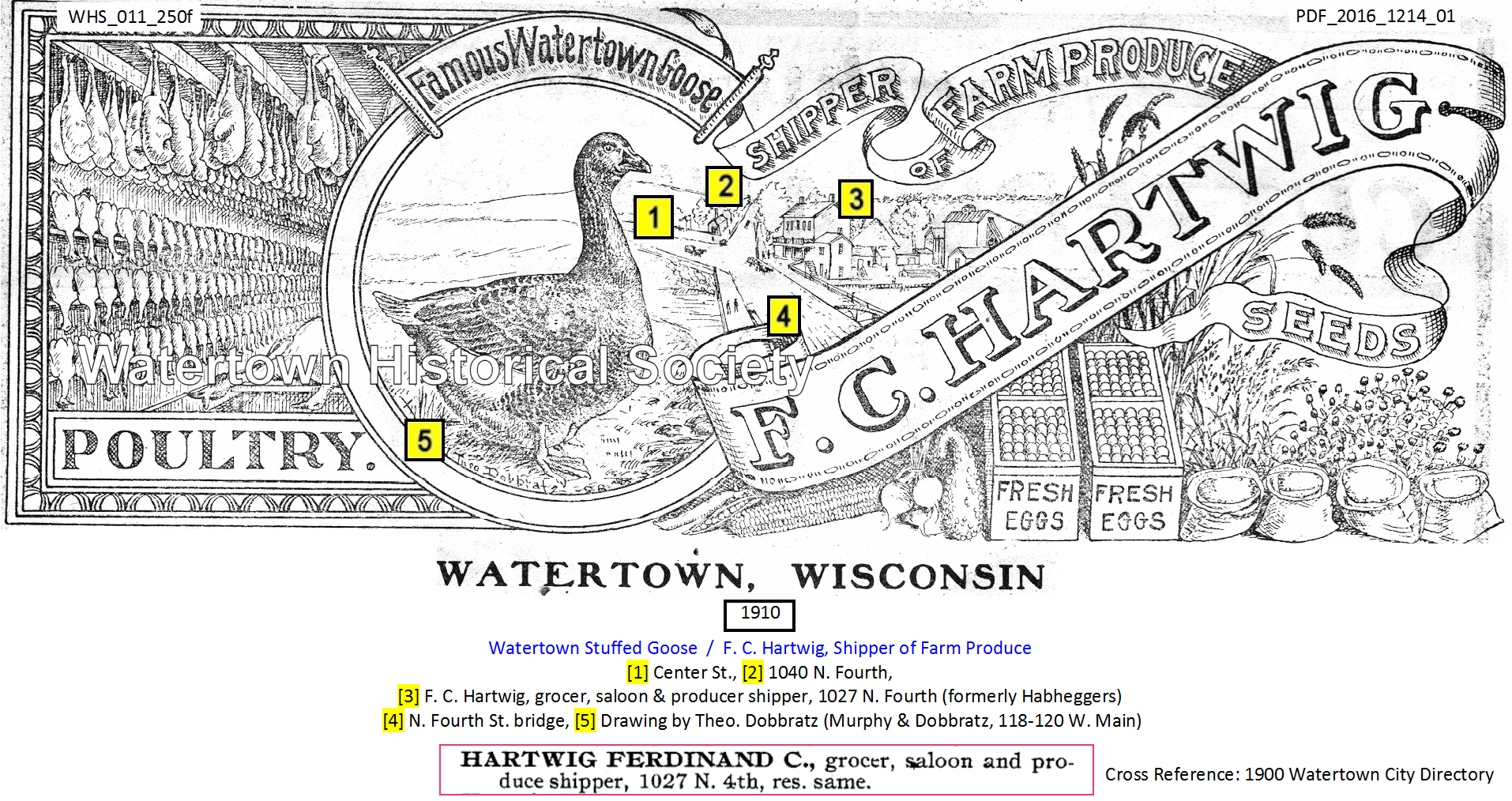
-- -- F. C. HARTWIG, 1027 N. Fourth Street
1912
12 19 THE
1912 SEASON
This
has been a great week for selling stuffed geese in Watertown. On Tuesday 900 were sold at Melzer’s seed
store, one of which weighed 37 pounds.
The Watertown Grain Co. bought 615, one of which weighed 36 pounds. WG
1913
10 09 WATERTOWN
STUFFED GEESE
Sliding your eye down
the carte du jour, you fix on the item:
Stuffed Watertown
Goose, a la Daub, $3. [Served for two, 50 cents additional]
You remark: "I
surely would like to taste some stuffed Watertown goose, a la Daub, but I have no
idea this evening of buying pearl tiaras for any high-binding son of a
Watertown goose monger." [Henry
Daub’s saloon and restaurant]
Perk up. The tariff
slides 'way down next year.
Don't thank
legislation.
Refrigeration.
In the city at the
ice congealment — the copyright is bi's — is a young
business man fresh from Watertown, Wis.
His message to epicures is that he is building a commodious refrig plant in the goose town and that each late fall —
the best season for Watertown goose — a large part of that city's population
will be hustled away to some poultry Atropos, then dressed and filed away under
"frigid" for follow up during spring and summer.— Chicago
Evening Journal / Watertown
Gazette, 10 09 1913
1916
11 24 17 CENTS A POUND
Chas. Kerr of Watertown is paying 17 cents a pound
for geese, 18 cents for ducks and 27 cents for turkeys. Rush them along. WDT
12 08 THE STUFFED GOOSE SEASON IS ON . . . .
. . . . and near Watertown and the big, fat birds
will soon be placed on the market. The
price this year is 4 cents above the schedule; that is 4 cents per pound above
the weight of the goose. If, for
instance, a goose weighs 27 pounds the price is 31 cents per pound. In years past some farmers living in the
vicinity of Watertown have received as high as $1,000 for a flock of about 120 geese. The geese are fed on corn for a month or so
and then for three weeks before marketing are put in small pens and are
“stuffed” with boiled noodles several times each day. During the last week the goose is fed every
three hours day and night. WDT
12 30 OTHER
STATES PRODUCE WATERTOWN GEESE
From Los Angeles,
California, Mrs. Herman Brandt sent us the advertisement which appeared in the
Los Angeles Evening Express in which
it says:
“Tom Murray serves
Watertown Goose for Christmas Dinner.
These big fat prize geese are way from Watertown, Wisconsin. There will be a crowd, of course, so you
better phone to have a table reserved.
Do it now if you want a taste of these 40 pound geese. Livers and goose grease from these famous
Watertown geese sold separately.”
These 40 pound geese
in Los Angeles gave us cause to ask our handlers Wertheimer & Co., Wm. A. Beurhaus and Chas. Kehr and they
tell us they had no 40 pound or other geese sent to Los Angeles. Therefore there are other states who produce
Watertown Geese. Mrs. Brandt was amused
about this in that she read about this and Watertown, where she had lived for
some time and is acquainted with the raising and production of geese. Watertown Weltburger
1918
12 06 STUFFED
GEESE DEMAND WILL BE LESSENED
The demand for
stuffed geese this season is not nearly as great as in former years and in
consequence the stuffed goose market will fall off greatly.
The season is now at hand
and the marketing will be done the week before Christmas. The prevailing high poultry prices is given
as the cause for this condition. Take
for instance geese which will average 25 pounds. The local buyer this year will be compelled
to pay about 17 cents over the average, making the geese cost 42 cents a
pound. By the time they reach the
markets of the country they will cost the consumer at least 50 cents a pound.
Some stuffing is
being done, however, and some big geese will doubtless be marketed here, but
the number will be lessened and, in their place, will be marketed a larger
quantity than usual of stall-fed geese.
Prices will range
about the same as at Thanksgiving, with the exception that geese may be a
little off at the start as there was a big Thanksgiving supply and the New York
market fell off at the close. However,
with butter at 76 cents a pound and eggs at 60 or better, the poultry
price bids fair to remain about as high as it was at Thanksgiving time. The Watertown News, 06 Dec 1918
1928
12 24 MERRY
CHRISTMAS - FOR SOMEBODY ELSE
Watertown, Wis. (AP) So far, as some 10,000 Watertown geese
are concerned, this will be a Merry Christmas for somebody else.
They will form the piece
de resistance of the yuletide meal on family and restaurant tables tomorrow not
only in the middle west but even as far east as New York
"Stuffed
Watertown goose" is the official title.
It means careful feeding six times or more a day to produce geese, some
of them so fat they can hardly waddle, esteemed as a table delicacy.
One Watertown produce
merchant estimated between 10,000 and 12,000 of the geese were sent out for the
Christmas trade. Besides that, there
were at least 15.000 ducks shipped out, he estimated
Watertown geese,
so-called, are raised by formers in this section of Wisconsin, some of them
living as far as fifty miles from this city of 9.500. Their geese have brought Watertown a unique
reputation.
There are two types
of geese—noodled, the "extra extra" special
geese, and "stall fed.”
The "noodled
ones are fed noodles six times a day — every four hours. The same applies to the "stall fed”
geese, only their diet is grain and milk.
In a few weeks, these geese gain from three to ten pounds. Their livers often are as large as three
pounds and these are esteemed as another delicacy
The
goose-and-duck shipping season for Christmas trade ended Wednesday. Now other geese and ducks are being raised to
supply the year-round trade which reaches its peak at Thanksgiving. - The
Oshkosh Northwestern (Oshkosh, Wisconsin), 24 Dec 1928
1936
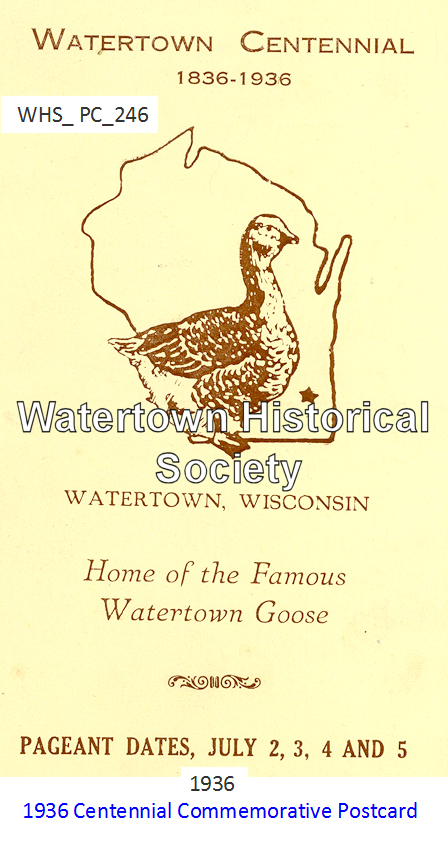
July CENTENNIAL
COMMEMORATIVE POSTCARD
1958
12 05 Some 200 genuine Watertown
stuffed geese readied by M/M Fred Rumler WDT
1959
11 05 Uncle Sam has given
the expected "Dodo" bird treatment to Watertown's famed stuffed goose
and as a result the happiest woman in the United States today is probably the
one in California who year after year, about this time, has written a letter to
the editor of the Daily Times
inquiring when Watertown was going to give up "the barbaric and inhuman
practice of stuffing geese by forced feeding?" She abhorred goose stuffing and said so time
and time again. She opposed it because
she said it violated humane laws and she often expressed distress over the fact
that no humane society hereabouts had ever entered or expressed an objection or
called upon the law to step in. WDT
1960
01 21 Watertown's goose
noodling industry, already hard hit by recent rulings involving federal
inspections at the points of slaughter, today faced dire restrictions for the
1960 crop of Watertown geese, for 100 years or more a leading Christmas
delicacy in famous eating places and on private tables of wealthy individuals. Secretary of Agriculture Ezra Taft Benson has
ruled that Watertown's famous geese cannot be exempt from federal
inspection. The issue had been put to
him by Congressman Robert W. Kastenmeier of
Watertown. Kastenmeier
had asked Benson to exempt Watertown noodled or stuffed geese from the
provisions of the 1957 poultry products inspection act because farmers engaged
in noodling geese and processing them are not engaged in a regular commercial
venture. WDT
1963
12 18 The famed Watertown
Stuffed Goose which for so many years carried the name of Watertown throughout
the land and in foreign countries at this holiday season of the year has now
declined to a point where only a few such geese find their way to the tables of
the wealthy. No longer is “Watertown Stuffed Goose” entered on dinner menus at
fashionable hotels in this country and in London. The number of stuffed geese
now produced here is down to a mere trickle compared to the thousands that once
were prepared on Watertown area farms and shipped form here each December.
According to Jerome O. Brunelle of Kerr’s Poultry and Egg House only a few such
geese went to private individuals who placed orders for them this season. The
last such shipment was prepared yesterday afternoon, Mr. Brunelle said. At one
time many shipped from here through Kerr’s went to famed Luchow’s
Restaurant at 110-112 East 14th Street in New York City. WDT
1964
12 18 Watertown’s once famous stuffed goose
has become so scarce in recent years that this Christmas it will be a
collector’s item. The geese, specially
fed during the last six weeks before being butchered and marketed at Christmas
time often attained a weight of as much as 38 pounds and when dressed resembled a large blob of butter. The meat never was prized too highly, because
the stuffed goose was mostly fat. These geese were valued for their enlarged
livers, produced by the forced feeding process at which German farmers in this
area were experts. WDT
1965
12 15 STUFFED GEESE A
COLLECTOR’S ITEM
There will be less genuine Watertown
stuffed geese on the Christmas market this year than ever before. The type of goose for which Watertown was
famous for generations is now a virtual collector’s item. The geese, specially fed during the last six
weeks before being slaughtered and marketed at Christmas time, often attained a
weight of as much as 38 pounds and when dressed resembled a large blob of
butter. WDT
1967
09 13 QUEST FOR GOOSE FEATHERS
A 68 year old man, who spent part of
his boyhood on a farm in the Watertown area, is back for a visit and is in
quest of a source of supply for the goose feathers he needs in the production
of the 100,000 goose quill pens he makes each year in Charlottesville,
Virginia, where he lives. Lewis Glaser
has been making the goose quill pens for 15 years, and currently is getting the
feathers he needs from Germany and France.
“I’d like to buy the feathers in the United States. I came to Watertown because it’s the center
of the stuffed goose industry and because as a boy I worked on a farm near
Watertown.” He has been in touch with
“Rosie” Brunelle, who for many years has supplied Luchow’s
Restaurant in New York City with stuffed geese. WDT
1968
12 22 MOUNTED NOODLED GOOSE
DONATED
The Watertown Historical Society will learn for the
first time by reading it here that the wheels were set in motion last week to
present it with a unique Christmas gift to be ready for display in its historic
Octagon House barn at its reopening in May.
This gift is a huge genuine noodled goose being mounted by taxidermist,
Walter Pelzer of the Milwaukee Museum, to elucidate and perpetuate the history
of a highly specialized industry originated two centuries ago in Alsace and
brought exclusively to the Watertown community by German farm immigrants a
century ago. About 150,000 pounds of
Watertown Stuffed Goose, made extremely large especially in the liver for the
choice delicacy of pate de foie gras, were shipped out at Christmas time for
the eastern gourmet restaurants at the height of the industry’s activity
here. Fred Rumler,
727 North Church Street, is the sole remaining producer today.
05 07 WATERTOWN
STUFFED GOOSE DISPLAY
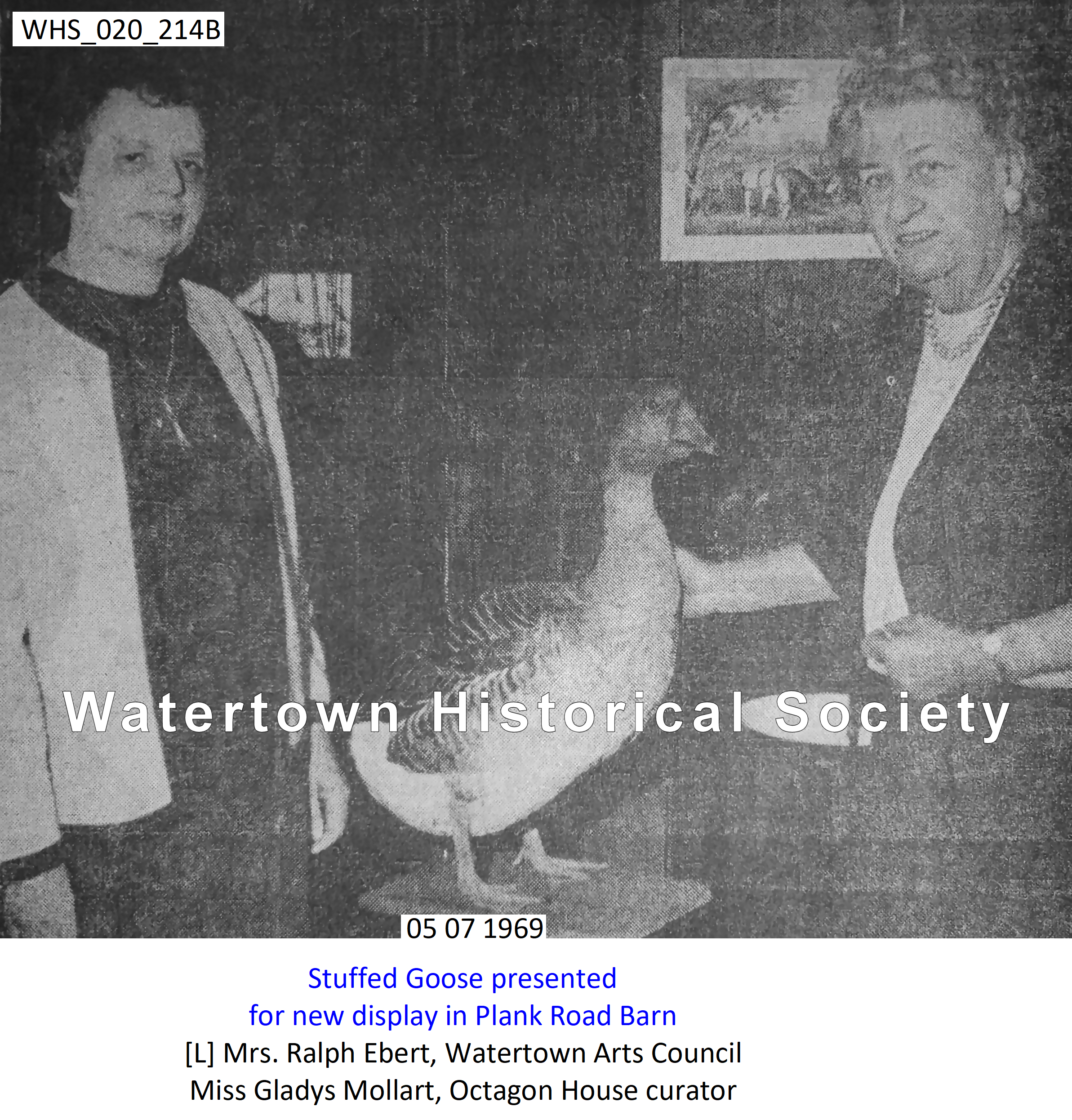
A new acquisition of
the Watertown Historical Society to its museum complex of Octagon House, First
Kindergarten and Plank Road Barn is a noodled Watertown goose.
This huge, handsomely
mounted exhibit is an example of a unique, highly specialized, once thriving
industry brought to Watertown by German farm immigrants over a century ago.
Fred Rumler, the one remaining producer here, noodled this
specimen especially for the museum display.
The taxidermist Walter Pelzer of the Milwaukee Museum mounted it.
The display is a gift
of the Watertown Arts Council to the Historical Society.
“The Historical Society
is pleased to acknowledge the Arts Council’s gift of the handsome Watertown
noodled goose. This gesture of
cooperation between these two community societies is most gratifying in that it
points out that all creative and skilled endeavor is art no matter where you
may find it. In exhibiting this fine
specimen, we are preserving a most interesting ethnic legend telling of bygone
days in this rural area which have left their mark on an entire country in the
nationally recognized Watertown Stuffed Goose.”
-Miss Gladys Mollart, museum curator
1970
Local Stuffed Goose
on Display at Bank Here
Watertown Daily Times, 04 09
1970
An
attractive and unusual display of a genuine Watertown Stuffed Goose: has been
placed in the Merchant’s National Bank.
It is a joint project of Watertown’s Arts Council and Historical Society
in an effort to bring before the public a bit of this community’s early
history. On display with the immense 25
pound goose are also a cast model of its enlarged liver, four pounds, beside
that of a normal goose. Completing the
display is a sample of the “noodles” used in the forced feeding process and the
historical legend which reads:
Watertown
Stuffed Goose, found on the menus of gourmet restaurants across the nation,
derives its name from the highly specialized old-world vocation brought to the
Watertown area by German immigrants in the 1850’s.
The
geese, and especially their livers from which the delicacy Pate de foie gras is made, were developed to enormous size by a
stuffing process of forced feeding. A
patsy mixture of barley, rye and wheat, rolled in the form of noodles, was
forced down the fowl’s throat every four hours to hasten the fattening. Often a goose so treated would attain a
weight of 30 pounds with a four pound liver.
At the
height of the industry here, about 1920, 150,000 pounds of stuffed goose were
shipped from Watertown annually. Today
there remains only one grower, but the name “Watertown Stuffed Goose” endures.
Christmas
1968 marked the year this African-Toulouse goose was noodled especially for the
Watertown Historical Society and prepared under the auspices of the donor, the
Watertown Arts Council, for this exhibit of a by-gone industry which made this
community famous.
A
four-page detailed story is available at the Octagon House souvenir center.
The
display will be on view in the Merchant’s Bank until May 1 when it will be
returned to the Octagon House museum for the opening of the tour season there
from May 1 to Nov. 1.
Credit
for the project goes to Joseph Darcey, Arts Council board member who arranged
the display in the bank, and to Mrs. Ralph Ebert, arts council board member and
Historical Society lifetime member, who first saw the desirability of the
city’s acquiring such a unique and artistic testament of its heritage.
Mrs,
Ebert also made the arrangements in 1968 with Fred Rummler,
Watertown, to noodle the goose, Walter Pelzer, Milwaukee Museum taxidermist to
mount it, and the Watertown Arts Council to finance and donate it to the
Historical Society. The Merchant’s
National Bank is proud to have this display and invites the public to come view
it.
The
earliest use of the word “gosling” when referring to Watertown
High School students is believed to be in the August 7, 1885 issue of the Watertown Gazette. “A raid by the Marshal on the steps of Union
School house No. 2 some evening about 9 o’clock would create a panic among the
young “goslings” which congregate there.
It has become quite a resort for young ladies and gentlemen of late
after dark.”
Among
the last evidence of Watertown's reign as America's goose capital comes from
its high school sports teams - the Watertown Goslings. The local radio station is “1580, The Goose”
and a popular polka band was known as “The Goosetown
Dutchmen.”
Cross-References:
No.
1: Milwaukee Journal Sentinel story (11 26 1998) on topic
No.
2: Watertown Daily Times column on topic
No.
3: Watertown Daily Times column on topic [WHS_005_235]. Many of the orders were sent to William Beurhaus,
200 Main St., who apparently handled the shipping and marketing for farmers.
No.
4: San Francisco Chronicle article, “Plagued by activists, foie gras chef changes tune”
No. 5: In addition to its reputation for stuffed
geese, Watertown was famous as a national market for squab
No. 6: Milwaukee
Journal Sentinel story (08 21 2006) on foie
gras
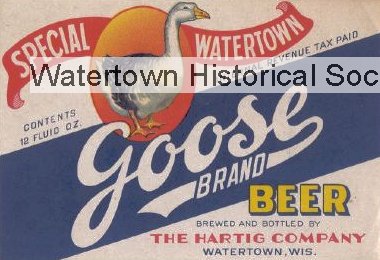
No. 7: Hartig Goose Brand
Beer. Cross reference to Hartig Brewery
No. 8: Rumler designed
rope-making machine WDT 07 14 2008
Roasted Watertown Goose recipe
No.
9: Milwaukee Journal Sentinel story (11 06 13)
Foie gras removed from Puck
restaurants, AP, 03 23
2007
LOS
ANGELES - As part of a new initiative to fight animal cruelty, celebrity chef
Wolfgang Puck said he will no longer serve foie
gras, the fatty liver produced by overfeeding ducks and geese. Puck [14 fine-dining restaurants, more than
80 fast-casual eateries and 43 catering venues] worked with the Humane Society
on the new initiative. He said he wasn't responding to pressure from animal
welfare advocates, but instead believes the best-tasting food comes from
animals that have been treated humanely.
California has decided to ban the production and sale of foie gras starting in 2012. Chicago
imposed a ban last year, and bans are being promoted in Illinois, New Jersey
and New York.

History of Watertown,
Wisconsin