website watertownhistory.org
ebook History of Watertown, Wisconsin
Buena Vista House
300 North Fourth Street
In
1847, the Battle
of Buena Vista took place during the Mexican-American
War.
U.S.
troops, led by General Zachary Taylor, fought
Mexican
General Santa Anna’s forces, who ended up withdrawing
Buena
Vista House. Built by Henry Boegel. Opened Feb 1848. Boegel was in Mexican War and had taken part
in the Battle of Buena Vista, hence its name. In 1849 Boegel sold to William Wiggenhorn, who
rented it 6 years later to son Constance Wiggenhorn. In 1855 sold it to A. Meiswinkel;
later sold to Franz Gebhardt and A. Bertling.
___________________
The
Buena Vista House, now (2016) known as Yangers Pub. It opened in 1847 and was soon afterwards
purchased by Wilhelm Wiggenhorn and his family who ran the place very
successfully for many years. They
served some of the finest food west of Milwaukee it
was claimed.
The
tavern was home to the German refugees of the Revolution of 1848 and many a
political debate was heard there. It was
also the site of the first gathering of what later became St.
Luke's Lutheran Church in 1847, as well as the site of the formation of the
first German singing society, known as "Der Liedetafel,"
in 1847.
After
the Wiggenhorn family (pioneer cigar makers here) sold off the property, it was
run by a succession of different owners.
During Prohibition it ceased selling drinks and became more of a rooming
house/restaurant.
It
lost its distinctive name, pronounced "Byoon-a-vista"
by Watertowners, in the mid-1990s and took on the
name Yangers and also
adopted a green and gold paint job. The
building, I believe, is essentially the original one from over 150 years
ago. - William F. Jannke III
1848 WIGGENHORN
PROPRIETOR
In the
spring of 1848, there came Dr. Fischer,
John C. Halliger,
Hohrmann and Ernst Achilles together with
families, then the first Baptist Fried.
Schielemann with wife, Nottorf,
Grossmann and Lorenz Fribert, Wilhelm
Wiggenhorn with family, among whom were his sons Constanz, Alexis, Eugen and August; Adolf Beurhaus and Adolph Lange, both
married, Henry Maldaner,
Fritz Herrmann, Chas. M. Ducasse, Gustav Schnasse,
Martin Hopf, George
Schempf and family, Schmidt
Toelle, Henry
and Louis Mulberger, Carl Roedel, Georg Koenig,
Louis Stallmann, Leonard Meth with wife and several others.
Wilhelm
Wiggenhorn arrived here with his family in the month of October, 1848, after he
had been on the farm with Averbeck for several weeks, and
bought the Buena Vista House and
the opposite lot from Henry Boegel
for the sum of $1680. The house [hotel]
at that time, however, was in only a half-finished condition, and only
plastered one time, but it was furnished comfortably as an inn and the upper
story was even used for divine services of the Evangelical Protestant parish,
which, in the absence of a regular preacher, was presided over by Mr. Senator Meyer. In his absence, Louis W. Ranis led the parish, and special religious functions
such as weddings, christenings, etc. were performed by Pastor Dietrichsen from
Milwaukee who came here from time to time.
In the
vicinity of the Buena Vista House, a German lathe operator had erected a windmill
on a stump, in order to operate his turning shop with it. His name, not accurately determined, was
declared by some as Schiess, by
others as Spiess. He did not however achieve his wish with his
windmill, and for a long time afterward its rudder stood there, without being
used until finally this and other buildings had to make way for the [St.
Henry’s] German Catholic church.
1848
WATERTOWN: “SECOND CITY” IN WISCONSIN,
PLANK ROAD BONANZA FOR LOCAL
TAVERNS
“After the completion of the plank
road, Watertown, early a place of promise, became the second city in the
State and a bonanza for taverns; their story, however, has been well told in
local histories. People and produce from
the country to the west and north for many miles PASSED THROUGH WATERTOWN TO
MILWAUKEE, and land seekers made it their
headquarters. J. B. Van Alstine, for
years the popular landlord of the Exchange, declared that he thought business
dull in those palmy days unless he had a hundred guests and as many horses to
care for. Two of the old taverns are
still running [in 1915], the Watertown House, now the Commercial, and the Buena
Vista, which was opened in February, 1848, by Capt. Henry Bogel, a veteran of
the Mexican War. During the regime of
William Wiggenhorn and his son, Eugene, the Buena Vista was the rendezvous of
German revolutionist refugees, among them Carl Schurz and Emil Rothe, while on
Sundays German services were held in its hall.”
Derived from “The Taverns and
Stages of Early Wisconsin” by J. H. A. Lacher, 1915. Contracts for construction of the road were let in October of 1848.
1900
08 24 PROTESTANT CHURCH HELD SERVICES AT BUENA
VISTA HOUSE
The German Evangelical Protestant church on North
Fourth was organized here in 1850, and the congregation first held services
at the Buena Vista house.
1851 BALL ALLEY
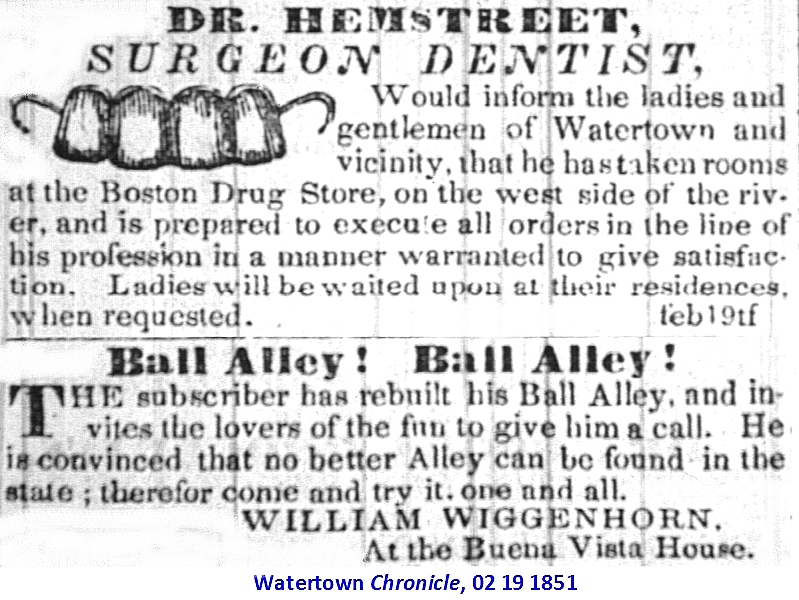 Ball
Alley at the Buena Vista House, bowling
Ball
Alley at the Buena Vista House, bowling
1866
GEBHARDT PROPRIETOR
Francis Gebhardt, proprietor, Buena
Vista House. Gebhardt was paid rent for Pioneer fire
dept engine room in 1859.
c.1895
GROUP PICTURE
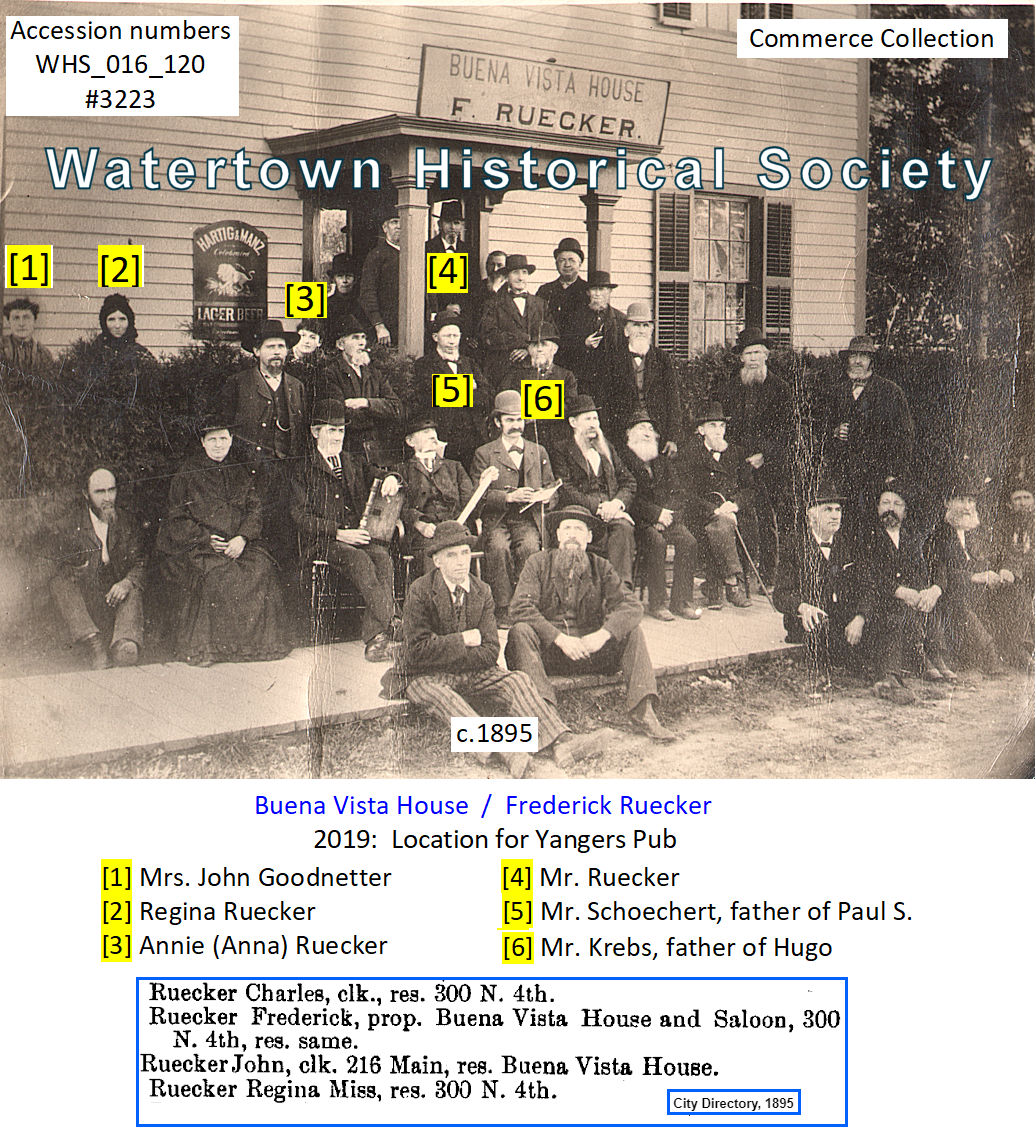
Mrs.
John Goodnetter, Regina Ruecker, Annie (Anna) Ruecker, Mr. Ruecker, Mr.
Schoechert, father of Paul S., Mr. Krebs, father of Hugo.
04 30 BUENA VISTA HOUSE SOLD
Louis Kronitz, who
recently moved to this city from Clyman, has purchased the Buena Vista House of
Otto Knoll, paying therefore $9000.
Louis is an old Watertown boy, and his hosts of friends here and
elsewhere wish him success in his new venture in Watertown business circles. WG
1916
Dec PROFILE
OF
BUENA VISTA HOUSE
/ E. T. WEYHER, PROPRIETOR
One of
the principal medium-priced hotels in the city is the Buena Vista House at the
corner of N. Fourth and Jones streets, occupying the building which extends 100
feet in depth with a frontage of 50 feet on Fourth Street, being two floors and
basement.
The
first floor is taken up with the bar, office, dining room, kitchen, three
bedrooms, sitting room and parlor, with laundry and heating plant in basement
while on the upper floor are fifteen bedrooms-all well
furnished; also bath, toilet and wash rooms on
same flat and toilet and wash rooms on first floor.
Both
floors are lighted by electric lights and gas; also
heated by steam, from furnace in basement.
The
dining room will seat 22 persons, excellent table fare
being served regularly while suppers and banquets tor party gatherings are
prepared when required.
The
house has a good local trade including from 25 to 40 regular boarders; also a good transient trade from grip travelers and people
from the surrounding towns including automobile parties from many ports of
southern Wisconsin within a radius of over 100 miles as far as Madison, Wis.,
Janesville, Wis.; Dubuque, Iowa; Clinton, Iowa, and Chicago.
One
specialty is their Sunday dinners which are well
patronized by automobile parties and the local trade.
The
proprietor, Mr. E. T. Weyher, purchased the property and succeeded to the
control nearly two years ago, coming from Black River Falls and was previously located
at Whitewater, having a wide acquaintance in many parts of the state and was formerly engaged at Whitewater for twenty
years in wagon manufacturing, having had long experience in that line.
Since
coming to Watertown his business has been steadily increasing.
Telephone: No. 271-Y
From “Watertown and Jefferson County Trade Review,”
Dec 1916
1929
11 05 BUENA
VISTA HOTEL IS ACQUIRED
Acquired
today by R. C. Winkler. One of the oldest
hotels in this section of the state, the Buena Vista located at 300 N. 4th
Street, changed hands today when it became the property of R. C. Winkler. This popular hotel was famous in the early
days as a meeting place for the "48'ers and the intellectuals of that
period." Before the past 7 years
the hotel has been under the management of Carl F. Gossfeld, a genial and
efficient landlord. . . .
1966
 City Assessor picture
1968
06 20 BUENA
VISTA HOUSE SOLD
Mrs. Rose
Surdick, who has been owner and operator of the Buena Vista House at 300 North
Fourth Street, has sold the place to Elmer L. Kuehl of 106 Main Street, where
he operates the Main Cafe. Mr. Kuehl
will take over the Buena Vista House on July 1.
Mrs. Surdick, who has been operating the place since the death of her
husband, John Surdick, in 1938, had applied earlier for a renewal of her
license but withdrew it in favor of Mr. Kuehl when she sold the property to
him.
1987
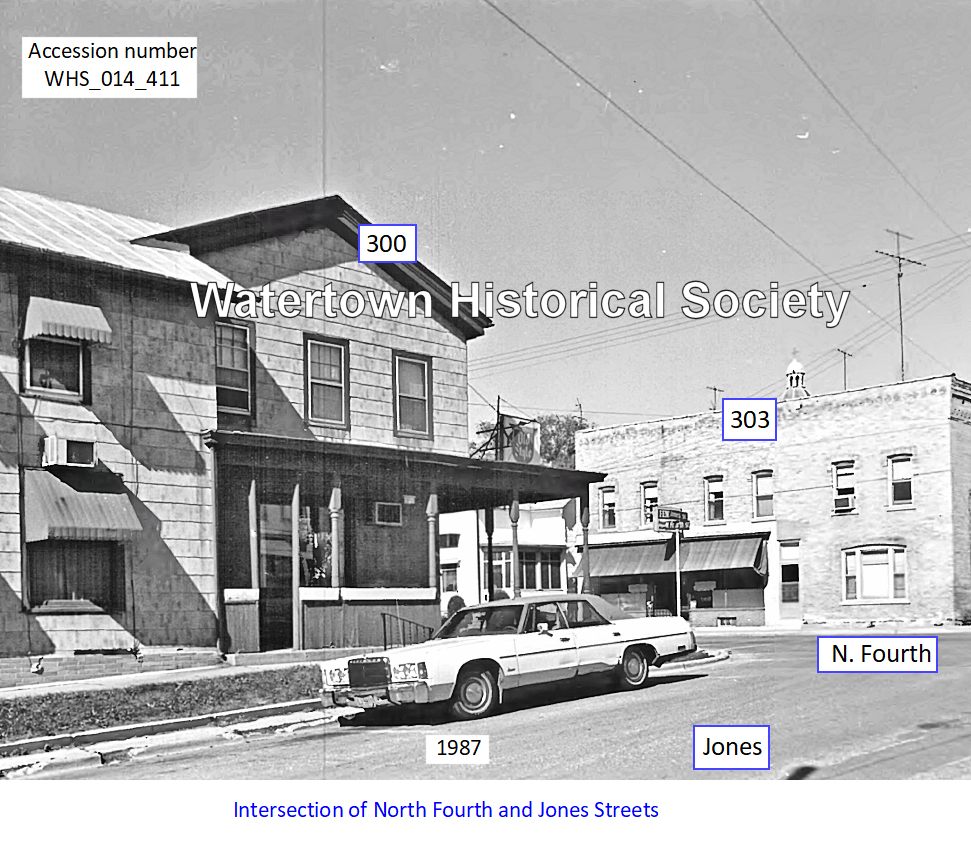
Cross
References:
Poll was at the Buena Vista House,
Annual Charter Election of 1859.

History of Watertown,
Wisconsin