website watertownhistory.org
ebook History of Watertown, Wisconsin
Concordia Opera House
117 N.
First Street
1859
-- -- BEGINNING
HEYDAY OF OLD CONCORDIA SOCIETY TOLD IN
ARTICLE
A sketch
of the Concordia Musical Society, one of the city’s most famous musical
organizations of generations ago, is contained in a reprint from the October 6,
1890, issue of “Der Seebote,” a
Milwaukee publication. The article was
written by the late Emil E. Gaebler and was part
of his memoirs which the paper printed.
Part
of the article is being reprinted here.
It follows:
At the
time Emil C. Gaebler came to Watertown, in 1859, there was an established
musical society here, called the Music and Singing Society and when Gaebler
organized a new society, called Philharmonic, there was an effort to combine
the two. The two finally joined but the
passive members tried to run it and after six months the active members seceded
and formed their own society in July, 1862, called the Concordia.
Emil Gaebler had organized a musical society in 1852 at Danbury,
Conn., and was familiar with the management of the Northeastern Singers league
of New York. He, therefore, organized
the Northwest league shortly after he came to Wisconsin and to this league the
Concordia gave its support, so actively, that at the first saengerfest held in La Crosse in 1866 Watertown won
the first prize, a silver loving cup, now on display in the historical museum
in Madison.
Thereafter
the following saengerfests (conventions or music festivals) were held:
Watertown, 1867; Milwaukee, 1868; Madison, 1869; La Crosse, 1871; Dubuque,
1873; Watertown, 1875; Freeport, 1877; Milwaukee, 1879; Madison, 1881; La
Crosse; 1883; Watertown, 1885; Freeport, 1887; Minneapolis, 1889; Milwaukee
1891; Dubuque, 1896. There was also a
band convention in Watertown in 1879.
As early as 1885 interest began to lag and young people turned to
amusements rather than to music. In its
“floruit” the Concordia undertook many projects besides regular concerts and
opera performances in Watertown. The old
music hall on North Second Street burned to the ground and a new opera house
was built at a cost of $11,872 of which $2,158 was raised by the women members
or auxiliary of the organization. The
Concordia Society also purchased the Tivoli island,
planted trees on it, built a pavilion, and painted it themselves. In 1879 an octagon band stand was built on
the island, forty feet in diameter and was first used for the band convention
for which occasion Mr. Sleeper was director and Mr. Mulberger, field
marshal. Many concerts and picnics were
held on the island, a windmill supplied water power for the large fountain, a
garden, and a fine bowling alley helped make this a very popular place.
A
large collection of manuscript music, opera scores, and instrumental numbers
are to this day reposing in one of our local stores waiting for the day when
Watertown will again take an interest in local amateur musical activities. WDT 05 20 1935
1862
MAX GAEBLER
Concordia
Society formed in 1862 under direction of Max Gaebler. Gaebler served for many years served as
musical director of the Concordia Musical Society.
John Keck also
helped to organize the Concordia Society.
Frederich
Misegades was charter member
1874
CONCORDIA ISLAND PURCHASED AND NAMED
In
1874 a German singing group, the Concordia Music Society, purchased and named Concordia Island.
The society had been formed in 1862 under direction of Mr. Gaebler. Concordia Island served as a host to many saengerfests, music festivals in which most of the
singing organizations of the state would take part. Local citizens held picnics and heard
frequent band concerts on Concordia Island.
Unions, clubs, and trade guilds from throughout the state rented the
island for annual gatherings.
Concordia
members landscaped the island, planting many trees and shrubs of various
varieties, some of which are mature trees today. Members constructed numerous buildings
including a beautiful central pavilion.
The island was graced with one of the first fountains in this area. Located in front of the pavilion, it sent
sprays of water splashing into a circular basin in the center of which stood an
ornamental statue. A secluded water tank
kept the fountain at play, while a windmill pumped water into the giant
container. It also had a circular
bandstand with beer, candy and ice cream sales on ground level and quarters for
musicians on the second floor.
c.1876
CONCORDIA OPERA HOUSE LOCATION, First & Madison
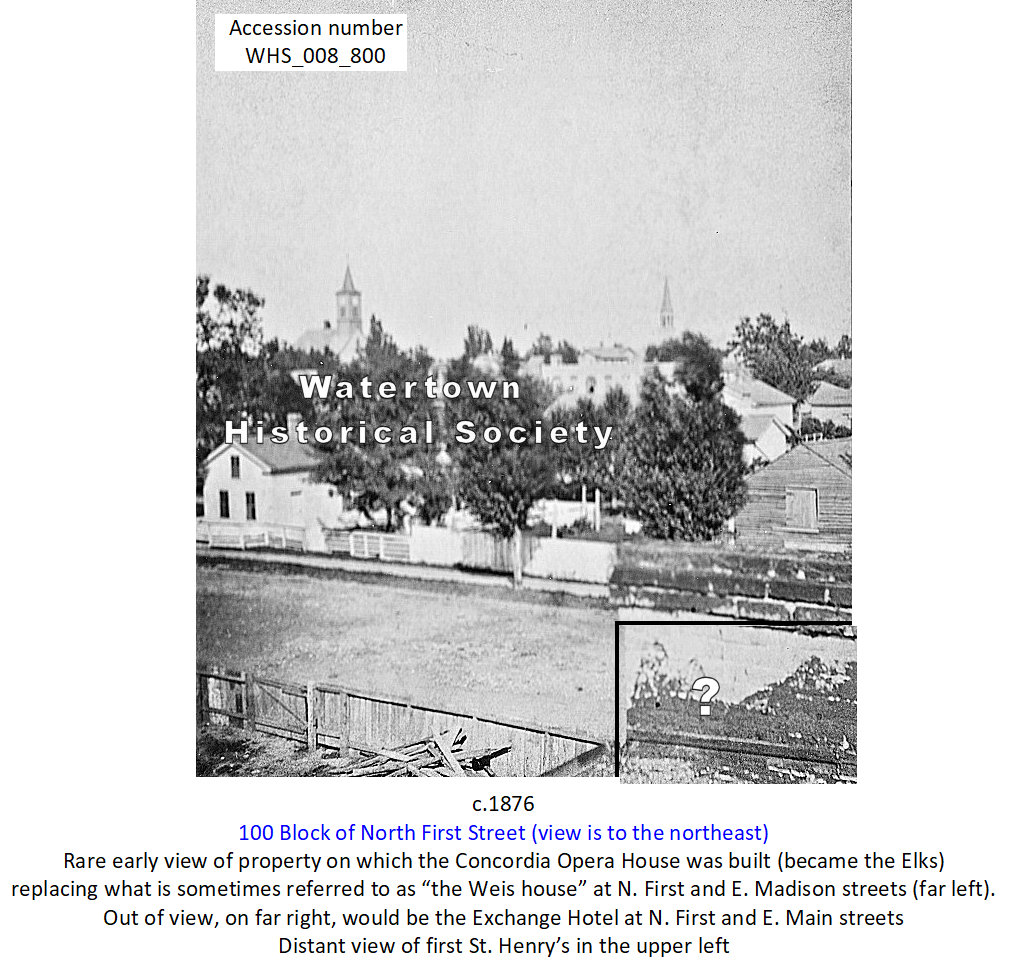
100
Block of North First Street (view is to the northeast)
Rare
early view of property on which the Concordia Opera House was built (became the
Elks) replacing what is sometimes referred to as “the Weis house” at N. First
and E. Madison streets (far left).
Out of
view, on far right, would be the Exchange Hotel at N. First and E. Main streets
Distant
view of first St. Henry’s in the upper left
06 20 La
CROSSE SAENGERFEST
The members of the
Concordia Society who were in attendance at the Saengerfest at La Crosse
returned Monday night, and all are loud in praise of the delightful time they
spent. Our delegation upon their arrival
at La Crosse Thursday evening, received a splendid reception from their
brethren and were welcomed in a fine speech by Dr. X Otilie, which was happily
responded to by Constance Wiggenhorn. At
the concert in the Germania Hall Friday evening the Watertown delegation
presented the former director of the Concordia Society, Prof. E. C. Gaebler, now residing at La Crosse, with
a beautiful lyre composed of the choicest and most delicate flowers, which was
a complete as well as a happy surprise to the recipient. J. B. May performed the task presenting the testimonial
in a graceful manner. The Saengerfest is
pronounced a fine success and all came home highly pleased with La Crosse and
her hospitable people. WR
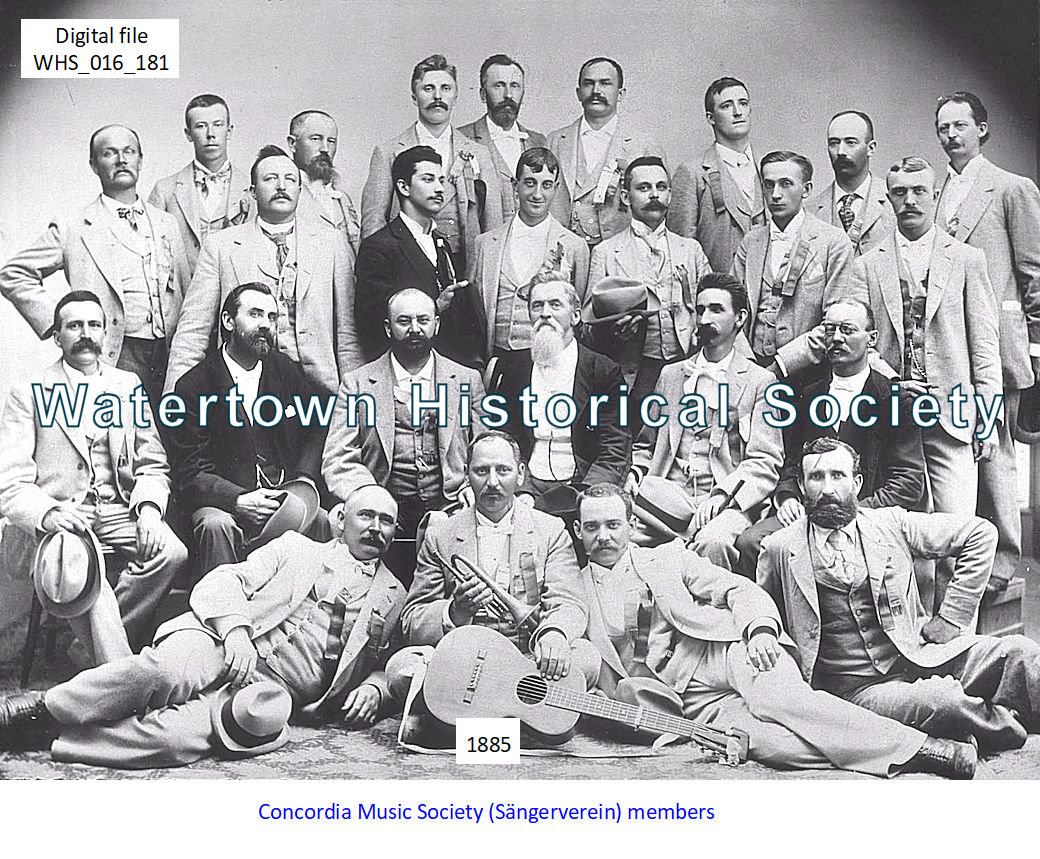
1883
-- -- CONCORDIA MUSIC SOCIETY MEMBERS (SÄNGERVEREIN)
1886
05 21 ESTIMATE
FOR BUILDING New Opera House
Wm. Waters, architect
of Oshkosh, was in the city last Monday and made an estimate for building the
new Opera House for the Concordia Society, figuring it at $11,000. The society instructed him to draw a plan of
the building, which he will have ready in about a week. The new building will be a two story brick
with basement. The gallery will be
fitted up with 277 opera chairs, and the main hall with about 300 perforated
seat chairs. In the basement there will
be a bar room and a double bowling alley.
The money for building will be raised by issuing 4 per cent bonds
payable in 5 years. WG
1887
08 04 CONSTRUCTION
TO BEGIN
The Concordia Society has
completed arrangements for the erection of a $10,000 opera house on their lot opposite
the City Hall on North First Street, and the
work will be commenced in a few days.
The necessary amount has been subscribed, and the only delay now is to
decide on the style of building. The
opera house will be 50 by 88 feet, two stories high, and basement. The hall proper will be on the 1st floor,
with the second for gallery purposes.
Every enterprise of this kind adds to the welfare of a city and in their
efforts to erect such a building here, the members of this society deserve the
best of encouragement from the residents of this city. Any assistance that can be rendered by our people
should be given cheerfully. It is a work
that deserves it.
1888 CONSTRUCTION OF, Concordia Opera House
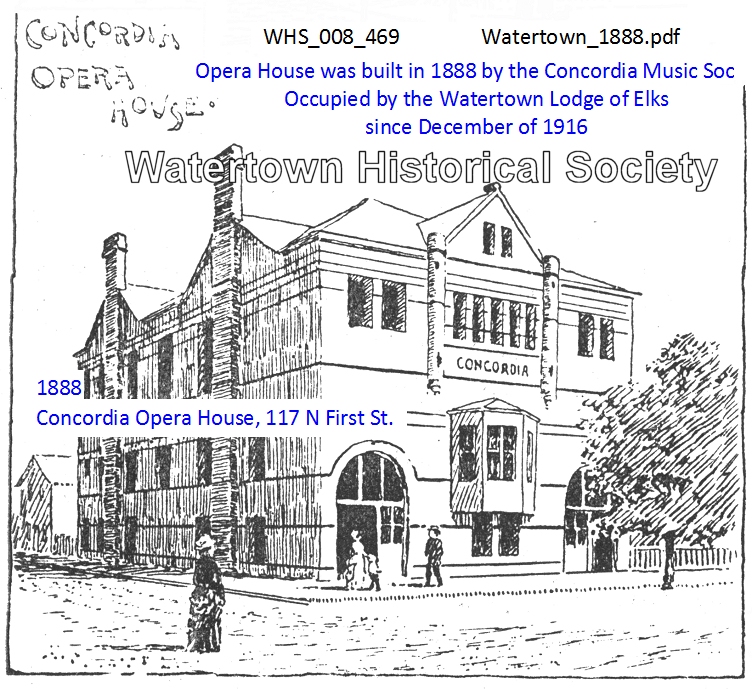 Opera House was constructed in 1888.
Occupied
since December of 1916 by the Watertown Elks
Lodge.
03 09 DROP CURTAIN AND SCENERY
The ladies of the
Concordia Society have ordered an elegant drop curtain and scenery of Sosman
& Landis, Chicago, for the new opera house and will present the same to the
society. The cost of these articles is $800. WG
01 08 NEW YEAR’S DAY BALL
New Year's Day was
dull, gloomy and unseasonable in all respects.
There was no evidence that we had entered winter; not a vestige of snow
to be seen, nor scarcely a crust of ice anywhere in sight. Instead of sleighing, we had wheeling and
slush and mire. Most of the stores paid
homage to the day by closing in the afternoon.
In the evening the Concordia Society gave a ball at the Opera House, and
the dancing was enjoyed by a large number of ladies and gentlemen.
02 26 SIGHT TO BEHOLD
A sight not often beheld presented itself at the Odd Fellows' dancing party at
Concordia Opera House Saturday evening.
In two sets of quadrilles on the floor at one time were four sisters
dancing in each set. WG
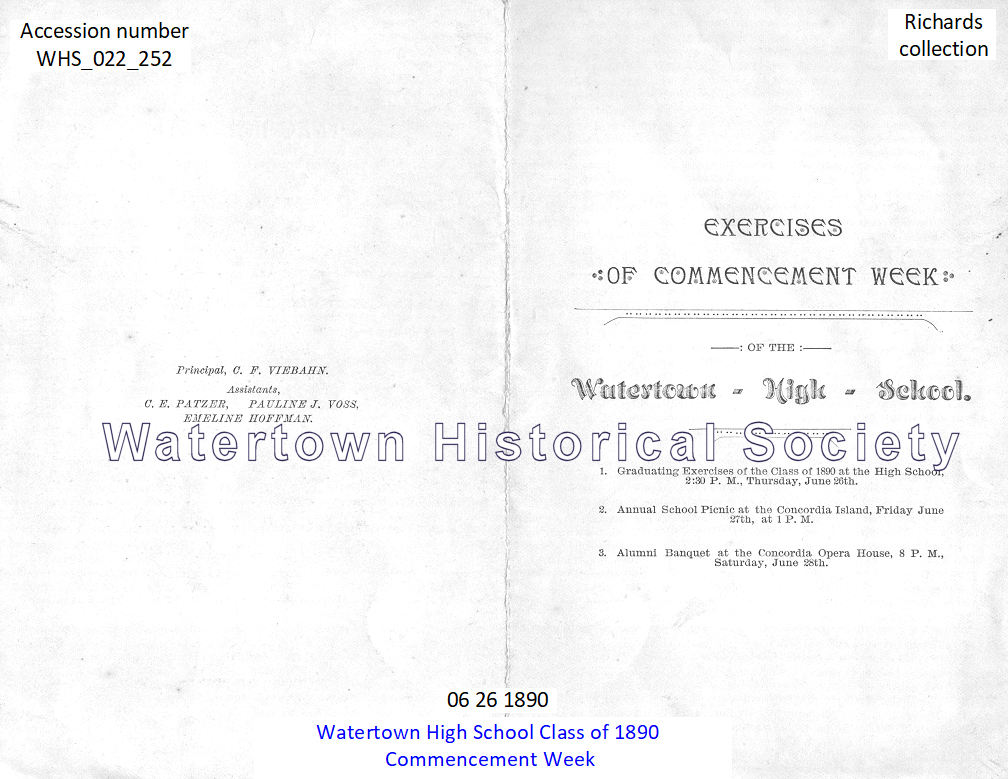
06 26 LOCATION FOR GRADUATION
CLASS EVENT
09 12 McGIBENY FAMILY ENTERTAINS
Concordia Opera House
was packed to suffocation Tuesday evening with one of the most select audiences
that have gathered in Watertown for many a day, to listen to the entertainment
given by the famous McGibeny family. The
audience was highly entertained from the rise to the fall of the curtain, and
it was with regret that they took their departure, only wishing that the
entertainment would last longer. WG
10 08 KINDLY REMOVE YOUR HAT
At the performance of "The Kindergarden"
at Concordia Opera house, Monday evening, three misses from the West side set
an example which it would be well for some of the older habitues of such places
to imitate. At the commencement of the
entertainment they removed their hats, giving persons behind them a free and
unobstructed view of the stage. The
headgear worn by many ladies at concerts and theatres may always be ornamental,
and as a rule useful, but if the wearers only knew what a nuisance it becomes to
spectators whose view is cut off by it, there would be fewer large hats worn on
such occasions, or else they would be lain aside after the fashion of the
sensible and independent maidens from the West side, whose graceful act
suggested this item. WR
10 17 DANCING SCHOOL TO BE
CONDUCTED
The ladies of the
Concordia society have made arrangements with Paul
Thom to conduct a dancing school at the opera house. Those desiring to attend are requested to
report at once so as to take advantage of a full term of instruction. Following are the terms: Friday evening sessions 8 to 10 o'clock, $3
per term for twelve lessons; Saturday afternoon sessions, 4 to 6 o'clock, $2
per term for twelve lessons. The first
lesson will be given this week Friday. WG
1891
01 14 DANCING CLASS SOCIABLE
A rather unique and pleasing affair took place last Friday evening at
Concordia Opera house, being the sociable of the Saturday afternoon dancing
class under the auspices of the ladies of the Concordia society and the
instructor, Paul Thom. The class is
composed wholly of children ranging in age from 5 to 15 years, and it was
really an interesting and novel sight to watch them go through the figures of
the different dances. The young folks
had possession of the floor until 10 o'clock, after which a general hop was
indulged in by the large company present.
WR
03 04 GOTTSCHALK'S LECTURES
Rev. F. Gottschalk's lectures Thursday, Friday and Saturday evenings of
last week upon Rome, Palestine and Egypt, at Concordia Opera house, were not
largely attended. The lecturer rather
failed in descriptive powers, but the views presented were such fine and
striking illustrations of the buildings and scenery that one could well imagine
himself among the ruins of Rome, traversing the streets of Jerusalem and
Alexandria, or in the shadow of the great pyramids. WR
04 03 "THE ROSE OF
CASTILLE”
The famous Abbie Carrington, supported by a corpse (sic) of excellent
artists. enroute to California, will appear at the Concordia opera house Friday
evening, April 10th, in "The Rose of Castille." It is not necessary to publish the high
praises this opera company received wherever they performed, but suffice it to
say that their performance is worthy in every respect of a crowded house, and
we can conscientiously warrant its superiority.
The prices of admission will be made as low as possible. WG
04 15 "THE ROSE OF CASTILLE” RENDERED
Balse's romantic grand opera comique "The Rose of Castile”, was
rendered at Concordia Opera house by the Abbie Carrington company Friday
evening. As has been too often the rule
here the size of audience fell much short of what the merits of the performance
deserved and demanded. It is no
exaggeration to say that no finer entertainment of any kind was ever given in
Watertown. During the entire piece there
was not a single break nor jar, everything being rendered with harmonizing
effect. . . . WR
04 17 CARRINGTON CONCERT
DELAYED
The delay at the Carrington concert last Friday evening was occasioned
by the pianist refusing to play unless the piano was placed on the stage. This
would have required a good portion of the audience to leave their seats in
order to place planking in the house on which to slide the piano up on the
stage. This the management of the opera house refused to do, not wanting to
inconvenience patrons of the house. The manager of the opera house offered to
place the piano on the stage in the afternoon to have it there for the evening
performance, but the manager of the Carrington company said it would not be
necessary, hence the dispute in the evening and delay of the performance was
brought about through no fault of the management of the opera house. The
pianist was induced to go on with his part of the performance only by being
reminded by Mme. Carrington that his salary would cease in the morning unless
he went on with the music at once.
WG
06 05 "FATHERLAND" AT CONCORDIA
Chas. A. Gardner and company in "Fatherland" at Concordia
opera house last Friday evening was witnessed by a packed house. The piece is an interesting one, and never
fails to attract interest here. The
company is a very good one, and gave quite general satisfaction here, excepting
Mr. Gardner, who appears to be losing his old-time popularity--- his singing
being much poorer than on previous visits to our city. WG
07 08 THE SAENGERBUND DEN NORDWESTENS
The Concordia society left by the 11 o'clock train this morning for
Milwaukee to attend the fifteenth Saengerfest of the Saengerbund den
Nordwestens, the reception concert of which takes place this evening. The members were dressed alike in tasty gray
woolen suits, made at the clothing establishment of W. H. Rohr.
c.1893
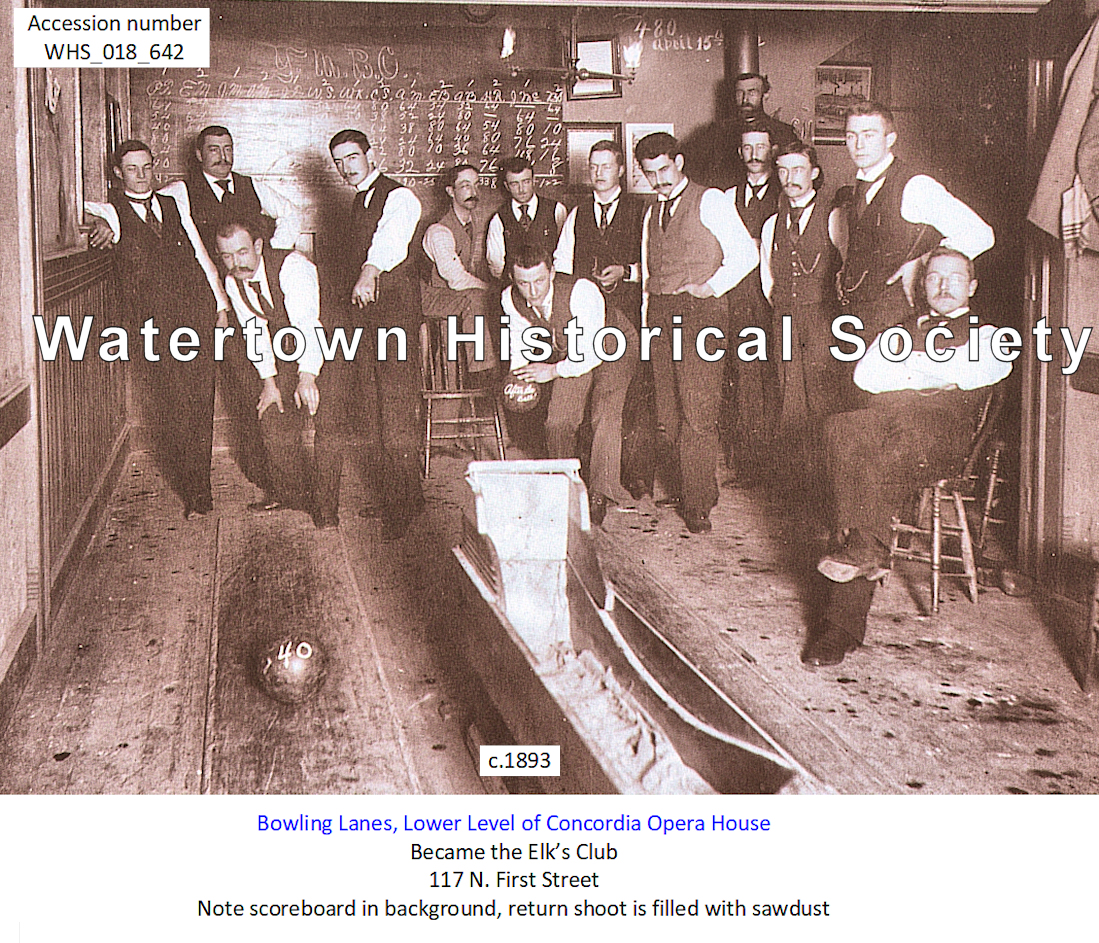
Note scoreboard in background, return shoot is filled with sawdust
1894
01 02 ANNUAL
NEW YEAR'S BALL
The annual New Year's balls of the Concordia Society have long been
noted as elaborate social affairs in dancing circles, and this year's event,
which took place Monday night at the opera house, far eclipsed all previous
efforts. A more brilliant or enjoyable
function is seldom experienced here.
Dances commenced at 9 o’clock and was of several hours' duration, a
varied program of choice numbers being enjoyed during the while. A large number of handsome new gowns were
displayed by the young ladies, and it was the general opinion that Watertown's
sex was never more charming or becomingly beautiful than at this time. WR
05 25 "FAST
MAIL" GREAT SCENIC PRODUCTION
On Tuesday evening next the doors of Concordia Opera House will swing wide
open for the great scenic production of Lincoln J. Carter's "Fast
Mail." The railway has often been used by the dramatist, but never much
before to such an extent as in Carter's famous play, "Fast Mail." A freight train with fourteen cars, a lighted
caboose and a full-sized locomotive, with engineer and fireman, crosses the
stage in the most realistic and noisy manner, while later in the play a great
Mississippi river steamboat, with bells and whistles and engines in full
operation, moves in and explodes with terrific force. A great scene is also given of Niagara in
real tumbling water. The company is a
most efficient one, and there is a great deal of fun to go with the sensation
of effect. A special car for the scenery
is used, and every detail is carefully looked at in the stage production of the
play. An extensive line of advertising
paper is carried by the company, but on account of the bill boards all being
covered by the circus bills, it was not possible to put it up; so on account of
not seeing a great display of advertising paper all people should not judge
lightly of the merits of the play. WG
12 05 ANNUAL
THANKSGIVING BALL
The annual Thanksgiving Ball of the Concordia Society was held Thursday
night at the Opera House. The
attendance, while not large, was select, and the pleasures of the dance,
enhanced by the excellent music of Hardege’s
Orchestra, was zealously entered into.
At midnight luncheon was served in the lower hall. WR
1895
01 02 NEW YEAR’S BALL
Once a year there is
recorded in the social archives of Watertown an occasion that is anticipated
with exceptional interest by the dancing set, it being the annual New Year's
ball of the Concordia. Legend is that
society is at its best, the ladies resplendent in new gowns and the gentlemen
vying with each other for gallantry
Last evening was the date of
this year's event, and the [Concordia] Opera house, between the hours of 10 and
12 o'clock, when the festivities were at their height, were the scene of an
unusually brilliant and pretty spectacle.
The dancing floor was completely filled, while from the balcony a
considerable number of interested onlookers passed judgment on the affair. Many of the costumes, especially on the young
ladies, were particular creations for the evening and of an elaborately
beautiful nature that conveyed dreams of perfection regarding the dressmaker's
arts’. . . a delightful program was danced, inspiring music being provided by
the Hardege orchestra and Paul Thom guiding the merry "trippers"
through the figures of the square numbers.
Luncheon was served in the lower hall during the evening. WR
03 15 "THE CREATION"
The first full joint
rehearsal of the Choral Union and the Concordia Society on "The
Creation" will take place on Friday evening of this week, under the
direction of D. F. Stillman. For general
information, we will state that Bach's full orchestra, twenty men, of
Milwaukee, has been engaged for the production, with Mr. Bach as concert
master. This will no doubt be the most
complete orchestra ever heard here.
Applications for seats from out-of- town have already been received,
although tickets have not yet been issued.
They will be ready next week. WG
03 20 The prices of seats at Turner Opera House for the production
of "The Creation" on Easter Monday evening are as follows: Body of parquette, reserved, $1; general
admission, sides of parquette, not reserved, 75 cents; rear of balcony and
front row or sides of balcony, reserved, $1; balance of balcony, not reserved,
50 cents. Tickets have been issued and
can be obtained from members of the Choral union. Time and place of exhibiting the reserved
seats diagram will be announced later.
The first joint rehearsal of the
Choral Union and the Concordia Society on the work, last Friday evening, was
largely attended and very satisfactory as to results. Some eighty singers were present. WR
06 12 FINAL CONCERT OF THE SEASON
The Concordia Musical
Society's final concert of the 1894-95 season occurred at the opera house last
Wednesday evening, under the direction of William Forane. The program was an elaborate one and
furnished an evening of pure musical delight, all the numbers being given with
a finish and beauty unmistakably marked the concert as an artistic
success. The attendance, however, was
not nearly what was deserved. WR
11 06 YOUNG
MEN BOWLING CONTEST
John Molzahn has another frog display this
week. It depicts the recent Concordia
Young Men bowling contest, several incidents being
caricatured in a manner that is amusing to knowing ones. But if John persists in libeling his friends
by representing them as common, bloated bull-frogs, he may look for no end of trouble. WDT
1896
06 20 OFF TO
THE SAENGERFEST (Dubuque, IA)
The Musical Society
Concordia leaves tomorrow morning about 10:30 on a special train over the St.
Paul Road for Dubuque, la., to attend the biennial Saengerfest
of the Northwestern Saengerfest, in session from the 23d to the 26th,
inclusive. The train will also carry the
Milwaukee, Waukesha and Oconomowoc societies.
The route is via Madison and Prairie du Chien.
A fine appearance will
be presented by the Concordias, in their natty suits of blue sack coats, gray
trousers and linen tourist hats, and that they will acquit themselves
creditably in the concerts is assured by the careful and rigid training they
have undergone.
The society, as it will
appear at the Saengerfest, is made up as follows:
First tenors—Edw. L. Schempf,
Alfred Baumann, Fred W. Lehmann, Jacob Weber and Gus Buchheit.
Second tenors —Fred
Vullmahn, Carl Manz, Wm. Sproesser, Adolph Hilgendorf and Max Wegemann.
First basses —Gus
Exner, Fred G. Keck, C. R. Blumenfeld, Oscar E. Meyer, Eugene Wiggenhorn and
Arthur Wiggenhorn.
Second basses —M. H.
Gaebler, C. J. Wenck, Oscar Wertheimer, C. H. Jacobi, J. W. Wiggenhorn, Henry
Daub, Wm. T. Dervin, Frank Petro, Otto Waltz and Edward Jantzen.
Director —William
Forane.
Librarian —Carl
Schwendke. Watertown Republican, July 22, 1896
1898
01 26 ANNUAL
"OLD FOLKS" BALL
Watertown's married contingent had an opportunity enjoy a dance all by
themselves last Friday evening, unrestricted by the whims and fancies of the
younger dancing set, and it is said that everybody present embraced those
desirable conditions and experienced an evening of unalloyed pleasure. The occasion was the annual "old
folks" ball arranged by the Concordia Society and the opera house was
scarcely commodious enough for all who desired to participate in the giddy
mazes. Dancing was begun at 9 o’clock
and it was not until the proverbial “wee small hours” that the last gay couple
wended its weary way homeward. Sergel’s
Orchestra was in attendance and at midnight the ladies of the society served an
appetizing repast in the lower hall. The
program to a large extent was composed of the old-time dances that were wont to
make glad the hearts of the participants in the days of long ago. WR
1899
Lewis Monument dedication participant
04 05 CONCERT FEATURED MRS. FELD
The concert Monday
evening at Concordia Opera House given under the auspices of the Concordia
Society, was one of the most remarkable musical entertainments ever given in
our city. And with such distinguished
and accomplished artists as Messrs. B. Steindel, E. Bare, J. G. Beyer and Mrs. C. R. Feld, how could it be otherwise? . . . Mrs. Feld enchanted the audience with
her charming vocalization of “One Spring Morning,” which necessitated a
response to an encore. Mr. Beyer, the
tenor, rendered two waltz songs, which were well received . . . Mrs. Feld is
especially to be congratulated on the great success scored by her. Her stage presence was a perfect picture of
composure, and her beautiful voice, while not of a strong or robust character,
is as musical and enchanting as is that of the sweet bird warbler. Her work at the piano in the trios was also a
marvel of correct and exquisite finish, and greatly delighted her audience with
its superior excellence. When it is
taken into consideration that Mrs. Feld sung two numbers, took part in two
trios, one in German and one in English, and responded to an encore in the
second number, besides her work at the piano, it will be seen that her labors
were necessarily severe and exacting.
Our music-loving people are also under obligations to this lady for
securing the talented gentlemen, Messrs. Steindel, Bare and Beyer. WR
06 20 PICNIC, COMMENCEMENT, ALUMNI BANQUET
The annual picnic of
our public schools will be held next Friday afternoon on Concordia Island.
All the schools with the exception of the high school will close the day
before, the latter continuing to have sessions next week. The high school commencement exercises will
take place on Friday evening June 30 and the alumni banquet will be given July
1 at Concordia Opera house. WR
10 03 PASSION PLAY
The celebrated Passion
Play as produced at Oberammergau was given a presentment at Concordia Opera
House Wednesday and Thursday nights through the medium of moving pictures. The play, as is well known, represents
different incidents in the life of Christ and the pictures were faithful
reproductions of these scenes, which are wonderfully realistic. The entertainment awakened considerable
interest among clergymen, teachers and students. WR
11 21 "BOB" FITZSIMMONS SPARRING MATCH
"Bob"
Fitzsimmons, ex-champion pugilist, and his vaudeville company held forth at the
Concordia Sunday night, the house being well filled by people anxious to see
the noted prize-ring artist at his work.
In this they were somewhat disappointed, for "Bob" cut out his
bag-punching business altogether and only sparred about three minutes with his
sparring partner, whom the sports generally class as a "dud." The vaudeville portion of the program is said
to have been good and clean. WR
Cross Reference: Robert James
"Bob" Fitzsimmons (26 May 1863 – 22 October 1917)
1900
01 09 QUEENAN AND CRAIG SPARRING MATCH
The sparring match
between Queenan and Craig announced for Saturday night at the Concordia was
given up owing to a lack of patronage.
Only about fifty sports had put up a dollar apiece and the promoters
considered this too small a purse for the men to go after. It was understood that the fight was to have
been to a finish. WR
02 13 DANCING PARTY
One of the most
elaborate and altogether enjoyable social functions ever given here was the
reception and dancing party held at Concordia Opera House last Friday evening,
the Misses Minnie and Jennie Sproesser and Miss Veina Sleeper being the
hostesses who on this occasion so royally entertained their friends. The younger society element was represented
in large numbers, and all were agreed that Watertown has never witnessed a
prettier party – one more complete in its appointments and arrangements, or
more happy and congenial in its atmosphere and environment. WR
12 19 AMERICAN STEREOPTICON PRESENTATION
The American
Stereopticon View Company will present the Oberammergan Passion Play at the
Concordia Opera house this evening. The
presentation of this sacred play has created considerable enthusiasm among
Watertown theater-goers and it is expected that there will be a large
attendance. The price of admission is
only a 25 cents for adults and 15 cents for children. WDT
10 26 LaFOLLETE SPEAKS HERE
Bob LaFollete, the
Republican candidate for governor, visited our cities Thursday morning and is
spoke at Concordia Opera House for about one hour. He arrived here at 11:45 and departed at 12
45 for Jefferson. His meeting had been
advertised far and near, and the Sinnissippi band had been out in our streets
for sometime before his arrival – still
only a small audience greeted him. The
day was delightful one, and though Robert is a fine orator, but very few people
from out-of-town, or in the city, were at the opera house to hear him – about
350 and all. Mr. LaFollete was in poor
voice, but made a good speech from a republic standpoint. WG
12 28 THE OLIVER STOCK
BIG MINSTREL SHOW
The amusement lovers of
this city have had to endure much during the past season in the way of colored
shows which lacked merit and naturally feel that all entertainment of that
character are inferior. In order to prove
that there still exists genuine talent in this line, and to show that the
management of the Oliver Stock Big Minstrel do not wish to obtain money under
false pretenses, we are authorized to notify the public that anybody visiting
the performance of this truly meritorious organization at the Concordia Opera
House on Dec. 30 will be given their money back at the box office if the
performance is not exactly as claimed — first-class in every respect. There is hardly a company travelling in
America today that has received more well-deserved praise from public and
press, and the determination of the management to refund money to any patron to
satisfy, proves that the Oliver Stock Big Minstrel caters to the public and
live up to their agreement in every way, and this guarantee should insure them
a packed house. WG
1900s
During
the early 1900s, the Concordia building housed two theaters - the Empire and the Colonial - which featured both
film and vaudeville acts.
The
performers in the opera house circuit would change wardrobes in the attic of
the building because the area next to the stage was too small. The actors may have also slept in the attic
between shows.
In
three sections in the attic, some of those actors carved their names into the
roof. 1905, 1906 and 1907 is when they
had painted their names and dates. Watertown Daily Times, 09
10 2007
1900c
E. J.
Brandt was president of the Concordia Musical Society.
1901
01 11 “WHAT HAPPENED TO JONES”
The company which presented “What Happened to Jones” at Concordia opera
house last Monday evening was one of the best which have appeared in our city
this season. While there is absolutely
no plot to the play it abounds with laughable situations throughout; each part
was well cast and the audience was kept in constant merriment; the fun is clean
and wholesome, never approaching the vulgar; if more such plays could be
brought here our people would soon be content to attend the theatre here at
home instead of going elsewhere.
02 08 SEEBOECK, famous pianist
Seeboeck [William Charles Ernest Seeboeck], the famous pianist, will
give one of his grand recitals in the Concordia opera house, Tuesday evening,
Feb. 12th. Seeboeck will be assisted by
Miss Cora. E. Chatfield, soprano. He
brings especially for this recital a new Steinway Grand piano, which will be
placed so that all can see the keyboard.
Seeboeck was Rubenstein’s greatest pupil. As a composer, studying under the great
Brahms, he has achieved world-wide recognition, playing his own concerto with
the Thomas orchestra in Chicago. His
playing is a revelation to those who have heard the other great artists, his
wonderful pianissimo effects have never been equaled . . . . All who love the
best in music should not fail to attend this recital. WG
02 27 LIQUID AIR LECTURE AND
EXPERIMENTS
Tomorrow evening at Concordia Opera House the liquid air lecture and
experiments will be given by Prof. J. Ernest Woodland. The management promises a sufficient quantity
of the fluid to insure a highly satisfactory and successful demonstration. Seats for the unique entertainment have been
selling well and the body of the house is all taken.
03 08 LECTURE ON LIQUID AIR
A large audience attended the lecture on liquid air at Turner Opera
House last week Thursday evening by Prof. J. Ernest Woodland. Professor
Woodland is a pleasing talker, and aside from the remarkable things he
illustrated liquid air was capable of doing, his lecture in itself was a real
treat . . . Those who heard the lecture and witnessed what liquid air can do,
are anxious to be given another opportunity of witnessing and hearing another
such treat.
1902
01 31 KINODROME SHOW
The Kinodrome show commenced a three-night engagement at the Concordia
Opera House, January 30th. A few words
explaining what the Kinodrome show is.
The Kinodrome is the moving picture machine now in universal use in the
leading vaudeville theatres in the country.
We mention this to demonstrate the high order of the pictures this
machine must exhibit to retain its prestige and constant use in the theatres it
is at this time being operated in. The
Kinodrome show is an exhibition of moving pictures sent on tour under the
direction of the company operating these various machines in the manner
stated. It has been found necessary to
gain public favor and interest in our moving picture exhibitions at various
theatres, to obtain at all times scenes and incidents of having things up to
date, and in so doing we have accumulated the largest and most varied stock of
animated pictures in existence. Up to
the introduction of the Kinodrome show on tour the public outside of the cities
had only a slight knowledge of what is being accomplished in motion
photography, the rapid advancement, ingenuity and quality of highest
photography being obtained in the mysterious art . . . The exhibition promised
is of the most interesting kind, and should be seen to be appreciated. Seats now on sale at Gamm's. Admission 10, 20, and 30c. Saturday matinee. WG
Cross
References: Info
on Kinodrome; Link to chapter on Classic
Theater.
03 23 HUMPTY DUMPTY & THE BLACK DWARF
PERFORMED
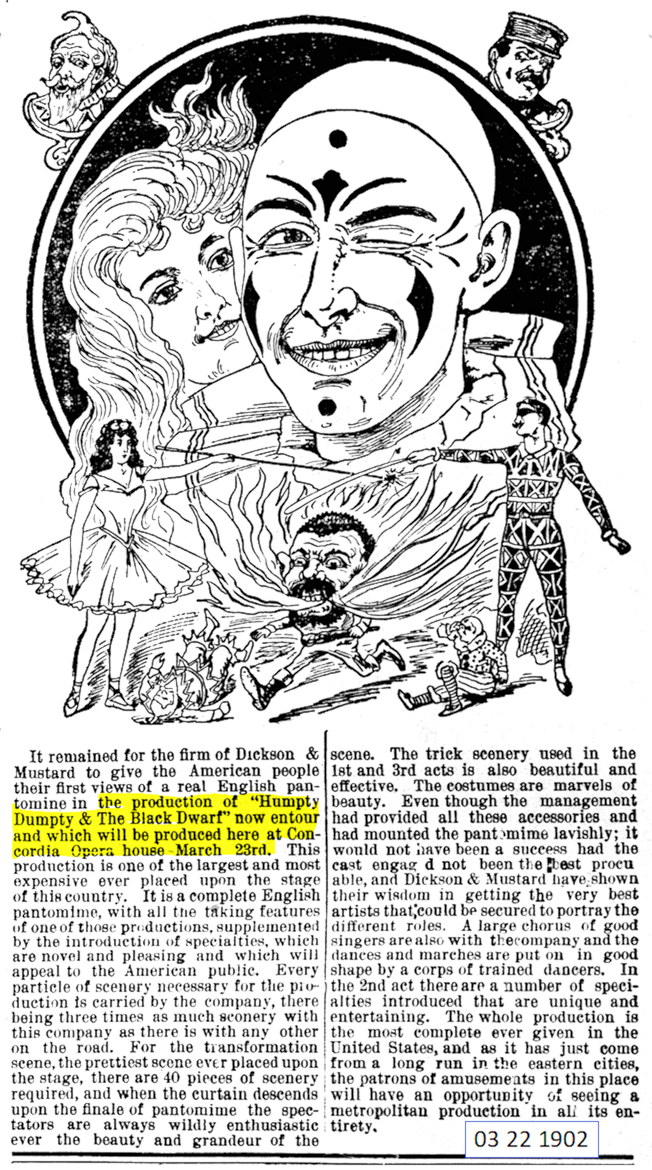 WR ad
WR ad
1903
11 17 LECTURE ON CHARLEMAGNE
A large
audience assembled last Thursday evening to hear the lecture on
Charlemagne. The use of Concordia Opera House has been
generously donated, as the capacity of the assembly room was altogether
insufficient. The hall, however, was poorly heated to the discomfort
of many, and the bowling was also the source of some annoyance. The
next lecture takes place Thursday, Nov. 19, the subject being Lorenzo di
Medici. WDT
1916
THE ELKS LODGE PURCHASED THE OLD CONCORDIA OPERA
HOUSE on Jan. 5, 1916.
Concordia
Opera House remodeled in 1916 to become Elks Club

Cross Reference:
PROF. HARDEGE DIRECTOR
During his early career Prof. Hardege
served as director of the old Concordia Society.

History of Watertown,
Wisconsin