website watertownhistory.org
ebook History of Watertown, Wisconsin
St. John's Lutheran Church and School
(Wisconsin Synod)
Founded 1852
North 5th and Cady Streets
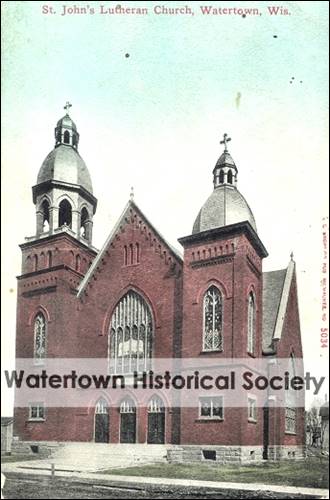
St. John's, 1910
1916 note: Built
by Ferdinand
Behlke, General Contractor
ITS BEGINNINGS
St. John’s Evangelical Lutheran Church had
its beginnings, together with many of the older Lutheran churches of our land,
in the great emigration from Germany that took place in the latter half of the
nineteenth century. In Germany, as in
most of the countries of Europe, there was opportunity only for the princes and
the landholders. But in America,
opportunity was unlimited. Vast reaches
of land, fertile farms were available to those immigrants, whether native or
foreign, who were willing to come into what was then known as the West, and
live on the land and cultivate it. The
railroad, improved roads, established settlements, the push to the far West
inspired by the gold rush of 1849 helped to tame the wilderness, to make it
easier to get into the West, and to
remove the fear of the unknown which kept many at home. By the hundreds of thousands immigrants
poured into the land, and those from Germany resolutely moved into the West,
and took their faith with them.
Among the vanguard of the German immigration
there were the founders of St. John’s Church.
They came from Pomerania, in northeast Germany along the Baltic
Sea. They were a little band, closely
knit by friendship, relationship and by their common faith. Already in Germany
they had left the State Church which had become more and more lax in it
adherence to the word of God, and affiliated themselves with a Free Lutheran
Church.
1851 ARRIVED
IN 1851
In the summer of 1851 they came to
Watertown. Watertown was then a thriving
community of 4,000 inhabitants. It was
not yet a part of the great railroad network that contributed so much to the
opening of the West, but was connected with the nearest railhead, Milwaukee, by a plank road. The journey across the Atlantic took eight
weeks, from there they went by rail to Milwaukee, and the final stage of the
journey was made by wagon.
It is impossible to ascertain exactly the
names of the hardy, Godfearing pioneers, who under God, were the founders of
St. John’s Church. Among them were,
however, the following: Heinrich
Kroening, Friedrich Schumacher, Friedrich Klug, Wilhelm Dobbratz, Heinrich
Koch, Erdmann Folijahn, Ludwig Mielke, August Schatz, J. G. Gerbig, J. F.
Spiegelberg, Caspar Schroeder, Carl Grewe, Wilhem Graunke, Carl Glamm,
Christoph Wiedenhoeft, Gottlieb Hicke and George Marquardt.
FIRST SERVICE
Being devout Lutheran Christians, one of the
first cares of this little group was to provide for their own spiritual welfare
and that of their families. There was in
existence in Watertown a congregation composed of German immigrants, served by
the Rev. Friedrich Rentzsch, but it required only a little investigation to
discover that this congregation was not an orthodox Lutheran group, but taught
the same “error” which had moved them to leave the German State Church in their
homeland. Unwilling to compromise the
true Lutheran faith, and being desirous to establish that church which teaches
the word of God in all its truth and purity, and make a beginning free of all
compromise, a number of the immigrants, under the leadership of Heinrich
Kroenig, and through the cooperation of one of the civic leaders of Watertown,
John W. Cole, rented a small public school building at North Fourth and
Division Streets. Here this little group
of Christians met, and since they had not pastor, one of the members would read
a sermon each Sunday from a book of Lutheran sermons prepared and published by
a German pastor, Heinrich Mueller. There
was, at first, no formal organization, so that actual date of the founding of
St. John’s Church is indefinite. But so
eager were these devout immigrants to be served by the pure Gospel that
according to the best information available these services were instituted a
very few months after the arrival of this little band of Lutherans in
Watertown, very likely in the fall of 1851.
1852 PASTOR
CALLED
St. John’s Church in Watertown had its beginning in 1852. The first new church building dedication followed on June 25, 1865.
Within a year, in 1852, the congregation
called its first pastor, the Rev. A. Kleinegees, who lived in Watertown and was
a member of the then Ohio Lutheran Synod.
He remained with the congregation a very short time, until March of
1853, since it was soon discovered that at the time he believed and taught the
liberal and rationalistic doctrines of the German State Church. Obviously, however, Rev. Kleinegees, who was
born in Germany on Sep. 15, 1824, must have later reached a different
conclusion, since he joined the Missouri Synod in or before 1867, and served
parishes of this body in McClure, Ohio, and Pilot Knob, Missouri, where he died
of typhoid fever on
During the tenure of Rev. Kleinegees and
under his leadership, the congregation took the first steps toward
organization, the election of a board of trustees. This act is recorded as the first entry in
the first volume of the records of corporate bodies filed with the register of
deeds of Jefferson County, Wisconsin, and is reproduced here in it entirety
because of its historical importance:
_______
German Evangelical Lutheran
St. John’s Church
Certificate of Election of Trustees
State of Wisconsin
SS
Jefferson County
George Gerbig and Johann
Spiegelberg being duly sworn on oath depose and say that on the 6th
day of
December, instant at a meeting
called according to law for that purpose Christoph Weidenhoeft,
George Marquardt and Gottlieb Hicke were duly elected trustees of the
German Evangelical Lutheran St. John’s Church in Watertown, Jefferson County
and State of Wisconsin, namely Christoph Weidenhoeft for one year, George
Marquardt for two years and Gottlieb Hicke for three years.
Watertown,
Witness George Gerbig
A Kleinegees John Spiegelberg
Subscribed and sworn to before
me this 11th day of December, A. D. 1852
A.
Minges
Justice of the Peace
Recorded
________
Being without a pastor, the congregation
prevailed upon Rev. L. Geyer, the pastor of Immanuel Church, Town Lebanon,
which at that time was a member church of the Missouri Synod, to serve in this
capacity. He began to serve the
congregation on
Parish School
Into this period belongs also the beginning
of St. John’s Parish School. The exact
date of it origin cannot be determined, but it is obvious from what is known
that one of the first concerns of the founders of St. John’s Church was the
Christian education of their children.
Already before the pastorate of Rev. Geyer,
Heinrich Kroening, and Rev. Kleinegees had served as teachers to the children
of the congregation. Now, however, the
work of the school was expended, and the children were placed under the
instruction of the son of the teacher of Immanuel Church, Lebanon, Mr.
Wetzel. It is remarkable, and a reason
to glorify God, that in the one hundred years of St. John’s history the needs
of its parish school have always been close to the hearts of the members of St.
John’s Church, and that its small, difficult beginnings have grown into such a
magnificent institution, and that this nursery of Christian education has
provided uncounted blessings to thousands of blood-bought souls.
1854 Join Synod
In this period St. John’s Church took
another important step, which has had far-reaching significance upon its
history. In 1854, at the eighth annual
convention of what was then known as the Evangelical Lutheran Synod of
Missouri, Ohio, and other States, the congregation applied for membership with
this body and was received as a member.
It is noteworthy that St. John’s
congregation is thus one of the oldest member congregations of what has become
a world-wide church group. Through its
affiliation with this staunchly conservative Lutheran body, St. John’s Church
has carried out its duty of preaching the Gospel into all the world, has helped
to bring the printed “Word” to thousands of blood-bought souls, has, by it
gifts and by sending men and women from its midst, provided pastors and
teachers firmly indoctrinated in the Gospel to meet the needs of a constantly
growing church body, and has taken an active part in the spreading of the
Church of the Reformation into every state of the union, and many of the far
corners of the world. Through its
affiliation with this body, St. John’s Church has also taken part in major
works of charity, supporting institutions of charity within the church and
contributing liberally with its fellow congregations whenever an emergency
arose among members of the household faith.
Full Time Pastor
It is understandable that a group as
God-fearing and devout as the founders of St. John’s Church would not long be
satisfied with only one service a month, particularly as their group continued
to grow as the tremendous immigration movement of the mid-nineteenth century
gathered momentum. They wanted, not only
a service every Sunday, but also to have a pastor in their own midst. And so, in the year 1854, they addressed a
call to candidate of theology, Anton Wagner, who had just graduated from the
Theological Seminary of the Missouri Synod at Fort Wayne, Indiana. He accepted the call, and came to Watertown
around the first of the year, 1855. At
that time the railhead was extended to Oconomowoc, form where the young pastor
traveled the remaining miles to Watertown by stagecoach. He arrived in the middle of the night, and
found lodging in a hotel. The next
morning, in spite of having contacted a severe cold on his journey, Candidate
Wagner walked the six miles through snow a foot deep to the home of Rev. Geyer
in town of Lebanon. Here he discovered
that St. John’s Congregation had no “Agenda”, that is, the book of forms and
prayers for church services, baptisms, the celebration of communion, the
performing of weddings, and similar ministerial acts. The Missouri Synod had published no such book
at that time. There remained nothing for him to do but to spend several days as
the guest of Rev. Geyer, and copy the most important sections from Rev. Geyer’s
book, which itself was also a handwritten copy.
It might be well to note at this time that
in those early years before the publication of hymnals by the Missouri Synod,
the conducting of a church service involved considerable difficulty. The German immigrants had faithfully brought
with them their copies of their hymnals, but since they came from different
sections of Germany, the selection of hymns varied considerably, and the same
hymn, although it often appeared in all the hymnals, nevertheless had different
verses and was published in different dialects, all of which made
congregational singing a problem. There
frequently remained nothing for the pastor to do but to serve as cantor. He would sing the first line of a hymn and
the congregation would repeat the line, whereupon the pastor would go on to the
second line, which was repeated by the congregation, and so on through to the
end of the hymn.
1855
Because of deep snow, Candidate Wagner’s
ordination was postponed to Quinquagesima
First Church
It was well that the Lord had provided this
infant congregation in virgin territory with a pastor full of enthusiasm and
physical stamina, for there was a great deal of work to be done. Already in 1854, the congregation had begun
the construction of its first house of worship, a frame building 40 x 26 feet,
located, as closely as can be determined, at the intersection of Vine and Lynn
streets.
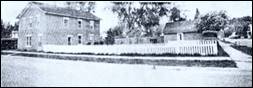 Vine and Lynn streets (808 Vine)
The deed for the property was turned over to
the congregation on
The walls and roof of the building had been
completed before the winter set in, but construction was suspended for the
winter. In the meantime, the services of
the congregation were still being held in the little public school building at
North Fourth & Division Streets. At
this time the congregation experienced a wonderful blessing. An accident, however, made the congregation
realize the need for its own house of worship.
It must have been at one of the first communion services at which Rev.
Wagner officiated after his ordination, the floor of the building suddenly
dropped several feet. Panic followed,
and the entire congregation, with the exception of Rev. Wagner and several of
the elders, fled the building. After the
dust had settled, the congregation returned, and the service was resumed,
although one can imagine how much on edge the members must have been, fearing a
further accident. The service was
concluded without incident, but on the next day it was discovered that the main
beam supporting the floor had broken, and that the joists resting on the beam
had very nearly been pulled from the walls.
Even after many years, Rev Wagner frequently remarked how wonderfully
the Lord had protected the congregation, in that no injuries or deaths had
resulted from this accident.
The accident, together with the rapid influx
of German immigrants who came to the congregation as members, moved Rev. Wagner
to urge the early completion of the new church.
On the Fourth Sunday in Lent, Laetare Sunday, 1855, he preached on the
Gospel for that Sunday, (St. John 6, 1-15) the story of the Feeding of the Five
Thousand. He pointed out that, as the
Savior had provided a place for His miraculous meal, so the congregation had
the duty to provide a place for hungry souls to be fed with the “Bread of
Life”. The next day members of the
congregation came, prepared for work, and in a few weeks it was possible to
conduct services in the new building. It
was not completely furnished at first.
For some Sundays, Rev. Wagner officiated
before an altar made of a table covered with a cloth, and preached his sermons
while standing on a pew. But the altar
and pulpit were also soon provided, so that it was possible to hold the
dedication services on the day of John the Baptist,
First School
Immediately after his ordination, Rev.
Wagner took over the conduct of the parish school in which he was soon actively
engaged. It can no longer be determined,
where the classes were held, but from a description of the building one can see
how determined the fathers of St. John’s Church were to carry out the command
of the Lord to bring up their children in the nurture and admonition of the
Lord in spite of humble and primitive surroundings. The building was a little hut made almost
entirely of slabwood, the trimmings from a lumber mill. The walls were made of slabs struck into the
ground: the roof was composed of the
same material, and was anything but water tight. In the center of the room was an old stove,
from which a metal stovepipe projected through the roof in lieu of a
chimney. Such a condition was not
permitted to exist very long, however.
Approximately a year and a half after the
dedication of the church, the congregation constructed, on the same plot of
ground, a school building, which was also to serve as a parsonage and
teacherage. This was the well known “old
school”, which many of the older members of St. John’s Church attended, which
served as a school until 1885, and was subsequently converted into a teacherage
and used for that purpose until 1929, when it was sold. The building located at
Trinity Church – Town of
Lowell
It was necessary that the pastor be relieved
of the burden of teaching the school, since opportunities existed in great
number in neighboring communities for the pastor to gather together the ever increasing
numbers of German immigrants into congregations. This was particularly true in the
neighborhood of Reeseville, in the town of Lowell, where there was a community
made up largely of immigrants of Bavarian descent. Clergymen of various persuasions attempted to
form a congregation in this area.
One of the most successful was a
non-confessional pastor from Watertown, Rev. C. Sans, who regularly held
services on Sunday afternoons in a public school in this community.
The Lutherans of the community, however,
felt dissatisfied with his avoidance of any clear cut statement on the Bible
doctrine, and asked Rev. Wagner to serve them.
In order to be absolutely neutral, the board
of the public school decided that the pastor who arrived first could conduct
the services in the public school on that day.
Naturally, the trips to the town of Lowell frequently amounted to a
race. The pastor would drive or ride
horseback to the shore of Mud Lake, where he would be met by one of the members
in a row boat. It frequently happened,
of course, that Rev. Wagner would arrive later than Rev. Sans. Then the Lutherans would leave the school
house and go to the home of one of the neighbors. Several pieces of fire wood would be taken
into the kitchen, planks laid across, and the improvised church was ready. Toward the end of his ministry at Watertown,
Rev. Wagner was instrumental in forming this nucleus into a congregation. It was in 1858 that Trinity Church of the
Town of Lowell was organized. It was
served by the pastors of St. John’s Church, Rev. Wagner and Rev. C. J. A.
Strasen, until 1865, when it called is first resident pastor.
Rev. Wagner also preached occasionally in
the vicinity of Ixonia in the home of Mr. Keup, no doubt, laying the groundwork
for the unique Lutheran school district which was organized later, and gaining
many families for the cause of conservative Lutheranism.
Growth Continues
The infant congregation under the blessing
of God and due to the phenomenal influx of immigrants grew amazingly in a short
time. In 1853 Watertown was a city of
4,000 inhabitants, the second largest city in Wisconsin. By 1855 the population had doubled. A good proportion of the immigrants were of
German origin, and many of these were Lutheran.
It is understandable, therefore, that by 1857, only five years after its
organization, St. John’s Church was a congregation of 90 voting members and 381
souls.
Not all the experiences within the
congregation were happy, however, perhaps due to the fact that the membership
of the congregation was drawn from Lutheran immigrant from various sections of
Germany, where customs differed. A
controversy arose in 1857 in St. John’s Church as well as in the congregation
at Lebanon. The custom of private
confession before communion, which many of the older Lutheran liturgies still
recognize as good Lutheran order, was followed.
A group of the members, however, under the leadership of the first
teacher of the congregation, Friederich Hasz, opposed this custom, at first
privately, without the knowledge of the pastor.
When finally the matter was brought into the open, and in spite of the
fact that in deference to the objecting faction the equally correct custom of
using the form of general confession was introduced as an optional practice, 20
families left the congregation. While
this constituted a serious loss to the congregation, it was quickly recovered;
so that only a year later the voting membership had once again risen to
96.
Rev. Wagner, who had served the congregation
for four years, received a call from Trinity Church, Fristadt, Wis., late in
1858, and being convinced that the Lord was calling him to a different field of
service, left Watertown with the reluctant approval of the congregation, and
was installed in his new charge on
Such, under God, were the beginnings of St.
John’s Lutheran Church, the first orthodox Lutheran Church in Watertown. The first seven years the congregation had
become a sizeable group; it had founded a school; purchased property; built a
church and school; called a pastor and a teacher; and undertaken missionary
activities in the surrounding communities and affiliated itself with the
Missouri Synod. It is with deep
gratitude to God and to the fathers of St. John’s Church that we can look back
upon these early efforts, which laid the groundwork for the century of Gospel
preaching which St. John’s is permitted to celebrate, which had brought peace
of conscience and the assurance of salvation through the merits of the Blessed
Savior to thousands of blood-bought souls.
1865
St. John’s Church in Watertown had its beginning in 1852. The first new church building dedication followed on June 25, 1865, at the corner of North Fifth and Cady Streets. The cost of that structure was estimated at $15,000, a very large sum in those days.
1868
ST. JOHN’S PARSONAGE / 314
North Fifth Street / Built in 1868
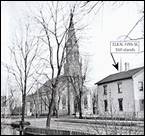
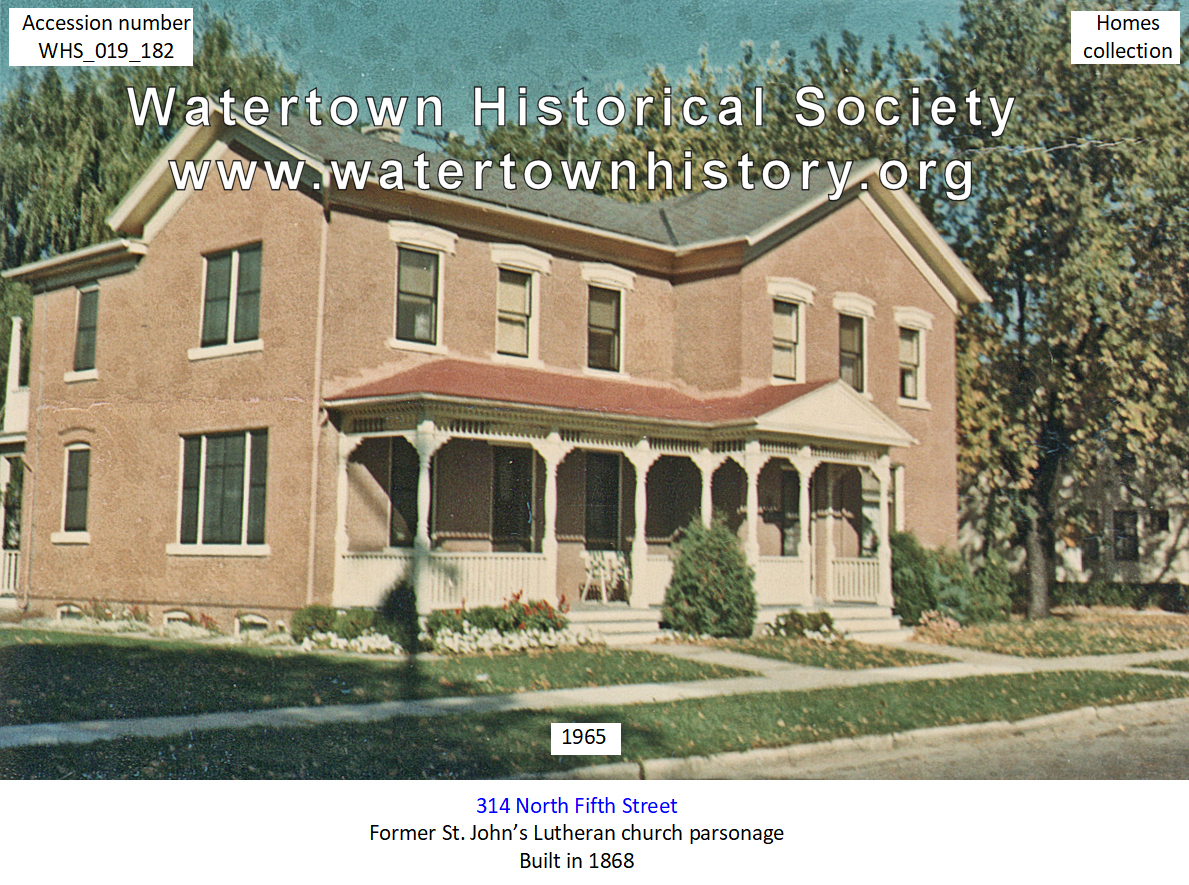 1965
1965
1875
06 16 Prof. E. C.
Gaebler is putting up in St. John’s
Lutheran Church a magnificent pipe organ manufactured at his Temple of Music,
Fourth Street. His organ is a fine
specimen of Watertown manufacture and reflects credit on its builder. A brief description of the instrument may be
interesting.
The organ has two banks of keys, two octave of pedals,
and contains over fourteen hundred pipes from 16 feet to 3/4 of an inch in
length. There are 28 stops and
combination pedals. The case is 15 X 14
feet and 20 feet high. There are 28
gilded pipes in front, the largest of which is ten feet long and 6 inches in
diameter. The bellows furnishes 35,000
inches of wind every second. The organ
when completed is worth $5,000.
Excellent workmanship has been displayed on all
portions of the instrument. The design
of the front was drawn by Mr. L. Charboneau and, of course, is tasty and
artistic. The gilding and painting on
the organ was done by Messrs. Degenhardt & Bradow, Mr. W. E. Dervin having
a hand in on the finishing touches. Of
course the tone of this instrument will be of the highest order, having passed
through the hands of Prof. Gaebler, one of the foremost musicians of the state,
who has supervised every portion of the work.
Our citizens will have an opportunity of hearing this
magnificent organ for the first time on Sunday, June 27th. It will be played by a celebrated organist
from Milwaukee. We hope the day is not far distant when Prof. Gaebler & Son will engage
more extensively in the manufacture of pipe organs. They are certainly competent to turn out as
good instruments as can be found anywhere, and we trust they may meet with sufficient
encouragement to build up a large manufacturing interest of this kind in our
midst. WR
c.1875
THE OLD ST. JOHN’S LUTHERAN
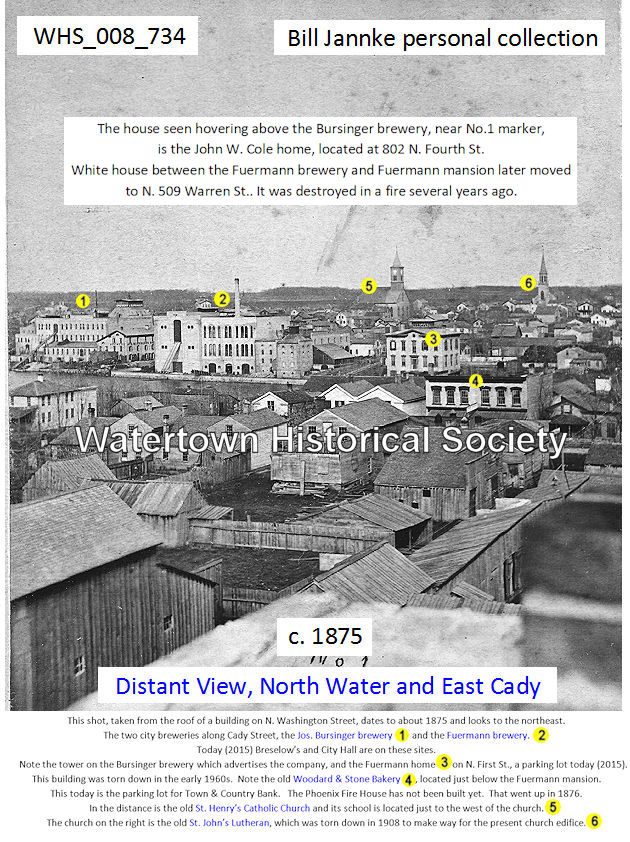 Torn down in 1908 to make way for the
present church edifice.
Torn down in 1908 to make way for the
present church edifice.
c.1885
ST.
JOHN’S SCHOOL, North Sixth
& Cady
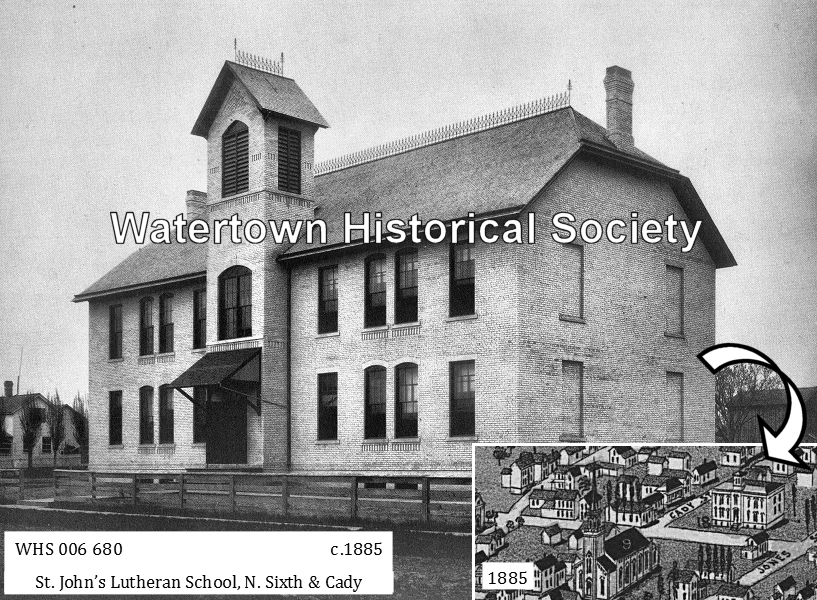
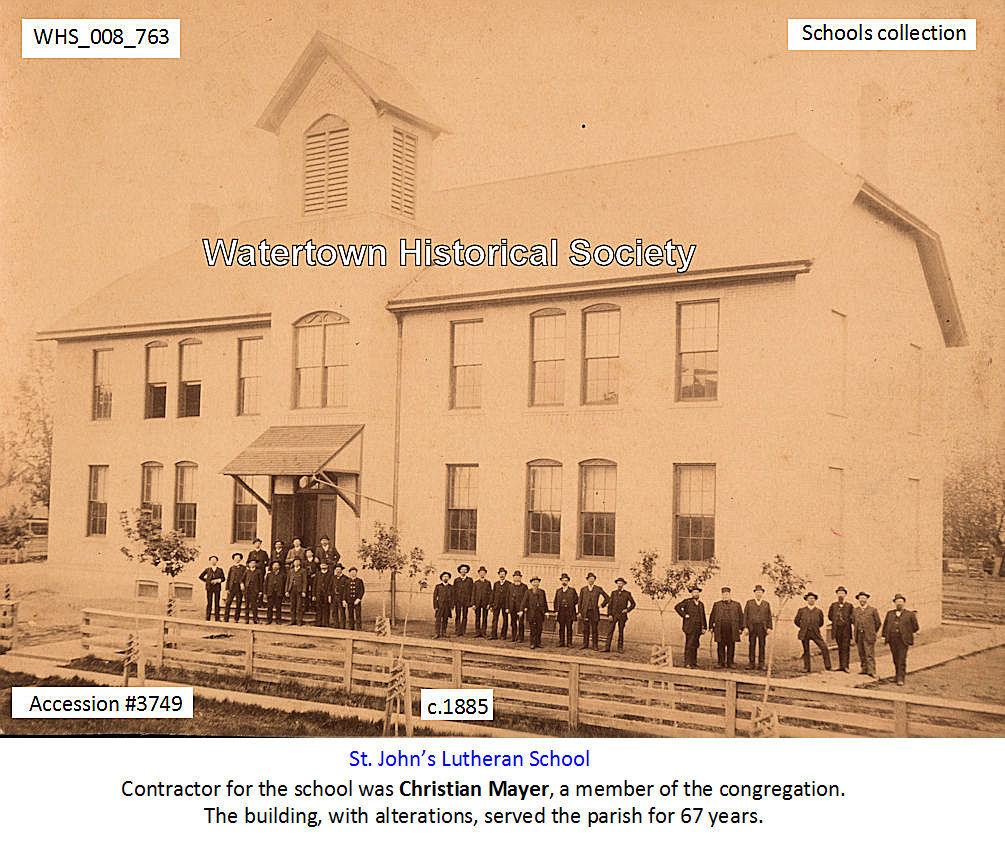
Recognizing that the brick building erected
for school purposes in 1868 was not adequate the congregation began to plan to
build a larger school in 1881 on the corner at North Sixth and Cady. Construction was delayed until March,
1885. Contractor for the school was Christian Mayer, a member of the
congregation. The building, with
alterations, served the parish for 67 years.
Cross
Reference: 1910, Obit; Mayer, F.C., b. Jan 24,
1828, d. Aug 6, 1910
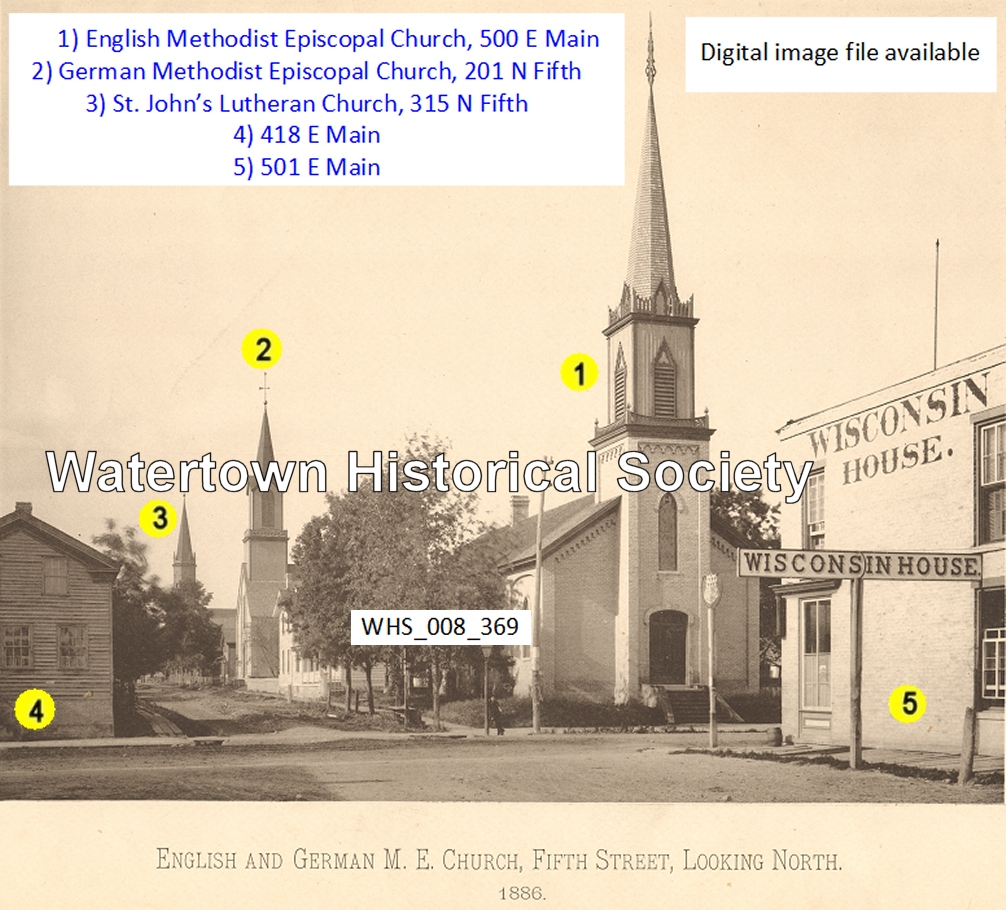
1886
1900
01 09 PROF. ALEX RIEMANN
The Juneau
Independent speaks as follows of a Watertown young man: "Prof. Alex Riemann, for a number of
years teacher in St. John's Lutheran parochial school in this city, has
received a call to teach the Lutheran school at Hustisford and has accepted the
same. This must be considered as a
promotion for the professor, as in his new charge he will receive a higher
salary and will have an assistant. Prof.
Pringle, of the Hustisford school, was called to Wauwatosa, where he has
already entered upon his duties. On New
Year's Eve the church choir and a large number of members tendered Prof.
Riemann a farewell reception. All regret
his leaving, as he was very popular with everyone. All rejoice in his steady
advancement." WR
06 15 REV. STRASEN RESIGNATION
Rev. C. Strasen, for the past 42 years pastor of St. John’s
Lutheran church in this city, has tendered his resignation, to take effect as
soon as his successor can be appointed.
He tendered his resignation on account of his advanced age, being 78
years old, and wishing to pass the remainder of his days in a quiet and restful
way. He has been a minister for 53
years. His congregation desires one of
his sons to succeed him. He has five
children, his daughter who keeps house for him; Rev; John Strasen of Milwaukee;
Rev. Strasen, of Wine Hill, Illinois; Rev. Henry Strasen, of Janesville,
Minnesota, and Prof. G. Strasen, of Horicon.
When his successor is appointed, he will remove from the city and make
his home at one of his sons. His many
friends here will regret his departure very much. WG
08 10 REV. EGGERS ACCEPTS CALL
The Milwaukee Sentinel of Wednesday says: “The Rev. Eggers, formerly pastor of the
Evangelical Lutheran Jehovah congregation on the south side, has accepted a
call to the pastorate of the Watertown Lutheran church, of which the Rev. C.
Strasen, Sr., was pastor. Mr. Strasen
who is one of the oldest Lutheran pastors of the state, has been compelled by
old age to withdraw from active church work.”
Milwaukee Sentinel
1901
10 04 WILLIAM DOBBRATZ
Another of Watertown’s old and respected citizens, Wm.
Dobbratz, passed peacefully from earth Thursday night of last week at his home,
913 N. Fourth Street, aged 68 years. His
death came rather sudden, as it was only last Monday that he became ill, the
cause of it being a cholera orbus. Mr.
Dobbratz was born March 8, 1833, in Sternin in Kreise Coerlin, Prussia and came
to Watertown when he was 10 years of age, and has ever since made this city his
home, during most of which time he was engaged in the boot and shoe
business. He served his ward several
times in the city council, was one of
the founders of St. John’s Lutheran church in this city, was a member of
the old Watertown fire department, and a member of the Watertown Arbeiter
verein. WG
1903
04 11 CONFIRMATION EXERCISES
The confirmation services at St. John’s Lutheran
church last Sunday were largely attended.
The commodious church has a seating capacity of about 500 people, and
every available seat was taken, after which chairs were pressed into service
and this proving inadequate to the demand of these zealous and interesting
people.
The church was beautifully decorated with huge palms
and the altar was embellished with handsome urns filled with cut flowers, which
were very pleasing to the eyes of The congregation.
Rev. F. H. Eggers, pastor of the church, delivered an
eloquent sermon, and a large class was confirmed. The children demonstrated the result of much
earnest labor and also the strict attention that had been given them by their
pastor during their term in the parochial school which was greatly appreciated
by their parents. Special music was
rendered. The girls were beautifully
gowned in white and the boys carried bouquets of carnations.
Those included in the class were: Herman Hofs, Willie
Baumann, Bernard Schmidt, Reinhold Borth, Waldemer Bunding, Willie Luther, Emil
Henning, John Seefeldt, Hugo Gutzlapf. Arthur Fetzlapf, George Gotterdam, Elmer
Kohn, Willie Fischer, Willie Schut, Max Maede. Lydia Mittag, Meta Krahn, Irma
Nickels, Else Beerbaum, Aldina Nickels, Minnie Wolf, Lydia Bittner, Ella
Schlieve and Else Christian.
1905
12 26 BETHESDA PROGRAM
The entertainment
given last evening at St. John's Lutheran Church by children from the Home of the Feeble-Minded was marvelous in the
extreme. It demonstrated that wonderful
mental improvement was being accomplished with the feeble-minded children at
the Home and also proves the value of its work.
Thirty-five
of the children were present at the exercises which were deeply interesting and
if anyone was skeptical when they went they were convinced when the exercises
were over that the mental and physical condition of the unfortunate was being
greatly improved.
The
church was packed from vestibule to altar and the galleries were crowded with
interested people and many were unable to gain admission.
Prof.
Schumacher presided at the organ and Rev. H. Eggers had charge of the liturgy
and Rev. J. Klingmann delivered an address in which he spoke feelingly of the
work being done in behalf of the children — the efforts to bring them to the
Savior, that they might know and love him.
"As ye did it unto the least of these, ye did it unto
me." The answers of the children
were clear and distinct and the singing especially fine, a beautiful Christmas
tree was put up by a committee of St. John's congregation upon which, there was
a box of candy contributed by Mrs. Lewis Junior.
The
collection taken up for the benefit of the home amounted to $70.
1906
02 26 BETHESDA MOVES TO MILWAUKEE
Prof. and Mrs. W. K. Weissbrodt, superintendent and
matron of the home for feeble minded and epileptic
children and Prof. and Mrs. E. M. Kirch, teachers in the institution, leave
today for Milwaukee, to which city their household goods were shipped
yesterday, where they will get things in readiness for the coming of the
children . . . the congregations of both
St. Marks and St. Johns churches having provided the necessary bedding and
furniture for their comfort while they remain.
1907
01 03 The year 1907 promises to be a good year in the way of
building and improvements. Among the
contemplated buildings are a new and modem church to be erected by the
congregation of St. John’s Lutheran Church on North Fifth Street. The new edifice, it is said, will cost in the
neighborhood of $35,000 and will be of pressed brick. The capacity is to be about 1,000. The church will have a gallery, steam heat
and toilet rooms.
01 20 At a meeting of the congregation of St.
John's Lutheran Church on Sunday, it was definitely decided to carry out the
plan to erect a new church edifice at a cost of about $30,000, plans for which
were drawn about a year ago by Architect F. A. Lindsay. This will be one of several notable
improvements that are promised Watertown for the present year, another writer
having in mind the new M. E. church, which is to be erected of concrete blocks
at a cost of $10,000 or $12,000.
It is the plan of the St. John's church
people to begin building operations just as soon as possible. A meeting of the building committee will be
held tomorrow evening to perfect plans for the preliminary work, and arrange
for the commencement of operations in calling for bids.
The new building will be erected on
Judging from the plans, the new church
will be an imposing structure. It is to
be erected of red pressed brick, with a slate roof. The interior finishing will
be handsome and is to be of oak. The
fixtures will be in keeping with the other appointments and when completed the
St. John's congregation will have a house of worship of which they can feel
proud and the city another ornament.
02 14 The Young Ladies Society, together with the Young Men
Society of St. John’s Ev. Luth. Church, celebrated their anniversary at the
school hall last Sunday evening. An
elaborate supper was served, covers having been laid for fifty. The feast was followed by music and games and
several guessing contests: First prizes were awarded to Misses Emma Doering,
Selma Meyer, Messrs. Frank Uttech and John Seefeldt.
04 04 LAST SERVICE IN OLD CHURCH
The regular services at St. John’s
Lutheran Church last evening (Sunday) were in the nature of a farewell, it
being the last to be held in the old church.
Work of razing the same will be commenced today to give place for the
erection of a beautiful new edifice at a cost of about $32,000, the plans for
which were drawn about a year ago by Architect F. A. Lindsay. This is to be one of the many improvements
promised for Watertown this year, another being the erection of a new Methodist
church at a cost of about $12,000.
The
new St. John’s church will be erected on North Sixth Street. According to the plans as drawn the church
auditorium is to be 58x76 feet, with a seating capacity of 700, while a gallery
is provided for with a seating capacity of 300, making a total seating capacity
of 1,000. It is to be erected of red
pressed brick, with a slate roof. The interior finishing will be handsome and
is to be of oak. The fixtures will be in
keeping with the other appointments and when completed the St. John’s
congregation will have a house of worship of which they can feel proud and the
city another ornament.
04 17 RAZING OF THE STEEPLE
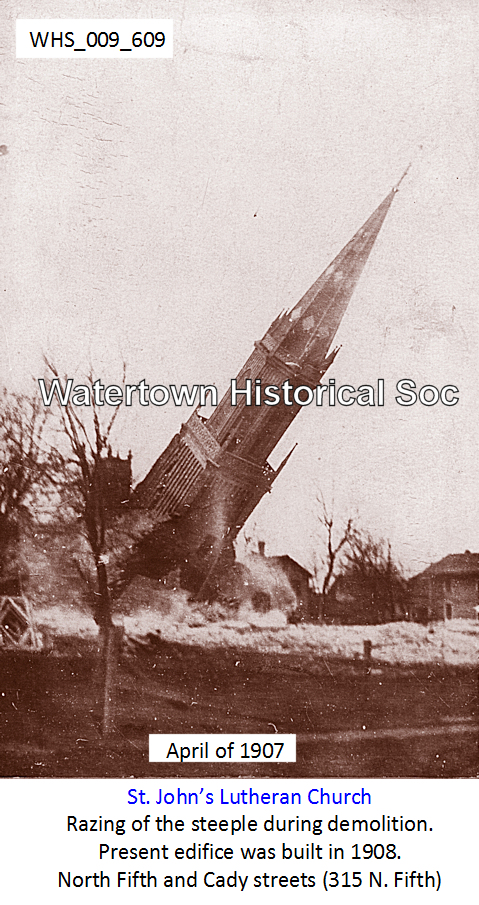 < click to enlarge
A sight that was watched with interest
by a large number of spectators was that of the razing of the steeple of St.
John's Lutheran Church, which occurred yesterday morning under the supervision
of John Diehl. The sight of the lowering
of the steeple, which was 150 feet in height, was a novel one. The job was nicely engineered and was
completed without any mishap. Jacks were
used, also a cable attached to a windlass.
The balance of the church has been razed to give place to a new edifice,
work upon which will soon be commenced.
06 30 St. John's German Lutheran church is
one of the oldest churches in Watertown and probably in the state. It was organized in 1852 . . . The foundation
of the congregation was laid by the Rev. Louis Geyer, who lived eight miles
northeast of Watertown. Rev. Geyer
visited the small congregation for a few years, when in 1855 a resident
minister was called. Rev. H. Wagner
became, in the fall of 1855, the first permanent pastor of St. John's
church. The services during Rev.
Wagner's pastorate, were held in a small frame building in the Sixth ward. In 1859, Rev. C. Strasen succeeded Rev.
Wagner. Rev. C. Strasen's work at the St. John's church was crowned with great
success. He occupied his position for
over forty years and until seven years ago he was pastor of the church when he
retired owing to old age. Since 1900 the
Rev. H. Eggers has acted as pastor of the church, a minister known for his conscientious
work.
The new church is expected to be
completed by Christmas time . . .
New St. John’s Church, Gamm Drug Store
postcard.
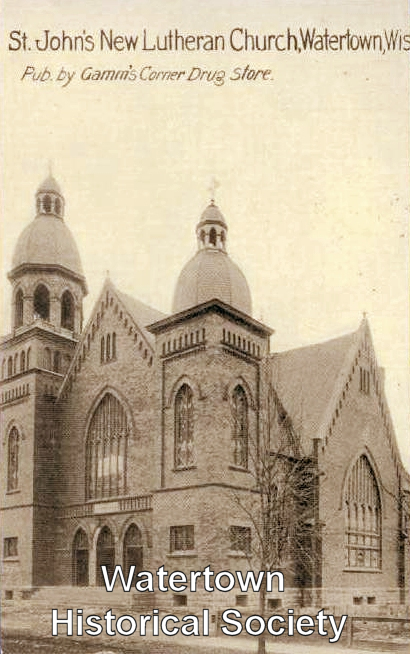
Early
in 1907 it was decided to build a new and larger church to meet the growth of
the congregation.
1908
01 02 Yesterday afternoon while Rev. F. H. Eggers was out
driving, his horse became frightened near the plant of the Dornfeld-Kunert
Co. on South Second Street and ran away and made it exceedingly lively for
Mr. Eggers, who fortunately escaped without injury, much to the gratification
of his many friends. The horse, which
was injured to some extent, was sent to the hospital
of Dr. A. H. Hartwig for examination, and if necessary, treatment.
04
05 On April 5, 1908, the construction was finally
completed, and with great rejoicing the congregation was able to dedicate its
new house of worship. Dedication
services were held in German and English.
The
church was built at a cost of about $45,000 in a Roman style of
architecture. The roof is covered in
slate shingles. The foundations are of
Portwing red sandstone, and the remainder of the church is built of St. Louis
hydraulic red brick. The north steeple,
the higher of the building’s two towers, extends 112 feet in the air, and
contains three large bells which were saved from the earlier church
building. The main sanctuary of the
church could seat 800 individuals, and at that time, the balcony could seat
375. A new pipe organ was installed at a
cost of $4,650.
04 05 INTERIOR VIEW
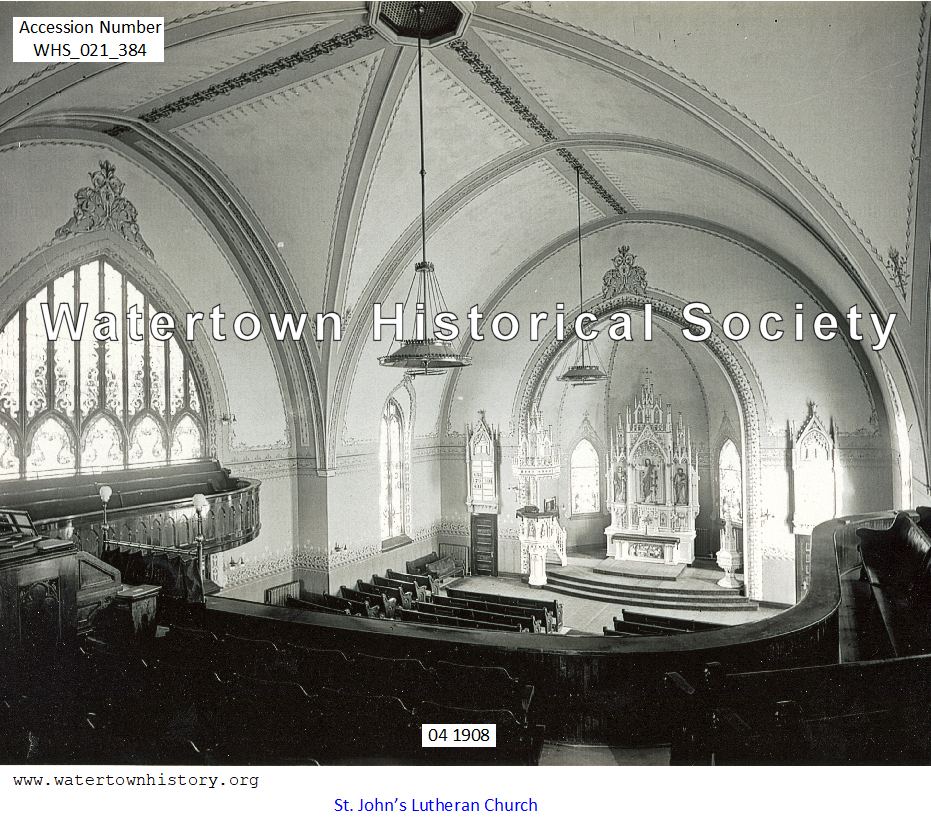
10 30 Fred
H. Meyer
School
instructor for the past 40 years, Fred H. Meyer, died at his home; 11 06
Funeral held from his home to St. John's Church. WG
1909
07 02 Lutheran Home
Corner Stone Laid; St John’s participation
WG
c.1911
-- -- ST. JOHN’S WOMEN’S
CHOIR, VALENTINE’S DAY CELEBRATION
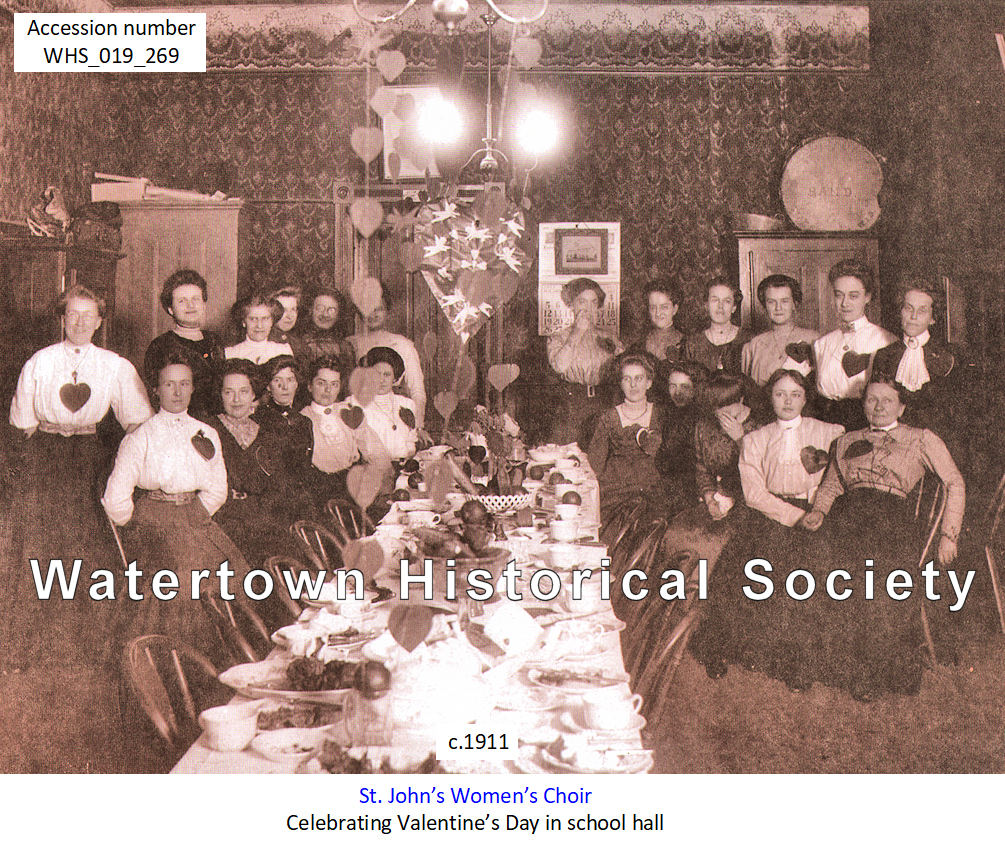
1916
06 27 PARTICIPATE
IN PICNIC AT BETHESDA
A Milwaukee contingent of 350 Lutherans of
twenty-eight churches took two special trains on the electric road and added to
the 6,000 that had already gathered from this city, Jefferson and Fort
Atkinson. The party was escorted to the Bethesda home by the St. John’s band and the morning service in German which
followed immediately was led by the Rev. Clarence Sheuer of Lowell, Mass. The afternoon program was in English being
featured by a sermon by the Rev. H. C. Jans and a talk to the children by Prof.
Theodore Schlueter of the Northwestern college.
Dinner and supper were served in one of the buildings
by the ladies of St. Mark’s church.
Choir numbers were given by the Watertown members on the lawns
surrounding the buildings which were specially decorated for the occasion. WL
07 16 BAND BOYS MAKE MERRY AT THEIR ANNUAL PICNIC
The picnic given by St. John’s Independent band at the Sauerkraut club on Sunday was a success and a most enjoyable affair from every stand point.
Early in the morning the live wire delegation was on the spot, and preparations were made for the crowd which soon began to arrive. Fishing and bathing were in order, and many of the younger ones of the party pitted their strength against the current in the river which is some stream just now at that point.
Early in the afternoon, after a splendid dinner had been served in the club dining hall, the quartette led by Pat Diekoff and assisted by whoever took a notion rendered some choice vocal selections. Some of the voices were a trifle rusty but the most of them gave great promise if they had the advantage of training by a good teacher.
Some records were made by expert horseshoe pitchers but it was at fishing that Fred Bittner tied them all. Bittner also led a cross country chase, the hazards including swamp ground, barbed wire fences and ditches. In this contest Pat Diekoff lost by a length by trying to pick a new route.
In the afternoon, an auto party enroute from Chicago to Madison visited the club.
`
The band is composed of the following
members: William Bast, Walter Krueger, Ray Brier, R. Grosnick, Otto Nienow,
Arthur Block, Ben Maas, Fred Maas, Edward Kohlhoff, Arthur Bast, Arthur
Sprenger, Anton Lemke, August Kohlhoff, J. Schiefer, William Thietz, H.
Borchordt, F. A. Bittner, Ben Schumacher, Walter Block, Frank Uttech, H. M.
Sonnemann, Prof. H. A. Schumacher. The Watertown news, July 16, 1917
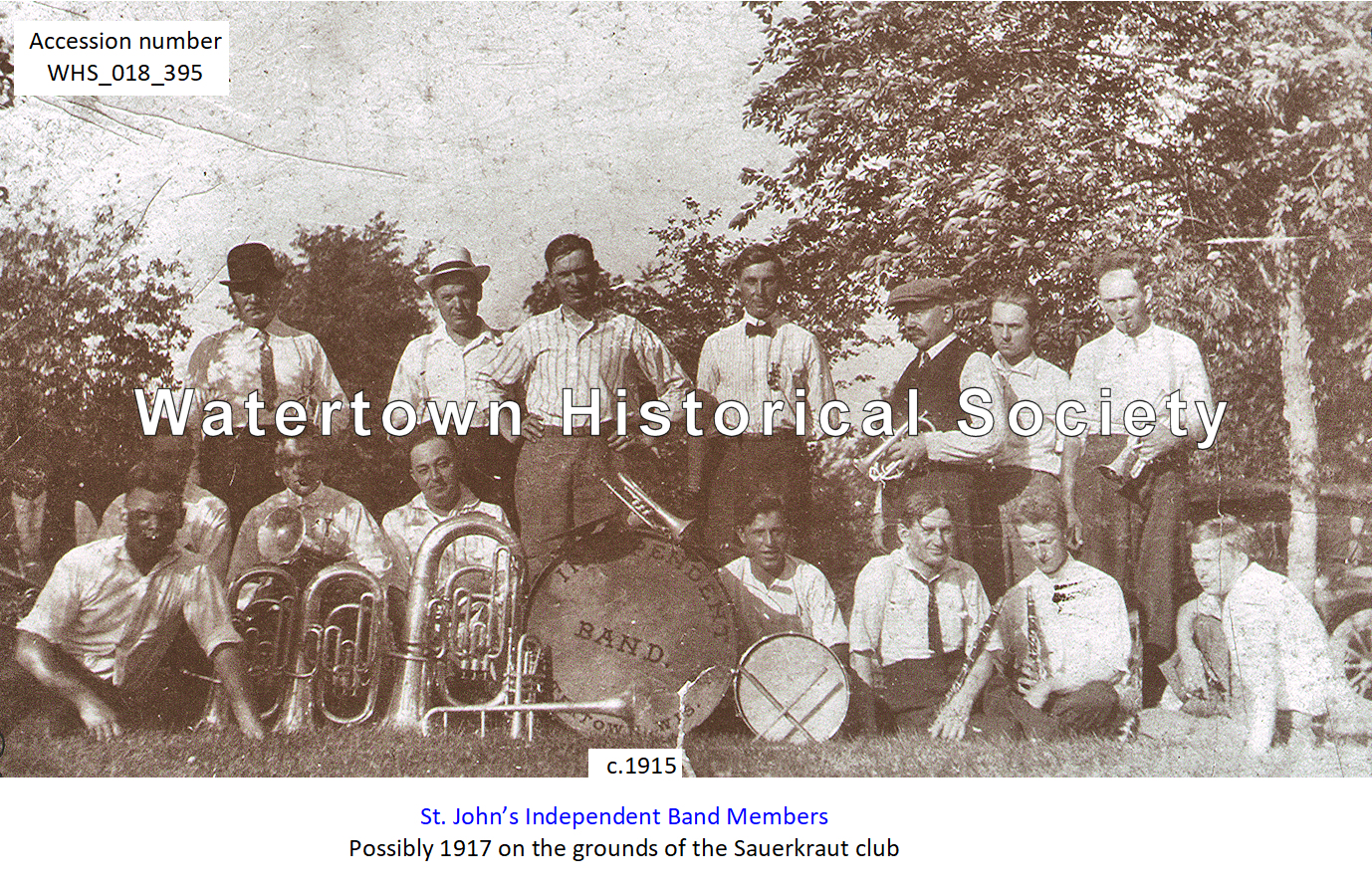
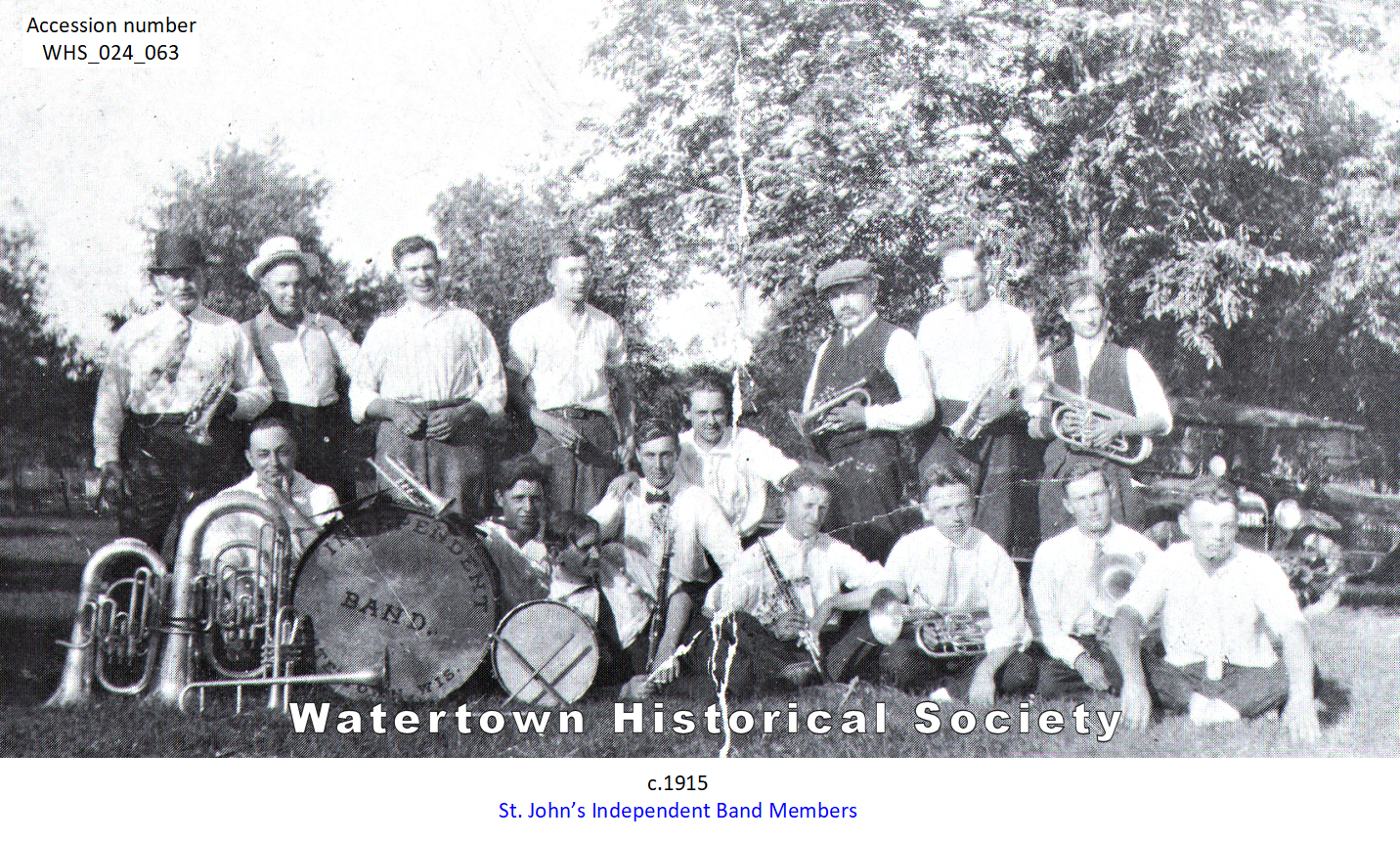
Band Members. c.1915, possibly 1917 on the grounds of the
Sauerkraut club
1918
05 24 Ladies Aid Society was organized May 24, 1918
with 47 members.
08 27 At the time of his
death, Rev. Christians was assistant pastor
of St. John’s Lutheran Church. WDT
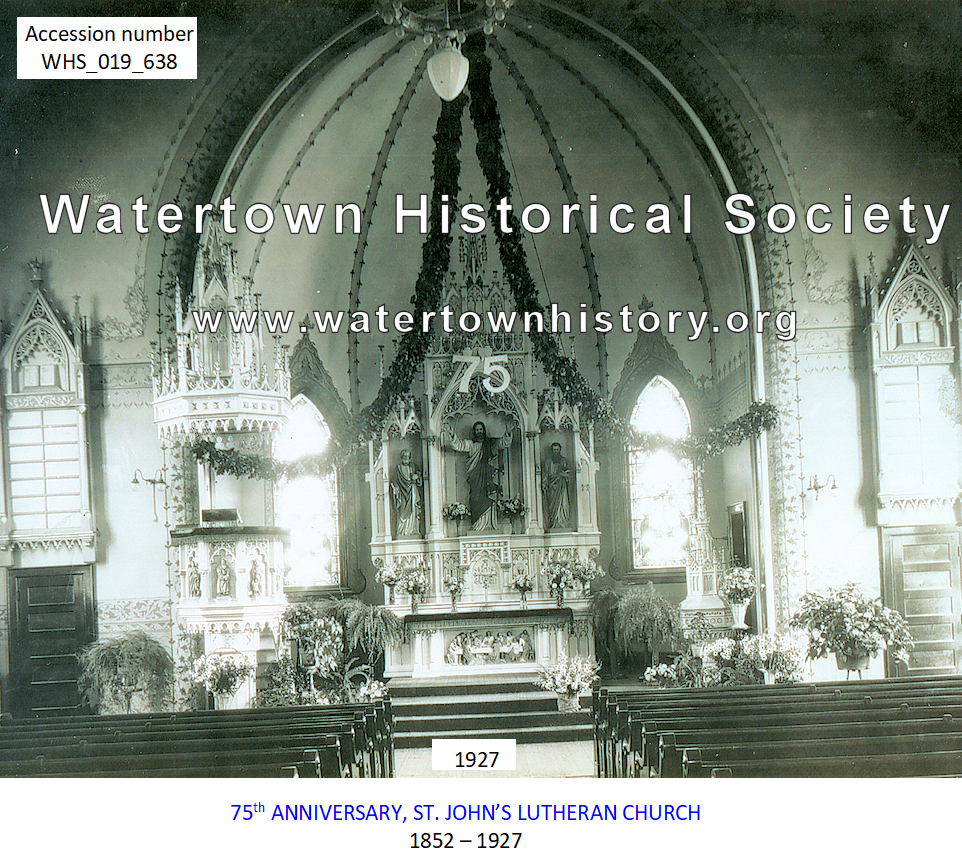
1927
75th ANNIVERSARY, 1852-1927
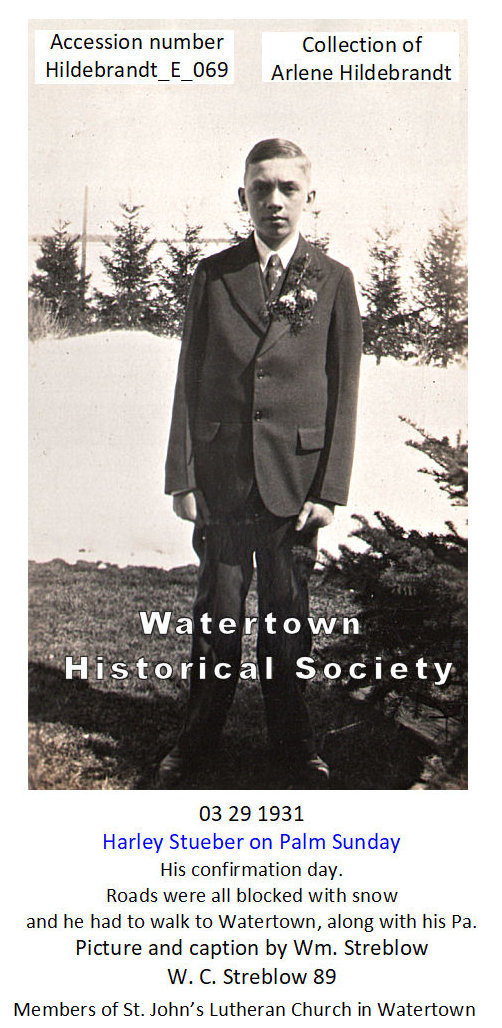
1931
03 29 CONFIRMATION DAY.
Palm
Sunday
04 14 CONFIRMATION
CLASS OF
APRIL 14, 1935
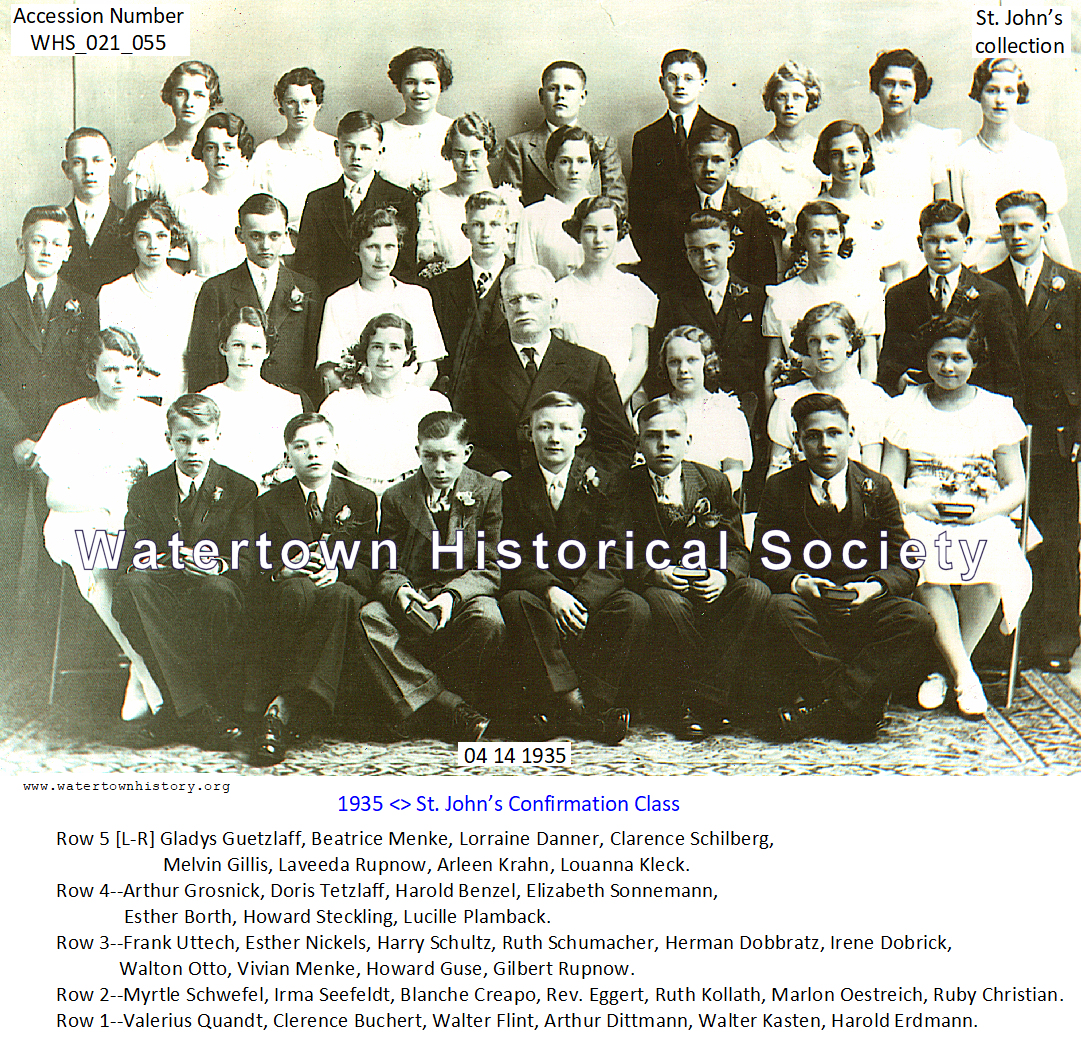
Gladys Guetzlaff, Beatrice Menke, Lorraine
Danner, Clarence Schilberg, Melvin Gillis, Laveeda Rupnow, Arleen Krahn,
Louanna Kleck, Arthur Grosnick, Doris Tetzlaff, Harold Benzel, Elizabeth
Sonnemann, Esther Borth, Howard Steckling, Lucille Plamback, Frank Uttech,
Esther Nickels, Harry Schultz, Ruth Schumacher, Herman Dobbratz, Irene Dobrick,
Walton Otto, Vivian Menke, Howard Guse, Gilbert Rupnow, Myrtle Schwefel, Irma
Seefeldt, Blanche Creapo, Rev. Eggert, Ruth Kollath, Marlon Oestreich, Ruby
Christian, Valerius Quandt, Clerence Buchert, Walter Flint, Arthur Dittmann,
Walter Kasten, Harold Erdmann.
1947 RESIGNATION OF Rev. F. H. EGGERS (1900-1947)
 Late in 1947 the Rev. F. H. Eggers, whom the Lord had preserved for so
long a time and had permitted to serve St. John's Church for 47 years, became
ill. It soon became evident that he
would no longer be able to fulfill his duties, and so on November 1, 1947; he
offered his resignation to the congregation, which was accepted with
regret. For several months Pastor Eggers
made his home with one of his sons, the Rev. Theodore Eggers, Chaplain of
Bethesda Lutheran Home, where he died on May 19, 1948, at the age of 78
years. His funeral was held on May 23 in
St. John's Church, where a large gathering of his sorrowing parishioners heard
the Rev. Karl Wedel, Circuit Visitor, deliver the funeral sermon. His body, like that of Pastor Strasen, was
laid to rest in the Lutheran Cemetery, where with a great number of his former
parishioners it awaits the Resurrection Morn.
In this manner, according to the will of God, ended the life and the
career of the third resident pastor of St. John's Lutheran Church.
Late in 1947 the Rev. F. H. Eggers, whom the Lord had preserved for so
long a time and had permitted to serve St. John's Church for 47 years, became
ill. It soon became evident that he
would no longer be able to fulfill his duties, and so on November 1, 1947; he
offered his resignation to the congregation, which was accepted with
regret. For several months Pastor Eggers
made his home with one of his sons, the Rev. Theodore Eggers, Chaplain of
Bethesda Lutheran Home, where he died on May 19, 1948, at the age of 78
years. His funeral was held on May 23 in
St. John's Church, where a large gathering of his sorrowing parishioners heard
the Rev. Karl Wedel, Circuit Visitor, deliver the funeral sermon. His body, like that of Pastor Strasen, was
laid to rest in the Lutheran Cemetery, where with a great number of his former
parishioners it awaits the Resurrection Morn.
In this manner, according to the will of God, ended the life and the
career of the third resident pastor of St. John's Lutheran Church.
In his tenure of office, Pastor Eggers had
seen the congregation grow into a church of considerable size. His talents had often been put to use in the
service of the Missouri Synod, on whose boards and committees he served. He also rendered a very great service to
Bethesda Lutheran Home, being a member of the original board which called the
Home into existence. He also was partly
responsible for its location in Watertown, and served as Chairman of the Board
for a great many years.
The congregation will long remember the many loving services it received at the hands of Pastor Eggers. It will always find a reason to thank the Lord for having sent it a man of such capabilities and talents, and for having permitted him to remain as its leader for so long a time.
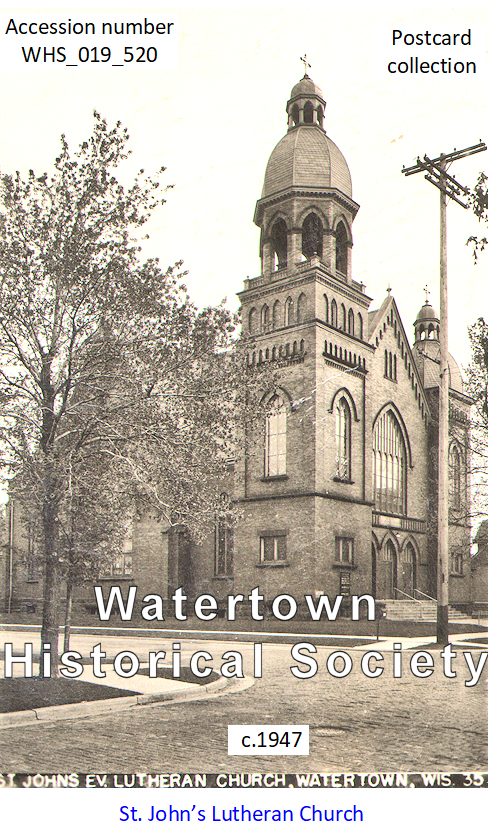
c.1925
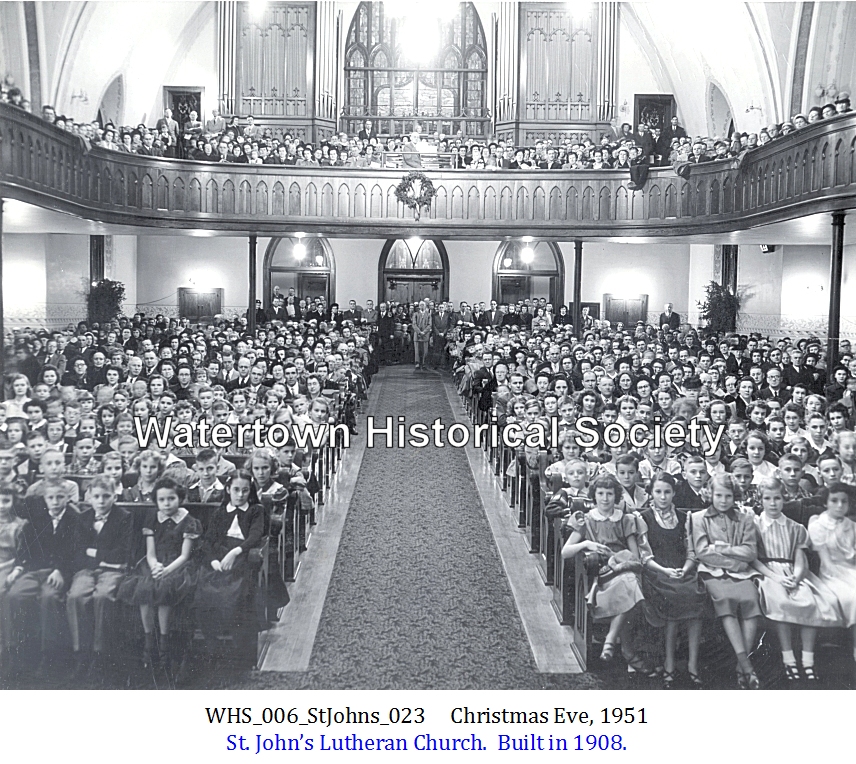
1951
12 24 CHRISTMAS EVE, 1951
1952
04 28 ROCK RIVER ZONE WALTHER LEAGUE FESTIVAL
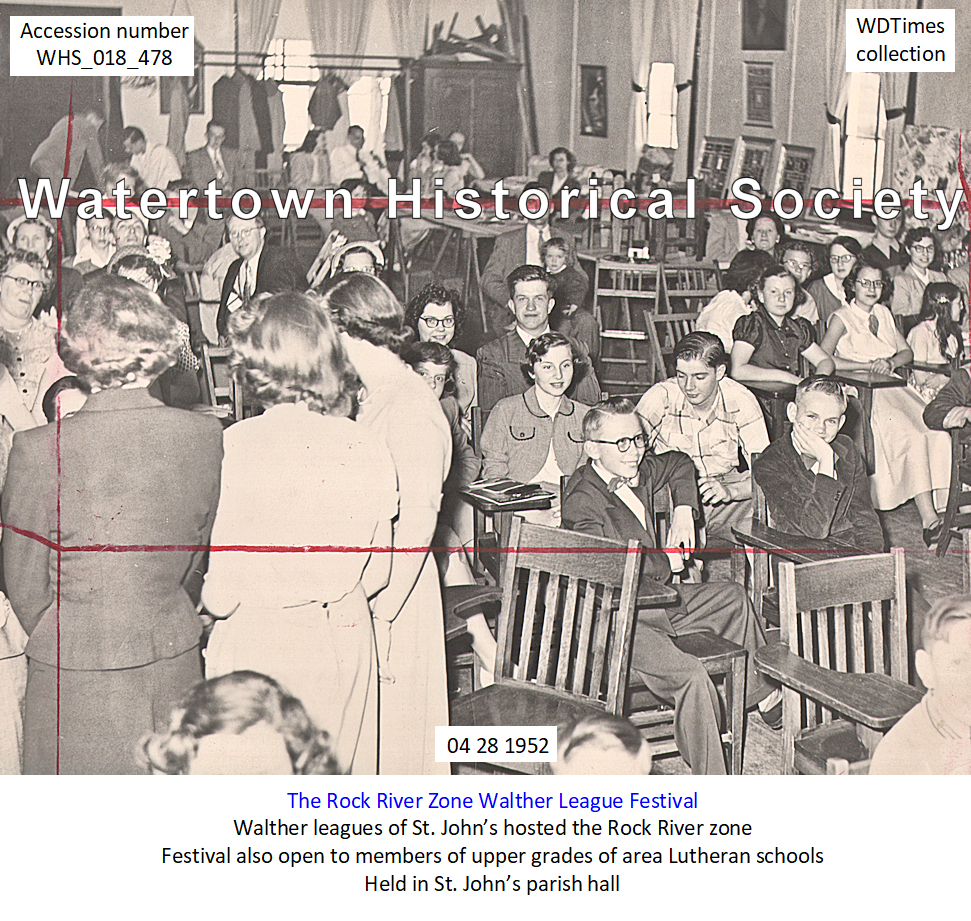
The Walther
leagues of St. John’s hosted the Rock River zone. Festival also open to members of upper grades
of area Lutheran schools.
Festival held in
St. John’s parish hall. Had Walther
League there, also choir practice, downstairs was the Ladies aid kitchen and
serving hall/multipurpose room. . .
“After high school, I volunteered to help in the office upstairs,
updating records.” Pauline Sukow taught
Sunday school in there for two years!
Faye Petig had first grade in the Parish Hall. The next year the class
used the old Webster School on Western Ave.
until St John's new school was ready.
1952
Watertown Daily Times, 09
03 1952
ST. JOHN’S CHURCH HERE
PREPARES CELEBRATION FOR ITS CENTENNIAL
History of its first 100 years
to be published
Introduction
St. John’s Lutheran Congregation in
Watertown, a member of the Missouri Synod, this year is observing its 100th
anniversary and the centennial will be celebrated on the four Sundays in
October. There will be outstanding guest
speakers.
A display of crosses has been placed in the
church, starting with the founding of the church in 1852. A cross is added each month representing
another decade of progress until the entire display of eleven crosses is
completed in October. In the center of
this display is the Luther Rose, which was the official seal of Dr. Martin
Luther. At the bottom of the display are
the words, “Through a Century with Christ”.
St. John’s congregation and its members
played an important part in the growth and development in the city of Watertown
and the surrounding area. It not only
founded this church, but helped in the founding and development of other
churches in the surrounding communities.
1954
09 15 ST. JOHN'S LUTHERAN SCHOOL
DEMOLITION
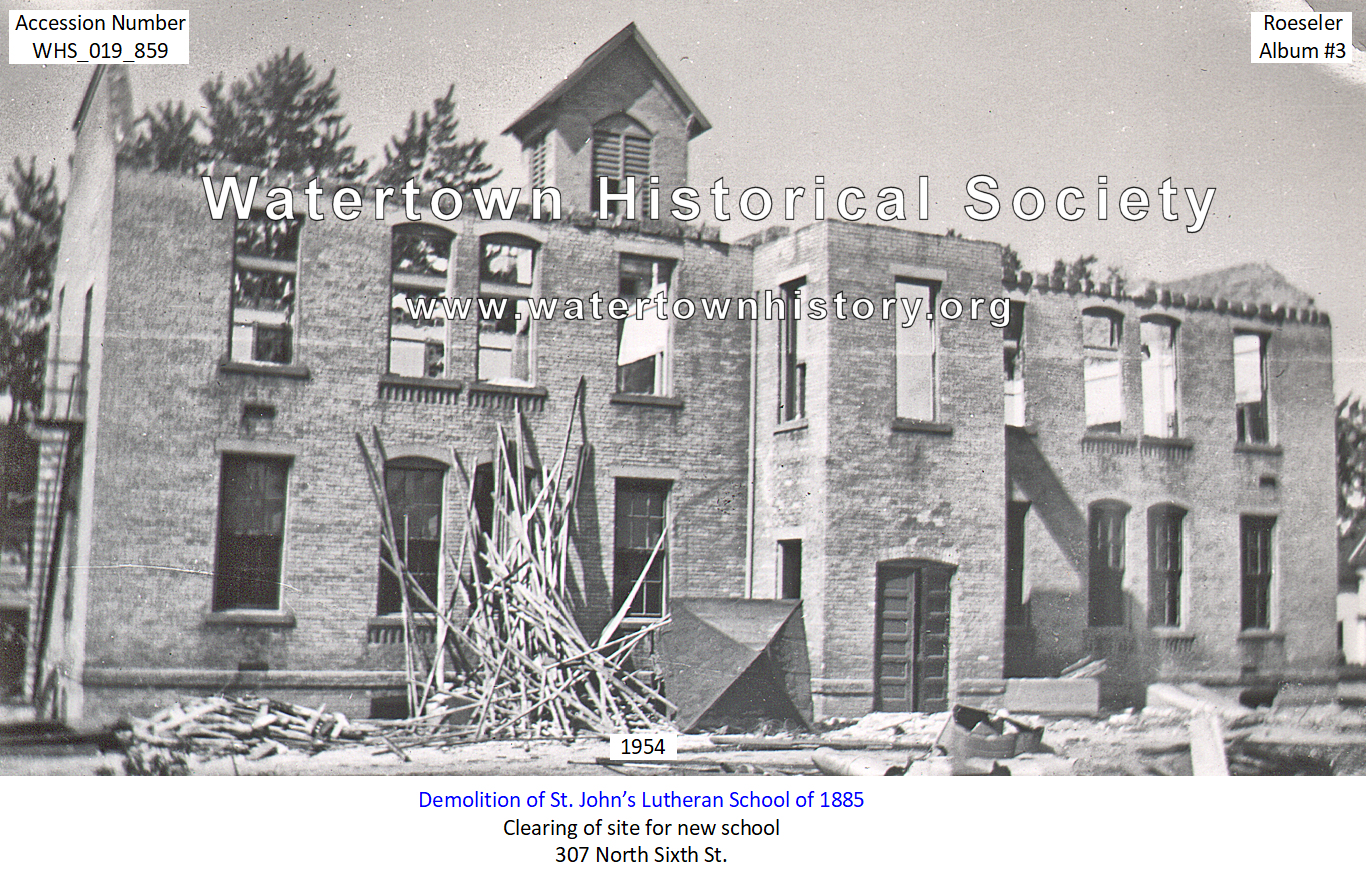
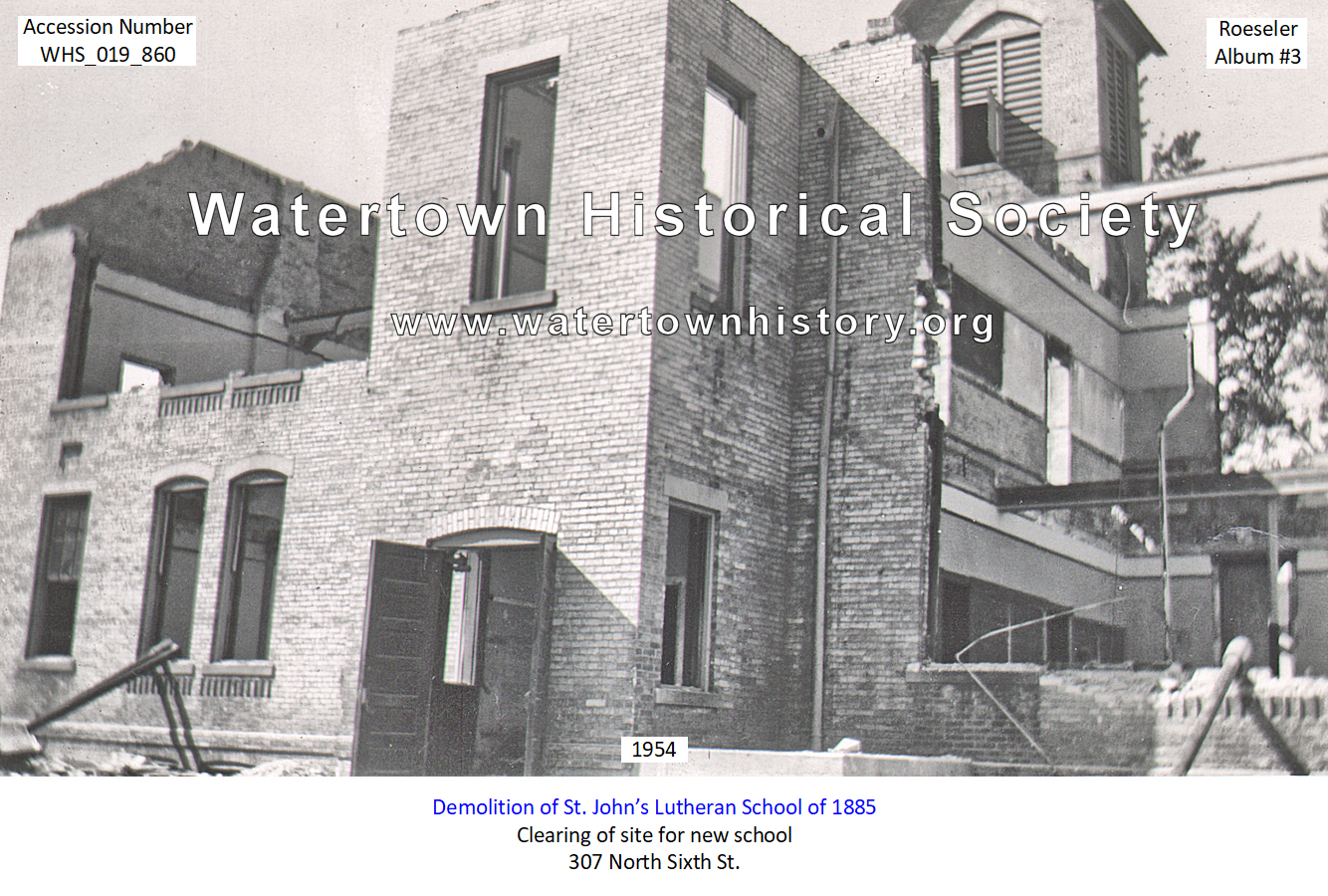
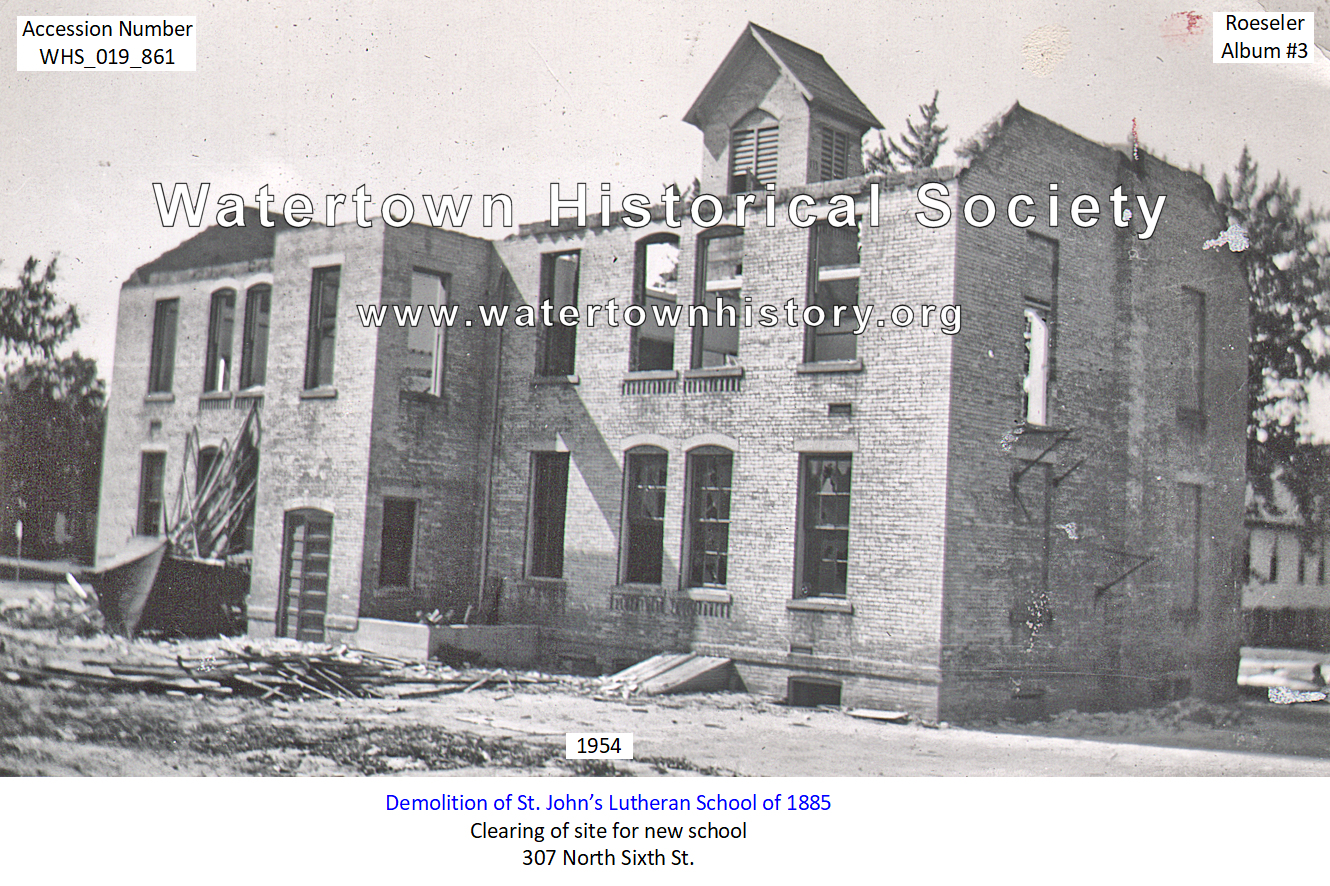
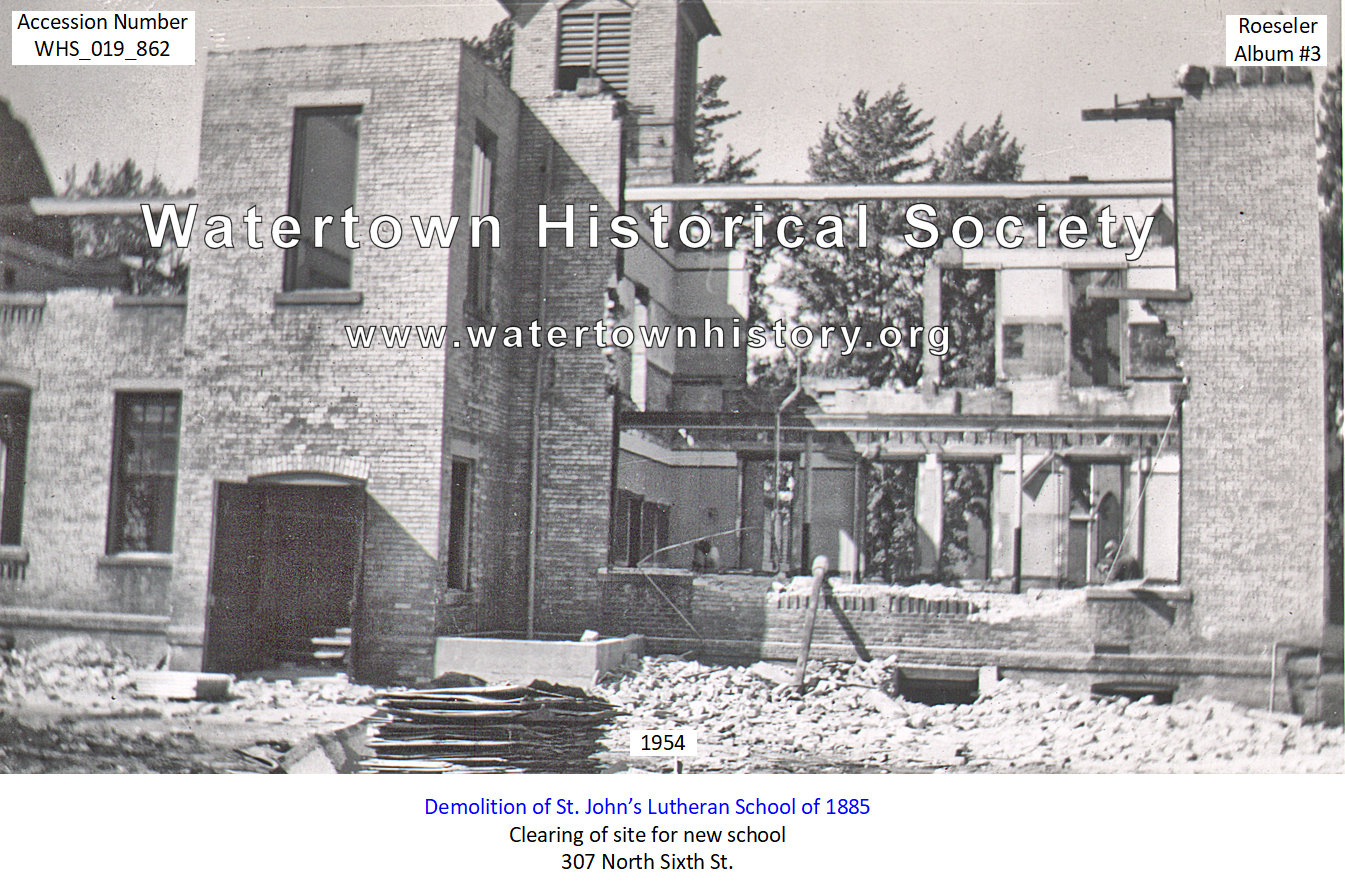
Work
has begun on the demolition of St. John's Lutheran School to make way for a new
and modern structure which will be undertaken shortly. The old building has served St. John's
congregation for the past 69 years. It
was erected in 1885 and several generations of
children have attended its classes. The
school which is to replace it will be a modern structure, utilizing
considerable glass and will embody many of the latest features. The architect is Alfred Siewert of
Milwaukee. The new school will front on
North Sixth Street, between Cady and Jones streets. It will occupy a much larger site than did
the old structure, since additional space (the former Wendt home and property
on Cady Street and the Zimmermann home and property on Jones Street), were
acquired by the parish for school campus purposes. The old properties have been cleared away to
make room for the new school.
Groundbreaking ceremonies will be held at the site by the congregation
Sunday morning. Classes in St. John's
School are being conducted in the city's old Webster School in Western Avenue
during the interval of construction.
1954
09 Rev E F Quandt’s 30th anniversary as pastor
1956
01 09 Final details were being arranged today
for the dedication on Sunday of the new school erected by St. John's on the
site of the old school building in North Sixth Street between Cady and Jones
Streets. There will be three dedication
services at the church, directly across the street from the new school. The school, which has a current enrollment of
270, will open Monday morning. The new $360,000 school was designed by Alfred H.
Siewert, well known school architect.
The general contractor was the firm of Fred Piette and Sons, Appleton.
1958
06 04 Edwin H. Matthes, retirement of,
teacher and principal WDT
1964
12 16 The
voters’ assembly of St. John’s Lutheran Church elected 1965 officers last
night. Elected were, H. M.
Stoeppelwerth, president; Herbert Lehmann, vice president; Ray Dobbratz,
trustee; and Mel Scheid, member of the board of education. The following were elected to the board of
elders: Marvin Kaufmann, District No. 1; Robert Wheeler, District No. 2; Howard
Herold, District No. 4; Gerhardt Doehler, District No. 11.
1966 Confirmation
11 30 HERBERT RICHTER HONORED
St. John's Lutheran Church will hold a service of
recognition Sunday to honor Herbert Richter, principal of St. John's School,
for his 25 years of service as a teacher in the Lutheran Church -- Missouri
Synod. The service will be at 9 a.m. Mr.
Richter has served as a teacher and principal of St. John's School since
1961. His other teaching service was
spent in other areas. The Rev. C. F. Golisch,
the executive director of Bethesda Lutheran Home, will be the speaker at the
service.
1967
03 13 PASTOR
GUNTHER SILVER JUBILEE
Church Service and
'Surprise' Are on Program
Members of St. John's
Lutheran Church turned out Sunday to honor the senior pastor of their
congregation, the Rev. Eugene C. Gunther on the occasion of his silver jubilee
as a minister.
Pastor Gunther assumed
the pastorate in Watertown on Aug. 18, 1963.
A feature of the
celebration yesterday was a "This is Your Life" program which was
held in St. John's School gymnasium at 2 p.m. and which came as a complete
surprise to the pastor and which brought out many of the highlights of his life
and his career as a minister. He enjoyed
it thoroughly and so did the program participants and the huge audience on hand
for the event.
Jubilee Service Held
The jubilee service was
held in the church at 3:30 p.m., beginning with an organ prelude, a
processional and vespers.
The choir also took
part in the service and there also were hymns.
The anniversary sermon
was delivered by the Rev. John W. Meyer of St. Paul's Lutheran Church, Mattoon,
IL.
The liturgist was the
Rev. Eugene P. Kauffeld, associate pastor of St. John's Church.
Herbert Richter was the
organist and Albert Dede directed the choir.
Native of Michigan
Pastor Gunther is a native
of St. Joseph, Mich., where he was born Nov. 6, 1910.
He received his
elementary, high school, and junior college education in Grand Rapids,
Mich. From there he moved with his
parents to High Point, N. C.
In 1932 he enrolled at
Concordia Seminary, Springfield, IL. He
graduated in June of 1938. Because of
the shortage of calls, he spent the next several years working in a mill, canvassing
for the Central Illinois District in the oil fields around Salem, and teaching
school at Arenzville, III, and Corunna, Ind.
On March 8, 1942, he
was ordained and installed as pastor of Zion Lutheran Congregation, West
Fairfield, Corunna, Ind. He served that
parish until May of 1952 at which time he became pastor of Immanuel Lutheran
Church, Mt. Olive, IL. During his
pastorate there he also served as chairman of the Southern Illinois District
Welfare Committee, as a member of the board of directors of the Lutheran Child
Welfare Association of Illinois, as a member of synod's committee on service to
the aging, as a delegate appointed by the governor to the White House
Conference for the Aging, and as zone pastoral advisor to the LLL and LWML.
He was also active in
the County Association for the Mentally Retarded.
Pastor Gunther was
married to Gertrude Wenger of Springfield, IL., on Nov. 20, 1941. They are the parents of one son, John, and
three daughters, Gail, Mary, and Hope.
Pastor Gunther received
many messages of congratulation yesterday and during the program in the school
he and Mrs. Gunther were presented with a gift by the congregation in the form
of a savings account.
The various
organizations of the church also presented gifts to Pastor Gunther. [Article includes pics]
05 11 REMODELING
THE CHURCH EDIFICE
St.
John’s Lutheran Church, of which the Rev. Eugene Gunther and the Rev. Eugene
Kauffeld are pastors, today made public plans for a vast remodeling program of
the church edifice. The preliminary cost
estimate for the project runs to $300,000.
Under present plans, bids are expected to be called for with completion
of the working drawings sometime in July, with the bids to be opened in August and
with construction to start late in August.
The construction is to include a new front entrance, new exit stairs,
remodeling the nave, balcony and chancel.
Included also are an insulated ceiling, painting and decorating, a new
lighting and sound system, new carpeting, new pews, a new heating system,
remodeling the basement, and an addition to the east.
06 08 St. JOHN'S SCHOOL TO HONOR 40 GRADUATES I
On Thursday
evening, June 8, at 7:30 o’clock 40 class members of St. John’s School eighth
grade will receive their diplomas. The
graduation ceremony will be held at St. John’s Lutheran Church during a special
worship service arranged for the evening.
The
festival speaker for the occasion is the Rev. Eugene Kauffeld, associate pastor
of St. John’s. The junior choir, under
direction of Albert Dede, will offer the worship anthem. Miss Viola Schlueter
will be the organist.
Chosen
to offer the salutatory and valedictory are two honor students of the class,
Christine Grosnick and Gary Sullivan.
The
class members will be presented to the congregation by Principal Herbert
Richter. Mel Scheid, chairman of the St. John’s board of education, will
present the diplomas.
On
Pentecost Sunday of this year the members of the class were accepted into
communicant membership of St. John’s through the rite of confirmation. They received their first communion on this
Sunday. A number of the class are
actively involved in parish activities including Sunday school, Walther League,
as well as the vacation Bible school beginning on June 12.
Several
male members are active in local Scout troops.
Members
of class receiving their Christian day school diplomas will be:
Pamela
Baumann, Roxanne Buss, Dan Casperson, Richard Ebert, Marcia Eggers, Code
Erdmann, James Griep, Christine Grosnick, Gary Guetzlaff, Cynthia Hilgendorf,
Frederick Hasten, Geoffrey Kaufmann, Dorrie Kienast, Sheryl Kohlhoff, Steven
Kohlhoff, Kent Kowalske, Dennis Lange, David Lauersdorf, Romana Lidmilla,
Norman Lorenz, Faye Maas, Craig Otto, Thomas Reason, Gary Schliewe, Edward
Schmidt, Daniel Schmoldt, Darlene Schmoldt, Richard Schmoldt, Diane Stueber,
Karen Stueber, Gary Sullivan, Allan Uttech, Christine Wagner, Jane Warner,
Linda Wendt, Steven West, Lori Wickus, James Wiley, Max Wincell, Bonnie
Zastrow.
12 14 RECONSTRUCTION
AND REMODELING CONTRACTS
St. John’s Lutheran
Church today announced the awarding of contracts for the major reconstruction
and remodeling project to be carried out at the church edifice, with work
expected to start almost immediately.
Plans for the program were originally made public some months ago. St. John’s is presently organizing a special
building and remodeling fund program.
Men and women of the church are being trained and prepared for the every
member visits which will begin on Sunday, Oct. 1.
12 14 Rev.
GUNTHER ACCEPTS CALL TO SYNOD'S BOARD OF SOCIAL MINISTERIES
The Rev. Eugene
Gunther, senior pastor of St. John's Lutheran Church, has accepted a call to
become the secretary for district and parish activities for the Board of Social
Ministeries of the Lutheran church, Missouri Synod. His duties will be to sensitize and counsel
the welfare committees and boards of the Synodical districts so as to
facilitate the fulfillment of their mission in and through the congregations of
the respective districts; to motivate, sensitize and equip individual
Christians, congregations and pastors so that they might address themselves to
the needs of their neighbor with increasing competence and consecration.
Pastor Gunther is to
assist in the conduction of welfare needs and opportunities and to be
knowledgeable in public welfare plans, proposals and programs and alert
Congregational Welfare Committees through the district with information and
possibilities of participation, and to assist in the direction and supervision
of the committees involved in the Board of Social Ministry. Pastor Gunther has long been active and
interested in welfare and social work before coming work and before coming to
Watertown served as chairman of Mental Retardation survey committee and was a
member of the board of directors of the Lutheran Service to the Aging. or many years he served as chairman of the
Southern Illinois District Social Welfare committee, and was also a member of
the board of directors of the Lutheran Child Welfare Association of Illinois.
One of his special assignments was that of a member of the governor's
delegation to the White House Conference on the Aging.
On Sunday, Jan.
14, Pastor Gunther will preach his farewell sermon at St. John's Lutheran
Church. He stated that he has enjoyed
his ministry in Watertown and has made many lasting friendships which he will
treasure over the years. His office will
be located in the Lutheran building in St. Louis.
1968
ANOTHER RENOVATION
PROJECT
The next
renovation/building program did not take place until 1968. The interior of the church was completely modernized
with the balcony wings removed to uncover the large stained–glass windows. The interior was greatly changed from the
original ornate and Gothic furnishings to a very plain nave and chancel. The free-standing altar and baptismal font,
as well as the tops of the pulpit and lectern, were covered with Travertine
marble. A wing was built onto the east
end (Sixth Street) of the church containing the sacristies, two pastor’s
offices, the church business office, a reception area, the council chamber, restrooms,
and an east and west entrance. In the
front of the church an addition covered the front steps and contained a chapel,
restrooms, and north and south entrances.
In the basement there were 10 Sunday school rooms, an altar, fellowship
hall, kitchen and restrooms.
02 05 REV.
KAUFFELD IS INSTALLED; SENIOR PASTOR
The
Rev. Eugene P. Kauffeld was installed as senior pastor of St. John's Lutheran
Church during a service held in the church Sunday afternoon. Pastor Eugene Gunther, former senior pastor
of the church, is now secretary for district and parish activities for the
Board of Social Ministries of the Lutheran Church, Missouri Synod.
The
liturgist at the installation services was Rev. Donald Nordmeyer and the
installing pastor was Rev. Herbert W. Baxmann, president of the Wisconsin
District of the Lutheran Church, Missouri Synod. Rev. Gerhard W. Zuberbier of Sullivan,
counsilor of Circuit 19 preached the sermon based on Mathew 14, verse 52 —
"Therefore every scribe which is instructed unto the kingdom of heaven is
like unto a man that is a householder, which bringeth forth out of his treasures
things new and old". Herbert
Richter was the organist.
A
reception followed immediately after the service in the school cafeteria where
coffee and cookies were served by Mesdames Ralph Christian, Armin Zastrow and
Howard Herold.
04 07 REV.
GUNDLACH INSTALLED AS ASSOCIATE PASTOR
The
Rev. Theodore E. Gundlach, newly named associate pastor of St. John's Lutheran
Church, will be installed on Sunday afternoon, April 7 at 2 o'clock, according
to announcement made today. Pastor
Gundlach, who is 34, eldest son of Mr. and Mrs. R. A. Gundlach, graduated from
Mt. Calvary Lutheran School, Milwaukee in 1948 and from Concordia High School
there in 1952. Two years later he
graduated from Concordia Junior College, Milwaukee. After attending Concordia Seminary in St.
Louis one year he transferred to River Forest, Ill., where he graduated in
1957.
Having
a desire to enter the ministry, he applied for entrance into the ministerium of
the Missouri Synod through colloquy. By
taking courses in summers, the requirements were met and he was ordained in
September of 1965. Pastor Gundlach
taught at Walther Lutheran High School from 1957-1960, and at Milwaukee
Lutheran High School from 1960 till the present time. He held congregational offices at Zion
Lutheran Church in Illinois and Mt. Calvary, Milwaukee. He has served as chairman of the Milwaukee
Lutheran High School faculty and of the Wisconsin - Illinois Lutheran Teachers
Association. Since his ordination in
1965, Pastor Gundlach has served as pulpit assistant at Nazareth Lutheran
Church, Milwaukee. In addition, Pastor
Gundlach has also served as pulpit assistant at Benediction Luthean Church,
Milwaukee, since April of 1966.
On
July 27, 1957 he was united in married to Jane Elizabeth Herbst. God has blessed the marriage with five
children, Timothy, Daniel, Diane, Jonathan, and Sarah.
10 06 REMODELED
CHURCH DEDICATED
Members
of St. John's Lutheran Church are looking forward to Sunday, Oct. 6, the day
that has been set aside for the dedication of what is practically a
reconstructed church, work on which began just a year ago and is now completed,
except for a few minor details here and there.
The huge task -- and it was a major one -- has been successfully and
beautifully carried out. The architects,
Durrant, Dondlinger, Dommer, Kramer and Gordon, have turned in a magnificent
job. From the entrance to the church, in
North Fifth Street, which has been entirely transformed, down to the most
minute detail, they have given the congregation an edifice that is complete for
modern day needs.
1969
04 18 PRESENTATION TO BOY SCOUT TROOP No. 94
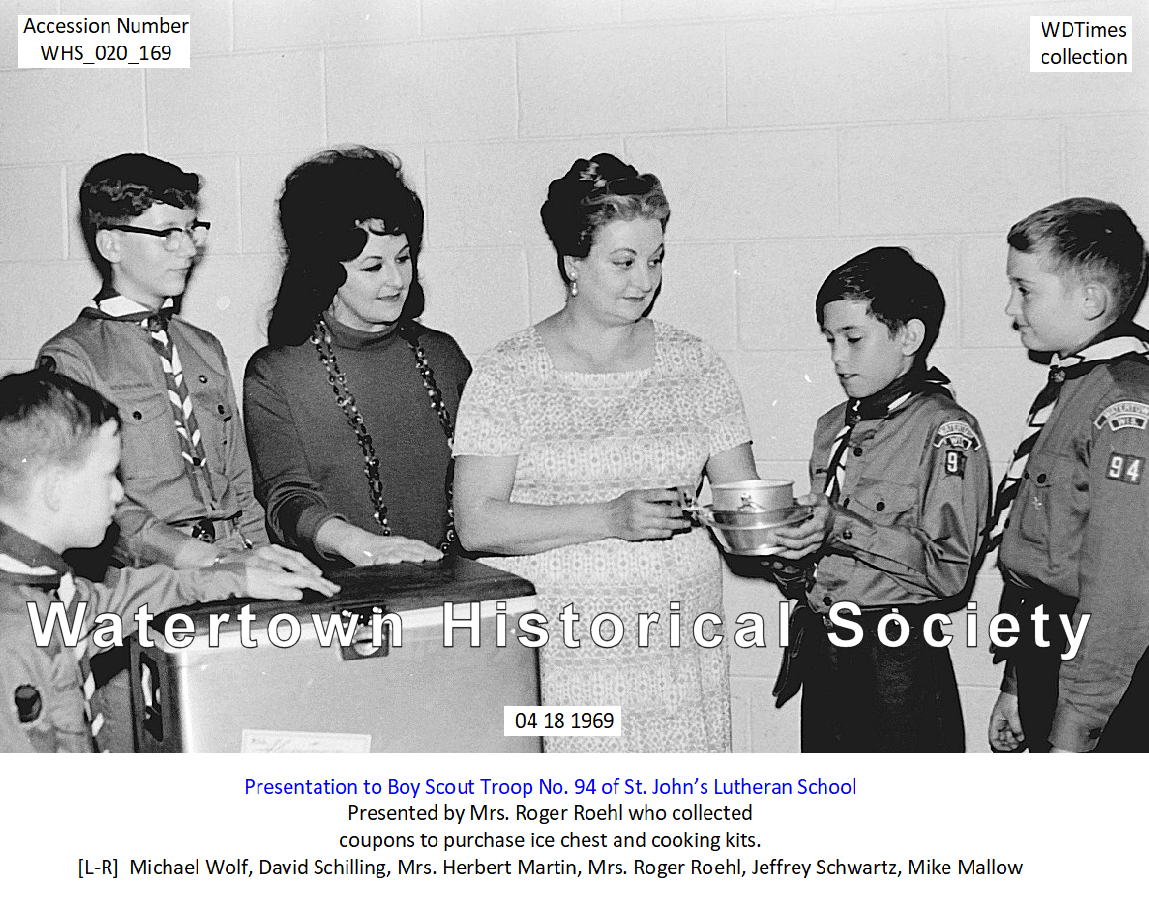 Boy Scouts of St. John’s Lutheran School
Presented
by Mrs. Roger Roehl who collected coupons to purchase ice chest and cooking
kits.
Michael
Wolf, David Schilling, Mrs. Herbert Martin, Mrs. Roger Roehl, Jeffrey Schwartz,
Mike Mallow
06 19 JEEPS FOR JESUS MISSION PROJECT
St. John's
Lutheran Church of Watertown, Rev. E. P. Kauffeld, senior pastor, Rev. Theodore
Gundlach, associate pastor and Rev. M. J. Ludwig, shut-in pastor, has completed
its mission project for this year, named "Jeeps for Jesus." The final check for $1,400 presented to Mrs.
was Donald Nordmeyer, chairman of the steering committee by Mrs. Earl Mundt,
office administrator. This check will be
sent to the Southern Wisconsin District of the Lutheran Church, Missouri Synod
for the Brazil mission field to be used to provide another missionary with
transportation.
The
goal set by St. John's was two new jeeps or $5,600. This sum has been sent to the Brazilian
Mission Field in separate amounts of $1,400.
The missionaries of the Lutheran Church-Missouri Synod in Brazil who
serve many outlying mission stations are in great need of adequate
transportation. St. John's took this
opportunity to help directly with spreading the Gospel of Jesus Christ.
06 21 VACATION BIBLE SCHOOL
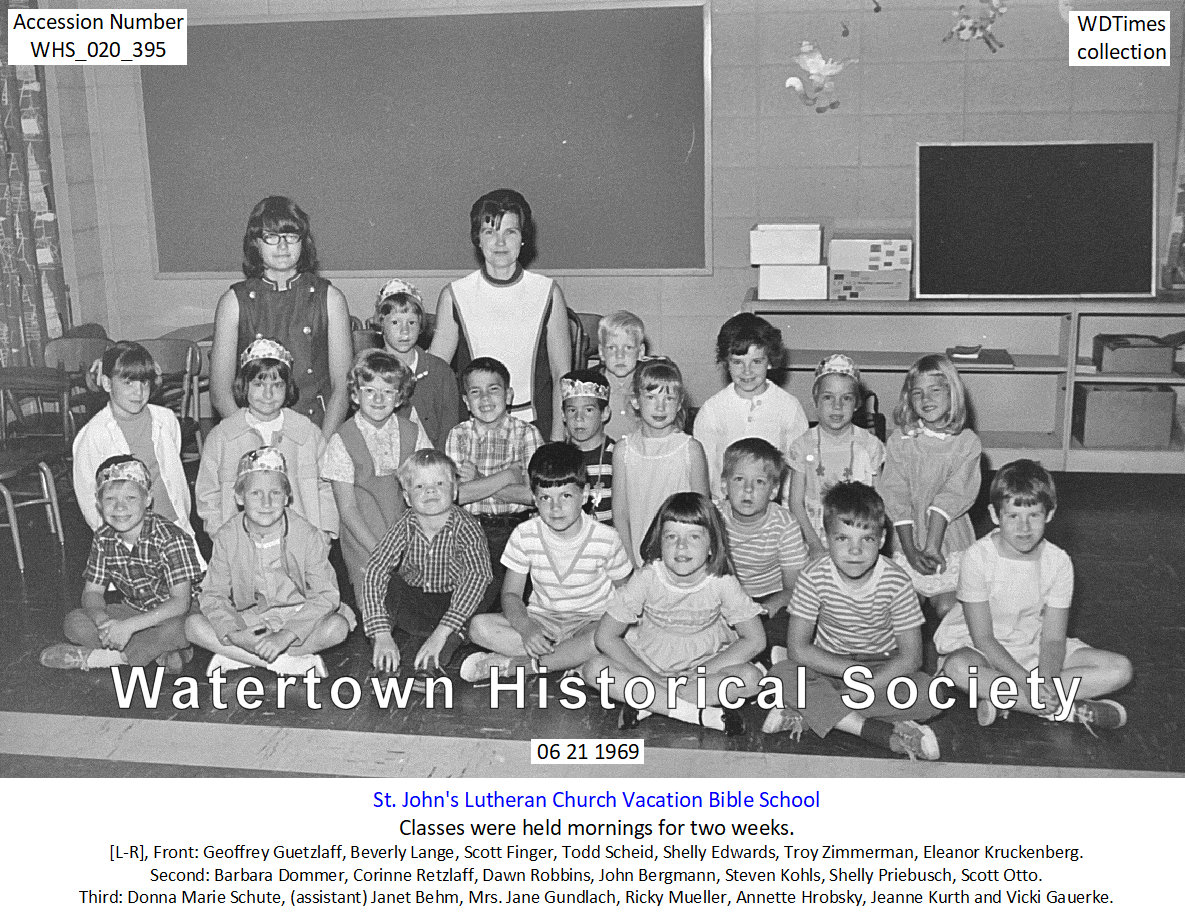
Classes
were held mornings for two weeks.
Geoffrey Guetzlaff, Beverly Lange, Scott Finger, Todd Scheid, Shelly
Edwards, Troy Zimmerman, Eleanor Kruckenberg, Barbara Dommer, Corinne Retzlaff,
Dawn Robbins, John Bergmann, Steven Kohls, Shelly Priebusch, Scott Otto, Donna
Marie Schute, (assistant) Janet Behm, Mrs. Jane Gundlach, Ricky Mueller,
Annette Hrobsky, Jeanne Kurth and Vicki Gauerke.
1970
08 25 NEW TEACHERS
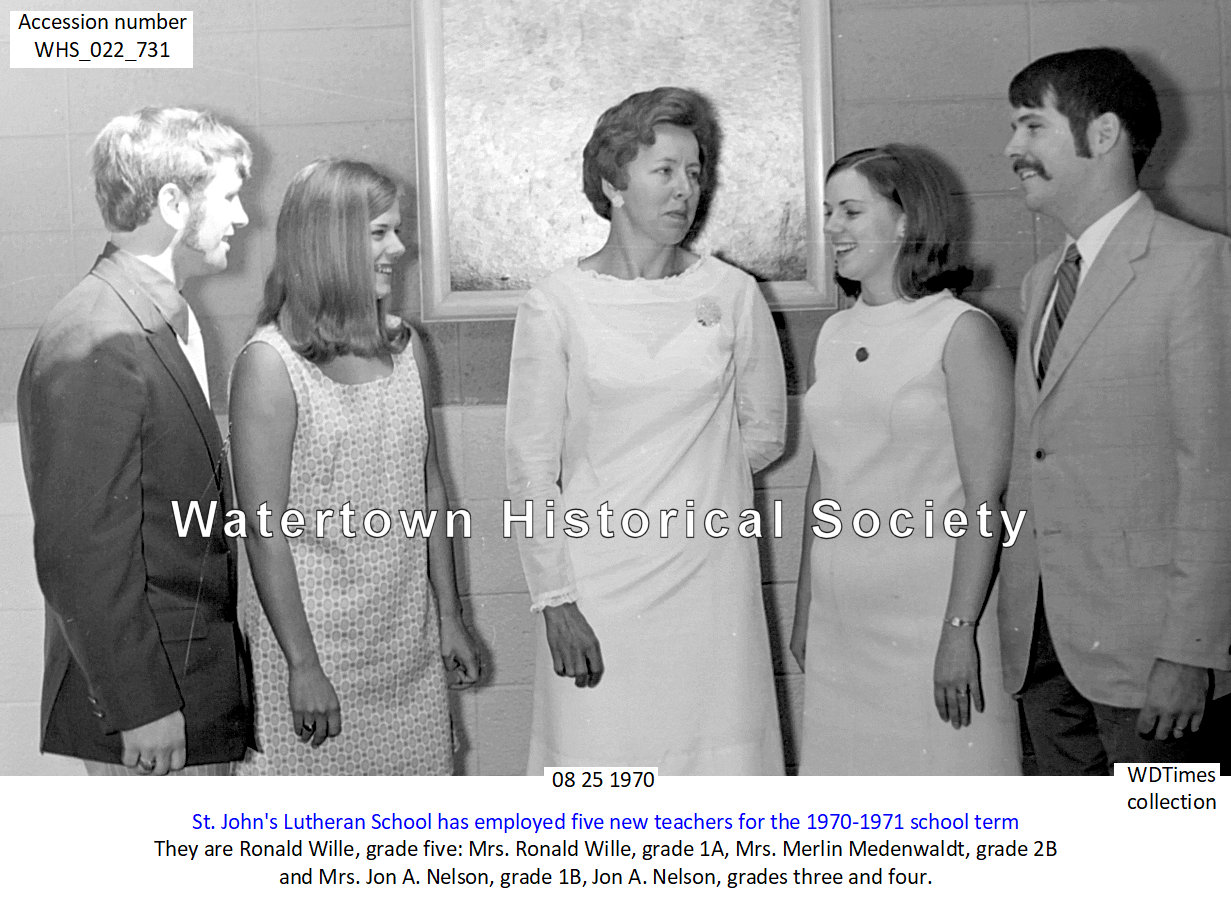
St.
John's Lutheran School has employed five new teachers for the 1970-1971 school
term. Ronald Wille, grade five: Mrs.
Ronald Wille, grade 1A, Mrs. Merlin Medenwaldt, grade 2B and Mrs. Jon A.
Nelson, grade 1B, Jon A. Nelson, grades three and four.
08 30 GOOD SHEPHERD
Good Shepherd Lutheran Church sprouted shortly
after members of St. John's Lutheran Church voted to sever its affiliation with
the Lutheran Church-Missouri Synod, on
On Aug. 30, 1971, congregational voters met in the
church and voted to leave the Missouri Synod.
This ended an association with Missouri Synod which had lasted 117
years.
1975
06 09 On June 9, 1975, St. John’s voted to apply for
membership in the Wisconsin Evangelical Lutheran Synod (WELS). The congregation together with its pastors and
teachers were accepted into the WELS in August 1975.
1988
09 18 Another renovation of the interior of the church and
dedication was held Sept. 18, 1988. The studios
of Potente were selected as the architect for the renovation project. The original Gothic interior was restored
with the soft colors and design painting.
The central focal point was the 17-foot linden wood cross and carved
figure of the ascending and blessing Christ on the center wall of the
chancel. This cross and figure of Christ
were carved in a small woodcarving shop in Italy.
The front narthex has been
repainted and the golden altar missal stand refinished. A special 100th anniversary banner has been
constructed and will hang in the church.
Historical picture
displays of the church may be viewed in the lower level of the church. Refreshments will be served. The public is welcome
1992
140th ANNIVERSARY CELEBRATION AT St.
JOHN’S
St.
John’s Lutheran Church will conclude its month-long 140th anniversary
celebration with three festival services on Sunday, Reformation Day. Services
are planned at 7:15, 9 and 10:30.
The
special emphasis for the day is on the organizations of the church and the
service of its members. Parishioners and
guests are encouraged to stop at the new display case in the entrance of the
church to view the pictures showing past and present organizations of the
church.
Preservice
music will be played by the handbell choir and special music will be offered by
the three church choirs during the services.
The
youth league will serve a potluck dinner at noon in the school cafeteria. Following the meal, Ruth Feld will give a
slide program on the history of St. John’s Lutheran Church. The congregation
and friends of the church are invited to share in this time of remembering.
St.
John’s Lutheran Church was formed in the summer of 1851, when a group of
emigrants from Pomerania in northeast Germany made their way to Watertown, a
thriving community of 4,000 people.
Under the leadership of Heinrich Kroening, the group rented a small
public school building in the neighborhood of North Fourth ad Division
streets. There was no pastor so a member
would read the sermon each Sunday from a book of Lutheran sermons. The congregation called its first pastor, the
Rev. A. Kleinegees, in 1852. He and
Kroening also served as teachers.
The
construction of the first house of worship began in 1854 and was located at the
intersection of Vine and Lynn Streets. A
school was later built to the south on the same lot. This building is currently being used as a
private home.
The Rev.
C. J. A. Strasen was installed as pastor of the congregation on July 31, 1859,
a position he held for 41 years. During
that time, a new and larger church was constructed on the corner of South Fifth
and Cady streets at a cost of $15,000.
Dedication services were held June 25, 1865. The new school building was construction on
the corner of South Sixth and Cady streets in 1885, with F. W. A. Fuerstenau as
teacher for 37 years. F. H. Meyer was
called as the second teacher in the 1868 and served for 40 years.
In
less than 50 years, the congregation grew to 1,600 members, making a larger
church necessary. The demolition of the
existing church began April 2, 1907 and the dedication of the completed new
structure took place on April 5, 1908. N This new building, the present church,
can accommodate approximately 800 people and was built at a cost of
$45,000. The Rev. F. H. Eggers was
pastor of the congregation and served St. John’s for 47 years.
The
oldest organization in the church, the Mixed Choir, was formed in 1908 and the
ladies aid society was organized May 24, 1918 with 47 members.
The
school received necessary changes in 1911.
Construction of the present school began in 1954, with dedication
services in 1956. In 1987, the school
received an extensive facelift, replacing the glass-block walls with more
energy efficient material and remodeling the office area. A parish hall was built in 1926 and is still
in use today.
Two
major church renovation projects were carried out by the congregation. The first project in 1967 saw the removal of
much of the original balcony, installation of a new pulpit and altar,
enlargement of the narthex, completion of the basement and an addition to the
office area. The 1988 renovation was
chiefly a redecorating project, with painting, installation of new carpeting, a
lectern, modified lighting, and the erection of the Ascending Christ behind the
altar.
St.
John’s left the Missouri Synod in 1971 for doctrinal reasons, ending a 117-year
association with the synod. The
congregation became a member of the Federation for Authentic Lutheranism (FAL),
an interim synodical body. On July 9,
1975 the congregation voted to apply for membership in the Wisconsin
Evangelical Lutheran Synod (WELS).
St.
John’s congregation supports a school with nine full time teachers, two part
time teachers, and a principal. Classes
are held for children in preschool through eighth grade. The Rev. E. P.
Kauffeld and newly installed associate pastor, the Rev. John Boehringer, serve
St. John’s.
1999
11 12 The beautiful sound of handbells at St.
John's Lutheran Church has reached a more resounding ring with the addition of
two more octaves. The adult handbell
choir will make its five-octave debut on Sunday, Nov. 14, when members will be
wearing new robes and performing at a longer line of padded tables. The original bells for the first three
octaves have been refurbished, making them just as bright and sound worthy as
their new counterparts . The enhanced sound means much more than increasing the
number of bells from 37 to 61. Adding
the two octaves shows the dedication of members and the growing interest in
providing special music for the congregation.
2002
The 150th anniversary of St. John's Lutheran
Church-WELS was celebrated with guest preachers and special activities
throughout 2002. The theme of the anniversary celebration was "Children of
God: Then, Now and Forever."
A number of guest speakers were planned
during the year.
Those addressing the congregation were:
Jan. 12 and 13 The Rev. Richard
Lauersdorf
March 9 and 10 The Rev. Eugene
Kauffeld
May 9 The
Rev. Herbert Prahl
June 8 and 9 The Rev. Shawn
Kauffeld
Aug. 10 and 11 The Rev. Richard
Strobel
Sept. 7 and 8 The Rev. Robert
Voss
Oct. 12 and 13 The Rev. Karl
Gurgel
Several guest choirs will also provide special music during the
celebration.
Jan. 13 Wisconsin
Lutheran Seminary Choir
Feb. 10 The
handbell choir of St. John's
Feb. 17 Lakeside
Lutheran High School Choir in Lake Mills
April 6 Dr.
Martin Luther College Choir
April 27 The Luther
Preparatory High School Choir
A new
pictorial directory was planned for church members and their families. Other
activities included a historic display, commemorative Christmas ornaments, an
anniversary video of the past 150 years, a congregational history book. A new pictorial directory was planned for
church members and their families. Other
activities included a historic display, commemorative Christmas ornaments, an
anniversary video of the past 150 years, a congregational history book, and an
anniversary dinner at Turner Hall on Oct. 13.
2008
04 11
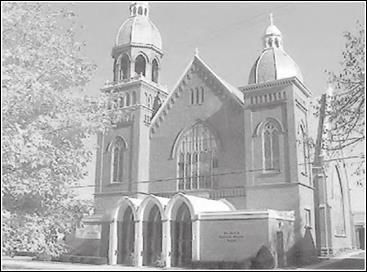 St.
John’s Evangelical Lutheran Church will celebrate the 100th anniversary of the
dedication of its worship facility during special services this weekend. Services are planned at 6 p.m. Saturday and
at 7:45 and 10:30 a.m. Sunday. WDT
St.
John’s Evangelical Lutheran Church will celebrate the 100th anniversary of the
dedication of its worship facility during special services this weekend. Services are planned at 6 p.m. Saturday and
at 7:45 and 10:30 a.m. Sunday. WDT
St.
John’s Church in Watertown had its beginning in 1852. The first new church
building dedication followed on June 25, 1865, at the corner of North Fifth and
Cady Streets. The cost of that structure was estimated at $15,000, a very large
sum in those days. Early in 1907 it was decided to build a new and larger
church to meet the growth of the congregation. On April 5, 1908, the
construction was finally completed, and with great rejoicing the congregation
was able to dedicate its new house of worship. Dedication services were held in
German and English.
Historical
picture displays of the church may be viewed in the lower level of the church.
Refreshments will be served. The public is welcome.
[1992 reference]
St.
John's Lutheran Church was formed in the summer of 1851, when a group of emigrants
from Pomerania in northeast Germany made their way to Watertown, a thriving
community of 4,000 people. Under the
leadership of Heinrich Kroening, the group rented a small public school
building in the neighborhood of North Fourth and Division streets. There was no pastor so a member would read
the sermon each Sunday from a book of Lutheran sermons. The congregation called its first pastor, the
Rev. A. Kleinegees, in 1852. He and
Kroening also served as teachers.
The
construction of the first house of worship began in 1854 and was located at the
intersection of Vine and Lynn streets. A
school was later built to the south on the same lot. This building is currently
being used as a private home.
The
Rev. C. J. A. Strasen was installed as pastor of the congregation on July 31,
1859, a position he held for 41 years. During that time, a new and larger
church was constructed on the corner of South Fifth and Cady streets at a cost
of $15,000. Dedication services were held June 25, 1865. The new school
building was construction on the corner of South Sixth and Cady streets in
1885, with F. W. A. Fuerstenau as teacher for 37 years. F. H. Meyer was called as the second teacher
in 1868 and served for 40 years.
In
less than 50 years, the congregation grew to 1,600 members, making a larger
church necessary. The demolition of the
existing church began April 2, 1907 and the dedication of the completed new
structure took place on April 5, 1908. This new building, the present church,
can accommodate approximately 800 people and was built at a cost of
$45,000. The Rev. F. H. Eggers was
pastor of the congregation and served St. John's for 47 years.
The
oldest organization in the church, the Mixed Choir, was formed in 1908 and the
Ladies Aid Society was organized May 24, 1918 with 47 members.
The
school received necessary changes in 1911. Construction of the present school
began in 1954, with dedication services in 1956. In 1987, the school received an extensive
facelift, replacing the glass-block walls with more energy efficient material
and remodeling the office area. A parish
hall was built in 1926 and is still in use today.
Two
major church renovation projects were carried out by the congregation. The first project in 1967 saw the removal of
much of the original balcony, installation of a new pulpit and altar,
enlargement of the narthex, completion of the basement and an addition to the
office area. The 1988 renovation was
chiefly a redecorating project, with painting, installation of new carpeting, a
lectern, modified lighting, and the erection of the Ascending Christ behind the
altar.
St.
John's left the Missouri Synod in 1971 for doctrinal reasons, ending a 117-year
association with the synod. The
congregation became a member of the Federation for Authentic Lutheranism (FAL),
an interim synodical body. On July 9,
1975 the congregation voted to apply for membership in the Wisconsin
Evangelical Lutheran Synod (WELS).
St.
John's congregation supports a school with nine full time teachers, two part
time teachers, and a principal. Classes
are held for children in preschool through eighth grade. The Rev. E. P.
Kauffeld and newly installed associate pastor, the Rev. John Boehringer, serve
St. John's.
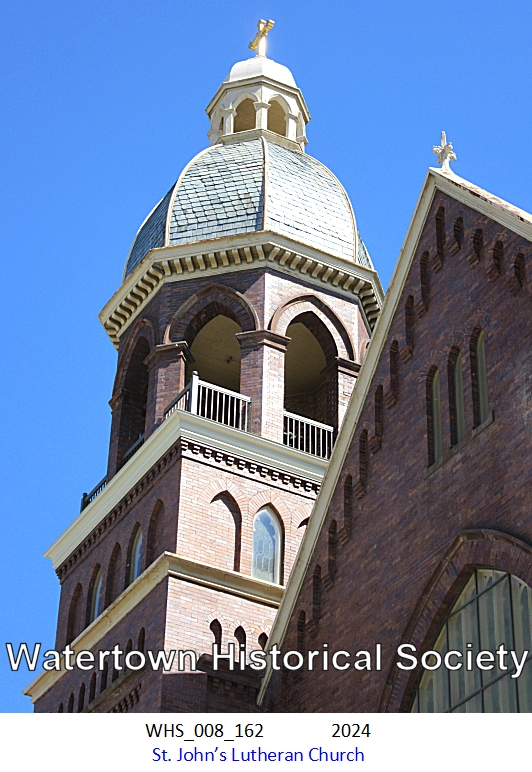
2019
PASTOR
TIM MUELLER
Pastor
Tim Mueller started in June 2019.
Retiring at the end of June, 2024.
2020
PASTOR
NICK QUINNETT
Assigned
from Wisconsin Lutheran Seminary in May 2020 and started at St. John's July 1st
2020.
02 02 STAINED GLASS WINDOWS RESTORATION
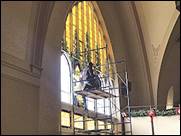
09 06 FOUR NEW TEACHERS
Philip
Ewerdt is a new 5th grade teacher and coach.
Ewerdt grew up in Ixonia and is a graduate of Lakeside Lutheran High
School and graduated from Martin Luther College in Minnesota. He served in the Minnesota Army National
Guard and was deployed to Iraq from 2005 to 2007.
Hannah
Ewerdt, Philip’s wife, is starting her position as a preschool teacher. Ewerdt grew up in Minnesota and graduated
from Minnesota Valley Lutheran High School and Martin Luther College.
Sarah
Kaulitz is in a new position as the special needs teacher and program
coordinator. Sarah grew up in Jefferson,
WI, where she attended St. John’s Lutheran School. She graduated from Lakeside Lutheran High
School and Martin Luther College.
Kaulitz currently is in the Master’s Program at Martin Luther College to
earn a degree in Special Education.
Jenessa
Werre is the three-year-old and four-year-old preschool teacher. She graduated from The University of
Wisconsin-Stevens Point in Dec. 2021.
2023
KARLA
OPPERMAN
Karla
Opperman installed in July as a new Early Childhood Director
2024
PASTOR
TIM MUELLER RETIREMENT
Pastor
Tim Mueller assigned in June 2019. He
will be celebrating his 40 years in the ministry with a celebration on June
23rd. He is also retiring at the end of
June.
We have
a new pastor coming in, Jerry Ewings, who will be installed on June 25th.
Starting
in June we have some big projects here.
A new roof on the school and gym, new univents in the school. New playground and school parking lot.
We
also have two new teachers coming to be installed in August. Abby Gaulke to teach grade three and Matt
Neumann to teach 7th grade.
06 18 PASTOR TIMOTHY MUELLER
TO CELEBRATE RETIREMENT
Pastor
Timothy Mueller of St. John’s Lutheran Church in Watertown will be celebrating
40 years in the preaching ministry and his retirement during weekend worship
services June 22.
Online
article, WDTimes
06 25 JERRY EWINGS NEW
ASSOCIATED PASTOR
Online
article, WDTimes
YOUTUBE VIDEO: St.
John’s Lutheran Church, Watertown, Ben Feld presentation

 < PORTFOLIO OF PICS

History of Watertown, Wisconsin