website watertownhistory.org
ebook History of Watertown, Wisconsin
Movie Theaters in Watertown
Portions derived in part from Watertown Daily Times of 06 26 1954
1903 PALACE THEATER
First movies in
Watertown were shown at the Palace Theater in
1903 by Joseph Herro of 109 Jones
Street. Mr. Herro and his two brothers,
George Herro, of Fort Atkinson, and Charles Herro, opened the first movie house
here, located at 206 Main Street, which later housed the Meyer Shoe Store. Watertown was the third city in Wisconsin to
boast a movie theatre. The first was
opened in Milwaukee on Grand Avenue, now Wisconsin Avenue by Saxe Bros. The second was in northern Wisconsin, said to
have been at Oshkosh, and the third was here.
1908
03 27 THE PALACE THEATRE
The Palace Theatre is
running along in the even tenor of its way, giving good little performances to
fairly good crowds. The entertainment
which ended last evening was exceptionally good. The three motion pictures were fine,
especially "The Pirates" and that it was appreciated was evidenced in
the applause. The "Airship
Burglars" and "The Plank" of a comedy nature, were also very
good. Then there was a good illustrated
song and harp solo, with musical selections upon the piano and violin.
Tonight there will be a
change of program. The illustrated song
will be "From the Garden to the Cross Alone." The song as sung by Malcolm Florent is a
feature, and a contrast from the mechanical phonograph selections. The gentleman has an exceptionally good
voice. WL
1907 and
1908 ?
In 1907 the Palace Theatre
was changed to the Lyric and in 1908 William Dobratz opened the Victor Theatre,
located at 115 North Fourth Street where the LeMacher
Studio was located.
1909 THE MAJESTIC
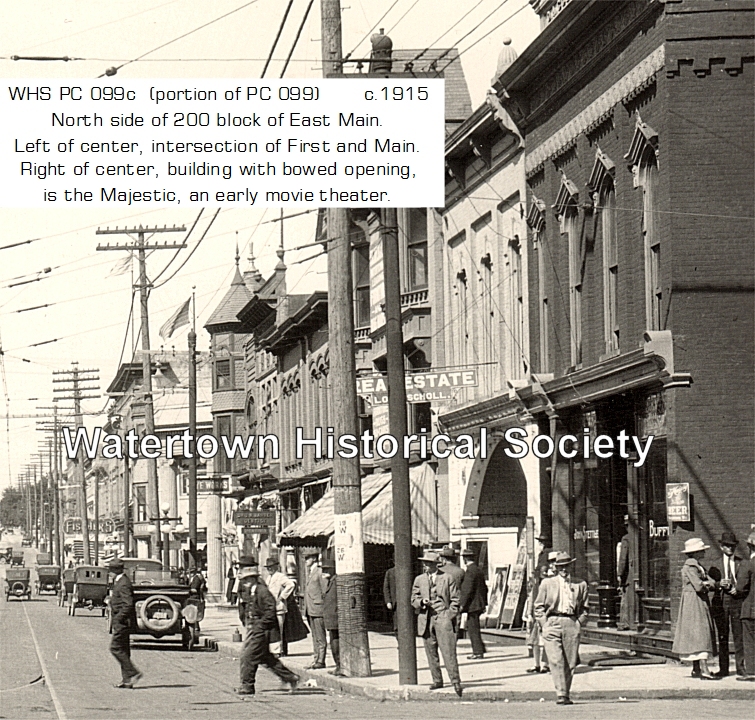 In 1909 a third theatre was introduced
here. It was the Majestic and was
located at 114 Main Street, which now houses Kern's Men's Store. It was operated by Bert Haskins.
In 1909 a third theatre was introduced
here. It was the Majestic and was
located at 114 Main Street, which now houses Kern's Men's Store. It was operated by Bert Haskins.
1910 FIVE MOVIE HOUSES: Lyric, Victor, Majestic, Orpheum and Empire
In 1910 Watertown had
five movie houses in operation. They
were the Lyric, Victor, Majestic, Orpheum and Empire.
The Orpheum Theatre came
into being here in 1910 and was operated by Si Davis, with Charles Buchalter
and was located at 306 Main Street and later became the location of the Tot
& Teen Shop.
In 1910 the old Concordia Opera House in North First Street
became the Empire Theatre and later its name was changed to the Colonial
Theatre. It is now the Elks Club. In its heyday it featured both films and
vaudeville and admission rates were scaled at 10, 20 and 30 cents.
1911 FILM EXCHANGE BUSINESS
In 1911 Si Davis opened
a film exchange here, first located at South Sixth and Market Street. Later he constructed the building at North
Fourth and Jones Streets for his film exchange.
It now houses the business of Walter Niehoff and Son. The exchange supplied
and "wound" films for the growing number of theatres in this area.
In 1912 still another
theatre joined the list here. It was the
Princess, successor to the Lyric. It was operated at the same location and was
owned by Albert Krahmer.
1913 CLASSIC OPENED
The Classic Theatre was opened here in 1913 at 310
Main Street by Willis Norton. It later
became the Bonnet Shop while the Classic now utilizes its present premises and also
part of the building to the rear of the Bonnet Shop.
Over the years the
Classic has kept pace with all the new advances in motion picture
entertainment. It introduced the first
talkies in 1928, the first such production to be shown here being "The Trial
of Mary Dugan" which based on a highly successful Broadway stage play.
In 1954 the Classic
introduced CinemaScope, having greatly enlarged its screen and installed
facilities to enable it to bring the best of modern day "big screen"
entertainment to its audiences.
1915
01 21 NABEL-WEIS WEDDING
Married. Herbert A. Weis and Miss Marguerite S. Nabel
of Madison were married at Waukegan, Ills., last week Wednesday by Rev. Mr.
Gangster at the Episcopal church.
Clarence A. Schimmel and wife of this city attended them. The groom is one of Watertown’s popular policemen and his bride has
been connected as a pianist for some
time with one of our moving picture theatres. She is a most excellent young lady and both
she and her husband have the well wishes of all our people in the life they
have just entered. They will make their
home at the Washington House. WG
03 04 ALBERT FUERMANN BUYS ORPHEUM
THEATRE
Albert Fuermann has purchased the Orpheum theatre of Jerome Kostermann, who has
conducted the theatre for the past two years. Mr. Fuermann will have associated with
him in the management of the theatre his son “Riz,” one of
the best pianists in the state. Albert
and Riz will be two great drawing cards at this
popular theatre. They are
two of Watertown’s most excellent citizens and the Orpheum under their
management will certainly be a grand success. The
Gazette extends its best wishes. WG
04 08 NEW EQUIPMENT FOR THE ORPHEUM
The Orpheum theatre,
for some weeks under the management of the new owner, Albert Fuermann, has been
equipped with a new and very effective ventilating system, a new curtain of the
most approved material, a flushing system and considerable additional
seating. The additional seating was secured
without the necessity of any patrons sitting closer to the curtain than
formerly, as the stage was torn out and the curtain placed against the rear
wall of the building. The flushing
system insures a clean, sanitary floor, with a minimum of labor and
expense. The janitor just “turns on the
hose” from the rear. The slant in the
floor extends to the rear wall, where a trough connected with the sewer
receives the water and the litter, which comes down with it. The floor is now washed every morning. The new ventilating system will be greatly
appreciated by the patrons, particularly with the approach of warm
weather. WG
10 07 MAJESTIC THEATRE SOLD
Louis Werner and Paul
Bilz, who have conducted the Majestic Theatre for some time past, have disposed
of it to Fred. B. Hollenbeck, Jr., and George Mullen, two of Watertown’s best
known young men, who took possession of it on October 1st. Mr. Werner will move to Milwaukee, his
former home, and Mr. Bilz is undecided just what business he will engage
in. The new proprietors in the near
future contemplate making many fine improvements in this popular amusement
place. Mr. Mullen will be on the
“reception committee” at the front door to greet patrons of the house, Mr. Hollenbeck
will operate the machine, Prof. Wm. J. Weber will continue to officiate at the
piano at the Majestic, and Miss Sadie Smith will have charge of the ticket
window, as she has for years past for Messrs. Werner & Bilz. WG
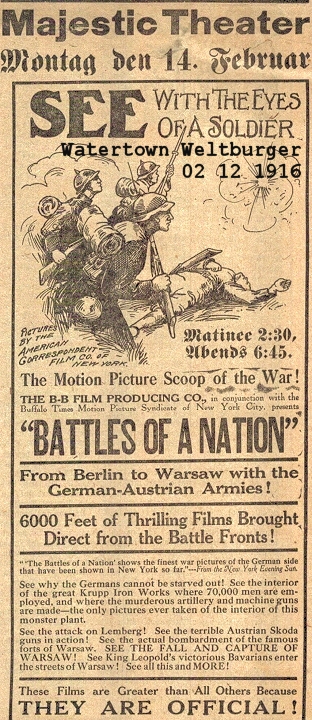
1916
“BATTLES OF A NATION” at
Majestic
Savoy Opened in 1938
The last theatre to
open here was the Savoy, which was launched in
August of 1938 by Milwaukee interests.
It operated for some years and then closed and was taken over by the
Classic Theatre management.
Recall Early Days
Oscar Baumann, the
manager of the Classic and Savoy Theatres, has been in the motion picture
business all his life. He recalls the
early movies, which ran only a few minutes compared with modern
productions. In those day admission was
five cents, chairs were not fastened to the floor but were he regulation
"folding type," and tickets were used over and over. After a dozen or so tickets had been sold and
taken they were returned to the "box office" and sold and used again
and again. Those were the days when
movies were mute and the only sound in the theatres was the music made by a
piano player "in the pit" and the laughter and comments of the audience. Later came colored slides and song lyrics
which were flashed on the screen. A bit
later came the serials, whereby two chapters of a film were shown once a week
and the action was "continued."
Among . the most popular of such serials were "The Million Dollar
Mystery," "The Adventures of Kathleen," and "The Perils of
Pauline." The comedies of the
Keystone Cops, Fatty Arbuckle, Charlie Chaplin and a host of .others were among
the most popular early films. Mary
Pickford became the reigning queen and "America's Sweetheart." The first great acting team to gain
international renown was that of Francis X. Bushman and Beverly Bain.
First Super Production
The first truly great
film production, turned out on a scale never before attempted, was "The
Birth of a Nation," which the late D. W. Griffith produced. It was a story of the Civil War and caused
riots in many places, but it went on to become one of the most successful film
productions ever made.
Mr. Herro said that
when the first movies were shown here he had to employ an acetylene projection
machine since he was not able to get an electric line into his theatre. It was considered too dangerous. The projection machine stood on the floor and
after each film reel was shown it had to be rewound for the showing. Later, however, he able to get the City
Council to approve an electrical outlet for a machine and this was largely to
the work of the late Dr. F. C. Werner who was an alderman at the time. But it required a lot of hard work to
persuade the other council members to give their permission.
Purchased Church Pews
Later on the projection
machines were housed in elevated booths and still later in fire-proof booths.
After several years of operation
with folding chairs for the audiences to sit on Herro purchased some old church
pews from what was then the First Methodist
Episcopal Church and put them in his theatre. This was considered quite a step forward in
theatre comfort at the time.
In the early days films
often flicked outrageously. The picture
"frames" -were not always in proper focus on the screen and it was
hard to watch pictures for any length of time.
But Joe’s brother, the late George Herro, conceived a simple device,
made out of cardboard, which served to keep the "frames" in line and
solved what had been a disturbing problem.
One day while a salesman was in the theatre, they were discussing the
problem and Joe happened to mention that his brother had solved the
matter. The salesman hurried to the
booth, saw the device and later went out and put it on the market. The inventor of the device was "left at
the post" and no doubt lost what would have been a substantial fortune had
he had the foresight to get his device on the market.
Three Programs Weekly
In the early days here
theatres purchased films outright and then, after they had been shown over and
over, were sold or exchanged for others from other movie houses around the
state. Mr. Herro recalled that he and
his brothers paid $50 per week for their films in the early days of their
theatre, and that provided for three changes of program per week.
Mr. Herro has been a
resident of Watertown since 1901. He is
still somewhat of a movie fan, but not a rabid one and sees a film only
occasionally. He also opened the first
billiard parlor in Watertown in 1904, located in South Second Street, and in
1905 opened the first street popcorn stand here, at Third and Main
Streets. Later he had a popcorn wagon
which he drove around the city at night, led by a horse, selling popcorn to all
comers.
In his business career
here he was also engaged in the fruit store and ice cream business and the
tavern and restaurant business. Now he
is taking things easy and planning another trip abroad with his wife. They plan to go next year, making the trip by
plane.

History of Watertown,
Wisconsin