website watertownhistory.org
ebook History of Watertown, Wisconsin
Ebenezer Moravian Church
and
Watertown Moravian Church
Ebenezer Moravian Church
[south of city]
1853-2003
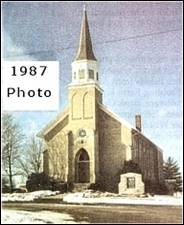
1987,
Prior to Renovation
THE
MORAVIANS
Watertown
and this area are among the centers where there are concentrations of
Moravians. According to the latest
figures, there are 55,000 Moravians in America and 300,000 in the world.
Not
many people know it, but the first organized Protestant church was the one now
generally known as the Moravian Church, the official title of which is Unitas Fratrum of “Unity of the Brethren.”
So
written Canon Howard Haper in an article dealing with the subject.
The
beginning of the Moravian group, he writes, goes all the way back, at least in
spirit, to July 6, 1415, when John Hus was burned at the stake. Hus, a Bohemian, did not actually found any
organization, but taught-and died for -the principles around which the Unity of
the Brethren formally organized in 1457, 42 years after his death.
Hus, a
Roman Catholic priest and professor in the city of Prague, had by his own study
and reflection, come to the belief that in many important ways the church was
not true to the New Testament. The
selling of indulgences was especially disturbing to him and against this particular feature he preached quite openly. It was not long before he was
excommunicated.
In
1414, a council of the church, known as the Council of Constance, was held to
straighten out the claims of rival popes, and it seemed to Hus that it would be
of value both to the church and himself if he could appear and plead his cause before this body, which was representative of the
whole Western Church. With the
reformer’s typical zeal, and with a guarantee of safe conduct from the emperor,
he went to the council. But he was
seized and never given an opportunity to state his position. Refusing to recant, he was burned.
Scandalized
followers rose in revolt and took up the cause.
By 1457, after much suffering and persecution, they established their
own church. The beliefs of this new
group, drawn straight from Hus’ teachings, were that the Christian faith is
stated in the Apostles’ Creed, that the Bible is the word of God, that personal
salvation is through Jesus Christ and the Christian Church is the fellowship of
those who share this experience of salvation.
Familiar ideas now-but you could have been burned for holding them in
those days.
In
fact, many of the Brethren did die in one way or another for their
beliefs. And the persecutions went on
and on for nearly three centuries. In
1621, the group came so near extinction that many went underground
and many others fled. As late as 1722, descendents of those who had fled to Moravia moved on again
for safety, this time to Germany. It was
here that the Brethren acquired the name “Moravians.”
Settled
in peace at last, these first Protestants lost no time in proving the pioneer
attitude of their forefathers had by no means died out. They produced another “conspicuous first” in
Protestant history by sending missionaries to foreign lands. In 1732, their missionaries went to St.
Thomas, in the Virgin Islands. Soon
others came to bring the faith to the American Indians and still others went to
Greenland, South America, South Africa and India. The Moravians may be said to have been the
forerunners of the modern era of Christian missions. It was 50 years or more before Protestant
churches generally began to follow this lead.
Strongest
Moravian settlements in the United States are in Bethlehem, Pa., which began in 1740, and Winston-Salem,
N.C., which began in 1766. These two
communities are famous throughout the country for their sunrise Easter
services, a custom that goes back to the denomination’s Euopean
days. Each Easter morning the Moravians
go to their cemeteries and greet the dawn with Easter hymns. There could be no more appropriate place for
a service in commemoration of the Resurrection.
The
Moravians are a loyal church group who enjoy close ties with their fellow
members and who are mission conscious to an extent more so than many other
Christian church groups. They are fine
and upstanding citizens and respect the beliefs and teachings of others while
holding fast to their own.
In
Watertown and elsewhere they are numbered among the best type of
citizenry. WDTimes
____________________________________________________________________
1851
Family
names as Strehlow, Klatte, Flath, Witte, Hans, Klausch, Botzel, Klar, Gerbsch
and Eberle, had immigrated to the United States from the province of
Brandenburg, Prussia, and settled in and near Watertown, in the spring of 1851.
1853
Ebenezer
Moravian Church, located four miles south of Watertown, marked its 150th
anniversary in 2003.
Ebenezer
Moravian Church was one of the first churches established in the Watertown area.
In the spring of 1853, the Rev. John G. Kaltenbrunn, a former teacher and
Moravian missionary from Silesia, Germany, left New York City for Jefferson
County to minister to a small group of German immigrant families who had
requested a pastor from the Moravian Church.
Only a
month and a half after his arrival, on June 17, 1853, 13 families signed the
charter that established Ebenezer as the first Moravian church in southern
Wisconsin and one of the first Moravian churches in the state.
Lake Mills and DeForest
With
contributions from the Home Mission Society of New York, the members built a
one-room log cabin in the fall that served as parsonage, house of worship and
schoolhouse. That same year Kaltenbrunn
started a German day school, which continued to hold classes until 1925. From Ebenezer he traveled the surrounding
area establishing preaching places that eventually became organized
congregations in Watertown, Lake Mills and DeForest, and earned him the
reputation as the "Father of the Moravian Church in Wisconsin." [File on Lake
Mills Moravian]
Originally
incorporated as "The Moravian Church in the Town of Watertown," the
name was changed to Ebenezer after the congregation dedicated its first
church-building on Oct. 5, 1856. The name derives from the Watchword for that
day, I Samuel 7:12, "Then Samuel took a stone, and set it between Mizpah
and Jeshanah, and called its name Ebenezer, for he said, 'Hitherto the Lord has
helped us."' This verse was also
chosen as the theme for the 150th anniversary.
WDT, 06 11 2003
The
Moravian Church is a Protestant denomination with more than 500 years history,
preceding even the Reformation. From its inception, the Moravian Church has
emphasized God's love for all people, fellowship and understanding. The
Moravian Church of America is comprised of nearly 160 congregations and 50,000
members of all walks of life, in 17 U.S. States and two Canadian
provinces.
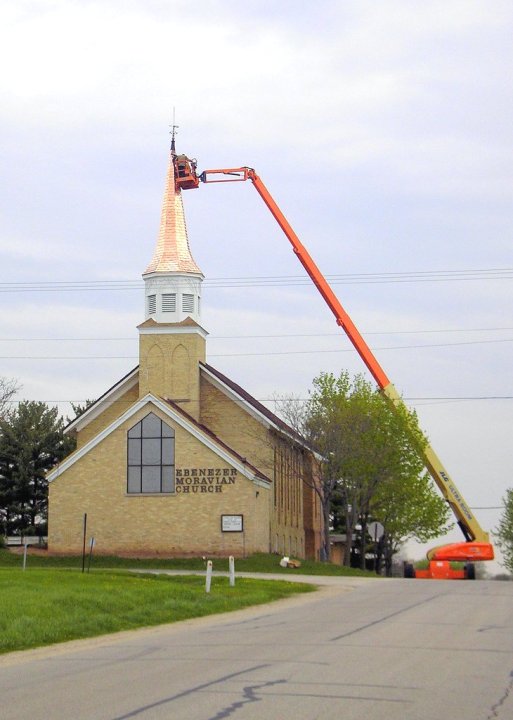
Link
to Ebenezer
Moravian Cemetery file
Watertown Moravian Church
[within city]
1854-2004
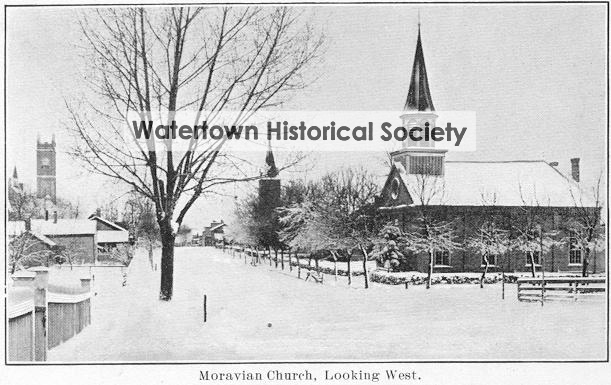
1901-1902
Click on images to enlarge
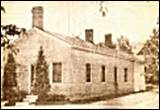
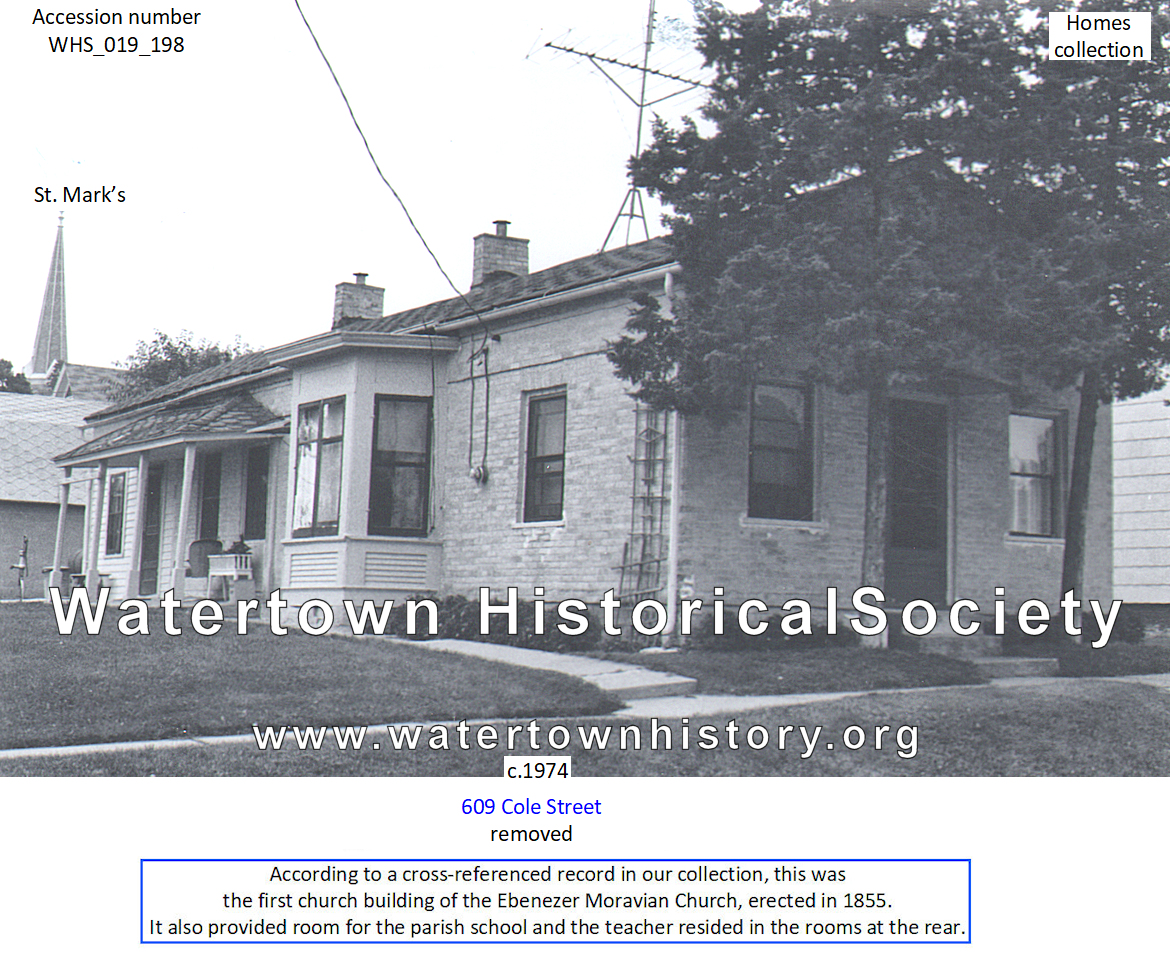
First church building, 605 Cole St,
erected in 1855. It also provided room for
the parish school and the teacher resided in the rooms at the rear.
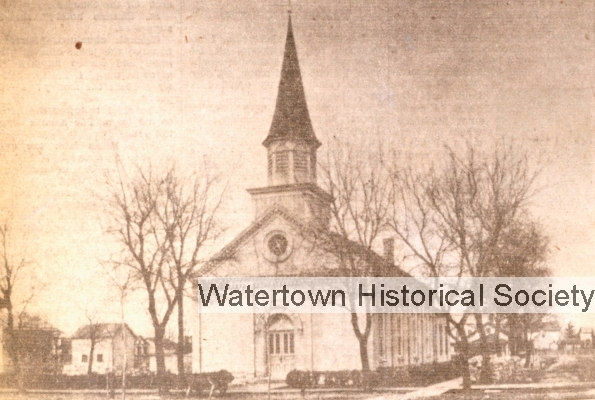
Church building erected in 1864. Dedicated August 14. This second building was replaced by the
present church in 1904 and has since been enlarged upon and improved.
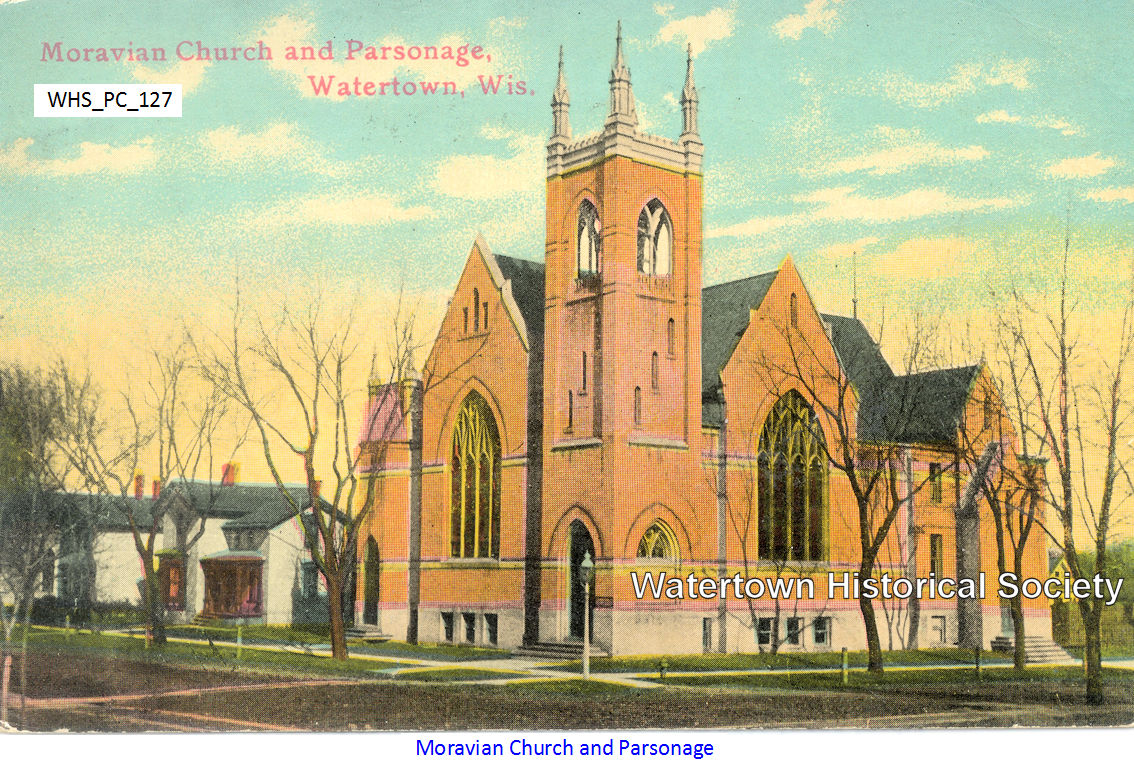
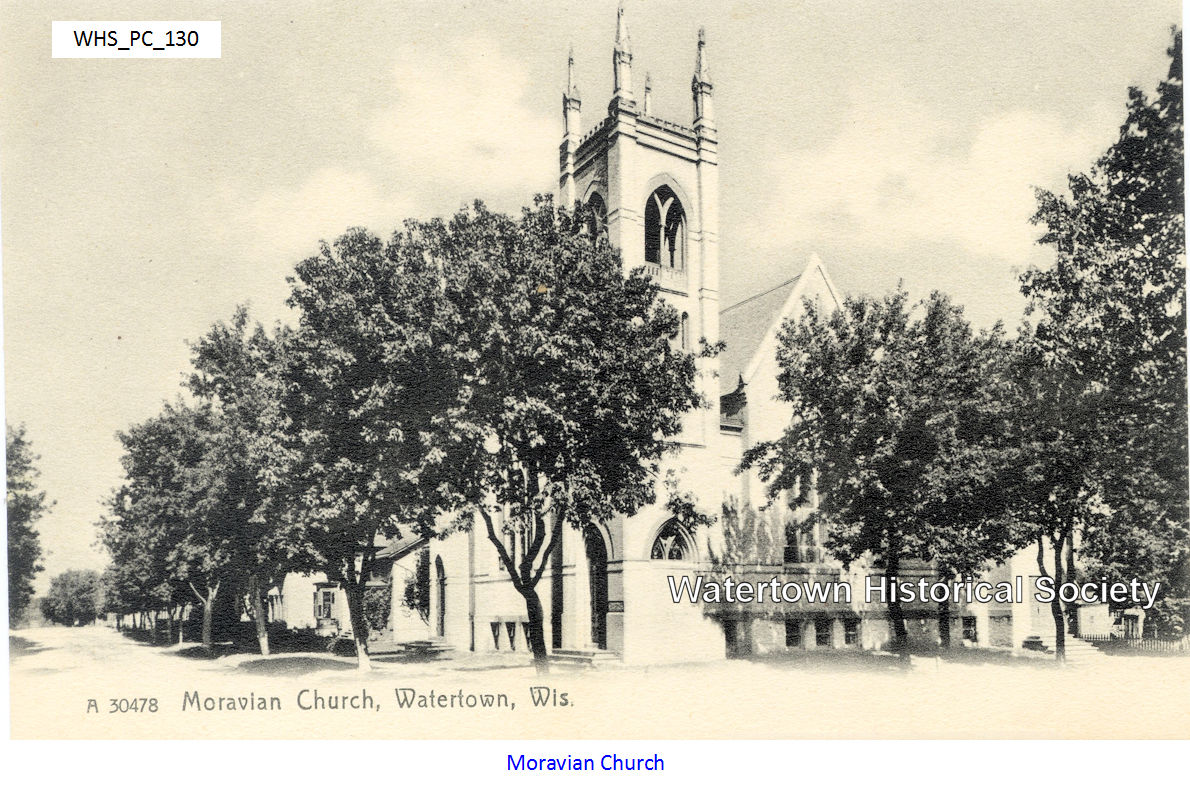
1859
01
06 Dwelling
of Rev. Mr. Kaltenbrunn, pastor of the Moravian Church, was destroyed by
fire WD
1895
03 20 PURE
THOUGHTS . . .
Next Sunday evening the
Moravian C. E. society will hold a special temperance meeting, to which all are
invited. A programme suitable to the
occasion has been arranged, and the topic is "Pure Thoughts, Pure Words,
Pure Deeds."
05 22 UNION
SERVICE AT REFORMED CHURCH
The German Reformed church, on
Cole Street, which has undergone a remodeling, including a new steeple, was
formally dedicated last Sunday with appropriate ceremonies. Three services were held, the first at 10 A.M
conducted by Rev. C. H. Nott, of Milwaukee; the second at 2 P.M., were Rev. H.
Rusterholz, of Montello, preached, and the third at 7:30 in the evening. The latter was a union service, in which the
Congregational and Moravian churches joined.
Rev. G. C. Weiss, of the former, delivered an English address, while
Rev. A. Haupert, of the latter, preached in German. At all meetings the attendance was large and the dedication awakened considerable
interest. The ceremonies were in charge of the pastor, Rev. E. Hinske. WR
1902
08 08 Rev.
ALBERT HAUPERT DEPARTURE
One of
the most noteworthy events in the annals of the Y.P.S.C.E. of the Moravian
Church took place last evening in the chapel of that church when a sumptuous
feast in the form of a farewell banquet had been prepared in honor of the
beloved pastor, Rev. Albert Haupert who will shortly leave for another field of
service. The tables were arranged so as to form the letter "E" signifying
“Endeavor.” Covers were laid for 60, all
of whom with but a few exceptions were members of the society. On each place lay a handsome souvenir in the
shape of a booklet, having a “C.E.” monogram inscribed on the cover and the
name of the person assigned to that place inscribed below. Shortly after eight o'clock the young people,
who had up to this time been indulging in games on the parsonage lawn, repaired
to the chapel and took the places assigned them by the committee. A hymn was sung, which was followed by a
moment of solemn silence, in which with bowed heads blessing was being
inaudibly invoked by the assembled guests.
The well prepared and wholesome food, of which here was in a great
abundance, was then passed unsparingly.
After the wants of the inner man were satisfied, Miss Bertha Marquardt
as toastmistress, called upon Rev. Karl Mueller, as one who for some years had
been a co-worker with Rev. Haupert, to make a speech appropriate to the
occasion on behalf of the society. In responding, Rev. Haupert thanked the society for the token
of appreciation shown him on this as well as on other occasions,
and assured them that the gratitude and love shown him and his family
would ever remain sacred in his memory.
WG
1903
02 14 Rev. SCHOECHERT FAREWELL
On
Thursday evening of last week the Moravian church
congregation arranged a farewell service for Rev. John Schoechert and wife
which was attended by a large number.
After an address by the pastor, Rev. D. C. Meinert, Rev. Schoechert
uttered his farewell and spoke feelingly of the parent’s separation from their
two little children whom they had left at Lititz, Pa., as they could not be
taken to Alaska with them. After the
services the Y. P. S. C. E. had a feast prepared in the chapel to which all
were invited. At the conclusion of the
feast Missionary Schoechert recited some reminiscences of the hardships and
ills endured in Alaska while engaged in missionary work.
Mrs.
Schoehert has translated the Christian Endeavor Pledge into the Esquimau language and the United Society of Christian Endeavor has
had printed several hundred of these which they will use in planting the banner
of Christian Endeavor in cold Alaska.
For ten years these missionaries have been at Carmel on the Nushagak
river. Now they push forward to Togiah,
a place of a few hundred inhabitants on the Togiak river, and
establish a new station there. Togiak is
about one hundred miles inland from Carmel, situated between the Nushagak and
Kuskakwin rivers. WR
1904
06 14 CORNERSTONE LAID
The
cornerstone of the new Moravian church was laid last Sunday afternoon by the
pastor, Rev. E.C. Meinert with appropriate ceremonies. The stone is Wausau red granite and was
presented to the church by J. J. Archie & Son’s. On the face of the stone is the following
inscription:
1854-1904
MORAVIAN CHURCH
1457
EZ. BRUEDER JERNEINDE.
The local newspapers were placed in the stone, also a history of the
church and the names of the church societies, a number of
coins of U.S., and the old coins taken from the cornerstone of the old church
which was built in 1864.
The congregation, however, was organized in 1854, and the doings of last
Sunday took the nature of a golden jubilee, as well as that of laying the
cornerstone of the new church.
11 17 DEDICATION
The new
Moravian church will be dedicated on Sunday, November 20. Bishop J. Mortimer
Levering, president of the provincial elders
conference of Bethlehem, Pa., will officiate, preaching the dedicatory service
in German at 10 a. m. and English at 7:30 p. m.
The afternoon service at 2 o'clock will be a jubilee service, the
congregation having been 50 years old September 11. Offering for the new church will be taken up
at every service. The public is
cordially invited.
-- -- NEW CHURCH
INTERIOR
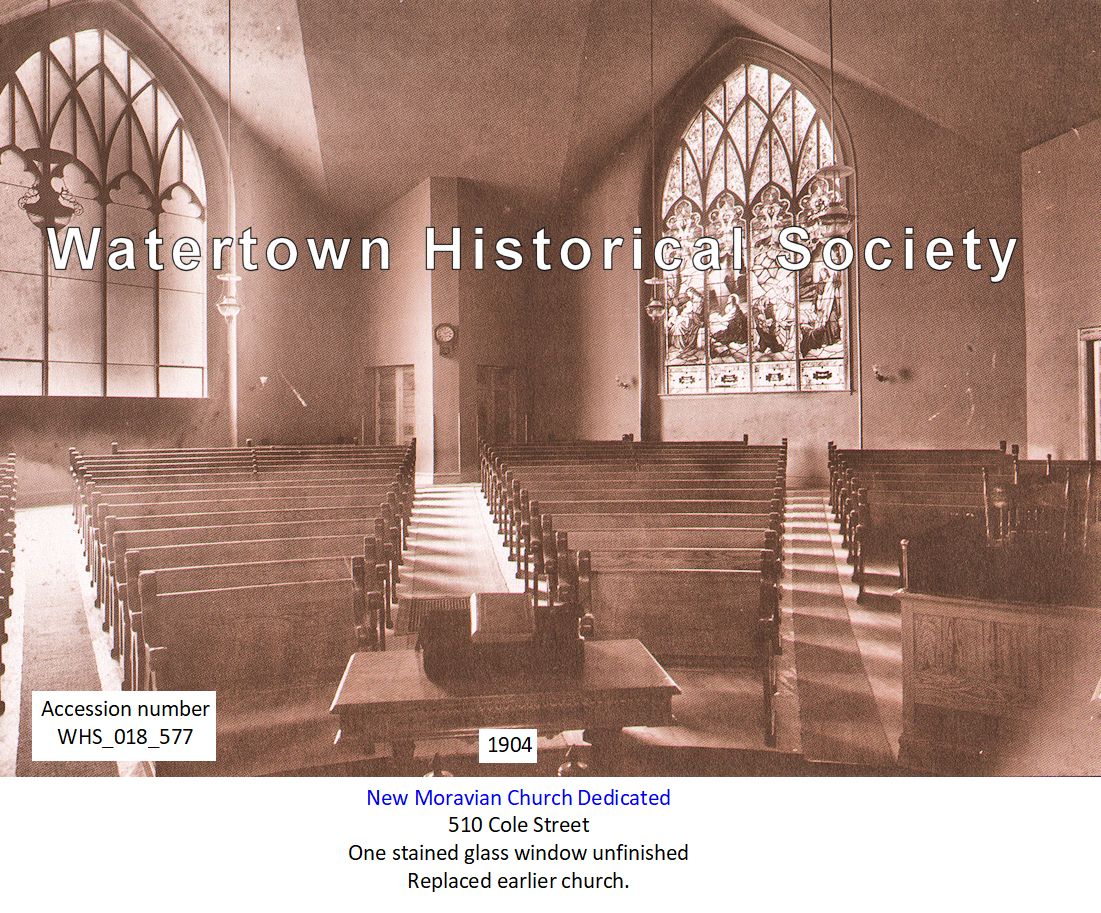 One stained glass window unfinished
12 04 Rev.
D. C. Meinert, of Nazareth, Pa., formerly pastor in Watertown, appointed
assistant principal of Linden Hall seminary at Lititz. WG
1905
04 21 EASTER SUNDAY CUSTOM
In accordance with an old-time custom, the
members of the Moravian Church will assemble at their house of worship Easter
Sunday before the dawn of day and proceed to the Moravian cemetery, where a
service will be conducted and the rising of the Easter sun greeted with joy and
gladness, mingled with songs of praise for the rising of Christ.
1907
10 01 New bell placed in the belfry of Moravian
Church WG
1908
05 02 The
body of men attending the meeting held at the Turner
hall Sunday afternoon was composed mostly of men from our leading
Evangelical churches and was proof of the facts that the desire of the state
workers to be of service to our young men is sincerely appreciated by many of
the Christian men of our city. State
Secretary F. E. Anderson made an earnest and powerful appeal for a stronger and
cleaner Christian manhood for Watertown—a manhood that shall come forth
victorious over temptations to sin; a manhood that has enough of love toward
his brother men to reach down a helping hand to those who are still conquered
by the servant to sin. The state Y. M. C. A. quartette rendered songs suitable
to the occasion
At the union service at the
Moravian church in the evening, the number attending was so large that the
annex had to be thrown open to provide seats for all . . . Mr. Charles Puehler
. . . spoke on the work throughout the stat e and of the splendid report it was
receiving from various cities, because they recognize its value to young men
and boys. WL
09 04 CHARLES FISCHER attends provincial synod of Moravian
church.
12 31 NEW
YEARS SERVICES
The several local churches will observe the
advent of the new year with special services.
At the Moravian church watch
night services will be held from 11 until 12 o'clock midnight. A social will be
held in the church parlors, beginning at 8 o'clock. Services on New Years day will be at 10:30
o'clock.
At the Catholic churches the
usual Sunday services will be held on New Years day.
At the Evangelical Protestant
church New Years eve services begin at 7 o'clock; New Years day at 10 o'clock.
At the Immanuel church New Years
Eve services begin at 7:30 o'clock; New Years day at 10 o'clock.
At St. John's Lutheran church New
Years Eve services begin at 7:30 o'clock; New Years day at 10 o'clock.
At St. Mark's Lutheran church New
Years Eve services begin at 8 o'clock; New Years day at 10 o'clock.
The banks will be closed all day as will also the barber shops, and the usual holiday hours
will be observed at the post office.
1909
10 01 MISSION
FEST largely attended; large
delegations WG
c.1910
-- -- CHRISTMAS PUTZ
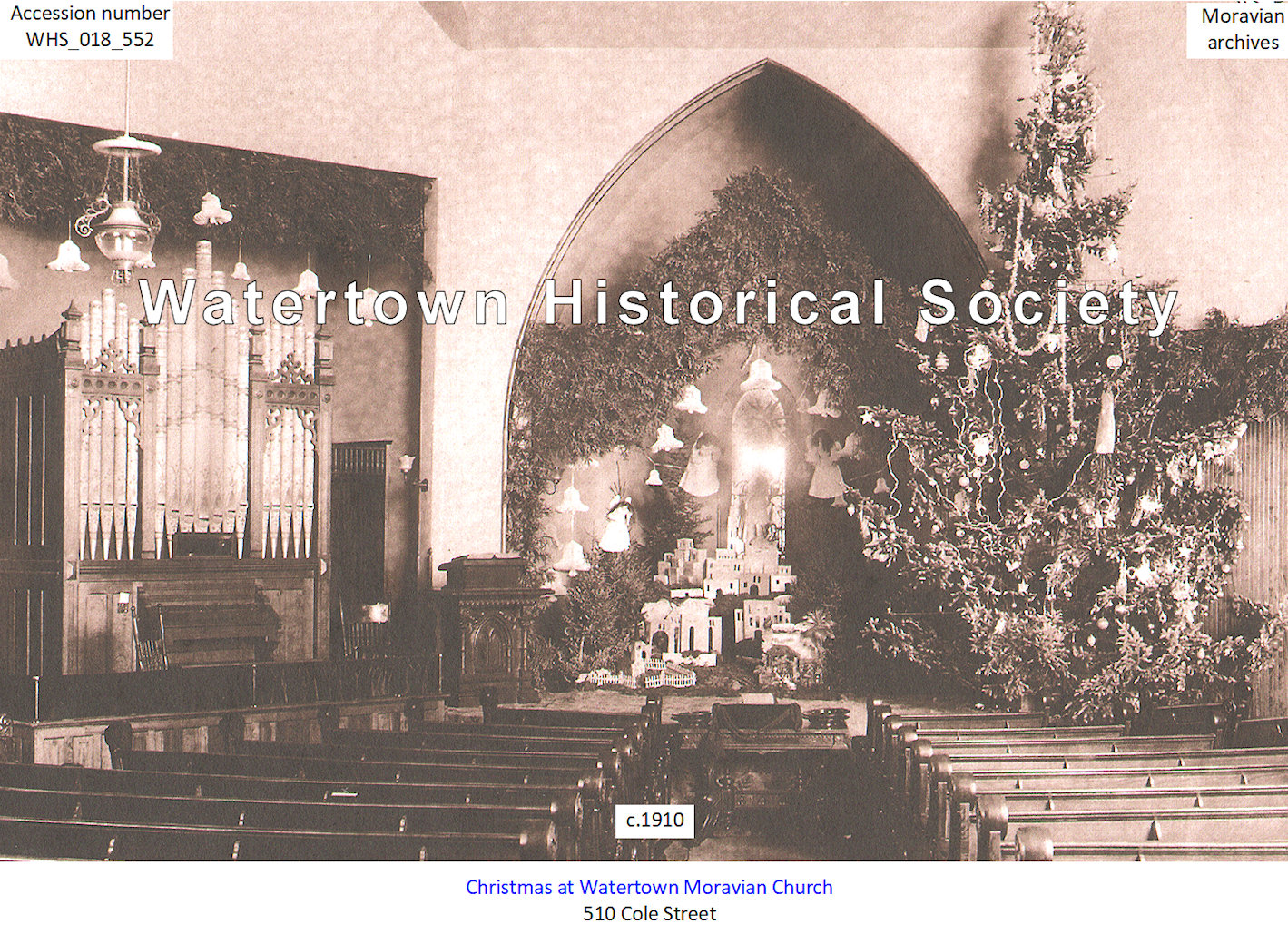
Festooned with arborvitae garland
trimmed with paper bells and angels. The
elaborate village in the center was known as a “putz” and is a Moravian
Christmas tradition. A variety of tree
trimmings including paper ornaments, paper garland, foil garland, glass
ornaments and candles on extensions to keep the flame away from the tree.
The small pipe organ at the left
is used today in the Mamre Moravian church on Highway Q, west of Watertown.
-- -- CHRISTMAS EVE & TREE WITH CADLES
On Christmas Eve, from her
grandfather’s house the family would walk to church for a traditional Moravian
“love feast,” which Nowack said originated in the 17th and 18th centuries when
the Moravians were an oppressed denomination.
At this service, aside from singing and scripture reading, everyone got
a beeswax candle to hold up at different times. And a symbolic meal was passed.
Everyone ate the same thing, which suggested equality.
Like most Watertown churches, the
Moravian church had a large Christmas tree that was lit with candles. Nowack remembers that nine men sat on the
side with dozens of buckets of water, in case the tree caught fire. That was
back when the fire department had white horses that pulled the engine, and
roads were cleared only enough for two carriages to pass side-by-side. Elizabeth Nowack: Christmas in Watertown, 1984, Vol 2, “Christmas in
Watertown Long Ago,” pgs 4-6
1911
04 14 EASTER
SUNRISE SERVICE AT 4:30 AM
Sunday morning
at 4:30 o’clock the members of the Moravian church will meet at the church
edifice and after a short service will proceed to their cemetery as is their
custom on Easter Sunday where the usual exercises will be held. The ceremonies are not only interesting, but
extremely impressive and instructive, and the public is cordially invited to
meet at the church at the hour named and accompany the members to the “silent
city of the dead” and witness the ceremonies.
07 27 CHURCH INTERIOR DECORATED
The Moravian Church
during the past few weeks has been undergoing some changes in its interior
which will greatly add to its beauty and attractiveness. The organ has been removed from its former
position and placed directly in the rear of the pulpit, together with a
platform for the choir, which change will make it better for the speaker and
the congregation. The beautiful art
window removed from the rear of the pulpit has been fitted in the former organ
recess while another window of prism glass reflects its beauty. The interior walls have been repainted and
decorated, the artists being J. B. Murphy and his assistants, the decorations
being in keeping with the interior finish.
Arrangements are under way to open the auditorium on next Sunday if
possible and special speakers and musical talent has been secured for the
occasion. WG
1912
01 11 NOWACK, WILLIAM, CARL AND LITTLE RUTH
The special missionary
services at the Moravian Church last Sunday evening at which the Rev. William
H. Nowack gave a report on the Ebenezer mission at Pi Yang Hsien, Honan
Province, China, was attended by over two hundred interested members of the
local churches. Little
Ruth Nowack, aged 7 years, eldest daughter of Rev. Nowack, dressed in
Chinese costume, sang “Jesus Loves Me,” in the Chinese tongue. Although the audience showed no signs of
being weary after listening for a full hour, Rev. Nowack thought he had done
the subject justice. Carl F. Nowack has
been acting as home secretary for the mission, publishing the missionaries’
circular letters and forwarding gifts from friends. WG
1913
09 25 MORAVIAN MISSION FESTIVAL
One
hundred and twenty-five dollars was raised at the special mission festival at
the Moravian church last Sunday. Rev. Henry
Richter of Unionville, Mich., preached at the morning, afternoon and evening
service. Rev. E. F. Helmich and Rev. H.
Meinert of Lake Mills assisted at the services. WG
1914
10 08 MORAVIAN CHURCH ANNIVERSARY
Last Sunday a mission fest
was held in connection with the 60th anniversary of the first Moravian church
in Watertown. Large delegations of
Moravians were present from surrounding towns.
Rev. Albert Haupert of Green Bay, a former pastor, delivered the
anniversary day address at the morning service, and also
delivered an address in the evening.
Rev. D. C. Helmich of Ebenezer was also present and took part in the
ceremonies. WG
1918
04 01 EASTER SERVICES AT WATERTOWN MORAVIAN
 Services at the Moravian church Sunday evening were of
more than passing interest.
Services at the Moravian church Sunday evening were of
more than passing interest.
To those who attended
was granted something that will never again be experienced.
The principal exercise
was the sermon, “The Glorified Cross.”
The address was delivered in the darkness with a huge five-foot cross
illuminated in red and made of carnations, the only illuminant.
Preceding the sermon
the children and adult Sunday school societies marched up to the cross singly
and affixed a red carnation to the frame work.
The lights of the church were then extinguished and red bulbs back of
the design were lighted. The effect was
most wonderful and impressive. The
program was lengthy and well balanced.
The first Moravian
minister, John Beck, of Salicia, Germany, who carried the message of the Cross
to the Esquimaux in Greenland in 1739 and who baptized his first convert five
years later on Easter day, was fittingly remembered in a
short eulogy. The
Watertown News
1940
06 08 CHILDREN’S DAY PROGRAM
A children’s day program will be held Sunday morning
June 9 at 10 o’clock in the Moravian church by the beginners, primary and
junior departments of the Sunday school, Mrs.
George M. Fischer will be in charge of the
program. She is being assisted by Miss
Ethel Bredow, pianist, Margaret Jane Fischer, violinist, Patricia Heim,
violinist, Mae Schilling, clarinetist, Junior Rehbaum, trumpeter, Kenneth
Nowack, flutist, Kenneth Schmidt, cornetist and the following teachers, Miss Helen
Kohls, Miss Myrtle Wesemann, Mrs. Clifford Schoechert, Mrs. Reinhold Zache,
Mrs. Eugenia Zillmer, Mrs. Edward Sprenger and William Radke, Jr.
1945
07 17 CONGREGATIONAL
CHURCH CENTENNIAL
Moravian greetings sent to Congregational
on Centennial
1954
08 31 CENTENNIAL PLANS
The Moravian Church in
Watertown, located at North Sixth and Cole streets, will observe its centennial
in September. Plans for an extensive
celebration have been made by the congregation.
The church, as many another in the Western District of the Moravian
Church in America, is the product of hardy pioneers who came to the United
States in the mid-nineteenth century. A
number of those families, among which one finds such family names as Strehlow,
Klatte, Flath, Witte, Hans, Klausch, Botzel, Klar, Gerbsch and Eberle, had
immigrated to the United States from the province of Brandenburg, Prussia, and
settled in and near Watertown, in the spring of 1851.
These people had
all been members of the State Church in Germany. But they had been ministered to by Joachus
Niedershoe and his wife, diaspora workers of the Moravian Church in Europe.
1956
02 23 Rev. HARBERG NAMED PASTOR
The
Rev. Thorlief Harberg, pastor of the Moravian Church in Northfield, Minn., has
been named pastor of the Watertown Moravian Church and will take over his
duties here in September. The Rev. Mr. Harberg will succeed the present pastor,
the Rev. Dr. Victor L. Thomas, here since 1944.
Dr. Thomas will move to Madison in September to assume his new duties as
president of the Western District of the Moravian Church in America, to which
he was elected last year. He succeeds Bishop I. R. Mewaldt of Madison in the
office of the district presidency. The
new minister of the Moravian Church is no stranger to Watertown. He is known among the Moravian community here
and has been a visitor at various times in Watertown and has appeared as a
guest preacher at the local church.
1958
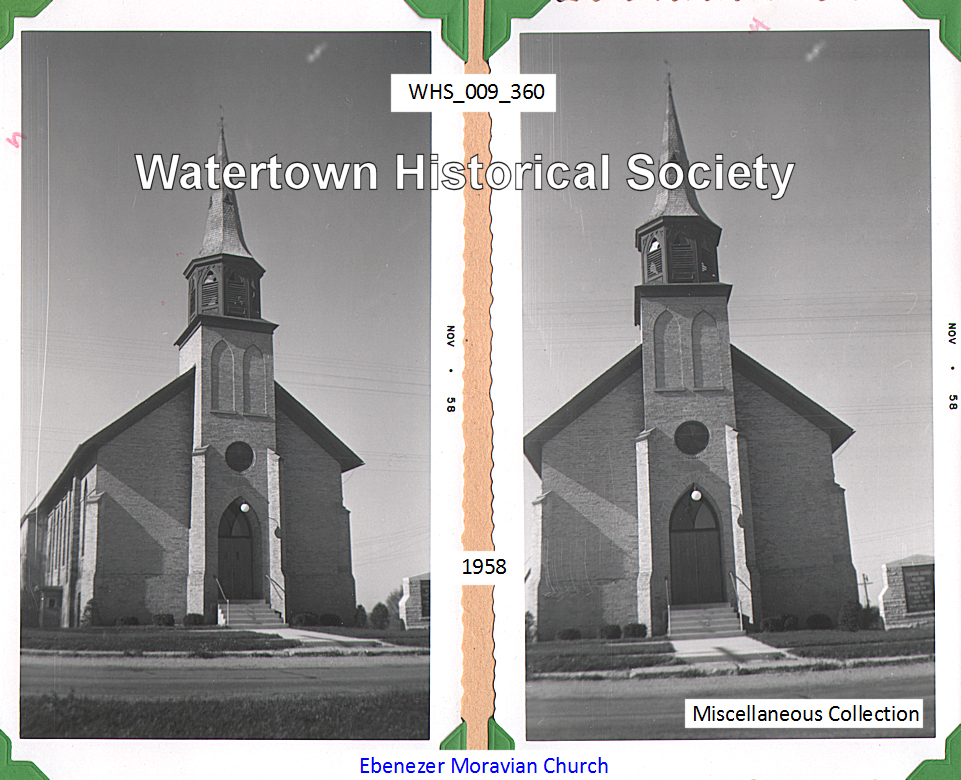
1961
04 24 DEDICATION OF NEW PIPE ORGAN IS ON SUNDAY
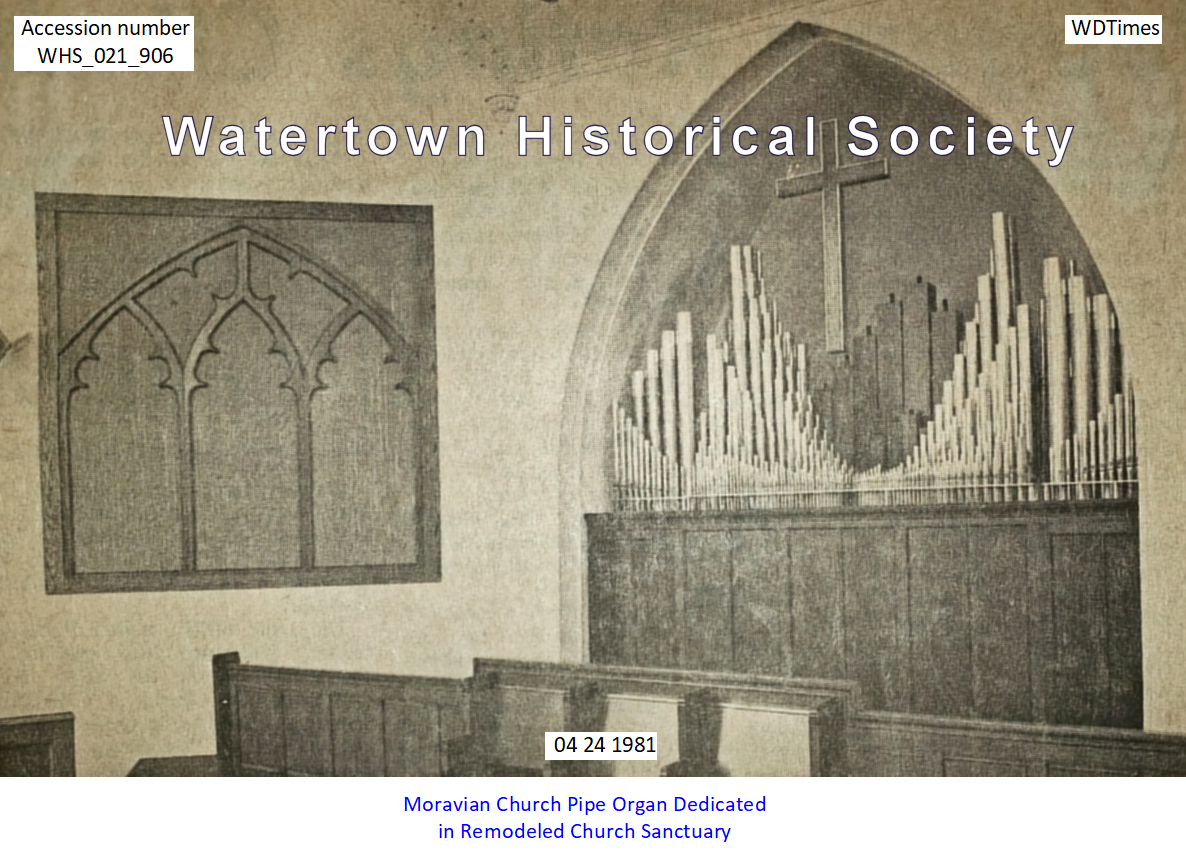
Members
and friends of the Watertown Moravian Church celebrated the dedication of its
new pipe organ and the rededication of its remodeled sanctuary.
At
10:15 a.m. the worship service will include the liturgy of dedication, and in
the evening service, at 7 o'clock, there will be a dedicatory recital on the
new instrument.
The
old organ was purchased by the congregation in 1937 from a Milwaukee firm that
rebuilt old theatre organs. Because of
badly needed repairs, the congregation voted to purchase the new instrument
from the Schantz Organ Company of Orrville, Ohio, a firm that has been a leader
in pipe organ construction for over 100 years.
The instrument
consists of two manuals and pedal divisions.
The great and pedal organs are exposed in the center of the chancel wall
and form a visual frame around the cross.
There are 19 ranks plus a one-half rank extention
for a total of 1,125 pipes.
Renovations
completed in the sanctuary, which was built in 1904 when the congregation was
then 50 years old, include stripping and refinishing the floors, painting the
walls and ceiling, with the highlighting of the ceiling medallion, stripping
the woodwork around the entranceways and one window, and recarpeting the
worship center.
Anne Sautebin Chesher will be the guest organist at both
services. Ms. Chesher is currently
director of music at Park Ridge Presbyterian Church, Park Ridge, Ill.
The
members of the organ committee who selected the instrument were Mrs. Esther
Flater, chairperson; Mrs. Georgianne Simdon, Nelson
Fischer and Rev. John Hicks, pastor.
Russel Polensky is the organist for the congregation.
1962
12 22 ANNUAL CHRISTMAS EVENT
The
Christmas story, as depicted in the display called “Putz,” is an annual event
at the Watertown Moravian Church, Sixth and Cole Streets. The Bethlehem scene of that first Christmas
is again visualized in this year’s display.
At the appropriate time during the telling of the Christmas story,
lights go on revealing the shepherds, the angel, the mother Mary, etc. By way of explanation, the pastor of the
church, the Rev. Thorlief Harberg, said that the word “Putz” simply means a
decoration, but American Moravians use it in a special way to mean a
distinctive kind of Christmas decoration.
WDT
03 04 NEW
CHRISTIAN EDUCATIONAL CENTER . . .
Demolition of the old parsonage of the
Watertown Moravian Church is well under way in Cole Street. The building is being torn down to make way
for the start of the new Christian educational center of the congregation which
is to utilize the site. The church
recently announced plans for the construction of the addition.
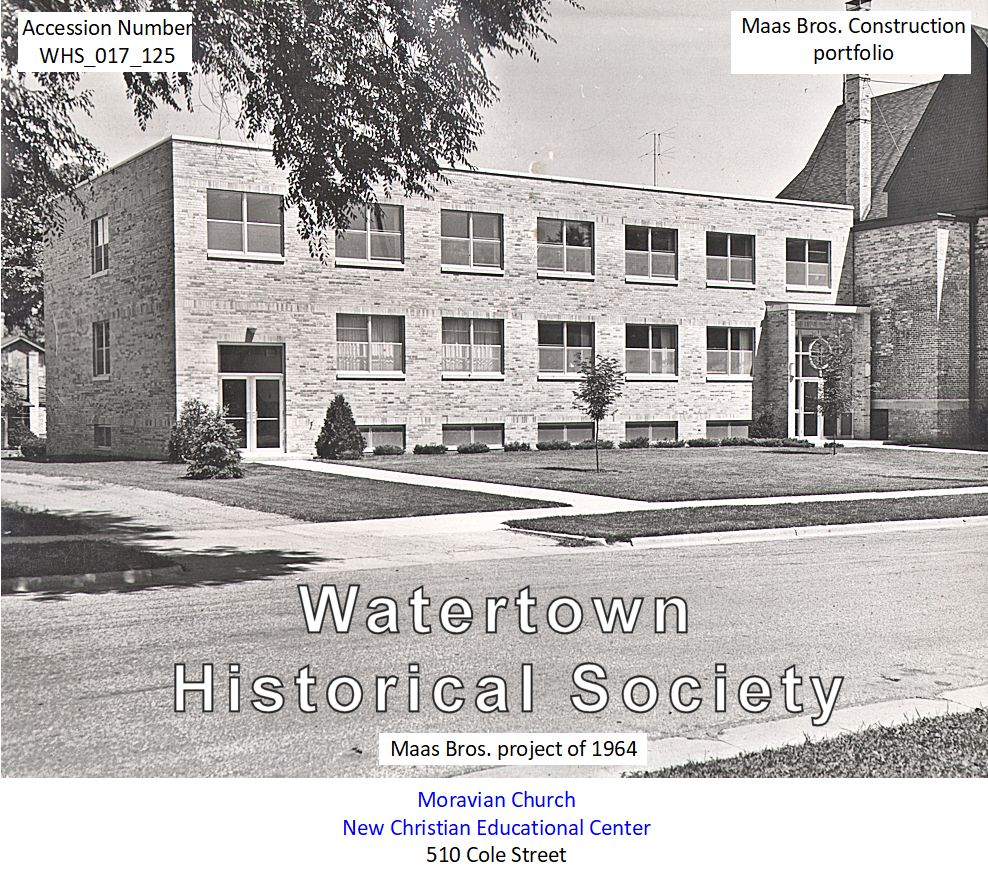
. . . and PARSONAGE DEMOLITION
The
church acquired a new parsonage last year and the pastor, the Rev. Thorlief
Harberg, has occupied it for some time.
It is the former Martha Grabow residence at 501 North Sixth Street,
directly across the street from the church.
WDT
 501 N. Sixth St
05 31 CORNERSTONE CEREMONY
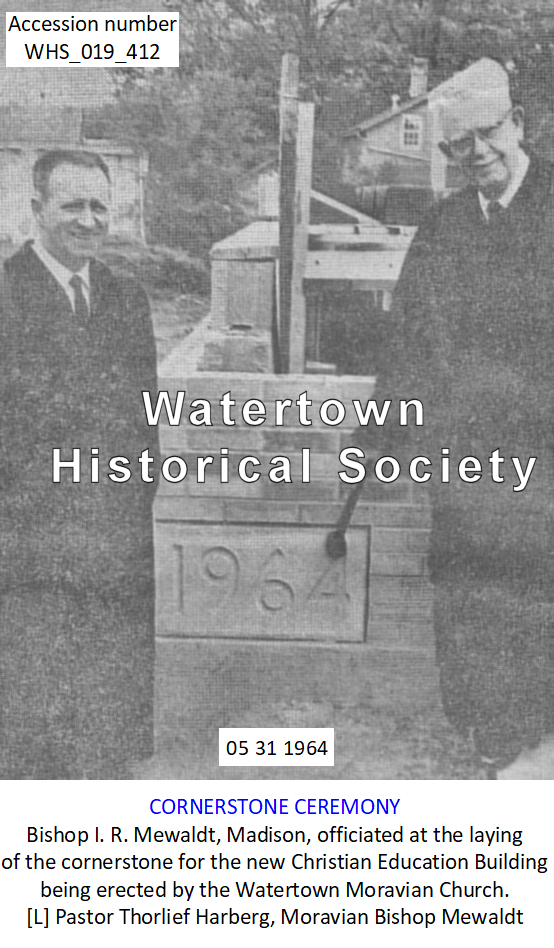
The
Rt. Rev. I. R. Mewaldt, D.D., Madison, a bishop of the Moravian Church, will be
in Watertown Sunday to officiate at the cornerstone ceremonies for the new
Christian Education Building now under construction at the Watertown Moravian
Church, North Sixth and Cole streets.
Bishop
Mewaldt will participate in the regular worship service at 10:30 a.m. after
which he will lead the congregation outside for the ceremony.
The
Watertown congregation will be observing its 110th anniversary on Sept. 11,
having been first organized in 1854. For
nearly 10 years after its organization the congregation worshipped in what is
now 609 Cole Street, a building erected by them for worship and a Christian Day
School. The first sanctuary was built in
1864 with the cornerstone being laid on May 5, 1864 — just 100 year ago. The
existing church building was erected in 1904 with a seating capacity of over
500.
The
new Christian Education Building, now in progress, is part of the
congregation’s effort to honor the past and prepare for the future while
serving the present, the pastor.
-- -- ADDITION PROGRESSES
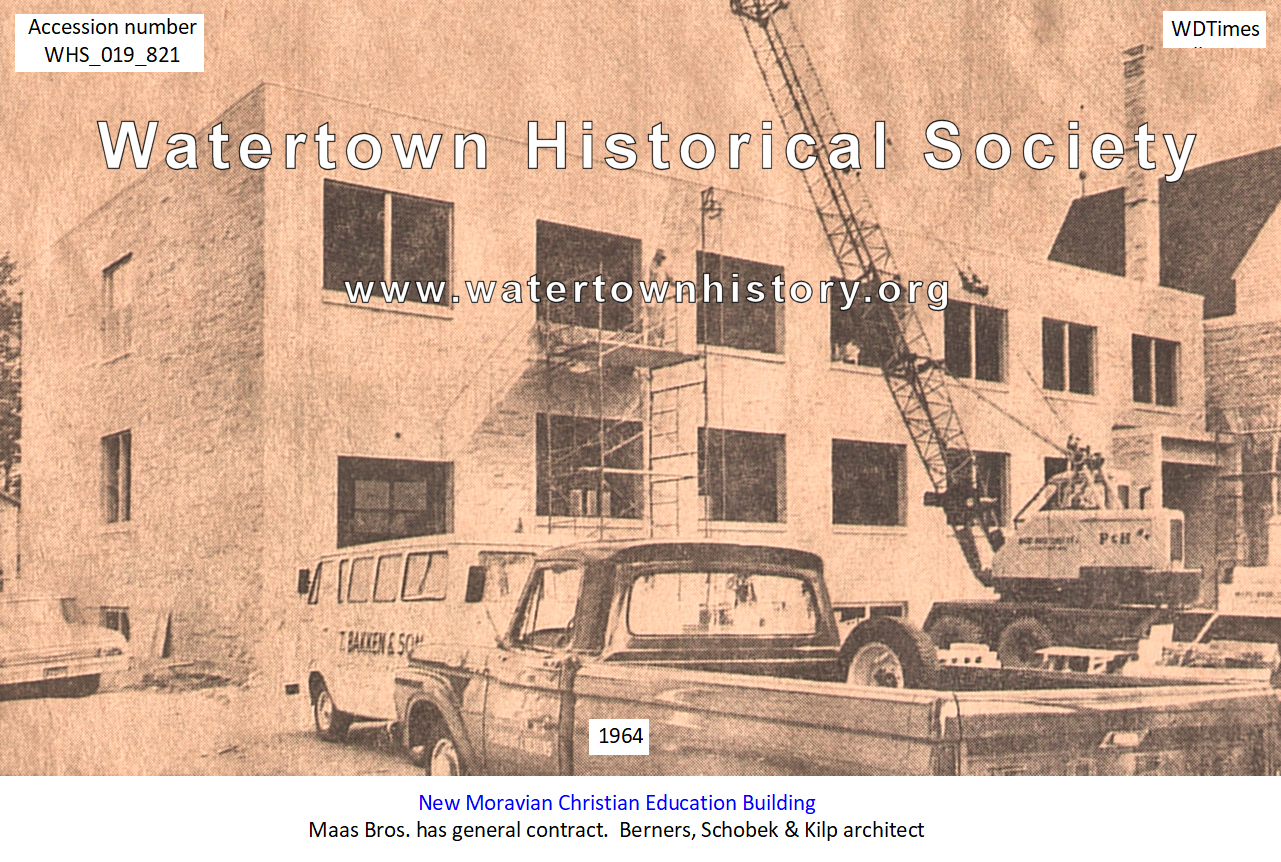
1965
01 23 NEW CHRISTIAN EDUCATION BUILDING
The
Watertown Moravian Church will dedicate its new Christian Education Building
with special services on Sunday. The
pastor, the Rev. Thorlief Harberg, will preach the morning sermon at the 10:30
o’clock worship service. His topic will
be: “Our Church: Monument or Instrument.”
A community open house at 4 p.m. will provide an opportunity for
everyone to inspect all the facilities and enjoy the refreshments served by the
Women’s Fellowship in Bohnsack Hall. WDT
01 31 NEW
CHRISTIAN EDUCATION BUILDING DEDICATED
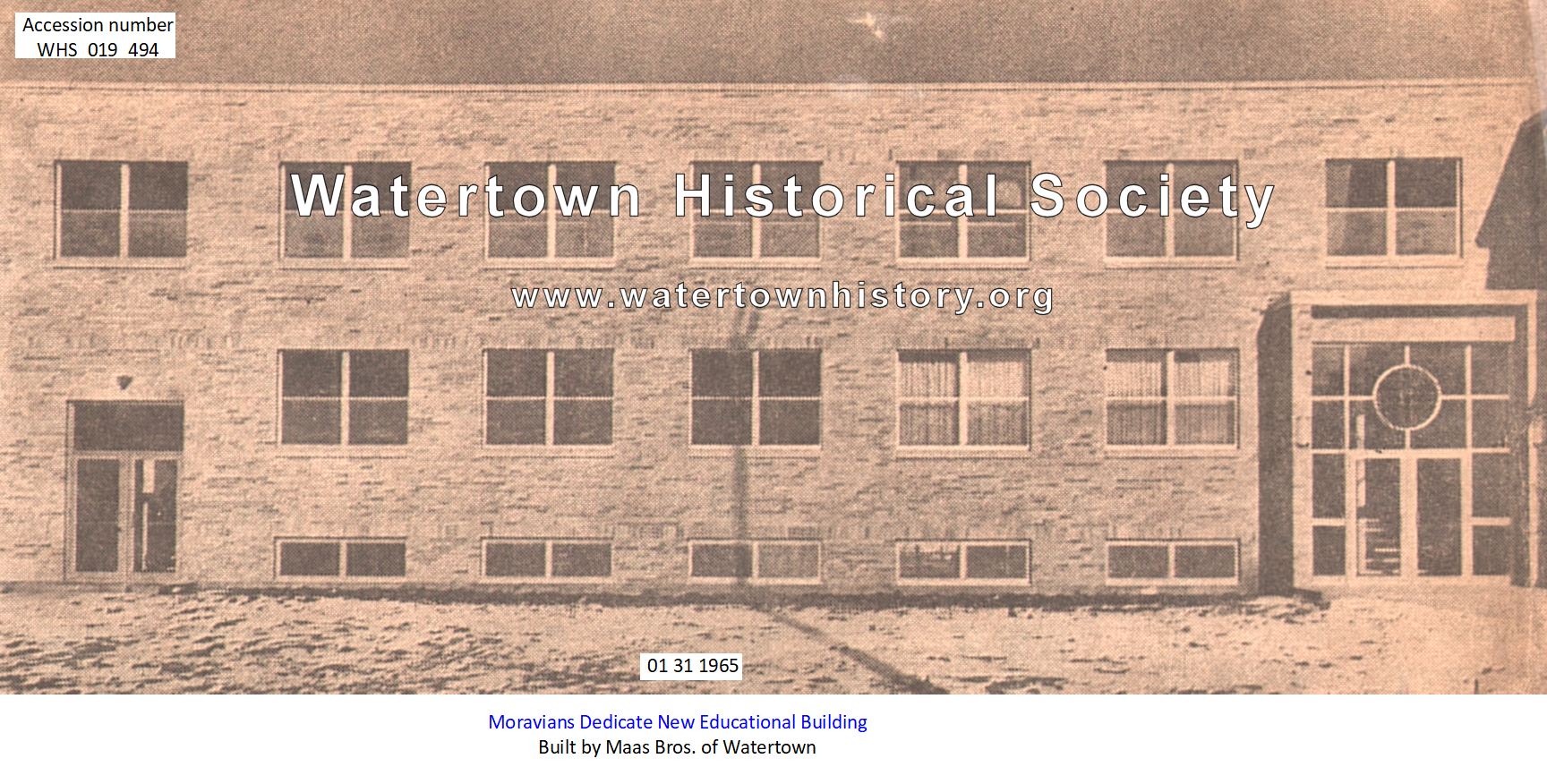
The
Watertown Moravian Church will dedicate its new Christian Education Building
with special services on Sunday.
The pastor,
the Rev. Thorlief Harberg, will preach the morning sermon at the 10:30 o’clock
worship service. His topic will be: “Our
Church: Monument or Instrument”.
At the
afternoon service at 2:30 o’clock, the Rt. Rev. I. Richard Mewaldt, D. D.,
Madison, will officiate at the act of dedication. Greetings will be heard from denominational
representatives and neighboring pastors.
A
community open house at 4 p.m. will provide an opportunity for everyone to
inspect all the facilities and enjoy the refreshments served by the Women’s
Fellowship in Bohnsack Hall.
Many
memorial gifts have become a part of the very structure itself. At the morning service three specific
memorials will be dedicated: Bohnsack Hall, in memory of Olga and Vernette
Bohnsack, whose bequest made possible the addition of a third floor on what
originally had been a two-storied plan; the furnishings in the pastor’s study
in memory of the late Rev. Arthur Schwarze, who served the Watertown
congregation for 27 years — from 1917 to 1944; the primary department
furnishings; wardrobes, bookcases, storage cabinets and a worship center, yet
to come, in memory of Mrs. George M. Fischer, who for many years served as the
superintendent of the primary department.
The
building was designed by the architect firm of Berners, Schober & Kilp of
Green Bay, Maas Bros, were the general contractors with Guse, Inc.,
plumbing; Ruesch Electric, electrical; and J. J. Newmann of Beaver Dam,
heating. Total cost of building is
approximately $170,000.
Three
Cornerstones
There
are three cornerstones in the total church and church school structure — on the
corner of North Sixth and Cole Streets the present church stone, 1904; on the
southwest corner of the new building, 1964; in the main entrance of the new
building, framed in the wall, the cornerstone, 1864 from the first church
building, which occupied the present site.
The
Watertown congregation was organized on Sept. 11, 1854. The first house of meeting still stands at
609 Cole Street. It was built in 1855 as
a school and a place of worship.
An
invitation has been extended to the people of the community to fellowship with
the congregation on Sunday, January 31.
01 31 Dr. THOMAS' CONDITION IS HELD SERIOUS
Former Moravian Pastor Suffers
Several Strokes
The
Rev. Dr. Victor L. Thomas, 59, former pastor of the Watertown Moravian Church,
was reported in critical condition today at Madison General Hospital following
a series of strokes, the first of which he suffered last Thursday night.
Dr.
Thomas is president of the Western District of the Moravian Church of North
America, a position he assumed after leaving Watertown and moving to
Madison. He was succeeded here by the
Rev. Thorlief Harberg, who is currently pastor of the Watertown church.
Dr. Thomas’
residence in Madison is at 709 Oneida Place.
Only
last week he was listed in a news report in the Daily Times as one of the
speakers chosen to take part here in the dedication planned for the new
Christian Education building on the Moravian Church grounds.
1966
01 08 BUILDING PROJECT
A
$50,000 building project is to be undertaken by the Ebenezer Moravian
Church. The annual church council of the
congregation was held Sunday with the election of officers. Elected for 1966 were Dellmar Schwartz, elder
(three year term); John Gehler, trustee (three year term); Clarence Lenz,
trustee (one year term to fill the unexpired term of Ronald Winter); Douglas
Rabbach, secretary; Carl Neathery, general treasurer; Donald Wesemann,
financial secretary; Roy Neathery, building fund treasurer; (all for one year
terms); Edwin Ohm, cemetery committee, (three year term); John Schlesner,
Christian education committee (two year term).
WDT
03 11 SKETCH FOR CHRISTIAN EDUCATION BUILDING
Yesterday’s
announcement that the construction of an addition to the Ebenezer Moravian
Church providing for a Christian Education building had been approved was
followed today by the release for publication of the above sketch prepared by
the architects, Thern Associates, Inc., of Oshkosh. Overall dimensions of the addition will be 88
by 50 feet, with an extended carport to the west. It will provide 10 classroom areas including
a pastor’s study, and folding partitions will enable the opening of four classrooms
to provide a dining area to seat 130 people.
The building will be one story high and will be of brick face. Negotiating of contracts has been authorized. WDT
06 04 CORNERSTONE FOR CHRISTIAN EDUCATION ADDITION
The
laying of the cornerstone for the Christian education addition to the Ebenezer
Moravian Church will form an important part of the congregation’s annual
mission festival on Sunday, June 5. The
cornerstone ceremony will be at the close of the afternoon service with the Rt.
Rev. I. R. Mewaldt, Moravian bishop, Madison, officiating. Eugene Kelm, chairman of the building
committee, and Edwin Schroeder, chairman of the board of trustees, will place
the stone after the pastor, the Rev. Bernard E. Michel, has deposited the
documents to be sealed by the stone in their container. WDT
09 28 CHRISTIAN EDUCATION ADDITION TO BE DEDICATED
The
Christian education addition of the Ebenezer Moravian Church will be dedicated at
services on Sunday, Oct. 9, at 10:30 a.m. The Rt. Rev. I. R. Mewaldt, Madison,
will be present to officiate in the act of consecration of the new building.
The Rev. Carl R. Nowack, former pastor, will share in the service along with
the present pastor, the Rev. Bernard E. Michel. The new Christian education
facility adds ten classrooms to the church plant. Four of the class areas open
into a dining facility for 130 persons. One of them serves as a study for the
pastor. WDT
10 09 CHRISTIAN EDUCATION ADDITION DEDICATED
The
near $60,000 Christian education addition to the Ebenezer Moravian Church was
dedicated and opened on Sunday. The Rt.
Rev. I. R. Mewaldt, Madison, led the rite of dedication in consecrating the
building for purposes of Sunday school training, youth instruction and
congregational fellowship. Nearly 500
people from the communities of Watertown and Johnson Creek and from the
Moravian congregations of southern Wisconsin visited the new building at the
open house Sunday afternoon. WDT
10 15 FAREWELL FOR REV. HARBERG
An
“Open House-Farewell” for the Rev. and Mrs. Thorlief Harberg is being planned
by the members of the Watertown Moravian Church for Sunday evening, Oct. 23,
from 7 to 9 o’clock. Neighbors and
community friends of the Rev. and Mrs. Harberg, as well as members of the
congregation, are invited to attend, according to Gerhard Axmann, who is the
master of ceremonies for the occasion.
The Rev. and Mrs. Thorlief Harberg will leave Watertown, Oct. 28, moving
to Bethlehem, Pennsylvania. The Rev. Mr.
Harberg was recently called to the position of general secretary of the
Moravian Denomination’s Board of Christian Education and Evangelism, Northern
Province. WDT
10 26 MARQUARDT MEMORIAL MANOR
The
Moravian Church seeks to provide skilled nursing care in its proposed 60-bed
nursing home, Marquardt Memorial Manor, which will be built on a 40-acre plot
of land in the northern edge of Watertown.
The U.S. Department of Health, Education and Welfare recognizes three
types of nursing home care for the aging: skilled nursing care, personal care
and residential care, it was pointed out.
All three types of care will be provided in the Marquart Memorial Manor,
according to Karl Fischer and Boyd Flater, co-presidents of the
corporation. However, the prime need is
for skilled nursing care. The proposed
plans have been submitted to the Wisconsin Department of Health in order to meet requirements for skilled nursing care. WDT
1969
03 29 MARQUARDT
MEMORIAL MANOR CONSTRUCTION PROGRESS REVIEWED
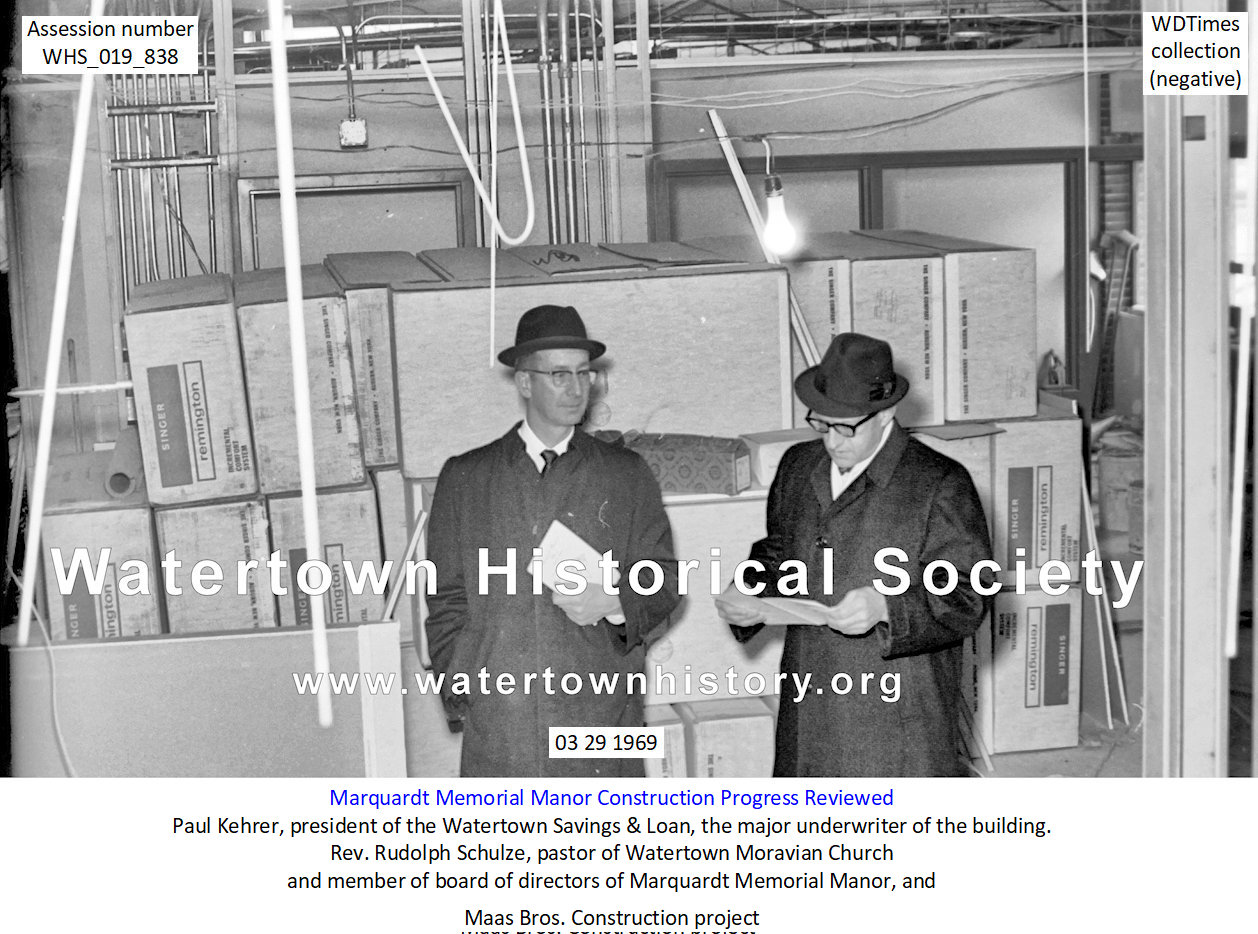
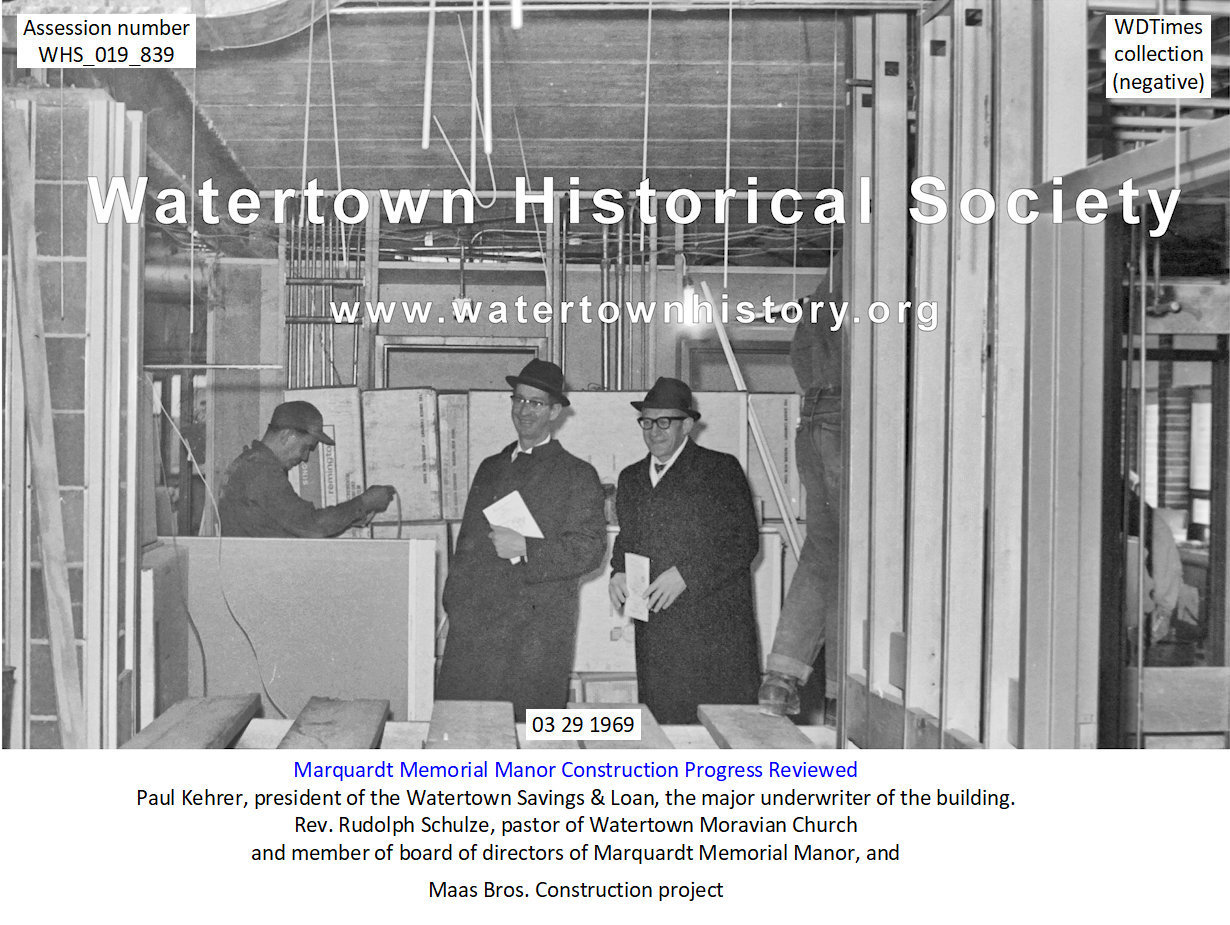
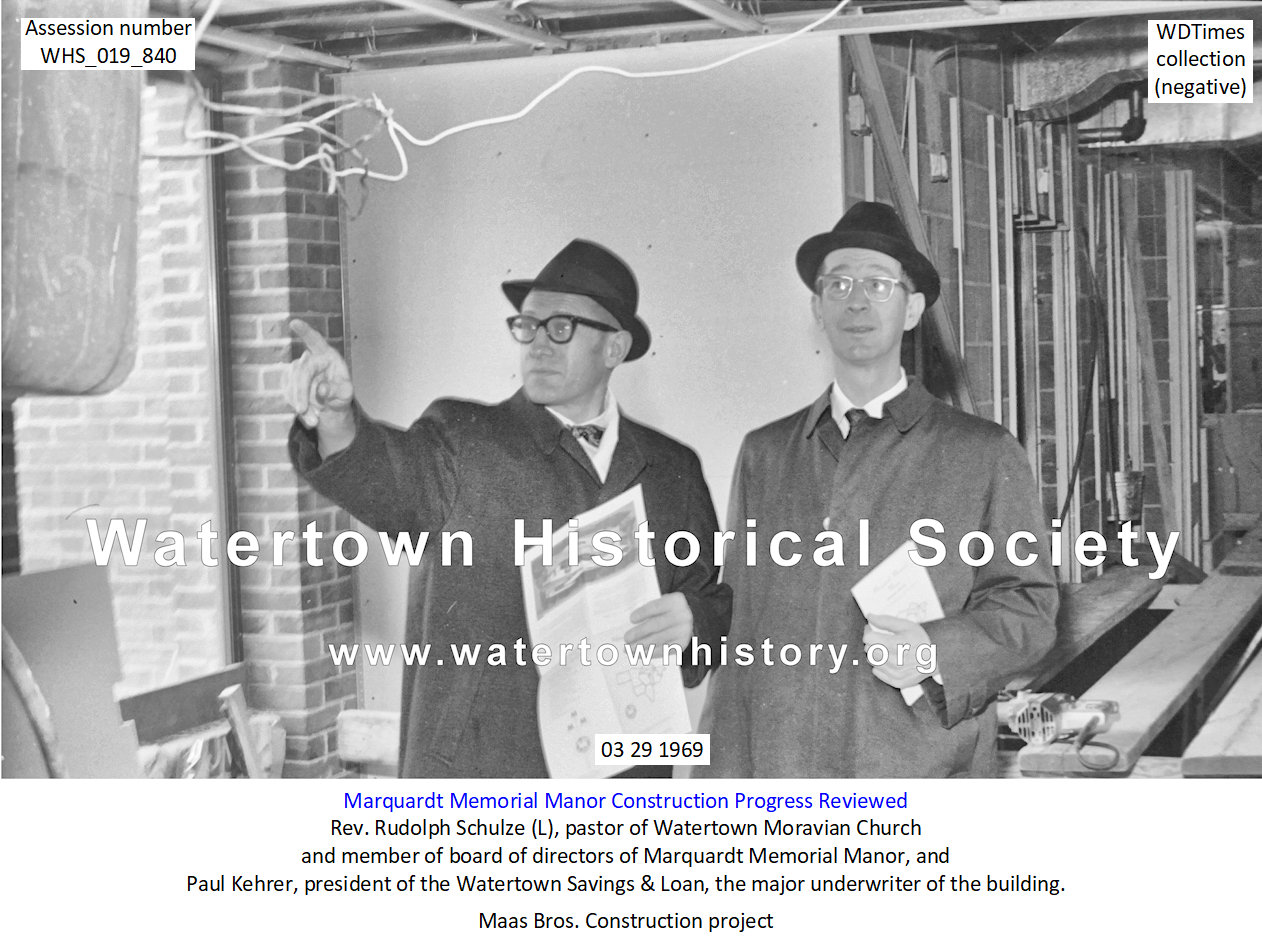
03 29 1969
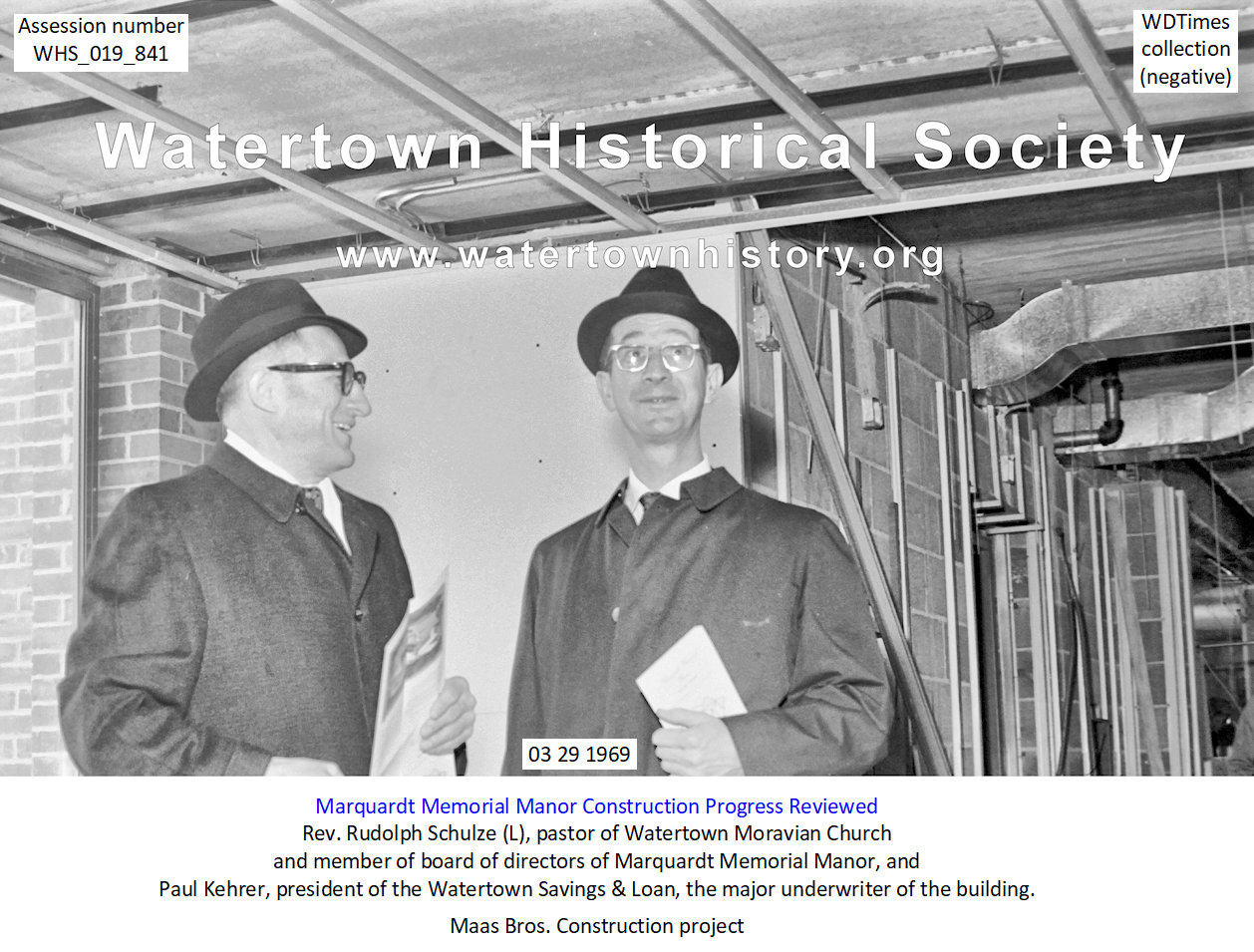
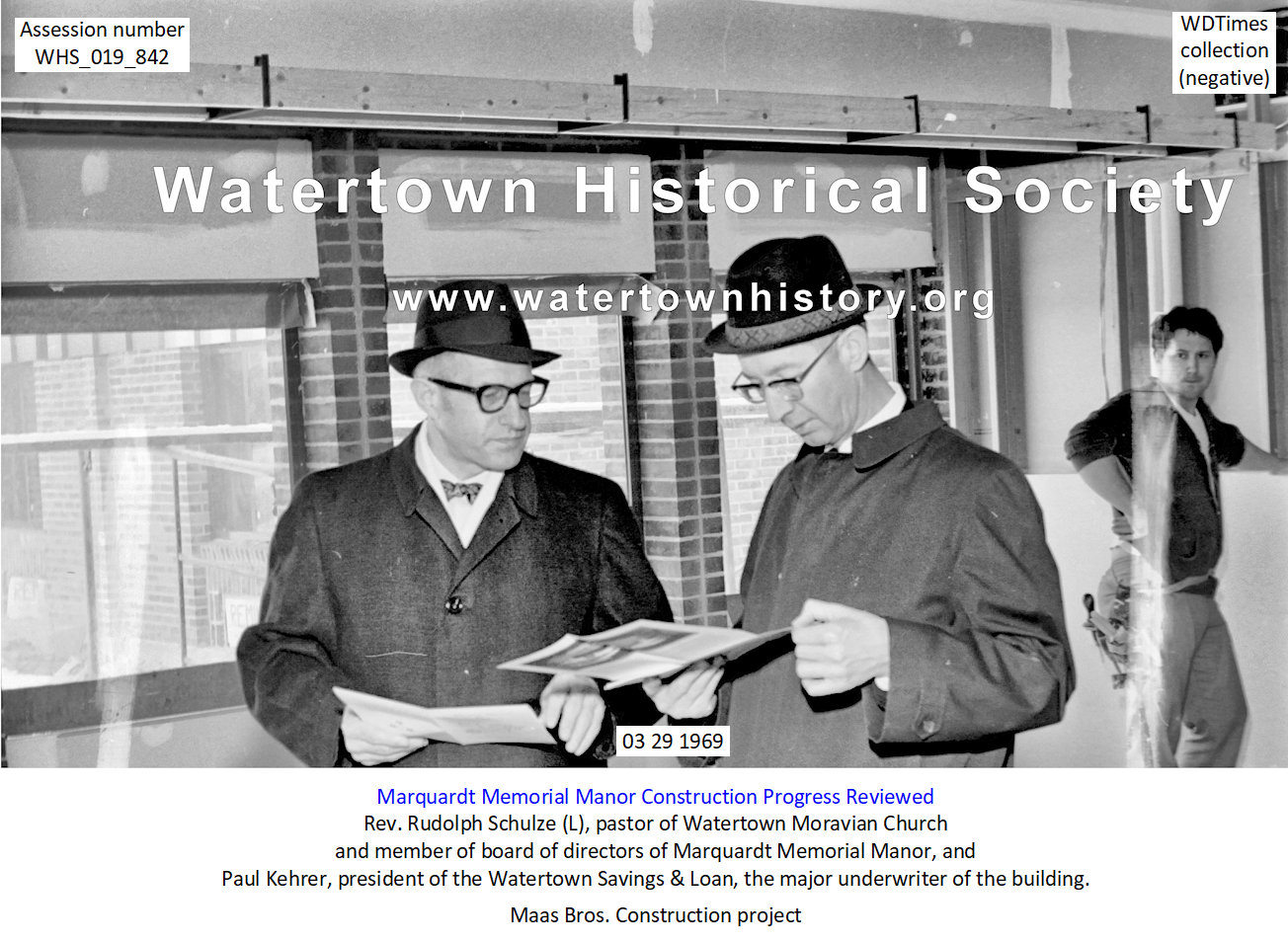
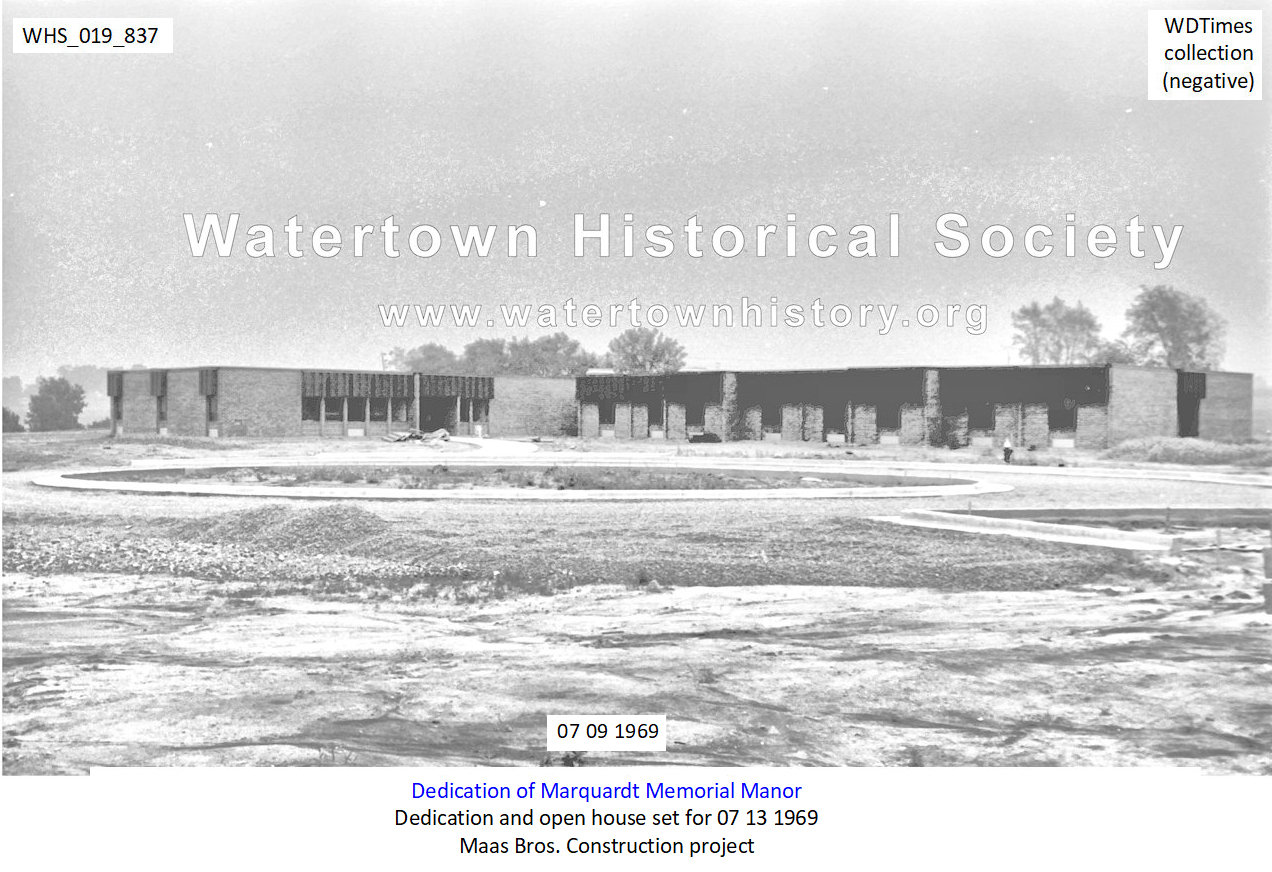
Dedicated 07 13 1969
1981
04 22 NEW PIPE ORGAN AND REMODELED SANCTUARY
Members
and friends of the Watertown Moravian Church will celebrate the dedication of
its new pipe organ and the rededication of its remodeled sanctuary on
Sunday. There will be two celebration
events. The old organ was purchased by
the congregation in 1937 from a Milwaukee firm that rebuilt old theater
organs. Because of badly needed repairs,
the congregation voted to purchase the new instrument from the Schantz Organ
Company of Orrville, Ohio, a firm that has been a leader in pipe organ
construction for over 100 years. The
instrument consists of two manuals and pedal divisions. The great and pedal
organs are exposed in the center of the chancel wall and form a visual frame
around the cross. There are 19 ranks
plus a one-half rank extension for a total of 1,125 pipes.
1982
12 22 REV. JACK HICKS’
Christmas gift to Rev. Eric Schulze
1984
05 30 Marquardt
Manor has been in existence for about 15 years, and much effort has been
placed on buildings and building improvements.
This spring the home is concentrating on the exterior, including the
planting of trees and the making of flower beds. A total of 80 trees have been planted. Much of the money for this project has been
provided by the various Moravian Church Sunday school classes and other Moravian
Church organizations (women’s fellowships, dartball teams, etc.) The Sunday school teachers and the children
from the Watertown Moravian Church, 510 Cole St., visited Marquardt Manor to
see the trees which their donations had provided. Four flower beds are also in the process of
being planted by two of the volunteers, Mrs. Betty Cudnohowski and Mrs. Ruth
McEntire.
1987
09 27 RECONSTRUCTION
PROJECT
Church entrance and the area under the
sanctuary
In January 1986, the Joint Board
appointed a Building Committee made up of Thomas Naatz (chair), Ethel McIntyre,
Gertrude Petig, Curt Piper, Robert Rein, and Pastor
Lorenz W. Adam (advisor) to plan for a major reconstruction of the church
entrance and the area under the sanctuary.
The Thern Design Centre, Inc. of Waupaca drew up architectural plans for
a new narthex with handicap access, a fellowship room in the basement for
smaller groups and social events, and additional rest rooms. Maas Bros. Construction Co. of
Watertown was the general contractor. Demolition work began on February 2, 1987,
and the project, including landscaping, was completed on August 24 and
dedicated on September 27, 1987. In
addition to redecorating the sanctuary, new carpeting and matching pew covers
were installed. The new fellowship room
in the basement was designated the Piper Room in memory of Ethel (George)
Piper, whose bequest underwrote the cost of decorating and furnishing this
room. The total cost for construction,
including a new roof for the Christian Education wing, amounted to over
$215,000 and was covered by the Edwin Ohm bequest. 150th Anniversary Commemorative Book,
1853-2003
1993
08 11 REV. BOB GHODES
The Rev. Bob Ghodes will
mark the 30th anniversary of his ordination into the ministry with a
celebration Sunday at Ebenezer Moravian Church, N8071 High Road. The celebration begins with a special service
at 10 a.m., followed by a potluck luncheon in Heiser Fellowship Hall. Ghodes was born, raised and educated in Cass
County, North Dakota. After graduating
from the Moravian Theological Seminary in Bethlehem, Pa., he was ordained into
the ministry on Aug. 18, 1963 at Canaan Moravian Church, his home
congregation. WDT
1999
10 28 PASTORS BARRY AND VALERIE LEHMAN
The final service for
Barry and Valerie Lehman, pastors of Watertown Moravian Church, is set for
Sunday. The Lehmans moved to Watertown
in 1984. Barry Lehman began his ministry
on July 1. Valerie Lehman entered
Nashotah House seminary in 1986 and graduated in June 1989. Following her ordination, she was called as
co-pastor of the local congregation.
Barry Lehman earned a doctor of ministry degree
from Lutheran Theological Seminary in Chicago in 1993 and has been a part-time
alcohol and drug abuse counselor with Family Resources Associates of Watertown
and Lake Mills since 1995. They have
recently accepted the call to become co-pastors of the Chaska, Minn., Moravian
Church. They will begin their ministry
there on Nov. 1. WDT
2001
05 26 Dr. Frederick Lemke scholarship program, WACF WDT
2003
12 20 A small brick home at 609 Cole St. was the
original home of the Watertown Moravian Church, now located at 510 Cole St.,
about a block to the west of the original building.
The
Moravian congregation in Watertown has its roots in the pioneers who came here
from Germany in the mid-19th century.
Names
like Strehlow, Klatte, Flath, Witte, Hans, Klausch, Botzel, Klar, Gerbsch and
Eberle immigrated to the United States from Brandenburg, Prussia and settled
near Watertown in the spring of 1851. They had been part of the state church in
Germany but they learned about the Moravian Church
from Brother Joachus Niedershoe and his wife who were church workers.
By May
of 1953 Father John Gottlob Kaltenbrunn arrived in Watertown and the
congregation was formed. The congregation was officially organized on June 17,
1853, and the congregation took on the name Ebenezer, just south of the city
limits.
By
September of 1854 a second congregation was formed, this one in the city. It
was done with the blessings of the Ebenezer congregation. Original founders of
this congregation were August Volkmann, George Marquardt, August Schiffler,
Gustave Eberle, Henry Homan, Henry Bruns, Frederick Gerbsch, Louisa Volkmann,
Marie Marquardt, Catharine Schiffler, Marie Eberle, Marie Homan, Henrietta
Gerbsch and Louisa Gerbsch. In addition there were
eight children for a total of 22 souls.
The
first board of trustees were Henry Homan, George Marquart and Frederick
Gerbsch. Brother Kaltenbrunn was voted to become pastor.
On
Sept. 16, 1854, just months after Watertown was incorporated as a city, the
trustees completed purchase of a building lot which was later known as 609 Cole
St. It was 50 feet wide and 108 feet deep. The cost was $80 of which $40 was
given by the Ebenezer congregation, $15 from members of the new congregation
and $25 as a loan from the Ebenezer congregation. That was big money back in
those days.
The
following year, in 1855, the congregation began construction of its church and
school building. The building was 18 by 36 feet. In it was the worship area and
the school room for a "Universal Christian School." Subjects to be
taught at the school included religion, reading, arithmetic, writing in German
and English, orthography, geography, history, English speech, singing and
"other advantageous knowledge." Tuition was set at a maximum of 25
cents per month.
The
teacher was to be paid $100 a year and was to get living quarters and wood for
fuel.
The
building was ready for plastering by July 4, 1855. Lumber for the building was
obtained from timber donated by the Ebenezer congregation from their cemetery.
Bolz and Quintmeyer made a donation of 1,000 bricks.
Individual congregation members donated labor and cash. One person was hired by
the month to dig the cellar and otherwise assist with the building project.
When it was all done, the new building cost $500. School went into session on
Sept. 10, 1855.
With
the opening of the school, the congregation learned it was carrying a debt of
$105. To give you an idea of the size, at that same time, the pastor's
compensation was $9.50 per quarter. But, by Christmas of 1856 the congregation
was free of debt.
In
1863, the school was turned over to the "English and German Christian
Academy of the City of Watertown" and by 1870 the school was closed.
The
year the school was turned over to this society the congregation saw the need
for a new church building. In November of that year the church council voted to
move ahead with plans and on May 5, 1864, the cornerstone was put in place on
the present building at Sixth and Cole streets.
After
that time, the original building was sold and used as a private home until it
was demolished in 2003. WDT
Abstracted from Watertown Daily Times, 09 14 2004
The
Watertown Moravian Church congregation celebrated its 150th anniversary in 2004.
The
Watertown Moravian Church was a product of pioneers who came to this country
from Germany in the mid-19th century. These pioneers had experience with the
Moravian Church in Germany prior to their travels to the wilderness of the
Midwest and applied to the governing board of the Moravian Church in America,
located in Bethlehem, Pa., to supply them with a minister for their spiritual
needs.
In
response to the request, the board in Pennsylvania sent the Rev. John Gottlob
Kaltenbrunn who arrived in Watertown in early May 1853. Since most of the
families lived in the country south of Watertown, the center of worship for the
newly organized congregation was located there. The first Moravian congregation
in this area was organized on June 17, 1853, and was named Ebenezer.
Soon
thereafter a number of other families in the city of
Watertown joined the group and the need for a separate and local organization
became apparent. At a meeting held on
Sept. 7, 1854, it was agreed to meet again on Sept. 11 for the purpose of
organizing a new congregation. The newly
formed, congregation was incorporated as of that date under the name "The
Moravian Church in the City of Watertown."
There were 22 people who were part of the first church with names such
as Marquart, Volkmann, Schiffler, Eberle, Homan and Gerbsch.
The
first property was a parcel of land which was 50 by 109 feet. The purchase
price was $80. The building that was
erected in 1855 was on the south side of Cole Street between North Sixth and
North Eighth streets. It was decided to operate the school as a Christian Day
School, then spoken of as a "Universal Christian School."
By
1863 the school was turned over to a Christian Society which was incorporated
the following year as "The English and German Christian Academy of the
city of Watertown." The school was
officially closed in 1870.
In
November of 1863 at the meeting of the congregation a decision was made to
proceed with plans for a new edifice. Sufficient funds were received so that
the work could be started the following spring and the cornerstone could be
laid on May 5, 1864. Progress on the church building was so rapid that both
roof and tower were added five weeks after groundbreaking and the interior
completed early in August, 1864.
The
entire cost of the new church was $2,512.62. There were 52 communicants and 60
children. Sunday School attendance ran
between 80 and 90.
In
1903 plans for a new church began to take shape. It was the 50th anniversary of
the congregation and the new building became known as the Jubilee Church. The
bid from J. A. Denning of Janesville for $11,856 for the entire building
($10,738 for the church without the chapel) was accepted. The first church was
tom down at a cost of $350 which included clean-up of the old lumber and bricks
for reuse in the new building. The bell in the church tower was added in 1907.
In 1928 a Milwaukee architect was hired to draw up plans for a thorough
remodeling of the church sanctuary, entrances, chapel and second floor Sunday
school rooms, and a new heating plant.
In 1934
the use of the German language was discontinued at the regular services of the
church.
In
1936 a new pipe organ was purchased and installed by Wagnerian Organ Company of
Milwaukee for $2,000. The Mamre Moravian Church bought the old organ for $50
and is still in use by that congregation.
In
preparation for the 100th anniversary an extensive remodeling of the
downstairs, the choir loft and Sunday School rooms of the church was done. At
that time there 420 communicant members and 126 children. Under the leadership
of Pastor Thor Harberg in the early 1960s the congregation voted to build a new
Christian Education wing. It was dedicated on January 31, 1965, with the
inclusion of the cornerstone from the first church built in 1864.
There
have also been building improvements in celebration of the 150th anniversary.
2009
08 25 DONATION
TO TRUANCY ABATEMENT PROGRAM
Watertown Moravian
Church recently made a donation to the city’s Truancy
Abatement Program, which is a cooperative effort between the Watertown Unified
School District and Watertown Police Department
to curb truancy in the middle and grade schools WDT
2013
06 15 160th ANNIVERSARY
Ebenezer
Moravian Church was one of the first protestant churches organized in the
Watertown area. The Moravian Church, the oldest protestant denomination, was
founded in 1457 by the followers of the Czech reformer, John Hus, who was tried
for heresy at the Council of Constance and was burned at the stake on July 6,
1415. The Moravian Church or Unitas Fratrum (Unity of the Brethren) as its
officially known, was founded 60 years before Martin Luther formulated his 95
Theses in Wittenberg, Germany in 1517. The English name Moravian is derived
from the Czech Province of Moravia, where followers of Hus lived before seeking
refuge from persecution in 1722 on the estate of Count Nicholas von Zinzendorf
in Saxon, Germany.
In the
spring of 1853, the Rev. John G. Kaltenbrunn, a former teacher and Moravian
missionary from Silesia, Germany, arrived in Jefferson County, to minister to a
group of German immigrant families, who had requested a pastor from the
Moravian Church. Only a month and a half after his arrival, on June 17, 1853,
13 families signed a charter to establish the Ebenezer Moravian Church as the
first Moravian Church of German immigrants in Wisconsin. The first Moravian
church in Wisconsin was founded in 1849 in Milwaukee by Scandinavian settlers,
who moved to Green Bay in 1850 and to Door County in 1853, where they
established Ephraim. In the fall of 1853, members built a one-room log cabin
four miles south of Watertown which served as a parsonage, house of worship and
a school. The German day school that Kaltenbrunn established continued to hold
classes until 1925. A man of incredible vision and energy, Kaltenbrunn traveled
the surrounding area by horse and wagon and established numerous preaching
places, some of which eventually became organized congregations in Watertown,
Lake Mills and DeForest.
As
membership increased the members of Ebenezer decided to build a new brick
church in 1856 with $500 that Kaltenbrunn had raised from congregations in the
East. Originally incorporated as “The Moravian Church in the town of
Watertown,” the name was changed to Ebenezer after the church building was
dedicated on Oct. 5, 1856. The name derives from the Watchword for that day, 1
Samuel 7:12, “Then Samuel took a stone and set it between Mizpah and Jeshanah
and called its name ‘Ebenezer’ for he said, ‘Hitherto the Lord has helped us.’”
The current church edifice, built in 1890 of yellow Watertown brick after the
congregation outgrew its first building, has undergone numerous structural
changes and modernization over the years. In 1950-51, the church was enlarged
to include a new chancel area and Sunday school rooms in the basement. In 1966,
the Christian Education wing was added and in 1987, a major construction
project added a new narthex that provides handicap access, renovated the area
below the sanctuary and redecorated the interior of the church.
During
its 160 years, 25 pastors have served Ebenezer; the current pastor is the Rev.
Jane Gehler. From its beginning, Ebenezer has had an active Christian Education
program for all ages and music has played a significant role in the life on the
congregation. The church has always had a choir and a band, and its
108-year-old tracker-action pipe organ, built in Pekin, Ill., is one of just a
few surviving intact Hinners organs and is still played for services today.
Members
of the community are cordially invited to attend the 160th anniversary
celebration of Ebenezer Moravian Church. All church facilities are handicap
accessible.
Ebenezer
Moravian Church is located at N8095 High Road, the corner of High Road and
Ebenezer Drive, one-half mile west of state Highway 26. WDT
2018
10 18 HAUS OF
PEACE
The Watertown Moravian Church held a basket auction
Sunday and raised $2,000 in support of Haus of Peace. This community ministry provides housing and
resources to help women and children who are in crisis and need a safe
environment as well as a place to find hope and encouragement. Haus of Peace is a nonprofit ministry with a
community board of directors and relies solely on community donations in order to provide meals, transportation and personal care
items for guests in addition to safe housing.
2022
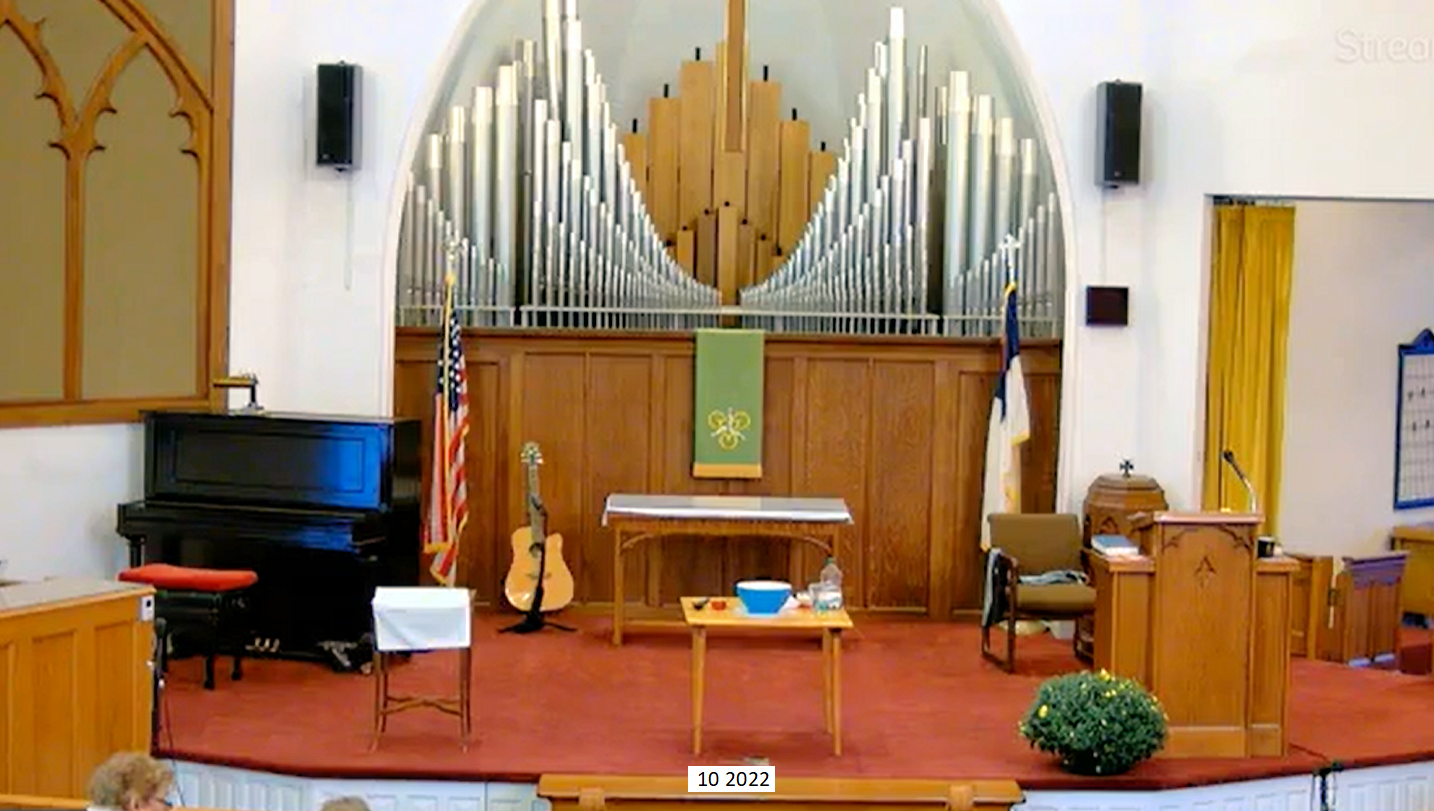
10 18 SANCTUARY
Cross-References:
Establishment
of Marquardt Manor by Watertown Moravian Church

History of Watertown,
Wisconsin