website watertownhistory.org
ebook History of Watertown, Wisconsin
From Mud To Bricks
or
What Took Them So Long?
Written and contributed by Ben
Feld
Annotated and expanded upon by Ken Riedl
The paving/bricking of Main Street
Watertown
Woods
1847
Watertown
Chronicle, 08 16 1847
Those who have traveled through
the Watertown woods, and expect to do so again, will be rejoiced to learn that
the road is being greatly improved. A
sum of money for that purpose was raised by the public spirited citizens of
this place, early last summer, and the repairs are now going on under the
immediate superintendence of Mr. Ozro Brackett.
Stumps are to be grubbed, holes
filled up, and the road in many places turnpiked. Operations were commenced at Kellogg's
tavern, in Concord, and are to extend hitherward. The judicious expenditure of
the sum raised will, it is thought, place the road in good order. These repairs
were certainly needed, as we never traveled a worse road than that was early in
June last.
We are surprised to learn that no
highway work has been expended upon that road the present season. This is wrong
-- most decidedly wrong. At whose door lies the culpability?
__________________________________________________
It has been said that the wheels
of justice grind slowly; but the wheels of the city government sometimes turn
even more slowly, as the city of Watertown learned when the citizens began
agitating for improvements to Main Street.
South Fourth St
Quite some time before Watertown
officially became a city in l853, there were complaints about the streets, and
citizens, sometimes without the help of the city government, took matters into
their own hands to improve some of the streets. Already in 1847, South Fourth
Street (the word "street" was never capitalized in the early days)
was found to be in need of a general cleaning up. When it was finally effected,
it was done by the youngsters of the village and the editor of The Chronicle made clear that "the
public spirit of our City fathers" got no credit for the work. Fourth
Street, it was discovered, had been used as a veritable dump during much of its
existence. In the cleanup operation, they removed old wagon racks, refuge of
building materials, broken the rails, as well as huge stumps which had been
there since the first settlers arrived. Cows, which then roamed rather freely
in the village, seemed to gather each evening on South Fourth Street. Cautiously
the editor suggested that some other place he found for the "Cow
Common" as the inhabitants of South Fourth Street did not wish to
monopolize all the glory resulting from hosting the daily gatherings of the
bovines.
Cross Reference:
Very marked improvements have
recently been made on South Fourth Street.
Rubbish of every description - old wagon racks, refuse building
materials, broken rails, fragments of slabs, etc.- have been confined to the
devouring elements, as have also the huge stumps which have so long stood
sentinel over the large assembly of staid cows which every evening do there
congregate. For this improvement we are
indebted to the good taste of the youngsters of that village, and not to the public
spirit of our "City Fathers."
We would suggest another
improvement upon this street, viz: the removal therefrom the Cow Common, and
its location in such part of the corporation as shall first make due
application therefor. We speak advisedly when we say that the inhabitants upon
that street do not wish to monopolize all the glory necessarily resulting from
such a place of resort. Wttn Chronicle May 23, 1847
City Streets
Each week the newspapers carried
complaints about the country roads which, at that time, were merely
much-traveled paths. In the territory in general all roads seemed to be in the
same hopeless condition. Much
experimenting with plank roads was being carried on with much success, and many
had been built, although none of them reached Watertown until 1853
The roads are bad, the
mud is nearly knee deep, and on the increase. And yet some of our businessmen
see no necessity for a plank road.
This excerpt from The Chronicle of 1849 was just the
beginning of a long string of diatribes by the editors of the local papers --
items which were sometimes presented as being letters from a dissatisfied
citizen but which were often quite obviously the words of the editor of the
particular paper: Ballou, of The
Watertown Democrat or, as time went on, Norris and Keyes of the Watertown News (later to become Watertown Republican).
There was plenty to be
dissatisfied about. From the first days
of Watertown until late 1899, Main Street, as well as other streets in
Watertown, was in abominable condition during most of the year. After a rain,
mud usually reached to the knees of the horses. The water continued to be
channeled into the river carrying with it all the horse manure deposited since
the last rain, making the river one great, smelly sewer.
Crossing Main Street was a
perilous adventure for the ladies for days after each rain. Some of the
enterprising merchants attempted to come to their rescue by constructing
temporary crosswalks which enabled the ladies to keep the hems of their skirts,
which normally brushed the ground, from dragging in the mud.
Why didn’t the ladies simply
raise their skirts a few inches to avoid the mud? UNTHINKABLE!
To do so might reveal the tops of their shoes, or even more unthinkable,
reveal an inch or two of the stocking. Better the skirts become caked with mud!
During the summers, Watertown
sometimes experienced a dry a spell during which no rains came to turn Main
Street into a quagmire. But then the
winds churned up great clouds of dust mixed with horse manure and other
dehydrated wastes. When the mud was
followed closely by cold temperatures, the resulting frozen ruts made wagon
passage, for a time, nearly impossible. Was it any wonder, then, that ladies,
men and teamsters all rejoiced when a snow fall covered the frozen ruts and
drivers brought out the sleighs?
A letter in The Chronicle indicates a certain amount of dissatisfaction and
concern on the part of at least one citizen in 1852:
FRIEND HADLEY -
Allow me to invite the
attention of our village trustees, in this public manner, to the condition of
Main Street, east from the river, and to suggest the propriety of levying a tax
for its improvements. At present almost all of it is quite impassable. It is a
very serious inconvenience to the traveling public, as well as a positive
discredit to the town; and it does seem surprising, that year after year, so
little is done to remove the cause of complaints in regard to it.
During a recent visit
to the north, I heard of a multitude of "curses, not loud but the
deep," upon the supiness of our village
authorities, and saw evidence of a spirit of redress in many localities which
threatened to make serious inroads upon the business of this place.
Cross
Reference: Condition
of Main Street in 1859
Plank Road
Proposed for Main St
Plank roads are
already projected in several directions, which must inevitably draw off much of
the northern and northwestern travel which now passes through Watertown; but
they are being pushed forth with a zeal that is not to be mistaken, and is sure
of success.
Let Watertown look
into this matter before it is too late.
H.
At the time this letter was
written, plank roads were a reality for southern Wisconsin. Fourteen years earlier travelers going to
Milwaukee from Watertown expected to be on the road for at least six days; in
one instance it took three weeks. The first covered carriages, presumably one
of the early stagecoaches in these parts, arrived in Watertown in 1841, after a
tedious journey on which the driver found it necessary at times to chop
branches from trees to permit passage. Once the plank road was put into service,
the travel time was cut to six hours and later to just four hours.
The existing and proposed plank
roads were often written about in the newspapers; generally they were praised.
But Main Street drew nothing but impassioned, sometimes vitriolic criticism.
The rainy weather of early December, 1852, brought forth this comment from
editor Hadley:
AWFUL!
Our "city
fathers" are not sufficiently thoughtful of the comforts of their
constituents. During the muddy weather we have had for a few days past, it has
been almost impossible for ladies to pass some of our streets. By far the worst
crossing place in the business portion of the village is between the stores of
Mr. AMENT and Mr. COONAN.
On Monday morning we
found a lady and two or three children fairly mired in there. A crosswalk is
much needed at that point . . . We advise our "city fathers” to obtain a
mud scow and visit the location at once. The safest way to approach it would be
by way of South Second Street. If, however, they should choose a different
route, we cannot too strongly urge on the observance of the utmost caution,
lest they become a swamped in rounding the point by AMENT'S.
A planked street would seem to
have been the solution to the mud and, indeed, it was tried, apparently. In June,
1853, The Chronicle carried the
following item:
The work of planking
Main street and West avenue, within the limits of the late village corporation,
so as to connect the eastern and western plank roads, is being vigorously
prosecuted. That portion of Main Street between Second Street and the bridge,
was completed last Saturday. About one-fourth of a mile east of the east line
of the older village limits, and about half a mile west of the river, remain to
be planked. This will be done at once.
The poll tax in the wards more immediately interested, will be mainly expended
upon the work and the deficiency made up from a fund appropriated by the city
council, to be expended under the directions of a committee consisting of the
Ald. Cady, Cole and Ford.
No mention of the completion or
of the abandonment of the plank road within the city is found in the reports
from the City council.
Sporadically the city council did
decide to do some repairs on side streets - repairs which consisted mainly of
ineffectual rough grading of the existing street and sometimes spreading out
natural gravel on the surface.
Some sidewalks were built, mainly
on a Second Street, of brick. They were privately financed notably by Dr.
Spaulding, J. W. Cole, L. R. Cady, S. Stimpson and C. A. Sprague.
The inaction of the city council
irritated many, and especially editor Ballou, who published this editorial [in
the Watertown Democrat]:
Somebody was today
preaching up the necessity of having crosswalks on Main Street, but that is all
nonsense. What have we to do with the
other side of the street more than we have on "the other side of the
river"?
I say, let people keep
on their own side of the streets and they won't need any crosswalks. It's only
the Shanghai's that clamor for them, and it's all because their long
pick-tailed coats drag in the mud. I
don't believe there are any there are folks enough here to build walks just to
accommodate them. Let them imitate the fair sex and carry their Shanghai
appendages in their hands.
Who wants to be taxed
for such "Miss Nancy" we see - washy, COM-foolery as that, I'd like
to know? If the Shanghai's can't do any better, let them go to the bridge and
across, and they can crawl under the railing. That might be a grand cross-walk
if the authorities would cut us a yard or to the goal stick of the railings.
But that wouldn't do - it would look “finished." People might to get out of the mud, drive the
wagon through on the sidewalks -- and then what is the use of having a railing,
if you are to have a whole through it? I'm dead agin
that.
In another column of the same
issue, Mr. Ballou expanded on his feelings about the condition of Main Street:
Some Shanghai was
talking the other day, about having "stone gutters” put in on either side
of Main street. He's a genius, full-fledged. I'll bet a steamboat load of
street mud, he's a runaway from some lunatic asylum. Let the proper officers
seize him immediately, as there is, probably, a large reward offered for
him. If there is not, there certainly
ought to be. Such a Utopian suggestion is good evidence that he is non-composmentis --.
Stone gutters! Humph!
Smart idea! Of course they wouldn't cost much, but there is such a beautiful of
descent to the river, but then what's the use of carrying the water off? Don’t the hogs want a soft place to lie down,
and don’t the horses and horned muleys want a soft
place to stand?
The water and mud is
not more than eighteen inches deep in the best gutter in Main Street, and there
is not a porker in town that would find any fault with that.
There is no use in
talking about "the necessity" . . . "carry off filth" and
all the swine will take it away for the rent of the mud hole. Stone
gutters! Bah!
A few days later, "Old
Fogy," a frequent contributor to the Watertown
Democrat, submitted another article which was made up to look like an
authentic news item:
TREMENDOUS EXCITEMENT
IN CHINA
A Watertown Berkshire
Among the Celestials.
A Watertown
"Berkshire" has appeared among the Chinese. The particulars haven't
"come to hand.” It is only reported
that his advent and Pekin was heralded by a "tremendous" earthquake,
during which the ground opened and belched forth donuts of mud as large as a
horse's head. There was a rise in bristles for the hair of the people stood on
end. There was a dreadful hurrying to and from and a fearful display of fiery
eye-balls.
"In awful frenzy
rolling"
Nature's spasms
extended to the sea shore, and old ocean was astirred
to its profoundest depth. The Leviathon of the deep,
lashed his oleaginous tail, and the diminutive tadpoles, wiggled his
extremities and made as much of a splurged generally, as could be expected from
one possessed of such a delicate organization. As usual in such cases a volcano
burst forth and earth became quiet, except about the vent hole, alias the
crater. Amidst the general consternation of a full grown Berkshire was seen to
rise with a fiery stream of lava, and the sound of his guttural voice, mingled
with a song of crackling flames and that hiss of fiery serpents, flying
skyward. The laws of gravitation being in force, the porker in due time came
down the "kerflummex" on a pile of black
tea. The people knew he was a runaway, for the fame of our streets had extended
beyond where
"Gangees roles her swelling flood"
The Berkshire's
bristles were filled with Main street mud making him fire proof. The Imperial government took the best
opportunity to convey the intelligence to the proper authorities at Washington.
The news was conveyed by a carrier pigeon telegraph from Pekin to Halfwayville, Havre, by lightning, Colli's
line of steamers to Halifax and lightning to the Watertown Democrat.
Some people may be inclined
to doubt the correctness of the report. We shouldn’t wonder if they did. The
world is full of wise-acres who are so fearful of being humbugged, that they
won’t believe the plainest truths. But I intend to silence all doubters by
"piling" up the arguments.
The facts and the
theory, physiological and philosophical, are as follows: It is well known that
China is just opposite Watertown. Well, then, if Berkshire popped into one of
the mud holes in Main Street, wouldn’t he pop out on 'tother?
All conclusive.
But says the old
fogies, "How do you get the earthquakes and the volcanoes?" Well, now
that's as clear as mud, and as beautifully philosophical too. The popular
theory is that the earth is a mere crust, which was formed by the “cooling
process" and that the interior of the ball is a boiling sea of fire.
Now, it is a well
known fact, that if you thrust a cold foreign body into liquid fire, you set
the whole mass in commotion and produce a general "sizzle." Is it not
then a logical conclusion, that if Berkshire plunged into one of our Main
street mud-holes and knocked the bottom in, the pent up, fiery sea would be set
in awful motion.
The fact that
Berkshire passed through the fiery furnace unscathed does not mitigate against
the theory, for Main street mud is proof against anything but water.
But many has supposed
our town had been heard of so far away; but this dispatch from the celestials
proves conclusively that our fame has crossed even the steppes of Tartary. Another circumstance given below is
corroboration of the truth of the foregoing report.
A few days since our
humble and diminutive self, with a number of the “prominent citizens" were
standing upon the steps leading to the Watertown Bank. We were meditating upon
the "ups and downs" of life, contrasting the present with the past
and wondering in all seriousness, why the mud in our streets should become
deeper as our improvements progress, and we longed for the return of the
"olden time" when only the crack of the emigrant's whip and the howl
of the wolf, in the contiguous forest, broke the gloomy silence.
The gong had rung out
its starting notes and some of us were anxious to respond. But how were we to
cross Mud River? Some suggested stilts and some ferryboats, but here our
cogitations were interrupted by the sudden boiling of the muddy cauldron in
front of us. But a moment elapsed when two ears appeared above the surface and
next arose an uncouth form rising in fitful contortions and its surface covered
with the well-known vegetable deposit, black, mushy, and "sticky",
and anon arose upon the air, a wheezing, half smothered sound, augh! Whoosh! Usguevaugh! followed by a few desperate leaps for a firmer
footing. It was almost gained, when lo! just in front of our bridge, down went
the ears. It was a fearful plunge. The thick volumes of mud closed over what we
supposed to be the ignoble grave of our departed Berkshire. We chanted the
"requiescat in pace” but the dead is alive, the lost is found! He had turned up on the other side, and is
reveling in the midst of oriental luxuries.
The foregoing precious
notes, evidently from the pen of some shanghai alias "young America,"
were picked up on the "crossing" this morning. Our business matters
just now are pressing but we intend to give the author “fits" in due time.
It is another stab in the dark at that let-alone policy that compels
corn-footed people to follow the laws of nature, and locomote over mush
crossings.
It is another
backhanded thrust at that generous spirit which crushes extravagance in the bud
and scourges recreant Aldermen, who dare squander the people's money, by making
even one street "passable" for thin-slippered
ladies.
It is like all the
rant and twaddle about the necessity of fostering useless necessaries, such as public
schools, churches, libraries, parks, shade trees, fire companies, etc.
I tell you, fellow
citizens, our liberties are in danger. No "Young American", Patent
Leather Nincompoop gentry should be allowed to introduce their down-cast
heresies and innovations here. We have paddled in the mud fourteen or fifteen
years and we can do it still, for we are alive and kicking - they can do it as
well as we for it costs nothing.
We must wage a war
against this system of taxation for street making. What's the use in giving
money if we are compelled to spend it?
Dear Editor, if I had
time I would give 'em fits now, for my choler rises with every stroke of the
pen. But really I haven't time for anything else. I must look after the
coppers. Let the hyenas growl.
Your's without Ambiguity,
OLD FOGY
When Watertown officially became
a city in the spring of 1853, and for another thirty or more years, the science
of street maintenance was in its infancy. Machines specifically for preparing
road beds and durable paving material were in the process of being developed
but in the meantime the city council had to operate with rather primitive
machinery and the natural gravel which they were able to obtain from some of
the glacial deposits in and around Watertown.
But the need for improvements to
Main Street became more pressing as Watertown grew and, concomitantly, the
traffic on the street increased. Main Street simply continued to become a sea
of mud after each rain. Merchants, in desperation, took to assigning at least
one employee the task of channeling the waters flowing past their establishment
down to the river, away from their property.
Someone erected a sign opposite
the post office warning drivers the mud hole there had no bottom. Mr. Morris
kept a yoke of oxen handy for the purpose of aiding farmers through the
business section of town from Van Alstine's Exchange
(northeast corner of Main and First streets) to the Enos
House ("behind Henry Winkenwerder's home").
But there were those who found
some humor in the situation. During a particularly muddy April, one editor was
moved to publish:
The "long and
tedious winter" has broken up, and while the street commissioners in their
respective districts are looking on in despair, the male pedestrians in their
thick and heavy boots, go mincing along, uncertain where to tread to avoid a
plunge "knee deep" in some undiscovered pond hole, and the ladies in
their silks and their satins go
“Splashing through the
gutters,
Trailing through the mire,
Mud up to their ankles
And a LITTLE HIGHER.
Little boys uproarious
'Case they show their feet-
Bles' me! This is glorious
Sweeping down the street!
Bonnet on the
shoulders,
Nose up in the sky,
Both hands full of
flounces,
Raised A LA SHANG-high
Underskirts
bespattered
That look'd
amazing neat-
All your silks get
'watered',
Sweeping down as the street!"
The "City Fathers" were
not completely oblivious of the condition of Main Street and the inconveniences
it brought to the citizens. It was not a problem easily solved. Except for wood
planks and natural gravel from the drumlins and moraines in and around
Watertown, there was nothing which would make a good, substantial roadbed.
Essentially, roads and streets were built alike; natural gravel consisting of
stones of all sizes was deposited on the roadway, leveled off as best could be
done, and then it was left to the ensuing traffic to pack it down. After each
rain, if money and time permitted, the road scrapers of the day, pulled of course
by horses or oxen, were employed to fill the ruts.
A fair surface of sorts existed
only during dry spells or during the winter while the frost remained in the
roadbed. Mud, deep ruts and dust were present most of the year. Some sprinkling
to keep down the dust was done by the fire companies on a contract basis. The
general dissatisfaction with the condition of the streets turned to demands for
something better when information began trickling in to the newspapers that
other cities and towns were experimenting with new materials and methods of
preparing roadbeds. Finally the editor of the Watertown Gazette made the plea:
Don't, for heaven's
sake, give us anymore puttering with the throwing away of money in the drawing
of earth into the streets, merely to be kneaded into mortar by the wheels of
vehicles or the hoofs of horses. Do the work so that it will be permanent, even
if it is not more than three or four blocks to be completed at a time.
In July of 1884, those
responsible for road and street maintenance in Watertown reported they had
finished laying a road-bed of limestone and gravel on Fourth Street. They were
satisfied this would be a permanent repair. It was the nearest they could come
to the hard pavement with which we are familiar. The experiment prompted the
board of street commissioners to consider purchasing a stone crusher, and
subsequently to consider purchasing the Baxter quarry on North Road which would
provide the city with a ready supply of stone to be crushed. At the same time
the purchasing of the quarry would remove the conundrum of whether it was legal
to purchase stone and crushed rock from a quarry owned and operated by one of
the aldermen and his son.
But that was not to happen for
quite a few years; in the meantime crushed stone would have to be purchased
from private quarries. Even with limestone and gravel available, the streets
continued to deteriorate. By the spring of 1885 they were "in the most
outrageous and terrible condition” and the aldermen, the people began to believe,
were completely unaware or didn't care about the streets.
What with the mud, the loose
planks on the bridges, nails protruding from the sidewalks, the pedestrians
began to feel like second-class citizens and let it be known they were tired of
being treated as nuisances. In the eyes of the teamsters, they felt, they had
no rights whatever and the only heed the drivers took of them was to "seek
amusement in trying to run over them."
Demands were made that drivers be required to travel slowly at crosswalks,
that the ordinance prohibiting cows from wandering on the streets be enforced,
and no ashes or rubbish be thrown into the streets, a move which had been
advocated by the teamsters for a number of years.
Indeed, one disgusted citizen
wrote The Watertown Gazette asking:
Is it stupidity or
downright cussedness that causes our people to throw ashes right plump into the
roadway of our beautiful sleighing? Common sense and the law forbid it.
Cross References:
A recent order of the common
council forbids the dumping of ashes on the streets. This action is a commendable one, as the
practice is no doubt a nuisance. WR 12 26 1894
The practice of dumping ashes on
the street is a very careless one, to say the least. Besides being injurious to horses' feet,
accidents are liable to happen to parties driving in the dark. WR 01 11 1899
Not surprisingly, many solutions
to the street problem were offered, including one which provided for street
improvements being made the responsibility of each ward and providing for a
street commissioner who would oversee all streets. William Norris, editor of
the Republican at that time,
supported the idea, but, he pointed out, such a solution would call for a
change in the city charter and that would take an act of the state legislature.
Starting about 1884, editors of
the two English newspapers began an almost weekly tirade on the need for street
improvement, specifically Main Street. Norris wondered why Watertown could not
emulate the town of Hardwig, Vermont, which kept its
roads and streets in condition by means of a machine consisting of five
rollers, each weighing from 2,500 to 2,800 pounds, each of which, when pulled
over the roads and/or streets following a rain, made it possible to travel that
road immediately, eliminating the usual two or three days waits heretofore
necessary.
It was an excellent idea and
piqued the interest of a number of councilmen but things moved slowly and it
wasn't until nearly ten years later that the city council actually came to an agreement
and bought a steam roller which eventually arrived, to the joy of The Watertown Republican and the
citizenry in general. The ten-year wait had had it positive side; rather than
being pulled by a team of four to six horses, this one was steam operated.
Three large wheels, one forward and two in the rear, did the rolling.
The large crowd which gathered to
watch the behemoth being demonstrated July 17, 1897, was favorably impressed .
. . Spikes were placed in the rear wheels of the roller and the roadbed
thoroughly loosened; the street was next dragged as even as possible which also
brought any large stones to the surface to be removed. Then the roller was
again set to work and the street was rolled to a hard crust. It was generally
realized that, although this was not a permanent improvement such as
macadamizing or, better yet, paving, which was being done in some cities,
nevertheless, with a few loads of crushed granite, a very serviceable street
surface could be had.
The problem of muddy streets was
exacerbated when three prominent men, one summer, overturned their buggy in the
mud near College Street during a Fourth of July celebration, soiling their
garments and damaging the vehicle to the extent of forty or fifty dollars; and
by the complaints of irate parents concerning their children arriving at School
No. 2 with wet feet -- a direct result of the muddy streets.
These were difficult years for
the city council, what with the streets needing improvement, the three bridges
in mid-town needing frequent repairs and periodic rebuilding, not to mention
the building and upkeep of the other bridges in town which needed constant
attention.
At the same time Watertown was
growing rapidly. While the muddy Main Street was being dealt with, electricity,
gas, the telephone and the telegraph had all come to Watertown, as well as the
railroad with the "Railroad Bond" problem which threatened to
bankrupt the city, and caused the city council to be reformed into a Board of
Commissioners which found its necessary to hold secret meeting at which they
attempted to deal with the mud in Main Street. During this time four new
elementary schools were built and Watertown became a pioneer in the providing
of free textbooks for the children.
The last decade of the 19th century
brought a truly concerted effort to secure the improvements needed on Main
Street. It was generally conceded that the worst roads in the state were in and
around Watertown due not only to bad judgment on the part of the supervisors
but also on the very nature of the soil which generally was too unstable to
support a firm roadbed.
Dr. Spaulding reported at one
point that it had taken him four hours to travel ten miles on a call north of
town. The road west of town was no better. In late winter of 1888 we find the
following in The Watertown Gazette:
Complaint is made by
many farmers who have occasion to travel over that part of Milford road from
St. Bernard's cemetery west to the city limits. They say it is the worst piece
of road they have to travel over, and where the different towns manage to keep
their roads open in winter time, this city allows its roads to remain blockaded
until farmers clear them. Enormous pitch-holes are in that piece of road at
present and endangers life and property. Two men can remedy this evil in a few
days, and it should be attended to.
That was followed the next week
with this news item:
Owing to the miserable
condition of the Milford road in the 3d ward of this city, John O'Conner of the
town of Watertown, while driving to town last Friday was thrown from his
cutter, and came near being seriously injured. His horse ran away and was
caught on Washington street by Paul Deminsky. The
poor condition of the roads within the city may yet prove a serious matter for
our citizens, therefore more care should be taken to keep them in proper shape
Snow removal was not practiced in
the early days of Watertown. In 1893 the
heavy drifts of snow and the pitch holes in the roads were beginning to affect
the people of Watertown.
The country roads are
in bad shape, having so many pitch holes, and the drifts in many places being
so heavy, that teams are compelled to turn out in the fields to avoid them. The
bad condition of travel prevents farmers from coming into town from long distances,
making wood on the market rather scarce, as well as all kinds of country
produce.
The people must have tired of
hearing how muddy Main Street was at that time; but then, the streets of
Milwaukee, it was reported, were just as muddy. Citizens began asking
questions, some serious, some with tongue in cheek: Where does all the mud come
from? Is the mud which is scraped off the streets deposited again in the street
to be removed once more at a later date? Should property owners be allowed to
place barbed wire fences along the sidewalks where the wind may blow a lady's
dress against it, ruining the dress or injuring the wearer (as had happened
twice on the east side)? And can't the city do something about the ugly Hawkins
building which had been built in the middle of the bridge some time after the
councilmen were so adamant that no building was ever again to be built on the
bridge?
Early on, the '90's gave evidence
of being an exciting decade. Charles Sprague, on Second Street near Main, set
the pace for other merchants by having an "artificial sidewalk",
manufactured by his brickyard, put down. A few months later a similar sidewalk
was laid in front of the Raue
residence on Fourth Street. Both side walks were
judged to be artistic and handsome in appearance and were expected last a
lifetime.
By 1894 the Street Commissioner
was able to report that the city had put in over several miles of sidewalk and
seventy crossings, all stone but one. With pride and a certain amount of
smugness, Mr. Norris reported that Watertown had nothing like the problem being
experienced by Janesville where a "tar-proof 'sidewalk had been put down
only to find that, according to Mr. Norris, "it pulled the soles off
ladies' shoes and it was dangerous for light weight kids to travel over if they
desired to get anywhere."
About that same time, in
preparation for the inauguration of a mail delivery system, houses were being
numbered and street names were being changed in a number of areas. Main Street
remained Main Street. There was never any question about the wisdom of that.
But we can assume there was some objection to changing the name of Washington
Street to Market Street, or Wilder Street to Tenth Street. The Watertown &
Milwaukee Plank Road, running from Main Street southeasterly, and its
continuation as Old Milwaukee Road in the same direction to the city limits,
now became Concord Avenue. Also that part of Old Milwaukee Road commencing at
the intersection of Main and Ninth Streets and running easterly to Western
Avenue, would now be known as College Avenue.
In the midst of all this change,
Norris, of The Republican, couldn't
resist remarking that now that the saloon license fees were being lowered,
there would, as a result, be more saloons and therefore it was incumbent upon
the legislature to pass a good-roads bill. If the opportunities for getting
drunk are to be multiplied, he reasoned, the danger of stumbling over bad roads
while drunk should be reduced.
But he wasn't joking when he warned
the mayor, later, that now that an ordinance had been passed fining the
citizens five dollars for throwing any straw, lime, ashes, refuse of coal, or
scraps of dirt or rubbish into the street, the city is obligated to make
provisions for depositing and carting away all refuse, especially for some of
the business places which had no back yard in which to store refuse.
The ubiquitous Main Street
problem did not go away, however. In October of 1892, the city council arranged
for a stone crusher to be displayed near S. M. Eaton's icehouse. All who viewed
its operation agreed it would go a long way toward bringing about the change in
street conditions they were looking for.
Within two weeks Mayor Kusel and three
aldermen had visited the city of Madison to view the improvement brought about
by the use of their stone crusher and the crushed stone it produced. They were
very favorably impressed and predicted that Watertown would soon enjoy similar
improvements.
The idea of the city purchasing a
limestone quarry and/or a stone crusher was never far from the minds of the
people and the city council. Prior to October, 1892, when the mayor and three
aldermen visited Madison to observe the work of stone crusher, Alderman Eaton,
had introduced a resolution to the common council providing for the purchase of
just such a machine. Although it was generally agreed a stone crusher would
solve many street repair problems, no further action was taken. Two and a half
years later, the Watertown Republican
reported that the city was using crushed stone from Eaton's crusher. It appears
that, when the city took no action, Mr. Eaton took matters into his own hands,
and eventually sold crushed stone to the city.
Gradually the citizens, led by
the editors of the newspapers, began talking of actually paving Main Street
rather than tolerating the mud, dust, and frozen ruts, all of which called for
constant repairs with the street never being in acceptable condition for more
than a few days at a time. But the choice of paving material was not large.
They had heard about the "petroleum road" in Texas that had been
saturated with oil to keep down the dust. It worked very well in Texas, but it
was immediately realized that the run-off from an oil-soaked Main Street would
have disastrous consequences for Rock River. Asphalt was also a possibility.
During the summer of 1894, Sacred Heart College had had a 600 foot asphalt
sidewalk put down and they were eager to show it off to interested parties. In
July of that same year, the mayor traveled to Waterloo to inspect the paving
blocks produced by the Portland Granite Company. No action resulted.
Early in the spring of 1897,
Norris, of The Republican, began a
very intensive push for better streets and suggested the improvement of the
same be the chief issue of the coming political campaigns. He suggested that,
since the stock of the defunct Herlin & Montello
Stone Company at the Portland quarry was to be disposed of at sheriff's sale,
and since it was understood the same could be purchased at about one-third the
true value, the city take advantage of the opportunity and purchase granite
blocks and crushed granite and with it begin a program of
"macadamizing" streets, if only a few blocks each year. He referred
to the excellent job of paving which had been done in Fort Atkinson the
previous summer. "Fort Atkinson's Main Street looks like a parlor floor
just now when compared to ours."
Two weeks later he again pointed
to Fort Atkinson and how proud they were of their Main Street. That city
planned, that year, to cover more streets with crushed stone and felt the money
spent on the stone crusher the previous year had been money well spent. He also
pointed to the city of Waukesha, which has just signed a contract to have one
of its streets paved with Galesburg brick at a cost of $1.26 per foot, a cost
much lower than the city had estimated. But Mr. Norris was optimistic about
Watertown, now that Alderman Skinner had informed him that he was looking into
the matter of street improvements and hoped soon to be able to propose some
immediate plan of procedure.
The reports coming out of the
city council meetings were confusing and exasperating. In mid-June, the mayor
and several aldermen accepted an invitation to inspect a steam road roller in
Waukesha, but their report of the inspection was discouraging. Yet two weeks
later, the council voted to invest in just such a machine. The encouraging part
of that move was the revelation that the city funds were adequate to cover the
cost, although it would mean postponing the installation of a fire alarm system
to some more favorable time. At the same meeting, a special committee was
instructed to ascertain the cost of a first-class stone crusher. It appeared
the city council was finally getting serious about improving streets.
During the early months of 1898,
the business of running the city took precedent over the improvement of Main
Street. Mayor Racek relinquished the mayoral office
to Mulberger without taking any definite action on
Main Street. The new mayor, in his inaugural address, made it clear that he was
opposed to the city buying a stone quarry, maintaining that the city could
better afford to buy the stone than maintain a crusher and a quarry. He was,
however, strongly in favor of street improvement and proposed the council begin
serious thinking about either paving Main Street or macadamizing it. He
proposed a network of macadamized streets from depot to depot by way of Main
Street. This would require the purchase of much crushed stone which, he said,
could more cheaply be purchased than produced by the city.
Macadamized streets consisted of
a six-inch layer of crushed rock no larger than three inches, covered with
limestone screenings thoroughly wet down and rolled by a steam roller. On top
of that a layer of crushed limestone, no larger than two inches was spread from
gutter to gutter, thick enough to bring the street to two inches below the
finished grade of the street, thoroughly "flooded" and rolled. On top
of this was spread a layer of crushed granite hardheads screened through a
three-fourths inch ring. This was topped off with 1/2 inch of fine limestone
screenings (sic) which was smoothed, wetted, and rolled.
The proposal to construct
macadamized streets was less than enthusiastically received by the city
council. They had other problems and proposals to consider - like an extensive
fire alarm system for the city, the summer schedule for sprinkling the streets
in an effort to keep the dust down and the installation of more sewers and the
repairing of existing sewers.
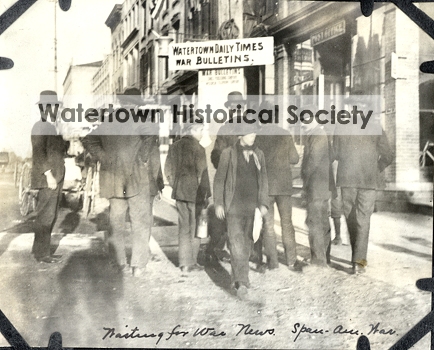
1898, Spanish-American War
The citizenry not occupied with
planning the next Memorial Day observance were caught up in the excitement of the new war
with Spain. Never, it seemed were the people so eager to have a war; so
eager to send troops away to the staging areas for the
invasion of Cuba. One group rigged up a rowboat to look like a
US-Man-of-War, complete with a cannon and high-flying flag. It was anchored at
the Hartig brewery. It was the center of attention
for some days. Colonel Soliday purchased a fine
saddle horse to carry him into battle. Various groups were formed to let it be
known, in some way, that they supported the troops.
Alderman Brusenbach,
however, saw clearly what had to be done on the home front and introduced to
the city council a resolution which said, in part. "the time has arrived when
at least that portion of said Main street which extends from Main street bridge
to the west line of Seventh street aught to be paved
with good brick pavement, Therefore: Resolved, that the board of public works
is hereby ordered to view the premises abutting and fronting on the portion of
Main street....to determine the damages and benefits which may accrue to each
parcel of real estate for any change or alterations made necessary for much
work..."
Alderman Brusenbach's
resolution seemed to be the catalyst for the thinking of the council. Suddenly
it became a question not of should Main Street be paved, but when it was to be
done and what material was to be used. The choice of material was not large.
Stone blocks were long-lasting but noisy and the cause of much wear on
vehicles; wood block set in tar were quiet but not long-lasting; water-bound
macadam was dusty and hard to keep clean; asphalt, which was then in its
infancy, was noiseless and easy to clean, but was not suitable for heavy
traffic. Balancing the longevity of the material with its initial cost, brick
soon became the material of choice in the minds of the council and the
newspapers, which, in turn, had great influence over the thinking of the
populace.
The council meeting the middle of
June, 1898, was concerned principally with the paving of Main Street. The one
real hitch to the paving proposed was the condition of the sewer in that street
there being a question of whether it lay sufficiently deep to furnish proper
drainage for the cellars of the properties abutting and fronting on Main
Street. The council was in general agreement that, before any paving was
commenced, all underground improvements were to be put in permanent shape.
Alderman Brusenback,
in his report of a survey taken of the property owners involved, reported there
was an almost unanimous sentiment for the paving, but one-fourth of them were
of the opinion that the existing sewer was not deep enough to provide the
required drainage for their cellars and they felt strongly that the condition
should be rectified before any steps were taken. The meeting adjourned with the
passing of a resolution directing the city engineer to prepare accurate figures
in regard to the basements complained of, and to present those figures to the
property owners involved, asking them if they would prefer to conform their
basements to the sewer, or whether they would demand the sewer be laid deeper.
The city engineer did as he was
instructed and the next city council meeting began on an optimistic note. All
necessary actions regarding the preliminary preparation for paving was
introduced and unanimously passed; but when the report of the committee on
sewerage and streets and bridges came up for consideration, the report which
recommended the adoption of Alderman Brusenbach's
proposition to proceed with plans for paving the street, it failed to pass,
four aldermen voting against its adoption. This came about, according to Norris
of the Republican, as a result of
jealousy on the part of one alderman, Mr. Mayer, who, as chairman of the
committee on streets and bridges, considered himself the logical head of the
joint streets and bridges and the sewerage committees, but, being opposed by
the chairman of the latter, he refused to sign the report and when the final
vote came up, three other aldermen refused to support the resolution, at least
until the next meeting, although Alderman Brusenbach
stated that he would be willing to relinquish all honors, such as being
considered the head of the joint committee, if only harmonious action would
result. The meeting adjourned with the prospect of paving Main Street some time in the near future dashed and a feeling of defeat
permeating Watertown. The Watertown
Republican called for an effort to get the objecting alderman to see the
error of their ways.
Two weeks later, at the July 5
meeting, Alderman Mayer read a communication stating his position on the paving
question and introducing a motion calling for a reconsideration of the report
of the joint committees on sewerage and streets and bridges regarding the
paving of Main Street from the bridge to Fifth Street. The motion passed and
with it a resolution providing for the board of public works to establish the
grade of the street, to assess the damages and benefits falling to property
owners, to furnish plans and specifications for paving, etc.
Now that the actual paving seemed
to be assured, the paving material itself became a popular topic of discussion.
At the first August council meeting, a petition signed by forty-three property
owners was presented. In it the council was asked to choose macadam over brick
as paving material as the former was not only cheaper, but the city already
possessed the machinery to construct such a street. The petition was referred
to the board of public works and the committee on streets and bridges which
group scheduled a hearing for August 13 when property owners affected by the
proposed paving were to be given an opportunity to present their views on the
subject.
Brick Chosen for Main St
In the meantime, editor Norris
editorialized in favor of vitrified brick pointing out repeatedly that although
macadam was initially cheaper than brick, in the end that is not necessarily
true. One very convincing piece of propaganda offered was a letter from a
former Watertown resident now living in Michigan. He recounted how in Ann
Arbor, five blocks of their main thoroughfare had been macadamized in 1896 and
was, in 1897, an excellent street but by the spring of 1898 it presented the
same appearance that Fifth Street in Watertown does after a week of rain.
At the August 16 meeting, the
city councilmen voted 12 to 1 for vitrified brick, the one councilman opposing
it on a technicality. It was expected that the paving would now be done
"before frost sets in". But that was a rather ambitious expectation.
There was much to be done before paving could start. It was decided to put
everything in order first before the frost set in; this meant all water surface
pipes, lateral sewers, gas mains etc. were to be laid at once and the ground
given a chance to settle over winter. To enlarge the area to be paved from just
the portion of Main Street between the bridge and the west line of Seventh
Street, to all those portions of Main Street lying between College Avenue and
Montgomery Street.
Bids for the paving work were
called for but only two were received by September 21; one from a Racine
contractor and one from Davenport, Iowa. Although there was a difference of
fourteen cents per square yard for the paving and five cents per foot for the
paving paraphernalia, the council found the bids unacceptable primarily because
neither bid was submitted with a contract as required in the city charter.
__________________________________________
1853 AN ORDINANCE In
relation to working Streets and Highways
05 21 1853
The Mayor, and City
Council, of the City of Watertown, do ordain as follows:
Section 1. All male inhabitants of the City of Watertown,
above the age of twenty-one years and under the age fifty years, persons exempt
by law excepted, shall work public streets and highways, two days in each year,
or in lieu thereof, shall pay to the Street Commissioner of the ward in which
he shall reside, the sum of One Dollar, and it shall be the duty of the Street
Commissioner in their respective wards to enroll the names of all such persons,
and cause them to perform such labor, or pay the said sum of one dollar, in
lieu thereof, agreeably to the provisions of this Ordinance.
Sec 2. Each person made liable to work by this
ordinance, who shall fail to attend in person or by satisfactory substitute, at
the time and place appointed, with the required tool or instrument, or pay to
the Street Commissioner the sum of one dollar in lieu thereof having had
twenty-four hours notice, or having attended, shall
spend his time in idleness or disobey the orders of the Street Commissioner,
shall forfeit and pay the sum of two dollars, for each such delinquency,
together with the costs of suit.
Sec. 3. The Street Commissioners shall be accountable
respectively, for the sums of money received by them as aforesaid and shall,
expend the same within the limits of each ward respectively, in which the same
shall have been collected, and in all suits brought under this ordinance, they
shall be competent witnesses.
Sec. 4. When the Street Commissioner has not an
opportunity of giving personal notice the time and place allotted for such
work, a written notice thereof left at the dwelling house or usual place of
residence of the party, shall be deemed sufficient notice.
Sec. 5. Every person who shall, at the request of the
Street Commissioner, furnish a plow, scraper, wagon or cart, a pair of horses
or oxen, to be used in working said street, shall receive for every day the
same are used as aforesaid, a credit of one half day, for such plow, scraper,
wagon or cart; and for every pair of horses or oxen, one day's work.
Sec. 6. There shall be one Street Commissioner in
each ward, whose duty it shall be to report to the City Council at their first
meeting in November, of each year, and oftener if required, a true account on
oath of the amount of labor by him bestowed, the names of all persons liable to
perform highway labor in his ward, and the names of all persons by him employed
in repairing the streets, alleys and highways, of the city and also an account
of the money expended in the repair of such streets and roads and the manner in
which the same has been expended, and to whom paid. It shall be the duty of the Street
Commissioner to report to the City Council, every infraction of any ordinance
relating to streets or nuisances which shall come to their knowledge, and they
shall perform such other duties as may be required of them by the City Council
not inconsistent with the laws of the State.
Sec. 7. No Street Commissioner shall, directly or
indirectly, be personally interested in any work done, or in any contract for
any materials furnished for any street, alley or highway in said city.
Sec. 8. All persons required to perform any work or
labor, on the streets, alleys and highways of said city, by virtue of this
ordinance, shall perform such labor in the ward in which he shall reside,
unless otherwise directed by an order of the City Council.
THEODORE PRENTISS,
Mayor.
Attest—J. G. PEASE
Clerk
1864
04 07 ACCUMULATION
OF MUD, DIRT AND FILTH
Main Street.
The accumulation of mud, dirt and filth on Main Street made during the
past winter ought to be removed immediately.
Both health and cleanliness would be promoted by carrying out this
suggestion, besides greatly improving the appearance of our chief thoroughfare,
which usually presents a scene of busy activity. We believe all our citizens would be glad to
see the city authorities act promptly in this matter and cause the necessary
work to be done immediately and thus put Main Street in something like a decent
and respectable condition. WD
1898
06 29 STEPS TAKEN FOR BRICKING OF MAIN ST.
MATTER OF PAVING RESURRECTED
From the present indications, we
are pleased to state, the matter of paving Main Street will be resurrected at
the next meeting of the common council and a favorable measure passed. It is very probable that one of the four members
who voted against Alderman Brusenbach's report at the
last meeting will move for a reconsideration of the vote, and it is thought
that sufficient votes can be secured favorable to the proposition to start the
ball rolling.
There is hardly a doubt but that
every citizen having the true interests of our city at heart will gladly
welcome such action. The time is
certainly right for street improvement, and as long as most of the property
owners on Main Street are willing to pay for the work and anxious to have it
done, a start should be made this season.
We are not urging unnecessary haste in this matter, but we take it that
everybody has had plenty of time to fully consider and ponder it. If the work is to be done, we of course want
it done properly, in the best manner possible; but we have confidence that the
Board of Public Works will attend to that phase of the subject.
07 06 PAVING MAIN STREET FROM
BRIDGE TO FIFTH
All members of the common council
were present at last night’s meeting except Ald. Jacobi. . . . . Upon motion of Ald. Mayer the vote taken at
the last preceding meeting upon the report of the Joint Committees on Sewerage
and Streets and Bridges, regarding the matter of paving Main Street from the bridge
to Fifth Street, was reconsidered. The
report and accompanying resolution, which provides for the Board of Public
Works to establish the grade of said street, to assess the damages and benefits
falling to property owners, to furnish plans and specifications for paving,
etc., was then passed by a unanimous vote.
WR
07 06 MORE ON PAVING MAIN STREET
[same date] As predicted in our last issue, the measure
for paving Main Street was passed by the common council last evening. There was not a dissenting vote. We are pleased to note this unanimous
expression for improvement and advancement, and the change of position of the
four aldermen who previously voted against the proposition, will be commended
on all sides. Ald. Mayer came forward
with proper spirit and explained his course in the matter. Ald. Mayor's statement follows . . . . WR
08 03 VITRIFIED BRICK vs. MACADAM
STREET
It will be noticed by last
night's proceedings of the common council, forty-three property holders have
signed a remonstrance against improving Main Street with a vitrified brick
pavement. It is held that macadam will
answer every demand and be considerably cheaper. The petitioners ask that, before the work of
paving is started, comparative estimates of brick and macadam be
furnished. In some quarters it is held that
this move was started by persons who are against any sort of paving, but the
petitioners will present, on the other hand, that they favor judicious street
improvement . . . Vitrified brick is a pavement guaranteed to last for years,
when properly laid. Nearly all cities
doing permanent street work where asphalt is not employed are utilizing brick,
and in every instance it has proved a success . . . When the comparative worth of macadam and
brick is considered, the difference in the cost is very slight.
08 03 CHANGED
HIS MIND
A gentleman who signed the petition presented to the
city council Tuesday evening, advocating macadam pavement for Main street,
stated to a TIMES reporter this afternoon that he would withdraw his name from
the paper and knew of others who wished to do the same. He said that when signing the paper he did so
on the spur of the moment, but now states that he is not in favor of macadam on
Main Street at any price.
Street Paving. The
city council should not allow persons who happen to own property on a street
which it is intended to pave to have all the say as
to what kind of paving should be used.
It must be remembered that the city stands a portion of the expense and
the whole city is directly interested as well as the property owners. There has been plenty of testimony appearing
in the press of this city with regard to the excellence of brick paving and the
columns of the Times are open to anyone who can show any reason why macadam
paving should be used. If the owners of
property on Main Street who desire macadam paving have reasons for it, let them
state them. They failed to do so in the petition to the council. WR
08 10 BRICK
COMPARED TO MACADAM
The Board of
Public Works and Committee on Streets and Bridges, to whom was referred the
petition of forty-three Main Street property owners presented at the last
meeting of the common council, will hold a
meeting in the city clerk's office on Friday evening next to act upon said
petition and to discuss the matter of paving Main Street. At this meeting all property owners affected
by the proposed paving will be given an opportunity to present their views on
the subject.
We are
pleased to note that the advocates of vitrified brick paving are growing in
number day by day. Macadam is all right
in its place, but for Main Street it is not substantial enough. While the first coat of macadam is considerably
less than that of brick, it will not be so in the end. Brick is guaranteed to stand wear and tear
for a score of years, while it is an established fact that macadam needs
constant repair from year to year on all streets where there is much
traffic. We adhere to the opinion that
our Main Street property owners will in the end be well satisfied with brick
pavement. WR
08 17 MAIN
STREET TO BE PAVED WITH BRICK
Main Street,
from the bridge to Fifth Street, is to be paved with vitrified brick. That decision was arrived at last evening at
the regular meeting of the common council, when a resolution covering all the
requirements was passed by a vote of 12 to 1.
The work will be commenced as soon as is allowed by the provisions of
the charter, and it is expected it will be complete before frost sets in. Thirteen members of the council were present
at the meeting, Alderman Wertheimer being the absentee. The only dissenting vote was that of Alderman
Dunigan, who objected to the proposition because he
considers that the cost of paving the street intersections should be borne by
the ward funds instead of by the city general fund. WR
09 21 The
paving of Main Street will very likely be delayed until next spring. The bids received Saturday were not
satisfactory, and as there is hardly time before cold weather comes in which to
secure new ones, the matter must necessarily be laid over. At last night's meeting of the common council
the board of public works gave a report which fully explains the situation [one
reason was that neither proposal was accompanied by a contract, as required by
Chapter 159 of the city charter.
Same At 4 o'clock
Saturday afternoon the proposals received for paving Main Street with brick
were opened by the board of public works.
There were only two, as follows: [1] Cape & Son, Racine Excavation,
30 cents per yard; filling, 30 cents per yard; curbing per lineal foot, 69
cents; resetting curb, 10 cents; protection curb, 30 cents per foot; Purington
brick paving, $1.80 per square yard; Clinton brick paving, $1.82 per square
yard; iron bridges for gutters, 90 cents per foot. [2] P.T. Walsh & Co., Davenport, la. Excavating, 35 cents per yard; filling , 70
cents per yard; curbing, 65 cents per yard; resetting curbing, 10 cents;
protection curbing, 40 cents per foot; Purington brick paving, $1.66 per square
yard; iron bridges for gutters, 80 cents per foot. The board adjourned until 4 P.M. yesterday,
when its report on the matter was formulated.
WR
10 05 At
last evening's meeting of the common council, steps were taken and measures enacted looking to the paving with
brick of all those portions of Main Street and West Main Street lying between
College Avenue and Montgomery Street.
The intention of the measures is to put everything in order this fall so
that the paving can be done early in the spring [1899]. All water surface pipes, lateral sewers, gas
mains, etc., are to be laid at once and the ground given a chance to settle
over winter. It is thought that with the
enlarged area for paving thus provided, advantageous proposals for the work may
be received. WR
Purinton brick made at Galesburg, Ill, used
Now that the decision had been
made to delay the paving until after winter, preparation work began in earnest.
As quickly as possible, all
water services, pipes and lateral sewers and gas mains were laid. Already in midsummer, the Watertown Gas
Company had begun recaulking joints and making the
necessary repairs to the gas main which had been put down forty years previously.
They were pleased to find the cast iron pipe in very good condition which
increased the general confidence in that material. Under the watchful eye of
Inspector Albert Krueger of the board of Public Works, the trenches dug by the
Gas Company, plumbers and drain-layers were expertly refilled and tamped so as
to leave no "clumsy and unsightly ridge".
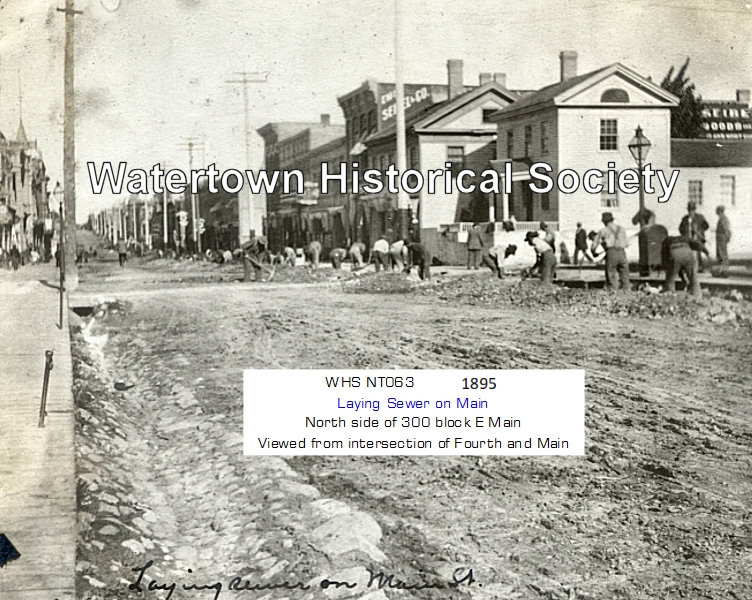
The progress made during the
ensuing months seemed almost mundane to the average citizen. Important things
had to be done however unimportant they may have seemed to be; of primary
importance was the establishment of a curb line on West Main Street at 15 feet
from the boundary line between the street and the lots abutting thereon. The
width of the carriageway on West Main was established at fifty feet between the
curb lines.
In February, 1899, an ordinance
was passed establishing a permanent grade from the east end of Main Street to
the east curb line of Ninth Street. Another ordinance established a permanent
grade from the west end of Main Street bridge to the west curb line of North
Montgomery.
Once cold weather set in, actual
physical work on the street ceased; but preparations for the paving, which was
now viewed as a project sure to be carried out, continued. There was some
controversy about a new sidewalk which had been laid in front of Eberle's Drug
Store being four inches lower than connecting sidewalks, but it was determined
that it was at proper grade level and would match perfectly when all sidewalks
were replaced at proper grade level. The property owners of the city continued
to prod the council with petitions, asking for streets, such as Washington, be
macadamized. The newspapers continued to keep an eye on road and street
construction around the country. They were especially pleased with the report
of a "petroleum-finished" highway near Fort Worth, Texas. This
highway, treated with a top dressing of crude petroleum, was reported to be
completely dust-free during five months of drouth (sic) and when the heavy
rains finally did come, the highway was dry and pleasant to travel on while
other roads and streets became impassable with mud.
The business of paving Main
Street seemed to be in hiatus through the first one-third of 1899, but, in
anticipation of the work which certainly would be begin soon, Mr. Moore, of the
Gazette warned that when the city
council did get around to letting contracts, it should insist that fair wages
be paid to all involved in the work. "It would be well to insert a minimum
price to be paid labor in the contract".
Finally the city council did
advertise for bids on the paving project, receiving, this time, quite a number
of replies. On May 23, 1899, the bids were opened and considered. After two
days of consideration, the contract was let to L. Schoenlaub
of Fond du Lac who pledged to do the entire paving job for $28,502.90 using Purinton
brick made at Galesburg, Ill. Work was to begin as soon as possible.
And so final preparations began.
The old sewer between First Street and the bridge was replaced as it was feared
a cave-in might eventually occur damaging the new pavement. Ten days after the
contract was awarded, L. Schoenlaub was in town
getting things in order for paving, which included unloading the paving bricks
which had come in by rail.
Within one week, work was begun
on laying a bed of Richwood quarry limestone on which was to be laid a bed of
concrete topped by bricks.
Cross
Reference:
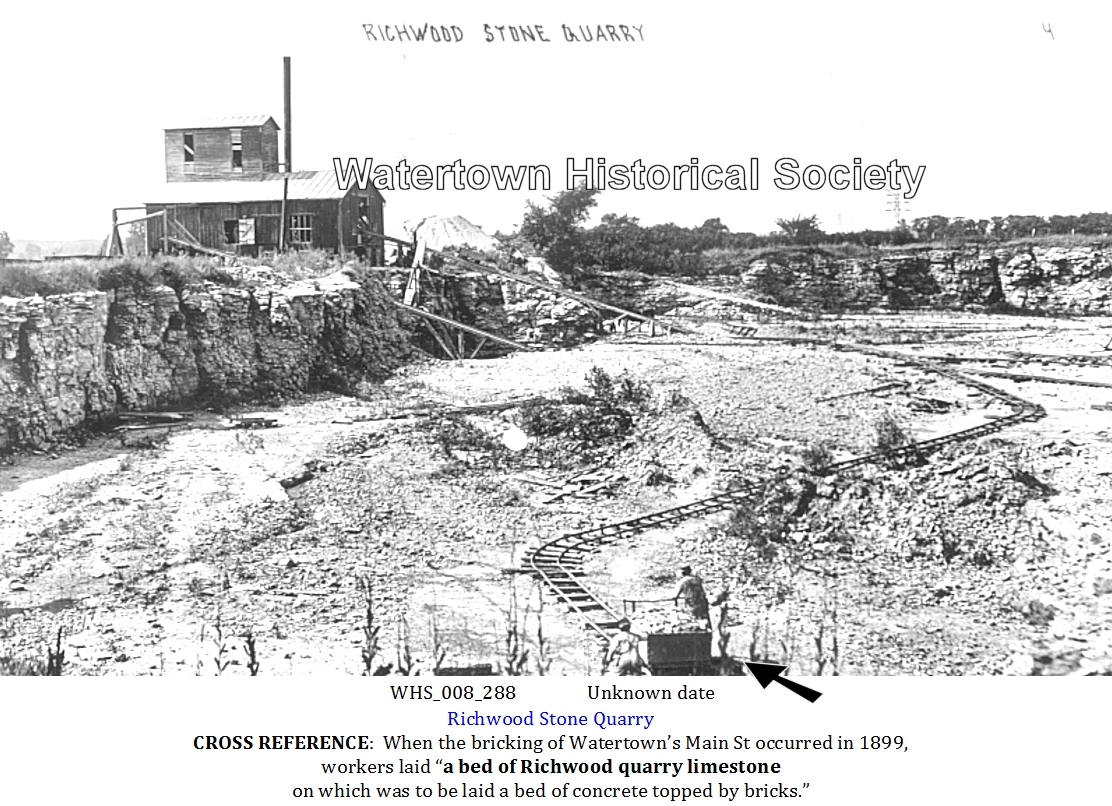 Richwood stone quarry, Eward
Racek
Richwood stone quarry, Eward
Racek
Although Mr. Schoenlaub
had little trouble procuring laborers, work went slowly, at first, due to the
extremely hard upper crust found on the existing street. There was no dearth of
sidewalk superintendents. In a short time contractor Schoenlaub
complained that people were in the habit of chipping bricks to test their
quality. That made the brick unsuitable for usage. Although the cost of each
brick was only 1 1/2 cents, it could amount to a considerable sum before the
job was completed. Prosecution was promised if the practice continued.
By July 4, concrete for the
foundation of the pavement had been received and in a few more days the actual
laying of the bricks began.
Starting at College Avenue and
working west, work progressed smoothly and rapidly causing the contractor to
put out a call for fifty more men. By July 25 the concrete bed had been laid to
Sixth Street and the first block of bricks had been put down. The entire street
was, by necessity, completely torn up and the usual rains brought on loud
complaints about the resulting mud and the flooding cellars, due, the property
owners insisted, to the shallowness of the main sewer line. The city engineer
was of the opinion it was due to the absence of street walls which allowed the
entrance of surface water.
The paving work was inspected
frequently by officials from outlying areas which intended to do similar
paving. The local experts among the
omnipresent sidewalk superintendents were, at times, dissatisfied with the work
being done and the material being used. Their biggest complaint was that the stone
used in the concrete bed was not crushed sufficiently fine, not enough cement
was being used, and the mixing process was not as thorough as it should have
been -- all of which went to make a loose bed, not compact enough to keep out
the frost, the self-appointed exerts said. Those in charge concluded the
materials were being properly prepared and used. And work continued.
While the paving was being done,
the city council prepared two ordinances regarding the newly paved Main Street.
One provided that a traction engine of any kind could be driven, propelled, or
hauled along any street paved with brick "provided that when it is
absolutely necessary to cross any such street with such traction engine, the
person or persons in charge thereof shall place on the pavement planks not less
than two inches thick, and keep them under the wheels of such engine while
crossing such street.
The second ordinance provided
that no person would be allowed to place, keep or maintain any hitching post
for hitching horses or other animals in any part of any street paved with
brick, nor on any sidewalk of such street, and there is to be no ring, staple
or other devise for hitching horses or any other animal to any telephone,
telegraph or electric light poles standing along any street paved with brick.
The paving of East Main Street
was completed Saturday, September 9. Then it was necessary to interrupt the
work for a week to allow Watertown to use the streets for the Harvest Jubilee
and Carnival which was expected to draw the largest crowd ever brought together
in an inland city in Wisconsin. The grand parade on September 13, the first
parade on the new brick street, was a grand success. Watertown took great pride
in showing off her showcase street to visitors.
Once the carnival was over, the
contractor had his men back at work in an effort to complete the work on the
west end of Main Street just as soon as possible. But work didn't progress as
rapidly as he wished. First there came two weeks of rainy weather. When that cleared
up and all indications were that the weather would hold good for two or three
weeks, it became difficult to get crushed stone owing to the scarcity of cars.
Meanwhile, the time had come to
make the first payment of $2,179.75 to the contractor which was eventually
done, but not before the city clerk had refused to sign the report by the Board
of Public Works, maintaining that no payment should be made until the work had
been inspected by the city. The payment, however, was made and the work did go on,
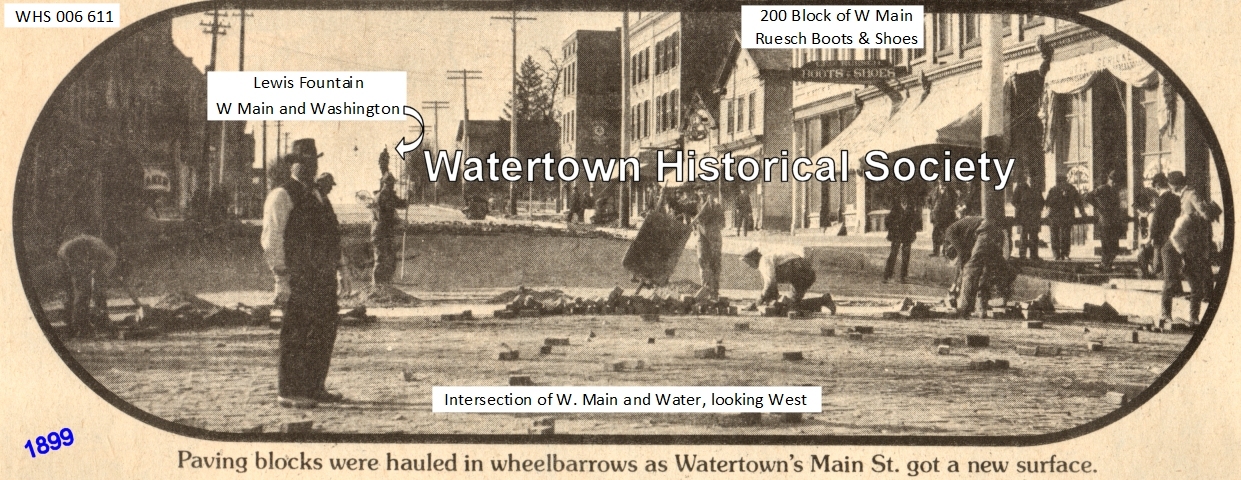
and the paving was finally finished on November 8, 1899. The Watertown Republican reported:
Last Wednesday
afternoon (Nov 8) marked the completion of Watertown's first job of street
paving, the final brick being laid in West Main Street just before 5 o'clock.
It was a gilded brick that was used to fill the last gap and after it was in
place an impromptu celebration on a small scale was had. An interested crowd of
spectators was assembled and ex-Mayor Fred Kusel gave
an appropriate address, after which there was music and general rejoicing.
The pavement,
extending on Main and West Main streets from College Avenue to Montgomery
Street, is of Galesburg vitrified brick on a six-inch concrete bed. The sides
are bound with stone curbing and the pavement is so constructed as to afford
drainage. The entire job appears to be a very creditable one and the
contractor, Louis Schoenlaub, has every reason to
feel proud of the work. There is no doubt that the thoroughfare as now
completed is one of the most substantial road beds ever build in the state.
Click to enlarge
Almost as an afterthought,
Alderman Mayer submitted a proposition to the common council to have the
intersections of West Main and Montgomery streets paved at once; but it was
deemed too late in the season so the matter was deferred until spring.
Also postponed until spring was
the purchase of a street sweeper which many felt was now necessary to keep
their new street in the finest condition.
Two weeks after the paving was
completed, the property owners along Main and West Main streets were surprised
to learn that, rather than being able to pay their assessment in five yearly installments,
the cost of the work assessed to them must be paid at once or be placed on the
tax roles and collected by the city treasurer with
the other taxes. It seemed the common council had neglected to take the
necessary steps to make deferred payments possible and now it was too late to
devise any means for the relief of the property owners. Needless to say, many
property owners were most unhappy with the situation.
The December 5th meeting of the
common council finalized the paving of Main Street when they agreed to pay
contractor Schoenlaub the final amount due him minus
$40.00 for the city water he had used.
With Schoenlaub's presentation of a $3,000
indemnity bond which guaranteed that all necessary repairs to the street
pavement should be made for a period of five years, the paving of Main Street,
which had been over fifty years in coming, was finally done.
1899
PAVING OF
MAIN STREET WITH BRICK STREET PAVERS
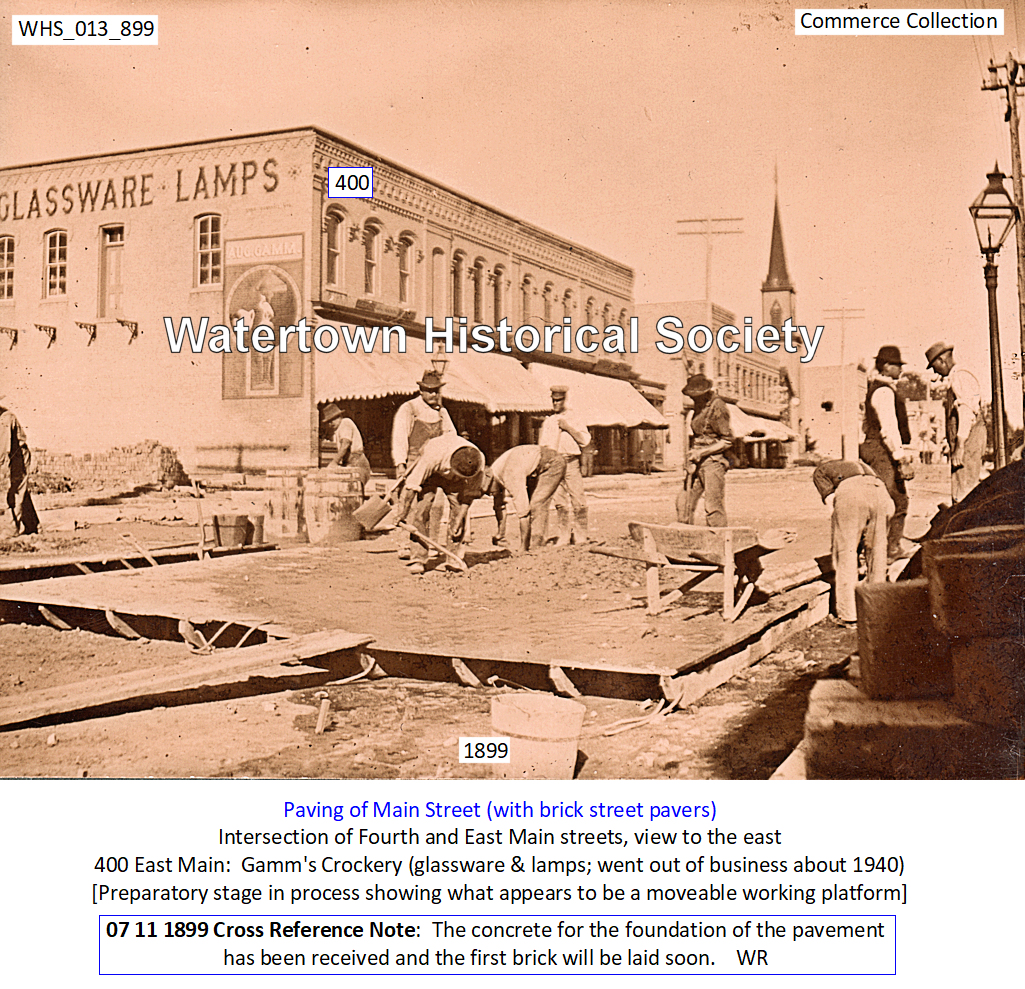
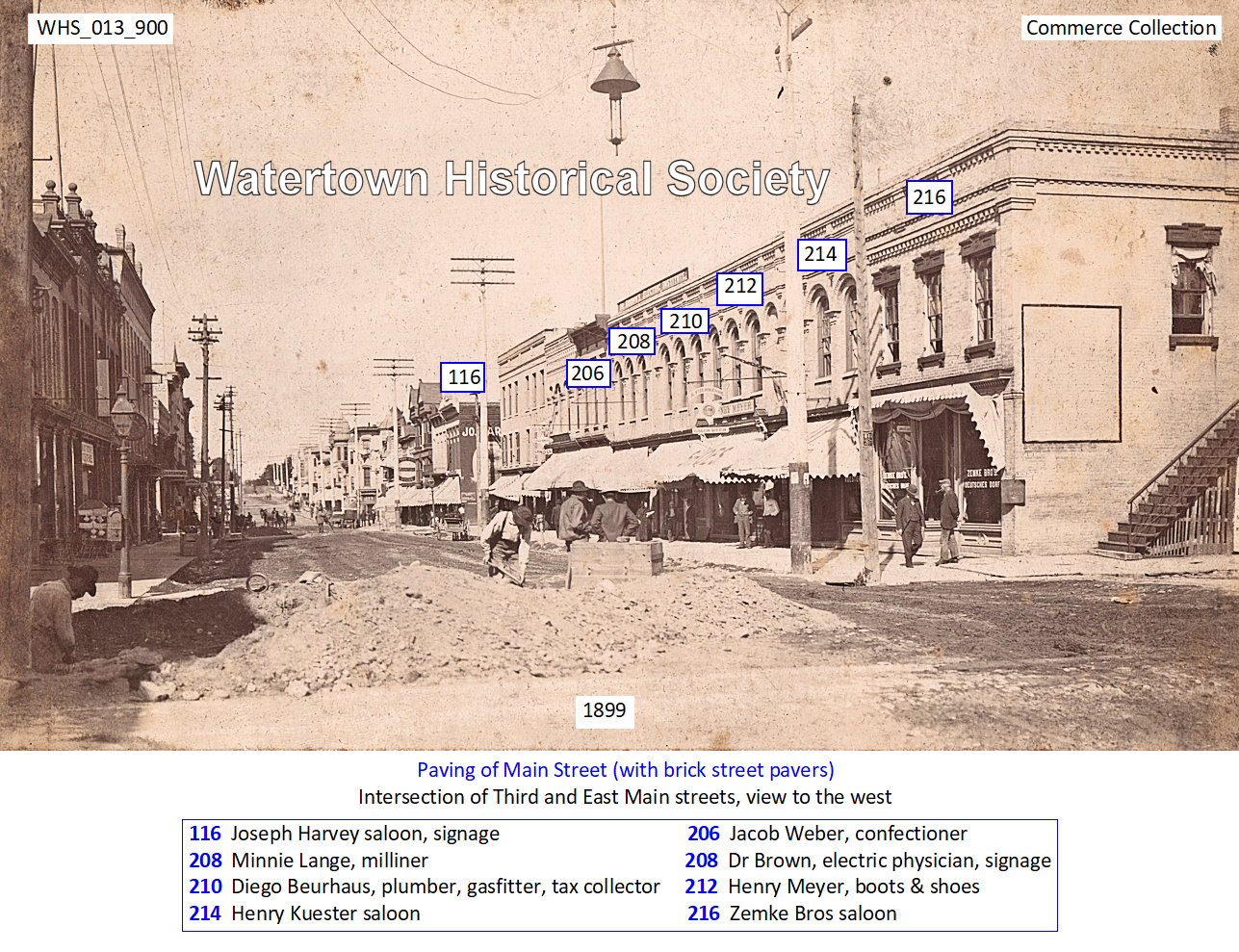
07 11 CONCRETE
FOUNDATION FOR BRICKING OF STREET
The concrete for the
foundation of the pavement has been received and the first brick will be laid
soon. Street Commissioner McLaughlin and
his men are fixing up some of the side streets in good shape with the material
taken from Main Street. WR
08 08 CEMENT FOR FOUNDATION CRITICIZED
The criticism is offered by some of our citizens who are closely
watching the street paving that the stone used in the concrete bed is not
crushed sufficiently fine, that not enough cement is used and that the mixing
process is not as thorough as it should be.
WR
08 22 PRESERVATION OF BRICKED STREETS
The Common Council of the City of Watertown do ordain as follows:
Section 1. No person shall drive,
propel or haul any traction engine along or upon any street in the city of
Watertown which is paved with brick, provided that when it is absolutely
necessary to cross any such street with such traction engine the person or
persons in charge thereof shall place on the pavement planks not less than
inches thick, and keep them under the wheels of such engine while crossing such
street
Section 2. No person shall place,
keep or maintain any hitching post or other permanent structure for hitching
horses or other animals in any part of any street in the city of Watertown
which is paved with bricks, or in any part of any sidewalk on such street, and
no person shall keep or maintain any ring, staple or other device for hitching
horse, or other animals, on any telephone, telegraph or electric light poles
standing in any street in the city of Watertown which is paved with brick. WR
09 26 PRIDE TAKEN IN BRICKED STREETS
Now that the hard fall rains have set in it affords untold satisfaction
to gaze upon the firm brick pavement which crowns the roadbed of Main Street
and turns the water so nicely towards the curbing and thence to the river. Memory reverts to the former days when the
same roadbed was a sea of mud and slush through which we had to wade and then
forthwith proceed to a boot shiner. What
a difference between then and now! It
must surely be a person devoid of all sense of things that are good and proper
who condones the construction of a brick pavement. It surely makes a splendid thoroughfare and
when the work on West Main Street is completed no city hereabouts can boast of
a finer improvement. Realizing all this,
the city authorities should share in the general pride and see that the
pavement is kept in a proper state of cleanliness. Purchase a street sweeper and set it in
operation at least once a week. Unless
reasonably attended the pavement will soon cease to be "a thing of
beauty." WR
1901
06 28 COMMISSIONER OF PUBLIC
HEALTH TO THE CITY COUNCIL
West Main street from Montgomery to Northwestern depot
should be cleaned as soon as we have a rainy time to soak it well. The surface is filled with an admixture of
manure and other matter. It certainly must
be filled with germs of all kinds.
There are several buildings used as factories and
others occupied by families and offices on second and third stories, which are
not supplied with proper fire escapes.
Owners of such please to rectify before accidents occur.
There are several old piles of manure scattered over
the city. Householders please to remove
them at once.
I must recommend the construction of a proper sewer in
Third Street of that portion not yet constructed. The present sewer is inadequate and faulty.
Some of the cellars on the west side on said Third street are lower than the
sewers; at times during rainy weather the cellars are flooded with sewer water,
causing disease in such families without a doubt. ... There is a condition of
things on Market street, between Eighth and Ninth streets, that ought to be
remedied. Whenever we have rain the depression between aforesaid streets will
fill up with water, having washed away all filth and germs before its course
along to that spot and there remain stagnant sometimes for several weeks. The smell is strong and unwholesome to those
living in proximity to such stagnant pools.
I hope the feminine portion of our population will
pardon me, when I condemn the practice of wearing the long dress skirts when
promenading the streets. A German
scientist of world wide reputation recently analyzed a portion of the dust collected in his wives dress and found
the germs increased over 100 per cent. WG

History of Watertown,
Wisconsin