website watertownhistory.org
ebook History of Watertown, Wisconsin
Old Municipal Bathing Beach (Boughton St)
Old Watertown Swimming Pool
Opened on June 14, 1942
New Watertown Aquatic Center
1866 OLD SWIMMING HOLE CALLED LAKE OSCALO
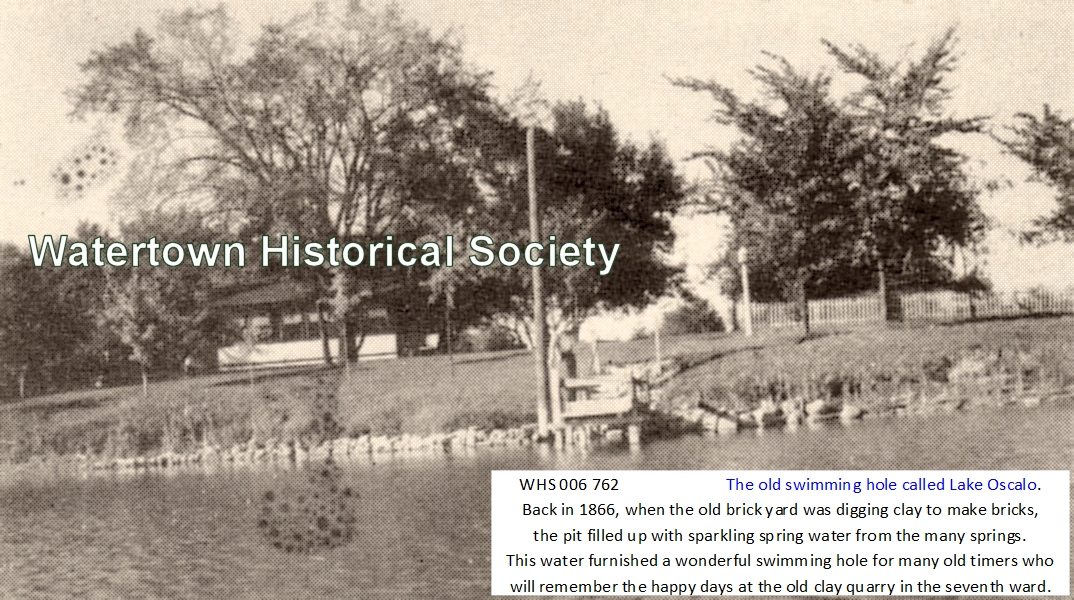

The old swimming hole
called Lake Oscalo. Back in 1866, when
the old brick yard was digging clay to make bricks, the pit filled up with
sparkling spring water from the many springs.
This water furnished a wonderful swimming hole for many old timers who
will remember the happy days at the old clay quarry in the seventh ward. In 1936 Mr.
and Mrs. Oscar E. Carlson purchased the brick yard property and made this
portion of their land a beauty spot for many of their friends who enjoy
swimming, fishing, and picnicking. Lake Oscalo was named
after Oscar and Loda Carlson and was registered with the State Conservation
Dept under that name. Today Lake
Victoria.
c.1890
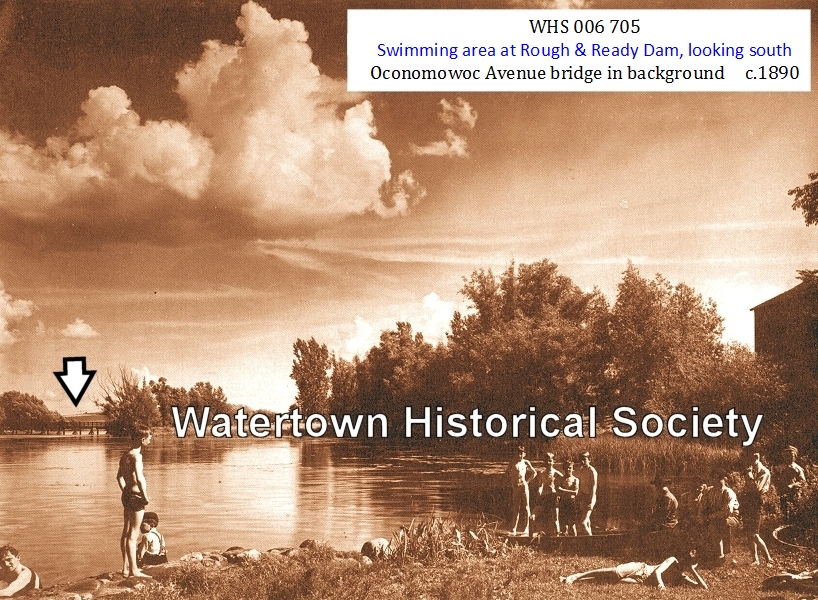
OLD SWIMMING HOLE, near south end of Tivoli Island,
Oconomowoc Ave bridge in distance
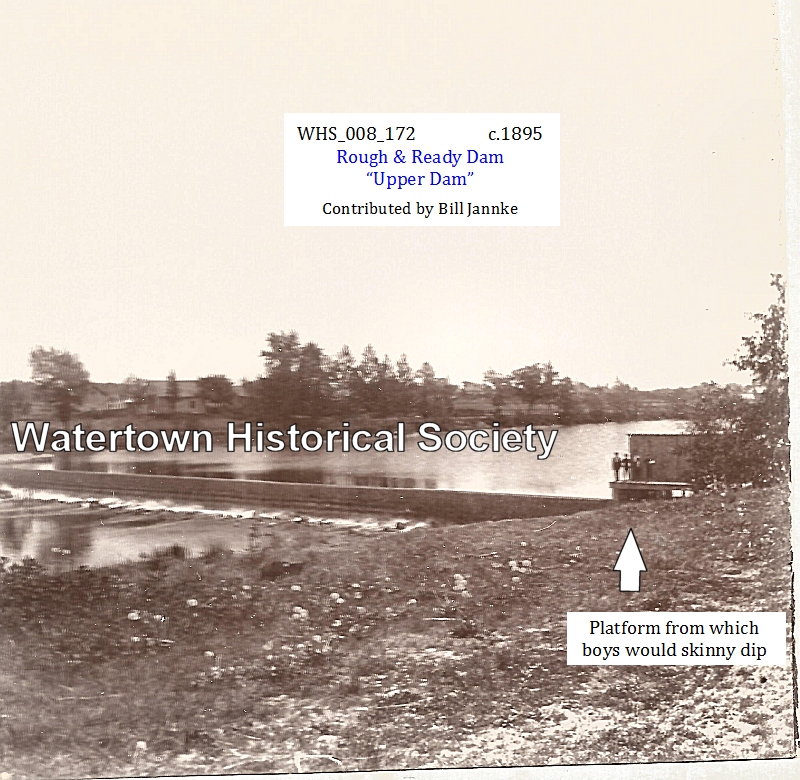
c.1895
SKINNING DIPPING AT THE DAM

1910
05 13 RIVERSIDE PARK
ESTABLISHED; includes bathing beach
Watertown
is to have a new pleasure park. Action along
this line was taken at a meeting of the park commissioners last evening when it
was decided to ask for bids for laying out the same, the bids to be received by
the board up to May 28.
The
proposed park will be known as Riverside park
and will be located on an island in what is now known as Riverside addition,
formerly the S. Kussel property in the Sixth ward. This matter was taken up last year and will
be pushed to completion the present summer by the board of park commissioners.
In
connection with the park it is planned to build a river drive connecting this
pleasure ground with other portions of the city, ending in the Third ward along
the newly platted Crangle addition.
One of
the features of the proposed park will be a rustic bridge connecting the
island with the mainland proper, and a bathing beach with dressing rooms
will also be features -which will appeal to all especially the children. The Watertown News, 13
May 1910
1914
05 21 BATHHOUSE PROPOSED
The matter of a public
bath house to be erected at or near Riverside Park
was discussed, but no action was taken on this matter pending possible action
by the park board, who has the matter in hand and are trying to make the
erection of the bathhouse possible during the present summer. WG
1915
10
07 PUBLIC BATH HOUSE CONTEMPLATED
More Land Purchased for Park Purposes
The Park Board has secured additional land for park purposes, buying of
John Schlueter one half acre of land just across the river from Riverside park,
on which the Park Board contemplate erecting a public bath house and otherwise
improving it. The price paid was
$450. This is a commendable move on the
part of the Park Board, and the city council no doubt will and should endorse
their action. WG
1916
08 01 ALL WATERTOWN SEEK COOL
SPOTS
SUNDAY IS HOTTEST DAY SINCE HEAT WAVE
REACHED THIS CITY
Bathing facilities are nil so
citizen donates use of tent for bathers use
The protracted heat spell reached its climax in Watertown late Sunday
night when the predicted cooler weaker arrived. Shortly before 10 o’clock
Monday morning a brisk northwesterly breeze sprang up. The highest temperature today was 85.
The banks along the river were thronged with bathers. It certainly is a shame and disgrace to the
city of Watertown that adequate bathing facilities are not furnished. The city officials refuse to construct any
bath houses, although a sufficient amount of money was listed in last year’s
budget. Something should be done and
immediately too.
Of course now that the weather has cooled there will not be such a
demand for bathing as there has been.
But another hot spell may arrive and still no bathing facilities.
The old maxim of Washington, “In time of peace prepare for war” could
easily be used by the people of Watertown to read, “In time of cool weather,
prepare for heat.”
It sometimes takes the combined ire of the citizens to bring the
alderman wide awake to the fact that they are neglecting their
constituents. Something should be done
about it at the meeting of the common council tomorrow night.
Things have come to such a pass that a private citizen had to donate the
use of a tent where bathers can undress and dress. This tent is at the corner
of Dewey Avenue and Division streets.
The Watertown
Republican, 01 Aug 1916
08 08 RELIEF IN SIGHT FOR
CITY BATHERS
PARK BOARD NOW HAS LAND UNDER
CONSIDERATION FOR BATH HOUSE
Land Near Riverview Park
Suggested
All
matters at last are under way for the furnishing of bathing facilities for the
people of Watertown. The mayor and common
council have signified their willingness that proper facilities be
furnished. Money has been provided for
the maintenance of such a place. Land
that will not cost the taxpayer a cent is under consideration. This is possible on account of the Fanny P.
Lewis fund. This fund stipulates that
money shall be furnished for the donation of the city of public parks. The selection of this park is up to the park
commission. All that is necessary is
that the city accepts the recommendation of the park board. The city officials then buy this park out of
the Fanny P. Lewis fund.
“The
suggestion offered in The Leader Friday in regard that bath houses be
placed at several points throughout the city is a good one,” said Alderman W.
F. Gruetzmacher today. “It shows that
the people are closely following the agitation of the Leader for bathing
facilities for the city.” However, to
adopt this suggestion would require some time as there is only $500 in the
hands of the park board at the present time.
This money was appropriated some time ago. by the council for bathing
house facilities.
There
is no doubt but that something should be done on the bathing question. Hundreds of persons would make use of this
beach if it were turned into a bathing spot by the city. The Watertown Weekly Reader, 08
Aug 1916
1917
07 11 BATHING PAVILION AND
BEACH TO OPEN AT RIVERSIDE PARK
If it
hadn’t been for a broken rustic bridge in Riverside park the youth of
the community would now be disporting in the water at the bathing pavilion
recently completed -- and have their clothes checked as per civilization -- and
not on a willow bush.
Next
week if the weather permits the new beach at Riverside park will be ready for
swimming purposes. The contractors have
not turned the building over to the city as yet but will in the next few days.
A need
for the building has been felt in the community for a long time and the new
building, which is 40x20, will accommodate 44 people, and will fill the demand
for a number of years to come. The
building contract was let for $1200, but extras will bring it up to $1300.
07
25 NEW BATH HOUSE USED BY MANY PEOPLE
The
recently built municipal bath house near Riverside park is being generously
patronized by the people, especially the young folks. There is no lighting system at present, but
we understand that will be attended to as soon as possible. The addition of a pier would be greatly
appreciated but that will probably come in good time. Many of the adults who would like to take
advantage of the privilege afforded say that the bath house is closed too early
and therefore they have no access to it when changing clothes. The Watertown News, July
25, 1917
1918
08 07 GIRL SAVED FROM DROWNING
Richard
Hoge, 203 North Fourth Street, a clerk in the Farmers & Citizens bank
of Watertown, saved a young lady from death by drowning Monday evening at the
public bathing beach at Division Street bridge.
Miss Stella Salick was one of the bathers and was wearing a pair of
water wings to assist her in keeping afloat while learning to swim. The wings became disarranged in some manner
and she sank, catching hold of two boys near her who were unable to render
assistance. Richard Hoge was nearby and
when the girl came to the surface a second time he grabbed her and she
convulsively clutched him and became unconscious. He broke her hold and caught her by the hair
and swam to shallow water where every assistance was rendered until consciousness
returned. The water at the point where
she sank is eight feet deep.
While probably in this particular
instance life buoys would not have been of much use there is always danger of
accidents and buoys or life preservers should be kept at a convenient point on
the beach so they can be used, or some other means employed to save life. The presence of mind of her rescuer is all
that saved the girl, which might in some cases have resulted in a double
drowning. The Watertown News, 08 07 1918
1920’s MUNICIPAL BATHING BEACH
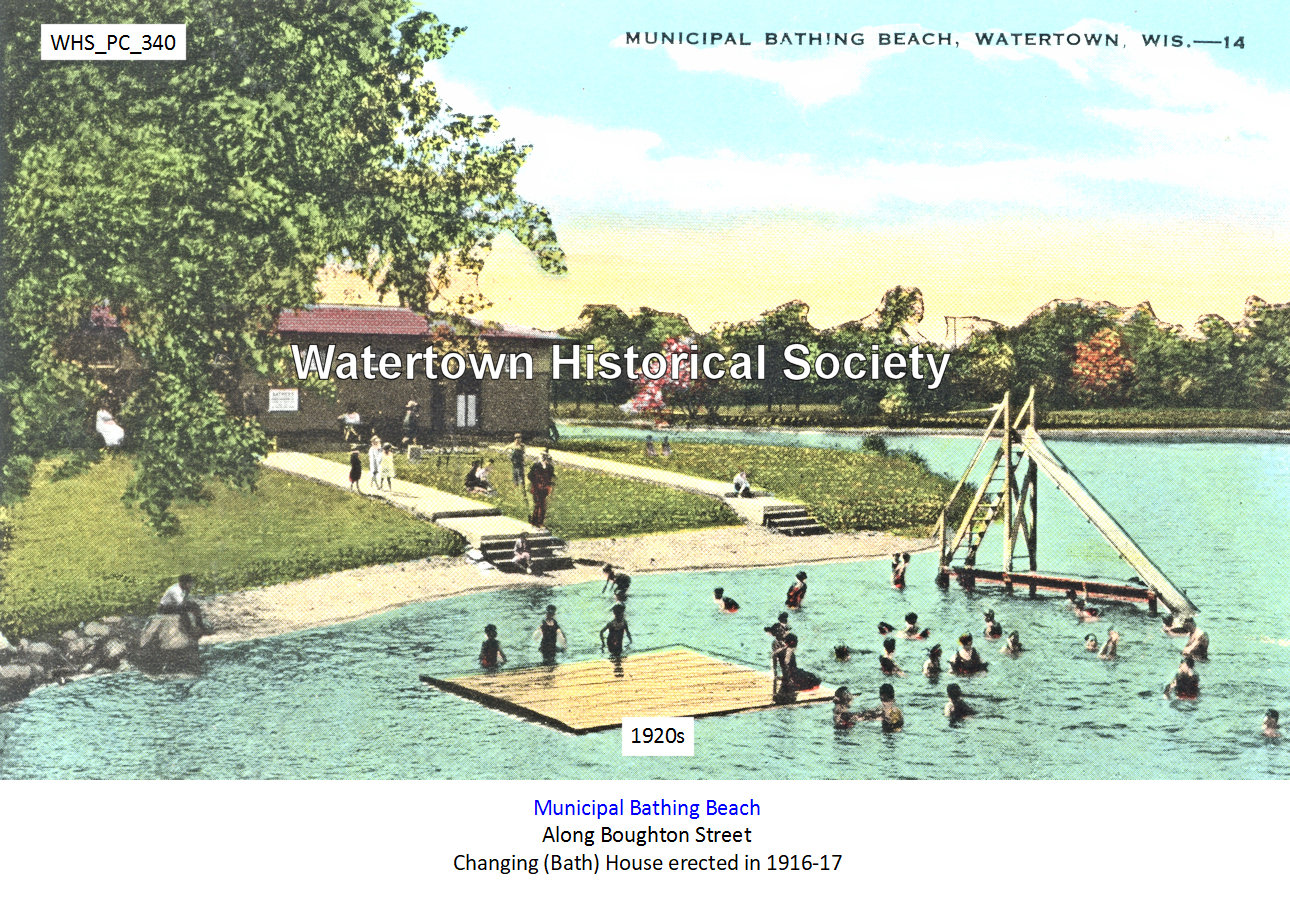
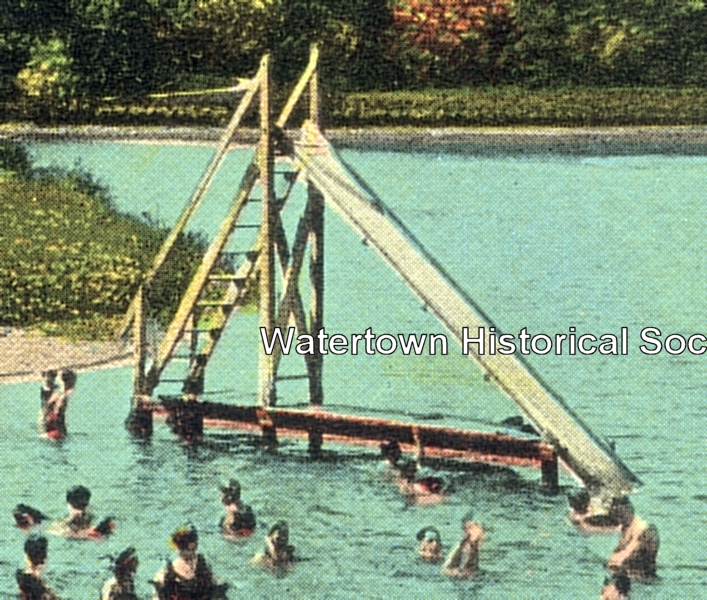
Boughton
St. beach / municipal swimming beach,.
DISTANT VIEW, from Riverside Park
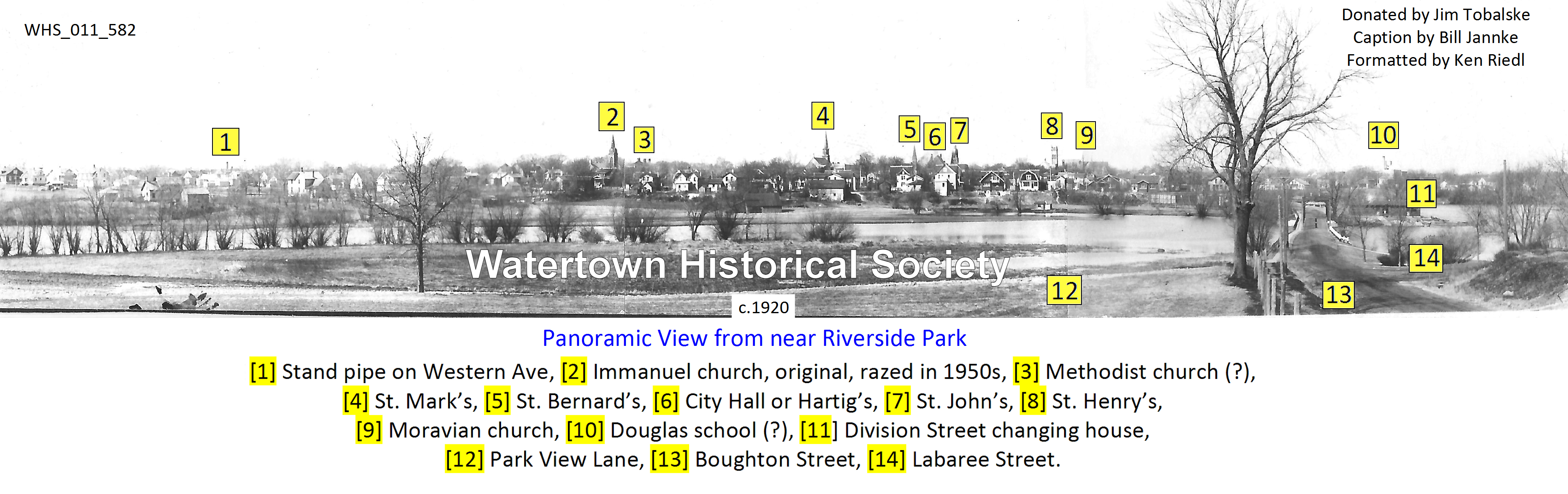
1920’s, late
REPLACE THE BOUGHTON STREET BEACH CONSIDERED
For about 10 years, starting back in the late
1910s there was a lot of agitation for a swimming pool to replace the
Boughton Street beach.
The old swimming hole on Rock river right at
the Division/Boughton Street bridge,
just a few blocks from the current pool setting. Back then, the community became more and more
concerned about swimming in the Rock river and decided a much safer environment
was needed. That's when the push started
for a pool to be constructed through this federal program. In addition to the dangers of swimming in the
river, just about when summer peaked the slow and nonexistent flow of water
caused the state health department ordered the "beach" closed.
1934
09 08 BRICK YARD SWIMMING POOL PROJECT IS BEING DEBATED
The proposal to have the city
purchase the 15-acre
tract at the old brick yard, the pool of which has been used for swimming over
a long period of time, and convert it into a swimming pool and general
recreation grounds is being debated these days, ever since the question was
revived at the last meeting of the city council. The council has taken the matter under
advisement and expects to act definitely on the offer made by the Koehler
family, owners of the property, when it meets on September 18. The offer, if it is not acted on now, will be
withdrawn.
The pool in question is two miles
from Main Street. In the last few days
scores of interested persons have visited the grounds to get a clearer picture
of it and to discover for themselves if the proposal should be considered. Every alderman and other city officials have
been instructed to visit the place in order to gain firsthand knowledge of the
site.
Opinion is divided on the
subject. Some contend the pool and
grounds is in too hidden an area and others assert it can be acquired now at a
price reported to be around $3,000 and that it can be developed at some future
time, if not now. Others claim it would
be an ideal project to develop with government aid, being pointed out that some
form of public works program will be continued by the federal government as
part of the Roosevelt administration.
With such a project ready to be
carried out, Watertown could present it when the proper time comes and men
could be put to work on turning it into a natural pool and developing the
surrounding grounds, those who support the idea assert. Spokesmen for Seventh ward residents also
point out that the ward, which has grown and developed more quickly in recent
years than any other section of the city, has no playground for its children
and that while other parts of the city have parks and playgrounds the people there
have been neglected in the matter of such projects.
The council has
taken the matter over as a committee of the whole and will bring it up at the
next meeting.
1938
NEW POOL AS A WPA PROJECT
In 1938 a referendum was presented to the
voters for a $15,000 bond issue to construct the pool as a WPA project. It passed 1,563 to 1,063. Later the common council voted to add $5,000
to the available money to make sure nothing necessary would be left out of the
project for lack of money.
1940
CONSTRUCTION BEGAN
Construction began in the winter of 1940 with
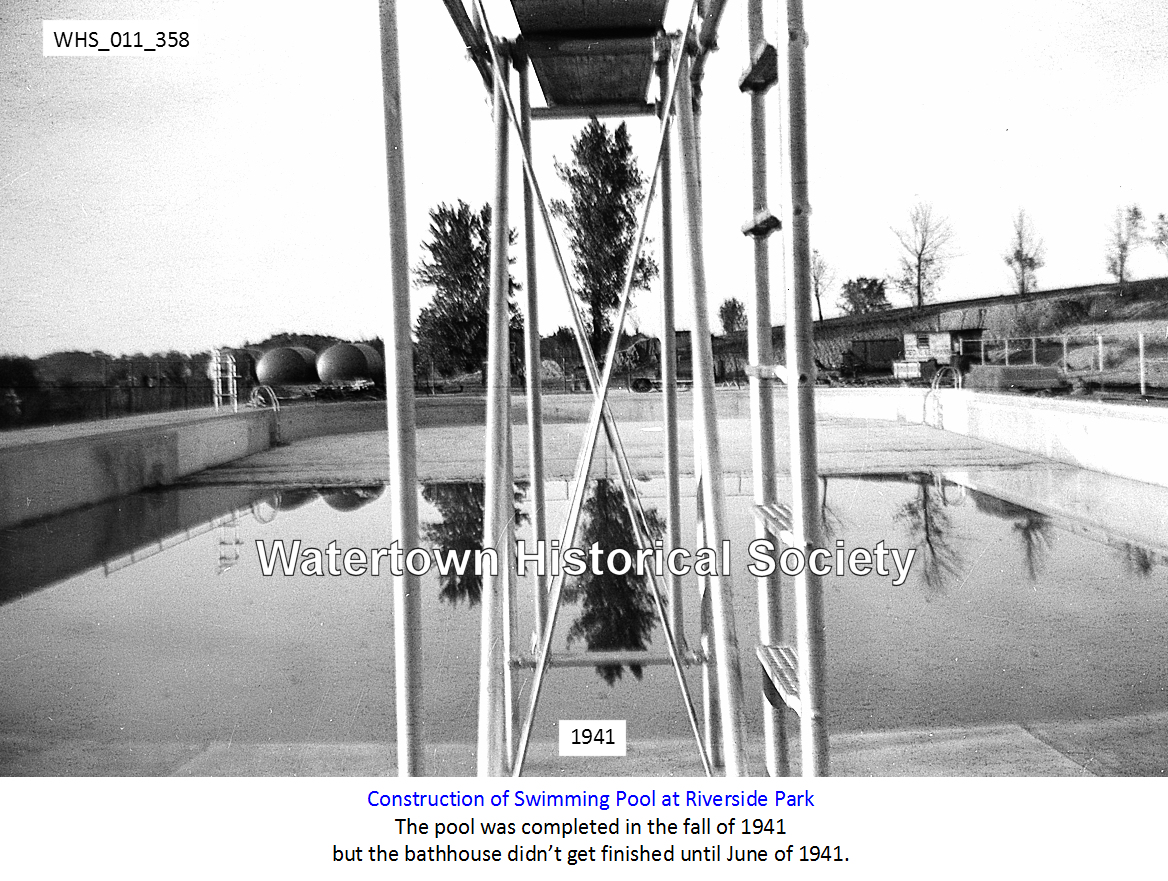
the leveling of the hillside where the pool was to be constructed. The pool was actually completed in the fall
of 1941 but the bathhouse didn't get finished until June of the following
year. The pool did open for one week at
the end of summer in 1941. It was filled
to check for leaks and city officials decided to let people use it for that one
week despite not having a bathhouse.
1941
SWIMMING
POOL CONSTRUCTED AT RIVERSIDE PARK
Pool completed in the fall of 1941; the
bathhouse finished in June of 1942.
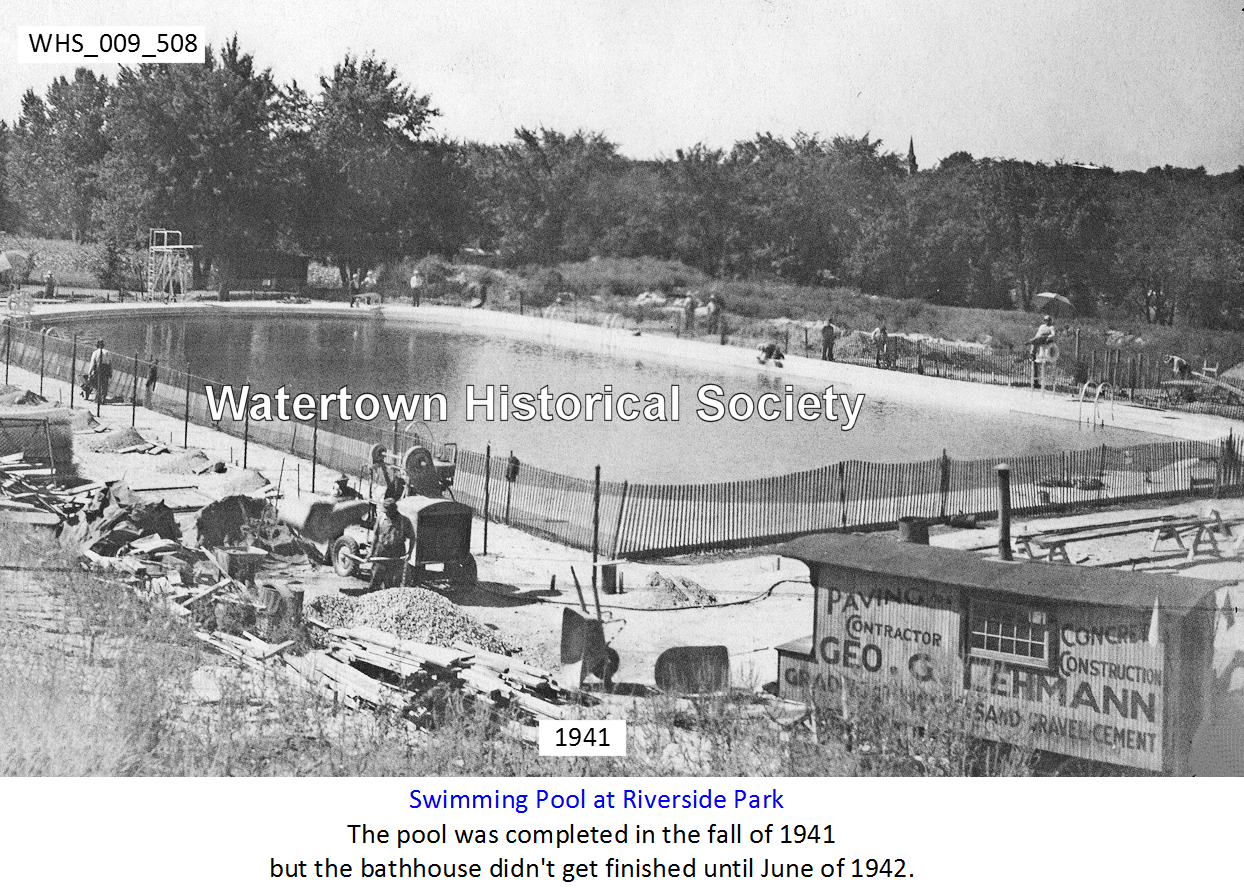
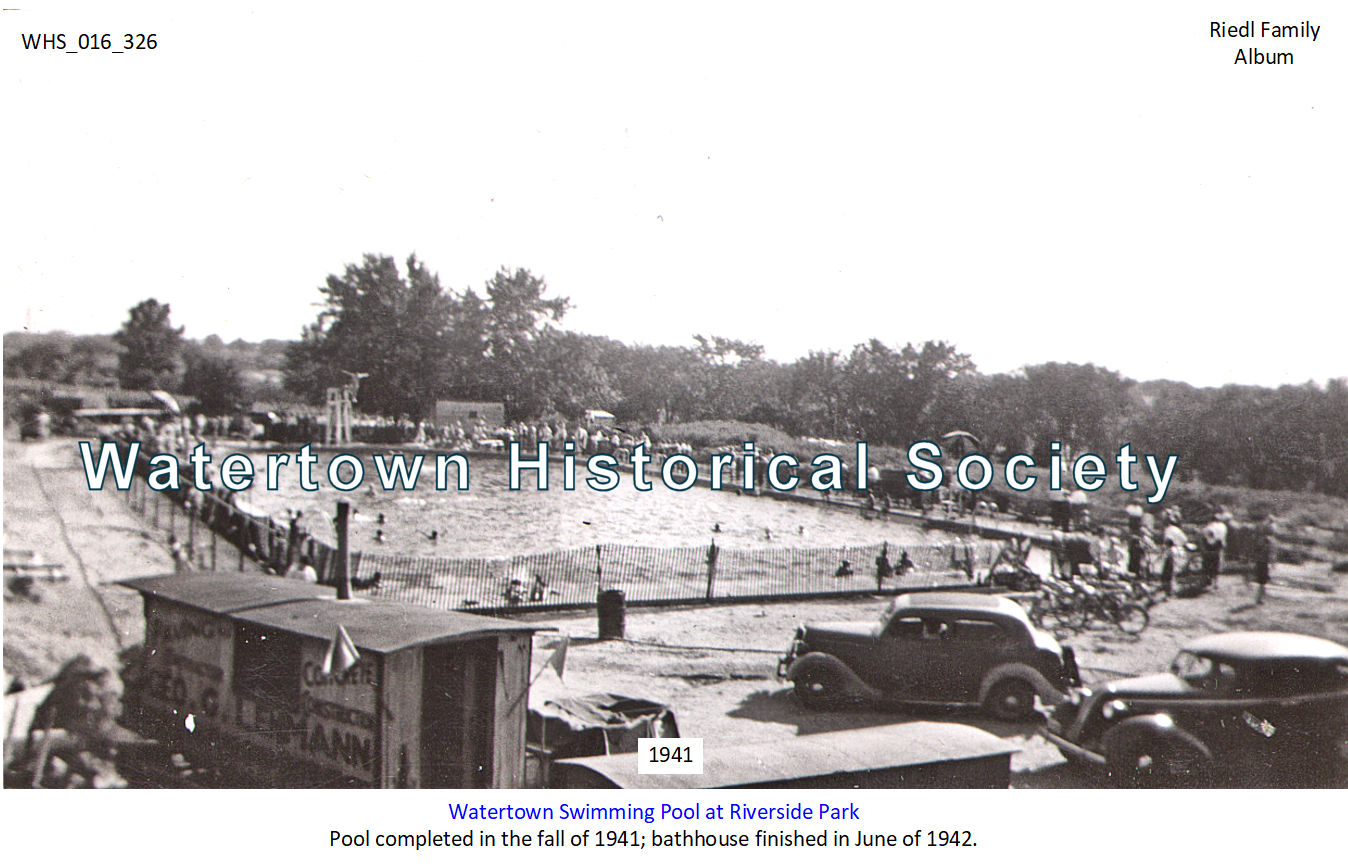
1942
06 14 OLD
SWIMMING POOL RECALLED
The pool was officially opened on June 14,
1942, and by the time it was dedicated on July 5, as part of the annual Fourth
of July celebration, nearly 5,000 people had used the pool.
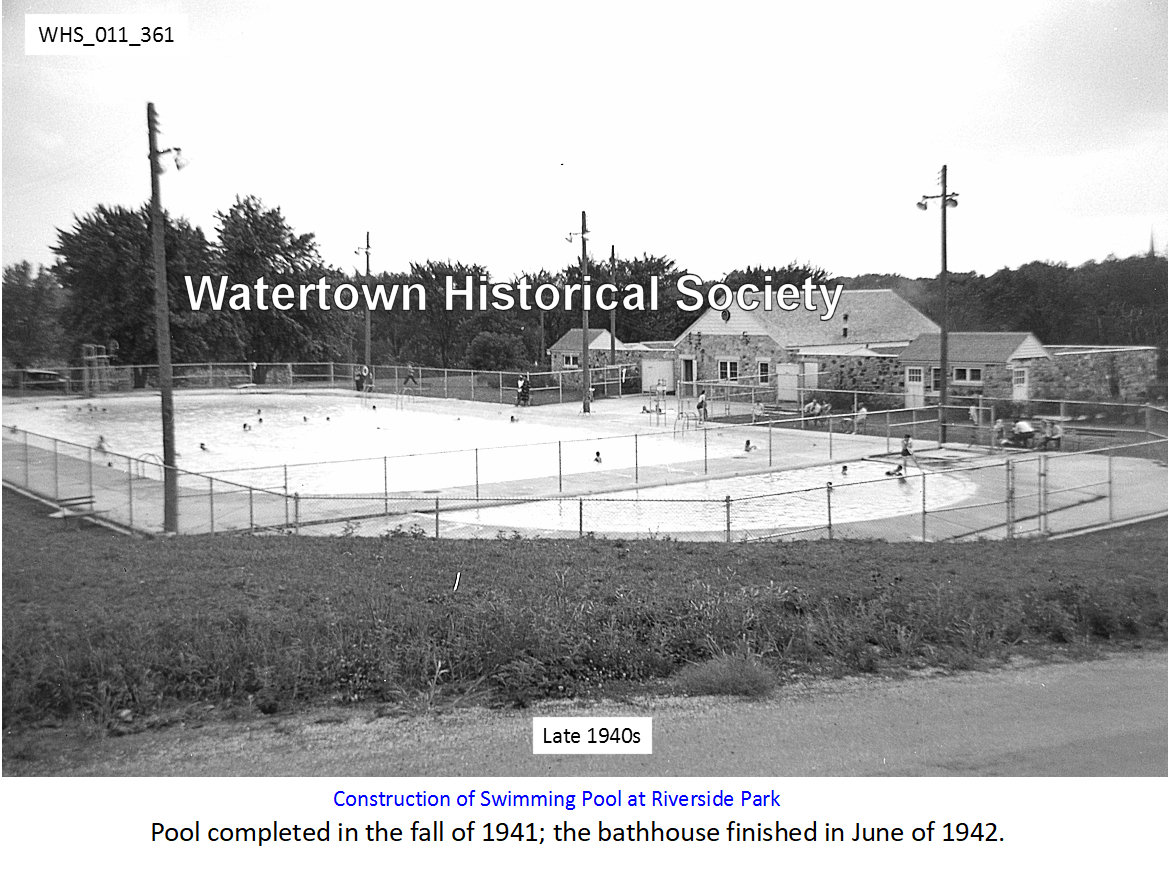
The old pool was 75 feet wide and 165 feet
long. The shallow end had a depth of
three feet and the deep end was 10 feet.
Back then and for many years, there was a 10 foot high diving board and
also two boards several feet off the water level. Diving off the high board was always
exciting, but as time went on there were concerns for safety and the high dive
was removed. The 10 foot depth was only
in a very small area and then it started rising quickly to the five foot level
where it gradually sloped back to the three foot level on the north side of the
pool. The pool also had a small separate
baby pool area which was just a few inches deep.
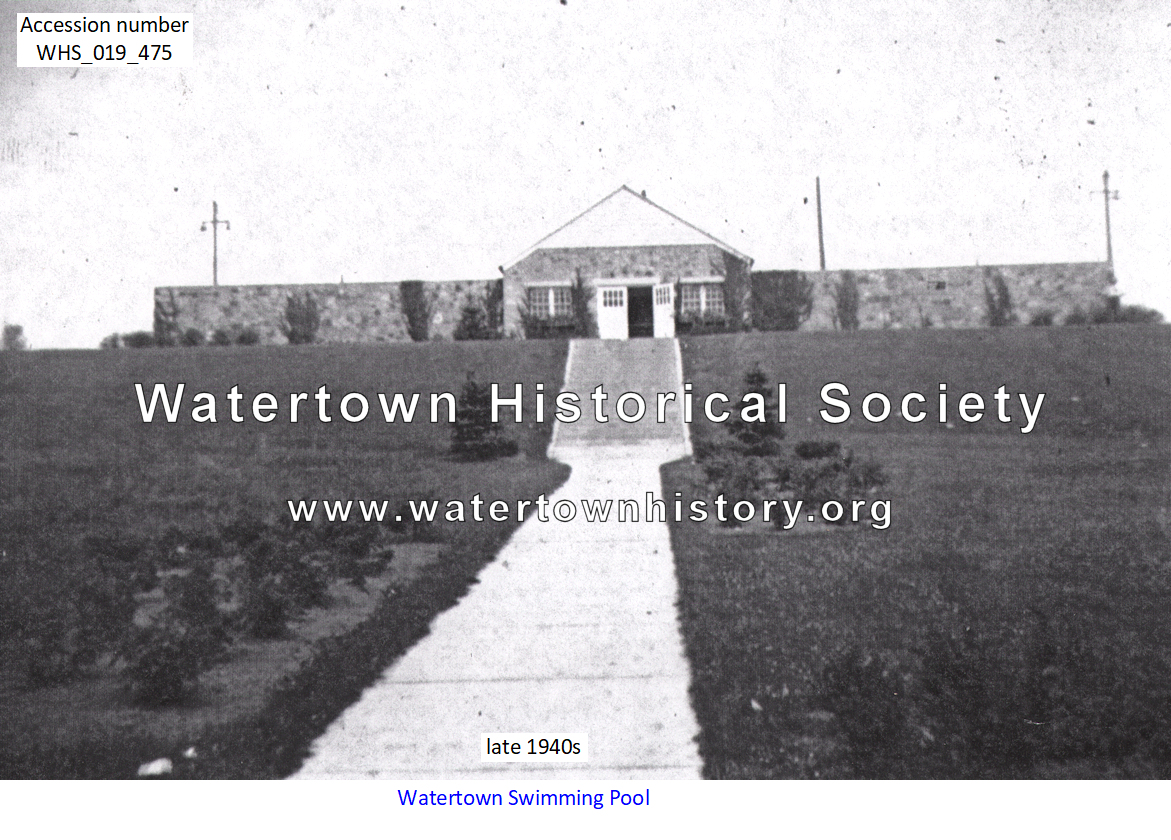
The bathhouse for the old pool was so
impressive that much of it was saved when the new aquatic center was
built. The fieldstone which was used to
build the old bathhouse was actually found on the site when excavation work was
undertaken. The building was 116 feet by
42 feet and is eight inches thick.
People using the pool would pay their admission
fee and then would be given a large basket in which to put their clothes and a
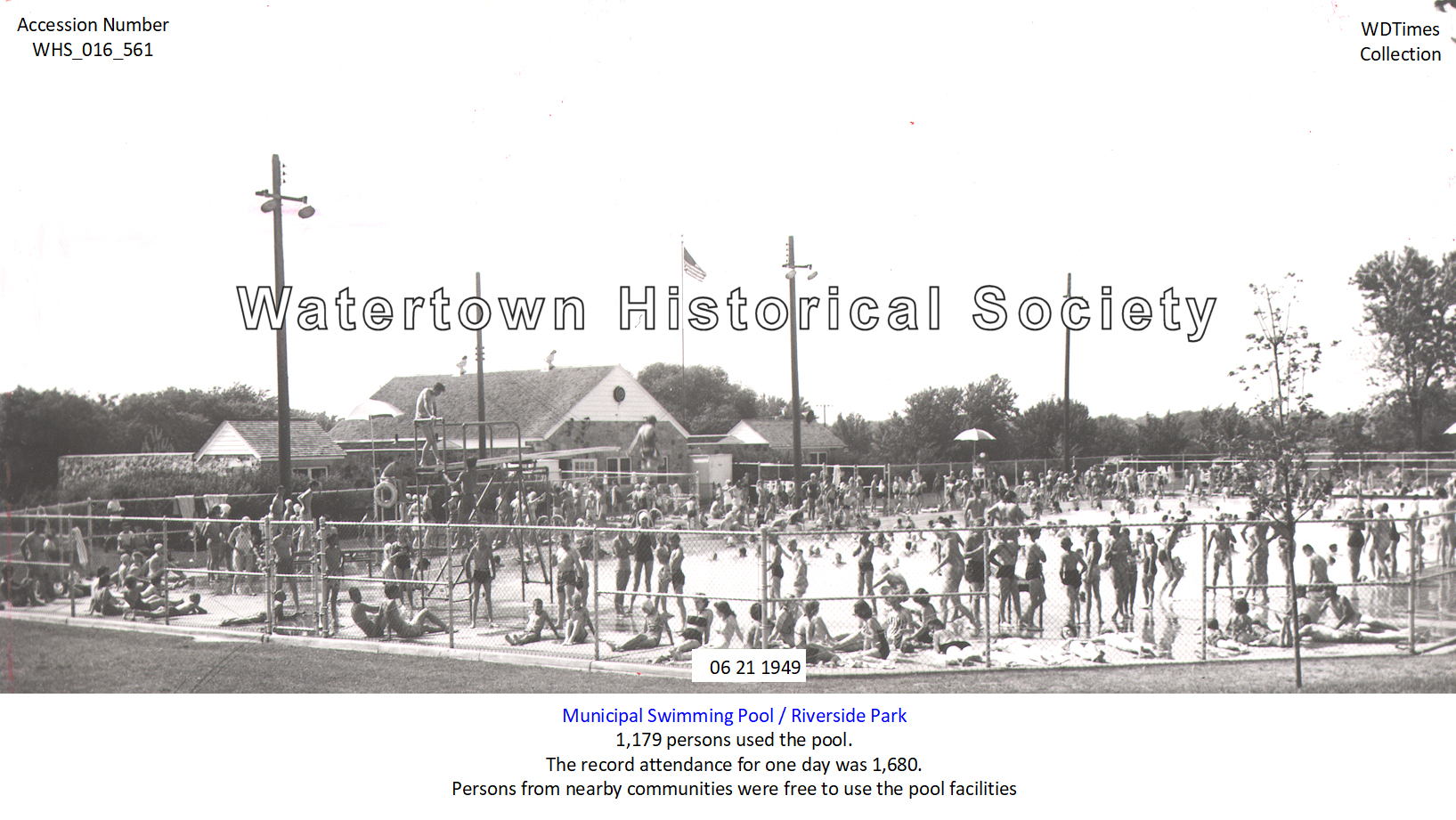
towel. In the event more than 500 people
were using the pool youngsters were encouraged to share a basket. Often there were upwards of 1,000 people in
the pool at a time, more than the rated capacity of 900.
The original pool and bathhouse were designed
by then City Engineer Richard Podolske.
He took into account many factors to make this bathhouse the envy of
many communities. He worked hard to be
sure it was clean, that there were no offensive odors and that damp and musty
conditions were eliminated to minimize any chances of skin diseases being
harbored there.
George Lehmann, a local building contractor,
supervised the daily construction work while Podolske was the overall manager
of the project. Those who served on the
pool committee during planning and construction were John H. Bublitz, Francis
F. Darcey, Fred W. Pfeifer, Harry A. Beurhaus, George Fischer, E. F.
Zimmermann, E. G. Hubb, R. J. Hoge, John D. Clifford, Walter Nurenberg, Fred
Block, Amandus Krueger, and E. E. Brumm.
Admission prices that first year the pool was
open were 5 cents for children ages 5 to 12, 11 cents for children ages 13 to
18 and 17 cents for adults.
Season passes were $2.20 for children ages 5 to
12, $3.30 for children ages 13 to 18 and $4.40 for adults. Towel rentals were a nickel and soap for a
before and/or after swim was one penny.
That first year the brand new swimming pool was
staffed by six people. Wallace
Zimmermann was pool manager; Jack Zimmerman and Margaret Derleth were bathhouse
attendants; and George Draeger, William Kuerschner and Ray Vogler were
lifeguards.
The actual dedication program on July 5, 1942,
was a big one. It started at 3 o'clock and
featured the Lake Shore Club of Chicago which put on quite a show. A total of 14 girls and six boys performed in
the program.
Speaking at the dedication were Mayor Walter
Nack, E. G. Hubb, president of the board of park commissioners; city attorney
H. W. Hartwig and Podolske.
WPA
It had to have been an incredible day for the
citizens of Watertown. The country was in the midst of World War II and money
was tight everywhere, but somehow, with the help of the WPA, the pool became a
reality. The WPA was a federal program
that got unemployed and underemployed people back to work, making municipal
projects come to fruition.
In addition to the pool, the WPA was
responsible for all of the wonderful stone and cement terraces along the east
side of the pool which were used as kind of bleachers, the similar terracing
around the ball diamonds, the walls along the Rock River in Riverside Park and
the small creek that winds its way along the river.
1940s, late
1949
06 21 LARGE
ATTENDENCE AT
1950
06 09 BEER BOTTLES THROWN INTO SWIMMING POOL
 breaking into millions of tiny bits
Two Watertown boys, one 17 and the other whose age
has not been given, will be questioned here in connection with the act of
vandalism at Riverside park swimming pool earlier this week which has delayed
opening of the pool for some time. Park
Policeman Glenn O’Brien picked up two boys in the park for being noisy and
boisterous Wednesday night and they are to be questioned in connection with the
pool incident.
Beer bottles were heaved into the pool,
breaking into millions of tiny bits [pool apparently not yet filled with
water]. The. entire pool will have to be
cleaned and flushed to eliminate all particles of the glass before the pool can
be used. The park crew, under the
supervision of Park Superintendent E. E. Brumm, had put in 30 man hours of work
getting the pool ready when the incident took place Wednesday night, which has
caused the delay in opening the swimming season here
07 07 TOO LENIENT WITH VANDALS AND HOODLUMS
Lectures,
psychiatrists, child experts and all the rest is the bunk
A Letter
to Times Square, Watertown Daily Times
Sir:
I see
by the paper where vandals have once more interrupted activities at the
swimming pool by tossing bottles into the pool.
This is vandalism at its worst. I
do hope that when and if the guilty person or persons are caught they will not
be given a mere lecture, if they are juveniles, and then dismissed. I believe the time has come when such
hoodlums should be dealt with harshly.
Instead
of calling them on the carpet, in the presence of the police, the parents and
juvenile probation officer, giving them a talking to and then letting them go,
I think it's about time such young hoodlums were taken into court and fined. And then given some sort of a job where they
can work off the fine. Say, even as much
as $50. Let them work it off at $1 per
week. Such an experience will make them
realize the seriousness of vandalism. It
will take time to work off such a fine and give them plenty of time to think
about it and also give them the sense of responsibility and good citizenship
which they now lack.
We
have been much too lenient with young vandals and hoodlums. Let’s begin treating them as they deserve to
be treated. All this nonsense about
lectures, psychiatrists, child experts and all the rest is the bunk. Let’s make the kids realize that they can’t
be vandals and damage public property and endanger the lives and safety of
others without being punished and held responsible.
Let’s
cut out some of the modern nonsense and frills and get down to business. The young hoodlums will remember a fine and
the work they do to pay it much longer than any lecture or any psychiatric
hocus-pocus anybody can dream up. It’s
too bad the old woodshed sessions ever were abolished.
-
Irate Citizen
06 09 ANNUAL WATER SHOW
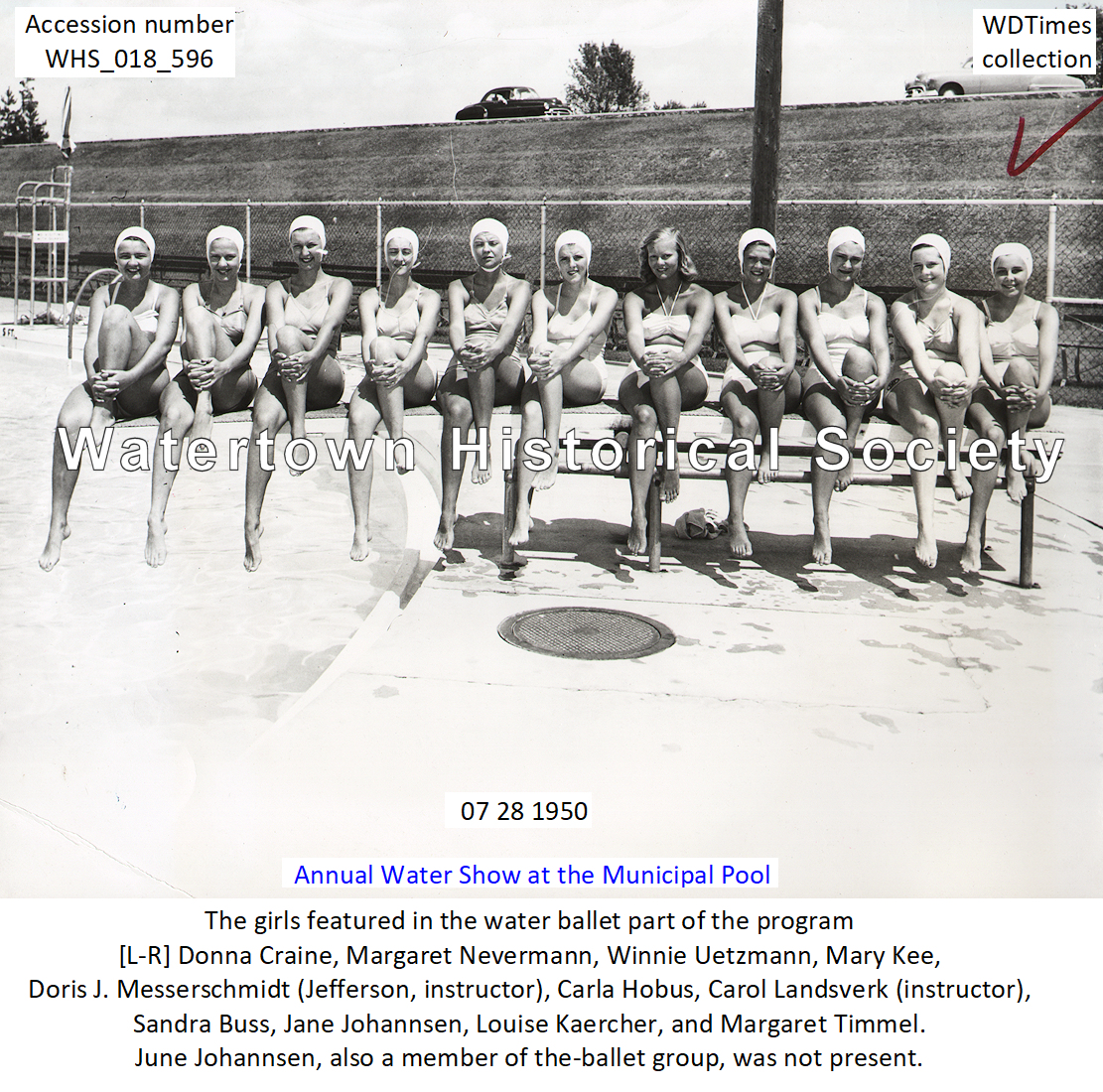
The
annual water show at the municipal pool at Riverside park was very much enjoyed
by the large number in attendance. The
girls featured in the water ballet part of the program, together with the two
instructors are: Donna Craine, Margaret
Nevermann, Winnie Uetzmann, Mary Kee, Doris J. Messerschmidt (Jefferson,
instructor), Carla Hobus, Carol Landsverk (instructor), Sandra Buss, Jane
Johannsen, Louise Kaercher, and Margaret Timmel. June Johannsen, also a member of the-ballet
group, was not present.
1953
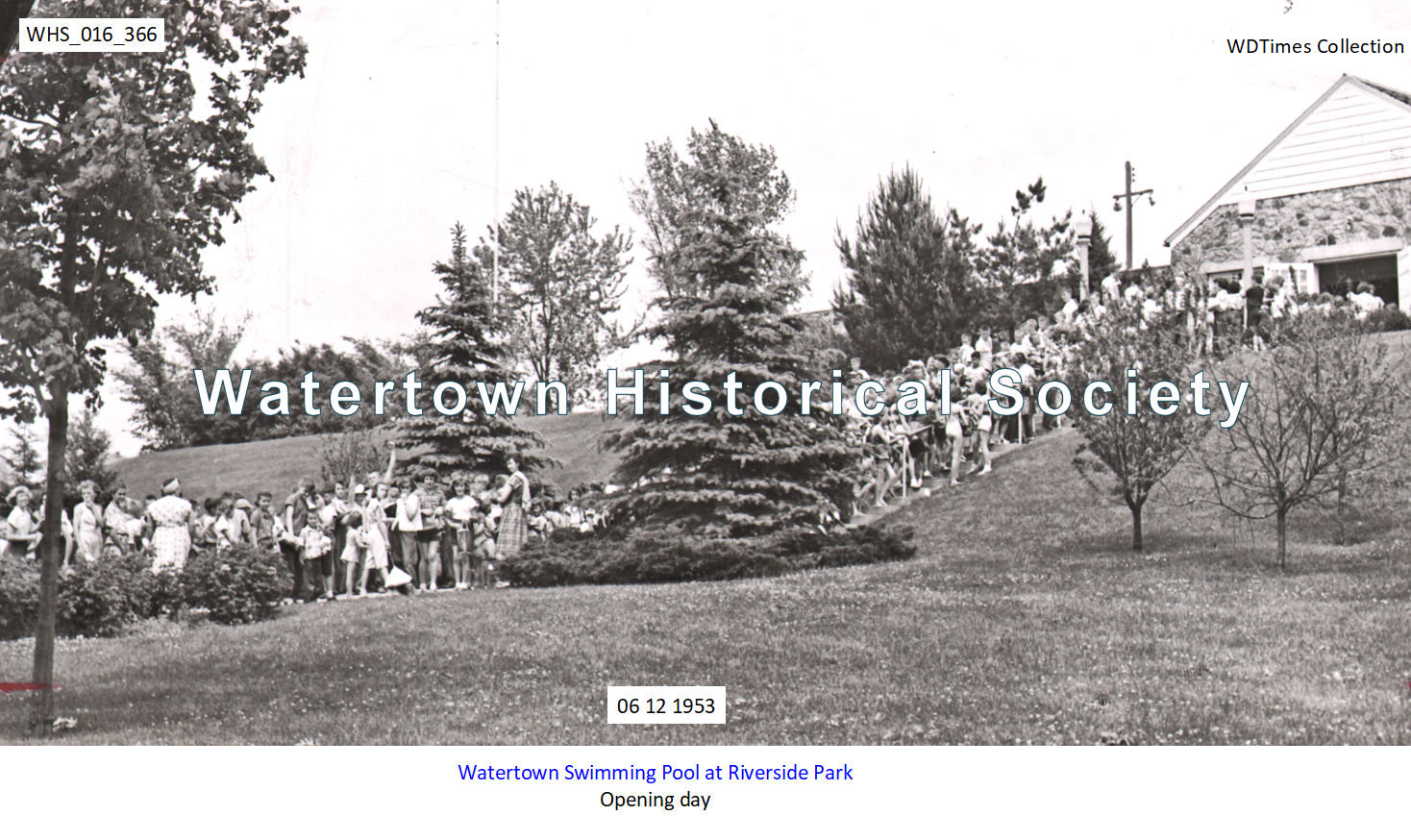
REFLECTIONS:
[1] On hot summer days the line was
just like this. [Remember] putting our clothes in a numbered basket and wearing
the matching numbered pin. I was so afraid
of losing the pin, never getting my clothes back and (horrors) having to go
home in my swimming suit and tell my mom.
[2] Swimming lessons in the
morning. Open swim starting at 1 and I
believe til 5. Reopened at 7 until
9.
[3] Swim for free all day. Remember the mangled dog-eared tickets you
moved from one basket to another, so they could count? Seems to me they announced the numbers on
WTTN and printed it in the Daily Times...along with the water temperature,
which was always cold!
[4] Remember the line up the steps well
and coming off Division Street from the bridge and trying to get enough speed
on your bike to make it up the hill to the bike racks.
08 05 ANNUAL WATER CARNIVAL

Barbara
Bauman, Leah Richter, Dorothy Crass, Mary Held, Audrey Rieck, Janet Borazo,
Laura Brunelle, June Johannsen, Sue Stark, Kay Kaddatz, Marilyn Swanton, Sandy
Schramm, Polly Zimmermann, Kay Meckes.
c.1954 SHARED MEMORY
"It
is now time for the 2:30 rest period.
Everybody out of the water and on deck.
Do not put your hands or feet in the water." (circa, 1954, over the
loudspeaker, once every hour)
<> Peter Burzynski
1950’s
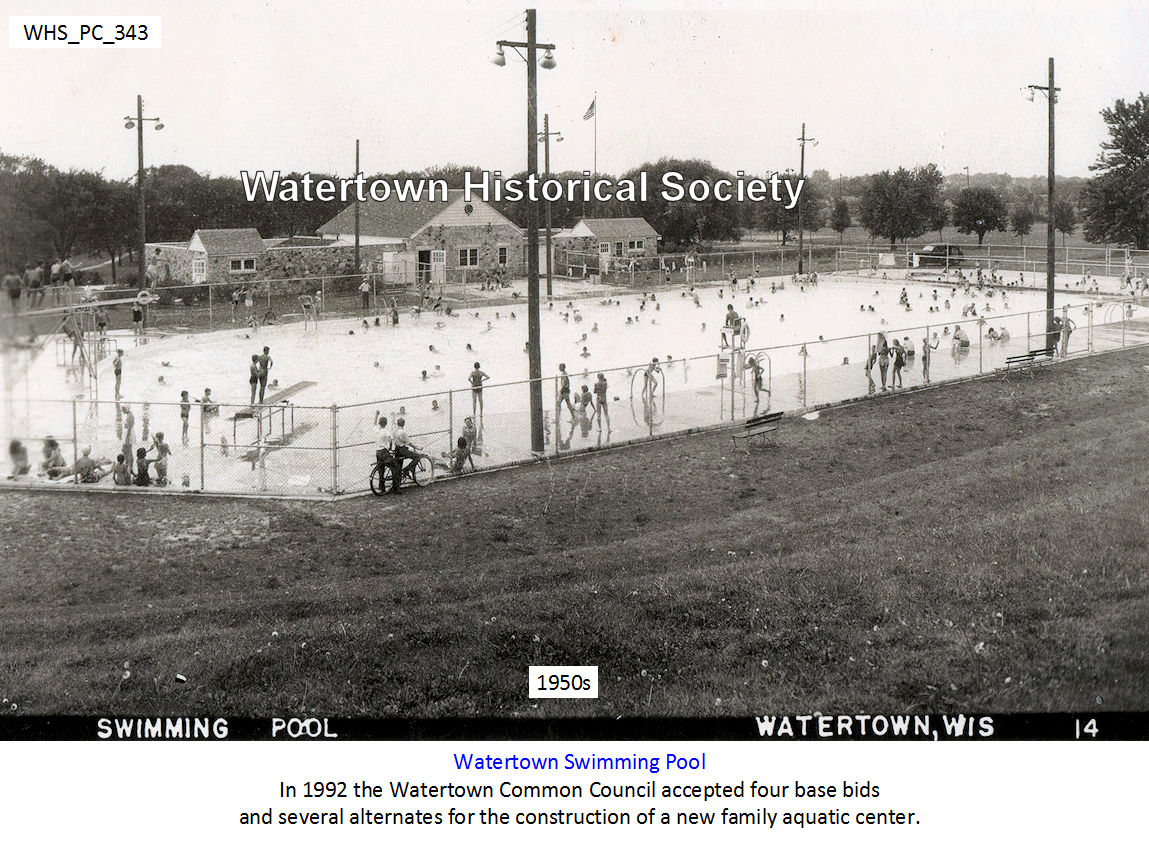
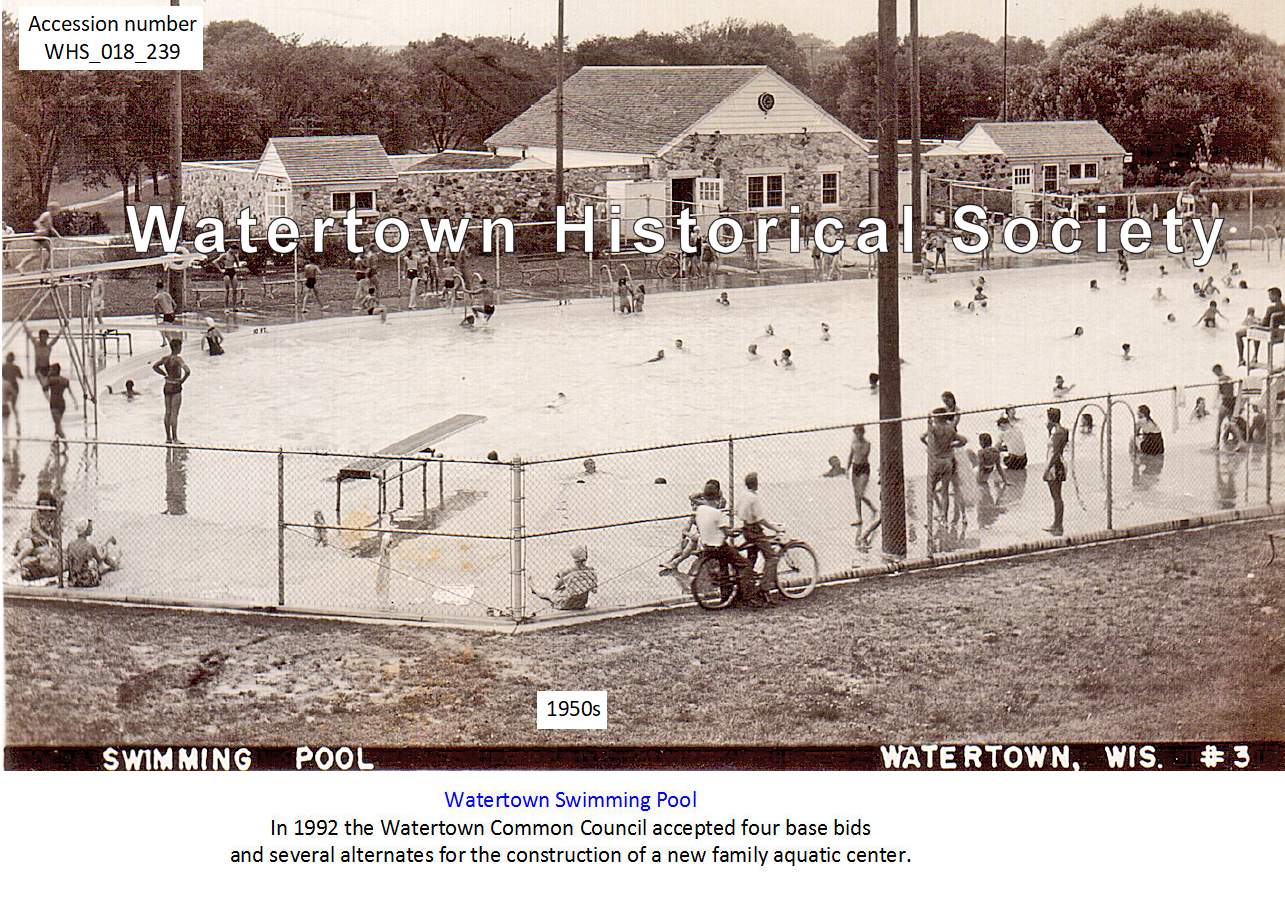
MEMORIES REGARDING ABOVE POOL
I
remember many summer days spent at the pool! I think it cost a dime to get in.
Boy, I'm old!!
We
were there almost every day from when it opened ‘til it closed at 9pm. Those were the days.
I
practically lived there as a kid!! Good
times, 1950s'!!
Great
memories of summer days spent there!
Did
spend a lot of time swimming there in the 60s.
It did cost a dime to get in but my mom gave us a quarter so we could
get a bag of Pagels popcorn or chips, which were the best.
It was
free during the week and a dime on Sundays most of my growing up years. I had to earn that dime helping with some
chore around the house.
I
recall doing the hill on my bike. What a
trip till you hit the fence.
In the
70s we bought a season patch to sew on our suit. The potato chips were the best. And so intimidated by the high dive when
young. Didn't do lessons but was in
water ballet one summer, 1977.
Power
lines running across the pool.
Let’s
talk about water ballet.
30
cents for kids if you didn't have the season pass. Dove off the high dive all the time. If it was cooler out we had to have 15 kids
waiting in order for them to open.
How I
loved that pool!
1958
06 06 With the 1958 swimming season at the Riverside
Park pool due to begin this week, making it the 16th year of operation for the
pool, everything was in readiness today for the opening at 1:30 p.m.
tomorrow. The Riverside Park swimming
pool, which someone has called the best recreational investment the people of
Watertown ever made, was dedicated on July 5, 1942. It was constructed during the years 1940 and
1941. It grew out of a city referendum
in which the voters of the city voiced their approval of the plan. Actually, the pool had been completed in the
fall of 1941 and during that winter and the following spring the bath house was
constructed and the filtration equipment placed in the basement of the
building. WDT
1964
06 27 With sizzling temperatures prevailing, the
swimming pool here set a new attendance record yesterday. According to a report made this morning by E.
E. Brumm, pool manager, there were 1,502 free swimmers, 108 who used their
season tickets, another 694 who paid admissions and 312 who used the pool as
part of their swimming lessons. This
represented a total of 2,616. WDT
10 12 Alderman Carl Seeber thinks it’s time the city
fathers begin to think about the construction of a second
swimming pool in Watertown — to be located on the west side. He made his proposal at last night’s common
council committee meeting. He suggested
that the council consider a plan to put aside a specific sum each year for a
number of years to provide the funds for the project. His suggestion was discussed only briefly,
during which one alderman said he felt that if the plan is adopted, thought
ought also to be given to making it an indoor pool so it can be used the year
around and not only during the few summer months the present facility is
operated. WDT
1969
07 12 REPRESENT WATERTOWN IN WATER MEETS
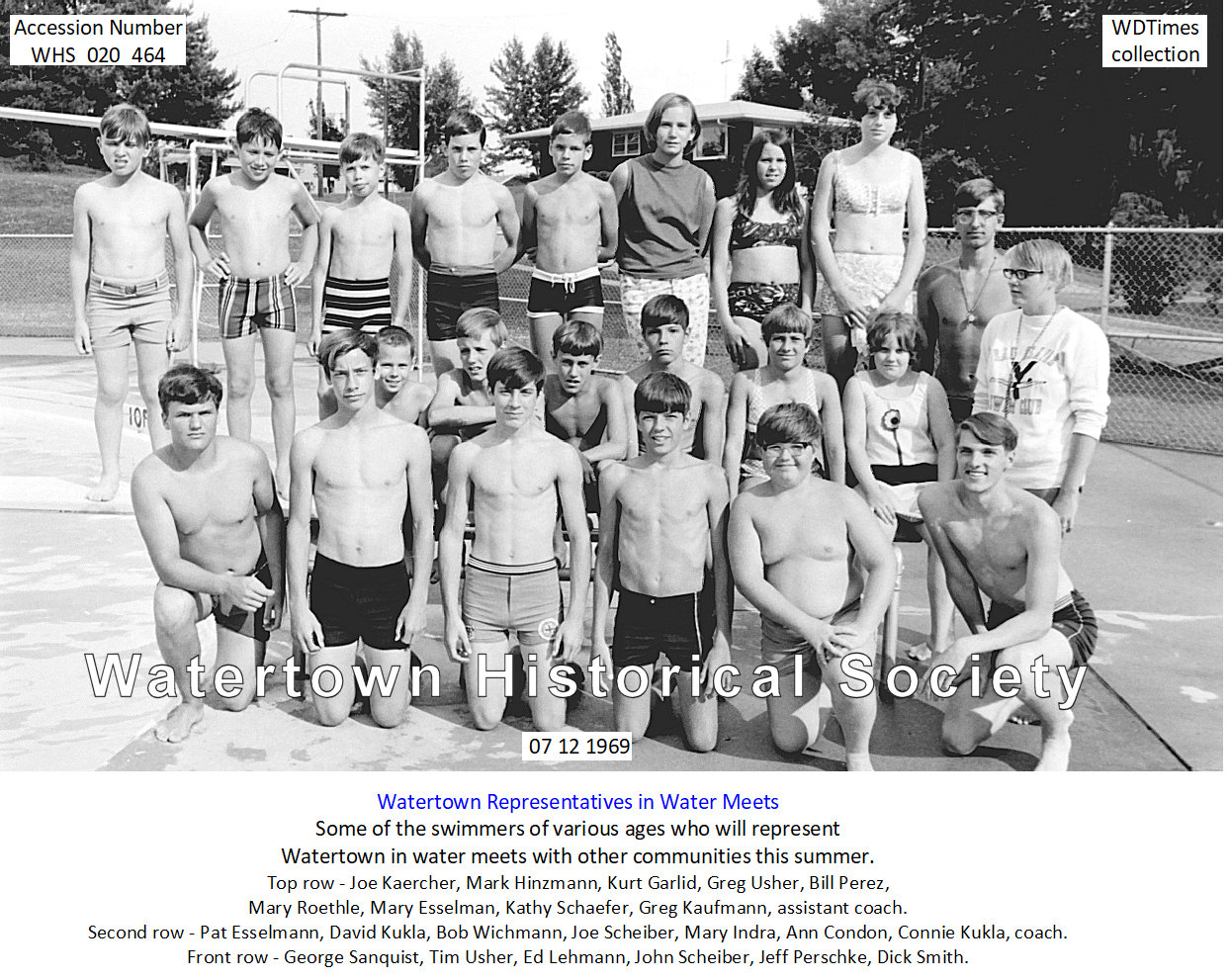
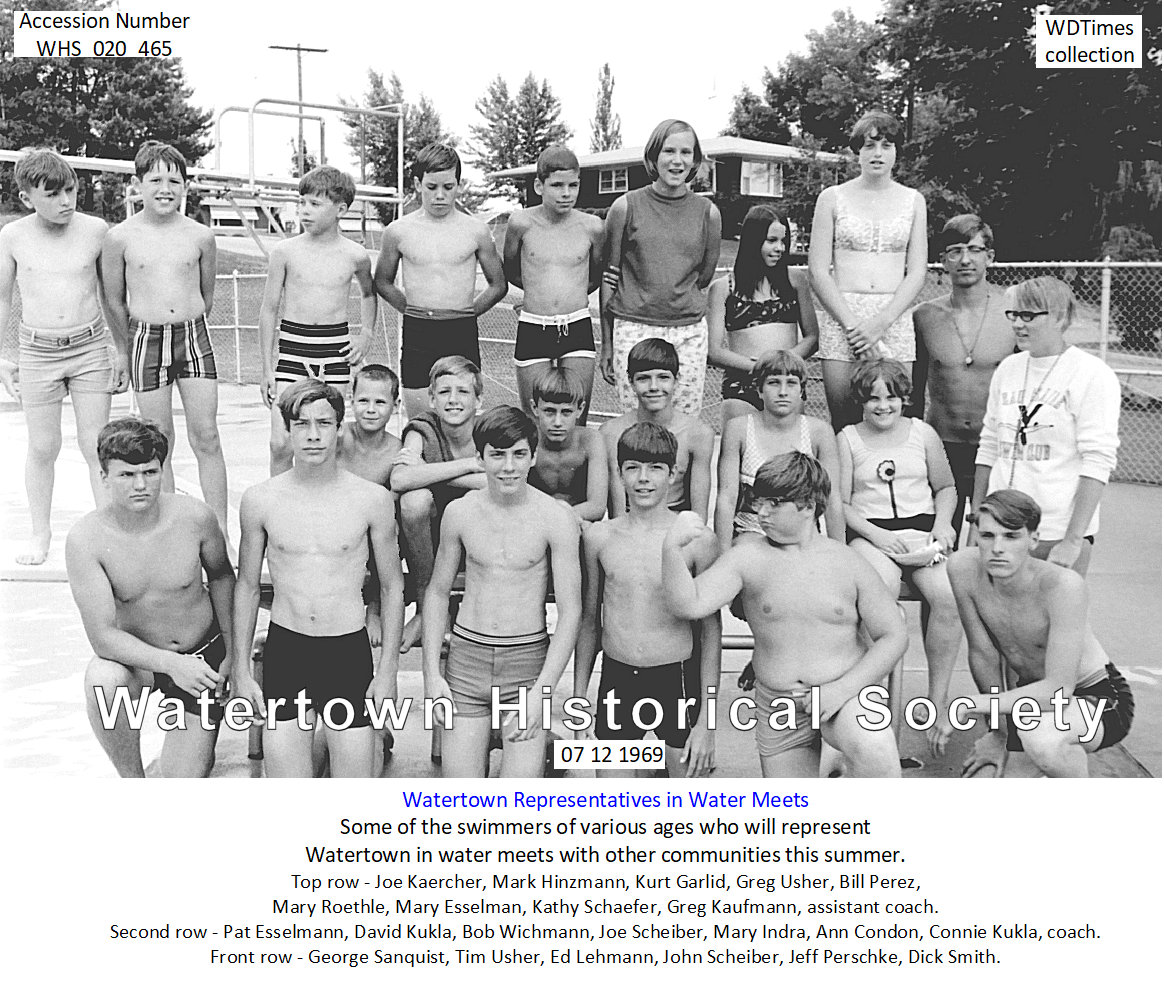
Some
of the swimmers of various ages who will represent Watertown in water meets
with other communities this summer.
Joe
Kaercher, Mark Hinzmann, Kurt Garlid, Greg Usher, Bill Perez, Mary Roethle,
Mary Esselman, Kathy Schaefer, Greg Kaufmann, assistant coach, Pat Esselmann,
David Kukla, Bob Wichmann, Joe Scheiber, Mary Indra, Ann
Condon, Connie Kukla, coach, George Sanquist, Tim Usher, Ed Lehmann, John
Scheiber, Jeff Perschke, Dick Smith.
1989
10 23 The Watertown Municipal Outdoor Pool has served
the community well for almost half a century, but recreation officials say it’s
time to look at renovating the 47-year-old structure. “We’re not looking for something that has to
be done tomorrow,” said John Steber, director of the park, recreation and
forestry department. “(But) we’ve got to
start looking at the future and where we’re going with this.” Toward that end, Steber has included a
request of $4,800 for a pool study in the 1990 outdoor pool budget. If authorized by the Watertown Common
Council, the study would include an investigation of the pool structure and
mechanical systems, an evaluation of projected use, a drawing of proposed
changes and budget estimates of renovations.
WDT
1990
06 09 A $4,500 study of the outdoor swimming pool is
being recommended by the Watertown Park and Recreation Commission. The recommendation calls for the Stevens
Point firm of Gremmer and Bablitch Architects and Engineers to offer three
alternatives for remodeling and renovating the existing pool to bring it up to
current state standards and to replace old and antiquated equipment. The three alternatives range from the most
economical yet functional pool facility, to a mid-range family aquatic facility
to a complete family aquatic center.
John Steber said the existing pool was built in 1941 and for the most
part it continues to operate with all of the original equipment. He said, “We are in violation of numerous
state laws, including the lack of water depth, we are unable to recycle water,
we don’t have a recycling tank for recycling and our filter system is
ancient. Any of this equipment could stop
operating at any time.” WDT
12 05 City aldermen will review a proposed outdoor
pool project with an estimated construction cost of about $1.7 million. Final plans for constructing a significantly
new water facility were presented to the city’s park, recreation and forestry
commission Monday by consultant Gremmer-Bablitch Architects and Engineers of
Stevens Point. The firm is scheduled to
provide another presentation at the council meeting on Dec. 18. Park and recreation
Director John Steber said the commission believes construction of a new
facility makes more sense than renovating the old outdoor pool, which was built
in 1941. WDT
Recollections
I remember Dale Gallert doing amazing
flips off the high dive! The guy was great👍
Always looked forward to the rest
period as Dale would display his diving skills off the high dive. Post hours of
swim, Pagel's popcorn or banana popsicle then the bike journey home.
Great times at the pool.
Got my bike ripped off there as well,
PD found it and brought to our house.
We were so fortunate to have the pool !
Loved that pool, except for the day I
got too much sun, passed out on the hill in front of the pool and rolled all
the way down. I was good though!
You can tell it was a time when there
were not hundreds of Waterparks.
like everyone we rode bikes and walked
back and forth from Warren St, swam all day and back at night, does anyone
remember the Policeman sitting on the bench at the bottom, he had a little
scooter, he would help us cross the street to the back rack?
Swam as a kid there daily ~ eventually
guarded and taught lessons there in late 70’s. Greatest job ever for a teen 🏊🏻♀️🩱
I remember buying a slow poke after
swimming and riding our bikes home.
I remember standing in that line. We
always tried to be at the front of the line.
Remember those days. Waiting for the
pool to open. Loved hanging out there
Practically lived at the pool in
summer!
Life before cell phones!
Those were the days! Spent many hours
at that pool in the day!
Spent many a summer day there!
I recall standing in that line often
Fun memories for sure!
I remember that line, got your basket pinned
the number on your suit.
I remember many times standing in line
on those stairs as a kid!
And remember standing on the edge of
the pool at the end of rest period waiting for a lifeguard to blow their
whistle so you could jump in!
My older brother and I would canoe from
our house on water street to riverside park. Lock the canoe to a tree and swim
all day, then canoe back home. Great memories!!
That set of stairs was epic
You mean kids rode bikes there!? Not
get dropped off with I pads & cell phones?
Those were the days!
I remember waiting in that line going
up the stairs! (Not in 1955, but in the 70's.)
The bike racks are full, you wouldnt see that 2day!!!
So cool! Either I took the bus from the
Bloody 7th that day or rode my bike to be there.
Waited in that line many times in the
1960’s👍🏻
I was there so much I thought I own the
place 😁
And Pagels Potato Chips after 3 hours
of swimming!!! Will never foget the "taste"
or good times!
Those were very fun times!❤️
I remember standing in those lines
waiting for the pool to open
Every day!!
Swim. Then Pagels potato chips and a
lime juice bar
Every afternoon and night
Summer 1970, notice the pool summer
pass. We spent so much time at the pool. Swimming lessons in the morning,
afternoons with friends, and back again for night swim. Pedaling our bikes like
crazy back & forth to try to be first in line! ❤️
May be an image of 1 person, child,
bangs and smiling
I practiced my three favorite dives,
the cannon ball, toothpick and jackknife there.😎
And...it was completely FREE there were
no "pool passes". The tickets were just blank pieces of poster board.
You took the ticket and threw it in a basket as you walked in the front door.
They counted the tickets to find out the days attendance, sometimes even
announced attendance on WTTN & printed it in the Watertown Daily Times.
(What a great small town newspaper)
We walked or rode our bikes to the pool
almost every day. Lots of fun memories!
That pool was actually one of the last
swimming pools that was operated using liquid chlorine gas. I used to have to
change the cylinders. I had a full face
gas mask with a filter box on my chest.
State inspector showed up one day and I asked him what would happen if
the valve broke off of the tank. He told
me I wouldn't even make it to the door
Watertown
Aquatic Center
1991
02 13 The city’s outdoor pool will not open this
summer unless the facility can meet state health and safety codes, according to
a recommendation from the Watertown Park, Recreation and Forestry
Commission. Also, the commission
recommended that the common council proceed immediately with the construction
of the $1.7 million facility plan prepared by Gremmer-Bablitch Architects
Engineers. “We feel it’s in the best
interests of the city and its citizens that we build a new pool,” said Jerome
Kruse, commission chairman. WDT
03 04 Construction on a new outdoor aquatic center would
begin in 1992 if the Watertown Common Council approves a resolution Tuesday to
authorize the $1.7 million project. The
council will meet at 7 p.m. in the council chambers of the Watertown Municipal
Building. Aldermen will consider two
resolutions concerning the city’s outdoor swimming pool, including a measure
that would commit the city to pay $1.2 million of the pool’s construction
costs. The other $500,000 would be
raised through a public fund-raising drive.
WDT
03 21 Watertown residents can begin to raise funds
for the construction of a new outdoor aquatics center following the Watertown
Common Council’s authorization of the project on Tuesday. The council agreed to commit up to $900,000
in general tax funds to the construction of the facility, depending upon the
level of support from citizens, who would need to contribute a minimum of
$500,000. The resolution states that
$1.50 in city funds will be contributed for each $1 raised through private
sector donations. The ration is intended
to encourage contributions to the $1.7 million project, which includes
construction of a zero-depth pool basin, concession area, volleyball courts and
a water slide. The mechanical and
filtration system will be replaced in the project and the bathhouse will be
remodeled. WDT
06 20 A nonprofit community foundation is being
established by a group of Watertown supporters, and its first project will be
to raise the $600,000 needed for the private sector’s share of the proposed
outdoor aquatic facility. The foundation
will be known as Watertown Area Community Foundation, and plans call for it to
be a long-term organization dedicated to providing financial assistance for
public projects which otherwise might not be feasible. WDT
08 31 NEW FAMILY AQUATIC CENTER, ARCHITECTURAL PLANS
Work on detailed architectural plans for
Watertown’s new family aquatic center should begin by early October for the most
competitive bidding process, according to Timothy A. Gremmer, president of
Gremmer, Ohm, Plover, architects for the project. Gremmer was in Watertown this week to prepare
topographic maps of the existing pool location to begin preliminary planning
for the project. The Watertown Area
Community Foundation has been established to raise $600,000 in private
funds. The Watertown Common Council has
voted to spend up to $900,000 if the $600,000 goal is reached. WDT
09 22 AQUATIC CENTER FUNDING NEAR HALFWAY POINT
The fund drive to raise $600,000 in private
funds for a new aquatic center in Watertown is near the halfway point, members
of the board of directors and advisory board of the Watertown Area Community
Foundation were told Thursday afternoon. The total amount of money contributed
in cash and/or pledged now stands at $286,500, according to H. Bruce Kasten,
foundation treasurer. Members of the foundation board were also told that a
number of contacts have been made and additional pledges should be committed in
the coming weeks. WDT
1992
01 24 COMMIT TO CONSTRUCTION OF OUTDOOR FAMILY
AQUATIC CENTER
The Watertown Common Council Tuesday voted
unanimously to commit the city to a maximum of $1.1 million for the
construction of the outdoor family aquatic center. The council’s action will
allow recreation officials to proceed with plans to build the facility this
year for a June 1993 opening. Bids for the construction of the pool will be
sought in the near future. The council’s commitment also will help the
Watertown Area Community Foundation secure several more donations to the
private fund-raising effort, which is closing in on its goal of $600,000.
Foundation officials say several large contributors will release their
donations only after the council commits to the project. WDT
04 01 BIDS FOR OUTDOOR FAMILY AQUATIC CENTER
The Watertown Common Council Monday accepted
four base bids and several alternates for the construction of the new family
aquatic center. The four bids, which
total $1,259,818, include most of the work to build the facility. Construction on the pool is expected to start
this spring to allow a 1993 opening.
“It’s gratifying to note that the bids came in lower than expected,”
said Mayor David Lenz, who added that the city will be able to accomplish more
of the project by using the savings. The
council authorized acceptance of a base bid of $749,625 for the general pool
construction from Neumann Pools Inc. of Beaver Dam. The firm also will build a vinyl-coated fence
around the pool for $5,978 and a concrete strip underneath the fence for
$5,813. WDT
04 28 FUND-RAISING GOAL EXCEEDED
The Watertown Area Community Foundation has
exceeded its $600,000 fund-raising goal, supporters of the new aquatic center
were told Wednesday evening. A
celebration to mark that accomplishment, held at Balistreri’s Welcome Inn, was
attended by about 75 members of the foundation board, advisory board,
government officials and others who helped make the fund drive a success. The total collected and/or pledged thus far
is $646,123.36, Bruce Kasten, foundation treasurer, told the group. The revealing of that total on a large board
was met with an enthusiastic round of applause by those attending. James
Clifford, president of the foundation, told the group that the total is
expected to go even higher in the coming weeks as more commitments in process
are made. WDT
07 22 NEW OUTDOOR AQUATIC CENTER
Last month the largest project filed with the city was the new outdoor
aquatic center, valued at $1.2 million.
The facility, which was financed through a combination of donations from
citizens and industry and city funds, is scheduled to open for the summer of
1993.
1993
06 01 NEW AQUATIC CENTER TO OPEN
After two summers without an outdoor swimming
facility, Watertown’s new family aquatic center will open to the public
Saturday with a dedication service planned Friday night. According to John Steber, director of the
city’s park, recreation and forestry department, workers are scrambling to
complete the final details by week’s end and some of the project will be
finished later. Nonetheless, the
facility will be ready for its opening, he said. “For the most part, we should be ready to
open the door,” Steber said. “We should
be ready to go.” Although the facility
will first open for business at 1 p.m. Saturday, Watertown residents will get
their first look at the new center Friday evening. WDT
06 09 NEW AQUATIC CENTER OPEN HOUSE
The cold and rainy weather didn’t deter a crowd
of several hundred from getting their first view of Watertown’s new family
aquatic center Friday evening. The open
house included a short dedication program in which various speakers emphasized
the positive spirit of the community that made the center a reality. Members of
the community raised $600,000 as the private sector’s share of the $1.7 million
project, an effort that has set a standard for other communities to seek. And those attending were pleased by the final
results. Many praised the project as a
great benefit to the community. Others
commented that it was one of the best aquatic center they have seen, comparing
it favorably with others in the area. WDT
One day after
adults christened the Watertown Family Aquatic Center, local kids gave the new
pool its first test on Saturday's opening day.
City recreation officials say 820 people used the pool on its first day,
with a comparable number on Sunday.
Attendance may have been even higher if the weather had been warmer, as
the highs were only in the mid-70s with a solid breeze. "It was rather cool on both of those
days," said John Steber, director of the park, recreation and forestry
department. "If we would have had
some 80-degree temperatures, we would have seen about 1,000
(people)." The heated pool water
helped keep swimmers comfortable, Steber said.
The old pool had a constant influx of cold water, so the pool
temperature never got warmer than about 72 degrees in those days. Now, officials expect the pool water to
average 78 to 82 degrees during the warm weather. This weekend, the water temperature was near
74 degrees.
09 06 NEW AQUATIC CENTER OPEN HOUSE
In its first summer, attendance and revenues at
the Watertown Family Aquatic Center exceeded the expectations of city
officials. In fact, the facility may
show a net profit for the year when all of the operating expenses are known,
according to Cindi Keller, aquatic center supervisor. In the 1993 budget, city officials projected
that net revenues would equal operating expenses for the aquatic center. “It does look like our expenses will not
exceed our revenues,” she said.
Watertown’s new family aquatic center opened for business on June
5. The city went two summers without an
outdoor pool because the old facility was closed for health and safety
reasons. WDT
2007
(2007)
The family-oriented facility offers a 220-foot water slide, a 24-foot drop
slide, a one-meter springboard, two animal water slides for preschoolers, a
mushroom waterfall, several floor fountains and a large zero depth area. In
addition, the facility also features a playground area, a sand volleyball
court, a concession stand, spacious deck space, a large grass area and ample
parking. Coin-operated lockers and a large bathhouse are also available.
This wonderful addition to the city's park and
recreation programs, has received a tremendous amount of use since it was built
to replace the aging municipal pool at the same location.
With the water slides, the zero depth pool and
the many other amenities, this center is a far cry from the pool it
replaced. Many take this spectacular
aquatic center for granted, but it came about through a major fund-raising
effort and a cooperative financial deal with the city. The private sector raised $600,000 and city
government added $1.2 million for the $1.8 million total cost.
05 16 PREPPING
THE POOL INCLUDES POWER WASHING

2020
06 01 CLOSED FOR SEASON DUE TO COVID-19
The
council agreed unanimously during its regular session for early June that the city
pool, known officially as the Watertown Family Aquatic Center and located at
Riverside Park, should remain closed for a number of reasons, including financial, potential staffing shortages and the
threat of a COVID-19 flareup. The
Watertown Park and Recreation Commission had recommended the pool not open in
2020.
2025
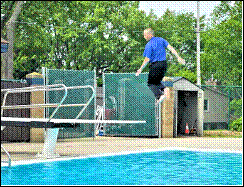
06 13 OUR NEW MAYOR TAKES A DIP IN THE POOL; Mayor Robert
Stocks
Cross References:
Derived
in part from Watertown
Daily Times article, 06 02 2007
Spent so many happy hours at this pool! Remember diving for greased
watermelons at end of summer!
Before they built the large one, this was the place to be for sledding.
Never missed it
Dr. E. J.
Hoermann was a member of the board of park commission. The park development program was one of the
things closest to his heart and up to the time he took ill was a leader in the
movement for a swimming pool here.

History of Watertown,
Wisconsin