website watertownhistory.org
ebook History of Watertown, Wisconsin
James Cody and William Cody [ father and son ]
James Cody
1820 - 1894
Derived from: The History of Jefferson County, Wisconsin by C. W. Butterfield, 1879
Dr. James Cody was born in St. John, Newfoundland,
______________________________________________________________
The followed was received but the
quoted source is not fully known. The
publication is that of the “State Medical
Society of Wisconsin” and the article was written by N M Wigginton, M. D.
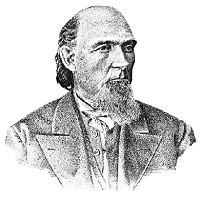 Dr. James Cody was
born
Dr. James Cody was
born
The doctor’s
parents died when he was a mere boy, leaving him and a younger brother under
the guardianship of an uncle who looked carefully to their education, which was
primarily obtained in their native city in a private school.
As the
time advanced for a higher education, the two boys were sent by the uncle to
Montreal, Canada, and placed in the large Jesuit school of that city, and there
received a careful moral and literary training.
The
younger brother died while studying for priest’s orders. About this time the subject of this sketch
began the study of medicine, the preliminaries having already engaged his
attention while at the Jesuit school.
The uncle watching carefully the inclinations of his ward, and realizing
even at that early date the superiority of American institutions, especially
that of Harvard, sent the young men to Chelmsford, Mass., and placed him under
the care and instruction of Dr. Hall Kittridge of
that place.
From
Chelmsford he took his regular courses in the medical department of Harvard
University, graduating
He
gave Dr. Bowditch one hundred dollars for the privilege of his office and
special instruction in auscultation and percussion, the doctor having just
returned from Europe where he had taken a course preparatory to teaching it in
his country. During the doctor’s
attendance at Harvard he also took a special course of surgery and anatomy
under Dr. Warren.
After
graduating he practiced in Boston for a short time, but finding visits few and
far between, which is unfortunately the usual experience of all beginners in
the profession, he gathered his little means together and again went to Canada,
where he invested a little money in a large lumber camp, and was employed by
the company as its physician and surgeon.
The doctor remained in this position for two years, at which time the
company failed, leaving him penniless, out of a job and badly in debt. “Rather than go to prison for debt in her
majesty’s dominions, the doctor turned his back upon the queen and again placed
himself under the broad and protecting wings of the spread eagle in the spring
of 1846.” Being enthusiastic over the
prospects of the great northwest country, the doctor got together a small
bundle of clothing, all his worldly effects, and immediately took passage in a
small sailing craft, and coming up the lakes under great stress and
difficulties, landed in Milwaukee and the wilderness full of buoyancy, hope and
enthusiasm.
1846
Remaining
over night only, the next day, as the doctor told it, “on foot and in company
with another passenger,” he plunged into the Milwaukee woods, following the
rude territorial road to Battle Town creek, where he deviated to the right
following the Rock river woods road, arriving in Watertown the next day, being
about the middle of April, 1846, without a dollar in his pockets but in a land
of freedom, where he was destined to endure the hardships and enjoy the
enthusiasm of a frontier practice lasting over forty years.
Dr.
Cody was above the average size, physically strong, rather slender in early
life, and of sound constitution. “Though
of mild, timid temperament, he was not unlike the hero of New Orleans, Gen. B.
F. Butler, in shape of face and size of head, and in many facial lineaments;
especially the strabismus of one of his eyes, might to many be misleading as to
which was the general or which the doctor.”
The
doctor now entered upon a pioneer life as physician and surgeon. “Poorly equipped as he was, his love for his
profession, coupled with indomitable courage and a sound constitution, enabled
him to surmount all difficulties.” Being
without a horse his visits were usually made on foot for over a year. The roads were few and horrible; no bridges
over small streams, few over large ones, and trackless forests to pass.
In his
lonely trips to his forest-bound patients, often the doctor’s only guide was
the smoke in the distance from the rude shanty of some recent settler, the
sound of the axe, or the ever welcome tinkling of the ancient cowbell as it
swung loosely over the neck of the leader of the herd. But these guides often failed as the darkness
came over the lonely forests, compelling the doctor occasionally to spend the
night within a fallen tree-top, lighted up by a great fire to keep the
mosquitoes and other animals at a respectful distance, with nothing to cheer
his lonely vigils but the hoot of the owl, the screech of the night-hawk, or
the dismal howl of the prowling wolf.
These are no fancy touches, but are the actual experiences of that noble
soul at that early period. Hunger and
thirst were also never-failing companions to fatigue.
Whisky
was abundant and cheap, but was only used by the more abstemious to satisfy the
ague microbe. At that early period the
doctor’s saddle-bags contained only a few necessary but effectual
remedies. Quinine, opium, ipecac, jalap,
nitrate potash, antimony, and a lancet to bleed all fevers, were thought
sufficient for all medical emergencies.
With quinine at $8.00 an ounce and New York the nearest market, this
article was often absent. Common salt
and cayenne pepper were occasionally used as a substitute.
The
second winter the doctor succeeded in getting a horse and “cutter,” the latter
consisting of a crockery crate perched upon a couple of bent poles, the front
ends answering for thills; and one of the amusing sights of that winter in
Watertown was to see the doctor coming down Main street in his “pung;” and if the horse chanced to run away, the occupant
always succeeded in being “thrown out” over the back of the seat, but strange
to say, never was hurt.
“The
doctor had no gift of witticism, nor was he of a humorous disposition. He was quiet and retiring, but was fond of a
joke, when not at his expense. He was
very sensitive to any wrong, and quick to resent dictation, especially from
young members of the profession. Yet he was friendly and advisory with
them. He loathed quackery in all its
forms, while he considered his highest duty.”
Marriage and children
The
doctor was married
Dr.
Cody held but few offices, and was absolutely devoid of political
ambition. In early times he was elected
superintendent of the city schools for two terms. He was appointed by Gov. Barstow as Surgeon
of Wisconsin State Artillery, and in 1863 was appointed examiner of pensions by
the government. He was surgeon for the
St. Paul and Northwestern railroads for over thirty years.
He
visited Pittsburg Landing by invitation of the governor just after the battle,
and gave a graphic account of the scene upon his return. Through hard work and economy the doctor was
enabled to accumulate a large property and was considered at one time quite
wealthy. Politically the doctor was an
uncompromising democrat, of the Jacksonian order. Religiously he was a staunch Roman Catholic;
but in religion, as in politics, he was inclined to peace. His life was fruitful for good, his
reputation unsullied and his death lamented by all, which sad event took place
Dr.
Cody was noted more as a surgeon than as a physician, although he had a large
practice extending over the greater part of two counties; in fact, many of his
neighbors thought they could not legally and legitimately depart this life
until they had finally seen the good doctor and been told the end was
inevitable. The writer of this obituary
well remembers many cases of this kind during his student life with the doctor. As a surgeon, Dr. Cody was conspicuously
ahead of his time. One of his constant
themes was “union by first intention.”
He often debated why it was so infrequent, or upon what principle it
took place at all. As early as 1866 he
always insisted that all accidental and intentional wounds should be
scrupulously clean with soap and clean spring water, or what he thought better,
hot water.
He
claimed that cleanliness did away with some subtle source of suppuration which
separated the parts and prevented primary union. Although he did not know what it was, he was
convinced a cause existed, and knew that cleanliness was in the right
direction. He often spoke of Dr.
Wolcott’s amputation at the shoulder joint, in which union took place
primarily. The writer of this article
remembers a few of the doctor’s capital operations in which union took place by
first intention. One was an amputation
of the lower leg for epithelioma of foot and ankle. Another was the amputation of a large fatty
tumor of the left chest walls; also amputations of the breast.
The
doctor always insisted on having everything clean before operation. He felt that he was groping in the dark, but
was sure he was in the right direction.
I think he never entered the abdomen except for accident, but all the operations
of the successive decades were freely engaged in with the same precautions, and
with rare success. When Lister
electrified the world with his multiform antiseptic dressings, the doctor, to
put it mildly, was exceedingly glad, and expressed the fact that “Lister got
there first.”
The
doctor began his medical career just at the dawn of the discovery of
anesthetics, and just one year after the great discovery of Morton of Boston,
the doctor was using it in his practice in surgery in the city of Watertown. He gave it sparingly at first, and at times
preceded its administration by large doses of whisky. This was so different from his teachings at
Harvard, where whisky and opium were always relied upon for their stupefying
effects, that he was not only surprised but made bold to operate where
otherwise he would have been satisfied with palliative measures only. The discovery of anesthetics made the doctor
a surgeon.
1861 A Gentlemanly Burglar
Watertown Democrat, 06 13 1861
An
uncommonly polite and chivalrous house breaker entered Dr. Cody’s residence
last Tuesday night, went to his bedroom, carried his pants through the hall
into the parlor, and after deliberately searching the pockets and finding only
a lot of keys and three cents in cash, quietly took the first writing card he
found lying on the center table and wrote the following words of admonition to
the Doctor:
“Next
time I come I want you to have more money.”
He placed
the three cents on the card and left, no doubt congratulating himself that if
he had not done the lucky thing he had the handsome. Though a burglar, and willing to be a thief
on a big scale, he is evidently above being mean about small matters.
Another
neighbor of the Doctor’s, Mr. Charles Wood, did not come off quite as
well. He was visited the same night by a
different customer or the same one. His
dwelling was also entered and robbed of a beautiful rosewood box containing
jewelry, notes and other articles, of about $30 value.
These
night-roaming gentry should be watched.
A charge of gun powder would do them good, and perhaps have the effect
of inspiring a salutary fear and prevent further depredations and losses.
House-Breakers Around
Watertown
Democrat, 06 20 1861
There is much reason to believe a gang of house robbers are prowling
about the county. They have been in this
city, visited Waterloo, and other places.
They are evidently carrying out a quite extensive plan of operations,
and most every day we hear of their attempts to steal. The best way to put an end to their night
enterprise is to be ready to make them a present of the contents of Colt’s
revolver.
_____________________________________________________________
1862 - 1947
Contributed by Ben
Feld, Jan 2001
William
Cody, born 1862, was the eldest son of Dr. (James) and Adeline Cody. Dr. Cody's
second marriage turned out to be very troublesome. Young Bill gave every appearance
of engineering a divorce between his father and stepmother. Obviously, it was thought, in an attempt to
have all his father's property deeded to him. But there is much evidence that
his stepmother was unfaithful to his father: and when the divorce became final,
Dr. Cody's property, which included two houses and at least a dozen farms, were
all assigned to young Bill. Over the years Bill lost all the farms and both
houses.
Although
Bill Cody had graduated from a prestigious pharmacy school, he spent little
time as a pharmacist. Watertown became aware of him when he began proceedings
to close barber shops, bars and other public places on Sundays in Watertown and
neighboring towns. During the course of these proceedings he became quite
proficient in the law, and was known throughout the town has "the best
damned lawyer in Watertown".
At one
time he had a stable of race horses and apparently did quite well with them.
The
entire state became aware of Bill Cody through newspaper reports about his numerous
lawsuits concerning his cows which were kept in a barn behind the family home
on
Even
at the present time, many people believe that he kept the cows in the basement
of his home, but there is no evidence to support that. His cows were pastured
near what is now the Buffalo Inn. At times the cows wandered into the pastures
of neighboring farms and were confiscated by those farmers. The resulting
lawsuits to regain possession of his cows were followed by newspapers all over
the state.
Bill
Cody's escapades in Watertown ended after his final eviction from the house on
BOOK AVAILABLE: The Best Damned
Lawyer in Watertown: The Bill Cody Story
Jan.
11, 2006: Ben Feld, of Watertown, is the
author of the new book, “The Best Damned
Lawyer in Watertown: The Bill Cody Story,”
published by Hometown Series of Publications. Feld’s book consists of his own
thoughts and clippings from newspapers including the Watertown Republican, the Watertown
Gazette and the Watertown Daily Times
dating back to the 1800s. In the book
through a progression of newspaper clippings Feld documents Bill Cody’s life
and how he became a well-known Watertown resident. Feld said although newspaper clippings
referred to Cody as the “best damned lawyer in Watertown,” Cody was actually a
licensed pharmacist. Feld said Cody’s many scrapes with the law and experiences
with the legal system helped him earn the title as lawyer.
_____________________________________________________
Kiessling,
Elmer C., Watertown Remembered
(Watertown: Watertown Historical Society, 1976), pp 58 and 60.
Dr.
Cody, an early Irish leader in Watertown . . .
Image Portfolio
Click to enlarge
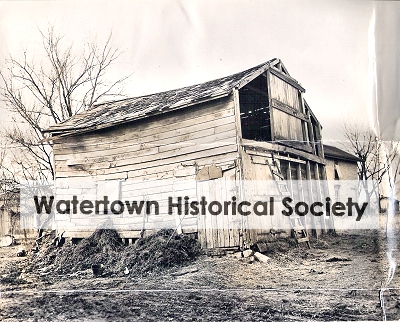
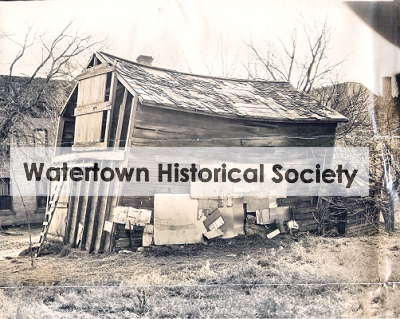

Cow Barn behind Cody home Former Cody home
North Church St, 1931 2005
Cross-References:
No 1: 1887-88 Watertown City Dir:
Cody,
James, physician, s.w. cor. W. Main and O’Connell,
res. w.s. Oak Grove rd, 2 n. of R’y
track.
Cody,
Wm. G., res. w.s. Oak Grove rd, 2 n. of R’y track.
No 2: 1893 Watertown City Dir:
Cody,
William, res. 114 N. Church.
No 3: Dr. James Cody (a Civil War
veteran) is buried in St. Bernard’s Cemetery, Watertown.

History of Watertown,
Wisconsin