website watertownhistory.org
ebook History of Watertown, Wisconsin
WHS
Concordia
Island
Tivoli
Island
Tivoli
Garden
Nestled
in an elbow of the winding path of the Rock River rests Tivoli Island, known
earlier as Concordia Island, and before that was one of many nameless islands
in North America's wilderness.
Long
before the Europeans first settled in the Watertown area, the island flourished
with lush vegetation and a wide variety of wildlife. Indians of the Potawatomi
and Winnebago tribes frequently visited this area hunting for game. By the time
the French fur traders canoed up the river, many of the Indians found living
here had come from eastern lands, having been forced to migrate due to western
expansion of the pioneers.
French
fur traders were some of the first white men to come upon these forests of
maple and basswood, and prairies scattered with oaks. Setting their traps along
the river, the island may have served as a place to camp for the night.
Timothy
Johnson
In the
1830's pioneers used the Rock River for a means of
travel in their pursuit of a new place to settle. Watertown's first settler, Timothy
Johnson, described the area surrounding the island as containing "a
combination of woodlands, prairie openings, and natural meadows. The banks of
the river were fanged with red cedars, the background being thickly wooded on
the west side with stately oaks and the east with a forest of maples, elms, and
ashes.”
Two
other early pioneers, John and Luther
Cole, arrived at the settlement and referred to the west side of the river
as being occupied by Winnebago and the east side by Potawatomi. They described
the area surrounding the island as having "several acres of cleared land
scattered here and there cultivated of corn by the Indians."
In
1835 the town lines were run by the government surveyor, John Mullet, on whose
map this island is clearly drawn. Soon after, Wisconsin became a territory and
in 1839, Jefferson County was formed. On the land to the west of the island, a
little settlement began to grow and by 1837 seventy strong-willed people had
made this beautiful area their home. Land could not be purchased until February
of 1839, after which the population began to increase, and by 1840 rose to 218
persons. From this time on the little island that we today call Tivoli Island
has played its part in the story of the city of Watertown.
First
Owner
The
first owner of the island was Jesse Decoy. He later presented the island as a
gift to the first son of John Cole, one of Watertown's founding fathers. Many years later, Mrs. John Cole
gave a speech on the island telling of its beauty and how her son had acquired
it. She said, “Before my baby was 24
hours old I had a deed for the boy of this little
island, the beauties and loveliness of which we so much admire and enjoy
today.”
In the
1840's an earthen and timber dam was constructed directly above the island by Joseph
and Calvin Boughton. The power was
used to run a saw mill on the east side of the river and a grain mill on the
west side. A wall was built from the dam
to the island to create a mill race around the island. In decades following construction of the dam,
city maps show the island enlarged and developed a peninsula extending to the
dam. These changes were caused by silt from the river building up along the
wall and along the island's shorelines.
It was recorded in 1908 that a
Benkerdorf family once owed the island.
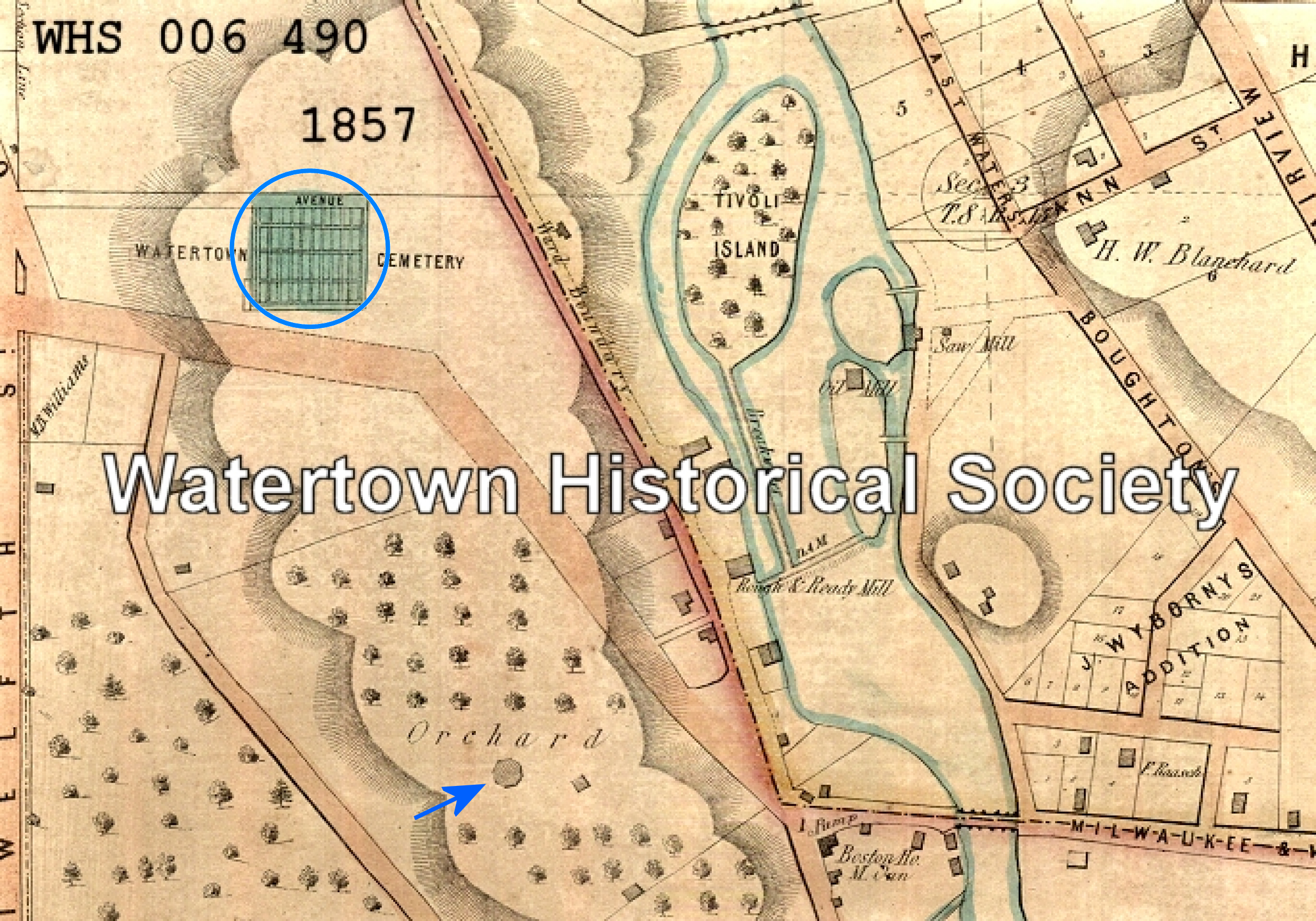
1857
Concordia
Island
1874
The
Watertown Musical Society, Concordia, has purchased Tivoli Island north of the
Rough and Ready Mills in the Second Ward and will proceed at once to fit up the
grounds as a grand summer resort. A
bridge will be built from the bank of the river to the island and a ball alley and suitable buildings erected. When the improvements contemplated are
completed, Tivoli Island will be a beautiful and enchanting spot for pleasure
seekers. The scenery in the vicinity is
charming and the grounds so convenient to the city that it must at once become
a popular place of resort for those in quest of rest and amusement." WR, 07 15 1874; WD, 07 16 1874
________________
In
1874 a German singing group, the Concordia
Music Society, purchased the island, and named it Concordia Island. The society had been formed in 1862 under direction of Mr. Gaebler. Concordia Island served as a host
to many saengerfests, music festivals in which most
of the singing organizations of the state would take part. Local citizens held picnics and heard frequent band
concerts on Concordia Island.
Unions, clubs, and trade guilds from throughout the state rented the
island for annual gatherings.
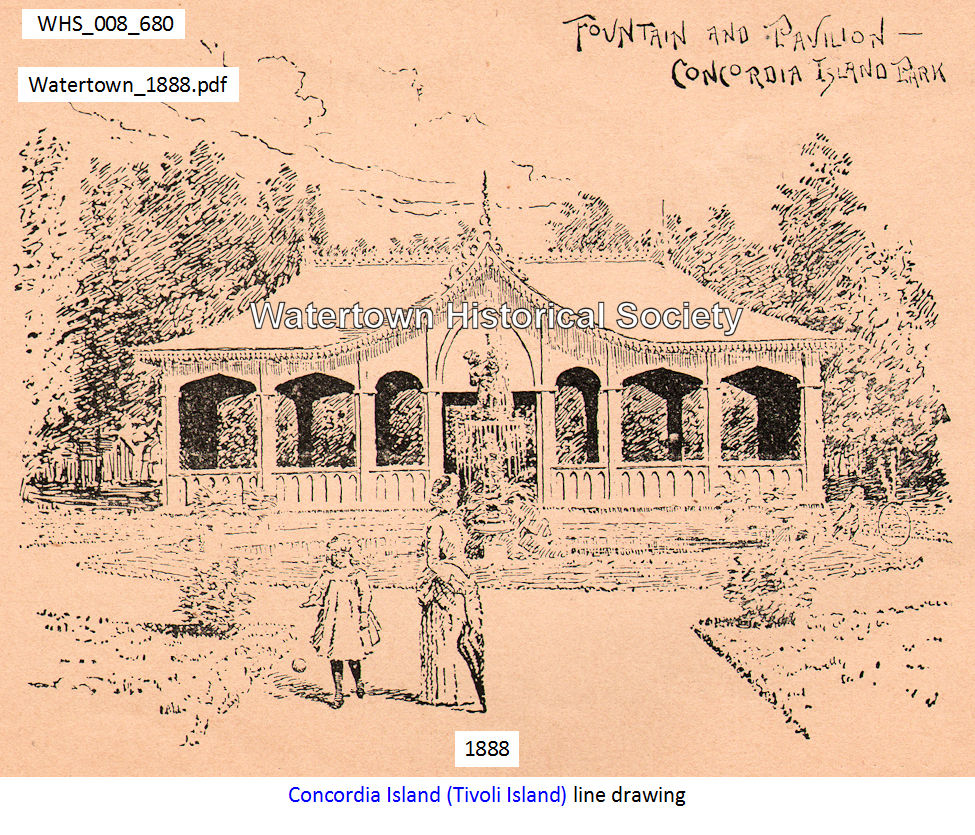
Concordia
members landscaped the island, planting many trees and shrubs of various
varieties, some of which are mature trees today. Members constructed numerous buildings
including a beautiful central pavilion.
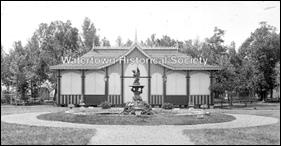
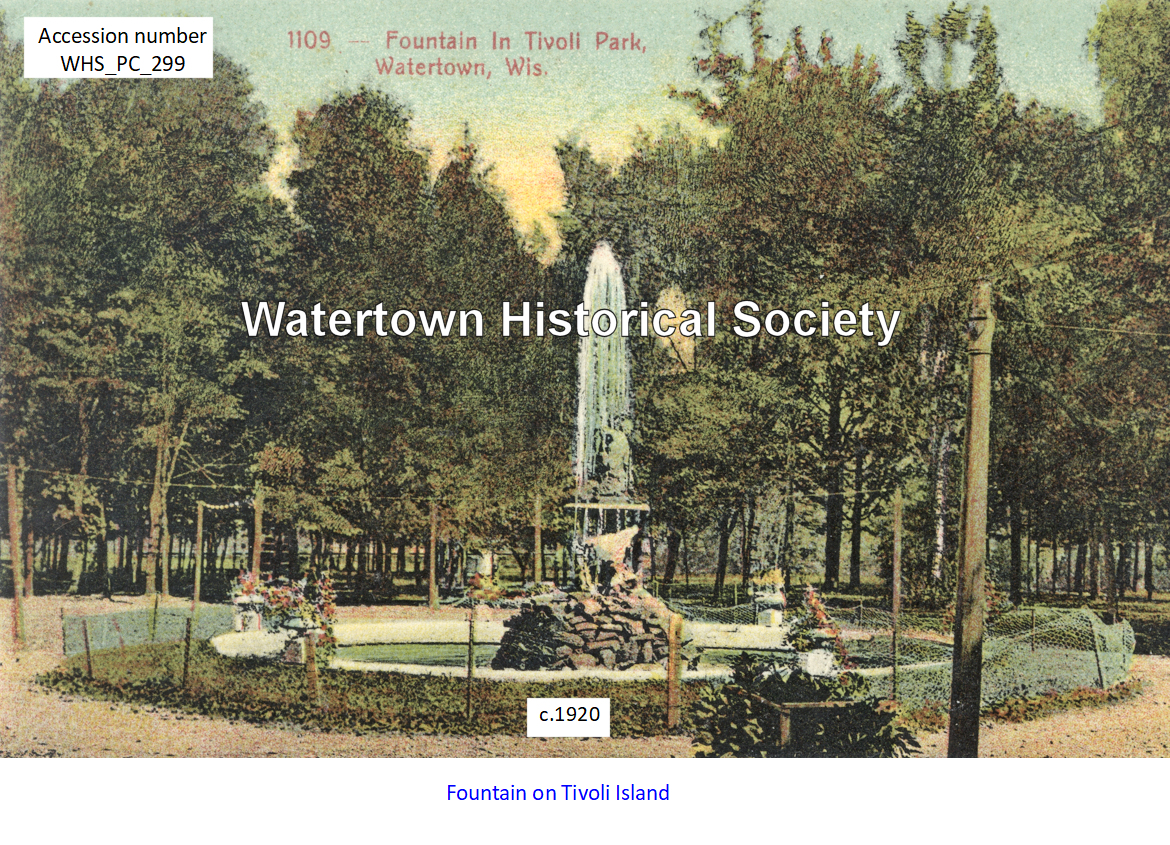
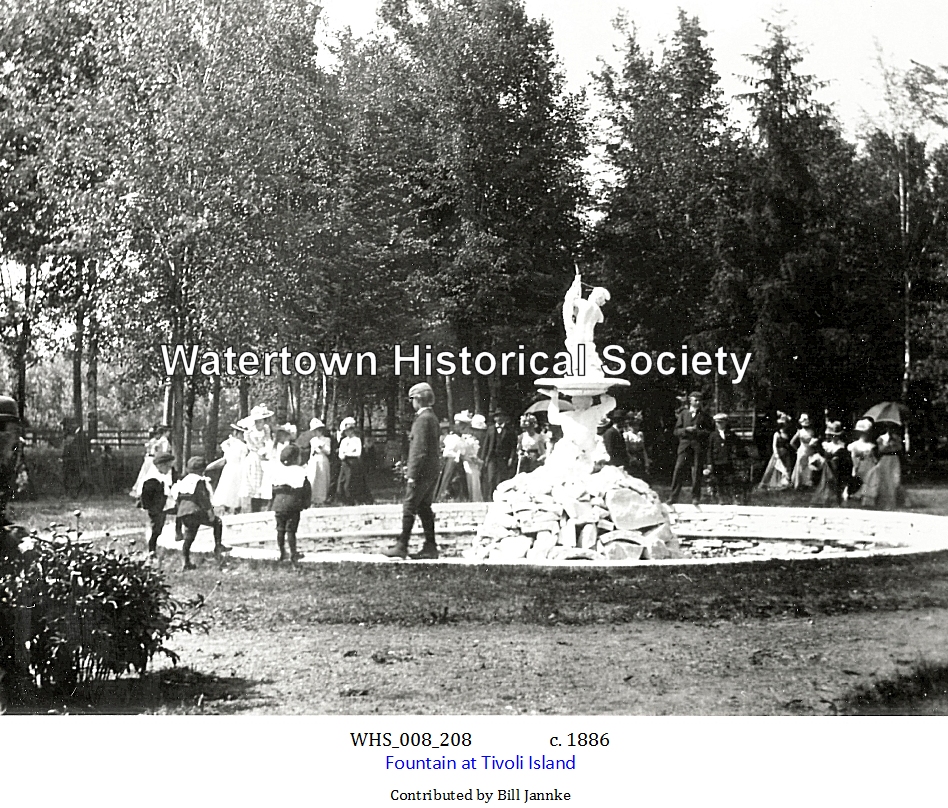
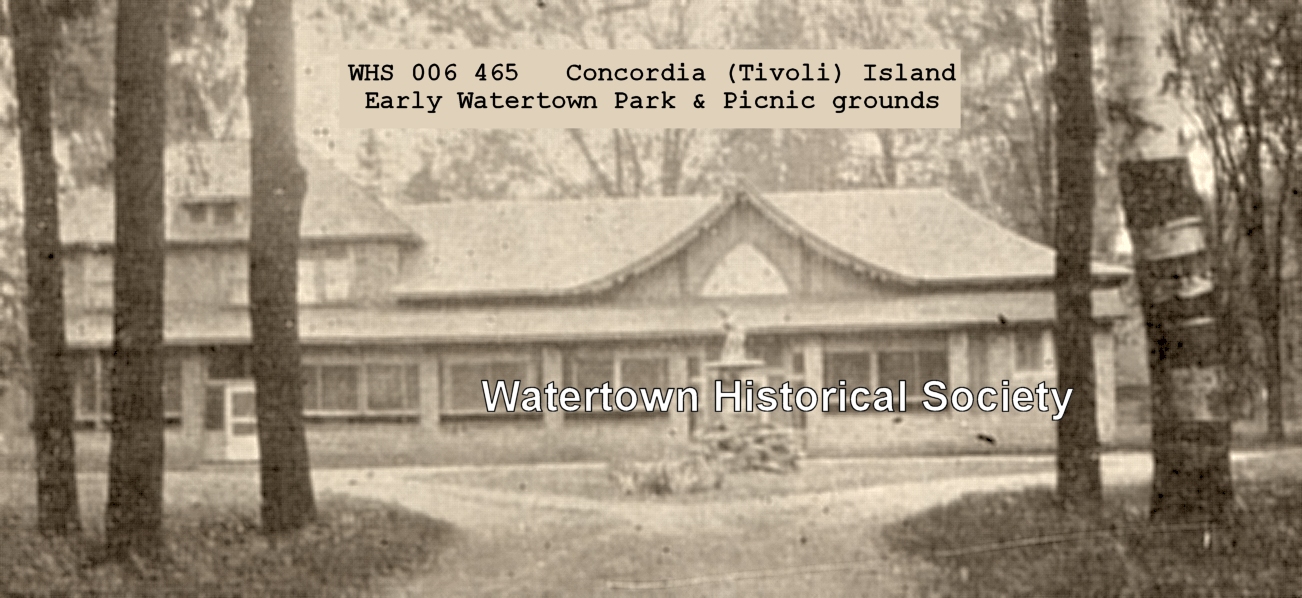
The island was graced with one of the first fountains in this area. Located in front of the pavilion, it sent
sprays of water splashing into a circular basin in the center of which stood an
ornamental statue. A secluded water tank
kept the fountain at play, while a windmill pumped water into the giant
container. It also had a circular
bandstand with beer, candy and ice cream sales on ground
level and quarters for musicians on the second floor.
Bowling
Alley
A
long, narrow building housed a two-lane bowling alley where the old game of
ninepins was played. A wooden, narrow
foot bridge spanned the Rock River on the island's north side, quite near the
present-day bridge. Concordia Island was known far and wide, and as some of
Watertown's old timers once recalled, the island was at one time so popular
that even Riverside Park cannot compare with the fame that Concordia Island
once knew.
Cross Reference: The Concordia Society also purchased the
Tivoli island, planted trees on it, built a pavilion, and painted it
themselves. In 1879 an octagon band
stand was built on the island, forty feet in diameter
and was first used for the band convention for which occasion Mr. Sleeper was
director and Mr. Mulberger, field marshal. Many concerts and picnics were held on the
island, a windmill supplied water power for the large fountain, a garden, and a
fine bowling alley helped make this a very popular place.
Cross Reference: Among the memories of 1938: The days when Tivoli Island had a saloon, a
bowling alley and a dance hall on it . . . and the
swings at the far end [south end] of the island that seemed to carry you half
way across Rock river at that point when you had them in full operation. WDTimes, 08 16 1938
1875
06 02 ARTESIAN FOUNTAIN CONSTRUCTED
The Watertown Musical Society has commenced the work
of sinking an artesian fountain in their pleasure grounds on Tivoli Island near
the Rough and Ready Mill. A flowing
fountain will add much to the beauty of the gardens. Watertown
News
06 03 BOAT
INSTEAD OF FOOT BRIDGE
The
Concordia Society now has a boat which will be used to convey frequenters
across the stream to that pleasant resort on their island instead of allowing all to pass over the foot bridge as they have done
heretofore. They expect the bridge to be
insufficient during the coming Saengerfest.
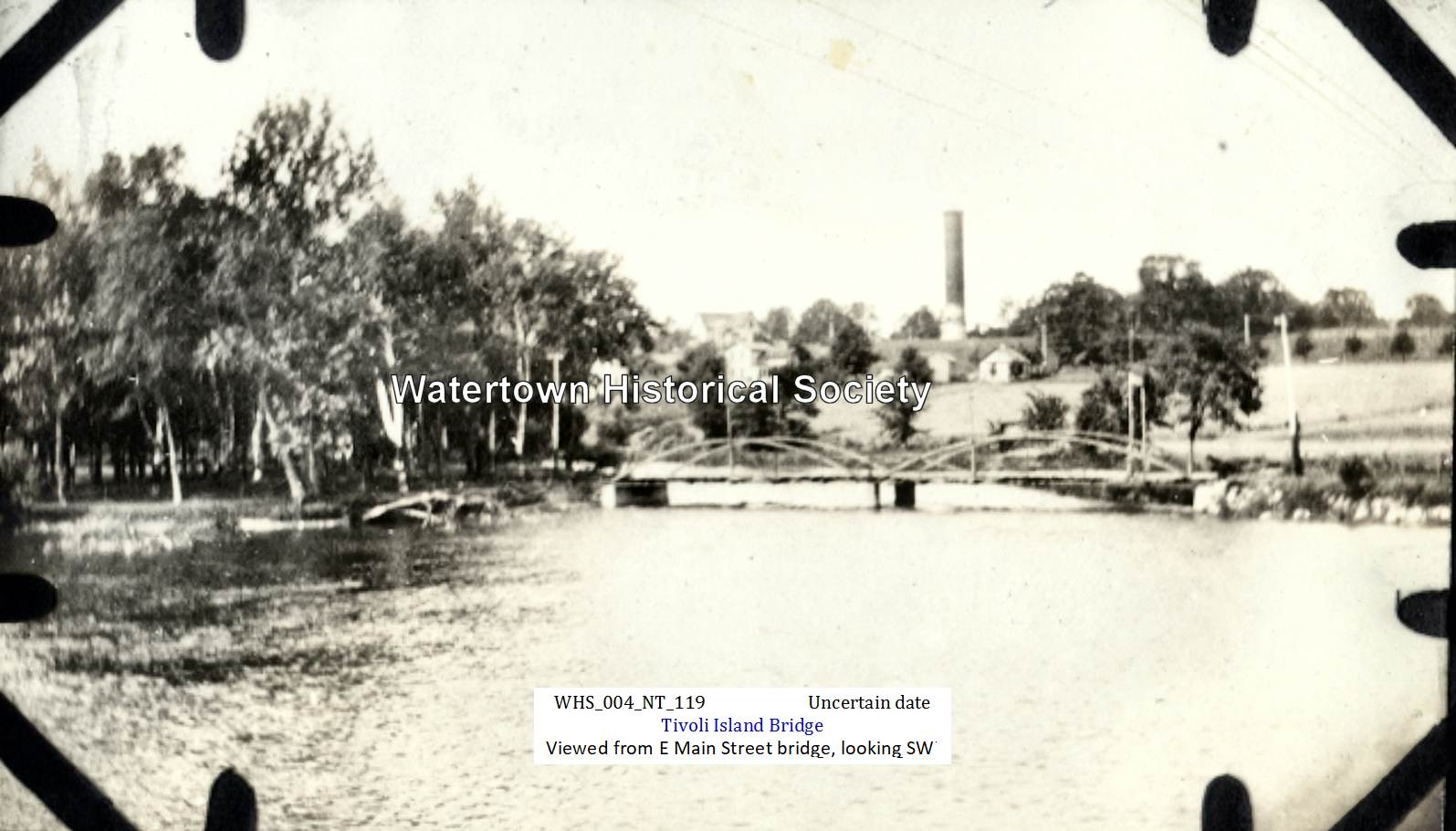 Uncertain date
1876
07 24 The excursionists who came up from Jefferson on
board the Florietta, Saturday morning, having spent a
few hours quite pleasantly in this city, started on their return trip shortly
after 5 o'clock in the afternoon. Busses
were provided at the Tivoli to convey passengers to the little steamer, which
stood waiting a few rods south of Boomer's dam to receive her cargo of human
freight. Before the boat started some
sixty persons were on board, including a band of
musicians, and several individuals from this town . . . The boat reached her
destination at half past eight o'clock in the evening, and as she slowly
entered the dock, the band played "God save the Queen." Hundreds of people stood waiting for the
boat's return, and before she fairly landed, loud exclamations of joy went up
from the gay and merry throng. The boat
will be here some time during the present week, to
carry passengers to Jefferson and back.
WD
08 23 Excursion
train of Milwaukee Turners picnic on Concordia Island. WR
1879
06 19 The Tivoli Garden has been recently fitted up
in a tasty and convenient matter, and is now the
finest resort for pleasure in this city.
Hoper's Tyrolean Troupe has been engaged by
John Heyman to give concert entertainments every evening. Admission to garden
10 cents – good also for refreshments. A
New York troupe has been engaged for the 4th of
July. All who wish to hear excellent
music should go and hear these musicians.
WD
c.1880
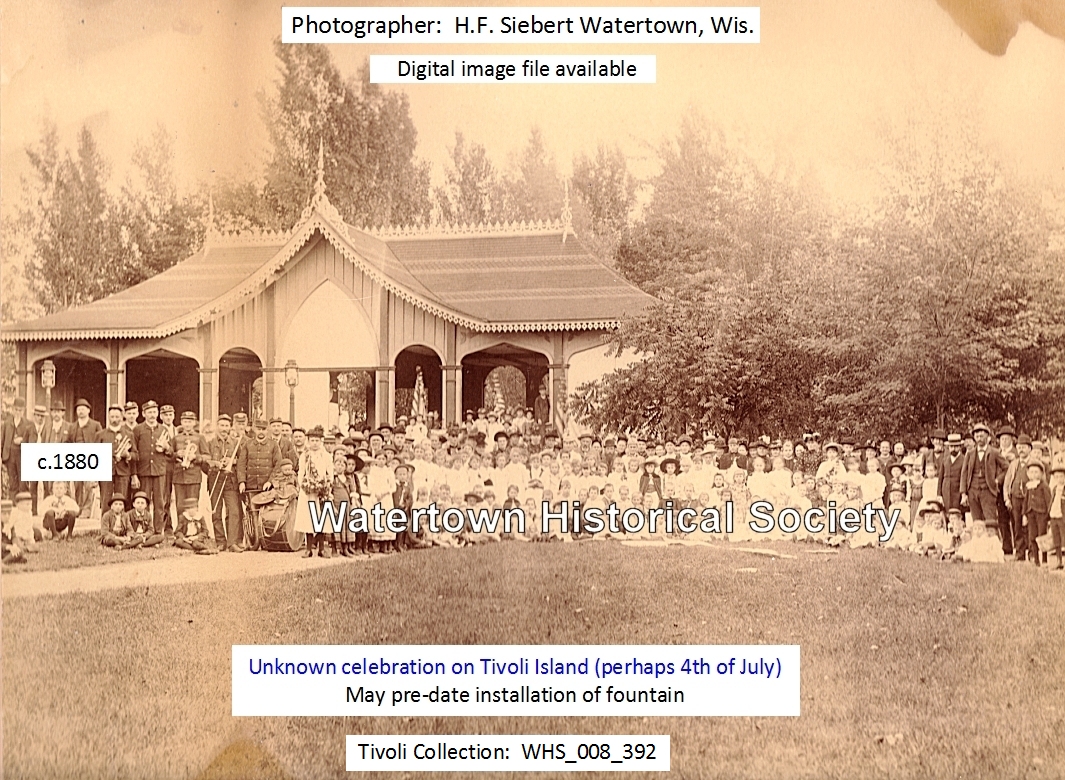 Unknown celebration (perhaps 4th of
July). May pre-date installation of
fountain
Unknown celebration (perhaps 4th of
July). May pre-date installation of
fountain
1882
-- -- FOUNTAIN
PURCHASED
 [article, written on 03 03 1932, refers to
1882] <> H. B. Gaebler recently turned over to Col. W.
F. Reichardt a letter written in 1882 relative to the fountain statute which
graces the center of Tivoli Island, now the property of Col. Reichardt.
[article, written on 03 03 1932, refers to
1882] <> H. B. Gaebler recently turned over to Col. W.
F. Reichardt a letter written in 1882 relative to the fountain statute which
graces the center of Tivoli Island, now the property of Col. Reichardt.
The
letter was written by officials of the Wassall Fire Clay Co. of Columbus, Ohio
from whom the statue was purchased by a local committee of which Mr. Gaebler's
father, the late Max H. Gaebler was chairman.
The letter written in fine long hand is well preserved and the original
envelope bearing a green 3 cent stamp with a portrait of Washington is still
intact.
The
Wassall Fire Clay Co. was at the time one of the leading manufacturing concerns
of such statues and fountains and many of their works are still to be found in
parks and on private estates throughout the nation. The letter to Mr. Gaebler pronounced the
fountain for Tivoli Island ready for shipping and the company was awaiting
instruction. For many years the fountain
was the central attraction on the island and old timers as well as some of the
younger folks of the community will recall the display it made with its streams
of water shooting out from several places on the base. The fountain at the time was considered the
last word in such ornamentation and although it is still in position [1932],
its glory has long been dimmed.
Col.
Reichardt will preserve the letter.
Later on it could be passed on to the proposed
museum which is hoped to be established.
At the time it was purchased it was known as the Concordia Island
fountain.
05 03 WATER
SUPPLIED TO FOUNTAIN
E.
A. Mendenhall has just taken the contract from the Musical Society to put up an
Eclipse wind mill on Concordia Island to draw the water from the Rough and
Ready Mill dam. A 700-barrel tank
will be erected which will furnish a supply of water for a fountain and all
other purposes. The
Watertown Republican, 05 03 1882
06 27 THE FOURTH AT CONCORDIA
Concordia
Island will be an attractive spot on the Fourth
next Wednesday. Picnicking will be the
order of the day amid the sylvan shades in this favorite retreat and the hours will
be enlivened with sweet chords of music from the Philharmonic Cornet Band. Arrangements have been made for grand balloon
ascensions and other amusements during the afternoon. WR
07 04 SCHOOL
PICNIC
Saturday
was a gala day for the children of the public schools. They turned out to the number of nearly nine
hundred and with their teachers marched to Concordia Island. The grand procession formed in front of Union School
No. 1 and headed by the Philharmonic Band moved fine array to the picnic
grounds. The long line of scholars, from
the tiny toddler to the mature boy and girl, decorated with flags, and carrying
cups and other picnic apparatus, their faces beaming with delight in
anticipation of the pleasures ahead, was indeed a beautiful sight. The arrival at the island was the signal for
the vast throng of juveniles to enter into the most
boundless ecstasies of joy. The little
ones amused themselves in various ways during the afternoon and they produced
loud and positive proof of their appreciation of the occasion. The luncheons provided for the children found
eager partakers and there was a rapid disappearance of sandwiches, cake, lemonade,
candies, ice cream and other things good for little stomachs. With the going down of the sun all returned
to their homes having every reason to remember with gladness the picnic of
1883. WR
08 01 YET ANOTHER PICNIC
A most
pleasant and agreeable picnic party was held at Concordia Island last Friday
evening. The weather was all that could
be desired giving those in attendance a fine
opportunity of enjoying the quiet shady retreats of the lovely grounds decked
so beautifully with nature's gifts of grass, flowers, trees
and shrubbery. After tea was served the
party repaired to the pavilion and danced away dull care for a
number of hours, choice music for the happy occasion having been
provided by the management of the delightful affair. WR
1885
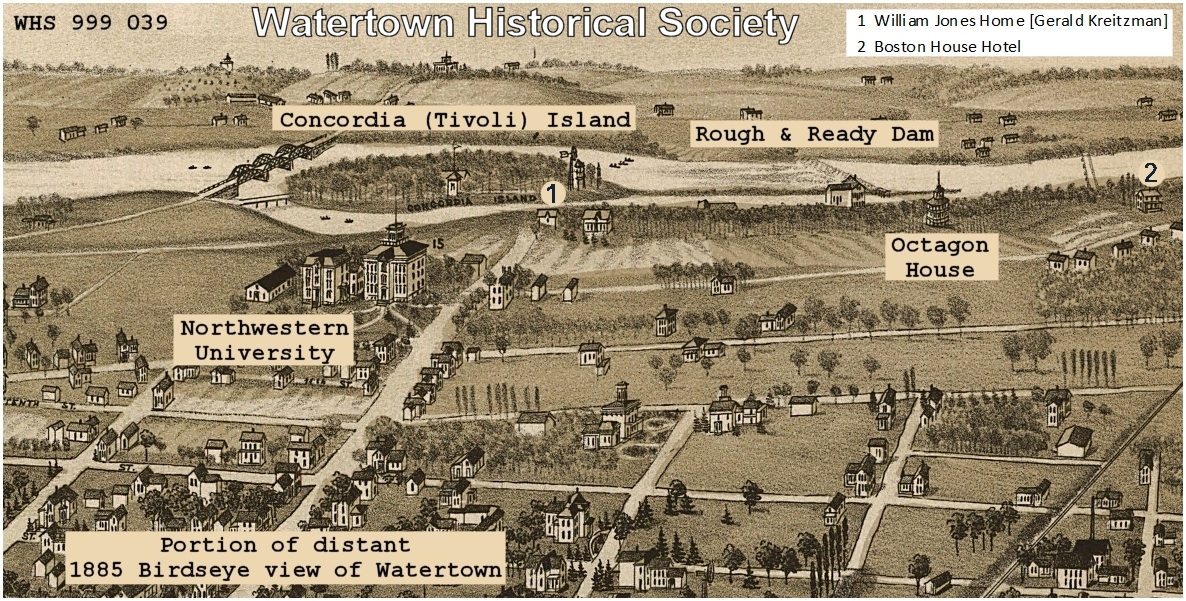 Portion of birdseye
view
Portion of birdseye
view
1886 FOUNTAIN
AND PAVILION, Concordia Island Park, [Tivoli Island]. This building was removed in 1961
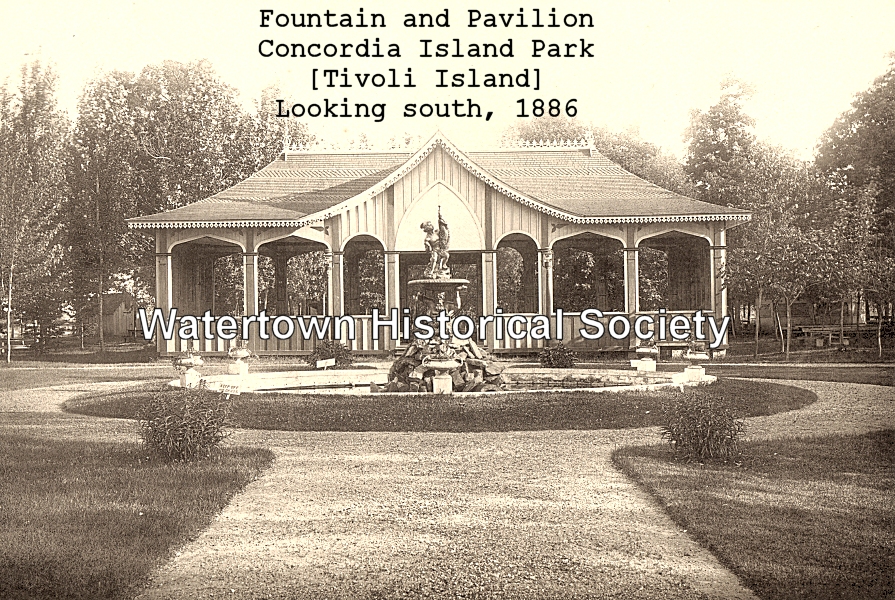 looking south, 1886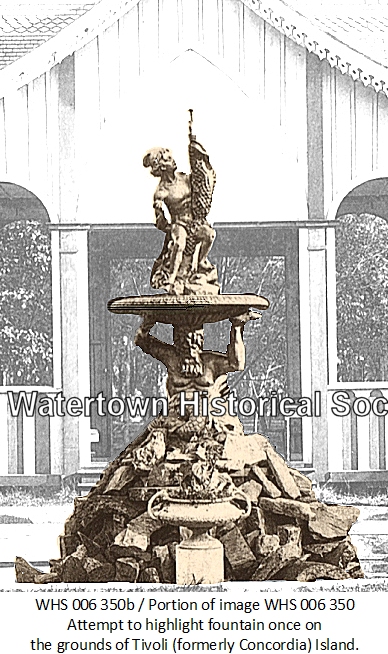
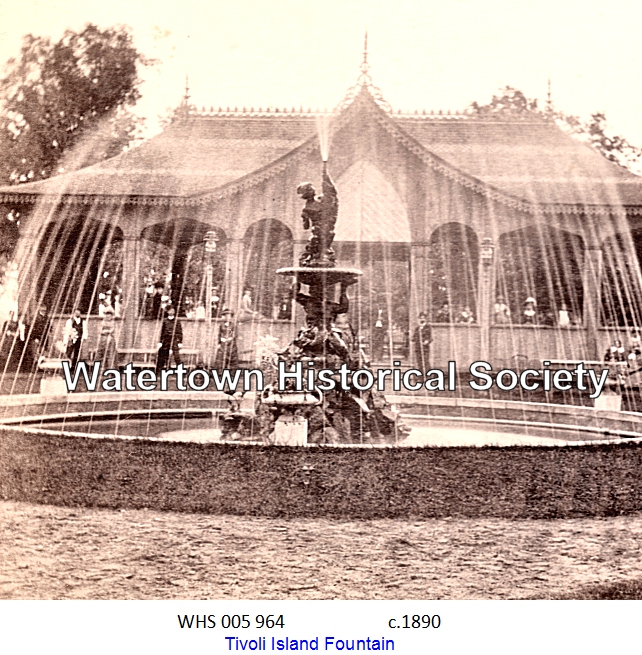
 looking north, ____
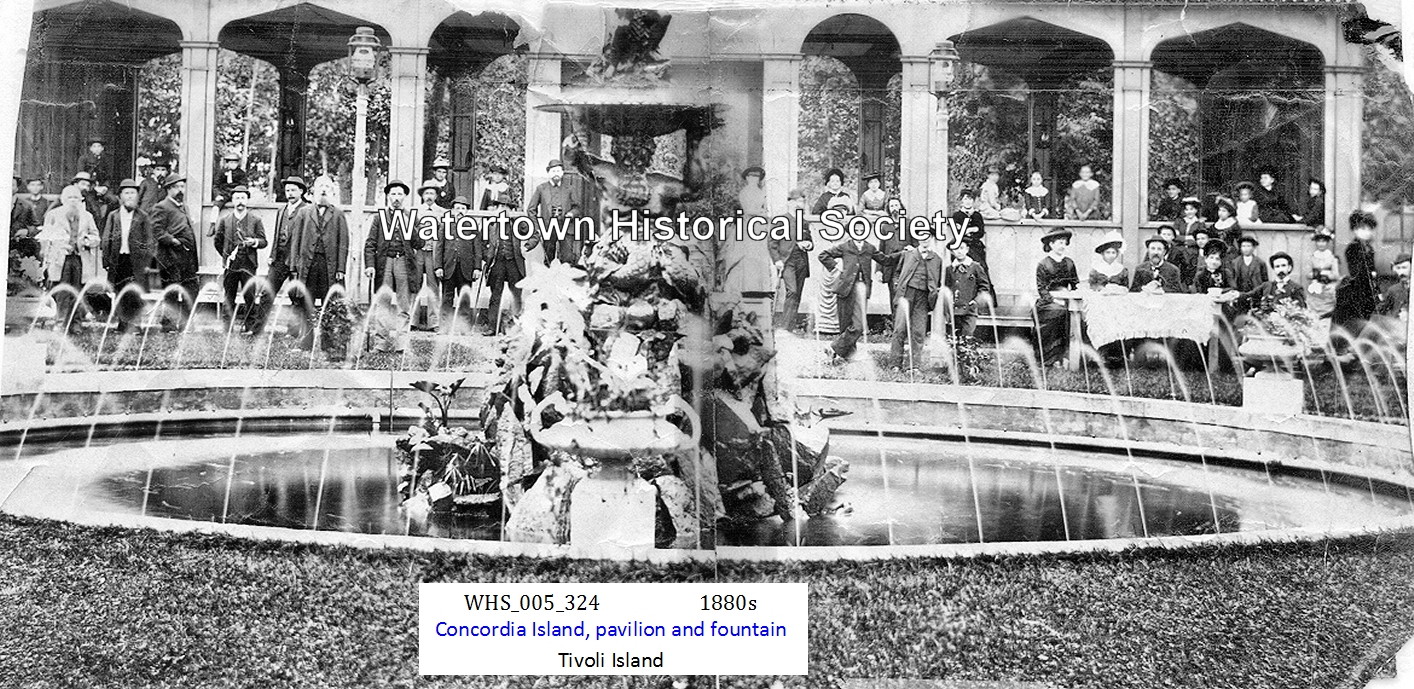 Concordia Island, pavilion
and fountain, 1880's
Concordia Island, pavilion
and fountain, 1880's
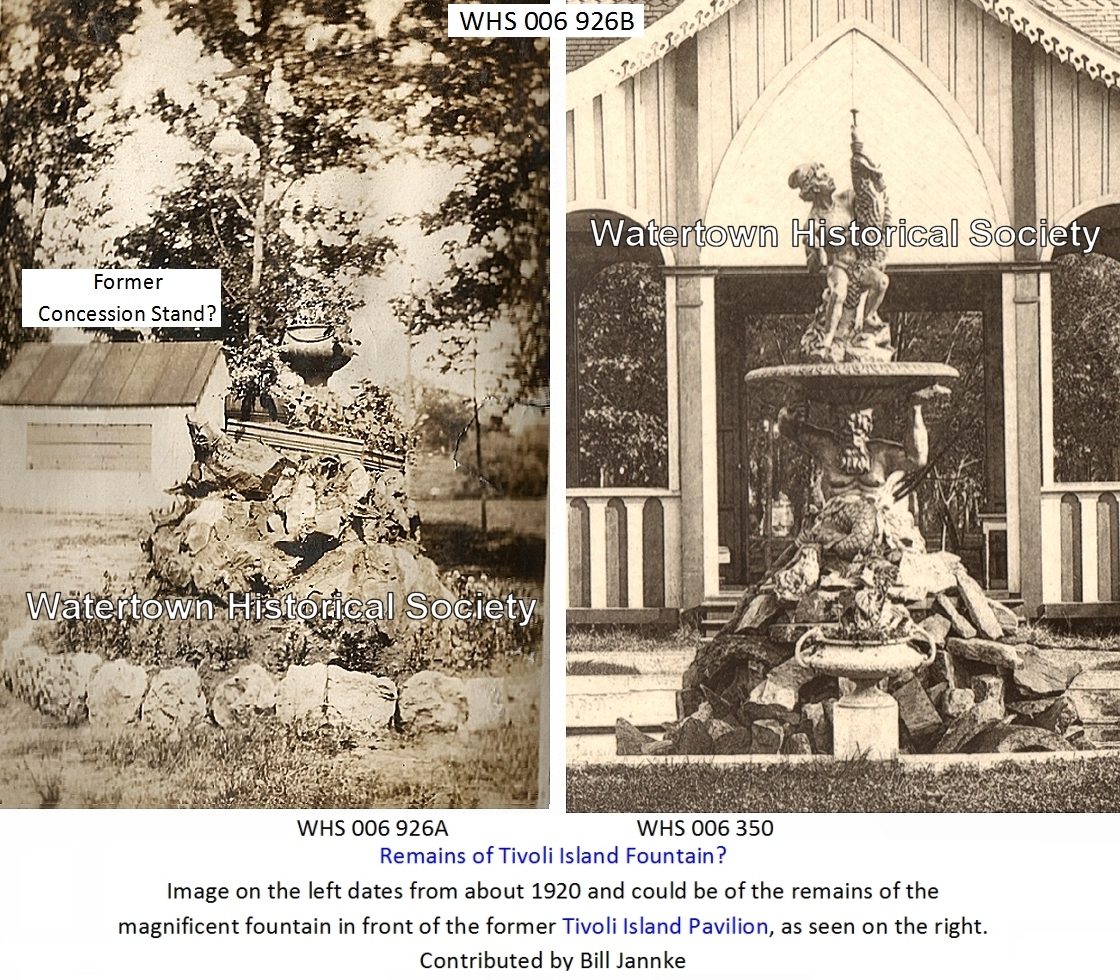 c1920 Remains of fountain?
1887
08 03 LINCOLN GUARDS
The
grand excursion and picnic of the Lincoln Guards, of Milwaukee, to be held at
Concordia Island park next Sunday afternoon, Aug. 7. promises to be of the most
attractive and enjoyable affairs of the season.
The guards are said to be a fine body of men and are noted for the
beauty and precision of their evolutions.
We know of no more imposing sight than a well drilled body of soldiery,
and present for our citizens a most delightful entertainment on this occasion.
1888
1890
06 18 BALLOON
ASCENSION FROM ISLAND
The renowned
Prof. E. E. Graig will make one of his marvelous balloon ascensions from
Concordia Island next Sunday afternoon.
From the height of 6,000 feet the aeronaut leaps to the earth and by the
aid of a parachute lands in seventy seconds, forming a most thrilling and
wonderfully daring spectacle. Read the
last number of The North American Review. WR
06 25 BALLOON
ASCENSION
Prof. E. E. Craig made a beautiful balloon ascension from Concordia island Sunday
afternoon. He descended from a great
height with a parachute, alighting at the Bohemian garden. WR
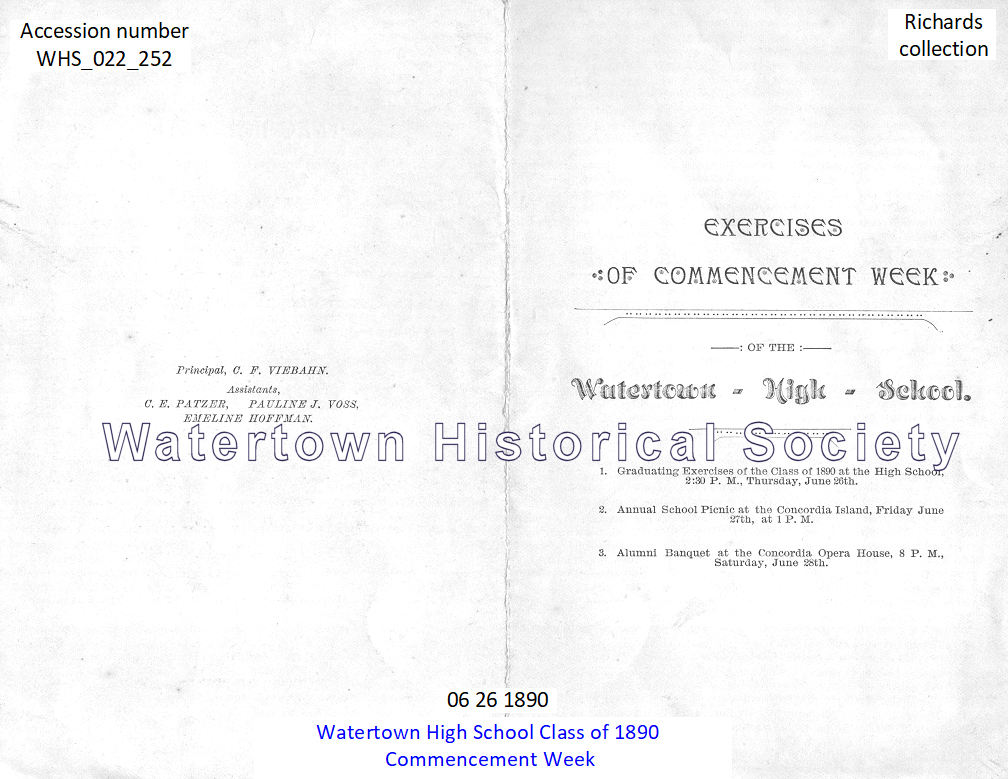
06 26 LOCATION FOR GRADUATION CLASS
EVENT
07 02 FOURTH
OF
JULY IN THE PARK
It is
proposed to have our citizens partake of their dinner on Fourth in the city
park, and enjoy a good old-fashioned Fourth
of July time among the
flowers and in the shade. Let everybody
come who can and spend a jolly time with some patriotic feelings and perhaps
speaking and singing mixed in. Bring
your baskets well filled. Seats and
tables will be provided for the many.
Dinner will be ready to serve at 1 o'clock. The ladies' committee will sell lemonade and
ice cream for the benefit of the park fund.
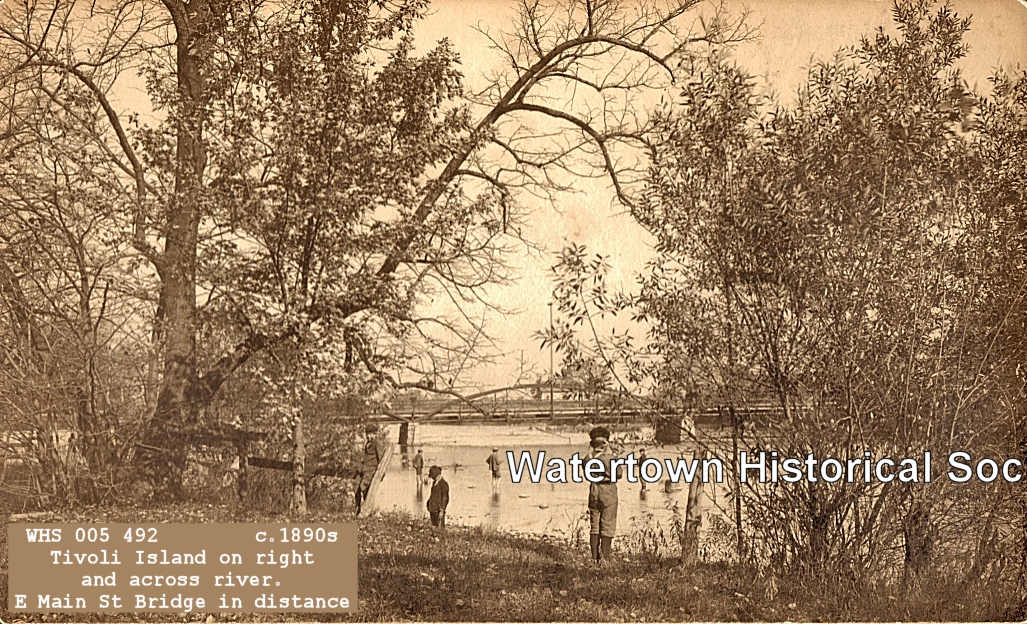
1890s Image of boys
fishing along river bank
c.1890
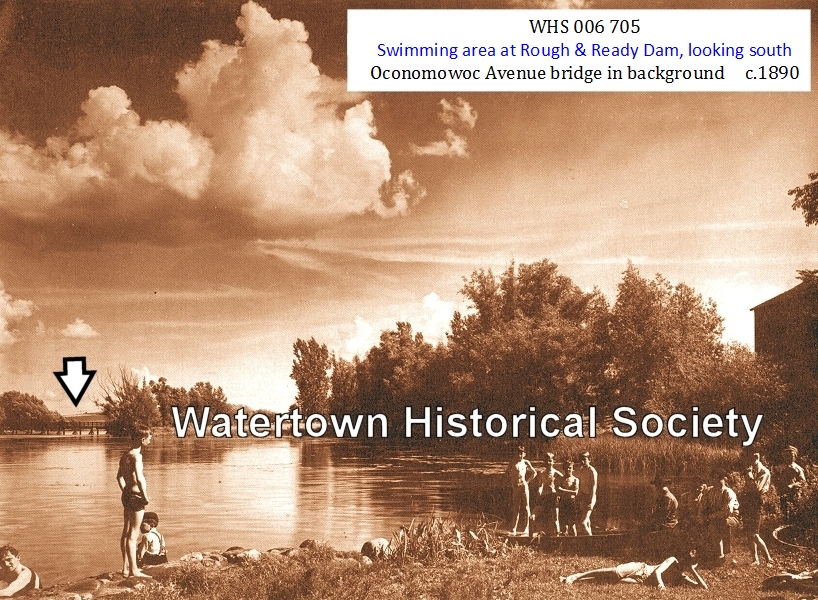 Swimming hole, area SW side of Tivoli Island, looking south
1891
06 10 WATER
TANK DESTROYED
The
storm of last Wednesday afternoon in this vicinity did considerable
damage. Barns were blown down on the Reimmels and Klausche farms in
the town of Watertown and on the farm Wm. Panchke in
Farmington. Hail stones fell during the
storm rivaling in size any ever seen before in this locality. Some of the stones measured over five inches
in circumference and all averaged as large as hickory nuts. Some glass was broken throughout the city,
but not to the extent that might be supposed, owing to the
fact that the hail fell in a slanting direction instead of
perpendicular. Loeffler Bros. greenhouse
lost about twenty-five or thirty panes.
The water tank on Concordia Island was blown down with
a loud crash and the tub broken into splinters.
This is a heavy loss on the Concordia society.
06 19 DESTINATION FOR
EXCURSIONISTS
There
will be an excursion next Sunday from Milwaukee by the American Legion of Honor
and the excursionists will picnic on Concordia (Tivoli) Island and will have
with them a first-class band to furnish music for concert and dancing.
Admission to the Island is free. WG
06 24 EXCURSIONISTS
NUMBERED 115
Not nearly
as many as were expected participated Sunday in the excursion to this city of
the American Legion of Honor of Milwaukee.
The day was fair and pleasant until 5 o'clock in the afternoon, when a
heavy shower fell, proving something of a damper to the day's enjoyment. The excursionists numbered 115.
c.1902
-- -- WINDMILL
ON TIVOLI ISLAND
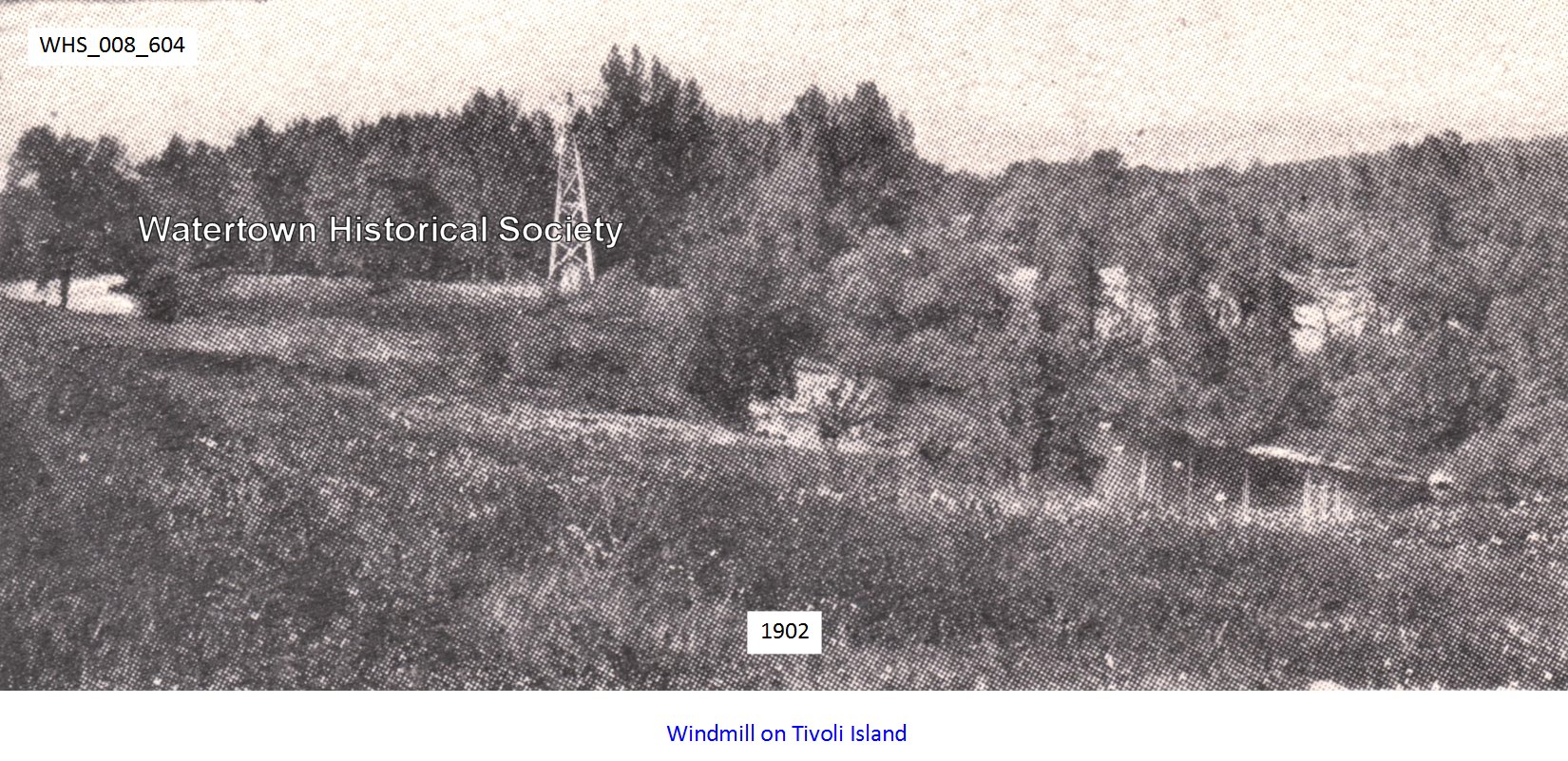
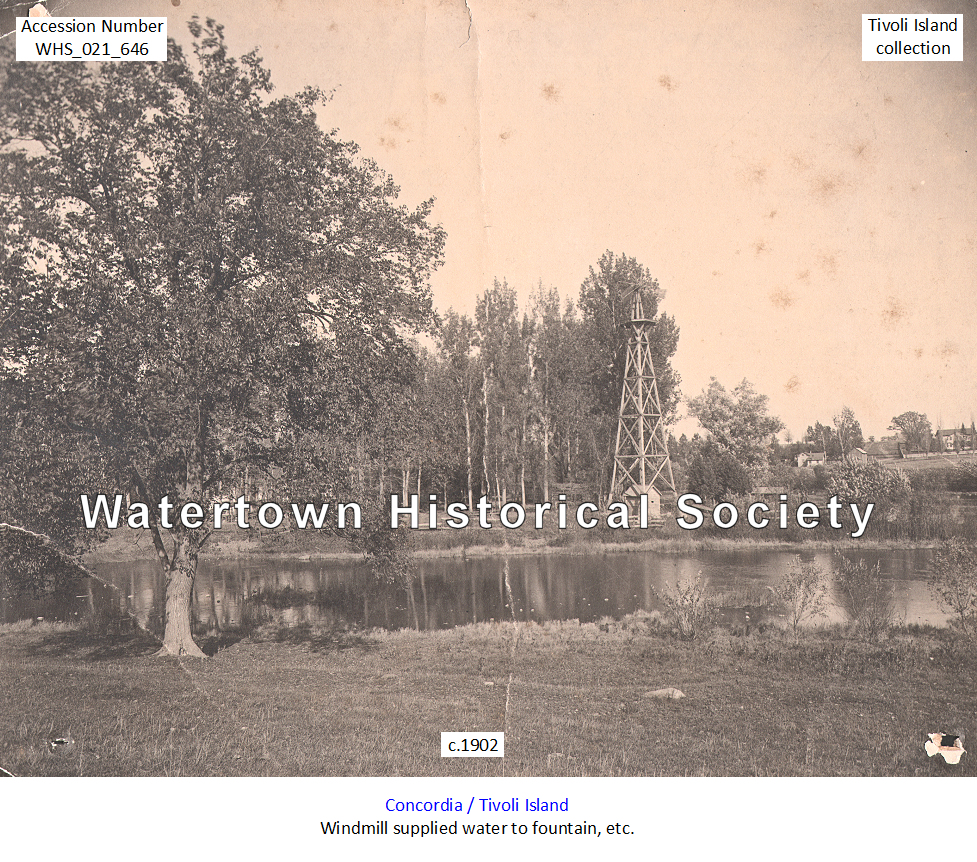
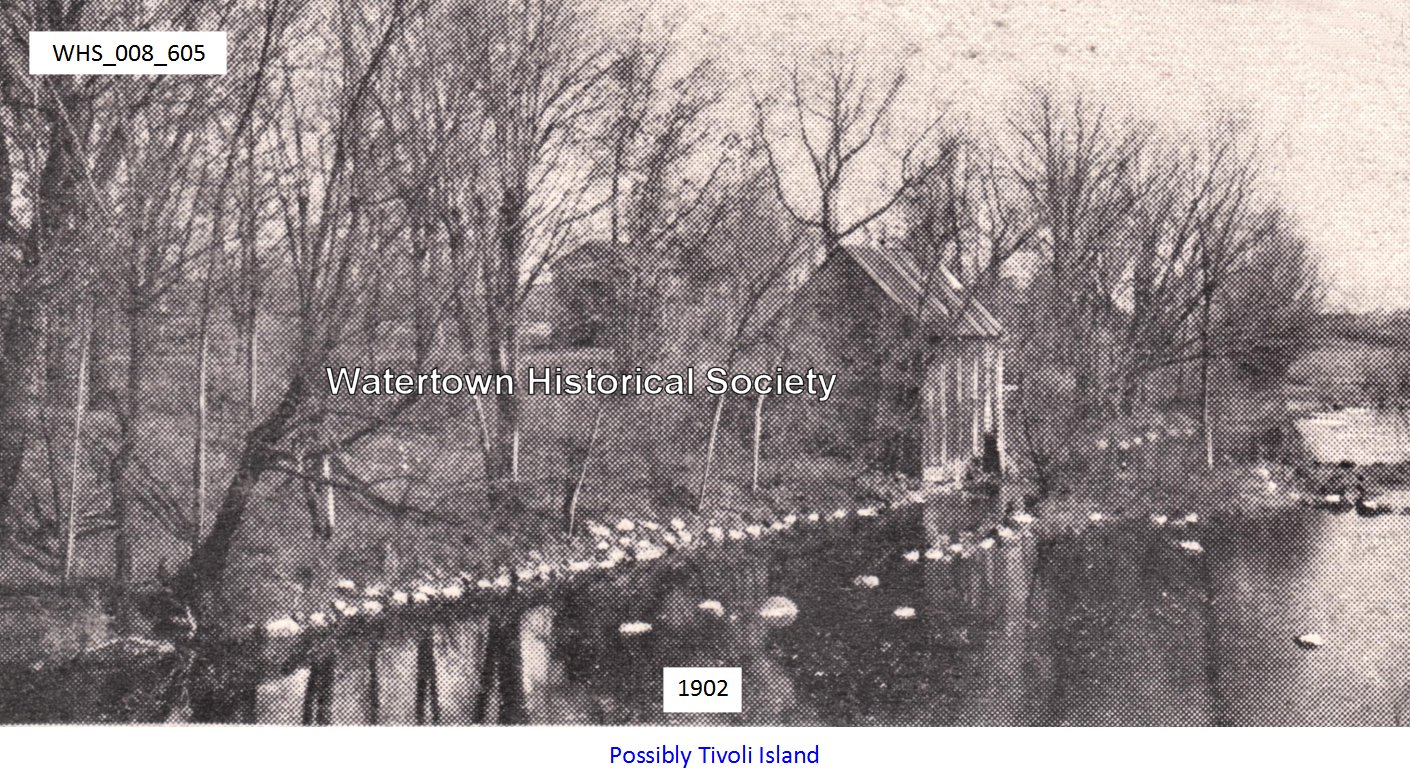 < 1902 views
1895
06 19 ANNUAL
SCHOOL PICNIC
Last Thursday
was a gala day for the country people of this vicinity, the occasion being the
first picnic given by the Watertown Farmers’ Club on Concordia Island. The city had a festive appearance, and many
of our residents took a half-holiday and joined with
their country friends in the afternoon's outing. Some of the principal streets were decorated
with greens, while the business houses generally were
festooned with bunting, flags, etc.
Preceding the picnic an industrial parade, abounding in amusing features,
took place. . . .
In the lead was the Watertown Cornet band, attired in most ludicrous
costumes after the style of the proverbial "hayseed." The chief idea of the parade was to depict
the old and new modes of farming, and this was done by a complete display of
agricultural implements both in and out of use.
06 26 ANNUAL SCHOOL PICNIC
Yesterday
afternoon the annual school picnic took place on Concordia Island, but it was
rather a sorry outing for the children, the hard rains spoiling all their
fun. The procession of some 900 children
in line, headed for the island, after the first shower had passed, about 2:30
o'clock, but the destination had scarcely been reached when the lowering clouds
again opened and thoroughly drenched many of the young folks, the sheltering
places not being sufficient to accommodate all.
The picnic broke up and the children regretfully wended their way
homeward with anything the present recollections of the school picnic of 1895,
an event so long and so joyfully anticipated.
The festivities were concluded this forenoon at the different school
houses, and the good things in the eating line disposed of. WR
c.1895
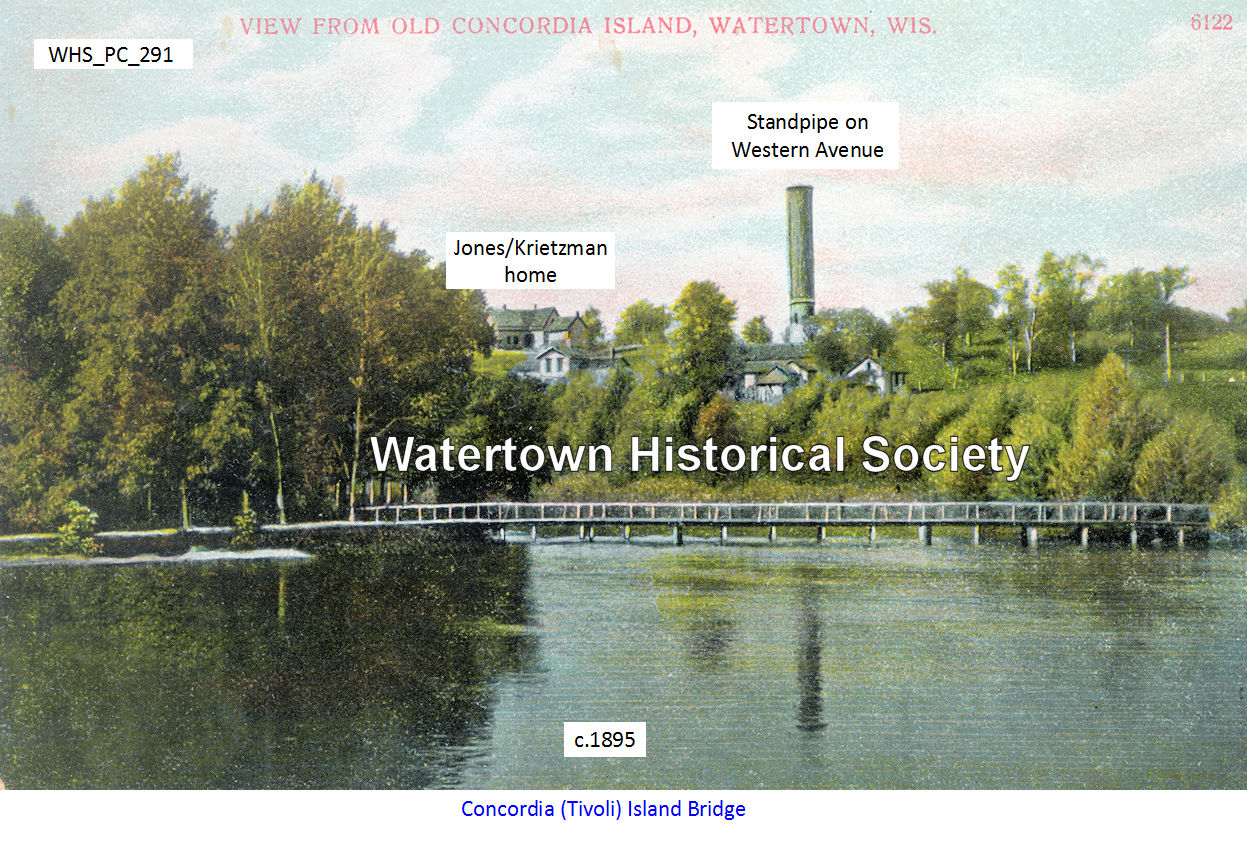
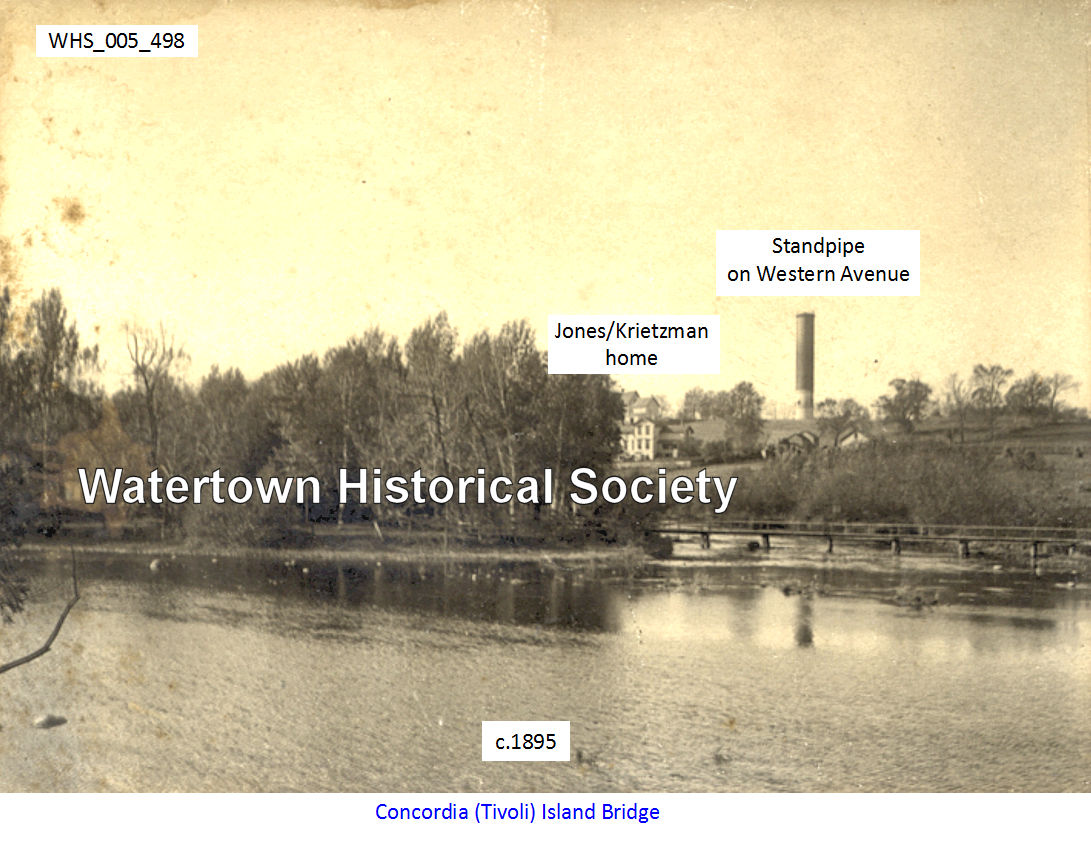
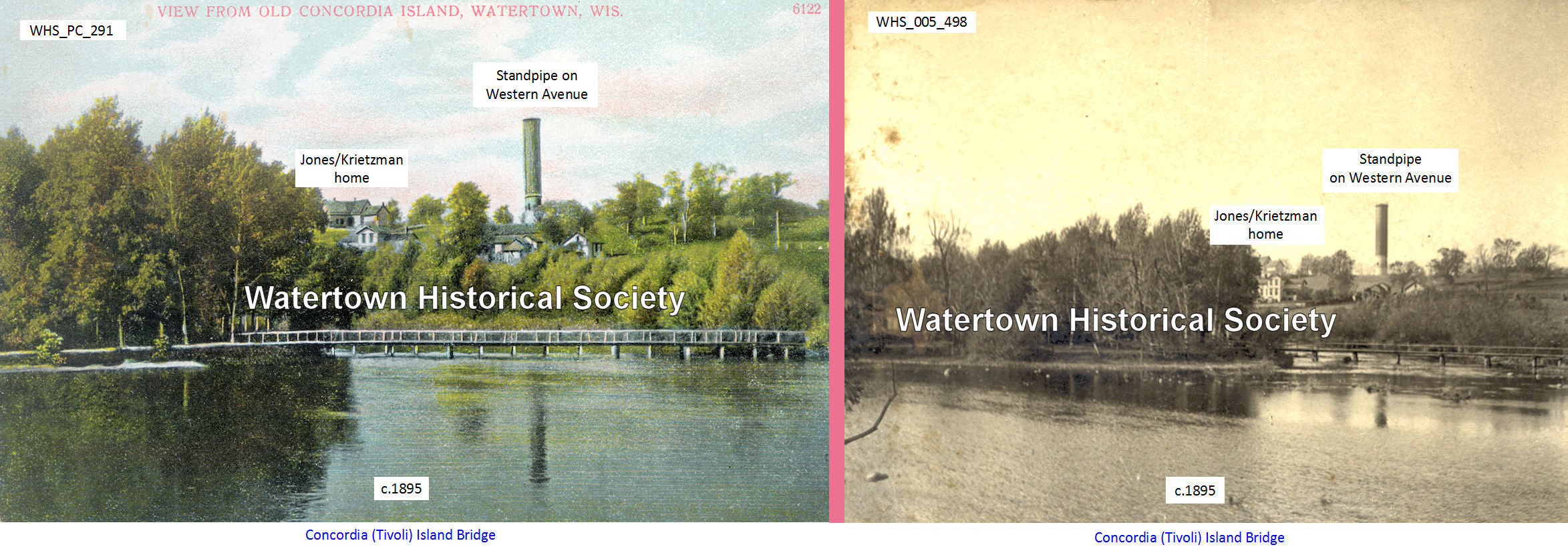
1898
06 29 RAIN SPOILS ANNUAL SCHOOL PICNIC
The-rain which began to fall about 4 o'clock last
Friday afternoon had the effect of spoiling much of the enjoyment of the annual
school picnic being held at Concordia island and drove the participants home in
flocks. The school children, in gay
holiday attire, marched to the island at 1:30 o'clock accompanied by the Sinnissippi band, but were only allowed about two hours of
fun before the rain came. WR
1899
06 27 ANNUAL
SCHOOL PICNIC, Concordia Island

Friday
was an ideal day for picnicking, and the children of the public
schools hugely enjoyed their annual outing on Concordia island. The procession of some 1,200 pupils in charge
of their teachers and attired in holiday garb, made a
pleasing picture as it wended its way to the island where the afternoon was passed with various kinds of games and pastimes. The Sinnissippi
band furnished music for the occasion. WR
08 22 DELIGHTFUL
ENVIRONMENTS OF THE ISLAND
The
Misses Emma and Clara Shasky entertained their friends to the number of nearly four
score in a charmingly hospitable manner Friday evening at a dancing party the
Concordia Island pavilion. The
delightful environments of the island, enhanced by the favorable weather and
the mellow light of the full moon, made the occasion truly enjoyable to all who
had the good fortune to be present.
Music was furnished by the Blaesius orchestra
and light refreshments were served. A
considerable number of guests were from out of town. WR
Cross Reference:
Miss Clara was the Goddess of Liberty in the 1901 Fourth of July parade.
1900
06 17 LEISURE
TIME AT CONCORDIA ISLAND
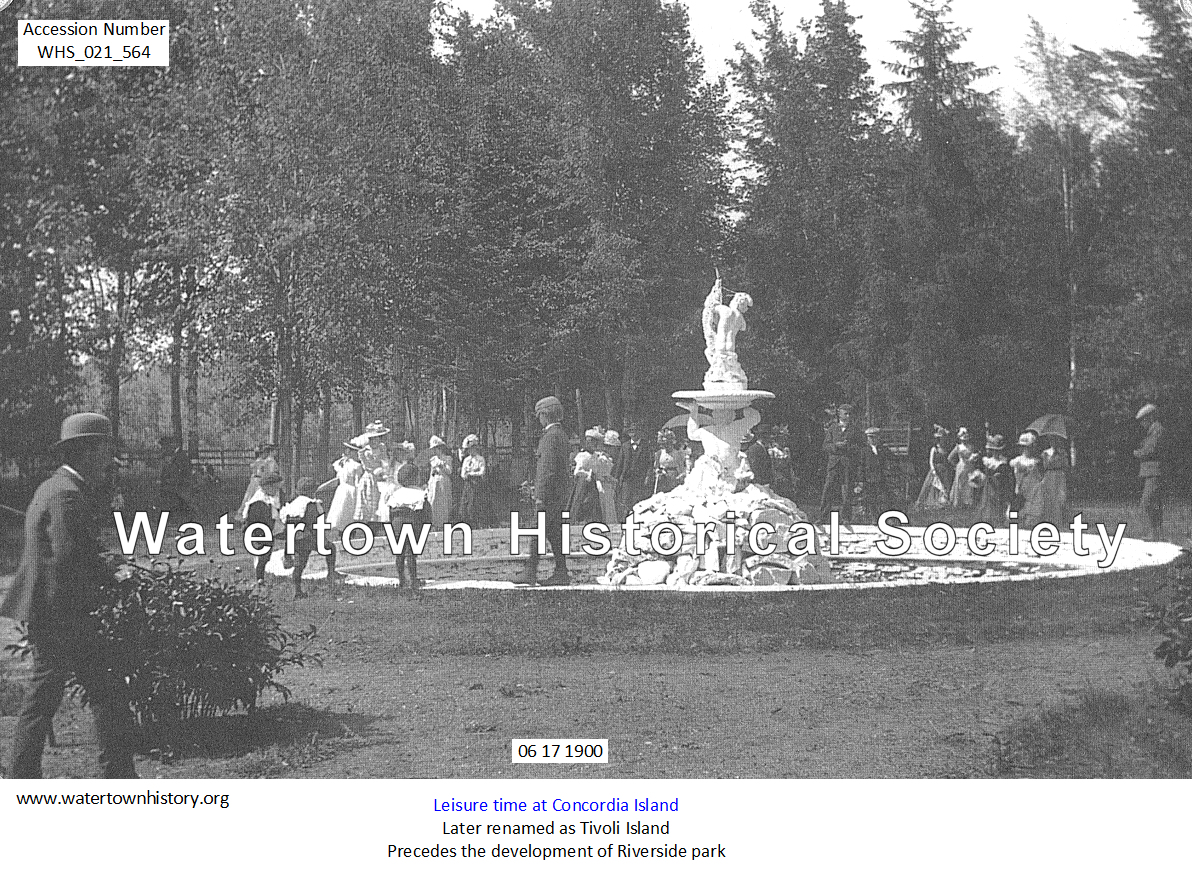
06 26 ANNUAL
SCHOOL PICNIC, Concordia Island
Owing
to the threatening weather of Friday, the annual picnic of the public
schools was postponed until the following afternoon. The necessity of postponing it was a sore
disappointment to the children, but they were nevertheless handsomely rewarded
for waiting, as a more perfect day for picnicking than last Saturday could not
be imagined. The pupils marched to
Concordia Island shortly after 1 o’clock in charge of their teachers and to the
music of the Sinnissippi band, and during the
afternoon parents and friends joined in the festivities. There was plenty of
good things to eat and drink, and what with various games and pastimes the
hearts of all were made glad and happiness reigned supreme. This yearly outing provided by the board of
education for the special enjoyment of the scholars after their school-room
labors is long anticipated with a great degree of pleasure, and it is an
institution which it is hoped may always be maintained. WR
06 29 The annual picnic of the public schools
was held on Concordia Island last Saturday afternoon. The picnic had been arranged for Friday, but
the day being rainy, it was postponed to Saturday, which was an ideal day for a
picnic. About 1600 children were in
line, accompanied by their teachers and the Sinnissippi
band. The children of the different
schools met at the Main Street bridge, where the procession was formed, and all
marched to Concordia Island, where a fine feast was in waiting, and all passed a most delightful afternoon together. A large number of
parents were present as well as friends of the
school. WG
1904
09 09 LABOR
DAY CELEBRATED on larger scale than ever before.
Monday was Labor Day, and it was celebrated here
on a larger scale than ever before. The
weather was pleasant and all who possibly could turned
out to join in celebrating the event at Tivoli Island, where a fine program was
arranged by the Central Labor Union. All
the unions of the city turned out and the parade started to the island at 1
o'clock from Union hall west to Fountain Street and back again to West Main and
Main Street. It was an interesting sight
to witness. The streets were crowded
with people to witness the parade, and those taking part in it were highly complimented all sides.
Each union wore a distinguishing mark of their trade. It was made up of one of the finest bodies of
men that has ever taken part in a parade here . . . Labor day, 1904 will pass
into history as one of the most enjoyable that Watertown people have ever
enjoyed.
1905
Third
Annual Homecoming
The
afternoon was spent in perhaps the most natural picnic grounds in all America -
Tivoli Island. Situated in the middle of Rock River, containing several acres
of fine wooded land, and within walking distance of the city, it is an ideal
spot. The beauty of the scene is
enhanced by the renowned Rough and Ready waterfall, which stretches the whole
breadth of the river just at the end of the island and within full view of it .
. . full
article
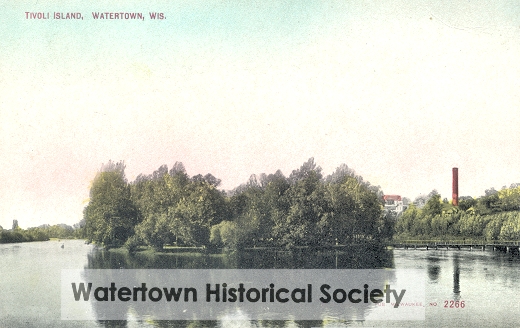 c1905
c1905
1906
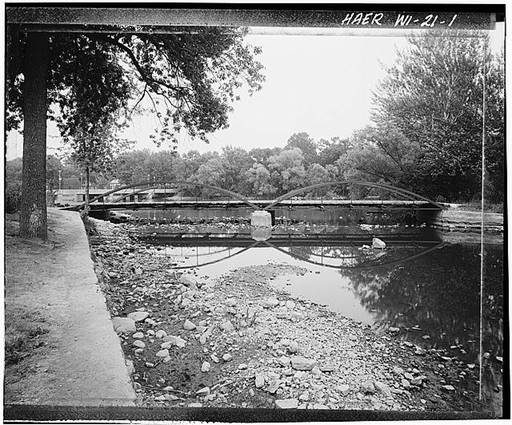
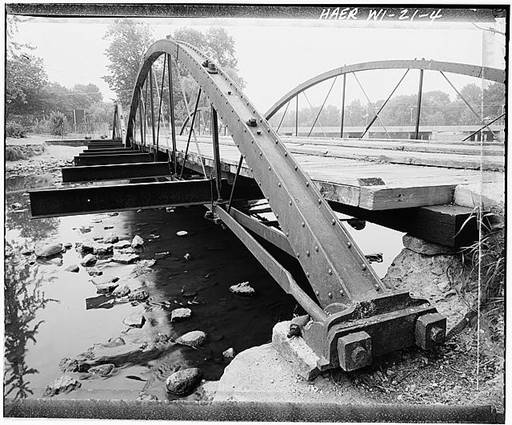
Bridge
The
current bridge, originally built around 1877 was part of
a four-span structure over the Crawfish River in the village of Milford. Two spans of the bridge were moved to the
present site in 1906. It is the last
remaining example in the state of a tubular iron arch design which was patented
in 1866 by Zenas King of Ohio.
By
1906 the bridge at Milford had begun to deteriorate, so the village of Milford
auctioned it off. Ernest and Fred Ohm acquired
half of the bridge--two spans, one six feet longer than the other--and moved
this shortened version to its current location, creating pedestrian access to
the Ohms’ Tivoli Island bowling and beer garden on the Rock River. The revelry ended with the advent of
Prohibition, but in 1961, the city of Watertown purchased the island,
established a city park, and redecked the bridge.
Historic
American Buildings Survey, 1987, ["moved from Milwaukee" is an
error], 15 pg pdf file
Historic
American Buildings Survey, 1987, six images
1907
Beer Garden
As the
Victorian age ended and the first Model T rolled into Watertown, the Concordia
Society disbanded and the island was sold. Around 1907
the Ohm brothers, local saloon operators, purchased Concordia, and changed its name to Tivoli,
and for a short time opened a beer garden (a news item using the name
"Tivoli Island" instead of "Concordia Island" appeared in
the June 29, 1906 issue of the Watertown
Weekly Leader.
Tivoli
Name
The
name Tivoli is said to have come either from an ancient summer pleasure resort
near Rome, Italy or from the Tivoli Gardens which had opened in Copenhagen in
1843.
The
Ohm brothers enclosed the pavilion and added on nine
rooms. In 1907 a new concrete electrical
dam was constructed just down stream from the old
earthen and timber dam. The older still remains but is submerged in the pond of the new
dam. The "Rough and
Ready Dam," as the structure came to be called, produced power for the
electric railway that ran from Watertown to Milwaukee.
1907
03 19 Tivoli Island will continue to be a
popular place of amusement, at least for the coming summer. When Ohm Brothers recently sold this resort
property, there were all kinds of rumors as to what disposition the purchaser
would make of the property. One even
went so far as to carry the impression that the land would be used for farm purposes by William Strehmel
of Columbus, the purchaser. It will be
pleasing news to many to know that the property has
been leased by local parties and that it will continue as in the past to be a
scene of recreation and pleasure for many of our Watertown people. As has been the custom in the past, the
island will be leased for picnics and other social gatherings. William J. Bethke has been engaged to manage
the island during the coming season and will put forth every effort to make the
spot even more popular than it has been in the past. It is understood that several improvements
will be made preparatory to the opening of the season. WL
04 26 Laborers will start at work this
morning putting Tivoli Island, our popular place of resort, in shape for the
season of 1907. A
number of improvements are to be made.
The place will be opened informally on the first of May. The formal opening will occur on the 19th of
May, when the members of the Watertown Band will give their annual picnic. From that time on there will be a picnic
every Sunday and there will be music every Tuesday and Friday evening. As previously stated, Manager Bethke is
arranging to secure some vaudeville attractions for the summer, it being the
intention to make the island even more popular than it has been in the
past. The Sunday dates for Tivoli are
fast filling up and if there are any who are planning on a Sunday outing this
summer, it would be advisable to get in their order early. WL
1908
06 13 Rural route No. 10 was
"specially" established yesterday between the city and Tivoli island
and Robert Irving "specially" appointed as rural carrier
and performed his first, last and only duty.
He carried a single letter addressed to H. T. Eberle, upon which there
was no postage stamp, which, of course, was conclusive evidence that it was
only a "special" arrangement and Mr. Irving performed his duty with
promptness and dispatch, demonstrating that he is a faithful and reliable
official. WL
1909
08 06 Site of
Homecoming celebration gathering
08 27 Labor
Day / Union Labor Annual Picnic WG
1910
07 22 Homecoming
Day reception WG
08 26 Labor
Day celebration WG
08 26 Band
concert and dance WG
1911
06 01 TIVOLI ISLAND CHANGES
PROPRIETORS
Gustave Teteschlag of Waterloo has sold Tivoli
Island to Henry M. Billinger of the same place.
The latter was formerly one of the managers of Wonderland, Milwaukee,
and he intends making Tivoli Island a popular and
high-class resort this summer. WG
08 05 SITE OF
1911 HOMECOMING CELEBRATION gathering
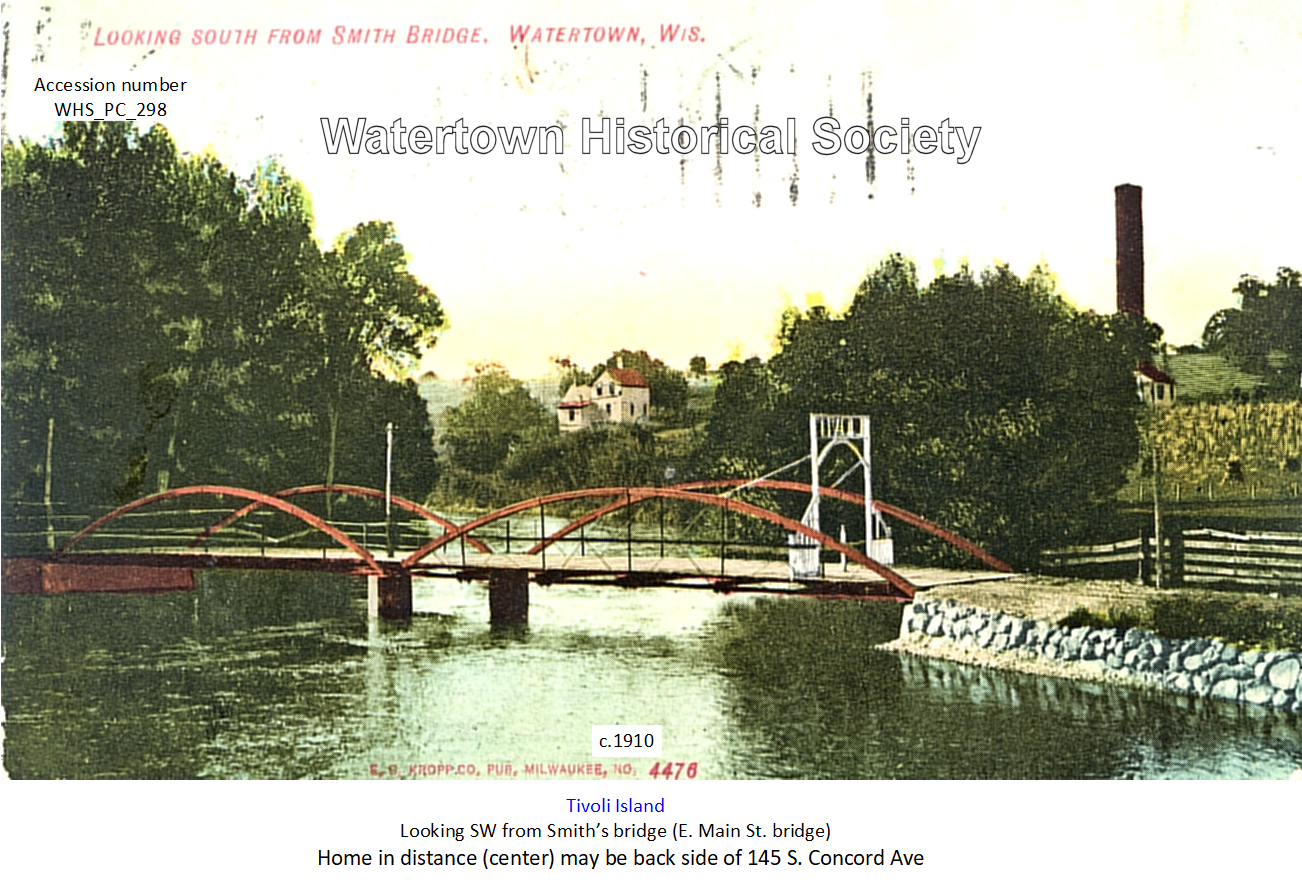 Bridge to island, south
from Smith
Bridge, 1911
Bridge to island, south
from Smith
Bridge, 1911
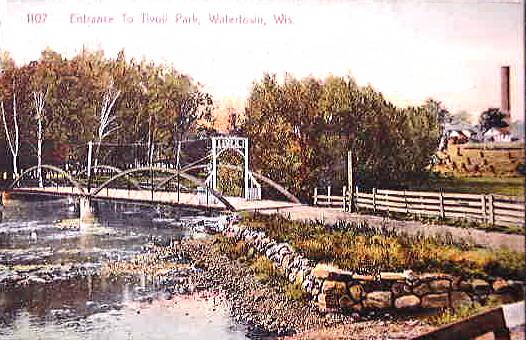 c1911
c1911
1912
07
11 TIVOLI
ISLAND SOLD TO EMIL DOBBRATZ
Emil Dobbratz of Lebanon has purchased Tivoli
Island from A. Billmeyer, the consideration being $10,000. WG
1913
07
25 DISTURBANCES
AFTER TIVOLI ISLAND DANCES
Considerable complaint has been heard from citizens residing at the east
end of Main Street because of the disturbance caused by frequenters of the
Tivoli Island dances when returning late at night. If the city authorities are going to allow
these dances to continue they should see that they are
properly supervised by a policeman.
There should be no recurrence of the disturbances which have occurred in
the past at 1 and 2 o'clock a.m. after these dances. Watertown Weekly Leader
1917
09
03 AN
IDEAL PLACE FOR PICNICS AND GATHERINGS
Tivoli
Island, ho my harties,
An
ideal place for picnic parties;
Open
to public day and night,
You’ll
always find things just about right.
Here
are served refreshments galore,
Always
on tap and then some more.
Proprietor is Sommers—none better.
And
ranks A1 as a business getter.
Service
and quality of the best,
Cheerfully
given while you rest,
Family
gatherings or no matter who,
Or
social parties and a dance or two.
Tivoli
island under the management of Mr. Sommers has become
a choice place in which to while away the afternoon or evening. It can be occupied as well by picnic parties
and there is plenty of opportunity for dancing. — Advertisement, The Watertown News, 09 03 1917
1920
03 29 TIVOLI ISLAND
DESTINED TO BECOME POULTRY FARM
Tivoli
Island, famed for years as a pleasure resort, is about to be converted into a
model poultry farm according to the plans of Roy F. Knowlton of this city, its
new owner.
Last
summer the property was sold at a sheriff’s sale to satisfy a mortgage
encumbrance and became the property of Greenwood’s Bank of Lake Mills, which
held the mortgage.
A deal
was consummated on Saturday whereby the same was sold to Mr. Knowlton and he
intends to remodel the business house and dance hall into a residence,
and use the other buildings in the construction of a first class
hennery.
The
premises have not been occupied since July 1, when Mr. Sommers, who conducted the same as a beer garden and recreation park for a number of years, decided to quit his lease. The island consists of about four acres of
land and the environments are such as to make it a paying proposition in the
poultry line
11 08 Melvin
Max Wolf was born on Tivoli Island.
1923
07 11 HONEYMOONING
ON TIVOLI ISLAND
Newlyweds
have devised a new way of spending their honeymoon since the advent of the
automobile tourist and last night 3 pairs of honeymooners arrived at the
Watertown tourist camp on Tivoli Island.
Of
course they have everything in camp equipment that would make a tourist
honeymoon comfortable and cheerful and are able to go as far as they want to by
any route they wish to take.
The
newlyweds seemed much pleased over the advantages offered at the Tivoli Island
camping ground. One of the couples came
from Michigan, another from Minnesota and the other from the northern part of
Wisconsin.
1924
07 19 MANY TOURISTS
VISIT CAMPING GROUNDS
Watertown’s
tourist camp is drawing many visitors these days, the grounds at times being a
regular tented city. In conversing with these visitors one
hears the general comment from them of the beauty, comfort and hospitality of
the camp.
State
inspectors of camp sites, here recently, say that it was one of the finest
located sites they know of and outside of minor recommendations said that
everything is O.K.
During
the past few days there has been a general cleaning up about
the premises. Weeds have been cut,
outbuildings and table tops painted and carpenters are building a kitchen. In the kitchen will be Installed two-2-burner
electric hot plates, to be operated on the coin-in-a-slot plan. A quarter inserted in the meter gives about
two hours service. The work of
installing the plates will be started today.
Heretofore, two outside brick fireplaces were provided for the use of
the tourists, also a plentiful supply of dry wood. Hereafter no more wood will be supplied but
the stoves will remain.
To a
veteran tourist camper the first sight of the grounds
is most appealing. The entrance is right
off the main highway. Coming in on No.
19 from the east, near the city limits, on the autoist’s right hand, looms up a
large signboard bearing the legend: “You are in Watertown—A regular town,”
and an advertisement of A. W. Bailey, ideal Ford dealer. About three-tenths miles more and the driver
crosses the beautiful new Memorial bridge.
Just after crossing, to the left, is the entrance to the camp site. Here are two welcome signs, one addressed to
everybody and the other erected by Watertown’s Elks, inviting visiting Elks to
enjoy the hospitality of the local club rooms.
Crossing
the bridge onto Tivoli island, is one of the prettiest groves imaginable and
being surrounded by water, the scene is most pleasing to the eye. There is plenty of room and many arrangements
for comfort, such as cooking places; a large shed under which cars can drive
during wet weather; electric lighted grounds, good water supply and
toilets. A couple of hundred feet away
is the new gas and oil-station just completed by
Arthur Bursinger.
The
grounds are worth visiting by local residents—in fact
many people drive down of an evening and eat a picnic
supper there. Evening is when most of
the campers arrive. Reaching there about
sundown they pitch their tents, cook supper and remain
for the night. Up again with the birds,
they get breakfast, pack camping equipment and take to the open road again.
When
they cross the bridge to leave another sign says: “Good-bye, Come Again,” which
has a tendency to make one think: “Watertown is a
regular town. It must be a fine place in
which to live.” And it is!
1925
TOURIST
CAMP
After
prohibition was put into effect the beer garden closed and the Ohm brothers
sold the island to Carl and Mary Wolf. For
some years the city rented the island for a tourist camp. At that time sanitary
facilities were also built, of which the cement foundation still
remains.
06 16 TIVOLI ISLAND
PURCHASED
Col. W. F.
Reichardt Purchases Tivoli Island from Carl, Amelia, Max
and Mary Wolf for about $7,500.00. He
has no plans yet as to what he will do with it.
He has bought two other pieces of real estate in Watertown in the last
few years.
-- TIVOLI ISLAND SOLD TO COL. W. F. REICHARDT
In
1926 Col. W. F. Reichardt, a civil engineer, later city engineer, mayor, and a
WPA director, purchased the island.
Reichardt improved the bridge by building concrete middle piers, upon
which iron beams supported a wooden floor.
Reichardt also published a booklet with photos and a detailed
description of the island to promote its sale.
08 08 TIVOLI
ISLAND FOR SALE
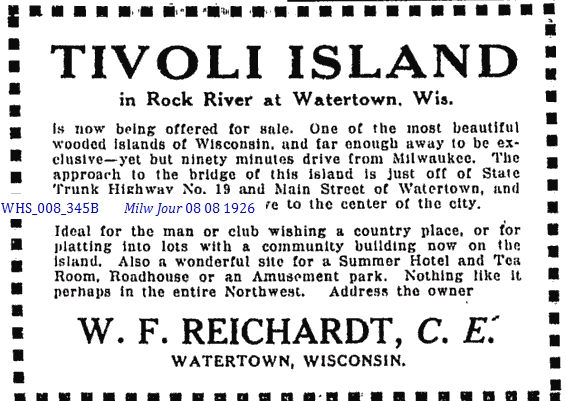
“Ideal
for the man or club wishing a country place, or for platting into lots with a
community building now on the island. Also a wonderful site of a Summer Hotel and Tea Room,
Roadhouse or an Amusement park. Nothing
like it perhaps in the entire Northwest.”
1927
12 24 TIVOLI TREE WITH LIGHTS PRETTY SIGHT
Tivoli
Island, owned by Col. W. F. Reichardt, is this year carrying the message of the
spirit of Christmas by means of a brilliantly lighted tree which is situated on
the island. One of the largest natural
pine trees on the property has been equipped with 40 powerful colored lights
and the tree presents a brilliant spectacle at night. It can be seen for a long distance in every
direction towering above the surrounding trees.
Motorist and others who travel the highway
nearby have stopped to look at it at night when it is illuminated, and it is an
impressive sight to behold.
Year
after year the practice of equipping a tree out of doors with brilliant lights
is growing and in many cities in the residential districts the practice is
carried out on a large scale.
Tivoli
Island this year presents a real holiday spirit when the large tree is
illuminated, and it is a sight worth seeing.
Several
smaller trees have been placed in front of residences here. Among the prettiest is that to be found on
the premises of the Dr. W. S. Waite home at 210 E. Water Street.
1931
05 13 PENNY SHOWER DANCE
Henry Schaller is new manager
Penny
Shower Dance at Tivoli Island Tonight.
Alton F. Gritzner and his Casino Band will play. Henry Schaller is the new manager of the island and this is the first of a series of special
novelties. The penny shower dance is
something new in dances and hundreds of pennies will be given away during the course of the evening.
05 20 DEAD BABY IS FOUND ON TIVOLI ISLAND
05 21 BIRTH CERTIFICATE SOLVES MYSTERY
Birthday
certificate solves mystery of finding dead baby. Father of dead baby
found on Tivoli Island was P. J. MacKinney.
1933
03 29 TIVOLI ISLAND---PARADISE OF THE PAST
Nestled
in an elbow of the winding path of the Rock river at the eastern limits of Watertown
rests Tivoli Island, known earlier as Concordia Island, pleasure spot of the
past, playground of children, meeting-ground of their elders, an arboreal
retreat of old.
Tivoli
Island today is little changed materially from what it was in the late nineties
and early part of the present century, however, for no longer does it play the
part in the community life of Watertown that it did in its earlier years. To the return of beer, now, the island looks
for its "new deal" hoping that with the advent of the legalized
beverage former visitors to this sylvan paradise will regain some of that lost
spirit of gemütlichkeit which was ever evident in the
past.
Prospects
Seem Appealing
While
its present owner, Col. W. F. Reichardt, has planned nothing definite for the
future of the island, prospects of its transformation into a typical European
biergarten present themselves as all the more alluring
as each new day comes and goes.
What
of this island paradise of which Watertown residents speak with a hushed awe, a sigh and a
twinkling eye? Whence did its appeal come? How did it grow
to be one of the most famous resort spots in the state, a mecca for the tired
city residents searching a quiet spot for re-pose and relaxation, a haven for
the people of Watertown in the simple life of a simple era?
Recall
Early Period
Turn
back the calendar, invert the hourglass and let the sands of conquering time
flow backward. Put aside thoughts of
present trying times and journey back 50 years to a Watertown of another era, a
Watertown whose days and nights are spent in hard, careful work, and simple
homely entertainment. Step away from the
era of the automobile, the radio, the speakeasy, the airplane, the motion
picture and stroll down the road of the past back to the island!
The
year is 1881. Watertown is a city of
8,000, a bustling little railroad center and city of small industries. Much of its population comprises retired
farmers and their families. The city
offers few amusements other than those which nature itself provided. Yet even in this small community there is a
spot that is as much of an institution in the life of the people as in Schlitz
and Pabst parks in Milwaukee, "Over the Rhine" in Cincinnati or Coney
Island in New York.
It is
a Sunday afternoon in late July or early August. It is warm, yet not intensely so. From a clear, sparsely clouded sky a summer
sun shines down on the brown gravel road that leads eastward from the trading
center of the city. Down the road moves
a family of five, a father, mother, one son of about 19, another of 10 and a
daughter of 12.
Group
Dresses Simply
Clad
in a black suit and straw sailor hat, an uncomfortable stiff collar and
plain-hued tie the father walks with his wife,
assisting her over the edge of the road with his free hand while the other
carries a large basket covered with a linen cloth. On the other side of his mother jogs along
the elder son, dressed similar to his father, yet his
attire revealing more of the spirit of his youth. The mother wears a long, light summer dress,
simple in adornment, high leather shoes scarcely visible from under the long
ruffles of her gown. Her head dress is a
large bonnet of straw bearing garland of highly-colored
cloth flowers.
The
young lad wears dark pantaloons, white shirt open at the neck and romps along
hatless. The daughter wears an
abbreviated copy of her mother's garb, her long blonde braided tresses, with
ribbons tied to the ends, falling out from under her little hat and draping
over her sleeved shoulders.
Buggies
Roll Past
Occasionally
a horse-drawn buggy rides by and there is an exchange of nods. Only a few pass
during the walk to the picnic spot at the out skirts for buggies are costly and
wealth is rare in this small city. The
passage of a rubber-tired buggy is almost a call for a bow of respect. Only the absolute aristocracy can own buggies
with soft tires!
Soon the
quintet reaches the hill far in the outskirts and as the crest is crossed, the
tall tops of the giant elms come to view.
Concordia island is but a few hundred yards away. The lad puts on a final spirt; sister, with
childish eager takes up the chase to cross the narrow bridge and find the best
spot for the picnic. The elder son in affected dignity stays behind with his parents,
nursing in his quickening heart that a certain "she" will be
picnicking this day too.
Trees
Adorn Site
Once
there the island soon reveals all its natural attraction. Here, surrounded on all
sides, by the rippling waters of the gurgling Rock river is a plat of
ground that Providence must have set aside for just the purpose the early
Watertown folk chose. Adorned with a few
man-made buildings, nature had blessed it with an abundance of verdant
shrubbery, tall, white birches, stately elms and
green, fuzzy evergreens.
Back
from the bridge that spans this natural moat is a fountain, babbling its
aquatic melody to vie with that of the rolling river nearby. Still farther back is the main pavilion, the bandstand and the bowling alleys where the ancient game of
ninepins rules the hours. Scattered
about these buildings are other small family parties, picnicking, chatting and exchanging greetings and conversant over
important subjects the day.
Family
Secures Dining Spot
Having
chosen a site under a large, shady tree the party of five settles down to enjoy
one of those typical afternoons at the island. Once at ease, the father removes his coat,
lounges for a time on the green, fragrant sod; the mother busies herself with
unpacking the basket. The younger
children restlessly roam about. The elder son sits stiffly and uneasily; he has
not espied "her" as yet.
Despite
the simple pastime, the day seems to pass speedily. Only a few minutes seem to expire before the
warm sun starts to descend beneath the horizon of Richard's hill.
The
call to lunch comes, but the mother finds her family scattered. Johnnie, the younger boy,
she knows, has pulled off his stockings and started wading along the edge of
the stream for crabs. The last she saw
of Emma, the daughter, she was running races with some of her schoolmates while
not dabbling her hands in the cool water of the fountain bowl. Father has been dividing his time between the
ninepin alley and the bar, rattling with the knock of large steins upon the
wood and echoing the sound of the foamy beer as it spouts from the keg. William, the elder son, is dividing his cake,
but not his attention. He has joined
"her" family for the day and is lunching from that basket.
Hours
Invigorate Appetites
After
the family once again has been reunited the pleasant task of disposing of the
food is cared for quickly. Crab fishing,
bowling and running feed fuel to burning
appetites. And even though some of the
gossip may have taken mother's breath away, her longing for food still lives.
The
luncheon has ended. The entire family joins to help clean and dispose of the
slight waste. Once arranged, the party
disperses for a time to previous amusements, while mother stays behind and
works at her crocheting until the growing dusk makes it impossible. As the caretakers stroll about to light the
huge kerosene lamps to illuminate the grounds for the evening, the parties one
by one gather up their belongings to return westward along the road. As they cross the bridge with lagging feet at
least one from each group says, as he turns back to look at the lighted haven,
glimmering there in the reflection of the rolling waters: “I wish it was next Sunday
already.” Tis the end of a perfect day.
Boasted
No Formality
Concordia
Island to the Victorian era gave Watertown persons
many days described in the above fashion.
This quiet spot where friend met friend and neighbor conversed with
neighbor offered the city a valuable aid in development
of its democratic community life. It
boasted no pomp, pleasures and amusements to appeal to
a simple folk who worked hard, led simple lives and were really happy. To them an afternoon such as this contained a
measure more of thrills and pleasure than does one of this era
replete with modern inventions and twentieth century comforts.
The
island was not wholly as beautiful by nature as it appeared to the hundreds who
assembled there. It took great planning
and long hours of labor to develop it to the stage where it stood at the apex
of its popularity. The Concordia
society, musical organization of early Watertown, supplied that labor.
Members
Erected Buildings
According
to members of the society, the charter group purchased
the land and set about to level it into the woodland paradise that it was. These rugged men, putting aside their singing
talents during spare hours, worked with hand and body, toiled fervently and inspiredly to erect a natural monument to their
organization and its friends. Many of
the singers were carpenters; others knew landscaping; still others were handy
at plumbing.
With
these expert tradesmen directing the work, others donated their help in
erecting the spacious pavilion, the bowling alleys, the fountain
and the bandstand. From all appearances
the playing waters of the fountain seemed to be fed by an underground
spring. So carefully had these pioneers
worked to preserve the pristine naturalness of their meeting ground that they
secluded the huge water tank which kept the fountain at play. A windmill pumped the water into the giant
container.
Planted
Trees, Landscaped
Those
white birches, stately elms and bobbing spruces were not always as kempt and
pruned as they appeared to visitors at the island. The early Concordians
planted them and landscaped the soil over the tract. These shapers of nature's mold knew well their task.
Not
always was the island just a retreat for the people of Watertown and the
immediate vicinage. Now and then the
society would be host to a saengerfest,
a musical festival in which most of the singing organizations of the state
would take part. To the islet they would
come with their families, to partake of a sylvan picnic at Watertown’s pleasure
spot them all to assemble in a mass chorus to sing the melodies popular at the
time.
Band
concerts, too, were frequent. Often
Bach's or Clauder's bands, musical groups which had established far-flung reputation by their playing in Milwaukee's parks,
would journey out to Concordia island for a concert, a meal, a few hours of
exchanged greetings with acquaintances here.
Conviviality was the spirit of the hour; affected formalities were
hurled to the winds.
Visiting
Clubs Used Site
When
Watertown staged one of its early homecoming festivals, the island was a
favorite rendezvous and former residents who returned to the community found it
quite the same as it had been when they left.
For years it figured in gatherings of this
type, not only to organizations from the city but from the entire state. Unions, clubs and
trade guilds would find their way to the city to rent the use of this natural
park for the day. Here they would find
the privacy and carefree gaiety their own localities had failed to provide.
For
many years the society operated the island and found
it profitable venture. Conditions
changed, the appeal declined with the alteration of modes of living and methods
of work and play. The society sold the
favorite haunt to private operators and for some time continued as an amusement
place. The name changed to Tivoli.
Hope
For Revival
In
later years it fell from use and now stands deserted except for the wild life
which still finds it the happy playground that previous human generations
did. A sudden change in living modes
again offers the island new hopes of restoration. If this scenic resort of another era can be
revived once again, all who strolled out to the land in former years join in
hopes that it will be reincarnated with the spirit which it fostered in the
simple days of long ago.
WDTimes
/ 03 29 1933
1938
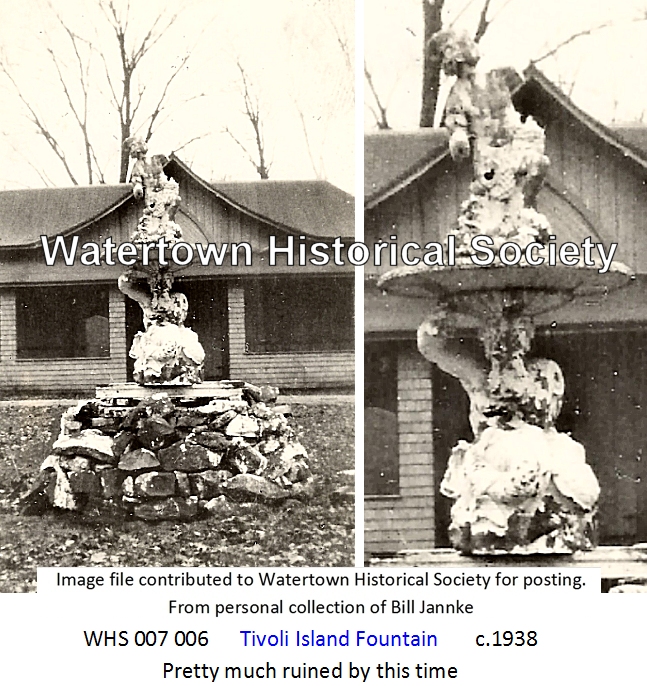 Fountain pretty much ruined by this time
1941
-- -- CITY CONSIDERED PURCHASE OF ISLAND
In
1941 the city of Watertown considered buying Tivoli from Reichadt,
but the idea was voted down by the citizens.
There was much debate for and against, and many "Voice of the
People” articles appeared in the Daily
Times. The main argument against its
purchase was shortage of money at the time and no desire for an increase in
taxes.
Late that
year the island was lost to the county for taxes and purchased from the county
by Flora Gerbitz. For many years Tivoli
had been left alone and buildings remained vacant. In 1946 Henry Scholl purchased the island
from Gerbitz.
1960
Jan CAUGHT IN THE ACT
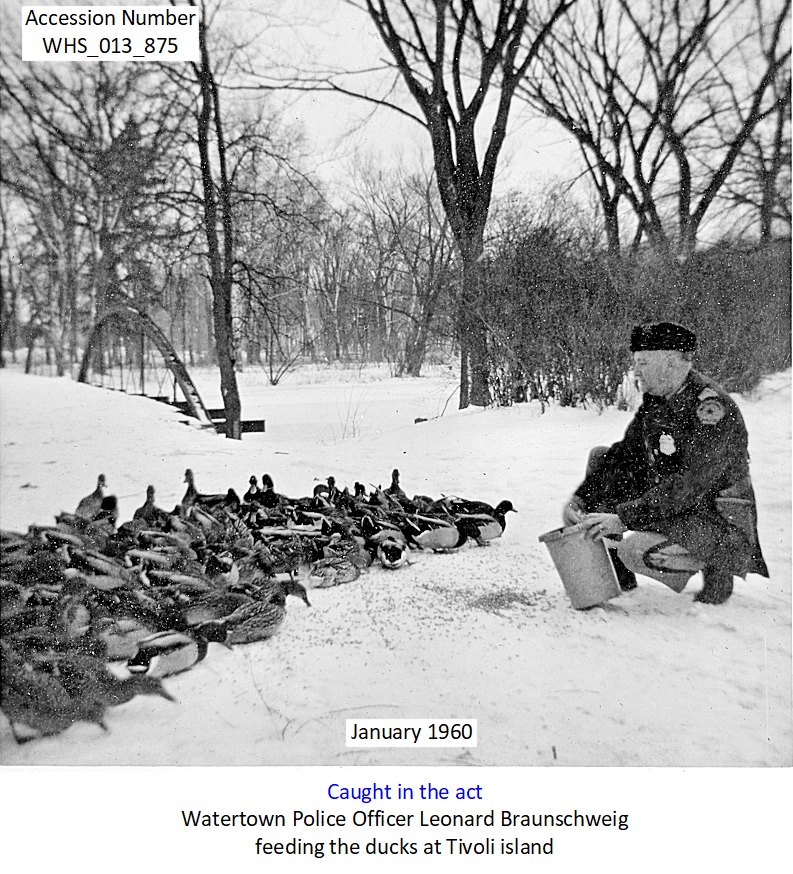 Officer Leonard Braunschweig feeding
the ducks at Tivoli island
Officer Leonard Braunschweig feeding
the ducks at Tivoli island
1961
PURCHASE
OF ISLAND BY CITY
In
1961 the city of Watertown purchased the island at which time the old run down buildings that remained
were torn down and dead trees removed.
The bridge was given a new floor and opened for foot travel. Other than this initial clean
up, little was done to change the island.
01 11 SURVEY OF TIVOLI ISLAND BRIDGE
Plans
are underway here to make a survey of the bridge which
leads to Tivoli Island, a piece of property which the city purchased last year, before any action is taken regarding the future use of
the island. City officials will inspect
the bridge. If a new bridge is built to
the island it will in all probability be a foot
bridge, since the old type span which used to accommodate carriages and horses
to the island in its heyday as an outing and picnic grounds is not necessary
today. The island was purchased from the
Henry Scholl Estate for $5,000, of which $2,500 was paid last year with the
remaining half to be paid this year. WDT
02 15 Tivoli Island, widely known picnic and
gathering place for this area in the Gay 90s and before that and
also some time after, is being integrated into the city's park
system. The island, which was acquired
by the city council last year, has already undergone extensive clearing and
restoration. Other changes will be made
in the months ahead. On the city council
agenda for this week's meeting, Acting City Manager Glenn R. Ferry has included
a “progress report” to keep council members informed on what has been done so
far. Today the full text of the report
was released for publication. The island
is being set aside as an arboretum. It
has long been the center of small wild life and a gathering place for birds as
well as ducks and other water fowl. WDT
02 21 Tivoli Island, once a
popular recreation area for residents of Watertown, may soon again become a
place for relation for city people. The island sank into disrepair in recent
years and was ignored for some time. The
area was obtained recently by the city and placed under the jurisdiction of the
park department. Improvement of the
island under the guidance of Ewald Brumm, park superintendent, has been
continuous.
The old building that
was located near the center of the isle has been removed and brush
and dead trees have been cleared away.
Dense brush along the stream banks has been trimmed out to open vistas
of the stream and surrounding areas to visitors on the island. A fence has been erected on the south end of
the island to prevent youngsters from reaching any danger areas near the power station
or the dam. WDT
1968
10 11 DEVELOPMENT OF ISLAND PROPOSED
Development of Tivoli
Island, once the city’s outstanding recreation and picnic grounds, known
throughout Wisconsin, has been proposed by the City Recreation and Park
Commission. It has been suggested to the
commission by one of its members that a master plan of city parks also be
undertaken and that professional help be engaged for this purpose. Dega and Stluka Associates of Madison and a
representative agency are to be invited to meet shortly with commission members
to discuss such steps.
10 11 DEVELOPMENT OF ISLAND APPROVED
A $30,000 item
providing for the restoration of Tivoli Island which was deleted from the
city’s general budget at Tuesday night’s meeting was restored at an adjourned
session of the common council last night at which the 1969 budget was finally
adopted.
1969
-- -- DEVELOP ISLAND INTO OUTDOOR RECREATIONAL FACILITY
In
1969 a resolution was put before the city council to develop Tivoli Island into
an outdoor recreational facility. It was
voted down because of the high cost of initial and future development.
03 08 IMPROVEMENT OF ISLAND (1)
 < 6 photos, scroll forward
City
park and recreation department employees are continuing their work on the
initial steps for the improvement of Tivoli Island. The diseased trees have been cut down, and
the men cleared the area of fallen trees and brush. The next step will be the planting of grass
and trees. A sum of $30,000 was
placed in the budget this year for the project, half of which it expects will
be replaced by the federal government.
08 17 IMPROVEMENT OF ISLAND (2)
Members of the city
council on Monday evening will discuss a proposed resolution which would
obligate the city for approximately $11,858 for the development of Tivoli
Island. The projects will cost
approximately $23,716, however, under the Land and Water Conservation Fund Act,
the federal government will pay half of the cost. The project will be accomplished with
matching Federal Funds, during the three-year period from 1970 to 1972. The project calls for the installation of
sanitary facilities, a shelter building, water supply and park
equipment. The resolution also calls for
the park and recreation department to make application with the State
Conservation Department to seek the federal assistance
for the program.
08 23 IMPROVEMENT PLAN DEFEATED
Mayor Kenneth Wilkes
Tuesday evening cast the tiebreaking vote to defeat a three-year plan for the
development of outdoor recreational facilities on Tivoli Island. The proposed resolution called for the city
to obligate $11,858 in funds which would be approximately 50 per cent of the
total cost of the first stage of the plan.
The other half would be paid by the federal government under the Land
and Water Conservation act of the federal government.
1970
08 13 REPAIR OF TIVOLI ISLAND BRIDGE
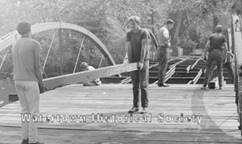
Park department
employees re-planking the steel span that links Tivoli
Island to the "mainland."
Daryl Schuett, Rod Berkers, Daryl Kulcinski, Roy Pulman, Dave Hackbarth, Tom Sindermann.
1975
In
1975 the Jaycees asked the city to consider restoration of Tivoli Island to the
condition it was while Concordia Society owned, it. Plans were discussed for
reconstruction of the pavilion and fountain that existed there at the turn of
the century. This proposal was turned down for several reasons. Limited
parking, availability of other parks of that type, and Tivoli's location near
the flood plain ruled out the possibility of such development.
For many
years Tivoli Island has been left to itself.
Its inhabitants have been the squirrels and
many species of birds. Ordinarily a piece of property located so close to a
residential area would have been developed or misused. But because it is an
island with only one bridge as an access point, the Rock River offers the best
natural protection available. Because of this protected isolation, and the wide
variety of existing natural landscaping, an idea was thought of to create
Tivoli Island into a natural park.
An
article requesting support of such a project was published in the Daily Times and the Izaak Walton League
responded by volunteering financial and physical support. This plan includes
the planting of native species and removal of foreign plants. It extends over a five-year period, and will restore the island with its native
vegetation.
In
April of this year the Izaak Walton League and the Octagon Garden Club worked
on the development of this plan.
The
Octagon Garden Club has planted nearly 100 native wildflower plants. Of the
flowers planted some of the species were Virginia Bluebells, Wild Columbine,
Jack in the Pulpit, Wild Ginger, Wild Blue Phlox, Mayapple, Bloodroot, Trillium
and Jacobs Ladder. These flowers were purchased through funds provided by the
club.
Hiking
Trail
The
Izaak Walton League has begun laying out a hiking trail which will cover the
island. In order to make a good walking surface, a
layer of wood chips was used to cover the path. These wood chips were made from
fallen or dead trees and provided by the Park and Recreation Department. The
Izaaks also cut and piled fallen tree limbs to provide habitat for small
wildlife. Derived
in part from Watertown Daily Times,
06 12 1976
1976
Maintenance of Tivoli
Island adopted by the Izaak Walton
League in 1976 as part of a bicentennial project
1977
05 11 TIVOLI ISLAND AS A WILDERNESS PARK
The development of
Tivoli Island as a wilderness park will be continued Saturday by members of the
Izaak Walton League. The project will be
a general work day with members planting trees and shrubs, redressing wood chip
paths, installing oak benches and cleaning up paper, cans
and other debris on the island. Donald
Hanson, Izaak Walton League member, said the wilderness park concept does not
necessarily mean cutting down trees, clearing out branches and carefully
manicuring Tivoli Island. WDT
1987
02 08 TICKETED FOR FEEDING DUCKS
Throwing scraps of
bread to a duck at Tivoli Island may cost a Watertown woman up to $50.25 as
police have issued their first ticket for feeding the birds on public
property. A police spokesman said the
ticketing officer was responding to a scene of a minor accident when he noticed
the woman feeding the birds. He then
stopped and issued the ticket, while another officer responded to the accident. “It was pretty obvious,” the spokesman said
of the feeding. “We aren’t looking to
give out tickets” for feeding the ducks.
“We’re just following what we’ve been told." WDT
1999
08 31 EROSION STUDY
A first-ever erosion
study of Riverside
Park and Tivoli Island has been recommended by the Watertown Park,
Recreation & Forestry Commission.
The recommendation to contract Bonestroo & Associates to study
erosion at the park and natural island preserve at a cost of $9,700 will go
before the Common Council in September.
Any construction on an erosion control program would not take place
until 2001. Bonestroo said that Tivoli Island,
a heavily wooded and passive recreational facility, has already experienced
significant land loss. Flat,
peninsula-type portions of the island have disappeared from
sight. WDT
2001
08 12 SHORELINE
RESTORATION, ATTEMPT TO STOP EROSION
Following the
installation of natural landscaping techniques, shoreline restoration along
Tivoli Island is complete. Steffes
Construction of Eden took roughly 2 1/2 weeks to finish the stabilization and
planting project to help combat years of erosion that has gradually reduced the
island’s size. Erosion adds soil and
nutrients to the water causing siltation and contributing to algae blooms. Cost for the
restoration project, which totaled roughly $50,000, had already been figured
into this year’s budget. However
original recommendations to use biodegradable logs wouldn’t work with Tivoli’s
rock bottom. Since there was no way to
anchor the logs, and bids for this procedure were too high, research began for
a different stabilization approach.
2002
05 16 IZAAK WALTON LEAGUE PROJECT
A 2002 project of the Izaak Walton
League is the maintenance of Tivoli Island which the club adopted in 1976
as part of a bicentennial project.
Member Don Hanson, chairman of the project since its inception, said the
island needed considerable cleaning up at the beginning of its project.
Formerly called Concordia Island, the area once had a pavilion and fountain but
had fallen into disrepair. Old lumber,
fencing and concrete and other debris had to be removed. Members also cut back brush
and laid out walking paths.
2006
BRIDGE RE-DECKED
Watertown
Park and Recreation Department re-decked the historic bridge structure in
December 2006.
2008
05 18 SPRUCING UP TIVOLI ISLAND
The Izaak Walton League invited teens from the Watertown Recreation and Outreach
Center (ROC) to join them in their yearly sprucing up of Tivoli
Island. “The island continues to be a
wonderful place for people to enjoy as they are able to walk all over the
island on groomed wood chip trails,” Rev. Tim Mueller, director of the ROC
Youth Center, said. “Folks can walk and
enjoy nature on Tivoli Island, especially now, as many varieties of birds and
baby ducks are visible and the spring flowers are in
full bloom.” Every year the Izaak Walton
League cleans up and spreads new wood chips over the many trails.


Cross-References:
How
to Build an Island: An Environmental
History of Tivoli Island, Jesse Koehler contribution (Word doc), 2010
Homecoming
Day celebrations, Tivoli Island site of

History
of Watertown, Wisconsin