website watertownhistory.org
ebook History of Watertown, Wisconsin
Chapter on Watertown Baseball
Fred C. Merkle
1888 -1956
David
J. Stalker
An article
by David J. Stalker, a passionate baseball fan and a
collector of baseball memorabilia.
Through his efforts a memorial to Fred Merkle
was erected on the grounds of the Octagon House, home of the Watertown
Historical Society. Dave has sent copy
of his documentation relating to Fred Merkle to the
National Hall of Fame in Cooperstown, New York.
Dave can be contacted at mailto:attheballyard@yahoo.com
The words that I would use to
best describe Fred Merkle are, a man of intelligence,
courageousness, strength and quickness, competitive, quiet and determined to do
his best at all times. This was Fred Merkle.
Fred Merkle
was born in Watertown on December 20, 1888, and baptized at Immanuel Lutheran Church on New Year’s Day, 1889. His parents were Ernst and Amalia (Thielman) Merkle.
Ernst taught at the Immanuel
School from the years 1884 to 1889, before taking a new teaching position in
Toledo, Ohio. Ernst’s parents settled in
the Amana Colonies, Iowa. This was an
extremely religious group, and Ernst was considered to have been a very strict,
no-nonsense teacher and parent.
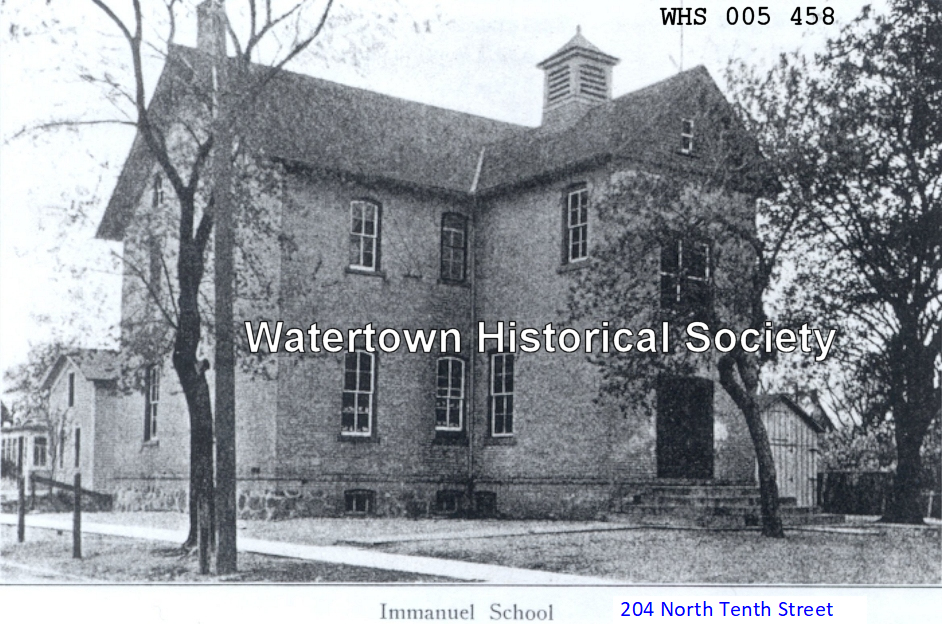
WHS_005_458
Immanuel Lutheran School is where
Fred’s father, Ernst Merkle,
taught and it is where he lived at
the time of Fred’s birth
There has been some controversy
as to where Fred actually spent his growing up years. As much as I would like believe some articles
that I have read about Fred growing up in Watertown, I cannot. I can only consider those claims as based on
assumption. Family records and Watertown records do not show any reason to
believe otherwise. Ernst Merkle moved to Toledo right
after his term at Immanuel, and Fred’s obituary from Daytona Beach Florida
states that Fred moved to Toledo when he was a baby.
Fred graduated from Toledo High
School in 1905. Along with playing baseball, he also starred in football and
track. He participated in athletic
programs at the YMCA and for some time held the sixteen pound shot-put record.
He was already showing signs of
his blend of speed and strength.
From 1906 through part of the
1907 season Fred played for the Tecumseh Michigan team in the Southern Michigan
League. This is where he met his
life-long wife Ethel, and it is where he captured the attention of Manager John
McGraw and the New York Giants. He was
purchased by the New York club in August of 1907.
Merkle made his major league debut for
the Giants on
The following year, 1908, is
considered by some historians as the most exciting season in baseball
history. It is important to understand
baseball as it was at this time in order to better understand the feelings that
Fred had. These were the feelings that would follow him to his grave.
It was a time when baseball was
truly the national pastime. Baseball teams were setting attendance records with
overflowing crowds trying to make their way into the ball yard. Jack Norworth wrote the famous song, “Take Me Out to the
Ballgame.” The pennant races were
receiving more coverage than the presidential election. The pennant races were
very tight in both leagues.
Try to imagine the excitement and
all the coverage that we would have today, living in Watertown, if the same
scenario happened today that happened almost 100 years ago. Taking a look at the 1908 teams racing for
the pennant, we can see that our general area here in Wisconsin was very well
represented.
In the American League the
Detroit Tigers, Chicago White Sox and Cleveland Indians battled down to the
wire for the pennant. Cleveland fell to
third place, but only one and a half games behind the winner. Within a week before the end of the season
the Indian’s Hall of Fame pitcher Addie Joss pitched the game of his life, a
perfect game against the Chicago White Sox, keeping them percentage points
above the White Sox in the standings.
Joss was born in nearby Woodland, grew up in Juneau and pitched for the
Watertown Sacred Heart team in 1899. It
is interesting to note that Addie’s catcher from his Watertown team was also
playing in the majors at this time. He was born in Milwaukee, his name was Red Kleinow, and in 1908 Red caught for the New York Highlanders,
the team that became better known as the Yankees.
The final game of the regular
season for the White Sox and Tigers was played in Chicago, with the winner
advancing to the World Series. The White
Sox had Fort Atkinson native and great defensive catcher Billy Sullivan. The Tigers had the speedy Cambria native Davy
Jones on their team. The winners of the
contest would advance to the World Series and play the Chicago Cubs.
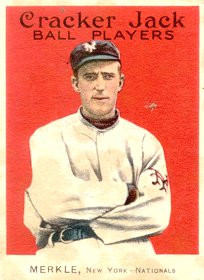
WHS_005_451
On the back of Fred’s 1914
and 1915 Cracker Jack baseball card
mention is made that he was born
in Watertown
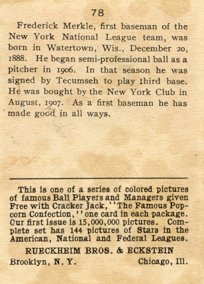
WHS_005_452
Some of the Cubs players were at
the game and were rooting along with the White Sox fans. This was in hopes for an intra-city rematch. Billy
Sullivan’s team beat the Cubs two years prior, in the 1906 Series. This was after the Cubs set a single season
record of 116 victories. The Tigers took
the crowd out of the game right away, scoring four runs in the first inning,
one in the second, and winning the game 7-0. Davy’s Tigers were crowned
Champions of the American League for the second of three consecutive years.
Over in the National League
another tight race was between our local favorite, the Chicago Cubs, Merkle’s New York Giants and the Pittsburgh Pirates. The Pirates ended up tied for second place,
just one game behind the winner. The
Cubs and Giants also came down to one last decisive game with the winner going
to the World Series. However, unlike the
American League being decided on the last day of the season, the Cubs and
Giants ended the season in a tie for first place. The teams were then scheduled to play a make up game at the Polo Grounds in New York. This game was
labeled “The Merkle Game.” It was due to the “Merkle
Mistake,’ or simply known as the “Bonehead Play” that occurred on September 23,
1908.
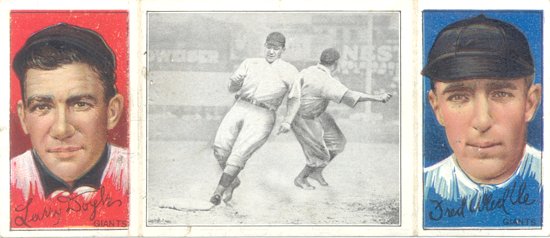
WHS_005_454
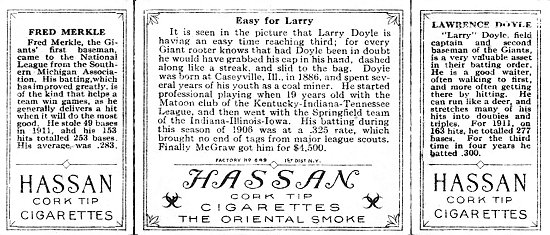
On this 1911 baseball card Fred
is pictured
with his Giant and Cub teammate,
and lifelong
friend, second baseman Larry
Doyle.
WHS_005_453
Let’s step back to that September
23 afternoon in New York. The Cub’s were
visiting the Polo Grounds and the two rivals were in the midst of a pennant
race. With the score tied 1-1 in the
bottom of the ninth inning, the Giant’s were at bat with runners on the
corners. Moose McCormick was the runner
on third base and playing for the veteran Fred Tenny
was Fred Merkle, on first base. Bridwell,
the Giants batter slashed a base hit into the outfield in what appeared to be
the game winner, with McCormick crossing the plate.
With the raging fans pouring onto
the field and heading straight towards the diamond, Fred Merkle
ran for his life, straight into the dugout before touching second base. The keen second baseman for the Cub’s Johnny
Evers noticed that Merkle did not touch second base,
and he knew that technically the run should not count until the base runner
touches the base. He started screaming
for someone to throw him a ball, so he could step on second and force out Merkle.
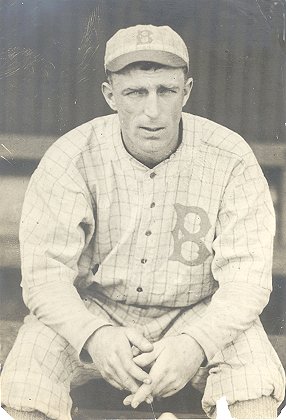
WHS_005_449
1916-17, while Fred was a
Brooklyn Dodger
He did end up getting a ball, but
it is believed to not have been the actual game ball that was hit by Bridwell. With the fans
on the field, and with daylight getting shorter being the end of September, the
game was ruled a tie.
The Cub’s and Giants did have
equal records at the end of season and the Merkle
game was played on October 8th. The Cub’s won 4-2, and then proceeded to beat
Davy Jone’s Tigers four games to one. To this date, it was their last time to be
labeled World Champions.
Merkle’s failure to touch second base was
immediately labeled the “Bonehead Play,” and Fred inherited the undeserving
nickname of “Bonehead Merkle.” Between September 23rd and October 8th Fred
became a physical wreck, he was losing weight, hair, and had become very
withdrawn.
About two weeks prior to the
September 23rd game, the Cub’s and Johnny Evers were involved in the same
situation against the Pirates. The
rookie Warren Gill of the Pirates was the runner on first base, who ran off the
field before touching second. At that
time Evers protested to the same umpire, Hank O’Day.
Hank was a Chicago native who eventually managed the Cub’s for a season. O’Day listened, but
did honor Johnny’s request, basically because it was a rule that was never
enforced. It was common practice for the fans to storm the field, and the
players to run off the field, a step quicker.
Entering into the 1909 season,
after replaying the so-called “Bonehead Play” over and over in his mind during
the off-season, Fred considered walking away from the game. With his courage, desire to succeed, and the
encouragement and pay raise he received from his Hall of Fame manager John
McGraw, Fred was back to face the season. Trying to get accustomed to his new
nickname, and still showing signs of suffering, Fred batted a disappointing
.191 in 79 games. The Giants had a good
season with 92 wins, but finished a distant third place.
The following year, 1910, he
played in 144 games and displayed his talent in ways that McGraw patiently
waited for. He batted .292, drove in 70
runs and stole 23 bases. It was the first of 8 years that he would steal 20
plus bases in a season. In 1911 he tore up the base paths with his single
season career best, with 49 swipes.
WHS_005_456
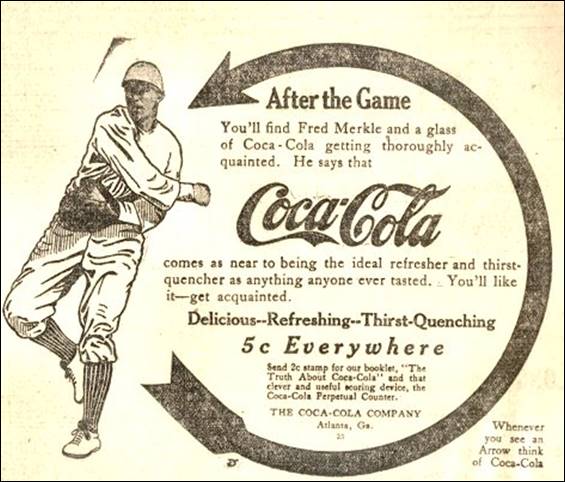
Fred was featured in a Coca-Cola
ad campaign. The ad above
appeared in the April 23, 1911,
edition of the Atlanta Constitution.
This was an amazing feat for one
considered to be a rather large man, 6’ 1” and 190 pounds.
After winning the National League
pennant four out of five years, the Cub’s dominance was fading to the Giants.
Three years straight, from 1911 to 1913, the Giants claimed the right of being
National League Champions.
Fred lead the 1911 team with 84 RBI’s,
and collected three hits in his first World Series. In the series the Giants had a hard time
scoring runs against the Philadelphia Athletics’ strong pitching, facing
Bender, Combs and Plank. The third
baseman for the A’s was Frank Baker, and became well known as “Homerun” Baker,
after collecting two homers in the Fall Classic.
In 1912 Merkle
became a homer run threat by leading his team with eleven round trippers. He helped lead the Giants to another World
Series, by displaying his power, along with his speed. In this trip to the
series he collected nine hits, against the Boston Red Sox. The Red Sox were playing on their new
grounds, Fenway Park. The Giants team
batting average elevated to .270 in comparison to the .175 average they had
against the A’s in the previous World Series.
The best of a seven game series ended in extra innings, in game eight.
The Red Sox prevailed, with winning four, losing three and tying one game.
Fred’s name was once again brought up in a controversial manner in a play that
happened in game eight. A foul pop fly
ball fell between pitcher Christy Mathewson, catcher Chief Meyers and himself,
and some seemed to think that Fred should have made the catch. The missed ball gave Boston’s Tris Speaker another chance to drive in the tying run, and
he succeeded. Shortly after, the Red Sox won the World Series with a sacrifice
fly off the bat of Larry Gardner.
During the 1913 season Merkle was the team leader in games played with 153, and
triples with 12. Once again they faced
Connie Mack’s Philadelphia A’s. During the regular season the Giants had three
20 plus game winners with Mathewson, Marquard and Tesreau, but they still fell short to the A’s, losing four
games to one. During the series Fred had
a few hits, one being a homer. He also drove in three runs.
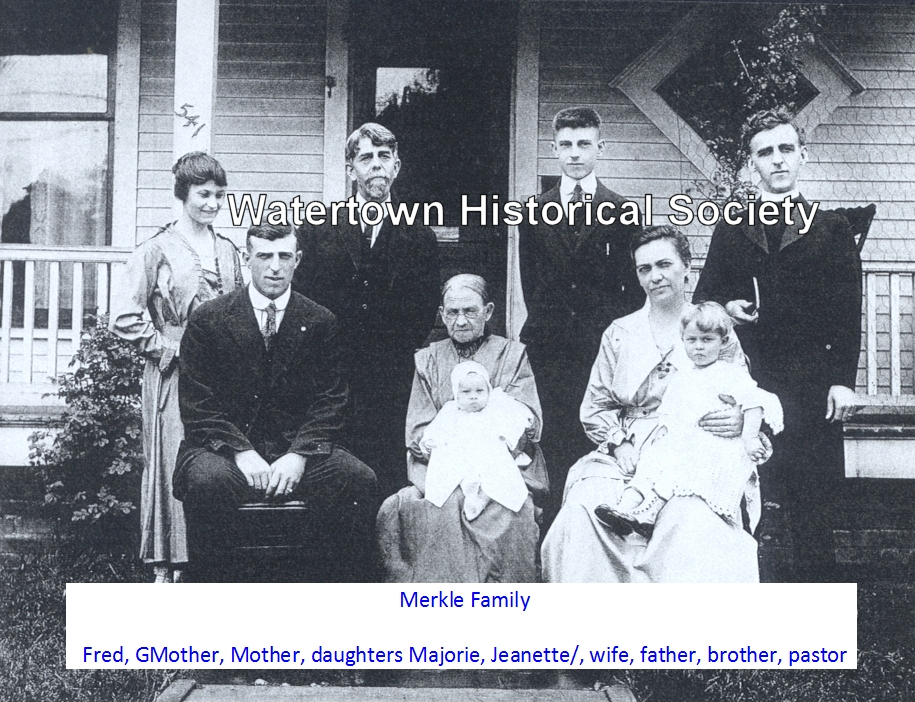
WHS_005_448
Merkle Family Picture, 1917
Seated: Fred, his grandmother and mother,
holding daughters Majorie and Jeanette
Standing: Wife, father, brother,
pastor
This was Fred’s last World Series
with the New York Giants. After the 1913
World Series and into the early part of 1914, Fred went along with the Giants
and White Sox on a World Tour. Later in
1914 he finally married Ethel. 1914 and 1915 were good, solid years, his last
two seasons with the Giants, before being sent to the Brooklyn Dodgers late in
the 1916 season.
Fred climbed on board and played
in twenty three games with the Dodgers, before advancing to his fourth World
Series. The Brooklyn club lost four
games to one against the Boston Red Sox.
One of Boston’s wins came from a young pitcher named Babe Ruth. Ruth pitched in game two and went the full 14
innings, giving up only one run in the first inning.
Fred only played in two games for
the Dodgers in 1917, before being picked up by the Chicago Cubs. He joined his old Giants teammate and friend,
Larry Doyle, and was now a member of the team that was once his bitter
rival. Chicago was excited to get Fred,
after their first baseman Vic Saier got hurt. In his
first game with the Cubs, at Wrigley Field, he participated in one of greatest
games ever pitched. It was the famous
nine inning double no-hit game between the Cub’s Hippo Vaughan and Cincinnati
Reds Fred Toney. It was not until the
tenth inning that Vaughan gave up a couple of hits, and the Reds won, 1 to 0.
The team finished a very disappointing fifth place.
It was not long before the
veteran Merkle helped lead the Cubs back into the World
Series. In 1918 while the world was at
war, he led the Cubs with 65 RBI’s during the season and then collected five
hits during the World Series against the Boston Red Sox. It was Fred’s fifth chance at a World
Championship and became his fifth losing attempt. And beat again by Boston’s
pitcher Babe Ruth.
It was the last time the Red Sox
won the World Series until 2004.
In 1919 the thirty year old Merkle had another good season with the Cubs, leading the
team in 133 games played, and RBI’s with 62. In 1920, his last year with the Cubs and last
year in the National League, he batted .285.
Still in good form, it is uncertain why Fred joined the Rochester ball
club, of the International League. He
played with them through 1924, and led the league in RBI’s for two seasons.
From 1924 to 1925 Fred joined the
American League, and wore the famous pinstripes, as a member of the New York
Yankees. He mostly coached, but also had
some playing time, appearing in seven games in 1925, and had two at bats in 1926. He did not play in the 1926 World Series, but
he was a member of the team. The 1926
Yankees then became Fred’s sixth World Series team. He had to feel confident going into the
Series with players such as Babe Ruth and Lou Gehrig in the line
up. The Series did go the full
seven games, and the last game was decided by one run. The St. Louis Cardinals overtook the Yankees
in game seven, by the score of 3 to 2.
The following year the Yankees
became World Champions, and are still considered to be one of the best teams in
baseball history. Fred, however, was with the Reading, Pennsylvania team for a
partial season. Fred’s father, Ernst,
passed away on June 18th and was laid to rest in Florida. Fred left the Reading team and Florida became
his permanent location for the remainder of his life.
Fred walked away from major
league baseball when he moved to Florida.
At home baseball was not even talked about. His daughter found out about the “Bonehead
Play” for the first time one day at school, when one of the kids teased
her. She then went home, inquired about
the name, and learned that it was something they did not talk about. It is most likely Fred was sheltering his
family from the pain he had suffered.
While in Florida he could be often be found at local minor league
games.
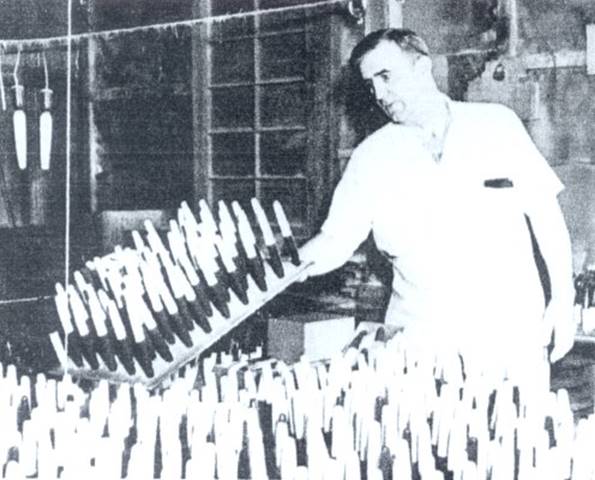
WHS_005_457
Retired from baseball, Fred had a
fishing lure business
After retiring from baseball Fred
designed and manufactured fishing lures, played a lot of golf and lived
peacefully in the Florida sunshine.
After twenty three years of being
away from major league baseball, Fred received an invitation from New York
Giants president, Horace Stoneman, to be a guest at an old timer’s celebration
on July 30th, 1950, at the Polo Grounds in New York. Upon encouragement from his youngest
daughter, the 61 year old Merkle, along with his daughter, accepted the
invitation and made their way to New York.
Fred met up with his old friend, Giant and Cub teammate, Larry
Doyle. Fred and Larry did not suit up
and play in the old timer’s game but were at the ceremonies as special
guests. Fred was fearful over what kind
of reaction he would receive from the New York crowd at the game. Would he hear the taunting “bonehead,” or
would he receive the type of ovation that he deserved, from the high level of
performance that he displayed in each and every game over his career? The large crowd cheered wildly for Mr. Fred
C. Merkle.
On
Besides having an outstanding
baseball career, Fred was a dedicated husband, father and business owner. For these reasons I felt that Fred deserved
so much more than an unmarked grave, and his family agreed with me. Together we financed his memorial monument. I
felt that there would not be a better place to place the memorial than in
Watertown, the place where his life began.
It became very logical for me to determine that the Octagon House
grounds would be the best choice for the monument’s permanent location. Along with the beautiful location, I felt as
though no one would appreciate and preserve the history of the memorial better
than the Watertown Historical Society.
Fred was courageous, intelligent,
and his determination for success would be hard for anyone to match. He could have walked away and been successful
at anything he might have done, but that would have been too easy for a man
that faced a challenge. It was a
challenge that would have made many others crumble, given the same situation.
We can be proud to claim
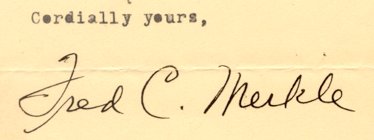
[Original autograph] WHS_005_450
as our own.
All rights reserved by the
author, David J. Stalker
__________________________________________________
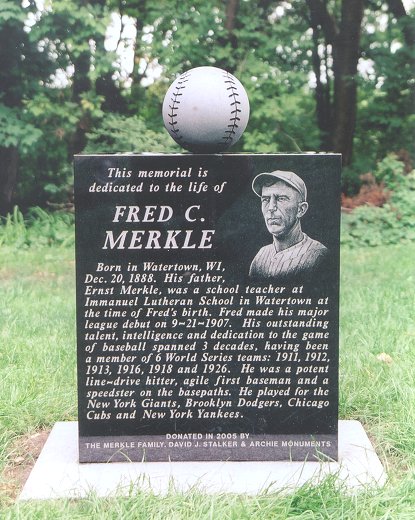
WHS_005_455
The Merkle monument is located on
the grounds of the Octagon House and was
donated to the Watertown
Historical Society in September of 2005, by the author,
baseball historian David Stalker,
Merkle family members and Archie Monuments
_____________________________________________________________________________________________________________
2010
Mike Cameron
/ "Public Bonehead, Private Hero: The Real Legacy of Baseball's Fred
Merkle."
Cameron, a sportswriter for Pioneer Press, presents an indepth
biography of Merkle and detailed account of the baseball drama. He strongly asserts that Merkle not only did
no wrong but stands to this day as a role model against adversity.
“Merkle did no wrong on the controversial base running play that
gave him the nickname of ‘bonehead' and he instead should be remembered for his
accomplishments and his perseverance in the face of extreme adversity.
“That is the essence of my book. No one had ever completely
exonerated Merkle of wrongdoing and presented him as a hero and role model
against adversity. I wanted to do both. Not just poor, poor Fred got a horribly
raw deal.
“What I want readers to take from my book is that if Merkle could
overcome all the bad stuff that life threw at him, we can surmount any hurdles
and challenges that come our way.
“I call it ‘Merkle Power.' Fred's example inspires and emboldens
me to stay strong through life's inevitable rough patches.
“This is the first in-depth biography on Merkle. Raised by strict
German immigrants, he was very smart, multitalented, modest and decent.
“He was just a 19-year-old rookie when the fateful play took place,
but he hung in there through all the insults and public scorn. He was a very
good player for 16 seasons as well as a member of six pennant-winning teams and
a leader on four of them.
“He overcame a lot more adversity after his baseball career. He lost
his house, had only a menial job and could barely support his family during the
Depression. Baseball turned its back on him for more than two decades. Merkle
and a partner started a business manufacturing fishing floats, and it
eventually succeeded.
“Marianne, his youngest and surviving daughter, opened up to me on
very personal and painful subjects. It wasn't just Fred who heard the bonehead
insults. Everyone in the family was subjected to ridicule. But the Merkles
looked past the ignorance and cruelty of others. They never struck back and
stooped to the level of their detractors or defined themselves by the
perceptions of others.
“Out of all this emerged Fred Merkle. Hero. Role model against
adversity. Epitome of a real man. True superstar as a human being.
“Watertown, you should be very proud. Salute your favorite son. No
community can lay claim to a better one. Fred Merkle represents all that is
good and strong in all of us.” [from the book]
Cross References:
Washington Park’s Merkle
Field
Movie
on Fred Merkle, Watertown Daily Times article
Review
article, Watertown Daily Times
article
Plaque
honoring Merkle, Watertown Daily Times article
Topic
in book, Watertown Daily Times
article
Watertown Baseball chapter on Watertown Historical
Society website
Scapegoats:
Baseballers Whose Careers Are Marked by One
Fateful Play
Poor
Mr. Merkle, The Boston Globe, Sept 23, 2008
article. “Sept. 23 is an annual Holy
Day. But this year it has an extra special meaning.”
Watertown’s Merkle Couldn’t Shed Nickname, JS Online, Bob Wolfley,
Sept. 24, 2008
Merkle highlighted on TV, print, Watertown Daily Times article, 09 22 2008
Link
to see the Merkle story on YouTube Part 1. Part 2 Much of the cards, photos and box scores are
from Dave Stalker’s collection. The Merkle monument is at the end of part 2.
Etched
in Stone: A Lasting Tribute to the Deadball Era, by David Stalker
Public Bonehead,
Private Hero: The Real Legacy of Baseball’s Fred Merkle, By Mike Cameron
Publication Date: February 2010
________________________________
From
the Milwaukee Journal
Born in Watertown
Birthday
congratulations are due to Frederick O. Merkle, who
was responsible for enriching the English language by the addition of the word
“merkle,” which means, according to Webster’s
Unexpurgated, “to pull a bone.” (Note: in 2004 this would probably mean
“boner"). Fred has attained the
mature age of twenty-seven years, and, by his subsequent work as first baseman
of the Giants, has long since atoned for the “crime of 1908.” In spite of the sloppy work of his teammates last
season, Fred played his usual heady game and at bat he came within a point of
joining the small and select circle of National League 300 swatters. He has apparently recovered his batting eye,
for his 1915 average of .299 is a great improvement over 1914, when he got
.258. In 1912 Merkle
batted .309, but after that he slumped to .261 in 1913.
Fred
was born in Watertown, Wis. Toledo has been Merkle’s winter address for several years. He broke into professional baseball at Tecumsah, Michigan and it was in 1907 when he was a kid of
eighteen, that he joined the Giants. Naturally,
considering his age and previous condition of servitude, he was quite verdant
when he donned the spangles in the big village. McGraw found him an apt student, and predicted
great things for the German lad. The fat
came pretty near to being in the fire when he failed to touch second in a
decisive game in 1906 and so lost the pennant for his club. Lots of veterans have pulled bones quite as
bad, but the New York fans didn’t consider that, nor were they included to be lenient
because of Fred’s extreme youth. If they
had their way, Merkle would have been ridden out of
baseball on a rail.

History of Watertown,
Wisconsin