website watertownhistory.org
ebook History of Watertown, Wisconsin
 Dogs . . .
And Early Days in Watertown
1858
Watertown Democrat, 07 08 1858
DEAD DOGS
Somebody sends us the following item through the Post
Office, which we publish just as we received it, for the sake of the hint it
contains to those who are troubled with the presence of these defunct
animals "A nuisance in the shape of
dead dogs line the shore of Rock River below the city, to the great annoyance
of the inhabitants who have no objection to the un-dogging of the town but at
the same time would propose some other method of disposing of the carcasses
this hot weather, more agreeable to.
SMELLER
1859
Watertown
Democrat,
07 28 1859
FEE FOR BURYING
DOG
Ald.
Shroeder presented the following account which was allowed and charged to the 2d Ward General Fund:
Account
of Chas. Buntrock for burying dog. Referred to
Committee on Finance.
1860
Watertown
Democrat, 01 26 1860
WANTED, A DOG LAW
We read in
our exchanges every few days of depredations committed in one place or another
by mad dogs and have wondered that something of a similar character has not
transpired here. We certainly have raw
materials enough for the manufacture of ever so many cases of hydrophobia
[rabies], provided, of course, the ball could only be set in motion by a single
rabid whiffit, no matter how diminutive his dimensions. All that seems necessary is that some
worthless cur should lead off in the fearful work and the destruction that
would be sure to follow is dreadful to contemplate.
We have
been to some little trouble to arrive at the probable number of canine species
lying around loose in this city and, after making a careful mathematical
calculation, think we speak within bounds when we say that it is not less than
two thousand. Only think of it! Two thousand dogs, not ten of which are worth
the strychnine it would take to send them to kingdom come! And yet they are permitted to live on as
though they were of some little value, if not absolutely necessary
accompaniments to the happiness and welfare of their owners.
But the
most remarkable feature of the whole case is that this little army of nuisances
is growing stronger every day.
Notwithstanding sausages are quoted firm in the market reports at twelve
and a half cents per pound, the dog crop is increasing daily and hourly and
bids fair, if unchecked, to double within another twelve months. For our part we must confess that we do not
understand it. It is one of those
intricate financial puzzles that we cannot in our profound ignorance comprehend
and we hand it over to some one better posted in such matters than we are, to
explain it.
But
seriously we think the cause of humanity demands the immediate and wholesale
slaughter of every dog permitted to run at large unmuzzled in the city. They have no business to exist. They are an unmitigated humbug. They are in all sorts of mischief by day and
disturb our slumbers with their howlings by night. Why not, then, put them out of the way before
some of our citizens fall victims of their madness? That no one has been bitten here before now
is a miracle. It is one of those streaks
of good luck for which Watertown is proverbial, but because such has been our
fortune in the past we have no right to expect that it will always be thus in
the future. Away then with the scalawags
at once. A dog-button, or a small piece
of meat, seasoned nicely with strychnine, will do the work up effectually and
quietly. The experiment was tried in
Milwaukee a short time ago under the auspices of the Common Council and found
to work admirably. Why can’t our city
fathers follow in their footsteps and do as much for the good of their country
as their neighbors?
In no other
way can they so strongly commend themselves to the gratitude, favor and
distinguished consideration of their constituents, as in the one here pointed
out. We content ourselves with throwing
out the suggestion and trust that some humane member of the board will give it
shape and press it upon the attention of his fellow aldermen at their next
meeting.
We are
aware that objections will be raised mountain high to the demolition we propose
but we do not consider them by any means tenable. To be sure, all amusements in the way of dog
fights will be cut off and the occupation of many of our street loungers and
hangers on at corners will be gone.
Watertown
Democrat, 02 02 1860
A good work has been well begun in our
city and by all means let it go bravely on until every worthless howler or
snarler that helps to make night hideous with his clamorous noise shall
disappear. Most every morning the dead
carcasses of defunct dogs are found lying about the streets, waiting for the
last rites to which even such useless creatures are entitled, at least for the
benefit of the living, if for nothing else.
Valuable or favorite dogs should be so taken care of that they will not
become public nuisances, but no one should try to prevent the speedy
extermination of all others.
Watertown
Democrat, 02 16 1860
KILL
OFF THE DOGS
The Common Council, it seems, is not
disposed to act upon our suggestion made two weeks ago relative to ridding this
city of its great multiplicity of dogs.
We presume this is upon the principle that large bodies always move
slow. After some of our citizens have
been bitten or fallen victims to the hydrophobia [rabies], we have no doubt a
special meeting of the council will be called at once and the necessary action
taken in the matter. After the horse has
been stolen the alderman will be eager to lock the barn door.
We think the time for them to act is
before any harm is done. Mad dogs are
all about us. Every one knows that. One was killed in Ixonia on Friday last, but
not until he had bitten a little boy.
That child’s life is of far more consequence to the world than the
existence of all the dogs in the universe.
Then why should we be compelled to peril our own safety and that of our
wives and children, merely to gratify the owners of a couple thousand such
whiffets as are allowed to run at large here in our midst. It is an imposition upon the public and we
advise every man who values his life to carry the implements of destruction
with him and deal them out with an unsparing hand. This is our only salvation.
Watertown
Democrat, 02 23 1860
ONE
THOUSAND NINE HUNDRED AND SEVENTY-THREE is the exact number of dogs now running
at large in this city, thirty-two having come to an untimely end since our last
report. The crop, instead of increasing
as it has been for the last year, is at last growing “small by degrees and
beautifully less.” Strychnine is doing
its work slowly but surely. Hydrophobia
will soon be at a discount and the places that now know such a vast army of curs
of high as well as low degree will soon know them no more forever. By all means, we say, let the reprobates be
dispatched without any unnecessary delay.
We can spare them just as well as not; in fact, we think we rather
prefer their room to their company.
We confess to a strong antipathy against
dogs. We hate them on general
principles. They are an eye sore to us
at all times and under all circumstances.
At such a time as this, particularly, when it is an every day occurrence
to be told that a mad dog has just been killed here, or that a child has been
bitten by one of them there, or that a half dozen head of cattle have died with
the hydrophobia in another place, we say at such a time we do not care to
encounter any dogs. We prefer to give
them a wide berth. If they will agree to
take one side of the street, we will take the other.
Persons owning valuable dogs or those
whose existence they would not have cut off in the prime of life suddenly and
unexpectedly, would do well to muzzle them or keep them chained up at
home. It is evident from the slaughter
that has already taken place that the canine species cannot travel our streets
safely. Who the parties are engaged in
the work of destruction, of course, we do not know, but we presume they are
actuated by good motives based on the principle laid down in that sound and
venerable maxim which says that “self preservation is the first law of nature.”
Watertown
Democrat, 03 01 1860
PEDRO,
TIGER, GROWLER, together with many other dogs that are nameless, have suddenly and
mysteriously departed this life during the past week. Their dead carcasses now enrich the soil it
was a nuisance to have their living bodies roam over. They are out of the way—something like a
hundred of as worthless creatures as ever infested a respectable town, and by
their presence made day dangerous and night hideous.
But Tray, Blanche, Sweatheart—as the
world-minded Shakespeare prettily calls as pestering and useless a tribe of
canine vagrants as ever escaped the salutary effects of strychnine or
lead—still exist to vex the world.
They should not long go "unwhipt of
justice," for they are not better than their fellows who have already been
sent to their long home. Then let the
rest follow the same road, till there shall not be one to chase another in
spring time.
The country will not be a bit too good
for civilized and well-behaved people to live in, if there is not a single
insolent puppy left to make a noise or get up a row, nor will there be a great
deal of mourning if their present owners are compelled to go masterless about
the streets, unattended by such evil-disposed companions. There will be enough barking, fighting,
scratching, snarling and biting when the whole race is extinct.
We wish to add a word of caution to the public-spirited
members of the Dog-Exterminating Society recently formed in this city. They have already accomplished a great reform
and are entitled to the thanks of all for the grateful feeling of relief now
experienced. It is a fact that pigs run
loose in our street—as well as dogs—and the former may be as likely to swallow
a finely prepared dose designed for the latter as anything else. Hence, care should be taken how loose bits of
meal, in which is carefully embalmed just the right quantity of the
breath-stopping article, are thrown
about and left to be picked up by any animal that first comes along. We have recently heard of one or two cases in
which hogs have been destroyed. As we
have reason to believe that those who entered upon this enterprise for the
public good have none but the best of intentions, this hint will be sufficient
to put them on their guard. Spare the
grunters—give it to the yelpers. Shut up
the one—silence the others.
If the Common Council don't do anything
else about this matter, they ought to vote a medal to every one who has helped
to save them the trouble of ever discussing the proposition of taking some
steps to protect men, women and children against the possible horror of being
bit by some stray and rabid cur who has missed his fair proportion of medicated
meat.
Watertown
Democrat, 03 15 1860
A
TEMPEST IN A TEA POT
Lager Beer is in a high state of
effervescence. Brother Lindeman of the
Volks Zeitung is greatly enraged. He is
exceedingly chagrined at our article of last week, wherein we plead the cause
of injured innocence and Bernard Grady at one and the same time. He froths at the mouth terribly, thus
betokening symptoms of the hydrophobia.
We trust the poor man has not been exposed to any attack from furious
dogs.
Rather let us hope, in the goodness of
our hearts, that his excitement is due to other causes. We trust that it arises solely from the great
sympathy he bears to the subject he is discussing, and is not in any manner to
be taken as indicative of the fact that he and some straggling rabid member of
the canine species have come in too close a contact for the food of our
fraternal friend. We shall watch his
case with deep solicitude and scan the columns of future numbers of the Zeitung
closely to observe, if possible, signs of returning reason, or perchance
confirmed lunacy. But we will not at
present indulge the thought that is so dire a calamity as the latter is likely
to be visited upon our afflicted typographical brother.
He thinks that his countryman, Grady,
should have been punished. What base
ingratitude have we here! He mourns that
he was not longer confined in prison for distributing infected meat. How perverse Brother Lindeman is. He objects to the miscellaneous distribution
of poison for the purpose of killing off the dogs. How infatuated our neighbor seems! He says that Grady not only should have been
continued in the lock-up, but that the editor of the Democrat should have been
compelled to keep him company. Here we
have the very quintessence of cruelty!
He submits that we have been the cause
of the wholesale slaughter of the innocent dogs. Here we fear the editor magnifies our
importance! And finally he gives it as
his opinion that a dog’s tail for a queue [pigtail] would much improve our
personal looks. Here he gives us a
striking evidence of his taste! We think
it is perfectly characteristic of the man, for one who is so great an admirer
of dogs as our friend shows himself to be, would naturally be pleased with such
an appendage as he speaks of, to the head gearing which nature gave him. By all means, Brother, reduce your
professions to practice, and make your debut at once in your dog’s tail queue.
. . . It may, perhaps, be true enough in
the abstract, but as a matter of public economy we think dogs may be used to
a better advantage than poisoning.
 Baked Puppy
It is said that baked puppy is
the greatest delicacy of the Sandwich Islands . . . why not, then, export
instead of kill off the remainder of our dogs?
Let them be sent to the Sandwich Islands at once!
The Common Council can pass an ordinance
confiscating them, and the revenue, which will be quite an important item, can
be applied to the payment of our city bonds amounting to only five or six
hundred thousand dollars at the present time, and have a nice little balance on
hand in the city treasury. What better
stroke of financial policy can our city adopt?
It is killing two birds with one stone!
We are heartily in favor of the plan but shall insist as a sine qua non
that our friend Grady be appointed an agent to superintend the shipment and
marketing of the dogs at a very respectable salary per diem, and their tails be
reserved to adorn the apparel of our German friend, which, taken in connection
with the present dimensions of his ears, will give him a fine appearance.
We offer this as an amendment to our
original motion to vote him a medal as a reward of merit. He certainly is entitled to some “pecuniary
compliment” of this kind. What say you,
Brother Lindeman, to the proposition?
Watertown
Democrat, 03 22 1860
Common
Council Proceedings
The following accounts were presented .
. . John Haines for burying dead dogs, $15.00 . . .
Watertown
Democrat, 04 12 1860
THE
DOG LAW
An Act to regulate and license the
keeping of dogs.
The People of the State of Wisconsin,
represented in Senate and Assembly, do enact as follows:
SECTION 1. Every owner or keeper of a dog shall on or
before the first Tuesday of April in each year, cause it to be registered,
numbered, described and licensed for one year, from that date, in the clerk’s
office in the city, incorporated village or town where he resides and shall pay
for such license one dollar for every male dog, six months old and upwards, and
three dollars for every female dog six months and upwards. The license shall be issued and the money
received by said clerk, who shall pay the same into the treasury of said city,
incorporated village or town, to be used and appropriated with the other funds
therein; and the clerk shall receive for each license so issued and collar
stamped the sum of ten cents out of said funds.
The treasurer shall keep an accurate and separate account of all sums
received and paid out under the various provisions of this act, which account
shall always be open to the inspection of any voter of the place.
SEC. 2.
The owner of every dog so licensed shall keep a collar around its neck
distinctly marked with the name of the owner, registered, numbered, and the
year for which such dog is licensed, which date shall be stamped on said collar
by the officer issuing said license, and for the purpose of enabling such
officer to so stamp the collar with the year for which he shall issue a license
as aforesaid, it shall be the duty of the proper authorities of cities,
incorporated villages and towns to furnish such officers with a proper stamp
for such purposes.

SEC 3.
Any person may, and every police officer, constable or marshal, shall
kill or cause to be destroyed, all dogs going at large and not licensed and
collared according to the provisions of this act; officers shall receive from
the city or town treasurer twenty-five cents for each dog so destroyed and
buried by them.
SEC. 4.
Whoever shall remove the collar from the neck of a dog so licensed and
collared, without the knowledge and consent of the owner, or steal a dog so
licensed and collared, or shall alter the stamp on such collar, shall be
punished by fine not exceeding fifty dollars.
SEC 5.
The owner of any sheep or lambs suffering loss by reason of worrying,
maiming or killing thereof by dogs, may present within thirty days after such
loss shall come to his knowledge, to the Mayor or Alderman of the city, the
President or Trustees of any incorporated villages or Supervisors of the town
wherein the damage is done, proof thereof, and thereupon the said officers
shall draw an order in favor of the owner of said sheep or lambs upon the
treasurer of said city, incorporated village or town, for the amount of such
loss. The treasurer shall register all
such orders in full at the time of their presentation, and shall annually on
the first Tuesday in April, pay all such orders in full if the gross amount
received by said city, incorporated village or town, under the provisions of
this act, up to such date, after deducting all sums previously paid out under
such provisions if sufficient therefor; otherwise the treasurer shall divide
said amount, after deducting as aforesaid pro rata among said orders and in
full discharge thereof.
SEC. 6.
Upon drawing an order as is provided in the foregoing section, the city,
incorporated village or town may recover against the keeper or owner of any dog
or dogs concerned in doing the damages, the full amount of the damages done.
SEC. 7.
Whoever keeps a dog not registered, numbered, described and licensed
according to the provisions of this act, shall forfeit the sum of five dollars
to the use of the town, city or village wherein the dog is kept.
SEC. 8.
Owners of dogs may at any time have them licensed until the first
Tuesday in April succeeding upon payment to the clerk of the sums provided in
the first section of this act, but such payment and license shall not exempt
them from the penalties of the preceding section on any complaint already made.
SEC. 9.
No new license for the then current year shall be required upon the
removal of any licensed dog into any other town or city or incorporated
village, unless the same be required by some law or ordinance passed under the
provisions of the twelfth section of this act.
SEC. 10.
The Mayor and Alderman of any city, President and Trustees of any
incorporated village and the Supervisors of each town shall require all dogs
not licensed and collared according to the provisions of this act, to be
destroyed by poison or otherwise as they may ordain and shall enforce all the
penalties herein provided.
SEC. 11.
Any officer of any city, town or incorporated village, who shall refuse
or neglect to perform the duties imposed upon him by this act, shall be
punished by fine not exceeding twenty dollars for every twenty-four hours which
he shall so neglect or refuse, which shall be paid into the treasury of such
town, city or incorporated village . . .
Watertown
Democrat, 04 12 1860
THE
DOG LAW
We do not know but we were a little
extravagant last week in the intimation we made that the Legislature of 1860
had done one good thing, and that was to adjourn. We think the next best thing it can be
credited with is the passage of an act regulating and licensing the keeping of
dogs, which we print in full, for the information of our readers, in another
part of this paper.
We trust it will be generally read and
its provisions faithfully observed by those whose duty it is to see them
carried out. The third section, it will
be seen, provides that “any person may” and that every police officer,
constable or marshal shall, kill or cause to be destroyed all dogs going at
large and not licensed and collared according to the provisions of this
act. Section tenth makes it the duty of
the mayor and aldermen to any city to see that the law is enforced, and the
next section fixes the penalty imposed upon any officer refusing or neglecting
to perform the duties devolving upon him.
Although there has been a large number of dogs killed here recently,
there is yet at least a thousand which should be served in the same
manner. Let their owners either comply
with the law, or let the dogs be slaughtered with as little delay as
possible. Will the proper authorities
see to it that one or the other of these things is done?
Watertown
Democrat, 04 19 1860
THE
DOG LAW is working admirably. A whole
array of worthless curs of all sizes, varieties and conditions have rapidly
disappeared from our midst and no longer infest every avenue and hang by the
dozens around every corner. Now that
provisions are made by law for taking care or destroying dogs, indiscriminate
poisoning or killing them should stop.
Those who comply with the law should have the full benefit of its
protection. Those who do not, should be
left to the consequences of their neglect and their dogs take the chances of
escaping the vigilance of the public officers whose duty and interest it is to
exterminate every unlicensed canine specimen that is running loose.
Watertown Democrat, 05 24 1860
THE DOGS STILL FLOURISH in our community.
To be sure, most of them are provided with a collar, name and number,
but they run about nearly as numerous as ever.
No less than two hundred and four have been registered in this city
during the present Spring. Who would
believe that over two hundred and twenty-five dollars would be paid to secure
the existence of nearly as many useless creatures as ever drew breath, for we
take it for granted that not one in ten is worth the food he eats for any
purpose whatever. We have alluded to
this subject to call attention to the fact that every one who keeps a dog
unregistered is liable to a fine of five dollars for so doing. As there has been one or two cases in this
city of parties being arrested for this offence, a hint may be sufficient to
prevent any more such unpleasant incidents.
Watertown Democrat, 12 06 1860
ORDINANCE
AN ORDINANCE IN RELATION TO DOGS
The Common
Council of the City of Watertown do ordain as follows:
Section 1. No dog shall be allowed to run at large in
any part of this city without being safely muzzled with a secure muzzle.
Sec. 2. Every citizen shall have the right, and it is
hereby made the duty of the Marshal, Deputy Marshal and Constables of this
city, to kill all dogs that may be found running at large in this city, for the
space of sixty days from the passage of this ordinance, unless the same shall
be safely muzzled, as above provided.
Sec. 3. The provisions of an ordinance of this city
against discharging firearms within the city limits shall not apply to persons
engaged in carrying into effect the provisions of this ordinance.
Sec. 4. The Mayor of the city is hereby authorized,
at any time after the expiration of sixty days from the passage of this
ordinance, if he shall deem it necessary, to again enforce its provisions, to
revive the same proclamation served upon the city marshal and posted up in at
least one public place in each of the wards of this city.
Sec. 5. This ordinance shall take effect from and
after its passage.
Passed, Nov.
17, 1860.
M. B. Williams,
Mayor
A. D. Harger,
City Clerk
1861
Watertown Republican, 02 01 1861
The Board of Trustees in Horicon has passed an ordinance that all doges found running at large without a proper muzzle will be killed and their owners fined $5 for each offence.
Watertown
Republican, 02 22 1861
A
PUP AND A PIG
The San Francisco Herald says that a gentleman in that city possesses a pup and a pig
between whom warm friendship has arisen.
Puppy is very assiduous in his attention to piggy, shares his food with
him, gathers materials to form a bed for him, even stealing articles of
clothing for the purpose, and shares his couch by day and night. By some strange instinct the dog seems to
have discovered that piggy’s tastes in the article of food are different from
his own, and he takes every opportunity to gratify the porcine palate with raw
vegetables, apples and other articles not found in a canine bill of fare.
Watertown Democrat, 05 09 1861
T. H. VESTY
The claim of T. H. Vesty for damages sustained by dogs killing his lambs was referred to the Judiciary committee. Common Council Proceedings
Watertown Democrat, 05 23 1861
DOG LAW IS PUT IN FORCE
Notice is hereby given to the inhabitants of the town of Watertown and the owners of dogs therein that the Dog Law is put in force and that any person or persons not having their dogs registered according to law, on or before the first day of June next, will be prosecuted according to law with an additional fine of five dollars. By order of the Board of Supervisors. Watertown.
Watertown Democrat, 06 20 1861
DOG LAW
The authorities of the town of Watertown have determined to enforce the dog law within their limits. Notice has been given to all owners to get their dogs registered or the penalties for neglecting this duty will be inflicted on all delinquents. This is right, only make the thing even.
1865
Watertown Democrat, 09 07 1865
SHEEP-KILLING
DOGS
We learn that the dogs are making serious ravages on
the sheep in this immediate neighborhood.
One farmer just outside the city limits has had thirty killed this
season, another fifteen, and in the town of Emmett, one man has lost an entire
flock of twenty. These are only a few
cases out of many constantly occurring, and they all come to us well,
authenticated. At this rate the loss of
thousands of sheep and thousands of dollars will result from this cause alone,
and the evil is rapidly spreading. This
increasing destruction of valuable sheep – many of rare and choice breeds – by
worthless dogs, ought to be stopped at once, if any means can be devised to do
it. Nine out of ten of these ravenous
and prowling curs are a nuisance to the whole community and of no benefit to
their owners. We are told that it is
very seldom sporting dogs are guilty of sheep-killing, as they are generally
more carefully kept and better trained.
If the present dog law is not sufficiently stringent to prevent this
destruction of property, then let us have an act that will. People have no business with dogs that make
nightly raids on their neighbors’ sheep folds.
Such dogs should be exterminated at once. They ought to be taxed out of existence, and
the cost of keeping them made so heavy that none can afford to have them. If they are a luxury worth having, at the
risk of injury to others, they are a luxury worth paying roundly for the
privilege of indulging. Anybody ought to
have the right to shoot down every unregistered, unmarked and untaxed dog found
away from its owner’s premises or presence.
The annual loss to the country from the stealthy depredations of
thievish and mutton-eating dogs is enormous, and should be arrested
immediately. Kill the dogs and save the
sheep.
1870
Watertown Republican, 10 12 1870
DOG-MATICAL
CHICANERY — A month or so ago a couple of peddling chaps came into this city
having a very handsome hunting dog which they offered for sale. The animal being a very desirable one for a
sportsman it was purchased for a good round sum by Mr.
Ed. Racek. Mr. Racek was just
beginning to realize some pleasure from the ownership of the dog, when the
former owner from Burnett, Dodge Co., came along a few days ago, and claimed
his dog. It appears that it had been
stolen from him a short time before Mr. R. purchased it, and several other good
dogs were taken from the same locality at the same time. Mr. Racek was too much of a gentleman to keep
the dog under such circumstances, and gave him up to the proper owner. From the tracks these fellows leave behind them
they are evidently making a business of dog-stealing, for they had scarcely
perfected the sale with Mr. R., when one of our citizens missed a splendid dog,
and the animal has not returned home yet.
1875
Watertown News, 06 02 1875
MANIFESTO AGAINST DOGS
The city Marshal has issued his annual manifesto against dogs and all owners of canines are notified that dogs found running at large unmuzzled on or after June 5th will be killed
1883
Watertown Gazette, 07 27 1883
The City Marshall gives notice that dogs found roaming about unmuzzled will be shot on sight.
1891
Watertown Republican, 02 11 1891
A dog belonging to Fred Berg was horribly lacerated by some inhumane brute a few days ago, the animal's lips being cut and his nose slit open in several places. In its mangled condition the poor creature could not partake of food and its death followed. The person who could commit such an act of cruelty does not deserve to be classed as a member of the human family.
Watertown Republican, 05 20 1891
We learn of a case of a man in the Second ward, who is apparently too humane to kill a couple of dogs he possesses, but is willing to starve them to death. This humanitarian ought to be visited by the marshal.
Watertown Gazette, 05 22 1891
Last week Thursday night dogs killed several sheep on the farm of Chris. Smith, town of Watertown. There are evidently too many worthless curs running at large in this community.
1892
Watertown Gazette, 09 23 1892
Several valuable licensed dogs have been poisoned in the 4th and 5th wards. Poison has evidently been strewn around quite generally, and whoever is guilty of it should be hunted down and punished.
1897
Watertown Republican, 12 22 1897
The dog-poisoner seems to be abroad in the city with the set purpose of lessening the canine population, and in this effort of extermination dogs of high and low degree, alI alike. Several of the fancy breeds have succumbed lately, along with a sprinkling of curs. Joe Harvey’s fine pointer was among the list reported to have "bitten the dust” last week.
1899
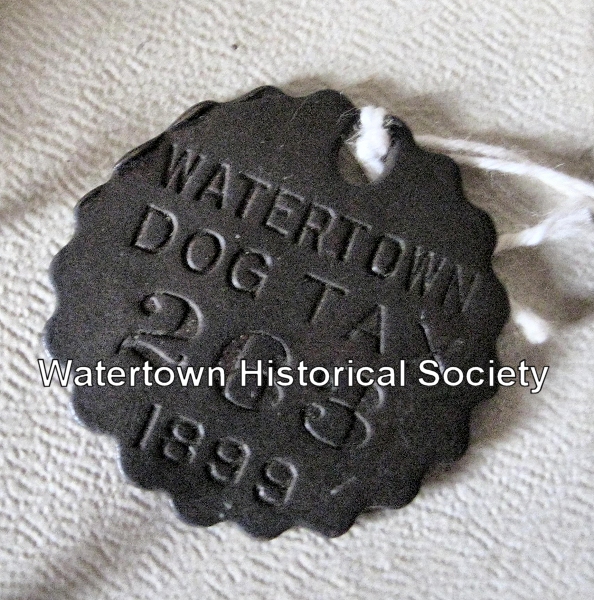 Dog Tag (1899)
03 03 DOG OF GAZETTE EDITOR
POISONED
I will pay $10 reward to the person who will furnish
me with information which will lead to the arrest of the party who poisoned my
dog shortly after 7 o’clock on Thursday evening, February, 23, 1899.
The guilty party, if found out, will get the full
benefit of the law for such an offense.
The law reads:
“Chapter 182, Section 4445. Any person who shall willfully, maliciously
or wantonly kill, main, mutilate or injure any horse, mule, cattle, sheep or
other domestic animal of another, or administer poison to such animal, or
expose any poison, with the intent that the same maybe taken or swallowed by
such animal; shall be punished by imprisonment in the county jail no more than
six months, or by fine not exceeding one hundred dollars.”
J.
W. Moore, Editor Watertown Gazette. WG
03 10 IT HAPPENED AGAIN !
For the second time within two weeks some miserable
cur has poisoned a dog belonging to the editor, a second one being poisoned
last Wednesday afternoon just one week after being presented to me by one of
our business men. I will pay the above
reward ($25) to anyone who will furnish the information that will lead to the
arrest of the guilty party, for whoever it may be certainly deserves
punishment, and it will be meted out in homeopathic doses if the person is found
out.
–
JAS. W. MOORE WG
1901
Watertown Gazette,
01 11 1901
Last
Saturday and Sunday a dog owned by a west side party made life uncomfortable
for quite a number of people, biting a number and attempting to bite
others. Among those who were bitten are
Chas. Frey, teller of the Merchants’ Bank; he was crossing Main Street when the
dog jumped on him, knocked him down and then bit him in the leg. A son of A. Zimmerman, one of Ben. Zoelte’s
sons, and three or four other boys were attacked and bitten. The animal also attacked a young girl, but
Will Spear went to her rescue and drove the dog away. An animal of that nature should be killed at
once without waiting for any undue ceremony.
Officer
Eiffler found the dog dead on the Kimski premises in the Third ward, on Monday,
and the supposition is that it had been poisoned just previous to attacking
people. WG
1915
Watertown Gazette,
07 15 1915
KENNEL
OWNER MUST PAY TAX ON EACH DOG
Madison, Wis., July 8
F. M. Wetter of Watertown is the owner
of a dog kennel where he always has from 12 to 30 canines. The city of Watertown levies a dog tax which
proved a great burden to Mr. Wetter, and he has appealed to the attorney
general to learn if the city of Watertown has authority to levy a tax upon his
dogs, as long as he keeps them closely confined and never permits them to be at
large. Mr. Wetter would much prefer to
have his dogs assessed as personal property.
Attorney General. W. D. Owen, in a
letter yesterday to Senator Mulberger of Watertown, advised that the city of
Watertown has a perfect right to levy a special tax upon the dogs, and that
even though they were assessed as personal property, they would not, because of
that fact, be exempt from the dog tax, for the reason that the latter impost is
under the police regulations.
1921
DOG COMMITS SUICIDE (article headline)
“Muhnka,”
an Airedale pup belonging to John L. Kehr (office manager for the Hartig
Brewery), committed suicide early this morning by jumping from the roof of Hartig’s
Brewery.
Death was instantaneous. The pup
has always been an avowed enemy of cats and it was because of this hatred that
he met his death. Having chased a cat
through the brewery, he reached the roof through a skylight. In the chase he came to the edge of the roof
and jumped to a lower roof. Landing on
his head, he was stunned and fell from there to the ground. When found he was dead. The dog was a familiar figure to citizens and
will be greatly missed. Persons who knew
the dog say he had been grieving over the Volstead Act and the world
series. – Watertown Times. Reprinted in The
Representative (Fox Lake, WI), 10 27 1921, pg 3.
1937
Watertown Daily Times, “Times Square,” 03 03 1937
GOOD DOG, GOOD DOG
What is probably the smartest dog in the city has come to the attention of this column (WDTimes, “Times Square”).
The dog is "Patsy", a little terrier belonging to Mr. & Mrs. John Jansky, 901 S. 10th Street.
Patsy always comes when members of the family take a small tin whistle and blow it. While she seldom strays away far from home, the whistle brings her running when it is sounded. Not only that, but Patsy ignores other whistles and knows when she is wanted by members of the family. So keen is her sense and distinction of hearing.
Patsy also does a lot of tricks and understands most things spoken to her. She also "speaks" when she is told to say "Mama." A sound that actually is like the word comes from her throat. Unless one has heard this it is hard to believe that such a thing is possible.
There is no doubt that Patsy is
a smart and unusual dog and how she was overlooked in listing some of the other
outstanding dogs in Watertown when the police made out the list is beyond this
writer to explain, so he hastens to
correct it by giving Patsy this well-deserved paragraph.
1944
Watertown Daily Times,
06 13 1944
IGGIE IS DEAD
He Was A Good Dog
Iggie is dead and buried. Iggie was the terrier belonging to Miss Margaret Oestreicher and for years was a familiar sight on the city streets, always accompanying her, much like Mary's little lamb, whenever she took a walk or came to the downtown section of the city. Iggie once followed her to church and attended services. That was some years ago. At that time he broke into print because of it. And now Iggie is dead. Iggie died at a pretty ripe old age and was given a decent burial, right under a rose bush in the Oestreicher yard. He was placed in a suitable box and it is rumored one of Margaret's friends even sent a bouquet of flowers. Iggie is dead. May he rest in whatever Happy Hunting Grounds it is that good dogs go to when they die.
City Directory has Miss Margaret living at 110 Warren.
1952
Watertown Daily Times,
04 09 1952
$100 REWARD OFFERED AFTER DOG
POISONING
Two dogs in the Lynn Street area were poisoned yesterday, according to a report made to the police department last night by a Watertown veterinarian who is treating both animals for strychnine poison. The dogs are owned by Albert W. Maas and his son, A. W. Maas, Jr.
Both dogs came home suffering from the poisoning. They were fed some meat, because large chunks of meat were heaved up by the animals. The veterinarian said that he will be able to save the dogs, unless they swallowed bits of bone which would be saturated with the poison. In that case, death will probably result.
A person in the neighborhood is said to be under suspicion but no direct evidence has yet been uncovered. Poisoning dogs carries a prison sentence.
Both dogs are held to be valuable as hunting dogs.
The elder Maas today offered a reward of $100 for information leading to the arrest and conviction of the poisoner.
Watertown Daily Times,
04 12 1952
SANDY NONE TOO HAPPY / Last day to roam freely
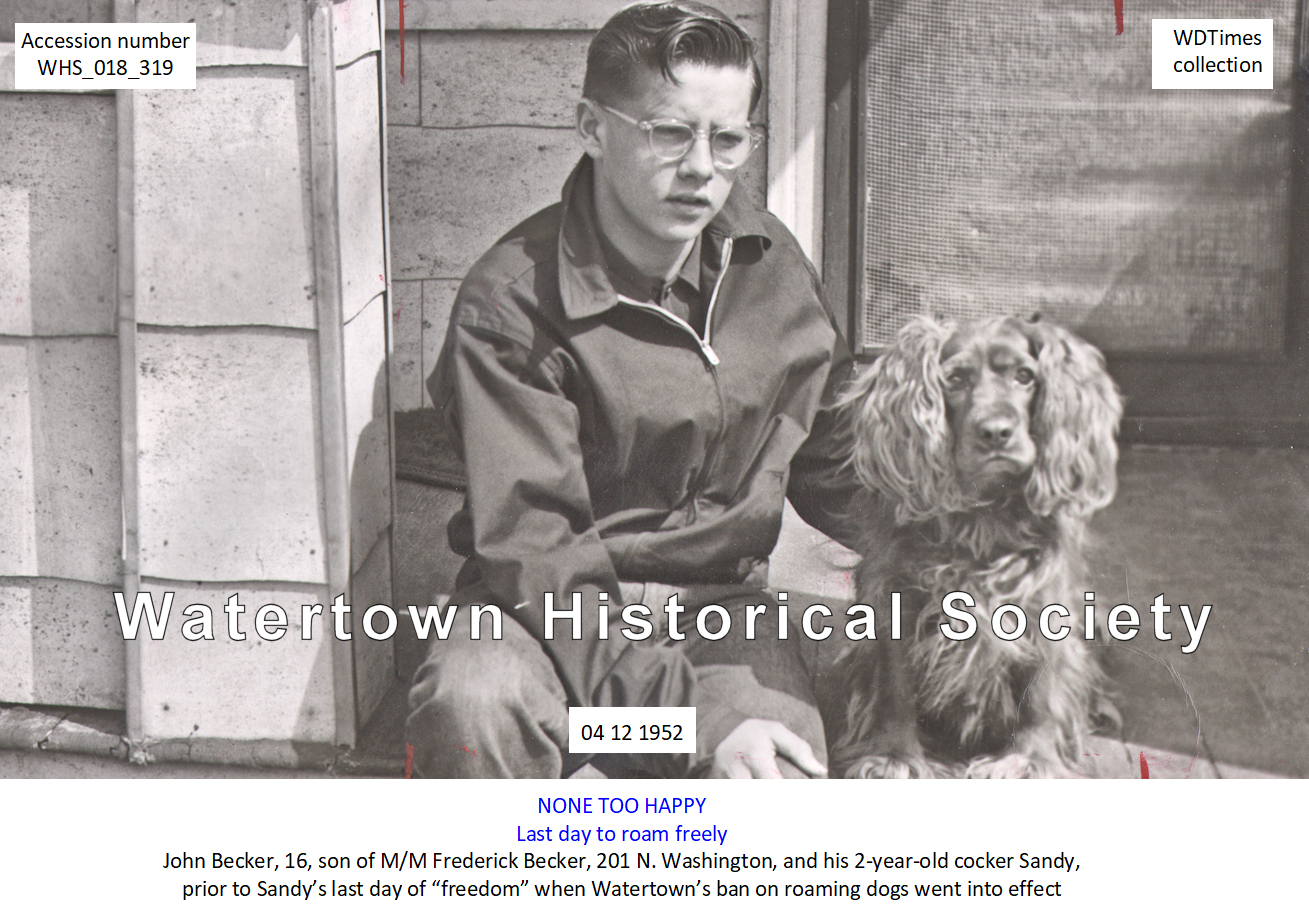
John Becker, 16, son of M/M Frederick Becker, 201 N. Washington, and his 2-year-old cocker Sandy, one day before Sandy’s last day of “freedom” before Watertown’s dog ban went into effect, through Sept. 30. City council expected to adopt year-round ban on dogs running at large in the city, implementing approved referendum by voters.
1962
Watertown Daily Times,
12 18 1962
Watertown cats and dogs, subject of a proposed
new ordinance under which they would be required to undergo inoculation against
rabies every three years, came in for more discussion and wordage at last
night’s common council committee meeting, but nothing definite was decided,
although the measure is scheduled for consideration at tonight’s regular
council session. For a time last night the proceedings sounded like a summit
meeting with aldermen expressing their views and asking questions.
Widespread disagreement was evident. One alderman kept asking, “Even if we pass
this ordinance, how are we gonna enforce it? Police have too many other things
to do than to go around chasing cats.” Another added, “I’d like to see dogs and
cats treated alike.”
c 1909-1910
Dog's Obituary
It is not often that a newspaper chronicles the death
of a dog, but as ex-Postmaster J. T. Moak's
dog Fido was known to nearly every man, woman and child in Watertown, and to a
large number of people outside the city as well, a notice of his death will not
be considered out of place.
Last Tuesday night he entered his last sleep, the
cause of his death being rheumatism and old age. For years he made daily rounds of the city
with the mail carriers, and his friendly greeting was greatly enjoyed, especially
by the juveniles of the city.
1966
Watertown Daily Times, 02 07 1963
Watertown’s new cat and dog ordinance, so hotly discussed and argued in past weeks, today was headed for inclusion in the city’s laws and the next question is one of enforcement. The new measure was adopted by a 9 to 3 vote at Tuesday night’s common council meeting. Contrary to the belief of many, the new ordinance does not require that dogs or cats be immunized against rabies, as was proposed in the original revised version. That provision was dropped entirely after information was received stating that no cat vaccine has yet been developed which is completely successful or effective.
2001
10 13 An ordinance to repeal and recreate a section of the city’s animal ordinance, regarding keeping animals and fowl within the city, was approved at its first reading. Limitations include making it unlawful to keep more than 10 rabbits, guinea pigs, hamsters, snakes, etc., or a combination of any 10 animals within the city. Permits are required for animals not listed in the ordinance, with approval of the city health officer who may also require an annual inspection of the premises where the animals are kept. Anyone in violation of the ordinance provisions is subject to a fine of at least $50 for each offense. “I hope the council will not pass this bill that make criminals out of law-abiding citizens,” said RoyAnn Webb, who has an indoor aviary. “Please remember the end of the pledge of allegiance words you just spoke, ‘and justice for all,’ and that includes people with animals.”
2013
02 23 Stricter regulations proposed on ownership of certain breeds of dogs (pit bulls). WDT “In Times Square” column (subscription may be required)
Cross Reference:
100 Years Ago Dec. 15, 1907
A lover of dumb animals in this city called the attention of The Leader reporter to the fact that there was a great deal of cruelty to animals both in the country and in the city which should be stopped, and in many cases the law should be invoked, that those guilty of cruelty might be punished as they deserve. He mentioned several instances where poor cows were belabored with milking stools because they were restless or refused to give down as quickly and freely as the milkers thought they should. He also mentioned cases in the city where horses had been whipped and abused without cause and gave the names of the parties which are withheld for the present but, should it occur again, there will be trouble.

History of Watertown, Wisconsin