website watertownhistory.org
ebook History of Watertown, Wisconsin
Also part of History of Railroads

 < PORTFOLIO OF PICS
Chicago & Northwestern Railway
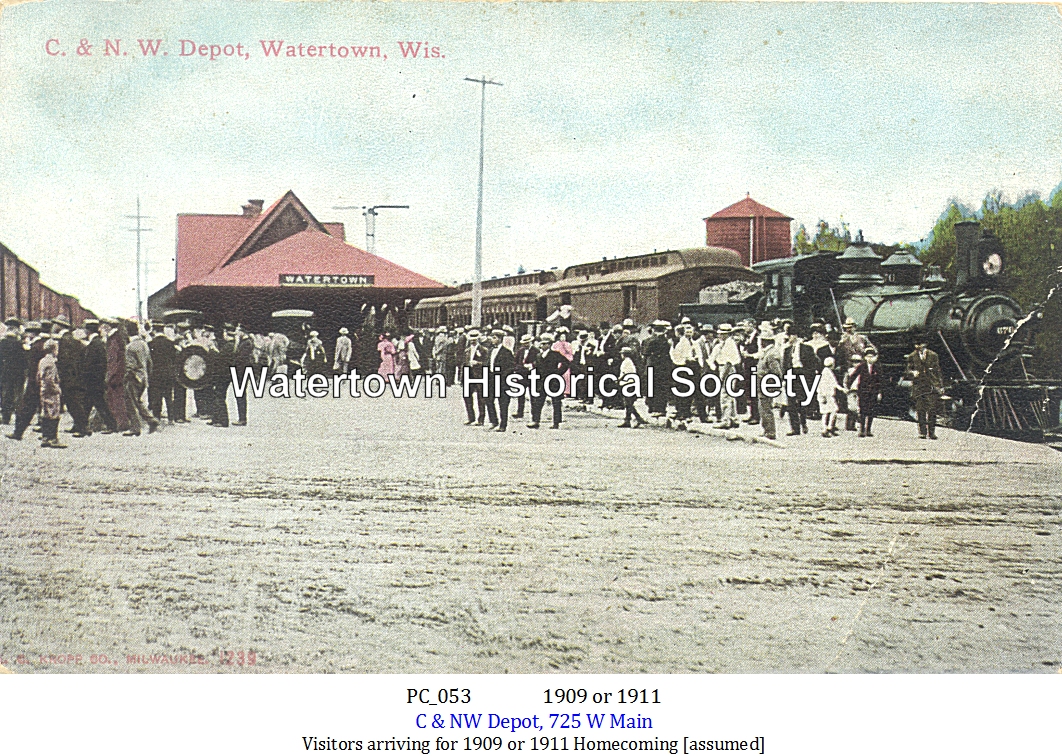
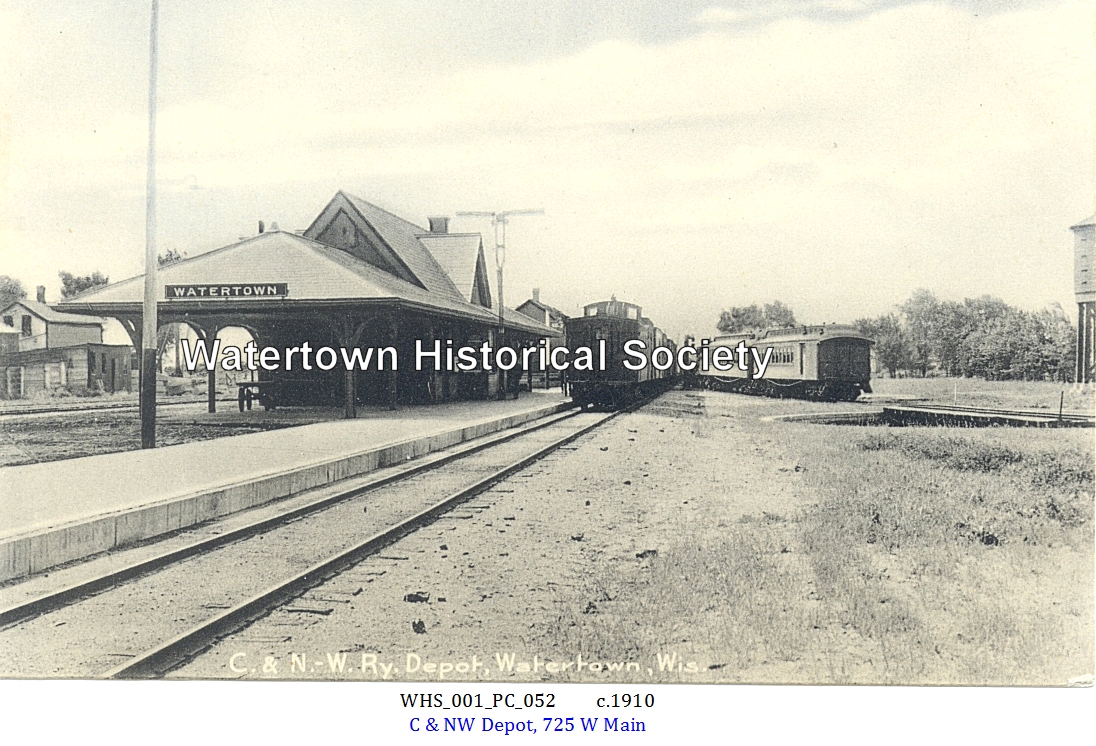
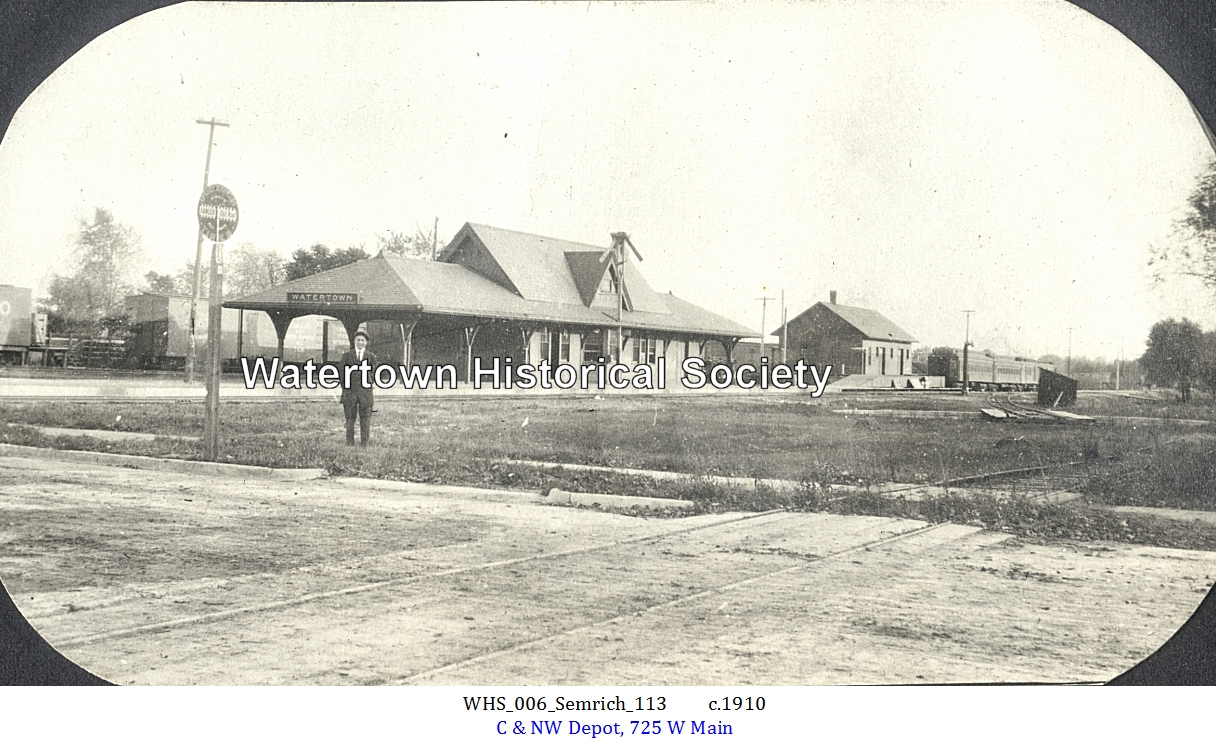
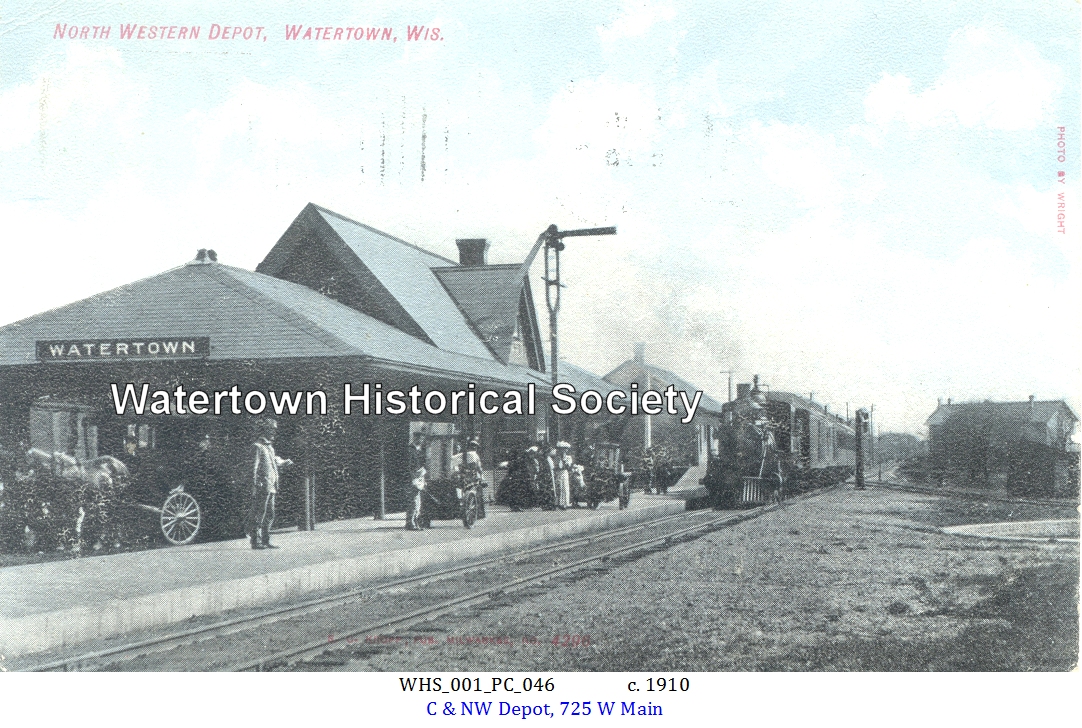
Chicago & Northwestern Depot
725 West Main
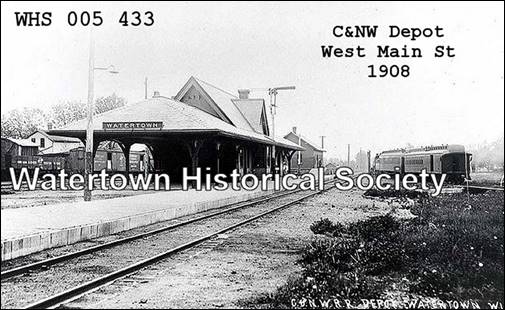
1908, WHS_005_433
1859
06 30 Work on the Chicago and Northwestern Railway is
fairly commenced. Under the old
regime—or what was known as the Chicago,
St. Paul and Fond du Lac Co.—we were so often humbugged into the belief
that the work was to be prosecuted with renewed energy and “finished up this time
without any mistake,” that we about made up our minds that the next time we
believed it, or announced it, would be when we saw it done and heard the
whistle of the locomotive. Gangs of men
are scattered all along the line of the road . . . Hon. Perry H. Smith is
securing the right of way and pays cash in hand for the damages when agreed
upon . . . We understand the iron necessary for laying the track the entire
distance between Milton and La Crosse Junctions is purchased. We see no obstacle to its completion
according to the terms of the contract.
WD
07 21 Two large and efficient parties of men are now organized and actively
engaged in laying track on the Chicago and NorthWestern
Railroad; one starting from this city, and rapidly advancing toward the La
Crosse Junction, and the other as rapidly coming from the Junction towards this
city. Already, for the first time, the
Iron Horse passed through and beyond the northern limits of this city
yesterday, and it is interesting to witness the speed with which the rails are
being put down, how fast a way is being prepared for the flying
locomotive. The days are few and numbered, when this seventeen mile
link will be supplied, which is to make perfect our railroad connection with
the north. The grading on the southern
section is progressing with equal and unabated vigor. WD
08 18 During the past two weeks track laying on the Chicago and North Western
Railroad has been suspended between this city and the La Crosse Junction in
consequence of the want of iron, but was resumed again
last Thursday morning. Vessels loaded
with rails for this road arrived at Milwaukee last
Sunday and Monday evening a train of iron was sent to this city and is now
being put down. This removed the last
obstacle to the speedy and sure completion of this short fragment of road—there
is not now over two miles of track to be laid and all will be finished at least
as soon as Saturday, when an engine will be able to pass over the road from
Watertown to Juneau. In this connection
we might as well state that enough iron to lay the whole distance between this
city and Janesville is now on the way from New York. It will soon be unshipped at Milwaukee and
Chicago and the work of track laying will be commenced and prosecuted from both
ends. The grading is so far advanced
that it will all be completed before the track layers can reach the ungraded
portions that yet remain to be done. As we said a few weeks since, this year will
not end before the cars will be running from the north to the south, and also from the east to the west, through this city. We shall then no longer be an isolated, one
side[d] place, but the center of travel of this state . . . WD
09 01 Regular trains are now running over the
Chicago and North Western Railroad between this city and Oshkosh. Mr. E. J. Cuyler is the station agent for
this city and is prepared to furnish tickets to any point along the line where
the cars stop. Until his office is
fitted up in the new depot building, which is now being built as rapidly as
possible, he will be found at the Planter’s Hotel, ready to give passengers any
information they may desire as to the hours of starting and arriving. In a day or two the regular time table will
be made out and announced to the public so that all may know what to depend
upon and be able to make their calculations accordingly. A large number of
men are scattered along the track, making it as even and firm as possible. For a track just laid, it is in as good a
condition for now as could be expected.
In fact it needs but little adjustment to make
it as good as it can be made. Even as it
is now, it is much better than many older roads. WD
09 01 New Depot. The Chicago and North Western Company are now
erecting a new depot building a few rods
south of the plank road, on the west side of the river [now Garden Path
Florist]. It will be built of wood, one
and a half stories high, and seventy-five feet long, by
thirty wide. It
will be used as both a passenger and freight depot for the present and until
arrangements are made with the Milwaukee, Watertown, and Baraboo Valley Company
to put up a union building large enough to meet the requirements of both roads. That such a structure will be built in this
city before long may be regarded as one of the things that will be. [sic] WD
09 15 All the grading between this city and Janesville on the Chicago and
North Western Railroad was finished last week and everything is ready for the
iron, which has already been laid over six miles south from this point. If there is no delay for the want of iron, it
will not be more than three weeks before a locomotive will pass over the entire
length of this splendid road, reaching from Chicago to Oshkosh. When this is done, all must acknowledge that
the directors of this company have accomplished a great work, considering the embarrassments under which they labored when spring
opened. Autumn will not pass away before
they will have finished the link that is to connect the north with the south,
and thus enable each section of country to supply the wants and contribute to
the prosperity of the other. A new and
valuable channel of trade and travel will be created for the benefit of the
chain of thriving cities and villages through which it runs, and the interest
of the public generally will be advanced by the final completion of this great
enterprise, which we are about to witness and chronicle. WD
09 22 As early as next Saturday all the iron will probably be laid on the
Chicago and North Western Railroad. Two
parties of track layers are rapidly approaching each other from the north and
south and it is confidently expected, if the weather should be fair, that they
will meet on the last day of this week, and the locomotive be able to pass over
the entire length of the line. But for
the unexpected delay in receiving iron, the road might have been in successful
operation before now. Of
course it will take a short time to ballast the track in order to make
it safe for heavy rains, but this will be accomplished as rapidly as possible .
. . WD
09 22 A long train of forty-seven cars loaded with wheat left this city last
Monday morning and passed over the Chicago and North Western Railroad to the La
Crosse Junction. Heavy amounts of grain
are now finding their way to Milwaukee over this route. The difficulty is to get cars enough to take
the freight that is daily brought here from all
directions to be sent to market. The
farmers are selling pretty freely and this furnishes
the railroads with all the business they can do. Every locomotive and freight car is put in
requisition and all is life and activity at every station where wheat can be
bought. . WD
09 22 Fencing. The
Chicago and North Western are now building a substantial board fence on
both sides of their road between this city and Oshkosh. This important work is nearly completed and
by the time the trains pass the entire length of the line it will be finished. The promptness with which the road has been
enclosed will be a benefit to the farmers and they will appreciate the favor. . WD
09 22 NEW DEPOT
The new depot of the Chicago and North Western
railroad in this city [now Garden Path Florist] is now completed and ready for
freight. It is a wood building of fair
dimensions and for the present will answer the purposes of the company. A new turn table has also been put in and is
now in use. The business of this road is
large and on the increase. It will fully
meet the anticipations of those who have been the means of putting it in
operation. It must be among the best
paying roads in the West . . . WD
Railroad completed at
point south of Jefferson
10 11 Railroad Completed—The connecting link between Lake Winnebago on the north and Lake Michigan on the south—or in other words, the last bar of iron which binds Oshkosh and Chicago together with metallic bands—was laid with appropriate exercises on Thursday last. The union was completed under the auspices of delegations from the various cities and towns on the line of the road, by whom the ceremonies of the occasion will long be remembered with emotions of pleasure and satisfaction. No notice had been given that anything out of the usual routine of track-laying was to take place, but it having been understood that the two gangs of men, having that work in charge, were to meet upon the day above mentioned at a point not far from Jefferson, it was determined to make it an occasion of congratulations and rejoicing on the part of a few friends of the work representing the various localities through which it passes.
About noon
an engine from the north, with banners flying, came whizzing along and brought
with it a train of passengers—or perhaps we ought to say, passengers on a
train—to which sundry additions were made at this place and at one o’clock we
were all off for the point where were to be celebrated the nuptials between the
north and the south, Wisconsin and Illinois, Oshkosh
and Chicago. Arriving at Jefferson in
due time, our numbers were still further increased and
we pushed on about one mile south of the village where the wedding observances
were to be performed. A train from
Janesville arrived soon after, bring a number of gentlemen from that city and intermediate
points, when everything being in readiness, no delay occurred in completing the
union between the two contracting parties.
A. Hyatt
Smith, Esq.—“the original President of the original road”—being called out,
made a few remarks going somewhat into details as to history of the Rock River Valley Union Railroad—spoke
of the embarrassments that company encountered when it first agitated the
project of building a road running north and south through this state—of the
opposition it had to contend with and the difficulties it was compelled to
surmount at the hands of those who should have been its warmest and most
steadfast friends. He alluded to the
fact that when ground was broken at Fond du Lac, on the 14th day of July, 1851,
eight years ago, at the commencement of the work, he threw the first shovel
full of dirt upon that occasion and claimed that as such had been his position
and he had stood by the enterprise in adversity as well as prosperity, he
should beg the privilege of now driving the last spike in the last rail, upon the
completion of the road.
Isaac Woodle, Esq., of Janesville, the first attorney of the
first organization, followed in a few remarks, reviving interesting
reminiscences of the past connected with the road and spoke of the immense
importance that this thoroughfare is to have upon the future welfare of the
state.
Charles A.
Eldridge, Esq., of Fond du Lac, being called for, responded in an able and
effective speech. He said the Rock River
Valley is the great backbone of Wisconsin, traversed by the Chicago and North
Western Railway and that all the other railroads in the state are but arteries
diverging from it. His remarks were
heartily applauded.
J. J. Enos,
Esq., of this city, L. B. Caswell, Esq., of Fort Atkinson, and D. F. Weymouth,
Esq., of Jefferson, followed briefly and spoke of the advantages that must
necessarily accrue to their respective localities, in common with all others on
the line of the road.
Their
remarks were to the point and went right home to the hearts of their hearers as
facts which it is impossible to controvert.
Cheer upon cheer went up from the crowd as the speakers contrasted the
valley of Rock River as it is today with what it was ten years since and what
it will be ten years hence, and otherwise illustrated the benefits that are
sure to follow the completion of the Chicago and North Western enterprise. After a few happy and pointed remarks from
Hon. Perry H. Smith in which credit was awarded to Wm. B. Ogden, Esq., the
President of the road, who has periled his own immense fortune for the success
of the work; to T. F. Strong, the superintendent, has worked early and late
ever since the project first originated, to carry it forward to successful
completion; to Wells & French, the contractors who have done the work of
grading fifty-six miles so rapidly and well; to Robert Campbell, the ever-ready
and accomplished Chief Engineer, and his assistants; to Campbell & Page,
the contractors for laying the track; to Mr. Barrett, their energetic foreman;
and others whose names do not now occur to us, for the manner in which they
have all discharged their duties in the premises—ascribing to them, however, no
more than their just need of praise for the promptness and fidelity with which
those duties have been performed—the other member of “the Smith family”—A.
Hyatt Smith—then proceeded to the execution of the welcome part assigned to him
in the final act, which, being over, we presumed was a signal for our departure
home. But the Janesville delegation said
No. They insisted that their friends
from the north should accompany them home and partake of
their hospitality, which was readily assented to, though nothing of that sort
was in the first instance contemplated.
Arriving in
Janesville we were all domiciled at the Hyatt House, supper was ordered, which
in due time was announced, and to our certain knowledge it received the
respectful attention of a hungry crowd.
That being over, “a feast of reason and a flow of soul” followed, in
which speeches were made by A. Hyatt Smith, Gov. Barstow, Mr. Eldridge, Mr. Woodle and Hon. P. H. Smith, the party breaking up soon
after in good “spirits,”—no allusion is here made to champagne—and the best
possible humor with themselves, their hosts, the Hyatt House, Janesville and
“the rest of mankind.” The fact that the
whole arrangement was extemporaneous and as unexpected to our Janesville
friends as it was to their visitors, gave it additional éclat and convinced us
all that on occasions of this kind Janesville is “sound” every time. Now that we are placed in direct
communication with her by rail, we hope to see more of her people hereafter,
and in behalf of the Watertown delegation would say
that our latch-string shall always be out and that at some future time we hope
to have it in our power to entertain them as handsomely as they did us. WD
10 11 RAILROAD SUPPER
Last
Saturday evening Mr. E. C. French of the firm of Wells & French, the well known and enterprising railroad builders, who are
always ahead of time, gave a supper at the Exchange
Hotel of this city to a number of gentlemen connected with him in the
construction of the Chicago and North Western Railroad, and a few others, among
whom we noticed Hon. Russell J. Sage, Judge S. L. Rose, D. C. Jackson, Esq.,
and Gen. Chappell. Everything went off
in the most agreeable and flowing style.
The supper was got up in the bountiful and unsurpassed way in which
Alderman Van Alstyne always does that kind of business. The wines were sparkling and pure; the
conversation and interchange of sentiments interesting and entertaining, and
all went away grateful and pleased with the opportunity of passing
an evening so agreeable among friends and acquaintances. WD
10 20 The formal opening of the Chicago and North Western Railroad took
place last week. Along the entire length
of the line, from Chicago to Oshkosh, all was festivity and rejoicing, and well
it might be, for the people of the Valley of the Rock River and Lake Winnebago
celebrated the completion of an enterprise which had long excited their hopes,
employed their resources, and involved their prosperity. On the 14th of July, 1851, the first blow was
struck towards the construction through the length of the state, and on the
11th day of October, 1859, the thronged and crowded excursion train was ready
to start from the city of Chicago, the metropolis of the inland seas, and
swiftly glide over the smooth metallic pathway, nearly two hundred miles to
Oshkosh, the rising city on the shores of the beautiful Winnebago.
After
receiving additions at Janesville, Fort Atkinson and Jefferson, the cars, with
their loaded freight of human beings, came rushing into Watertown, the locomotives
covered with fluttering and flying flags and the cannon at the end of the train
answering to the cannon that thundered from the green a salute to the long
expected and welcome visitors from the south.
A splendid brass band struck up a national air,
the Zouave Cadets of Chicago made a brief display in their singular and
attractive uniforms and shortly, with the car assigned to this city, all were
on their way north.
Arrived at
Fond du Lac, after a rapid passage, a torch light procession received the
guests of the day and escorted them amidst the strains of music and the roar of
artillery, to the Main Street, when all dispersed to
prepare for the evening entertainment.
The gathering of people was immense, far larger than was ever collected
on that ground before, or is likely to be soon again. The
hotels being filled to overflowing, private citizens kindly opened their
tasteful and commodious residences for the accommodation of strangers and made
everyone who had the good fortune to test their hospitality perfectly “at
home.” In the evening, after a bountiful
repast, Amory Hall was brilliant with dazzling light and there the beauty,
fashion and manliness of a dozen iron-bound cities and villages assembled and
until the beams of the rising sun began to light up the Eastern sky, all was
music, dancing and pleasure.
In the
morning the excursionists, or such as chose, continued their journey to
Oshkosh—some going up the river on the steamers which lay at the wharf ready
for a pleasure trip, some visiting friends, and some passing a few hours in
sightseeing—admiring the activity and prosperity of a flourishing place and
wondering how quickly all the traces of a calamitous fire had been effaced by
the energy and enterprise of its business men.
In the
afternoon the train returned to Fond du Lac—part of it coming as far as
Watertown. Those who remained at the
former place were again entertained with unbounded liberality and invited to
join in the pleasures of another dance.
The next day was the conclusion of this lively and exciting scene. The extended train of thirty cars went back
to its starting point, and so ended one of the most memorable days in the
history of improvement and progress in the fertile and happy Valley of Rock
River.
We have not attempted,
now can we now, to sketch all the incidents of this excursion, the most
remarkable and enthusiastic that Wisconsin has yet witnessed. The rejoicing and enjoyments of the trip were
next to nothing—they were but the graceful flowers thrown around an occasion of
great significance and importance, which speaks of the finishing of a work that
is forever to bind together with iron bands the north and the south, and will
ultimately form an indissoluble and unbroken link in the chain of railways
which will yet unite Lake Superior with the Gulf of Mexico—Ontonagon and
Marquette to New Orleans and Mobile.
On this
unequalled line of travel and trade, Watertown forms an important point. Here four different railroads intersect each
other and there is no direction which may not be taken from this city. North, South, East or West, we can journey
with every facility that steam can give us.
So situated and favored, it is our own fault if we do not here build a
place that in wealth, manufacturers, agriculture, trade, intelligence
and refinement shall be second to no interior place with the broad limits of
Wisconsin, its capital not excepted. WD
1860
05 17 Fence
Building; Chicago and Northwestern soon to be enclosed along its entire
length WD
05 24 Train wreck; derailed, south of city, cow
struck WD
07 26 150 more freight cars, to accommodate
increasing business WD
07 26 Kadish Lumber yard
opened near depot WD
1861
02 28 Tuesday morning
the hind car of a wood train on the Chicago and North Western Railroad, while
coming from the south, by some means got off the track and as it came to the
bridge crossing Johnson’s Creek, plunged some twenty feet below onto the ice
and into the water. There were five persons in the car, all of whom were badly injured . . .
After learning all the facts of the case it is no more
than right to state that this is one of those accidents that will sometimes
happen in spite of every precaution. The
cars got off the track a considerable distance from the bridge and in consequence of the mist and smoke it was impossible to
give a signal to the engineer. As many
as could left the car while in motion and saved themselves. Those who could not get out had to go down
with it. WD
03 07 The iron
on the track of the Chicago and North Western Railroad is now laid to the city
of Appleton. In a few days arrangements
will be made for making regular trips to Appleton. This road is now doing a
heavy business and a large proportion of its freight comes from the
growing and energetic North. WD
03 14 GLAD
WELCOME TO THE ENGINE—A few days since, the Iron Horse entered within the
limits of the city of Appleton the first time. Following is from the Appleton Cressent: Appleton - the seat of learning of Wisconsin;
Appleton - the center of trade of the best agricultural region in Wisconsin;
Appleton – the manufacturing city of the West; Appleton – the railroad! the railroad! WD
1862
02 28 EXPLOSION FROM KEROSENE
An explosion
from kerosene occurred a few days since on the Chicago & Northwestern
Railroad, a few miles below this city, as follows: The company had loaded a car with goods,
including a barrel of oil and two or three barrels of kerosene, and while on
the way the kerosene sprung a leak. Two
of the hands went into the car with a lighted lamp, an explosion immediately
followed – the gas from the leaking kerosene taking fire – blowing both men
into the ditch, setting the car and goods on fire and
consuming them both. Loss to the company
about $1,000. WD
1864
03 17 THAT MISSING SIDEWALK
The
impassable condition of the going from St. Bernard’s Church to the Northwestern
Depot is a standing shame and disgrace to the city, for which no excuse can be
given. Strangers or citizens arriving
here in the night when no omnibus is at hand to convey to the hotels or home,
are swamped in mud and plunged into gullies, from which extrication is almost
impossible. In day time the way to the
depot, at such a season as this, is bad enough, but in darkness it is doubly
difficult. The Common Council, if that
body has any regard for public convenience, should take steps immediately to
remedy this miserable state of affairs. We do not believe another city in Wisconsin
would permit or endure this gross and unjustifiable neglect for a single month,
yet here we have been wallowing in filth and mire for years, and all for the
want of a little energy and enterprise.
This is an improvement that ought to be made as soon as the work can be
done. Not only the owners of the lots
front of which the road runs will be benefited but all
who have occasion to visit this most frequented railroad depot in the city will
be accommodated, which includes our entire population.
Travelers
form a poor opinion of a city, which they have regarded as growing and
flourishing, when they find access to its business streets neglected, muddy and
unapproachable except by wading through pools, jumping over ditches, and
finding themselves covered from foot to head with a cart load of well-worked
clay mortar. Some
time this job must be taken in hand, and the sooner the better. Give us the sidewalk now. WD
03 31 A WALK TO THE NORTH WESTERN DEPOT
A walk over to the North Western Depot at this
particular time will give any one a good idea of the
highly creditable condition of the streets leading to that much frequented
place. The state of affairs should not
be disturbed, but should be permitted to remain
year after year just as now. If mud knee deep is a good thing, we
are not likely to be without it in that part of the city for some time. Those who attempt any improvements in that
locality ought to and will fail. No more
grumbling about dry and neat sidewalks.
WD
04 21 SIDEWALK FROM DEPOT TO WEST MAIN
Resolved,
That the Street Commissioners of the Third ward be and they are hereby directed
to carry into effect, without any unnecessary delay, so much of said ordinance
as relates to the building of sidewalks on the south side of West Avenue [West
Main St] to the depot of the Chicago and North Western Railroad, and give
immediate public notice in the official paper of the city to the delinquent lot
owners that if said sidewalks are not complete within [a certain number of]
days from the first publication of said notice, the Street Commissioners will
cause the same to be built at the expense of the lots, or owners of lots, as
provided in the City Charter. WD
07 21 SIDEWALK FROM DEPOT TO WEST MAIN
The
Northwestern Railroad Company has built a substantial sidewalk from their depot
to West Avenue Street [West Main]. We
now have an easy and decent way of getting to and from that important railway station all seasons of the year. You can ride or walk, just as you prefer,
without being swamped in mud. This is
both an improvement and convenience. WD
1876
WATERTOWN IN 1876
Watertown
is beautifully situated on both sides of Rock river, in the northern part of
Jefferson county and the southern part of Dodge county. It is on the line of the La Crosse division
of the C. M. & St. Paul Railway, 43
miles from Milwaukee and 152 from La Crosse.
A branch of this line extends from Watertown to Madison, the Capitol of
the state, distant 37 miles. The Chicago
& North Western Railway passes through here, terminating at Green Bay, 112
miles north.
Watertown
was laid out about the year 1836. In
1840 a part of the town was laid out in blocks and town lots, Milo Jones of
Fort Atkinson being the surveyor. After
that the town took a fresh start, and the surrounding country began to settle up with farmers.
The
streets are laid out at right angles, and are broad
and pleasant. One of the crowning
glories of the city is the profusion of shrubbery everywhere prevalent, lining
the streets on either side, and in the door [house] yards, forest and
ornamental trees vie with each other in giving a home-like appearance, and in
the spring and summer there is such a wilderness of foliage as to almost
obscure the houses.
The
streets are well provided with substantial sidewalks, usually kept in good
repair, and afford many attractive promenades and drives.
The principal streets are Main on the east, and West Avenue on the west
of Rock river, upon either side of which are fine business houses and blocks,
and many of them of beautiful design and finish. Madison City Directory, 1875-6.
01 05 NEW DEPARTURE OF C. & N.W. RAILWAY
Considerable
feeling has been aroused hereabouts over the order recently issued by the Chicago
and Northwestern Railway, and put in force on the 1st inst., refusing to carry
passengers on their freight trains as heretofore. Enforcement of this order causes great
inconvenience to the traveling public along the entire line of the road, and strong
disapproval of the new departure by the company is evinced in every town
through which the road passes. Traveling
by freight train on the Northwestern has got to be an actual necessity and to
be suddenly out off from the privilege is seriously
felt by the community. We can hardly believe that the company will allow this
order to remain long in force. The interest of the
public, and, we believe, those of the public alike, demand its revocation. WR
1898
03 09 POLICE SET TRAP
Resident offers sleigh to officers
A gang of eight tramps
who had imbibed freely of alcoholic spirits held high revelry and caused
considerable trouble in the vicinity of the Chicago & Northwestern railway
roundhouse last Thursday afternoon.
The police department
being notified, Officers Eifiler, Kerr and Pieritz were dispatched to quell the disturbance and arrest
the culprits. At about 5:30 the latter
were encountered, and after a desperate struggle, in which Officer Kerr was
roughly handled but nevertheless succeeded in besting his man, three of the
gang were landed behind the bars of the lock-up. They gave their names as
Charles Carney, William Bates and Thomas Curlen.
Subsequently Justice
Stacy sentenced Bates to the county jail for twenty days and Curlen for five days, the former for using obscene language
and the latter for drunkenness. Carney
was held for examination on the 11th.
After jailing the above
three the officers went back in quest of the other offenders, who it was
ascertained had kept up their nefarious work in the meantime. They attempted to ensconce themselves in the
roundhouse and, being ordered out by the engine-wiper, Samuel Fluker, had
unmercifully pounced upon the latter and pummeled and kicked him so that he was
rendered unconscious, when they left him and fled up the track.
Fluker was found by
neighbors in this condition and taken to his home. On their way over the police were notified of
what had happened by Station Agent Heimerl and Joseph
Reinehr and chase was given, Mr. Reinehr
placing his sleigh at the officer’s disposal.
As they neared the
crossing north of the roundhouse the tramps noticed the pursuing party, but
supposing them to be farmers returning home, set about
to hold them up. The tramps were
somewhat dismayed upon discovering the trap they had fallen into
and their capture was soon ef fected by the
officers.
The prisoners gave
their names as Robert Gray, Thomas Ryan, John Gukeen,
Charles Haney and James Clark. Saturday morning Justice Stacy committed them to jail at Juneau to await their examination
tomorrow, when it is expected Mr. Fluker will be able to appear against
them. Mr. Fluker was quite seriously
injured, sustaining a broken rib and some pretty sore
bruises, but he is recovering nicely.
His assailants, it is hoped,
will receive their just deserts at the hands of the law.
1900
04 03 CITY WATER FOR
LOCOMOTIVES
Arrangements have been
completed whereby the Chicago & Northwestern Railway Company will use city
water for their locomotives and other purposes at this point. Julius Fix, superintendent of the waterworks, has closed the contract, but the
same must be ratified by the board of water commissioners. The company will put in three taps — one
where their water tank now stands, another near the coal sheds, and the third
at the stock yards. The company’s
surveyors are now employed in making the necessary
surveys. The water commissioners will
furnish piping to the curb from the West Main Street main. WR
1901
02 13 SETTLEMENT WITH INJURED WORKMAN
The Chicago & Northwestern Railway Company
has made a satisfactory settlement with William Ebert, the workman who was
injured recently at the company’s coal sheds here, Mr. Ebvert
receiving $200 on account of his injuries.
The settlement was effected through the efforts
of Rev. A. M. Bullock, pastor of the M. E. church. WG
03 29 WORK CREW NARROWLY ESCAPES DEATH
Last Monday Herman Shallock,
section foreman, and his crew of men narrowly escaped death while going north
on their handcar on the C.&N.W.R.
It was quite foggy and they almost ran into a
freight train coming from the north before they discovered it. They jumped just
in time to save their lives. The handcar was badly wrecked and
also the engine pilot. WG
1903
07 29 EARLY MORNING FIRE
Northwestern Passenger and Freight Depot almost Totally Destroyed
A disastrous fire occurred in this city early
Monday morning, in which the C.&N.W. Railroad depot was almost totally destroyed.
The night operator, it appears, had been excused at 11:30 and during his
absence, or near 1 o’clock, the blaze was discovered
and the alarm turned in. The fire department immediately responded,
but by the time of their arrival the fire had gained such headway that it was
impossible to do much, although they succeeded in saving the lime warehouse on
the south and the waiting rooms and north shed roof.
Owing to the fact that the freight room had been pretty well cleared
out on Saturday there was not much loss in that quarter. However, the office was completely
destroyed. Among the ruins may be
seen the charred remains of books, freight bills, tickets, etc., in a useless conditions.
As to how the fire started is a question which
will probably not be known, although it is reported that a freight train passed
through shortly before the blaze was discovered, and it is thought that a spark
from the engine might have started the fire.
It is evident, at any rate, that the conflagration started in the
freight department by all appearances which remain.
The telegraph office has been temporarily
located under the roof at the north of the waiting rooms, where a temporary
office has been enclosed with rough boards.
A large force of men have been engaged in
tearing away and burning the debris for the past two days, and although nothing
definite has been learned, it is altogether probable that the railroad company
will soon commence the erection of a new depot.
The business of the company is being conducted as usual without
interruption and all freight shipments are accepted.
During the fire, Louis Griep,
driver of hose cart No. 1, was injured, but was able to attend to his duties
the next day, however.
It is estimated that the total loss to the
railroad company is about $5,000.
The Watertown News, 29 Jul 1903
1907
08 16 Robbery of box cars at the Northwestern
depot WL
1908
01 04 TELEPHONE AT THE DEPOT
The Chicago & Northwestern is placing telephones in the depots on their line. The telephones will be used only in the running of trains or the block system. That is, in place of telegraphing the arrival and departure of trains from one station to another, the telephone will be used. According to a law passed by the last legislature that operators are only allowed to work eight hours and this will necessitate the services of another man after the first of January.
09 09 INTERURBAN EXTENDED TO NW DEPOT
The interurban electric line will be extended from Montgomery Street to the North Western railroad depot and work on the extension will begin at once, John I. Beggs of Milwaukee, president of the Milwaukee Light, Heat and Traction company, has issued orders to this effect and work will probably begin tomorrow. This will mean a great deal to people in Watertown using the cars, as it will afford rapid transportation to the railroad station. Local labor, as much as possible, will be hired on this work and it is expected it will be finished before late fall. It seems to be the aim of the electric company to give Watertown as good a service as possible and it is to be hoped that city officials and citizens generally will not retard the work when it is being pushed now. All that can be reasonably expected is that the company construct its lines according to the terms of the franchise and petty exactions should not be made a deterrent. Watertown is in the field for all the transportation lines it can get and the sooner we leave aside ill will and ill feeling and boost the sooner we will receive what we are after.
An order has also been issued to the effect that beginning next Monday all electric cars running into the city from Milwaukee will make one round trip between Montgomery Street and Western Avenue. This is a trial which Mr. Beggs will make to determine whether the traffic will warrant this measure. It will be given a fair trial and if found of mutual benefit will be continued. It will be continued any way until the North Western extension is in operation and will allow each car fifteen minutes in which to make the round trip before leaving on the interurban trip.
During next week each electric car will have a trailer and enough other trolley cars will be put on to give a good service for the Watertown Inter-County Fair, and each car will bear a banner advertising the fair.
The agitation for the extension to the North Western depot was started in the Daily Times sometime ago and it was urged that business men and city officials unite in an endeavor to secure it. The matter was placed before Mr. Beggs before local action was taken, with the result that he has ordered the work done. In this connection it might be well to state that farmers from as far southeast as Delafield are taking advantage of the transportation facilities to do their trading in Watertown. This means much to local merchants and in turn to the public generally. Let's boost the work along and hope that the line will be extended south next year as far as the fairgrounds, at least.
10 23 TRAIN WRECK AT THE JUNCTION
C.&N.W. Ry. and
C.M.&St.P. Ry. freight trains
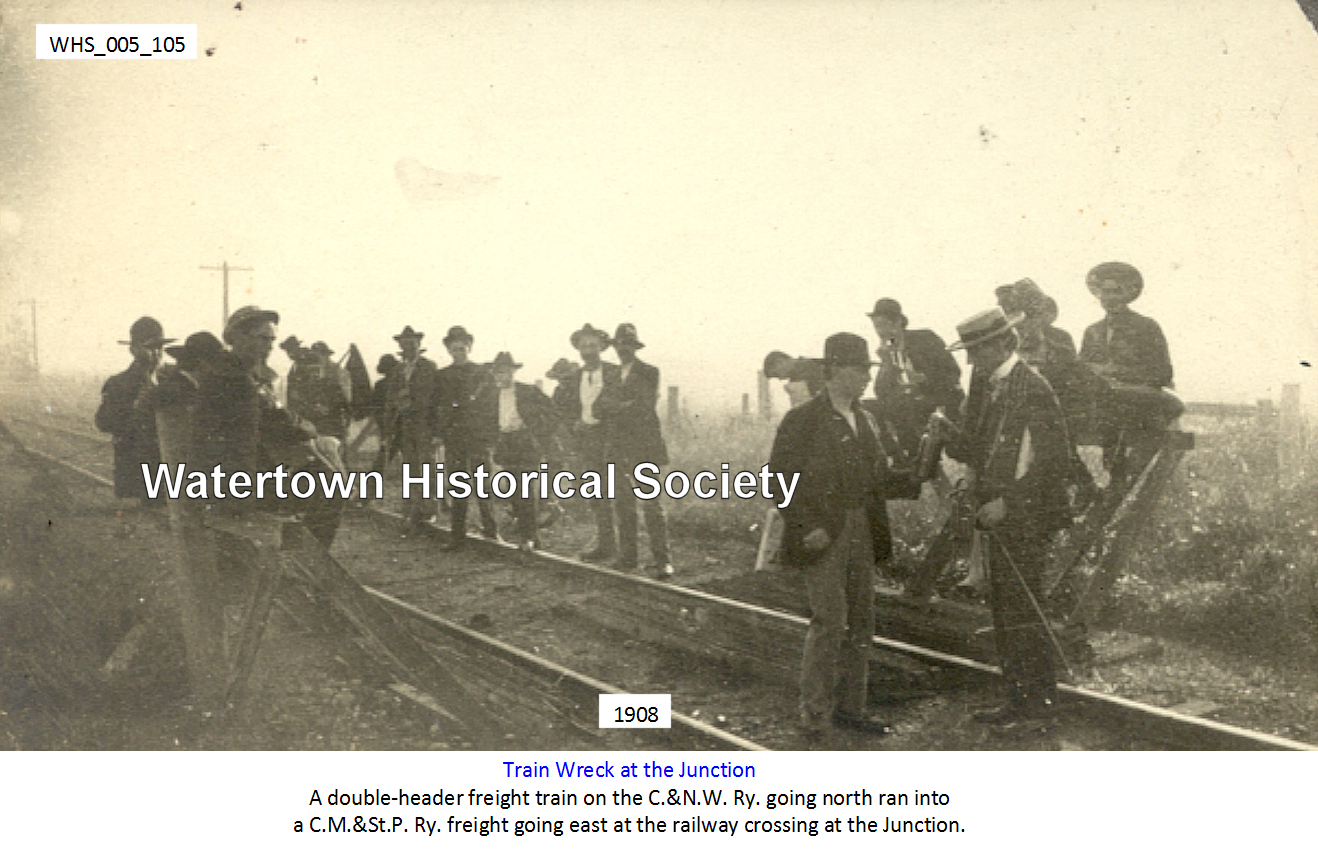
At 1 o'clock last
Saturday afternoon a double-header freight t train on the C.&N.W. Ry. going
north ran into a C.M.&St.P. Ry. freight going
east at the railway crossing at the Junction (Union
Depot). No one was injured, but one
of the C.&N.W. engines and a number of coaches
were badly wrecked. Conductor W. F. Clasen and Engineer Chas. Burmaster had charge of the
C.M.&St.P. freight, and D. F. Harrison and C. F. Dunwiddie had charge of the Northwestern. WG
11 06 Paul Kohler appointed agent, replaced A.
F. Beirmann WG
1909
Nov Chicago and North-Western accident, 12
killed WD
VISITORS ARRIVING FOR HOMECOMING [1909 or 1911]
c.1910
1914
01 01 CHAS. MANNING LOSES LEG
Christmas morning at about 1:30 o'clock
Chas. Manning had his left foot crushed by a freight train near the Chicago
& Northwestern depot in this city, and he crawled on his hands and knees to
the Junction hotel, not reaching there till nearly five o'clock that morning,
when Dr. Moulding, the C.&N.W.Ry.
physician, was phoned for from the Junction, and he brought the ambulance and
had the young man taken to St. Mary's hospital.
He had been exposed for about three hours, and at first from the great
loss of blood it was thought he could not live, but he is now getting along
nicely. His leg had to be amputated below
the knee. We understand the young man
claims when he reached the C.&N.W.Ry. crossing on
West Main Street, a freight train blocked the crossing and after waiting some
time he endeavored to pass under or between the cars, when the train started,
with the above result. WG
c.1915-1920
SPUR SEEN IN DISTANCE, along North Water Street
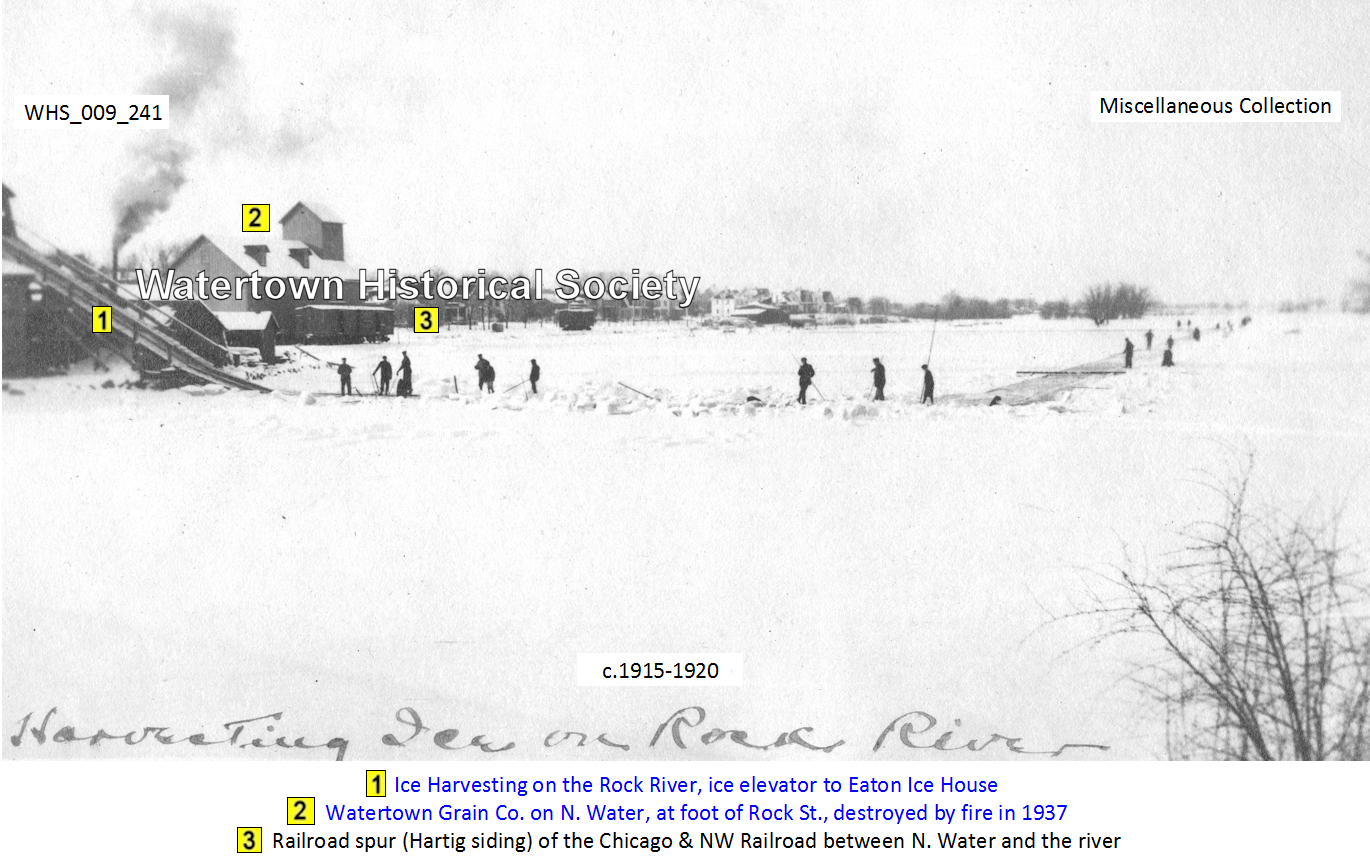 Ice Harvesting photo
1950
06 07 LAST RUN FOR PASSENGERS ON THE CHICAGO
& NORTH WESTERN
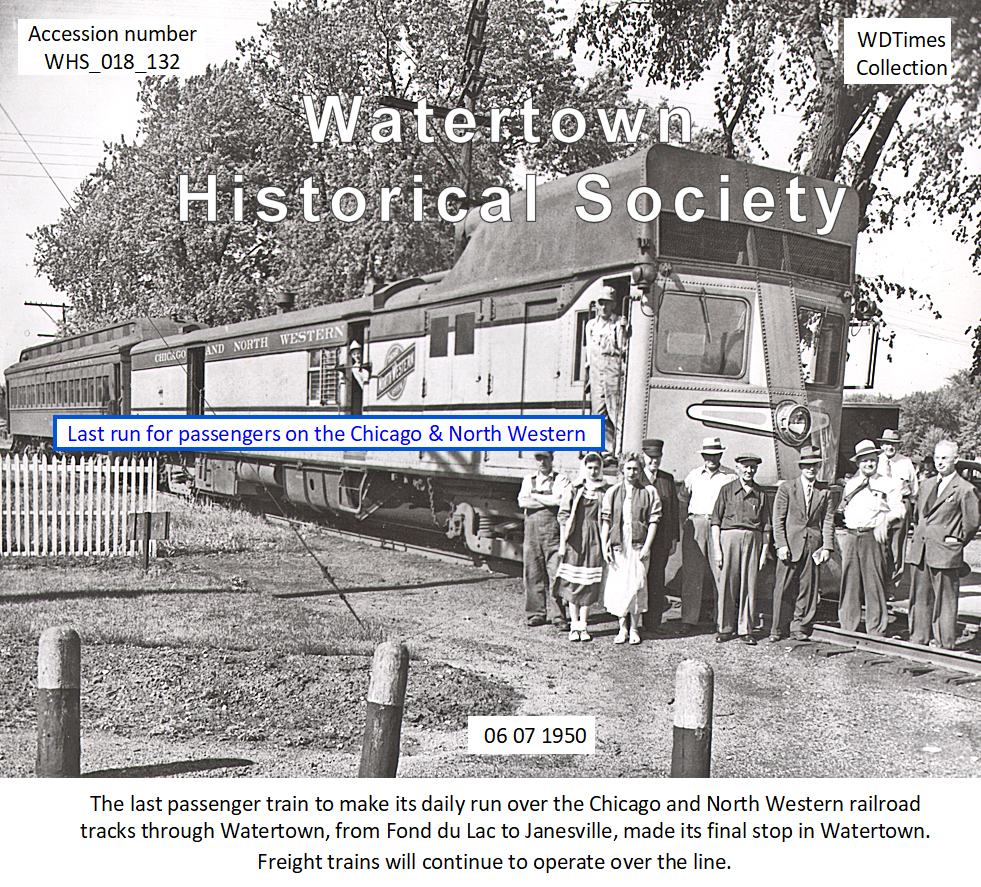
The
last passenger train to make its daily run over the Chicago and North Western
railroad tracks through Watertown, from Fond du Lac to Janesville, made its
final stop in Watertown.
The
Chicago and North Western road began operating its trains on the line through
here as early as 1860 and during the Civil War served an important place among
the railroads of this section.
It
was then one of the main lines of the system in this area.
Freight
trains will continue to operate over the line, but the two passenger trains
which served in recent years were taken off.
The
road claimed it lost some $54,000 a year on the service and that an average of
only six passengers per day had used the line for some time.
1965
Dec TWO VIEWS OF
ABANDONED DEPOT
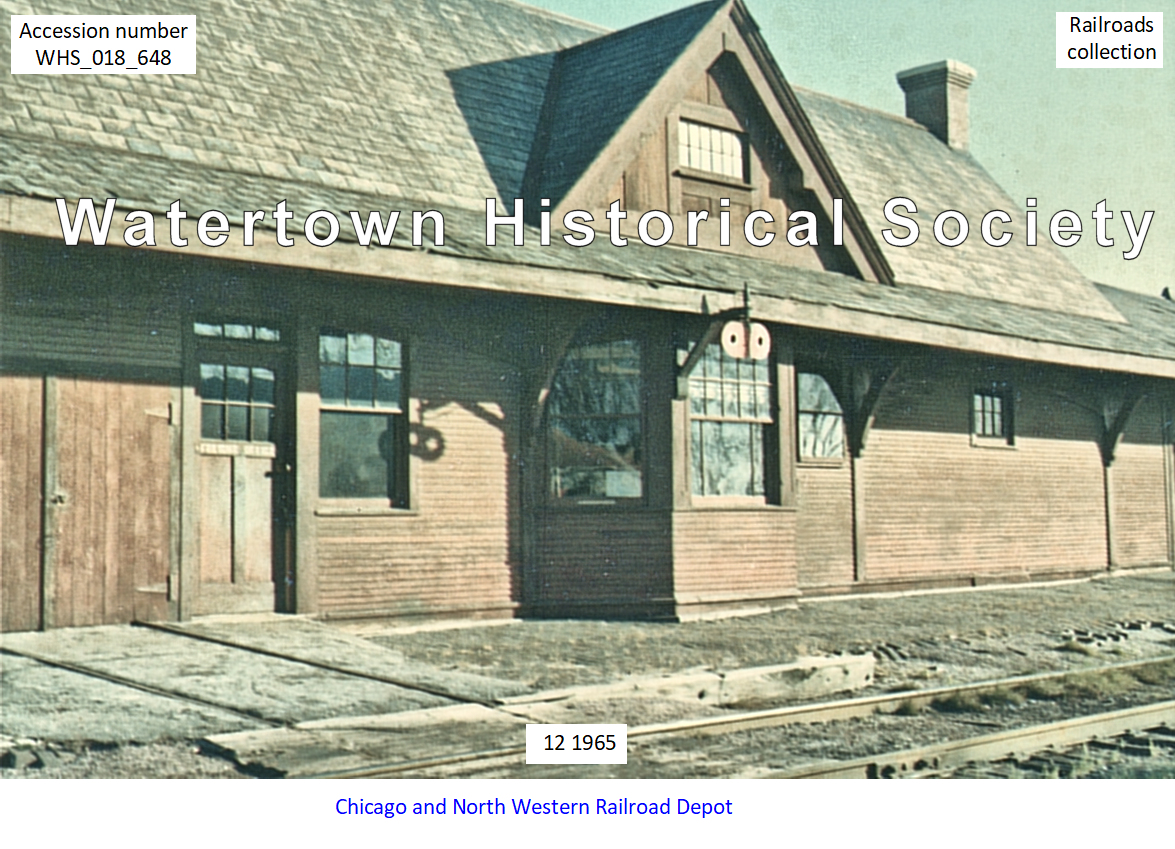
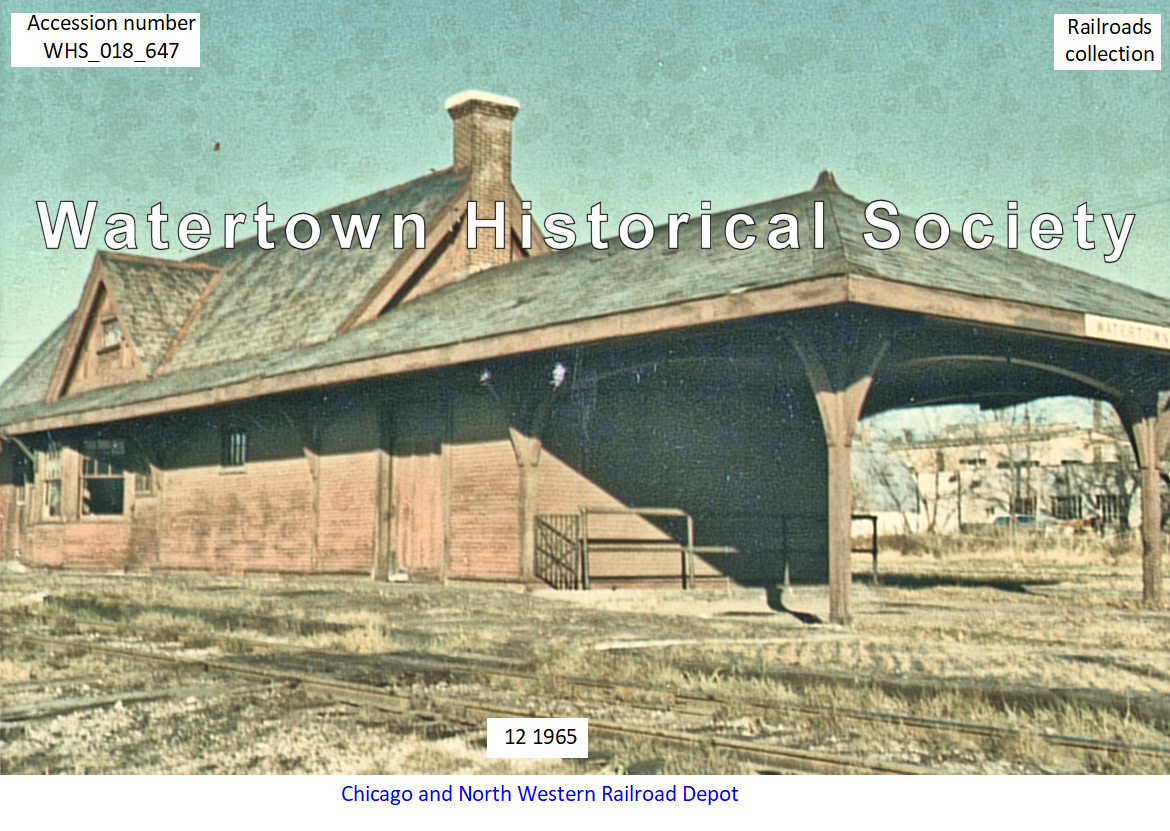
05 28 SWITCH ENGINE NOISE
The case
involving a Chicago and North Western Railroad conductor in a charge of having
permitted a switch engine to make excessive and prolonged noises at nighttime
which developed here last week did not come up in Watertown Municipal Court at
today’s session. The case is being held
open. Railroad officials have assured
police authorities that starting June 1 a new policy regarding the switch
engine will go into effect and eliminate complaints of long standing regarding
excessive noises at night. WDT
1976
12 13 TRAINS JUST PASS WATERTOWN BY
The
following article about train service in Watertown,
appeared in Sunday's issue of the Wisconsin State Journal. The article was written by Charles Fulkerson
of the State Journal staff and was accented with three pictures in the Journal.
WATERTOWN
- Richard Seivert pushed the frigid switch handle
with his padded mittens, spreading a snow crusted rail.
A
hopper car rolled through the switch, its screeching wheels drowning out the
bleating horn of a diesel.
It was
1 p.m. and Seivert, 26, was nearing the end of his
work day on a four-man switch engine crew operating out of Watertown.
He
trudged to the station to meet engineer Brian Reynolds, 27. The two joked about a beer commercial
featuring a railroad crew, and then Seivert turned
momentarily serious. "My own
feeling is the railroads aren't going downhill.
Some day the United States is going to realize
the railroad is the only way to go," he said earnestly.
But
for Watertown, a manufacturing city of 15,000 on the Jefferson-Dodge County
line, the railroad stopped being the only way to go years ago, and for
passengers it became no way to go in 1972 when the last passenger train stopped
here.
In
1855, when the predecessor of the Milwaukee Road arrived here, Watertown was
the second largest city in Wisconsin and according to local historian, James Rothschadl, city fathers had "really grandiose
plans" for turning Watertown into the capital and metropolis of the state.
In
1859, the North Western Railway reached Watertown from Chicago, and the city's
bustling future as a rail hub seemed assured.
But
in their rush to get the railroads to Watertown, city fathers had underwritten
bonds for the Milwaukee Road's predecessors and when the early railroads went
broke, the creditors turned to the town officials for their money.
"For
many years,"Rothschadl explained,
"Watertown didn't have a functioning city government." The public officials
the town did have meetings seldom and in secret to dodge the creditors and their
warrants. The lack of stewardship-
probably hurt the growth of the town, Rothschadl
speculated.
The
Milwaukee Road established a variety of railroad shops and rail mills employing
more than 100, but by the turn of the century the railroad had moved the shops
elsewhere, and Watertown's importance as a rail center was on the decline.
Today,
trains are still numerous in Watertown. But, explained Jim Scribbins
of the Milwaukee Road's corporate communications department, few of them
stop. "Practically all of the
trains that pass through Watertown do exactly
that. They pass through.
However,
Scribbins called Watertown, "a relatively
important place on our railroad."
The L-shaped,
stucco station at the junction of the Milwaukee Road and North Western Railway
tracks is manned around the clock by a train operator who forwards written
instructions to passing train crews and handles initial billing for freight
customers in Watertown.
An
ancient brick freight house south of the station once served as headquarters
for a freight agent and three clerks.
But the freight house has been abandoned; its windows are shattered and trees are growing in the tracks behind the
building.
STATION
OPERATOR
Lewis
R. Manthey has worked in Watertown since 1955 and for
many years he sold tickets to the Hiawathas bound for
Minneapolis and Seattle.
But
the last Hiawatha passed through Watertown more than five years ago. Now Manthey's only contact with passengers and passenger trains
is a cursory inspection of the wheels on the four daily Amtrak trains that roar
through Watertown, leaving only swirling snow behind.
The
Milwaukee Road station built in 1926 is headquarters for Manthey,
signal maintainer, Ken Bornitzke and two switch
engine crews that work out of Watertown.
In activity, it is a Grand Central
compared
to the sleepy North Western station a quarter mile away.
Last
spring the North Western removed the station agent from Watertown and 23 other
stations in Wisconsin. The North Western
division manager concluded that the small town agent
was excess baggage for the railroad.
"We just don't need people to do work in those stations
anymore," he said.
William
Konitzer, the agent forced to leave Watertown,
sympathized with the railroad which claimed to be losing money. "But the personal touch is lost this
way, and who could put a price on the personal touch?" Konitzer
asked.
The
Northwestern still sends a train down to Watertown five days a week from Fond du
Lac, but the tracks south of the city to Johnson Creek are snow covered and no
longer used.
The
North Western's Chicago connection from Watertown via Fort Atkinson and
Janesville, once thought to be a boom for the town, was torn up last year. The railroad has no plans, however, to tear
up the tracks between Watertown and Johnson Creek, said James McDonald of the NorthWestern's public affairs
office.
Manthey
estimated that an average of 25 freight cars daily are dropped off and picked up
in Watertown by the Milwaukee Road. The
city also is a junction point between the mainline and a branch that runs west
to Waterloo, Sun Prairie and Madison.
Many
cars dropped off in Watertown contain feed and corn syrup. A malt company in Waterloo is a big rail
customer. A Watertown scrap dealer ships his product by rail and a furnace
manufacturing company occasionally sends oversized furnaces out on rail
flatcars.
Scribbins said
the-railroad has no plans to centralize further the
duties done by station operators and agents and apparently the jobs in the
Watertown station are secure. He ranked
Watertown in importance as a mainline station behind La Crosse and Portage.
"The
railroad is damn important to the community," said Paul Kehrer, president of First State Savings and Loan
Association and active in a drive to get passenger service restored. In terms of the city's economy, he said,
"the future of Watertown being on the mainline of the Milwaukee Road has
to be real important." WDT 12/13/1976
1983
05 03
Workers installed a crossing diamond where the Milwaukee Road and
Chicago & North Western railroads will intersect in Watertown north of West
Street. C & NW plans to abandon east-west track through Jefferson County this summer and to
restore north-south track from Jefferson Junction to Clyman,
abandoned several years ago. WDT
09 16 TRACK RESTORATION
Track restoration
project [from Jefferson Junction to Clyman
Junction] through Watertown; status WDT
1985
08 14
TWO
RAILROADS, ONE LINE PROPOSED
The two major railroad companies
running track through Watertown are discussing the possibility of having all of their trains operate on one line, but an agreement
between the two is unlikely, a state transportation official said Friday. Rick Montgomery, director of the Railroad
Bureau of the Commissioner of Transportation, said the Chicago and Northwestern
Railroad company and the Soo Line Railroad Company have resumed talks on
running the CNW’s Chicago to Minneapolis trains on the Soo Line (formerly
Milwaukee Road) track. “But from what
I’ve heard, the talks are not promising,” he said. WDT
2010
GARDEN PATH FLORIST
 Garden Path Florist ad
20141
GARDEN PATH FLORIST
2016
10 04 SET APART ART
Occupies former depot
at 725 W. Main. Offers a variety of art
classes and a venue for private parties.

 < PORTFOLIO OF PICS
Cross
References:
“When the St Paul Railroad came here it was so
poor that Daniel Jones couldn’t pay for the wood it needed to run its
engines. “Alexander Mitchell was a great
friend of mine and he told me that if I would pay for
the wood he would see that I didn't lose by it.
For two years I bought the wood for it. When the
Chicago & Northwestern got this far it couldn’t get its iron, which
was in bond. With several others I signed the bond that released the rails and
permitted the road to go on. These acts
cost me dear.”
Garden Path Florist
|
Main, W, 725 |
|
|
Main, W, 725 |
|
|
Main, W, 725 |
|
|
Main, W, 725 |
|
|
Main, W, 725 |
|
|
Main, W, 725 |
|
|
Main, W, 725 |



History of Watertown,
Wisconsin