website watertownhistory.org
ebook History of Watertown, Wisconsin
E. B. Quiner
Jeffersonian
Democratic State Register
Watertown Chronicle
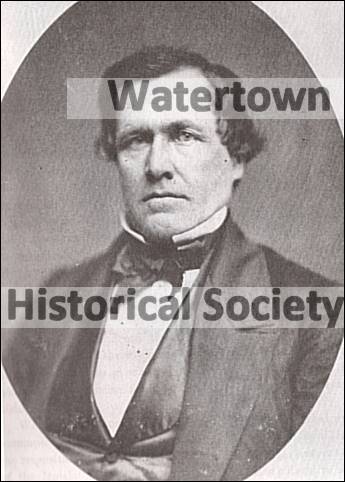
Edwin B. Quiner WHS_006_311
1850
Watertown Chronicle, 03 13 1850
And Yet More Changes – The Rock River Jeffersonian has “gone the way of all the living!” After a rickety existence of seven months, this jack-o’-lantern Democratic light ceased to emit its feeble rays on the 26th ult. “Sic transit Gloria mundi!” Peace to its ashes!
From the ruins of this ill-fated concern springs up the Democratic State Register! Ostensibly published and edited by E. B. Quiner — Mr. Taylor, whose various political somersets had rendered him an object of suspicion with the Democracy, “retiring from the press,” as he says, in consequence of a “decline of health” – albeit, he is to continue an operative in the office. With Mr. Quiner we have not acquaintance whatever.
These changes make the seventh in the name and proprietorship of the opposition paper in this village, within so many months! Verily this is a world of mutations!
1855
Watertown Democrat, 06 21 1855
Mr. E. D. Quiner is now making arrangements for putting up a new warehouse near the depot of the Milwaukee and Watertown Railroad, between Third and fourth streets, just west of Stimpson and Cady’s building. It is to be forty feet long, twenty feet wide, one story high, well and substantially built and so constructed as to admit for a larger addition – in fact, designed more for a wing to a more extensive main building than anything else.
1860
Watertown Democrat, 07 05 1860
History
of the Press in Watertown—No. 2
Below we
give E. B. Quiner’s experience as a printer in the West in general, and as an
editor in Watertown in particular. He
now resides in the city of Madison, and for some time past, we believe, has
been employed as foreman of the book department of the Wisconsin Patriot.
He will be well remembered by most of our citizens as the proprietor of
the Democratic State Register, and
afterwards in connection with it, of the “Home
Circle”—a kind of temperance and horticultural semi-monthly sheet, which
met with but little success, and in the end, like all attempts to establish and
sustain journals on any other than a political basis, proved a failure.
As far
as we have observed, he is the only contributor to the publication of the
Wisconsin Editorial Association who has made any allusion to the partisan
controversy of this state. Such being
the case, it may not be improper to say that when the Republican party was
formed, being mortified at the defeat of all his attempts to obtain office, and
usually having a personal quarrel with some or all of his Democratic associates
on hand—he joined the new organization, and for two sessions was Assistant
Clerk of the Assembly. When the office
of State Comptroller was created he indulged the delusion that it was intended
for his particular benefit, but finding he was regarded as a man bristling with
too many thorns and points, and seeing H. A. Tenney bear off the prize, he made
a bitter and foolish attack on the official conduct of Gov. Randall, though we
believe that gentleman had treated him not only with kindness but liberality,
which closed up every avenue to his further promotion by those who held the
means of dispersing executive favors.
At the
time when these incidents transpired, a very unnecessary question was slightly
discussed, as to whether the Democrats gained or the Republicans lost by “his
change of front.” How the matter was
finally decided we do not know, and we will not express our opinion now. There is nothing wrong in wishing to occupy a
prominent or lucrative position under our government, but somehow or other,
those in power manage to cut off the heads of most who are eager to “stick
their fingers into every pie.” Whether
or not such was the intention, it is certain that such has been the fate of our
predecessor. Here is his picture of
himself:
LETTER
FROM E. B. QUINER
Madison, Aug. 19th, 1859.
In
complying with your request, that I should furnish the details of my experience
in connection with the press of Wisconsin, I find myself at a loss for material
to make up a narrative which shall prove of interest to the public.
I first
took my place at the case, in the year 1829, in the office of the “Columbian Register,” a well known
Democratic paper, published at New Haven, Connecticut, by Col. Jo. Barber,
where I remained awhile and then removed to Cincinnati, Ohio.
I
arrived in Wisconsin, in the fall of 1839, with my family, from Richmond,
Indiana, where I had been engaged for a few years in the printing of the “Jeffersonian” newspaper. I immediately found employment in the office
of the “Milwaukee Sentinel,” then
published by Harrison Reed, Esq. At that
time Milwaukee contained about a thousand inhabitants, and bore unmistakable
evidence of the hard times incident upon the speculative spirit of 1836-37, in
the number of vacant buildings which stood in different localities upon the
town plat. It may not prove
uninteresting for me to give a few particulars of the history of the early
Milwaukee press . . .
 The Sentinel
office was located in the lower story of a frame building which was divided in
the center . . . the north part was occupied by the father of Mr. Reed, as a
stove and tin ware store, who finally sold out to Linus R. Cady and Leonard J.
Farwell, then just emigrated to the Territory, and who established themselves
in business at Milwaukee.
The Sentinel
office was located in the lower story of a frame building which was divided in
the center . . . the north part was occupied by the father of Mr. Reed, as a
stove and tin ware store, who finally sold out to Linus R. Cady and Leonard J.
Farwell, then just emigrated to the Territory, and who established themselves
in business at Milwaukee.
. . . I
have thus given a history of the present Milwaukee English press. With the German press, and its history, I am
not familiar.
 While
residing in Waukesha I became the purchaser of the materials of the “Jeffersonian” newspaper, published in
Watertown, and removed to that city, with my family, in 1850. I established the “Democratic State Register,” a seven column paper, which, with the “Chronicle,” published by Mr. Hadley,
were the only papers in Dodge and Jefferson counties. In 1847 the “Rock River Pilot” was established by George Hyer, but soon passed
into the hands of Judge Butler. The material,
however, subsequently passed into my hands and were used in the publication of
the Register.
While
residing in Waukesha I became the purchaser of the materials of the “Jeffersonian” newspaper, published in
Watertown, and removed to that city, with my family, in 1850. I established the “Democratic State Register,” a seven column paper, which, with the “Chronicle,” published by Mr. Hadley,
were the only papers in Dodge and Jefferson counties. In 1847 the “Rock River Pilot” was established by George Hyer, but soon passed
into the hands of Judge Butler. The material,
however, subsequently passed into my hands and were used in the publication of
the Register.
The Register enjoyed a liberal support in
both Dodge and Jefferson counties, and I continued its publication as a
Democratic sheet until that party passed under the control of “Barstow and the
Balance,” when I deemed it my duty, as the conductor of a public press, having
the interests of the people at heart, to refuse to support a portion of its
candidates for state offices. I
considered that the mismanagement of the School Fund, and other matters, which
have become a part of the history of the state, demanded that an exposition
should be made so that the people of the state could understand their interest,
and substitute better men to manage their affairs. I therefore took issue with a portion of the
Democratic candidates and declared my independence of party control, and
henceforth the Register stood upon independent political ground, and so
remained until I sold out my establishment.
The materials afterward passed into the hands of Messrs. Chubbuck &
Sanborn, and they are now used in the publication of the “Central Wisconsin,” at Wausau.
This
ends my connection with the Wisconsin press, except for a short time in 1857, I
resuscitated the Watertown Chronicle
and continued its publication during the fall campaign and advocated the cause
of the Republicans, and sided in the election of A. W. Randall, as Governor of
Wisconsin.
My reply
is longer than I expected. Hoping it may
prove of sufficient interest to be worth perusal, I remain yours, etc.
E. B.
QUINER.
Cross References:
Edwin B Quiner,
Built Watertown's other
octagon house
1865
05 11 “SCHOOLMAMS”
An Old
Watertown Printer. Mr. George Hyer, formerly newspaper publisher in this city, who has
recently been traveling in Oregon, writes as follows about Mr. S. H. Taylor,
whom some of our older citizens may remember as the proprietor of a paper in
Watertown, though we have never heard that a journal called the Jeffersonian was published here. We copy the extract below from a letter
written by Mr. Hyer dated “Astoria, Oregon, Feb 25th,
1865” as it may be interesting for some to know what becomes of those who
wander from our midst to the Pacific shores:
“The old
printers of Wisconsin will remember a printer by the name of S. H. Taylor. He was for a time, while working as a jour [?], engaged as editor of the Madison Statesman, was afterwards employed on the Milwaukee Sentinel, and later published
for a time the Watertown Jeffersonian,
succeeding Judge Butler. He came
overland to this, then a territory, with his family and died near Portland some
five or six years since. He left a
“printer’s fortune” and his children have been educated by the Masonic
fraternity, of which he was an honored member.
I happened to meet with his widow a short time since, who, among other
incidents of early times remarked the difficulty with which “schoolmams” were kept at their calling, and in illustration
of it showed me a contract drawn by her late husband between an applicant for a
school and the district board, from which I copied the following as an item.
“And it
is further agreed and understood that if the applicant fails to fulfill her
agreement, or should marry during the time, and from that cause abandon her
school, she shall forfeit 20 per cent of her wages, which sum the school board
are hereby authorized to retain until this contract has been satisfactorily
fulfilled on the part of the applicant.”
“This, I
was told, was a condition common to all similar contracts – the teachers were
seldom engaged for a second term, they having contracted other and more
acceptable alliances. Many a man here
owes his prosperity in life to his good fortune in securing a Yankee school marm for a wife.
There is now in this state a Mr. Higgins purporting to be the agent of a
Massachusetts society for colonizing a portion of the excess population of that
state. Families in want of help are
engaged to receive the girls thus sent out, detaining a portion of their wages
until the passage money is refunded. In
this way, the Oregon bachelors will eventually be supplied with help mates.” WD

History of Watertown, Wisconsin