website watertownhistory.org
ebook History of Watertown,
Wisconsin
The Lake Koshkonong Monster
Written and contributed
by Ben Feld
Watertown Republican, November
1887
When
Watertown first learned of the famous Scottish Loch Ness monster in 1933, they
had been talking about the monster in Lake Koshkonong
for at least 46 years. For nearly half a
century skeptics and believers alike had enjoyed telling and retelling the tale
of the alleged sighting by two storytellers on a duck-hunting expedition long
ago.
To be
sure, the Koshkonong monster was not the size of the
Loch Ness monster. It couldn’t be, given
the shallowness of the lake. No aquatic
beast of any great size could find an area of sufficient depth to conceal
itself in that reed-filled pond. But it
was sighted, not once, but six times, albeit the other five sightings were in
Red Cedar Lake a few miles away. Strangely,
the Red Cedar Lake sightings were not mentioned in the newspapers until quite
some time after the fact.
The
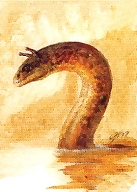
one sighting which did find its way into the Watertown Republican took place in early November, 1887, when two
men, A. I. Sherman of Fort Atkinson and his cousin, Charles Bartlett of
Milwaukee, were duck hunting on Lake Koshkonong. While rowing down the south edge of a bay in
the northeastern part of the lake, they both spotted, about 150 feet away, a
huge snake-like object swimming toward the center of the lake. It swam with the head raised about two feet
above the water, and about ten feet of the trunk, which appeared to be eight
inches thick, was partly visible. The
water being very calm at that time, the highly visible wake left by the
creature indicated it was about thirty or forty feet long.
Without
a thought about the wisdom of their actions, and following the instincts of the
inveterate hunters they were, Sherman and Bartlett put their oars into the
water and began rowing at top speed toward the animal hoping to kill it and
examine it at close range. But the
creature, for it could not truly be called a snake, a fish, or a lizard,
spotted them and at once slipped under the surface leaving the pair befuddled,
astonished, and thoroughly disappointed at having to abandon the chase.
Forever
after, the two nimrods stoutly maintained they were in no way under the
influence of the ardent spirits and they never failed to remind the skeptics
that at least six times a similar sighting had been reported in Red Cedar Lake only afew miles away.
One
wonders, were A. I. Sherman and Charles Bartlett still around when the
newspapers announced the sighting of the Loch Ness monster 46 years later? Was their veracity doubted any less? Did they feel they had finally been
vindicated?
Or did
the skeptics conclude that the sighting of a strange creature in Lake Koshkonong and a monster in Loch Ness, in Scotland, prove
that hallucinations are not limited by national boundaries?
