website watertownhistory.org
ebook
History of Watertown,
Wisconsin
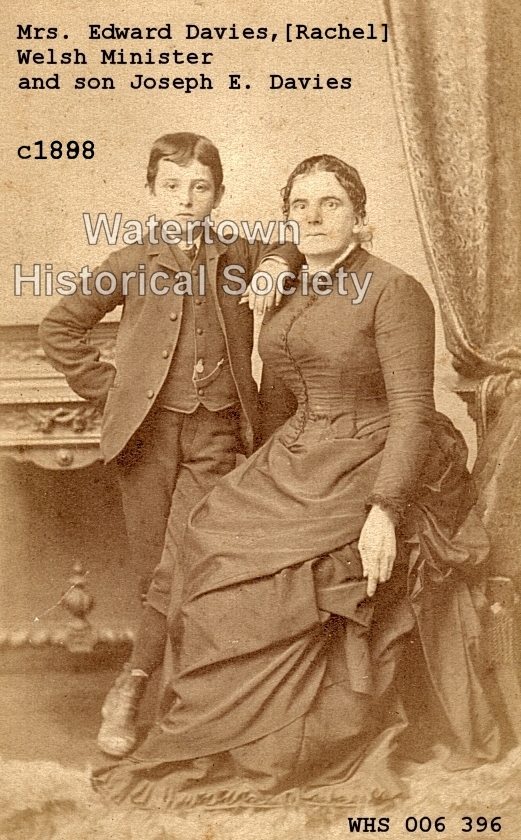
Rev. Rachel Davies
[ Rahel O’Fon ]
1847 - 1915
Rev.
Rachel Davies was reportedly the first
woman minister ordained in the state of Wisconsin, serving the Welsh
Congregational Church in Ixonia for several years and resided in
Watertown. In some circles, she might be better known as the mother of Joseph Davies, the U.S. Ambassador to
the Soviet Union under President Roosevelt.
1912
04 04 Letter from Mrs. Davies.
The
editor is in receipt of a letter from Brynsiencyn, Wales, from Mrs. Rachael E.
Davies, mother of Joseph E. Davies, in which she says:
I am
very well, excepting trouble with one of my eyes. I was very much surprised to read in Gazette
of Mrs. Knight's sudden death at Madison.
I could not believe it at first that it was she, as she was so well when
I left Watertown. It is well for us all
to be ready when the call comes. Please
state through The Gazette that I send
my sympathy to all my friends in sorrow in Watertown — so many dear ones have
been called by death since I left home.
I thank you very much for promptness in sending Gazette.
Love to all in
Watertown. WG
09 26 Letter from Wales, G. B.
Editor Gazette, Watertown, Wis.
It will be received
with great sympathy by many of your readers to hear the sad news of the death
of Mrs. Evans, Cefudderwen Farm, Anglesca, sister to Mrs. Rachel Davies,
Watertown, better known as Rahel o Fon.
Mrs. Evans had been
under a severe illness for many months past.
She had undergone a very severe operation at one of the Liverpool,
England hospitals, but she did not recover.
She had been laid up ever since and passed away last Friday morning,
Sept. 13, 1912. She was buried the
following Tuesday, a very large crowd of people, among whom were the foremost
men of the country who had come to pay their last tribute to the deceased.
Mrs. Davies has been
over here several months, and she has been most faithful in her attendance upon
her sister. She has passed through very
trying times. She has been complaining
herself, but now she is greatly improved, although she is not what would be
desired. She wishes to thank all her
numerous friends for their kindness in sending her letters, and she wishes to
be pardoned for her delay in answering them, but her eyesight is not at all good
and with the worry and anxiety of the past month she has had no time or
opportunity to do hardly anything. She wishes to be kindly remembered to all
her friends, and acquaintances. She will
be pleased to receive letters from her friends as she would like to know how
they all are – though she is far away from them, she thinks a lot about them.
Her thanks are also due to the Editor of the Gazette for past kindness.
Mrs. Davies has decided
to seek a quiet place where she can get a quiet rest, which at present is
absolutely essential. She has not
decided where to go yet, but she intends leaving the neighborhood early next
week. She will be pleased to receive any letters her friends might care to
send, and she wishes them to be addressed to my care and I shall be pleased to
forward them immediately. She is now
looking forward to returning and is anxiously awaiting the time when her son,
Mr. Joseph E. Davies, shall get an opportunity of coming over to bring her home
again.
She wishes to be kindly
remembered to all her friends. She is
sending them all her kindest regards.
Yours etc.,
for Mrs. Davies,
Rev. D. C. Herbert,
Brynsiencyn, Anglesen,
North Wales.
Dear Sir: Mrs. Davies
wishes me to write to your paper, I hope you can find space for this in your
next issue, as by doing so you will be doing Mrs. Davies a great favor, I
remain
Yours truly,
D. C. Herbert. WG
1915
LAST SAD
RITES PERFORMED TODAY
Body of
Mrs. Rachel Davies Laid to Rest In Oak Hill
BROUGHT
HERE FROM WASHINGTON
Mrs.
Davies Spent a Busy Life As An Evangelist and Missionary Worker
Was
Greatly Loved by Her People
The
body of Mrs. Rachel Davies was laid to rest beside those of her husband and
daughter in Oak
Hill Cemetery this afternoon, with all the honors due the memory of a noble
woman whose life was one of active service from her earliest years until her
declining years forced a retirement from active work.
The
pall bearers were Edward Davies, Chicago; John L. Davies, Dix, Illinois; Morgan
Lloyd Davies, Daniel S. Throne, Chicago; Morgan S. Throne, Cleveland; Victor M.
Stamm, Milwaukee. There were ten
honorary pall bearers as follows: C. A.
Skinner, Dr. F. C. Werner, Owain T. Hughes, W. D. Sproesser, James W. Moore,
William F. Voss, Frank E. Woodard, Ellis G. Humphrey, Oconomowoc; David Evans,
Milwaukee.
Among
those here from out of town to attend the funeral were Postmaster Devine, John
A. Aylward, Mr. and Mrs. William Westerman, Miss Marian Davies and Mr. Ponny,
Madison; Mrs. H. E. Evans, Clark Knight, Ashland; Percy M. Cochran, Elkhart,
Indiana; Postmaster Frank Schultz, Mrs. H. E. Evans and Mr. Sawyer, Milwaukee;
Mrs. J. R. McGlade, Princeton, Illinois; and Postmaster Cunningham, Janesville.
There
were many beautiful floral designs, the offerings of friends. Two large but simply designed casket pieces
of purple and white chrysanthemums, which covered the top of the casket, were
the gifts of President Woodrow Wilson and his daughter, Miss Margaret
Wilson. A large wreath was the gift of
Mr. Davies’ fellow members on the federal trade commission.
Rahel
o’ Fon, as Mrs. Davies was known among the Welsh people, was for many years
recognized as one of the most powerful of woman evangelists. Rahel o’ Fon is the Welsh name for “Rachel of
Anglesey”. And Anglesey is an island
close to the coast of North Wales where Mrs. Davies was born, and where she
began her evangelistic work.
The
island is also the birth place of Owain T. Hughes of this city, who though a
few years younger than Mrs. Davies, watched her career with interest from the
time she first became interested in religious work, at which time she was about
fourteen years of age. When she was
seventeen years of age, Mrs. Hughes heard her preach before one of the largest
audiences every gathered in a religious assemblage on the island. The largest church on the island was placed
at her disposal for the meeting and the young girl’s sermon was most
impressive. Not only had she a fine
voice and presence, but great dramatic ability, which she used with effect. Her meetings in Wales and other parts of the
British Isles were uniformly successful, Mr. Hughes declares.
The
young evangelist was greatly influenced in early life by one of the greatest of
Welsh preachers of that day, the Rev. Henry Reese, from whom she received
religious instruction while a student at Liverpool.
Her
work in America was also wonderfully successful. From the eastern coast to California she
traveled to every large and small settlement of Welsh people. She was a delegate to nearly all religious
conventions of the Welsh people, and even in her later years, when she was
widowed and burdened with a growing family, she freely answered calls to the
pulpit wherever she was needed. She
often spoke at the little Welsh church in
North Washington Street, though it was not of her own denomination.
She
was renowned for her works of charity, even though but few of her charitable
acts became public. An exception was the
presentation of a church building to a small and struggling congregation at
Niles, Ohio, the congregation being too poor to build. Their gratitude was expressed in the
dedication of the church in her honor.
As
Mrs. John Throne, her niece by marriage, pointed out, Mrs. Davies was alone in
this country, having no immediate relatives here. But she won the hearts of all her husband’s
people, who accepted her and loved has as one of themselves. A fact evidenced by the fact that all of them
who could possibly come were here to attend the last sad rites, many of them
traveling from distant points.
Her
religious work, which included effective temperance work, was carried on almost
entirely among the Welsh people, who she loved as if united by ties of
blood. It was only on rare occasions
that she would consent to speak in the English language – it was always in the
Welsh tongue that she preferred to state her message.
Cross
Reference:
