website watertownhistory.org
ebook History of Watertown, Wisconsin
1883 - 1942
"Turkey's Roost"
416 E Main
For more than 25 years Arthur E.
(Turkey) Gehrke had been in the habit of
going to bed early in November
and staying there until April.
“Turkey”gained wide fame from his hibernating
practice.
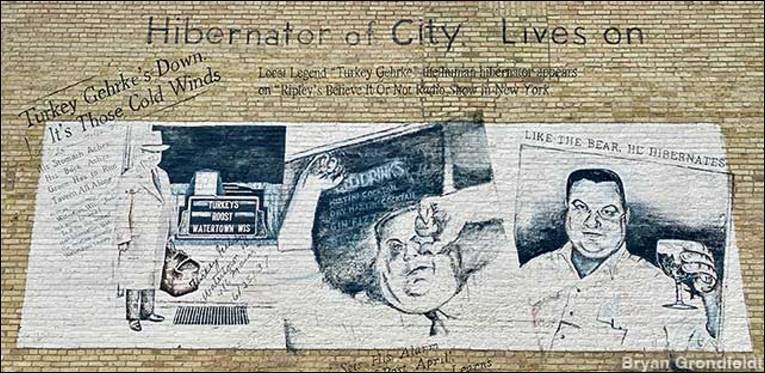
This mural depicting highlights
of the life and career of Arthur "Turkey" Gehrke graces the wall of
his former tavern.
Turkey's claim to fame was he
slept through the every winter, never rising from his
bed until spring.
Mural painted by Vance Hull and
Sherry Ertl.
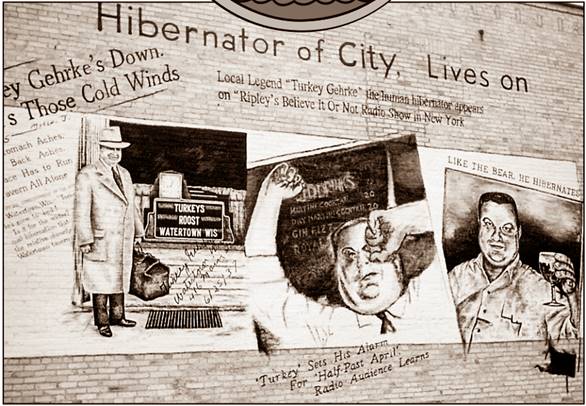

416 E Main (1977)
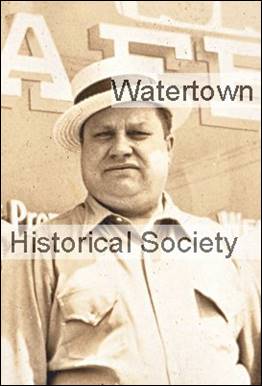
Portion of image WHS_005_837
c.1936
PHOTO USED LATER IN MAIN STREET MURAL
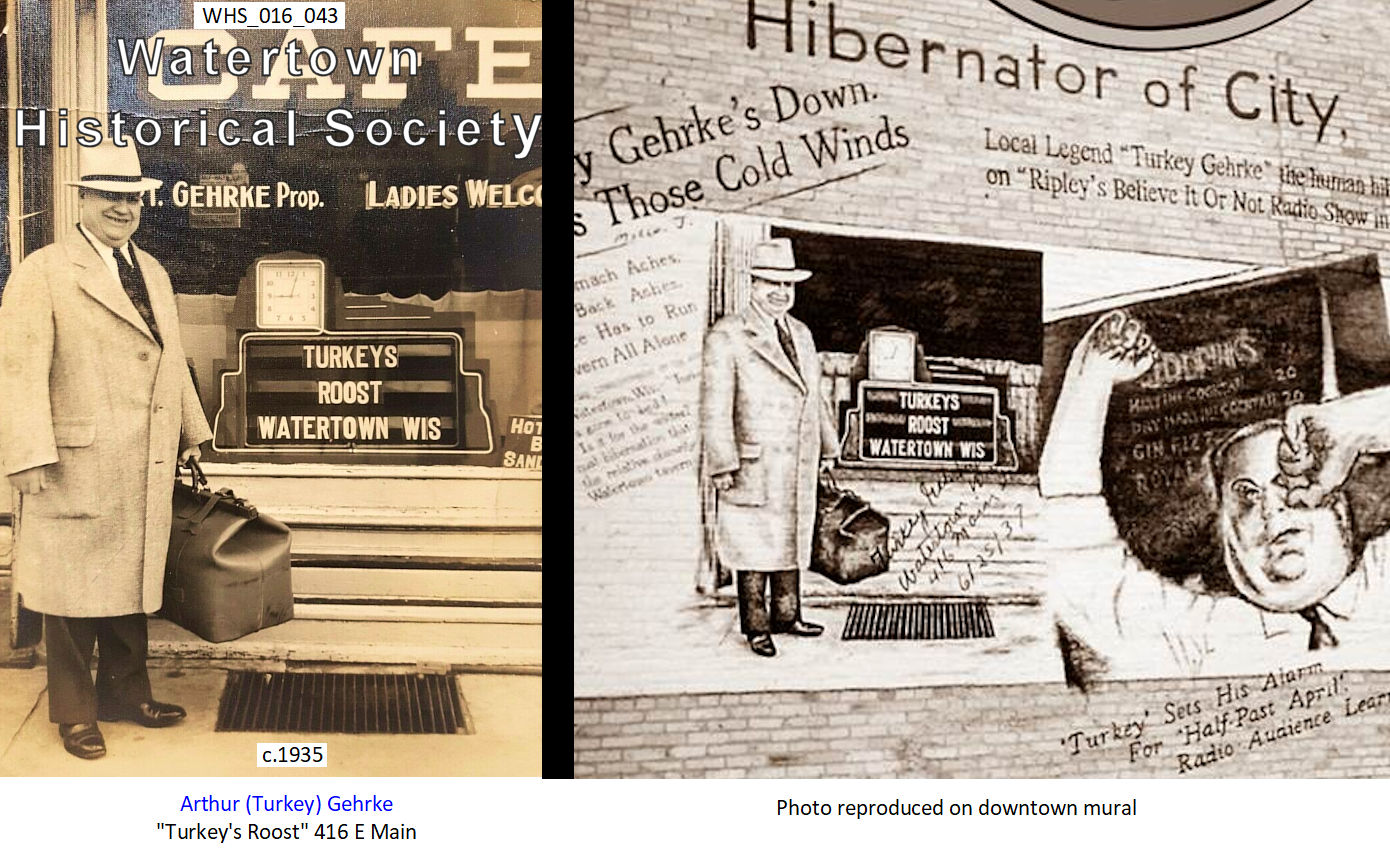

A press release photo of
Turkey. Back says: 53yrs old, 215
lbs. This is dated 9/21/1935!!
VIDEO CLIP
FROM HOME MOVIE
 < click to play
Video clip
from home movie is of poor quality but also rather rare
1936
02 24 DEATH OF GRACE GEHRKE
Leaving Bed is an
Ordeal, Turkey Finds.
Arthur E. (Turkey) Gehrke, whose
annual hibernations was broken for the first time yesterday when his wife,
Grace, 48, died unexpectedly of a heart attack, was up today and making arrangements for her funeral. It was the first time in about 25 years that
he had left his bed in winter to resume normal hours. It was evident he found it an ordeal. Cold weather makes him feel ill. He went to the Nowack Funeral Home and to the
parsonage to arrange for the burial service, but he traveled in an automobile
equipped with a heater.
In the 22 years of their married
life, Gehrke depended upon his wife to manage his tavern business during the
winter. Gracie, as his wife was
affectionately known, always defended his hibernation.
The Rev. K. J. Berbner of the Immanuel Church will officiate
at the services tomorrow. The Woman’s
Relief Corps and the Royal Neighbors of American, in which Mrs. Gehrke held
membership, will attend. Milw Sentinel
11 22 TURKEY GEHRKE ROUSES, GOES BACK TO SLEEP
Yawning as he observed that
Saturday was the opening of the Wisconsin deer hunting season, Arthur (Turkey)
Gehrke, Watertown's hibernating tavernkeeper, reasoned "what of it"
and promptly went back to sleep. Turkey
bedded down for the winter just a week ago and no pleadings of his friends
could make him change his bed cap for a red cap and go in search of deer. Gehrke likes his vension,
but he likes his bed better. For 26
years Gehrke has been retiring to his quarters for the winter, there to remain
until the nip goes out of the air and buds begin to show. For many years his
wife, Gracie, ran the tavern, looked after his other business and fed him. Last year Gracie died. Now his bartenders look after things and send
him food in a dumb-waiter. He lives above his tavern. Turkey started his hibernation, he says, to
avoid illness that annually came upon him in the fall. This year he was a little
later getting to bed than in the past. He had to remain up to vote, "for the
winner," he said. Reports that
Gehrke would pull himself out of bed to go to New York for a radio appearance
have been denied by friends. The Capital Times Madison,
Wisconsin Sun, Nov 22, 1936
1937
09 22 TURKEY SIGNAGE
Arthur E. (Turkey) Gehrke has at
last done what his friends have been urging him to have for a long time.
He has put a "Turkey
Gehrke" sign on his Main Street tavern.
Many people who come here from
other cities still ask about him and where he can be found, thus showing that
interest in him is still keen. So,
Turkey recently put up a sign on the outside of his tavern and now nobody can
miss it.
12 06 TURKEY GEHRKE SHARES THE LIMELIGHT
Here's another line about
Watertown's hibernator.
Yep, Arthur E. (Turkey) Gehrke
makes the current issue of Look magazine.
His picture appears on the back inside
cover page along with Jascha Heifetz, the violinist; the sultan of Morocco;
movie star, Jean Muir; Mickey Walker, former boxing champion; Clem McRathy, the sports announcer; and other celebrities.
12 24 TURKEY TO NAP THROUGH YULE SEASON
Goblets of Christmas cheer
clinked merrily today in the tavern of Arthur E. (Turkey) Gehrke, while in a
darkened upstairs bedroom the proprietor slumbered on in the tenth week of his
annual winter hibernation. Gehrke, who
hibernates during the winter months annually to escape abdominal pains caused
by the cold, took to his bed unusually early this fall as the state experienced
an early cold spell. The bartender in
"Turkey's Roost" said that he hadn't seen the boss since he began his
winter sleep and that he doesn't expect to see him until the weather turns warm
in the spring. Holiday festivities were
not expected to tempt him to forsake his quilts. Bartender Emil Kwapil
takes care of the business in "Turkey's Roost" while Gehrke slumbers
on in the upstairs apartment. Meals are
sent to the hibernator on a dumb waiter from the tavern. He eats only a sandwich or two and a glass of
milk daily. All visitors are barred from
the upstairs quarters.
1938
12 13 “TURKEY ACQUIRES GALOSHES, READY FOR COLDER
DAYS
It begins to look as though the
annual hibernations of Arthur (Turkey) Gehrke, Watertown tavern keeper, are at
an end – he’s bought a huge pair of galoshes.
For 27 winters Turkey has dived
beneath the blankets each fall when the cold winds howled and the mercury shriveled, and stayed in bed until spring. Today he expressed confidence he would stay
up all winter. He has a bet of $25 that
he will be up and around on New Year’s Day and he says
it’s “in the bag.”
Each morning Turkey arises at 6
o’clock and strolls around town before he takes up his stand behind the
bar.
He’s proud of the galoshes – the
first pair he has owned in more than a quarter of century.
“Believe me, I’ll be using them
plenty,” he grinned.
He resumed bowling
recently for the first time in 27 years and has been getting
a lot of fun out of it.
Besides, he’s been going to
wrestling matches with Tubby Reinhard.
WDT
1942
01 16 TO BED NOVEMBER UNTIL APRIL
For more than 25 years Arthur E.
(Turkey) Gehrke of Watertown had been in the habit of going to bed early in
November and staying there until April.
Last November Gehrke took to his room above his
tavern here, but the 59 year old tavern keeper will
not be up again in April. He died at the Watertown hospital.
Gehrke, whose sleeping habits
earned him international fame, was suffering from an anemic condition at his
death, a physician said. The once portly
tavern operator had shrunk to less than 150 pounds. Emil Kwapil, his
bartender, said that Gehrke had begun to complain of not feeling well last
summer. He began to lose weight but
refused to summon a doctor. Early in
November he took to his room. Two weeks ago he
gave in to urging of his sisters and friends and a
doctor advised that he enter a hospital. Gehrke refused until the night before
his death.
Gehrke gained wide fame from his
hibernating practice. A Dr. Samuel Plahner, a psychiatrist, had visited
Gehrke in September, 1935. Dr. Plahner heard Gehrke explain why he took
to bed every winter to keep from getting sick and having an operation and
dying. Dr. Plahner
reported that the 215 pound tavern keeper was a
"typical case of mixed compulsion and anxiety neurosis" because of a
shock experience resulting in an illness from a liver ailment.
Because Gehrke found that staying
in bed for a few weeks allayed his suffering, the psychiatrist added, he came
to believe that the advent of cold weather, when his attacks recurred annually,
meant that he should go to bed to prevent them.
Retiring to his room each winter made Gehrke unhappy because it cut him
off from the community and condemned him to inactivity, Dr. Plahner
said. Gehrke would lose about 10 pounds
each winter.
The story was widely circulated
by press associations in this country and Gehrke subsequently was asked to
appear on radio programs. The London
(England) Times even called Gehrke by transatlantic telephone to verify his
story in connection with another man, a Norman justice of the peace, who also
had gained fame by staying in bed for long periods.
Few occasions ever caused Gehrke
to interrupt his hibernations. Some years he would not go to bed until after
the November elections. Once he was
forced to report for jury service but was excused because of illness. Another time he left his room to pay a court
fine for a liquor violation. And he
stayed up through New Year's Eve one year to win a $25 bet.
Gehrke was proud of his late
wife's forbearance, often declaring that she understood why he had to hibernate
every year and made no effort to dissuade him from the practice. She died about five years ago.
He got his nickname,
"Turkey," when he was a boy because it happened to occur to one of
his pals that "turkey" rhymed with his name, he once explained.
Buried in Oak Hill
Cemetery.
__________________________________________________
When “Turkey” Visited New York
Death of Arthur “Turkey” Gehrke today
recalled his visit to New York with a
Watertown bowling team in April, 1937
1942
Watertown Daily Times, 01 17 1942
Article includes group photo in front of
café/tavern
Watertown’s most renowned resident,
Arthur E. “Turkey” Gehrke, died at St. Mary’s hospital at 7:50 o’clock this
morning. He had entered the hospital
last night, being taken there in the Krueger ambulance after he had been ill at
his apartment, above his tavern at 416 Main Street, since November. He died in his sleep.
In 1935 he won almost universal
attention as the “human hibernator” and as a result was publicized in
newspapers all over the world, in addition to an avalanche of national
publicity which he received in this country from newspapers and press
associations.
Always “afraid” of hospitals, he
had resisted being taken to one until his condition he was critically ill. His
condition was described as acute anemia.
For years he had complained that cold weather gave him severe stomach
pains which could be relieved only by a long sojourn in bed. Thus he developed
the habit of retiring annually with the first sign of severe cold and of
remaining in bed until spring when the first thaw marked the breakup of winter.
Won Fame in 1935
Prior to 1935 this had been his
habit each year for something like 25 years.
It attracted only passing attention in Watertown and some of his friends
looked upon it as something a little queer, but not too much out of the
ordinary for a man like Turkey who was so situated that he could go to bed and
stay there as he pleased. His tavern
business continued to run without him.
It was in 1935 that the habit was
publicized and the next day Turkey awoke to find
himself a national figure. Soon after
the press of Europe, carrying stories about him, made him a sort of
international news figure and one day he was aroused from his hibernation to
answer a long distance telephone call. He heard a voice say: “Hello I say, are you
there, Turkey? Are you in bed?”
The call was from London. The famous newspaper, the London Times, known as “The Thunderer,” had become interested in Turkey’s case and put
in a trans-Atlantic telephone call for an interview. The paper had first called the Watertown Daily Times which had the call
transferred to Turkey’s home.
“I could hear the man just as
plain as though he was calling me from a phone next door,” Turkey said after
the interview.
German newspapers, as well as
papers in Poland, Hungary, Russia, Italy and from countries all over the globe,
printed stories about “the man who slept through the winter like a bear.”
Tourists Demand a Look
Turkey’s fame spread Tourists
began to read and talk about him, heard about him on the radio and many routed
their trips through Watertown to visit his tavern which became familiarly known
as “Turkey’s Roost.” They all wanted a glimpse of the rotund and jolly figure
of Gehrke. He was up and about most of
the spring and summer and early fall. He loved big league baseball games and it was his contention that he was up with the
crack of the first bat against a ball in the spring training of the major
teams. He was a follower of the Chicago
Cubs and saw a number of big league games each season
over a period of many years.
Gehrke was born in Watertown 59
years ago. He was a son of the late Mr.
and Mrs. August Gehrke, the family being well known and highly regarded in the
community.
There are four sisters, Mrs.
August Melcher and Mrs. Arnold Gauerke, Watertown;
Mrs. August Krueger, Mankato, Minn., and Mrs. Albert Radke, Waupun. A brother and three sisters preceded him in
death.
His wife, the former Grace Schramck of Milwaukee, died in 1936.
Part of City’s Saga
Turkey became part of the legend
of Watertown, famous for its quiet and friendly humor of a comfortable and
placid community where “Gemuetichkeit” is the
watchword.
There have been many accounts of
how he acquired the name “Turkey.” He wasn’t sure
himself, but he believed it resulted from a small boy’s version of how to
pronounce Gehrke. The boy, a favorite of
Gehrke’s, was with him so often that patrons of his place picked up the
nickname and made it stick.
__________________________________________________
c.1942
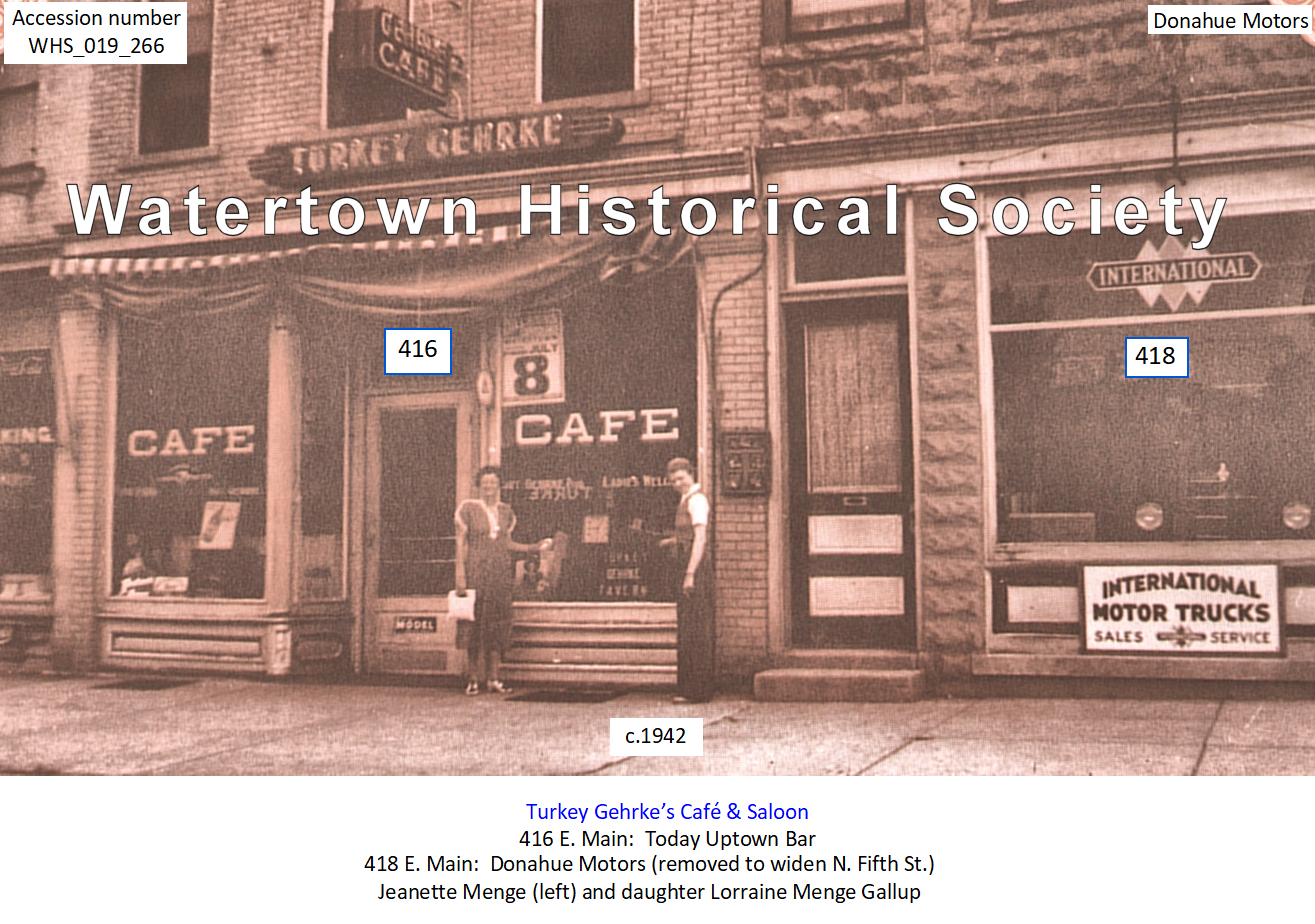
Jeanette Menge and daughter
Lorraine Menge Gallup
IN TIMES SQUARE
1967
Watertown Daily Times, 01 10 1967
The Turkey Gehrke Story, the saga
of Watertown’s famed hibernating tavern keeper, has broken into the news again,
this time in the National Observer, a
weekly newspaper which reprints the article that Robert W. Wells wrote for the Milwaukee Journal some months back.
The story has been told and
retold many times in the Daily Times
over a period of many years but first attracted national- and international-attention
in 1935 after the late Richard S Davis of the Journal made a trip to Watertown
to see for himself and write the story of Turkey Gehrke.
The Wells article as it appears
in the National Observer follows:
It
has been 25 years since the death of Turkey Gehrke, but his name still comes up
in Wisconsin about this time of year.
Since the white men settled this north country under the misapprehension
that it was habitable the year around, Arthur E. Gehrke was the only one to
figure out a satisfactory way to deal with a Wisconsin winter: He would hibernate-stay in bed-from November
to April.
The
overweight tavern keeper from nearby Watertown attained some prominence in his
day. Each winter, when he took to his bed, the papers dutifully noted the fact
as a sure sign of snow and sub-zero weather ahead. The notion of a hibernating human attracted
interest as far away as London, where the Times recorded Turkey’s habits as an
example of what goes on in the former colonies.
As
with many men who have attained their goal in life, Turkey had the help of a
good woman. His wife, Grace, accepted
his hibernation without public complaint and brought him the one meal a day he ate during his dormant period.
When
Grace died, there were those who supposed that Gehrke would become like other
Wisconsinites, suffering through a season not fit for man or beast. But when next November came, he crawled
between the covers of his bed in a room above his tavern. The bartender of the
establishment known as “Turkey’s Roost” sent him two sandwiches and a glass of
milk each day on a dumbwaiter rigged up between the bar and bedroom.
Gehrke
was about 30 when he started his annual hibernations and kept them up until he
died at 59. He began in a small way. The first year, he went to bed for only a
few weeks during the worst of the weather.
But before long he had the hang of it and was able to fight down any
foolish impulse to get up and fire the furnace or shovel the walk. On one occasion, a building next door caught
fire during his hibernation. Friends
shouted to him to run for his life. He
rolled over, looked out the window, decided the tavern probably wouldn’t burn
down, and stayed where he was.
It
is also recorded that he was once subpoenaed to testify before a Federal
court. He sent back word
that he’d be glad to testify, providing they’d carry him there in his bed. The lawyers decided to let the matter drop.
There
is a myth that he stuck with his hibernation no matter what happened. That is
not quite true. One year he stayed up
until New Year’s to win a $25 bet. Once
he had to report for jury duty, but was quickly
excused and hurried back to bed. On
another occasion he had to leave to pay a fine for a liquor violation.
But
three instances of backsliding in 29 years only show the man was human. The bear stirs out of its den now and then in
winter too.
As
for Turkey Gehrke’s record, it seems safe.
Each year, when the wind begins to howl outside Wisconsin homes and
taverns and the snow comes slanting across the streets and fields, some of us
consider following his method. So far,
it is just talk. It is too hard to find
a wife that understands.
Mr.
Gehrke died on Jan. 16, 1942 at what was then St. Mary’s Hospital here after a
brief illness. He was 59.
How
did he get the name “Turkey?” It was
because a little boy
in his neighborhood couldn’t pronounce the word :Gehrke” and
called him what sounded like “Turkey” and the name stuck
__________________________________________________
Kiessling,
Elmer C., Watertown Remembered
(Watertown: Watertown Historical Society), 1976, p 137-38
In
1935 the name of one of our citizens became a household word on two continents
when it was revealed that Arthur "Turkey" Gehrke, a jolly, rotund
tavern- keeper, had been hibernating like a bear each winter for 25 years. He
used to creep under the covers in the middle of November and emerge each spring
when the baseball teams began practicing, for he was a great baseball fan, the
Cubs being his favorites.
A Chicago Daily Times reporter first heard about the strange
phenomenon and mentioned it to some newsmen in Milwaukee. The Milwaukee Journal sent out its star
reporter, Richard S. Davis, with a cameraman, to get the details. Turkey was a
bit suspicions at first, but soon warmed up to the affable questioner and
provided Davis with all the material he needed to write a rattling good story.
It was printed in the Journal and was
picked up by newspapers all over the country and Europe.
The dignified London Times called up Turkey by
telephone, greeting him with these words: "Hello, I say, are you there,
Turkey? Are you in bed?" A famous London haberdashery sent him one dozen
fine silk pajamas. Robert L. Ripley persuaded him to come to New York to appear
on his' "Believe It Or Not" radio program.
Turkey made a surprisingly good impression. People stopped in at his tavern,
popularly called "Turkey's Roost," just to see what a human
hibernator looked like, and Dr. Samuel Plahner, a
Milwaukee psychiatrist, came out to give him a psychological once-over. Plahner concluded that "Mr. Gehrke is a typical case
of mixed compulsion and anxiety neurosis." He used to suffer from cramps
and pains every November until he went to bed for a few days. It seemed like a
good idea to forestall the aches and pains by going to bed in the first place
and staying there.
Turkey was fond of children, even
though he had none of his own, and one little boy who was a good friend
unwittingly gave him his nickname when he mispronounced Gehrke as Turkey.
During the time of his annual dormant state, Turkey's wife carried on the tavern
business. But when she died in 1936
[Gehrke, Grace F., b. 1888, d. 1936], he had to depend on employees. In 1940
November was mild, and Turkey thought he might be able to break his habit, but
he failed. The following year he returned as usual to "the pleasant land
of counter-pane" at the onset of cold weather.
But after a snooze of only two months he became ill
and had to be taken to the hospital, where he died in his sleep, at 59, January
16, 1942.
Cross References:
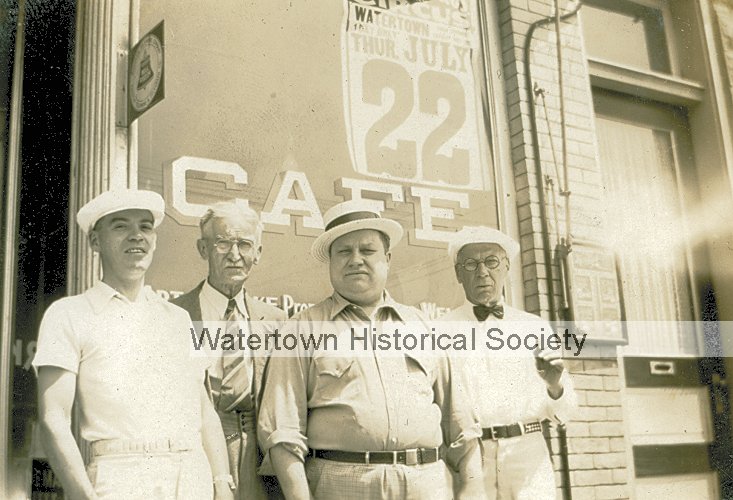 WHS_005_837
James D. Kehr, Charles Kehr, “Turkey
Gehrke,” Orville Kehr standing in front of cafe at 416 Main St. 07 20 1937
WHS_005_837
James D. Kehr, Charles Kehr, “Turkey
Gehrke,” Orville Kehr standing in front of cafe at 416 Main St. 07 20 1937
“Watertown
was home to hibernating ‘Turkey,’” Wisconsin State Journal article, Doug
Moe, 10 16 2008

History of Watertown,
Wisconsin