website watertownhistory.org
ebook History of Watertown, Wisconsin
THE SORROWFUL DAY
Assassination of President Abraham Lincoln
Assassinated
on the 14, died on the 15th
April 14: THE DAY OF
THE ASSASSINATION
The
day of Lincoln’s assassination was also Good Friday.
Late
morning
While
picking up his mail at Ford’s Theater, John Wilkes Booth overhears someone
saying Lincoln will attend that evening’s performance. He spends the following eight hours gathering
supplies and plotting with Powell and Atzerodt.
10:13
p.m.
At the
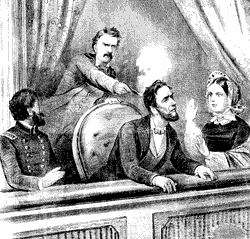
theater, Booth shoots President Lincoln in the head during a performance of
“Our American Cousin.” Booth breaks his
leg, but escapes by horseback. Lincoln
is taken to the Peterson boarding house, across the street, where a death watch
begins.
10:15
p.m.
Lewis
Powell attacks Secretary of State William Seward in his bed, slashing Seward’s
face and inflicting a serious wound.
Powell escapes out the front door of the house.
Late
evening
Secretary
of War Edwin Stanton takes charge of a manhunt for the assassins.
THE SORROWFUL DAY
On
Saturday morning, the 15th of April, 1865, the first reports of the assassination of
Abraham Lincoln, the President of the United States, reached this
city. All were startled and shocked
beyond expression at the unexpected intelligence, and as the unwelcome and
alarming news spread, the excitement became more intense and general. Business pursuits ceased at once, and the
greatest anxiety was it to learn the whole truth concerning the terrible
tragedy – many hoping that the statements were exaggerated, and the results not
so bad as the rumors represented. But a series of telegraphic dispatches soon
confirmed the worst apprehensions, and added to the prevailing consternation by
the details of the brutal attempt made on the life of William H. Seward, the
Secretary of State.
 A kindred sentiment seemed to pervade
the entire community. Sadness and sorrow
for the great and sudden national loss were written visible on every
countenance. Indignation and abhorrence of
the savage crimes that had been committed, were the emotions and feelings that
agitated all minds.
A kindred sentiment seemed to pervade
the entire community. Sadness and sorrow
for the great and sudden national loss were written visible on every
countenance. Indignation and abhorrence of
the savage crimes that had been committed, were the emotions and feelings that
agitated all minds.
On
Tuesday, the 18th, the Mayor issued a proclamation, recommending the
observance of Wednesday, when the funeral ceremonies in honor of the late
President were to take place at Washington, as a day of public mourning – a
request which was cheerfully complied with by all classes and denominations.
On
Wednesday, the 19th, all business was suspended, and the whole city
clothed in all the dark habiliments of sorrow.
The various churches were shrouded with the sad emblems of the nation’s
woe. Every private residence and public
house was draped with the weeds of mourning.
The stores were closed, and all displayed tokens of grief for the common
loss the country had just sustained.
Never was such a scene witnessed here before. All joined in paying the last tributes of
respect to the goodness and greatness that the grave was about to receive in
the person of Abraham Lincoln.
At St.
Bernard’s (Catholic) Church, Rev. Dr. Norris delivered an eloquent and
appropriate discourse to a large and crowded audience.
At St.
Paul’s (Episcopal) Church, Rev. Wm. Dafter preached a sermon suggested by the
occasion, which we have heard spoken of as highly impressive and finished
effort.
At the
Methodist Church, Rev. L. Searles made a short and
affecting address, and was followed by Hiram Barber, Jr., and J. A. Lovely, who
spoke with sincerity and earnestness that well harmonized with the feelings of
their audience.
At the
Congregational Church, the services were deeply interesting and
appropriate. The Masonic fraternity were
present in a body, having first assembled at their Lodge Room, formed a
possession under the direction of J. J. Enos, as
Marshal, and marched to the  Church.
Rev. C. Boynton delivered a brief and earnest discourse, founded on the events
which called the assembly together. He
was followed by Mr. D. Hall and Mr. M. B. Williams, who both spoke in a manner
befitting the theme that was uppermost in every mind, and engaged the thoughts
of all. At the request of several of our
citizens, we have solicited Mr. Hall to furnish us with a copy of his remarks
for publication. We cannot better
conclude this imperfect sketch of the proceedings of the melancholy day, than
in his well chosen and heartfelt words.
Church.
Rev. C. Boynton delivered a brief and earnest discourse, founded on the events
which called the assembly together. He
was followed by Mr. D. Hall and Mr. M. B. Williams, who both spoke in a manner
befitting the theme that was uppermost in every mind, and engaged the thoughts
of all. At the request of several of our
citizens, we have solicited Mr. Hall to furnish us with a copy of his remarks
for publication. We cannot better
conclude this imperfect sketch of the proceedings of the melancholy day, than
in his well chosen and heartfelt words.
MR. DANIEL HALL’S ADDRESS
No man
living has ever taken part in funeral ceremonies such as we
this day commemorate. In the great
qualities of the victim, the elevation of soul with which he maintained the
cause of his country and the fiendish wickedness with which his life was sought
and taken, the death of Abraham Lincoln perhaps finds its nearest parallel in
that of William of Orange – known as William the Silent. He, the founder and defender of the liberties
of the Netherlands, in the maturity of his strength and fullness of his fame,
while surrounded by his family and friends, was slain by the hands of a bribed
assassin and expired amid a nation’s tears.
But in order to find this dark parallel, you must turn back the pages of
history for almost three hundred years.
It is
cause for devout thankfulness to the giver of all good that our Chief
Magistrate was not taken away in the darkest hour of his country’s peril. He was permitted to live through all our
darkest nights of sorrow to save our nation from the destruction prepared for
it by traitor hands; and from one of the loftiest summits of human grandeur,
God showed him the dawning of victory and peace upon his beloved country and
permitted him to contemplate that country, reunited, redeemed, regenerated and
disenthralled, entering upon a career of happiness and prosperity, to which her
past history could furnish no parallel . . .
With
eye undimmed and natural force unabated, while this beatific vision was
enrapturing his soul, he passed from our midst, from these great scenes of his
trial and labor to that land “whose outlines star-eyed science has but dimly
viewed.”
The
example of its great and good men are the nation’s treasures – treasures which
cannot be overvalued among a people, where the most exalted positions are open to
the competition of all – so signally illustrated in the humble origin,
contrasted with the great fortunes of the closing years of him whose loss we
now deplore. Whatever was great and good
in the character of Abraham Lincoln is now the priceless heritage of the land
he loved and ruled so well . . . . Watertown Democrat, 04 27
1865
MAYOR’S PROCLAMATION
04 20 It having been officially announced that
the funeral services of ABRAHAM LINCOLN, the late and lamented President of the
United States, will take place at Washington, the National Capital, at noon, on
Wednesday, the 19th of April, 1865, and the acting Secretary of State having
recommended that the various religious denominations throughout the country
assemble at their respective houses of worship at that hour and solemnize the
death of the Chief Magistrate by befitting ceremonies:
Now I,
Joseph Lindon, Mayor of the city of Watertown, do earnestly urge that the above
request be complied with by the people of this city on the day named, at the hour
of half past 12 P.M., that all places of business be closed from 10 o’clock
A.M. till 4 o’clock P.M., all residences be draped with the emblems of sorrow
for our great and sudden National bereavement, the bells of the different
churches be tolled, and all citizens meet at their
respective places of worship and engage in such religious devotions as shall be
most appropriate to the sad and mournful occasion that calls them together.
Joseph
Lindon, Mayor.
Gustavus Werlich, City Clerk. WD
Following three from Google books . . .
THE NATION MOURNS
Yes, from the Lakes to the Gulf, from the Atlantic to the Pacific,
every loyal bosom swells and heaves with sorrow. And well we may sorrow. This is no childish grief. It is a rational, manly grief. Let us give vent to it in every suitable
way. The cause demands it. Don’t suppress it. It would be wicked not to grieve for such a
cause. I pity the heart that is so hard
or so indifferent or so perverse as not to feel emotions of deep grief over the
sad event that makes our nation mourn today.
Yet more, I despise such a heart.
For such evident perverseness of soul can but be despised while we can
but admire the tender flow of grief such as Jesus showed when He wept over the
doomed Jerusalem at the grave of Lazarus, at the bier of the widow's only son,
and over the ruined condition of a lost world.
Such expressions of such grief are magnanimous.
A GREAT MAN IS FALLEN
The greatness of President Lincoln is seen in contemplating his
powerful and well balanced mind. It is
said that on a certain occasion when Dr. Watts was introduced to one who had
long admired him for his celebrity but who expressed surprise at the smallness
of his stature the doctor replied “Were I so great as to reach the poles, or
grasp the mountains in my span, I must be measured by my soul. It is the mind that makes the man.” This was true of President Lincoln; his great
mind made him a distinguished man.
Without the advantages of a liberal education which often makes ordinary
minds brilliant and distinguished, without wealth to aid him, without family
distinction to raise him, without experience or acquaintance with the skill of
running the machinery of government at the capital, he rose from obscurity to
one of the most conspicuous positions in life and managed the affairs of this
great nation in its most critical
condition in such a masterly manner as to place him in the short space
of four years among the greatest men of earth.
LINCOLN AND THE PROCLAMATION OF EMANCIPATION.
Many of the warmest friends of that measure had long been out of
patience with the President and they said many hard things about him and some
even became his political enemies because he did not make the proclamation
sooner. And some of his generals went so
far as to take that power into their own hands on a small scale. But he saw that things were not yet ripe for
the measure. The Union loyal mind of the
North was not yet ready for it. And
though he himself felt that it was a measure that would do a mighty work for
the Union cause and the good of the country and that it must be adopted some
time, yet he waited and watched till the right time came and then he issued
it. He saw that the minds of loyal
citizens would approve the act and sustain him in it whereas before that time
there was great danger of division of Union men on account of it. And the sequences show his wisdom and good
judgment in waiting as he did and in striking at just the right time to do one
of the most difficult and yet most important acts for our nation's good that
was ever done.
04 27 THE GRAND CONCERT
M. Zirom gives a splendid musical entertainment at Cole’s Hall
tomorrow evening. He will have the
assistance of the best musical talent in the west and we have no doubt that
this concert will be the most brilliant and successful of any ever given in
this city. It was to have taken place
last week, but was postponed on account of the great national calamity which
had just occurred in Washington, the assassination of our President. WD
05 04 THE PRESIDENT’S FUNERAL
A
number of our citizens have gone to Chicago to be present at the impressive
funeral solemnities that will take place there on the arrival of the body of
Abraham Lincoln. WD
05 04 RESOLUTION OF ALDERMAN DENNIS:
. . .
. Resolved, that we can find no words sufficiently strong to express our utter
abhorrence, detestation and condemnation of the dastard, brutal and cowardly
act which has deprived the people of their recently chosen Chief Magistrate and
we hope that the guilty wretch who committed the cold blooded and atrocious
deed will be quickly brought to some punishment adequate to the unparalleled
enormity of his awful and revolting crime against mankind.
Resolved,
that as an indication of our heartfelt grief we direct that the Common Council
rooms of this city be appropriately draped with the weeds of mourning and so
remain during the period of ninety days.
WD
05 04 THE TRIUMPHAL PROCESSION
The
departed President has been borne to his final resting place at Springfield,
Illinois, amidst a Nation’s tears of sorrow.
From the capital of the Republic to the capital of the state which was
his home, the most touching demonstrations of regard and respect have
everywhere attended the mournful journey, as it made its slow progress through
cities, villages and hamlets. All
classes have joined in these affectionate ceremonies with the most heartfelt
and sincere love and admiration for the virtues and services of the patriot and
statesman who bore himself so calmly and wisely in this great office and fell
so cruelly and so suddenly by the hand of violence, at a moment when his
earnest desires for returning peace were about to be gloriously realized. WD

History of Watertown,
Wisconsin