website watertownhistory.org
ebook History of Watertown, Wisconsin
Silver
Creek Club
An
Enduring Clubhouse
The Seattle Times of March 9, 1920 says that Frank J.
Parker an old Watertown boy,
was with the C. & N. W. Ry. when Jos.
Giles discovered Silver Creek in Watertown.
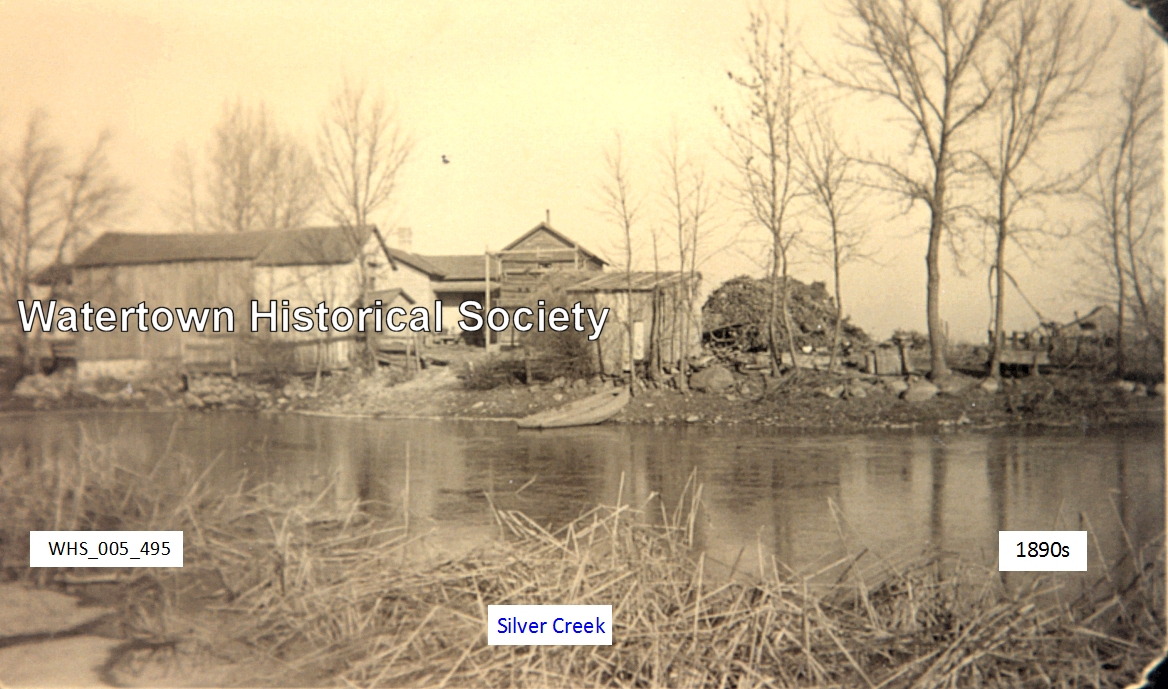
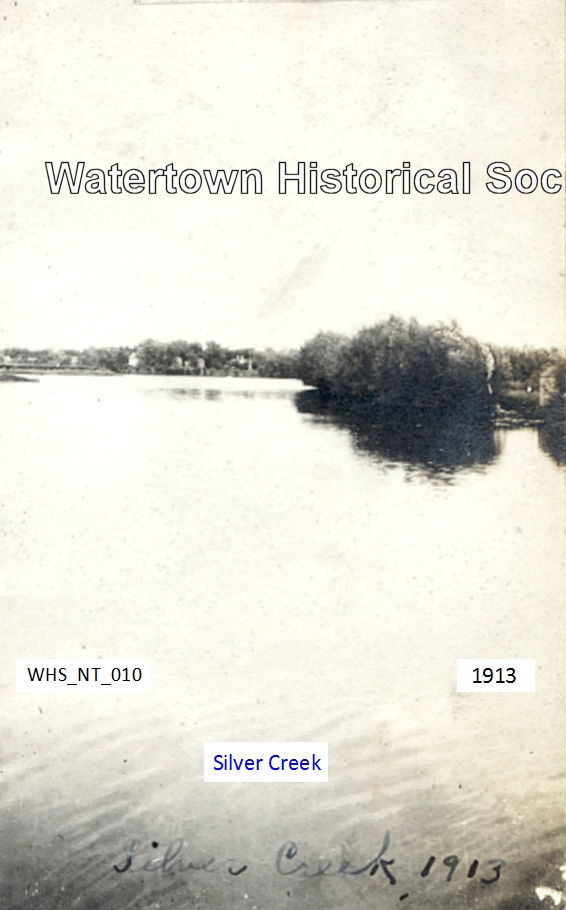
1890s, approx
c.1930
1960
03 01 SILVER CREEK AND SILVER CREEK POND BULKHEAD LINE
Charles E. Kading,
Watertown attorney, realtor and former president of the city council, appeared
before the council at its meeting last night to explain in some detail his
petition for a Silver Creek and Silver Creek Pond bulkhead line, a matter that
needs both approval from the city council and the Wisconsin State Public
Service Commission. He explained that
the total water area within the proposed Silver Creek Pond bulkhead line
is 3,000 square feet, computed by Richard S. Podolske, a former city engineer
of Watertown and now an engineering consultant.
Mr. Kading said that under his plan it is proposed to fill only 2,000
square feet of this area and that it is proposed to remove about 300 square
feet of land area represented by the railroad
right of way [spur] which extends into the pond or creek from North Water
Street. WDT
1962
11 24 A shelter for skaters
using the Silver Creek pond is now being erected, and will be available for
skaters using the pond during the skating season, Mayor Robert P. White
reported today. The shelter, or warming
house, is being erected on city property by the city park department. The shelter will be heated, Ewald Brumm, park
superintendent advises. The shelter will
be supervised and the pond will be lighted.
“Last year, and again this year, I have received calls from mothers
requesting skating facilities in the Silver Creek area,” the mayor said. “Mr. Brumm and I were aware of this need last
year and provided for this in the forthcoming budget.” WDT
Watertown Daily Times, 22 January 2000
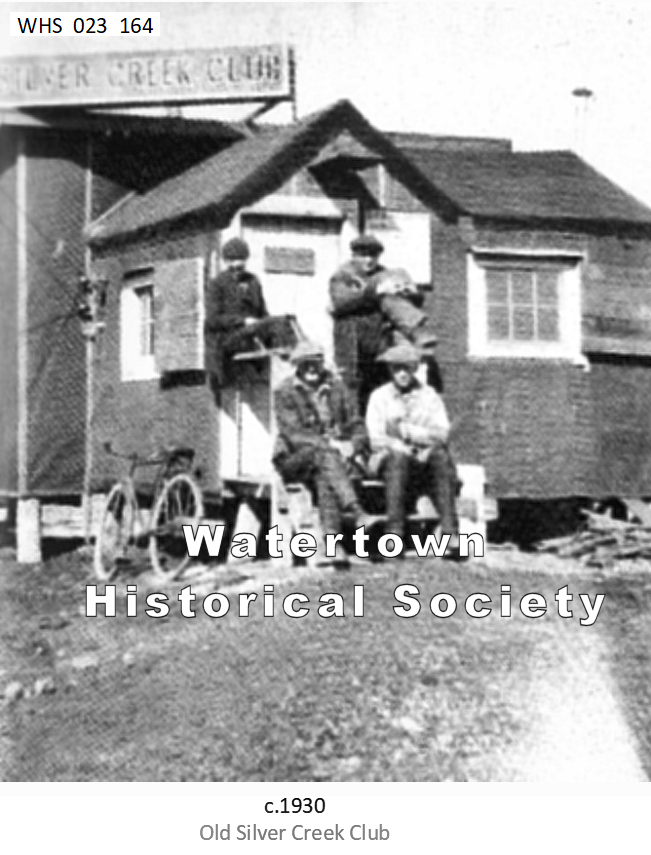
The Silver Creek Club dates
back to 1905 when the first clubhouse was built by Ben Krahn and Paul Munzel, according to old news articles saved by
longtime member Bill Schlueter.
Krahn and Munzel erected a 7-by-9-foot shack
near the present Silver Creek Club to be used as a warmup place for skaters and
for gathering of young fellows. At that
time, the land was owned by the Chicago and North Western Railroad and was
adjacent to a railroad spur parallel to Water
Street.
As skating became more popular, the clubhouse was enlarged. After the
club was permanently organized, it reached agreement with the Chicago and North
Western Railroad for leasing the site. In the 1930s, the railroad gave the club
a five-year lease on the land which was extended after the expiration
date. The lease was for $5 a year.
In 1940, the club constructed the present building and continued to
prosper. Then the railroad halted its
use of the old spur line, it sold the land where the clubhouse stands for $75. The railroad offered to sell the club all of
its land south to Rock Street for an additional $150, making the deal a total
of $225, but members could not raise the money.
The club was incorporated as a nonprofit organization in 1946 when
membership became limited to 10.
Membership dwindled as time went on, and in 1972, the club received the
bad blow that Water Street would be resurfaced with new curb and gutter.
Members could not pay the assessment.
The club and city reached an agreement for the club to operate for a
10-year period and then be turned over to the city. However, the 10-year period came and went
with no change in ownership. The last three members turned the club over to the
city in 1990.
The club nearly closed in the 1950s when the city manager back then
refused to the normal $150 for club for operating expenses. "It looked like we were going to have to
close, but then John Clifford (long-time editor and publisher of the Daily Times, got wind of it. He told the city he skated there, his
children would skate there and his grandchildren would skate there, and that's
the way it happened - the city put the money back in the budget,"
Schlueter related.
According to an article in the Watertown
Daily Times in 1950, "There were four skating clubs in the city and
all were popular. The Silver Creek Club
often had 400 to 500 skaters on the ice on a nice Sunday afternoon back in the
happy years about 1925." In the
early years the skating season extended through March.
The article noted that the shoe checking charge in the early days was 5
cents and later changed to 50 cents a season.
Checking was free in 1950.
Members warmed themselves with shovels, clearing areas for skaters. If a thaw came, a homemade sprinkler system
was devised to resurface the ice at the next freeze. A barrel was perforated, mounted on a sled,
filled with water and then rushed over the ice with bucket crews keeping it
filled.
The club provided pleasure for many skaters, and also entertainment for
many others. The club conducted several
skating meets and even a state meet in 1944. Local skaters also gained fame on
other rinks.
Seven Decades of Memories
Bill Schlueter, the last
remaining member of the Silver Creek Club, loves to reminisce about the way
things used to be for ice skaters on the Rock River.
The first Silver Creek Clubhouse
was started in about 1905 by a group of friends who formed a club of the same
name. The present one was built in 1940 and has had additions over the years.
Schlueter was not a charter member, but has become the official historian as
the last living member. He grew up on North Water Street and still lives near
the Rock River. Many men with the last name of Schlueter figured into the
club's history.
"I skated on the river as a boy and I am 85 now," said
Schlueter. "Silver Creek was always a place to warm up and buy soda in
winter, but it was also a social club. Meetings were held whenever members
wanted to come down. They would meet and walk in, sometimes every night. No one
was working during the Depression. There was no place to go, no money and no
work. Out of the 14 members, only two were working," he recalled.
"They let me join when I was about 16. It took money to build
and to buy furniture. If I wanted to sit down, I had to buy my own chair. I had
no money to pay Keck's for a chair, so at first I had to sit on a box. At that
time, you had to pay $1.50 just for a wooden chair. That was a lot of money
then," he explained.
"After members started running the skating rink, it ran on its own.
Candy and soda sales brought in enough money. Each guy got a duty night, but
the club was self-supporting. We were paid maybe $75 a year to shovel the ice
for the city. We had to shovel the ice and keep it clear, but we subcontracted
for a guy with a team of horses to plow it off for us. With the leftover money,
we bought coal for the two coal burners that provided heat. It was open
afternoons on the weekend, but only evenings during the week." he said.
"We always had music for the skaters. At first it was just a
phonograph with a horn outside, but then we got sophisticated," he noted
with a laugh. "We got an amplifying system."
"I have fond memories of those days," he said, "There
were lots of New Year's Eves when we skated the old year out and the new one
in. The whole gang skated and all of he members were
pretty good skaters." Watertown
Daily Times
|
Ice
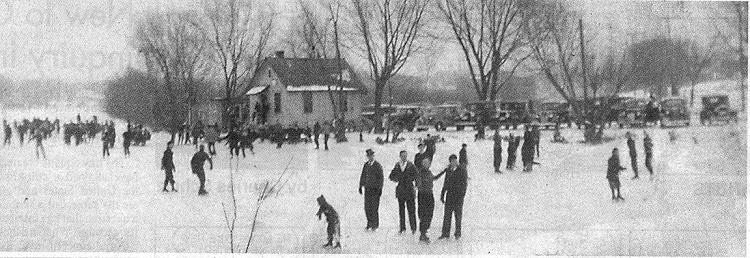
skaters by the hundreds used to glide across the ice near the Silver Creek
clubhouse on North Water Street, but those days are long gone. When weather permits,
skaters take to the ice near Silver Creek on the west side of North Water
Street, but the sight of couples whizzing around the rink arm-in-arm to the
sound of music from a Victrola is only a memory. The abandoned Silver
Creek clubhouse was sold by the city several years ago, giving the building a
reprieve from a wrecking ball. The
city was given the building after the last living member of the Silver Creek
Club, Bill Schlueter, could no longer tale care of it, or afford to pay for
curb and gutter along the property. The skaters have gone
west, but the clubhouse has a new life as "space" for a Watertown
man. Clyde Gerth bought the building
in November 1992 by sealed bid from the city and has refurnished it with
memories in mind. |
SILVER CREEK AND DAYS OF GOOD ICE. Winter in Wisconsin brings me a bittersweet feeling
whenever I drive over the Division Street Bridge by Riverside Park in
Watertown. On a crisp winter’s day with
clear blue skies and pristine snowdrifts, this was a magical place 45 years
ago. Every weekend and most school
nights, when there was good ice, we were skating on the Rock River. Watertown, back then, was a small German city
with 4 parochial grade schools, two Lutheran, two Catholic and several public
grade schools. But when it came to
skating, the Rock River was nondenominational; it was just good ice. There was
a small warming house that sizzled with the sound and smell of wet woolen
mittens drying on the heater, the thunk thunk thunk of our skates on the
wooden floor and laughter . . . The river itself spoke to us with deep-throated
cracks as it shifted its load of ice. We
skated until we could barely stand. We
were cold, wet and tired, but so energized by socializing, skating and the
perfect setting it didn’t matter. We
played crack-the-whip and oh the music!
The warming house had a blaring speaker system and the Beatles were the
rage. To this day I know every word of
every early Beatle song from those days of skating and singing at the top of
our lungs to songs like “8 days a week”.
Our parents told us never to go under the bridges because the ice wasn’t
safe, so of course we did. We skated to
the Silver Creek warming house, a few bridges and miles down
river, just for the adventure especially at night. The Beatle songs and frozen river remain, but
the warming house, the kids and the laughter are no more. This saddens me because I cannot imagine a
childhood without those days of good ice.
Anonymous
ANOTHER MEMORY: Yes, it
does evoke memories!! I was just in
Watertown last weekend and drove over the Division St. Bridge and fondly
remembered the hours spent skating. The
warming house was the old Girl Scout building I think! I remember that some of the boys would bring
their snowmobiles to the rink and we would sneak rides! I would also skate at the "Brick
Yard" rink. They too had a TV in
the warming house and I remember seeing the Beatles!
ANOTHER MEMORY: I have shared so
many times how great it was to skate at Riverside Park and to take skating
class in PE there. I learned so much and loved it. When I left for college in Missouri in 1980,
I couldn't wait to come home for Christmas so I could skate. It was late at
night and the park was dark, but I put on my skates and skated by moonlight. It
was awesome! I was truly free and had all the space I needed. It was not too long when I saw a tall figure
come walking out in boots on the ice toward me. I was a little nervous, and it
wasn't until he was fairly close that I realized it was my dad. He taught me
how to skate when I was three years old. He took us to rinks and also flooded
the yard each year. He just wanted to be with me and make sure I was safe. I
will never forget that night. A few
years later while at college in Minneapolis, I was able to skate at the park
rink in front of my dormitory. It was there that another man came out on the
ice in boots to boot skate with me. It was my husband and soon after he
proposed and we married in 1984. I have
made sure to teach each of my kids to skate. I even host skating parties at my
home here in Southern Indiana on the rare years when our pond freezes enough to
skate. I have several pairs of skates on hand for those who need them . . . . I
still have my skates. Although I am not as nimble as I used to be, I continue
to love the freedom, excitement and camaraderie that skating brings. I'm
looking forward to the next chapter when I can pass the baton on and teach my
grand children.
1992
12 28 Ice Skating at “Silver Creek Pond” -
Watertown, WI - 
2015


History of Watertown,
Wisconsin