website watertownhistory.org
ebook History of
Watertown, Wisconsin
Deutsches Dorf
Third
and Main
Garret Gahlmann
Holmes, Fred L., Sideroads:
Excursions into Wisconsin’s Past, Madison: The State Historical Society of Wisconsin, pg
75.
Click to enlarge
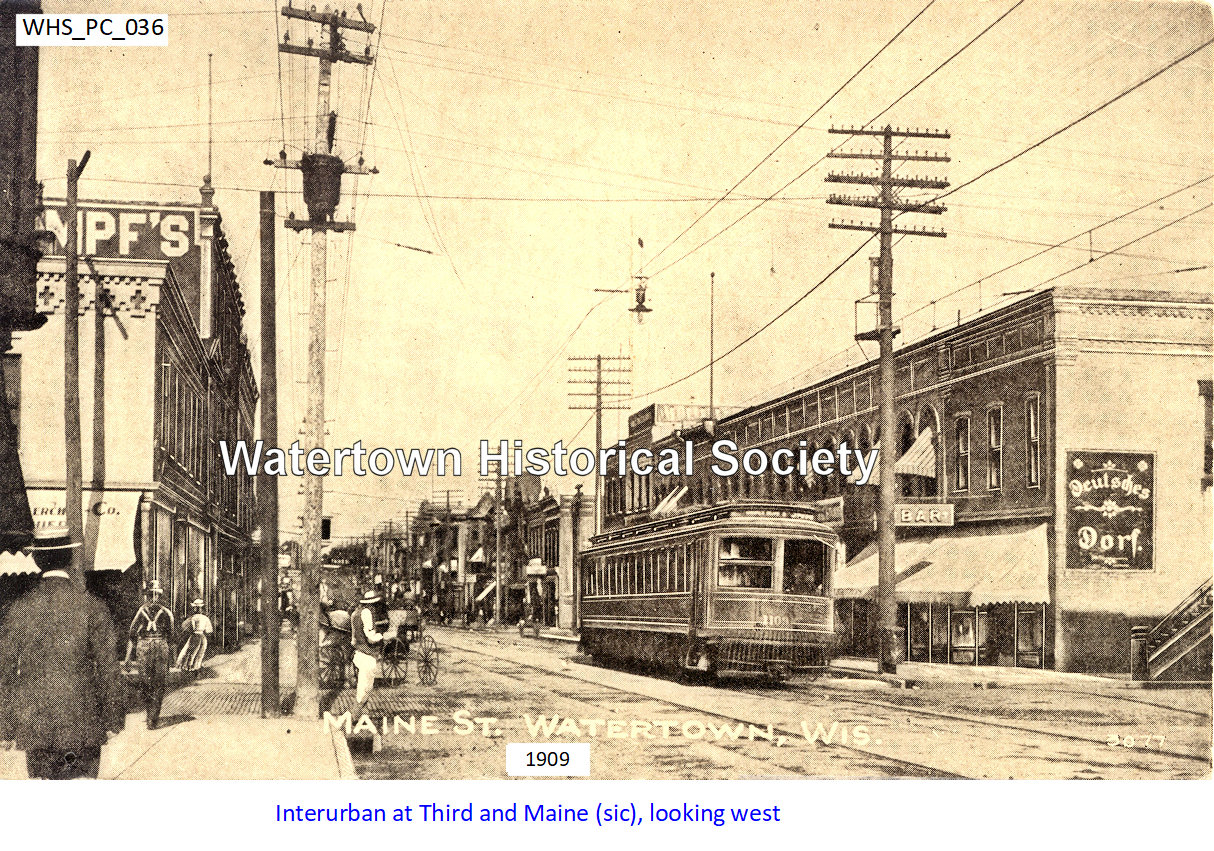 Among
the more pretentious saloons that had a free lunch counter was the Deutsches Dorf at Watertown,
which came to enjoy a statewide reputation.
Architecturally it was modeled upon the famous German drinking place at
the World’s Fair held in St. Lewis in 1904.
With its carved woodwork it looked more like a music hall than a saloon,
and it often served this purpose.
Among
the more pretentious saloons that had a free lunch counter was the Deutsches Dorf at Watertown,
which came to enjoy a statewide reputation.
Architecturally it was modeled upon the famous German drinking place at
the World’s Fair held in St. Lewis in 1904.
With its carved woodwork it looked more like a music hall than a saloon,
and it often served this purpose.
Groups
of patrons would join their voices in old German songs and ballads, and on
special occasions the proprietor, Garret M. Gahlman (Gallmann), would bring a German orchestra from Milwaukee to
entertain his customers. During the
pre-prohibition era its massive oak bar, laden with a variety of good food,
required the services of four attendants.
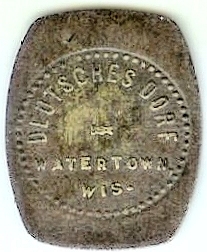
Deutsches Dorf Saloon Token
Mayor Charles Mulberger was
without question Watertown’s most flamboyant mayor, a very popular
executive. He had a law degree but never
practiced law. He would come down to the
business section every morning around 10 o’clock, go to the old Seager Barber Shop for
his daily shave and a trim, then walk over to a floral shop and buy a fresh
carnation which he wore each day in his bottonhole,
then make the rounds of downtown business places, including the old Deutsches Dorf which
was then the gathering place for many Watertown business men and
executives. It was by far the finest
saloon Watertown ever had and was located at the corner of Main and North Third
Street, now the site of the Wisconsin Gas-Electric building.
c1905
John
C. Gruel purchased the Deutsches Dorf
with the late Grover Glaser as a partner.
The Deutsches Dorf which was situated
at Main and North Third Streets where the Gas and Electric building is now
located, was perhaps the outstanding tavern in the history of Watertown. It was an elegant place, staffed by several
bartenders, who always wore white jackets.
The tavern had several palm trees and its lunch counter was known
throughout the state. It featured three
varieties of hot meats every day, in addition to the regular lunch counter
fare.
On
special occasions poultry
dishes were featured. The place
regularly employed special music, often bringing German orchestras and stringed
groups from Milwaukee to entertain customers.
The Deutsches
Dorf took its name from a bar that had been
established on the grounds of the Columbian Exposition. In Watertown the name fitted well because
Watertown was predominantly German drinking and eating customs prevailed.
1906
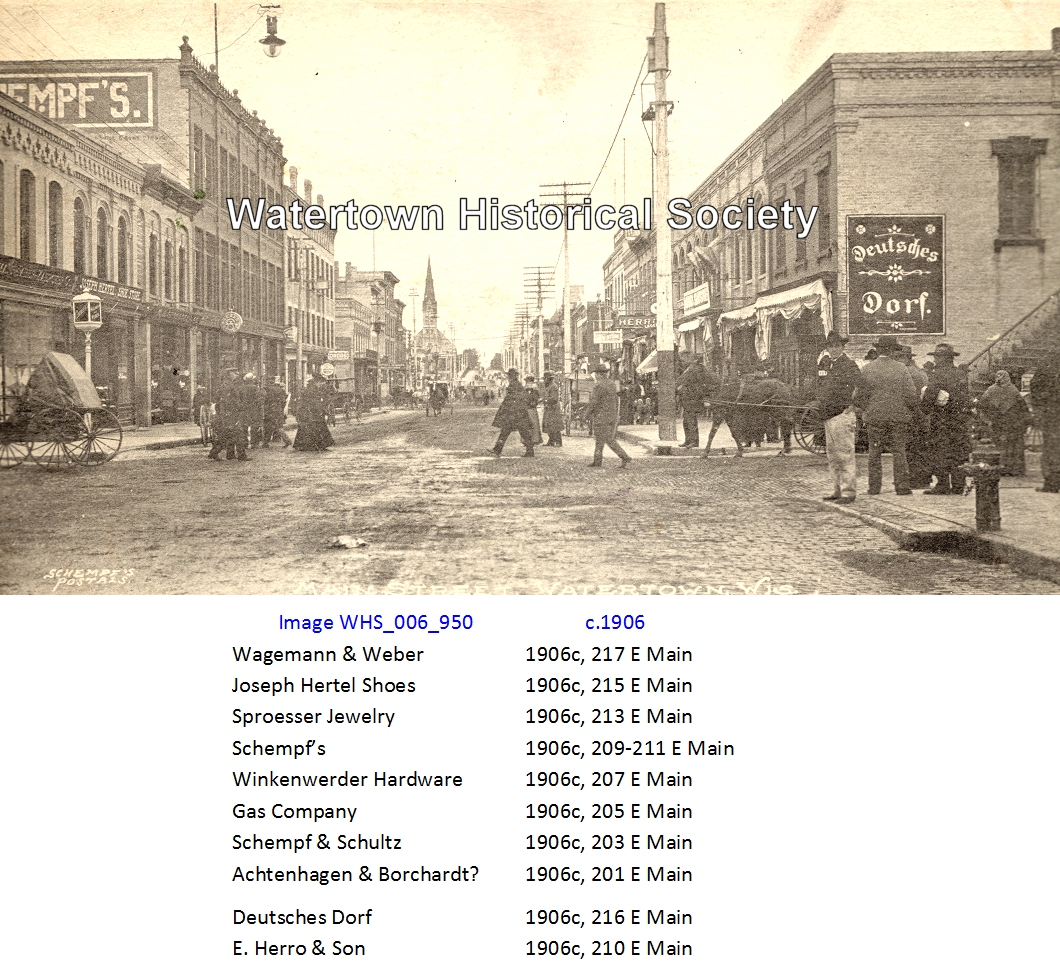 1906
1906
1909
01 22 Long distance
telephone pay station established in Deutsches Dorf WG
1918
Deutsches Dorf
closed with the advent of prohibition in 1918.
1921 Watertown
Canning Company Officer
The Watertown
Canning Company was established and incorporated in 1913. The 1921 officers included G. M. Gahlman,
Treasure.
___________________________________
1946
Garret
Gahlmann Obituary
Derived from Watertown Daily Times, 02 02 1946
Garret
M. Gahlmann, 79, 1417 River Drive, died at this home
on February 1, 1946. He had made his
home in Watertown for the previous 45 years.
A son
of the late Frederick and Josephine Baurichter Gahlmann, he was born in Clyman
January 5, 1867, in Clyman. His marriage to Laura Belle Kehoe took place
June 8, 1904.
Mr. Gahlmann was a member of St. Bernard’s Church and was
buried in the parish cemetery.
In the
death of “Gary” Gahlmann Watertown lost one of its
most widely known and most popular residents.
As the operator of the old Deutsches Dorf, at Main and North Third streets (216 Main), later the
site of the Gas and Electric Company
building, Mr. Gahlmann for years played host to
thousands of visitors to Watertown. The
place was perhaps the most popular gathering and stopping off point in the city
of many years, when an earlier “Gemütlichkeit” marked community life here and elsewhere.
Mr. Gahlmann conducted his business along high ethical lines
and many older residents, as well as hundreds scattered far and wide, remember
it as a place where they could meet their friends among spacious and pleasant
surroundings, with white-garbed bartenders dispensing drinks and with a lunch
counter that fairly groaned with good day in and day out. And presiding over it was Mr. Gahlmann, with a cheery word of welcome for everyone.
In
later years Mr. Gahlmann opened a new business
establishment at the corner of North Third and Madison streets (300-302
Madison) and this, too, became known at the Deutsches
Dorf, but it was on a much smaller and far less
glamorous scale. He retired from
business some time ago.
It can
be said of Mr. Gahlmann that he had friends in every
walk of life and in many Wisconsin cities, as well as cities scattered around
the nation, among people who had visited his earlier place of business and who
always went away with a friendly feeling for its genial proprietor.
The Poor Man’s Club
The
old-time saloon was the Poor Man’s Club.
Men gathered in the barbershop or sat around the country-store stove to
discuss politics, but for good-fellowship, friendliness, and Gemütlichkeit
they went to the saloon. To it came men
from all walks of life. Within its
portals a democratic spirit reigned, and all present became equals.
Standing
at the bar with one foot on the rail or sitting around tables, little coteries
talked companionably of their families and home and of their work. They drank a little beer, ate of the free
lunch, and then went home or back to their work. Social life today offers few meeting places
like the old German saloon. Compared
with it, the modern tavern is an arrogant pretender.
Holmes, Fred L., Sideroads:
Excursions into Wisconsin’s Past, Madison: The State Historical Society of Wisconsin, pg
63.
___________________________________
1956
John
Gruel Obituary
Derived from Watertown Daily Times, 02 29 1956;
article includes photo
John Gruel, 1872 – 1933
Sheriff of Jefferson
County, 1925-1933
John
C. Gruel, 83, of 209 Cady Street, former Jefferson County Sheriff and one of the
most widely know men in the community, died this morning following a protracted
illness which began with a stroke he suffered two months ago.
Mr. Gruel was born in
Watertown on March 31, 1872, a son of the late Mr. and Mrs. August Gruel. He was married to Miss Nell Mahoney in 1899
and conducted a hotel, shoe store and tavern in Clyman
with the late Louis Kronitz and after five years of
operations he disposed of his interest to Mr. Kronitz. Mr. Gruel operated a grain elevator in Clyman for another year and then came to Watertown where he
purchased the Deutsches Dorf
with the late Grover Glaser as a partner.
The place closed with the advent of prohibition in 1918. For several years Mr. Gruel was a salesman
for Wilkowski Bros. cigar
manufacturers here.
In
1925 he was elected sheriff of Jefferson County and served until 1933 after
which he again became a salesman.
Mrs.
Gruel died in 1942 and a year later he married Esther Glaser of Watertown.
He is
survived by his wife, an adopted son, Donald Gruel, Corpus Christi, Texas. He also has two brothers. William and Walter
of Watertown, and a sister, Mrs. John Rhodes, Reeseville. Two sisters preceded him in death.
Mr.
Gruel was a member of St. Mark’s English Lutheran Church at Jefferson. He was an honorary member of the Janesville
Elks Lodge and was a member of Lincoln Lodge No. 20, Knights of Pythias in Watertown and the Plattdeutscher
Verein.
Arrangements
Pending
The
funeral arrangements will be announced tomorrow, the Schmutzler
Funeral Home of Watertown in charge.
Outstanding
Sheriff
John
Gruel was an outstanding sheriff and public servant in office. It was said of him “he looks like a sheriff”
and he did, for in his day he was large and impressive, well built and set up
and by his very appearance commanded respect.
Mr.
Gruel had so many fine qualities that it is impossible to even touch on his
attributes. He was loyal and kind and
friendly and knew how to deal with people.
Of him it can be said that whatever defects there were in his nature,
they were far outweighed by his good qualities and character.
In his
later years he found much pleasure in tinkering about his home, building bird
houses and doing other small woodwork.
He liked people and he was especially fond of children. He reflected an inner goodness that attracted
people to him and his friends were many throughout this area.
Elegant
Place
The Deutsches Dorf which was situated
at Main and North Third Streets where the Gas and Electric building is now
located, was perhaps the outstanding tavern in the history of Watertown. It was an elegant place, staffed by several
bartenders, who always wore white jackets.
The tavern had several palm trees and its lunch counter was known
throughout the state. It featured three
varieties of hot meats every day, in addition to the regular lunch counter
fare.
On
special occasions poultry dishes were featured.
The place regularly employed special music, often bringing German
orchestras and stringed groups from Milwaukee to entertain customers.
The Deutsches Dorf took its name from
a bar that had been established on the grounds of the Columbian
Exposition. In Watertown the name fitted
well because Watertown was predominantly German drinking and eating customs
prevailed.
Compiled
by Ken Riedl
